Abstract
With the advent of the internet, robotics, and artificial intelligence, the world of the internet is undergoing a tremendous technological revolution that is altering human society at a rate never seen before. P2P networking and computing have become so widespread that communities with close to 60 million members regularly engage. Due to the extensive influence of the internet on culture and society, it is imperative to adjust to the ever-evolving terrain. Kelly argues that technology growth follows a developmental curve independent of human or socioeconomic circumstances, drawing comparisons between it and biological evolution. Based on Moore's law, which claims that chip computer performance doubles every three years and increases exponentially, Ray Kurzweil's theory forecasts future technological growth. Calling this “the age of spiritual machines,” he projects that by 2029, machines will be more advanced than people. The rapid and powerful development of AI has led to the emergence of LLM models, allowing for the simulation and training of different areas of human cognition at high speeds. Human civilization, culture, and brain anatomy will change as a result of the introduction of new media and techniques. The rule of accelerating returns enables us to predict potential developments in the upcoming years since technology may free up human labor, and society ought to benefit from it rather than be constrained by it. The AI era is heading toward the emancipation of all limitations, even while it poses hazards like cybercrime, the digital gap, poverty, unemployment, energy crises, sustainability issues, and financial risks. We can anticipate a different and more optimistic world if we examine “what technology wants” and the law of accelerating returns.
Introduction
Chat Generative Pre-Trained Transformer (ChatGPT) is an AI ChatBot developed by OpenAI based on a large language model (LLM). It was launched in November 2022 and gained over 100 million users within two months, making it the fastest-growing application. The release of ChatGPT sparked competition in the development of generative AI across various sectors, with competitors such as Gemini, Ernie Bot, LLaMA, Claude, and Grok entering the AI development race. Microsoft also joined the battlefield by launching Copilot based on OpenAI's GPT-4. On February 15, 2024, OpenAI showcased Sora. This text-to-video model generates high-quality videos with simple commands, even without actors or scenes, automatically creating lifelike videos and attracting attention from various sectors. Unlike previous programs such as Midjourney, Dall-E, etc., that generate images, Sora is based on the “diffusion transformer” which can “train text-conditional diffusion models jointly on videos and images of variable durations, resolutions, and aspect ratios,” allowing “Video generation models as world simulators. 1 ” In simple terms, Sora converts the text version of LLMs into image versions, extracting visual elements from many videos to the smallest units of visual content, training the connections between them through AI, generating coherent images, and forming videos. The final blocks in Figure 1 are patches that can be connected to form images, ultimately forming a 4D spatial puzzle including time, planning for the continuity of visuals and time, and generating continuous videos. 2

The final blocks are patches that can be connected to form images.
ChatGPT is based on LLM to train AI to understand the connection between a vast amount of human languages. Sora trains AI to understand various features in a massive amount of videos and string them together into meaningful sequences, which is approaching the way humans process information in the cognitive process. To a significant extent, Sora signifies that AI is gradually acquiring human cognitive abilities.
In just over a year, AI has evolved from ChatGPT to Sora, prompting us to ponder: if we trained AI using all of the human cognitive processes, what kind of extension will AI evolve in the future? What kind of challenges will we need to face in the human society?
How to estimate the future?
A frog in a well cannot picture the ocean, don't speak of snow to insects that live only one summer. (Zhuangzi, The Floods of Autumn) When faced with a totally new situation, we tend always to attach ourselves to the objects, to the flavor of the most recent past. We look at the present through a rearview mirror. We march backwards into the future. (McLuhan and Fiore, 1967)
In history, most predictions regarding the development of technology and market applications have been problematic. Here are a few examples (Spoonauer, 2013). There is no reason anyone would want a computer in their home. (Ken Olson, president Digital Equipment Corp, 1977) The subscription model of buying music is bankrupt. (Steve Jobs, 2003) Because of capacity “the Internet in 1996 [will] catastrophically collapse.” (Robert Metcalfe, 1995) Cellular phones will absolutely not replace local wire systems. (Marty Cooper, inventor, 1981)
In the year 2000, Amazon founder Jeff Bezos stated that people could only grasp about 2% of the various possibilities for knowledge development in the next ten years (Clark, 2000). Considering the changes in technology and society today, it is indeed very limited what could be grasped in the year 2000.
The World Wide Web, one of Tim Berners-Lee's earliest conceptions, was envisioned as an Internet where everyone could participate, edit, contribute, communicate, share, and interact. However, in its early development, it was still limited to access relationships between central servers and individual computers. The World Wide Web still resembled a vast library, providing convenient access to information for everyone. The true benefit of the internet is realized by giving the function of peer-to-peer (P2P) communication.
P2P computing or networking is a distributed application architecture that enables participants to share files and work together equally privileged in the network. However, it wasn't until Shawn Fanning and Sean Parker designed the music-sharing application Napster software in June 1999 and made it publicly available for download that P2P applications were truly popularized. It wasn't until March 2001, when the court ruled that Napster was illegal and had to cease operations, that over 40% of personal computers worldwide had Napster software installed. At its peak, the Napster website had 58 million registered users, and in February 2001 alone, 2.7 billion songs were exchanged and downloaded through the Napster system, creating the unprecedented “Napster Music Community.”
Poblocki (2001) examined whether Napster meets the academic definition of “community” by applying various criteria from classical sociologists such as E. Durkheim, F. Tönnies, as well as contemporary social network scholars B. Wellman, S. Brint, and H. Rheingold. The conclusion drawn was “that indeed the Napster virtual community is both an imagined and a network community. All of the variables we distinguished were confirmed in practice (Poblocki, 2001).”
In just over a year, through P2P technology, a community with nearly 60 million people interacting frequently can be formed, which was unimaginable in the past. However, if you take away the P2P elements, there would be no Web 2.0 internet applications. Just think, without Wikipedia, Gmail, all social networking sites, and interactive media, the internet world would be left with just mundane access actions, and the vibrant internet culture we have now would no longer exist.
According to the Digital 2023: GLOBAL OVERVIEW Report (Kemp, 2023), social platforms such as FB (2.96B), Youtube (2.5B), Whatsapp (2.0B), Instagram (2.0B), WeChat (1.3B), and Tiktok (1.05B) all have over 1 billion users. Other platforms like FB Messenger, Douyin, Telegram, Snapchat, Kuaishou, Sina Weibo, QQ, Twitter, etc., have over 500 million users.
We can say that the internet world we are familiar with today was constructed in the 21st century. The development of P2P technology allows people to connect closely with countless strangers online based on personal needs.
At the 2007 EG conference, Kevin Kelly revealed, The World Wide Web, as we know it, is only 5000 days old (Kelly, 2008): The Internet, the Web as we know it, the kind of Web the things we're all talking about is already less than 5000 days old … which we couldn't even imagine happening before … And I know that 10 years ago, if I had told you that this was all coming, you would have said that that's impossible. There's simply no economic model that that would be possible. And if I told you, it was all coming for free, you would say, this is simply—you're dreaming … think about, like, Wikipedia, it's something that was simply impossible. It's impossible in theory, but possible in practice. … [The Internet is] a big machine … to a first approximation, the size of this machine is the size—and its complexity, kind of—to your brain. Because in fact, that's how your brain works—in kind of the same way that the Web works. However, your brain isn't doubling every two years. So, if we say this machine right now that we've made is about one HB, one human brain, if we look at the rate that this is increasing, 30 years from now, there'll be six billion HBs. 2040 The Web will exceed humanity in processing power. So, by the year 2040, the total processing of this machine will exceed a total processing power of humanity, in raw bits and stuff.
In Out of Control Kelly (1994) predicts the rise of the internet, virtual community, virtual reality, cloud computing, and digital economy. In New Rules for the New Economy Kelly (1999) discusses 10 radical strategies including winner-take-all, freemium, law of increasing returns, for a connected world we couldn’t imagine before. In What Technology Wants Kelly (2010) explores the trends of human social development from three dimensions: population growth, technological progress, and energy use. He analogizes the inevitability of technological development with biological evolution. In his view, if we examine it from the perspective of technological evolution, there is a developmental curve that continues to unfold according to established structures regardless of individuals, national boundaries, or socioeconomic conditions. It binds the universe, biosphere, and technosphere into a single series, with humans merely being executors of this trajectory. For example, in the 5th century BC, what Karl Jaspers (1883–1969) referred to as the “Axial Age” of humanity saw the rapid simultaneous emergence of major religions in human history, such as Confucius, Laozi, Buddha, Zoroaster—founder of Zoroastrianism, author of the “Upanishads,” and prophets from Judaism. After that, there were very few important religions emerging among humans. Almost all technologies follow specific trajectories and are promoted during specific periods. Important inventions in human civilization will inevitably appear when they are supposed to, even if the technological details and styles differ, many significant developments arrive in human society simultaneously. This main argument also forms the main arguments in his The Inevitable (Kelly, 2016): “Constructing a planetary system connecting all humans and machines into a global matrix” will be the inevitable expansion in the next 30 years.
This teleological view of biological evolution has certainly sparked considerable controversy. In addition to his exceptional observational skills, the more important part is Kelly's observation is based on Moore's Law: the number of transistors in an integrated circuit (IC) doubles about every 18 months. For 50 years, the computational power of computer chips has grown exponentially according to Moore's Law geometric series curve and still applies today.
In the newly compiled “5000 Days Later” (Kelly et al., 2023), Kelly believes that each revolution requires hardware interfaces and software development to work together to launch a technological and social revolution. The first 5000 days saw the development of computers and the internet, followed by smartphones and various app applications in the second 5000 days. By the third set of 5000 days, it will be smart glasses and a mirror world formed through AI development.
The mirror world shaped by big data, AI, and cloud computing could allow us to search physical space as we search text, locate specific objects or places, and present them before us through augmented reality. Humans will no longer be the most intelligent beings but will be surpassed by AI.
Will AI surpass humans? What kind of world will it be when AI surpasses humans?
The coming of singularity?
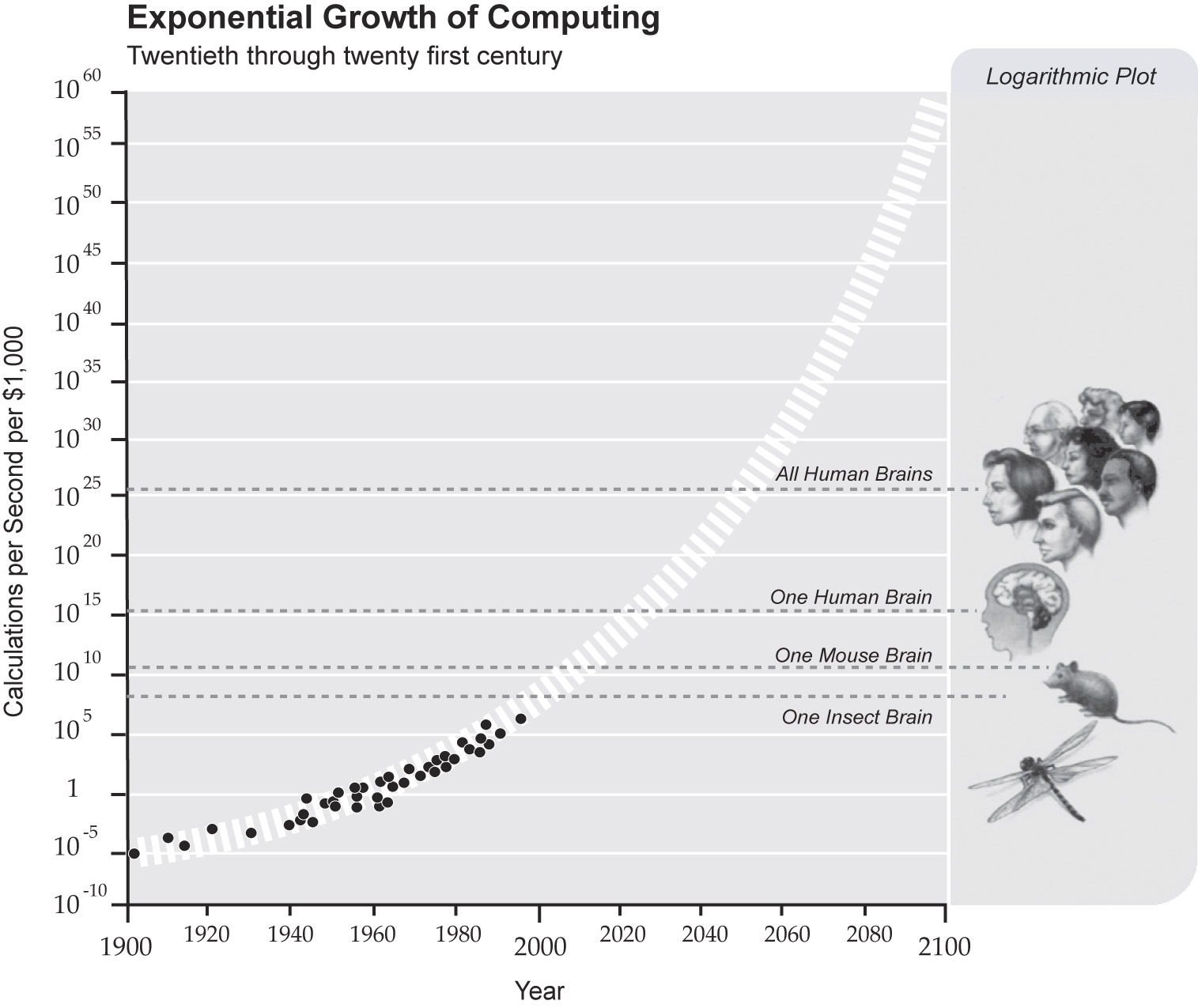
The most in-depth and widely discussed research on this issue is by Ray Kurzweil. Kurzweil's theory of predicting the future development of technology is similar to Kelly's, based on “Moore's Law”: in terms of information processing capability, technology development allows chip computing speed to double, volume to halve, and price to drop by half every 18 months. In simple terms, computer processing power doubles every three years and increases exponentially. Moore's Law makes computer hardware equipment increasingly powerful. According to Kurzweil's estimation based on Moore's Law, around 2029, a regular personal computer purchased for $1000 will have computational capabilities equivalent to that of the human brain (Figure 2) 3 ; and around 2060, the computational power of a regular personal computer will be equivalent to the total sum of all 10 billion human brains at that time globally. This is still considering individual machines; assuming integration capabilities between different computers exist, their performance would be immeasurable (Kurzweil, 1999).
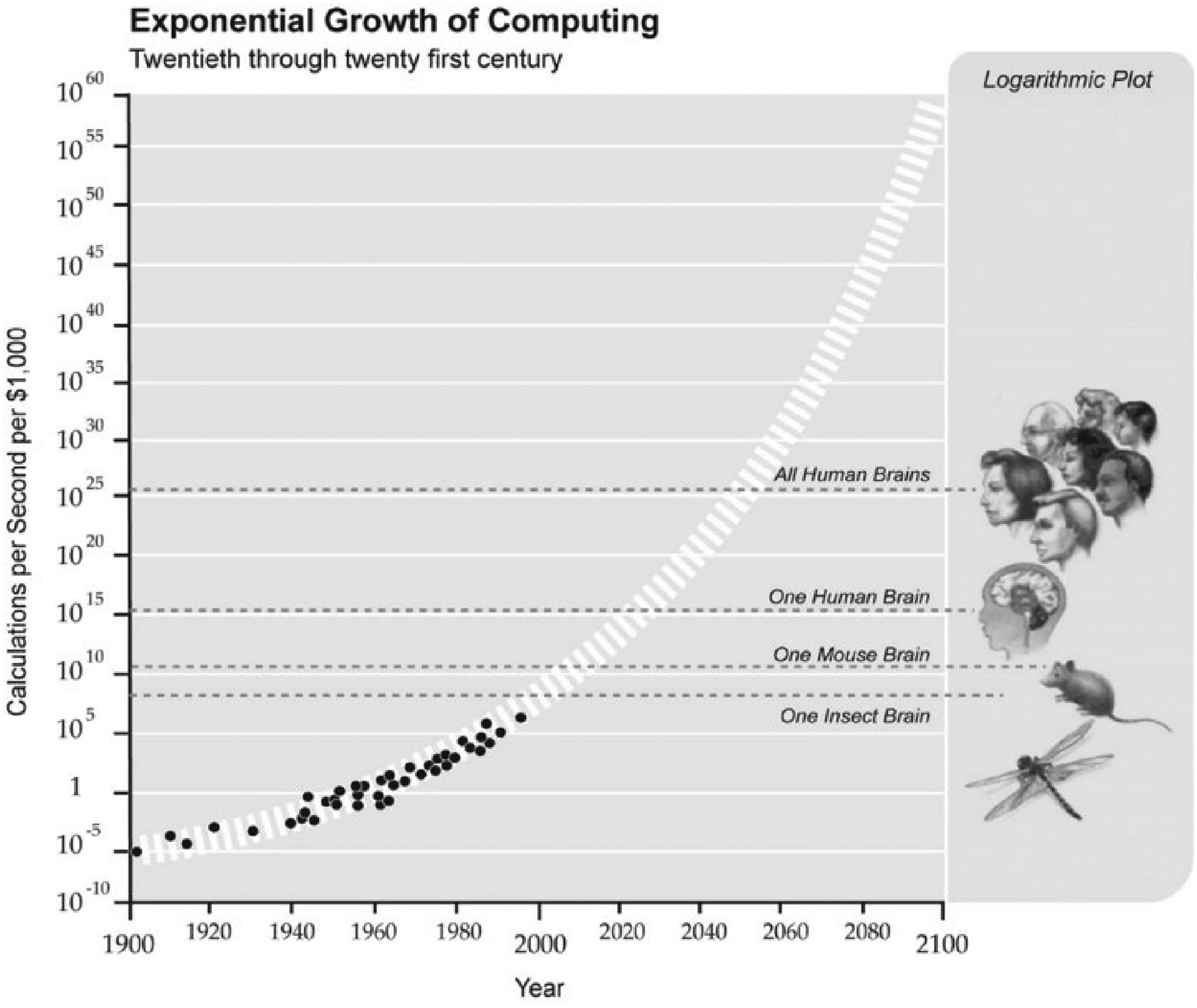
The computing power that can be purchased for $1000.
Like Kelly, Kurzweil also believes that computer processing power will eventually surpass that of the human brain. When machines surpass humans, our understanding of this world will completely collapse, as we lack a fundamental understanding of “the age of spiritual machines.” Based on Moore's Law, technological progress follows a pattern of exponential growth which he calls the “law of accelerating returns” which will exceed the speed of human evolution. He refers to the concept of a “singularity,” indicating that when humans are surpassed by machines in evolution, future society may fall into an implosion similar to a black hole, and civilization development can no longer be led by humans. At this point, “The Singularity will allow us to transcend these limitations of our biological bodies and brains … There will be no distinction, post-Singularity, between human and machine” (Kurzweil, 2005).
In The Age of Intelligent Machines, Kurzweil (1990) predicts machines will pass the Turing Test and share the same intelligence as human beings between the early 20s and the end of 30s. In The Age of Spiritual Machines Kurzweil (1999) precisely predicts singularity will come by 2029. Until now Kurzweil still insists machine computing will surpass humans by 2029. In The Singularity Is Near Kurzweil (2005) estimates singularity will take place in 2045. This will be the very year technological progress will change the past technological development path of mankind, the old social model will be gone forever, and new rules will begin to dominate the new world (Kurzweil, 2005).
After this book was published, it was circulated merely in the professional field and did not attract the attention of the general public until Time Magazine published the cover title “2045: The Year Man Becomes Immortal” on February 11, 2011, Kurzweil's “Singularity” theory has received widespread attention. Even so, the public still has doubts about the possibility of this theory really working. It was not until the development of this wave of generative AI that it aroused public concern again.
Kurzweil uses the Human Genome Project as an example to explain how the “law of accelerating returns” works (Kurzweil and Thompson, 2017): Halfway through the Human Genome Project, 1% of the genome had been collected after seven years. So mainstream critics said, ‘I told you this wasn't gonna work. You're at seven years, 1%; it's going to take 700 years just like we said.’ My reaction at the time was: ‘Wow we finished 1 percent? We're almost done.’ Because 1% is only seven doublings from 100%. It had been doubling every year. Indeed, that continued. The project was finished seven years later. That's continued since the end of the genome project—that first genome cost a billion dollars and we're now down to $1000. So, when this girl in Africa buys a smartphone for $75, it counts as $75 of economic activity, despite the fact that it's literally a trillion dollars of computation circa 1960, a billion dollars circa 1980. It's got millions of dollars in free information apps, just one of which is an encyclopedia far better than the one I saved up for years as a teenager to buy. All that counts for zero in economic activity because it's free. So, we really don't count the value of these products.
After we actually had LLMs, one hundred million connections became 10 billion, it started to work. We started now at 100 billion, and will go to a trillion connections in the near future enable to look at all the different connections between them. And that's exactly how our brain works. All these things will be going to go way beyond what our brain does (Kurzweil, 2023b).
In The Age of Spiritual Machines, Kurzweil (1999) predicted machines will pass the Turing Test by 2029. Stanford held an international conference to debate his prediction. Eighty percent of AI experts from around the world agreed that a computer would pass the Turing Test, but it would take 100 years instead of 30 years. With the emergence of generative AI and LLM, almost all AI experts now agree that machines will surpass humans in 2029. LLMs are the best example of AI, that can go beyond just language and bring in pictures, videos, and so on. If we apply it to medicine, for example, we can simulate biology. The computer considered billions of different combinations of things that would fight COVID-19, including mRNA sequences. It took only two days to go through several billion medical trials to create the Moderna vaccine and decide on the best one. Technological development will not be limited to a single machine, everything is moving to the cloud and connected. “The brain part is not going to grow, but the computer part will grow and ultimately most of our thinking will be in the computer part.” Eventually, we’re going to have our thinking in both our brains and the computer (Kurzweil, 2023). The combination of humans and machines is imperative to face future competition and development.
Machines would be doing everything far better than human beings, therefore, “AI is going to go inside of us and make us much smarter than we were before.” And the AI is going to work through us. Just think about how we all have our smartphones connected to the cloud, that's your portion of the cloud and other people can’t access it (Kurzweil, 2022). These are not future tenses, but actual situations that are already prevalent. The future is just an expansion of AI-based cloud systems to enhance everyone's capacity.
By 2029, computers will pass the Turing test and can do everything that humans can. Humans are going to bring computers and AI into ourselves. Humans can multiply our intelligence millions-fold in 2045 (Kurzweil, 2023). Singularity is coming for sure.
When machine computing power exceeds the ability of the human mind to process, the history of science and technology will undergo a comprehensive qualitative change. Kurzweil advocates that technology develops toward an exponential growth model, which is contrary to our generally intuitive linear view. Therefore, we will not experience the so-called 100 years of the 21st century, but more like 20,000 years of rapid progress (calculated at today's rate). So-called “returns” such as chip speed and cost-effectiveness also increase exponentially. Even “exponential growth” itself is increasing at an exponential growth rate. Comes “Singularity,” machine intelligence will surpass human intelligence. Technological changes are so rapid and profound that will cause a paradigm shift and break with the historical structure of mankind. This implies the merging of biological and nonbiological intelligence, humans based on immortal software, and super-high intelligence expanding into the universe at the speed of light (Guo, 2006).
What technology wants?
“Video generation models as world simulators.” That's the claim on OpenAI's website a day before Sora was released on February 16th, 2024. What Sora does is not merely a large-scale training of generative models on video data, but also scaling video generation models to promise a path toward building general-purpose simulators of the physical world. Sora “can understand and simulate the real world, a capability we believe will be an important milestone for achieving artificial general intelligence (AGI).” As a “world simulator,” Sora shocks the entire industry.
Not long after Sora was released, Elon Musk announced on Twitter that Tesla had developed real-world video generation earlier than OpenAI. At the same time, Tesla's real-world simulation and video generation is the best in the world. Tesla has been able to do real-world video generation with accurate physics for about a year. It wasn’t super interesting, because all the training data came from the cars, so it just looks like video from a Tesla, albeit with a dynamically generated (not remembered) world. (@elonmusk 5:45 a.m., February 18th, 2024)
4
I’ve wanted to do that for a long time :) Our real-world simulation and video generation is the best in the world, but unfortunately making a game can only come after we release unsupervised FSD that is far safer than even supervised FSD. (@elonmusk 3:59 a.m., February 19th, 2024)
5
Safety is always the most important concern. OpenAI admits SORA still has security issues and will build tools to help detect misleading content including misinformation, hateful content, and bias. Their text classifier will check and reject improper prompts such as extreme violence, sexual content, hateful imagery, celebrity likeness, or the IP of others. Even so, risk, fear, and destruction are what people fear in the AGI era. Once ChatGPT and Sora are generated, their progress will be exponential and will eventually lead to growth that no one can control. After transcending humanity, the world after the singularity is beyond our imagination.
The media is the message, McLuhan claims the emergence of new media and new tools will cause changes in human society, culture, and even the human mind and brain structure. Bipedalism, tool-making, and using language to communicate, Home sapiens are distinguished from other animals. Written text replaced oral tradition, enabling human beings to develop high spiritual civilizations. The development of technology such as steam engines, electricity, lights, trains, cars, telephones, computers, the Internet, smartphones, etc., completely changed the world, civilizations moved forward rapidly and could never go back. This wave of AI development is so fast and powerful that no force can stop its development.
It is only in the last three years that LLM models have become feasible, and we can simulate and train different areas of human cognition based on LLM models, and move in all directions at very high speeds. Kurzweil is quite optimistic about this development. He mentioned, 80% of human work 200 years ago was related to creating food. This proportion has now dropped to 2%. Although many jobs have been eliminated by machines, human creativity has increased significantly. Most of the jobs, humans are currently engaged in were simply unimaginable 20 years ago. Facing the challenge of AGI, humans must become smarter, and AGI will enter our minds and make us smarter than before. At the same time, AGI will work through us (Kurzweil, 2022).
Kurzweil observed the exponential growth of computer computing power 40 years ago. Over the past 40 years, he has tracked the development of more than 50 fields, recording changes at all levels of human society year by year. 7 Even if machines are about to surpass humans, the singularity will eventually arrive, he believes that all fields of human civilization have brought significant improvements due to the law of accelerating returns. Making good use of the power of science and technology to solve problems in different fields such as the environment, medical care, transportation, health, etc., to improve human society and enhance human civilization is what positive meanings science and technology bring to mankind.
Similarly, for Kelly, technology liberates human beings from their physiological limitations, provides them with endless choices, and gives them opportunities to realize their potential fully. A unique line of self-reproduction binds the universe, biosphere, and technological sphere into the same creation. Everyone can develop their talents appropriately. The development of science and technology continues to increase the opportunities for human choice, greatly enhancing human civilization's value. Compared with zero-sum games win-or-lose competition, technological development is an infinite game with no winner and final goals, therefore, it will continue forever, and so will the development of human civilization (Kelly, 2010).
In The Age of Spiritual Machines (1999), Kurzweil takes 10 years as a unit and predicts the possible development of science and technology in the next one hundred years. Here are two of his predictions for 2029 (Kurzweil, 2005):
Direct neural pathways have been perfected for high-bandwidth connection to the human brain. A range of neural implants is becoming available to enhance visual and auditory perception and interpretation, memory, and reasoning. Automated agents are now learning on their own, and significant knowledge is being created by machines with little or no human intervention. Computers have read all available human and machine-generated literature and multimedia material.
When machines surpass humans, humans must learn how to connect and cooperate with machines to continue the development of civilization. Connecting the human brain with computers to enhance their functions so that they can complement each other will be the only solution. And this is exactly what Kelly has been advocating in his series of books. To continue the inevitable development of technology, humans must cooperate with computers and AI. When all of us carry smartphones at all times, and all programs are linked to AI applications and connected to cloud databases, we can no longer avoid becoming the ones connected with machines and AI.
The FDA approved Neuralink for human clinical trials in May 2023. Musk tweeted on January 29, 2024, saying that Neuralink had implanted a brain chip into the first human body, and the person not only recovered well but also the neuronal spike detection picture is quite promising. The connection between the brain and the chip is no longer a theoretical issue, but a matter of time. Through the law of accelerating returns, we can anticipate possible changes in the next few years.
Concluding remark
July 25th, 1978, Louise Joy Brown, the world's first successful “test-tube” baby was born in Great Britain. One week later, Time Magazine (1978, July 31) used “The Test-Tube Baby—Birth Watch in Britain” as the cover story (Figure 3). 8 At that time, it caused serious protests from defenders and religious groups, who believed that it was God's responsibility to create humans and that no one could replace God's role in procreating jobs. Such a thing was immoral and treasonous. Today, in vitro fertilization is a mature and common medical practice, no one views it from an ethical or moral perspective. Ethics and morality often occur at the forefront of technological development. Once it is proven to be harmless, and can even create social value and enhance human well-being, following new technologies develop, disputes can be discussed objectively.
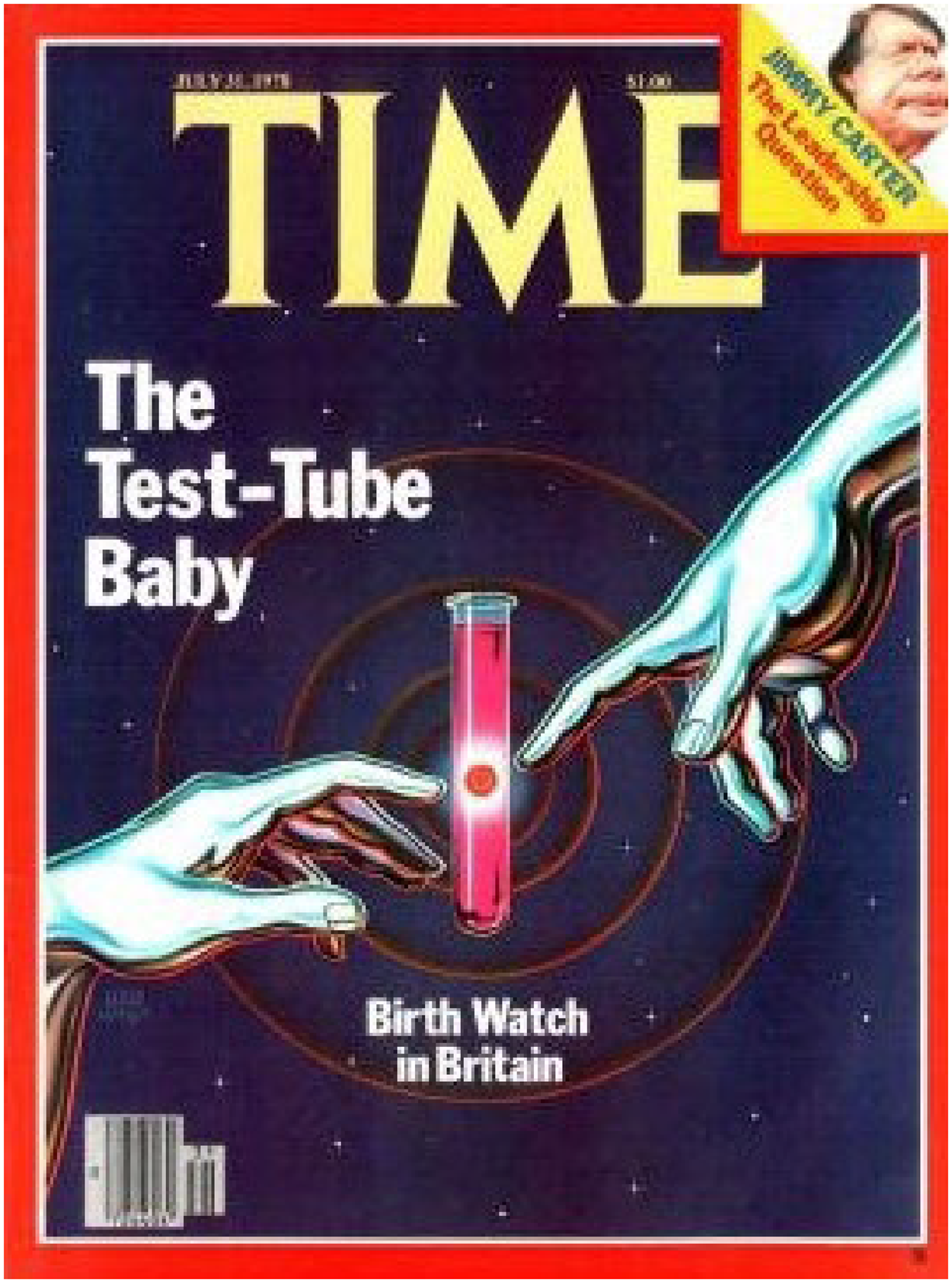
Time magazine cover story on July 31st, 1978.
People have a considerable degree of fear about unknown and uncontrollable things. We look at the present through a rearview mirror to reflect existing ethics and morality. Therefore, when people hear that machines will surpass humans and may even replace humans’ work, then they hear that singularity is coming, and all things cannot be taken for granted anymore. This sense of boundaryless will of course create infinite fear and uncertainty in people's consciousness for sure. All the research studies by Kelly and Kurzweil are not intended to cause public panic. On the contrary, because we understand the nature and process of technological development, humans have more time to prepare for the future world, and at the same time adjust their mentality to accept the changes that may be brought about. At the same time, precisely because technology can liberate human work, future society should be able to enjoy the benefits of technology instead of being restricted by it. This is true for computers, the Internet, and the development of AI. On the main axis of technological development, this road will eventually continue to advance, leading mankind toward an infinitely possible future. To do one thing today and another tomorrow, to hunt in the morning, fish in the afternoon, rear cattle in the evening, criticise after dinner, just as I have a mind, without ever becoming hunter, fisherman, herdsman or critic. (K. Marx The German Ideology, 1845/46)
This does not mean that everything is rosy in the AI era. Potential risks, such as hacking, digital divide, poverty, unemployment, energy crisis, sustainability issues, financial risks, cybercrime, etc., are still major issues that need to be overcome. However, if we think from the positive side and imagine the life people lived 50 or 100 years ago, or even think about our daily life in the age of 1999 without P2P communication tools, then will we know how much the world and human life have progressed and improved. Although the world is not perfect, it is moving toward the liberation of all kinds of constraints. We don’t need to become technological determinists, but if we learn to think from the perspective of “what technology wants” and then consider the possibility of technology's future development from the law of accelerating returns, we will be greeted by a new and hopeful world.
Footnotes
Declaration of conflicting interests
The authors declared no potential conflicts of interest with respect to the research, authorship, and/or publication of this article.
Funding
The authors received no financial support for the research, authorship, and/or publication of this article.