



Abstract
This article examines the institutional landscape of early-career opera training in North America through the lens of cultural policy and labor precarity. Drawing inspiration from the paradox of artistic apprenticeship exemplified in Wagner's Die Meistersinger von Nürnberg—where professional advancement is inextricably tied to subordination—the study interrogates how Young Artist Programs (YAPs) perpetuate a prolonged liminal status for emerging singers, positioning them between student and professional. Through historical analysis, industry discourse, and original data on career trajectories, we argue that YAPs institutionalize ambiguity, or managed liminality, as a structural feature of operatic labor. This liminality is theorized through three interlocking frameworks: the institutionalization of labor precarity, the legitimization of passion-driven exploitation, and the reproduction of cultural capital hierarchies. Examining programs ranging from tuition-based festivals to salaried residencies, the analysis reveals how YAPs extract artistic labor under the guise of mentorship while embedding economic, gendered, and hierarchical imbalances. Financial burdens, opaque terminology, and exclusionary practices disproportionately burden women, who navigate patriarchal norms within a prestige economy that prioritizes institutional reputation over equitable labor practices. By tracing YAPs’ evolution from postwar initiatives to neoliberal career gatekeepers, this essay critiques their role in sustaining systemic contradictions that defer professional stability for early-career artists. The conclusion calls for institutional accountability, financial transparency, and policy interventions to realign training systems with equitable, sustainable practices. This research contributes to broader debates in music sociology and cultural policy, urging a reckoning with how artistic traditions perpetuate exploitation and how institutions might instead foster accessible, vibrant pathways into the operatic profession.
Introduction
The tension between artistic tradition and professional transformation lies at the heart of cultural labor systems. In Die Meistersinger von Nürnberg, Hans Sachs turns to his apprentice, David, and grants him a promotion from Lehrbube to Geselle, from student to professional. But before David can stand and step into his new role, he must kneel. Before he can claim his title, he must absorb a blow. The blow, Sachs assures him, is part of the lesson. Steh’ auf, Gesell’, und denk’ an den Streich: du merkst dir dabei die Taufe zugleich. [Stand up, journeyman, and consider this blow: you'll always remember the christening along with it.] Wagner leaves little ambiguity about what he is illustrating: the inseparability of artistic success from an extended period of apprenticeship that must contain an element of suffering. A mixture of professional advancement and mistreatment is enshrined in the Great Works of opera itself, binding achievement to subordination, and therefore within its cultural institutions (Kelly, 2023). This scene also crystallizes a broader sociological question: How do cultural institutions structure liminality, and to what ends?
This paper focuses on North American Young Artist Programs (YAPs)—training systems that position opera singers between the ages of 20 and 35 as neither students nor full professionals. These artists, we posit, find themselves in a version of David's paradox, caught between their high artistic and material investment and low structural power. Embedded within a hierarchical system that relies on their deference and labor, we argue that this extended liminal status, marked by high expectations and low pay, makes young singers—and disproportionately young women—vulnerable to exploitation. Drawing on mixed-method analysis of existing literature, qualitative and quantitative data, and industry discourse, we examine these economic, gendered, and hierarchical tensions.
In particular, this essay considers:
The emergence of YAPs and how they became a prevalent model in the North American opera industry. What essential functions YAPs serve; why have they evolved as essential cultural industry mechanisms within the neoliberal restructuring of arts ecosystems. How YAPs shape the career trajectories of emerging opera singers, examining both outcomes they offer and constraints they impose. The extent to which these systems support and/or compromise equitable, sustainable career pathways, particularly for women navigating patriarchal institutional norms.
Accordingly, we situate YAPs within broader sociological and policy frameworks of cultural labor. Reframing YAPs through three interlocking theoretical lenses: the institutionalization of labor precarity, the legitimization of passion-driven exploitation, and the reproduction of cultural capital hierarchies, YAPS emerge as sites of institutionalized, managed liminality. We argue that their reliance on undercompensated labor and deferred professional stability exposes systemic contradictions which disproportionately burden early-career artists, particularly women, sustaining opera's prestige economy at the cost of individual precarity. By examining YAPs from this angle, we aim to contribute to ongoing debates in music sociology, cultural studies, and arts policy regarding how institutions can balance the cultivation of artistic talent with the imperative of equitable, sustainable labor practices in the arts. We draw on a study conducted by the authors to investigate these issues.
Methodology
The study employed a mixed method approach to investigate the institutional design, professional implications, and labor dynamics of Young Artist Programs (YAPs) in North American opera. Anchored in the concept of managed liminality—a sociological framework for understanding structured transitions and prolonged ambiguity in professional identity formation—we integrate qualitative, quantitative, and historical data to map the evolving landscape of early-career operatic training in the following way:
We drew on a range of data and secondary literature, spanning labor reports, industry analysis, and discourse, contextualized within the historical evolution of YAPs to trace the current training landscape. Available data from industry platforms including YAP Tracker, Opera America and Operabase are explored to assess patterns in compensation, application volume, and eligibility criteria. This data is supplemented by analysis of program design, promotional language, and institutional rhetoric.
To gain qualitative insight into institutional perspectives, we conducted a semi-structured expert interview with the director of a flagship North American YAP, with results anonymised following best research practice. The interview was transcribed using the AI-driven transcription tool TurboScribe, built on OpenAI's Whisper speech recognition model, then human-checked, cleaned, and analyzed.
Drawing on YAPTracker's online database of over 150 YAP programs, we compiled original comparative data on four representative programs—Seagle Festival, Tanglewood Music Center, Glimmerglass Opera, and Houston Grand Opera—focusing on organizational structure, compensation models, stated pedagogical goals, and projected career outcomes.
Finally, we performed a longitudinal case study in early 2025, tracking the career trajectories of 39 singers who completed extensive (one-to two-year full-time residency) YAPs in 2010. Data is drawn primarily through access to LinkedIn or Operabase profiles, supplemented in some cases by professional websites and informal knowledge within the authors’ academic and professional networks. While this approach introduces certain methodological and ethical considerations—particularly concerning data completeness and researcher proximity—it enables a grounded, retrospective view of long-term outcomes in the operatic labor market.
By triangulating and contextualizing these varied data sources, the study provides a multidimensional account of how YAPs have become both an essential part of industry infrastructure, and sketch how they function at the nexus of mentorship, institutional gatekeeping, and cultural labor exploitation, contributing to broader debates about precarity, equity, and access in the performing arts.
Theoretical framework
Three interlocking theoretical lenses frame this study: the institutionalization of labor precarity, the legitimization of passion-driven exploitation, and the reproduction of cultural capital hierarchies. Together, they provide a critical framework for understanding how Young Artist Programs (YAPs) perpetuate systemic inequities as sights of managed liminality—functioning as sites of extraction, exclusion, and deferred stability for emerging opera singers—while masquerading as meritocratic, linear, series of stepping stones to professional success.
Labor precarity and the liminal artist
The transition from training to professional life in opera is rarely linear. Scholars observe that true artistic development often begins only after technical mastery is achieved (Kolokytha, 2013). This growth is shaped by personality, adaptability, and environment—not solely by talent or credentials. YAPs thus serve both as training grounds and as precarious holding zones, where singers’ identities are tested but insufficiently protected, and where career trajectories may easily be derailed.
Drawing on Guy Standing's (2011) conception of the precariat—a class marked by insecure labor and the absence of professional identity—this study positions YAP singers as archetypal precarious workers. In opera, YAPs define the liminal phase between training and professional status, a concept rooted in Turner's (1969) rites of passage theory. This liminality is not transitional but institutionalized or managed: singers remain perpetually emerging and are largely denied the benefits of full professionalization (union protections, living wages) while providing essential labor (covers, outreach, minor roles, and chorus work).
This precarity is exacerbated by what Hesmondhalgh and Baker (2011) term the cruel optimism of creative careers: singers invest in YAPs despite diminishing returns, believing both that precarious training will eventually yield stable employment, and also in their own calling to the artistic profession (Lingo and Tepper, 2013). Yet, as our data show, few achieve international, sustained careers, and many fewer any sort of stability derived through the profession itself—a testament to systemic overpromising and underdelivering.
Passion as a mechanism of exploitation
The opera industry's reliance on passion narratives to justify unpaid or underpaid labor aligns with Kim et al.'s (2020) theory of passion exploitation: framing work as a calling legitimizes surplus labor extraction. This mirrors Ettarh's (2018) concept of “vocational awe,” where glorified sacrifice in service professions masks economic exploitation.
In North America, artistic labor occupies a blurred space between work and play. As sociomusicologist Simon Frith observes, “The belief that making music is in itself, fun, a pleasurable activity that shouldn’t be thought of as work,” is culturally embedded (Frith, 2017, p. 115). Industry discourse reinforces this, casting musicians as players rather than professionals (Lupo, 2022). This framing underpins systemic exploitation. A 2019 Duke study found that passion narratives make unpaid labor and personal sacrifice appear more acceptable (Jost, 2019; Kim et al., 2020). In creative sectors, intrinsic motivation often justifies precarious conditions (Umney and Kretsos, 2015). Musicians are expected to invest heavily with little return, devaluing their labor and professionalism.
When combined with the pressures of maintaining a second income stream, the impacts can be physically and psychologically debilitating (Allison, 2021, Phyland et al., 1999; Titze et al., 1997). Even emerging artists at the highest echelons report being treated as expendable and denied basic professional respect (Partridge, 2024).
Gender exacerbates this dynamic. Women are disproportionately drawn to artistic careers and systematically disadvantaged by them, as feminist and cultural policy scholars have noted (Duffy, 2017; Kolokytha et al., 2025; McRobbie, 1998; Taylor, 2011). In opera, 75% of YAP applicants are women—a demographic plagued by oversaturated soprano roles (Finkelstein et al., 2020). Passion discourse disproportionately burdens them with devalued emotional labor, often framed as assistive or communal.
Cultural capital and hierarchical reproduction
Bourdieu's theory of cultural capital—non-economic assets like education, networks, and aesthetic knowledge—elucidates how YAPs replicate class hierarchies, tightening a double bind as job opportunities narrow (Bourdieu, 1986). Entry into the YAP pipeline is often economically prohibitive, and while marketed as career stepping stones, these programs more often act as sorting mechanisms: singers in elite YAPs advance to international careers, while those in regional programs face marginal pay and heightened precarity.
Selection is largely guided by directors’ aesthetic preferences rather than standardized merit (Kolokytha, 2013), enforcing exclusionary norms—such as the gender imbalance in named roles—and protecting entrenched hierarchies. As field-specific gatekeepers (Bourdieu, 1993), YAPs convert economic capital (the ability to afford unpaid residencies) into cultural capital (prestige, mainstage opportunities).
Over the past five decades, the proliferation of YAPs and a shrinking job market have transformed the operatic landscape. While these programs can fill educational gaps, they also impose significant financial burdens and serve as gatekeeping systems that intensify challenges—particularly for female singers—within an increasingly competitive field.
Synthesis: A theory of artistic precarity
We synthesize these lenses into a theory of artistic precarity, where:
1. Passion narratives romanticize exploitation, framing unpaid labor as training. 2. Cultural capital hierarchies restrict upward mobility to those with preexisting economic resources without transparency. 3. Gendered role scarcity compounds risks for women, who dominate the YAP pipeline but face limited professional opportunities.
This framework challenges the myth of meritocracy in opera, revealing YAPs as systems, which extract labor from the many to sustain careers for the few.
YAPs: Historical context
For classically trained singers in the U.S., the next step after conservatory or graduate-level university training is typically application to young artist programs (YAPs). These programs offer advanced training—including private lessons, coaching, and small performance roles or covers—as well as outreach performances in schools and communities. YAP contracts range from two months to two years, and singers, depending on gender and voice type, may spend up to a decade in them. Many consider YAPs formative, and industry professionals widely regard them as essential to a professional career (Burnett, 2015).
Leading American YAPs evolved from earlier efforts to cultivate domestic talent. The Metropolitan Opera Auditions of the Air, begun in 1935, awarded cash prizes and radio performances (‘Singers Win Chance…’ 1936; Villamil, 2004). In 1954, the company established the National Council Auditions to broaden access beyond New York (Discovering the Next Generation of Opera Talent, n.d.; Smith and Houlton, 2004). The San Francisco Opera Debut Auditions followed in 1955 to focus on western talent (Merola, 2023). The following two decades—marked by the creation of the National Endowment for the Arts and the founding of over fifty opera companies—were “seismic”, according to Opera America's former CEO Marc Scorca (Waleson, 2019). Major YAPs such as the Ryan Opera Center (Chicago, 1974), Houston Grand Opera Studio (1978), and the Lindemann Program (Metropolitan Opera, 1980) emerged in this period and became central to professional development.
YAPs proliferated nationwide in the 1980s and 1990s alongside the expanding American opera scene. The end of the Metropolitan Opera's national tour in 1986 prompted regional companies to absorb its audiences and donors (Eaton, 1957; Plotkin, 2016). During the Clinton administration (1993–2001), charitable giving rose to 2.1% of GDP—its highest in 30 years—spurred by policy emphasis on philanthropy (The Clinton Presidency: National Service and Philanthropy, 2001). In 1995, the Arts Education Partnership united 120 organizations in support of the arts as an educational initiative (Arts Education Partnership, 2019). This climate fostered YAP growth, aligning their dual missions of artist training and community outreach with increasing philanthropic support. Where American singers had once been expected to train in Europe, a robust domestic network of YAPs soon offered a dominant new path (Cohn, 2020). Today, most major and midsize U.S. opera companies operate a YAP.
YAPs in theory: Bridging the liminal gap
To frame our findings, we first consider the categorization guidelines provided by Opera America the central service organization for U.S. opera companies. Its membership includes over 600 opera companies, educational institutions, affiliated businesses, and other entities, as well as more than 40,000 staff members, artists, and trustees, alongside over 3000 individual members (Opera America, n.d.). The organization operates the National Opera Center in New York City, publishes a quarterly industry magazine, and administers grant programs for opera companies across the United States.
A nonprofit organization, Opera America describes its mission as “leading and serving the entire opera community, supporting the creation, presentation, and enjoyment of opera” (Opera America, n.d.). Opera America has also established guidelines for categorizing singers into professional tiers. It delineates four stages of singer development—student, emerging artist, young artist, and young professional—each linked to a set of professional benchmarks (Rice & Baltz, 2019): Figure 1.
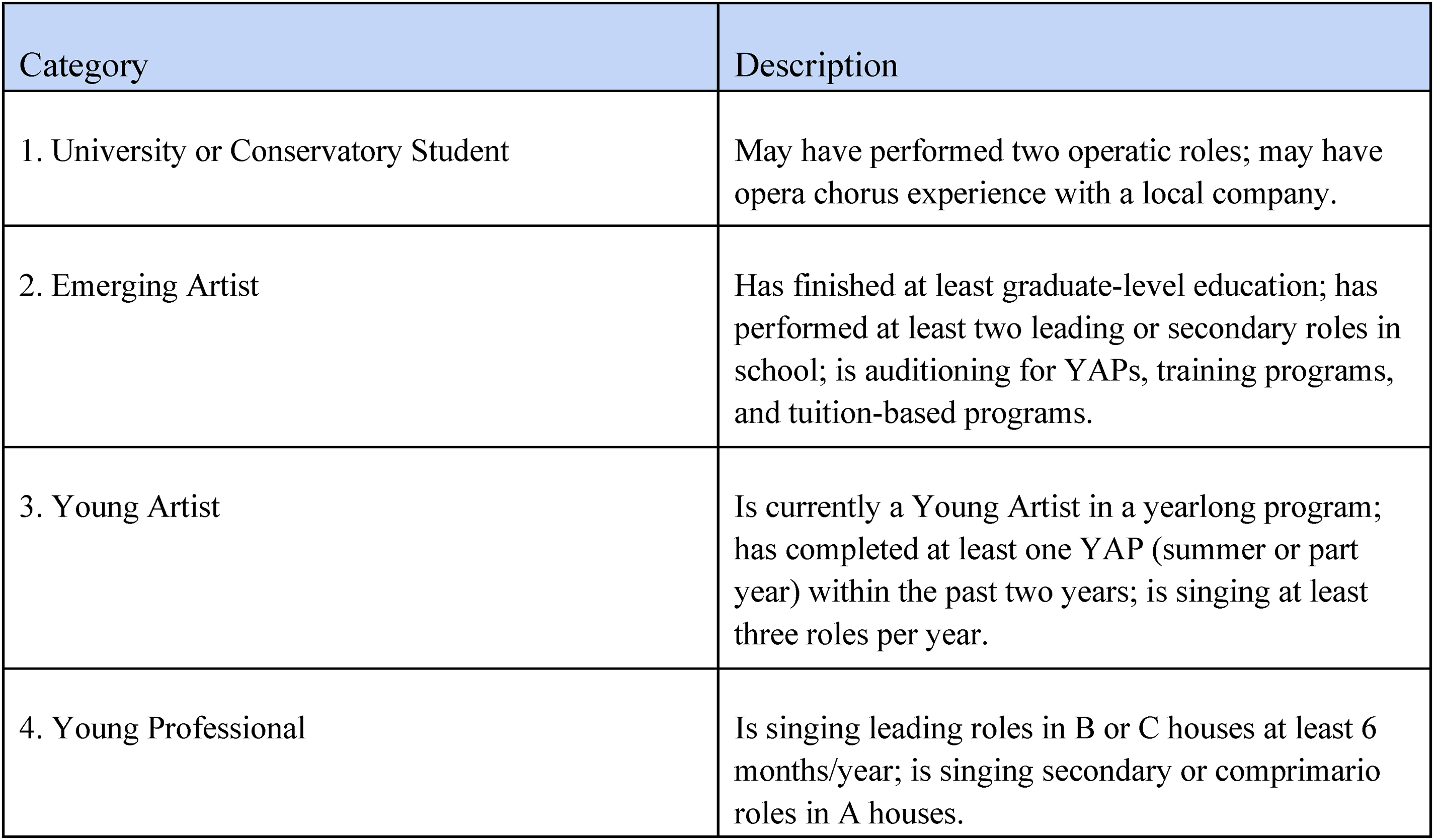
Opera America: Young artist categorizations (authors’ own).
While widely cited in industry discourse, these categories are inconsistently applied across institutions and rarely enforced in hiring or casting practices. We include these classifications here not as definitive criteria, but as illustrative of the aspirational logic and language underlying the professional pipeline. They function as a kind of soft policy infrastructure—indicative of sector-wide ideals but not regulated practice. Significantly, the framing laid out by Opera America positions the career trajectory of a developing opera singer as a stepwise progression, with the implicit understanding that singers move in a more or less linear fashion through these four steps before ultimately arriving at the status of a full professional.
Findings
While YAPs aim to bridge the educational and professional worlds and are framed as progressive pathways, our findings demonstrate that they largely, in fact, reproduce cultural capital hierarchies. Our study indicates that this occurs as a result of several mechanisms:
Economic Barriers to Entry and Participation YAP Indispensability Scarcity & Increased Competition Hierarchical Impermeability Institutionalized Gender Inequities
Economic barriers to entry and participation
According to Data USA, 7281 music performance degrees were awarded in the U.S. in 2022 (Deloitte and Hildago, 2023). Students attending university in the state where they reside paid median tuition costs of $7666 annually; students attending out-of-state universities paid an average of $34,498 each year (Deloitte et al.). In 2020, 579 singers earned master's or doctoral degrees in voice or opera (Cohn, 2020). Widespread reliance on student loans heightens financial strain. Brookings and the Texas Public Policy Foundation report that in 2022, the median debt for music majors was $26,000 after a bachelor's, $43,408 after a master's, and $55,342 after a doctorate (Hanson, 2024).
Additionally, a recent survey by the Los Angeles-based Pacific Opera Project estimated that post-university singers face annual business-related expenses of circa $9700 (Pacific Opera Project, 2023). These costs include association memberships (YAP Tracker, n.d.), lessons, coaching, audition and travel fees (Adrian, 2009; SCEA [Soloist Collective for Emerging Artists], 2025), demo recordings, pre-screening videos, and pianist fees.
If accepted into a YAP, compensation models vary widely, and institutional framing is often opaque. According to YAP Tracker, programs span a complex financial spectrum: some charge $2000–$8000 for 4–10-week summer sessions; others offer housing and modest stipends; and a few resident programs provide full salaries and benefits. See Figure 2 for a comparative overview:
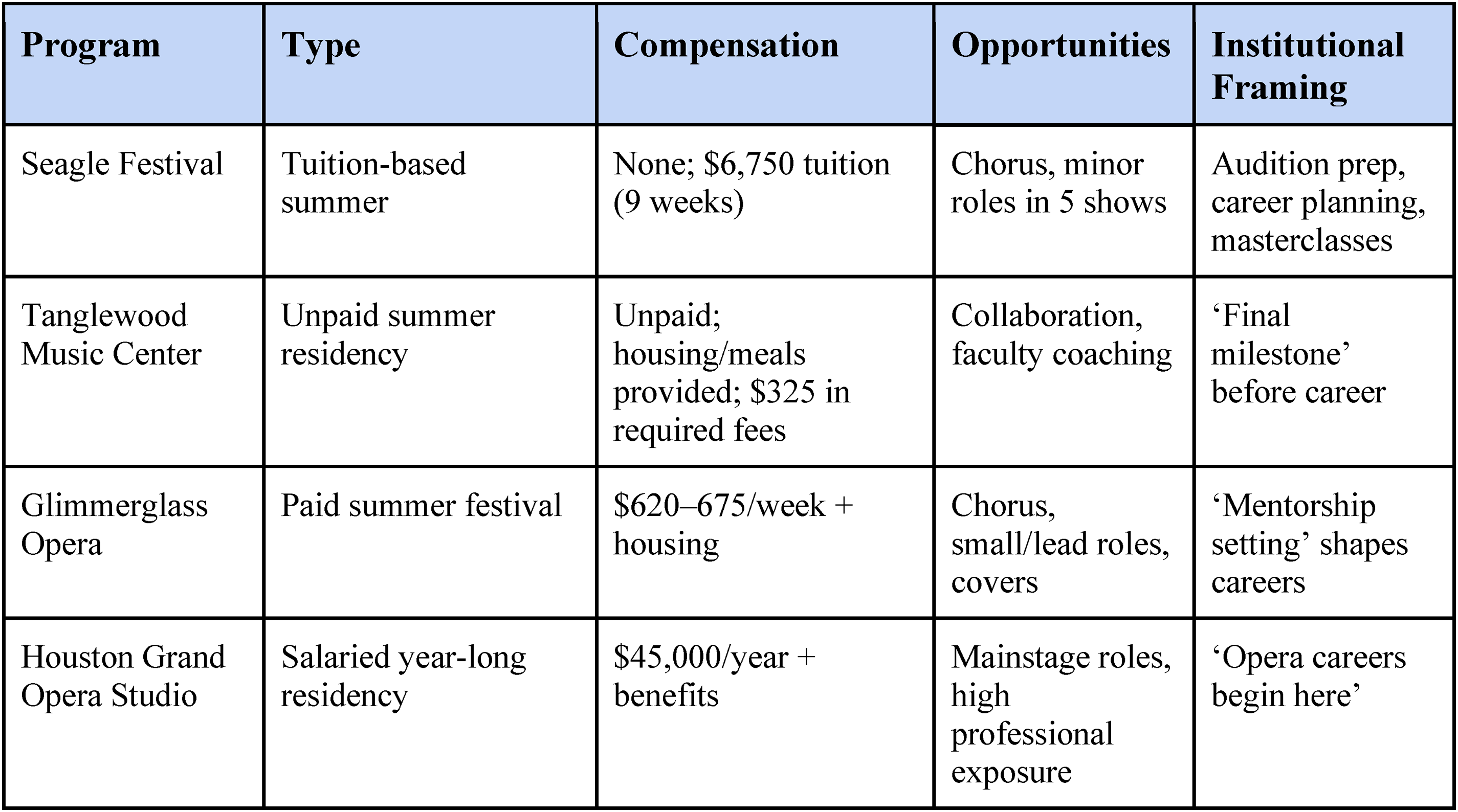
YAP program model variety (authors’ own).
As shown in Figure 2, Seagle's singers pay tuition to perform in chorus or minor roles during its summer season. Tanglewood's unpaid residency, typically for graduate students, offers exposure to major industry figures. At Glimmerglass Opera, singers perform in chorus, small roles, covers, and occasionally leads; they receive housing and a weekly stipend slightly above New York State's minimum wage (∼$600), but well below the county's living wage, which exceeds it by about 50% (Glasmeier, n.d.). By contrast, Houston's Butler Studio offers yearlong, salaried positions with benefits; participants earn slightly above Houston's living wage and perform on the mainstage (Glasmeier, n.d.). The rhetoric (institutional framing) used to describe the function of each program, as a stepping stone to professional life is, by contrast, strikingly similar.
According to Lindberg and Pitts (2020), one-third of YAPs pay below a living wage. Additional data from YAP Tracker shows weekly stipends ranging from $350 to $875, with inconsistent housing support, across 3–9-month contracts in cities with varying costs of living (Nashville Opera, 2024; Opera Colorado, 2024; Opera North, 2024; Pittsburgh Opera, 2024; Sarasota Opera, 2024; Wolf Trap Opera, 2024). Several programs advertise compensation without disclosing amounts (Cafritz Young Artists, 2024–25; Fort Worth Opera, 2024; Toledo Opera, 2024; Utah Opera, 2024; Virginia Opera, 2024).
Indispensability
Given the economic precarity of YAPs, it is worth asking why participation remains essential. While passion and vocational awe increase singers’ willingness to invest in this extended liminal phase, YAPs are perceived to deliver critical training or opportunities unavailable elsewhere. To explore this institutional logic, we conducted a semi-structured interview with the director of a leading North American YAP—an expert with experience both in conservatory education and in managing a major opera training program. The interview offered firsthand insight into the program's guiding philosophies, challenges, and priorities.
The following section outlines four key training gaps identified through this conversation—areas where academic programs fall short and YAPs step in to bridge the divide:
Foreign Language Proficiency: American singers typically begin language study later than their European peers, due to national education norms, limiting early fluency in operatic languages. Style, Repertoire and Performance Practice: With fewer opportunities to experience live opera, American singers often lack immersion in stylistic nuance and repertoire breadth, disadvantaging them in interpretive development. Synthesis of Skills: Academic programs often compartmentalize vocal training, language, acting, and musicianship. As a result, singers struggle to integrate these elements—something YAPs can help unify through applied stage work. Stage experience: Many promising graduates have minimal stage exposure, leaving them underprepared to translate their training into performance. YAPs offer a vital environment for skill consolidation through practical application.
According to the expert interviewed, participation in YAPs and success in vocal competitions now rank among the most critical résumé credentials for emerging singers.
The tightening double bind
While YAP participation has become increasingly essential, it has also become increasingly competitive. In 2020, data indicates that only 3.4% of applicants were accepted into YAPs, a significant decline from 5.37% in 2014 (Cohn, 2020). This rate is lower than that of elite academic institutions such as Harvard or Stanford (Admissions, 2016; Everything You Need to Know About Applying to Stanford University, n.d.).
Simultaneously, the number of professional opportunities has declined significantly during the twenty-first century. Once important early career training grounds, the touring companies of the Houston, San Francisco, and New York City Opera companies all shuttered before the financial crisis of 2008. That crisis then led to the closure of further US opera companies, while the number of international opera performances fell by 18.5% between 1994 and 2017 (Cohn, 2020). The number of constantly engaged professional singers declined by 19% worldwide between 2000 and 2017 (Cohn, 2020). YAPs began to flesh out their companies’ shrinking seasons (Woolfe, 2012). Activities such as community outreach, recitals, and workshops could be packaged as educational and simultaneously pitched to ticket holders as part of the season. YAP work began to afford companies the optics of robust activity—activity centered on their least experienced, most poorly compensated artists.
One example from the 2024–25 season is a regional US company presenting four operas, a studio cabaret, and a solo guest artist recital packaged together as “our season” (Arizona Opera, 2024). The five singers in the company's YAP performed 22% of the season's leading roles, 60% of its featured roles, and 33% of its supporting roles, in addition to bearing full responsibility for the studio cabaret (American Guild of Musical Artists, 2024).
Hierarchical impermeability
To assess whether the progressive career pathway promoted by Opera America reflects real conditions, we analyzed 2010 cohorts from three top-tier YAPs (Los Angeles, Washington National, and Houston Grand Opera; 21 singers) and three regional programs (Arizona, Minnesota, and Pittsburgh; 18 singers). We chose 2010 to allow a 15-year window—ample time for singers to reach mid-career status by 2025 and to control for pre-pandemic trajectories. All six programs were extended one- to two-year residencies, making them structurally comparable.
Using accessible data from Operabase, LinkedIn, and artist websites, we tracked singers’ current roles: performing nationally or internationally, performing regionally, working in music-adjacent roles, or employed outside the field. We did not attempt to assess secondary income streams, as most North American performers maintain additional employment.
Among the major YAP cohort, 11 singers (52%) are still performing nationally or internationally in 2025, with three of them (27% of that smaller group) considered headliners —principal-role singers around whom productions are planned. Three (14%) sing regionally, one (5%) now works in voiceover, two (10%) have transitioned to non-music careers, and data was unavailable for three (14%).
In the regional YAP cohort, four singers (22%) now work nationally or internationally, with two (50%) of those as headliners. Nine (50%) perform regionally, one (6%) holds a senior development role at a major orchestra, two (11%) have moved to other industries, and data is missing for two (11%).
These outcomes are represented in Figure 3.
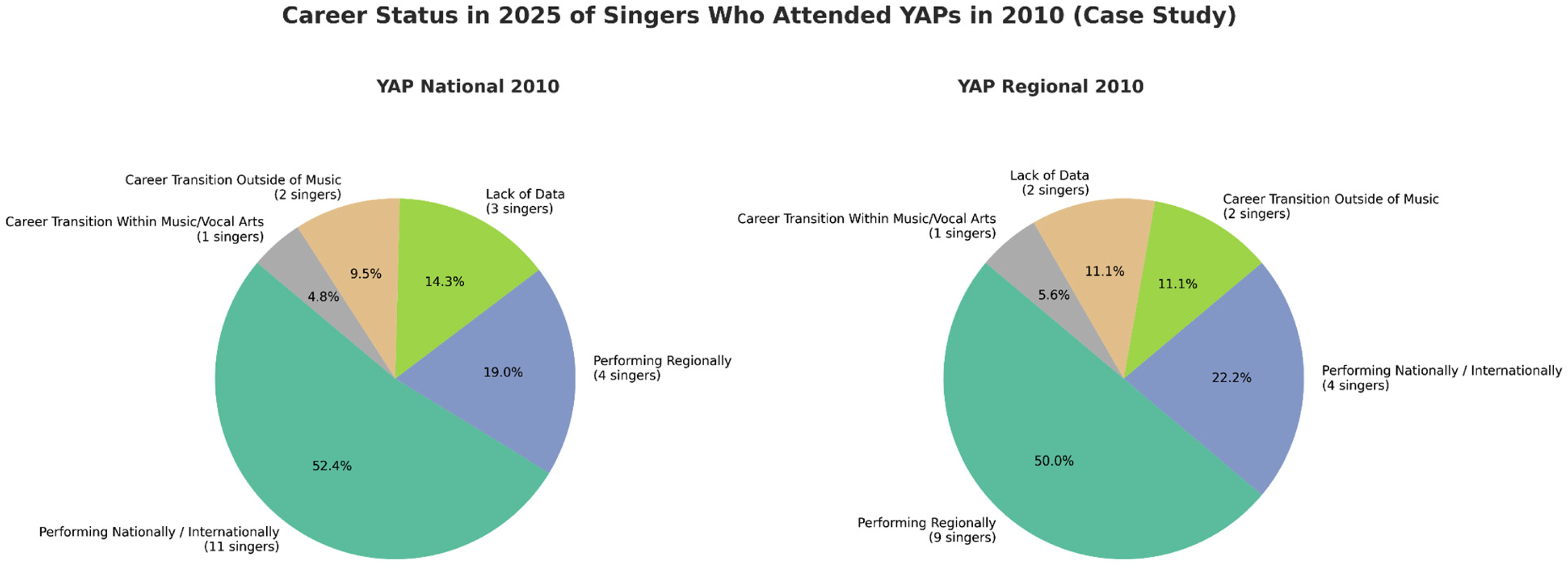
Career Status in 2025 of singers who attended Major YAPs in 2010 (authors’ own).
Of the 39 singers studied, 15 (38%) are still performing nationally or internationally 15 years post-YAP. A strong majority—76% of major program alumni and 78% of regional program alumni—remain in music-related careers. However, career scope differs by program: 52% of major program graduates sing at the national/international level, compared to just 22% from regional programs. Conversely, only 14% of major program alumni have regional careers, compared to 50% of regional YAP graduates. Notably, three of the four regional singers with international careers are Wagnerians—rare dramatic voices that remain in high demand.
Gender
Data shows a significant gender imbalance in opera training and casting. Around 75% of university-level singing degree applicants are women, particularly sopranos, who often bear a disproportionate share of educational costs due to scholarship competition favoring scarcer male voices (Varga, 2017). Application pools for young artist programs and professional engagements frequently consist of more than 50% sopranos, while the remaining 50% comprise all other voice types combined.
The U.S. has fewer opera houses per capita than Europe, compounding the issue. Moreover, the classical operatic canon skews heavily male: among the 50 most-performed operas from 2010–2019, only 35% of roles are for women, while 62% are for men (Gender Disparity in Top 50 Operas, n.d.; Opera Base, n.d.). Similar patterns appear in Brooke Larimer's analysis of the top 25 operas (Larimer, n.d.).
Contemporary works show modest progress, with 43% of roles from 1995–2019 written for women (LaBonte, 2019). Still, economic pressures discourage risk-taking, incentivizing major companies to favor male-dominated canonical works (Sgourev, 2013).
Discussion: Revisiting managed liminality–from transition to extraction
These findings suggest that YAPs function less as bridges to sustainable employment and more as mechanisms of labor extraction and symbolic professionalization. Though framed as meritocratic and educational, they primarily benefit institutions, externalizing risk and cost to individuals. Managed liminality—prolonged ambiguity between student and professional status—is not incidental, but a structural feature of YAPs. We argue that this ambiguity is routinely exploited.
Economic extraction
Pursuing an operatic career in the U.S. imposes substantial financial burdens, often inaccessible without significant resources. Multiple degrees, frequently accompanied by student debt, are compounded by the costs of navigating the over 150 YAPs in existence today. Fees for auditions, travel, applications, and tuition are, here, borne largely by singers (SCEA, 2025).
Accepted singers face varied models of compensation and expectations within YAPs, with many roles unpaid or minimally paid under the guise of training, while they contribute to revenue-generating institutional activities such as community outreach, secondary roles, or principle covers in mainstage productions. Programs like Seagle Festival charge tuition while assigning artists to revenue-producing performances, revealing a troubling extraction model in which institutions profit from unpaid or self-funded labor. These barriers privilege those with access to savings, spousal support, or alternate employment. This contrasts starkly with European models that offer subsidized training and longer, institutionally supported transitions into the profession.
This model also raises broader equity concerns. If financial privilege is a prerequisite for entry, the field risks reinforcing socioeconomic exclusivity and limiting artistic diversity. Without systemic support or financial subsidies, many American singers are effectively priced out, rendering the classical music field increasingly exclusive.
Gatekeeping cultural capital
Our longitudinal career outlook research indicates that YAPs at major houses correlate with broader career success, while regional YAPs tend to lead to localized careers. Though 38% of our case study participants maintained national or international careers after 15 years, outcomes strongly correlated with program prestige. These preliminary observations, while limited, suggest the boundary between regional and elite careers is largely impermeable, challenging the notion of a linear progression through the YAP system, and imply that the boundary between regional YAP work and national/international work is largely impermeable.
All YAPs require extensive private and conservatory training, and expensive audition tours, thereby excluding lower-income singers. Elite programs then act as gatekeepers, converting heightened economic privilege into higher-status cultural capital. Regional programs, by contrast, trap singers into what (Menger, 1999, p. 550) calls the “peripheral population”—singers who land in this tier perform sporadically in small-town theaters rather than metropolitan mainstages—working under demanding conditions with limited return.
Although much grey space exists between these two categories (Mathisen et al., 2024), our case studies underscore this divide: while Houston's salaried artists secure international careers, regional program graduates often remain geographically and professionally siloed, their labor rendered invisible by the industry's prestige economy. These mechanisms reveal YAPs as neoliberal tools that defer professional stability, forcing singers to navigate a labyrinth of unpaid labor and deferred rewards.
Institutional complicity and the prestige economy
Opera companies benefit materially and symbolically from YAPs. By framing YAP labor as education, institutions offset shrinking seasons and reduced public funding, while enhancing their reputations as talent incubators. The romanticization of artistic calling legitimizes this exploitation, particularly for women, who comprise 75% of applicants but face systemic scarcity of roles (35% in the canon). This aligns with Kim et al.'s (2020, p. 121) “passion exploitation,” where emotional and financial sacrifices are framed as intrinsic to artistic identity. The interview with a YAP director highlights this tension: while programs certainly strive to fill critical training gaps (language skills, stage experience), they simultaneously rely on singers’ unpaid labor to sustain operations.
Programs rarely transparently disclose key differences in outcomes or compensation. Despite vast disparities in pay, access, and prestige, most use similar rhetoric, presenting themselves as direct links between education and employment. This reveals the instability of the Young Artist designation and its function as a managed liminal category within the opera labor market. That singers in programs so remarkably disparate are all described as young or emerging, with some of their (ticketed) performances framed as education, serves to underscore the unclear demarcations between the industry's professional rungs within this liminal space.
This complicity is deepened by opaque compensation models (undisclosed stipends) and the absence of clear professional benchmarks, as evidenced by Opera America's inconsistently applied tiers. YAPs are only one part of a U.S. opera landscape marked by job insecurity at all levels. In such a hierarchical industry, those at the bottom face the steepest burdens. For instance, many university voice teachers participate in YAPs to advance their own careers, with employment sometimes linked to the number of students they attract. Students, in turn, may pay tuition to programs that support their teachers’ advancement—an example of how risk and responsibility are disproportionately placed on emerging artists.
(Gendered) precarity and the myth of meritocracy
The data expose how YAPs replicate broader patriarchal norms. Women, overrepresented in applicant pools and underrepresented in canonical roles, face a double bind: they are expected to perform unpaid emotional and artistic labor (outreach, mentorship) while competing for scarce opportunities. This aligns with McRobbie's (1998) critique of creative industries, where passion narratives disproportionately burden women by conflating labor with service or community building. Similarly, sopranos—the most oversaturated voice type—compete for roles in a canon heavily skewed toward male voices, while shouldering higher student debt due to scholarship disparities (Varga, 2017).
The current system and its baked-in gender canonic disparities create significant barriers to career advancement in particular for women in the field (Madonna, 2020), which is likely only exacerbated by the broader underrepresentation of women in creative and decision-making positions within the industry (Vincent et al., 2022). In summation, the percentage of female singers on the market compared to their male counterparts, combined with an established operatic canon and economic reality all result in an industry which “skews so heavily towards men that male opera singers are three and a half times as likely to be cast as women opera singers” (Finkelstein et al., 2020).
Conclusion
The story of the Young Artist in opera is one of institutionalized ambiguity: a system where the blurred line between education and employment can enable the exploitation of underpaid, precarious labor in the name of mentorship, excellence, and opportunity. Opera's prestige economy has normalized a prolonged, undercompensated professional adolescence that too often serves as a filter for privilege rather than a bridge to sustainability. As this paper shows, the cultural policy frameworks shaping early-career development in North American opera—though couched in the language of access and education—operate within a market logic that appears to benefit institutions while shifting risk and cost onto individual artists. This structure reinforces preexisting socioeconomic, geographic, and gender disparities in the field.
Limitations to our study remain: our 2010 cohort analysis predates major post-pandemic shifts; reliance on online platforms like Operabase and LinkedIn for longitudinal career data introduces selection bias; and our limited sample size restricts generalizability. The interview with a single YAP director, while illustrative, is not definitive. Broader, cross-institutional studies are needed to validate and expand upon our findings.
What is clear, however, is that this extended liminal phase can, and should be better managed. The systemic failure to adequately compensate and protect young artists undermines the meritocratic ideal, replacing it with a test of endurance and access to resources. While unionized musical theater has curbed exploitative audition practices, such protections remain uneven in YAPs. Reports of age and marital status queries and discrimination, as well as audition fees levied without granting singers live auditions, persisted into the twenty-first century (Edwards, 2011). Advocacy has curbed some of these practices, but the space remains underregulated. Further research is necessary to explore alternative models that could mitigate financial challenges (expanded funding opportunities, institutional support mechanisms, and policy interventions targeting equitable accessibility).
Reimagining YAPs as sites of policy intervention—not a prolonged, punitive rite of passage—would require clear thresholds between training and employment, financial transparency, and increased support for marginalized artists. Passion exploitation and the romanticized narrative of artistic struggle must give way to a model that values equity alongside excellence. Hans Sachs may have insisted every journeyman take his blow—but today's opera economy delivers many metaphorical blows with no guarantee of stability or recognition. Without systemic recalibration, the field risks narrowing its future by excluding those unable to endure its inequities. Talent may still be essential, but without meaningful reform, opera's next generation may never find a sustainable place on its stages.
While talent remains vital, the structural and financial challenges facing young opera singers today have rendered the profession increasingly precarious. The dependence on YAPs, mounting financial pressures, and an oversupply of trained artists—especially female sopranos—have intensified competition to unsustainable levels. Addressing these systemic issues will require coordinated, industry-wide efforts to align training with viable career pathways and preserve opera as a profession accessible to future generations.
Footnotes

Funding
The author(s) received no financial support for the research, authorship, and/or publication of this article.
Declaration of conflicting interests
The author(s) declared no potential conflicts of interest with respect to the research, authorship, and/or publication of this article.