



Abstract
Debates about the value of culture are ancient and apply equally to culture expressed as ‘tangible’ heritage assets, and to ‘intangible’ cultural activities. The notion of culture as an economic force has dominated Western public discourse, policy making and cultural practice, yet research from around the globe has consistently identified ‘non-monetisable value’ in cultural activities. Research exploring the many examples of the non-economic values of culture has tended to dig selectively into each identified source of the value of culture without seeking to link them into a holistic framework for appraising multiple values inherent in culture. This paper reports on a thematic analysis of a disparate body of available literature investigating the benefits of cultural activity. Adopting a broad and high-level definition of culture, it identifies seven domains of value: aesthetic, educational, financial, personal, socio-cultural, technical and well-being. It finds that these domains are not silos and prefers an ecological model of the values of culture.
Introduction
In 2016, the UK Arts and Humanities Research Council reported on the Cultural Values Project: a two-year project to ‘establish a framework that will advance the ways in which we define and think about the value of cultural engagement as well as the methods by which we evaluate it’ (AHRC, 2013). The research team noted that their efforts had needed to move beyond the ‘current logjam with its repeated polarisation of the issues’ and the distorting effects of the ‘wish to protect public funding and to influence policy’ (Crossick and Kaszynska, 2016: 6–7) that plagued previous attempts to identify and assess the value of culture. In identifying four key categories of cultural value: intrinsic value, instrumental value, relational value and cultural capital, they expanded their definition of culture to include a wider range of cultural practices, including amateur and community cultural practice, and encompassed digital technologies but remained within the field of ‘arts and culture’ (2016: 13). They did not, for example, include media, sport, or hospitality as examples of cultural practice.
This debilitating definitional issue has a long history, in which the inclusion of various aspects of art, culture, creativity and industry within the definition of culture has been debated at length without resolution (e.g. Throsby, 2001, Galloway and Dunlop, 2007, Flew, 2012; O’Connor, 2024). In the latter neoliberal era, the arts and culture are selectively claimed by policy makers to transform individuals and societies, especially economically, via the miracle of ‘continuous innovation on which growth depended’ (Hewison, as in Belfiore, 2022: 303; also Hill et al., 2024; Lords, 2025; Nandy, 2025).
Many important understandings of the value(s) of specific elements of culture have been advanced across a range of disciplines, and this research continues apace. These theories have tended to advance understanding of specific aspects of culture such as the anthropological importance of artefacts, sites or practices (McAnany, 2020; Schneider, 2020; Profico et al., 2019); the aesthetic and historical importance of artistic production (Nanay, 2019; Lomas, 2023; Skov and Nadal, 2020); the power structures inherent in mediated culture (Aitchison and Meckled-Garcia, 2021; Dahlgren and Hill, 2020; Hesmondhalgh, 2017); the economic and social benefits of cultural industries (Adorno & Bernstein, 1991; McCarthy et al., 2004; PEC, 2025); the value of cultural activity to urban development and/or visitor economy (Falanga and Nunes, 2021; Seyfi et al., 2020; Paddison and Miles, 2020); and advances in the technologies of cultural production and reproduction (Buhalis et al., 2019; Lifintsev and Wellbrock, 2019; Osiurak and Reynaud, 2020), among many others.
In Western policy discourses, particularly those concerning the allocation of public resources to cultural practices, the neoliberal obsession with budgets, returns on investment and value for money, has become unhelpfully dominant (O’Connor, 2024). However, a growing body of research has argued that there is more to culture than costs and revenues, and that existing methods and metrics do not capture the full range of cultural activity and benefits that arise therefrom (Novak-Leonard et al., 2015, Kaszynska, 2024). Flew (2012) argued that ‘it is foolish to place culture and economy at opposite ends of a political-ideological spectrum’, and this view is headlined in the international community, which recognised that ‘The measurement of the economic dimension of culture is more fully developed in the Framework for Cultural Statistics … however, equally important is the social dimension of culture, including culture participation and intangible cultural heritage’ (UNESCO, 2009: 9).
This paper draws on this vast history to propose a framework for a holistic evaluation of culture that seeks to address a clearly identified problem: ‘we are lacking robust methodologies for demonstrating the value of the arts and culture, and for showing exactly how public funding of them contributes to wider social and economic goals’ (Crossick and Kaszynska, 2016: 4). Responding to calls for more and better evidence (UNESCO, 2025; European Commission, 2025), the proposed framework includes quantitative and qualitative approaches and it rejects any notion that some cultural activities or outputs are better than others. It aims to help analyse the value of cultural activity within any human culture, current or historical, and identifies seven domains of the value of culture that it hopes are common to all human groups around the globe and will endure through processes of cultural evolution (Lewens, 2015). It acknowledges the lack of empirical support for this ambition, particularly given the inherent bias towards Western and urban cultures in the sample of literature that it examines, and outlines a programme of research that aims to support, refute or amend the framework's potential for universality.
It proceeds by reviewing a selection of relevant literature to define key terms and offer a history of thinking about the value of culture. It then describes a thematic analysis of a broad sample of research that identified value(s) in many cultural activities and distils this into seven domains that constitute the top level of taxonomy of the values of culture. It then discusses each of its proposed seven domains of the value of culture with reference to examples of cultural activity and begins to map these onto a nascent taxonomy. It concludes by acknowledging its limitations and recommending further research.
Literature review
It is not possible to comprehensively review the enormous volume of literature pertinent to this discussion in a single paper of this size. Similarly, it is not possible to include examples or data from every culture around the globe – many cultural activities of which are not understood in anything like the depth available regarding Western cultural practices. Accordingly, this section focuses only on the most significant concepts, theories and examples that help to outline the definitions, systems, descriptors and methods that have been used to value culture in Western discourses and policy.
The meaning(s) of ‘culture’
Throughout the body of literature consulted for this paper, various definitions of ‘culture’ had been chosen – usually to suit the purposes of each paper. These choices often involved taking one side of the dichotomies identified by Crossick and Kaszynska (2016: 4) as ‘the intrinsic v the instrumental, the elite v the popular, the amateur v the professional, private v public spaces of consumption, qualitative v quantitative evidence and the publicly-funded v the commercially-oriented’. This is perfectly practical but produces evidence that responds to specific needs and which can be produced in convenient time frames. This limits the depth and breadth of the research outputs, resulting in an evidence base that is ad hoc in nature, bespoke, difficult to locate and not easily transferable. However, this paper seeks to canvass the broadest possible range of examples, perspectives and data to build a holistic framework. Thus, the most useful definition of culture for this purpose is the broadest one, as adopted by the United Nations in its Universal Declaration on Cultural Diversity: ‘… culture should be regarded as the set of distinctive spiritual, material, intellectual and emotional features of a society or social group, and […] encompasses, in addition to art and literature, lifestyles, ways of living together, value systems, traditions and beliefs’ (UN, 2001, p1).
One of the weaknesses of the econometric approach to assessing the values of culture is that ‘The dynamism of a cultural economy does not reside only in its most commercial components, nor the value of its outputs exclusively in monetary value’ (O’Connor and Gibson, 2015: 38). Thus, the many cultural inputs and outcomes that are not immediately quantifiable must be included in any holistic framework, and qualitative data must be considered alongside quantitative. This paper acknowledges this by also accepting UNESCO's approach to evaluation: Whereas it is not always possible to measure such beliefs and values directly, it is possible to measure associated behaviours and practices. As such, the UNESCO Framework for Cultural Statistics defines culture through the identification and measurement of the behaviours and practices resulting from the beliefs and values of a society or a social group. (UNESCO, 2009, p9)
The UNESCO Framework for Cultural Statistics divides cultural heritage into ‘tangible’ and ‘intangible’ heritage. It defines intangible cultural heritage as the ‘practices, representations, expressions, knowledge, skills – as well as the instruments, objects, artefacts and cultural spaces associated therewith – that communities, groups and, in some cases, individuals recognize as part of their cultural heritage’ (UNESCO, 2009: 28). This paper accepts that the distinction relies on ‘practices and activities’ and focuses on the value of these rather than that of the tangible heritage that enables them. It adopts the term ‘cultural activity’ rather than cultural production, consumption or participation, because the latter terms have become associated with quantitative evaluations of attendance or involvement with cultural events and programmes that are usually organised to produce immediate specific outcomes (e.g. ACE, 2023; DCMS, 2023; Mihelj et al., 2019; Romanovska, 2020; Li et al., 2020; Adamsen et al., 2021). While these studies produce valid and important data, they tend to overlook the qualitative (and sometimes quantitative) value that derives from ‘everyday’ (Wright, 2022) cultural activities; especially value that manifests over inter-generational time frames, which this paper seeks to include.
Finally, Kaszynska (2024) notes that the term ‘value of culture’ should be distinguished from the broader term ‘cultural value’, as discussed below. This paper will refer to ‘the value of culture’ in its broadest sense unless it refers to cultural value specifically.
Existing approaches to the value of culture
There have been many previous attempts to understand what is now known as culture. However, as Crossick and Kaszynska (2016) note, no framework has proven sufficiently robust to solve the problem that the Cultural Value Project sought to address. The following section briefly reviews a limited selection of the most prominent contributions.
Aristotle disagreed with Plato about the value of culture. Plato was conflicted between the emotional harm of the arts to the character of audiences and the educational and transformative benefits of various cultural practices to society (Belfiore, 2006), whereas Aristotle viewed the arts as valuable because of emotion's role in fostering ethical virtue (Abakare, 2020). Confucius wrote that through learning and appreciating the arts, a ‘gentleman’ (sic) could achieve both internal and external (engaging with nature and his fellow man) harmony (Akuno et al., 2015).
This discourse remained the domain of philosophers, artists and writers for thousands of years until Adorno noted that cultural activities and artefacts had become increasingly commodified and commercialised into a mass market for largely technical and economic reasons. He and Horkheimer coined the term ‘culture industry’ to critique what he viewed as a corruption of the real value of culture, arguing that in the culture industry ‘enlightenment … becomes mass deception’ (Adorno and Bernstein, 1991: 106). Despite these and other critiques, the neoliberal era saw the ‘absorption of the cultural sector into neoliberal policymaking, and its integration into the economic imaginary of the knowledge economy’ (O’Connor, 2024: 26), with a resulting disregard for non-economic values of culture.
In the twenty-first century, a great deal of work has developed systematic approaches to assessing the non-economic values of culture. This has chiefly involved recognising the ‘intrinsic’ values of cultural outputs, practices and capital, which cannot be easily (if all) measured (Throsby, 2001). Throsby proposed six dimensions of value in culture: aesthetic, spiritual, social, historic, symbolic and authenticity, which can be stored in tangible and intangible forms as artworks, rituals or building sites, referred to as ‘cultural capital’ (Throsby, 2020), which should be distinguished from Bourdieu's use of the term (Haines and Lötter, 2022). Throsby used the term ‘cultural value’ to distinguish these properties from the ‘economic value’ of commodified culture. Holden (2004, 2006) developed a triangle with three interrelated types of value: intrinsic, instrumental and institutional. He argued that the over-emphasis in public policy on instrumental value, which produces the most easily measured outcomes, neglected much of the value that culture provides.
The perspectivist view (Smith, 2022) recognised the subjective and political nature of artistic meaning by contrasting an individual's excitement, validation or inspiration upon first experiencing a work with the community identity and cohesion that derive from sharing that experience (Brown, 2006). Brown argued while the immediate effects of artistic production or consumption may not be measurable, ‘repeat experiences lead to higher-order benefits’ that produce measurable outcomes across expanding audiences. Brown placed these benefits into five overlapping categories from the immediate personal ‘imprint’ to accrued ‘economic and macro-social benefits’ (2006: 19) of repeated indoctrination into practice, which opened up the possibility of evaluating culture via ‘spillovers’ (Bina et al., 2012) into other sectors or ‘externalities’ (Bille, 2024). These spillovers include increased tourism, urban development and increased productivity through education and well-being (ACE, 2015), though they can be difficult to isolate and measure directly, and they may require many iterations over years to manifest. These views of cultural impact are integrated into the UK Department of Culture Media and Sport's (DCMS) latest quantitative valuation of the health and well-being impacts of culture and heritage (Frontier, 2024), though its definition of culture is limited to the arts, it excludes qualitative data and it includes only a limited range of externalities. Similar issues limit the impact of the Creative Industries Policy and Evidence Centre's work (PEC, 2025).
In attempting to identify a reliable quantitative method for evaluating culture, O’Brien (2010) acknowledged the inherent difficulties in measuring culture's intrinsic worth beyond purely economic terms. He modelled a range of methods by which the economic, social impact and subjective well-being values of culture might be evaluated but found none of them satisfactory and instead encouraged the development of a more nuanced, holistic approach to valuation. In doing so, he rigorously critiqued the approaches to valuing culture that had been developed up to that point (O’Brien, 2010: 19–21), arguing that the ‘intrinsic/instrumental division’ was too imprecise to be useful.
In more nuanced view, the value of culture was proposed as an ‘ecology’ (Holden, 2015), with a complex, non-hierarchical structure that could be understood via ecological metaphors including life cycles, growth and webs. This metaphor has found growing influence in research, albeit with some inconsistency in its framing language (Kaszynska et al., 2022; De Bernard et al., 2022). For example, it underpins the approach used by the UK government's Cultural and Heritage Capitals project (Sagger and Bezzano, 2024). The cultural ecology approach is perhaps also better suited to understanding non-Western concepts and practices of culture (Liu, 2016; Watene and Yap, 2015). It reveals its truth over longer time frames, for example, inter-generational social cohesion and development to improve entrenched poverty; or the contribution of culture to the Sustainable Development Goals (Zheng et al., 2021; Sabatini, 2019), and considers spillovers and externalities, as noted above.
Advancing and analysing theories of ‘cultural evolution’, Lewens (2015) identified limitations in ecological metaphors, including the wide variations among fundamental cultural units, or ‘memes’. Unlike genes, memes are not easily identifiable or quantifiable, which makes their precise role in cultural evolutionary processes difficult to precisely discern. Further, humans, unlike organisms, play an active role in the evolution of their cultures, which means that the transmission of culture is mediated by language and technology and therefore problematic to trace. This complexity means that much more research, perhaps using aggregative mathematical models, is needed before a reasonable understanding can be claimed (Moss, 2016).
Klamer (2017) identified specific problems that derive from economic policy fixations on quantitative measures such as GDP and profit. These included environmental degradation, social inequality and a loss of meaning and purpose among individuals and communities. He proposed a value-based approach that identified five spheres of value creation: the market, the state, the household, the community and the oikos, or the location of purpose and meaning. He emphasised the intrinsic value of non-economic goods, such as families, communities, knowledge and art and argued that progress requires increased focus on non-economic values in the household, the community and the oikos. This requires a critique of the evaluation process (O’Brien, 2015): who does the valuing and how they do it – and thus who and what is omitted or excluded – are critical aspects of any valid assessment.
Trembath and Fielding identified 12 domains of cultural and creative activity that ‘contribute to Australia's GDP, even when that contribution is numerically small’ (2020: 11). They recognised that poor data collection and management limited the ability to value Australia's cultural sector and explored seven qualitative ‘transformative Impacts’ of culture, concluding that ‘a rich cultural life delivers significant economic and social benefits to the Australian community’ (Fielding and Trembath, 2019: 5). To clarify the values of culture for policy purposes, several suites of ‘indicators’ such as the Culture|2030 Indicators (UNESCO, 2025), the Centre for Cultural Value's Vitality Indicators (CCV, 2025) or the Takso framework (CDN, 2025) have been advanced to provide ‘a reliable method to assess impact across a range of public policy areas’.
The Centre for Cultural Value has sought to bring some degree of harmony to this chaos via its co-created evaluation principles (CCV, 2021). These principles are not intended to be prescriptive but to help evaluators to ‘set priorities, engage the right people and use appropriate methods to understand the holistic impact’ of cultural activities and programmes. They accept the above arguments that there is more to the value of cultural interventions than economic benefits, and they encompass the politically unpopular notion that failure is an unavoidable outcome of innovation that can produce valuable learnings (Jancovich and Stevenson, 2023), even when it is de-emphasised in pursuit of the scarce funding available under neoliberal regimes.
In summary, there remains no agreed definition of culture upon which to base a theory of value, nor an agreed taxonomy of values to assess, nor an agreed approach to including quantitative and qualitative values. Even the most recent attempts to derive economic valuations have not succeeded in embracing the ‘methodological pluralism’ that Crossick and Kaszynska (2016: 123) identified as necessary to reconcile the enormous range of values in the diverse cultural practices that humans’ exhibit. More expansive approaches might include the perspectives of arts and humanities researchers in assessing the cultural values that economics cannot measure Kaszynska (2024), though it is beyond the scope of this literature review to include them.
This paper takes a holistic approach to the available literature and proposes a high-level framework for understanding all of the types of value that are evident in cultural practice. It does so based on a review of existing quantitative and qualitative research that seeks to answer the question:
What are the domains of value that are common to cultural activity?
Method
This research comprised an inductive thematic analysis (Terry et al., 2017) of a sample of literature investigating the motivations, intentions and benefits (including disbenefits) of cultural activities. The analysis was informed by the researcher's insider perspective (Finefter-Rosenbluh, 2017) based on his personal experience as a musician, event manager, journalist, manager of creative teams, semi-professional athlete and coach. This unavoidably introduced biases into the analysis.
First, Google Scholar was searched to identify potentially useful articles using combinations of search terms ‘motivation’, ‘intention’ and ‘benefit’ with ‘culture’, ‘arts’, ‘sport’ and specific cultural practices including but not limited to ‘music’, ‘writing’, ‘football’, ‘festival’, ‘broadcast’, ‘prayer’, ‘travel’ and ‘food’. This identified a long list of thousands of articles from all over the world that used a range of qualitative and quantitative methods. An abstract-level filter was applied to identify 514 useful papers based on their peer-reviewed status and their inclusive focus on cultural activity rather than output. For example, meta-studies and examinations of the value(s) of artefacts were excluded.
Next, an Excel spreadsheet was used to list the papers and to identify the purpose and/or the benefit(s) of the cultural activity being studied. Using the answer to the basic question ‘what did this stakeholder seek to gain from this activity?’, each paper was tagged with multiple descriptors such as ‘money’, ‘health’, ‘politics’, ‘activism’, ‘beauty’, ‘teaching’, ‘learning’, ‘community’, ‘identity’ and ‘exposure’, that were associated with stakeholders in the cultural activity that was the subject of the research, as opposed to the research itself. Reflecting the perspectivist (Smith, 2022) view, the stakeholders included participants, organisers, funders and other beneficiaries who were mentioned in the paper. This step identified 167 types of value associated with this sample of cultural activity research.
Next, these descriptors were categorised into common themes. The first iteration of this process identified 24 categories and the second reduced this to seven (see Appendix 1 for the top two levels of the framework). At this point, the process stopped as it had achieved the (completely arbitrary) goal of reducing the number of categories to less than ten. In search of validation, the process was then reversed, with the activities described in each paper being placed into at least one of the seven categories from each stakeholder's perspective (Brown, 2022). Most were placed into multiple categories, reflecting Holden's (2015) ecological view of the inter-related values of culture.
Results and discussion
This study identified seven top-level domains of the value of culture:
1. Aesthetic 2. Educational 3. Financial 4. Personal 5. Socio-cultural 6. Technical 7. Well-being
These domains are not mutually exclusive; they co-exist to varying degrees in any cultural activity from the various stakeholder perspectives. They form an ecology of values whose practices and manifestations differ between individuals, cultures and sub-cultural groups and have evolved over time, consistent with Brown's (2006) view and Holden's (2015) metaphor. As noted in the introduction, examples of cultural activities within the various sub-categories of these domains have been studied on their own by diverse researchers for a long time and each has its own body of current and extant literature. These studies tend to focus on a single source of value, and therefore to ignore additional types of value that were evident in each study. The bodies of literature are not equal across categories or sub-categories, reflective neoliberal research funding priorities.
In theory, these values should be historically congruous to all human cultures. That is, these domains of value should describe the values evident in cultural practices and cultural artefacts belonging to all past human cultures as well as to contemporary cultures. See the final section for a discussion of the limitations of this study and a suggested research agenda to test this claim across multiple and more diverse samples of literature and cultural activities. The following section describes the place of each domain in the framework and identifies areas of overlap between the domains.
Aesthetic value
People participate in arts and culture because it's attractive – or not.
The study of aesthetics is ancient and multi-cultural but ‘fuzzy’ without losing its power or importance (Cooper, 2019). This study identified aesthetics as, perhaps, the only truly intrinsic domain of the value of culture. Although aesthetic value appeared in a wide range of settings, this analysis found no universal human aesthetic standard but instead a persistent use of aesthetics to define identities using distinctive aesthetics (Nanay, 2019). Some art and cultural activity is made for no purpose other than its aesthetic appeal. However, not all cultural activity is granted aesthetic approval by the culture industry and some is deliberately challenging or provocative.
Even within cultures, aesthetic preferences come and go as cultural evolution proceeds (Lewens, 2015). Aesthetic value was found in the use of colours, shapes, sounds and movement across every culture and era included in this study; and it was open to stakeholders to place radically different values upon aesthetics within one activity of study. Aesthetics have a long history in debates about ‘high art’ (Fisher, 2013) and fashion (Venkatesh et al., 2010), but aesthetic value is also found in research into sport (Sandle, 2008), military uniforms (Craik, 2003) and gangland symbols (Murer, 2015), among others. In the latter cases, negative values that is, the rejection of identifiable aesthetics and the resultant anti-social responses - was a prominent feature. This highlights the limitations of assessments of the value of culture that limit their definitions to a snapshot of the cultural sectors.
Aesthetic values appear in most of the characterisations of culture considered in the literature review. In the literature reviewed for this study, the pursuit of aesthetic value produced many spillovers and externalities, most notably across the financial, personal and socio-cultural domains via the fashion and merchandising industries. They also produced externalities in the technical domain via innovation in pursuit of aesthetic goals (Scaturro, 2008). Well-being and educational overlaps were present via studies into personal and cultural identity and politics, but this was less strong.
Educational value
People participate in arts and culture to learn and to teach.
The use of art in education delivery is a well-established field of research (Magsamen and Ross, 2023), as is the role of education in reinforcing cultural norms and rituals (Mulvihill and Swaminathan, 2019). This was found to be true in both oral and literate cultures, though the timeless use of drawings, rhymes and chanting as mnemonic tools for learning (Akpan et al., 2021) has been supplemented in recent times by infographics, training videos and other technological enhancements. The benefits of arts and cultural activity as educational tools can be immediately measurable in individuals (Inanna et al., 2020; Longinou, 2020), though their value is subjective – dependent upon the teacher, the learner and the conditions for education.
Sport has long been recognised as a cultural activity that teaches beneficial skills development and desirable traits such as resilience and teamwork (Opstoel et al., 2020), while under neoliberal government, artistic practice as an educational outcome and the arts as a tool for educational practice have become deprecated in public policy (Booth, 2024). Links between scientific and creative cognition are understood to be inter-woven via shared ‘tools for thinking’ (Root-Bernstein et al., 2019), which enhance both intellectual and social learning of information, skills and attitudes such as discipline, collaboration and effective communication. The cumulative effects of repetition in education support the view that higher-order values of culture accrue over time (Brown, 2006), though longer-term and cumulative effects of, for example, religious indoctrination are harder to measure using existing systems for measurement.
The educational value of cultural activity appears to comprise a key component of Throsby's (2001) cultural value, though he did not name it in his list of six dimensions. Nor did Holden (2006) include it as an instrumental value of culture, which viewed culture as creating ‘potential rather than predictable’ effects. It is considered a factor concerning the value of cultural institutions (Armbrecht, 2014). While the values may be unpredictable according to current methods of evaluation, in this study they were found to overlap with financial value via discussions of arts education funding and the careers of teachers in cultural fields (Bridgestock, 2011) and with the technical domain via the link between arts education and innovation beyond the cultural sector (Oakley et al., 2008). The personal value of activities in the educational domain emerged as a consistent theme, and to a lesser extent, it also overlapped with the socio-cultural and well-being domains.
Financial value
People participate in arts and culture to make money.
This paper prefers the word ‘financial’ over ‘economic’ because it views economics as concerning the creation and exchange of value(s) including but not limited to money. This domain is well covered in discourses about the politics and management of the creative economy/creative industries/culture industries (O’Brien, 2010; Domenech et al., 2023) and has dominated cultural policy discourses across the Western world. It is also well covered in academic research and in enormous amounts of other literature concerning the ‘how-to’ of artists making a sustainable living from their creativity (Bridgstock, 2011; Fischbach, 2018).
The financial value of cultural activity overlaps with all other domains but is of different importance to different stakeholders in a cultural activity, some of whom prefer socio-cultural, educational, technical or aesthetic outcomes from their cultural activities. These stakeholders can be ambivalent about financial matters (McQuilten et al., 2020) despite funding bodies imposing policy imperatives to pursue financial outcomes. Similarly, the value of the cultural sector in aggregate to a national economy (Trembath and Fielding, 2020) will be viewed differently between people of different ideological and political alignments (McAndrew et al., 2020). However, according to the framework proposed in this paper, the financial value of culture is not something to be condemned (Flew, 2012), nor celebrated more than any other values.
When aggregated to include higher order effects across time, the financial domain of cultural activity includes spillover benefits relating to visitor economy (Du Cros and McKercher, 2020; Yamamura, 2020) and urban development (Montalto et al., 2019; Della Spina, 2019; Paddison and Miles, 2020) and investments in cultural education and technical innovation. The financial benefits of culture as well-being have been modelled (Frontier, 2024) and a similar long-term, inclusive method applied to the other domains may eventually quantify the economic contribution of the values of cultural activities.
Personal value
People participate in arts and culture to feel … something.
Catharsis, comprehension, identity, ecstasy, emotional turmoil and more. Humans turn to cultural activities and expressions for a range of personal reasons, including the social, psychological and psychosocial benefits of joining a sports team (Andersen et al., 2019); the academic and emotional benefits of practicing an artistic discipline (Fancourt and Finn, 2019); or the mental and physical health benefits of volunteering at cultural events (Russell et al., 2019). Group and personal morality or ethics can be formed through childhood cultural activities in educational or institutional settings (Carr, 2005; Stables, 2005) and challenged by exposure to unfamiliar activities. The values in this domain are just as subjective as those in the aesthetic domain, but patterns of personal value are discernible via proxy measurements such as market segments, participation rates, club memberships and religious affiliations. Although this domain is called personal, it is not necessarily individual; this value accrued to groups that shared, for example, sacred symbols or rituals, icons of identity such as flags and anthems or sub-cultural identifiers such as fashion or music genre.
Personal value was found both as private creativity or expression and as consumption of or participation in other cultural expressions. The values in this domain were found to overlap strongly with the aesthetic and well-being domains (Wheatley and Bickerton, 2017) and also with education. Personal exceptionalism and alienation were also found to be enhanced in studies of cultural activity. In this domain, participatory processes can be just as valuable as consumption of cultural products, with the cumulative effects producing spillovers, particularly in financial, socio-cultural and well-being domains. The personal values attached to cultural activity can be used to reinforce cultural norms and rituals, or to resist or oppose them.
Socio-cultural value
People participate in arts and culture to understand and/or change their place in the world.
This broad and growing field of research encompasses social morality and ethics, tolerance and diversity, political discourse, urban and regional development and much more. In this study, the value of culture was demonstrated via cultural activities including journalism, satire, public protests and social education programmes, whose outcomes involved democratic participation, civic engagement and social cohesion (Hammonds, 2023), or debate and conflict. It includes artistic practice as activism (Elliot et al., 2016), and debates about the place of Artificial Intelligence in creative practice (Voigts et al., 2024) and political discourse (Schippers, 2020). In a broader sense, participation in any cultural activity contributes to a person's sense of identity with or alienation from the society in which they live.
Sociopolitical value can be normative or transformative at individual or social levels. For example, attendance at institutional rituals such as church services or memorial day ceremonies encourages a sense of belonging and tends to reinforce acceptable behaviours and beliefs, whereas attending protest rallies or reading subversive literature challenges dominant power structures and encourages change. It is within this domain that the most negative outcomes of the value of culture are demonstrated, when extreme activities in the form of coups, assassinations and terrorism lead to large-scale destruction of property or the institutions of governance. Conversely, some cultural activities are known to contribute to de-radicalisation (Halafoff et al., 2019; Amit et al., 2021).
There are clear overlaps between this domain and educational, personal and aesthetic domains. Wherever power concentrates, money follows closely, so many of these cultural activities also demonstrate financial value. Since politics and ethics are personal, there is also a strong, though less dominant, association between this and personal value in cultural activity. Recent research into the prevalence and effects of ‘fake news’ have drawn attention to the links importance of technology, both as the source of (Dale, 2021) and the solution to (Mykytiuk et al., 2023) creative inputs into political discourses.
Technical value
People participate in arts and culture to try out new techniques or technologies.
Technical value was found to encompass two aspects: the long history of cultural activity driving or inspiring technological innovation, and the ancient tradition of technical discipline among cultural practitioners (Tsugawa, 1971) as individuals and in ensembles (Gaunt and Treacy, 2020). A complex interaction between these two emerges when practice of a creative technique requires experimentation that becomes innovation (Baker and Sicchio, 2016).
The first aspect results from direct and indirect outcomes of cultural activity. For example, science fiction has inspired scientists to realise futuristic visions of technology and lifestyle, which is an indirect outcome of creative writing (Steinmüller, 2013). On the other hand, the rapid spread of religious teachings was one of the direct motivations for and consequences of the printing press, which produced a legacy of scientific innovation and economic development (Hugh-Jones and Tvede, 2022). There is an essential role for the market in filtering such innovations, whether they are commercially successful or only a stepping stone to further innovation. For example, the phonograph became famous for changing the music industry, but it was originally intended as business tool (Beecher, 1889), which was not commercially successful.
Developing technique also takes two forms: proficiency within the accepted boundaries of established practice, and experimentation to enable new types and methods of expression. This duality invites a conflict between creativity/originality and pure technique (Jordan and Weston, 2003), which is the subject of a separate on-going and probably unresolvable debate. Recent research has focused on the interplay between Artificial Intelligence as a tool for creativity (e.g. Micci et al., 2021). Studies also found that technical practice is a collective as well as an individual pursuit, depending on the form of cultural expression. The development of collective technique, such as cast rehearsals in theatre, brings with it socio-cultural value as well as a personal sense of achievement and self-esteem.
The vast amount of unremunerated labour involved in the development of cultural skill and creative practice is rarely if ever acknowledged within neoliberal ‘innovation’ agendas. It does not appear in annual labour statistics reports but it is an immense repository of the value of culture and can be a source of higher-order and longer terms spillovers when resilient, productive workers develop important skills in creative thinking and other transferrable skills. Equally undervalued in the technical domain are the lessons from failure in the development of skills and innovation, which overlap with the Educational domain. However, the enormous uncounted value from ‘failed’ experiments in cultural activity is invisible in national accounts and often written off in public discourse as the consequence of creative self-indulgence. However, Jancovich and Stevenson (2023) argue that by confronting failures head-on through open dialogue, and a willingness to learn from mistakes, the cultural sector can create a more honest, equitable and effective environment for cultural engagement.
Well-being value
People participate in arts and culture to make themselves or their world better.
Well-being is both the most obvious and the most problematic domain in this framework because, ultimately, well-being in some form is the point of all of the other domains. It is included here as its own domain in the sense that cultural activity is increasingly recognised as a driver of specific individual, social and global well-being outcomes. This is a rapidly growing field of study across several fields of enquiry, ranging from arts for individual therapeutic health interventions to cultural activities promoting climate change activism (Fancourt and Finn, 2019; De Witte et al., 2021). Driven by a desire to reduce health inequalities around the global, the World Health Organisation commissioned a report into the social determinants of health (WHO, 2008), an area of research that has begun to explore the role of culture (Olson et al., 2021).
A growing body of research concerns the use of a range cultural activities, including arts and sport (Seaman, 2003), in promoting specific health outcomes (Wheatley and Bickerton, 2017; Pesata et al., 2022). These include individual mental health, disability and ageing interventions, along with activities designed to promote social identity, engagement and cohesion in an attempt to reduce inequality. These interventions can be preventative or therapeutic (Masotti et al., 2023), with indirect or higher-order effects (Mastandrea et al., 2019) that create spillovers or externalities to cultural activity (Thorpe, 2022). However, some research has raised methodological doubts over the validity of these claims (Skov and Nadal, 2023). It has also been found that the harsh working conditions and sometimes toxic working environments in cultural industries can cause poor health outcomes for paid and unpaid workers (Gross and Musgrave, 2020). Cultural activity has also been found to play a significant role in sustainable development (Sabatini, 2019; Wiktor-Mach, 2020), in achieving the Sustainable Development Goals (Watene and Yap, 2015), and in inspiring people to engage in climate change activity (Sommer et al., 2019), which contribute to global well-being outcomes.
Ecology of value domains in culture
These domains all have overlapping elements and aspects. Whether ecological metaphors can be validly applied to cultural value or not, each domain has subcomponents that were found to intersect and overlap when explored in any particular cultural activity. This has the potential to cause more of the definitional ‘logjam’ referred to in the introduction. However, it is necessary to map the values of past, present and future cultural activity against these domains to account for the overlaps in evaluations of benefits.
Much of this value was observed to be precarious (McKay et al., 2019) for a number of reasons. Producing personal, social and economic returns on the investment by individuals, institutions and governments requires inter-generational time frames and needs to be analysed in all of Klamer's (2017) spheres. Further, this study found that the value generated by cultural activity does not have to be created intentionally. For example, a cluster of creatives in a run-down district of a city may begin with purely social and creative intentions, but the growth of the cluster can create profound long-term value via social cohesion, urban development and visitor economy (Pourzakarya and Bahramjerdi, 2019), with consequent processes of gentrification.
A worked example – AI in song writing
Imagine that there is a Creative Industries academic who is involved with a group of songwriters in their home village. This academic organises monthly song writing events involving creative activities and a showcase of new work from attendees, who comprise a mixture of amateurs and semi-professionals. Imagine that at one of these events a conversation develops around fears of AI replacing songwriters (Booth, 2024) and that this evolves into discussing ways in which AI can help songwriters (Tillmann and Zaddach, 2024). At the end, the academic agrees to host a stand-alone event at which AI techniques and tools are demonstrated to and practiced by attendees. Based on a very brief analysis, this paper argues that the seven domains outlined above are demonstrated in such a hypothetical event, from the perspective of the presenter, as follows:
Aesthetic: The event would not expect to be, nor to produce, anything of particularly high aesthetic value. The expectation would be of technical proficiency, education and skills development. A work might be produced that expresses the identity of the group using symbolism and other aesthetic devices, and that task could be set as an exercise. There is, however, always the possibility that something beautiful or strongly aligned with group identity is produced either at the event or as a result of it, and the introduction of an unknown and uncontrollable factor such as AI proficiency makes this less predictable. Educational: The workshop aims to transfer knowledge and to develop skill, so this domain is strongly present. Learning is a two-way process as the presenter can expect to learn from preparing and running the workshop while the attendees are learning about the subject matter of the workshop. The educational value of the workshop may not be immediately measurable but may emerge over time should some of the attendees be inspired to pursue a career as a songwriter who uses AI technologies. Financial: If the presenter receives funding to organise the workshop or charges a fee for attendance, then financial considerations are obvious and mostly quantifiable. However, if it is run on a completely voluntary basis, then financial considerations are limited to the opportunity costs of time, labour and room or equipment hire. Financial benefit might also emerge as an externality should a participant use the techniques that they learn in the workshop to create a work that becomes a hit. Personal: The presenter and the attendees should derive significant feelings of satisfaction, competence and perhaps belonging from the event and from the skills they develop because of it. The group may increase their sense of identity and social cohesion, though this is probably not as strong as the individual values that arise. Should resulting works be inspired along religious lines, spiritual value – shared or individual – may also be increased. Socio-political: Since this workshop seeks to address some very real fears about a contentious issue, it should have some socio-political value. This would not be on the same level as, say, running a campaign via songwriting peak bodies that take a stand for or against AI, but it will have value, nonetheless. To the extent that it makes people more or less comfortable with the social concerns of AI in general, and it engages with broader discourses around AI and the future of creativity, it should have some spillover effects. These will, of course, accrue and/or evolve over time and with future developments in AI and related technologies. Technical: As with educational value, this value is strongly present in this activity. It is the purpose of the workshop to introduce new technologies and to practice new techniques. It is possible that an innovative workshop delivery technique, device or piece of software emerges as a result of the workshop design process, though this is also unpredictable. It is more likely that it will inspire many hours of practice and the creation of many new works. Well-being: To the extent that this activity increases the satisfaction and confidence of its participants, it will have a positive effect on the mental health of each. Similarly, the song writing community should be stronger from the inclusion of shared understanding – particularly if one outcome is a work of group unity and identity. Attending a venue outside of attendees’ homes should have a small positive effect on physical health, though this may be counter-balanced by a reduction in physical activity if the songwriter subsequently spends more time seated at a computer instead of playing an instrument.
This analysis identifies that value from every domain is present to a greater or lesser extent in the brief hypothetical activity. However, only the financial domain would be captured by current evaluation methods for such activities and, since this is such a small event, it would probably not be counted unless it used public funds. Similarly, there is no current method for assessing the value in the spillovers and externalities that are evident, especially over longer time frames. This is, of course, one very brief description of the values inherent in this hypothetical activity from one perspective. There is not room here to give this evaluation the nuance it requires, and this paper does not present tools to help map the full range of values.
Conclusion
This paper has identified seven domains of the value of culture, including but not limited to economic values, which it argues should be common to all cultural activity. Adopting an ecological approach to cultural value as a useful metaphor, it has sought to resolve problems of intrinsic vs institutional values by including qualitative values alongside quantitative over longer time frames, and by acknowledging the inter-related multiplicity of values that arise from taking a perspectivist approach. The framework derives from an analysis of a broad cross-section of literature concerning cultural activities and aims to apply equally to all current and historical human cultures; a claim that remains to be tested.
The framework allows a more structured and complete collection and analysis of data concerning the value(s) of cultural activities and programmes, responding to calls from international policy-making bodies (UNESCO, 2025; European Commission, 2025). It is hoped that this inclusive framework offers a starting point for a holistic approach to the problem identified in the introduction: ‘we are lacking robust methodologies for demonstrating the value of the arts and culture, and for showing exactly how public funding of them contributes to wider social and economic goals’. It argues that useful methodologies must take externalities and spillover effects into account over longer time frames than those currently used and must include non-economic cultural value that may be effectively analysed using new approaches developed beyond those applied by the UK's DCMS to health and well-being (Frontier, 2024). However, it is acknowledged that this approach and this paper have many limitations.
First, the author is a white, middle-aged, middle-class male whose experience and understanding of the many cultures practiced in current and historical humanity is limited. His perspective and innate biases will have skewed this research. Second, the literature analysed in this paper is significantly biased towards Western traditions and Global North datasets. It is entirely possible that other approaches to knowledge will refute or refine this framework in important ways and thus it must be tested against a wider range of cultural activities and including other perspectives to reveal the significance of these biases and offer alternatives.
Including other perspectives may or may not change the framework substantively so further research is needed to validate it and explore its usefulness:
This framework should be qualitatively tested against cultural activities and perspectives from other cultures including First Nations knowledges and values to validate or refute its claims to universality. This might involve compiling more rigorous case studies along with the lines of the brief hypothetical above using a mixture of data types and sources, and/or the above method could be applied to a selection of non-Western literature, which might identify missing domains or consolidate this framework into fewer domains. It is not clear precisely how these domains are comprised, nor where their boundaries lie. Further exploration of each domain is needed to identify common examples and descriptors, and to make decisions about their limits for the purposes of policy making. Emerging systems of cultural indicators might prove useful in identifying factors that define each domain. The relationships between these domains need to be mapped, identifying common overlaps and relationships. Using a culture-as-ecology metaphor, the links between activities, organisations and facilities must be identified to reduce problems caused by double-counting the identified values and to understand which links are causative and which are correlations. Where possible, systems of measurement might be developed using proxy figures for qualitative values, such as attendance as a proxy for satisfaction. This highly contentious step might allow for useful inclusion of otherwise ‘intrinsic’ values in accounting systems, especially over longer time frames and including higher orders of effect. Only then might the non-economic values of culture be taken seriously by neoliberal systems of management and policy. Finally, this framework presents the opportunity for a range of tools to be developed to assist academics and policy makers to better understand and manage the values of culture. These tools might be analytical at first and may lead to predictive modelling of increased values from a proposed cultural activity or programme.
This paper has proposed an evidence-based ‘framework that will advance the ways in which we define and think about the value of cultural engagement’ (Crossick and Kaszynska, 2016), although much work is needed to clarify and define each of its domains into ‘robust methodologies for demonstrating the value of the arts and culture, and for showing exactly how public funding of them contributes to wider social and economic goals’. Should the proposed domains prove to be useful and to reflect universal human cultural values, it may provide the first step towards a complete theoretical framework for understanding and evaluating the role and value of culture in human society.
Footnotes

Ethical approval and informed consent statements
This research is based entirely on a review of previously published research and does not require ethical approval.
Funding
The author(s) received no financial support for the research, authorship, and/or publication of this article.
Declaration of conflicting interests
The author(s) declared no potential conflicts of interest with respect to the research, authorship, and/or publication of this article.
Appendix 1. Top two levels of the framework
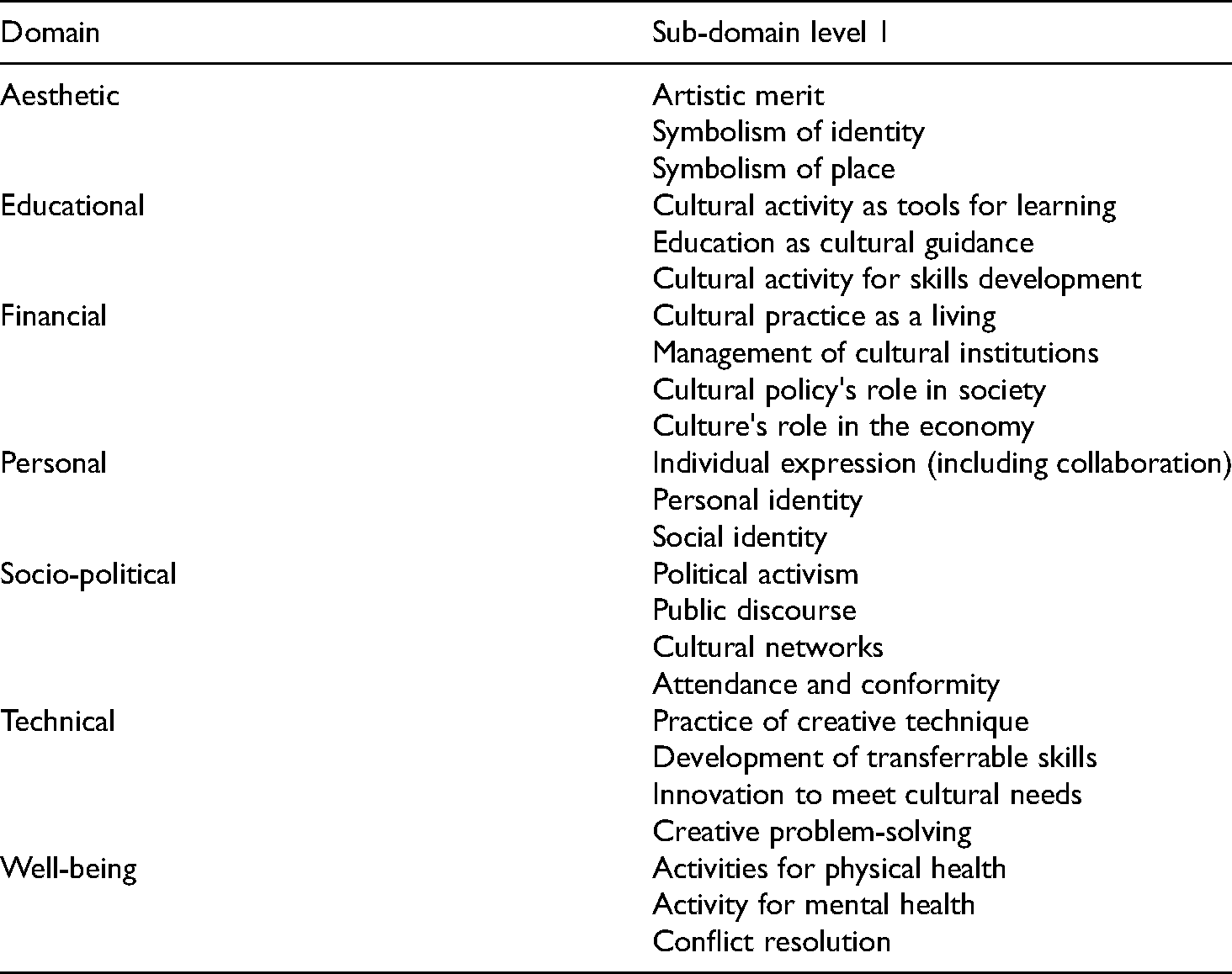
| Domain | Sub-domain level 1 |
|---|---|
| Aesthetic | Artistic merit |
| Symbolism of identity | |
| Symbolism of place | |
| Educational | Cultural activity as tools for learning |
| Education as cultural guidance | |
| Cultural activity for skills development | |
| Financial | Cultural practice as a living |
| Management of cultural institutions | |
| Cultural policy's role in society | |
| Culture's role in the economy | |
| Personal | Individual expression (including collaboration) |
| Personal identity | |
| Social identity | |
| Socio-political | Political activism |
| Public discourse | |
| Cultural networks | |
| Attendance and conformity | |
| Technical | Practice of creative technique |
| Development of transferrable skills | |
| Innovation to meet cultural needs | |
| Creative problem-solving | |
| Well-being | Activities for physical health |
| Activity for mental health | |
| Conflict resolution |