



Abstract
Keywords
Introduction
Classical music concerts are a unique blend of sensory, emotional and intellectual stimulation, often leaving a lasting imprint on their attendees. However, what specific aspects of these experiences remain in our memories, and what elements fade over time? Much has been written on how music enables autobiographical memories (Ghosh and Jakubowski, 2021; Janata et al., 2007). Studies show that music can trigger memories and that it influences the way we remember the past (Ghosh and Jakubowski, 2021; Hennis et al., 1999; Kubit and Janata, 2022; Lippman and Greenwood, 2012). Most work in this area has taken up the question of how music triggers memories of past life events, but little research focuses on the remembrance of musical events themselves. This study seeks to explore the immediate and lasting impressions of a classical concert. The article's premise is: If one remembers something as pleasant, beautiful, or outstanding, the desire to repeat that event becomes more likely, as compared to an experience remembered as boring or meaningless – or not remembered at all. For this reason, the present study examines the memories developed following a classical concert. To do this, we compare concert visitors’ impressions from immediately after a concert (interview participants) with memories of the same concert that remain with them after several weeks (survey). Research focusing on the interplay of impressions experienced directly at the classical music concert and later memories of the concert is relevant because the decision to attend a subsequent classical concert depends on previous experiences and the memories generated (Kuwabara and Pillemer, 2010). If the experience has a positive impact, a visitor's likelihood of attending another concert in the future increases. Concert organisers should therefore know what elements have positive impacts on their audience members and what it is they remember long-term.
Current state of the research: memories of music events
Memories of music events, such as classical concerts, have been little researched. Only a few studies regarding rock and pop concerts and festivals exist (Cohen, 2014; Wood et al., 2023). These studies emphasise the importance of musical experience as a common, shared experience.
Wood et al. (2023) refer in their interview-based research (n = 12) to festivals, which as multiday travel experiences contain multiple components that contribute to a shared ‘we-feeling’. The authors analysed how the participants’ reports of their memories were merged, negotiated, coordinated and changed, in a conversation, in order to meet the needs of the narrator or listener. As part of the qualitative interview analysis, Wood et al. came to the conclusion that remembering a shared journey and musical experience with a co-attendee reinforces the process of creating a shared reality (Wood et al., 2023). They emphasise that a sense of community is developed based on the shared concert experience (Wood et al., 2023).
In their quantitative study (n = 153), Chen and Cabrera (2022) conclude that the music itself and the way it is performed are the most important aspects of the classical concert experience. Using a 5-point Likert scale, they investigated the question of what visitors of a classical concert consider important from their memories. The questions, however, were not related to any specific concert that the respondents had attended. They were simply asked for their general assessment based on past concert experiences. Regarding the results of all participants, the authors summarise that the music, the musicians’ performance, and the acoustics are decisive for the overall experience of a concert (Chen and Cabrera, 2022). In addition, the authors note that visual components, comfort and the connection experienced with the musicians play a role: Overall enjoyment of the concert was also most affected by repertoire and musician, then the acoustic factors, followed by visual factors, physical comfort, and connection with the musicians. Other relevant experiences and auxiliary factors were considered less important but still moderately important. Connecting with or meeting other audience members was only slightly important to not important. (Chen and Cabrera, 2022: 10)
In a study on (non)attendances of art and cultural institutions conducted in Berlin, 1248 students were surveyed, and pre- and post-visit interviews were conducted with 77 of those (Tröndle 2022). The results show that one's musical taste and knowledge, leisure activity preferences, circle of friends and course of studies significantly impact the decision of whether to attend classical concerts. Interview results showed that proximity, in all dimensions, was key for the cultural participation of the interviewees.
The multi-year international research project Experimental Concert Research, produced several theoretical articles and empirical studies, shedding light on various aspects of the aesthetic experience of concerts (Wald-Fuhrmann et al., 2021); the physiology of the listener's experience (Tschacher et al., 2024a, 2024b); visitor types (Tröndle et al., 2025); and listening modes in classical concerts (Weining et al., 2025), among many other topics (experimental-concert-research.org). In this article, therefore, we do not aim to discuss the aesthetic experience of classical concerts in general or matters relating to audience development but rather focus on the specific aspect of remembering classical concerts.
Methodology
This study is based on the research project Experimental Concert Research (2018–2023), which conducted interdisciplinary research regarding the perception of classical concerts (experimental-concert-research.org). For this large-scale research project, 11 classical concerts were held in Berlin between April 12 and May 5, 2022. On the first two evenings, the concert took place in the Pierre Boulez Saal in Berlin (www.boulezsaal.de), and the remaining nine evenings occurred at Radialsystem (www.radialsystem.de), also in Berlin. Three of the 11 concerts were performed by the emerging Yubal Ensemble (WWW 1) and eight concerts by Ensemble Epitaph (WWW 2), which brings together established artists (including Alban Gerhardt and Baiba Skride). Each evening's musical programme featured the same pieces:
Ludwig van Beethoven, String Quintet op. 104 in C minor, Allegro con Brio Brett Dean, Epitaphs I–V Johannes Brahms, String Quintet op. 111 in G major
The experimental setting was changed in each concert to investigate the effects of different concert formats. These included: changing concert venues, changing ensembles, changing the musical program's sequence, adding moderation, changing light settings, and adding interactive note format and screens (in detail, see Tröndle et al., 2025b).
Two phases of the study are relevant for the present investigation: the 79 interviews conducted immediately after the concert (interview), and a follow-up online survey conducted six weeks later with 345 participants (survey). The subsequent online survey has already been analysed under the title Memories of the Concert Experience–What Remains? (Böndel et al., 2025). The categories inductively developed for coding the responses of the subsequent online survey were adopted for the analysis of the interview responses, and in some cases further developed. According to Flick ‘it makes sense if the combined methodological approaches open up different perspectives’ (Flick, 2011: 49). The same principle applies in this context, as two different qualitative research methods were used: the interview directly following the concert, and the subsequent online survey six weeks later. The face-to-face interviews provided the opportunity to ask participants questions directly and to dig deeper, while the online survey allowed us to reach concertgoers weeks after their visit. This triangulation of research methods provided information about the participants’ immediate impressions of the classical concert and their lasting memories, thus enabling a deeper understanding of the concert experience. Figure 1 provides an overview of the methodological approach.
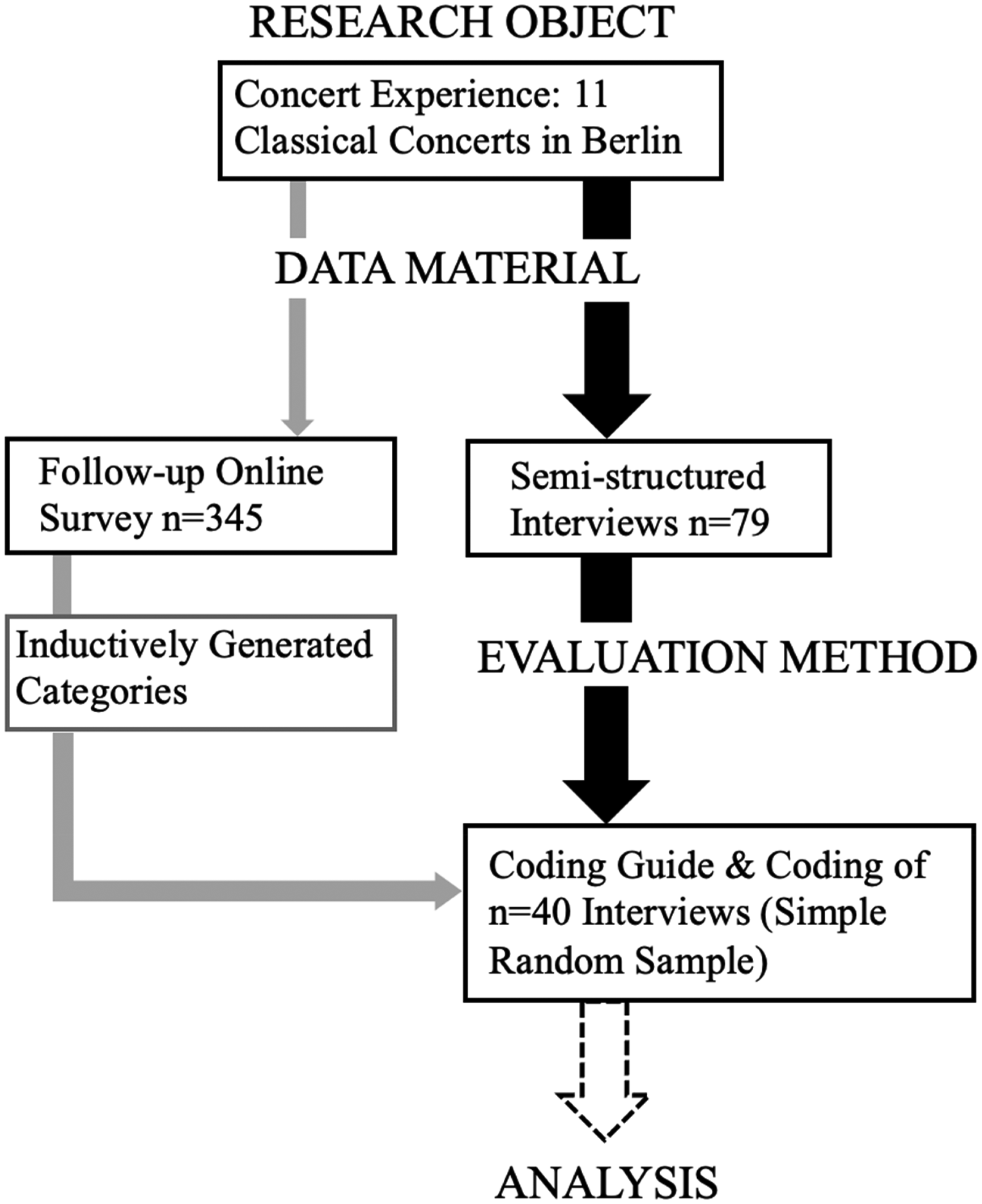
Overview of methodological approach.
The above schematic representation of the research procedure illustrates how the immediate post-concert interviews and subsequent online survey are interrelated.
Sample interviews and follow-up online survey
After each concert, there was a random selection of visitors who were categorised as normal concertgoers, that is, whose physiological data had not been recorded during the concert. These randomly selected visitors were asked if they would like to participate in an interview as part of the Experimental Concert Research study. Visitors who attended the concerts in a group were permitted to be interviewed as a group. A total of 79 groups were interviewed, with the number of participants per interview varying between one and three people, with n = 136 respondents. Interviews with two people were conducted most frequently. The interview participants were on average 48 years old, and 50.0% identified as female and 50.0% as male. The interview analysis was a qualitative method and was characterised by a small sample size, which could be analysed and interpreted in detail (Pohlmann, 2022). For the purposes of this article, we discuss 40 of the 79 interview groups that were coded and evaluated. To select these 40 interviewed groups, a simple random sample was drawn using the online random generator Ultimate Solver. These 40 interviews contain n = 70 interviewed concert participants. The average age in this randomised sample of interviews is 46.8 years, with 50.0% identifying as female and 50.0% as male. In terms of age and gender, the sample is highly comparable with the total number of interviews. The categories derived from analysing the first 20 interviews were confirmed in the course of analysing the randomly selected 40 interviews. We are confident, therefore, that the smaller sample remained representative and all relevant aspects to deeply investigate the research question were captured.
Of the participants who did not partake in the interview, many agreed to participate in a later follow-up online survey six weeks later and voluntarily provided their email addresses. From this group, 346 people opened the emailed link and answered the following four questions:
Generally speaking, what do you remember about the concert? Can you please tell us the composers and pieces that were played that evening? Was there anything that particularly impressed or moved you that evening? If so, what? What else would you like to tell us?
The adjusted sample is n = 345 with an average age of 43.9 years. Among this group, 56.5% identified as female and 41.2% as male. This sample of the follow-up online survey did not overlap with the sample of the interviews conducted immediately after the concert.
The questions were pretested in a series of three concerts at the same venue held in 2020. The questionnaire was subsequently slightly adjusted.
Empirical procedure: Interviews
Semi structured guided group interviews were held directly after the concert. Instead of gaining an idea of the material through numerical evaluation of the data and its statistical calculation, as in quantitative research, the data in this study was recorded, analysed, and interpreted in terms of content in order to identify existing patterns (Hopf, 2022).
The interviews were conducted in the spring of 2022 by 14 individuals who volunteered for this activity. They included BA students, MA students, PhD students, and postdocs who had all received the same briefing, had music backgrounds, and used the same interview guidelines.
Concertgoers who agreed to the immediate post-concert interview were shown to a room next to the concert hall where various seating options and bottles of water were available. After an interviewer had taken a seat with one or more participants (up to three people per interview were permitted), verbal consent was obtained to record the interview. In 78 out of 79 cases, the recording was approved.
Between August and December 2022, the interviews were transcribed and the transcription double-checked. Content analysis of the interviews was conducted in 2023, using the qualitative data analysis program MAXQDA. The categories were developed according to Kuckartz's principle of deductive-inductive category formation (Kuckartz, 2016). Consequently, both predetermined categories were applied to the material and new categories were developed from the material in the process of working with it (Kuckartz, 2016). The coding guide created for evaluating the interviews is based on Mayring's approach and includes the category name, the corresponding definition, anchor examples, and specific coding rules in tabular form (Mayring, 2022). The predetermined categories were derived from the interview analysis (in 2023); the analysis of the answers of the subsequent online survey took place in 2024. The study by Böndel et al. (2025) shows in detail how the themes emerged from the survey, and analyses them.
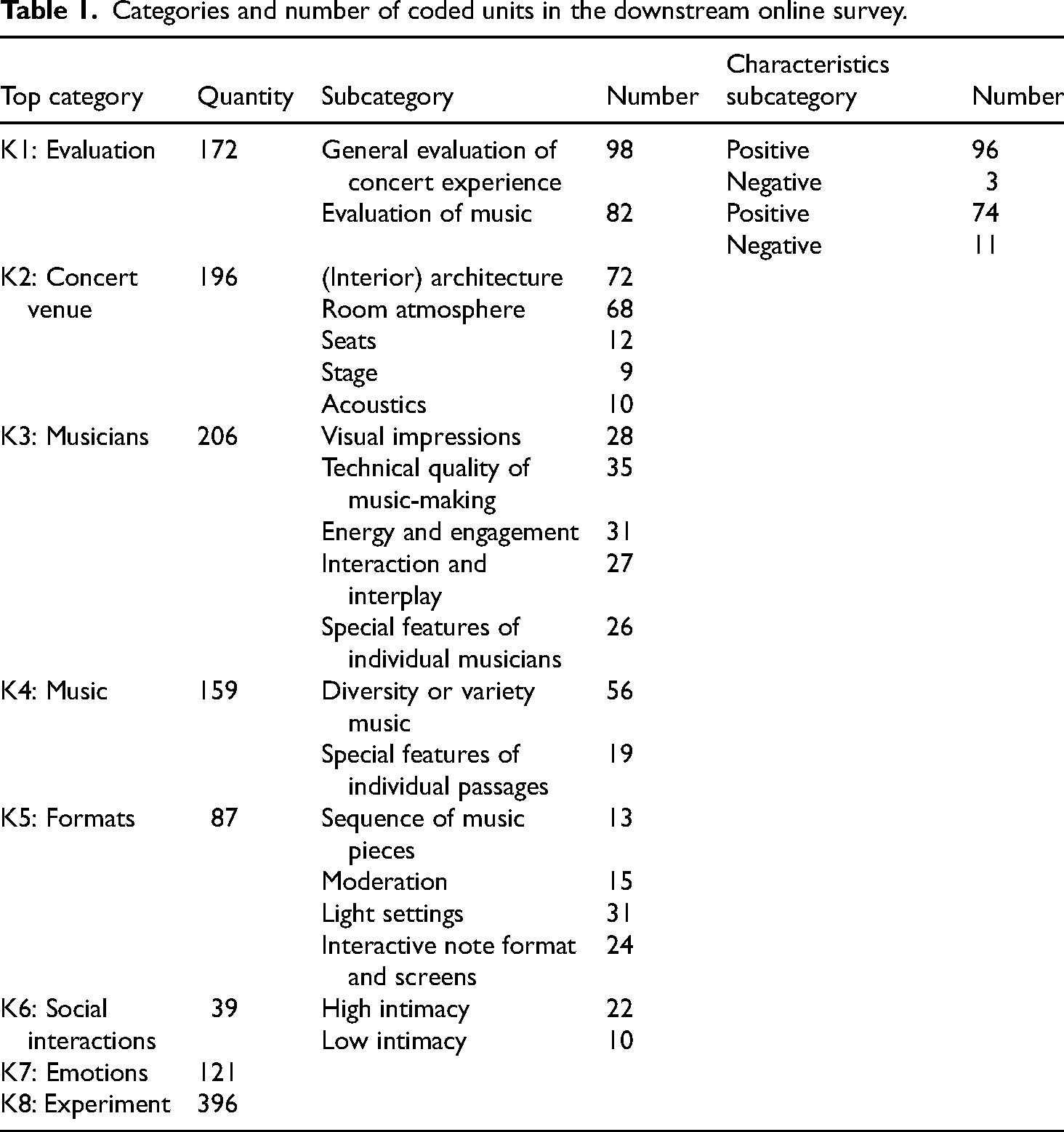
The following categories (Table 1), initially developed for coding the responses of the subsequent online survey, served as the basis for the coding guide for evaluating the guideline interviews analysed in this study.
Categories and number of coded units in the downstream online survey.
To ensure comparability between the results of the interviews conducted immediately after the concert and the online survey sent six weeks later, we decided to include only the first and second interview question in the analysis. These first two interview questions are broad and therefore do not push the participants’ answers in any particular direction. They are:
What did you think of the evening, i.e., what you just heard and saw? If you were to tell someone else who wasn’t there today about the concert, what would you say about the evening?
This open-ended type of question, which gives participants the freedom to identify their own notable thoughts about the concert visit, is similar to the open-ended questions in the subsequent online survey, which relate to the visitors’ memories.
It is obvious that the two methods capture different data. With the immediate post-concert interviews, we had the opportunity to obtain detailed answers in a conversation. Several weeks after the concert, we were only able to survey concertgoers online. The survey also encompassed a qualitative approach, but, in contrast to the interviews, the answers were much shorter. Employing two different methods is used for triangulation purposes, and each method involved a different approach. By using both sources, we aimed to gain valuable insights into the memories of the concert visitors. Both the interview and survey were specifically designed for examining the concert experience and visitors’ memories of the concert.
Results
The top category Evaluation contains the two subcategories General evaluation of concert experience and Evaluation of music. These two subcategories contain the positive and negative characteristics already generated from the online survey. These characteristics were inductively supplemented with the further characteristic, ambivalent, from the data generated from the immediate post-concert interviews. The evaluative statements made in the interviews were thus divided into the categories ‘positive’, ‘negative’ and ‘ambivalent’.
The results of the subsequent online survey show that the concertgoers’ evaluative memories were mostly positive: 97.9% of the evaluative statements regarding the entire evening were positive, while 3.0% were negative (due to a few double-coded ambivalent evaluations, the total is 100.9%). The interview results show that, even immediately after the concert, most of the general evaluative statements contained a positive assessment of the concert evening: 87.4% of the evaluative statements were positive, 9.8% ambivalent, and 2.8% negative. Positive assessments also predominated regarding the general evaluation of the music: the survey results show that 90.2% of the evaluative statements regarding the music were positive, while 13.4% were negative (here, too, double coding occurred due to ambivalent evaluations). A similar trend can be observed in the interview results: 88.2% of the evaluative statements were positive, while 11.8% were ambivalent. There were no negative general evaluative statements regarding the music.
The predominantly positive overall impression of the event and the generally positive assessment of the music can be found in the statements given immediately after the concert and also in the memories surveyed six weeks later. Specifically, the survey participants, when making a positive overall assessment of the evening, said things like: ‘I remember a nice, entertaining concert evening’ (Tok. yb6um), ‘I have very fond memories of the evening’ (Tok. 9j4mf), ‘I found it exciting and overall had a very nice evening!’ (Tok. Shnhy).
The positive overall assessment of the concert evening in the interviews included such statements as: ‘I thought it was very positive. I personally liked it very much’ (Int. 14), ‘I think it was really nice. I would definitely recommend it to others’ (Int. 30), ‘I would say it was a nice evening of chamber music’ (Int. 77).
Positive evaluations of the music in the online survey were expressed as follows: ‘wonderful special music’ (Tok. 7ufw2), ‘it was great music’ (Tok. Bvzbf), ‘interesting and beautiful pieces of music’ (Tok. en9px).
Positive assessment of the music in the interviews included: ‘So that really–I completely switched off. I just listened to music, yes. I thought that was nice, so I liked that’ (Int. 32), ‘I also thought again about the music itself. I thought it was a lively evening. I found the music very moving, moving and lively’ (Int. 40).
The role of the concert venue
The Concert venue is a main category that influences the overall rating. Subcategories include (Interior) architecture, Room atmosphere, Seats, Stage and Acoustics. If we first look at the responses to the follow-up online survey, the participants stated that they remembered the ‘hall’ (Tok. 9t5aw), ‘the location’ (Tok. xgyhd), ‘the atmosphere and the premises’ (Tok. qoxb8), and ‘the room situation’ (Tok. h3fy3). However, these descriptions were often vague, and it remains unclear which features of the concert venue were so notable and impressive for the participants that it made a ‘memory of the venue’ (Tok. ze6gf). The distribution of survey participants between the two concert venues, the Pierre Boulez Saal and Radialsystem, reflects the fact that nine of the 11 concerts took place at Radialsystem: 21.74% of participants experienced the concert in the Pierre Boulez Saal, while 78.26% attended at Radialsystem. Nevertheless, participants at both locations cited the concert venue when asked six weeks later what they remembered. However, the statements in the survey differ very little in their depth of description. For example, someone who attended at Radialsystem wrote: ‘I remember what the location looked like’ (Tok. 2axbe), while someone who attended at the Pierre Boulez Saal said: ‘I remember the beautiful concert hall’ (Tok. eb9k4).
In the interviews conducted immediately after the respective concerts, however, the interviewees gave deeper insights. Here, the descriptions differed depending on the venue at which the concert was experienced. Of the n = 70 interviewees, 25.71% attended at Radialsystem and 74.29% at the Pierre Boulez Saal. In both groups, the interviewees explicitly described the concert venue and what they found particularly striking about it, referring to its different characteristics. One participant interviewed following a Pierre Boulez Saal concert related the atmosphere to the materials, colours and shapes of the concert hall: Well, first of all I was curious about the hall, and I think it's very, very nice. I like the atmosphere of this hall, really. And of course, I know many concert halls, but you immediately get a very warm feeling here, a very pleasant feeling. So, it has a kind of inspiration that really makes you want to listen. (B2w: Exactly) That's because of the wood, that's because of the colors, that's certainly also because of this unique form of square and oval, which is an interesting mixture. (Int. 57) I mean the room, and the hall, as such, is interesting in that you sit around it and don’t have the classic frontal view. And I was sitting behind the musicians, which means I couldn’t see some of their faces. I think it's a very special atmosphere, because you have an all-round seating arrangement and you see the other listeners, you can see their faces and see their reactions … and that's why I find the place different and special, in contrast to many other concert halls. Venue and music, I think, both play a big role here. (Int. 45) I would definitely say special and unique, because when I usually go to classical concerts, it's in a huge hall, a big concert hall or philharmonic hall, you know, huge. And so, it was somehow nicer, so personal, that you could put yourself in the artists’ shoes a bit. And I would definitely recommend it to others. (Int. 66) Because it was a small ensemble, a quintet, I perceived it as something fine and delicate–a small concert. I found it–but that has something to do with the space–I always like it very much when I see the musicians playing. Can you be a bit more specific about what you liked so much about it? We were sitting in the front row, so I felt very close, very involved in the music. And because it was a quintet, it wasn’t in a big room with a huge distance and I felt very connected to the music. I felt the same. (Int. 75) I like listening to classical music and I found that it was somehow closer here, because often classical music feels more distant for me, but here I somehow felt closer and more connected to it. They [the pieces of music] really got into body, I thought, and it could also be because of the space here, that you are close to it and not so far away like in a spacious concert hall. (Int. 72)
Perspectives on the musicians
The main category Musicians consists of the subcategories Visual impressions, Technical quality of music-making, Energy and commitment, Interaction, and Special features of individual musicians. The results of the follow-up survey show that the participants independently recalled all these subcategories when asked about their general memories. With regard to the energy and commitment of the musicians and their interaction, participants responded, for example: ‘I remember the committed quintet making music’ (Tok. wsbk9), ‘Seeing the emotion/concentration and passion of the musicians’ (Tok. afosj), ‘The positive energy of the young ensemble’ (Tok. acmu2), ‘How the musicians acted together and communicated with their instruments’ (Tok. jrsfn). Memories of visual impressions, such as the musicians’ clothing and facial expressions, were described, as follows, in the survey results: ‘all dressed in black’ (‘ (Tok. 5zbtu), ‘First violin had a cool style’ (Tok. to9e8), ‘I found the musicians’ facial expressions exciting’ (Tok. twbnz). The participants also mentioned the technical quality of the music-making: ‘I remember the very good interpretations and performances’ (Tok. do6h4), ‘The quality of the performance with technical and musical perfection’ (Tok. qqwba). Similarly, special features of individual musicians were still anchored in the participants’ memories even after six weeks: ‘I remember the one violin player with the broken string’ (Tok. pnftc), ‘that the one musician (violin) had forgotten his sheet music and had to run back to get it’ (Tok. cjgaa), ‘I remember the cellist Alban Gerhardt’ (Tok. 9j4mf).
In the interviews conducted immediately after the concert, the participants also referred to visual impressions such as the artists’ facial expressions and gestures. They associated these visual impressions with a feeling of connection and closeness to the musicians: ‘I felt very, somehow connected because they had strong facial expressions and so you could see how they felt or supposedly felt while playing the pieces. It was nice to be able to see that, to be able to participate and somehow share their emotions’ (Int. 6). The interviewees independently emphasised the energy and commitment that the musicians conveyed and the interaction between them: […] it was also visually interesting, because the group or the performers were very much in interaction with each other, and I found that very nice to watch. Yes, actually you’ve already said it, but I found this combination of these different pieces very nice to watch, and how the musicians interacted with one another, how they looked at each other and also communicated with their eyes – and somehow were still in their own bubble while playing, but were also together in one, I found that quite nice to watch. (Int. 72) What I really found interesting was the communication between the musicians. […] and I had the feeling that they are already playing together for a long time. Somehow, they had such a good shared energy when making music. I thought it was very nice, both musically, but also to watch the interpersonal interaction. (Int. 40)
Some interviewees also described individual musicians and special features that they had noticed about them. In one interview, for example, the cellist Alban Gerhardt was highlighted: […] it was so appropriate and suited the concert so well, that after the second movement of Brahms there was this first movement of the other piece. Yes, it ended and then continued with exactly the same note. […] linking together these very different pieces was totally exciting. And it was also very surprising for me, I thought ‘Okay, what happens next?’ I don’t know if you meant this transition, but I felt the same kind of surprise when Alban Gerhardt then continued with the cello with the same note with which the movement had ended before. Exactly. (Int. 22)
The effect of music
The main category Music contains the two subcategories Diversity or variety of music and Special features of individual passages. It is striking that the results of both the follow-up online survey and the interviews were clearly more frequently assigned to the subcategory Diversity or variety of music. In some cases, the survey participants even explicitly mentioned that they could remember the different types of music or the overall compositional picture but could not recall any specific melodies or individual passages: ‘I certainly couldn’t reconstruct a single song, which is a shame, but I still remember the overall impression of the music very well’ (Tok. oax5c). Six weeks after the concert, many participants remembered ‘different styles’ (Tok. xgyhd), ‘a varied program’ (Tok. nfb4x), ‘very different musical styles of the pieces’ (Tok. hokrg), and ‘the sometimes very modern music in contrast to the classical music’ (Tok. 9mdzv). The participants interviewed immediately after the concert described the diversity of the music in more detail and explained how this diversity shaped their concert experience: […] so two classical pieces and one experimental piece. And this alternation of these pieces was very exciting. Has it influenced your concert experience? Would you say so? Definitely. Yes. In what way? In what way? That it had such an arc of tension. That the whole thing at the beginning had this total sinking in, and in the middle, this waking up through this other piece. So a strong awakening and being completely present again and then sinking in a bit more at the end. But it was a nice tension curve of relaxation and being very aware and present. (Int. 11) So, with the first piece, the Beethoven, I really noticed how I went along with it, sang along inside and breathed along and felt the joy and relaxation. With the Dean, that wasn’t my kind of music, I felt very stressed at times. And with the Brahms, I was able to get involved and open up to it again. (Int. 52) […] if the music was somehow happy and the musicians were all laughing at each other or smiling, I also had this feeling, and I was swaying along. And when it was very dramatic, it was easy to get the feeling that it was a stressful situation because the music was getting so dramatic, and it was building up, so I got very tense. (Int. 66)
Emotional facets of the concert experience
The main category Emotions contains the subcategories positive, negative and ambivalent, which were generated inductively in the interviews. In the follow-up online survey, the description of the emotions experienced at the concert remained very vague and superficial: ‘I remember well-played music that triggered a wide variety of feelings in me’ (Tok. 79bod), ‘I remember the interplay of music and my own feelings’ (Tok. o9sf2). As such, the specific feelings and emotions experienced at the concert, as well as what triggered them, remain unclear in the survey results.
The interview participants, however, went into depth and explained their emotions. They focused in particular on immersion and the extent to which personal willingness to engage with the music influences the concert experience. They also emphasised the special nature of the concert event, which lies outside the everyday routine and can therefore evoke positive feelings of relaxation: Well, if you open up and get emotionally involved and really let this music have an effect on you, it does something–to me at least. It makes me very happy. I like to breathe with the music. And when I see that the musicians are also having fun, then that is transferred onto me, that there is a certain energy and fun in playing. I definitely felt that tonight and that's why I was able to get fully involved, yes, I was taken along. (Int. 3) I feel like a concert is always a little oasis. It has such surreal moments and it is a nice way to end the day. But yeah, it's just a completely different world. So you immerse yourself in a completely different world and, well, it's not just a nice end to the day, but it also builds up a distance to everyday life and reality, and that's what I like about it. (Int. 51) Dean, exactly […] there is tension in it. At the beginning you feel a bit skeptical: What does he want to say? But little by little, you sense the tension. It emerges to be some sort of panic, and somehow it is as if the composer is in an emergency situation and he's desperate to get out of it. Yes, can you describe this tension in a little more detail? Yes, so like, he really wants to get out of it. As if the composer is in a small room and he is locked up and he just wants to get out […] or if he is being chased and he just wants to get away from someone. (Int. 30) It's exciting to hear this mixture. […] I think it was good that I didn’t know what the concert was gonna be like. Yeah, I think it was good that it was so diverse […]. That's exactly it–this mixture of tension and relaxation that somehow increased and then decreased at the end. And this concentration in the middle. (Int. 11) Yes, so the last one, I would say, is a kind of journey of the heart, which is all about feelings. I found the middle one more […] well, it could have been just random playing. It had no meaning for me. And the first one, that was Beethoven, it I found very controlled, very organized, very planned, very structured. Those were the things that I felt. That sounds good, you described a ‘journey of the heart’. (B1m: Yes.) What emotions would you say came up for you within that journey? Joy. Tension. Calmness. Excitement. So lots of different emotions. But then it was ups and downs – really a journey. (Int. 13) I found it also very beautiful. The pieces that were played in the middle [Epitaphs I–V by Brett Dean], reminded me very much of the seasons and of natural spectacles. I don’t know why […]. What kind of natural spectacles? For example, the savanna and the wind blows sharply, or snowfall or waterfalls or something like that. (Int. 61) The middle piece [Epitaphs I–V by Brett Dean] triggered different feelings than normal music would trigger; you know, even other classical music doesn’t trigger these feelings. I couldn’t even define exactly what it was, if it was actually music or just sounds that somehow stimulated the emotions. And I thought that was crazy, but I don’t know how I could describe it […] painting these feelings might work. Okay, what would you paint if you could paint the feelings? I can’t paint feelings! (laughs, points to B1w) (addressing B1w) You can paint feelings? Yes, but not always! […] and if I were to paint it, I would paint the ocean and, well, turmoil and restlessness. (Int. 6)
The influence of different concert formats
The various concert formats were a central component of the Experimental Concert Research project (Tröndle et al., 2025b). This main category Formats can be broken down into the subcategories Sequence of music pieces, Moderation, Light settings, and Interactive note format and screens (with live close-ups of the artists and others). For the latter, the interactive aspect, participants were invited to write the names of deceased relatives on slips of paper. During the concert, the paper slips were displayed on two pinboards positioned diagonally at the back right of the stage.
The follow-up survey results show that the different elements of the various formats were mentioned, but less frequently and more superficially than expected when planning these concert formats. Most survey statements regarding the formats referred to the changing light settings: ‘I remember the changing light’ (Tok. zmoey), ‘the changing lighting’ (Tok. fdfaa), ‘the different light and colour effects during the pieces’ (Tok. pxr2c). However, how the changing light settings influenced the concert experience and what effects the different formats had on the overall perception of the concert remain unclear.
The interview results, on the other hand, show that the changing lighting conditions usually had a positive influence on the general concert experience. But even in these interviews conducted immediately after the concert, only a few participants mentioned specifics about the different concert formats: ‘and of course I noticed the different lighting moods, I found that quite supportive, yes, actually very supportive’ (Int. 34). Some interviewees also mentioned the light settings together with other aspects of the various formats, such as the interactive initiative with the slips of paper: And what makes it so recommendable? Definitely these new formats, the lights and this pinboard and the videoclips. […] I had a feeling that these recordings of the musicians were a movie. That the artists were playing themselves as actors in a movie and at the same time they were making the film music themselves. So, they themselves make the accompanying music to their own movie, and I thought that was really cool. (Int. 30)
Social interactions in the context of the classical concert
A further main category, Social Interactions, with the subcategories High intimacy and Low intimacy, was extended within the analysis of the interviews with the new subcategory Shared experience. This category and subcategories were mentioned comparatively rarely, similar to the category Formats, described above. The concert was only infrequently described as a shared experience. Interactions with friends or family or interactions with other concertgoers were also no emphasised by most interviewees. Occasionally, participants in the follow-up online survey responded with statements such as ‘I was happy to spend the evening with my friend, who was in the city to visit me from further away’ (Tok. of3ze), ‘I remember being there together with the family’ (Tok. xzo78), ‘holding hands with my new love’ (Tok. qbrgm), which were coded in the subcategory High intimacy. Statements such as ‘my boss was sitting in the audience’ (Tok. ujpba) or ‘I remember the audience’ (Tok. xzptd) were coded in the subcategory Low intimacy. The subcategory Shared experience was only created inductively by reviewing the materials from the conversations conducted immediately after the concert.
In the immediate post-concert interviews, only one out of 70 respondents explicitly mentioned that they perceived the concert as a shared experience: And could you describe what you mean when you say ‘it gets under your skin’? Yes […] I feel gratitude to be a guest here and to be able to listen to such a concert. And, well, to share this event with the other audience members. (Int. 53)
Results overview
A comparison of the two methods’ results clearly shows that the concert experience was evaluated immediately after the experience and that the concertgoers still remembered their evaluations six weeks later. Immediately after the concert, it was the musicians and their performance, the music, and the emotions triggered in the audience that played the most important role. The concert venue also played a significant part. The unusual formats and the social interactions that the participants had during the concert evening were mentioned less frequently. Six weeks later, in the follow-up survey, the musicians and their performance still occupied an important spot in the participants’ memories. Memories of the music, the emotions, and the concert venue had already faded somewhat, but nevertheless still played a role in the participants’ recollections. Still six weeks after the concert, the formats and social interactions were mentioned only sporadically and played a subordinate role. Figures 2 and 3 provide a weighted overview, with the subcategories aggregated in each case.
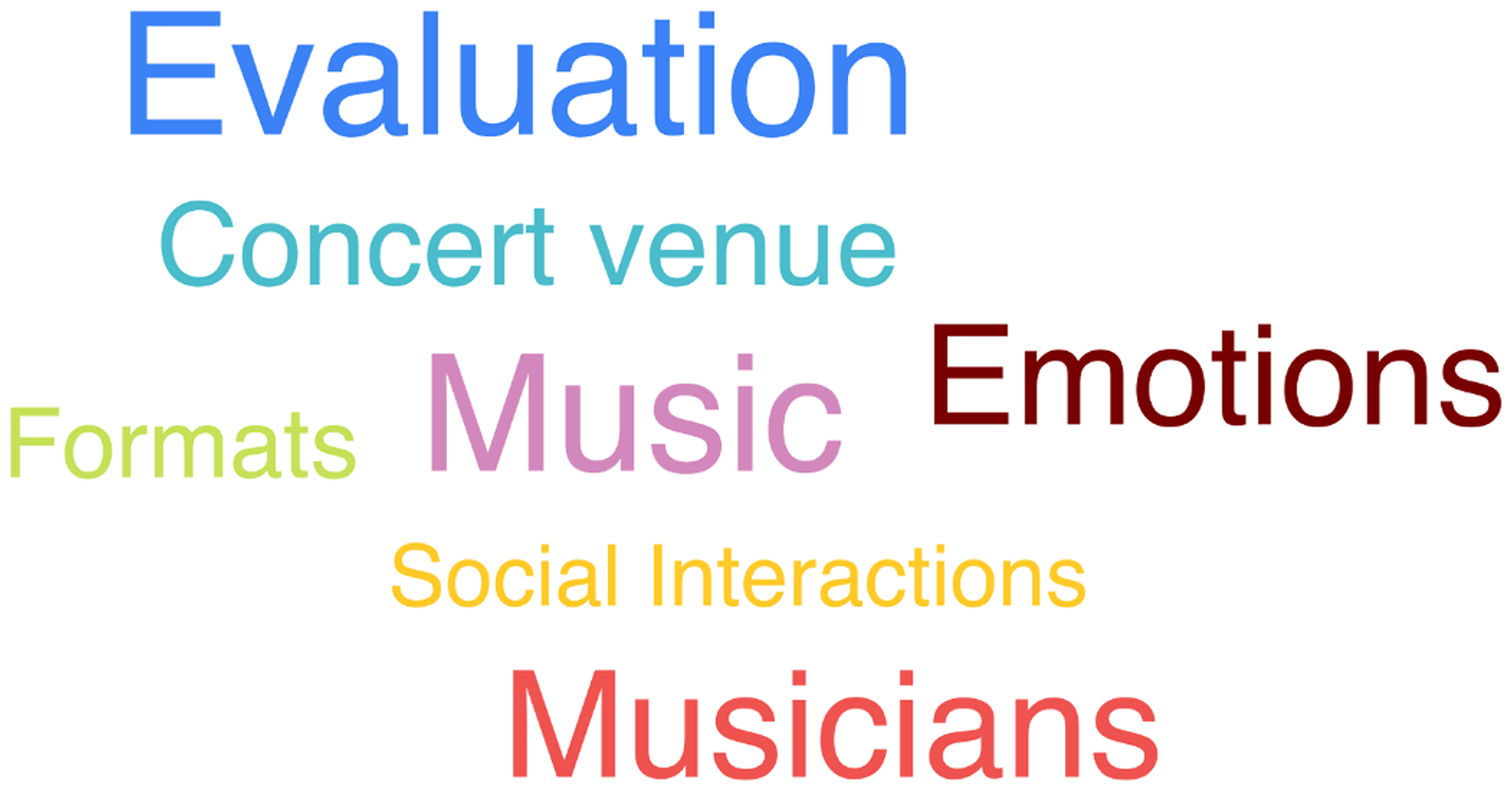
Word cloud – immediate interviews.
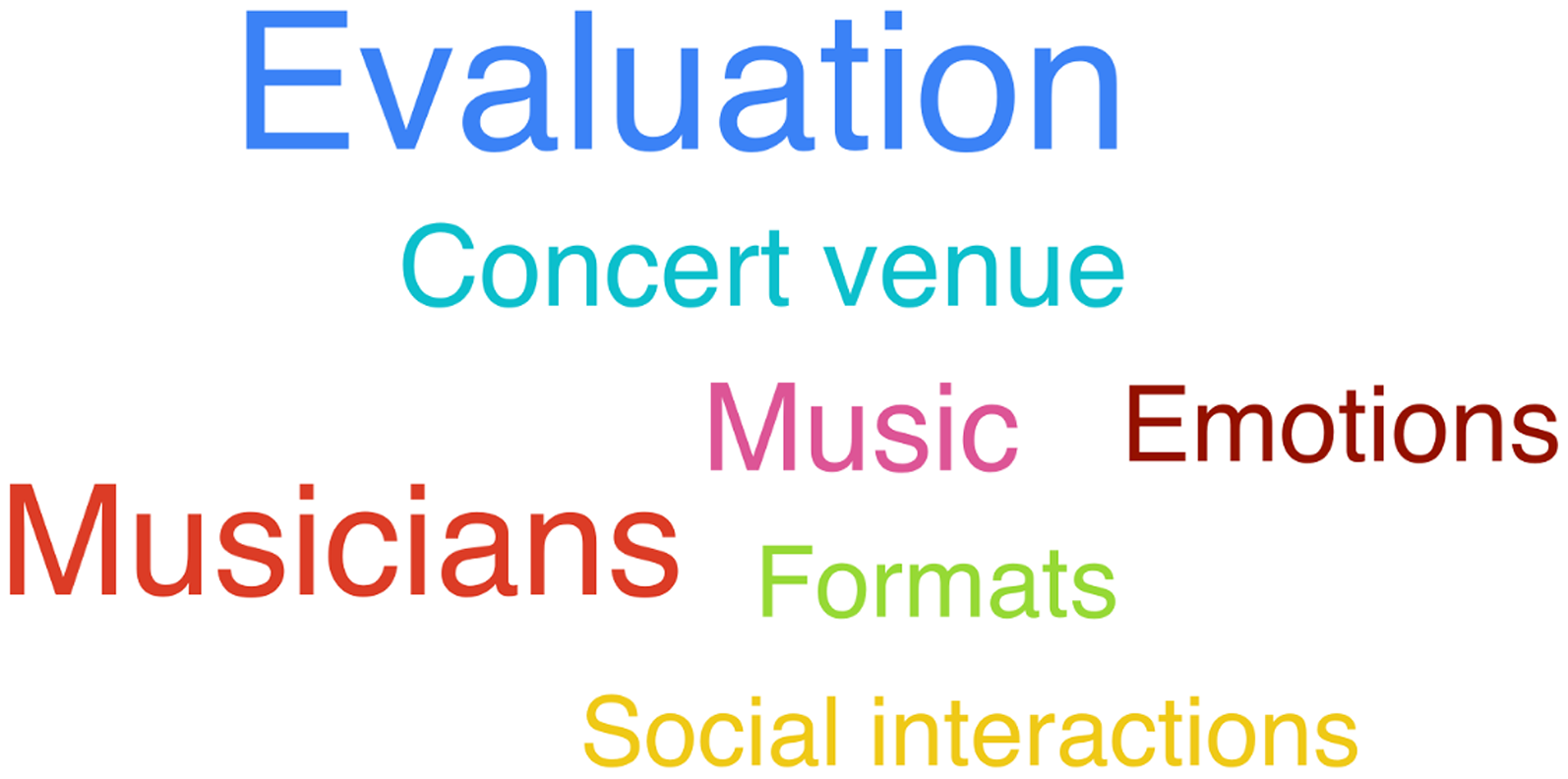
Word cloud – follow-up online survey.
Discussion
The interviews conducted immediately after the concert show that certain visual components, such as the musicians’ facial expressions, are perceived as being related to the musicians’ communication and interaction with each other. The fact that these observable elements play an important role in the visitors’ concert experience is consistent with the findings of Kawase (2013). This finding – that the view of the stage and, thus, the observation of the musicians is relevant to the concert experience – can also be found in our study. Spatial proximity, specifically the shortest possible distance between the individual seat and the stage, goes hand in hand with a feeling of ‘musical proximity’ to the musicians, which can be interpreted as empathy or sympathy. In the immediate post-concert interviews, participants stated that they could empathise with the musicians based on the facial expressions they observed; that is, that they felt connected and close to the musicians as a result of being able to observe them. That the visual impressions of the musicians significantly shape the concert experience and create a feeling of closeness is also supported by the results of the quantitative study by Chen and Cabrera (2022). The authors come to the conclusion that the music played (the repertoire) is the most important aspect of the concert experience for people who frequently go to classical concerts (Chen and Cabrera, 2022: 15). However if the results are considered independently of how often participants attend classical concerts, then observation of the musicians’ performance is actually the most important factor (Chen and Cabrera, 2022: 14). Visual impressions seem to be a catalyst for closeness
Music and emotions
The diversity of music played at the concert – the musical program – was often mentioned in the interviews together with ambivalent emotions. The concertgoers reported an arc of tension, an emotional change between tension and relaxation, an alternation between openness to the music and stress, and sensations of sinking in and waking up. This musical closeness – which interviewees described as ‘going along with the music’, or, in other words, ‘getting involved with it’ – also becomes apparent in their responses referring to specific images and associations that the music evoked. For example, visitors associated a small room with the image of someone being locked up and panicking. Other images triggered by the music were wind blowing across the savanna, snowfall, waterfalls, and even the ocean. In each case, emotions were triggered. The music they experienced touched the listener, creating a strong connection, which is another form of closeness.
The concert as a communal experience
Neither immediately after the concert in the interviews nor six weeks later in the follow-up online survey were social interactions present in the participants’ responses. While 39 statements from the survey were coded in the category Social interactions, only two statements that fit this category were found in the interviews.
Our study thus differs from the existing studies on this feature (Cohen, 2014; Wood et al., 2023). Either the classical concert has lost this component (Tröndle, 2021) or it is less important here than in other forms of music. Cohen (2014) examined rock concerts, and Wood et al. (2023) analysed a festival lasting several days. Both types of events are much more physically intense experiences than a conventional classical concert. The barrier of anonymity is broken in the pushing, jostling, and dancing together at festivals and rock concerts, and a form of social closeness is created that cannot be generated by quietly sitting next to one another.
The fact that the participants did not describe their social interactions in the interviews immediately after the concert, and also did not mention them in the subsequent online survey, does not necessarily mean that they are insignificant. It might be that interviewees simply overlooked the social components of the concert due to the fact that ‘they are normal’. To investigate the importance of social interactions regarding the classical concert experience, future studies should explore how audience dynamics and nonverbal as well as verbal communication influence the overall perception and enjoyment of the event.
The dispositive of proximity in the concert context
To better classify empirical results, and thus identify a general pattern, the concept of ‘proximity’ offers a useful perspective. As Tröndle (2022) states, ‘proximity must be understood as a multidimensional concept’. He found that the decisive factor for a successful experience for a person's first visit to a classical concert is, in fact, the experienced proximity: This could be closeness in terms of content, which is thematically laid out in the performance; a dramaturgy that surprises and evokes moments of identification; the architecture of the organisation's building; the interior design of the premises; the design of the performance space and its atmosphere; the social structure of the audience; or the feeling of ‘being part of it.’ […] In short, reducing the distance to the potential audience is essential to gaining interest from ‘never’ and ‘infrequent’ visitors. (Tröndle, 2022: 92)
The idea of proximity can also be shaped with different types of visitors in mind. This way, the concert experience can be designed to align with the expectations of various target audiences. The question, then, is: How can proximity be established with this specific visitor type (Tröndle et al. 2025a)?
Practical implications
The most accessible dimension of the dispositive of proximity is ‘spatial proximity’. With regard to the classical concert experience, spatial proximity refers to the concert venue. In this context, it takes on various forms. Proximity or distance can involve the location of the venue, how easy it is to arrive at or leave this location, with or without a vehicle, how easy it is to reach the location via public transportation, and so on. In addition to the venue's surroundings and the infrastructural connection, architectural elements can also be considered from the perspective of proximity – in which case it is about the building itself. Barrier-free architecture, accessible to wheelchair users and people with walking aids, for example, ensures the formation of spatial proximity. The concert experience can further be influenced by the concept of proximity in terms of interior design.
The dimension of ‘musical proximity’ can be applied both to the artists (the musicians) and to the content (the music itself). Regarding the musicians, the proximity that the visitor can feel toward them is affected by spatial proximity: the distance of one's seat from the musicians determines the visual details one can perceive. Observing the musicians from close proximity can create a feeling of closeness to them.
Musical proximity can also relate to the music itself. As Tröndle describes, this is ‘proximity in terms of content and lifeworld, which is thematically laid out in the piece, a dramaturgy that surprises and evokes moments of identification’ (Tröndle, 2022: 92). The feeling of familiarity through proximity to content and lifeworld, but also new and unfamiliar associations that arise in the flow of the music, can indicate musical proximity. The mental attitude of engaging with the music and allowing it to come close can be understood as ‘musical closeness’. The highest form of musical closeness is perhaps becoming one with the music – its complete incorporation. Frith writes: ‘By “taking possession” of the music, we make it a part of our own identity and incorporate it into our idea of ourselves’ (Frith, 1992: 9).
The dimension of ‘social proximity’ includes the social structure of the audience, with its various constellations. Certain people with whom one has arranged to spend the concert evening are just as much a part of the social fabric as strangers with whom one happens to share the concert experience. Social proximity refers to the perceived connection and interaction with others in the social environment. It also means feeling involved and being able to experience oneself in a community.
Social dynamics, whether with acquaintances or strangers, can arise in various ways. At this point, it should be noted that, just like musical proximity, social proximity is also influenced by external factors. The design of spatial proximity can play a role in shaping social dynamics – for example, with the seating arrangement, which can encourage or inhibit social interactions. Furthermore, the external factor of behavioural codes and the degree of ritualisation play a decisive role in establishing social proximity. The way visitors’ behaviour is structured by ritual procedures in classical concerts (Tröndle, 2021) or in rock concerts (Cohen, 2014) impacts the specific social proximity created. Do the interior design and the staging of the space offer opportunities to engage in conversation before the performance, during the interval, or after the concert?
If physical and sensory impressions are limited by establishing a strictly ritualised framework around the concert, this can affect social proximity. Lowering one's voice upon entering the concert hall, queuing at the cloakroom in an orderly manner, taking one's seat after the gong has sounded, sitting still, and only clapping when the last note has faded – these are all examples of how the behavioral codes of classical concerts restrict physical and sensory experiences (see Tröndle, 2021: 33). In contrast, rock concerts, where acquaintances and strangers stand arm in arm, sing loudly, shout and whistle, create a more intense feeling of social closeness by dissolving physical distance.
With this in mind, concert organisers can ask themselves how they can establish proximity through the way we treat audience members, the roles they are assigned, the degree of freedom they are given (other than, e.g., to sit still and to remain silent)? How visitors are received and how they are sent off? What atmosphere do they enter, what do they experience, what stories are they told? Who they can meet during their visit, if they can make new friends? (Tröndle, 2022: 92)
Limitations
The Experimental Concert Research concerts took place in a highly specific cultural setting – a culturally engaged city and non-traditional venues – which likely influenced audience responses. In another city or cultural environment, audience responses may be different.
The concert experience, as it is understood in this study, could be ascertained only through interviews directly following the 11 concerts and an online follow-up survey with concertgoers. It goes without saying that an interview or written response can only ever reflect on one's experience. In other words, only what was reflected on and verbalised can be captured in the data. This should be seen as a limitation of this study. In other research contributions derived from the Experimental Concert Research project, attempts were made to get closer to the immediate experience via physiological measurements and evaluations of individual passages, among other things, in order to better understand the aesthetic experience in the moment (see experimental-concert-research.org).
Verbalising musical experiences is a challenge. The use of metaphors (snowfall, waterfall) and generalised emotional language raises the question of the extent to which the collected statements convey the depth of the concert experience. On the other hand, this is the language that the respondents chose to use. While it clearly differs from the language of musicologists, we are interested in the general population and their experiences of concerts, rather than specialists’ interpretations. The interviews shed light on a peculiar distance between the echo chambers in which music critics and academics write and those spaces that the various audience members occupy. Nevertheless, the experience of the concert is at the centre of everyone's responses, no matter what type of language they use.
In terms of future research, we would like to mention that we are building a large language model (LLM), which is being fed the data of all interviews. Users will be able to ask the LLM questions and to retrieve answers about concert experiences based on the experiences of all concert visitors.
Conclusion
The musicians and their performance, the music, and the audience member's own emotions, as well as the concert venue, the formats, and social interactions, remain essential in both short- and long-term memory. The aim is to create and facilitate closeness.
Managers of concert halls, festivals and similar events should ask themselves with every decision: Does this decision create proximity for the visitor? The guiding principle for decisions – whether artistic, social, atmospheric or otherwise – should be proximity. If a cultural organisation, in all its dimensions, fosters a sense of closeness, visitors are more likely to return. The interplay of proximity and distance should be consciously employed to reach new audiences and continue to inspire existing ones.
Footnotes

Ethical considerations
The research carried out in this project adhered to the principles outlined in the Declaration of Helsinki and complied with applicable regulations in Germany. The Ethics Council of the Max Planck Society granted approval for the procedure under reference number 2702_12.
Funding
The authors disclosed receipt of the following financial support for the research, authorship, and/or publication of this article: This study was conducted within the framework of Experimental Concert Research, which was substantially supported by the Volkswagen Foundation under Grant 93261. The Aventis Foundation supported the concert series.
Declaration of conflicting interests
The authors declared the following potential conflicts of interest with respect to the research, authorship, and/or publication of this article: Author Martin Trondle is Editor of Journal of Cultural Management and Cultural Policy and did not participate in the editorial handling or peer review process of the article.