



Abstract
Keywords
Introduction
With the development of the concert in the 18th century, music had finally become an art form of its own. In the concert, not only did the religious, social, and political functions of the works performed take center stage, but the music itself as well through its artistic, esthetic, and expressive qualities. New listening forms and behaviors were developed, which for a long time occurred in continuous interaction with the works being composed for. Because of this, public concerts in 1780 had utterly different social, spatial, acoustical, and performative contexts than those in 1840 or 1890 (Salmen, 1988). However, this dynamic process of evolving the concert format came to a premature end in the late 19th century (Heister, 1983). From that point on, the classical concert established a more or less fixed routine that was characterized, among other things, by it the concert venue, musical content (canonized works performed in a specific order), rituals (the dimming of lights before the start of the performance, applause for the entrance of the conductor and soloist, and an intermission with catering), behavioral discipline (listening attentively, remaining seated without talking during the music, and applauding only at the end of multi-movement works), and social profile (Small, 1987, 1998).
This routine was not allowed to change significantly despite the sociocultural changes of the last third of the 20th century—much unlike popular music concerts, which experienced continuous development. Such “frozen” rituals—the social routines, the canonization of programs, and the way classical concerts are staged–may be the reason why classical concerts in the West have continuously lost their power to attract new audiences and, therefore, are frequented mainly by an aging population (Glaap, 2024; Tröndle, 2021a). Although, lately, the COVID pandemic may have lowered the average age, it also lowered audience attendance numbers. Research on concert attendees and the effect on concert formats should be performed, to address this question.
Motivations to attend concerts, as well as the concert experience itself and the factors influencing it, have been noted in the literature (Burland and Pitts, 2016; Dobson, 2010; Nicholls et al., 2017; Pegg and Patterson, 2010; Pompe et al., 2013; Sigurjónsson, 2010). Pitts (2021) provided a summary of empirical studies on audience motivation. Radbourne et al. (2016) conducted focus group interviews to analyze the effect of varying locations in several concert formats and called for a combination of different approaches in audience research. In recent study, Chen and Cabrera (2023) showed that different factors influence the concert experience and that different groups within the audience focus on different aspects depending on how often they attend classical concerts. Tröndle et al. (2025) analyzed what motivates people to attend classical concerts and shed light on the expectations and experiences of 748 concert attendees. They found four different types of concertgoers regarding their motivation, expectations, and actual concert experiences. Also Tröndle (2022) investigated why people do not attend opera and theater performances (n = 1248).
Based on an analysis of the literature, Wald-Fuhrmann et al. (2021) developed a model of the concert experience, that highlights the interplay of the sound, as well as the concert format of the performance. Similarly, Karlsen (2016) defines contextual factors, such as time of day and space (frame factors) or the kinds of artists performing, the quality and the atmosphere (mediative factors), that influence the experience of music festival visitors. Kronenburg (2016) differentiates between types of live music venues, putting the effect of the venues features itself in the focus of his analysis. And besides the context, venue, or format of the concert, the mere value of being there is analyzed as an own quality of live music experiences (Radbourne et al., 2016). However, in the systematic experimental study of music perception, different contexts have rarely been considered. Especially, when one understands the live experience of performances not just as the opposite of a mediated event, “but rather something that only exists in resonance between performance and audience” (Reason and Lindelof, 2016: 3), the audience effects of the live format need to be investigated systematically, to understand what shapes an in-person concert experience.
Böndel et al. (2025) take a qualitative approach in their attempt to understand how lasting (positive) experiences of a concert event are created. They surveyed concertgoers six weeks after the concert as well as directly after the concert and thus gained insights into which parameters of the concert evening are remembered positively.
For musicology, the development of the Western classical concert is not at its core. Thereby, one finds only little research on this topic, methods are mostly text orientated, qualitative and interpretative. Few empirical or even statistical–experimental research has been performed, possibly owing to the historic self-conception of the discipline. Focusing on the present research question−how do concert formats effect concertgoers?−an experimental design was chosen to analyze concert practice and the concert experience. For details of the applied methodology, see Tröndle et al. (in review).
Concert format
A score is only a written instruction of how to play (Cook, 2013); how the music is played, by whom, and in which situation, determines the concert format (Tröndle, 2021b). Only rarely have concert formats and their effects on classical concert audiences been investigated (Brüstle, 2013; Marín, 2018). Therefore, examining the effect of the format is at least as important as examining the listeners or the musical works themselves. Consequently, the present study analyses the effects of various concert formats on classical concertgoers. The term “format” has no fixed definition. Based on the volume “Classical Concert Studies” a concert format contains all aspects that a concert organizer may influence (see Tröndle, 2021b). Such factors might include the space, i.e., the relocation of the concert from the concert hall to another super- or extraordinary concert venue (Göbel, 2021; Kirchberg, 2021), the change of the program and the staging of the concert (Fein, 2021; Uhde, 2021), the change of the concert format by establishing other routines or by introducing electronic sound (Brümmer, 2021; Canisius and Tröndle, 2021), the change of concert rituals (Roselt, 2021; Vogels, 2011) or the establishment of a context through information (Thorau, 2021; Wimmer, 2021), often called education.
In the following, we want to analyze the effect of various formats—such as a moderated concert, a participatory concert, a specific staging etc.—on classical concertgoers. Therefore, we organized 11 concerts to empirically analyze the effect of various concert formats on concert attendees. In the following, research questions on the effect of typical concert formats are formulated based on our experience and previous literature and in regard to the conducted experiment. In the method section, the different formats are described further and presented systematically in Table 1.
Overview of the concert formats.
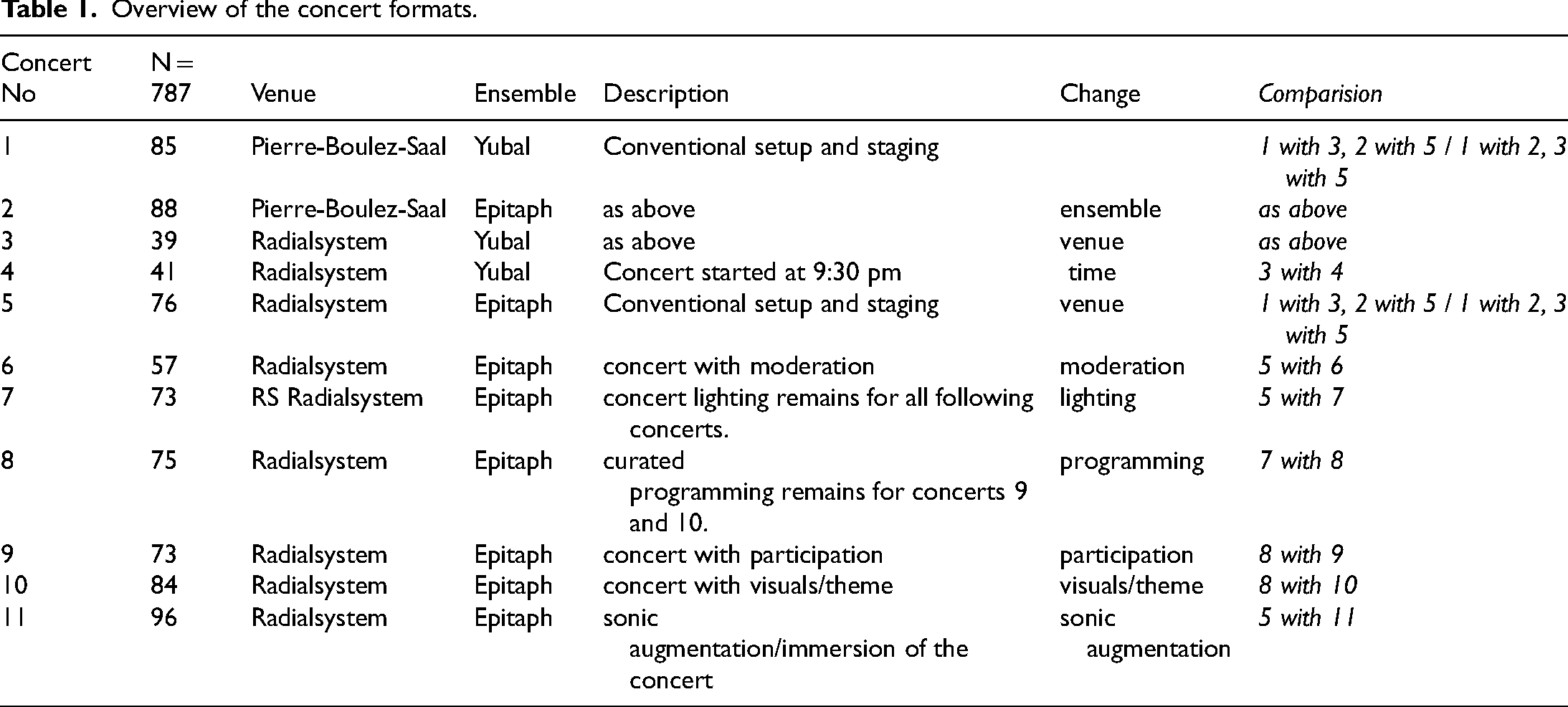
Concert formats: Research questions
In the following, we present the specific setting that we have tested experimentally.
How do two different concert venues affect the audience members’ concert experience?
The acoustical dimension is not the only factor determining the experience (Kirchberg, 2021; Kronenburg, 2016). Kronenburg (2016) stated: “These typological building differences affect audiences in terms of both their expectation of what the event will be like and their experience of the event as it happens” (p. 37). Whether a concert takes place in a certain location and thus achieves a certain effect is particularly relevant for music festivals (therefore concerts are organized in, e.g. a monastery, a mine, an industrial hall, a barn). We chose two locations for our experiment to investigate their influence on the audience. The same program was played by the same ensemble at the same time. This comparison was carried out twice, with the professional ensemble and the young ensemble.
How do different ensembles playing the same pieces affect the audiences’ assessments?
It is almost taken for granted that internationally famous musicians with many years of stage experience are more appreciated by audiences than newcomers. For decades, the music industry has developed a cult following around stars, as they are easier to market due to their recognition value. That said, their fees are also higher. In addition to this cultural-economic approach, we were interested in determining whether these two ensembles could also affect the audience differently. And as far as we know, there is no literature empirically investigating the effect on the audience of different ensembles playing the same pieces. In music education research, mostly novices and experts are compared regarding their approach towards a musical task (e.g. Bergee, 2005; Goolsby, 1999). Audience reactions comparing different ensembles are not considered yet.
How does a different starting time, e.g. a late-night concert, affect the audience?
One typical format is changing the time a concert starts. Late-night concerts have been held for many years, however, to our knowledge, no empirical investigations on the effect of day versus night musical events exist.
How does a host presenting and moderating the concert affect the audience members’ concert experience?
Many music educational programs aim at bringing the music closer to the audience through explanation and moderation (Rüdiger, 2015; Wimmer, 2021). Therefore, we asked a professional concert moderator (from German National Radio) to speak at one concert to help understand the pieces better by shedding light on the composer's intentions. How do musicological explanations and background knowledge of the composition affect listeners? The effects of priming through images, video, or text on the musical experience has been studied most often in laboratory settings (Margulis, 2010; Mitchell and MacDonald, 2016; Timmers and Crook, 2012). The actual situation of real-world priming in moderated concerts has not been investigated as yet.
Do changes in concert lighting affect the listeners?
Lighting may substantially impact how musical and theatrical performances are perceived (Uhde, 2021). For decades, pop concerts have featured massive light shows to create specific atmospheres and draw audience attention. Classical music concerts are quite different. When performing a classical concert, musicians mostly use standard stage lighting that remains unchanged from the beginning to the end.
What is the effect of a curated program on concert experience?
Over the past 15 years, more and more festival and concert programmers have started experimenting with the program itself (Fein, 2021; Marín, 2018; Uhde, 2021). They no longer play entire symphonies or musical works but break up the pieces or only play single movements (Nicholls et al., 2017). Indeed, such practice was standard for concerts in the late 18th and early 19th centuries (Salmen, 1988). To our knowledge, no empirical investigations on the effect of concert lighting or curated programs exist till now.
Do participatory elements in a concert affect the concert experience of the audience?
Participation is a widely discussed concept in art theory that established itself in the early decades of the 20th century. The concept became more prominent with Joseph Beuys’ idea of the social sculpture in the 1970s and 1980s, the sociocultural movements of the 1990s and the turn of the 21st century, and the recent concept of socially engaged art (Mamrud, 2023; Matarasso, 2017). One of the main ideas is to make the audience active co-creators rather than passive recipients (Toelle and Sloboda, 2019).
Do additional visual components, such as images and live video recordings supporting an overall theme (“remembering”), affect the audience members’ concert experience?
In a digital society, music is becoming more and more visualized (Holt, 2011). At pop concerts, the use of visuals to intensify moods and close-ups of the musicians are very common. This is not the case in classical music concerts. Nevertheless, some organizers successfully used visuals and live visuals (Canisius and Tröndle, 2021). Generally, the effect of visual stimuli influencing the musical experience is studied regarding music videos (e.g. Dasovich-Wilson et al., 2022), social media (e.g. Wilson et al., 2019) and different forms of audio-visual presentations (e.g. Finnäs, 2001). How a visual representation of the concert in a live concerts effects music listening has not yet been investigated.
What is the effect of sonic augmentation on the concert experience?
In classical concerts, we are used to the sound source coming directly from the stage. The further away one sits, the less one hears. For some years, there have been technical advancements in amplifying the sound of classical instruments and allowing the sound to emerge in classical concert halls (Brümmer, 2021; Woszczyk, 2014). While the image of live sound without artificial technological amplification still plays an important role in the live sector (Dahlie et al., 2021; Mulder, 2015), investigating the effect of new technological possibilities of amplification on the audience experience, also in classical concerts, will help to better understand what constitutes the concert experience.
In summary, one may say, that many of the aspects presented (lighting, moderation, participation, etc.) are performed in current concert formats, but almost no empirical research exists on their effects. The present approach may therefore be described as applied basic research.
Methods
From the literature presented above and from previous concerts, a concert designer and the researchers extracted several formats to mirror today's most common concert formats. These prototypical formats were analyzed in an experimental series of 11 concerts in 2022. Each concert came along with a specific, hypothesis-driven question to investigate its effect on the participant's experience of the specific concert format (see Concert Formats: Research Questions). The actual concert formats are described further in the subsection Stimuli. Through standardized questionnaires the in the study participating concert audience rated their experience.
Participants
The average age of participants attending the 11 concerts was 43.8 years (N = 778, SD = 17.5), 56.8% of whom identified as females, 42.8% as males, and 0.4% as diverse. 80% of the participants, including applied universities (N = 778), held a university degree. For 77.9% of the sample, German was the first language, followed by English (4.5%).
This was a relatively young audience for classical music. Heinen (2013) reported an average age of 66.2 years among German concertgoers. Reuband (2018) reported a median of 60 years. It should also be noted that both the Radialsystem and Pierre Boulez Saal offer progressive programs and may generally attract younger audiences. Additionally, COVID likely influenced the audience composition, biasing older people to stay away. Our sample revealed that older listeners enjoyed the concert more than younger listeners (t = 5.13****, explained variance r2 = 3.3).
Stimuli
A string quintet provides enough versatility to create the concert formats that were presented in the research questions table (see Table 1). Its instrumentation is more diverse than that of a soloist playing a recital, but the number of musicians is smaller than that of an orchestra. We engaged internationally renowned artists to form a string quintet with the acclaimed cellist Alban Gerhardt, including solo instrumentalists of the Berliner Philharmoniker (Ensemble Epitaph). For two concerts, we engaged an additional ensemble of five young professional instrumentalists (Yubal Ensemble) to compare the two ensembles.
Three pieces by Ludwig van Beethoven, Johannes Brahms, and Brett Dean were performed at each concert. The concerts lasted approximately 70 minutes. The program represented a “typical” chamber music concert featuring two works by well-known Classical composers combined with a piece of Contemporary music. The “heavy” Romantic work was placed at the end of the program, and the program was always initiated by the Beethoven piece. Ludwig van Beethoven: String Quintet, op. 104, in C minor (1817), 1. Allegro con brio (1st movement); Brett Dean: Epitaphs (2010) (5 movements); Johannes Brahms: String Quintet, op. 111, in G Major (1890) 1. Allegro non troppo, ma con brio, 2. Adagio, 3. Un poco allegretto, 4. Vivace ma non troppo presto. Allegro assai.
The selected pieces covered a broad range of stylistic features and compositional techniques from three periods (Classical, Contemporary, and Romantic). They were chosen because they form an attractive and functional chamber music program and enable different combinations for the concert experiments (“curated programming”). For each concert, a brief information sheet (program and names of musicians) was available to the audience, free of charge, at the entrances to the concert hall. For Concert 3, distribution of the program was deliberately forgotten. The outlined concert formats were presented in the concert series. In the following further information on the concert formats is given, where needed.
Concert venue
The two present concert venues served as experimental laboratories to analyze their effect on the visitors. A professional and a newcomer ensemble performed the same program in each location (“concert halls”—a comparison of Concerts 1, 2, 3, and 5, see Table 1). Two concerts were held in the Pierre Boulez Saal, a hall characterized by its elliptical design (WWW 1). The ensemble performed in the middle of the hall, with the audience seated around it on a tribune (Figure 1).
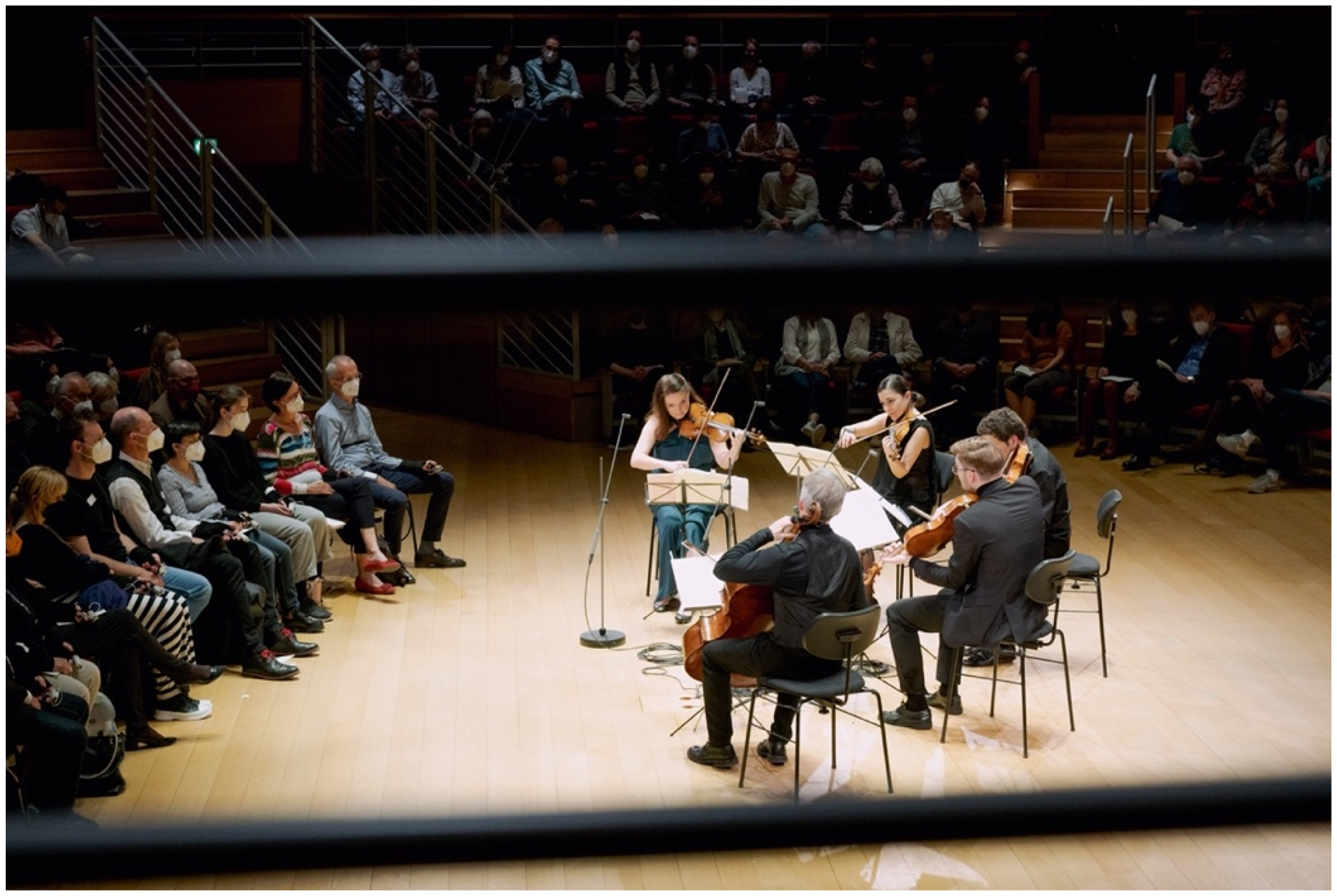
The “standard” concert in the Pierre Boulez Saal with Ensemble Epitaph.
The nine other concerts were held at another venue, the Radialsystem (WWW 2), a former industrial building. The audience sat on a rising tribune opposite the ensemble (Figure 2) (WWW 3).
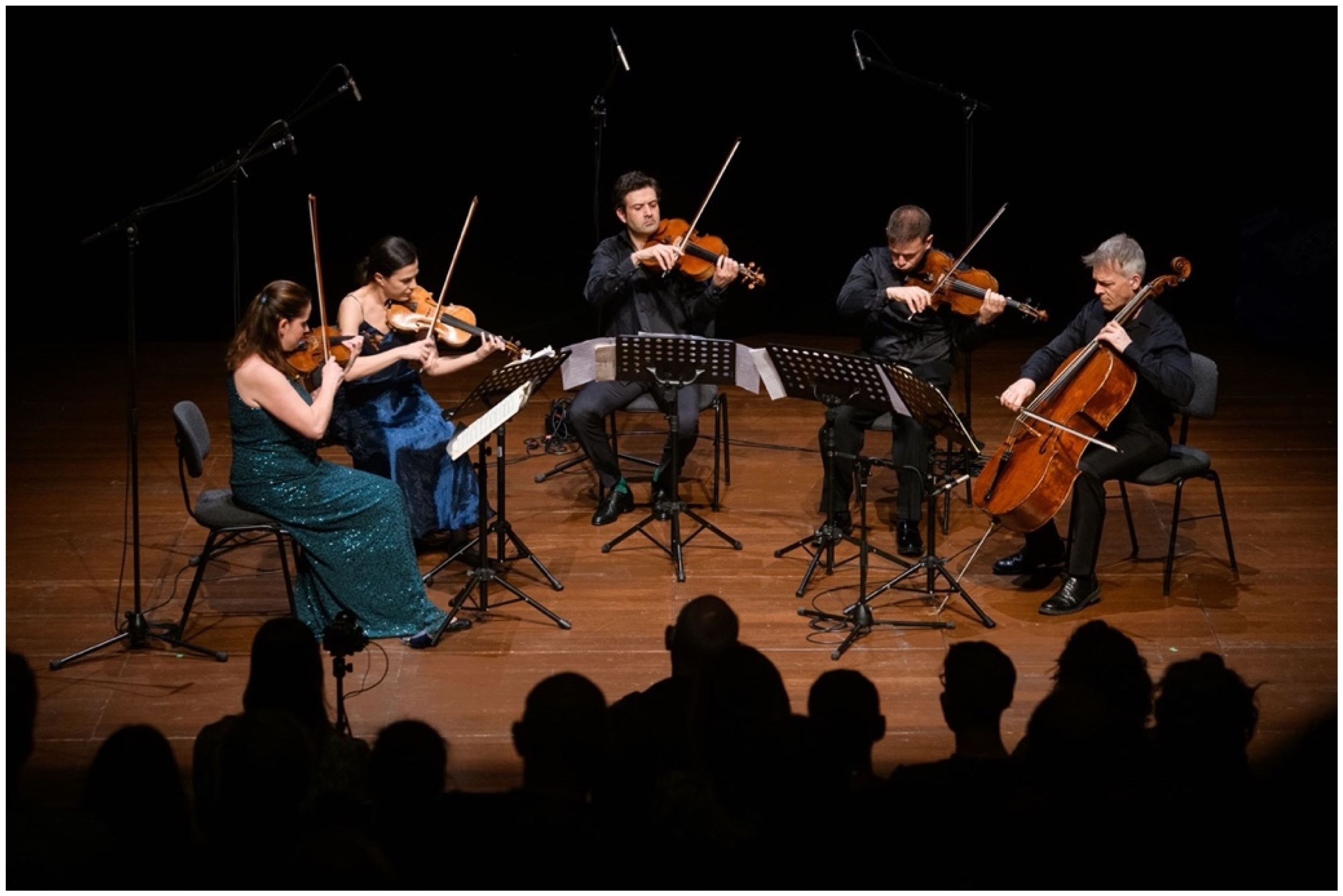
The “standard” concert at Radialsystem with Ensemble Epitaph.
Ensembles
The same concert program was performed by two different ensembles, once by Ensemble Epitaph and once by the Yubal Ensemble. The Yubal Ensemble is comprised of young, talented musicians who are still studying or have just graduated (WWW 4). We conducted this experiment in both the Pierre Boulez Saal and the Radialsystem. Four concerts were compared (“Ensembles”—a comparison of Concerts 1, 2, 3, and 5, see Table 1).
Starting time
We tested the effect of the starting time by comparing two concerts performed by the Yubal Ensemble: one at the standard concert time of Radialsystem, namely 7:30 pm, and one on the following day at 9:30 pm (“Late-Night”—a comparison of Concerts 3 and 4, see Table 1).
Moderation
Two concerts were compared to test the effect of a moderation. Ensemble Epitaph played the same program at the same venue, with different audience and on different evenings, first with a moderator and then without (seen in the comparison of Concerts 5 and 6, see Table 1). The moderation especially intended to make the contemporary piece more accessible to the audience by providing information about the piece and asking the musicians about their relationship to the piece. The idea was to talk about the piece in a non-academic way, and to interact with the musicians. It should less be purely musicology-driven but give the audience a possibility to develop a personal approach. Dean's piece is about friends who passed away. The moderator is working as a professional music journalist for German national radio, and she is very experienced with concert moderations.
Lighting
To test how lighting affects the audience, the pieces and movements were illuminated in an artistic, very subtle way in one concert (Figure 3 “Lighting“)—a comparison was made between Concerts 5 and 7, see Table 1).
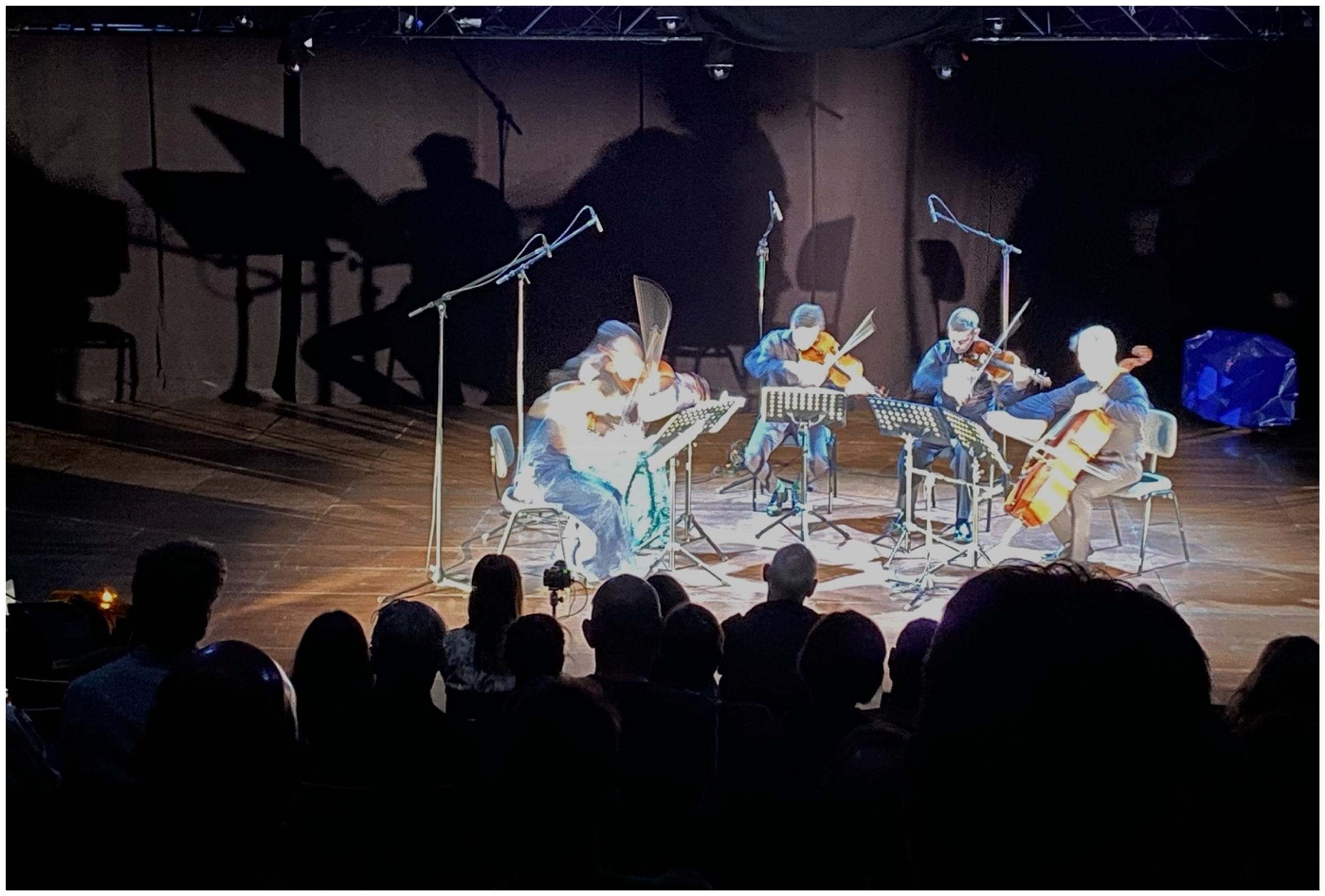
“Lighting,” Concert 7.
Curated program
The concert designer of the concert hall prepared the concert program and the curated rearrangement. The rearranged program should evoke “listening surprises”. The rearranged concert program was as follows:
Beethoven, 1st movement; Dean 1st and 2nd Epitaph; Brahms 1st. movement; Dean 3rd and 4th Epitaph; Brahms 2nd and 3rd movements; Dean 5th Epitaph; Brahms 4th movement (“Curated Programming”—comparison of Concerts 7 and 8, see Table 1).
Participation
To test the influence of a participative concert format, before the concert, participants were asked to write down the name of a deceased person close to them on a slip of paper and place the note on a board on stage. The note stayed visible for all to see during the concert. The concert theme of remembering a beloved person who passed away was thus personalized via this action (“Participation”—comparison of Concerts 8 and 9, see Table 1).
Visualization
We tested the influence of visuals on the audience’s experience. On stage, during the performance of Brett Dean's Epitaphs, a screen showed pictures of the deceased friends to which the composer had dedicated his music. During the performance of the quintet by Brahms, live video recordings showed close-ups of the musicians (Figure 4; “Visuals”—comparison of Concerts 8 and 10, see Table 1).
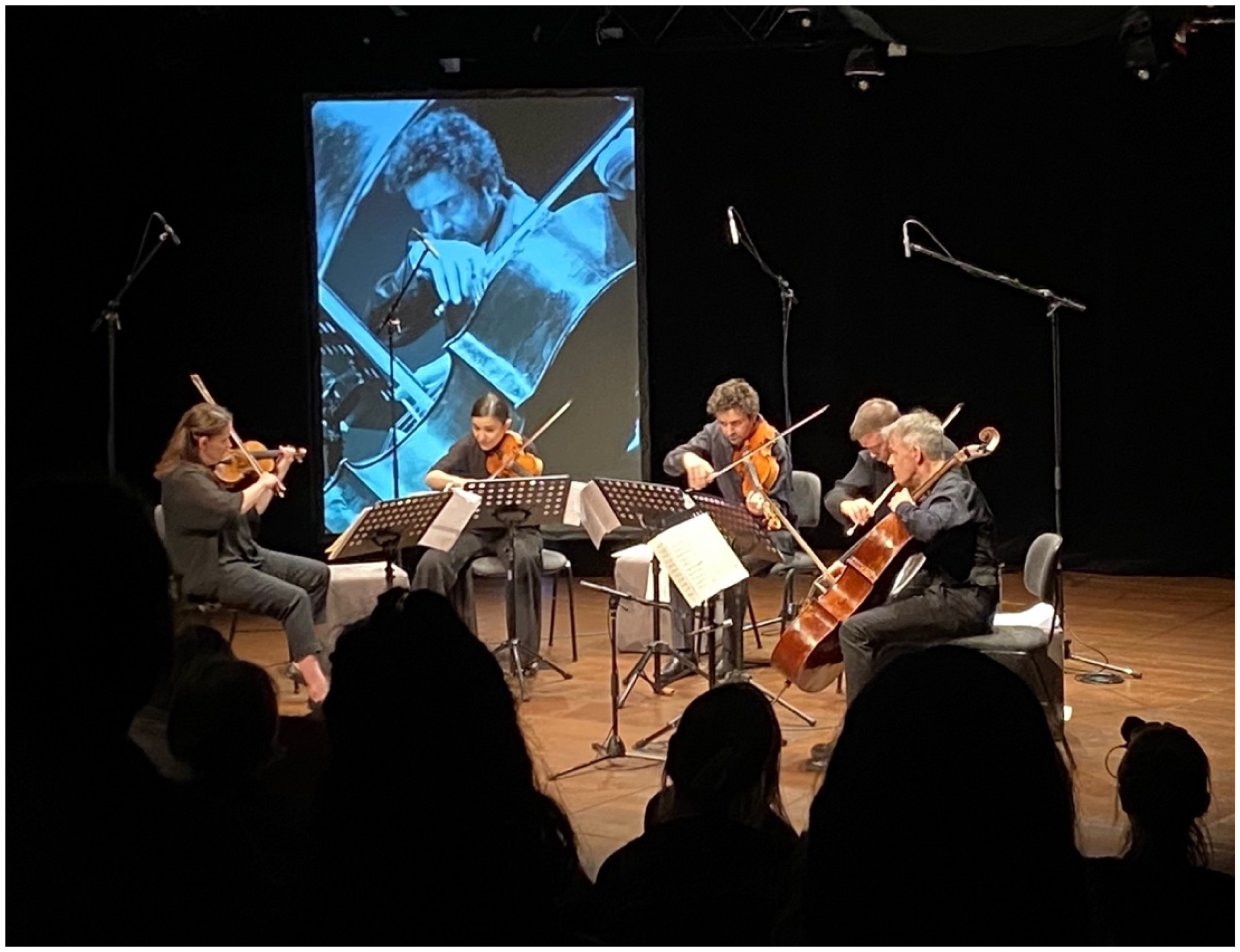
“Visuals,” Concert 10.
Sonic augmentation
In one concert, the sound was amplified by a multi-channel speaker system surrounding the audience in the concert hall. The sound was distributed in and around the space, and the concert was louder than it had been without amplification a few days before (“Sonic Augmentation”—comparison of Concerts 7 and 11, see Table 1).
Experimental procedure and questionnaire
The series of experimental concerts was advertised in the local press and on the radio, placards, social media, mailing lists, and the websites of Radialsystem and the Pierre Boulez Saal. Concertgoers could either book tickets as regular attendees or as participants in the study. Each participant had to sign a consent form and data privacy statement. At the end of each concert, participants were asked to fill out an exit questionnaire.
The research team, made up of experts from cultural studies, musicology, psychology, and music, developed 15 items to analyze the impact of the concert formats. The items were rated on 5-point Likert scales (1 = very poor to 5 = very good). The questions were developed to investigate each specific concert format. To assess, for example, the influence of the two different concert halls, we asked participants to assess the overall concert, atmosphere, acoustics, ambiance, and interaction between musicians and audience (see Table 2).
Items to assess the aspects of the concert performance.
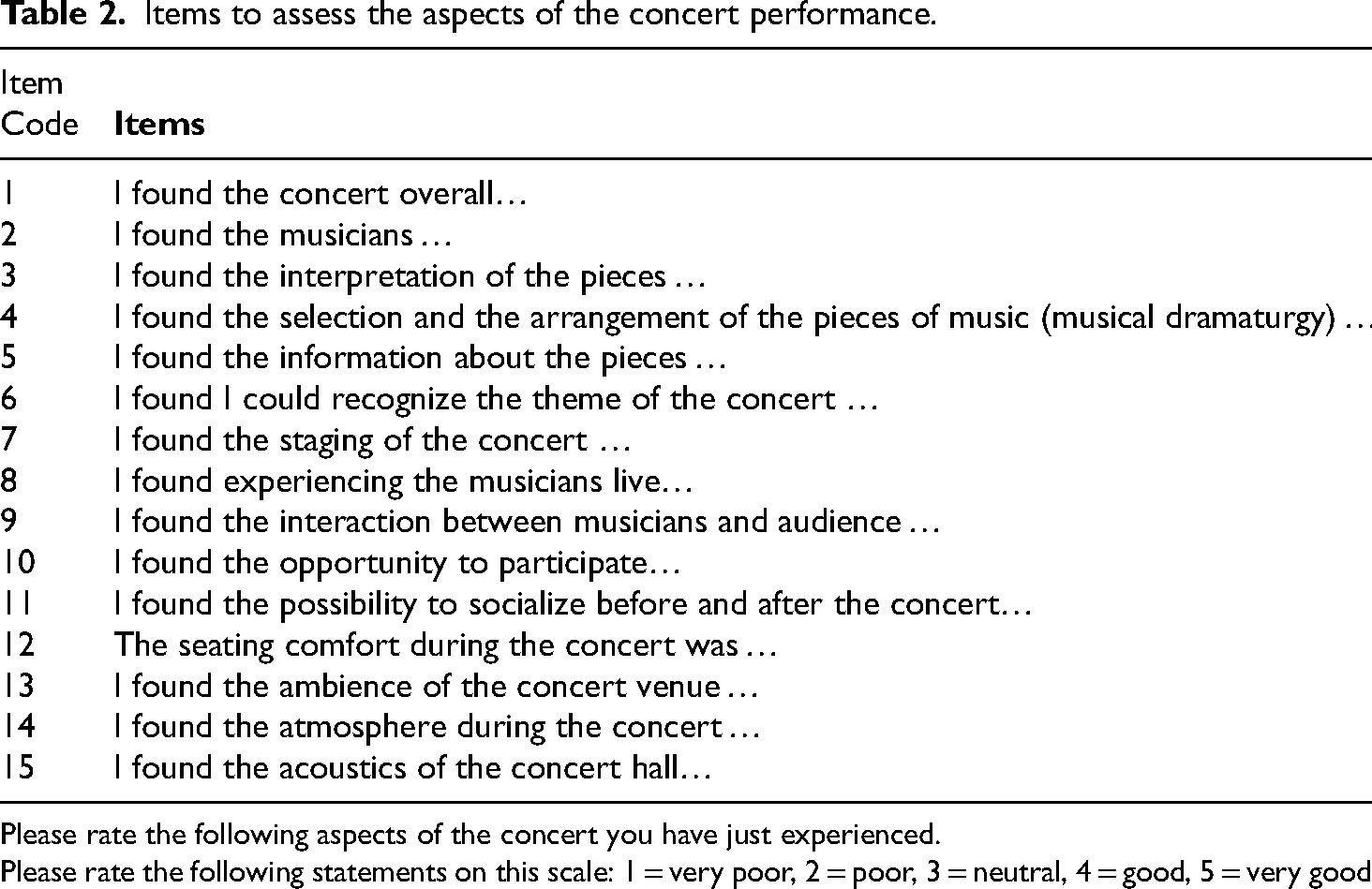
Please rate the following aspects of the concert you have just experienced.
Please rate the following statements on this scale: 1 = very poor, 2 = poor, 3 = neutral, 4 = good, 5 = very good.
The questionnaire was pretested in three concerts at Radialsystem in 2020. The questionnaires are presented on the project's website. 1 All statistical analyses were performed using JMP Pro 15.1 software (SAS Institute Inc.). More detailed information on the methodology of the project is provided by Tröndle et al. (2025).
Statistical analysis and wider frame
The general procedure for testing the influences of concert formats on participants evaluation was to conduct regression models. Mostly two concerts were compared with each other, in order to test the influence of a specific format. More detailed descriptions are to be found in the results section. We selected from all 11 concerts those that differed with respect to one specific format change and not with respect to others. In the following these are called the comparable concerts.
The considerable duration and scope of the ECR - Experimental Concert Research entailed several articles. Other research articles focus on different aspects of the concert experience such as audience physiological synchrony in classical concerts linked with listeners’ experiences (Tschacher et al., 2024), the experience of different visitor types (Tröndle et al., 2025), listening modes in classical concerts (Weining et al., 2025), remembering the concert experience (Böndel et al., 2025) and many more (https://experimental-concert-research.org).
Results
We will first investigate the effect of the different concert formats. Second, we will ask what concert assessment generally depends on. And third, we will analyze the effect of concert formats on individual visitor types.
The effects of the concert formats on all visitors
In the following, we will investigate the effects of the different concert formats, of the concert venue and the performing ensembles.
Concert venue
Across all 11 concerts, a multiple regression model was computed with the overall rating of a concert as dependent variable and concert venue as well as listener's age as predictors. The model was significant (F(2, 761) = 21.74, p < 0.0001; r2 = 0.05), to which both predictors (concert venue: t = 4.09, p < 0.0001; age: t = 3.26, p < 0.01) contributed. The interaction of age and concert venue as a further predictor was insignificant.
Only the four comparable concerts with conventional setups (Concerts 1, 2, 3, and 5, see Table 1) were included in a further regression model to specifically analyze the effect of the two different venues. The model (F(1, 286) = 10.79, p < 0.01; r2 = 0.04) significantly pointed to this difference. The Pierre-Boulez-Saal was liked better by the audiences (all evaluations were provided on five-point Likert scales ranging from 1 to 5). The mean evaluation of the Boulez-Saal was M = 4.53, 95% confidence intervals: lower CI = 4.44, upper CI = 4.62; Radialsystem: M = 4.29. According to Akaike's information criterion (AIC), inclusion of listeners’ age again improved the model (F(2, 275) = 9.45, p < 0.0001; r2 = 0.06), whereas inclusion of the predictor “ensemble” did not.
The Pierre-Boulez-Saal was rated significantly better in terms of atmosphere (F(1, 286) = 19.65, p < 0.0001; r2 = 0.06) and likewise in terms of its acoustics (F(1, 286) = 89.15, p < 0.0001; r2 = 0.24). Thus, acoustics explained 24% of the total variance of venue differences. Moreover, the interaction between musicians and the audience was rated better in the Pierre-Boulez-Saal than the Radialsystem (F(1, 286) = 3.99, p < 0.05; r2 = 0.01). The venue's ambiance was rated better in the Pierre-Boulez-Saal than at Radialsystem (F(1, 286) = 34.22, p < 0.0001; r2 = 0.11). The seating comfort of the Pierre-Boulez-Saal was assessed significantly better (F(1, 286) = 45.87, p < 0.0001; r2 = 0.14).
Ensembles
The four comparable concerts (Concerts 1, 2, 3, and 5, see Table 1) were included in the calculation to analyze the effect of the two ensembles. The assessment of the musicians of the two ensembles was not significantly different in the four concerts (F(1, 286) = 1.70, n.s.). Even if the concert venue was included in the model as a further predictor, the model remained insignificant (F(2, 285) = 1.52, n.s.), and model fit according to AIC was reduced. Using the “interpretation of pieces” as the dependent variable, interpretation was however significantly explained by the ensemble (F(1, 286) = 6.86, p < 0.01; r2 = 0.02). Ensemble Epitaph was assessed to be superior: M = 4.41, 95% confidence intervals: lower CI = 4.30, upper CI = 4.53; Yubal ensemble: M = 4.19. When the concert venue was additionally included in the model as a predictor, the model fit improved according to AIC (F(2, 285) = 5.73, p < 0.01; r2 = 0.04), and the Epitaph ensemble was still rated better: M = 4.41, lower CI = 4.30, upper CI = 4.52; Yubal ensemble: M = 4.15. The dependent variable “evaluation of experiencing the musicians live” was not related to the ensembles (F(1, 286) = 0.02, n.s.), and inclusion of the concert venue in the model improved the model only marginally (F(2, 285) = 1.34, n.s.). Also, no difference was found for the dependent variable “interaction between the musicians and the audience” (F(1, 286) = 1.03, n.s.).
Starting time
The concert evaluation of the two concerts (Concerts 3 and 4, see Table 1) with the standard and late-night starting times, but no other divergence in format, were evaluated differently (F(1, 78) = 5.74, p < 0.05; r2 = 0.07). The standard Concert 3 was evaluated more positively: M = 4.36, lower CI = 4.15, upper CI = 4.57; late-night concert: M = 4.00. The interpretation of the music was not influenced by the starting time (F(1, 78) = 0.21, n.s.) and there was no difference in the evaluation of the atmosphere (F(1, 78) = 0.45, n.s.). Yet, the social dimension (the possibility to talk with others and to get together) was significantly predicted by starting time (F(1, 78) = 5.69, p < 0.05; r2 = 0.07). The standard concert was again rated better: M = 3.49, lower CI = 3.21, upper CI = 3.76; late-night concert: M = 3.02.
Moderation
Concerts 5 and 6 were compared to test the influence of a moderator’s verbal introduction into the contents of the performed pieces, hence information on top of the written program (see Table 1). The overall evaluation of the concert indicated no significant differences (F(1, 131) = 0.27, n.s.). Likewise, the evaluation of how the pieces were interpreted was not significantly better (F(1, 131) = 0.25, n.s.). Even the evaluation of the information offered about the pieces was not significantly improved (F(1, 131) = 1.92, p = 0.17). The moderated Concert 6 was rated with respect to piece information with mean M = 3.88, lower CI = 3.67, upper CI = 4.09; unmoderated concert: M = 3.68). The moderation was intended to help the audience understand the concert's theme better. Nevertheless, the recognition of a theme for the concert with moderation was not rated any better (F(1, 131) = 0.40, n.s.).
Lighting
To test the influence of the lighting of the stage and concert hall, Concerts 5 and 7 were compared (see Table 1). The overall evaluation of the concerts indicated no significant differences (F(1, 147) = 0.64, n.s.). There was also no significant difference in how the musicians were rated (F(1, 147) = 2.86, p = 0.09). The interpretation of the pieces was rated differently (F(1, 147) = 4.93, p < 0.05; r2 = 0.03), where the standard Concert 5 was rated higher: M = 4.32, lower CI = 4.14, upper CI = 4.50; concert with lighting design: M = 4.03.
Lighting generated no significant differences in how the concert staging (F(1, 147) = 0.00, n.s.) and the ambiance of the venue (F(1, 147) = 1.28, n.s.) were experienced. The rated atmosphere during the concert (F(1, 147) = 3.79, p = 0.05) also failed to reach significant differences, with the atmosphere of the standard concert evaluated more positively (Concert 5: M = 3.96, lower CI = 3.79, upper CI = 4.13; concert with lighting design: M = 3.73).
Curated program
To test the influence of curated programming, Concerts 7 and 8 were compared (see Table 1). Curating generated no significant difference between the two concerts concerning the overall evaluation of the concert (F(1, 146) = 0.44, n.s.), the evaluation of the musicians, the interpretation, the program, or the atmosphere. The evaluation of the program also failed to reach significance (F(1, 146) = 3.63, p = 0.05), with the standard program evaluated more positively (Concert 7: M = 3.92, lower CI = 3.71, upper CI = 4.12; curated Concert 8: M = 3.64).
Participation
To test the influence of participatory elements, Concerts 8 and 9 were compared (see Table 1). There was no significant difference between the two concerts in terms of the overall evaluation of the concert (F(1, 146) = 2.14, n.s.), the evaluation of the musicians, the interpretation, the theme, the interaction between the musicians and the audience, the opportunity to interact, or the atmosphere. Participants were directly offered to rate their opportunity to participate, yet the mean differences of ratings remained insignificant (F(1, 146) = 1.99, p = 0.16), Concert 8: M = 3.21, lower CI = 2.98, upper CI = 3.45; Concert 9 with audience participation: M = 3.45.
Visualization
To test the influence of visual components, Concerts 8 and 10 were compared (see Table 1). There were no significant differences between the two concerts regarding the overall evaluation of the concert (F(1, 157) = 0.93, n.s.), the interpretation, the theme, the staging, or the atmosphere.
Sonic augmentation
To test the influence of sonic augmentation, Concerts 5 and 11 were compared (see Table 1). There were no significant differences between the two concerts in terms of the overall evaluation of the concert (F(1, 170) = 0.91, n.s.), the interpretation, the experience of hearing the musicians perform, or the atmosphere. Likewise no significant impact of sonic augmentation was found on the ratings of acoustics (F(1, 170) = 0.40, n.s.). Concert 11 with sonification was rated on average M = 3.97, lower CI = 3.79, upper CI = 4.14; Concert 5 without sonification: M = 4.05.
All concerts regarding musical performance
When comparing all 11 concerts in terms of “evaluation of the musicians,” significant differences were found only in two concerts: Concert 2 (Ensemble Epitaph performing in the Pierre-Boulez-Saal) was rated significantly better than all others (t = 2.81, p < 0.01), but the same ensemble received the poorest rating in Concert 7 (t = –1.97, p < 0.05).
Comparing all 11 concerts in terms of “interpretation” (F(10, 776) = 3.79, p < 0.0001; r2 = 0.05), two concerts revealed differences: Concert 2 (Ensemble Epitaph in Pierre-Boulez-Saal) received the highest ratings (t = 4.17, p < 0.0001), whereas the curated program dramaturgy of Concert 8 the lowest (t = –2.71, p < 0.01).
When comparing all 11 concerts with each other in terms of “experiencing the musicians live,” differences were found (F(10, 776) = 2.65, p < 0.01; r2 = 0.03), significant differences were revealed in three concerts. Concert 1, Ensemble Yubal in the Pierre-Boulez-Saal, was rated highest. The lowest ratings were given in Concert 10 to Ensemble Epitaph in Radialsystem with visuals (t = –2.49, p < 0.05). Likewise, a significantly lower rating was received by Ensemble Epitaph in Concert 8 with curated programming (t = –1.96, p < 0.05).
After the distinct analyses of the impact of single format variations, now all concerts are compared.
All concerts regarding concert format
To analyze the effects of the concert format, the participants were asked questions after each concert about the selection and arrangement of musical pieces, the information given, the theme of the evening program, the staging, the atmosphere, and the acoustics. In comparing all 11 concerts—with Concert 5 serving as the reference concert (Radialsystem standard)—we found the following (Table 3).
All concerts regarding concert format. Multiple regression model with predictor concert number and participants’ age.
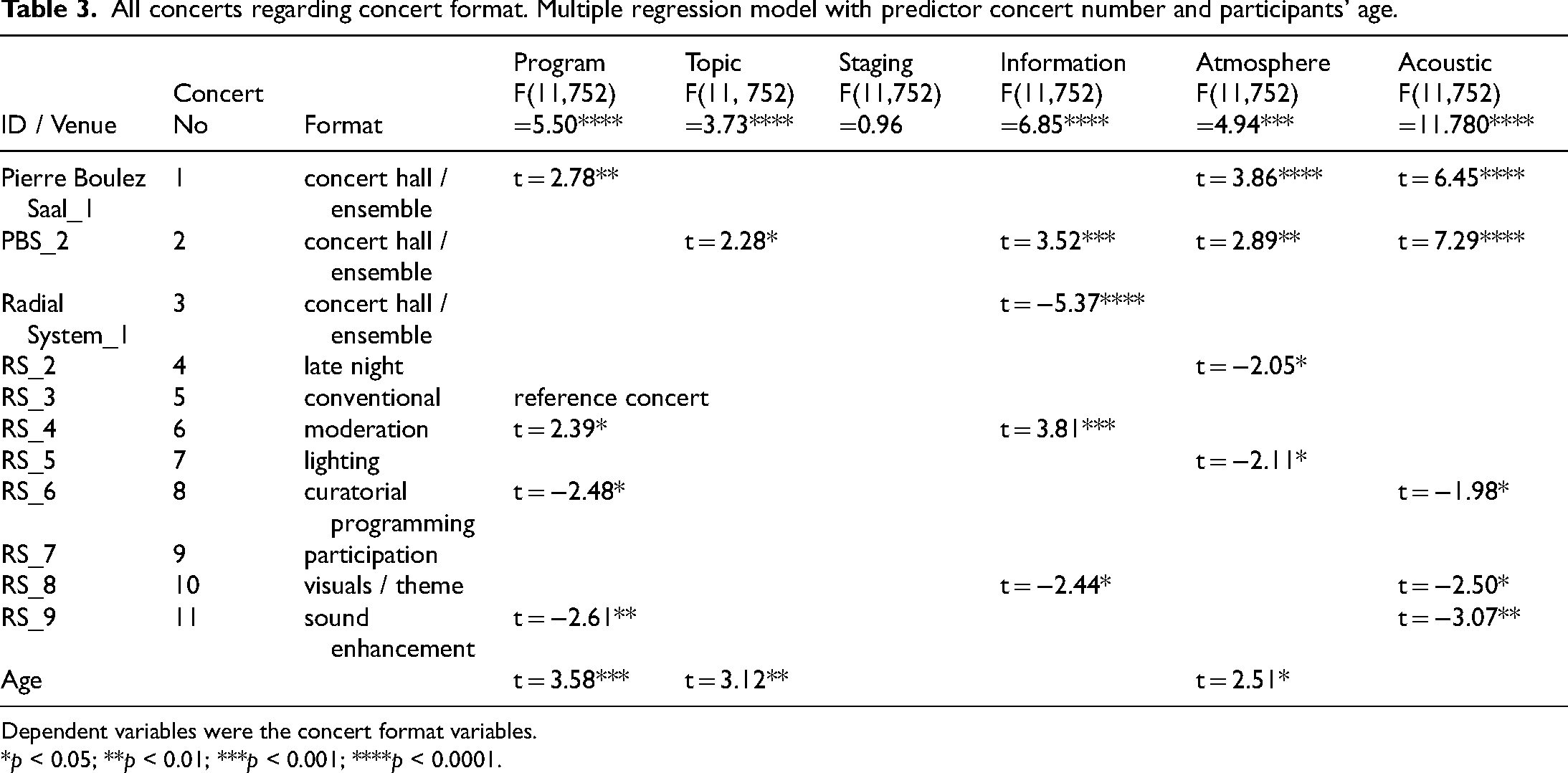
Dependent variables were the concert format variables. *p < 0.05; **p < 0.01; ***p < 0.001; ****p < 0.0001.
This overview shows that the acoustics and atmosphere in the Pierre-Boulez-Saal were rated higher than in all the other concerts. Concert 3 received the lowest ratings regarding the information. In this particular concert, distributing the information sheet with the pieces and the musicians was forgotten. The concert with moderation (No 6) was rated better than the other concerts, but the same was true for Concert 2 without moderation.
What does the evaluation of the concert depend on?
How a concert is evaluated overall depends strongly on the assessment of the musicians (t = 7.74, p < 0.001). Experiencing the musicians live (t = 3.41, p < 0.001) and listening to how they interpret a musical work (t = 9.32, p < 0.001) are each highly significant in the model, which explains 46.3% of the total variance (multiple regression, mixed effects model, N = 787).
Also, the evaluation of the concert as a whole depends on the program (t = 12.76, p < 0.001), the atmosphere (t = 6.56, p < 0.001), the acoustics (t = 5.48, p < 0.001), and the theme (t = 2.92, p < 0.001), (multiple regression model, N = 787, F(10, 776) = 63.29, p < 0.001). All ratings of these items are highly significant. Staging, information, participation, socializing, seating, and venue were all not significant. In this model, 44.92% of the total variance is explained.
Discussion
We wished to account for both research requirements and practical necessities when experimentally changing one aspect of the concert at a time, while at the same time designing a concert that is organic in nature. When analyzing the concert experience in this manner, however, it must be stated that reducing the concert experience to individual components is hardly possible. Instead, the concert experience seems to be multidimensional, influenced by the following aspects.
The concert venue has a decisive effect on the listeners’ experience in classical music concerts. The assessment of the concert as a whole—its atmosphere, acoustics, and even the interaction between musicians and audience—differed substantially in the two concert venues. The concert venue had an overarching impact on the audience experience.
When looking at the impact of the two very different ensembles in terms of their reputation, we received a more mixed picture: There was no difference in the assessment of the musicians of the two ensembles in the four concerts. The interpretation of Ensemble Epitaph was found to be superior. But again, the live experience of the ensembles did not significantly differ with regard to the audience ratings. Although the performance by Ensemble Epitaph in Concert 2 was rated significantly better than all others, the same ensemble received the least favorable rating in the evaluation of Concert 7 (evaluation of the musicians). Internationally renowned artists can perform poorly; reputation is no guarantee for such surprises. The performance depends on the musicians’ form of the day. Even a lesser-known ensemble can play better than a renowned one.
A different starting time (late night) did influence the concert, although the standard concert was rated more positively. One could say that the possibility for the audience to socialize seems to be more important than the nightly setting. However, it must be noted here that the concert designer could not perform the late-night concert the way he wanted to on account of the research project’s specifications. Typically, when listening to music during late-night concerts at Radialsystem, members of the audience lie on mats on the floor. For our experiment, however, the audience was seated “normally” in the tribune.
Considering that almost every concert hall and festival offers moderated concerts and relies on the power of moderation and explanation, the results are surprising. All in all, the moderated concert was not rated better, nor was the interpretation rated better, and even the information offered about the pieces was not rated better. Furthermore, the theme of the concert could not be better identified. When looking at the results, it may be concluded that the moderation did not influence the concert experience. Margulis (2010) even reported an adverse effect of “priming” the audience. Nonetheless it has to be noted, that if all concerts were included in the model, there was a significant difference (Table 3).
Astonishingly, when comparing the two comparable concerts, neither the concert lighting, visual components, participatory elements, nor sonic augmentation positively affected the visitors’ evaluation. And when comparing the 11 concerts as a whole, the experiments even showed some negative influences. This was unexpected.
Nonetheless, one sees a different result if the audience members are categorized into the four concert visitor cluster types (Tröndle et al., 2025). “Concert accompaniers,” in particular, gave the light staging a poor rating, whereas the “concert enthusiasts” tended to rate it favorably. This was also true for the “curated programming” concert format. “Concert accompaniers” rated the curated programming unfavorably, whereas the “concert enthusiasts” gave it a good rating. The four different types can be identified regarding their motives for attending a concert, their specific expectations, and their reactions to the actual concert experience. Each of these four types must also be addressed by a specific concert format to fulfill their expectations and experiences.
Limitations
No study is without its limitations. On the macro level, we freely admit that the data collected here are the findings of only a few concert formats. However, there are endless ways to moderate a concert, create a participatory concert, use lighting, add visuals, etc. Other formats featuring other musicians and different pieces performed in other locations might have brought other results.
On the micro level, it must be kept in mind that the concert experience is multifaceted and intertwined. Concerts 7, 8, and 10 were rated less favorably in terms of musical performance. The research team made notes on each specific concert and took into account the fact that the musical performances on these three evenings were regarded as subpar. Therefore, we must be careful in interpreting the concert formats of concert lighting, curated programming, and the use of visuals. Potentially, the subpar musical performance of these three concerts may have overshadowed the effects of the specific concert format.
Another limitation might be that, apart from the late-night concert, the participants attended the concerts “at random,” not knowing which concert format to expect in advance. In a real-life situation, the visitor would deliberately choose the specific concert they like (e.g. moderated, participatory, or staged) or are interested in. Therefore, studies in the future might further substantiate or rebuke our findings.
Self-reflection: It must be noted here that the authors have different academic backgrounds and a diverse range of musical socialization. Through the transdisciplinary makeup of the research group, it was hoped that individual preferences and assumptions could be put into perspective. Nonetheless, the team recognized that those trained in music performance or musicology rather assumed the concert format would strongly affect the visitors. The authors less inclined to classical music did not share such assumptions. The authors are also subject to certain listening styles and assumptions as listeners. To exemplify that, researchers stemming from musicology believed in a strong impact of moderation and information, concert curators believed in the impact of the light, participatory and dramaturgic effects etc., cultural sociologists estimated the venue and the atmosphere, psychologists the impact of the music stimulus, and the musicians the musical performance.
The results were therefore surprising for us as an interdisciplinary research group. They show us how much we are each shaped by our disciplinary thinking. Understanding esthetic experience is an endeavor that can only be challenged by interdisciplinary research (Tröndle et al., 2022).
Conclusion
It is surprising that, in general, the different concert formats created few measurable effects on the listeners in the audiences. Retrospectively, we might infer that the impact of varying the concert format was quite subtle. When looking at the results, it was clear the tested concert formats did almost nothing. The alterations would have to be more rigorous to have an impact on the audience. However, it must be said that due to the technical necessities (sitting on the tribune etc.) and research requirements (only one aspect of the concert was to be changed at a time), the concert designer was unable to implement the individual concert variants to the extent he was used to.
Several differences become apparent when looking at the ratings in a more differentiated way regarding the four types of concertgoers (clusters). “Concert enthusiasts” tend to like innovations and changes made to the traditional concert format. This is not true for “concert attendees” and “social-event visitors”. “Concert attendees” are generally not very inclined to new formats. They prefer a familiar experience in a familiar setting (Tröndle et al., 2025).
All in all, the concert is a multifaceted experience. According to our study, it depends not only on the musicians, the program, the interpretation, the live performance, the venue and its acoustics, and the subject of the concert but also on the listener's disposition. Due to the overall variance, we can safely assume that the musicians and their interpretation have a slightly more substantial influence on the overall experience than the format. Considering these empirical results, we state that the concert experience is formed by the space, the musicians, and the music, as well as the listeners (Wald-Fuhrmann et al., 2021).
Practical implications
What can concert managers, concert designers, dramaturges, musicians, and artistic directors conclude from these results? The concert space plays a significant role in the concert experience. Even young, still unknown ensembles can win the hearts of audiences with their performance and musical quality. Even internationally renowned soloists can give disappointing musical performances. New concert formats offer, above all, inspiration to those long-devoted to the classical concert and potentially interested in seeing and hearing something new, while others will only walk away little convinced by such new formats.
Having a more holistic approach on the concert experience, it becomes apparent that one must address specific audience clusters to create a fulfilling concert experience for each cluster type. The attendance motivation and expectations of concert attendees differ in many respects (Tröndle et al., 2025). To understand the drivers of a fulfilling concert experience it also might be fruitful to analyze what is remembered positively weeks after the concert visit and why (Böndel et al., 2025). Festival or concert managers and concert curators should keep that in mind when designing a concert event.
Footnotes

Ethical considerations
The research carried out in this project adhered to the principles outlined in the Declaration of Helsinki and complied with applicable regulations in Germany. The Ethics Council of the Max Planck Society granted approval for the procedure under reference number 2702_12.
Funding
The authors disclosed receipt of the following financial support for the research, authorship, and/or publication of this article: This study was conducted within the framework of Experimental Concert Research, which was substantially supported by the Volkswagen Foundation under Grant 93261. The Aventis Foundation supported the concert series.
Declaration of conflicting interests
The authors declared the following potential conflicts of interest with respect to the research, authorship, and/or publication of this article: Author Martin Trondle is Editor of Journal of Cultural Management and Cultural Policy and did not participate in the editorial handling or peer review process of the article.