



Abstract
This study proposes a new rapid measurement method for determining the Weibull parameters of carbon fiber strength distribution based on tensile testing of carbon fiber bundles. Unlike traditional fiber bundle tests, which require both stress and strain measurements, this method only requires testing the tensile strength of the fiber bundles. The process involves three key steps: First, a formula derived from the Weibull distribution function was used to establish the relationship between the Weibull parameters and the tensile strength of fiber bundles of different lengths. Next, fiber bundles of varying lengths were selected for tensile strength testing. Finally, the Weibull parameters were calculated by substituting the test results into the formula. This method offers several advantages: First, compared to single fiber testing, this method eliminates the need to test a large number of individual fiber strength values, requiring only a few bundles of different lengths to be tested. The experimental equipment is both reliable and affordable. Second, unlike the traditional fiber bundle test, which involves testing both tensile strength and the
Introduction
Fiber is the main load-bearing phase of composite materials, and its strength determines the macroscopic mechanical performance of the continuous-fiber-reinforced composite. At the microscale, the single fiber strength distribution at different lengths plays an essential role in the micromechanical study of the fiber–matrix interface stress transfer.1–4 Therefore, it is necessary to accurately determine the strength of a single fiber through experimentation.
The manufacturing process of fibers may introduce defects in their microstructure. As a result, it is difficult to fully characterize the tensile strength of these fibers using an average value. Instead, it should be characterized by a probability distribution.
5
Both theoretical and experimental results have shown that there is a significant randomness in the strength of single fibers. The strength of brittle fiber is often described in line with the weakest-link theory6,7 where it is assumed that a given volume of material fails at the point of most detrimental flaw. Based on the weakest-link theory, the random distribution of defects can be expressed as a Weibull formula at a macro level8–13 As confirmed experimentally by Coleman,
14
the strength of single fibers conforms to this Weibull distribution. Since then, it has been widely applied in engineering, especially for the two-parameter Weibull model.15–23 The two-parameter Weibull distribution model is expressed as the following function

In majority of studies,24–37 these two parameters,
The single fiber tensile test is the most common method used to obtain the Weibull parameters required for the distribution of fiber strength. Through this test, the stiffness and strength of individual fibers can be determined directly. Notably, each fiber must be manually selected from a bundle and then mounted onto two plastic tabs, with each tab holding the fiber at one end, as shown in Figure 1. A fitted straight line is drawn by inputting the test data into equation (2), where Schematic diagram of single fiber tensile testing fixture.

The slope of the line is indicated by the Weibull shape parameter
Single fiber fragmentation test (SFFT) is recognized as an indirect testing method. It is usually performed to measure the fiber with a shorter gauge length, typically less than 1 mm. In this method, one single fiber is embedded in a dogbone specimen of epoxy resin after curing as shown in Figure 2. The transparent epoxy allows the fiber breakage in the specimen to be observed in situ. The fragmentation test is carried out by applying tensile load to the epoxy dogbone at a low rate using a mini tensile tester mounted on an optical microscope stage. As the load increases, the number of breaks increases. The mean fragment length is used to determine the parameters of Weibull strength distribution at short gauge lengths. Ganesh
36
demonstrated that a different population of defects becomes dominant at shorter gauge lengths. In the SFFT, loading and microscope observation are carried out simultaneously, which makes the testing process relatively complex and prone to significant errors. Schematic diagram of single fiber fragmentation test.
Dry fiber bundle tensile test represents another indirect testing method. Instead of single fibers, fiber bundles were used for testing Weibull parameters. The tensile force-strain Schematic diagram of fiber bundle tensile test.

The advantage of the dry fiber bundle test is that a single fiber bundle experiment is sufficient to determine the distribution of strength values. Meanwhile, it is simple to process the data. Conversely, the disadvantage of this method is that the strain must be tested to determine the fracture strain
Therefore, a new dry fiber bundle testing method, which is different from the traditional way of fiber bundle test, is proposed in this study. It only requires the strength of the fiber bundle to be tested. The Weibull parameters can be determined through the length and fracture force of fiber bundle, which removes the requirement of testing the strain value. Therefore, the test process is simplified, and errors are reduced.
Theoretical model
The fiber bundle model is illustrated in Figure 4. In this model, Fiber bundle model for tensile testing.
The assumptions of the fiber bundle model are as follows
37
: (1) The distribution of single fiber strength under tension follows the two-parameter Weibull distribution as given in equation (1). (2) The relationship between applied stress, denoted as

From equations (1) and (4), it can be obtained that (3) The interaction between the fibers is negligible. As the tensile load increases, some fibers break. When


Substituting equation (5) into equation (6), the force Theoretical 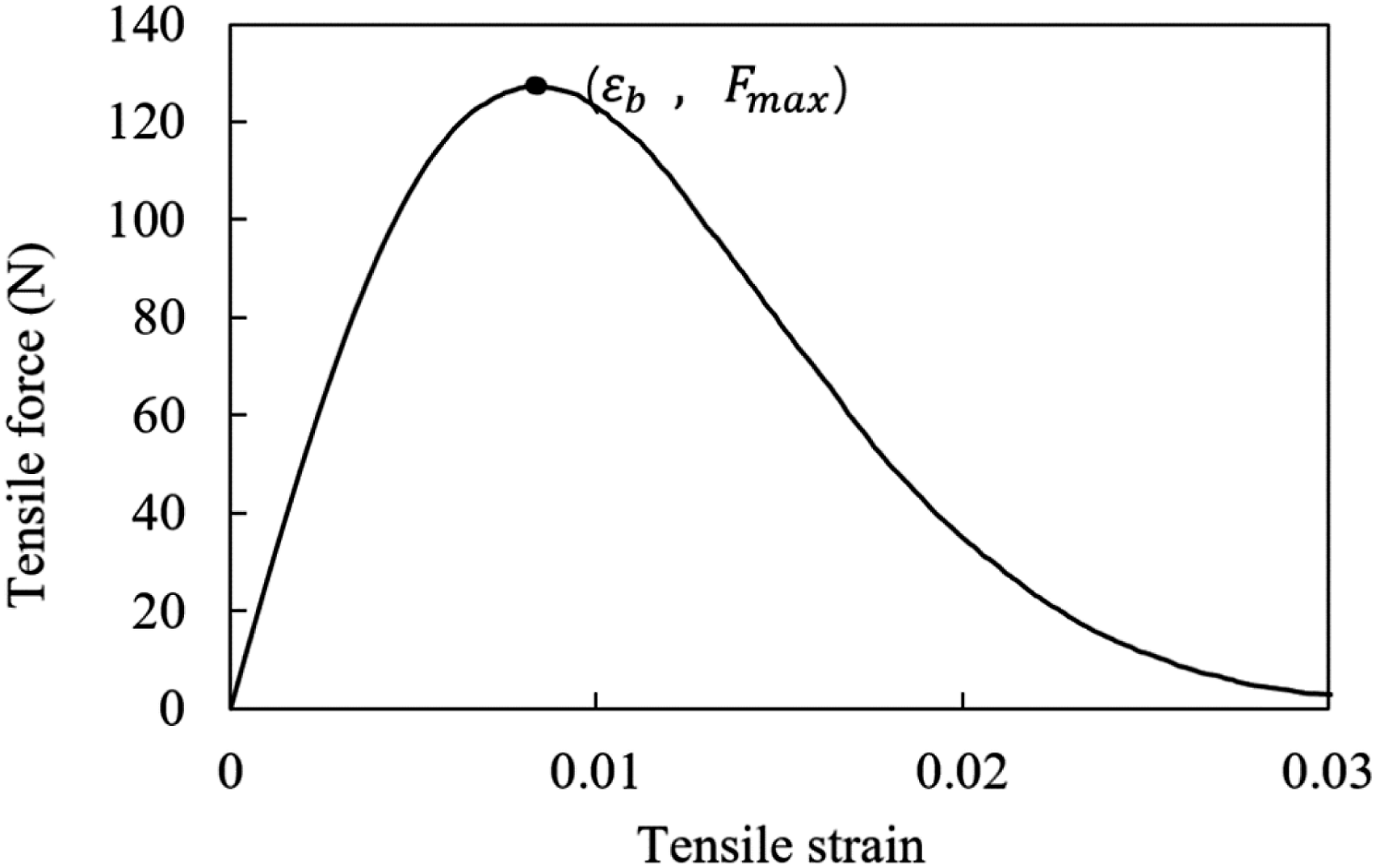

According to equation (7), the force

From equation (7) and equation (8), the


According to equation (10), different fiber bundle lengths lead to different breaking forces. Therefore, two breaking forces
When


From equation (11) and (12), the Weibull shape parameter


Equation (13) and equation (14) demonstrate the principle of this testing method. There is no need to test the strain of the fiber bundle. This method requires a test conducted only on the fracture forces of two different bundle lengths. Thus, it is easily operable and the testing error is reduced.
Experiment
Experiment and results
Based on the above theory, 3K fiber bundles of varying lengths, produced by Zhongfu Shenying (SYT45-3K carbon fiber), were selected for tensile testing. Weibull parameters are obtainable by substituting bundle length and fracture force into equation (13) and equation (14). The equipment used to conduct tensile test is shown in Figure 6. Through a wire clamp and a tension sensor with a capacity of 1 kN, it captures the maximum tension force in real time without measuring the strain during test. Fiber bundle tensile testing machine (with wire fixtures).
The tensile strength of 3K carbon fiber bundle, with a length of Tensile test of two fiber bundles with different length (
Figure 8 shows the force–time curve of a sample with a fiber bundle length of Experimental curve of tensile force–time for two carbon fiber bundles of different lengths.


Testing results for different length bundle.

Figure 9 shows the photo of the fiber bundle after it has broken. Each fiber breaks at different locations, which explains the difficulty to test the strain using a strain gauge when progressive fracture occurs. Due to the impact of fracture energy on the strain gauge, it causes a shift of the strain testing device, resulting in significant errors. Fracture photos of carbon fiber bundle under tensile load.
Comparison of two testing methods for the same carbon fiber material.

Discussions
Equation (10) can be converted into equation (17) which is simpler, where 
According to the Weibull parameters obtained from the test as described in the previous section, the relationship between bundle length Comparison between theoretical analysis by equation (17) and experimental strength of carbon fiber bundles with different lengths.
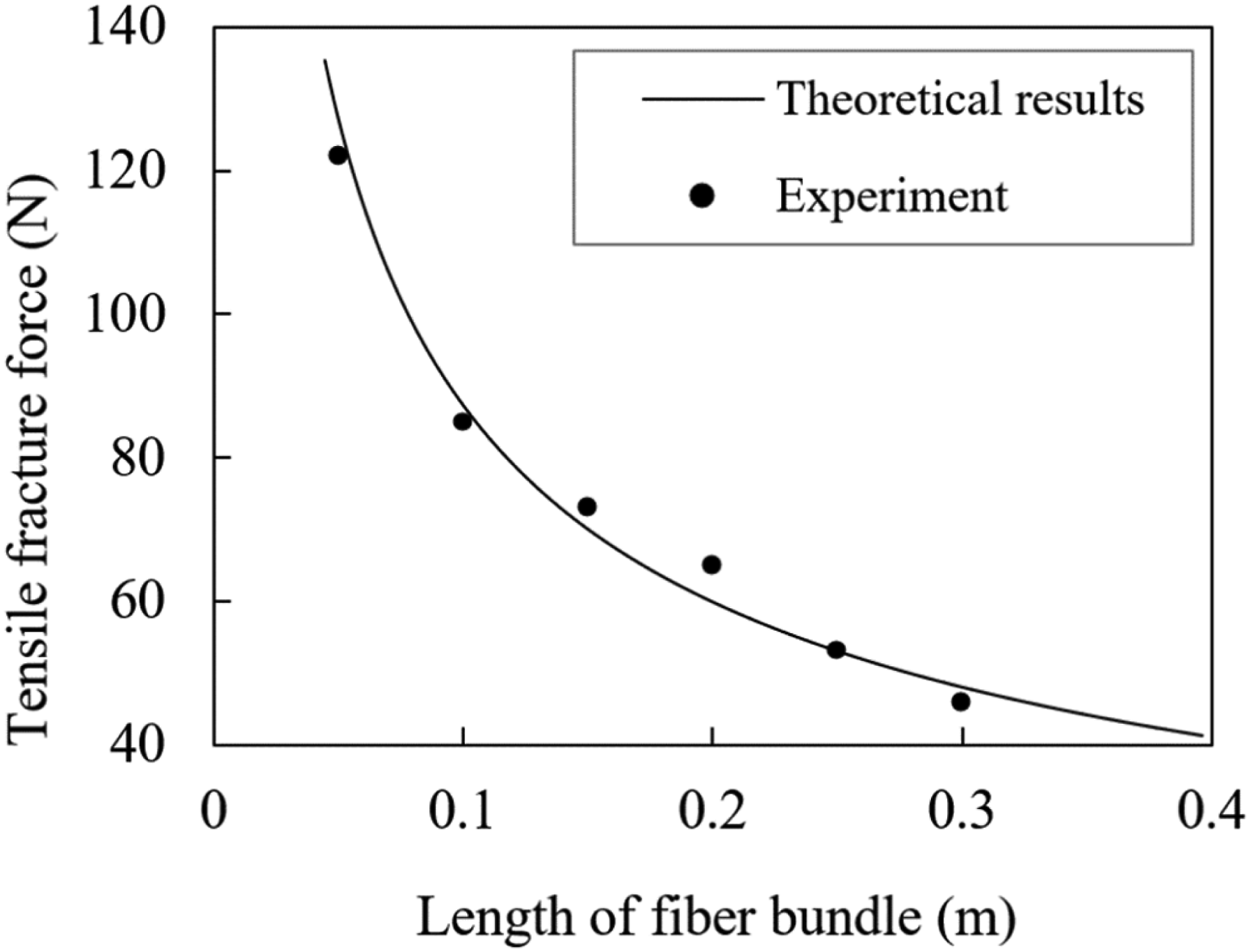
The method presented in this paper for obtaining Weibull parameters from fiber bundle testing requires only a few tests. The fiber bundle contains a large number of fibers (e.g., N = 3000), which exhibit relatively stable statistical properties at the macroscopic level. In contrast, the method of obtaining Weibull parameters through testing a large number of single fiber strengths and conducting statistical analysis requires a sample size of N >80, which is a considerable amount of work. The operator’s experience and skill play a critical role in the testing accuracy. Any individual fibers selected from the fiber bundle that fall below the limit strength will not survive, ultimately affecting the accuracy of the analysis. 16
Conclusions
A new rapid method for fiber bundle tensile testing was proposed in this study for measuring Weibull parameters. Compared with the traditional fiber bundle test method, it eliminates the need for strain measurement. The testing equipment is easy to operate and reduces time costs. Additionally, errors can be mitigated during the test. There is no need to test strain, the stiffness of the testing machine does not need to be very high, and the structure can be designed to be relatively small and lightweight.
This method was validated through tensile tests conducted on bundles with different lengths. The strength predicted theoretically is generally consistent with the results of multiple experimental tests. As shown by both theoretical and experimental analyses, this testing method is applicable for measuring Weibull parameters of other brittle fibers.
Footnotes
Acknowledgments
We would like to thank Professor Li Liang for providing the experimental testing equipment and assisting with the testing process, Dr Feng Yubo from Nanjing Glass Fiber Research and Design Institute for providing the carbon fiber bundle materials, and Dr Yuan Tiejun for his assistance with the experimental testing.

Funding
The authors received financial support for the research, authorship, and/or publication of this article: This work is supported by the Funding for school-level research projects of Yancheng Institute of Technology (grant number: xjr2023002) and the Yancheng Key Research & Development (industrial support) Program (grant number: BE2023028).
Declaration of conflicting interests
The authors declared no potential conflicts of interest with respect to the research, authorship, and/or publication of this article.