



Abstract
The effect of carbon nanotubes (CNTs) on the tensile properties of polyacrylonitrile (PAN)-based carbon fiber epoxy impregnated bundle composites was investigated. To grow CNTs on the carbon fibers, the following catalysts were selected: Ferrocene ([Fe(C5H5)2]) catalyst applied to the bundles using chemical vapor deposition (CVD), and iron (III) nitrate nonahydrate ([Fe(NO3)3•9H2O]) catalyst applied by dipping the bundles in ethanol solutions of different concentrations ranging from 0.01 to 0.5 M. For bundle composites with Fe(C5H5)2-catalyzed CNTs, the Weibull modulus was 29% higher than the as-received state, although the tensile strength is almost unchanged. The Weibull modulus is 9–39% higher than the as-received state for Fe(NO3)3•9H2O catalyst solutions in the range 0.01–0.3 M, while it decreases by 22–32% for 0.4–0.5 M solutions. The tensile strength is lower in both cases; 4–7% lower for 0.01–0.3 M solutions and 14–17% lower for 0.4–0.5 M solutions. Fe(NO3)3•9H2O catalysts 0.1 M solutions gives the best combination of tensile strength and Weibull modulus improvement. The results also show that for each type of CNT-grafted and as-received PAN-based carbon fibers, an almost linear relation between the Weibull modulus and average tensile strength on the log-log scale is observed. This relation indicates that Fe(C5H5)2 catalyst-grafting of CNTs gives better tensile strength and Weibull modulus results.
Introduction
Carbon fibers are widely used as reinforcement in composite materials because of their high specific strength and modulus. 1 Today, many polyacrylonitrile (PAN)- and pitch-based carbon fibers are commercially available. Naito et al.2-7 characterized the tensile, flexural, and transverse compressive properties and fracture toughness of PAN- and pitch-based single carbon fibers.
In contrast, carbon nanotubes (CNTs), with extremely high tensile strength (∼150 GPa), have also attracted attention as nanoscale reinforcement. 8 However, CNTs cannot be grown as long, continuous fibers. An interesting technique to modify single carbon fibers is the grafting of CNTs onto the carbon fiber surface, which has been reported previously.9,10 CNT-grafted single carbon fibers offer the opportunity to add potential benefits of nanoscale reinforcement to well-established fibrous composites to create micro–nano multiscale hybrid composites.10,11 Evaluating the effect of CNT grafting on tensile strength is important for understanding the mechanical properties of the single carbon fibers that contribute to failure of composites. However, the effect of CNT grafting on the mechanical properties of single carbon fiber has not been fully evaluated. Naito et al.12-15 reported that the grafting of CNT improves tensile strength, Weibull modulus, and thermal conductivity of PAN- and pitch-based single carbon fibers. Naito et al. 16 also examined tensile properties of ferrocene ([Fe(C5H5)2] catalyst and ethanol solution iron (III) nitrate nonahydrate ([Fe(NO3)3•9H2O/EtOH]) catalyst-type CNT-grafted PAN-based single carbon fibers. Fe(C5H5)2 catalyzed grafting of CNT improves the tensile strength and Weibull modulus of single carbon fibers. For Fe(NO3)3•9H2O/EtOH catalyst 0.01–0.1 M solution, the tensile strength of CNT-grafted single carbon fibers is almost identical to the as-received state, although the Weibull modulus of the CNT-grafted single carbon fiber is higher than the as-received state. For a 0.5 M solution, the tensile strength and Weibull modulus are lower than those in the as-received state.
The combination of traditional carbon fibers with CNTs leads to enhanced fiber/polymer interfacial load transfer. 17 Bekyarova et al. 10 reported that using epoxy composites reinforced with multiwalled CNT-coated PAN-based carbon fiber fabric led to dramatically enhanced out-of-plane mechanical and electrical properties. However, the addition of CNTs increases the shear modulus of the polymer matrix and the ineffective length becomes smaller based on the shear lag equation.18,19 In addition, when a fiber breaks, the stress is transferred back into a neighboring fiber by the surrounding matrix in a manner that is controlled by the stiffness of the surrounding material. This greatly increases the chance of one fiber fracture causing an unstable sequence of neighboring fiber fractures, resulting in complete failure. These considerations mean that the improvement of CNT-grafted single carbon fibers disappears for carbon fiber reinforced polymer matrix composites. Therefore, clarifying the tensile properties of polymer composites reinforced with CNT-grafted single carbon fibers is important.
In this work, tensile tests of epoxy impregnated bundle (composed of a large number of filaments) composites of CNT-grafted PAN-based carbon fibers were performed. The effects of CNT-grafting on tensile strength and Weibull modulus of the PAN-based carbon fiber epoxy impregnated bundle composites were evaluated. The novelty of the work is in clarifying the effects of Fe(C5H5)2 and Fe(NO3)3•9H2O/EtOH catalysts for CNT-grafting on tensile strength and the Weibull modulus of tensile strength for carbon fiber bundle composites.
Experimental procedure
Materials
Physical and mechanical properties of T1000GB carbon fiber.
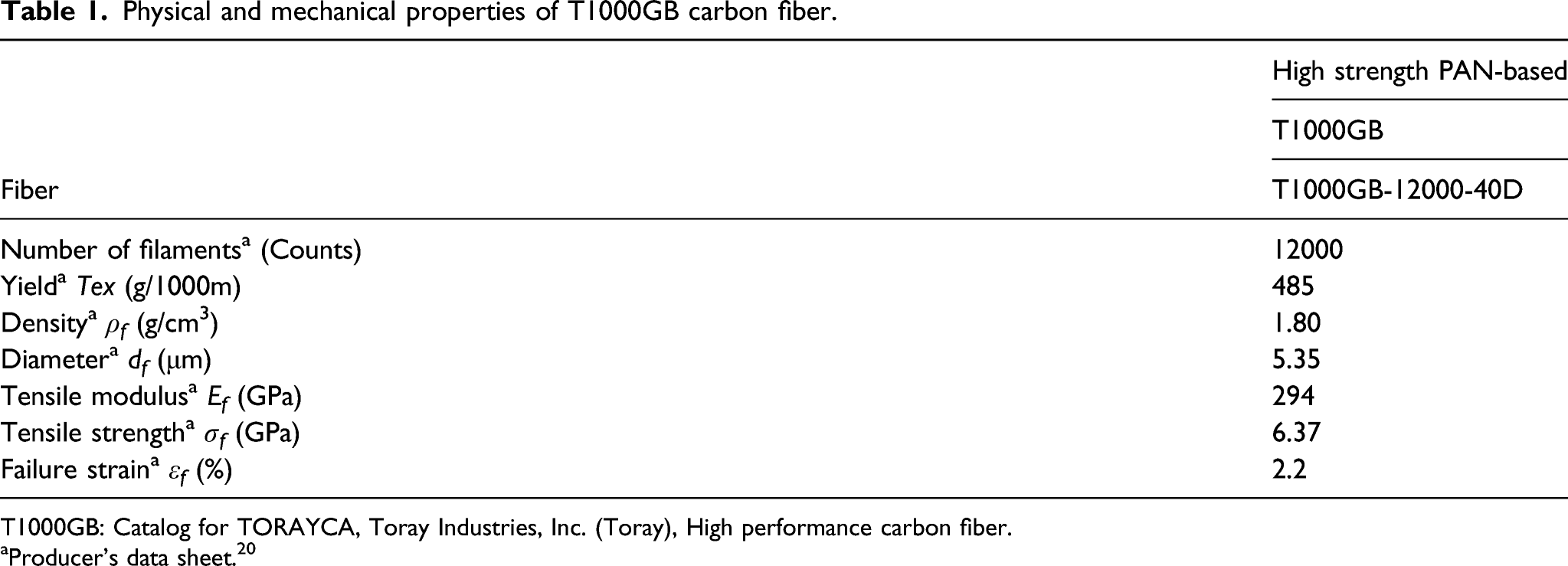
T1000GB: Catalog for TORAYCA, Toray Industries, Inc. (Toray), High performance carbon fiber.
aProducer’s data sheet. 20
The thermoset epoxy mixture consists of a diglycidyl ether of bisphenol A (DGEBA) epoxy (JER813, supplied by Mitsubishi Chemical Corp.) and an acid anhydride grade hardener (YH306, supplied by Mitsubishi Chemical Corp.) at an epoxy to hardener ratio of 100:124 by weight. 21
Preparation of CNT-grafted carbon fiber
To grow CNTs on the carbon fibers, catalysts were applied to the T1000GB fiber bundle. The catalysts used in this study were: (i) Fe(C5H5)2 catalyst applied using chemical vapor deposition (CVD), and (ii) Fe(NO3)3•9H2O catalyst, with several different concentrations ranging from 0.01 to 0.5 M in an ethanol solution, applied by dipping. The CNTs were also grown on the carbon fiber surface using CVD. Experimental details on the synthesis technique of the CNTs can be found in our previous papers.12,16 The growth temperature and time for CNT deposition were important parameters to prepare the CNT-grafted carbon fibers. Several trial temperatures and times were used and these CNT-grafting carbon fibers were observed using a scanning electron microscope (SEM). The growth temperature and time for CNT deposition were selected to be 750°C and 1200 s. For brevity, CNT-treated carbon fibers catalyzed with ferrocene are referred to as FeCNT-CF, while those catalyzed with iron nitrite ethanol solution are labeled NiCNT-CF-(molarity).
Preparation of epoxy impregnated bundle composite
Several curing temperature and time were used in selection period and these resin (bulk) specimens were tested in flexural and tension. The bundle was impregnated with a liquid epoxy mixture and cured at 90°C for 3 h and at 150°C for 12 h, with a heating rate of 3 °C/min, to form a rigid bundle composite. 21 High curing temperature treatment for long durations was applied to make sure the resin was completely cured.
Tensile test
The bundle composite was trimmed to approximately 65 mm in length. Emery paper tabs were bonded to each end of the specimen and a gauge length, L, of 25 mm was used. 21 The specimen was set up in the testing machine using active gripping systems. The tensile tests of the bundle composite were performed using a universal testing machine (Autograph AG-series, Shimadzu Corporation) with a 5-kN load cell. A crosshead speed of 5 mm/min was applied. All tests were conducted under the laboratory environment at room temperature (23 ±3°C and 50 ±5% relative humidity). 20 specimens were tested for NiCNT-CF bundle composites and 30 specimens were tested each for the FeCNT-CF and as-received bundle composites.
Results
Figure 1 shows transmission electron microscope (TEM) micrographs of the cross-sectional views of CNTs grown on the T1000GB carbon fiber. It can be seen that the CNTs grown on both types of fibers were multiwalled CNTs (MWCNTs) that appear as rolled-up graphene sheets (10–20 layers). It was found that the diameters of most of the CNTs fell in the range from 30–50 nm for the ferrocene catalyst, and of 50–240 nm for the iron nitrite catalyst. For the latter, no differences in the diameters of the CNTs were observed at lower and higher catalyst concentrations. TEM cross-sectional views of the CNT-grafted T1000GB carbon fibers: (a) Fe(C5H5)2 catalyst CNT-grafted, and (b) 0.01-M, (c) 0.1-M, and (d) 0.5-M ethanol solution Fe(NO3)3•9H2O catalyst CNT-grafted. TEM: transmission electron microscope; CNT: carbon nanotubes.


Tensile properties of T1000GB PAN-based carbon fiber epoxy impregnated bundle composites.

() indicate standard deviations.
The tensile strength of the CNT-grafted and the as-received carbon fiber bundle composites, σ
bf
, was calculated as
The average tensile strengths of the CNT-grafted and as-received bundle composites (σ bf.ave ) are summarized in Table 2. These results show that the average tensile strength of the FeCNT-CF bundle composite is 5.29 GPa, which is almost identical to that in the as-received state (5.31 GPa). Evidently, the FeCNT did not affect the tensile strength (did not sacrifice the tensile strength) of the epoxy impregnated bundle composite. A similar result was observed in a previous investigation, 22 wherein the average tensile strength of FeCNT-CF polyimide impregnated bundle composite was 5.32 GPa, which is similar to that in the as-received state (5.32 GPa). The growth time for CNT deposition (900 s) in that study was different from that of this work. The average tensile strengths of the NiCNT-CF bundle composites are ranging from 5.08 to 4.37 GPa, showing slightly lower values at lower concentrations (0.01 and 0.05 M) compared to the as-received state. The tensile strength subsequently increased with increasing catalyst concentration, ranging from 0.1 to 0.3 M, then dramatically decreased at higher concentration (0.4 and 0.5 M).
Scanning electron microscope micrographs with longitudinal views of the tensile fractured surfaces of the CNT-grafted and the as-received carbon fiber bundle composites are shown in Figure 2. A previous report showed that an axial tension failed unidirectional carbon fiber reinforced polymer (CFRP) specimen led to fracture in the transverse direction at several points, which was associated with longitudinal splitting of the composite.
23
Similar fracture morphology (longitudinal splitting) was observed for all bundle composite specimens. In particular, the carbon fiber bundle composites failed owing to extensive longitudinal splitting along the whole length of the specimen, resulting in a brush-like fracture surface. This suggested higher strength PAN-based carbon fiber-dominated fracture behavior and an increase in fiber efficiency. There is a distinct difference in the morphology among the CNT-grafted and the as-received carbon fiber bundle composites. The fractured surfaces of the CNT-grafted bundle composites are rough with a large amount of resin. However, the as-received bundle composites have smooth surfaces with a small amount of resin. The CNT-grafted on carbon fibers may lead to enhancement of the interfacial properties (strength) between the fiber and the matrix. SEM longitudinal views of the tensile fractured surfaces of CNT-grafted and as-received T1000GB carbon fiber bundle composites: (a) As-received, (b) Fe(C5H5)2 catalyst CNT-grafted, and (c) 0.01-M, (d) 0.1-M, and (e) 0.5-M ethanol solution Fe(NO3)3•9H2O catalyst CNT-grafted (insets show CNTs at high magnification). SEM: scanning electron microscope; CNT: carbon nanotubes.
The interfacial shear strength of FeCNT-CF and NiCNT-CF-0.1 was examined using a carbon fiber epoxy microdroplet composite.24-26 For all microdroplet composites, the load was almost linearly proportional to the displacement until the load reached its maximum and the interfacial fracture between the fiber and the matrix occurred. Afterward, the load decreased abruptly to the low value of the frictional load, which was maintained during the move of the deboned microdroplet along the fiber. The average interfacial shear strength, τ
IFSS.ave
was calculated by using the fitting straight line of maximum fracture load, P
max
as a function of embedded length, l
e
as follows
Fractured surfaces of CNT-grafted and as-received carbon fiber epoxy microdroplet composites were examined using the SEM. There is a distinct difference in the morphology among the CNT-grafted and the as-received carbon fiber epoxy microdroplet specimens. The fractured surfaces of the CNT-grafted microdroplet specimens are rough with a large amount of resin, whereas the as-received microdroplet composites have smooth surfaces with a small amount of resin. The CNT-grafted on carbon fibers lead to enhancement of the interfacial shear strength between the fiber and the matrix. Similar results were observed for the literatures10,11,17 and the tensile fractured surfaces as shown in Figure 2.
The results shown in Table 2 indicate scattering in the tensile strength for the carbon fiber bundle composites. The statistical distribution of fiber and composite strengths is typically described by the Weibull equation.
27
The two-parameter Weibull distribution is given by


Therefore, m b can be obtained by linear regression from a Weibull plot of equation (7)
Figure 3 shows the Weibull plots of the tensile strength for the CNT-grafted and as-received carbon fiber bundle composites. A tensile strength threshold was observed in the plots. The influence of threshold stress on the estimation of the Weibull statistics was discussed by Lu et al.
28
where it was concluded that the two-parameter Weibull distribution is still a preferred choice. As a result, the two-parameter Weibull distribution was applied in this study. Weibull plots for CNT-grafted and as-received T1000GB PAN-based carbon fiber bundle composites. CNT: carbon nanotubes.
The Weibull moduli of the CNT-grafted and as-received carbon fiber bundle composites are summarized in Table 2. For FeCNT-CF, the Weibull modulus was 29% higher than that in the as-received state. For NiCNT-CF 0.01–0.3 M solutions, the Weibull modulus was 9–39% higher than that in the as-received state, respectively. The results show that the selected catalysts for grafting of CNTs improve the Weibull modulus of bundle composites. However, the Weibull modulus in the case of higher catalyst concentration (0.4 and 0.5 M) NiCNT-CF is 22–32% lower than that in the as-received state.
Discussion
The tensile properties of the unidirectional bundle composites are strongly related to the fiber strength and interfacial shear strength between the fiber and the matrix. A high interfacial shear strength is necessary to increase fiber efficiency. However, higher shear modulus may lead to stress concentrations upon fiber breakage. The interfacial debonding between the fiber and the matrix is also necessary to disperse of localized fracture energy at fiber breakage point.
The interfacial shear strengths of the CNT-grafted and the as-received bundle composites were considered high enough (<60 MPa). The interfacial debonding of the as-received bundle composite was observed in Figure 2. The fiber strength in the as-received state was found to be 5.31 GPa, while the fiber strength of the FeCNT-CF was higher than that in as-received state. 16 However, interfacial debonding was not observed in Figure 2 and the dispersion of localized fracture energy was not ideal. Therefore, the tensile strength was not improved by the ferrocene catalyst.
On the other hand, the ferrocene catalyst improved the Weibull modulus of the carbon fiber bundle composite. The grafting of CNTs could help heal flaws (surface and internal) that relate to lower tensile strength of bundle composite. Similar results were observed in tensile strength of CNT-grafted PAN- and pitch-based single carbon fibers at a shorter gauge length. 14 The grafting of CNTs could help increase the shear modulus of the matrix and enhance stress concentrations. The dispersion of localized fracture energy was not ideal, resulting in decreased higher tensile strength of bundle composites. The introduction of CNT grafting on the carbon fiber could increase the lower tensile strength and decrease the higher tensile strength of bundle composites, resulting in an improved Weibull modulus of bundle composite. Similar results were observed in the tensile strength of CNT-grafted PAN- and pitch-based carbon fiber polyimide impregnated bundle composites. 22
The tensile strength and Weibull modulus of NiCNT-CF bundle composites varied. For 0.01–0.3 M solutions, the Weibull modulus of the bundle composite improved, but the tensile strength was slightly lower than that of the as-received state. However, for the higher catalyst concentration (0.4 and 0.5 M), the tensile strength and Weibull modulus decreased compared to that of the as-received state. Figure 4 shows the effects of iron nitrite catalyst concentration (C
c
) on tensile strength and the Weibull modulus. Considering the effects of CNT grafting, the tensile strength of CNT-grafted bundle composites linearly increased with increasing catalyst concentration for the 0.01–0.1 M solutions and reached a maximum value (positive effect). However, the iron nitrite catalyst damages the surface of the carbon fiber, leading to decreasing tensile strength with increasing catalyst concentration (negative effect). The combination of these effects is complex to model and requires further study; however, it was found that the root mean square of an exponential function could represent the CNT grafting and ethanol solution of catalyst Effects of CNT grafting and ethanol solution Fe(NO3)3•9H2O catalyst concentration on tensile strength and the Weibull modulus of ethanol solution Fe(NO3)3•9H2O catalyst CNT-grafted carbon fiber bundle composites. (a) Tensile strength and (b) Weibull modulus. CNT: carbon nanotubes.


In our previous investigation,
4
it was found that when the gauge length of as-received T1000GB PAN-based single carbon fiber is less than 100 mm, there is a linear relationship between the Weibull modulus, average tensile strength, and gauge length on the log-log scale. For the CNT-grafted T1000GB single carbon fiber, there is also a linear relationship between the Weibull modulus, the average tensile strength, and the gauge length on the log-log scale. For the bundle composites, it is thought that there is a similar linear relation between the m
b
and σ
bf.ave
on the log-log scale

Hence, α b can be obtained by linear regression from equation (11).
Figure 5 shows the relation between m
b
and σ
bf.ave
of the CNT-grafted and as-received T1000GB carbon fiber bundle composites. Previous results of Weibull modulus (m
f
) versus average tensile strength (σ
f.ave
) for as-received single carbon fibers at several gauge lengths,2,4 FeCNT-grafted single carbon fibers at several gauge lengths,12,14 and NiCNT-grafted single carbon fibers
16
are also shown in Figure 5. The results show that the Weibull modulus for the bundle composites increased with increasing average tensile strength, as well as the Weibull modulus of the single carbon fibers. An almost linear relation between the Weibull modulus and the average tensile strength of the CNT-grafted and as-received PAN-based carbon fiber bundle composites is observed on the log-log scale. This means that the high strength of carbon fiber bundle composites causes a narrow strength distribution. Relation between the Weibull modulus and the average tensile strength of CNT-grafted and as-received T1000GB PAN-based carbon fiber bundle composites. CNT: carbon nanotubes.
A potential mechanism for increasing or decreasing tensile strength or both is thought to be the balance between the healing the surface flaws related to the three-dimensional network structures of CNT and damage from the catalyst ethanol solution. The tensile strength and Weibull modulus are varied by the combination of these effects. This relation as shown in Figure 4 also indicated that Fe(C5H5)2 catalyst-grafting of CNTs was giving better tensile strength and Weibull modulus results.
Concluding remarks
Tensile tests of Fe(C5H5)2 catalyst and Fe(NO3)3•9H2O/EtOH catalyst CNTs grown on T1000GB PAN-based carbon fiber epoxy impregnated bundle composites were performed. The results are briefly summarized below. (1) Ferrocene and iron nitrite catalyzed grafting of CNTs do not affect the tensile modulus of carbon fiber bundle composites. (2) Ferrocene catalyzed grafting of CNTs improved the Weibull modulus of the carbon fiber bundle composite, although the tensile strength of the bundle composite was almost identical to that in the as-received state. (3) The tensile strength and Weibull modulus of NiCNT-CF bundle composites varied. For 0.01–0.3 M solutions, the grafting of CNTs improved the Weibull modulus of the bundle composite, although the tensile strength of the bundle composite was slightly lower than that in the as-received state. However, for higher catalyst concentration (0.4 and 0.5 M), the tensile strength and Weibull modulus of CNT-grafted bundle composites were lower than that in the as-received state. (4) The Weibull modulus increased with increasing average tensile strength of CNT-grafted carbon fiber bundle composites compared to the as-received state. On the log-log scale an almost linear relationship between the Weibull modulus and the average tensile strength of CNT-grafted and as-received carbon fiber bundle composites is observed.
Footnotes
Author contributions
Kimiyoshi Naito performed research, wrote the manuscript and drew the figures. Chiemi Nagai prepared the manuscript. All the authors read and approved the manuscript.
Declaration of conflicting interests
The author(s) declared no potential conflicts of interest with respect to the research, authorship, and/or publication of this article.
Funding
The author(s) received no financial support for the research, authorship, and/or publication of this article.
Data availability
The datasets supporting the conclusions of this article are included within the article.
