



Abstract
This article explores the acoustic properties of a bio-composite material derived from coconut plant waste and potato starch material. The material consists of coir fiber as reinforcement and starch as a binding agent, produced using the hot press technique. To improve structural durability, a glass fiber layer was added to one side of the test sample. The study used the impedance tube method to measure the sound absorption coefficient of the newly developed material. It investigated the effects of material composition, thickness, and structural arrangement relative to the sound source on sound absorption. The results reveal that these factors significantly influence sound absorption properties. The fibrous structure achieved the highest noise reduction coefficient when facing the sound source with maximum thickness. The maximum sound absorption coefficient, ranging from 0.35 to 0.4, was observed in the higher frequency range, while the lower frequency range showed more variability in results. Starch-based composites are known for their environment friendly nature and find its applications in various sectors including packaging, consumer goods and automotive too.
Keywords
Introduction
Technological advancements have led to a significant rise in municipal solid waste, generating about 11.2 billion tons annually. In addition to industrial and poultry waste, agricultural activities contribute substantially to plant-based waste and other organic materials. Worldwide, around 1.6 billion tons of plant waste are produced each year. 1 Disposing of this waste presents challenges for municipalities and industries, as much of it ends up in open dumps, where it accumulates in the environment and contributes to pollution. In recent times, there is a growing focus on bio waste natural fibers as an eco-friendly alternative to mineral and synthetic fiber composites. These fibers are gaining prominence across various industries such as automotive, construction, and various engineering applications, where they serve as reinforcing materials. However, it’s true that their mechanical properties may not match those of synthetic fibers due to its hydrophilic nature, fiber length, fiber orientation, etc. Adhesion between fiber and matrix can be improved using chemical treatment of the fibers. Natural fibers are in boom due to its biodegradability, cost-effective, readily accessible, high strength-to-weight ratio, and contribute to lower CO2 emissions. 2 Numerous researchers have delved into examining the mechanical and tribological properties of various natural fibers and their composites. 3 Among these natural fibers, coir, fiber has garnered substantial attention owing to their ease of procurement, affordability, and reasonably favorable properties.
Aireddy and Mishra 4 employed the hand layup technique to create coir fiber (contain cellulose, hemicellulose, pectin, and lignin) epoxy composites and examined their resistance to erosive and abrasive wear under various conditions, including different impingement angles and varying silica impact velocities. Their test outcomes indicated that as the fiber content increased, the material’s wear resistance also increased, particularly under high-load conditions. Numerous researchers have investigated the impact of alkaline treatment on coir fibers in composite tribological properties. These studies have consistently demonstrated that fiber treatment substantially enhances the interfacial adhesion between the fiber and matrix, consequently improving the overall material properties.5–8 In a review article, Adewale George Adeniyi et al. 9 discussed the utilization of various resin materials such as polypropylene, epoxy, polyester, PLA, and polyethylene in combination with coir fibers. They also contemplated the potential use of other future resin materials like vinyl ester, polystyrene, and polyvinyl chloride in conjunction with coir fibers. Yousif et al. 10 conducted a study to explore the influence of different weight fractions of coir fibers on the friction and wear properties of the composite material. Their findings underscored the substantial impact of fiber content on the composite’s properties.
Devadiya, Bhat, and Mahesh 11 utilized sugarcane fibers as a filler material in concrete and investigated the thermal stability of the resultant material under elevated temperatures. On a similar note, El-Tayeb 12 developed a composite using sugarcane fibers and polyester resin, evaluating its tribological properties and comparing them to glass fiber composites. The study unveiled that sugarcane fiber composites have the potential to replace glass fiber composites, demonstrating improved friction and wear properties. Additionally, Mahapatra and Chaturvedi 13 strategically oriented sugarcane fibers within a composite and assessed its resistance to abrasive wear.
Noise, defined as unwanted and unpleasant sound, poses a significant health hazard. Given the continuous progress in technology, urban expansion, and industrial development, completely avoiding noise in our daily lives has become nearly impossible. 14 Excessive noise can lead to a diminished quality of life and adverse effects on human health. To tackle this issue, researchers are diligently working on various technologies, strategies, and materials. Noise control can be broadly categorized into two approaches: active noise control and passive noise control. Active noise control involves reducing noise at its source, while passive noise control entails the use of sound-absorbing materials at the source to mitigate its impact. 15 Due to the practical challenges associated with implementing active noise control mechanisms, researchers are increasingly directing their efforts toward an alternative approach—the development of sound absorption panels. In alignment with this shift, many researchers have begun exploring the potential of natural fibers as materials for sound absorption.
Traditionally, materials like glass wool, cotton, polyethylene foam, and rock wool have been utilized for sound absorption. Nevertheless, these substances are associated with issues such as skin and eye irritation, as well as respiratory ailments. 16 In recent times, extensive research has been conducted to develop innovative porous materials that can provide effective sound absorption capabilities, offering a viable alternative to conventional options.
Porous materials exhibit remarkable sound absorption capabilities, and optimizing the design of fibrous porous materials can significantly enhance their sound absorption capacity. 17 Yilmaz et al. have conducted research on various factors affecting sound absorption, including fiber porosity, size, and layer sequence, 18 as well as the impact of heat treatment on multi-fiber nonwoven composites 19 and surface treatment on material sound absorption capabilities. 20 Several studies have also assessed the sound absorption properties of materials developed from recycled resources like tea leaf fibers, rubber waste, waste wool, and discarded polyester fibers, among others.21–25 In their article, AL Oqla F M discusses the critical parameters for selecting natural fibers that result in effective sound absorbers. 26 Furthermore, research has delved into the use of fillers in polypropylene to enhance soundproofing, with notable findings. 27 Various studies have explored the acoustic properties of diverse natural fibers, including corn cob, 28 kapok fabric, 29 jute fiber, 30 hemp, 31 and banana fiber. 32
In a study conducted by Zulkitli et al., 33 they developed a novel material using coir fiber with a woven cotton cloth backing and assessed its acoustic properties across various frequencies. The experimental findings demonstrated that this newly created material displayed exceptional sound absorption characteristics. Authors also concluded that this innovative panel holds significant potential as a substitute for traditional glass fiber and mineral-based synthetic materials. In a separate investigation by Ibrahim Taban et al., 34 they engineered coir fiber materials of varying thicknesses while maintaining a constant density and introduced an air gap behind them. The evaluation of these materials' acoustic properties revealed that as the material thickness increased, so did its sound absorption capacity. Azma Putra et al. 35 manufactured an absorber material using sugarcane waste as reinforcement and a polymer as a binding agent. Test results indicated excellent acoustic resistance within the medium frequency, with a sound absorption coefficient of 0.65. This suggests that this material possesses the potential to replace conventional materials like wool and mineral-based options for acoustic applications. Ehsan R. et al. 36 has developed natural fiber-reinforced micro perforated panel made from cork fiber and PLA and developed using 3D printing technique. The authors have identified the effect of perforation diameter, thickness, and back cavity depth on the sound absorption coefficient.
All the aforementioned studies have consistently pointed out that natural fiber-based materials exhibit outstanding acoustic properties, particularly for medium and high-frequency sound absorption. However, there is some variation in results when it comes to low-frequency sound absorption.
Even though mechanical properties of the starch-based resin may not match those of thermosetting polymers, this shortfall can compensate in several other ways. They are recyclable, biodegradable, and cost-effective compared to many polymers and less toxic in nature. Due to the biodegradability and less toxicity of natural fiber and starch-based resin, starch-based composites find its applications in the several areas including packaging, consumer goods, and automotive sectors.
The increasing use of glass composites in various applications poses a threat to the environment due to their lack of eco-friendliness. Many of the studies mentioned above have highlighted the potential use of agro waste natural fiber-based composite materials, taking into account their mechanical properties and environmental benefits. Nonetheless, further research is required to fully explore their potential as sound absorbers.
In line with this, this research focuses on investigating the sound absorption characteristics of recycled resources such as coir.
Materials and methods
Materials
Coir fiber waste was collected from a local vendor, which underwent a specific treatment process. Initially, the fibers were immersed in a caustic soda-water mixture for a duration of 4 h to eliminate dust particles and extract the fibers. Subsequently, the fibers were subjected to a 5% NaOH solution treatment for 1 h, followed by thorough rinsing with distilled water. The cleaned fibers were then dried naturally in sunlight for 2 h and further dried in an oven at 60°C. The fibers cut in range of 10 mm to 15 mm length and stored in an airtight bag.
The diameter of these treated fibers was measured using an optical microscope. Coir fibers exhibited a diameter range of 50 µm–200 µm. Measurements were taken at three distinct locations on 10 different fibers. On average, coir fibers displayed a diameter of 155 µm. Additionally, extra pure potato starch in powdered form was obtained from Chemish Enterprises in Vadodara, Gujarat, India, to be used as a binding material.
Fabrication of specimens
The specimens of 29.5 mm and 99.5 mm diameters were fabricated using a hot press technique. In this process, layers of fibers and matrix material were layered in a circular mold with 75% fiber and 25% of starch. The mold was then heated to 180°C using a heater. Subsequently, a pressure of 50 tons was applied to the mold, which was maintained for a duration of 24 h. As a result of this process, specimens with uniform structures were obtained, each having varying thicknesses of 7.5 mm, 6.8 mm and 6 mm. Process of manufacturing the samples is shown in the Figure 1. Sample preparation for acoustic testing.
The developed specimen was examined using scanning electron microscopy, as shown in Figure 2. The image reveals good bonding between the fiber and matrix materials, with fibers arranged in a way that create porosity (as heighted) at few places—an essential feature for acoustic materials. SEM image of developed coir fiber composite.
Durability test
The samples prepared were assessed for their thermal stability and their ability to withstand exposure to an open environment. These samples were subjected to the open environment conditions, and their weight loss was measured after 15 days and continued for a period of 3 months to assess the impact of the environment on material sample. Additionally, to evaluate their thermal stability, sample was subjected to controlled heating in an oven, ranging from 20°C to 250°C, with a heating rate of 20°C/min. The coir fiber-reinforced material demonstrated its thermal resilience by maintaining stability up to 220°C as shown in the Figure 3. To further enhance their environmental resilience, a single layer of glass fiber was applied to one side of the specimens as shown in Figure 4. Durability test for coir specimen. Coir fiber specimens.

Testing
The acoustic testing involved the preparation of samples with circular dimensions, specifically with diameters of 99.5 mm and 29.5 mm. These varying diameters were chosen to cater to different frequency ranges, with the larger diameter samples intended for the lower frequency range and the smaller diameter samples designated for the higher frequency range. The experimental setup adhered to the two-microphone method, in accordance with the ASTME 1050-12 standards.
In an impedance tube, a speaker typically generates sound waves within the tube. Microphones positioned on the tube wall capture acoustic pressure at two fixed locations, enabling the computation of the mixed acoustic conversion function. This study utilized an impedance tube equipped with both a large-diameter tube for measuring absorption coefficients at lower frequencies and a small-diameter tube for higher frequencies. Integrating the outcomes from both tubes allows for the comprehensive calculation of sound absorption coefficients across the entire frequency spectrum, providing an overall value for sound absorption in the studied material.
Impedance tube setup was used for study shown in the Figure 5. To conduct the experiments, both Type 4206 standard large tube and standard small tube setups were employed. Impedance tube setup for determining sound absorption coefficient
37
.
The acoustic tests were conducted with different arrangements relative to the sound source, as illustrated in Figure 6. Placement of samples with respect to sound source. (a) Glass fiber layer toward the sound source (arrangement 1). (b) Fiber layer (coir) toward the sound source (arrangement 2).
Results and discussion
The sound absorption coefficient of the samples was examined for varying thickness and arrangement, and the subsequent sections will show the factors influencing this coefficient.
Effect of varying thickness on sound absorption in coir fiber composite
The analysis of Figure 6 indicates a notable impact of material thickness on the acoustic properties of the developed material. In Figure 7(a), it is evident that with arrangement 1, materials with greater thickness exhibit superior sound absorption coefficients. Lower thickness levels display considerable fluctuations, especially in the lower frequency range. Figure 7(b) corroborates these findings, showing that increased thickness leads to higher sound absorption coefficients, though with more pronounced fluctuations at lower frequencies. Notably, samples with a thickness of 7.5 mm demonstrate the highest and most consistent sound absorption performance. In comparison, samples with 6.8 mm thickness, in both arrangements, exhibit moderate sound absorption, while those with 6 mm thickness show lower absorption coefficients than their thicker counterparts (6.8 mm and 7.5 mm). Sound absorption coefficient of samples having different thickness. (a) Arrangement 1. (b) Arrangement 2.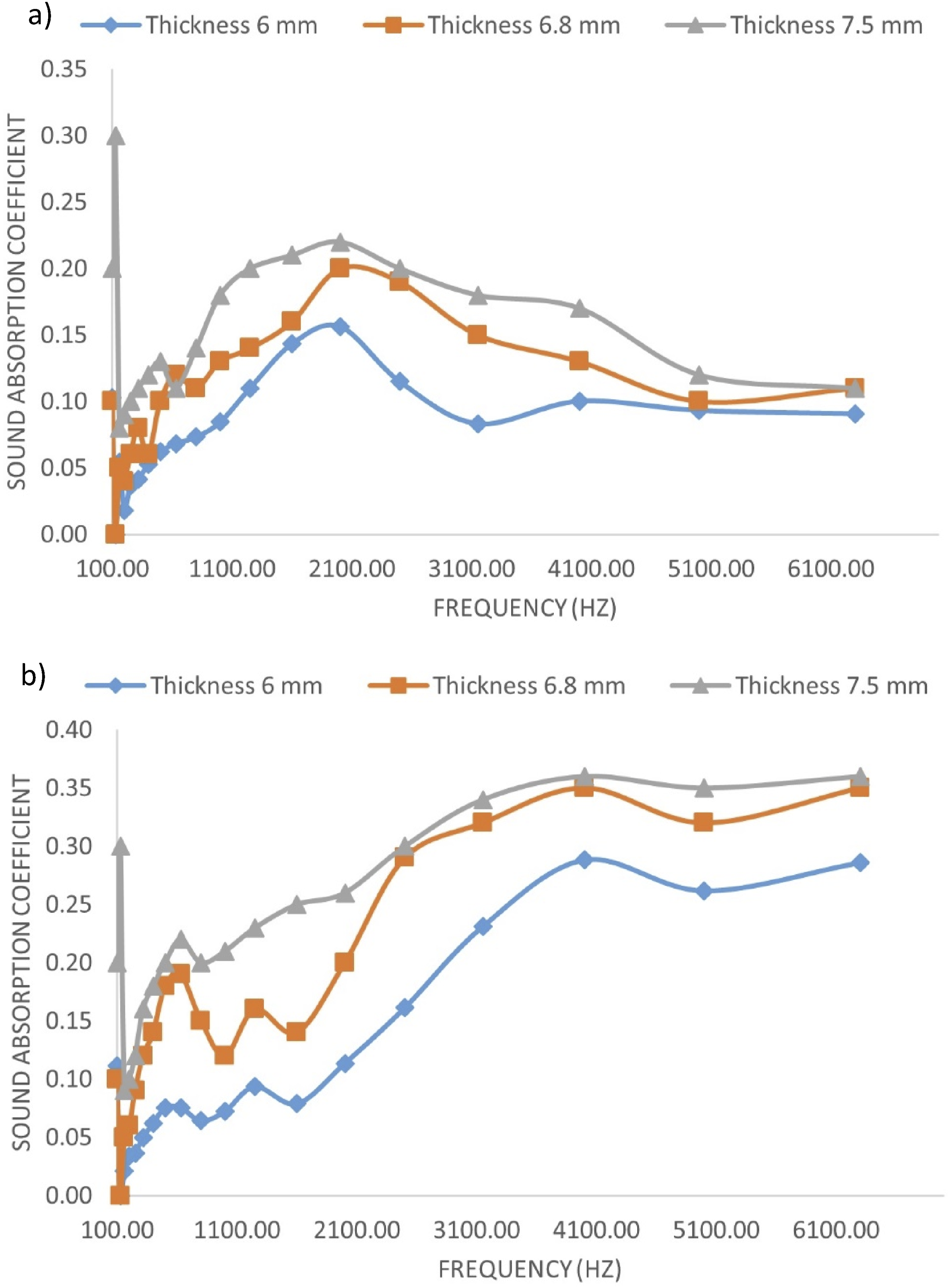
In both arrangements—whether the glass fiber is oriented towards the sound source or the natural fiber is directed toward the sound source—it is evident that at medium and high frequencies, there are fewer fluctuations across all thickness levels. However, it is noteworthy that in the first arrangement, where the glass fiber faces the sound source, the sound absorption performance is consistently lower across various thickness values compared to the second arrangement. Specifically, when the sound source is directed toward the natural fiber and the specimen has a thickness of 7.5 mm, the material exhibits the highest sound absorption coefficient observed.
In the first arrangement, the material exhibited the highest absorption coefficient at medium sound wave frequencies. However, as the frequency increased, the absorption coefficient decreased. In contrast, the second arrangement showed an increase in sound absorption coefficient with thicker materials. This difference can be attributed to the natural fiber’s more porous structure compared to glass fiber. The natural fiber’s abundant air cavities allow sound waves to easily pass through, dissipating energy as heat with increasing thickness. In the first arrangement, more sound waves reflect back than are absorbed, leading to a lower coefficient of absorption. Meanwhile, the porous nature of the second arrangement enables more sound waves to be absorbed and transmitted through the material, resulting in a higher absorption coefficient.
Effect of arrangement on sound absorption coefficient in coir fiber composite
Two distinct arrangements were tested for sound absorption, with arrangement 1 placing glass fiber toward the sound source and arrangement 2 using natural fibers in the same position and shown in Figure 8. An intriguing pattern emerged when considering different thicknesses. In arrangements 1 and 2, samples with thicknesses of 6 mm and 7.5 mm exhibited significant fluctuations at lower frequencies, stabilizing as the frequency increased. However, the 6.8 mm thick sample in arrangement 1 showed a different absorption pattern. Sound absorption coefficient of different arrangement. (a) Thickness 6 mm, (b) 6.8 mm, and (c) 7.5 mm.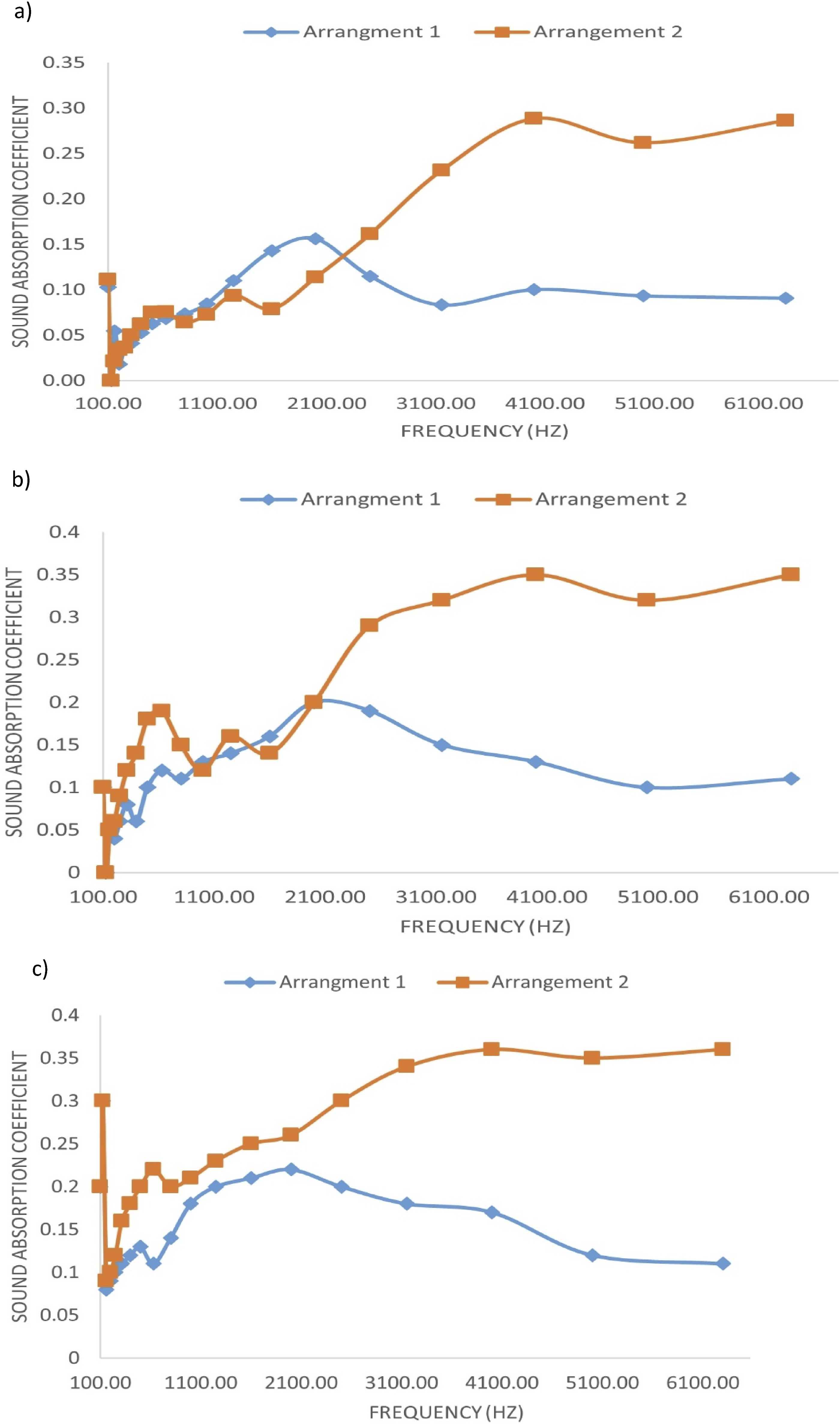
In arrangement 2, the sound absorption coefficient increased with higher frequencies, whereas in arrangement 1, it decreased in the higher frequency range, a trend observed across all thicknesses (6 mm, 6.8 mm, and 7.5 mm). Arrangement 2 consistently demonstrated more stable sound absorption compared to arrangement 1. Notably, the difference in sound absorption was more noticeable at higher frequencies, with minimal disparities at lower and medium ranges.
Arrangement 1 consistently outperformed arrangement 2 in terms of sound absorption. This can be attributed to glass fibers having fewer pores than natural fibers, allowing fewer sound waves to pass through. The structure’s low porosity causes most waves to reflect back, with a portion penetrating the material as thickness increases. As sound waves are absorbed, they dissipate as heat, reducing wave intensity. The compact structure of arrangement 1 results in a few rays being reflected back, affecting its overall sound absorption performance. This disparity explains why arrangement 1 has a lower sound absorption coefficient than arrangement 2.
Measure of sound absorption coefficient along the length of the tube for both the arrangement is shown in the Figure 9(a) and (b)). Sound absorption coefficient along the length of the tube. (a) Arrangement 1. (b) Arrangement 2.
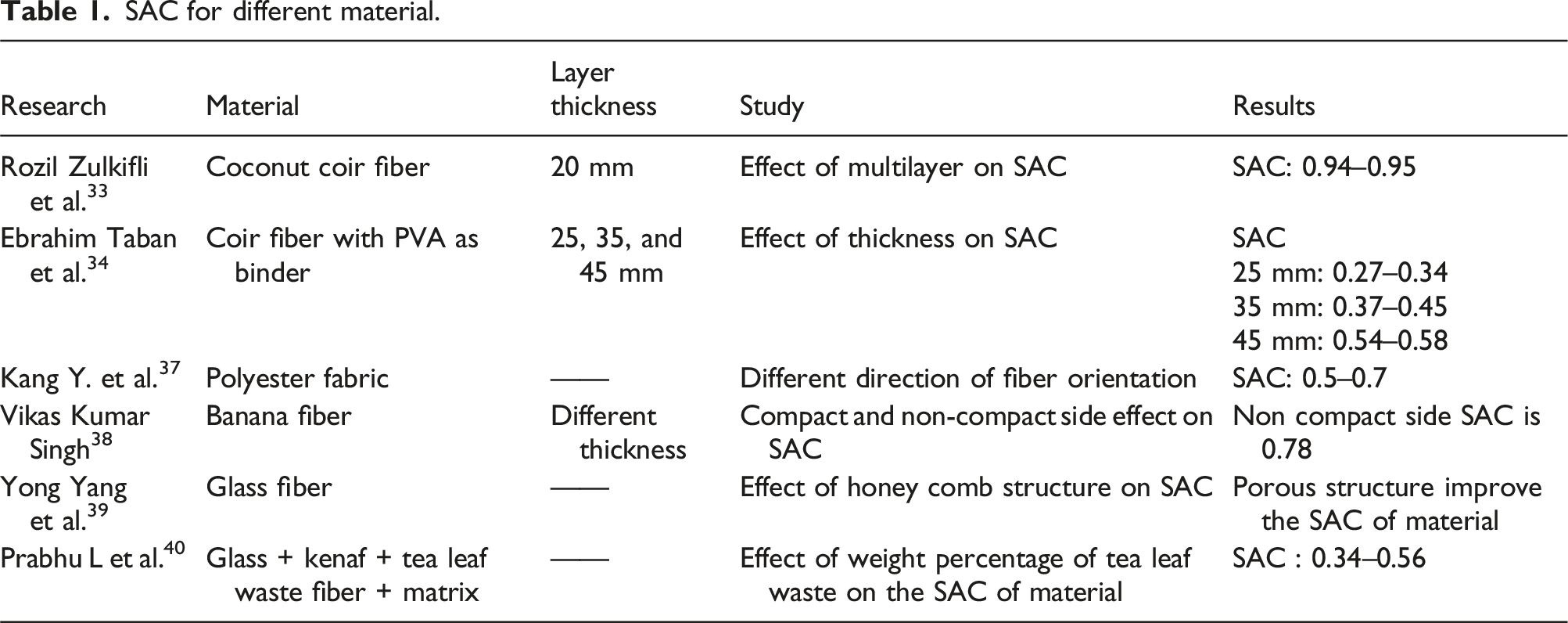
SAC for different material.
Conclusion
This study focuses on the development of a composite material using coir fiber and starch, with varying thicknesses of 6 mm, 6.8 mm, and 7.5 mm. Additionally, a 1 mm-thick layer of glass fiber was applied to one side of the samples. The objective was to investigate the impact of the coir fiber thickness and the presence of glass fiber on the sound absorption coefficient (SAC).
The findings from the tests are as follows: • The SAC of the material demonstrates an increasing trend with the thickness of the coir fiber layer. The highest SAC was observed for a 7.5 mm thickness, ranging from 0.5 to 0.55, particularly within the high-frequency range of 3100–6100 Hz. • In the case of glass fiber, the maximum SAC (ranging from 0.2 to 0.22) was noted in the middle frequency range of 1100–2100 Hz. Conversely, SAC showed a reduction in both the low and high-frequency ranges. • Notably, natural fibers, such as coir fiber, exhibited a greater sound absorption capacity compared to synthetic glass fiber.
In summary, the study highlights the influence of coir fiber thickness and the introduction of glass fiber on the sound absorption characteristics of the composite material, emphasizing the superiority of natural fibers in sound absorption over synthetic counterparts. The developed coir fiber-reinforced starch-based composite material has shown good potential as a sound absorber. Further this study can be extended to identify the effect of various fiber orientation, fiber weight fraction, and fiber length on the sound absorption coefficient.
Footnotes

Funding
The authors received no financial support for the research, authorship, and/or publication of this article.
Declaration of conflicting interests
The authors declared no potential conflicts of interest with respect to the research, authorship, and/or publication of this article.
Data Availability Statement
The data presented in this study are available on request from the corresponding author.