



Abstract
The coupling effects of high and low temperature-humidity-applied load on the longitudinal tensile mechanical properties and the durability performance of epoxy resin-based carbon fiber reinforced composites (EP-CFRP) are studied in this paper. It considers two high and low alternating temperature ranges [−40°C∼40°C]/[−40°C∼25°C], two humidity conditions (soaking in water and anhydrous), and three load levels of unstressed state or 30% and 60% of the ultimate load. The results indicate that all these three factors have a significant impact on the durability of EP-CFRP. The tensile strength varies with the high and low temperature alternating cycle, showing a trend of first decreasing, then increasing, and then decreasing; however, the peak and valley values appear in the quite different alternating cycle. The coupling effects of these factors have less influence on the tensile modulus. The microcracks generated at the interface between the resin matrix and the fiber have been proved to be the main reason for the strength reduction at the later stage. The coupling effect of humidity and load promotes the expansion of cracks and exacerbates the damage to EP-CFRP. Based on the cumulative damage theory, the residual strength damage model of EP-CFRP under the three-factor coupling action of “high and low temperature cycling-humidity-load” is calibrated by nonlinear fitting method.
Introduction
Carbon fiber reinforced polymer (CFRP) is widely used in aerospace, wind power, and new energy, due to its high specific strength, high specific modulus, lightweight, and high strength. 1
The properties of resin-based composites are affected by ambient temperature. Gao 2 studied the effect of thermal cycling at [25°C∼120°C] on the tensile strength of T700/3234 composites. It was found due to the influence of CTE difference between carbon fiber and epoxy resin matrix and post-curing effect that the tensile strength of the composites decreased with the increase of thermal cycling at the initial stage, and increased after 50 cycles, then stabilized after 100 cycles. Yu 3 measured CFRP mechanical properties after thermal cycling at [−140°C∼140°C]. It resulted that when the thermal cycle increased to 95 times, the transverse tensile strength decreased by 9%, then, tended to be stable. Meng 4 found that the internal defects of unidirectional CFRP composites were amplified after thermal cycling of [−196°C∼23°C], and the longitudinal tensile strength decreased by about 2.4% after 150 cycles. Lord 5 found that after thermal cycling at [−51°C∼140°C], the most severe matrix cracking occurred in the first 10 cycles, then gradually slowed down, and the material appeared to have obvious delamination at about 100 cycles. The above studies have shown that high and low temperature cycling will affect the longitudinal tensile properties of carbon fiber reinforced composites. The type of material, temperature range of high and low temperature cycles, and cycle period are important factors that lead to the degradation of the performance of resin matrix composites.
The properties of resin-based composites are also affected by humidity. Bowen Li 6 investigated the mechanical behavior of CFRP under different humidity via molecular dynamics simulation method and found that the humidity led to a weakened interfacial adhesive performance. Gálvez 7 concluded that moisture diffuses into the interface via an adsorption process and accelerates the degradation of adhesive properties. Chen 8 found that the bond strength of CFRP-concrete interface decreased in hot-wet environment. De Parscau 9 placed the EP-CFRP in a relative humidity of 56%, 70%, and 84%, respectively. The experiment showed that the higher the relative humidity, the faster the material absorbs moisture and the higher the moisture absorption rate. Yalagach 10 found that the diffusion coefficient and saturation mass of the composite increase with the increase of temperature and humidity. All the above researchers have unanimously concluded that humidity leads to a faster performance degradation.
Nardone 11 tested the tensile strength of single-layer CFRP samples at 20°C and 70°C and 65% relative humidity, as well as the tensile properties of CFRP after exposure to 30, 80, and 210 freeze-thaw cycles. The results show that the tensile strength and ultimate strain decrease significantly with the increase of temperature. The influence of low freeze-thaw cycles on mechanical properties of CFRP is negligible, and the tensile strength and ultimate strain decrease slightly after 210 cycles. Li’s 12 experiment showed that the tensile strength of CFRP unidirectional plates showed a trend of first decreasing, then increasing, and then decreasing after freeze-thaw cycles at [−30°C∼30°C]: after 90 cycles, the tensile strength decreased by 16%, and the elastic modulus decreased by 18%. The above studies show that the coupling effect of high and low temperature cycles and humidity will significantly weaken the tensile properties of CFRP.
In addition to the effects of high and low temperature cycles and humidity, the properties of resin-based composites are also affected by loading. Kafodya 13 found that under continuous bending loads, the tensile strength of CFRP composite panels immersed in water and seawater decreased significantly after 2 weeks immersion, then increased slowly from 4 to 12 weeks, and decreased significantly after 20 weeks immersion. Xian 14 found that continuous bending load would lead to the formation of microcracks between the resin and fiber interface of CFRP composites, resulting in a decrease in tensile strength. As the number of cycles increases, the higher the load holding level, the faster the matrix and interface cracks form and propagate, and the faster the material strength declines. The above studies show that the coupling effect of high and low temperature cycling-humidity-load has significant influence on the tensile properties of EP-CFRP.
At present, there are still few reports on the coupling effect of high and low temperature cycles, humidity, and load. The research mainly considers the influence of high and low temperature cycle and humidity environment on the aging of composite materials, while ignoring the coupling effect of load. In engineering structures, components are usually under the combined action of environment and load, and there is a certain coupling relationship. It is obviously insufficient to consider the influence of environmental factors or load factors alone. The manuscript takes epoxy resin-based T700 carbon fiber reinforced composite material (EP-T700CFRP) as the research object, combined with tensile strength test and water absorption rate experiment. By comparing the experimental results after experiencing different high and low temperature cycles in anhydrous and in soaking environments under different loading conditions, the manuscript explores the change rule of tensile performance of EP-T700CFRP plate under the coupling effect of “high and low temperature cycle-humidity” and “high and low temperature cycle-humidity-load” and the interface damage mechanism. Finally, the prediction model of residual strength is calibrated by data fitting method.
Test materials and methods
T700SC-12K properties index of T700SC-12K carbon fiber yarn.

The properties index of FRD-YG-04 epoxy resin prepreg.


EP-CFRPT700 unidirectional plate specimen size chart (Unit: mm).
Arrangement of the test pieces of the test group.
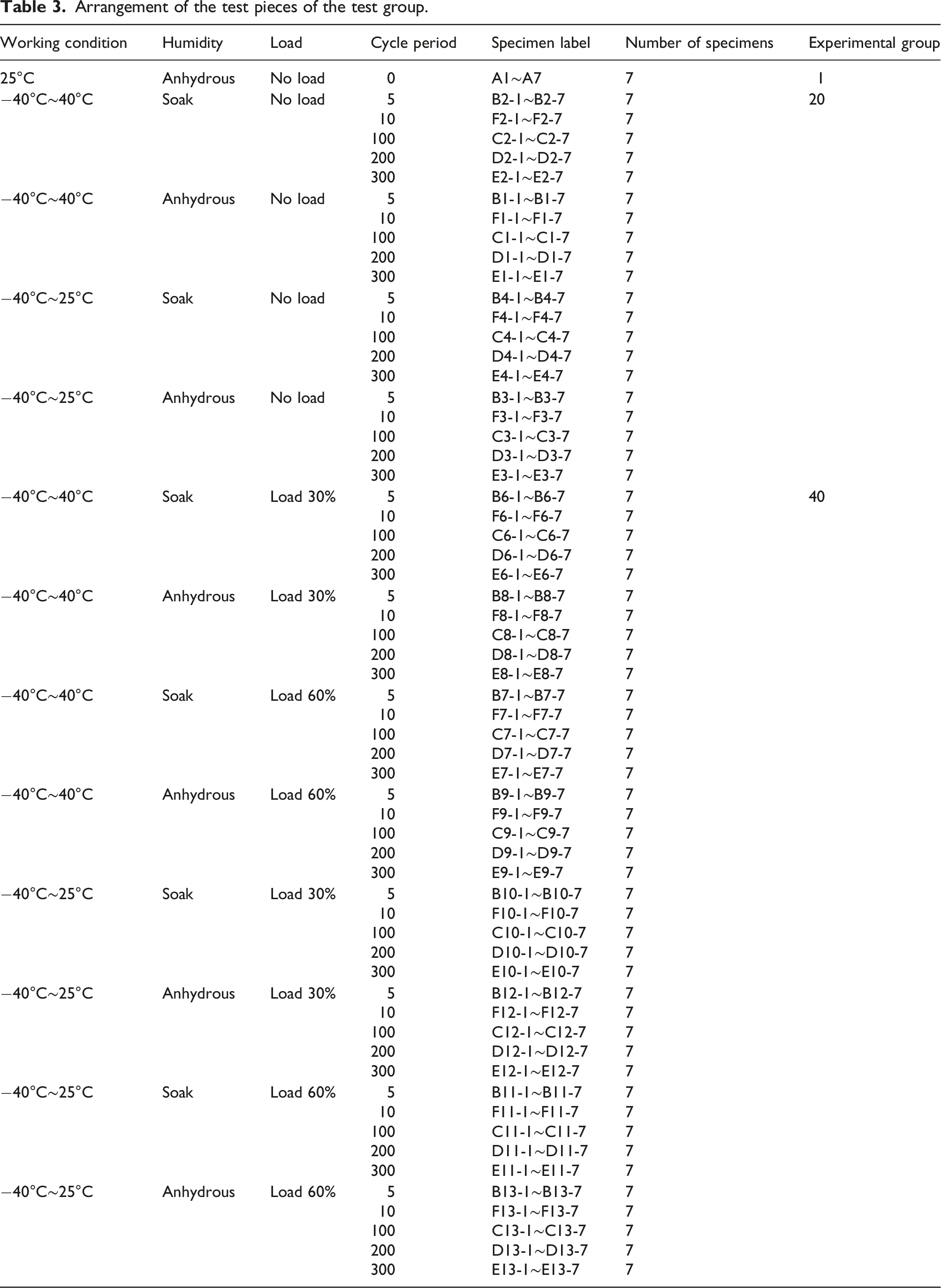
The experiment used the T-HWS-80U adjustable high and low temperature test box produced by Dongguan Tianya Instrument Co., Ltd (Temperature range: −60°C∼150°C; Fluctuation degree≤ ± 0.5°C; Deviation of plus or minus≤± 2°C; Cooling rate: 2°C–3°C/min; Relative humidity: 45%∼55%). In order to ensure a relatively stable initial state, the specimen is first placed in an environment with normal temperature and 45%–55% humidity for 10 days and then placed in the experimental box for high and low temperature cycling experiments: the temperature control curves of [−40°C∼40°C] and [−40°C∼25°C] groups are shown in Figure 2. Under each high and low temperature cycle experiment condition, the comparison experiment of two groups of different humidity environment with soaking and anhydrous was set simultaneously. Temperature control curve in one cycle of [−40°C∼40°C] and [−40°C∼25°C].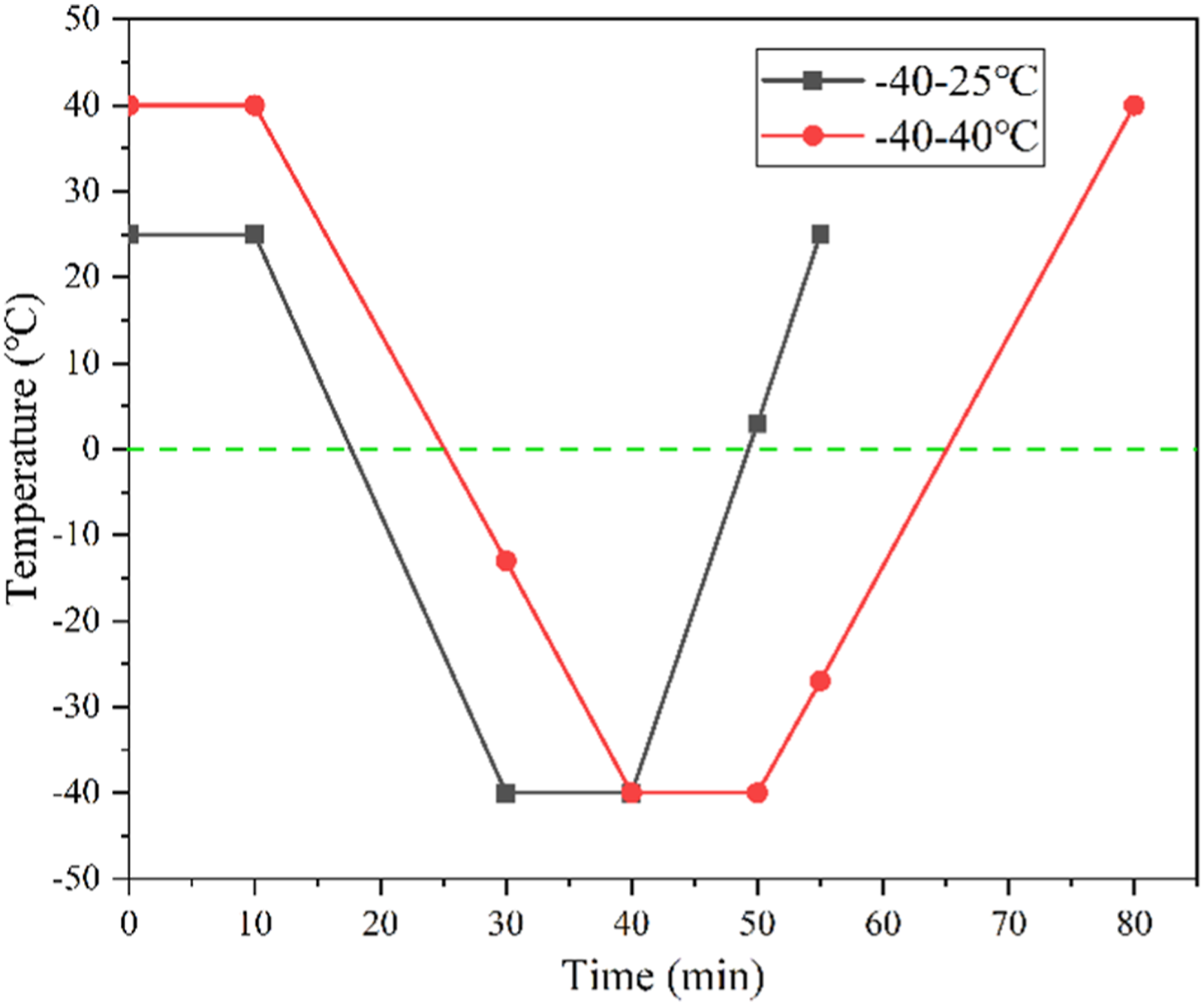
To achieve the coupling effect of the three factors of high and low “temperature cycle-humidity-load,” referring to literature,
14
a bending loading device shown in Figure 3 Bend loading device.

After the environmental experiment is completed, the specimen undergoes water absorption rate and tensile strength tests in sequence. Water absorption test was conducted according to GB/T1462-2005 test method for water absorption of fiber reinforced plastics
16
and HB7401-1996 test method for moisture absorption in humid and hot environment of resin matrix composite laminates.
17
First, put the specimen into an oven at 70°C and dry it to the engineering dry state (weigh the specimen once a day during the drying period, and the dehumidification rate is stable when the daily mass loss is not greater than 0.02%, which is the engineering dry state). The sample was then kept at room temperature of 25°C for hygroscopic treatment, weighing once a day for the first 4 days, then weighing once every 3 days, and weighing once a day when the hygroscopic rate increment is close to 0.05% of the daily mass increment. When the hygroscopic rate increment obtained by three consecutive weighing is less than 0.05% of the daily mass increment, the specimen is considered to be in a balanced hygroscopic state.
17
The water absorption of EP-CFRP can be calculated by equation (2)
The tensile strength test was conducted according to GB/T3354-2014 test method for tensile properties of directional fiber reinforced plastics 15 using the ETM105D electric-hydraulic servo universal testing machine produced by Shenzhen Wance Test Equipment Co., Ltd. The stress–strain curve is obtained by using displacement control with a loading rate of 2 mm/min and using the extensometer to measure tensile deformation.
Test results and analysis
High and low temperature cycle-humidity coupling effect
After the coupling effect of high and low temperature cycle-humidity, the tensile failure fracture of the specimen presents a relatively flat form, belonging to brittle failure.
18
The failure morphology is shown in Figure 4. Longitudinal tensile failure morphology (a) (−40∼25°C) 200 cycles + soak; (b) (−40∼40°C) 200 cycles + soak.
In this paper, the variation trend of tensile strength, equilibrium hygroscopicity, and tensile modulus of EP-T700CFRP one-way plate under the coupling effect of high and low temperature cycling and humidity are shown in Figures 5 and 6. The tensile strength shows a trend decreasing first, then increased and then decreased, and the equilibrium hygroscopicity increased first, then decreased and then increased. As can be seen from Figure 5, under the coupling effect of high and low temperature cycle and humidity, the tensile strength of the specimen is obviously lower than that in the anhydrous environment. On the contrary, the equilibrium hygroscopicity is obviously higher. The maximum decrease of tensile strength was 13.15%, and the maximum increase of equilibrium moisture absorption was 0.43%. As can be seen from Figure 6, the change in tensile modulus is not significant, and it varies within 130∼150 MPa. Tensile strength and moisture absorption rate of the double-factor specimens versus the number of temperature cycles. Elastic modulus of the double-factor specimens versus the number of temperature cycles.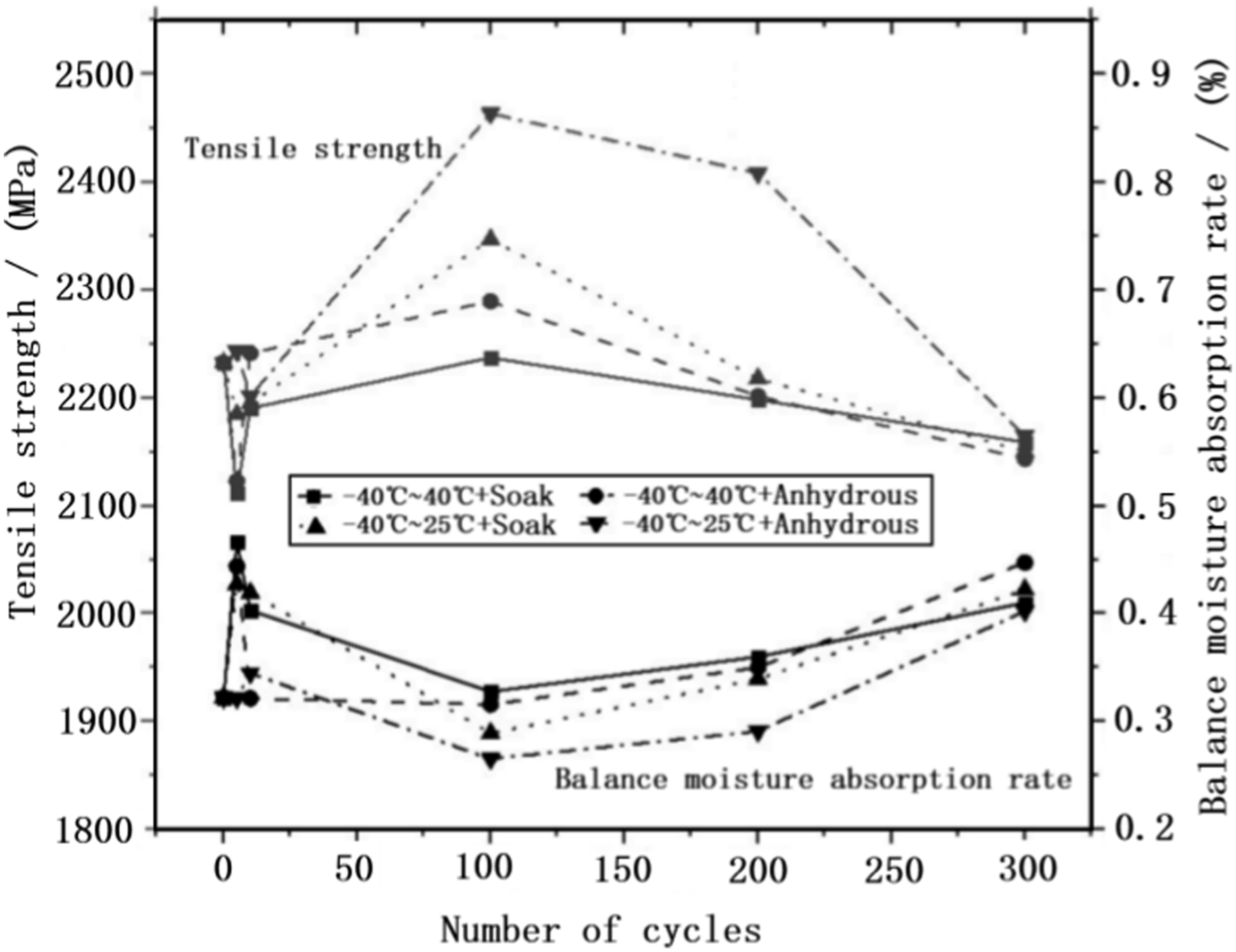

In the initial stage of high and low temperature cycle and humidity double-factor coupling action (about 5 cycles), due to the large difference in thermal expansion coefficient between carbon fiber and matrix, when the environment changes, large thermal stress and thermal strain are generated inside the composite, resulting in severe instantaneous cracking of the matrix. 19 The hygroscopicity of the composite is enhanced, the equilibrium hygroscopicity is increased, and the tensile strength decreases temporarily. The reduction in moisture absorption after about 10 cycles may be due to the fiber limiting the expansion of the resin matrix, and accordingly restore the tensile strength to the initial state. The subsequent moisture absorption exhibites a continuous increasing trend until approximately 100 cycles. After 100 cycles to 300 cycles, the continuous accumulation of thermal stress and thermal strain 20 leads to further expansion of microcracks, increase of equilibrium hygroscopicity, and decrease of tensile strength.
High and low temperature cycle-humidity-load coupling effect
The tensile failure of the specimen under the coupling effect of high and low temperature cycle-humidity-load presents a form of loose wire splitting, which is a toughness failure.
18
The failure morphology is shown in Figure 7. 1 [−40°C∼40°C] high and low temperature cycle-humidity-load coupling effect: Longitudinal tensile failure morphology (a) (−40∼25°C) 100 cycles + soak+ Load 60%; (b) (−40∼40°C) 300 cycles +soak + Load 60%.

Figure 8 shows that: [−40°C∼40°C] the variation trend of tensile strength of specimens under the coupling effect of high and low temperature-humidity-load is consistent with the results of double factors: the whole specimen shows a trend of decreasing first, then increasing, and then decreasing. While the equilibrium hygroscopicity first increases, it then decreases, and then increases. The smaller the tensile strength is, the greater the equilibrium hygroscopicity is, that is, the stronger the water absorption capacity of the material capillary is, which also means the more microcracks exist in the material. Under the same load holding level, after the same cycle of high and low temperature, the tensile strength of the specimen in soaking environment is obviously higher than that in the anhydrous environment, and the equilibrium hygroscopicity is obviously lower than that in the anhydrous environment. Figure 9 shows that the tensile modulus does not change much. Tensile strength and moisture absorption rate of the triple factor specimens versus the number of (−40∼40°C) temperature cycles. Elastic modulus of the triple factor specimens versus the number of (−40∼40°C) temperature cycles.

It can also be seen from Figure 8 that at the initial stage (about 5 cycles) of the coupling effect of the three factors of [−40°C∼40°C] high-low temperature cycle-humidity-load, when there is a sudden change in the environment, due to the large difference in thermal expansion coefficients between carbon fiber and the matrix, the composite material may still experience severe instantaneous cracking of the matrix and a significant decrease in longitudinal tensile strength. But compared with the double factors, the coupling effects when a load coupling, with a long cycle fell in the first round, and at the initial stage, the cumulative effect of thermal stress and thermal strain caused by environmental mutation was more obvious, resulting in the tensile strength specimen to decrease significantly at 5 cycles and maintain a continuous downward trend around the subsequent 100 cycles. After 100 cycles, it reached an inflection point of rise and continued to rise to about 200 cycles (possibly due to the constraining effect of fibers on the matrix swelling, and the swelling is relaxed after 100 cycles), and then the tensile strength decreased slightly. At this stage, the microcracks and micro-pores in the specimen further expanded, and the equilibrium hygroscopicity increased slightly. 2 [−40°C∼25°C] high and low temperature cycle-humidity-load coupling effect:
According to Figure 10, when the three factors high-low temperature cycle-humidity-load are coupled together and act simultaneously, the cyclic tensile strength in the high and low temperature range [−40°C∼25°C] presents a different trend from that in [−40°C∼40°C]. Before 200 cycles, the variation trend of tensile strength was consistent with that after the coupling effect of high and low temperature cycle-humidity, with a second slight increase after 200 to 300 cycles. As a whole, it shows a trend of four stages: first decrease, then increase, then decrease, and then increase, and the equilibrium hygroscopicity correspondingly increases, then decreases, then increases, and then decreases. For the same soaking environment or anhydrous environment, after the same cycle of high and low temperature, the tensile strength of 60% load is less than the tensile strength of 30% load, and the equilibrium moisture absorption rate is correspondingly larger. Figure 11 shows that the tensile modulus does not change much. Tensile strength and moisture absorption rate of the triple factor specimens versus the number of (−40∼25°C) temperature cycles. Elastic modulus of the triple factor specimens versus the number of (-40∼25°C) temperature cycles.

According to the above experimental results, there is a certain corresponding relationship between the external load and the moisture absorption of composite materials: after the same humid thermal cycle, the higher the load level of the laminated plate, the higher the moisture absorption rate of composite materials, the more serious the tensile strength decline. This is because for resin matrix composites, there are initial cracks or pores in the matrix and other defects; the effect of load causes stress concentration at the defects, accelerates the formation and expansion of cracks, and promotes the further moisture absorption of the matrix. This mechanism can be called “stress cracking.” With the increase of moisture absorption, the mismatch of moisture and heat expansion between fiber and resin matrix becomes more severe, resulting in shear internal stress at the interface; when the shear stress exceeds the bonding force borne by the interface, interface debonding and delamination will be triggered to further promote moisture absorption. This mechanism can be called “stress-induced debonding.” 21 Thus, due to the external load which promotes moisture absorption in the above two aspects, the hygroscopicity rate and the equilibrium hygroscopicity of the material increase, and the greater the loading amount, the more obvious the promoting effect on the hygroscopicity of the material. In general, the hygroscopic process of composites under external loading is a self-accelerating vicious cycle, and the combined action of external loading force and hygroscopic force accelerates the strength damage of composites.
Analysis of strength damage model
The variation of tensile strength is mainly affected by high and low temperature interval,
22
high and low temperature cycle,
23
environmental humidity, and external load.
24
This change comprehensively reflects the matrix damage and interfacial bond properties of composites. In this paper, two temperature cycle intervals of [−40°C∼40°C] and [−40°C∼25°C] and two environmental conditions of soaking in water and anhydrous were considered to explore the variation law of EP-T700CFRP composite plate with different cycles of high and low temperature and external load level. The residual tensile strength model can be expressed as
According to the design requirements of composite structural structures for domestic aircraft, the general design strength is 130% of the design load. After conversion, when the strength of composite laminates decreases by 23%, it can be considered as strength failure.
25
Assuming that 

Based on the cumulative damage theory,
26
the damage amount of a high and low temperature cycle test can be defined as
The cumulative damage after 
When the number of cycles is 
Substituted into the boundary conditions (4) and (5), the critical cumulative damage value 
Assuming that the critical damage limit value of damage failure of EP-CFRP specimens after 
Combining (6), (7), and (10) and considering that the remaining tensile strength of the composite component failure is 
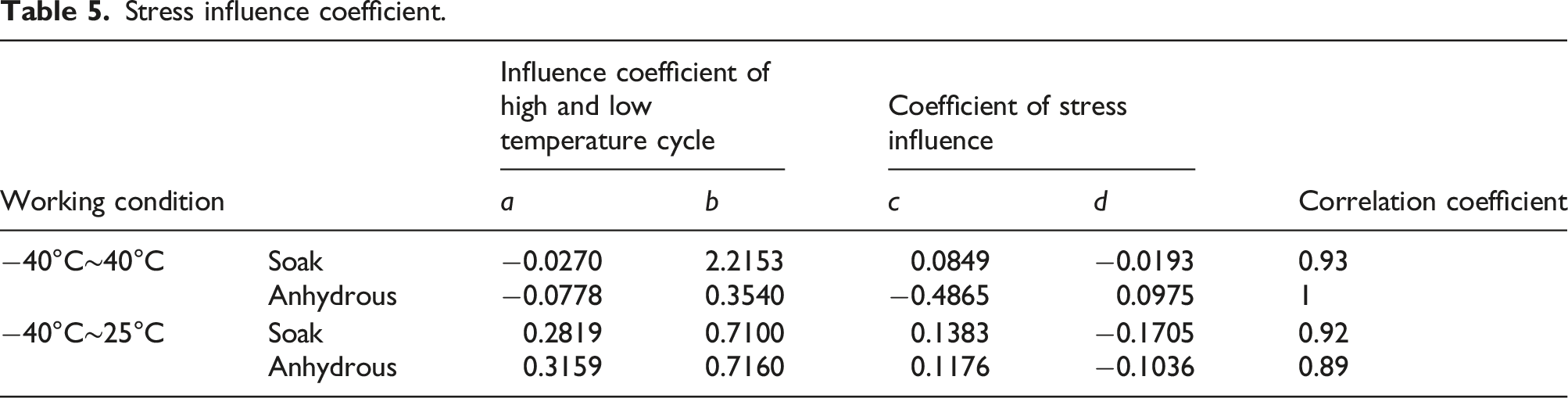
The determination of the damage function is a key point to establish the damage model. According to the tensile test results in this paper, after analyzing the damage attenuation trend of EP-T700CFRP composite plates in two temperature cycles of [−40°C∼40°C] and [−40°C∼25°C] and two environmental conditions of soaking in water and anhydrous, the following relation is used to describe the damage function 1 First consider the influence of load on 
Software fit factor.

2 Determine the cycle coefficient
Stress influence coefficient.
Damage model.

The residual tensile strength values calculated according to the damage model of each working condition in Table 5 and the experimental results are shown in the Figure 12, which are basically consistent with each other. It indicates that the damage model in Table 5 can be used to predict the tensile strength after the high-low temperature cycle-humidity-load coupling. Residual tensile strength versus high and low temperature cycles under different conditions (a) −40∼40°C+soak; (b) −40∼40°C + anhydrous; (c) −40∼25°C + soak; (d) −40∼40°C + anhydrous.
Conclusion
In this paper, the variation law of tensile strength, damage mechanism and residual strength damage model of EP-T700CFRP sheet under the coupling action of high and low temperature cycle, humidity (with soaking and anhydrous), and load (30% and 60% of ultimate load) at [−40°C∼40°C]/[−40°C∼25°C] are studied experimentally. The conclusion is as follows: (1) After the coupling effect of “high and low temperature cycling-humidity” and the coupling effect of “high and low temperature cycling-humidity-load,” the tensile strength of EP-CFRP decreases first and then increases and then decreases with the increase of the cycle of high and low temperature. However, when the peak and valley values of tensile strength appear, their corresponding cycles differ greatly. Under the coupling effect of two factors, the tensile strength reaches the valley point after 5 cycles, then rebounds, and rises to the peak value about 100 cycles. When [−40°C∼25°C] cyclic-humidity-load three factors act, the cycle times corresponding to the peak and valley values of tensile strength are consistent with that under the action of double factors, but the tensile strength has a secondary rebound in the later stage. When [−40°C∼40°C] cyclic-humidity-load three factors act, the tensile strength reached the valley point after 100 cycles, rebounded to the peak around 200 cycles, and then continued to decline for 300 cycles. In all the processes, humidity and load level have little influence on the tensile modulus of EP-CFRP. (2) By comparing the tensile strength and equilibrium hygroscopicity of the materials, it can be seen that the microcracks at the interface between resin matrix and fiber are the main reason for the later strength reduction of the materials. The coupling effect of humidity and load promotes the propagation of cracks and obviously weakens the tensile properties of the resin-based carbon fiber composites. (3) By comprehensive analysis of the durability test results and based on cumulative damage theory and nonlinear fitting methods, the damage function of EP-T700CFRP composite plates was calibrated at two temperature cycles of −40°C∼40°C] and [−40°C∼25°C] with two environmental conditions of soaking and anhydrous, and given a reasonable residual strength prediction model.
Footnotes
Declaration of conflicting interests
The author(s) declared no potential conflicts of interest with respect to the research, authorship, and/or publication of this article.
Funding
The author(s) disclosed receipt of the following financial support for the research, authorship, and/or publication of this article: This work is financially supported by Natural Science Foundation of Sichuan Province (Grant No. 2022NSFSC0317) and Key Laboratory of Icing and Anti/De-icing of Aircraft Project (Grant No. IADL20190404). All data, models, and code generated or used during the study appear in the submitted article.
