



Abstract
This perspective introduces a new experiment in community-led place-based research that is taking off in the United Kingdom. The article provides the background and rationale for funding nine independent Community Research Networks for up to £1 million each, for up to 5 years. This, in turn, raises questions about how human geographers might respond to this development and the implications for disciplinary thought and practice. The article explores: (1) the implications for understanding the place of place in research and knowledge production and (2) a series of questions about community-led place-based research in practice. The latter raises questions about: (i) community engagement; (ii) setting the research agenda; (iii) data sovereignty and epistemic authority; and (iv) the role of academic researchers.
Keywords
Introduction
The motivation for this perspective comes from the decision taken by the leading research funder in the United Kingdom (UK) – UK Research and Innovation (UKRI) – to support nine new Community Research Networks (CRNs), each with up to £1M for 5 years running from late 2024 to 2029. This breaks new ground in providing significant amounts of funding for community-led networks to engage in research, setting their own agendas and associated activities. Early funding provided to support the development of these networks in 2023 exposed the importance of geography in their constitution; all 25 successful pilot projects were organised around local geographies covering all four nations of the country, including towns and cities, rural and peripheral places (UKRI, 2023). Rather than funding academic researchers to conduct enquiries that may or may not involve local communities as is more normally the case, the new funding aims to reverse the traditional hierarchy between academics and communities (Morrison, 2022). It is part of a wider drive to engage the public in research and innovation, with the potential to build research capacity, harness new ideas and foster innovation. As Tom Saunders, Head of Public Engagement at UKRI, explained at the time of the launch of the pilots in 2023, CRNs aim to ‘ensure that research and innovation is something that more people can contribute to and benefit from’ (UKRI, 2023).
One of these successful CRNs has been running in the Isles of Scilly since 2023 and I have played a role in supporting the group as they develop their work. This has involved organising a round of conversations between undergraduate students and residents and sharing the findings with the local leadership team (Wills, 2023). It has also involved ongoing conversations with the team about the extent of community interest in asking questions and doing research, managing expectations and realising impact from any research, as well as how to govern the network and guide the activity, and the role for outsiders and experts in doing the work. This, in turn, has prompted me to think much more carefully about thorny matters such as what we mean by place-based research; how local leadership changes the research agenda; the extent to which and processes through which local people engage in research; how to manage relationships between the community and university; the importance of research and data sovereignty; the implications for epistemic authority; and what the CRN tells us about ordinary versus academic geography today. In this perspective, I seek to contribute to ongoing academic debate about these concerns. The discipline of human geography has grappled with these and related questions for at least 60 years, and we have a rich body of published scholarship and related practice to draw upon in thinking it through.
In what follows, I introduce CRNs in the wider context of the changing research funding landscape in the UK, emphasising growing support for place-based research. I argue that such work sits along a continuum from business-as-usual at one end to community-led research at the other. I explain the rationale for this shift in funding, highlighting its contribution to national government ambitions around ‘levelling up’ opportunities and innovation in what are being called ‘left-behind’ places. I then raise some questions about the CRN experiment in the hope of setting out a research agenda to better understand this approach to community-led place-based research.
CRNs: Background and rationale
The UK government channels most of its funding for research and innovation activity to universities, research organisations and businesses via a non-departmental public body sponsored by the Department for Science, Innovation and Technology (DSIT) called UKRI. In 2025, its budget was just short of £9 BN and the money can make or break a career as well as determining the future direction of science and impact. Most of the funding supports traditional academic research that reflects the state of knowledge in a particular field, distributed following rigorous assessment by panels of peers.
However, UKRI also has the potential to shape the national research and innovation agenda by looking across disciplinary divides and picking up national concerns. Decisions about funding have shifted towards place-based research in the context of growing concern about ‘left-behind places’ (Pike et al., 2024) and popular disquiet manifest in the vote to leave the European Union (EU) in 2016. The referendum exposed the degree to which geography divided the nation, prompting politicians and policy-makers to recognise the need to ‘level up’ wealth, well-being and opportunity and to reach the angrier parts of the polity that they were clearly not able to reach (Rodríguez-Pose, 2018). This renewed attention to geography was further entrenched by the impact of the COVID-19 pandemic that revealed dramatic spatial disparities in outcomes and resilience to shock (Bhattacharjee et al., 2020; Nicodemo et al., 2020). In combination, these events have exposed the fragility of communities living in the poorest parts of the country and the extent of geographical differences in experiences and attitudes. National politicians have since reconfirmed their desire to do something about it, and shifting the priorities for research funding to advocate greater attention to place and improving local opportunities has become a key part of the national-level response.
Reflecting these concerns, UKRI launched a new Public Engagement Strategy in 2023. This had a three-fold ambition to (1) build a sense of shared endeavour by making research and innovation relevant and accessible to all; (2) ensure the benefits of research and innovation are shared widely by supporting collaboration and valuing diverse forms of knowledge; and (3) create new opportunities for all by inspiring and engaging the next generation. This strategy has now started to influence funding opportunities as UKRI seeks to promote culture change in research organisations as well foster greater public engagement. To this end, UKRI is encouraging the creation and strengthening of partnerships that enable long-term, reciprocal collaborations between researchers, non-academic organisations and the public in place-based research, innovation and impact.
Although it is difficult to be fully comprehensive about the scale and reach of this investment, the aggregated finance comes to at least £100M (see Supplementary Information). Significant amounts of money are being used to support place-based research through standard academic-led and peer-reviewed calls in areas such as coastal resilience and sustainability transitions. However, there has been additional investment in a project called ‘Creating opportunities, improving outcomes (COIO)’ that provides up to £20M for four Local Policy Innovation Partnerships (LPIPs) and a Strategic Coordinating Hub to lead innovation in place-based research and the development of new policy ideas. 1 There is now one LPIP in each nation of the country, each working on slightly different concerns. In Northern Ireland, the focus is on access to the labour market; in Scotland, the project is coalescing around water resources; in Wales the team are looking at the challenges of people living in rural areas; and in Yorkshire and Humber, the LPIP is working with low-income and marginalised groups to engage them in policymaking (UKRI, 2024a). These projects involve building a network of local partners to work together over shared concerns although UKRI outlined seven themes that they are expected to address comprising: communities in their places; cultural recovery; living and working in a green economy; local economy; local innovation; local skills; and felt experiences. The LPIPs are led by academics but require partnership working to research problems and develop new policy ideas.
At the more radical end of this new investment, UKRI has also funded three different schemes to channel funds towards the community, with less prescription about what must be achieved. First is a community-based research pilot in Reading and Slough, overseen by the British Science Foundation. This is a partnership involving geographers from the University of Reading working in partnership with local community organisations and residents, doing participatory action research. 2 Second, a Community Knowledge Fund run by the Young Foundation to provide small grants to foster local research capacity. 3 And third, the significant investment in nine CRNs with which this perspective began.
The growing momentum behind place-based research has been further championed by research organisations and networks beyond the direct control of UKRI. The National Coordinating Centre for Public Engagement (NCCPE) has played a particularly important role. 4 Based at the University of the West of England and opened in 2008, the NCCPE produces guides to public engagement in research, provides training for academics and recognises good practice and leadership in the sector. Its staff play an important leadership role in shaping debate about the evolution of public engagement in research and have had direct influence on UKRI’s commitment to public engagement and the new funding for place-based research.
Several active research networks have also emerged to promote a place-based approach, and the Civic University Network (CUN), led by Sheffield Hallam University, has been particularly important in promoting the idea of place-based collaborations for positive change. 5 Universities are being encouraged to sign Civic University Agreements with key stakeholder organisations including local government, the National Health Service, Further Education colleges and the private sector, signifying their commitment to working together for the common good. At the time of writing, there were at least 100 Civic University Agreements signed, each of which reflects university support for place-based research and action (Goddard et al., 2012; Harney and Wills, 2017).
Similarly, the National Institute for Health Research (NIHR) 6 has supported the development of place-based research in public health policy and practice via 30 new Health Determinants Research Collaborations (HDRCs) that aim to better understand and challenge social disparities in health. This funding comprises an annual investment of at least £30M for collaborative place-based research and innovation involving local government officers, health trusts and research partners.
The funding for CRNs is a particularly important indication of this step change in support for place-based research. In 2022, UKRI commissioned The Young Foundation’s Institute for Community Studies (ICS) to explore how public engagement in research could be better supported than had been the case in the past. Working with a specially assembled steering group, the inquiry consulted over 50 representatives from community organisations, mutual aid networks, campaign groups, community interest companies, local branch organisations of social movements, rights-based groups and members of community businesses and social enterprises (Morrison, 2022). The final report called for wider inclusion in research policy and practice, identifying the need to address ‘knowledge injustice’ by recognising diverse forms of knowledge and arguing for new investment in ‘infrastructure to produce, share and scale these [local] forms of knowledge’ (Morrison, 2022: 7). While the ICS acknowledged the complexities of place-based communities that necessarily comprise a wide range of diverse interests, and uneven degrees of organisation and institutionalisation, they called for experiments in making a power shift in research. The ambition was to ‘seed power to communities to own, share, and use the knowledge and information they create and need – as equal organisations within an expanded Research and Innovation (R&I) system’ (Morrison, 2022: 10).
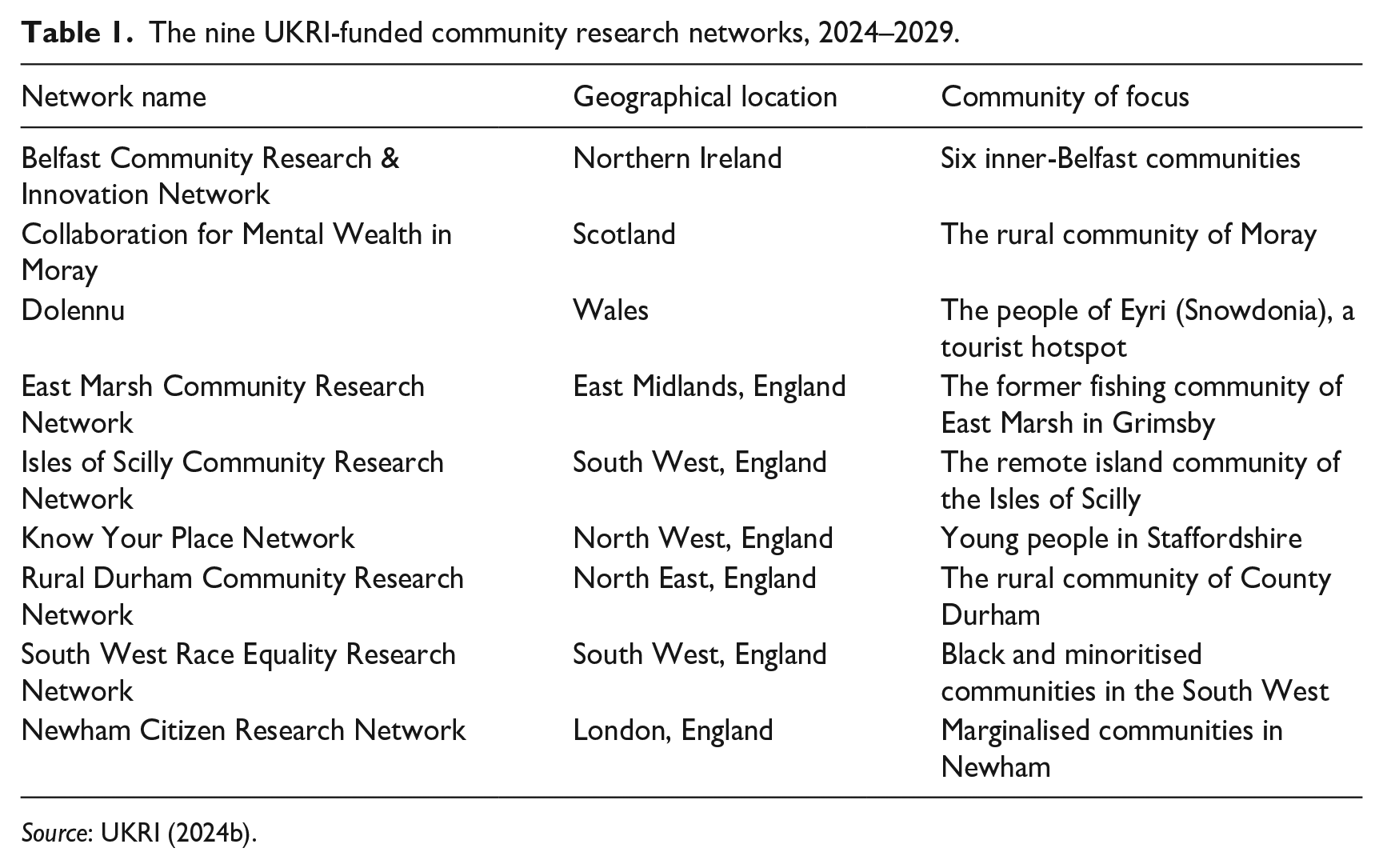
Reflecting this ambition, UKRI provided phase one funding (up to £25,000 each) for 25 CRN projects to develop their purposes, operation and impact, with the option to then bid for additional, longer-term funding to run from late 2024. These funding rounds were competitive and attracted a much larger number of applications than were awarded, casting a wide shadow effect across potential applicants in the community and voluntary sector. Nine CRN networks were funded for a second and extended phase of activity, and they cover a wide diversity of places and purposes (see Table 1).
The nine UKRI-funded community research networks, 2024–2029.
Source: UKRI (2024b).
Questions for geography and geographers
For the past 60 years, professional geographers have been caught in what Entrikin (1991) famously called ‘the betweenness of place’ whereby the study of place is always vulnerable to the appeal of generalisation. While the discipline retains a focus on geographical difference, it does so with a mind to the spatial relationships and porous boundaries that constitute place. Indeed, over the past 30 years, the leading thinkers in the discipline have advocated for a ‘relational ontology’ with a focus on networks and interconnections across space alongside attention to place (Massey, 1999, 2005). The discipline has championed research that is in and about place but rarely simply of place, as the non-local is ever-present and constitutive of any one place (Amin, 2002: 397; Featherstone and Painter, 2013). This further reflects a political orientation that is averse to the erection of borders around places in the context of heightened awareness of the associated risks of xenophobia, racism and nationalism (and for fuller discussions, see Castree, 2004; Tomaney, 2013).
In contrast, however, the CRNs start from a particular place and develop a research agenda around the interests of people in place without any a priori philosophical attachments to a particular spatial ontology. The projects have been founded on a ‘common-sense’ or ‘ordinary’ view about place and its role in shaping experience, interests and opportunities. Research questions are developed from the challenges encountered by people living in a particular place and who have the energy to research new ideas and solutions. They have no need to worry about the philosophical underpinnings of their research, nor the knowledge produced. The projects reflect an unashamedly non-relational approach to place even though the funding has come from outside and many will end up focused on similar and related concerns.
In this regard, I have been struck by unexpected resonances with contemporary debates about non-relational spatiality in the discipline of geography. Paul Harrison has led the way in trying to develop what he calls a ‘non-relational approach’ arguing that ‘there are modalities and aspects of affective experience that cannot be brought into the systematisation, thematisation, and conceptualisation that defines the work of social analysis’ (Harrison, 2007: 591). He looks at personal experiences of suffering, pain and passion that defy easy communication, highlighting the limits of relationality between people and by implication, their context and location. There is similarly something about local experience and knowledge that defies easy appreciation, extraction and analysis by those from outside (Walkerdine, 2016).
As Rose and colleagues suggest in their development of Harrison’s work and its incorporation into what they rather confusingly call ‘negative geographies’, ‘there is a politics to letting otherness be other, rather than seeking to enrol this otherness into our own schemas of comprehension’ (Rose et al., 2021: 23). Those who live outside a community will struggle to make sense of the place and its people, and it is politically important to recognise this. As Jazeel (2019) suggests in making the case for ‘singularity’, there is scope for taking things on their own merits and resisting the urge to compare. He advocates for in-depth engagements in place, ‘cultivating an orientation and responsibility to the demands of a field site or area studies community, and also of treating that space as a fully formed intellectual community, not simply a data reservoir’ (Jazeel, 2019: 16).
Indeed, as Steve Pile (2023: 150/1) puts it in relation to his efforts to learn from Stoke-on-Trent in Northern England, this involves treating place ‘not as a case study of something else nor as an ideal type nor as an example or everywhere, but with the limited goal of acknowledging the limits of universals and abstractions’. Furthermore, the ontological pluralism that Pile finds in Stoke-on-Trent is mirrored a hundred-fold and more by the diversity of cultures and associated theologies that comprise human geography, and it is surprising that the discipline does not do more to celebrate this (Savransky, 2021).
The appeal of comparison and universalism is hardwired into contemporary forms of research, and for the pragmatist philosopher John Dewey, this ‘neglect of context’ was the ‘founding fallacy’ of Western epistemology. For him, Thinking takes place in a scale of degrees distance from the urgencies of an immediate situation in which something has to be done. The greater the degree of remoteness, the greater the danger that a temporary and legitimate failure of express reference to context will be converted into a virtual denial of its place and import . . . [such that] the neglect of context is the besetting fallacy of philosophical thought (Dewey, 1984 [1925]: 5).
In contrast, he advocated taking ‘context . . . into account . . . [to see] that every generalization occurs under limiting conditions set by the contextualisation’ (Dewey, 1985 [1931]: 8). This argument predates more recent efforts to recognise that knowledge production needs to be located in the particular context in which it is made (Haraway, 2016; Janack, 1997), a process that necessarily provincialises apparently universal ideas (Chakrabarty, 1992). Such arguments help to make the case for place-based research on its own terms rather than being a means to alternative ends, even if the insights from one place end up travelling to shape knowledge in other places as well (Massey, 2007).
In this regard, some geographers are grappling with approaches to doing research that reject an a priori understanding of place. Building on the powerful work of the late Clive Barnett (2017), Bodden (2023) has started to develop an argument that geographers develop a more ordinary approach to understanding the dynamics of everyday life. In what he calls ‘intersubjective social inquiry into how to respond to the challenges of a shared world’ (2023: 12) researchers are encouraged to be part of ongoing conversations in the context of place. With strong echoes of the pragmatic tradition of which Dewey was part, Bodden (2023: 13) suggests that: Conducting critical geography in an ordinary spirit would . . . mean attending to the practices, material resources, conversations and concepts people use to voice and to place themselves in the world – to assemble, review, submit and critique, to circumstantiate the meaning of their surroundings, words and projects as lively and ongoing works-in-progress (emphasis in the original).
The development of CRNs, and other place-based research endeavours, through which communities can find their own voice and determine their interests on their own terms has the potential to deliver this more ordinary geography. The task of professional geographers would be to support them and learn with them, without forcing their activity into a prescribed analysis already developed outside (Wills, 2024). Championing the epistemic authority of diverse communities would mark a shift towards ordinary geographies that reflect the diversity of experience and the necessary contextualisation of knowledge production.
In what follows, I identify some of the more practical issues that CRNs pose for contemporary academic geographers, writing in the hope that my list will provide a foundation for subsequent research and debate. Each CRN will be operating for at least 5 years, and each will conduct ongoing evaluation while also being part of a broader assessment to be overseen by the Young Foundation on behalf of UKRI. There are opportunities to learn from what happens, the outcomes achieved, and the wider implications for community-led place-based research. Here I take a preliminary look at questions for practice, focusing on participation; determining the research agenda; data sovereignty and epistemic authority; and community-university collaboration.
Community-led research in practice
Understanding local engagement
The CRNs are each establishing their own approach to listening to people about their concerns, exploring the scope for engagement and determining the best methods for identifying the research questions they want to explore. In the Isles of Scilly, for example, the research journey will rely on CRN advocates engaging in conversations with residents, exploring the issues they would like to address, and finding champions to argue the case for doing the work. Rather than relying on academic (or other) researchers to raise the funds and run projects around a pre-determined agenda and process, people will have the chance to put their own issues on the table and to engage in the research activity as much as they choose. There will likely be a range of divergent opinions and priorities, and serious disagreements about what needs to be done.
Furthermore, the process of engaging in a CRN has the potential to expose people to new kinds of activity and experience. There will be opportunities for personal and collective transformation through the process as well as from the outcomes of doing the work. This has strong parallels with the established tradition of community organising which seeks to use organising campaigns to develop people’s leadership skills, relationships and capacity for citizenship (Harney et al., 2016). It might be that the CRNs facilitate a similar process, as people learn through doing research and mobilising their ideas to implement local reforms. It will be illuminating to explore the extent to which a new cadre of community leaders develop in each CRN and the wider impact these people have beyond the life of the project.
Of course, the CRN will also expose the limits of lay engagement in research and knowledge production. It is likely to be a small minority of any population who are willing and able to get fully involved, and they will need to have strong personal motivations for doing this work. The process will need to be carefully managed to ensure people feel included and heard. It will also be revealing to explore differences in the way this is done across the nine networks.
Setting the research agenda
As outlined earlier, CRNs are an intervention designed to allow the community to self-determine the research agenda and mobilise resources to find answers and potential innovations for change. On the face of it, this would appear to chime with many of the interventions to support community-oriented inquiry, public participation and action research that have been pioneered in human geography. Since the shift towards radical geography in the late 1960s, human geographers have been on a quest to develop more collaborative research relationships for knowledge production, many of which focus on community and/or place. There is a very large literature, pioneered by feminist geographers in particular, that developed to support the democratisation of disciplinary methods and output (see McDowell, 2016). Early pioneers sought to foster more equitable relationships with research participants, using qualitative approaches to hear their perspectives and raise a wider range of voices and issues in public debate. In subsequent years, academic geographers have experimented with a range of approaches to research with communities emphasising collaboration (Glass and Newman, 2015) and co-production (Gibson-Graham et al., 2013) to stimulate local action research (Kindon et al., 2007). At its most collaborative, this work ‘begins with the knowledge, questions, and interests of communities and develops research programs that investigate issues otherwise outside the attention of the dominant culture’ (Glass and Newman, 2015: 32).
In a recent overview of what is now being called ‘Community Geography’, Shannon et al. (2021) highlight the guiding principles of this approach, beginning with the need to sustain local coalitions of residents, policy-makers and academics as the ‘starting point for research and teaching’ (Shannon et al., 2021: 1149). They argue that these local coalitions need to incorporate the full diversity of community interests and ensure reciprocal benefits to all those involved. There are further commitments to deploying the full range of research methods and sharing the work with the public. The goal is to ‘decenter (sic) the academy as the ultimate producer of knowledge while amplifying excluded voices and ontologies and promoting progressive social change’ (Shannon et al., 2021: 1148). A similar case is made by Castleden and Sylvestre in their overview of community-led research collaborations that ‘develop mutual trust and respect, equalize power differences, and co-own the knowledge produced . . . to bring about social justice and change’ (Castleden and Sylvestre, 2022: 359).
These innovations would suggest that geographers are already supporting community-led place-based research, and that we might expect considerable continuity with the new CRNs. However, the discipline has been supporting what Shannon and colleagues refer to as ‘progressive change’ and Castleden and Sylvestre describe as ‘social justice’. The research agenda has been controlled at least in part by the academics leading the work and this, in turn, reflects the dominance of progressive worldviews. It is salient to consider the absence of research and scholarship that takes a more conservative or even reactionary perspective, despite the extent to which people willingly vote for such political platforms when given the chance. Truly independent community-led research might be expected to shift the issues on the agenda, adding some that are outside the range of topics usually addressed in academic-led community-located research. Indeed, given the context for UKRI investment in this initiative, responding to growing concern about what is often negatively referred to as ‘populism’, the CRNs might embrace the kinds of non-progressive concerns that do not currently feature in academic research. Difficult questions are often raised in community settings, and thorny topics such as the allocation of social housing, access to basic services, the costs of energy transition and anti-social behaviour might be expected to come to the fore. Rather than ignoring or silencing such concerns through the charge of ‘misinformation’, or the drive for community cohesion, as is often the case, CRNs might allow such issues to be aired, discussed and explored (and for an example of challenging political questions being raised in community research, see Harney and Wills, 2020).
Reflecting on the extent to which this has not happened in the past is an indication of how far we are from any genuine reversal in epistemic power relations between academics and the communities in which they do their research. Certain people and places are often excluded from public discourse due to their identity (comprising a ‘testimonial injustice’) and they have limited opportunities to articulate their experiences and turn them into alternative narratives (exemplifying ‘hermeneutical injustice’ as outlined in Fricker, 2007). In a small way, the CRNs could be a means to challenge this wider epistemic injustice. It will be interesting and revealing to see the kinds of research topics and questions that are surfaced and prioritised by the nine CRNs.
Research sovereignty and its implications for knowledge
As outlined in the previous section, the CRNs have been set up to ensure that research, data and knowledge production are controlled by and for the local community. This quest for data and epistemic sovereignty is core to their mission and it will shape who engages in the process, the ideas explored and the impact of the work on people and place. In research interviews conducted in the Isles of Scilly as part of the development phase of the CRN, some respondents highlighted the problems caused by ‘people from the mainland’ who had a tendency to arrive with ready-made projects that subsequently had unintended negative consequences for the community. Interviewees provided examples in relation to the installation of electricity cabling from the mainland, the smart islands renewable energy project and the construction of sea-defences. One respondent also remembered being consulted as part of a research project during the 1980s and having to assist when the outsiders got things wrong: In the 1980s, there was a firm that came over, that did a report on Scilly . . . some of it was so wrong. And then you have to rewrite it. You’re not paid to rewrite it. All the people sitting around the table have been paid and you’re the one giving your time. And you’re the one saying ‘Well hang on a minute, it doesn’t work like that. You haven’t quite got the right slant on this’. And so . . . in the end, you become a little bit resentful of people coming from the outside . . . telling you what you should do because they’re official, and we’re not. And then you get a bit chippy, which is not a good thing to be . . . you start resenting everybody who comes in, because you think automatically, they’re going to tell you what to do, or do this or do that. [Later adding] The perception is sometimes that you will be stopped or you will be bossed about [by outsiders] (in Wills, 2023: 10).
The vision is for CRNs to start to reverse these power relations, ensuring that the local community set the agenda, control the research and data collection and lead locally appropriate innovation and change. The experiment aims to put local knowledge, rather than outsider knowledge, at centre stage.
In this regard, there is scope to learn from the work being done by Indigenous communities to secure control over the processes of data collection, analysis and knowledge production as part of broader political struggles for territorial and cultural sovereignty and self-determination (Johnson et al., 2023; Smith, 2021; Williamson et al., 2023). Community organising and trans-national networking since the 1970s has culminated in the United Nations Declaration on the Rights of Indigenous Peoples (UNDRIP) which recognises research ethics and control of data as being central to the struggle for self-determination. Resistance to ‘epistemicide’, defined as ‘the suppression and co-optation of Indigenous knowledges and data systems’ (Carroll et al., 2020: 2), requires that communities have the capacity to tell their own stories, on their own terms, in protection of their own interests. A growing movement for Indigenous data sovereignty comprises ‘an assertion of the rights and interests of Indigenous Peoples in relation to data about them, their territories, and their ways of life’ (Carroll et al., 2020: 3).
This, in turn, requires that Indigenous communities establish and operate protocols over research, data collection and knowledge deployment. While each will do this in keeping with long-established traditions of inter-communal diplomacy and relationship building, often in ways which simultaneously cement the traditional culture (Lucchesi, 2020), there are growing efforts to standardise these protocols across space. The Indigenous Data Sovereignty Interest Group has been organised as part of the US-based Research Data Alliance, recently publishing the CARE Principles for Indigenous Data Governance to ensure Collective benefit, Authority to control, Responsibility and Ethics (see Figure 1).
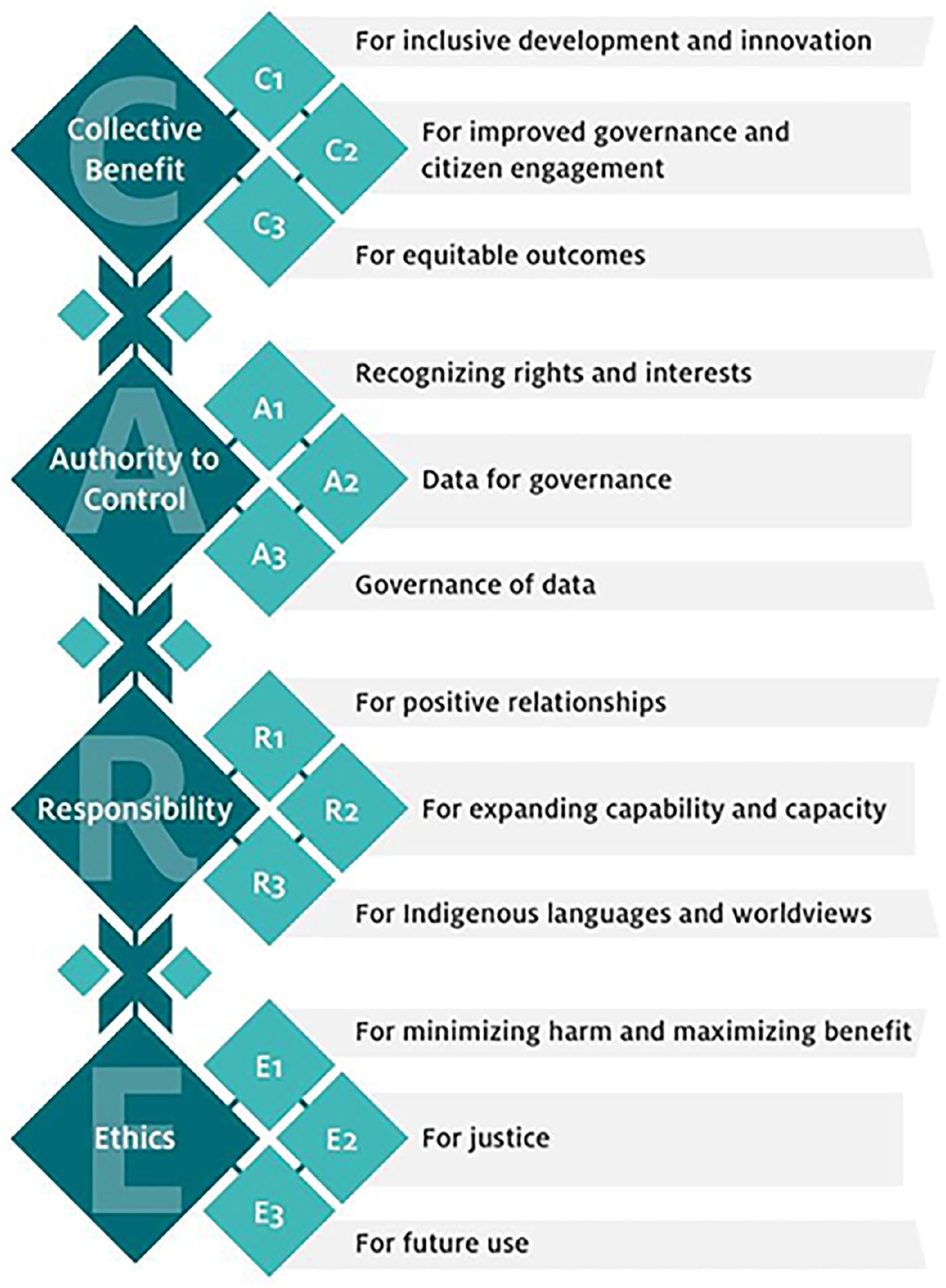
The CARE principles for Indigenous Data Governance.
These principles have purchase for other communities that have traditionally been marginalised and/or found themselves suffering the consequences of outsider-led research activities and interventions. There is potential for the CRNs to pick up the CARE principles as a foundation for developing locally appropriate protocols for research activity. As Hudson et al. (2023) point out, data collection, storage and use needs to be carefully governed, but it also has the potential to shape the quality of governance and outcomes for local communities. Both aspects of this – the ‘governance of data’ and ‘data for governance’ – will be important to the success or otherwise of the CRN projects.
The new investment in CRNs will allow a range of communities to organise themselves around their own research agendas and to establish protocols for doing research with scope to review outsider-led proposals and practices before supporting their work. CRNs may give communities the means to control the production and dissemination of research and its wider impact, with implications for the stories they are able to tell. It is salient that research with Indigenous communities has allowed academics to deploy place-based epistemologies that bring new perspectives on what would be otherwise controversial activities such as forest burning, coal mining or whaling (and for examples, see Curley, 2019; Murveit et al., 2023). Starting from the interests of Indigenous communities and working with them to understand local practices and perspectives is generating new knowledge and appreciation for diverse ways of living, feeling and thinking. The same should arise from the CRN work.
The role of academics in community-led place-based research
Even though CRNs may pursue the kinds of epistemic control exemplified in Indigenous-led research activity, there is still an expectation of joint working with academics and universities in the work to be done. Many of the CRNs will draw on academic expertise to help provide training for volunteers, access to specialist knowledge and equipment, and to lever in additional funding for more demanding and complicated research demands that arise. There is no expectation of a solid wall being erected between the community and academics, just a role reversal in funding, decision making and authority. As such, there is much in common with the way in which academics are already supporting research with Indigenous communities. In many of these projects, academics have been valued as intermediaries, being ‘interpreters of Indigenous knowledge for the general academic community as well as providing Indigenous communities with insights into the discourses of academic disciplines’ (Murton, 2012: 16). This role is particularly salient for academics who come from the communities being researched and have feet in both camps (Carroll et al., 2020; Lucchesi, 2020; Smith, 2021), but whoever is involved, they need an openness to straddling different approaches to understanding the world.
Engaging in a more equitable research relationship can also mean rethinking standard approaches to academic research practices such as the process of abstraction (Derickson, 2024) or comparison (Jazeel, 2019). Drawing on the work of Donna Haraway and an ongoing collaboration with the Guallah/Geechee people in South Carolina, USA, Derickson makes the case for ‘response-able’ abstraction that is ‘made with, for, and from communities and is tethered to and accountable to their lived experiences and aspirations, but not limited by them . . . built through a rigorous process of “thinking from” the collective lived experiences of minoritized people’ (Derickson, 2024: 3). Similarly, Jazeel highlights the need to focus on ‘incomparable geographies’ that stand on their own terms rather than being shoehorned into comparison with other locations.
These kinds of place-based community-led engagements have started to change the way academics write about their experiences and the insights they gain. As an example, a collective of Indigenous people and researchers working together in Bawaka Country, Australia, have framed their shared narratives as coming from the land itself, deciding to include the territory as lead author in their accounts (Bawaka Country et al., 2015, 2016). The group have documented Aboriginal understandings of place, highlighting the extent to which the territory and its more-than-human residents and ecosystem dynamics are understood to be active in making place and its meaning. By developing a ‘methodology of attending’, they have better felt, understood and articulated the ways in which the community makes sense of their place.
The development of CRNs provides an opportunity to think about applying this attention to place-based community experience in a wider range of locations. We may be forced to reflect on how little we can ever really know about the way people understand their place and its meaning and the diversity of experiences within any place (Pile, 2023). There will always be things we cannot (yet) know and limits to what we can appreciate. This humility is critical to working effectively in place-based research, particularly if, as researchers, we are not from and/or living in the communities in which we are working and support an agenda set by the community rather than us.
Concluding remarks
As outlined at the start of this perspective, the UK’s major research funding body has stepped up investment in place-based research with a view to increasing public engagement in research and innovation activity. Although it might appear small in relation to the overall budget, the funding represents the financial tip of a much bigger iceberg in the wider research community. There is growing momentum for a place-based focus in research, policy, cultural activities and public service delivery. Mounted as a response to the growing geo-political divides manifested by recent plebiscites as well as the socio-economic divides revealed by the 2020 pandemic, place-based interventions are likely to attract greater attention and scrutiny in the coming years. In this regard, I have focused on the more radical end of this experiment and explored the implications of community-led place-based research, manifest in the nine CRNs that have been funded to run for 5 years (2024–2029).
Drawing on insights from the discipline of human geography, I have raised some critical issues in relation to the place of place in research and the implications of community-led research in practice. As outlined, the latter includes the following questions: (1) Who is engaged in the process, how does this happen and with what consequences?; (2) What do people want to explore and why does it matter?; (3) The implications of community participants having control over the research, data, knowledge production and storytelling; and (4) The ways in which academics support and engage in the work. Given that the research funding has been allocated in response to socio-spatial polarisation in economic opportunities and political attitudes, we might expect CRNs to mount a challenge to the status quo in relation to academic research agendas, practices and products. The CRNs have the potential to identify and develop a cadre of community leaders who can speak with authority about the challenges facing their communities, as well as sharing ideas for change. The networks may become a manifestation of the ‘ordinary geographies’ that deserve much greater attention (Bodden, 2023), providing an opportunity to explore and reflect on the purposes, practices and consequences of community-led place-based research.
Supplemental Material
sj-docx-1-epf-10.1177_26349825251350714 – Supplemental material for Making sense of community-led place-based research
Supplemental material, sj-docx-1-epf-10.1177_26349825251350714 for Making sense of community-led place-based research by Jane Wills in Environment and Planning F
Footnotes
Declaration of conflicting interests
The author declared no potential conflicts of interest with respect to the research, authorship, and/or publication of this article.
Funding
The author disclosed receipt of the following financial support for the research, authorship, and/or publication of this article: The author is part of the Local Policy Innovation Partnership Hub based at the University of Birmingham and funded by the ESRC (reference ES/Y000544/1). She also volunteers as chair of the Advisory Group of the Isles of Scilly Community Research Network that is funded by the ESRC and managed by the Isles of Scilly Community Venture.

Supplemental material
Supplemental material for this article is available online.
Notes
References
Supplementary Material
Please find the following supplemental material available below.
For Open Access articles published under a Creative Commons License, all supplemental material carries the same license as the article it is associated with.
For non-Open Access articles published, all supplemental material carries a non-exclusive license, and permission requests for re-use of supplemental material or any part of supplemental material shall be sent directly to the copyright owner as specified in the copyright notice associated with the article.
