



Abstract
It is challenging to understand the full and detailed story of Native People’s lands in the United States. In this article, we contend that reliable and accessible data regarding Native People’s lands complicate and perpetuate those challenges. Stemming from the implications of colonial ideologies, such as the General Allotment Act of 1887, Native Peoples’ land-based data are difficult to access for Tribal Nations and researchers. Land data have been and continue to be obscured by U.S. federal processes and are dependent on unreliable systems of outdated and exclusive practices that consistently marginalize Native Peoples. Therefore, those data do not adequately inform Tribal land planning initiatives. In this article we recommend new processes that strengthen Tribal data sovereignty as the fundamental underpinnings to an inclusive and protected data in the future.
We are a group of Indigenous and Allied scholars who partner with Indigenous Peoples. We represent only ourselves and work to hold up Indigenous Peoples’ inherent sovereign rights in a variety of ways, one of which is the protection, pursuit, and creation of Indigenous Peoples Data and Research Sovereignty. This collective commentary synthesizes cumulative years of frustration working with Indigenous Peoples’ data in the United States. At a time where reliable data are considered paramount to successful projects, initiatives, legal claims, advocacy, and land planning, access to quality and reliable information is particularly problematic regarding Native Lands. 1 Data have been used historically to colonize, commodify, and extract wealth from nature by dispossessing the original stewards of these lands. The steps of this structural oppression have been well hidden, but today, much can be uncovered and reclaimed by enforcing Indigenous Peoples Data and Research Sovereignty.
This special journal issue contributes to the growing body of literature that works toward the fundamental, yet complicated, tasks of defining, securing, and assuring Indigenous Peoples Data and Research Sovereignty. Some manuscripts provide examples of successfully partnering with Indigenous Peoples on their own initiatives. Other papers explore theoretical concepts to encourage a deeper understanding of the learning opportunities within essential scholarship of the topic. Many authors in this special issue have ongoing relationships with Indigenous communities, which seems to be couched in research that is first and foremost established in trust. Together, these papers inspire and demonstrate the tremendous growth in Indigenous Peoples Data and Research Sovereignty over the last 30 years. While the field and topic expand in a positive way, there is another part of this conversation that needs the same amount of attention that has been paid to the issues highlighted in this commentary.
Indigenous Peoples Data and Research Sovereignty
Globally, Indigenous Peoples steward over one quarter of the Earth’s lands and many of the remaining non-renewable natural resources (Garnett et al., 2018). The long-standing stewardship responsibility crosses generations and has been shown to be critical to biodiversity (Lamn et al, 2022). However, Indigenous Peoples’ land stewardship today is complicated by extractive research practices; data mining and hoarding by researchers, governments, and other institutions; and Indigenous Peoples’ limited access to data about their own lands (Carroll, Rodriguez-Lonebear, et al., 2019; David-Chavez and Gavin, 2018; Emanuel and Bird, 2022). Indigenous Peoples and “nations are those which, having a historical continuity with pre-invasion and pre-colonial societies that developed on their territories, consider themselves distinct from other sectors of the societies now prevailing on those territories, or parts of them. They form at present non-dominant sectors of society and are determined to preserve, develop and transmit to future generations their ancestral territories, and their ethnic identity, as the basis of their continued existence as peoples, in accordance with their own cultural patterns, social institutions, and legal system” whether recognized by colonial powers or not (Cobo, 1981). Indigenous Peoples’ data include both tangible and intangible information, knowledge, and specimens about their peoples, governments, and non-human relations that are digitized and entered into the data ecosystem (Carroll, Kukutai, et al., 2019; Duarte et al., 2020; Kukutai and Taylor, 2016).
This special journal issue centers Indigenous Peoples Data and Research Sovereignty, which recognizes and adheres to Indigenous Peoples’ inherent sovereign rights to govern research processes and steward data across the data lifecycle to maintain relationships, use, and benefit from data and other research outputs (Carroll, Rodriguez-Lonebear, et al., 2019; Carroll et al., 2020). Within this context, Indigenous Peoples shape their own research and data futures by setting their own research agendas and creating ways to maintain relationships and responsibilities to their data (Carroll et al., 2022). Central to the exercise of Indigenous Peoples Research and Data Sovereignty are the rights to collective privacy, ongoing consent, including the right to refuse research or data requests that do not adhere to their protocols or needs (Global Indigenous Data Alliance (GIDA), 2023).
Indigenous Peoples Data and Research Sovereignty has been a topic of discussion in Indigenous Methods and Methodologies literature for over 30 years by Indigenous people, allies, as well as antagonists, and has been reaffirmed by the United Nations Declaration on the Rights of Indigenous Peoples (Chilisa, 2019; Deloria, 1988, 1998; Medicine, 1988; Smith, 2021; Wilson, 2020). Today, Indigenous Peoples Data and Research Sovereignty continues to expand in expression and action (Chilisa, 2019; Walter et al., 2021). The varied perspectives in the literature include, but are not limited to, academics, researchers, federal, state, and tribal agencies and non-profit organizations the world over. The cumulative movement from Indigenous Peoples and allies underscores Indigenous Peoples’ inherent sovereign right to control any and all data that are derived from them and/or their lands.
Why data access matters for Native Lands
This commentary is a collaborative effort to inform a variety of readers about the issues of data access and why it matters for Native Peoples in the United States. In our day jobs, we have each dealt with countless examples of data hurdles. Here, we recollect our unique experiences synthesized into a broad enough picture to build a visual representation of the data caveats. The result is the following Mind Map (Figure 1). While we chose to focus here on Data Access, it relates closely to other key themes tying to Data colonialism, Land planning, Indigenous Knowledge systems and sovereignty, and important tenets present throughout this special journal issue. This Map is a work in progress, it does not exhaust the discussion by any means, and each topic is a paper or book in itself, but our goal is to provide a more thorough analysis of each topic in the future.
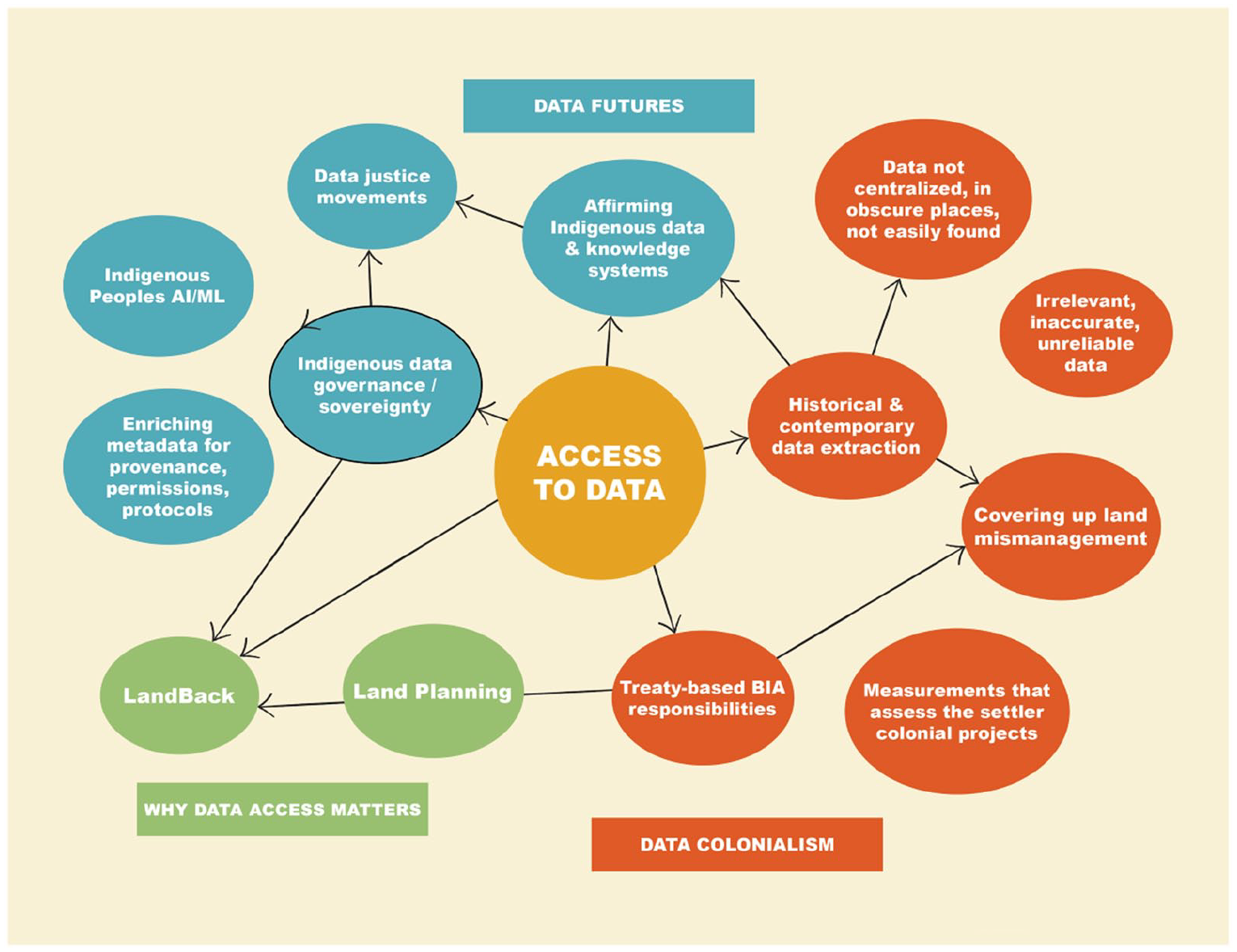
Relational map of access to data in Native Lands.
The primary struggle, of the many challenges to advancing Indigenous Peoples’ Data and Research Sovereignty, that we bring to the fore, confronts the authors of this commentary daily in the work we do alongside Indigenous Peoples. The struggle is access to data. In the United States, tribes and tribal members do not have adequate and equitable access to data which limits their ability to use, benefit, and govern those data. This particular issue, like the other topics in this special journal issue, has many layers. Fundamentally, tribes and tribal allies lack direct access to land data. Many tribes in the United States rely on the Bureau of Indian Affairs (BIA) for their land-related data needs. A federal agency under the Department of Interior, the BIA is tasked with maintaining “government-to-government relationships with Indian tribes and facilitating support for tribal people and tribal governments” (bia.gov). Essentially, the BIA is the controlling fiduciary and trust agent of federal government-to-tribal government relations, born from legally binding treaties and a self-appointed (by the US government) ward–guardian relationship over tribes (Fletcher, 2006). For example, in the northern Great Plains region, in the context of tribal lands, potential revenue from tribal lands is overseen by the BIA. Mechanisms and controls of the BIA which oversee the collection and distribution of revenue from tribal lands, both tribal and individual tribal member-owned, are primarily managed by the BIA.
Reclaiming and asserting data futures
Much of the personal and professional work the authors of this commentary have been engaged with over the course of their careers centers on the empowerment of Indigenous Nations through fair and equitable self-governance. The conceptions of “fair and equitable,” from Indigenous Peoples perspectives, stem from Indigenous observations and experiences over millennia of interacting/relationality with their traditional homelands. The conception of fair and equitable from a BIA perspective stems from the very fundamental aspects of an agency’s illusion that appointing one-self as the entity that controls and distributes land-holding equity on Native Lands is reasonably ethical and morally sound. Now in modernity, at least from the Indigenous experience, these interactions have recently evolved to include what is fair and equitable land management, such as appraisals and leasing of tribal lands. Leasing of tribal (tribe and individual) lands is generally a BIA responsibility, as in most cases on the northern plains, the BIA works to both appraise and negotiate leases for tribes and individuals. For example, one reason to appraise lands is for the purpose of leasing for agricultural endeavors. Agriculture-related leases on some reservations, such as Pine Ridge, South Dakota for example, are dominated by non-native farmers.
For context, agriculture, or yeoman agriculture, a foundational component of the assimilationist agenda in the 1880s was, at least on paper, the core objective of the federal government: to turn Natives in the United States into yeoman farmers. The General Allotment Act of 1887 was created to do this very thing, break up tribal lands held communally and generally assign 160 acres of land to the head of the household to be farmed. The “act caused Indian land holdings to plunge from 138 million acres in 1887 to 48 million acres by 1934 when allotment ended” (Indian Land Tenure Foundation, History, 2023). Withholding the fact that many Indigenous Peoples were already outstanding farmers and had been participating in cultivating crops for sustenance since time immemorial. Also, regarding the “amount of tillable land on each reservation and its population; the numbers clearly show that on most reservations, the amount of land required for allotment under the Dawes Act far exceeded that of tillable land” (Schwartz, 2000). While scholars are still working to understand the full-scale impact that allotment had and still has on tribal lands, leading scholars of allotment seem to all agree that allotment was a ploy to steal Native Lands (Carlson, 1981; Dippie, 1982; Hoxie, 2001; Prucha, 1984; Sutton, 2002; and so on). What we would like to bring to the reader’s attention is that much of the data born from the implications of allotment are obscured by the very entity that is tasked with the empowerment of Natives in the United States, the BIA (Cobell v. Salazar, 1996; Meriam Report, 1928).
Even the most basic data, for example, land area totals for each reservation, are not regularly published or easily obtained, making public consumption or even scrutiny nearly impossible. An author of this commentary filed a Freedom of Information Act (FOIA) for the land area totals for all US Native Lands. It took the BIA nearly 2 years to fulfill this request for data. 2 Upon the initial evaluation of the data received, there are discrepancies of hundreds of thousands of acres for a total acreage of trust lands on reservations when compared to state land area totals records. 3 We are still investigating whether this discrepancy spans from mishandling or mis-collecting records, but if States and the federal government do not have matching records, how can they accurately inform economic policies? More importantly for Native Lands, how can the BIA honor its fiduciary responsibilities? Without important record-keeping related to the data, which, as indicated, is difficult to come by, we are left to draw our own educated conclusions. Currently, we are analyzing and scrutinizing these issues and plan to have a conclusion soon. The fact that BIA does not regularly publish these data and that it could only be obtained through the FOIA process means that problems like this exist and can languish unnoticed for decades; this lack of transparency also allows the continuation of economic injustices. At the end of the day, tribes generally do not have direct access to these data, it is housed by and with the BIA, and if tribes do not have direct access to data about their lands, how can they make well-rounded decisions about the tribe’s future?
Staying within the context of the assimilationist agenda and attempting to assess the impact of allotment, one of the many questions we and countless others have been searching for is essentially post-allotment agriculture data, in particular total agricultural revenue on allotted reservations since allotment. In short, we have found that there is a significant racial difference in the share of market value from agricultural products sold depending on whether the reservation was allotted. Given many Natives in the United States were forced into allotment, this clearly shows the contemporary impact of these policies on Native agriculture and how allotment has structured and maintains racial inequality. From the time of allotment until today, what is the total revenue extracted from racist policies on Native Lands, and does this demonstrate fair and equitable practices within the BIA?
Figure 2 illustrates the detrimental and long-enduring impact that allotment policies have had on Native agriculture. The BIA holds 66 million acres of lands in trust for various tribes and individual tribal members. Approximately 46 million acres (69%) of this land is used for farming and grazing by livestock and game animals. When we compare allotted versus not-allotted reservations in the 2017 United States Department of Agriculture (USDA) data for Native Reservations, it is clear that non-natives are the primary beneficiaries of agriculture on allotted reservations. Non-natives capture over 89% of the market value of agricultural products sold. From another perspective, using the same USDA data in 2017, 4 Natives captured only 12.89% of the agriculture revenue generated on their lands versus 87.11% captured by non-natives. In addition, non-natives controlled 86.33% of harvested croplands and 72.16% of the livestock. By contrast, in reservations that were not allotted, non-natives capture 24.2% of the market value. The most likely cause of this is the high degree of fractional ownership, fee-patented lands, and widespread agriculture leasing (to non-native farmers) that allotment policies introduced onto reservations.
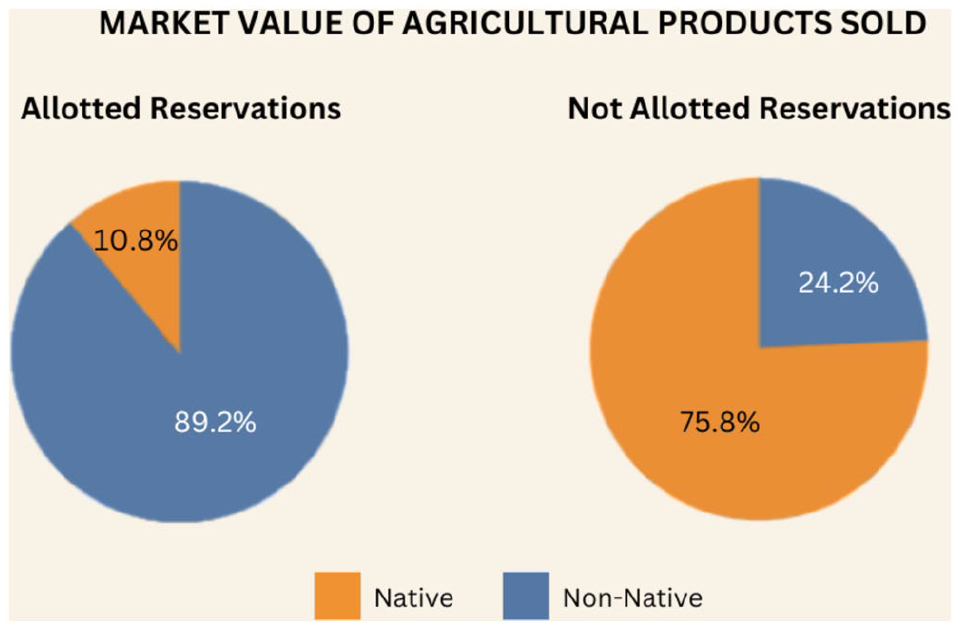
Racial distribution of agricultural revenue for allotted and non-allotted reservations.
The agricultural disparity endemic on Native reservations can thus be traced back to the passage of General Allotment Act of 1887 and subsequent amendments that ceded and opened up Native Lands to non-native farmers and ranchers. In fact, we estimate the lost agriculture revenue 5 on reservations as a result of these policies to exceed $749 billion since the late 1800s (Figure 3). Of course, with limited access to data and an assumed mismanagement of data, we estimate the true damage of neglect and malfeasance regarding the Government’s role as fiduciary and trust agent to be much higher.
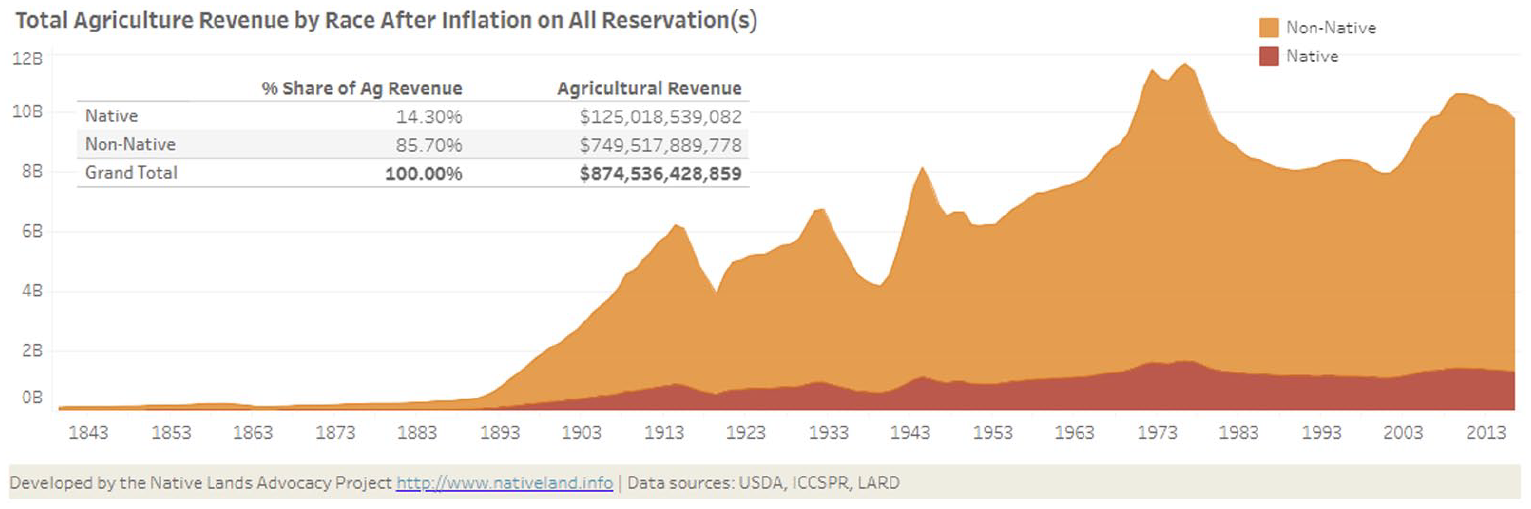
Racial distribution of agriculture revenue on US Reservation lands, 1840–2017.
In conjunction, for lands to be leased for agricultural endeavors or sold, they must first be valued, that is, appraised (Figure 4). The ways in which Native Lands were appraised, post allotment, were/are contentious and do not appear to be uniform—contentious because there was not a clear uniform standard for how lands were valued. In Oklahoma, for example, pre-1953, “Indian Farmers” and “Farm Management Supervisors,” who were also BIA employees, provided the valuation of Native Lands. Up until the early 1900s, the Allotment Act generally prevented 6 Natives from selling their lands; thus, there was not a major need for appraisals, though we can clearly see thousands of acres of land left Native ownership during this time period. When appraisals were needed pre-1953, 7 much of the valuation was based on rudimentary indicators that would essentially promote the production of monolithic agriculture. Such indicators included the general working “Indian Farmer” knowledge of the “price paid for farms in the immediate area” or a “loose system of comparable sales” (Haney, 1961: 6). While much of the appraisal process in the years leading up to 1953 was “loose,” in 1953, the number of needed appraisals, due to changes in federal policy that had prevented sale, but not prevented all Natives from selling their lands, were lifted, and the need for appraisals grew. 8 A committee was created made up of BIA realty professionals and soil experts who were familiar with Oklahoma and primarily focused on soil productivity (Haney, 1961, p. 8). This particular system lasted until 1955 when new standards were created, and more uniformity in appraisals was and continued to be refined.
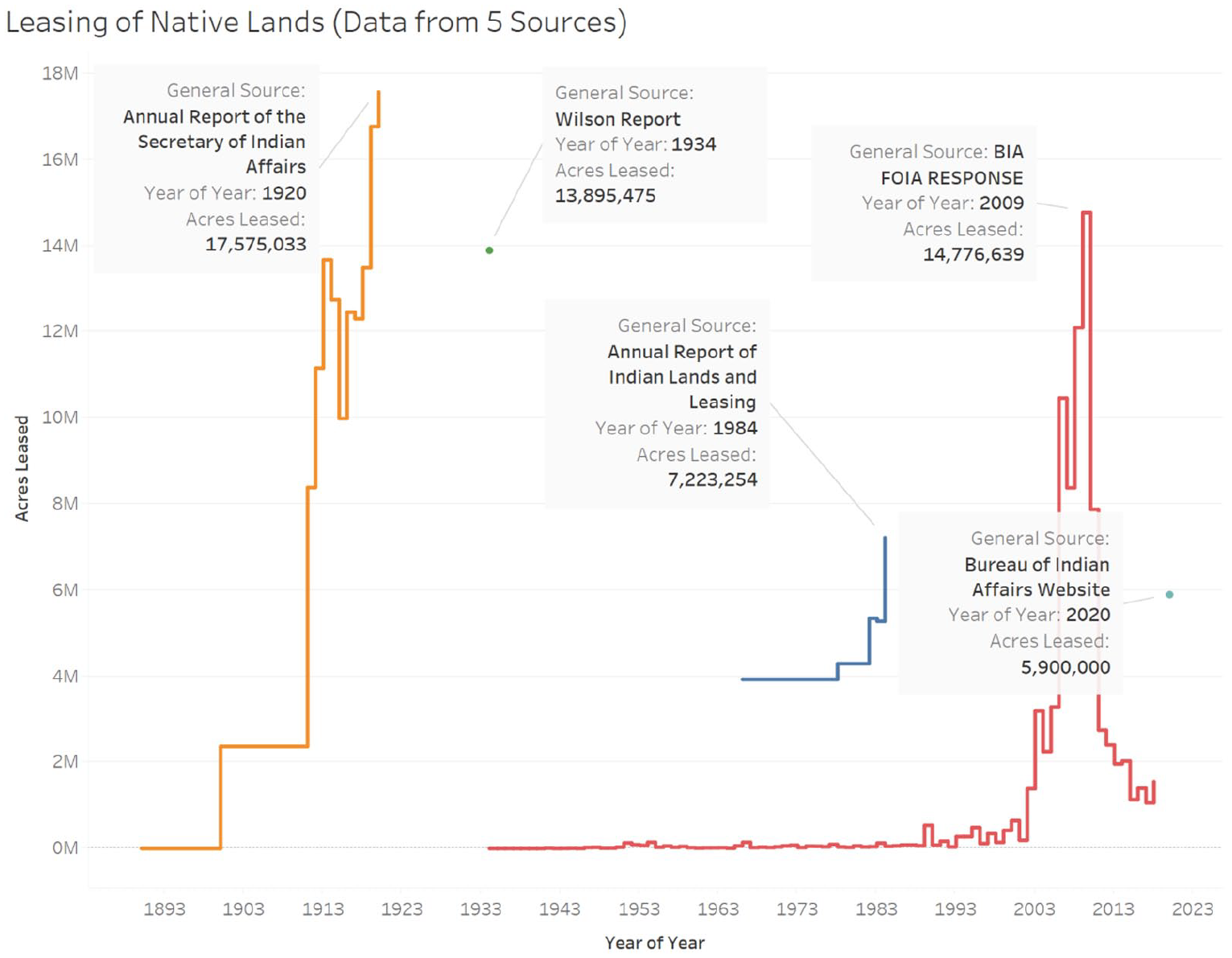
Comparison in total acres of agriculture leased on US Reservations for five government sources for the period of 1890–2019.
While appraising lands in Oklahoma up until the reform of appraisals began to take hold within the BIA in 1953 and refined over the years, one of the questions that we maintain is what is known about those Native Lands prior to 1953. Bell Haney reports that between a 10-year period of 1947 and 1957, the Cheyenne-Arapaho lost 34.6 thousand acres, Kiowa lost 85.6 thousand acres, Osage lost 107.6 thousand acres, and the Shawnee lost 11.7 thousand acres (Haney, 1961: 18). Though the Indian Reorganization Act (IRA) of 1934 officially stopped allotment, which many scholars equate to a loss of 90 million acres of Native Land total between Allotment in 1887–1934 IRA, these numbers demonstrate ongoing land loss 23 years after allotment ended. Based on our work, this is a microcosm in the bigger picture of Native Lands lost and tracking land loss (Farrell, 2021). With the documented land loss, our question is, “How were these lands valued if the appraisal took place during a time of ‘loose’ appraising?” Where are those data? Generally speaking, there is an inquiry/accounting that needs to be made regarding the fair and equitable appraisal of Native Lands sold and leased not only during the eras represented in this commentary but also leading up to the present day.
As we are aware, there has been an increase in the amount of Indian land leased and sold to Whites, a decrease in the rate of capital accumulation by Native farmers, a decrease in the rate at which Natives were presented and learned farming and a reduction in group cooperation in economic matters that would further truncate Native agriculture. Though the era in which assimilationists’ agricultural agendas are long gone, the implications persist.
Beyond settler colonial data scapes
Moving toward a more inclusive and equitable Indigenous Peoples Data and Research Sovereignty future, it is worth pointing out that only recently (8/16/21) the BIA updated the code of federal regulations (CFR) regarding Indian Land Title and Record, which had not been updated since 1981 (Federal Register, 2023). Regarding access to data, the CFR contains no statute about the amount of time the BIA has to fulfill requests. Given this encumbrance, tribes, individual tribal members, and allies are better off filing a FOIA for land information knowing that these are tracked and there is a time requirement for FOIAs. However, wait time often takes months or years. This considerably slows down research and planning, and can result in the data not being made available or shared.
Currently, the BIA outsources data inquiries/access to private companies such as CGI Group Inc. 9 In conjunction, the Bureau of Land Management, the federal tribal lands trustee, which also houses sensitive tribal lands data that can assist tribes land management initiatives, such as patent data, also outsources data access to a private company called IHS Markit Ltd. IHS Markit Ltd., 10 like CGI, then makes these data available for a fee to whomever can pay. For example, an inquiry to map General Land Office data down to the parcel for a particular reservation was sent to IHS Markit Ltd. If the map produced was quality and there was a desire to proceed with mapping all Native reservations in the United States, the preliminary estimated quote came back in the hundreds of thousands of dollars. To bring this point home, IHS Markit Ltd. offered to sell authors on this commentary Native Lands data. This literally means that anyone wealthy enough to pay for these data can access sensitive information about Native Lands that tribes themselves struggle to access. So, in the age of Big Data and Open Data, are we moving in a positive direction where fair and equitable treatment (i.e. access to data regarding Native Lands) of Native People by the federal agencies who are both fiduciary and trustee or are we going backwards?
Though the promotion of and adherence to tribal self-determination and sovereignty is the primary task of the BIA, it seems the very underpinnings of assimilation may prove to have always been and continue to be a farce with limited and at times no access to timely and accurate data. It seems that while Native People in the United States are encouraged to participate in the very foundational concept this country was built on, they are at the same time paralyzed by the very entity that is tasked with empowering them, the BIA. While the Federal Government has repeatedly acknowledged the failures of its policies on Native Lands, it has never addressed them to the extent necessary to fix them, which is the reason why the disparity has persisted to this day.
Productive data relations
As a result of these enduring issues surrounding access to meaningful data, the following are paramount for the federal government to improve Data Relations with Native Nations:
Release all land class maps to tribes and tribal land holders.
Release all data being withheld from tribes and individual tribal land holders regarding their lands.
Create regionally based data centers for tribes, at aggregations of their own choosing, supported by congressional appropriations. Not to eliminate or absolve the BIA of mismanagement of Native Lands, Native Lands data, or federal treaty responsibilities.
Issue federal directives in support of Indigenous Peoples Research and Data Sovereignty adhering to tribal rights and responsibilities to access, use, and govern and steward their data wherever it may be.
Footnotes
Declaration of Conflicting Interests
The author(s) declared no potential conflicts of interest with respect to the research, authorship, and/or publication of this article.
Funding
The author(s) received no financial support for the research, authorship, and/or publication of this article.
Notes
 . She is a political ecologist and has been working in Indian Country for the past 12 years on issues of coloniality and data development to support tribal land sovereignty. She received her PhD in Sociology from Colorado State University in 2017. She is Breton and lives in her homeland of Brittany, France. NLAP is based in Fort Collins, Colorado, on the traditional homelands of the Arapaho, Cheyenne and Ute nations.