



Abstract
Faculty research agendas are informed by and intertwined with the evaluation process. One’s research agenda influences productivity, choice in methodology, and dissemination decisions. Indigenous researchers often undergo a dual evaluation process—one with their academic institution and another with their Indigenous communities. Indigenous researchers, situated in the liminal space between these two spheres, need control over the research process in order to conduct the type of research their communities desire, while meeting the standards of their institution. Using a series of talk stories with Indigenous faculty, this article explores how the tenure process often is a barrier to Indigenous research sovereignty. Indigenous faculty, in this study, articulated feeling lonely and, at times, ill-prepared due to a lack of mentors, prior traumatic academic experiences, and the weight of the many facets of a faculty position. They also noted a disconnect between their institutional processes and Indigenous methods and felt that administration needed to make changes, especially in terms of faculty evaluation through the tenure criteria. Improving the tenure process for Indigenous faculty could have rippling effects beyond individual faculty, expanding into Indigenous communities by providing space for Indigenous faculty to conduct important research that is relevant to their communities.
Introduction
Faculty research agendas are informed by and intertwined with the evaluation process. One’s research agenda influences productivity, choice in methodology, and dissemination decisions. Indigenous researchers often undergo a dual evaluation processes—one with their academic institution and another with their Indigenous communities. Indigenous researchers, situated in the liminal space between these two spheres, need control over the research process in order to conduct the type of research their communities desire, while meeting the standards of their institution. Improving the tenure process for Indigenous faculty could have rippling effects beyond individual faculty, expanding into Indigenous communities by providing space for Indigenous faculty to conduct important research that is relevant to their communities. Thus, the tenure system plays a key role in Indigenous research sovereignty.
Tenure or the right to a permanent position is the “gold standard” of academia (Gavazzi and Gee, 2018). In 1940, the American Association of University Professors (AAUP) issued a Statement on the Principles of Academic Freedom and Tenure. The preamble notes that “Institutions of higher education are conducted for the public good . . . The common good depends upon the free search for truth and it’s free expression,” which rests upon academic freedom (AAUP, 1940). With the number of tenure-track position decreasing more faculty are competing for less tenure-track positions, and faculty who are offered a tenure-track position immediately building their tenure dossier.
Although the requirements to obtain tenure vary based on the type of institution as well as the discipline, the tenure system places pressure on faculty to achieve and maintain a certain level of performance with the promise of full control over their pedagogy and research pursuits in the future (Pfeiffenberger et al., 2014). Most tenure procedures require three elements: research productivity judged by peer-reviewed publications, teaching excellence, and service (Park and Riggs, 1993). The degree of focus on each of these three elements varies by institution. Research institutions, for example, place a significant focus on faculty publishing multiple peer-reviewed publications in their pre-tenure or probationary period to prove their research trajectory will continue (Hardin and Hodges, 2006). In contrast, teaching institutions place the emphasis on teaching, while still requiring faculty to publish in peer-reviewed journals. The lower publication requirements are still challenging, however, when accounting for the heavy teaching loads.
Societal inequities are mirrored in the tenure system. The tenure process itself is vague and rife with ambiguities, which disadvantages minorities, women, and faculty from lower socioeconomic backgrounds who may not know unwritten rules of academia (Cate et al., 2022). Minority faculty also endure being racialized by students, colleagues, and administrators in ways that negatively impact their tenure dossier (Endo, 2020). Women, especially those expanding their families, have increased caregiving burden that can make the tenure process challenging (Perna, 2005; Ylijoki, 2013). Some women faculty opt to stop their tenure clock in order to give birth, recover, and caregive, which increases the length of their pre-tenure appointment (Cardel et al., 2020; Stewart et al., 2009). Their male counterparts also have the option of stopping their tenure clock with one study finding that this inequitably benefited them during the tenure process (Antecol et al., 2016). Finally, faculty engaged in community-based participatory research are often confronted with balancing the additional time requirements of this type of research methodology (Holkup et al., 2004) while still completely the myriad of other requirements imposed on faculty.
Indigenous faculty face these same issues as well as unique challenges such as ontological differences, balancing community expectations, and honoring Indigenous ways of knowing. Indigenous faculty are often called upon in an array of situations to represent the Indigenous perspective, yet with the numbers of faculty being so low it creates even more of a strain on this population (Henry, 2012). Institutions of higher education have been the slow to recruit certain sub-specializations, which could open space for Indigenous faculty whose “research areas relate to their own history, traditions, and social problems,” however, the devaluing of community work compared to peer-reviewed publications in Western academic journals disadvantage community focused Indigenous scholars (Henry, 2012). Finally, Indigenous faculty have also expressed fear of losing their Indigenous identity while teaching and researching in oppressive settings as well as being racialized by students in teacher evaluations (Council of Ontario Universities, 2020; Fiarcloth, 2017; Mohamed and Beagan, 2019).
Although more Indigenous people are receiving doctoral degrees than ever, they remain a clear minority in academia. Only 2% of respondents identified themselves as Indigenous in a 2019 Survey of Postsecondary Faculty and Researchers in Canada (Statistics Canada, 2020). Similar statistics exist in the United States where, in 2018, less than 1% of full-time faculty identified as American Indian and Alaska Native (US Department of Education, 2020). In the face of junior faculty concerns across ethnicities and genders regarding the lack of support and resultant stress of the tenure process (Eddy and Gaston-Gayles, 2008), several programs that support Indigenous faculty achievement have been implement and show promise (Brodt et al., 2019; Windchief et al., 2018). Nonetheless, these efforts seek to tackle the issue of tenure at an individual level and fail to address the communal impact of Indigenous tenure.
Indigenous research sovereignty is linked to and builds upon the movement around Indigenous data sovereignty, which promotes Indigenous control of Indigenous data including its collection, ownership, and use (Williams et al., 2020). While there is no clear consensus on the definition of Indigenous research sovereignty, there are key elements considered in the literature. Indigenous research sovereignty is an extension of the right to self-determination (Díaz Ríos et al., 2020; Sabzalian, 2019) and can be seen as a response to inflexible Western research paradigms. Western research along with neoliberal models of research often involves the dehumanization and colonization of Indigenous peoples through the marginalization and exploitation of Indigenous knowledge (Kennedy et al., 2020; Williams et al., 2020). Within Indigenous research sovereignty, Indigenous peoples, therefore, decide and control the process as well as the aspirations of the research (Williams et al., 2020). The process itself highlights the importance of relationality and reciprocity between the research, researcher, place, knowledge keepers, and Indigenous communities. The acknowledgment of Indigenous methodologies and epistemologies as well as the protection of Indigenous knowledge, worldviews, and intellectual property is paramount. Research itself should be framed within the sovereignty of Indigenous nations, countries, and lands and in doing so, confronts present colonization that is otherwise upheld within Western research (Alderson, 2020; Muller et al., 2019; Williams et al., 2020).
The implementation of Indigenous research sovereignty requires substantial shifts within the academy. Expanding the capacity of Indigenous communities to control Indigenous research, establish ethical regulations, and protect intellectual property are crucial starting points. Integration of Indigenous values into research policies guides research and researchers toward Indigenous principles, but without control or authority by Indigenous peoples it does not inherently challenge current power structures (Díaz Ríos et al., 2020; Kennedy et al., 2020; Muller et al., 2019). Indigenous research sovereignty, therefore, is not only an aspiration but a right for Indigenous people that challenges the harms that Western research has perpetuated against Indigenous peoples.
The tenure system creates subversive incentives to increase research productivity (Park, 2011), which poses unique challenges for Indigenous faculty regardless of the type of institution. With the stakes of tenure being so high, Indigenous faculty face choices that challenge their axiology, question their methodological choices, and stifle their ability to express themselves (Council of Ontario Universities, 2020). At first glance these seemingly individual challenges work in unison to subvert collective Indigenous research sovereignty (Castleden et al., 2015; Freeman et al., 2009). The desire for tenure may lead Indigenous faculty to pursue topics or methods that may not align with their desired research area or bifurcate their research agenda into pre-and-post-tenure tracks. Yet, because Indigenous faculty feel a responsibility to Indigenous communities, these choices not only impact them, but also impact the availability of qualified researchers committed to working with Indigenous communities in ways that honor Indigenous research sovereignty (Barney, 2018; Galloway et al., 2020).
This article shares the experiences of Indigenous faculty and higher education administrators across the United States and Canada with the tenure system. Faculty discussed how the tenure system presented challenges to conducting research on the topics and in the ways that they hoped. Faculty expressed difficulty aligning their work with the desires of the community in ways that would be mutually beneficial. Similarly, faculty disagreed with the focus on research over students indicating that Indigenous faculty held differing understandings of what constituted success. Faculty also expressed frustration with the misalignment of the service requirements for tenure. Due to a lack of Indigenous faculty, they faced a high service load to the institution, yet also felt a responsibility to be of service to their own community, which resulted in an even heavier service load. Finally, faculty believed that mentorship played a key role in their ability to find their voice, that administration needed to play a role in creating a space of Indigenous research, and that the tenure system needed to acknowledge a different definition of success by valuing research for community. The tenure system, therefore, plays a role in shaping or mis-shaping Indigenous research sovereignty.
Methods
Position statement
We believe in the importance of disclosing our positionality and acknowledge that the researchers’ worldview and experiences influence the inquiry and interpretation of findings. All the researchers in this study are Indigenous. Although we are either working at or attending an institution of higher education with a particular focus on serving Indigenous students, we also reside in a discipline where Indigenous voices are underrepresented. As junior and prospective Indigenous faculty, we reflect deeply on our place in the academy while representing our respective communities. At the same time, we acknowledge our position of privilege having benefited from higher education and reached a certain socioeconomic status. This privilege motivates our desire to do this work in support of an academy that better reflects our Indigenous values.
Indigenous qualitative research methods
We adopted Indigenized methods to approach this topic. Using the talk story method, the lead author remotely interviewed 10 Indigenous faculty and Indigenous administrators across the United States and Canada. Talk story interviews align with Indigenous values by building relationships between the participant and researcher while honoring the participants’ stories (Sing et al., 1999). Originally, we focused solely on current Indigenous faculty; however, after interviewing a faculty member who later became an administrator, we opened the dialogue to Indigenous administrators as well. We used purposeful sampling to identify six Indigenous faculty and then used snowball sampling to recruit an additional four Indigenous faculty members. Participants spanned the United States and Canada from Toronto to Hawai’i. Care was taken to ensure that participants varied in terms of the types of institutions, the disciplines, and where they were on their tenure journey. Only one participant was currently in Indigenous Studies and none of the faculty was from Tribal Colleges. This was intentional as we hoped to understand how the tenure process impacted one’s research agenda at institutions and in disciplines that were not already infused with Indigenous ideas and values.
Once we conducted the 1-hour talk story sessions, two researchers independently coded the recorded interview on Atlas-ti using inductive thematic coding. Inductive coding was used because it allows the voices of the participants to be expressed without necessarily fitting into a preset list of codes. To better align with Indigenous axiology, we used a rigorous consensus coding scheme meeting and discussing the talk stories and codes throughout the coding process until consensus was reached in the themes (Olson et al., 2016; Raskind et al., 2019). Theoretical saturation was achieved and resulted in 7 themes and 10 sub-themes. Several recommendations, refined from the talk story interviews and research team discussions, were included for institutions of higher education to consider supporting the creation of a space for Indigenous faculty to, not only thrive in the institution, but also continue to work on issues that are important to their communities. Finally, we applied the COREQ (COnsolidated criteria for REporting Qualitative research) Checklist as a check to ensure rigor and transparency.
Results
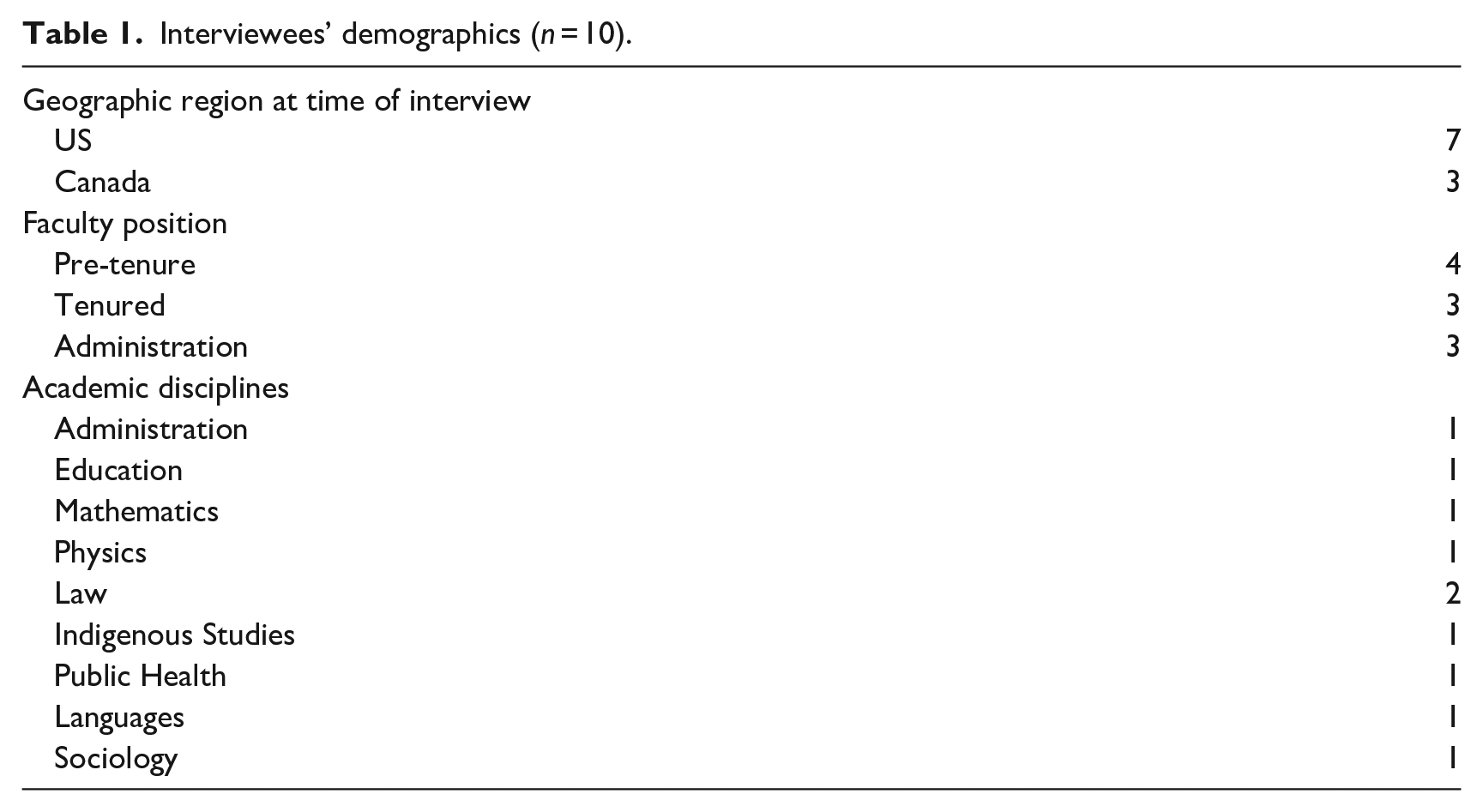
Ten Indigenous administrators and faculty members who identified as Indigenous from either present-day United States or Canada representing a variety of disciplines from law to mathematics were engaged in a talk story session. The faculty varied in terms of experience, with some in their first year on tenure track while others had transitioned to administration or left academia altogether. See demographic table for full description (Table 1).
Interviewees’ demographics (n = 10).
Themes
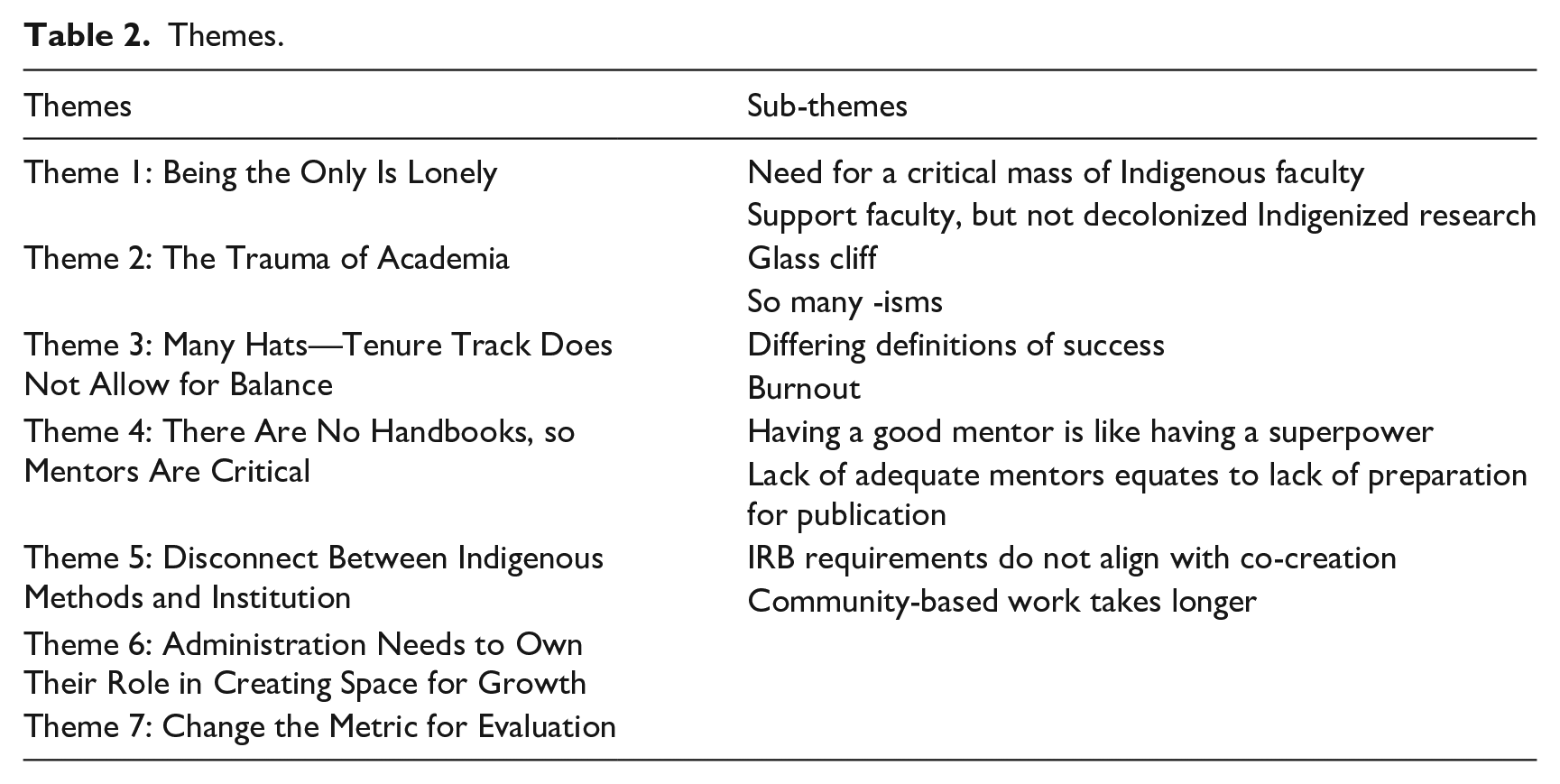
All participants expressed some degree of difficulty having sovereignty over their research agenda at some point in their academic journey. While some participants experienced this conflict during their graduate education, others experienced this challenge more profoundly while on the tenure track. Table 2 identifies the 7 themes and 10 sub-themes (see Table 2).
Themes.
Theme 1: Being the only is lonely
Many Indigenous faculty participants experienced feeling as if they were alone. The first theme of Being the Only Is Lonely formed regardless of the location, type of institution, or discipline. Even at institutions where there were other Indigenous faculty, the Indigenous faculty were rarely in the same department. Two sub-themes were identified: Need for a critical mass of Indigenous faculty and Support faculty, but not decolonized Indigenized research.
Sub-theme: Need for a critical mass of Indigenous faculty
Having a critical mass of Indigenous faculty was brought up by every participant. Even in Indigenous focused institutions, faculty felt that having more full-time Indigenous faculty would be beneficial not only in strengthening the focus on Indigenous issues, but also to spread the workload across a larger number of faculty. Many faculty expressed that they disliked how they were frequently called upon to provide the “Indigenous” perspective on topics and committees. These faculty also believed that if there were more Indigenous faculty it would be easier for them to focus on their dossier since the service burden would be shared across more faculty members.
The absence of similarly situated faculty meant that Indigenous faculty lacked adequate camaraderie in their departments and across the campus. Some wanted other Indigenous faculty so that they could collaborate on projects, while others simply wanted to share experiences and gain perspectives. This feeling was further enhanced during the COVID-19 pandemic where faculty did not return to campus and so were further isolated. One fairly new faculty member noted, “Here I’m in my second year of my tenure track position, and I haven’t even been to campus once, except to get my ID and meet with my Dean.” Since starting, only one person reached out to welcome them and help them adjust. They suspected that if there had been other faculty with similar research agendas they may have received more interest and compassion. Another faculty member who started around the same time noted that only two faculty members reached out when they started—the other Indigenous faculty member and a faculty member who worked on Indigenous issues. They recalled how difficult it was to adjust and that they were “stressed out” about not having enough publications for their first contract renewal, but they didn’t know how to meet people who they could collaborate with in their new institution.
On the contrary, a current administrator recalled that as a new faculty member they were seen as “an exotic” and often were overly engaged by curious faculty colleagues. Similarly, a mid-career faculty member bemoaned the “tokenism” that they experienced at their most recent institution. He recalled being recruited and paraded around, but when he tried to speak up about concerns at faculty meetings, the Chair began canceling the meetings, which he interpreted as an attempt to limit his voice. Several faculty said that they were sometimes kindly and sometimes aggressively told that they should limit their advocacy for Indigenous issues as it was “hurting them” or that they would be labeled “the angry Indian.” They felt that these things were experienced, in part, because they were the only Indigenous faculty and so were the only ones bringing up these issues. Several faculty noted that they had to regroup and “find wholeness in [their] family.” Yet another faculty stated after their third year they realized that the “only way I was going to survive this was to lean in on my Indigenous values.”
One administrator summarized by stating that “it’s all about getting those [Indigenous faculty] numbers up.” To that end, they tried to use their authority to increase the number of Indigenous faculty by sitting on hiring committees and “paying attention to the details” such as writing position descriptions to include community engagement. Another administrator attempted to use their position to have “high level discussions” with other administrators educating them on the importance of having Indigenous perspectives represented in their departments.
Sub-theme: Support faculty, but not decolonized indigenized research
While some faculty experienced behavior that suggested that their presence was not desired, it was more common for faculty to be support in their growth, but not their research. For example, some faculty experienced mentors pressuring them to change elements of their dissertation topic arguing that their topic would not be well received by general academia, such as one faculty member who shared that during their PhD candidacy a mentor “didn’t think my topic [] had any merit.” The mentor went on to say if she “want[ed] to be a star” she needed to study a different topic. In another instance, a faculty member was told as a PhD candidate that they were not doing “real science” because they were researching Indigenous ways of knowing. Another Indigenous faculty member was told by one of her colleagues that she was not teaching “real law” because she focused on Indigenous legal topics.
One faculty member who received significant support throughout their academic journey, admitted that they “did not know [Indigenous topics] were an option” for their dissertation. Instead, they worked on topics that their non-In-digenous mentors worked on. While they reflected that they did not believe they were pushed into the topics in any nefarious way, they also acknowledged that being educated in a highly Western context meant that their advisors were not well-versed in decolonized research.
Several Indigenous faculty received verbal encouragement and even funding to support their academic growth, but their specific research agenda was questioned. One faculty member said that people always seemed to want to fund Indigenous topics, but colleagues and administration often suggested or required that elements of these projects change. For example, specific interview questions were removed during the review process. In many instances colleagues, deans, and mentors were well-intentioned, but their advice served to disenfranchise their colleague and call their work into question.
Theme 2: The trauma of academia
The second theme, The Trauma of Academia, included two major sub-themes: Glass cliff and So many -isms. Although academia is already challenging, Indigenous faculty often face a compounding layer of trauma that they must endure and overcome. Whether explicit or implicit, many Indigenous faculty experience bias, racism, sexism, and lack of respect for their culture.
Sub-theme: Glass cliff
Glass cliff was a term that one Indigenous faculty member used to describe the tendency to place women and minorities in positions when conditions make it unlikely that they will be successful. He stated, the institution puts “Indigenous people, or minorities, or highly underrepresented individuals” into a position where it is “impossible for even [a] white person to do [the job] . . . they put ‘them’ there because they are gonna fail and drop off the cliff.” Other faculty members described the same phenomenon when discussing the unrealistic expectations in teaching, service, and publications. Others noted working through their off-duty period because that was the only time they could engage in research and writing.
Several faculty were hired into tenure-track positions in disciplines other than the area of their academic degree. In most cases, the disciplines were minimally related, but nonetheless created additional and unique challenges that, when coupled with a lack of appropriate mentors in that discipline, made the glass cliff terrifying. These Indigenous faculty members lacked support and guidance to understand the many unwritten rules of the new discipline. Unfortunately, in the end, the glass cliff may be too much for some Indigenous faculty members to overcome.
Sub-theme: So many -isms
Several faculty discussed struggling with intersectionality. These faculty felt impacted not just by a bias against Indigenous-focused topics, but also experienced sexism, racism, and discrimination based on sexual orientation. In one situation, financial and mentorship support was made available to female Indigenous students, but not to male students. This faculty member understood that when viewed through the lens of the White world women are underrepresented compared with men, but felt that Indigenous men in higher education needed additional support, too.
Another faculty member recounted some student evaluations appeared motivated by sexism as well as political outrage for a mandatory Indigenous focused course. For example, students wrote that the faculty member was “incompetent as a professor [and] as a person,” “hostile,” “mean,” and “not kind at all” without providing any details. She said that she didn’t want to be an “aunty” to these students. She attributed the “vitriol that is student evaluations” to the mandatory nature of the Indigenous course. As part of the course, the students learned about Indigenous ceremonies and several students were incensed with one commenting, “We shouldn’t be subjected to other people’s religions,” even though alternative assignments were provided for those who did not wish to engage. The result was that the faculty members’ contract renewal process was contentious. They later learned that other faculty were “concerned about my student evaluations and [ ] they wanted to put conditions on my renewal.” Having anticipated the evaluations being an issue, the faculty member spent a significant amount of time taking appropriate steps to not only improve their teaching, but also providing context and interpretation in her dossier for the renewal committee. The “emotional energy” expended led this individual to consider alternative professions.
Faculty members who have experienced trauma from their academic journey often need to find their own healing journey. When reflecting on their student evaluations, one faculty member decided they had to lean into their culture. They now
view those evaluations as more of a [ ] microcosm of the intersectionality that happens—like racism, sexism, things like that—and not as any sort of personal attack upon myself or as a failure to being able to teach.
Another faculty member shared that it took years of therapy for them to be able to read peer-review articles in their discipline without taking them back to the trauma they experienced in their PhD journey.
Unfortunately, some faculty experience a “toxic” environment in their Departments. These faculty were dismayed to find that “people are just in it for themselves” and that they wanted “clout and attention.” “I don’t like talking like that about my own people,” but some Indigenous faculty become “automatic experts” for the media. When speaking about non-Indigenous faculty, this faculty member said that “everyone wants to be Dances with Wolves,” yet “not everyone was cut out” to be an academic. Another Indigenous faculty noted that some “talented Indigenous scholars didn’t make it” and the one’s that did gain “control of a lot. [ ] They’re in control of programs. In control of publications. In control of knowledge.” He expressed concern that some Indigneous faculty were allowed to struggle by senior faculty while others had “everything handed to them,” leading him to question whether the tenure process was bias. With tenure comes a significant amount of power making an equitable process important.
Theme 3: Many hats—Tenure track does not allow for balance
The third theme, Many Hats—Tenure Track Does Not Allow For Balance, included two significant sub-themes: Differing definitions of success and burnout. Being in academia requires faculty to multi-task, function within multiple roles, and wear many hats, professionally and personally. All faculty are expected to meet specific research, teaching, and service quotas at their institutions, however, Indigenous faculty are often faced with the unique challenge of having a responsibility to their community as well. In these talk stories, most Indigenous scholars disclosed they struggled to balance their research with teaching and service to community.
Sub-theme: Differing definitions of success
Success is subjective and takes on many forms. One Indigenous faculty member stated, “The people who are the gatekeepers are selling and marketing a version of what success is . . . but I’m hearing a systematic story come along.” The gatekeepers in academia are typically non-Indigenous faculty and administrators who have manufactured a standard of what success looks like, which does not always match the Indigenous version. One faculty member explained that the
most recent [ ] Director was on a tenure track, but they weren’t counting a lot of what she did. They’re like, you have to publish in a peer-reviewed journal. It doesn’t matter that you’ve done some technical books and that you’ve done a lot of stuff with the communities, etc., so she left.
In academia, publications and peer-reviewed articles are measures of a successful faculty member. However, this form of measurement is largely a Western construct of success:
I don’t know if being peer-reviewed is valuable, it can be a very valuable experience, but the way that it’s done in such an impersonal manner, I don’t find it very useful at all, [ ] it’s not growth-oriented. Whenever I look at the promotion and tenure system, I’m just like, you know, there is no growth objective here.
For several Indigenous scholars, the need and desire to learn and grow was ever-present.
Indigenous faculty seem to agree on one key element of what constitutes a successful faculty member. As one faculty member shared, “All my greater emphasis is on making an impact at the community level, versus making an impact at the university level.” This faculty member said that if they “don’t want to promote me to tenure in the end, then, you know, I’m fine with that because I think my greater concern is for the community than it is for the university.” This is a prime example of the difference between Indigenous and non-Indigenous Western views of success. Indigenous views, values, beliefs, teachings, and practices are not individualistic; Indigenous values focus on the collective.
On the contrary, many Indigenous faculty felt a deep responsibility to students, as well. Many participants reported a desire to teach and pass down their knowledge to their students. Indigenous faculty members stated they wanted to focus and prioritize Indigenous pedagogy and practices for their students. For example, one Indigenous faculty member stated,
I try to show them that participation isn’t just what you say in class. Participation in the topic is immersive and it [ ] feeds more into what I believe is Indigenous pedagogy.” This faculty noted that their focus on teaching “definitely detracts from my ability to have time for research.
Indigenous faculty are often forced to teach specific classes. For example, for several they were the only Indigenous faculty in their department and taught all of the “Indigenous” courses. Another Indigenous faculty member said, “There’s only four tenure track math faculty for 3,000 students, [and] I’m the only one that’s ever taught the upper-level classes.” At the same time, Indigenous faculty members are also starting new and groundbreaking Indigenous courses, which are the first of their kind. These faculty are responsible for not only teaching the course, but developing the curriculum as well. Indigenous faculty, then, become role models to Indigenous students especially in disciplines that have few Indigenous faculty leading one faculty member to say, “I’m like the face of Indigenous mathematicians, [ ] so I’m being asked in the mathematical community to be [ ] a representative of Indigenous people,” and it’s “kinda hard to turn down because this could really impact [ ] students.”
Indigenous faculty members recognize the importance of mentorship to doctoral students. For example, one Indigenous administrator said,
I actually always have a dissertation student that I’m working with, so I’m working with two right now because that’s the core of what we do, that whole learning and discovery and exploration, and then watching someone that you care so much about just blow the roof up. You know and just go and do really good work. [ ] That’s what fighting to stay in the institution has meant to me.
Indigenous faculty see the importance of supporting other Indigenous students and how supportive mentorship can shape the future of Indigenous research and teachings.
Sub-theme: Burnout
Positions in academia involve wearing many hats from teaching to research to mentorship to administration. Handling this unrealistic expectation on a daily basis leads Indigenous faculty members to burnout. One Indigenous administrator expressed, “[Indigenous] faculty [ ] were really just overwhelmed and didn’t have the support they needed [ ] to be successful.” In addition, Indigenous faculty members feel pressure from their institutions and indirect pressure from the Indigenous community. Because there are limited Indigenous faculty members in academia, they field numerous requests to present and participate in projects. Understanding the privilege that they hold, these requests are difficult to decline, however, this type of “community service is not rewarded in the tenure process.”
Depending on whether the faculty hold positions at research-focused or teaching-focused institutions, the percentage of time a faculty member devotes to research versus teaching differs. While the number of publications required to be granted tenure varies, each type of academic institution requires faculty to publish in peer-reviewed journals to achieve tenure. One Indigenous faculty member stated,
I think the bar, of that glass ceiling, is too high . . . it is unrealistic. We only have 24 hours in a day, so many hours in a week, so many hours in a year. Really one publication a year is all you need to do, [but] we do not have that much time when we teach so much.
Some Indigenous faculty members may also be expected to provide formal or informal administrative support. For example, one Indigenous faculty member reported a high turnover rate at their institution because of the unmanageable workload and unrealistic expectations. When discussing her positions she stated, “it’s an academic appointment, so you are supposed to run a center and go through the tenure process, and teach, and do all that other stuff.” Another faculty shared that at their institution they were expected to do all of their grant management and administration like accounting and human resources paperwork, which meant that faculty were expected to learn all of those policies on top of the research and teaching policies.
The compounding layers of pressure weighed heavily on these Indigenous faculty members and resulted in physical and emotional drain. This led one Indigenous faculty member to disclose to her Chair that, “I’m too burnt out to apply for another job, so I’m gonna stay here for the rest of the semester, but I hate this.” This type of pressure can also lead to resignation. This same faculty member noted that the pressures were so immense at her institution that many Indigenous faculty were leaving feeling that they lacked support, especially in the face of systemic racism. She noted that “It feels like I’m in a forest fire and all the smarter animals have already left.” Without support from their institution and sufficient mentorship, this pressure can quickly lead to burnout, decreased productivity, and ultimately leaving academia altogether. Wearing many hats creates an imbalance and an insurmountable pressure, which can lead to stress and burnout.
Theme 4: There are no handbooks, so mentors are critical
Mentorship was a strong theme that all participants discussed. Mentorship played a critical role in the success of Indigenous faculty, however, even those with strong mentors felt underprepared when entering academia. Having a good mentor was perceived as having a superpower, while lacking good mentorship was often equated to being ill-prepared for tenure, especially in relation to the publishing requirements.
Sub-theme: Having a good mentor is like having a superpower
Whether or not an Indigenous faculty member had access to a strong mentor played a critical role in their career trajectory. One faculty member noted that it was their mentor that “walked me back from the ledge” when they were in graduate school and thought they “weren‘t cut out for this” and were “admitted by error.” Especially in the sciences, students gain critical research experience through mentorship by faculty in labs and other clinical settings. Students who are unable to meet the criteria to participate due to minimum grade point average requirements or because of family obligations leave their programs with an abridged understanding of the research process. Whereas another faculty member recounted that, all of their publications prior to being hired in a tenure-track position were because their mentor invited them to join in on projects.
Mentors also played a critical role in the ability of junior faculty to navigate the tenure process. In one instance, an administrator provided significant mentorship on how to navigate the politics of the institution highlighting the value of diverse mentorship. That same administrator noted, however, that it is critical for faculty to have at least one champion in their department since they are the ones that review the tenure application. Having “some type of coaching system embedded in the process” would be beneficial. This individual expressed the idea that coaching was “our [Indigenous] competitive advantage. We had thousands of years of history . . . that pre-date Western civilization” and coaching should be everywhere. “It is an Indigenous system.” When mentors were not available, some Indigenous faculty gained experiences in minority focused graduate research programs.
Finally, a strong mentor helps Indigenous faculty “find their voice.” Most Indigenous faculty expressed frustration early in their careers not being able to do the research that they wanted. One faculty recalled being afraid to tell his research mentor that he wanted to shift from being more research focused to teaching more, but “it was something he realized in me before I realized it.” Another faculty member said that their mentor told them, “You are going to make a difference in this field, but you have to stop being us; and you need to start being you.” This type of individual-focused mentoring is important for Indigenous faculty and must start early on one’s academic journey.
Sub-theme: Lack of adequate mentors equates to lack of preparation for publication
The last sub-theme identified was that lack of adequate mentors equates to lack of preparation for publication. “I wasn’t properly mentored,” “I need a mentor,” and similar phrases appeared through many of the talk story sessions. These Indigenous faculty members felt lost, confused, and ill-prepared for academia. This was especially noticeable as early faculty began independently conducting their own research for publication. “I need a mentor that’s above me—that I can talk to. I still can’t publish. My barriers: I can’t publish because I don’t know what my research field is,” stated one Indigenous faculty member who was teaching in a discipline related to his degree.
Indigenous faculty members also highlighted the need for collaboration among all Indigenous researchers and scholars. For example, one faculty member stated, “I think we need to come together and not have these cliques. And, like, why are only certain people asked to write.” This same Indigenous faculty member stated further how research is privileged, even for him. He says, “I don’t know where I can publish, and I’m trying to find where I can publish.” Another faculty member noted that there were “two groups of Indigenous faculty” at their campus and they worried about upsetting one of the groups to the detriment of their tenure application. They did not want to “burn bridges” by engaging in certain research topics or making certain conclusions, which may anger one of the groups. Implicit in these comments is a desire for a supportive near peer research community that is not always present due to internal conflicts.
Even Indigenous faculty who receive grant funding with an assigned mentor, sometimes still experience challenges. For example, one Indigenous faculty member stated, “I was supposed to have a mentor as part of this national grant that I’m part of, but that other person is just too busy.” This scholar said that they spent a lot of time “trying to get some research support, and trying to find out, like how do I do this? What do I do?” Another faculty echoed this by stating that their grant supported mentor does a good job of explaining things to me, but felt that they “need[ed] a mentor who will walk alongside me.” Even Indigenous faculty that appear to be successful and are getting funded still desire stronger mentorship.
Theme 5: Disconnect between Indigenous methods and institution
Another strong theme that emerged related to the unique challenges of conducting community engaged research using Indigenous methods. Specifically, Indigenous epistemology calls for the co-creation of a research project from the development of the initial research questions to the dissemination of research with the Indigenous community. To varying degrees the faculty that engaged in this type of work experienced challenges navigating the Western research focused bureaucracies.
Sub-theme: IRB requirements do not align with co-creation
One troubling sub-theme was that many Indigenous faculty encountered seemingly unnecessary bureaucratic challenges to conducting their research. A recurrent topic of discussion was the Institutional Review Board (IRB) or Research Ethics Office policies. Although these faculty suggested that the processes did not align with their chosen methodology, none suggested that these checks should not exist. Rather, participants shared the sentiment that the IRB process was overly cumbersome for those who wanted to engage the community in research. At one institution, anyone who engages with research participants or reviews the collected data must receive two multi-hour long online ethics training, which poses a substantial burden to the community collaborators and often delays the research timeline. No trainings were offered that were geared toward collaborators rather than principal investigators.
One faculty shared that their university had “done some not-so-good things in the past and [ ] now the Research office was incredibly stringent.” The Indigenous faculty member described the process of drafting an autobiographical reflective article where the Research Office determined that she, as author, was a vulnerable participant, triggering the need for additional steps, including an advisory committee, to ensure there was no coercion. The same faculty member expressed discontent that Indigenous elders and participants were automatically considered “vulnerable.” They noted that as an Indigenous researcher “elders, ceremonial keepers, and current and former leaders hold more of the power vis-a-vis ‘me,’ the institution, than anyone else.” Nonetheless, the past actions of other researchers with Indigenous communities have created systems that erect barriers for faculty.
Several faculty noted the timing of IRB approval for grants did not always align with the flow of Indigenous research. One stated that “when we put our grants forward, we have to have our research questions ready,” but what “if I wanted to work with [the Indigenous community] to find [the] research questions.” This participant noted that the requirement to have a fully formed research project in place to apply for grant funding proved challenging. Another faculty member agreed, adding that community partners are often not invested in the details until funding is secured. As a result, the faculty member had to create a “strawman protocol” and then go through multiple modifications once funding was secured.
Finally, faculty noted that IRBs push for a structured list of interview questions, which is off-putting to many Indigenous participants who prefer to let the conversation “just flow.” The expectation of using structured or semi-structured methods also impedes the use of more Indigenous “conversational” or “talk story” method of inquiry. Similarly, faculty felt as if they were being asked to unnaturally remove their voice from their work. As one faculty member put it, “we cannot remove ourselves from our work . . . and why would we want to” highlighting how the IRB process conflicted with Indigenous understandings of what constituted good research. These types of challenges feed into the second connected sub-theme that community engaged research takes longer.
Sub-theme: Community-based work takes longer
Most of the Indigenous faculty we talked with collaborated with the Indigenous community as part of their research, however, many noted that community engaged research models take longer to execute. One faculty, when describing the additional steps to conduct community engaged research, noted that “the same hands-on process happens at every stage of the research project, including getting approval to publish.” As a result, another faculty mentioned that during the tenure review process they spent a significant amount of time explaining to potential reviewers that their methodology was time intensive in order to justify the relatively few publications they had. In many cases, it takes years of steady work to build the relationships needed to engage in truly collaborative projects.
Several faculty members who are also cultural practitioners reinforced the belief that working with Indigenous communities means that we need to honor their values. One faculty member summed this up by saying that you have to ask “is it your place to do [the work]?” especially when it comes to “decisions on research topics and whether to publish.” Another stated that they hoped to work in cultural revitalization and learn their community’s traditional speeches for special events and ceremonies, yet they also acknowledged that they needed to consult tribal leaders to determine “whether it’s appropriate or not for the greater audience of academia or wherever.” Clearly, these types of internal discussions have an impact on a pre-tenure faculty member’s decision as to what research projects to engage in. As one faculty member put it, “I have my pre-tenure research agenda and then I have my post-tenure research agenda. My pre-tenure research agenda will, hopefully, get me tenure, but my post-tenure agenda is what sets my soul on fire.” This sentiment was echoed by many.
The challenge of creating a research agenda that is tenurable was noted by other faculty who said they “still don’t really know how to [create a research agenda].” Despite feeling overwhelmed with all the requirements of tenure-track positions, another faculty member felt obliged to agree to co-author certain articles to meet their annual publication requirements. As a result, they felt pulled in many different directions, some of which “they really weren’t that interested in.” Those other projects “took time away from what they wanted to work on,” but they needed a safety net of sorts for their dossier.
Theme 6: Administration needs to own their role in creating space for growth
One theme that more seasoned faculty and administrators noted was the important role that administrators play in creating an environment that supports Indigenous faculty and Indigenous students. When commenting on the role of administration in creating a supportive environment for all faculty, one administrator noted, “the administration needs to own it. They are part of the problem if they are not tackling it head on.” While they suggested that it was important to have Indigenous administrators, they also noted that it was equally important to nurture allies at the administrative level. One administrator suggested that all Indigenous faculty should attempt to “develop a relationship with [non-Indigenous] faculty” in order to “demystify” the Indigenous issues and values.
Few Indigenous faculty reach the level of an administrator, and those that do, often face a difficult and lonely battle. Indigenous faculty expect a lot from Indigenous administrators. Several administrators and faculty recounted Indigenous administrators faltering under the weight of pressure. Some administrators entered into these positions hoping to make change, but found that the institutions were firm and change could only be incremental. While Indigenous faculty noted how important it is to see Indigenous faculty farther along in their careers providing a pathway and goal to aspire to, they were also quick to criticize those same people. Without releasing the high expectations, several faculty and administrators suggested that more support was needed for these emerging leaders.
Theme 7: Change the metric for evaluation
A final recurrent theme that Indigenous faculty members shared is the desire to reform the tenure process to include additional metrics for evaluating an Indigenous faculty member’s true potential. One administrator suggested that “the whole publish or perish perspective has been somewhat skewed.” They suggested that those who created the definitions used in tenure may “not be progressive enough to really understand what scholarship and research can be and the usefulness of it.” They bemoaned the rule bound tenure process’ attempt to create an “objective measurement process,” which they saw as “hinder[ing] your capacity to do imaginative work” and “wonder in public.” In attempting to be even-handed, tenure has turned impersonal and not “growth oriented.”
Other faculty members focused on what counted toward publications in the tenure process. Several faculty took issue with the requirement that publications be peer-reviewed where the peer was another PhD. The Western concept of peer-review does not encompass publications for the community. However, these faculty saw the Indigenous community as their peers and felt that scholarly work done for them such as creating language curriculum, reports, or analyses should count as peer-reviewed. Another faculty suggested that Indigenous honors such as “blanketing” should receive the same level of recognition as more traditional academic rewards. On the contrary, one faculty opined that even if the criteria changed the tenure process still consists of largely “non-Indigenous faculty judging Indigenous faculty and interpreting what counts for tenure.” The interrelated nature of these themes can be seen when imaging potential solutions.
Specific improvements
Participants were asked whether and how they would like the tenure process to be reformed to allow for greater Indigenous research sovereignty. All of the participants expressed gratitude for their positions recognizing that tenure-track positions are increasingly rare. Most expressly stated that they feel privileged to be able to do this work at their instituions. Nonetheless, room for improvement was identified. One faculty member when reflecting on their journey, said
it was not easy [ ] for Indigenous faculty to get promoted and to get time tenure . . . and one of the reasons it was not easy was that no one really took the time to map it out.
Although many other faculty also discussed the importance of clarity in the tenure process, what constituted clarity varied. One faculty expressed pleasure that their institution clearly listed the number of peer-reviewed publications required to obtain tenure while another wanted written confirmation that certain research activities, which were orally supported by the department would also be supported by the tenure review committee. These suggestions grew out of concerns related to the uncertainty surrounding whether that faculty member’s research agenda aligned with the tenure criteria.
Several participants suggested that mentorship programs be continued and expanded, especially faculty mentorship programs for new and junior faculty. One faculty member stated that they would like to see mentorship programs that pair junior and senior faculty to conduct research together in order to gain “publication experience.” They felt that this type of partnership would support junior faculty who may not have had strong mentors or were unable to take advantage of research opportunities in graduate programs due to family obligations. Other faculty members simply suggested that federal funds continue to be placed into programs that provide opportunities for underrepresented students.
Finally, quite a few faculty members suggested that academic institutions should reconsider peer-review as the “gold standard” of publication. The concept of peer-review is to ensure a certain quality of work, yet many Indigenous faculty find themselves torn between meeting Western standards as well as the standards of their Indigenous community. Several faculty members suggested that they “choose to focus on community” indicating that their loyalties were toward using their positions to support the community. This suggests that these faculty members held a different concept of who they considered a “peer,” and leads to the conclusion that the narrow definition of peer-reviewed applied in the tenure process is misaligned with Indigenous values.
Discussion
Although we are seeing more Indigenous scholars being hired into tenure track positions, they still face unique challenges. Our findings are consistent with other studies that have queried Indigenous faculty regarding the challenges they experience (Galloway et al., 2020; Henry, 2012; Kennedy et al., 2020; Mohamed and Beagan, 2019). Issues related to the emotional burden of being the representative of their community, having to take on additional service, and struggling with the competing interests of service and teaching in relation to time for research and publication. Most notably, the inflexible tenure process hampers the ability of Indigenous faculty to engage in the type of research that they want to engage in. This not only impacts Indigenous faculty, but also Indigenous communities as Indigenous faculty make conscious decisions not to take on as many projects that rely on community engaged methods due to tenure pressures.
Although we anticipated that faculty would make the connection between service to community and publication, we did not anticipate that so many faculty would experience institutional barriers in conducting community engaged research and the impact it would have on their tenure timeline. It is widely accepted that community engaged work takes more time. To do this work correctly requires the building of relationships over time that often occurs outside of official work hours. However, overly complicated institutional policies meant to be protective have also served to hinder Indigenous faculty from engaging with the community, especially their own communities, in the ways that they hoped. This created a chilling effect on some junior faculty who recognize that if they are to achieve tenure, they cannot rest their entire dossier on this type of work. Alternatively, other junior faculty have decided that their principles are more important and acknowledge that this may put them in a more vulnerable position when it comes time to go up for tenure.
Another important finding was the different axiology that Indigenous faculty tended to express in relation to students. Well-intentioned senior faculty seem to acknowledge that to be excellent in teaching, service, and research is nearly impossible and suggest that junior faculty focus on research, which is critical to one’s dossier. However, this seems to create an ethical dilemma for many Indigenous faculty who felt it was inappropriate to focus on research at the expense of teaching and mentoring students. Regardless of the reason, even Indigenous faculty who acknowledge that one cannot focus on all three elements have difficulty letting teaching fall to the wayside.
The overarching takeaway from this work is that Indigenous values diverge from the traditional tenure process. Because of the relationality that is embedded in conducting research with Indigenous communities, Indigenous faculty are caught trying to balance the opposing forces of publishing and community engagement. While individual Indigenous faculty deal with this conflict in different ways, they all discussed needing to navigate between these opposing forces. Academic institutions, in turn, need to understand the unique challenges that Indigenous faculty face and adjust to policies, procedures, and values to create truly open institutions. In particular, academic institutions need to continue to fund and encourage the expansion of mentorship programs that support underrepresented minorities, especially Indigenous students and junior faculty. These programs were instrumental in the pathways of many of the participants. Creating ways to incentivize shared research should be encouraged.
Ultimately, Indigenous communities are suffering from the narrow view that academic institutions are taking toward what constitutes “peer-reviewed publication.” When Indigenous faculty must choose between doing needed community work and getting the right number of publications, they either do less community work or they run the risk of not getting tenure and, thus, not being able to continue the work in the future. Thus, the issue of tenure in the academy impacts more than just individual Indigenous faculty, it diminishes the amount of support that Indigenous faculty can provide to Indigenous communities.
Academic institutions should do more than merely state their desire to hire more Indigenous faculty and take meaningful steps to accomplish this goal. From promoting policies that require Indigenous representation on hiring committees to adding community relationships as a desirable qualification, these steps honor the commitment that Indigenous candidates have to not only the institution, but also the larger community. Once a critical mass of Indigenous faculty are present there will be more opportunities to expand the concept of “peer” to include community and acknowledge community work as a criteria for tenure. If the goal is to create an academy that honors all, the institution must make modifications to the conceptualization of research and create space for new ways of engaging in and creating knowledge.
Footnotes
Acknowledgements
The authors thank the participants who honored them with their stories. Special thanks to the editors who had the foresight to put together a special issue on this important topic.
Declaration of conflicting interests
The author(s) declared no potential conflicts of interest with respect to the research, authorship, and/or publication of this article.
Funding
The author(s) received no financial support for the research, authorship, and/or publication of this article.
