



Abstract
Indigenous scholars have been calling for renewed attention to the theorisation and practice of sovereignty, including within research. Their scholarship has drawn attention to the sovereignty of people within research processes, as well as diverse expressions of sovereignty. In this article we bring these two dimensions into conversation to consider how research methods might enable and enliven understandings and practices of sovereignty within geography. Illustrating Yuin approaches to research through poetry, observation and dreaming, we show how Country is a living enactment of sovereignty. It dynamically contributes to research processes and enables nonhuman entities to communicate within and beyond their territory as sovereign subjects. In particular, Yuin research methods acknowledge the significant contribution of plants in the theorisation~storying and practice of sovereign Country. Through plants, we come to develop a knowledge of sovereign Country as often in between things, including places and knowledges, vulnerability and protection, and removal and persistence. Such insights are respectfully offered here in the spirit of broadening disciplinary perspectives and capacities in order to revitalise research that addresses the relationships between territory and its people.
Introduction
Sovereignty does not exist with the concept and reality of oneness
Sovereignty however does exist with the concept and forced reality of colonisation
So I am living in a world in which sovereignty is non-existent and exists at the same time
So where do I sit
Often in between
Often somewhere in the middle of being in between
Oddly I am dammed if I do
Oddly I am dammed if I don’t
Venturing into the middle of do and don’t is don
Venturing into don’s meaning is master
Everyone is entitled to respect
Everyone is titled with respect
Everyone should be able to have a tilt at respect
Right now what does respect look like when sovereignty is a title
Right now in the now I am Country
Right later in the past we remain Country
Eventually we are remains within Country and our authority of custodianship is the same
Eventually sameness evolves from sovereignty of occupation
Eventually the occupied are sovereign
I cannot occupy rule over
I can occupy rule over my behaviour of and in respect
I am in and of you
Got me tolerance
Got me patience
Got me you
Nothing is something and I control something that is often missed by someone
Nothing is missed when in connection to oneness, even when unknown or known
Totally confused but in understanding
Totally understand to be in confusion
Yet Sovereignty is a ruler of power to itself
Yet the only sovereignty I hold is me and me is Country
Yet the word sovereignty is non-existent within existing.
This poem is an invitation to consider the sovereignty of Country. We (the authors) explain:
The layering of meaning in poems can allow for Aboriginal pedagogical approaches attached to our epistemology and ontology to occur in some form within research. The reader can make meaning from the story (Poem) as it is not just in the ‘hands’ of a sovereign researcher/writer. If no one person has ownership of the poem, then in this context Country does so – in relationship with all living things, including research. (Anthony, Awabakal, Gumaroi, Yuin man and academic) It was not necessary to conceptualise the idea of sovereignty until colonisation began. Respect and understanding for every living thing and their Lore was always considered. There was no need to assert sovereignty. Today, power and Law is held within governments. Aboriginal people have had to conceptualise sovereignty to reassert their own sovereignty and likewise, that of the nonhuman. (Crystal, Gundungurra woman and academic) I am not familiar with poetry in research. I am challenged by its form and function. I have questions about the place of poetry in geographical research and where it fits. But this poem pays no attention to my hesitations. The poem calls me into Country and the spaces in between what I know and what I don’t. (Jenny, non-Indigenous woman and academic)
Can you see the poem, can you see Country? Our invitation is to you, reader, to consider this poem and other diverse methods as academic stepping-stones for geographical research with Country – as a knowledge holder and system. Methodological approaches that centre Country assist researchers to step towards an understanding of Countries’ sovereignty. The Sovereignty poem comes from McKnight’s engagement with Country. He shares it here with you to recount what he saw from Yuin Country who speaks ‘without voice’ (Harrison and McConchie, 2009). The poem is McKnight’s acknowledgement of the messages he receives from Country – messages which are produced in a format that will both induce thought and also limit his human intention to directly implement his meaning onto others. In the form of a poem, Country can still influence our conversation.
Sovereign Country sits in the spaces in between things – in between discomfort and learning, in between confusion and enlightenment, in between colonisation and oneness. We recognise however, that in order to explain this to you, we work within the structures of academia. To communicate to you, we need to elaborate some of our understanding and our intention. We do this through what we call theorisation~storying (McKnight, 2015), we are telling you our story of sovereign Country, and storying you into the process. An academic paper has to unpack its own knowledge system, processes, corruptions, biases and codes in order to learn (unlearn) and unpack (pack) meaning for its readers. Poetry, and the other methods we share in this article, contain teachings about sovereignty and Country that can be unpacked. We say can be unpacked, because not everything can be explained in words or will be clarified. Some meanings and interpretations have been reserved and some are left for you, reader, since you also have agency and responsibilities to Country. By starting our explanation about sovereignty with this poem, we are initiating a conversation with you. We are dancing between knowledge systems in order to do this. And we are inviting you in. As you read, we are showing you how the spirit of Country is recited, dreamt, danced and woven into the logical practices of research.
We recognise unapologetically, that what we share may challenge you. But that is a part of learning. Aboriginal academics are continually challenged to work in Western knowledge spaces and learn in a way that is foreign, or out of place, to them. The constrictions of Western knowledge conventions – those that ‘do our head in’, are the same ones that damage Country and its spirit. To undo such damage, we need to create a space for you to step out of a colonial mindset and step into Country. It won’t happen without confusion and pain, but the methodologies of Country can be understood simply, when known. So respectfully, we acknowledge the knowledge shared here is partial, but that is how Sovereign Country is.
Questioning sovereignty
Sovereignty has been the subject of analysis and debate across many disciplines but particularly within geography where the relationship between territory and human authority are central concerns. Within conventional political discourse, sovereignty is inherently related to the authority of the state and how orders are given by an agent of state in accordance with claims to authority (Agnew, 1995). In such understandings, sovereignty is understood to be state-based and territorial. It requires the nation, kingship, government or authority (human) figures to control and operate effectively – first, through the exertion of power to arrange principal political institutions, and second, through the spatial division of territory where those institutions can utilise their power (Agnew, 1995). The historical development of the relationship between these two aspects has been explored by Johnson (2014) who understands the modern state system is built on the terms of Westphalia and conflict concerning the constitution of the Holy Roman Empire, religion and the state system of Europe. Fundamental to this conception of sovereignty is that it relates to a specific national territory occupied by a specific population with their own unique history, demonstrated in the shape of their lives and in their customs, institutions, laws and the entitlement to protect these systems.
Growing disciplinary interest in sovereignty challenges the orthodoxy of such conventions. Within international relations, sovereignty is central to the relationship between territorial states and their different procedures of authority (Agnew, 1995; Barkin, 1998). But geographers have shown how more diverse form of power and articulations of territory are at play through focus on sovereign regimes, spatial metaphors, debates about power, the body and Indigenous sovereignty (Bauder and Mueller, 2021; Koerner and Pillay, 2020; Mountz, 2013; Shrinkhal, 2021; Wildcat and De Leon, 2020). A surge in interest in the concept of sovereignty has underscored that sovereignty and its relationship to territory has been and can be understood differently through culture and practice. As Bartelson (2006) states:
What then became the subject of great interest was the question of why the meaning of this concept changes across time and space, and under what conditions these changes in turn spill over into institutional change on a grand scale. (p. 464)
Accordingly, recent work has addressed the transformational geographies of sovereignty, questioning how it is conceptualised and located (Mountz, 2013). For example, the Arctic is considered to be at a crisis point in only decades as climate change transforms marine and terrestrial landscapes (Gerhardt et al., 2010). A reduction in ice indicates less opportunities for resource use that will, in due course, escalate struggles over sovereignty among nation states, Indigenous peoples and corporations (Nicol, 2010). Likewise, analysis of conflict over marine resources illustrates how traditional legal and terrestrial notions of sovereignty are challenged by the shifting spaces and agency of the ocean (Campling and Colás, 2018; Havice, 2018).
For Indigenous people, the concept of sovereignty and related critique is particularly significant because of the historical and ongoing effects of colonisation. In Australia, ‘terra nullius’ was the false doctrine used to rationalise invasion (Porter, 2018) and which allowed for environmental and cultural genocide to occur. A treaty has never been made between Indigenous people in Australia and the state, and so it is argued by Indigenous people that sovereignty has never been ceded. Indigenous people are asserting their sovereignty in the face of ongoing harms and injustices, while also taking issue with its definition and the terms of engagement (Bauder and Mueller, 2021; Koerner and Pillay, 2020; Lee et al., 2020; Moreton-Robinson, 2020). For example, Sheryl Lightfoot (2016) argues that Indigenous definitions of sovereignty are different from those conventionally conceived because they do not necessarily include defined territories or states with authority. Likewise, McKenna and Wardle (2019) drawing on Watson of the Tanganekald, Meintangk Boandik First Nations Peoples, illustrate a definition of law very different from European traditions of sovereignty, and which is all-embracing (p. 55). In a different vein, Wildcat, a Cree First Nations man from Canada (Wildcat and De Leon, 2020), argues that Indigenous sovereignty is inclusive of spiritual expressions, knowledge and practice:
This powwow belongs to the creator, you gotta remember, all these ceremonies that we have, they are from the creator. As individuals, as families when we want to do something, we ask the creator to borrow this lodge, it could be a round dance, powwow, Sundance. All these ceremonies they don’t belong to us, they belong to the creator. (Wildcat and De Leon, 2020: 3)
The point here is not only that there are differences between Indigenous and non-Indigenous conceptions of sovereignty, but that ‘expressions of sovereignty are multiplicitious’ (McKenna and Wardle, 2019: 41). Nonetheless, expressing or defining sovereignty differently creates serious dilemmas for Indigenous people, in that the process of full articulation risks undermining claims against ongoing occupation and control by colonial states.
Within this context we are interested in emerging relationships between expressions of Indigenous sovereignty and contemporary geographical research methods. Indigenous ways of knowing and being, including methodologies for research, are as ancient as the earth herself. Constructed within the nonhuman world, they are principal in interpreting individual identity connected to nonhuman and human communities (Arnold et al., 2021). Knowledge flows like rivers and methodologies are ‘living knowledge’ passed on and through generations forever evolving and growing, never static (Kurtz, 2013; McKnight, 2017; Ryder et al., 2020). The negative colonising effects of Western research practices on Indigenous peoples have been widely reported (Moreton-Robinson, 2004; Nakata, 2010; Rigney, 2001; Saunders et al., 2010; Singh and Major, 2017; Smith, 1999; Toombs, 2011; Tur et al., 2010; Walter and Andersen, 2013), however, emerging research practices and collaborations provide more hopeful possibilities that Indigenous research methods and perspectives on sovereignty might be acknowledged and respected within geography.
For example, Indigenous researchers have asserted the sovereignty of nonhumans through their practices and methodologies including co-becoming (Bawaka Country et al., 2016), yarning/storytelling Dadirri (Datta, 2018; Geia et al., 2013; Ungunmerr, 2003) and Country as methodology (McKnight, 2017). Bawaka Country et al. (2016) is Country authoritatively writing itself – a collective of Indigenous and non-Indigenous authors, and all that is tangible and in-tangible which become together in an active, sentient, mutually caring and multidirectional manner in, with and as place (Bawaka Country et al., 2016). Bawaka Country et al.’s research is a co-becoming – where humans and nonhumans together contribute to research. Datta (2018) and Geia et al. (2013) utilise Indigenous methodologies of yarning and storytelling as a form of deep relational communication to build vital Indigenous methodologies based on collaborative and respectful partnerships. Miriam Rose Ungunmerr (2003) offers Dadirri – the process of being still and waiting to let research follow its course. These approaches recognise forms of nonhuman agency that others (Latour, 2007) have elevated, though for Indigenous people such ideas are not new.
Some of the examples noted above have addressed the relationship between research methods and the sovereignty of Indigenous people in the process of research. They are emblematic of necessary moves away from researching Indigenous people as subjects, towards collaborative and participatory processes led by Indigenous people on more ethical and equitable terms. Other examples have addressed the research process as a basis for illuminating Indigenous knowledge about what sovereignty is, in order that it be perceived and recognised (Robertson, 2017). We argue both aspects are important while also acknowledging that making such a claim is a necessary challenge to thinking about what methodologies are recognised as valid within the discipline. We invite discussion by sharing how Yuin methods enable the sovereignty of Country within the research process.
Methods for sovereign Country
Anthony’s sovereignty poem demonstrates the complexities of current and historical interactions between Aboriginal and non-Aboriginal knowledge systems. These confusing, contradictory, divisive and intimate interactions are central to how Aboriginal people experience the ongoing effects of colonisation and the structures that have been imposed to govern how people think, act and behave. The poem also points to a middle ground in between knowledge systems – a space where Aboriginal and non-Aboriginal people might come together to heal and look after Country. Research practices and processes are part of Aboriginal people’s experience of colonisation and so they are also part of how the collective of Aboriginal and non-Aboriginal people working as geographers may address the damage and destruction wrought by it. Country is a term used by Indigenous people in Australia to refer to all that is seen and unseen (Rose, 2004). In Yuin Country, the oneness of all that is (McKnight, 2015), is depicted through Mother Earth, Father Sky, Grandmother Moon and Grandfather Sun. Our focus in this article is Mother Earth. The poem cryptically informs the reader of the entity who can bring people and knowledge systems together: Mother Earth and all the Kin born of her, in which ‘we’ the humans were born last (Yuin Story of Creation: Uncle Max Harrison personal communication). Humans are understood to be the most destructive of all Mother Earths’ children, something geographers have also noted (Kunstler, 1993). Mother Earth holds the solutions and the context to bring people together and heal by taking care of our nonhuman siblings.
Yuin knowledge about the world and how to act is derived from Country and takes the form of story. Country is our knowledge holder who seeks oneness with us through stories of chaotic connectivity (Arnold et al., 2021; Bawaka Country et al., 2015; McKnight, 2017; Milroy and Revell, 2013). Country can ‘see’ spirit and communicate without voice (Arnold et al., 2021; Birrell, 2006; Harrison and McConchie, 2009; McKnight, 2015) through our kin – plants, wind, sun, moon, animals, insects, people and so on – what we refer to as spiritual yarning. As Uncle Max says ‘I don’t use a computer but I receive emails from the land; they’re spiritual ones’ (Harrison and McConchie, 2009: 77). Country sends messages which provide knowledge. Messages may concern a nonhumans’ own experience as a sovereign being, or something for the human receiving it. To interpret messages into knowledge requires training and connection to the stories held in the Yuin tradition. In connection with Country, non-Yuin people also have the capacity to experience Country in this way. And, in connection, they may find solutions that contribute to the healing of Country, and its people (Birrell, 2006; Iwama et al., 2009; Nakata, 2007; Yunkaporta, 2009). Such healing can occur when academics learn from Country, her kin, and relevant Yuin people about how to weave in the body as knowing ‘research instruments’ together with the spiritual elements referred to as knowing, doing and behaving in oneness.
Yarning has been described by other researchers and Indigenous people in Australia as a form of deep communication:
Both the researcher and participant journey together visiting places and topics of interest relevant to the research study. Yarning is a process that requires the researcher to develop and build a relationship that is accountable to Indigenous people participating in the research. (Bessarab and Ng’Andu, 2010: 38)
On Yuin Country, spiritual yarning is yarning that is inclusive of spirit. McKnight (2017) shares his understanding of approaching life and learning from the oneness concept:
The term spiritual for the context of this article is not intended in a religious manner. Spirituality from my current Yuin position is an appreciation of everything that is inherent of Country, a connecting energy that provides oneness of being. (p. 153)
Spiritual yarning then is the communication that takes place between the human and nonhuman world. Through the strength of yarning relationships, participants whether human or nonhuman contribute to a yarn. In a yarn that is part of a research process, Country contributes to the research decision making, the data and the analysis, gifting its messages and providing the basis for knowledge production and interpretation. For example, when a researcher yarns with plants, the plants might provide messages. A researcher may observe a plant and then write about how it grows. The plant may come to the researcher in their dreams, depending on the strength of the connection. These are messages shared with an individual that are then shared and interpreted in connection with other Yuin people who know the Yuin stories. This type of visual and spiritual communication is illustrative of the sovereign nature of plants – how they make a space for themselves in collaboration with and respect for others.
The validity of Yuin methods rely on the acknowledgement and maintenance of reciprocity and respect. Messages may be received as gifts for knowledge production but there is a dynamic element to the process that relies on the return action. Spiritual yarning, whether for research or otherwise, is a process of acknowledging human oneness with Yuin Country. The responsive action is the work we must do as people to look after and to heal Country. Yuin research methods therefore, are about responsibility and ethics. We are obligated to Country, not only because of the messages we might receive as gifts, but also because Country provides everything that we need to live, survive and work as academics – Country holds sovereignty. Academics working in other traditions may build respectful reciprocal relationships with Country and relevant Aboriginal people, and/or be invited in to develop their own methodology with Country, provided their behaviour is appropriate.
In addition to established protocols for reciprocity and respect, there is a methodological fluidity to Yuin research processes. This is because Yuin methods also respect the individuality of the researcher and their personal journey. An individual may receive messages, which require interpretation. Strength in interpretation develops through familiarity or proficiency with the relevant Yuin stories. Stories may be held in safe keeping by particular people. Interpretation or analysis therefore is always about who Country chooses to share its messages with and whether they are ready, able and supported to interpret them with integrity. Like methods elsewhere, Yuin methods recognise a researchers’ positionality, but this is understood to be in a constant state of becoming. To illustrate these aspects further, we share Crystal’s research journey. We trace some of the stepping-stones she has taken to place the physical, mental and spiritual aspects of her academic practice with sovereign Country through spiritual yarning.
Nonhuman knowledge: Messages received
Culturally, it is necessary for Country, including nonhumans and humans, to feel safe. In order for plants to share their thoughts and feelings or messages with people, they need safety to know that what they share will be respected. As articulated above, respect and reciprocity are integral to Yuin research methodologies. If plants or other elements of Country do not feel safe, they may not provide or send messages. In this way, the research process becomes blocked. Messages only flow if the conditions for cultural safety are met. Research that heals comes from a safe space where reciprocal relationships and respect are the foundations.
Crystal’s and Anthony’s Ancestors and Elders, as part of Country, hold them accountable to their actions and behaviours. When they make ‘mistakes’, in the sense of going on Country with inappropriate intent or trying to force knowledge attainment, Country and/or themselves and/or Elders provides discipline through varying forms of communications. Discipline is similar and different to blockage, or in between. For example, their car may break down to stop them from going further, a red-belly black snake may cross their paths sending them a respectful message to stop what they were about to do, or an Elder may respond to questions with silence or a ‘growl’. Crystal and Anthony then have responsibility to self. Self as Country, Country as Self (McKnight, 2015): an example to look at (your)self in relationship with Country to decipher a feeling of understanding and possible meaning. These interventions from Country can sometimes seem harsh or gentle, but are a necessary part of cultural learning and a way for Country to keep us in line and ensure we are showing respect. As a non-Indigenous woman, Jenny is also accountable to her actions and behaviours, but she has to work at recognising when and how Country blocks and/or disciplines her. Like Crystal, Jenny has to work alongside Anthony, as an Awabakal, Gumaroi and Yuin man, in order to maintain the protocols of respect and reciprocity.
As a Gundungurra woman, Crystal interacts with humans, plants and other nonhumans from Yuin Country in a way that is particular to her personal, familial and community relationships. The Yuin ontology of oneness (Arnold et al., 2021; McKnight, 2015) helps to explain Crystal’s developing relationship with Country and her research process. For example, as Crystal wrote this section, she gave close attention to the messages that were being sent from Country. In the moments she typed these words, a community of ants were walking their own stories in waves and flows across her desk. As she received their messages, they incorporated themselves into her spirit. Crystal sensed movement within her blood cells, within her breath and within her movements at the keyboard. In this moment Crystal and the ants are in oneness. They are weaving themselves together, linking up ideas, feelings, sights and sensations into the trail of words that became the text for this article. Each ant is individual, but they link up to form larger connections that aid interpretation or clarify overall meaning. Country inserts itself into the research process in surprising and unexpected ways.
Some of what is described above resonates with what geographers have described elsewhere as embodied, affective and sensory methods. For instance, Wright et al. (2012: 41) note how research methodologies can be situated within felt, sensed and emplaced storytelling:
Our research interactions are based on the ongoing telling of stories that are embodied, emotional, sensual, and placed. They are constituted by the agencies of the people directly involved, of other humans and nonhumans, and of places. Rather than an orchestrated discussion between designated people, our research interactions involve contrapuntal stories that are simultaneously told, heard, felt, sensed, and recorded by humans, nonhumans, and Country.
Wright et al.’s (2012) account notes the active and dynamic nature of research interactions between people and Bawaka Country and the way that the process and artefacts of research may be recognised.
Their accounts however, also challenge the foundations of conventional research processes, attuned to the lively positionality of the researcher. Bawaka Country et al. (2016) describe these interactions as a process of co-becoming, ‘As the messages emerge, we emerge, we co-become’ (p. 462). Co-becoming with the ocean attends to deep and emergent connections in the spaces and times of salt-water Country:
The ocean breathes in currents and swirls, catching the wind in its wake. It is reminding us that we are always co-becoming with ocean breathing. There are deep material and symbolic connections that enable cultures, beings, becomings, and places. (Bawaka Country et al., 2019: 1)
The concept of co-becoming helps to impart some of what research as a lived experience with Country can be. It is not a surrendering of the self to Country, but the colocation and ongoing development of the self in place (Arnold et al., 2021). Thus, co-becoming redirects attention away from the forces that separate people from territory, towards those that connect people and place in Country. Becoming researcher is a critical, thoughtful and rigorous process of engaging the self in place.
Yuin research on Country, follow Yuin protocols. It starts with showing respect to Mother Earth and spiritual yarning through ‘looking, listening and seeing’ (Harrison and McConchie, 2009). Looking and listening are actions a researcher might do to identify and locate messages. These actions are intentional, directing of the self towards Country. Crystal approached nonhuman entities, in this case weeds, as participants and co-researchers. They may actively participate, and she may receive messages from them, provided she is not blocked. Messages come through all the senses and can take diverse forms. To ‘see’ the messages, Crystal is learning to interpret them. To see and understand them she uses her body, and she embodies their messages. In order to share these messages, she has had to develop respectful reciprocal relationships with Country, learning through discipline and spending long periods quietly observing plants and their kin, watching their behaviours and actions. Moreover, she has considered their needs and wants in life. Through these considerations, she has worked to understand a snapshot of their perspectives.
What we share below then, are Crystal’s efforts to yarn with plants working within the Yuin ontology of oneness. Within this ontology, weeds are an important part of Country, not separate to it. We bring weeds to the fore, rather than separate them out, because they have something to share in terms of how they become a part of a new place and ecology. Like people, they are mobile. They can be benign, supportive and/or damaging. All of these aspects mean that they lend themselves to reflection on human centred concepts, as well as to human behaviours and practices with respect to Country. Yuin people are not the only people who seek to learn from weeds, as McKiernan et al. (2021) show, they are instructive in other contexts also. In this case, however, the interpretations we’ve made have required connections and yarns with Yuin people and the stories they hold to aid explanation. Only some of the messages Crystal has received can be shared with you.
Poetry: Sovereignty
Weeds are active participants in research. They engage readily in discussions about sovereignty, territory and place. They may stand out with a bright show of flowers, present prickles that puncture your skin, or insert seeds that stick onto your socks as you walk around. As plants understood to be ‘out of place’ they also make themselves at home. In becoming weedy they take up space or occupy the space of others. When Crystal was observing plants along the Shoalhaven River, a certain Scotch Thistle called out – its bright purple flower contrasted against the surrounding dried grass. The Scotch Thistle grows readily along the Shoalhaven River, as it does elsewhere in riparian areas and in gardens, parks and among crops (Qaderi et al., 2005). Crystal was unsure what this plant had to offer and sought advice from Anthony who guided her to sit in silence, and observe the messages that came:
Listen to my silence, hear my presence, feel my flow, Observe, understand, know, My story begins in my birth country Scotland, Here, I am not foreign, Here, I am sovereign. My Lore is to uphold bravery, courage and loyalty, All in the face of treachery. If I enter your body, my medicine is anti-inflammatory, I courageously put out the flames in your body. But, If I enter the soil on Yuin Country, My actions are no remedy, I am the bearer of treachery, My behaviour can be wild and fiery, I extinguish native plants like my enemy, But like any battle, I long for serenity. The sovereign Lore that I uphold, Is not Yuin Country Lore that my new home holds. The Lore that is Country, Is the only authority, Here, on Yuin Country, It is a guarantee, That Country is the very being of Sovereignty.
The story of this plant and its knowledge was shared with Crystal in the form of a poem. Within academic writing poetry has been utilised as a valid form of representation in qualitative research (Acim, 2021; Baxley and Sealey-Ruiz, 2021; Carroll, 2005; Fitzpatrick, 2012). According to Fitzpatrick (2012) ‘poetry can provide a rich, evocative, and aesthetic means of communication, which ultimately enhances ethnographic work’ (p. 8). The shape of the Thistle is represented through the words on the page. The Thistle takes up space at the expense of other words. This shape is recognisable, perhaps already known or imprinted in your mind before you’ve read the words. However, poetry can be much more than a visual communication tool. According to Carroll (2005) poetry is based on voice and must be passed through ears. When poetry is read with spirit and meaning behind it, messages can be felt within. Taking the words of the poem into the mouth and passing them through the ears, produces feelings. Taking notice of these feelings and the auditory experience of poetry moves your mind. The Thistle is an entity that can take up space. Through poetry it can also occupy bodies elsewhere.
Acim (2021) asserts that through poetry, poets strived to build human connections with one another and establish a networked society governed by verse and rhythmical prose. Poems provide the means for reflection and for insights to be developed building connectivity across distance. In this case, the poem above is a means for allowing different understandings of sovereignty to be expressed and shared. Sometimes, those understandings or insights can be in tension, or in between. For instance, the Scotch Thistle is a sovereign plant. It has power through its own traditions and what it knows of the world. In its home country, this plant symbolises bravery and loyalty and can even be healing when consumed as it acts as an anti-inflammatory (Garsiya et al., 2019). But it also travels, and when it does so it actively colonises by spreading rapidly into disturbed native grasslands, open woodlands and conservation areas. A single plant can produce more than 20,000 seeds (Pettit et al., 1996). Thus, thistles remind us of two things; how knowledge from elsewhere can travel and spread, sometimes to the detriment of local knowledge and places, but also that in travelling and spreading, knowledge can bring hope and the promise or possibility of situations being otherwise.
While a thistles’ message may travel in poetry, voicing ideas by writing poems can also connect a researcher to personal and political situations, acting as an outlet. Research that takes place across a wide range of different social conditions, cultures and diversity allows voices to be heard beyond socio-political boundaries (Bourdieu, 2004). It is commonly understood that having your voice heard, particularly in poetry, can be healing (Carroll, 2005) and poems are gifted to others when we are in need of comfort. Whether the words resonate, sooth or inspire, we have all been moved on some occasion by words. It is through finding the words to articulate experiences that poetry can bring relief. Through poetry, the voices of Indigenous people can be heard and can travel. The poems by Anthony and Crystal both invite readers to question their own understanding of sovereignty, where that knowledge comes from and how it sits in their place in the world.
Observation: The snake
Alongside poetry, observation is a key aspect of Yuin research methods. Yuin, Gundungurra and other Indigenous nations are connected to each other by the Shoalhaven River. The river is also a significant place for ecologists and other scientists who identify it as a place of high water and sediment movement, and full of aquatic life (Carvalho and Woodroffe, 2020). The river is constantly evolving and becoming anew as it responds to the rain, the ocean tides, the plants that grow along its banks and the humans and animals that live alongside and within it. Yuin people pay close attention to the river and how it changes. The presence and activity of plants and other entities are observed in relation to the seasons, and how people sense and feel in the moments they are on Country. Observations are required in order to identify feelings and meanings for connecting stories that may be needed for interpreting the messages that Country offers as knowledge.
Crystal began data collection for her research in the late summer of 2020. During one visit she stepped into the vegetation by the river. The riverbank was somewhat overgrown, and Crystal was making observations of the weeds growing there. However, the first thing she saw was a graceful python eating her prey, Figure 1. Crystal felt honoured to witness this moment and watched the snake ingest a feed. She stood at a distance so as not to disturb her in this vulnerable state. In this moment, Crystal began questioning her own right to be in this particular place. In Yuin understandings, some snakes bar movement and present barriers that cannot be transgressed. Crystal did not venture further but continued to observe the snake’s movements. The snake was nestled under a plant and Crystal saw that this plant grew in a way that allowed animals to take shelter underneath its branches. Careful observation provided the means for these plants to convey their role on Country – how they care for small birds and other animals by providing protection. Again, questions emerged in Crystal’s mind in relation to how plants, which were also weeds, might care for and shelter others.
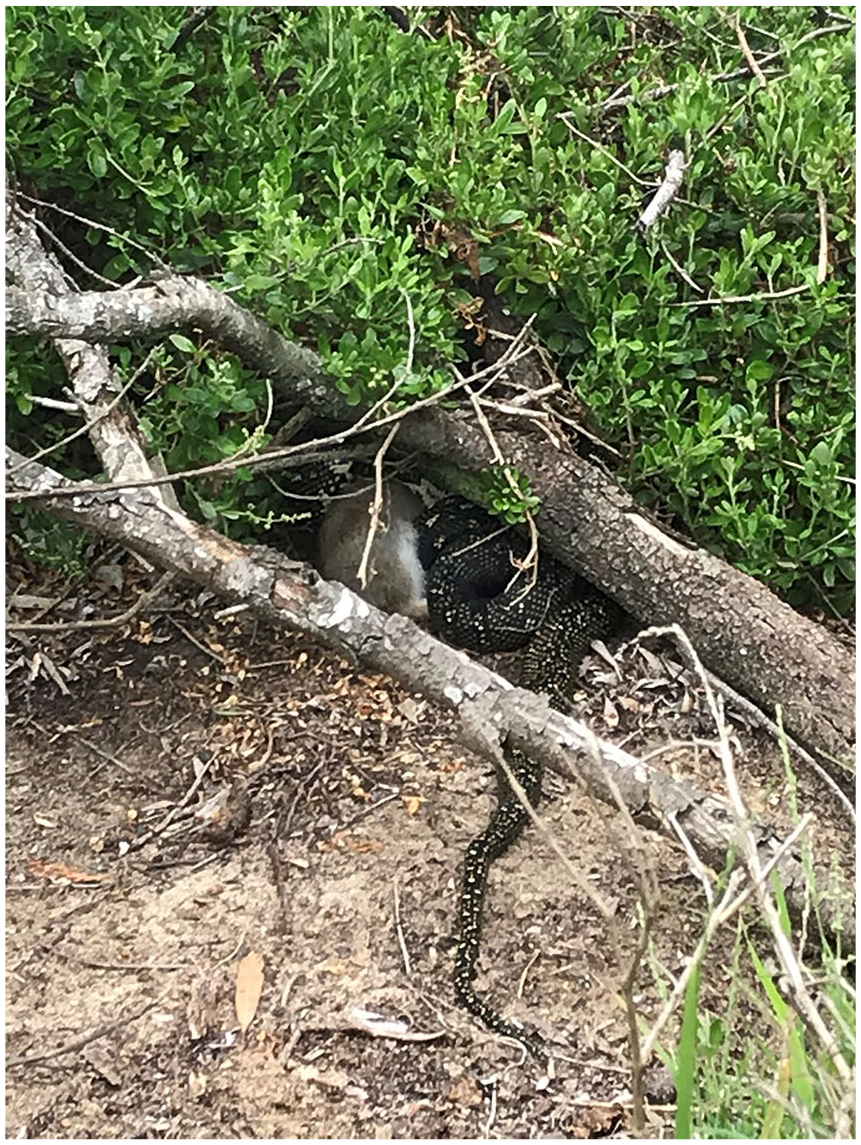
The snake – as she feeds on her prey under a plant at the Shoalhaven River.
In Yuin Country, observation involves paying close attention through the senses to all entities within the environment through ‘looking, listening and seeing’ (Harrison and McConchie, 2009). It is a means to take in and know the world. Crystal made observations about the snake she encountered and what it was doing at the time she encountered it. She considered it within its relationship to the world around it and what it appeared to be doing. On one level, this observation provides a metaphor for thinking about sovereign Country. Nonhuman entities need to be free to practice and govern themselves and to be free from interference. But they are also vulnerable and need care. Sometimes the source or locality of care can be unexpected as in the case of weedy plants that shelter and protect others. Addressing the problems weeds present in terms of how they take over territory thus requires us as humans to hold their capacity for care in mind. It requires careful consideration for how much damage might be done within worlds of existing relations in the process of trying to make situations better.
On another level, it also provides the direction for thinking about the sovereignty and safety of Indigenous researchers. In addition to what can be seen or heard, observation involves paying close attention to how sensory responses during observations dwell within the observer – how they make the observer feel, and how the observer responds to those feelings. Those feelings – the emotions, affects, thoughts and questions that arise through observation are also the way that Yuin people come to know the world and how Country asserts itself and brings itself, into the spirit of the researcher. Attending to these feelings is vital since they are the conduit for Country’s messages which guide people in their actions. These feelings, and how they are interpreted, in turn contribute to the formation of identity. However, expressing these ideas, including as part of research processes, can make Indigenous people feel vulnerable, especially when they are evaluated in Western terms. Indigenous scholar Irene Watson notes that sovereignty is dependent upon Indigenous people being able to practice their Lore, respect and honour their territories and acknowledge their right to life (Watson, 2002). In relation to expressing sovereignty, there is thus always a tension for Indigenous researchers, who in order to assert their ideas, risk opening their worlds to the scrutiny and subjugation of others.
Dream: The weeds
For many Indigenous people understanding dreams or ‘spiritual emails’, as Uncle Max calls them, are vital for understanding the world. Dreams act as a catalyst for attaining access to inner spaces and are considered so invaluable that the external environment is often manipulated in order that dreams might happen (Ermine, 1995). Yuin Elder Uncle Max Harrison and Yuin cultural men including Anthony, taught Crystal that she needs to go within when connecting to Country and she has learnt how to incorporate spirit and her ‘inner knowings’ (Rowe, 2014) into all areas of her life.
Dreams have always been a big part of Crystal’s life and she has vivid memories of dreams she had as a child, but incorporating and understanding dreams as a research process has not been straightforward. Although they have always been directing and guiding her, she has often been confused about what her dreams meant. In the process of reconnecting with Country, Crystal began to talk about her dreams to Yuin cultural people. She received guidance from them which helped her to understand the meanings of her dreams. In turn she began to understand the value of listening to her dreams for guidance in her life. One dream about weeds is instructive:
I dreamt that weeds were growing out of my legs, pushing through my skin. . . . And when I tried to pull them out, they snapped at the stem and the roots remained in there. I couldn’t get them out and I was worried that the wound where the opening of the weeds coming out in my legs would get infected.
This was a frightening dream and through this dream, Crystal started paying attention to the fears that people have of weeds. Again, there are levels of interpretation to be made in relation to sovereignty. In the dream, weeds were growing and pushing through the surface of Crystal’s skin. They crossed boundaries and territories. People are fearful of weeds because they show us how the boundaries people create are flimsy or permeable. As other geographers have argued, they illustrate the tenuous nature of territory as something that can be separated, known and controlled. Furthermore, the weeds growing out of Crystal’s legs would not come out when Crystal tried to pull them, and she feared an infection. Weeds are difficult to remove. Often a lot of effort is expended on removing weeds, only for them to re-sprout or set seed. In this case, fear relates to a sense that weeds are or will become uncontrollable and provides the impetus for thinking about what needs to be done to care for Country in order to prevent weeds, when it is feasible.
On another level, this particular dream shifted Crystal’s perspective and focus from plants as entities who are separate from humans, to entities who are part of the self and so deeply connected that they metaphorically grow out of us. Thinking about weeds as part of Country, even as part of the self, presents profound challenges to considerations of whether and how they should be addressed, managed or even removed. While Western knowledge about weeds and weed management practices often emphasise the differences and disconnections between people, places and plants, the Yuin ontology of oneness directs attention to the interconnectedness of all living things, including weeds, as part of Country. Acknowledging such interconnectedness therefore requires a shift from thinking about how we fight against weeds, to thinking about how we nurture the sovereignty of Country and work towards a balance between weed removal and their likely persistence.
Summary and conclusion
In this article we have sought to unpack and share with you Yuin research methods which enable and assert the sovereignty of Country. Poetry, observation and dreams are just some of the methods that Yuin people use to theorise~story Country. We say story because our theories bring entities into relation – researchers in relationship to Country, us as authors into relationship to you as reader. We know that these methods tip upside down, or turn inside out, conventional understandings of what constitutes geographic research, research methods and sovereignty itself. But we are unperturbed; there are already lively and vital discussions taking place in geography about Indigenous epistemologies and ontologies which strengthen the discipline and knowledge of the diverse relationships between people and place. What we have shared seeks to work alongside these efforts in tandem and build solidarity through dialogue and connection. In this final section, we offer three concluding insights in relation to the sovereignty of Country, geographical research methods and research collaborations for sovereign Country.
First, Yuin research methods highlight the sovereignty of Country. When we say the sovereignty of Country, or sovereign Country, we mean that Country is self-determining. As people, we do not hold sovereignty over Country, we are only sovereign in oneness with Country. Mother Earth is not the territory or the background to human control over space, but the authority and sphere of connection between people and place. Yuin expressions of sovereignty come through the Yuin ontology of oneness, a worldview which refocuses thinking away from what separates entities to that which binds or brings them together. Thus, within research, sovereign Country determines whether and how messages will be shared. Only when people are ready through discipline and training, and when they have behaved appropriately and with respect and reciprocity, will they be able to receive and interpret messages from Country. Interpreting messages requires collaboration with other Yuin people, as well as ethical relationships with Country. This is an ongoing ever-evolving process, involving obligations of mutual exchange and an openness to the diverse forms through which Country sends its messages. Our theorisation~storying of sovereignty goes beyond conventional conceptions of sovereignty because it emphasises how knowledge of the world comes into being in relation to Mother Earth.
In recognising Country as sovereign, we also recognise that our capacities as researchers to know and understand Country, and the world at large, are always partial. Country is not under our control, nor do we control when and where knowledge is shared. Country keeps its knowledge close, it is not always knowable, or definable. We know and sense this when our research does not progress, and when our data are not interpretable. As people, we cannot always put words to the messages that Country sends. Certain messages are also for particular people, reflecting always the positionality of an individual person and their relationships. We illustrated the partiality, or in betweenness of what we can know as researchers through the example of plants and their stories of sovereignty. Plants, and weeds in particular, are good collaborators with whom to think through questions of sovereignty. Plants are tied to and constitute places in ways that animals do not. They not only occupy space, they share and give shape to how places are felt. But plants such as weeds also move, and in some cases colonise space, reminding us that mobility and transgression are forces that undermine existing power relations and remake places differently. Plants which come from elsewhere hold knowledge and power, both of which must be considered and interpreted in respect of Yuin Country. Thinking through these dynamics of relationality – between plants in relationship to sovereign Country, provides new scope for thinking through how we relate to, and also manage them as weeds.
Second, Indigenous research methods expand the ethical scope for geographical research in relationship to both people and place. We have illustrated how Yuin people and their collaborators receive and interpret messages from Country through spiritual yarning. The practice of spiritual yarning situates researchers in place and requires them to learn and follow the protocols for appropriate behaviour in place. It involves researchers engaging with the people, stories and traditions of places in order to learn about where they are, as well as how they conduct themselves. Respect and reciprocity, to people and Country, are foundational to this endeavour. While formal research ethics processes often prioritise ethical relationships with people, and we highlight the continued significance of attention to human research ethics, we also underscore that research ethics must engage with relationships to place. Spiritual yarning draws attention to researchers’ ethical engagement with Country and all of the human and nonhuman entities through which it is constituted. Geographers in particular, attuned to questions of sustainability and justice, are encouraged to place themselves and their research practices in relation to Country with respect and reciprocity.
Finally, our axis of analysis has sought to go beyond the weary binary of Indigenous and non-Indigenous ways of knowing towards analysis of what happens when we pay attention to the spaces in between knowing and understanding. Indigenous epistemologies and ontologies inform distinctive approaches to understanding, knowing and being in the world. They also inspire more ethical foundations for reciprocal and respectful relationships between people and the nonhuman world highlighting Indigenous people’s concern for the importance of nonhumans and their continued efforts to continue their cultural practices. But Indigenous people continue to endure and suffer the oppressive structures of colonial power which constrain thinking, as much as they also assert authority and control territory. These structures are damaging for Indigenous and non-Indigenous people alike. Undoing them requires new collaborations, new relationships and a shared sense of purpose, binding ourselves together towards healing Mother Earth. And so, we invite you, reader, to free yourself too and engage with us about how places move and inspire you to see and sense, know and understand the world through your research. Indigenous research methodologies and efforts by Indigenous scholars to be recognised within academia are connected to broader projects of recognition, decolonisation and the reclamation of sovereignty. We are making a space for you to be part of that conversation. We are calling you in through respect and reciprocity with sovereign Country.
Footnotes
Acknowledgements
We would like to thank the snake, plants and spirits who shared their knowledge with us. We would also like to give thanks to Yuin Elder Uncle Max Harrison for the teachings that have helped us to hear the messages from Country. You are forever in our hearts, and we look forward to receiving ‘spiritual emails’ you send us from spirit. We would also like to thank Greg, a Yuin cultural man, who is always eager to have a yarn to help unpack our messages from Country, spirit and dreams.
Declaration of conflicting interests
The authors declared no potential conflicts of interest with respect to the research, authorship and/or publication of this article.
Funding
The authors disclosed receipt of the following financial support for the research, authorship and/or publication of this article: J.A. acknowledges funding from the Australian Research Council, FT200100006.
