



Abstract
This article explores the development of nascent civil defence efforts during the First World War in Britain, through the use of urban case studies from the north-east coast of England. Whilst pre-war defence planning by central government and military authorities had been primarily concerned with the building of coastal gun batteries and strengthening the Royal Navy – in response to looming fears of invasion by a foreign foe – the war itself saw thousands of civilians on the ‘home front’ affected by war violence. Though they were many miles away from the conventional theatres of war, from late 1914, British civilians began to be killed and injured on their own soil by hostile battleships and aircraft. The largely improvised and dynamic multi-level response of central government, local authorities, the police and civilians indicated shifting relations between the national, local and individual. Fundamentally, early forms of civil defence were devised with pre-war notions of public safety in mind, while in the war context, these discourses were used to promote non-combatant resilience, particularly in urban coastal areas.
Introduction
The First World War 1 has been referred to as a ‘total war’, a mass conflagration that mobilised the entire human and material resources of societies in Europe and across the globe. 2 In the process, the footing of economies was shifted to support the logistics of the frontline and both rural and urban environments were transformed by the mechanised destruction wrought by artillery and entrenchment, becoming ‘war landscapes’. 3 The conflict saw a thorough blurring of the generally accepted boundaries between the conventional theatre of war – the battlefield, epitomised by the ‘moonscapes’ of the Western Front – and the ‘home front’, as towns and cities were attacked by naval vessels, airships and aeroplanes. 4 Rather than an aberration arising from the attrition of the trenches, such methods expressed the logic of modern industrialised war. 5 In contravention of international laws agreed by European states during the 19th century, civilians were increasingly treated like combatants. 6 They had to adapt to constantly shifting wartime socioeconomic conditions, often in the context of enemy occupation (Belgium and northern France from August 1914), and in Britain, from December 1914, bombardment of military targets close to areas of civilian employment and habitation. 7
The development of military and naval technologies, particularly the destructive capabilities of battleships, artillery and the rise of aeronautics, transformed rural and urban landscapes. While the fields of Flanders and Verdun were reduced to a ‘slough’ of mud, craters and splintered trees, the home front saw both monumental and vernacular architecture scarred or reduced to rubble, first by battleships firing from offshore and then by Zeppelin airships and aeroplanes, including the infamous Gotha bomber. 8 In Britain, according to official figures, 1570 people were killed in naval and air raids. Out of this total, the vast majority (1508) were civilians. 9 However, despite the clearly deadly toll aeroplanes took, particularly following daylight attacks on London in 1917, Zeppelins retained a more threatening mystique throughout the conflict, owing to their potential for metaphor-making, ‘part animal and part machine’, ‘natural and constructed, primordial as well as futuristic’. 10 Though naval battleships were a patently familiar cultural presence to the British public, enemy naval raids signalled potential invasion, built upon a fear that had been particularly prevalent since the turn of the century, and sharpened in the years prior to 1914 by the growth of Germany as a naval and industrial power. 11
Prior to the Gotha air raids of June 1917, some of the most destructive raids upon Britain occurred on the north-east coast of England. 16 December 1914 saw a naval raid by a group of German battlecruisers upon four towns on this part of the coast: Scarborough, Whitby, Hartlepool and West Hartlepool (known as ‘The Hartlepools’ to contemporaries) (Figure 1).
12
In little over an hour, 157 people (mostly civilians) had been killed by naval shells, and more than 500 were injured.
13
As Catriona Pennell has noted, many local people assumed that the bombardment was a precursor to a German invasion.
14
Pre-war defence planning, including a 1908 investigation by the Committee of Imperial Defence (CID), downplayed the threat of invasion, as long as ‘naval supremacy was maintained’.
15
The combination of a ‘naval shield’ in British waters with an auxiliary force on land was expected to prevent an organised invasion by a foreign power.
16
Interdepartmental debates on the issue of home defence from the turn of the century often focussed on the appropriate division of labour between naval and military forces, with much time devoted to balancing the interests of the Admiralty and War Office, particularly with regards to funding.
17
Though the shield of naval supremacy remained a potent motif among pre-war planners and in popular culture, home defence planning as late as 1913 still envisaged a role for land troops on British coastlines, including the stationing of mobile troops (Territorial Cyclists) along the east coast.
18
Even during the war, though the Admiralty saw invasion as a remote possibility, troops stationed at home remained part of official plans.
19
However, this did not mean that all areas on the east coast were accounted for. Indeed, while pre-war defence planning included the ‘vulnerable points’ of industrial Hartlepool, neither Scarborough nor Whitby was perceived as possessing any installations of interest to a hostile force.
20
This is because they were both, to differing degrees, largely sedate seaside resorts, with Scarborough possessing at most an understaffed garrison and obsolete muzzle-loaded cannons, and Whitby an ornamental ‘old Crimean gun’ on the seafront.
21
Following the raid, the government admitted that, owing to the ‘unfortified’ status of these towns, they had been ‘completely defenceless’ at the time of the attack.
22
This provided a boon to propagandists seeking to drive military recruitment by occupying the ‘higher moral ground’ against Germany’s apparent breach of the 1907 Hague Conventions.
23
As such, as Susan R. Grayzel notes, ‘Hartlepool and Scarborough became watchwords for German aggression and provided the first wave of what became iconic images of attacks on civil spaces’.
24
Map of the United Kingdom, with north-east coast shaded (left) and in focus (right). Source: Digimap.edina.ac.uk. Contains OS data © Crown copyright and database right 2022.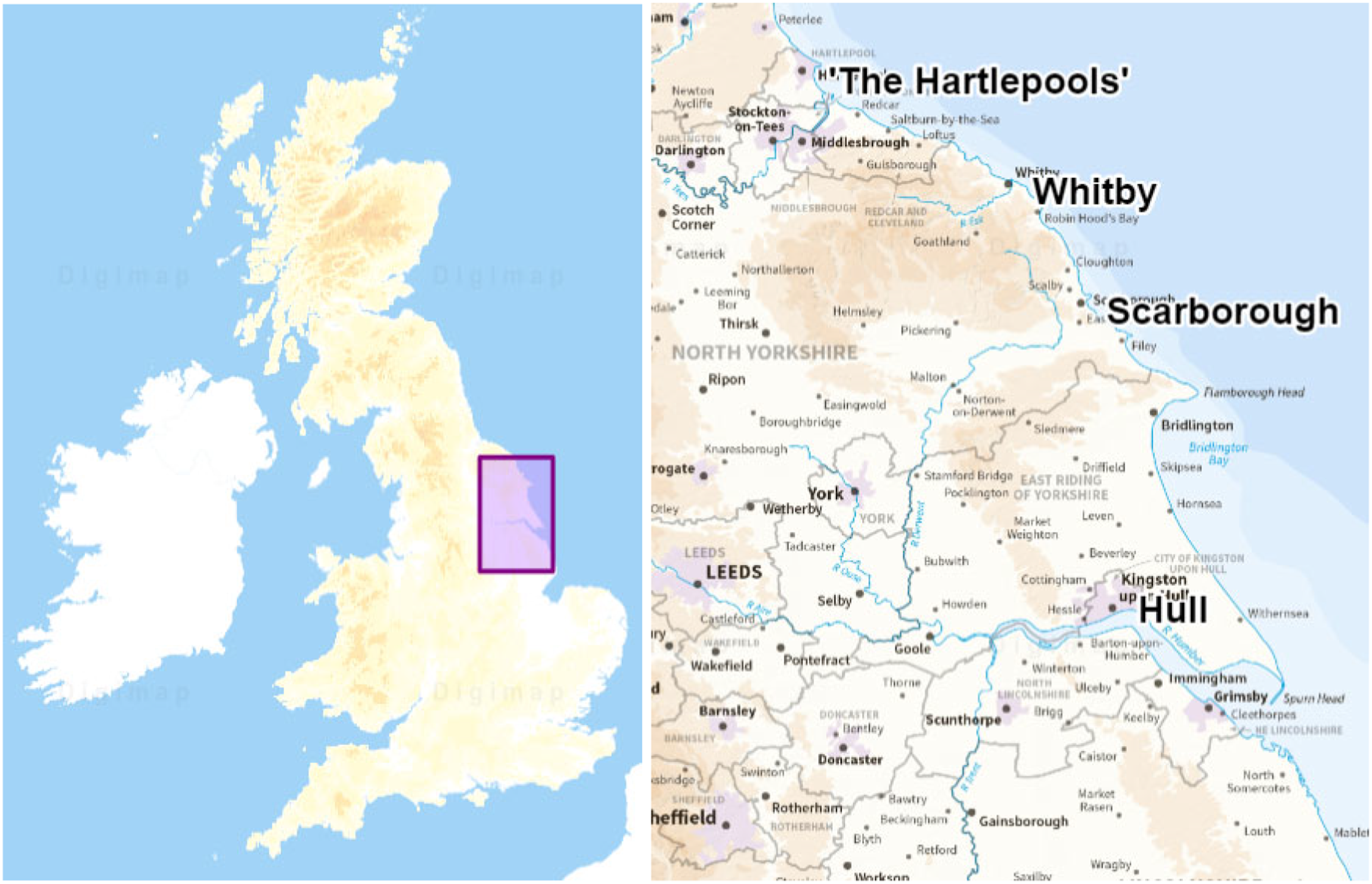
Air raids, consisting of explosive and incendiary shells dropped by Zeppelin airships, killed 57 and injured 151 people in the industrial port of Hull between June 1915 and August 1918. 25 If naval and aerial cases are taken together, attacks on this part of the coast formed 14% of the national total, and within the area explored here, 61% of the civilian deaths affected ‘The Hartlepools’ specifically on 16 December 1914. 26 The latter was one of the most deadly raids upon civilian areas during the whole war. Ensuing naval raids during 1915-18 were less deadly, with the war in the air far eclipsing subsequent seaborne efforts. 27 Though, nationally, there were some 12 naval bombardments, this paled in comparison to a total of 48 Zeppelin airship raids and 59 aeroplane raids during the span of the conflict. 28
Pre-war and wartime home defence planning – thorough-going and continually re-assessed – maintained a concerted focus on the east coast as a possible access point for an enemy landing. Its northern portion, within the remit of Northern Command, was central to the defence of inland ‘munition areas’ in the Midlands and Yorkshire. This area, which included Hull, Hartlepool and Scarborough within its bounds, was contrasted with the west coast, given the latter’s situation away from the North Sea. 29 Indeed, the relative safety of the west coast was presented as a unique selling point in the promotional materials of seaside resorts such as Morecambe in Lancashire. An advertisement in the Yorkshire Post during the summer of 1917 presented the town as ‘Safe, Sheltered, and Sunny… Protected from Air Raids and Bombardment by its natural position on the beautiful Morecambe Bay’. 30 Another, in the Sheffield Independent, stated boldly that ‘Morecambe is Free from Air Raids and Other Bombardments’. 31 In the case of both potential invasion and, later, naval and aerial bombardment, the east coast maintained its status as potentially vulnerable and in need of defence from on land as well as at sea, even with the rise of aerial weapons that fundamentally undermined coastal defences. 32
It is no coincidence that many towns and cities affected by bombardment during the conflict were in coastal areas, close to the North Sea. Not only was the east coast geographically close to Germany, entailing only a short journey for battlecruisers, Zeppelins were only capable of travelling relatively short distances, while being susceptible to the whims of the British weather. As an illustrated feature put it in The Graphic in December 1914, the distance from the German naval base at Heligoland to Hartlepool was ‘330 Nautical Miles or about 14 HOURS PASSAGE for a FAST CRUISER SQUADRON at 22-25 Knots their average speed; the journey can therefore be done under cover of NIGHT’. 33 However, this fact did not prevent already prevalent anxieties becoming widespread, among civilians and government ministers alike, about the frightening capabilities of airships, especially as, early in the war, they were often out of range of anti-aircraft (AA) guns and Royal Naval Air Service (RNAS) aircraft. 34 This article utilises the above conurbations on the north-east coast of England to explore the plans and measures put in place to deal with war on the coastal home front. Specifically, there is a focus on the intersecting activities of local and central government in nascent ‘civil defence’ planning, the ‘home defence’ activities of the military and the actions of civilians themselves.
Through a focus on this region and its considerable experience of naval and aerial bombardment, this article argues that attempts to develop responses to threats against civilians on the home front should be understood not only as emergency measures specific to wartime but also as adaptations to longer-standing discourses of risk and public safety. Rather than seeing the conflict solely as a harbinger of social, economic and cultural cataclysm, it is helpful to stress points of continuity, as well as change, during this period. 35 As Arthur Marwick suggests in his classic formulation, war is not a distinct external entity that impacts upon society, but a continuum comprising elements of both pre-war life and wartime social change. The processes set in motion by war ‘interact to touch off all kinds of mechanisms of change, direct and indirect, few completely new, most in the form of intensification… or distortion of ideas and developments already present’. 36 Though Marwick’s broader ‘war-as-watershed’ thesis is now certainly outdated, this explication of the shifting temporal boundaries between ‘society at war’ and ‘society not at war’ maintains its relevance, particularly when turning attention to the topics of urban governance and public safety discourses, where long-term trends (as well as radical shifts) spanning both wartime and peacetime can be discerned. 37 Rather than downplaying the changes enacted by war on British society, this approach enables us to understand the specific ways that mass conflict has led to the adaptation of pre-war ideas, techniques and technologies for use in the war context. Not only does this view of war- and peacetime provide a way of understanding the role of conflict in processes of social change, it combines fruitfully with an analysis of the shrinking distance between the ‘home’ and ‘fighting’ fronts, particularly the parallels between these spaces as ordinary homes and businesses came under fire.
Pre-war discourses of public safety and risk management
The First World War produced ‘intensified risks and dangers’, a condition that is now synonymous with the mass conflicts of the 20th century. 38 But, this characterisation must be understood as part of a longer-term concern for individual and public safety among policy-makers and the wider public, associated with the changes wrought by industrialisation and urbanisation from the early 19th century. 39 This period was also marked by changes in both the structures of government and the techniques of governance (beyond and below ‘the state’), as well as the social composition of political life, following the increasing enfranchisement of working people from the late 1860s and working-class involvement in a ‘variegated, autonomous, and self-governing associational culture’ from the 1890s, including engagement with trade unions, friendly societies and mutual aid associations. 40 As Tom Crook and Mike Esbester note, focussing on the complex and varied ‘field of regulating everyday risks and physical dangers’ allows us to rethink governance in modern Britain, including the role of the state in governing both people and ‘things’. 41 More than this, an appreciation of risk in historical settings underlines the diffuse nature of power. Just as existed in 19th-century public health and welfare governance, an analysis of risk in both Victorian and early 20th century public safety and risk management (including the First World War) reveals the ‘complex networks of agency that also embraced local and voluntary actors, as well as those of a commercial and transactional sort’. 42 We see this play out politically and structurally during the First World War, given both the form taken by wartime governance and the interactions between its different (and often intersecting) levels. We also see – particularly through the active involvement of civilians in wartime defensive measures – the complex interplay of the actions of the ‘free’ individual and more collectivist codes of ‘duty’ and ‘service’ to the community and nation. 43 This, in many ways, mirrored pre-war commercial, state, and popular responses to everyday risk and danger, including early efforts at improving industrial safety. On the railways, in factories and mines, the ‘boundaries of the public and private spheres were continually contested’. 44 As such, there was an often-complex interrelation existing between the central state, local government, private organisations and the individual worker or citizen, in terms of where responsibility lay for defining risks and for responding with methods for maintaining safety. 45
At the heart of defence efforts during the First World War was an understanding of public safety developed during the 19th and early 20th centuries and adapted for the war context, as well as an awareness of the risks and threats specific to coastal areas. 46 During the late 19th and early 20th centuries, an increasing recognition of coastal vulnerability contributed to changing perceptions of Britain’s island status. The insularity of islandhood had long been an important facet of British national identity and was central to perceptions of national security: the sea surrounding the British Isles acted as a ‘symbol of security’. 47 New military, naval and aerial technologies fundamentally undermined the belief that the sea could not be bridged by enemy forces, even if a strong navy was maintained. This reinforced a sense that the period was synonymous with risk. 48
If we understand ‘risk’ in this period as the ‘possibility or chance of being exposed to a danger, which might be more or less certain’, then the rise of industrialisation and urbanisation in the early 19th century was accompanied by a panoply of risks and threats to life and limb, particularly associated with the dangers of new industrial technologies and ways of working. 49 Working-class people bore the brunt of these new threats, particularly those working in factories, mines and on the railways, where machinery malfunctions, explosions and accidents respectively were commonplace. 50 As Isaac et al. have argued, a growing awareness of novel sources of risk in the Victorian period was combined with an ‘increase in perceptions of risk’, owing to a disproportionate amount of images in the popular press of ‘danger, destruction, and death, as well as statistics of illness, accidents, and mortality rates’. 51 With an increase in perception of risks specific to the age came cultural attempts to understand and manage them. As Elaine Freedgood argues, there was a concerted effort by a range of writers active between 1830 and the turn of the 20th century to construct ‘strategies of containment’ to deal with the risks posed by industrialisation, comprising the efforts of political economists, public health reformers, imperial adventurers and ‘industrial’ novelists. 52 Writers in the 1830s, such as the political economist J.R. McCulloch and the social theorist Harriet Martineau, aimed to provide reassurance that laissez-faire capitalism was ideally suited to England’s naturally abundant resources, with the ‘invisible hand of the market’ providing balance in its unregulated provision of prices and wages. Statistical information formed the bedrock of their evidence base and was presented as authoritative. 53 Similarly, in the realm of mid-Victorian public health reform, the likes of Edwin Chadwick and Florence Nightingale identified problems related to sanitation and hygiene but, rather than providing passive reassurance through the provision of ‘facts’, they outlined immediate solutions that involved both collective (national, political) and individual effort: the ‘active rhetoric of many highly visible hands’. 54 Such rhetoric can be glimpsed in the advent of first-aid in the late 19th century, as well as in the actions of railway companies to combat novel dangers.
The first-aid movement, often associated with the St. John Ambulance Association (established in 1877), was a response to this heightened awareness of dangers, purporting to offer ways of managing risk. By providing ‘specific modes of preparation’, through rudimentary medical training aimed at industrial workers, risks were said to be made manageable. 55 Popular interest in workplace safety and risk management grew as the century progressed and while accident rates remained high. Urban life was increasingly seen to have ‘inherent dangers’, owing to the nature of the urban landscape and as a result of technological changes in industry. 56 As such, first-aid training grew in popularity among railway workers and miners, industries where occupational injuries and deaths were common. 57 By 1901, over 80% of police officers in England and Wales had received training, given their perceived role as a force for ‘public good’ and an agent in everyday urban risk management. 58 Attaining first-aid certification was often framed (by promoters and employers) as a laudable act of personal sacrifice, given the effort involved in training during brief lulls in the intense, physical working day or on highly valued days off, including Sundays, all for the benefit of the workplace’s overall safety. 59 As Isaac et al. note, this strategy shared an affinity with the schemes utilised during the First World War to mobilise civilians to contribute to the war effort, taking part in ‘saving the nation from the threats posed by war’. 60 As David Monger outlines, ‘sacrifice’ was a major theme in wartime patriotic propaganda, including sacrifices endured specifically by civilians, such as the loss or adaptation of civilian status (to become either a combatant or war worker) and restraints on leisure and the consumption of alcohol. 61 As in other areas, we see parallels between a culture of public safety engendered by war and that seen in the pre-war context responding to the risks of an industrial society.
The ‘Safety Movement’ in the railway industry from 1913 sought to similarly involve workers in developing a culture of safety in the workplace. This was achieved through the circulation of information but was more informal in its delivery; rather than formal training sessions, messages were delivered through ‘social’ channels, including most notably the company magazine of the Great Western Railway Company (the GWR). 62 Existing alongside the company’s more punitive rule book, the ‘Safety Movement’ was conceived as a educative campaign couched in the ‘popular vernacular’ familiar to, and therefore accessible to, rank-and-file railway workers in manual occupations. 63 This included the printing of text in informal language alongside photographs, in formats not dissimilar to the increasingly visual print culture of the period. 64 As Esbester suggests, the GWR sought to construct a ‘discipline of safety’ based upon ‘managerial understandings’ of risk on the railways, defining ‘safe’ and ‘unsafe’ work practices. 65 As a disciplinary framework, the ‘Safety Movement’ defined acceptable behaviours in the workplace, in an attempt to ‘inculcate particular ways of thinking and acting and to integrate employees within a power dynamic’, with management’s ‘normative judgements’ seeking to correct the ‘unknowingly dangerous’ practices of workers through the provision of accessible educative materials. 66 In this campaign – and similar ones produced by other railway companies following the GWR’s lead – risk was understood as inherent in the activities of manual railway workers. However, a widespread appreciation of safety, with the knowledge and ‘normalised’ actions required to attain it, was seen to prevent serious harm from occurring by empowering workers to self-discipline their otherwise ‘risky’ behaviour. 67 A similar dynamic between collective and individual effort can be glimpsed in the work of wartime defence planners and government officials, entailing the dissemination of information which sought to remind individuals of their responsibility for personal and public safety, while simultaneously encouraging a more generalised community resilience through the installation of physical defensive infrastructure.
The First World War generated an awareness of a shared, collective responsibility for maintaining public safety, entailing the dissemination of instructive information, with individual actions central to how community resilience and defensive responses would be achieved and maintained. This approach to public safety mobilised materiality and technique under the auspices of defence. If we situate this characterisation within a longer history of ‘liberal governmentality’ – with roots in the 19th century – it is possible to see military and civilian responses to bombardment not as mere impositions upon the wartime populace and its environment but as part of an assemblage of material-technical and social relations which made possible particular actions. 68 Defensive infrastructures, technologies and techniques were embedded within the everyday lives of ordinary people living in coastal towns and cities. As Patrick Joyce notes, this ‘[alters] the ground of social life, [impacting] on existing social relations and political life in new ways’, in turn creating ‘new social worlds’. 69 Indeed, though the governing processes at work during the conflict have clear points of continuity with the preceding century, the far-reaching disruptions and shifts that war had on everyday life indeed made the wartime scene seem like a unique social world, if only because of changes that, in reality, remained temporary or subject to intense contestation in the interwar period.
Given the wartime diffusion of power throughout a shifting network of governmental and military actors, Chris Otter’s concept of ‘techno-social relations’ is useful in its eschewing of both ‘crude technological determinism’ and ‘hard social constructivism’, as well as underlining the continued involvement of government in modifying urban material environments. 70 The emergency regulations and infrastructures developed in response to war in coastal–urban spaces – rules, guidelines, sandbag barricades, barbed wire entanglements, early-warning sirens, naval/air raid shelters and anti-aircraft weaponry – can then be considered relationally: as ‘socio-technical assemblages’ contingent upon each other for their effectiveness. 71 Though similar assemblages may have been applied inland, the coast was widely perceived as the likely access point for both seaborne and aerial enemy forces. With these interrelated concepts in mind, it is possible to elucidate the ways that regulatory discourses, physical installations and communication technologies combined during the First World War to govern newly militarised civilian spaces, including urban streets, homes and schools. In the latter case, an extended case study of school-based bomb shelter, illustrating a key melding of material and practice, is explored below. The overall aim of this article is, therefore, to provide a perspective on the First World War coastal home front as a ‘landscape of defence’ as well as a site of destruction, highlighting both the effect of war on civilians and the significance of geographical place – culturally and materially – in formulating responses to attack. 72 As Crook and Esbester put it, the emerging ‘discourse of risk and danger was not a matter of cultural invention; it reflected a profound transformation in the physical fabric and material culture of British society’. 73 The perspectives on danger and risk carried forward from the pre-war period into the context of war in 1914 provided a framework for responding to the inherent risks and uncertainties of war on the home front.
Responses to bombardment: ‘home defence’ and ‘civil defence’
The initial post-raid responses of central government occurred within the framework of emergency legislation, which had been passed only days after Britain entered the war in August 1914. The Defence of the Realm Act (DORA) and its incumbent regulations (known as Defence of the Realm Regulations or DRR), sought to ensure that the entire human and material resources of the country were mobilised towards the war effort, particularly with a view to controlling civilian populations and preventing social upheaval.
74
However, from the outset, this legal framework blended the language of public safety and national defence in order to empower the centre, particularly the Secretary of State – and, by Order in Council, the Crown – to deal with the exigencies of war on an industrial scale: His Majesty in Council has power during the continuance of the present war to issue regulations as to the powers and duties of the Admiralty and Army Council, and of the members of His Majesty’s forces, and other persons acting in His behalf, for securing the public safety and the defence of the realm; and may by such regulations authorise the trial by courts martial and punishment of persons contravening any of the provisions of such regulations [emphasis added].
75
This legislation was amended more than nine times during the span of the war, lending credence to the view of a number of historians that the DORA and DRR were vaguely defined ‘ad hoc responses’ with ‘no overall plan, no philosophy of action’. Rather than a clearly elaborated programme, DORA was a ‘process of experimentation under exceptional measures’. 76 While some have seen these efforts as impulsive and lacking foresight, it is argued here that this framework both aided and disabled central government, conferring powers upon a new dynamic consortium of governmental and military forces often with a firmly regional and local remit. 77 This activity was organised under the auspices of the Authorised Competent Military Authority (ACMA), though in practice only a specific element of its day-to-day business was expressly military. 78 Within what was effectively an amorphous coalition of civil and military bodies, the traditional military authorities, based at the War Office and General Headquarters, were responsible for the stationing of ‘home defence’ forces (Territorial Force battalions) and the provision of anti-aircraft (AA) guns and military defence installations to mitigate the effects of a hostile landing. Conversely, local civil authorities and police forces took charge of early-warning systems and other preventive measures, including public information posters and circulars, to guard against further bombardments. Such measures, during the interwar period, would become known as ‘civil defence’. 79 As with emergency legislation, the boundaries of the ACMA were not impervious to change if warranted by events. Rather than a simply top-down system, these responses mobilised civilians, encouraging them to take part in maintaining their family’s safety through adherence to certain procedures.
Before the bombardment of civilians on British soil, heralded by the coastal attack of December 1914, the DORA and DRR had been primarily concerned with the maintenance of public order and guarding against any activities deemed to harm the national war effort. This included the sharing of military intelligence with foreign parties and ‘reports likely to cause disaffection or alarm’ and hence social disorder.
80
Following the experience of actual bombardment on the east coast, and the anticipation of further attacks to come, the DRR began to reflect the need to protect civilians from harm. In this way – alongside the improvised responses of local authorities and police forces – a culture of wartime vigilance and resilience began to be inculcated. Social regulation and the building of specialised infrastructure or temporary installations interacted within the specific geographical, environmental, material and socio-cultural conditions engendered by the ‘coastal zone’, be the entity an industrial port, such as Hull or Hartlepool, or a seaside resort, like Scarborough.
81
While the early versions of DORA had an overtly military character, the development of measures seen to pre-empt enemy actions turned the unknowable (when would a naval or air raid occur?) into the calculable: risk.
82
As interwar writers, including Lewis Mumford, later suggested, the violence of warfare directed at civilians was present in the ‘temporal vectors of preparation and expectation’.
83
As Paul K. Saint-Amour notes: ‘No longer a passive field within which violence unfolds, time – and anticipation in particular – has become a new medium for delivering injury’.
84
Nascent civil defence measures could help people to cope with anticipation and uncertainty by reminding them that specific activities could work against risk, such as the cessation of public lighting and the sounding of coastal bombardment or air raid sirens. They would act as ‘specific modes of preparation’, much like earlier risk management techniques in industrial contexts.
85
This could convert anxiety (unknown or anticipated) into fear (known or immediate), thereby preventing panic or mental collapse in victims.
86
As some contemporary medical writers suggested, the unpredictability and strangeness of the situation on the home front – which had striking parallels with bombardment on the battlefront – could lead to disorderly and erratic behaviours among civilians.
87
The result was often an ‘instinctive’ search for shelter at the sight of an aircraft or at the sound of an early-warning siren. Accordingly, the more civilians became acclimatised to this situation, the less fear they would exhibit: ‘The more unusual, strange, unfamiliar the exciting stimulus, the more overpowering is the instinct likely to prove… With increasing knowledge our behaviour becomes more and more rational’.
88
In this context, clear public information and confidence in protective systems were key to encouraging civilian resilience, even with the existence of social and demographic variables. As the physician Maurice B. Wright remarked in 1939, reflecting on the experiences of the First World War: The morale of a civilian population is impossible to assess beforehand; it will depend on many factors – to a certain extent on class, to a greater extent on the density of the population exposed, and probably to the greatest extent on the adequacy of the protective measures and the confidence these measures inspire. The civilian population must be treated as if they were combatant troops; they must be under authority and know what to do and what to avoid doing in case of emergency’.
89
Concerns for civilian morale – though not discussed in such terms during the First World War – in light of the non-material damage (‘moral effect’) wrought by bombing spoke to broader cultural perceptions of the capabilities of air power. 90 Though experience of both naval and aerial bombing was relatively limited during the conflict, and even post-1918 projections about the potential of military aviation were at least partly based on ‘imaginative visions and overdetermined recollections’, it is clear that the novel bombardment of civilians alarmed contemporaries responsible for public safety and order. 91 Indeed, it should not be overlooked that, in early 20th century Britain, ‘morale’ was often associated with military and, latterly, industrial discipline, as well as the forging of common purpose, group cohesion and public consent, particularly in wartime. 92 When wartime concerns about ‘moral effect’ are viewed with this in mind, it becomes apparent that effective public information, authoritative leadership (political and military) and mitigating protective technologies could be seen to counter any perceived shocks to the material and social fabric entailed by civilian bombardment: they would enable the mobilisation of the civilian populace to ‘fight’ this threat. For other physicians, such as John Rickman, again writing in 1939 and looking back to 1914–18, even civilians in a state of acute anxiety – with symptoms including stupor and loss of motor skills – were still receptive to ‘moral reinforcement’ and reassurance. 93
The perceived relationship between anxiety and fear was at the centre of debates among medical professionals on the effect of bombing on both soldiers and non-combatants. 94 For some, civilians on the home front suffered from a ‘special form of anxiety’, due to the uncertainty that accompanied the anticipation of raids, often followed by the actual ‘horror of the exploding shells’. 95 While the bombing of civilians in British towns and cities was certainly novel – and forms of civilian psychological and somatic trauma a ‘special’ concern of medical professionals and commentators – there may have been greater overlaps with combat-related ‘shell shock’. As Stefanie Caroline Linden suggests, drawing upon the perspectives of medical practitioners and hospital patient records, there were parallels between the worlds of the soldier and civilian under fire. 96 The uncertainty that characterised life in the trenches, particularly the unpredictability of falling bombs, was similar to that of towns and cities under threat of bombardment. Civilians treated in psychiatric facilities for functional disorders attributed to experiencing air raids exhibited similar symptoms to ‘shell-shocked’ soldiers, including trembling hands and legs, paralysis, insomnia and loss of speech. 97 This includes civilian patients treated at the West Riding Pauper Lunatic Asylum in Menston, West Yorkshire, where trauma following the bombardment of Scarborough in December 1914 was cited as the cause of psychological reactions. 98 In Hull, anticipation of aerial bombardment was enough to cause serious illness and an attempted suicide, triggered by the onset of steam-powered ‘buzzer’ early-warning systems. 99
In terms of military ‘home defence’, the weeks immediately following the December 1914 bombardment saw a significant ramping up of military activity in the areas affected.
100
In Scarborough, a well-known seaside resort particularly popular with the northern industrial middle-classes, trenches were dug into the beach and barbed wire roadblocks installed in streets running perpendicular to the seafront, in order to prevent the forward march of an invading force (Figure 2).
101
As a contemporary observer noted, these installations gave the town the appearance of a ‘war landscape’, much like the Western Front: [Y]ards of barbed wire have been crossed and re-crossed, thus making an effectual and spiky barricade about six feet high across the roads. Then in the principal thoroughfares there are placed massive sand-bag barricades. These are formed by numbers of large sacks, filled tight with sand, placed on top of each other to a height of about eight feet, while planks are built in between them to make the wall more secure, and holes are left at regular intervals for the guns, in case the Germans land and are rash enough to do a little sight-seeing.
102
Map depicting military defences of Scarborough, c. 1914. Source: From the collection of NYCC Libraries, Scarborough. Reproduced with permission.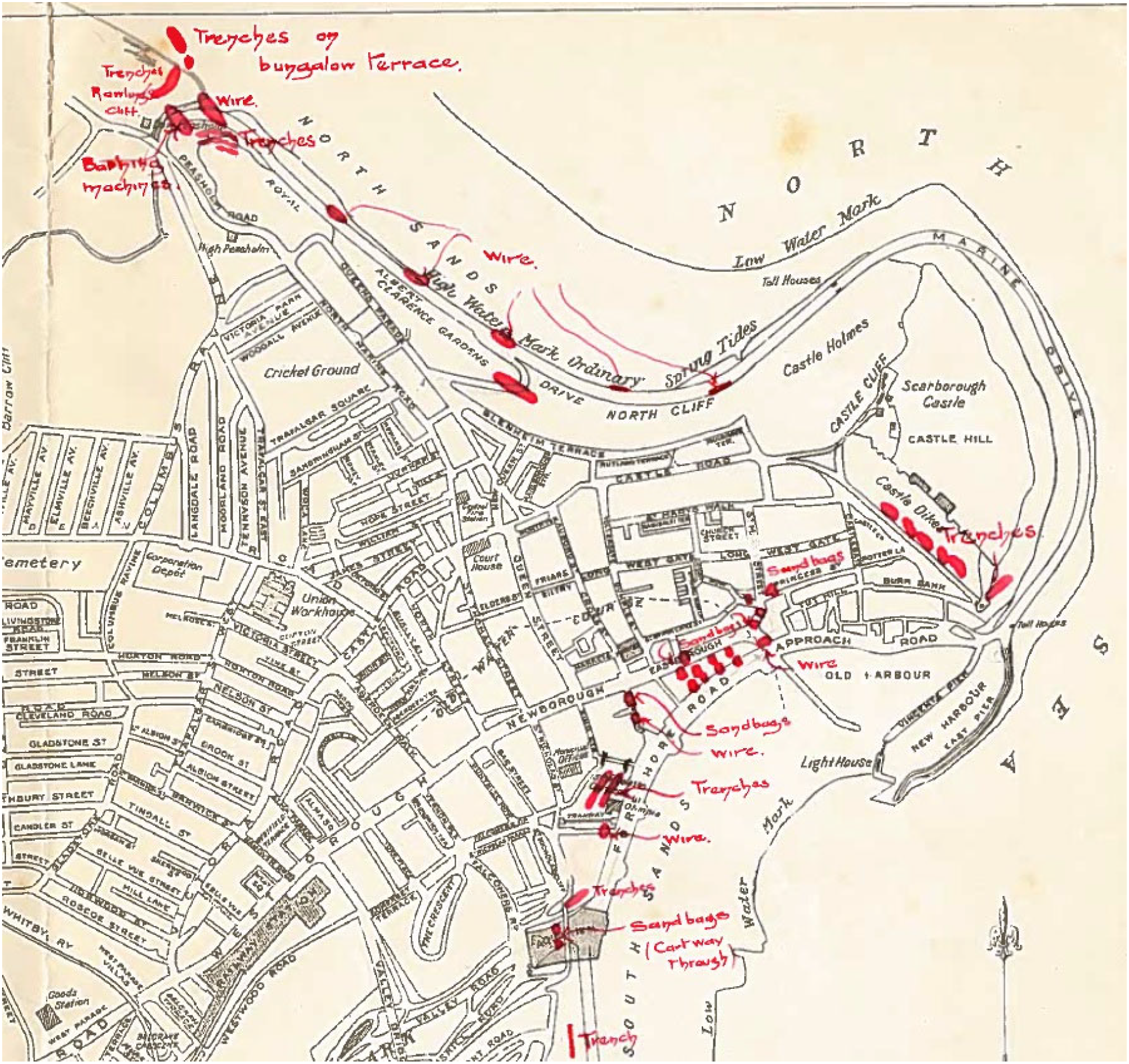
The suffragist and socialist campaigner Sylvia Pankhurst visited Scarborough in the days following the attack, providing a first-hand perspective not only of the novel efforts to defend the coast from further attack and potential invasion, but the wider social and economic costs wrought by bombardment: The big amusement “palaces” on the front were scarred and battered by shell-fire, iron columns twisted and broken, brickwork crumbling, windows gone. Yawning breaches disclosed the pictures and furnishings, riddled and rent by the firing, dimmed and discoloured by blustering winds and spray. The little steep streets, leading up from the foreshore, were barred by wire entanglements – the first I had ever seen – great stakes driven into the ground, with a mass of stout barbed wire threaded around them, and tangled about between. At many points were high barricades of sand-filled sacks, with a row of loopholes for rifles.
103
For these commentators, the spaces of leisure, work, and everyday civilian life were shaken to their core. The apparent permanence of the built environment and familiar urban surroundings, including vernacular architecture, were rendered strange: a disorientating experience for permanent residents and visitors alike. 104 Buildings, like the ‘amusement palaces’ of Scarborough, were the ‘scarred and battered’ victims of violence, their damage being both physical and symbolic, underlining the massive disruption entailed by war and the blurring of boundaries between the home and battlefronts. 105 This material dimension of increasingly vulnerable coastal–urban spaces – coupling the destructive effects of ordnance with the exposure of being situated by the sea – acted upon inhabitants. Damage and destruction were not only shocking and disorientating, they were a reminder of the intertwining of people and things in urban spaces. 106 The vulnerability of the coastal built environment meant the vulnerability of the communities living within it. The taken-for-granted ‘background’ of everyday life was rendered shockingly visible and focal. As Victor Buchli notes, this process can be productive as well as destructive: ‘The destruction of buildings produces, it would seem, a paradoxical effect, rendering something previously seen as inanimate suddenly animate’. 107
The immediate aftermath of the bombardment also saw the stationing of 8th Battalion, The West Yorkshire Regiment (Territorials) in the town, who travelled by train from their garrison in nearby York at the request of the local government. 108 This militarisation of the town’s civilian spaces, hitherto associated with domestic residence and seasonal entertainment, was achieved despite it not having the status of a ‘defended port’ in government defence plans, unlike Hartlepool and West Hartlepool further to the north. 109 Defensive trenches were also built into beaches in Hartlepool, primarily to provide cover for docking facilities, while pre-existing coastal guns and batteries were improved. 110 In Hull, following a significant Zeppelin raid on 6 June 1915, the local urban environment was similarly militarised, though its impact was less severe than in Scarborough, owing to its defended status. 111 Nonetheless, the presence of anti-aircraft guns, staffed by Territorial soldiers, transformed the character of the urban environment, while the everyday activities of civilians were increasingly placed under the scrutiny of the police. 112
The months that followed these attacks from sea and air were also accompanied by the improvised and often experimental activities of local authority officials, who attempted to maintain order and encourage resilience following bombardment. City and borough engineers, town clerks and chief constables began to develop what became known during the interwar period as ‘civil defence’. 113 Local authorities on the north-east coast frequently distributed information to citizens relating to public safety following raids. A poster printed following the December 1914 attack on Hartlepool encouraged residents to ‘remain in the lower part of their houses or cellars, as practically no casualties occurred to those who did so during the bombardment’. 114 The experience of material destruction and loss of life led to this almost immediate response, which was both a call for calm and a tacit acknowledgement that a follow-up bombardment was possible. In Whitby, instructions written by a local press correspondent recommended that civilians with homes ‘within gun range of a hostile fleet’ prepare a ‘safety room’, preferably a lower room or basement with suitable fire exits. Failing this, ‘a pick, hammer, and other implements should be stored there so that a way may be hacked out if necessary’. 115 Civilians were then prompted to keep ‘vessels filled with water in each room in case of fire’ and retain a store of food, warm clothing and matches. These instructions were, as the writer made clear, in lieu of any ‘official instructions’; therefore, ‘the public must do a little hard thinking for itself, and out of this we may evolve a better plan than official advice could provide’. 116 This comment betrayed more than a little frustration with the apparent inaction of the state, as was also evident among even regional military officials, who demanded more AA guns following the first Zeppelin raids. 117 Though these guidelines were drawn up within the specific context of post-bombardment Whitby, later regional guidelines reproduced calls to remain in lower rooms and assemble provisions, though now Zeppelin air raids were the perceived threat, particularly in light of the attack on Hull in June 1915. 118
As the conflict wore on, and bombardments became more commonplace across the country, local authorities published detailed instructions as to the correct civilian behaviours to pre-empt future raids. Hull Watch Committee distributed a circular just days after an air raid on 6 June 1915, suggesting that local residents should place buckets in front of their houses for use by special constables to extinguish spent incendiary shells, while baths could also be filled for the same purpose. 119 Indeed, police guidelines advised that this kind of bomb was relatively safe to touch, as it had a handle attached. 120 In Hull, special constables were actively encouraged to fight fires, owing to the ‘drastically altered position’ of the fire brigade in the face of military recruitment. 121 These voluntary police officers received rudimentary training in both fire-fighting and first-aid, underlining their role as an auxiliary force not only for the maintenance of order but also for combating danger and preserving public safety. 122 In Hull, following the city’s first Zeppelin raid, the ‘specials’ were expected to have available ‘four large extinguishers, or 30 small hand appliances, per area’. 123 Advice pamphlets published as late as February 1918 by the North Riding Lieutenancy suggested that people lie down during a raid, to lessen the danger posed by shrapnel. In addition, reflecting the recent experience of gas bombs on the Western Front and the development of gas masks, the dangers of poisonous fumes were underlined, and instructions appended for a crude form of homemade respirator. 124
Safeguarding the next generation: bombardment precautions in schools
Across the north-east coast, naval/air raid emergency procedures were also developed for schools, with basements and tunnels utilised as shelters. 125 The Borough of Scarborough Corporation Education Committee devised detailed precautionary guidelines in January 1915, following the addition of ‘Bombardment Drill’ (‘similar to fire drill’) to the local curriculum. 126 Guidelines were issued to schools in the borough, with specific ‘places of safety’ selected for each building. Cellars and basements were advised as the primary source of shelter. Schools not in possession of such facilities were prompted to make use of nearby business premises. For example, Gladstone Road School infants were to take refuge in the cellars of Farmers’ and Cleveland Dairy Co, while the boys’ and girls’ classes were to shelter in the basements of W. Rowntree & Sons’ Furniture Warehouse. Others, including St. Martin’s Church of England (C.E.) School, were directed to local domestic premises; in this case, the basements of a Mrs Newlove. St. Peter’s C.E. School was to utilise the nearby church rectory’s cellar to shelter infants, while boys and girls would occupy the crypt. 127
Several schools also carried out regular air raid drills, with initial efforts attended by the mayor and chief constable. 128 In some cases, calm and orderly drilling was seen as an adequate measure when space for shelter was in short supply. This was proposed as a way of placating worried parents, who were said to be suffering from ‘nervous tension’ following bombardment. 129 Contemporary medical commentators suggested that children were unlikely to suffer a similar affliction, though research by Linden points to evidence from hospital records of children with long-term psychological effects from air raid anxiety and exposure. 130 The first weeks of 1915 saw dramatic falls in school attendance in Scarborough, with school logs claiming this was the result of parental anxieties, though Friarage Council Girls’ School managers saw illness caused by shock and flight from the town as the primary causes for falling attendance. 131 A raid on another east coast port – Yarmouth in Norfolk – was blamed on 22 January 1915 for a further dip in attendance. By 25 January, and following an even worse turnout, St Thomas’ Infants recorded that ‘[the] people are still afraid to send their children’. 132 The level of organisation displayed by the educational authorities certainly contrasted with the Scarborough Corporation’s Watch Committee, which did not discuss air raid precautions in any depth at the height of Zeppelin raids in the wider region during June to August 1915. 133
A similar picture emerged in Whitby, particularly regarding dips in attendance following the December 1914 raid. Cliff Street Infants’ School saw a drop from an average attendance of 104.3 children in the days before the attack, to 97.3 on 18 December. For the most part, children being removed from the town to relative safety inland was the cause attributed. 134 The log book of Cliff Street Girls’ School, for 18 December 1914, records that ‘A state of terror still exists among the children’, though it is interesting to note that attendance was more severely affected by truancy in mid-October 1918, as many children opted to scavenge coal from a ship that had run aground on the beach, reflecting economic hardship and war strain at this late stage in the conflict. 135 A similar occurrence had affected the Mount Boys’ School, also on Cliff Street, in December 1917, when coal and wood from a torpedoed vessel lying upon the sands was further disturbed by a severe storm. 136 This may be evidence of the ‘philosophic attitudes’ said to be exhibited by some children, with any exhortations of fear being restricted to the moments following a raid, notwithstanding the ‘children who suffered most’ by repressing emotions: ‘girls of about 12, who were really frightened but would not show it’. 137 However, as James Greenhalgh has found in a study of children’s written responses to bombing during the Second World War, prevalent contemporary languages of civilian service and fortitude could frame the articulation of experience. 138 As a number of historians attest, similar languages of sacrifice and endurance existed during the First World War, in ways that connected the military conflict with the ‘war effort’ at home, providing a framework for understanding and symbolically ordering the mobilisation of soldiers and civilians. 139 It is not unreasonable to suggest that the views of children during 1914–18 could not be similarly inflected by ‘contemporary modes of understanding’. 140
As in Scarborough, Whitby schools without sufficient or safe cellar space improvised their own measures, albeit guided by representatives of the Watch Committee, including the chief constable. The scheme approved at Cliff Street Infants’ School placed the children in the lobbies and corridor of the building, presumably as this was ‘away from the firing line’, as posited in earlier improvised guidance.
141
The Mount Boys’ School conducted an emergency drill on 29 January 1915, ‘as a prelude in the event of a second bombardment’. Interestingly, rather than finding shelter in or around the school itself, teachers led approximately 160 pupils to nearby Khyber Pass, where a tunnel honed into the rock, passing through to the promenade, would serve as protection (Figure 3). On this occasion, it took 3 minutes to evacuate the school, setting the benchmark for any future alarms, though this precaution was never tested by an actual raid.
142
In Hull, the annual meeting of St. Mary’s High School staff and governors in January 1917 discussed shifts in the ratio of day pupils to boarders. A decrease in the latter was attributed to parents being ‘afraid to let them come on account of the air-raids on the East Coast’. In response, a special timetable was drawn up – approved by the ACMA – for days following air raids, to reduce the disruption caused to schoolwork.
143
Pedestrian tunnel in Khyber Pass, Whitby (photographed in 2017). Source: http://www.geograph.org.uk/photo/5419201 [accessed 30 August 2022]. © Mark Anderson. Creative Commons License CC BY-SA 2.0.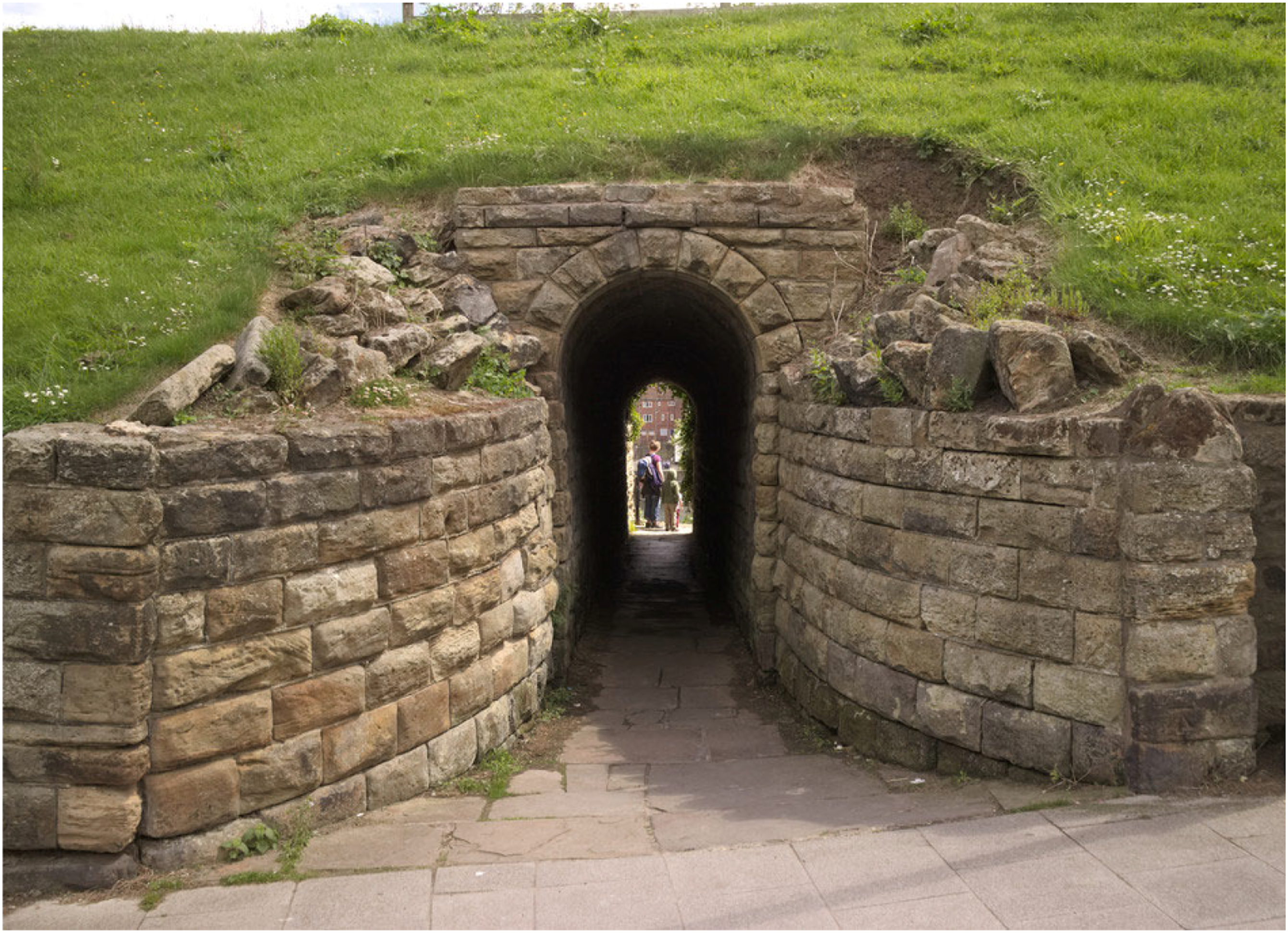
The common thread here is the attribution of decline in school attendance to a palpable fear among children and parents, both following the bombardment and in anticipation of another. Indeed, in West Hartlepool, a scare of this calibre followed just 2 days after the bombardment. Following the communication by the police and special constables of an apparent ‘misreading of an official message to the effect that hostile airships were to be looked out for’, the local newspaper reported that throngs of people were seen to rush to the railway station: ‘the outgoing trains were crowded, of course, with women and young children’. 144 This was despite the message’s orders for special constables ‘to warn residents on approach of any such craft to go into the basements of their houses and remain until danger was past, to avoid panic; to keep cool; and not to congregate in groups in the streets’. The message ended with the proviso that the rumours may be false but ‘everyone was to be prepared’. 145 When related to the available school logs for the district, it is clear that such fears impacted upon school attendance, though this picture must also be related to the broader socioeconomic circumstances of war. As a result of these anxieties, most of the schools surveyed here put in place forms of naval/air raid precautions or contingencies, even if these were never to face enemy fire. While local politicians and experts discussed public shelters in depth, the closest successful schemes of this kind in the region were achieved in Scarborough and Whitby schools, albeit in a haphazard fashion. Recommendations from both civil and military bodies maintained that the private home was a suitable, though eminently fragile, shelter from the dangers present in the street during and following a bombardment alarm. However haphazard their organisation, such measures stand as ‘socio-technical assemblages’ whose aim to safeguard the next generation combined physical infrastructure, the dissemination of instructions and the inculcation of specific disciplinary practices. 146
Lighting restrictions, ‘buzzers’ and guns
Beyond the issuing of public safety information and the ad hoc development of shelters for school children, the main civil defence method adopted across the region, codified in DORA regulations, was the restriction of public lighting.
147
This remained a consistent policy throughout the war, as the threat of Zeppelin raids was most acute at night and military defensive resources, notably anti-aircraft (AA) guns, could not be provided without a substantial delay. Commander of the Humber Garrison, Major-General J.A. Ferrier, made frequent requests during the summer of 1915 to Northern Command and the War Office for mobile AA guns – mounted on motor cars or field carriages – following the 6 June Zeppelin raid on Hull.
148
Such calls were dismissed, favouring instead the already-extant fixed gun emplacements and lighting restrictions. It was not until 16 March 1916 that mobile AA guns and searchlights were installed in the city, some 10 days after a second air raid, which resulted in the deaths of 17 people.
149
In any case, the chief of Northern Command, Major-General H.M. Lawson, stated in June 1915 that ‘the best passive protection against Zeppelins is
In November 1915, the Scarborough business community cited seasonal losses in the summers of 1914 and 1915, as well as anticipated Christmas trading issues, in a petition to the Home Office. Garnering more than 300 signatures, the signatories called for a suspension of lighting restrictions for the sake of the local economy. 155 The reply disregarded the petitioners’ demands, following the advice of military leaders, including Lieutenant-Commander Sinclair of the Royal Naval Volunteer Reserve. In Sinclair’s view, there was ‘no substantial reason for [the enemy] not coming and I can imagine that nothing would please the gentle Hun more than to drop bombs onto Christmas gatherings’. 156 Relations were likely particularly fraught by this point, given promises made in March 1915 by Brigadier-General Nickalls of Northern Command that trenches and barbed wire entanglements on the seafront close to businesses would be removed. This issue rumbled on throughout the year, with military and naval officials becoming increasingly incommunicative (likely due to the changeable defensive situation as the threat of naval bombardment waned and aerial bombing increased), frustrating local officials. 157 Here we see a glimpse, then, of local disagreement between citizens, local and military authorities. The seaside town, transformed into a ‘landscape of defence’ by public safety-orientated socio-technical assemblages, was where the harsh realities of economic disruption could outweigh local concerns regarding possible future enemy attacks or invasion. 158
Another arm of the ACMA, the Special Constabulary – a voluntary police force historically associated with quelling ‘provincial disturbances’ and political disorder – was given primary responsibility for enforcing rules around civil defence, including lighting regulations. 159 Much to the chagrin of some, this often entailed waking up residents at the sound of an air raid alarm, while some officers were reported as forcibly extinguishing household lights when people refused to do so themselves. 160 Furthermore, though alarms or steam-powered ‘buzzers’ were developed across the region – entailing experiments with geographical placing and the kind of sounds used – they often caused a great deal of confusion and disquiet, particularly as so many were sounded falsely. 161 In Hull, a thriving port, the commonplace sounds of dockside work and ships' hooters often competed with the buzzers, causing widespread consternation. 162 As late as the summer of 1917, some civilians called for more clearly audible early-warning systems, due to the city being, as one civilian writer put it, in ‘the danger zone’. 163
These changes in the aural and material landscapes of coastal–urban towns marked a further deepening of state encroachment into the private sphere, though it should be underlined that this process had already been underway in the 19th century, implicit within elements of social welfare and urban planning. 164 In wartime, this was expressed not only through the requisitioning of private land to build military defences but also through the policing of civilian behaviour in the hope of inculcating self-disciplinary attitudes. 165 However, rather than a top-down arrangement, power in the wartime ‘total’ state was dispersed among a variety of actors, from the agents of the ACMA to civilians themselves through self-led civil defence activities. 166
Conclusion
Though a full exposition of the multi-level development of home and civil defence schemes before and during the First World War cannot be developed in this article, nonetheless it is clear that notions of public safety – including safety from bombs, fire and invasion – were at the heart of these wartime efforts on the north-east coast of England. To varying degrees, all of these measures, military and civil, framed and helped manage the anticipation of wartime dangers. Indeed, implicit in all was a belief that anxiety could be converted into a manageable fear, and that such tangible risks entailed by bombardment could be combatted through particular activities. The ‘socio-technical assemblage’ of material infrastructure and public safety discourses was exemplified in the responses of military–civil governance, including the installation of barbed wire entanglements, domestic and public lighting regulations, early-warning sirens and the use of improvised bomb shelters. 167
Though the war was patently an ‘emergency’ situation – entailing perhaps a ‘state of exception’ – the means utilised by the agents of wartime government were not entirely novel. 168 Rather, the material, political and social technologies and techniques applied to deal with the threat and subsequent fallout from bombardment in coastal towns had their roots in 19th century liberal governance. The local and central state response to naval attack and the threat of invasion was not top-down: power was dispersed among several intersecting agents, both civil and military. Adaptations to the coastal–urban environment and, it was hoped, to the behaviour of inhabitants stand as early 20th century examples of ‘liberal governance as rule through freedom’. 169 Though a ‘strong state’ was a necessary part of this governing framework, the ‘highly dispersed agency’ entailed by material governance – in the 19th century as during the First World War – ensured that it was not omniscient. 170 As we have seen through analysis of relations between local government officers, central government officials and military chiefs, the central state often relied on local government to carry out (and develop its own) public safety policies, at times with little direct state oversight. In many cases, the private home (or the school basement) was the perceived site of civilian safety, again suggesting the highly dispersed nature of anti-bombardment governance.
Being prepared for an enemy attack, at first imagined and then experienced either directly or vicariously, made it appear that civilians could actively pre-empt bomb damage and destruction, encouraging them to be resilient in uncertain times. This was especially pertinent in coastal areas and ports, such as the ones covered here, as they were not only geographically susceptible to actual bombardments but also were imbued with cultural significance as links in a broader imperial network, as sedate seaside resorts, or as part of the stage for the playing out of intracontinental rivalries. 171 Though some measures and activities – such as those installed and applied in Scarborough and Whitby – remained largely precautionary in nature, their presence appears to have played a role in reassuring local civilians that something was being done to combat the threat of bombardment and invasion. In Hull, as Arthur G. Credland notes, though a ‘degree of panic and disorder’ had followed the first Zeppelin raid of June 1915, this was not widespread and was undermined by a growing popular confidence that ‘anti-aircraft protection’ of some kind was in place (and it was), despite the ongoing discussions and disagreements of those in authority throughout the conflict. 172 By late 1915, some local people in Scarborough were clearly tired of the disruption caused by defensive infrastructure and felt confident enough to suggest that at least some measures, including lighting restrictions and barbed wire entanglements, could be removed for the sake of economic recovery. However, the sense that this part of the east coast remained vulnerable was palpable among those in the ACMA, despite the threat shifting from primarily seaborne to airborne attack. In some areas at least, a degree of caution was maintained and, despite civilian calls to remove defensive infrastructure, only slight adaptations were made to coastal trenches and barbed wire entanglements. By contrast, in Hull, where the Zeppelin threat loomed large from June 1915 onwards, local and regional authorities struggled to attain the defensive installations they saw as necessary to combat an aerial, mobile threat.
In the interwar period, preparations for a future conflict in these north-eastern coastal communities, including civil defence, seem to have taken a similar course to other British towns and cities. 173 However, while lessons seem to have been taken from the bombardments of 1914–18 – not least the need to defend civilian populations from harm against a now more effective aerial weapon – there was still an element of trial-and-error in local efforts to safeguard the citizenry. As early as March 1937, there were experiments in Scarborough to find the ‘best sound for warning of air raids’, though with early results not dissimilar to those attempted in the First World War and using broadly the same steam-powered technology. 174 There were similar results following fresh tests in Hull in 1938, with the city’s antiquated buzzer said to be ‘almost inaudible’ in some areas. Tests later in the year experimented with the erection of buzzers in locations across the city, a ‘combined alarm’ that would be heard by more people simultaneously. 175 When announced in September 1938, the Hull A.R.P. (Air Raid Precautions) plan included public safety measures closely resembling the ‘socio-technical assemblages’ of the First World War, though much-supplemented in some areas. This included the building of physical installations, such as trenches and dugouts, both in private gardens and public parks: this time, the onus was more on the need for public shelter than the construction of active coastal defences. Beyond this, early-warning buzzers and lighting restrictions were central planks of pre-war planning. 176 In Hartlepool, prospective air raid precautions were discussed throughout 1938, including public lectures and demonstrations on preparing for poison gas attacks and ‘How to make your own Refuge Room’. 177 An air raid siren was tested in the town in November, to the surprise of some residents: ‘People stopped and turned their heads all ways, but found it difficult to trace the point from where the sound was coming’. 178 By the start of the war in September 1939, Hartlepool’s borough engineer advertised the addresses of recommended ‘trench shelters’ and ‘basement shelters’ in the town, in the latter case including a number of residential basements accommodating between 20 and 60 people, and ‘combined basements with communication right through’ beneath a series of shops, where 177 people could be accommodated. 179 Here, as in other forms of defensive and public safety infrastructure, clear points of continuity can be traced to the First World War, only now the focus was solely on the threat posed by air raids as a now normalised weapon against civilians. 180 By way of contrast, plans for the defence of civilians were in place by the eve of the conflict, rather than developed in the ad hoc manner borne out by evidence from the north-east coastal region during the First World War, despite pre-war discussions regarding the threat of invasion.
As this article has demonstrated, the experiences of civilians under bombardment produced startling parallels with the experience of soldiers overseas, a motif that would continue to have relevance during the interwar period as civil defence measures prior to 1939 were developed in earnest. 181 Not only did the civilian experience of naval and aerial bombardment blur the boundaries between military and civilian spaces, it underlined the unique character and apparent vulnerability of towns and cities in the wartime coastal zone. With the rise of aerial bombardment, inland areas could be similarly vulnerable, but the geographical proximity of the east coast to the North Sea meant that the coastal home front’s sense of exposure – evidenced by both official actions and largely popular support for defensive measures – was more explicitly felt. On the north-east coast, defensive infrastructure (including technology and technique), geography, environment, political organisation and social action interacted to provide a means for reinforcing public safety and inculcating civilian resilience, however uneven this process may have been in practice. As demonstrated here, the study of the local ‘specificities’ of coastal communities at war enriches not only our understanding of First World War civilian experience but also helps us understand the specific ways in which coastal towns and cities managed public safety in wartime; a process built upon longstanding pre-war discourses, technologies and techniques related to public safety and risk management. 182
Footnotes
Declaration of conflicting interests
The author(s) declared no potential conflicts of interest with respect to the research, authorship, and/or publication of this article.
Funding
The author(s) received no financial support for the research, authorship, and/or publication of this article.