



Abstract
Perspectival Kinaesthetic Imaging is being proposed as a method designed to facilitate the heightened sensitivity needed for the anthropological study of the relationship between making and thinking, during the creative engagement with form-generating materials. Technically, this objective is achieved through the juxtaposition of perspectival view points on the process of making. We follow the ways of the hand using a combination of multimodal visual captures (i.e., photography, video, observational drawing and mobile eye-tracking). Each of these multimodal visual captures affords a specific spatio-temporal perspective from which to identify and observe morphogenetic events of interest (e.g. creative gestures and modes of enactive signification). The basic idea is that the juxtaposition of different media affects how we observe and what can be observed by enabling the discovery of connections and material relations that are often obscured when seen from a single perspectival point.
Introduction
This article proposes a new methodology, i.e., Perspectival Kinaesthetic Imaging, designed to facilitate the multimodal sensitivity needed for studying the sentient conditions and possibilities of creative material engagement. This method combines the descriptive power of anthropological participant observation with the discursive breadth of material semiotics (which is the term we use to denote the study of material relations and enactive signs). Perspectival Kinaesthetic Imaging has been developed and applied within the context of an ERC funded research project which explores the process of making by hand, focusing on the craft of ceramics. The principle objective of the HANDMADE project is to follow the creative transactions (in the relational sense of co-constitution) between hand and clay trying to understand the cognitive ecology of their entanglement. To that end, since 2018 we are undertaking multi-sited participant observation working with potters and ceramists in mainland Greece and the islands. We have been studying their bodily skills, creative gestures and modes of material imagination. Perspectival Kinaesthetic Imaging is the product of our ongoing experimentation with devising more efficient ways to identify, observe, and investigate the ceramists’ commitment to the enactive discovery and re-production of forms (Malafouris, 2014; Malafouris and Koukouti, 2022).
The latter point, is worth emphasising. Perspectival Kinaesthetic Imaging can only fulfil its goals as part of a rigorous anthropological inquiry based on long-term commitment to the immersive interaction with participants during fieldwork. What differentiates Perspectival Kinaesthetic Imaging from traditional ways of conducting participant observation is that it is designed to facilitate the heightened sensitivity and responsiveness to the sensory modalities and skills needed for the anthropological study of creative material practices. We suggest that one possible way to facilitate this kind of responsiveness is through the controlled selective juxtaposition of perspectival view points on the process of making. ‘Perspectival’ here denotes the dependence of observation on the ‘affordances’ of the media and techniques we use to observe with and through. These media and techniques enact different perspectives that affect how we observe and what can be observed. Their ‘perspectivity’ should not be confused with relativity. The epistemological foundation of Perspectival Kinaesthetic Imaging is realist (committed to the mind-independence of the world) and process-based (committed to explore modes of becoming rather than being, and to the situatedness or dependency, thus, perspectivity, of knowledge and observation) (Gosden and Malafouris, 2015; Malafouris, 2021a). Perspectival Kinaesthetic Imaging is essentially turning those co-dependencies of the knower and known; of knowledge and observation, into a bypassing strategy for overcoming the subject-object divisions that block the path and distort our vision of creative material engagement. This is made possible through the juxtaposition and combination of multiple media — in Barad’s (2007) sense of ‘material-discursive apparatuses’—which are used like traps for capturing ‘in the wild’ material transformations and bodily movements ‘that matter’ to the process of making (Figure 1). Our objective here is not representational but ‘diffractive’, i.e., we are seeking to capture difference by tracking, attending to and responding to the effects of difference (Barad 2007, 71). We call these tracking apparatuses multimodal visual captures. For our purposes in the HANDMADE project we employ four such multimodal visual captures: photography, videography, drawing and mobile eye-tracking (of course, more media and techniques may be added targeting different material practices, senses and temporal scales). Actualising their distinctive affordances for tracking, tracing and imaging each of those multimodal visual captures can reveal unattended connections and draw attention to moments of alterity. In that sense, Perspectival Kinaesthetic Imaging opens up new possibilities for the challenging study of the relationship between making and thinking. Perspectival Kinaesthetic Imaging: the juxtaposition of multimodal visual captures (i.e., photography, video, drawing and mobile eye tracking).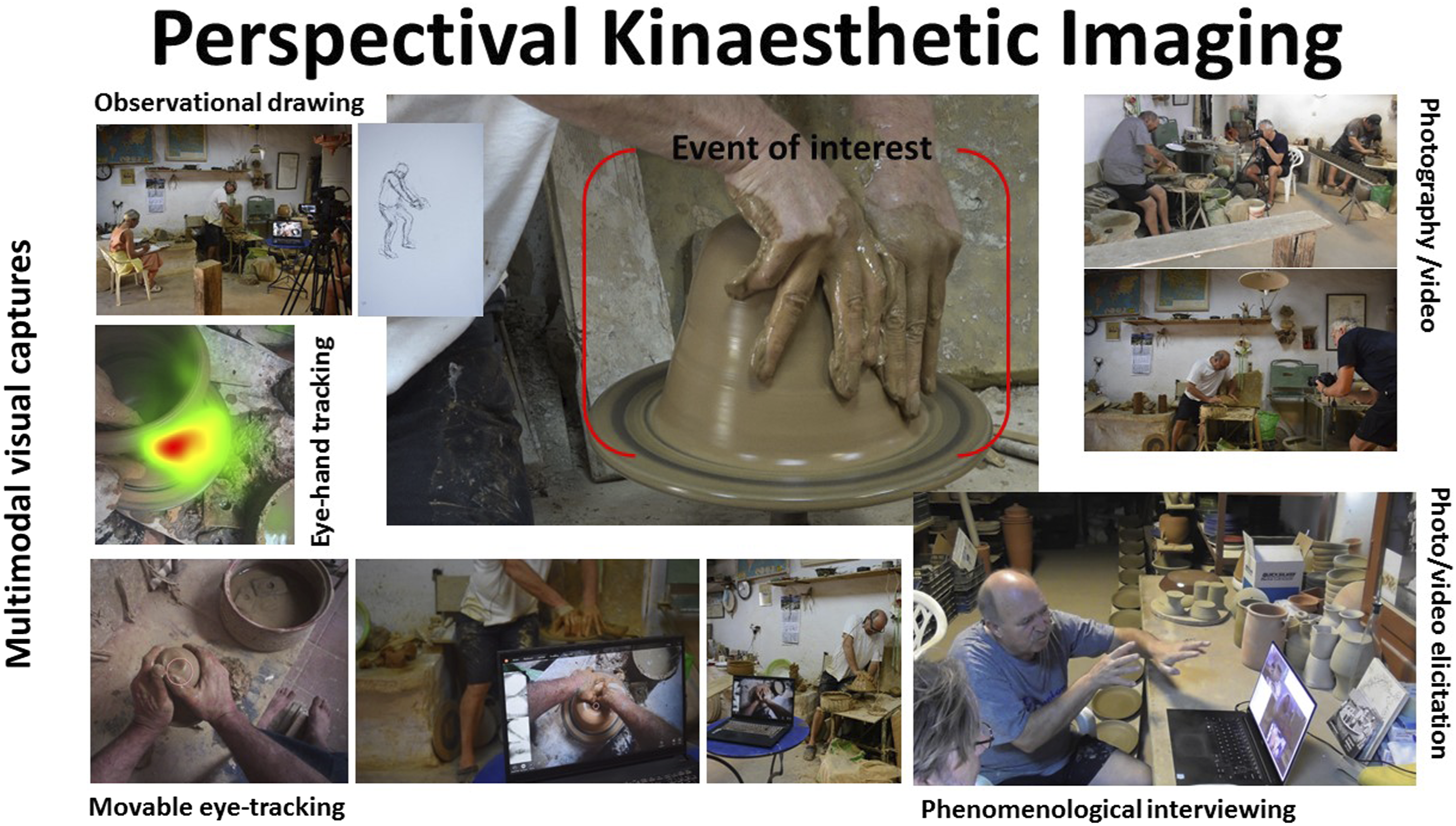
One rather persistent mistake, that continues to raise obstacles in our way to meet this challenge, has been the common assumption that mental states are internal representations and thus, unobservable: that they can only be inferred based on indirect cues (for instance in posture, symbols or body language) since they have no recognisable material trail to track outside the brain. Under the spell of modernity, we are convinced that human cognitive life and creative imagination must be firmly located inside our heads. This old ontological split between mind and matter seems hard to overcome. It still largely defines the way we think about what counts as ‘thinking’ and how we should go about studying human cognitive processes. This ontological split also explains our tendency to believe that although humans create and use a variety of material forms they don’t think ‘with’ or ‘through’ them; rather, they think ‘about’ them. This difference (between thinking with and thinking about) makes a difference. Thinking about implies that mind and the material world must be separate; connected by means of representations. Thinking with and through opens the way for the relational co-constitution of mind and matter.
To avoid those pitfalls, Perspectival Kinaesthetic Imaging is grounded on the principles of Material Engagement Theory (MET) (Malafouris, 2004, 2013; Malafouris and Renfrew, 2010) (Figure 2). The distinctive feature of this theoretical framework is that it proposes a radical continuity between thinking and making: Thinking is in the making, or else, making is thinking (Malafouris, 2008a, 2008b, 2014, 2020, 2021a, 2021b, 2021c; March, 2019; see also Ingold, 2012, 2013; Vega et al., 2023). From the perspective of MET, the clay at the potter’s hand is not a passive material substance for the imposition of form, but an active part of the potter’s hylonoetic field (from Greek hylē for matter and noêsis for intelligence). Mind and matter form a unity (Gosden and Malafouris, 2015; Malafouris et al., 2021). In the context of MET, the term thinging is used to denote this cognitive ecology of moving materials, emerging forms, environments and techniques that characterise human thinking and feeling with and through things (Malafouris, 2019, 2020). The major principles of Material Engagement Theory (MET): i) mind is not limited by the skin (the extended mind); ii) meaning is enacted through things (enactive signification); and iii) agency is a relational property of people and things (material agency) (Malafouris, 2008a, 2013, 2019, 2020; Malafouris and Renfrew, 2010).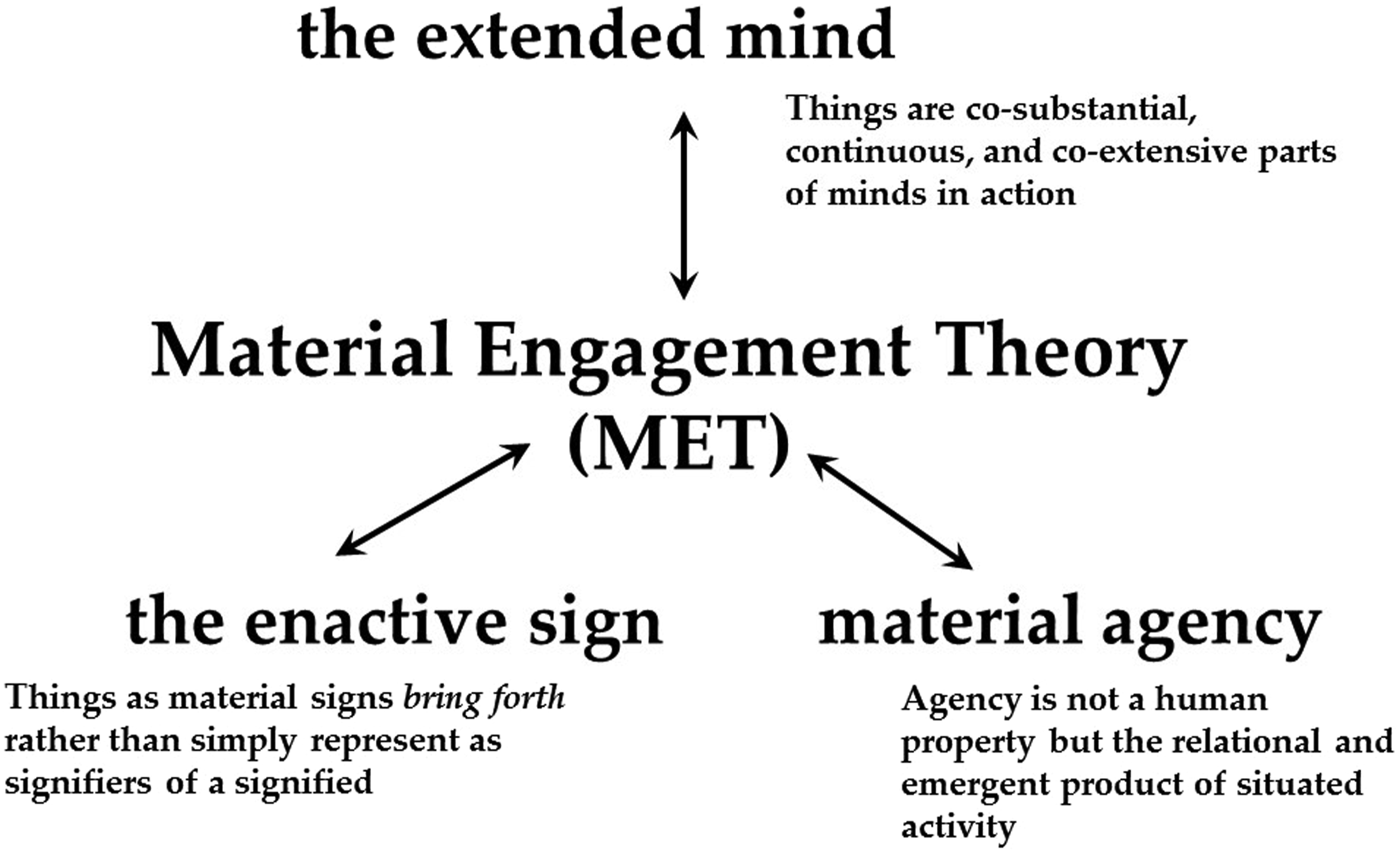
These are ideas that draw upon and resonate with old and new enactive-ecological trends in philosophy and embodied cognitive science (Bateson 1973; Baber, 2021; Baber et al., 2019; Gallagher, 2017; Chemero, 2009; Clark, 1997; Fuchs 2018; Newen et al., 2018; Rietveld and Kiverstein, 2014; Vallee-Tourangeau and March 2020), postphenomenology (Ihde and Malafouris, 2019), pragmatism (Dewey, 1925; Iliopoulos, 2019), and the anthropology of distributed cognition (Goodwin, 1994; 2000; Hutchins 1995, 2010). Moreover, the proposed methodology builds on Goodwin’s (1994; 1995, 2000, 2018) vision of situated human interaction as well his notion of ‘semiotic fields’.
It is this constitutive intertwining of cognition and material culture that provides the foundation for Perspectival Kinaesthetic Imaging. It can be described both as a form of contemporary cognitive archaeology — given its emphasis on the ways by which human thinking becomes constituted, transformed and reproduced in different configurations of brain-body-material environment (Malafouris, 2022) — and as a way of practicing material semiotics — given its emphasis on the study of material signs and the processes of meaning-making by means of enactive signification (Malafouris, 2013). To use an analogy, as functional brain imaging (fMRI) allows neuroscientists to trace creative thinking by detecting changes associated with blood flow (hemodynamic response) inside our heads, so Perspectival Kinaesthetic Imaging helps us to track our creative thinging (thinking and feeling with and through the world) by detecting changes associated with the flow of bodily movement and materials. In the case of fMRI, creative activity is measured because of chemical changes in the blood related to energy use by brain cells. In the case of Perspectival Kinaesthetic Imaging, creative activity is picked up through the tracing and capturing of gestures and enactive material signs. With fMRI the focus is on the changes in the cerebral blood flow (the blood oxygenation level dependent, or BOLD contrast); with Perspectival Kinaesthetic Imaging the focus is shifting onto the material flows and formative processes wherein creative processes come into being. What does this mean in practice? We will discuss the respective contribution of each of the multimodal visual captures separately in the following. First, we want to present and clarify some distinctive features that all media have in common.
Perspectival Kinaesthetic Imaging
Imaging and enactive imagining
We begin with the meaning of ‘imaging.’ We should note, cautioning against a possible misunderstanding, that Perspectival Kinaesthetic Imaging should not be confused for a method targeting primarily the ‘visual’ aspects of making. Unlike other image-making practices used in anthropology, the aim of Perspectival Kinaesthetic Imaging is not to record visual phenomena, or to obtain visual data, but to selectively capture multi-sensorial aspects of creative skilled practices. This is why we use the term multimodal visual captures to characterise the different media involved. The term ‘multimodal’ is adapted from multimodality studies (Jewitt et al., 2016; Jewitt, 2017; Jewitt and Mackley, 2018) to emphasise the special interest on material semiotic resources and multi-sensory ‘modes’ of enactive signification (Malafouris, 2013). Some of those multimodal resources or aspects of making are readily visible both in video and photography (for instance, embodied in language, gaze, sound, gesture, as well as the use of tools and materials) (Gowlland 2015a, 2015b). However, it is also the case that important multimodal aspects of creativity often remain ‘unseen’ or are hard to observe. Perspectival Kinaesthetic Imaging can make those invisible modalities visible and render them available for investigation.
One important source of inspiration here has been Ingold’s ‘graphic’ anthropology of lines. We build on his innovative attempt at ‘redrawing anthropology’ by ‘following the materials’, ‘learning the movements’, and ‘drawing the lines’ (2011a, 11) as well as on his general approach to the study of creativity and enskillment (Ingold 2011a, 2011b, 2013). Current developments in multimodal (Dicks, 2014; Dicks et al., 2011; Jewitt, 2017, 2019; Jewitt and Mackley, 2018), and sensory anthropology (Banks, 2001; Mondada 2012, 2019; Pink, 2011; Pink et al., 2014, 2016) have also been considered. Especially relevant in this context has been the new emphasis on multisensoriality, and the interconnectedness of the visual sense with other senses, proposed by Pink, as a new way of ‘Doing Sensory Ethnography’ (Pink 2009). This new way involves the adoption of a phenomenological approach and invites us to rethink the experience of making and seeing images as multisensory processes, rather than merely visual experiences. That is, “understanding the sensoriality of images as something that is generated through their interrelatedness with both the persons they move with and the environments they move through and are part of” (Pink, 2011: 4). It is in this discursive context that the meaning of ‘imaging’ should be understood: not as a passive visual ‘representation’ of the results of an investigation, but as an active capture of events and occurrences (material transformations and bodily movements) for investigation. ‘Imaging’ does not refer to the product, but to the actual means of participation. The aim of ‘imaging’ in Perspectival Kinaesthetic Imaging is to provide new ways to intervene, to experiment and to participate with creative activity coupling the movement of the potter with the observer’s attention. It is for this reason that Perspectival Kinaesthetic Imaging can also be described as an apparatus for capturing material imagination. It combines enactive semiotics and archaeological traceology (the study of material traces and indexes) with sensory anthropology aiming to ground and expand traditional visual methodologies and narratives. This brings us to the second distinctive feature of Perspectival Kinaesthetic Imaging.
Perspectival juxtaposition
Perspectival Kinaesthetic Imaging works on the principle of selective juxtaposition. The basic idea is that the juxtaposition, layering and comparison of different multimodal visual captures enables the discovery of relations that are often obscured, or may seem fragmented and disconnected, when seen from a single perspectival point. Each of these multimodal visual captures enacts distinct imagistic practices (digital or analogue). They also embody different temporalities. For instance, the observational drawings produced by the artist of our project, although synchronic, are not readily comparable with the photographs taken by the project photographer or with the images produced via mobile eye-tracking (Figure 3). They all relate to the same event that happens in a specific time period but they embody and express time in different ways. This multi-temporality, far from a problem, offers an onto-epistemological advantage. Each of the multimodal visual captures enact and embody different temporalities.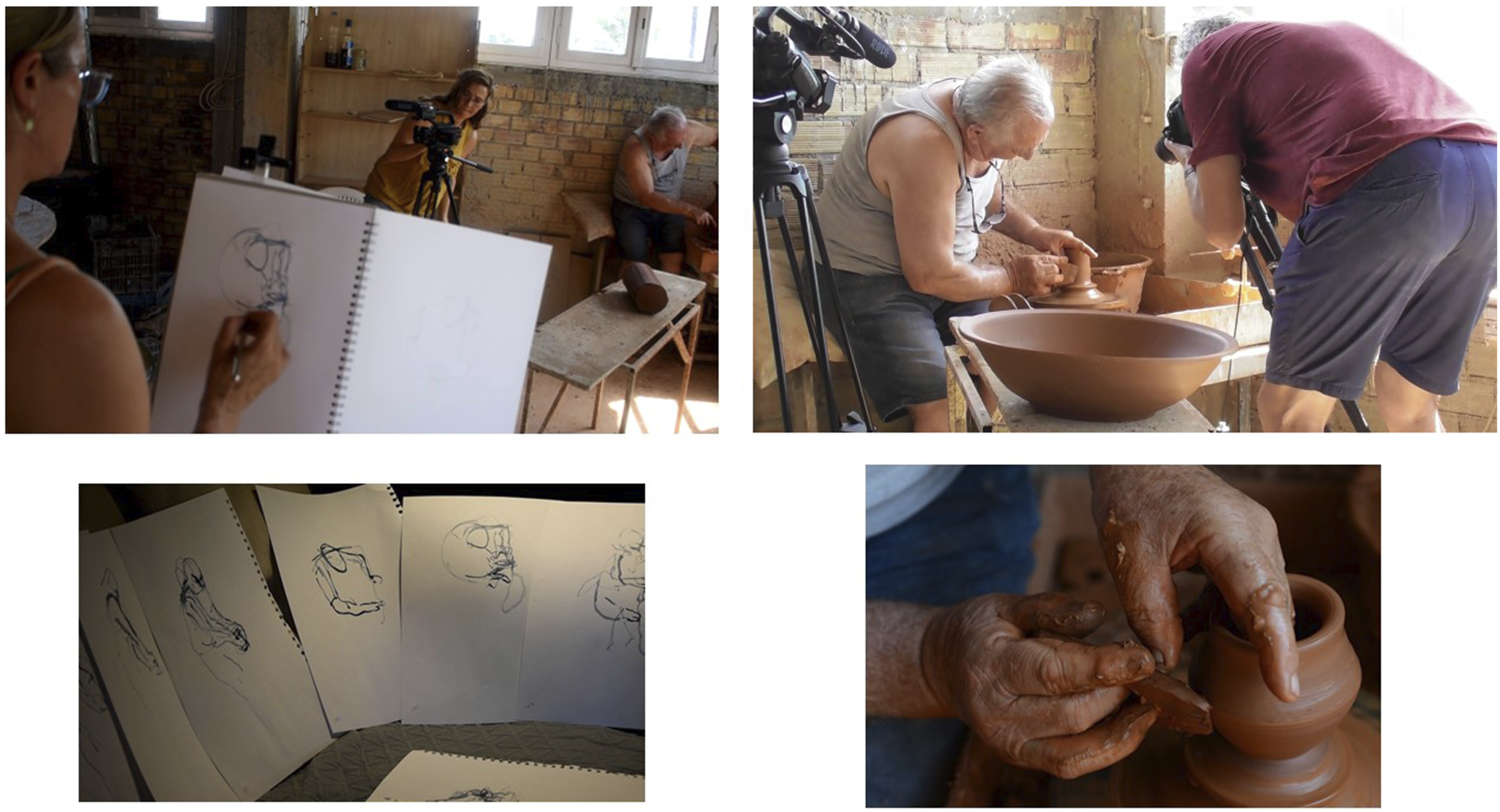
Each multimodal visual capture affords a specific spatio-temporal positioning (i.e., perspective) from which to identify, select and observe kinaesthetic events of interest. Kinaesthetic events of interest should not be confused with technical stages (e.g. grips and techniques) (Figure 4). Events of interest are usually discovered in areas of creative tension or friction that are usually associated with transitional movements (e.g. creative gestures and modes of enactive signification) which occur in-between technical stages, beginnings and endings often with no particular order. Perspectival Kinaesthetic Imaging allows for those events to be arranged chronologically, as a sequential spatial arrangement, but also dynamically as a durational composition or orchestration of rhythmic bodily movement. This is especially suited for the study of crafts and skilled material practices where no general rules can be used to prescribe in detail the contingencies of situated action. To study craft and creative gesture you must be able follow and learn (also unlearn) from the ways of the hand. Kinaesthetic events of interest (e.g. creative gestures and modes of enactive signification). The images were made by manually setting the camera to have a slow shutter speed, a low iso rating and a wide open aperture to create a shallow depth of field.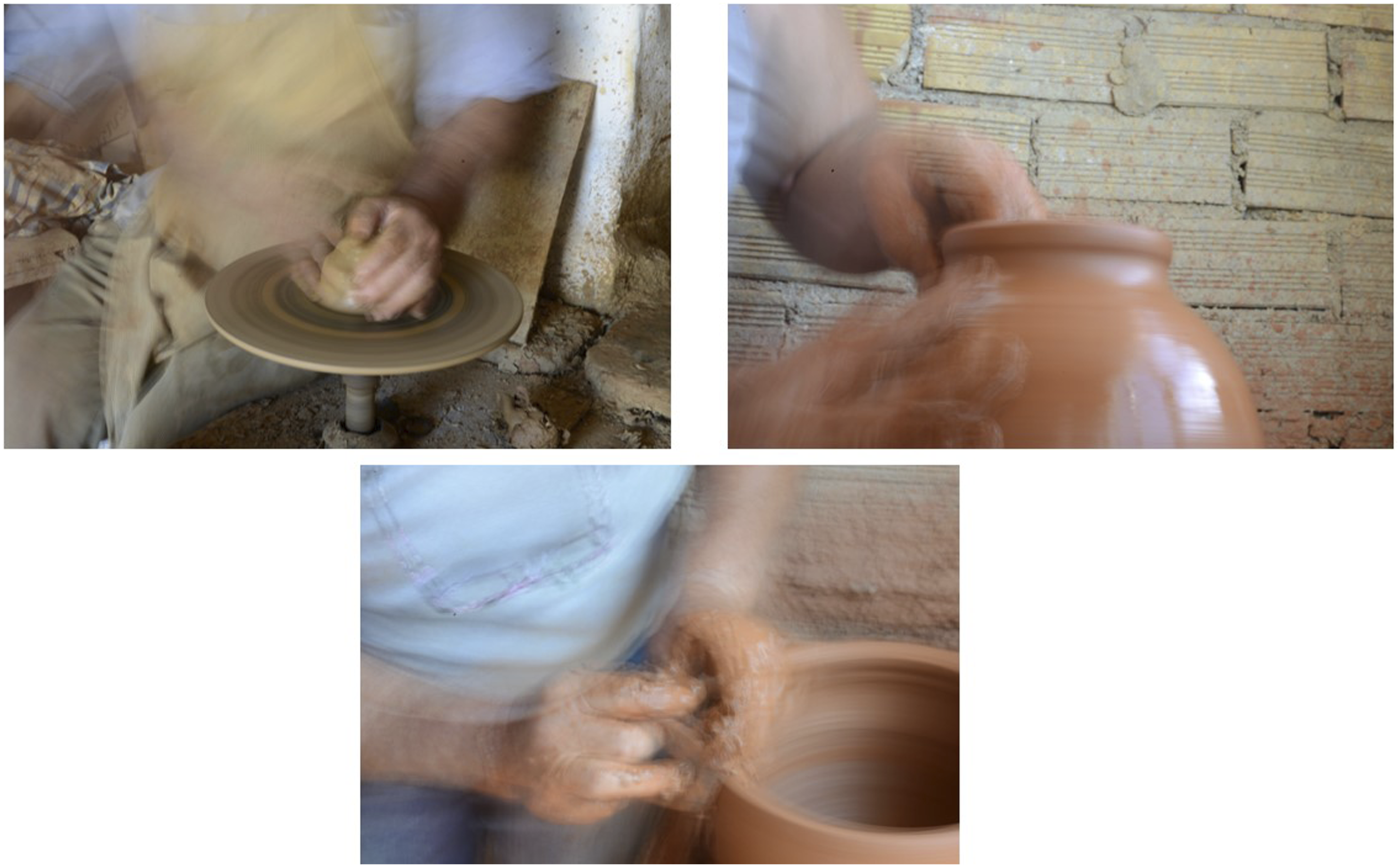
We should clarify that the term ‘kinaesthesis’ is used in the motional sense of ‘thinking in movement’ described by Maxine Sheets-Johnstone (1998, 486). However, whereas in Sheets-Johnstone’s analysis the primacy of movement essentially denotes unmediated bodily movement and ‘kinetic intelligence’, our approach extends beyond the sequential organization of moment-by-moment bodily interactions to include the multi-temporality and dynamics of creative material engagment. The key difference relates to the meaning of interaction which in the context of material engagement theory can be better described through notions of ‘trans-action’ (Dewey and Bentley, 1949), ‘intra-action’ (Barad, 2003) and ‘correspondence’ (Ingold, 2017, 2022). What these notions allow us to see, despite their differences, is that the entities to be related, as well as the properties and the boundaries that will be used to define them, emerge and stabilise after the interaction and do not exist prior and independent to it. In other words, hands and tools, forms and flows, ideas and techniques, are ontologically co-produced. The purity of interactivity between a subject and an object, for instance, potter and clay, although analytically conceivable, is in practice unattainable. Trying to determine the direction of the causal arrow, or to separate cause from effect ‘is like trying to construct a pot keeping your hands clean from the mud’ (Malafouris, 2008a, 25). Even before their interaction begins, the agency of the potter is actualised by the affordances of clay and the agency of clay is actualised by the affordances and skills of the potter — the term affordance is used here in the ecological sense (Gibson, 1977, 1979) of interactive relational possibilities. Creative material engagement does not allow the detachment of one state from the other. This does not mean that retaining meaningful boundaries between them is impossible, rather, it means, that their boundaries do not predate their entanglement (see also Malafouris, 2021a, 2021b; Malafouris et al., 2021).
One may trace in our thinking here, elements of the new materialist (Bennett, 2010; Coole and Frost, 2010) and posthumanist vision (Latour 1992, 1993; Barad 2003, 2007) for a (re)thinking of matter as agentive and vibrant. However, it is important to clarify that from a material engagement perspective the aim is not to ascribe agency and vitality to matter as separate from the agency of humans, but instead, to recognise that the two are inseparable. Agency is not the kind of phenomenon that can be described, let alone accounted for, by looking either at the human or the non-human alone (Barad, 2003; Latour, 1992, 1993; Malafouris, 2008a; Pickering, 1995). More simply, our basic aim to provide a starting point that allows us to join forces with matter, taking advantage of, instead of hiding from the intimate connections between humans and things.
As mentioned, the juxtaposition of multimodal visual captures allows us to track and trace material transformations and bodily movements that matter across scales that span from seconds to days. This process also involves what can be described as a semiotic ‘theft’ where structure and meaning is ‘abducted’ from a familiar domain and projected onto an ‘unfamiliar’. Technically this is an ‘abductive’ process, in the Peircean sense (1932), by which indexes of bodily movement on clay and of clay movement on the body, are being suspended and dislocated from the time and place in which they occur, in a sense ‘stolen’ from the flow of activity, to be examined separately in juxtaposition with other selected events and traces during the elicitation phase. This process can help us create new meanings (and boundaries). It opens up new “diffractive” analytical possibilities, in the sense of “marking differences from within and as part of an entangled state” (Barad, 2007: 89). Combined with phenomenological interviewing and video/photo elicitation this selective perspectival juxtaposition allows us to capture events of interest that occur at different temporal scales during the process of making. For instance, some creative gestures are short-lived and leave no visible trace, while others endure for much longer periods of time, leaving a permanent memory trace long after their completion. Moreover, the use of multimodal visual captures affords us to manipulate the flow of time returning and juxtaposing events of interest as many times as needed exploring their possible (previously unnoticed) connections.
Important to note, relevant to the participatory character of this methodology, is that there are no pre-specified and pre-scribed rules about what events should be captured and in what way. The research design is flexible and responsive to new insights and findings as they emerge during the ethnographic process. As it happens with anthropological studies, it is the ‘field’ that decides where to draw boundaries and what would be the focus of the tracking. The challenge is to enact the right kind of agential ‘cuts’ (Barad, 2003, 2007) and create juxtapositions, abductions and metaphoric relationships that help us reveal hidden patterns that connect (Bateson, 1978). This constant need to be attentive and responsive to the contingency and materiality of action also explains why multimodal visual captures are moving rather than fixed. Their spatio-temporal positioning needs to resonate with the movements of the potters and the changing rhythms of generative actions that occur in different stages of the process and often have different requirements in terms of skill and attentive material engagement. So, although, to give an example, some of the cameras can be fixed at specific positions and viewing angles, focusing on specific parts of the potter’s body, it is more common that the participants will be constantly moving in response to the potter’s movement. Holding a camera, or sketching the participants’ bodies and senses must remain attuned to the potter’s movements. That also means that each participant eventually creates a distinctive track-record, mapping and capturing different regions or events of interest.
At the end of the process, the different records are compared and juxtaposed. This provides the basis of our comparative analysis as it is during that stage of juxtaposition where interesting patterns (previously unseen) emerge and form the basis of our research design. Perspectival Kinaesthetic Imaging is part of the process of selection (or hypothesis formation) by which we choose the ‘kinaesthetic events’ of interest that will be used in subsequent analysis and comparison. In other words, it embodies already at the level of description and recording important analytical choices that derive from previous research and influence what to capture and not capture. We engage the potters with a specific set of questions and objectives that we want to explore. At the same time, the potters’ expertise will inevitably shape the content and steer the direction of the questions and observations as well as the nature of anthropological comparisons and descriptions. As such, although Perspectival Kinaesthetic Imaging can be seen as offering a view from the ‘outside’, it is already informed and will subsequently form the basis of further analysis from the ‘inside’ that is, from the point of view of the ceramists.
We now turn to discuss the multimodal visual captures, starting with photography and videography.
Multimodal visual captures
Photography and videography
The thing to note, is that, in the context of Perspectival Kinaesthetic Imaging, both the use of photography and video are more than just means of documenting creative actions. Both video and photography are part of our research process that is seeking ways of recognising and attending to the experiences and the creative processes associated with the observed skilled material practices. In other words, the role played by video and photography is not reflective or representational (mirroring activity); rather, it is enactive and, to borrow again from the vocabulary of agential realism, ‘diffractive’ — that is, they intervene and participate in the activity. The latter serves the purposes of Perspectival Kinaesthetic Imaging for selecting and studying material transformations that make a difference to the practice of making, rather than with interpreting the visual ‘content’ and ‘meanings’ of photographs and videos as aesthetically pleasing visual ‘representations’ of skilled action.
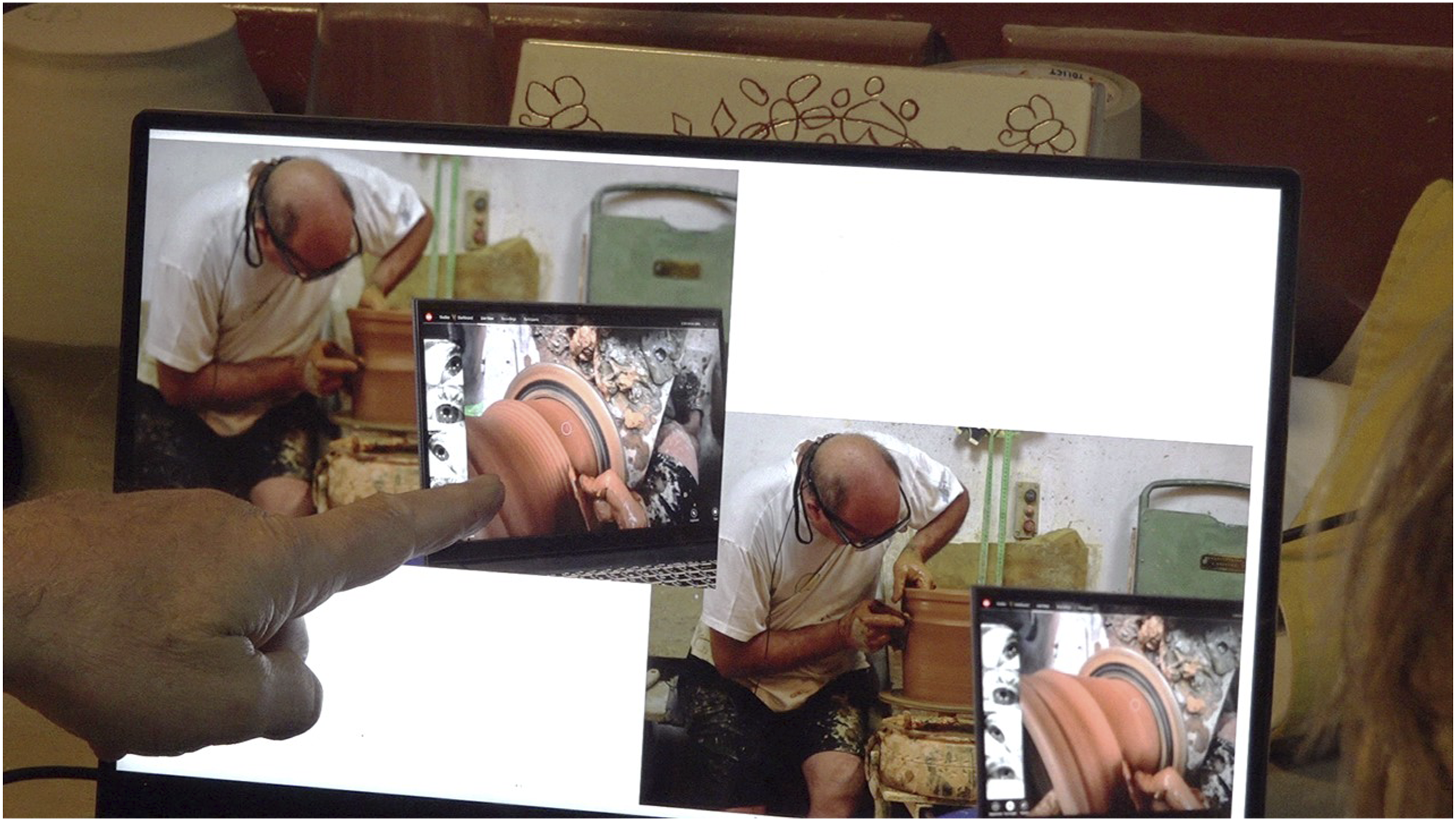
The images produced in the context of Perspectival Kinaesthetic Imaging are mostly generated by the participant researchers. The ceramists are also involved in the process of image selection and interpretation during the elicitation phase. Photo elicitation involves inserting selected photographs or edited video footage related to pre-identified events of interest into the structure of the interview (see relevant section below) (Figure 5, 6). The major function of the photographs and footages selected as elicitation prompts is to facilitate observation, discovery and dialogue between the anthropologist and the ceramist. The ceramists' comments and responses are recorded for later analysis and additional photographs are subsequently selected and used as prompts to elicit further information. Moreover, repeated viewings of the photos often reveals changes in the ceramists understanding of the processes depicted. Also, the selection of images and the editing of the video footage is often participatory allowing the ceramist to take part in the analysis and interpretation of the photographic shots as well as looking at the footage in order to guide the detection and selections of significant bodily movements and non-verbal behaviour. Photo and video elicitation session with the potter Sigouros Golemis. Photo and video elicitation allows the ceramists (here A. Atsonios) to re-enact aspects of their ‘lived experience’ of the creative process and putting the experience into words.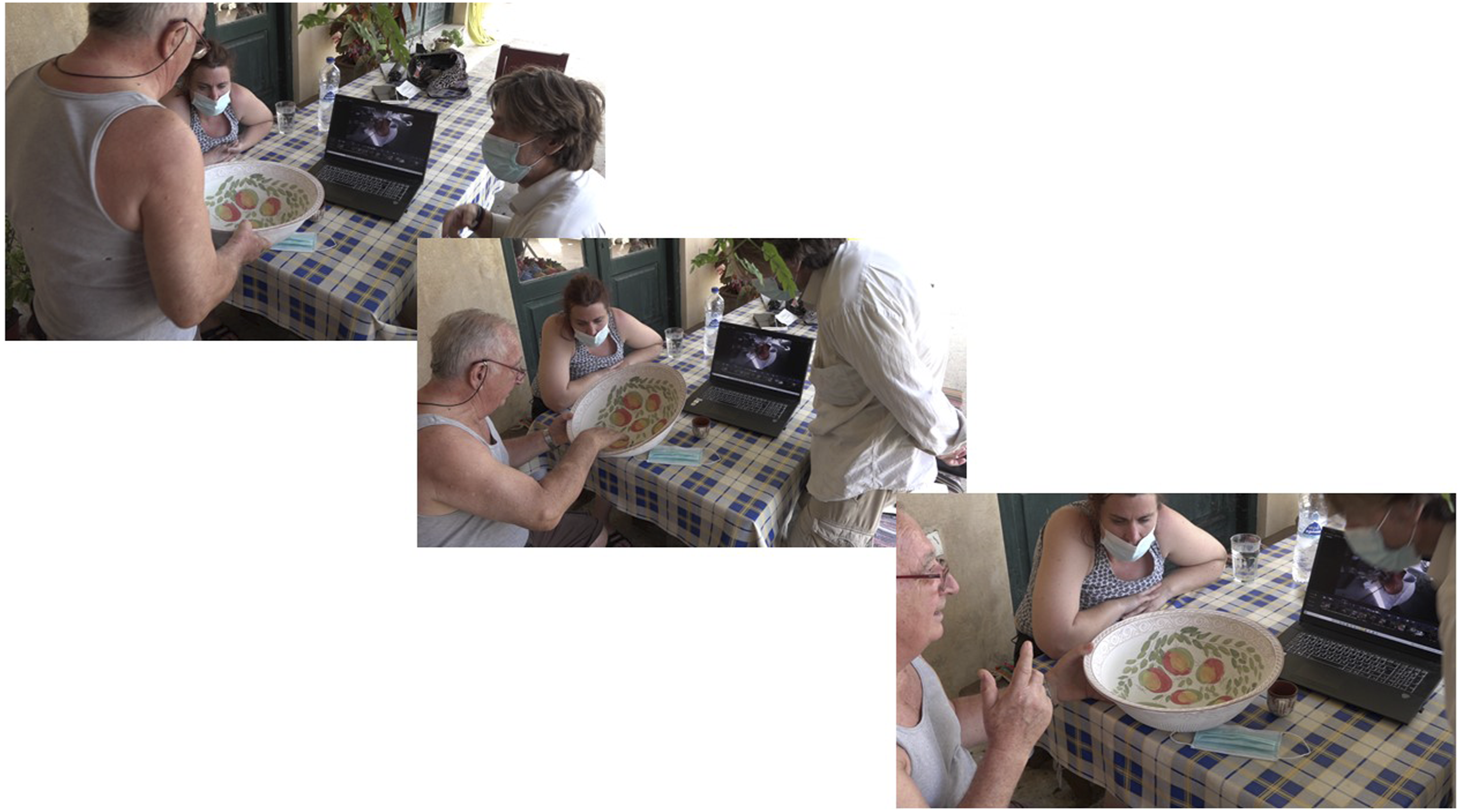
The project’s team also includes an artist photographer (RC) who has been trying to capture specific ‘events’ in the process of making. We have sought to harness the ability of photography to materialise and communicate the creative process by condensing time and movement. For instance, the blurring in Figure 4 is intentional, trying to find ways to capture process in single shots (what you see is actually the blending of many moments in a single photo). All the images speak of process and they were taken with such a process-oriented consideration in mind. The trans-temporal blurring of the potting images creates an aesthetic displacement and dispossession that allows enactive ways of imaging the tactility and temporality of making. This enactive imaging gives us partial access to the potter’s material imagination (Koukouti and Malafouris, 2020a, 2020b).
We are also attentive to photographing and videographing as bodily practices and skills in themselves (for a good discussion of the somatic and performative aspect of photography see Shusterman 2012), and we have been exploring their positioning (as creative performances) within the choreography of pottery making (Figures 7, 8 and 13). That means that the processes of framing, setting up, preparing, anticipating and taking the shot, as well as the movement and natural choreography of the participants’ bodies (those who are making pots and those who are making images) are as important for our analysis as the subsequent critical processes of selecting which shots will be edited, exhibited or used in the elicitation stage. We should be reminded that clay is not always co-operating with the potter, the photographer or the videographer. Photography and videography require attentiveness and a highly concentrated level of decision-making, about capturing (or not capturing) a specific event in the process of making. In a way, the act of centring not only attunes the clay to the potter’s body (eye-hand-clay-wheel) but also affects the actual placement of the photographer’s body so that the optimum alignment of eye-hand-camera-centring can be achieved (Figure 8). There are constraints here imposed by the speed of the wheel and the throwing activity as well as by the skilled vision (Goodwin, 1994; Grasseni, 2004) of the photographer and the videographer. Skilled vision here relates both to the affordances of the medium (photography or video) and the affordances of clay. Seeing is a multimodal transaction (tactile as much as visual): the result of our perceptual engagement which we may also describe as enactive gaze. Photographing and videographing are not just media of participatory observation but also bodily practices and skills (creative performances) in themselves. We have been exploring their positioning within the choreography of pottery making. The act of centring not only attunes the clay to the potter’s body but also affects the actual placement of the photographer’s body so that the optimum alignment of eye-hand-camera-centring can be achieved.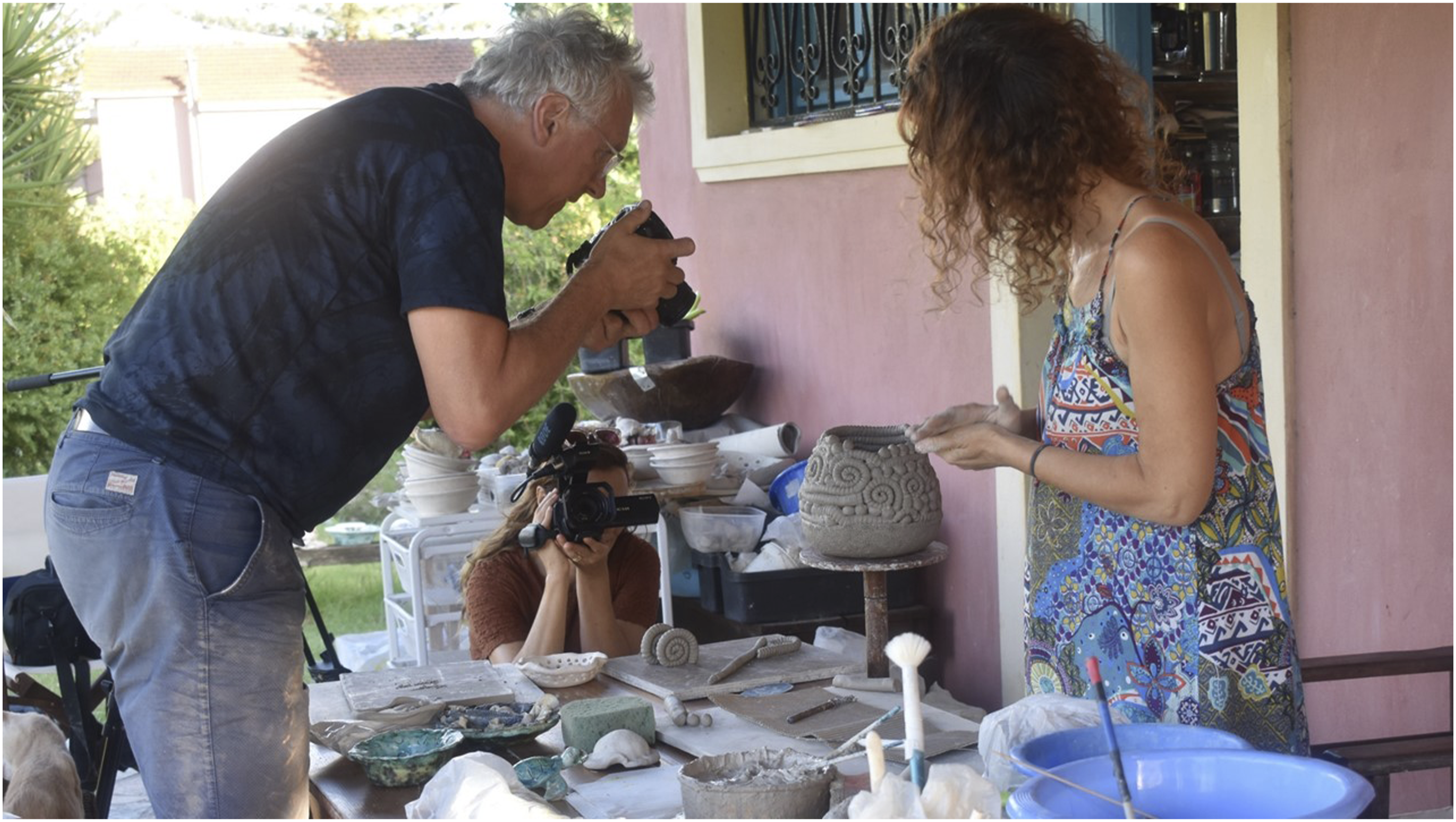
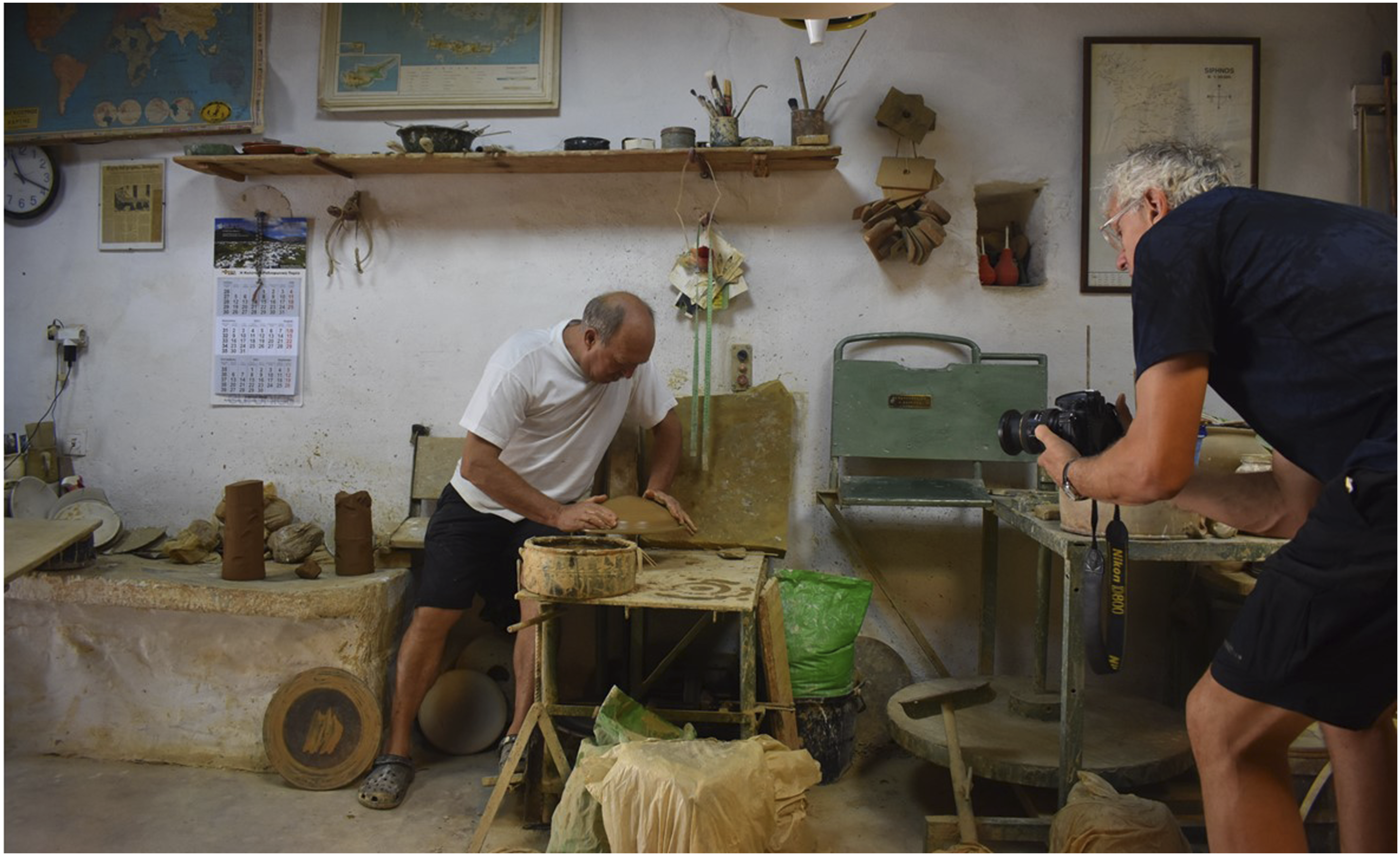
A further aim of videography is to present how the multimodal visual captures involved in Perspectival Kinaesthetic Imaging achieve or fail to produce perspectival juxtapositions, at times complimenting, ignoring or antagonizing each other. We set up our cameras with an intention to understand what could be learnt about the creative process through the process of filming it and how our observation affects the events observed given the different temporalities afforded by different media. We start from the position that all the different elements involved in the process, interact, affect, and extend into each other. This emphasis on responsiveness, performativity and collaboration can be contrasted to the traditional idea of the ‘decisive moment’ (Cartier-Bresson, 1999) where shots are attributed to the agency of the person holding the camera who is seeking to seize in a ‘moment’ the ‘essence’ of what passes in front of the camera’s lens. From the point of view of Perspectival Kinaesthetic Imaging, there is no single moment where all elements come together to create the ‘essential’ meaning of the creative gesture to be caught on film. The event supersedes the moment. If there is anything that resembles such a ‘moment’, is, in fact, inherently ‘indecisive’; it is diffracting, unestablished, and incomplete. This is why, in the context of Perspectival Kinaesthetic Imaging, the hunt of the ‘decisive moment’ gives way to that of ‘indecisive’ processual occurrences or events. Instead of ‘decisive moments’, representing the essence of action cut out from time and space, what we are after are ‘indecisive creative events’, where past, present, and future, unite, like knots of concentrated activity in the flow of movement carrying the past and present into the future. We should note, that by calling the aforementioned events ‘indecisive’ we do not mean that they lack importance, meaning or significance. On the contrary, these are events that matter and make a difference. What we mean by calling them ‘indecisive’ is that they are partial and imperfect. They are also co-created by everyone entangled in the process (people and things) and, thus, belong equally to every-body and every-thing. Their ‘indecisiveness’ in other words lies, on the one hand, in their durational and incomplete character as becomings (the opposite of essence), and on the other, in their decentralised nature so far as the attribution of agency is concerned. The videographer, in this perspective, is not the centre in the process of video making, but an active participant in a constant transaction within the wider ecosystem of image production. The semiotic hylonoetic field to which the videographer aligns and participates include people, tools and materials (earthenware, stoneware, porcelain, glazes, brushes, spatulas, water etc); finished and unfinished ceramic objects; places, spaces and landscapes (ceramic workshops, landforms and other features that integrate with the creative process); words (stories, interviews and discussions); material mediations and technologies (pottery wheels and kilns, video cameras, laptops, eye-trackers, drawing equipment); and, of course, skill.
Within this ecology (cognitive and material), the use of photography and video have proven to be powerful tools that can help overcome some traditional limitations of other interpretative methodologies by allowing marginal details that may originally have been dismissed as trivial to gain significance as revealing clues of analysis during the elicitation stage. The combination of photography, video and observational drawing (which we discuss below) offers an especially pertinent means to express these intertwinements of mind and matter, or in our case of potter and clay.
Observational drawing
Observational drawing, like any other component of Perspectival Kinaesthetic Imaging, is not just a means of visual documentation or representation but a way of obtaining knowledge by merging creative attentive engagement and observation. The basic idea behind observational drawing is that you are drawing to see rather than drawing what you see (Causey, 2017; Ingold, 2011a; Heath et al., 2018; Mäkelä et al., 2014). As such, observational drawing requires active sensory participation with the processes observed (not just their visible surface properties). In that sense, it supports anthropological description by enhancing the participants’ responsiveness and attentiveness to the situation (i.e., form-making). This capacity for ‘seeing-drawing’ (Causey 2017: 11) adds to Perspectival Kinaesthetic Imaging a capturing mode that allows us to reconfigure movements on paper with forms and shapes, and thus, to see unnoticed patterns and processes that emerge out of this selective reconfiguration.
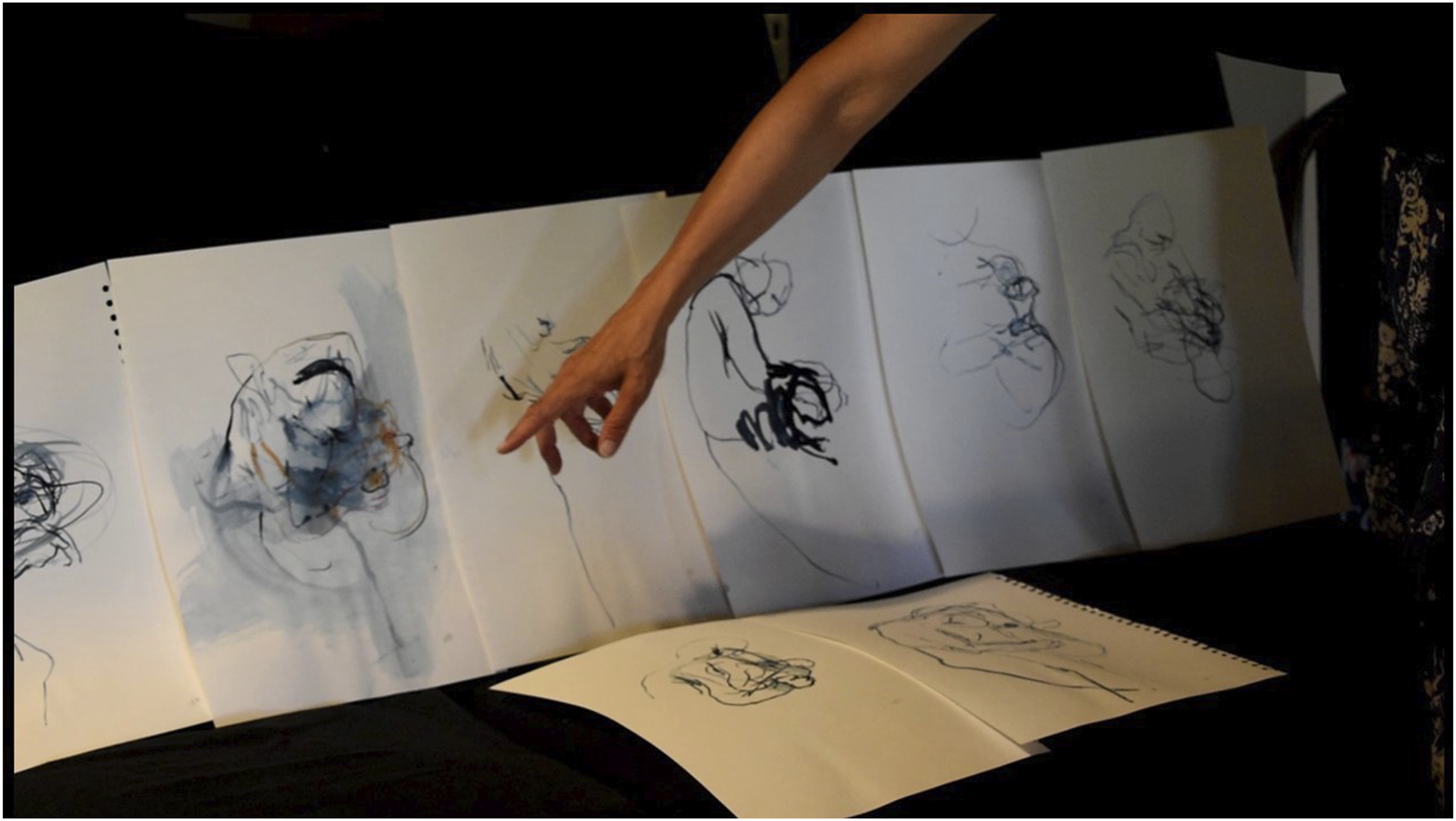
MC, the artist of the HANDMADE project, has produced over two hundred observational sketches following the ceramists’ hands and the movements of materials (Figure 9, 10). She has been making drawings on site, and in real time based on the participatory experience. These are action-based and process-oriented drawings lacking obvious points of commencement or initiation. Their role is to complement the understanding of process and the identification of events of interest, rather than to visually represent aspects or stages of making. These drawings help us to understand and to visualise the phenomenology of creative gesture in ways that could have been difficult to express by other verbal or photographic means. Admittedly, the materiality and tangibility of drawings as something corporeal to engage with, to touch and to look at has proven especially valuable. The research team found it stimulating to display and compare these drawings exploring how they could be read in a particular way or another, asking questions and discussing observations with the artist (Figure 11). Observational drawings with the Sifnian potter A. Atsonios by MC. Sample of observational drawing by MC. Display and comparison of the drawings by the research team.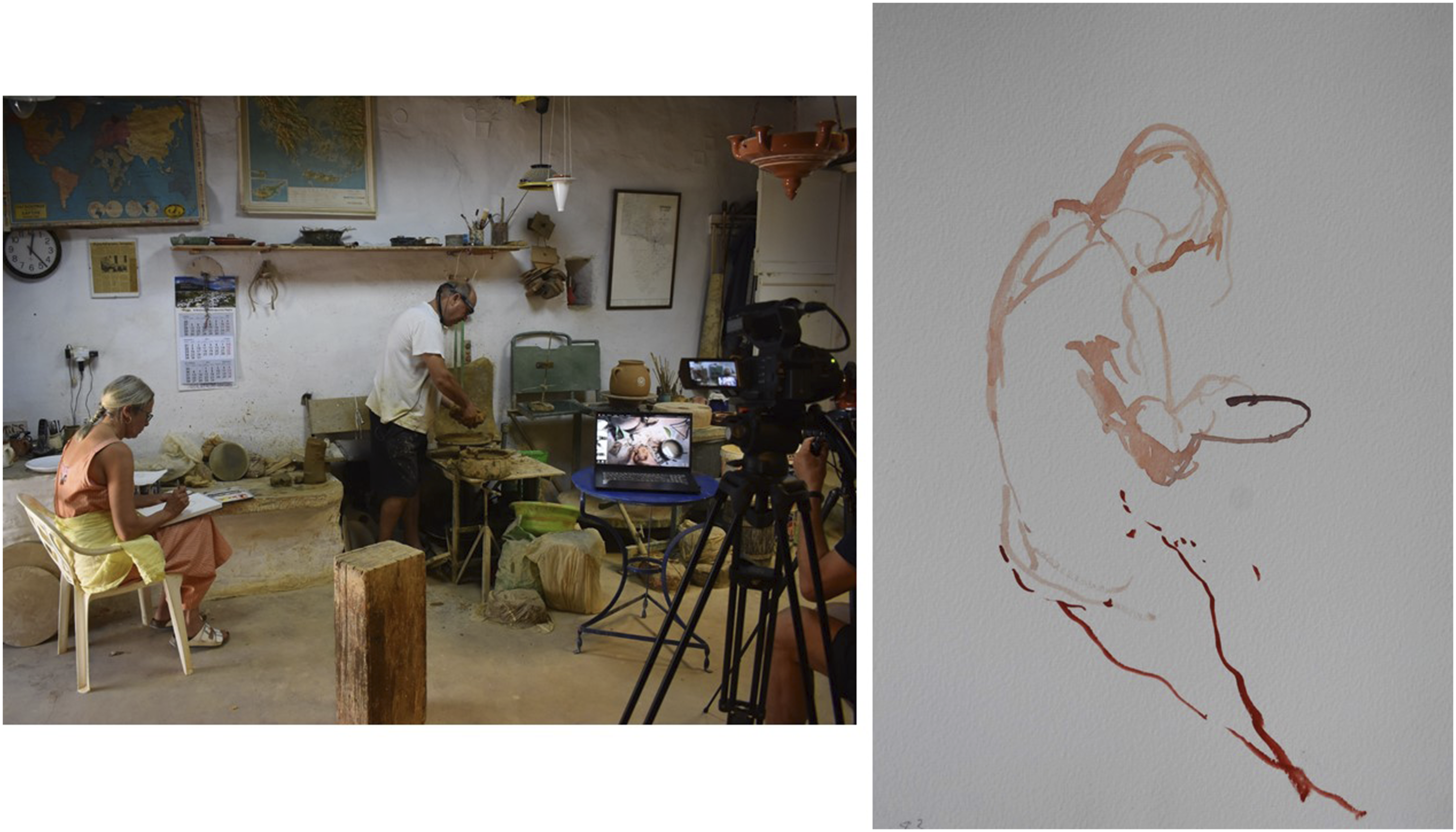
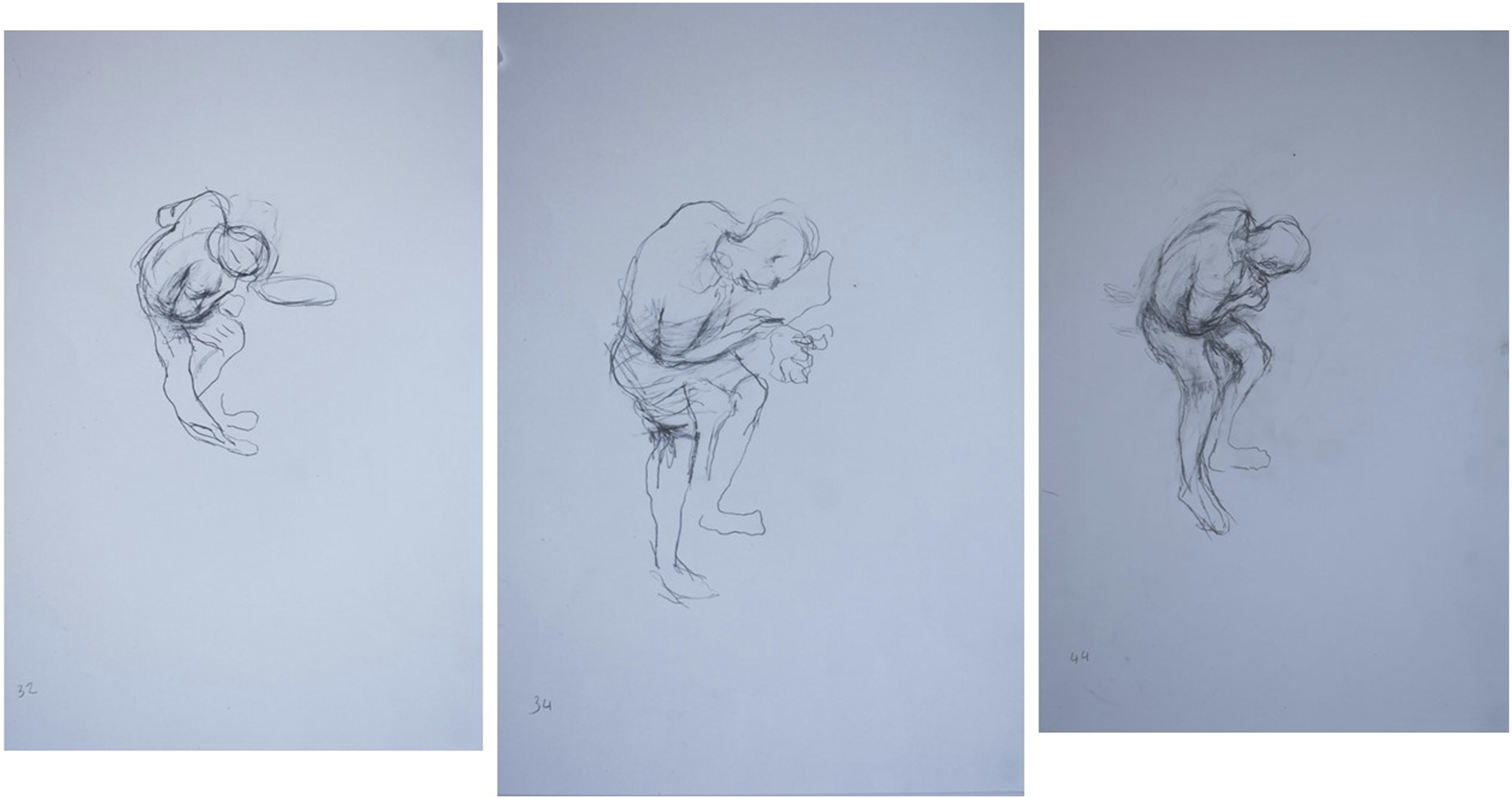
Observational drawing offers some distinctive affordances for studying skilled movements and material practices. For instance, one important contribution of observational sketching, compared with other media (e.g. photographs), that emerged early on in our project, has been the ability of drawing to condense the multi-temporality of making and to graphically enhance and underline, onto paper, distinctive bodily gestures and choreographies of action (Figure 12). As Ingold observes: the process of drawing (participatory or from memory) combines, perhaps more than other anthropological media “observation and description in a single gestural movement” (2011b: 222). In that way, besides enhancing attentive engagement, it promotes new multimodal ways of seeing. The choreography of participant observation is of special interest. Looking at the video recordings of MC’s process-drawings we noticed that the intensity of her gestures while drawing often correspond with and reflect the vitality of the ceramist’s movement and the shaping of clay. This observational attunement is also visible in the final drawings that provide indexical signs of this tension between the depicted and depicting gestures. However, it is primarily in the video recordings of the process, where the juxtaposition of all participants is visible in real time, that the synchronicity of the observer and the observed becomes more salient. A similar correspondence or attunement has been observed also in the case of other visual captures during photographing and filming (Figure 13). Observational drawing has the ability to graphically enhance and underline, in real time, distinctive bodily gestures and choreographies of action. The flow and synchronicity of the observer and the observed.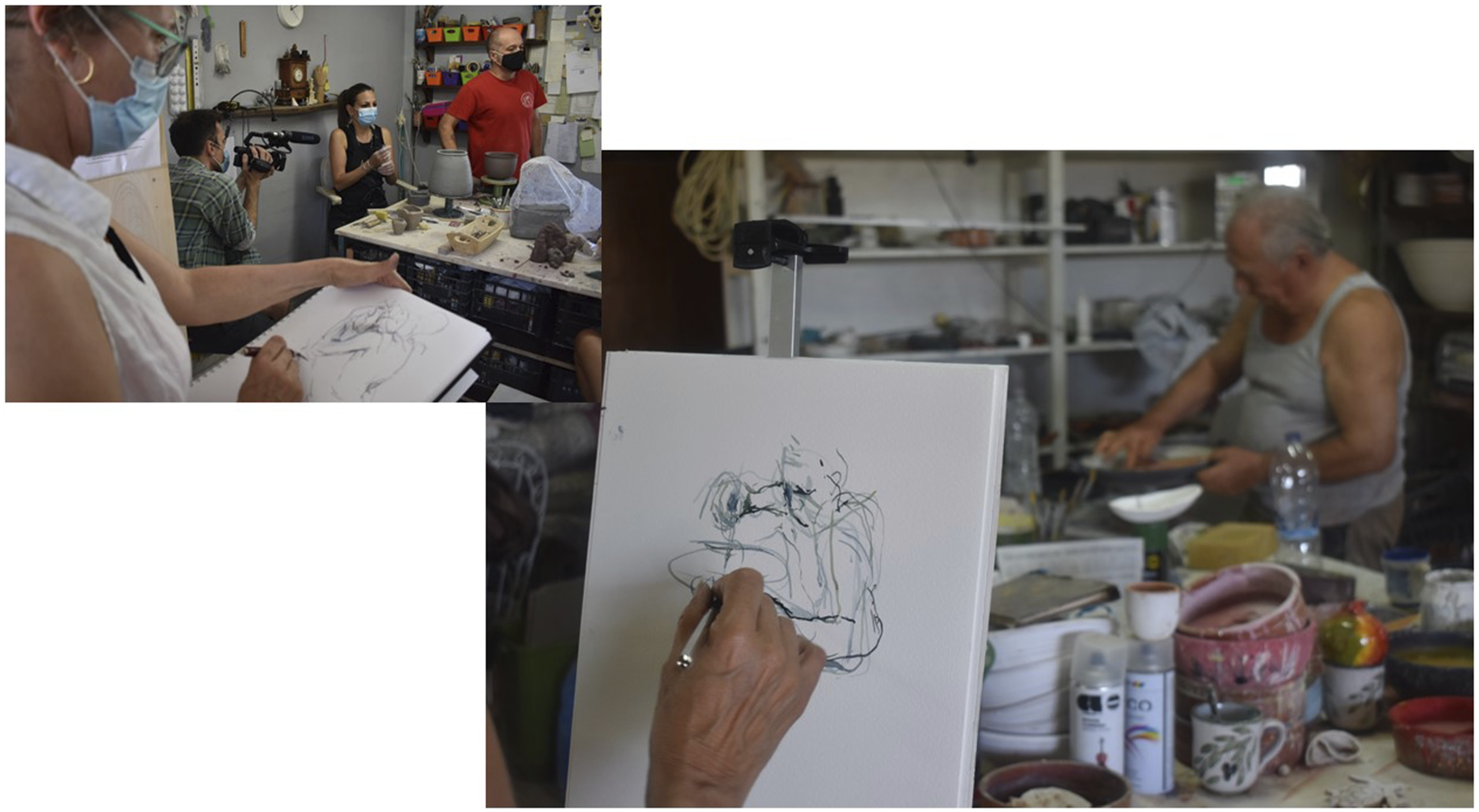
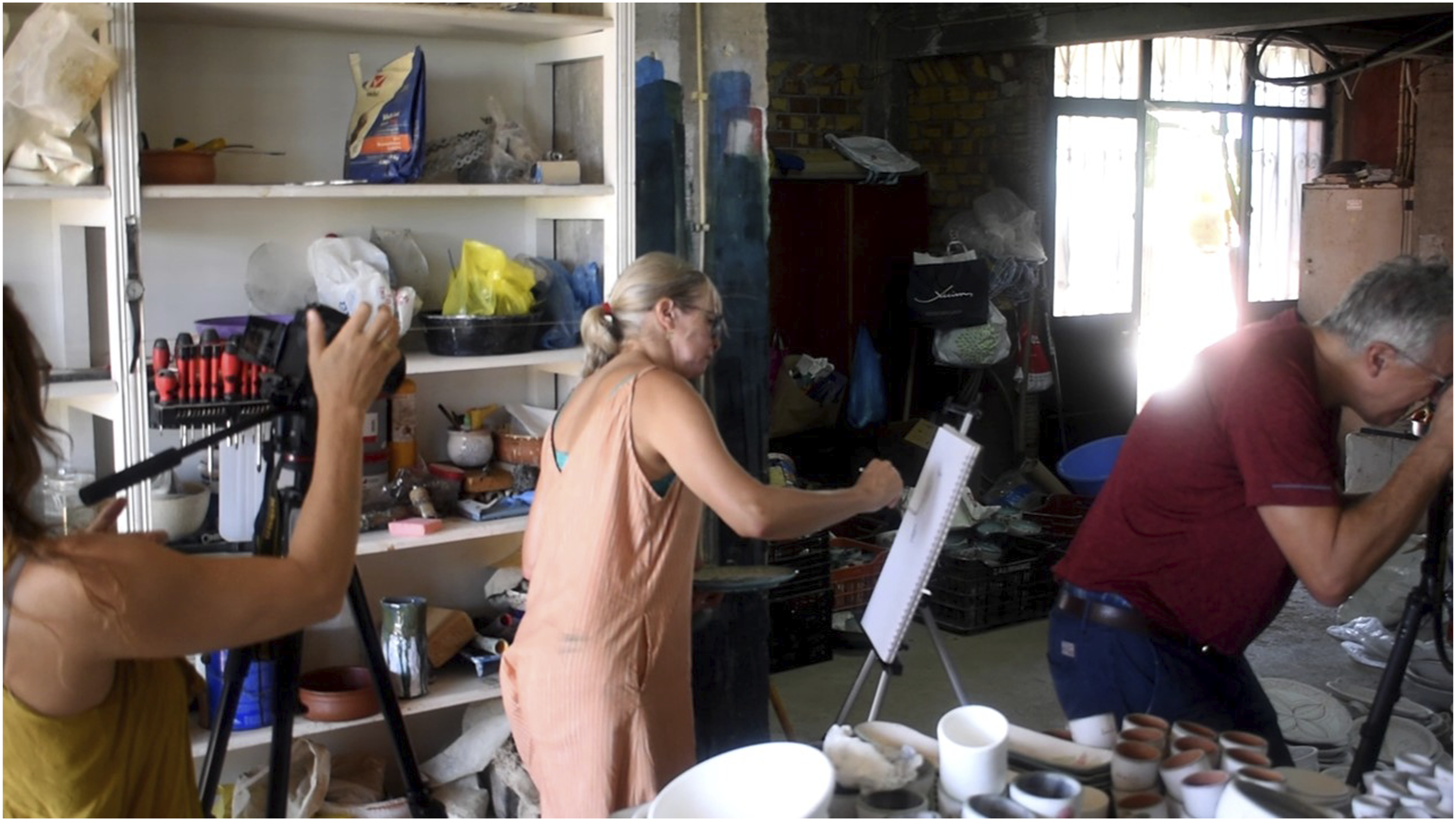
The power of observational drawing lies precisely on its inherent selectivity and tentativeness (Causey, 2017). Observation through that medium takes the form of an open dialogue between what we chose to draw and what those choices allow us to see. Drawing in order to see is an open process that demands attentive engagement and responsiveness to the details of action. For that reason, observational drawing enacts a process-oriented, instead of a product-oriented approach to the study of creativity. It is also for that reason that observational drawing presupposes ethnographic immersion and participation with what is to be drawn and observed. That also means that observational drawing is inevitably ‘sketchy’ and thus incomplete. Partial closure can be achieved with the combination of the different media, and the dialogue between the different perspectives. This dialogue among what may have initially seemed a discontinuous collection of moments and depictions often allows for their transformation into a well-integrated assemblage of organic events wherein one sheds light and meaning to the other.
Observational drawing, like other imagistic techniques and media, provides a useful methodological tool facilitating the ability of anthropologists to observe, interact and relate with the process of making and its material environment. According to Taussig (2009: 265), the act of drawing not only fundamentally alters what can be seen and experienced during fieldwork but also the way those experiences can be recorded and used for anthropological analysis. Interestingly, Taussig (2009: 265; original italics), following John Berger, sees an important difference between making a drawing and taking a picture in that these modes of “picture making” carry different temporal implications, i.e., “a photograph stops time, while a drawing encompasses it”. For Taussig there is a different connection and interaction between a drawer and the thing drawn than between a photographer and the photograph taken. The ability of the drawer to see is shaped by the very act of drawing. Each line drawn is “important not for what it records so much as what it leads you on to see” (Taussig, 2009: 269). The act of drawing is bringing the drawer closer and closer to the thing drawn.
Mobile eye-tracking
Eye movements are remarkably dynamic, a mixture of shorter saccades and longer fixations which are often theorised to reflect attention or cognitive processing (although see Orquin and Holmqvist (2018) for a cautionary note). Attentional processes have overwhelmingly been studied drawing on evidence from auditory or visual processes. There has been a feedback loop – as technology has improved measurement in those domains so their importance has solidified encouraging efforts to improve technology. Developments in virtual reality have only accelerated this tendency. Until very recently, technological limitations meant that eye-tracking research was restricted to analysis of two-dimensional images and the published research using eye-tracking in experimental archaeology is therefore exclusively lab-based. Lab work allows large sample sizes of both participants and artefacts and facilitates automated quantitative analysis (see e.g. Criado-Boado et al., 2019).
The development of mobile eye-tracking allows experimentation with eye movements ‘in the wild’ while action happens in real time (for a recent application see March, 2021; March and Vallée-Tourangeau, 2022). The process of making can be recorded, tracking the eye’s pathway (made of fixations and saccades) in relation to the pathways of the hand. Dynamic mobile eye tracking poses significant challenges for the quantitative analysis of eye movements. Eye tracking works by overlaying eye movements onto the video feed from a point of view camera. With dynamic eye tracking the feed from the point of view camera is constantly changing making drawing automatic quantitative conclusions difficult. However, the gaze of the participants in the HANDMADE project was sufficiently focused that we were able to use still images and the automatic mapping tool in Tobii Proto to concentrate the eye tracking data over time, crystalising movement into one still image. There are two main ways we can do this, illustrated below (Figure 14, 15). The first is to track the gaze path with moments of longer fixations (here defined by the in-built attention filter) generating numbered points of interest. This generates the sense of movement. The second is to create a heat map which uses colour to represent depth of attention (again as defined by the inbuilt filter) with red indicating a concentration of visual focus. A combination of the two generates the feeling of movement and focus to complement the video of the scan paths. Gaze plots showing the order of the fixations combined with heat maps showing the depth of focus. Gaze plots showing the order of the fixations combined with heat maps showing the depth of focus.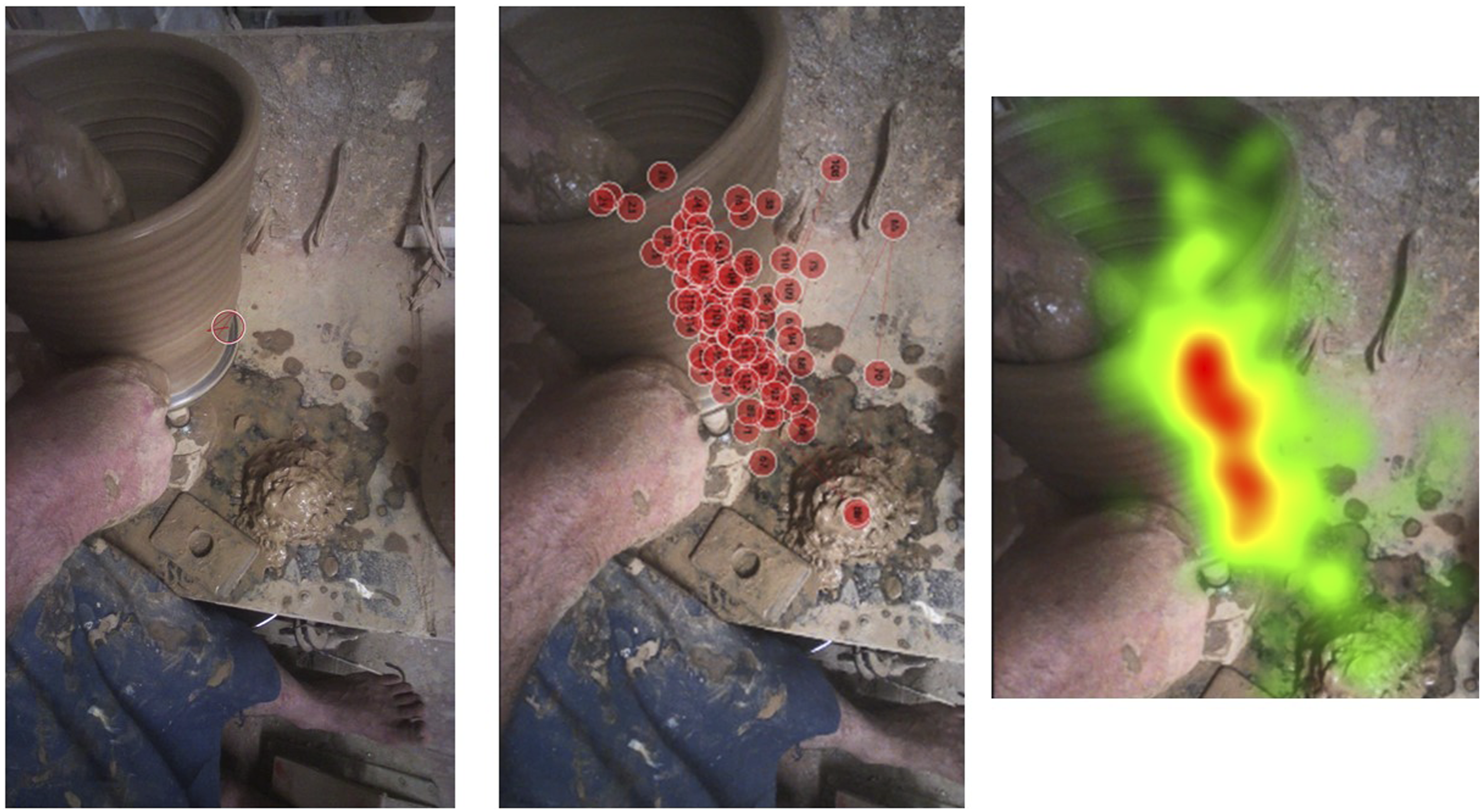
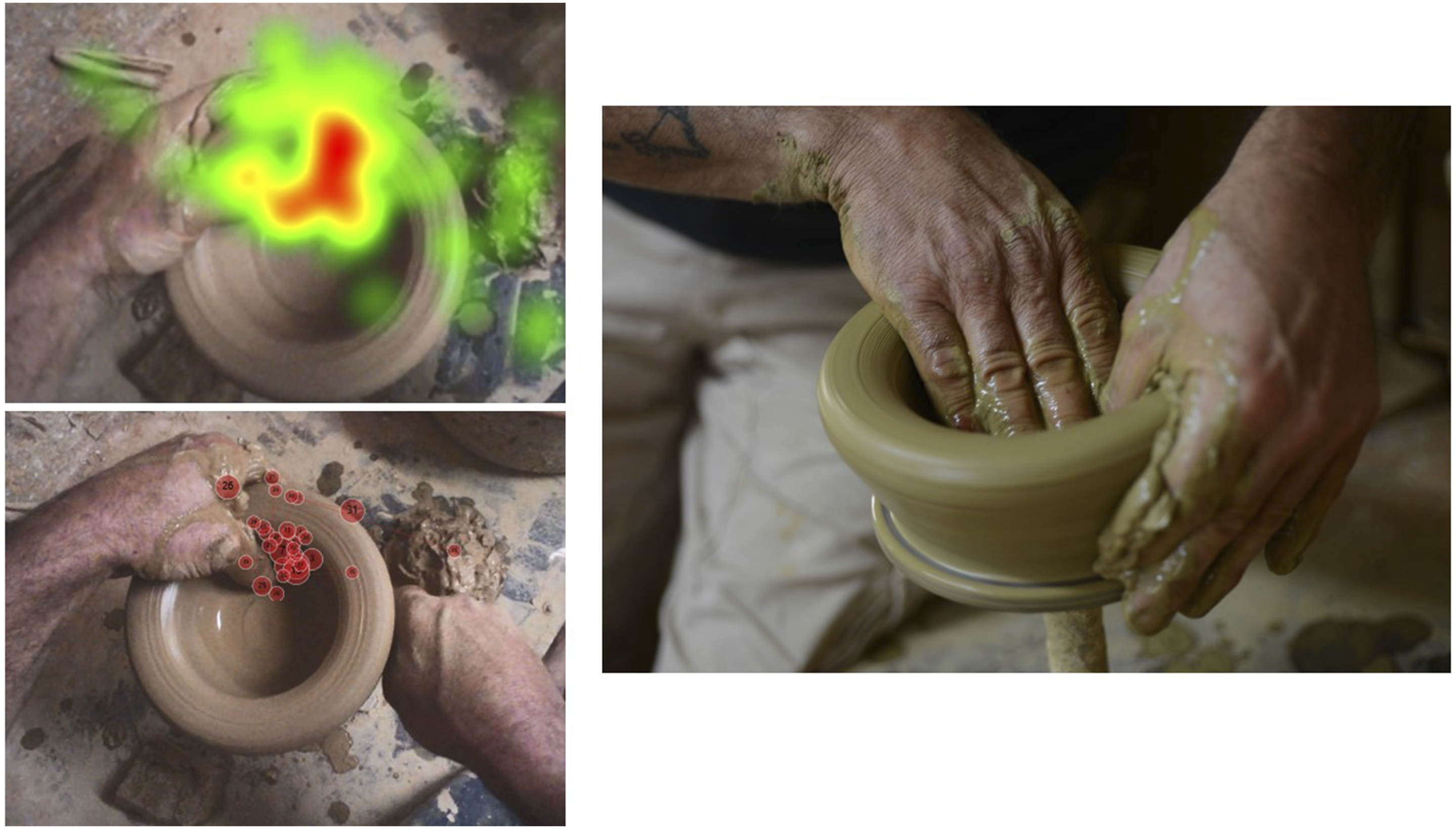
Important to note here, is that in the context of the HANDMADE project, we use mobile eye-tracking to capture motion and to understand how the eye of the potter touches the clay (as the hand of the potter touches the clay) (Figure 16). Ultimately, our concern is to understand the chronoarchitecture of action or else the temporality of making. This also means that the logic behind the use of mobile eye-tracking as part of Perspectival Kinaesthetic Imaging is different from that we find in the psychological applications of that methodology. We employ mobile eye-tracking in order to follow and track the invisible path created by the eye movements of the potter during the task. This path (made up of fixation strings linked by saccades) tells us where and for how long the potter’s eye is touching the clay, which we can then compare with the parallel visible trace left where the hand is touching the clay. This form of real time eye-hand tracking provides useful insights for understanding the temporality of making and the multimodal character of attentive material engagement. It allows us to follow the movement of the eye parallel to the movement of the hand and to understand the temporal structure and correspondences of tactile and visual modes of creative consciousness (Malafouris and Koukouti, 2022). This has also proven to be an especially productive analytical tool as source for video elicitation and phenomenological interviewing that we discuss next. Observing how the eye of the potter touches the clay.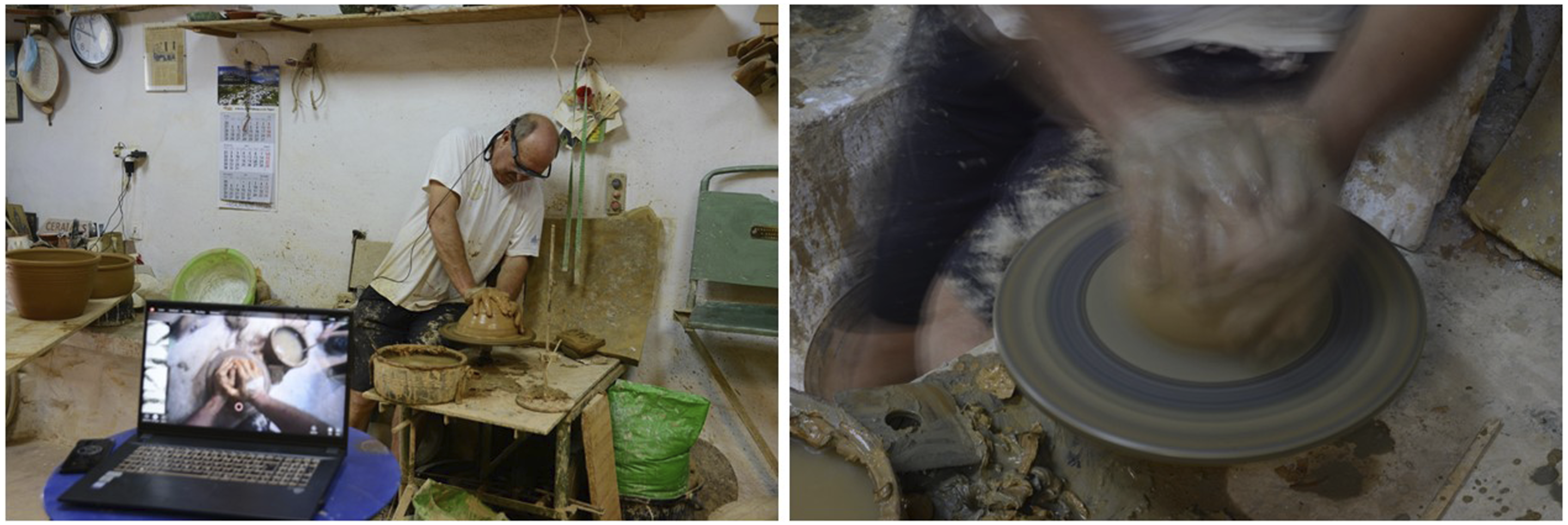
Phenomenological interviewing with video and photo elicitation
The difficulties of becoming aware of and describing subjective experiences associated with skilled practices are well known (Streeck, 2009; Ingold, 2013; Kneebone, 2020; Sennett, 2009). Being an expert in pottery making does not imply, or necessitate, the ability to produce a verbal description of the various experiences and processes involved. Such descriptions and conscious articulations often require different kinds of skills and expertise (for instance, in story telling). The difficulties verbalising the lived experience of making are many. The language of clay is in large part tactile and nonverbal. Any attempt at translation must be conveyed, but also concealed and deformed both by the language employed by the ceramist and the categories the anthropologist uses to make sense of the ceramists’ descriptions. We should not forget that, during the process of making, the potter’s attention is usually absorbed (often entirely) by the desired task to be achieved and only peripherally by the actual ‘way’ in which this objective is to be achieved. Expert ceramists, as skilled practitioners, spent little time consciously thinking about their doing; they are more concerned with doing their thinking. That is, they are concerned with thinging their skill to achieve their task. This form of ‘tacit’ material knowledge (Polanyi, 2009 [1966]) is often been described as proportional to the potter’s level of skill (Dreyfus and Dreyfus, 1986). It is also described as ‘mindless’ (since it does not require deliberate, conscious attention). Without denying the close relation between the level of skill and the capacity for creative material imagination, we suggest, there is nothing in the latter process that could be seen as ‘mindless’. Quite the contrary, it can be more accurately be described as ‘mindful’ (Malafouris and Koukouti, 2018, 2022).
There are good reasons why the potters have little reflective awareness, and thus, memory of the cognitive and bodily processes that enable them to achieve their objectives. Such an awareness would have diverted their attention from their performance towards the processes that enable them to achieve it. If ceramists ‘know more than they can tell’, the use of phenomenological interviewing can facilitate the description and exposition of their material and tacit knowledge as well as highlight key aspects of their ability to imagine with and through clay.
Technically, by phenomenological interviewing we refer to the interview method of descriptive phenomenology. The method was originally developed and employed in cognitive sciences (including clinical and therapeutic domains) in order to provide in depth descriptions of lived experiences. These descriptions could be used to identify pre-reflective experiential invariants which constitute the structure of the experience under study (Petitmengin, 2006, 2017; Petitmengin et al., 2019). Within the context of the HANDMADE project, we have developed and employ similar semistructured, phenomenologically inspired, but importantly, ethnographically responsive interview methods. Our approach is committed and tailored to the experiential dimensions of craft practice and attentive to the affective material forces that constrain and connect the forms that the ceramists create and the stories they tell in correspondence to their creations. We employ phenomenological interviewing as a participatory method that allows both the interviewer and interviewee (the ceramist) to capture through verbal, bodily or other descriptions, experiential structures of interest (variant and invariant) relevant to specific aspects or phases of the creative process. We use open and semi-structured questionnaires because on the one hand, they facilitate reciprocity, reflexivity and improvisation (it is often the preceding answer that defines the nature of the next question) and, on the other hand, provide a sound basis for analysing and comparing the judgments, comments and descriptions gathered by means of the interviews relevant to the varieties of gestures which guide potter’s attention. Our principle aim in using this method is to bring the ceramist into contact with the different technical dimensions of the creative process and enable connections with their ‘felt meaning’ making possible to re-enact aspects of their ‘lived experience’ and to switch from pre-reflective to reflective modes of creative material engagement. To elicit as nuanced descriptions as possible, we combine phenomenological interviewing with photo and video elicitation (inserting selected photographs or edited video footage related to pre-identified events of interest into the structure of the interview) (Figure 5) (Banks, 2001; Harper, 2002; Pink, 2001; Van Leeuwen and Jewitt, 2001).
The focus and scale of the events depicted in photo and video elicitation varies. The focus on singular situated experiences is essential for avoiding abstract impoverished descriptions that do not correspond with the actual doings of the ceramist but rather with learned representations of general rules that the ceramist uses to describe what it is that they are doing. Moreover, the vocabulary at our disposal to describe or translate the various experiential dimensions of creative material engagement is very poor especially when it comes to remembered events and sensations. Photo and video elicitation enhances re-collection of events discussed with the ceramists and helps to avoid misunderstandings in putting the experience into words. It helps us understand ‘what to look for’ and to which dimensions of the creative process and the ceramist’s experience our attention should be directed in order to reveal the events that ‘matter.’ Moreover, elicitation provides a medium for remembering which affords a different mode of recollection than through traditional verbal-based interviews. Images provide a semiotic field of temporal associations (sequential and non-sequential) for participants to reflect on the meaning of their actions. Captured in film or photographs those actions become available to think with in ways that would have been otherwise impossible to imagine, remember, re-enact and communicate (Figure 6).
The interactive and dialogical nature of photo and video elicitation also offer frequent opportunities for the ceramists to alert researchers to omissions, misperceptions as well as to new questions. Photo and video elicitation is also disruptive in a positive sense allowing for ‘surprise’ and the redirection of attention. Those surprising and disruptive occurrences are also opportunities for the interviewee (the ceramist) to become aware of unperceived aspects of their experience. This allows them to deepen the phenomenal awareness and description of their experience opening new interpretive possibilities. For instance, watching eye tracking videos provides a powerful medium of elicitation that enables the ceramists to become aware of the exact timing and interplay between vision and touch. This combination of visual and narrative methods is especially pertinent for studying creative activities and assessing sensory experiences given that there is little interruption in the doing of the ceramist and that the many interesting aspects of the process are hard or even impossible to notice while the action unfolds.
Creative gestures
Gestures are usually conceived as bodily movements that are communicative and representational, and which are often intimately associated with language and speech (e.g. enhancing and complementing their function) (Goldin-Meadow and Brentari, 2017; Kendon, 1980; McNeill, 1992; Novack and Goldin-Meadow, 2017; Streeck, 2009). Pointing would be the classical example here. In our study, we have been focusing primarily on a special category of gestures we call creative. We started our exploration with a simple enactive definition of the creative gesture as the wordless expression of the inexpressible. Creative gestures express and do things that language cannot express and cannot do. Their primary role is to make tangible, and thus possible, what would otherwise remain hidden and unrealisable. From an onto-epistemological perspective, the study of creative gestures provides opportunities to re-negotiate some fundamental distinctions that cut across all aspects of making and which are tied up in issues of agency, attention and intention. Thus, their intimate association with artistic performances and skilled practices. Our focus on the craft of ceramics provided an especially fertile environment for the study of the situated dynamics of the creative gesture. This is primarily due to the limitless variety of forms that can be produced within a well-defined set of material and technical constraints. Creative gestures establish the possibility of a meaningful dialogue between the ceramist and the material. Without being ‘communicative’ or ‘representational’ they do have a deictic function pointing the way forward and revealing new affordances for action.
We have been using Perspectival Kinaesthetic Imaging to capture selective transactional gestural patterns and sought out to investigate their relation with key aspects of material imagination, and enactive discovery. One elementary way to describe the process of making is as the temporal unfolding of a given material form through the dynamical creative tension between states characterised by openness and uncertainty and states characterised by prediction and control. Our guiding hypothesis has been that, if creative gestures are anywhere to be found, then, they should be traceable as the products of this creative tension. That is, they must exist somewhere between the liberating morphogenetic potential of clay and the limits that both the affordances of the material and of the technique impose on the process of form making.
We have been selecting, reflecting and comparing the tracings and recordings of the different media (multimodal visual captures), searching for persistent gestural patterns in the emergence of material form. The search of these invariable patterns structured our analysis and interpretation of creative gesture as a constitutive feature of creative thinging. Creative thinging designates the discovery of new varieties of material signs and modes of enactive signification through an attentive engagement with form-generating materials (Malafouris, 2014). Creative gestures can be argued to be the elementary blocks of creative thinging in that they help to express what is possible, but previously unthinkable, and open up new exploratory possibilities for material imagination.
A major challenge for our study has been how to differentiate creative gestures from other kinds of gestures. If gesture is “any performed act with a beginning and an end that carries a meaning (from gero = I bear, I carry on)” (Maddalena, 2015: 69–70) or a “movement through which a freedom is expressed” (Flusser, 2014: 164) what may be the difference that makes the difference with creative gestures? How are we to distinguish those gestures that carry forward and constitute enactive discovery from those that merely prepare the ground or support the creative process? Any gesture may prefigure the direction of movement and shape the material in a way that allows for a hidden affordance to become visible or present. Such an anticipatory gesture, is able to set in motion or motivate the possible occurrence of creative thinging. But should it also be considered part of it, i.e., creative gesture, or is it better to be distinguished from it?
In practice, these are difficult distinctions to make. We should not forget, that the same gesture can have different meanings as part of different processes. For instance, a finger can be used as a communicative gesture in the deictic sense ‘to point’ a line (Figure 6, 11) but also as a creative gesture that participates in the making of the line (Figure 12). Although both gestures are enactive (world-involving sense-making is involved in bringing forth the experience of a line) only the latter is creative in the sense discussed above. The former is merely a ‘transition.’ Still, a pointing gesture may lead to creative gesture in the sense of ‘enactive discovery.’ An important consideration here concerns the temporality of creative gestures. Creative gestures are durational, that is, they cannot be experienced chronometrically or captured as isolated moments in time. Look, for instance, at the gestures depicted in Figure 4. Although they may be seen to represent sequential phases in the making of the pot, these phases were by no means discrete. Creative gestures do not just follow one another in time, instead, each is carried over into the next as a path of movement along a line of clay.
So, the challenge remains: observing the ceramist’s body engaging with clay how do we decide which part or aspect of their movement to associate with creative gesture? If what makes a gesture ‘creative’ cannot be defined a priori, but is to be found, instead, in the way form-giving expresses (or not) a possibility-widening sense of discovery that goes beyond established ways of doing things; what would then constitute a meaningful analytical unit?
Traditional (representational) ways to define gestures provide little help with answering those questions. The main reason for that is because they leave unattended the material ecology and enactive character of gestures that co-occur with creative practices. Creative gestures are situated, and thus, inseparable from their material environment and dependent upon the activity contexts within which they arise. They cannot be reduced or conflated with mere bodily movement or symbolic communication. They are not reducible to mental or other events and therefore, cannot be abstracted or defined outside of the creative process. Creative gestures can only partially be captured. Their study demands that we combine and integrate kinematic, kinaesthetic and performative analysis of skilled action, paying sufficient attention to the details of the material environment. This is where our proposed methodology for the perspectival juxtaposition of kinaesthetic events of interest has proven to be useful in capturing some of the defining features of creative gesture. We present a summary of the main insights that arose from applying Perspectival Kinaesthetic Imaging in the form of four propositions: 1) Creative gestures should not be confused with technical gestures. One observation that became clear at an early stage in our investigation, was that creative gestures, although closely related are not the same as technical gestures. In the case of pottery making, technical gestures take the form of specific grips for handling clay (Figure 6, 15). These are basic techniques that the ceramists learn at an early stage of their training (often as part of their local tradition) and which they incorporate and perform during the process of making in order to produce specific results with clay. A noticeable pattern that Perspectival Kinaesthetic Imaging allowed us to see, was that the kind of improvisatory movement that better suited our working hypothesis of how a gesture should behave and what features it should have to be called creative, seem to manifest, rather consistently, during transitional stages in-between those grips. Creative gestures relate less to the effectiveness and efficiency of the ceramist’s handling of clay through well controlled grips and techniques to achieve a pre-defined end; rather, they relate to the effectiveness and efficiency of the ceramist’s handling of chance and uncertainty that any act of making embodies (Malafouris, 2023). This is also why creative gesture is often susceptible to error within the parameters of a given design process. There is no room for creative gesture in an assembling line. 2) Creative gestures are disruptive: they enact and at the same time suspend creative habits. Creative gestures instantiate an affective disturbance between previously established connections. The value and significance of creative gesture in the process of making is to help the ceramist produce destabilising ‘occurrences’ where the flow and rhythm of movement can be momentarily disturbed for the sake of novelty and enactive discovery. In this sense, creative gestures often manifest as an anomaly, opposing, rather than following the potter’s ordinary habits of skilled practice. Creative gestures allow ceramists to: a) rearrange the direction, combination and duration of material forces and energies, b) re-structure the order, strength and tempo of technical grips, and c) violate the constraints of repetition in a given technical grip producing new moves and variations of form. Important to note here is the role that creative gestures play in the process of learning and the ‘education of perception’ (Gibson, 1977, 1979; Ingold, 2017; Goodwin, 1994). Far from enabling the simple expression and transmission of techniques and forms across generations, creative gestures provide a way of disrupting established relationships and patterns of making in ways that enable the ceramist to respond to the changing sociomaterial ecologies and affordances of clay. 3) You cannot perform the same creative gesture twice. Creative gestures are unique kinaesthetic ‘occurrences’ situated in time and space as parts of specific hylonoetic fields. They are ‘actual’ phenomena (both present and active) that blend the trans-actional constitution of Dewey’s ‘situatedness’ (Dewey and Bentley, 1949) with the Whiteheadian sense of becoming in the sense of ‘concrescence’ (Whitehead, 1929: 322, 433). In that sense, creative gestures are concrete, non-objectifiable, processual, and temporally dynamic (see Gallagher, 2021). That means they cannot be re-enacted or re-created without distortion. Instead, it can be expected that creative gestures will vary in different occasions, or stages of making. This also explains their intimate association with the ways of the hand. Especially in the case of pottery making, the movement of the hand has special significance in that it situates and orients the rest of the body in anticipation of the precise improvised action to be taken and which cannot be known in advance. The inherent indeterminacy of creative gestures renders them also incompatible with machinic forms of creation, re-production and mass production. 4) Creative gestures are contingent and indeterminate, not in the a-causal sense, but in the dynamic or metastable sense that places form-giving activity outside the practitioner's control. Creative gestures are not produced deliberately as part of pre-defined plan or choreography of action; rather, they are spontaneously co-produced in response to the way the ceramist feels the material can be shaped at that moment of the performance. Unlike other types of communicative or representational gestures, i.e. bodily movements that tend to reproduce something or resemble something, creative gestures operate as media of enactive signification: they help to bring into being that which does not yet exist. Creative gestures take the form of unpredictable moves of improvisation. These are gestures of surrender, subjection and submission that embody both the desire of form-making and curiosity about the affordances of the material at hand.
Conclusions
Perspectival Kinaesthetic Imaging is a research tool for the study of skilled creative practices and the mapping of their associated cognitive ecologies (understood as local forms and flows of distributed intelligence). It is a process-oriented method (targeting modes of becoming rather than being) (Gosden and Malafouris, 2015; Malafouris et al., 2021). Our use of the term ‘method’ does not imply separation from theory. On the contrary, Perspectival Kinaesthetic Imaging is a method of participant theorising (i.e., theorising produced and realized in practice through participatory observation in the field). With Perspectival Kinaesthetic Imaging attention is moved from things as objects of human thought to things as processes of material imagination. The aim of Perspectival Kinaesthetic Imaging in this context is not to generate a record of events that would have been hard to document otherwise, but to provide a possible means for the identification and comparison of selective events that ‘matter’. The ‘mattering’ we refer to is, of course, ‘situational’. In the context of the HANDMADE project, these are events associated with creative gestures. Which also means that they occur in-between beginnings and endings (however we define beginnings and endings and whatever the scale of activity we choose to focus upon). The captured events of interest are dynamic and temporally emergent — meaning, they change during the process of analysis. An event of interest may be abandoned or replaced by a new discovery during the process of elicitation.
Although the focus of the HANDMADE project is on clay and the craft of ceramics, the methodology presented, as well as the theoretical framework of Material Engagement Theory (Malafouris, 2013, 2019) from which it derives, may apply to the study of any human skilled action and creative engagement with form-generating materials (Malafouris, 2014).
A marked feature of all crafts, not just ceramics, is that they enact time and imagination in ways that still resist appropriation by our consumptive capitalist value system. There are lessons that the cognitive and material ecology of craft can teach us about the nature of the creative process and the ethics of care, which can help set us free from the enslaving logic of modern, product oriented, meaning of ‘innovation.’ We need to study those lessons in meaning making that things and materials (forms and flows) can offer, in order to understand their modes of material enactive signification. It is a common assumption in the anthropology of craft that much of what we study cannot be adequately described using words alone. Perspectival Kinaesthetic Imaging as a method of practicing material semiotics can aid anthropological analysis creating new kinds of immersive knowledge and modes of participatory observation which allow us to look at skilled practices and to explore material relations from the inside out. The combinatory use of various multisensory techniques enables us to image and capture the affective dynamics and temporal structure of creative gesture, as well as to compare among individuals. One advantage of Perspectival Kinaesthetic Imaging is that it allows what Ingold (2010; 2011a; Ingold and Hallam, 2007) would call a ‘forward’ tracing of creativity by following the improvisatory movements and creative gestures that give rise to form. This can be contrasted with the usual ‘backward’ reading of creativity which traces the novelty of actions by looking for their antecedent causes in the brains of the ceramists. A further strength of Perspectival Kinaesthetic Imaging is that it provides a bridge between art and anthropology overcoming epistemological asymmetries. It also highlights the tactility of seeing and offers a multimodal postphenomenological lens (Ihde and Malafouris, 2019) for exploring skilled creative practices. Crafts, like pottery making, offer a good place to start. Crafts provide this special diachronic hylonoetic field where materials become alive and are allowed to speak and to influence the morphogenetic process. However, the reason that, within craft, materials and things are allowed to speak is not because all of a sudden they develop a voice; rather, it is because through craft we learn how to listen. In the care, and attentiveness, that characterise the dialogue between maker and material, we could find guidance for how to imagine a better future: a future with human touch. The study of handicraft is more timely than ever because it is through craft that human bodies learn to care about things and value meaningful material engagement. The processes of attentive material engagement and enactive signification, which are inherent in craft, make it possible for things to ‘matter.’ Perspectival Kinaesthetic Imaging, through the multimodal capturing and juxtaposition of selective events and material relations, allows us to examine how they come to ‘matter,’ contributing towards a unified anthropological science of material semiotics.
Footnotes
Declaration of conflicting interests
The author(s) declared no potential conflicts of interest with respect to the research, authorship, and/ or publication of this article.
Funding
The author(s) disclosed receipt of the following financial support for the research, authorship, and/or publication of this article: This work was supported by the European Research Council Consolidator Grant HANDMADE (No. 771997; European Union Horizon, 2020 program) awarded to L. Malafouris.
Author biographies
