




Abstract
This essay reflects on divergences and overlaps across two approaches—the industrial and the artistic—in current debates about generative AI and creative practices. We articulate some key differences between the two through the semantic variances in four keywords: technology, creativity, skill, and authorship. These keywords continue to be essential vocabulary in present interdisciplinary investigations into the impact of generative AI on creativity and creative work. In the artistic field, characterized by the notion of “the artworld,” creative practices hold relative autonomy from economic considerations. From the industrial perspective, the “creative industries” occupy a position between the artworld and the economic world—that is, creative practices are simultaneously subject to artistic considerations and the market logic of cultural production. We argue that by foregrounding the specificities in how the two approaches differ and by tracing shifts in the meanings of particular words used in the communication and critique of the uses and effects of generative AI on the production of creative media, we move towards a more nuanced perspective that is sensitive to disciplinary, institutional, and conceptual disparities.
Keywords
Introduction
In December 2025, the Responsible Digital Transformations community at the University of Amsterdam organized the international conference GenAI & Creative Practices: Past, Present, and Future. Over two days, scholars from across fields such as media studies, political science, art history, sociology, computer science, and literary studies gathered to share both conceptual advances and empirical findings relating to burgeoning concerns about the impacts of generative AI on creativity, media and cultural production, and artistic practices. Besides some minor exceptions, the conference succeeded in moving beyond the common schism between “apocalyptic” and “integrated” discourses, providing nuanced and situated analyses of the growing entanglement between creativity and algorithmic technologies. At the same time, however, we noticed another type of schism between two different approaches to the relationships between AI and creative practices, each with their own sets of questions, interests, and research problems. For now, let’s call them the industrial and the artistic approaches. One might say that this is of course expected; that every emerging phenomenon will see a plethora of disciplines trying to make sense of it through their respective methodological and conceptual toolkits. Nevertheless, and precisely because of its emerging character, it is worth examining how the topic of AI and creative practices is framed by these two differing approaches. In part, this exercise can prove useful to avoid confusion and misunderstanding when communicating our observations and arguments across disciplinary spaces, considering that researchers from different perspectives use the same terminology but are in fact referring to very different sets of problems. Moreover, this task can help us trace a way forward, identifying where both research agendas differ, and where they could complement and strengthen each other.
Let us roughly sketch both approaches. By the industrial approach we refer to the methods and aims of critical cultural research that focuses mainly on the socio-economic conditions of media-cultural production. This includes, but is not limited to, questions revolving around the impact of AI in the material conditions and experiences of creative workers. In disciplinary terms, this approach is closely related to media production studies, the “labour turn” in media studies (Hesmondhalgh, 2015; Lee, 2024), and platformization studies (Poell et al., 2022). The artistic approach, on the other hand, tends to focus on aesthetic questions regarding both the materiality of the artistic medium and the symbolic and conceptual meanings behind the experimental art practice. In disciplinary terms, this approach is linked to art history, new media theory and practice (Soon and Cox, 2021; Steyerl, 2025; Zylinska, 2024), as well as digital aesthetics and software studies (Andersen and Pold, 2018; Manovich and Arielli, 2024; Somaini, 2023). We propose these two approaches not as monoliths that represent the diverse perspectives within them, but rather as a heuristic strategy for better interrogating the debates happening today.
One could argue that these two approaches are simply the effect of looking at the same object through different disciplinary lenses. Alternatively, one could argue that we are, in fact, dealing with different media objects, circulating through different spaces and institutions, and that the disciplinary differences are a consequence of this. To continue conducting and communicating our research within our disciplinary lanes, however, is to risk eliding the very boundaries from which we might find productive tensions that would allow us to better describe and critique the specific entanglements between AI and creative practices. To overcome this impasse, we resort to Bourdieu’s (1983) concept of field to highlight the boundary between the creative industries and the artworld. Following Bourdieu, we claim that the artworld and the creative industries are regulated by very different sets of “rules,” and that these rules shape distinct ways of valorizing the relationship between technology and creative practices. By setting this conceptual boundary, we hope to better understand how each field deals with the growing entanglement between AI and creativity. In doing so, we want to map differences, affinities, and complementary strengths. We do so by focussing on four keywords: technology, creativity, skill, and authorship. We argue that both fields have defined and operationalized these concepts in very different ways. Examining these differences may offer more clarity on the boundaries between the artworld and the creative industries, and by mapping the keywords across different fields, we are responding to calls to situate AI in specific communicative contexts and praxes (Arora and Natale, 2025). Our approach is informed by the enduring influence of Williams’s (2014) Keywords project that traced historical shifts in the political values and social meanings of specific words in a bid to contest the idea that quotidian notions of, for instance, “culture” or “art” were uncontroversial and determinate. Williams’s vigilance towards semantic mutability reminds us to exercise the same caution with the vocabulary we use in our discussions of AI and creativity across different fields. This helps us not only to avoid conflating differing contexts but also to move forward with a nuanced approach that is sensitive to disciplinary, institutional, and conceptual disparities.
The artworld and the creative industries
The concept of “the artworld” is often attributed to Danto (1964), who introduced this notion to explain how commonplace objects (e.g. Brillo boxes, urinals, or a red canvas) come to be perceived as works of art. This, Danto argued, does not depend on the physical properties of a given object but on a series of conditions (knowledge of art history and art theory, institutional legitimation, etc.). With the notion of artworld, Danto inaugurated what later became known as the institutional theory of art (Dickie, 1969). Danto’s concept is relevant because it allows us to define the world of art as a (relatively) autonomous field, with its own sets of rules, its mechanisms of legitimation, and its disciplinary and theoretical assumptions. Much of this would be later empirically examined by Becker’s (2008) sociological articulation of “art worlds,” where he takes a nuanced approach to argue for art worlds as a collective activity with particular conventions but without strict boundaries.
For our argument in this article, we believe that the artworld is best described by Bourdieu’s ideas of the field of art and its rules (Bourdieu, 1983, 1996). According to Bourdieu, the field of art describes a specific space, geographically situated in Western Europe and the US, and with its historical origins in the late19th century and early 20th century. What is most peculiar about the artworld, Bourdieu claims, is its relative autonomy from the economic world. In fact, he compares the two by saying that if the guiding principle of the economic world is “business is business” and “in business there’s no room for feelings,” then the fundamental law of the artworld is “the theory of art for art’s sake” (Bourdieu, 1983: 343). The artworld, for Bourdieu, is a very peculiar field in which the principle of “interest” that rules the economic world is “reversed,” creating mechanisms of legitimation guided by a structural “disinterest”: the rules of art require that we suspend economic interest in the name of artistic expression and aesthetic experience, and to translate this “disinterestedness” into other forms of capital and power which in turn can later be exchanged once again for economic profit. This last point can be seen in the case of art galleries that translate the symbolic capital of “disinterestedness” into concrete economic capital.
The notion of “the creative industries” has a very different history. First, the concept should be distinguished from that of the “culture industry,” a pejorative term coined by Adorno and Horkheimer in the 1940s to critique the growing application of industrial and capitalist principles to the production, distribution, and consumption of cultural objects. In other words, the culture industry refers critically to the commodification of culture. However, the concept of the “creative industries,” often deployed by policymakers in the public sphere, openly embraces this process of commodification and renders creative work and cultural production as a new economic sector proper to late capitalism. According to Hesmondhalgh (2008), its birth can be traced back to the 1990s in the UK and, more specifically, to the Labour Government’s plan to strengthen the British economy by exploiting its creative sectors (fashion, music, film, television, videogames, etc.). During the 2000s, the policy discourse surrounding the creative industries expanded beyond the UK to other European countries and to other “creative hubs” or “creative cities” around the globe (Moore, 2014). Today, the market logic of the creative industries framework permeates cultural policymaking globally, with states predominantly framing the public value of creative work in starkly economic terms (O’Brien, 2013), while simultaneously promising to expand access to culture beyond the elitist domains of the artworld. The “white cube” of the artworld (O’Doherty, 1986) is replaced by a “democratization” of cultural consumption. Following Bourdieu, we could argue that, as a field, the creative industries are situated between the artworld and the economic world. As such, the structural rejection of the axiom “business is business” is softened, and the reversal of economic interest is suspended. In Caves’s (2003) words, the creative industries are therefore located in an area (not free of conflict) between art and commerce (see Figure 1 for summary).
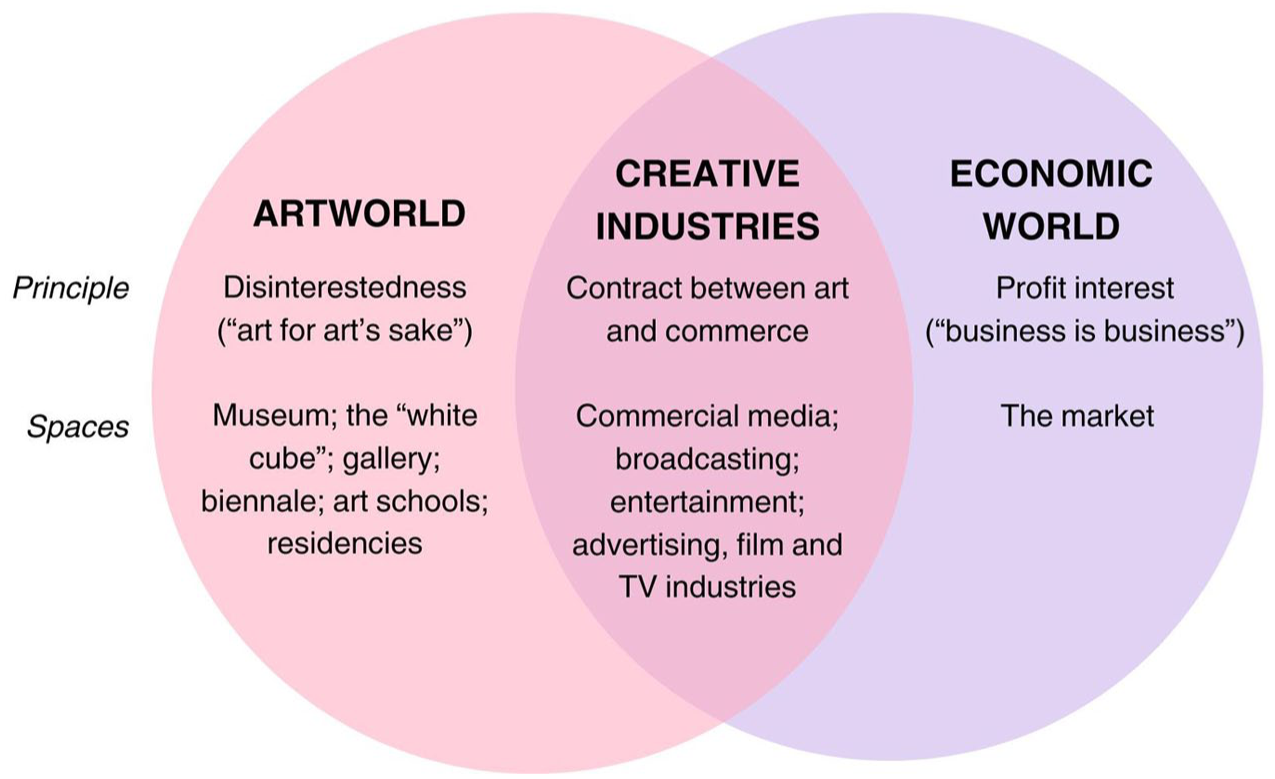
Defining the fields and their intersections.
Four keywords
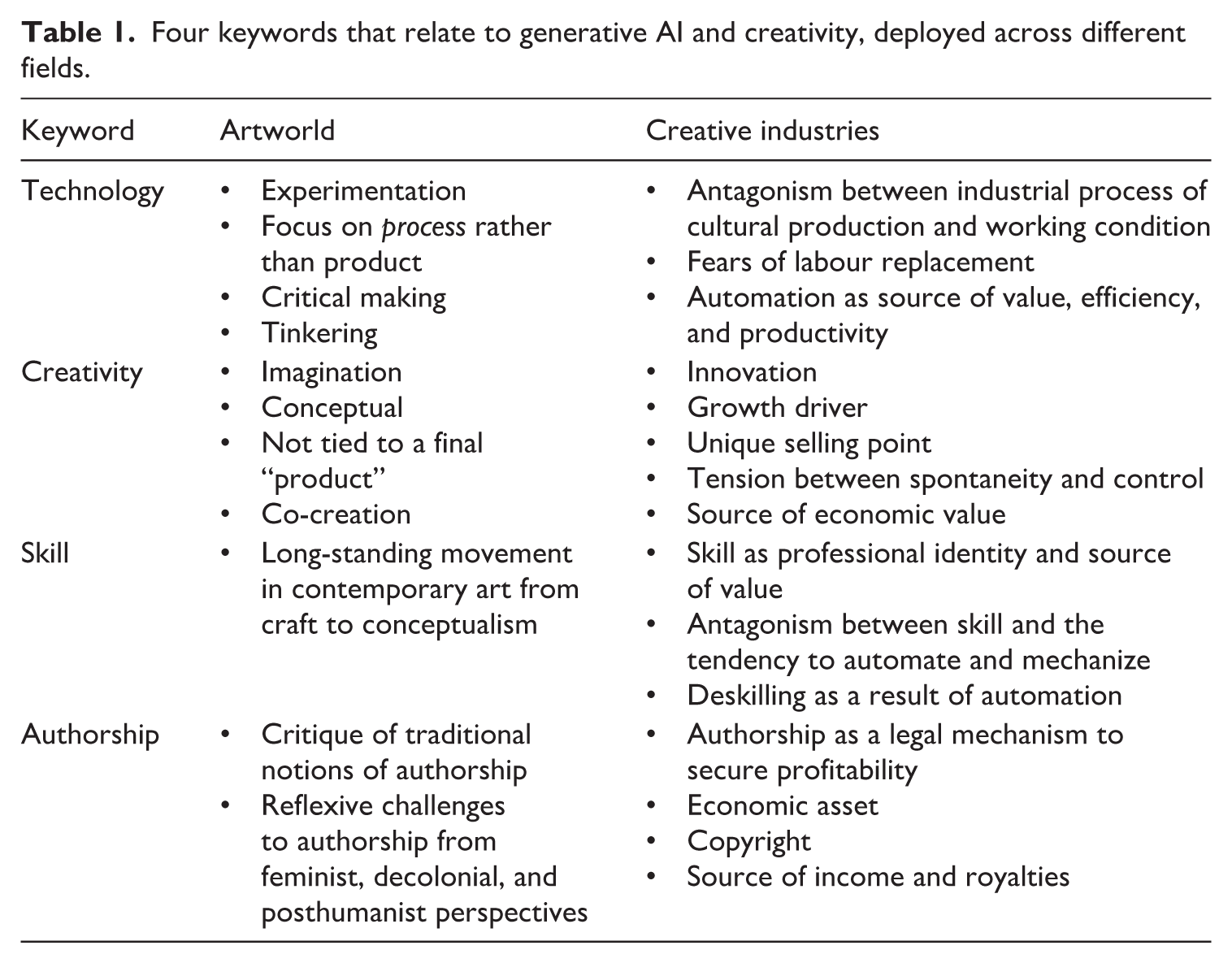
Four keywords emerge from our articulation of the boundary between the creative industries and the artworld, specifically regarding the links between technology and creative practices that guide current debates in both fields. To better differentiate between the two, we examine how practitioners, researchers, and pundits in each of them discursively engage with the following keywords: technology, creativity, skill, and authorship (see Table 1). Each of these keywords appears frequently in their respective discursive terrain, particularly as the dust has yet to settle around the impacts of generative AI on both fields. Essentially, we argue that each field perceives this phenomenon differently due to their own history, rules, material conditions, and conceptual approaches. Greater interdisciplinary sensitivity to the differing (and shared) concerns might bridge gaps in our critiques and contribute to a pluralization of perspectives on generative AI and creative practices.
Four keywords that relate to generative AI and creativity, deployed across different fields.
Technology
The first keyword, “technology,” is perhaps most salient in the context of AI and is one that has generated robust responses within both fields over time. Yet practitioners and scholars in these two fields have very different relations to technology, with the artistic approach viewing technology largely as a material object that holds critical potential for the exploration of new aesthetics of (un)making media. Because of its relative autonomy from the economic world, the artworld’s relationship to technology is not subordinate to the principles of efficiency and profit. For example, the emergence of new information technologies such as computers, Internet architectures, and software was already the opportunity for new artistic experimentation (see e.g. Bertram and Montfort’s (2024) collection of computer-generated text since 1953). Such dispositions explored the boundaries of how technologies were intended to be used—and often did so against the grain (Pereira et al., 2022). This tended to create novel collaborations between artists and scientists, for example, between concrete artist Waldemar Cordeiro and physicist Giorgio Moscati in Brazil in the 1960s (Fabris, 1997); or through scientist-artists, for example, the Dutch computational linguist and artist Remko Scha. Within the artworld, artists may seek to experiment with the limits of these technologies and to reimagine their utility. Importantly, artistic practices value the process, rather than the outcome, of technologies. This is why so many artists working with AI today, such as Jake Elwes or Nouf Aljowaysir, tend to centre the processes of data collection and model training as the work itself.
The entanglement between creative and economic rules in the creative industries restricts the experimental uses of technology that characterize the artworld, subordinating its application to principles of efficiency and profit. This translates into a more antagonistic relationship between technology and creativity than that of the artworld. On the one hand, technology is perceived to reduce production costs, expand distribution, and replace expensive and time-consuming labour processes. On the other, technologies appear to offer new creative avenues and forms of expression for practitioners. Both promises of technology are not always compatible and tend to create nodes of tension between the creative and the economic rules guiding the field of the creative industries. The studio system in advanced film industries, for example, has been characterized by a Taylorist mode of production, where the process of film production mimics the factories that produce consumer goods en masse in industrial economies. Within this stand the creative labourers (be they actors, editors, lighting crew, screenwriters, etc.), whose jobs have at many historical junctures been at risk of replacement by technological advancements. The highly publicized strikes by the Writers Guild of America and SAG-AFTRA in 2023 (Grohmann et al., 2025) were hence not the only time that creative workers withdrew their labour in protest against new technological challenges (Banks, 2010). While AI is the focus of this latest labour dispute, the film industry has, at various points in time, demonstrated a more antagonistic relationship to new technologies: the introduction of recorded sound, television, cable television, digital distribution, each of which threatened to severely disrupt labour conditions.
Despite these disruptions, it is important to note that the creative industries have not shied away from technological advancements as integral parts of the creative process; rather, what is significant are the ways by which groups of creative workers have been disadvantaged in the face of new technological tools, whether by wage suppression, enforced job displacement, or ever more precarious and contingent employment terms. With AI, creative workers continue to fight the threat of labour replacement or devaluation by sophisticated automation and algorithmic tools, whether it is in the form of AI-generated voice dubbing capabilities, synthetic actors, or AI-generated screenplays, to name but a few (Bender, 2025).
Creativity
The English term “creativity” only became popularized in the 1950s as a consequence of Guilford’s speech at the American Psychological Association (Kaufman and Glaveanu, 2019). Creativity began as a concern for the field of psychology (Guilford, 1950) and only from there expanded into other fields (Gaut, 2010). Correspondingly, the first attempts to bridge creativity and artistic practice also came from the field of psychology (Csikszentmihalyi, 1965; Guilford, 1957; Tomas, 1958), and were initially absent from the fields of art theory, art history, or art criticism. The entanglement between creativity and artistic practice developed beyond the limits of psychology in the 1980s and 1990s through two parallel movements: the emergence of art education as a self-standing discipline (Eisner, 1987) and, most significantly, the rise of the “creative industries” as a new economic sector (Hesmondhalgh, 2008). This means that before the 1980s, the concept of creativity was not part of the language of artists, art critics, art connoisseurs, and the art public in general. Consequently, the “artworld” developed its conceptual apparatus without resorting to such a concept. This is an important acknowledgement for at least two reasons. First, it denaturalizes the link between artistic practices and creativity that seems so obvious nowadays, placing this link within a very recent history. Second, it highlights the boundary between the creative industries and the artworld based on their specific relation to the concept of creativity.
For a long time, the debate regarding the relationship between art and technology did not refer to the concept of creativity for the simple reason that this concept did not play a dominant role in the language of the artworld. During the 19th century, for example, the act of artistic creation was instead understood through the notion of imagination. Within this context, imagination was defined as a “mysterious faculty” that linked artistic creation to metaphysical and moral questions (see, e.g. Baudelaire’s (1956) Salon de 1859). The problem is that today both terms are used as synonyms (Gaut, 2003). But conflating the two conceals the specificity of how the artworld has historically understood imagination and imposes the framework of the creative industries as the norm. What characterizes the creative industries, Bröckling (2016) notes, is that creativity occupies an ambiguous position—it is simultaneously something that needs to be controlled or operationalized as an asset and something that needs to remain spontaneous in order to have any value. Furthermore, with the global expansion of the creative industries, creativity becomes a buzzword that conveys values of progress, freedom, prosperity, and innovation (Flew, 2010; Florida, 2012). Yet the euphoria of the term is used in part to conceal precarious working conditions (McRobbie, 2016), cloak the more concrete and material realities of creative labour (Chow and Celis Bueno, 2025), and blur the boundaries that have historically defined the relative autonomy of the artworld. In market-speak, creativity is also operationalized as a driver of growth and as a unique selling point that one has over one’s competitor. In this sense, current discourses by tech giants take this process further, positioning their AI tools as a way to expand creativity from the fields of the artworld and the creative industries into everyday life, turning every user into a potential “artist” (Kemper, 2025).
Skill
Similarly to the case of creativity, the creative industries have an ambiguous relationship to skill. On the one hand, skills are a fundamental aspect of creative labour and function as a key source of value in the creative industries. To possess specific creative skills, such as the ability to skilfully operate a camera or to write a story that relates meaningfully to readers is to define one’s professional identity as a photographer or a writer operating within a capitalistic media industry. As such, skills need to be safeguarded, reproduced, and stimulated. On the other hand, the economic imperative of the creative industries pushes for broader control of the labour process, increased division of labour, and the capturing of skill through technologies of automation (McKinlay and Smith, 2009). These tendencies are often translated into a general process of deskilling creative workers (Sonn et al., 2019). At a discursive level, proponents of the creative industries tend to highlight the fact that human creative labour is immune to the risks of automation and deskilling (e.g. Florida, 2012). The platformization of cultural production (Poell et al., 2022) and the recent rise and massification of generative AI tools, however, seem to challenge this belief, exposing creative labour to similar processes of deskilling than those that have long existed in other economic sectors (e.g. Omidi, 2026; Steinhoff, 2024). This leads to a general devaluing of creative labour and a more precarious bargaining position regarding working conditions within the creative industries.
In the contemporary artworld since the 1960s, conceptualism has largely come to dominate over style or the material, finished artistic object. This means that skill and craft have long been devalued, or at least moved to the background of contemporary art practices. Specifically, contemporary art movements not only devalued traditional skills that required disciplinary training (i.e. in an art school or apprenticeship) but also expressed this as a conscious rejection of traditional training and, by extension, of capitalist industry (Bishop, 2011; Burn, 1999). A foundational moment is Marcel Duchamp’s ready-made Fountain (1917), which, through its tactic of appropriating an everyday object, helped to shift the means and processes of art from the romantic imaginary of the distant artist. Rather, in Duchamp’s own words, the ready-made is “a work of art without an artist to make it,” helping to de-deify the artist and lower their status in society (Roberts and Duchamp, 2019). This perspective has helped give rise to a variety of forms of art, including the socially and research-oriented practice of artists such as Andreja Kulunčić and Rosana Paulino.
The deskilling discourse from the creative industries, then, makes less sense when talking about artistic practices that have long used mass-produced images, “ready-mades,” appropriation, and automation as core tactics. Crucially, these different tactics are used as critical and reflexive processes to unsettle societal assumptions through social and cultural critique—for example, Warhol’s Brillo boxes comment on images and consumerism. The art made with AI today uses similar critical approaches to experiment with computation. While an artist could mindlessly generate a multitude of images using AI, the craft is not in the operationalization of machine results into “pretty” or “realistic” images, but in the conceptual operation behind the artwork. Take for example Flora Rebellis (2022) by artist and scholar Giselle Beiguelmann, where she uses AI to generate videos of plants. The generative videos result from a long process of collecting and experimenting with “datasets of plants with offensive and prejudiced names for women, Blacks, Jews, indigenous people, Roma, Sinti and Caló (‘gypsies’)” as well as how contemporary algorithmic techniques resemble the racist forms of statistical correlation developed by the eugenicist Francis Galton (cf. Chun, 2021). This work exemplifies how the deskilling narrative from creative industries would fail to account for the intellectual and critical craft that differentiate artistic practice from mere image generation.
Authorship
The relative autonomy of the artworld has created a curious milieu in which individual authorship can be explicitly criticized and rejected, while individual artists can still acquire symbolic capital from the process. Appropriation art, for example, blurs the boundaries between authorship and the (often uncredited) reuse of existing materials. Duchamp’s Fountain is again a historical example, but this relationship to authorship continues today through Barbara Kruger’s collages or Gustavo von Ha’s remediation of memes. The reversal of the economic principles in the artworld means that authorship is not translated directly into an economic asset. Instead, authorship can be suspended while symbolic capital can still be accumulated by an individual artist. This symbolic capital can then be exchanged for other forms of capital, and funding can be secured through other means such as residencies, commissions, fellowships, research posts, exhibitions, etc. The entanglement between technology and artistic practices has also contributed to this particular rejection of authorship in the artworld. Cornelia Sollfrank’s net.art generator (1997–) used emerging internet technologies to randomly create new artworks based on basic user inputs and the resulting images from a Google Search. As Sollfrank (1997) puts it, “a smart artist makes the machine do the work.” Although the artist takes credit for the net art generator, she shares the authorship for each individual output with the user, the machine, and all the images that have been used. In some of these cases, the redefinition of authorship is seen as a feminist rejection of the patriarchal notion of authorship that historically defined the artist as a genius and artistic creation as a lonely and self-sustained process (creatio ex nihilo). This gives continuity, thus, to Zylinska’s (2020) argument that technical automation contributes to a decentring of the humanist notion of authorship, calling for a posthuman theory of creativity in which authorship results from a network of human and non-human actors.
In the creative industries, authorship takes on a clearly economic character. That is, authorship is framed as a legal mechanism through which the economic valorization of a cultural product can be secured. Authorship matters because it ensures the direct link between creative labour, income, and profitability. The idea of the “author” of a creative work carries considerable weight as establishing authorship then has implications on legal ownership of copyright, intellectual property, and royalties—and inevitably here we are concerned with the income of creators, publishers, and related entities. In this context, the weakening of the notion of authorship is seen as a direct threat to the very condition of creative labour as a source of economic capital. In the late 1990s, online sharing of music and films led to debates and legal actions to protect the profit of big studios and media companies (often in the name of individual artists). Today, we see a reversal of this scenario, where big AI companies train their generative models using copyrighted materials without any form of attribution nor compensation, frustrating authors’ attempts to maintain control over the distribution, use, and ultimately the ability to profit from their creative labour. As of January 2026, there are well over 50 lawsuits against nearly all AI software companies for copyright infringement (AI Watch.dog, 2026). These legal struggles over authorship and copyright in the context of AI-generated images, text, and sound can be read as a fight to recenter the human author and their creative input against AI systems created by tech companies that have thus far paid very little heed to the rights of authors. While AI companies market their tools as means of “democratising” the making of creative work (Celis Bueno et al., 2025), speaking to distributed or transformative forms of (co-)authorship that depart from conventional frameworks, there is little evidence of the alleged openness promised here. Instead, as Andrejevic (2013: 124) deftly notes, these are simply “new forms of privatization [. . .] based on the collection and aggregation of personal data.”
Conclusion
In this essay, we offer more granular definitions of four keywords frequently used in discussions around generative AI and creative practices. In the heady rush to conceptualize and explain this new technological moment, we urge fellow scholars to pause and attend to the words and notions that have seemingly become common coin—à la Raymond Williams. We believe that doing so can activate new engagements between disciplines, perhaps changing the way researchers might observe, analyse, and generate knowledge about the entanglements between generative AI and creativity. In our view, a basic delineation between the artworld and the creative industries (Figure 1) is necessary to first establish how each field operates according to different principles and materializes in different contexts and spaces (Table 1). Following this, we can then begin to clarify how the vocabulary used to describe generative AI—our keywords—changes in meaning and focus across these two fields.
To be clear, our intent is not to defend one perspective as opposed to another, or to oversimplify these two complex fields, but rather to consider how their different trajectories may inform future research. By understanding how these fields and their concepts intersect and diverge we may ask better, more informed questions about current technological developments and how they are differently situated.
While we have explored just the four keywords in this essay, we are cognizant that there are other concepts that would benefit from the same scrutiny. There is no doubt that over time and as AI technologies evolve, so too will the meanings and valences of each keyword morph as disciplinary discourses respond to new phenomena. It is thus an ongoing project to continue exploring productive, interdisciplinary ways of describing and critiquing generative AI’s impact on creative work and media production.
Footnotes

Ethical considerations
Not applicable.
Consent to participate
Not applicable.
Funding
The authors disclosed receipt of the following financial support for the research, authorship, and/or publication of this article: This work was supported by the NTU Social Science and Humanities Research Seed Grant [award number 2024-CoHASS-013] and NTU Start-Up Grant.
Declaration of conflicting interests
The authors declared no potential conflicts of interest with respect to the research, authorship, and/or publication of this article.