




Abstract
Creative intermediaries are increasingly recognised for their role in facilitating the growth and development of creative entrepreneurs and creative and cultural industries. There is also a growing interest in the role of creative and cultural industries in developing economies, for economic development but also cultural engagement and social change. In this article, we bring a Global South perspective to the study of creative intermediaries in the craft sector by exploring how they engage with makers and markets for craft products in Cape Town, South Africa and beyond. Using qualitative interviews with key players from four intermediary organisations working at the community level through to luxury export, we present their different business models and approaches to supporting the development of the craft sector and makers. We reflect on the role they play in addressing inequalities, especially in opportunities to access craft careers and develop sustainable livelihoods for disadvantaged communities. We also consider some of the key challenges these intermediaries face in relation to policy, infrastructure, finance and global competition. The article argues for the value of adopting an ecological perspective in studying the role of craft intermediaries to recognise their role in addressing inequalities in accessing craft careers and the importance of support for makers at different stages in their professional development.
Keywords
Introduction
This article connects with the growing literature that explores the role of creative and cultural industries (CCIs) in local development, focusing specifically on South Africa (SA) (Abisuga-Oyekunle and Sirayi, 2018; Snowball et al., 2017). Within the broader area of research, the craft sector has been upheld by many policymakers and development agencies (UNDP and UNESCO, 2013) for its potential to create jobs and opportunities for international trade (UNDP and UNCTAD, 2010), especially in contexts of countries with high levels of inequality and poor infrastructure (Rhodes, 2011). Many authors highlight how the craft sector can contribute to rebalancing inequalities by generating income and employment opportunities, particularly for disadvantaged urban and rural communities, and especially women, youth and those operating in informal economies; this is facilitated by low access requirements in craft, with capital, education, resources and equipment often passed on within communities (Nyawo and Mubangizi, 2015; Pereira et al., 2006; Rogerson, 2000; Shackleton and Shackleton, 2004).
Connections have been made between formal and informal craft economies and creative tourism opportunities in rural areas (Nyawo and Mubangizi, 2015; Rogerson and Sithole, 2001) and cities where there are vibrant tourist hubs (Booyens and Rogerson, 2015). However, the opportunities to pursue a craft career or develop a sustainable livelihood from craft are not only down to the individual or groups involved. Recent research on the CCIs (Comunian, 2019) has highlighted the importance of adopting a complexity perspective when researching the sector and the importance of looking at creative economies as ecosystems (de Bernard et al., 2021). Building on this framework, we acknowledge that current research has concentrated on both the micro (individual) experiences and the macro (policy and markets) structures concerning the craft sector. In the SA context, this includes studies on the experiences and challenges of craft makers in emerging and informal economies (Abisuga-Oyekunle et al., 2021; Rogerson and Sithole, 2001) and policy frameworks at national and local levels (Rogerson, 2010; Rogerson and Rogerson, 2011) supporting skills development and employment creation initiatives. These are often targeted at persons from disadvantaged backgrounds, focusing on gender, racial and socio-economic inequalities and their intersections (Abisuga-Oyekunle et al., 2021). However, there has been a lack of research on the meso-level, looking specifically at networks, intermediaries and other organisations that contribute to the development of the craft sector. This article aims to specifically address this research gap and reflect on how this meso-level connects not only with questions of career or business development but also with issues of diversity and inequality in the opportunity to access sustainable craft careers.
The article is structured in four parts. First, we review the connected literature. Here, we recognise that it is important to reflect on the role of craft in local development, with specific reference to SA and the role of intermediaries in the CCIs. We also reflect on the current research on diversity and inequalities in craft careers in SA. In the second part, we introduce the methodology adopted by the project and the data used. We also provide more detailed information on the SA craft sector and Cape Town as the location of the four key craft intermediaries that are the focus of the article. In the third part, we present the key findings concerning the business models and mission of these craft intermediaries, their work to support and develop the sector and their interconnection with the broader ecology both within and beyond the city. In the ‘Conclusion’ section, we reflect on what we learnt about craft intermediaries through the analysis and how their work connects with diversity and inequality in the sector.
Craft, development agendas and intermediaries
The role of craft in local development and the challenges of diversity in South Africa
Academic and policy literature engage with contradictory dynamics. On one side, there is recognition that crafts – such as weaving (textiles), pottery (ceramics), jewellery (metal/natural resources), basket making (natural resources) and others – can play a significant role in local development because of their low infrastructure requirements and connection to a range of development agendas (Abisuga-Oyekunle et al., 2021); on the other side, acknowledgement that a lack of infrastructure, sector fragmentation in micro and small enterprises and its informality often makes it very hard to capture its impact and value (Bennet, 2020).
In the specific context of SA, there is an emphasis on how the sector connects with a range of overlapping policy agendas. These can be summarised under four headings, although many of them connect across policy fields. First, as an economic activity, craft can connect with economic policy. It is promoted as an opportunity for poverty alleviation, and Nyawo and Mubangizi (2015) reflect on how this can be maximised in connection with tourism and its economic multiplier effects. Furthermore, the opportunity offered by low start-up costs and investment is used to present craft as a promising business opportunity across a range of diverse social groups, often from disadvantaged backgrounds. This also connects with opportunities to bridge rural and urban economic divides (Nyawo and Mubangizi, 2015). However, Rogerson and Rogerson (2011) consider it a limited policy option for economic growth.
Second, craft is seen as an essential aspect of education policy. The scope to offer specific craft skills and training is important as part of inclusion policies (connecting to social and economic policies). Moreover, expanding creative education in Africa in general (Comunian et al., 2021b) seems an important response to engage its growing youth population. This builds on work suggesting that traditional and transferable skills offer a valuable entry point for education in general (Cultural Strategy Group, 1998). Third, craft connects with social policy and is recognised as critical opportunity to respond to issues such as youth unemployment, connecting to further opportunities for job creation (Abisuga-Oyekunle and Fillis, 2017). The gender and diversity agenda is also crucial in relation to craft and the social; the sector has been considered accessible to often marginalised groups in many informal ways (Rogerson and Preston-Whyte, 1991) and as having potential for women’s economic, psychological, social and political empowerment (Scheyvens, 2000). Finally, craft is a pillar of SA cultural policy development. By connecting with cultural heritage and making traditions as the foundation of African cultures and communities, ‘this can add value by connecting with opportunities for cultural participation and bottom-up engagement in inclusive and participatory forms’ (Abisuga-Oyekunle et al., 2021: 138). In cities, such as Cape Town, there are further connections with strategies for creative place making, creative-led urban regeneration and tourism (Booyens and Rogerson, 2015), and support for CCIs in economic and cultural urban cultural policy (Minty and Nkula-Wenz, 2019).
While it is clear from these arguments that craft offers a range of opportunities, there has been a lack of formal interventions and policies for the sector in the past decade in SA. This builds on the international tendency to undermine the contribution of craft to the CCIs because of its informality and large number of micro-enterprises, which are hard to capture in data mapping exercises (Kaiser Associates, 2005). Therefore, the management of the sector is often left to informal networks or local communities (Snowball and Mapuma, 2020).
Recently, the South African Cultural Observatory (SACO, 2019) provided a statistical overview of the craft sector, highlighting some interesting workforce dynamics. The Visual Arts and Craft (VAC) domain is one of the most ethnically diverse cultural occupations, with 82.4% of workers being ‘Black African’, 10.9% ‘Coloured’ 1 people, 1.2% of Indian/Asian origin and only 5.6% ‘White’. However, there is a ‘lower proportion of young people (30%), but a higher proportion of middle-aged (35–49 years old) workers (44.4% in the VAC domain, compared to 38.7% in cultural workers overall)’ (SACO, 2019: 17). Furthermore, older women are more heavily involved in the sector than young women. Nyawo and Mubangizi (2015) present other data in their study of the KwaZulu-Natal region. They suggest that the craft sector is perceived as the domain of women, although there are disciplinary divides – men dominate sub-sectors such as woodcarving, metalwork and painting. They also highlight that 90% of crafters only have very low levels of education and that for 60% of their households, there are no other forms of employment or income beyond that derived from craft (Nyawo and Mubangizi, 2015).
As it is clear from this initial overview, there is a wealth of research on the micro-dynamics and individual dimensions of craft businesses (alongside research on how they can be supported); similarly, there are contributions at the macro level considering the role that policy (across a range of policy areas) can play and the way it connects with the sector. However, it is interesting to note that much less attention is given to the meso-level, looking at networks and intermediaries operating in the sector and their potential role.
Craft and creative intermediaries: definitions and roles
Comunian et al. (2021a) highlight the importance of creative intermediaries in supporting the development of the creative economies in Africa. They consider how there has been a shift within our understanding of intermediaries from both the traditional cultural intermediaries that Bourdieu (1984) studied and more contemporary studies (Maguire and Matthews, 2014) which continue to focus on curatorial/taste making and gatekeeper functions. This development means that intermediaries are now not only mediating and translating cultural content from producers to audiences and markers; they also take a proactive role in supporting producers and product development (Comunian et al., 2021a) and in connecting communities to creative economic activity (Jones et al., 2019). Jakob and van Heur (2015) identify various kinds of cultural or creative intermediaries: ‘arts and cultural councils, policy networks, economic development agencies, foundations and unions to artist collectives, cultural centres, creative industries incubators, festivals and tradeshows’ (p. 357). Comunian et al. (2021a) further articulate the ways intermediaries in the creative economy operate across a range of sizes, business models and services, from individuals providing training or consultancy to large publicly funded organisations with a remit to distribute funding and provide feedback to CCIs. Finally, they suggest that intermediaries intervene and support CCIs in many ways, but these can be categorised in five broader groups: space and equipment; finance; business advice and guidance; training and skills; and networking and partnership (Comunian et al., 2021a). Following this approach, we explore craft intermediaries as creative intermediaries’, assuming roles here go beyond traditional cultural intermediaries curatorial/gatekeeping functions.
In this article, we provide more details on a sub-group of creative intermediaries, craft intermediaries, here defined as individuals and organisations that interact and connect across the ecosystem (de Bernard et al., 2021). In the craft sector, this includes policy and businesses as well as individual designers and makers, but can also engage other cultural resources and actors, such as youth organisations, schools, freelancers and community networks (Gross and Wilson, 2019) and more, as visualised in Figure 1. They intervene across a range of specific agendas, generally summarised as supporting the creation, promotion, access and distribution of craft through support and guidance provided to makers.
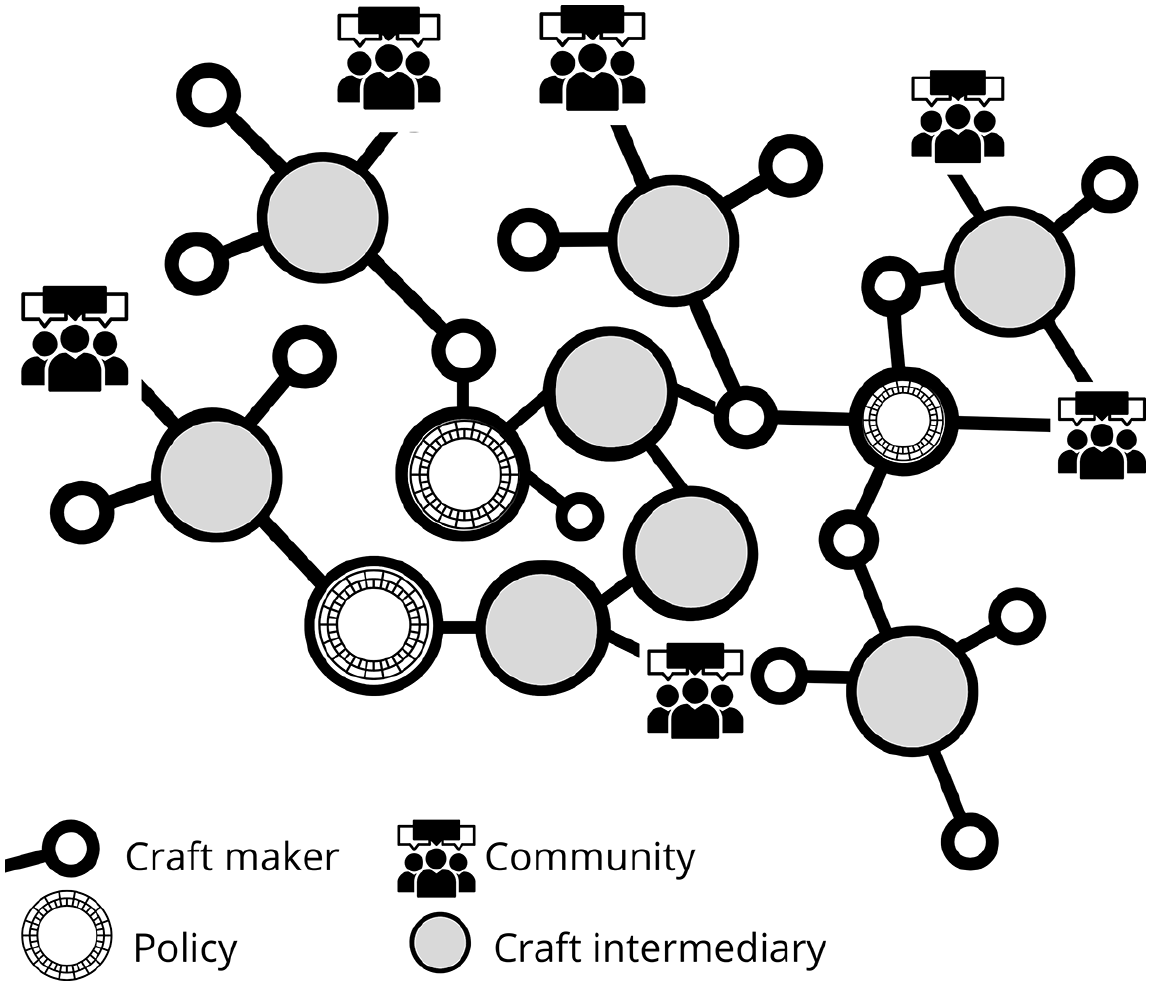
Craft intermediaries in local and national craft ecosystems
This does not mean that our traditional understanding of cultural intermediaries (Bourdieu, 1984) is no longer valid. In fact, in many areas of the cultural and creative ecosystem (de Bernard et al., 2021), cultural intermediaries continue to play a vital role in defining, mediating and setting trends (Maguire and Matthews, 2014; Shultz, 2015). However, we acknowledge that changes in our societies indicate that alongside traditional and new cultural intermediaries, there is now a wider group of intermediaries that act and interact across the sector without necessarily being concerned with the cultural content of what has been produced. They are central in supporting the ecosystem, but rather than positioning themselves between producers and consumers – translating content or defining cultural value – they tend to position themselves alongside producers – facilitating access to a range of support – or ‘behind’ producers, providing finance, advice or other forms of initial training. As illustrated in Figure 1, craft intermediaries interconnect across communities, policies, craft makers and among themselves, to facilitate the development of craft; depending on their specific focus, they engage with all (or some) of the social, cultural, education and economic policy frameworks developed nationally or at the city-region level. Their work to support access and diversity often overlaps with policy initiatives and frameworks across socio-economic, cultural, educational and economic development agendas and therefore it is important for both craft intermediaries and policies to be in constant dialogue. Similarly, their access to specific communities or specific craft makers can enable broader reach and engagement for policy initiatives, as illustrated in Figure 1.
Overall, the role of craft intermediaries seems to be enhanced by some structural conditions of the craft sector in emerging economies like SA. First, while products have the potential to have high-end value (due to the unique skill and tradition they embody), they also tend to be located very far from their potential market – in remote rural communities nationally and also globally. Second, as is recognised in the wider craft literature, there is a perceived and actual lack of business/entrepreneurial skills among makers (England, 2022; Naudin and Patel, 2020). This is potentially heightened in emerging economies where training and higher education (HE) is less accessible to low-income sections of society. Third, the sector builds on a diverse tradition of highly skilled making across the continent. Craft intermediaries are well positioned to value (or re-value) those skills and traditions, building on the infinite variety of the products (Caves, 2000) to overcome increased competition at the international level. Finally, the grassroots nature of the sector, which builds on learning opportunities across communities and the informal transfer of skills and knowledge, has the potential to be maximised or developed further professionally to reach new markets.
Methodology, case study and research participants
Research and methodology
The article presents findings from fieldwork undertaken in SA as part of an AHRC (Arts & Humanities Research Council in the United Kingdom) funded project. 2 The broader project aimed to map creative economies development and investigate the role of intermediaries across Africa, focusing on three countries (Kenya, Nigeria and South Africa) and using qualitative methods to understand: (1) their work and business models, (2) the opportunities and challenges they deal with and (3) their relationship with national and international policy for the development of creative economies in Africa. In SA, a specific focus on craft was identified through an initial review of the literature (Abisuga-Oyekunle and Sirayi, 2018; Rogerson, 2010; Rogerson and Rogerson, 2010, 2011). This article is informed by the broader learning and data collection of the project (see Comunian et al., 2021c), but focuses specifically on rich reflections from four in-depth semi-structured, audio-recorded interviews with craft intermediaries in Cape Town. In three cases, the interviews also included some ethnographical and observational elements as the interviewees took the researchers for a tour of the organisation’s venue and activities to observe them taking place.
Case examples and research participants
Cape Town was chosen as a site for investigating the role of craft intermediaries for a range of reasons. The city is considered a hub for the SA creative economy alongside its capital Johannesburg (Oyekunle, 2017), and many authors have identified the potential of the creative economy locally because of the opportunities offered by tourism (Booyens and Rogerson, 2015). However, questions have been raised about how this might also connect to new patterns of exclusion and inequality (Booyens, 2012) and potential gentrification, as in the case of the Victoria & Albert Waterfront development discussed by Ferreira and Visser (2007). Recent research also reviews how the awarding of World Design Capital in 2014 to the city (the first African city to be awarded the international title) has affected its image and recent development (Nkula-Wenz, 2019). This includes the city entering the United Nations Educational, Scientific and Cultural Organization’s (UNESCO) Creative Cities Network in 2017 as a ‘Creative City of Design’, ‘staking a further claim towards its position as the preeminent creative city on the continent’ (Nkula-Wenz, 2019: 13).
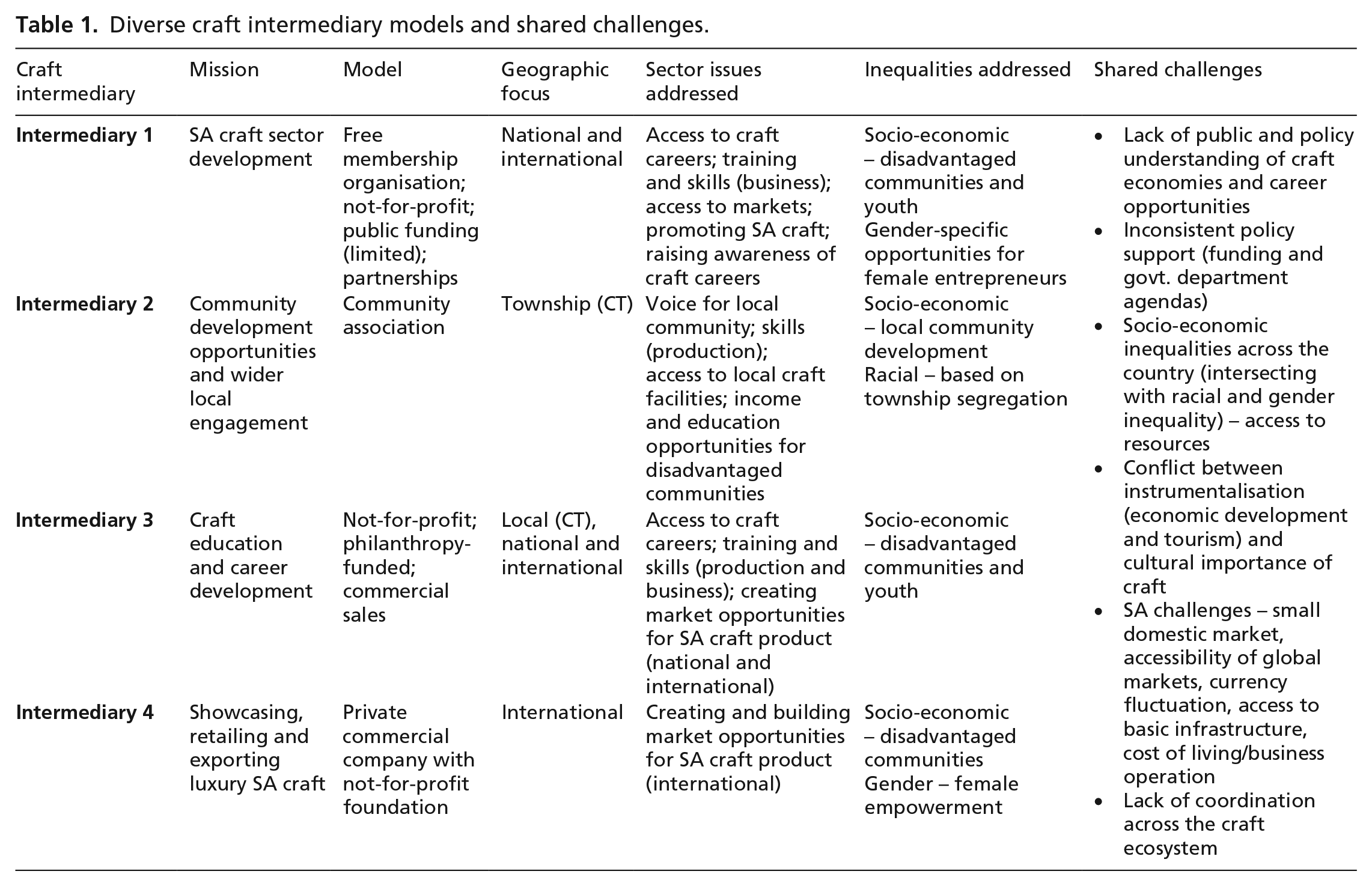
The new image and place branding opportunities enjoyed by the city do not always answer or engage with questions of access and inclusion. The regeneration has taken place at the Waterfront, while most of the non-white population still live on the urban periphery in racially segregated, overcrowded residential neighbourhoods that remain underinvested today (Seekings, 2011), as per the apartheid (1948–1994) design. Although the potential is there for tourism, place image, regeneration and international branding to have a broader impact on local craft and designer-makers and designers, this potential is often not realised. While the city of Cape Town is not the focus of our analysis, craft intermediaries based in Cape Town present valuable examples from which to reflect on local craft economies and inequalities. They also provide scope to reflect on wider SA craft sector development, connected with the wider national and international remit and engagement of some of the craft intermediaries located there (see also Table 1).
Diverse craft intermediary models and shared challenges.
In this article, we argue that between the wider (macro) policy initiatives and changes and the individual (micro) stories, careers and businesses of craft and designer-makers, it is important to consider what role craft intermediaries play or might play. The main research questions were (1) what is the role of craft intermediaries in sector development, especially concerning issues of access and equality, (2) how do they operate and what business models do they adopt, (3) how do they work as part of a broader ecosystem – promoting equality and diversity – connecting with other intermediaries and policy?
Therefore, here we focus specifically on four craft intermediary organisations. We identified the four organisations through an extensive review of policy documents, public online listing and snowballing (from previous interviews with crafters). These craft intermediaries were also chosen as they represented a range of business models. For each organisation, we conducted desktop research, consulting reports, websites and social media activities. During the fieldwork in Cape Town, we conducted four face to face, in-depth, semi-structured interviews with the four craft intermediaries. To respect the anonymity of the individuals involved in these organisations, we identify the organisations with four generic labels, reflecting their organisational model: Intermediary 1: a not-for-profit (also receiving public funding) support development agency; Intermediary 2: a local and informal community crafters’ association; Intermediary 3: a philanthropy-funded educational craft project; Intermediary 4: a private business involved in showcasing, retailing and exporting SA craft.
The interviews were structured in three parts. First, we discussed their history, objectives and business model; second, we explored their work in detail with a focus on how they facilitated access, inclusion and development in the craft sector. Finally, we explored how they worked as part of a broader ecosystem connecting with other intermediaries and policy.
Table 1 summarises the mission and models of the four intermediaries, alongside the key sector issues and inequalities they addressed.
Craft intermediaries: mission and models
The four intermediary organisations had different histories, some longer and more stable than others. Intermediary 1 has been established for 20 years as a not-for-profit business model which strategically does not support their income by selling work: ‘we see ourselves as a facilitator and an intermediary, as soon as you trade, you have to take a position in the marketplace [. . .] And so people will fall by the wayside’. Their model shifted when the local regional authority changed its economic development strategy and ended their funding. However, they still did not shift to trading and instead kept facilitating rather than retailing. They developed new partnerships with other organisations: ‘In the last two years, I’d say the organisation has had to totally re-articulate from being in a, in a relatively well-resourced environment to a particularly under-resourced environment. And we had to build new partnerships’.
Intermediary 2 is a more informal community association bringing together the crafters of a local township. It has a more informal structure and community-led approach. It collaborates with the running of a cultural centre and so builds on existing resources to further develop craft in this context. This crafters’ association shapes the space where they operate, and their collective voice is heard because of their collective action: they were kind of stuck between the battle between the city’s intention here, which is how can we make this a nice space for tourists, [a local counsellor] had read it somewhere and he felt that this is what white people need to see when they come to townships. [. . .] this was so important when we set up the Crafter’s Association. It was really about how do you give these people the voice to kind of direct the space?
Intermediary 3 has been established for a decade following a fairly consistent business model based on the combination of ‘a very supportive patron network’ that sponsors the training element of their work. Building on that, income is generated by selling the work developed through the rest of the programme: ‘we pay for it through what we sell. So they make, we sell it in the market, and that then comes back. So in that sense, we’re not for profit, but we’re not an NGO’.
For Intermediary 4, the drive is a sustainable business model where retail, showcasing and distributing generates income for the organisations and the craft makers they work with.
Integrated with the retail business is a broader agenda: we’re promoting South African production processes, but also elevating the perception of craft in an art market. And those pieces are selling hundreds of thousands of dollars [. . .] every sale they keep an amount and that comes back. [. . .] And then we manage those projects for the shipping and dispatch here.
However, they also work on individual projects and development through a not-for-profit foundation; for example, they developed a programme mentoring craft and designer-makers ‘to elevate their business practices and to create sort of a network hub to progress their businesses’.
This overview tells us about the diverse nature of these organisations and their operating models – despite a shared agenda of supporting crafters, makers and designers in successfully delivering their work and products locally, regionally or internationally. The range of business models represented and their continuous fluctuation in response to the market, policy and funding also highlights how their work also diversifies continuously in response to the sector needs.
Craft intermediaries work: access, barriers and growth
Supporting access and openness to creative craft careers in SA
All the four intermediaries were concerned with the access point for craft makers and who gets to become one and make a livelihood in the sector. However, for two intermediaries (1 and 3), this was a core concern and developing skills and careers was central to their operation. They all recognised however, that there was a need for a multi-level career stage support and pathways through from entry-level (local) to global engagement, emphasising a holistic approach to career development. Intermediary 3, in particular, articulated having a responsibility in how they were training people, and how many, and where they would go on to: ‘we don’t want to be irresponsible, you know, so we feel the burden of what are they? How are they going to run this business afterwards?’ In terms of access, even considering craft as a career is seen as a barrier. As discussed by others in relation to other African contexts, one of the main barriers for young people is the stigma of arts and craft as careers (England et al., 2021; Obia et al., 2021). In the case of Intermediary 3’s training programme, the socio-economic background of applicants was considered, to facilitate access to a type of education they would have not been encourage to pursue.
As Intermediary 3 highlights, in their course recruitment, ‘Art is often obviously not taken very seriously [. . .] can you make a living from it actually?’ and when young people come for interviews, there is even questioning as to whether they told their parents what they are applying for. Furthermore, others noted issues of access in higher education and the general lack of investment in craft education in the country: ‘from a cost perspective, they’ve closed down the amazing ceramics, the facility in the university [. . .] there’s very little craft that can be studied’ (Intermediary 4). One method of addressing this was working with schools to raise awareness of craft careers and work with local community role models: ‘we do an enormous amount of work in getting school groups in. [. . .] to inspire and sort of, say, you can have a career you never even thought of’ (Intermediary 4). Intermediaries acknowledged, therefore, that providing access to creative careers was an essential first step to support an equal representation within the sector. As another intermediary (1) highlights, even this consideration about who might value education in arts and craft has potential connection with socio-economic inequalities: there was a big distinction between graduates and non-graduates. And that tended to be, because of South Africa, racially based [. . .] most of the non-graduates or people without a formal education were mostly black. That’s changed in the last few years.
This is the reason why opportunities for training, like the one offered by Intermediary 3, adopt a much broader approach: ‘it’s a very level playing field. [. . .] we want to give this opportunity to somebody who perhaps doesn’t have that chance’. There is a clear agenda for access and diversity within the objective of their work: ‘you are accepted here with no education. And obviously, this country is hugely damaged by the horrific structures for decades, that prevented any kind of just entry-level education’.
For Intermediary 3, the entry requirements are not linked to education necessarily, but still need to lead to the ability to become sustainable craft workers in the future: [. . .] We do not require an artistic background of any kind, we just need, you need to have good spatial understanding. [. . .] we have an entrance exam, very basic [. . .]. You don’t have to have metrics, so you didn’t have to finish school. But you do need to have a level of numeracy and literacy. Because you will need to develop quotes, you will need to engage a client by email or whatever. And so that’s what’s required.
Similarly, the more publicly driven intermediary (1) recognised the importance of leaving access open to a range of practitioners rather than imposing definitions or requirements in order to access support: we are a membership-based organisation. And we make absolutely no distinction as to what is craft any longer. We tried in the early days to, to work out what it was and how to define if you could be supported or not, that we now actually support, support anybody who’s looking for support (Intermediary 1)
However, this level of openness is also described by the most commercially driven intermediary (4), suggesting that a prerogative of craft itself might be in breaking some of the socio-economic barriers to access that are present in other sectors. They reflected: in terms of in our industry and [our organisation], there is no racism, there is no inequality, there is no difference, simply because as I say you don’t need a formal education, it is about sheer raw talent and experience. And it’s a beautifully unifying category. (Intermediary 4)
For Intermediary 4, this is also an important process for SA from a historical perspective, with the capacity to unify people across the craft industry as a ‘healing process’, addressing some of the barriers imposed previously by racial segregation and their legacies.
While access and openness offers an important first step for many to enter the craft sector, intermediaries also felt a responsibility to ensure this was sustainable in the long-term. In that vein, Intermediary 3 provides training and skills but also reflects on how this needs to be connected with career development: once you graduate with us, we have a fourth year, which is called the journeymen year, we will give you space free of charge, you can come work here. And we will use you on our commissions [. . .] we are giving them this training [. . .] but we’re also teaching them to work, in the working world (Intermediary 3)
For many, the priority is access to education. However, thinking critically about the sustainability of craft careers (England, 2022) has become an essential issue across many countries and also needs to be acknowledged in the context of SA. In fact, programmes that aim to integrate craft skills with business skills might be a more successful strategy, as discussed by Intermediary 1. While they have focused previously on business training, they recognise that there might be value in also delivering skills training to become more inclusive, especially in relation to youth. Similarly, Intermediary 2, which is more informal and community-based, saw its future role as a skills provider as a means of truly showcasing how its craft members are not simply makers but facilitators of broader access and development agendas. This is particularly relevant in the context of townships as the organisation wants to be able to engage with ‘curriculums and schools, for arts and cultural industries and products’, supporting a broader movement that expands their remits from producing in the workshop to teaching crafts, arts and culture across the community.
Barriers to professionalisation and development
All of the intermediaries engaged in various ways in the professional development or business development of the craft and designer-makers they worked with.
As Intermediary 1 articulated, a key concern is not just creating products but how craft products reach their markets. They reflect on how their organisation, right from the start, chose a market driven approach: ‘that’s actually saying that access to markets [is] crucial, for producers to actually be successful’.
In a similar way, even the community-based Intermediary 2 explained the importance of setting local crafters on a development trajectory and thinking about their markets, even beyond those that are currently available. They questioned ‘how do you move beyond [township]? So how do you get to the Waterfront?’ The Waterfront was seen as ‘the pinnacle mountain’, however, they also acknowledged that this was not the aspiration for all crafters, and there was an understanding that personal and business development trajectories can vary between makers: I think if you understand, where do people want to go, [. . .] you allocate your efforts, it might not necessarily be a business plan, a website or social media, it might, that’s not appropriate to every possible crafter in the space. (Intermediary 2)
Here, development and growth are never perceived as a must, rather as an opportunity for the makers that aim to reach those goals.
Some of this agenda has been policy driven: ‘from a political point of view [. . .] it’s seen, rightly or wrongly, as an entry for people in terms of jobs and incomes’ (Intermediary 1). However, this instrumentalisation is often at odds with the cultural importance of craft, which in SA also has roots in the cultural division of the past. In particular, Intermediary 1 highlighted that in the days of conflict in SA, Indigenous culture was undervalued and ‘victimised’. Now, ‘there’s a strong push for, for sort of reclaiming Indigenous culture. And so, so craft from that point of view, is, is seen as a priority’.
Therefore, the development of the sector is also impacted by different agendas for what growth and professionalisation might look like and the motivation of policy to make the sector grow further: ‘there’s a confusion around how to actually work with the sector and deal with the sector, is it an economic sector? Or is it a cultural sector?’ (Intermediary 1)
So even in business support or development work, there is a struggle to understand equality and opportunities offered to the people working in the sector, especially at the start-up point, and even more so if crafters are coming from a disadvantaged background. This is strongly connected with issues of access and inequality. For example, people with more resources, coming from more privileged backgrounds, might have a garage or a spare room to work from and to get started. However, as Intermediary 1 highlights, ‘A lot of people who come from townships don’t. They’re really living in really small spaces [. . .] and electricity is very expensive. Transport, there’s no public transport. And it’s very expensive’. Consequently, the opportunities for people to establish a craft business are not open to everyone due to a lack of resources. The barrier to entry and to business development therefore remains very high for makers from disadvantaged backgrounds.
Growth: markets and internationalisation
Craft makers are also affected by the size of the local and SA market overall. This also depends on the stigma towards SA made products where ‘the market tends to sometimes think that buying goods that aren’t from South Africa are actually better than buying goods that are’ (Intermediary 1). Therefore, the work of intermediaries does also target the general public or market: ‘we’re promoting, again craft, we’re promoting South African production processes, but also elevating the perception of craft in an art market’ (Intermediary 4). More broadly, the objective is ‘actually getting people to understand the value of local and getting them to buy into it’ (Intermediary 1).
The SA domestic market is seen as a big problem and a structural one: ‘our market is small. [. . .] our middle class is not a middle class, our middle class is an upper class, the majority of people are poor’ (Intermediary 1). This means that inequality in craft can affect both supply and demand as the local population cannot access craft products due to the limited income and resources. There is subsequently very little economy of scale for the sector to grow and products are not seen as affordable by low-income households. Therefore, intermediaries have to address the challenge of thinking of external markets, which represent an even bigger challenge: we are way way, way more expensive than anybody else [. . .] South Africa is still considered a third world country [. . .] the length of time that it takes to ship and the cost of shipping. [. . .] we’re far, and we’re remote.
While these barriers are shared by craft makers across SA, they can certainly be more detrimental to the growth of businesses that already lack resources.
For one of the intermediaries (4), the agenda was the luxury market (being a commercial organisation) and internationalisation. This connects with the importance of adding value to the making process through storytelling and bringing craft to international markets so that their value can be recognised. Intermediary 4 is specifically concerned with recognising the quality and distinctiveness of craft: ‘none of this is mass production. None of this is even industrial design, it is all craft, but at the most exquisite level. [. . .] authentic, beautifully crafted product’ (Intermediary 4).
In many ways, this is the practice of a traditional cultural intermediary linking producers to market/audiences. However, the mission of the organisation seems much broader than this; they see their purpose ‘to really imbue the sense of the country and the history and story of the makers’. This is particularly important in adding value to craft products that might not be fully appreciated unless the intermediary can ‘really show where and how and who made these products’ (Intermediary 4).
Discussion: craft intermediaries in the broader craft ecosystem
The findings highlight how craft intermediaries are key players in the craft development ecosystem (Figure 1). They contribute at three specific stages of the crafters and craft business development: training and skills; business support and development; and marketisation and internationalisation. While they have different missions, business models and agendas (as summarised in Table 1), our findings show that the challenges they face are shared.
Some of these shared agendas and challenges mean that they also need to connect with each other, as well as with the broader policy infrastructure. In relation to their interconnection with each other, they often fulfil distinctive and complementary interventions to support access and diversity within the sector, from a crafters association (2) or a training programme (3) supporting the initial steps of makers, to a business support initiative able to make them grow or find suitable production space (1) to an international-reaching retailer and showcasing organisation able to launch them in international markets (4). However, this complementarity does not imply a linear development of the sector or the perspective that each small crafter needs to go up to the international stage. Similarly, moving up or across are sometimes not individual makers but ideas, projects or community groups. The concerns for access and diversity are, however, felt across the sector and the stages in which intermediaries operate.
All the craft intermediaries interviewed were aware of each other’s work, role and value in the broader ecosystem. Intermediary 4 reflected on their work with Intermediary 1 and considered how their work ‘dovetail[s] very neatly together’ and how they shared the same mandate but operated at different stages of the ecosystem: we’ve collaborated with them [. . .] their function is much more the development sphere. So they find people in early-stage, really give them the infrastructure, the opportunities to grow their capabilities. And we really are at the point where once they’re ready or starting to be ready, we train on the export side of things on export readiness. (Intermediary 4)
Similarly, Intermediary 1 reflected on the value of the crafters’ association (Intermediary 2) and approaching their space for running workshops and activities. Meanwhile, Intermediary 3 has recruited students for their training programme from the township of Intermediary 2 and have used their venue.
The intermediaries also recognised the challenge of the ecosystem and the survival not only of makers but also craft in general. They see the challenge to be the broader environment, the disengagement and slowness of public policy and the lack of a long-term vision for the sector in which intermediaries could thrive and cooperate, but also where diversity and inclusion could be more steadily supported. The collaborations identified above demonstrate some capacity for collective action among intermediaries, which could be developed further to leverage policy support and raise public awareness of the sector and career opportunities. There was however limited evidence of sustained, coordinated work or partnerships. This could partly be attributed to the varied policy and funding frameworks intermediaries operated under and the organisational challenges faced individually.
Intermediaries acknowledged that Cape Town had come a long way in the past decade and that policy has become more interested in the sector and its potential. There was also recognition of the importance of the Watershed development: ‘When I started 15 years ago, there was no way that 150 traders could have supported 364 days of trade a year [. . .] at the level that the Watershed is at now’ (Intermediary 4). Similarly, Intermediary 1 recognises that ‘Cape Town is really fortunate that we’ve got the Watershed, which is a massive tourist hub, and there are 150 businesses in there’. However, the contradictions and overlaps between culture, economic development, rural development and tourism, youth, and so on, takes its toll on the organisations involved. Intermediary 1 highlights that ‘having an integrative policy, that brings all of those departments together, and would be kind of, if it could be implemented, in a way would be transformative’.
So while policymakers are very interested in small business development, and are very interested in this emerging sector, especially building on the success of the Waterfront, there are also critical issues with how policy engages with both crafters and craft intermediaries. For Intermediary 4, this is also due to the reticence of policy to engage with certain expertise because it does not reflect agendas of representation and equality, despite being valuable: a reticence to work with the established figures because of those figures belonging, or seem to belong to a colonial [. . .] if you are white, there was a resistance to fund you, even if you have had the most experience [. . .] how do we solve this common problem? How do we talk? How do we get around the table and talk together? How do we make real difference that is economically sustainable? (Intermediary 4)
Craft intermediaries act as an important node in accessing finance and funding – which again often does not have clear frameworks in many African countries (Mokuolu et al., 2021). However, funding is not the only provision that is key to craft development; these intermediaries provide a richness of space, opportunities, markets and networks, which reflect the multifaced nature of intermediation in the CCIs identified by Comunian et al. (2021a). Sometimes, this provision includes very basic infrastructure which cannot be taken for granted in emerging economies, such as electricity, communication, logistics and retail space. Beyond acting as cultural intermediaries connecting markers and markets, craft intermediaries take the development of the individual marker and his or her skills or ideas as a core remit. They also help craft to navigate the volatile nature of markets and exchange rates to allow the product to reach international markets. While they recognise the limitations of the small domestic market of SA and the dependence on tourism and international markets, they also have at their heart the importance of educating future audiences for the development of the sector through exhibitions and partnerships with education providers.
Conclusion
This article has engaged with craft intermediaries in the context of SA and specifically Cape Town. It explored their motivation and business models and discussed their role and work in supporting crafters. It particularly considered their work in providing platforms to access craft careers that might bridge across socio-economic, ethnic and geographical barriers. Each of the intermediaries reflected on the inequalities affecting the development of craft in SA, from access to education and initial steps into the sector to resources and infrastructure for growth. These barriers were high on their agenda because of the history of racial segregation and contemporary (often intersectional) racial and socio-economic inequality in the country, but also because of the potential that craft might offer to build opportunities and bridges across these issues. The case studies of craft intermediaries were used highlight the different business models adopted and how each is catering to different stages of development or markets in the craft ecology. This diversity of agendas and interventions allowed intermediaries to address inequalities within the sector from different angles and contribute to expanding opportunities – especially for crafters from lower economic backgrounds or marginalised communities. It also provided chances for other barriers faced by makers to be addressed, particularly at stages of business development, growth and internationalisation. There was a complementarity in the work of craft intermediaries, intervening at different stages of careers and development but also engaging with specific provision, such as skills development or internationalisation to enable future development. Finally, their role could be seen in the context of a complex ecology (Comunian, 2019; de Bernard et al., 2021) which implies collaborations, diversification and support of craft intermediaries among each other. We presented some evidence of craft intermediaries working together, or at least signposting individuals to each other across the ecosystem.
However, overall Cape Town craft intermediaries recognised that the ecology is still fragmented, and more integrated development is needed. Here, we see – as identified also by Comunian et al. (2021c) – that policy can play an important coordinating and brokering role to enable collaboration, development and resource maximisation across intermediaries. This is specifically important in order to address structural inequality issues and barriers for craft makers from non-white backgrounds. The interventions of intermediaries – whether funding workshops open to all or setting-up interventions in townships where opportunities are scarcer – offered inspiring models of best practice for policy that could be encouraged more broadly.
Such encouragement can happen through funding and direct support, but recognition and validation were also really important for intermediaries to continue their work. Opportunities for craft intermediaries to think more strategically together about the development of the sector are an important next step. The different ‘ownership’ models also result in varying degrees of public policy engagement or recognition. This again does not seem to lead to a more coherent range of opportunities for development. However, they all appreciated that their role is about bridging divides and that the value of craft was in its ability to do so by being ‘something that is accessible by all and it’s also been sort of beautiful, boundary breaking’ (Intermediary 4). They also see the importance of the sector as inspiration for new generations that can bridge across the cultural and socio-economic divides of the past.
Policy could play a stronger role to establish a forum or collaborative platform through which intermediaries can share agendas, intervention and influence policy more directly.
Further sector research – such as that conducted by SACO – could provide a clearer understanding of craft economies and support integrated policies which acknowledge craft’s connections across economic, education, social and cultural policy. Across the sector, collective action of intermediaries could generate a louder voice (Tanghetti et al., 2022; England et al. 2022) in policy advocacy and strengthen connections between their services, providing clearer pathways into and through craft careers.
Footnotes
Author’s Note
Lauren England is also affiliated to King’s College London, UK.
Funding
The author(s) disclosed receipt of the following financial support for the research, authorship, and/or publication of this article: The authors would like to acknowledge the AHRC (Arts and Humanities Research Council) funded international research network “UNDERSTANDING AND SUPPORTING CREATIVE ECONOMIES IN AFRICA” (AH/P005950/1).
