




Abstract
There is growing interest in creative graduate skillsets, but so far there has been limited investigation of the specific skills and resource requirements of early-career crafts graduates. Drawing on qualitative interviews and quantitative rankings of skills and resources conducted with 25 graduates from four higher education providers in England, this article examines the role and relative priority of different skills and resources in establishing a professional practice. It is identified that the skills and resources key to professional practice are highly interrelated, and proposed that the diverse requirements for professional practice should be understood as an amalgam rather than isolated components, with the acquisition of skills and resources seen as accumulative. The potential for a lack of key resources to exacerbate inequalities in who can enter and work in the craft economy is discussed and recommendations made for initiatives that could help to address an unequal distribution of resources.
Introduction
This article seeks to contribute to the developing interest in craft and craft entrepreneurship (Bell et al., 2018; Luckman, 2015; Luckman and Andrew, 2020; Naudin and Patel, 2020) by expanding the field of study to early-career professional practice, an area currently under researched. Specifically, the article investigates the role and relative priority of different skills and resources in establishing a professional craft practice from the perspective of recent crafts graduates and of where inequalities emerge.
While it is acknowledged that career development is an ongoing process, and that higher education is just one route into a craft career, this article connects with a wider study on craft higher education and therefore focuses on the experiences of recent craft graduates pursuing a professional practice. To provide a more realistic understanding of the craft graduate experience, this includes graduates working full-time or part-time as independent makers and those whose creative practice does not constitute a primary form of employment. Here, the ‘early-career’ stage is defined as the first 4 years after graduation (in line with an ‘emerging maker’ classification as 4 years of professional experience – Crafts Council, 2021).
Through the experiences of early-career craft graduates, this article seeks to develop understanding of the diverse and interrelated set of skills and resources needed to establish and develop an independent professional practice. It is proposed that these diverse requirements should be understood as an amalgam rather than isolated components, and that the acquisition of skills and resources be seen as accumulative. From here, the potential for inequalities to emerge is considered and the implications for higher education (HE) training are discussed, and recommendations made for initiatives that could help to address some of the inequalities arising from an unequal distribution of resources.
Creative graduate skillsets, networks and inequalities
There has been growing interest in the transition of creative graduates from higher education (HE) to work and their ideal skillset (Bridgstock, 2011; Haukka, 2011), alongside investigations into new working patterns (Taylor and Luckman, 2020) and inequalities (Patel, 2020b) emerging for creatives, including craftspeople (Luckman and Andrew, 2020; Patel, 2020a). While craft careers are seemingly open to everyone under the wide spectrum of amateur and professional activity (Luckman, 2015), increased competition and precarious working conditions make craft (and other creative) careers challenging (Gill and Pratt, 2008; Taylor and Luckman, 2020), with higher barriers to entry for some groups than others (Brook et al., 2020). However, there has, so far, been limited consideration of the specific experiences of the experiences of recent crafts graduates, the skills and resources they need and where inequalities may emerge.
The wider literature on creative graduates and creative industries employment has often emphasised transferable skills to facilitate portfolio working and capacity for non-creative employment (Bridgstock et al., 2015). This skillset has been identified as including interpersonal skills, research skills, business communication skills, knowing the language of finance, flexibility, career self-management and other transferable skills such as financial management, marketing, negotiation and presentation (Wilson and Stokes, 2005). More specific gaps that have been identified are technological skills (Bartosova, 2011), awareness of relevant legal frameworks (Haukka, 2011), small business skills and professional network development (Bennett and Robertson, 2015).
Recent craft-focused literature positions craftspeople and designer-makers operating as sole-traders or micro-enterprises as needing both practical skills (e.g. material knowledge and making skills) and entrepreneurial skillsets which are both technical (business management) and personal (networking) (Luckman, 2015; Luckman and Andrew, 2020). However, Bridgstock et al. (2015) suggest that in-depth business knowledge is not necessarily required, providing graduates have the capacity to develop partnerships and relationships with those who have the requisite business skills, highlighting the importance of professional networks.
Social networks (as social capital – see Townley et al. (2009) for an extended discussion on the role of social capital in creative industries) are understood as providing important access to resources and career opportunities for crafts professionals (England and Comunian, 2016) and creative graduates both prior to and following graduation (Caves, 2000; Comunian et al., 2011). Both formal (industry or practice-based) and informal (family and friends) networks play a role in craft career development (Hunt et al., 2010), and HE institutions can act as developers, maintainers and mediators of professional networks (England and Comunian, 2016; England, 2022a). In particular, in transitioning from education to professional practice creatives are dependent on ‘gatekeepers’ within the field for legitimisation and promotion in the development of their career through selection for exhibition, sales and commissions (Caves, 2000). Social networks can also support the development of a creative identity (Taylor and Littleton, 2012) and the identification of career trajectories (Comunian and Gilmore, 2016).
There is an acknowledged reliance on ‘who you know’ in accessing creative work (Brook et al., 2020), particularly as a recent graduate where word of mouth recruitment is prominent, but also in network building opportunities such as internships and work experience during university (Allen et al., 2013; Orr and Shreeve, 2017). This favours those with extant social and cultural capital (Bourdieu, 1983; Brook et al., 2020; Townley et al., 2009). Allen et al. (2013) note connections between students’ economic capital and their capacity to undertake (often unpaid) work placements which subsequently limits social capital acquisition. Meanwhile, Shade and Jacobson (2015) also identify class and family support advantages in accessing internship opportunities. This is supported by reports on unequal representation within the industry based on class, but also gender and race (Brook et al., 2020).
Further inequalities may also emerge in the positioning of craft entrepreneurs and the pursuit of passionate work under a neoliberal framing (Taylor and Luckman, 2020) and in entrepreneurial ‘self-making’ – where creatives position themselves as self-governing and self-motivated, creative entrepreneurial subjects (Scharff, 2016) and perform an ‘integrated sense of self as both maker (the professional craft worker) and a broader person, as part of a rounded performance of a seemingly successfully balanced self’ (Luckman, 2015: 113). In recent literature, creative work has also become increasingly exposed as precarious work (Comunian and England, 2020). The potential for self-exploitation, gendered subjectivity and critical governance of the self and others (Scharff, 2016; Taylor and Littleton, 2012) has been highlighted in the pursuit of creative careers where ‘passion’ is perceived to be key to success (Taylor and Luckman, 2020). Structural inequalities and entrenched precarity in creative work (Comunian and England, 2020) however continues to be discursively presented as individualised failings (Lee, 2019) – not being passionate, resilient or talented enough – rather than acknowledging how family resources and class advantages can be leveraged to support early-career development (Frenette and Dowd, 2018; O’Brien et al., 2016; Taylor and Luckman, 2020). This may be further exacerbated for ethnically diverse makers. Patel (2020b) states that a cultural worker’s social, economic and cultural capital are crucial for their aesthetic expertise to be developed and recognised. The prioritisation of Eurocentric aesthetic and cultural codes in the craft canon, as perpetuated in HE curricula (Patel, 2020c), therefore creates divisions and hierarchies in the types of craft knowledge, skills and practices that are valued (Clifford, 2018; Mamidipudi, 2019) by gatekeepers and intermediaries as ‘good’ work (Patel, 2020b).
What remains to be explored in this article is how, in the specific context of craft, recent crafts graduates prioritise their skills and resource needs for professional practice, including networks and resilience alongside specific material and business elements. Also, how their social and/or economic capital – as potentially interconnected (Allen et al., 2013; Brook et al., 2020; Shade and Jacobson, 2015) – might be leveraged during the early-career period and where inequalities may arise in the acquisition of skillsets and resources to be the ‘ideal’ creative graduate (Allen et al., 2013).
Methodology
This article presents findings on early-career skills and resource needs from interviews with 25 crafts graduates from four craft undergraduate degree programmes in England: 3D Design Craft at Plymouth College of Art, Furniture & Product at London Metropolitan University, 3D Designer Maker at Staffordshire University and Glass & Ceramics at the University of Sunderland. Participants represented a range of creative disciplines including art, jewellery and metal, ceramics, glass, furniture and product. In total, 19 participants were female and six were male; there were eight mature students included in the sample. The high female representation corresponds with data on craft student demographics (Crafts Council, 2016). Further information on participants’ socio-economic background (class) or ethnicity was not explicitly collected as part of this study and inequalities in craft were not a primary focus of the wider research. Nonetheless, advantages and disadvantages relating to financial situation and/or social background were identified (unprompted) by the graduates in their narratives around skills and resource needs. The discussion on inequalities presented in this article therefore relates primarily to class, although graduates did not always explicitly articulate this as a class-based inequality. It is also acknowledged that the majority of participants were white – also reflecting craft degree demographics (Crafts Council, 2016) – and therefore experiences specific to ethnically diverse makers (Patel, 2020a) may not be fully represented in this study. Recent discussions and research acknowledging a lack of diversity and the presence of racism in craft, including in craft education (Patel, 2020c), are therefore used to contextualise discussion of how inequalities, particularly around the role of creative identity, may be exacerbated for ethnically diverse makers.
All participants were given an information sheet for the study and informed that they would be anonymised in research outputs. All signed a consent form prior to taking part. Semi-structured interviews, lasting between 1 and 1.5 hours, addressed a range of topics including participants’ experiences of craft HE and early-career professional practice. A skills, knowledge and attributes ranking (hereafter referred to as ‘skills ranking’) and resource ranking exercises were conducted as part of the interviews. Here participants ranked skills and resources on a scale of 1 to 10 (1 = least important, 10 = most important). The numerical value facilitated statistical analysis of priority skills by calculating mean value which was used to identify priorities and patterns across the sample. The skills and resources included in the study (see Figures 2 and 3) were influenced by the existing literature on creative graduate skillsets (Bridgstock, 2011; Hunt et al., 2010), the Crafts Council’s learning framework (Crafts Council, 2017), a pilot study and earlier interviews with craft educators. At the beginning, the researcher and participant discussed interpretations of the skills and resources included to ensure understanding and consistent interpretation. After completing the ranking exercise, participants were also asked to explain their choices and to reflect more broadly on how important these skills/resources were in establishing and sustaining their creative practice after university.
The process of analysis is summarised in Figure 1, illustrating how the statistical analysis used for the ranking exercises was triangulated with thematic analysis (Braun and Clarke, 2006) of the interview data. Triangulation of the statistical findings with thematic analysis of the discussion of where skills and resources were placed was vital in developing a fuller understanding of the needs of crafts practitioners. Finally, the interview data were analysed to identify the explicit connections articulated by graduates between skills and resources. By constructing a matrix and mapping these connections as networks using UCINET software (Borgatti et al., 2002), the interrelation of the graduate skillset and resources could be visualised (see Figure 4). A limitation of these data is the fairly small sample size (n = 25). A larger group of participants and the development of more sophisticated statistical tests for correlations between the data and the thematic variables identified in the interview data would be valuable for further research.
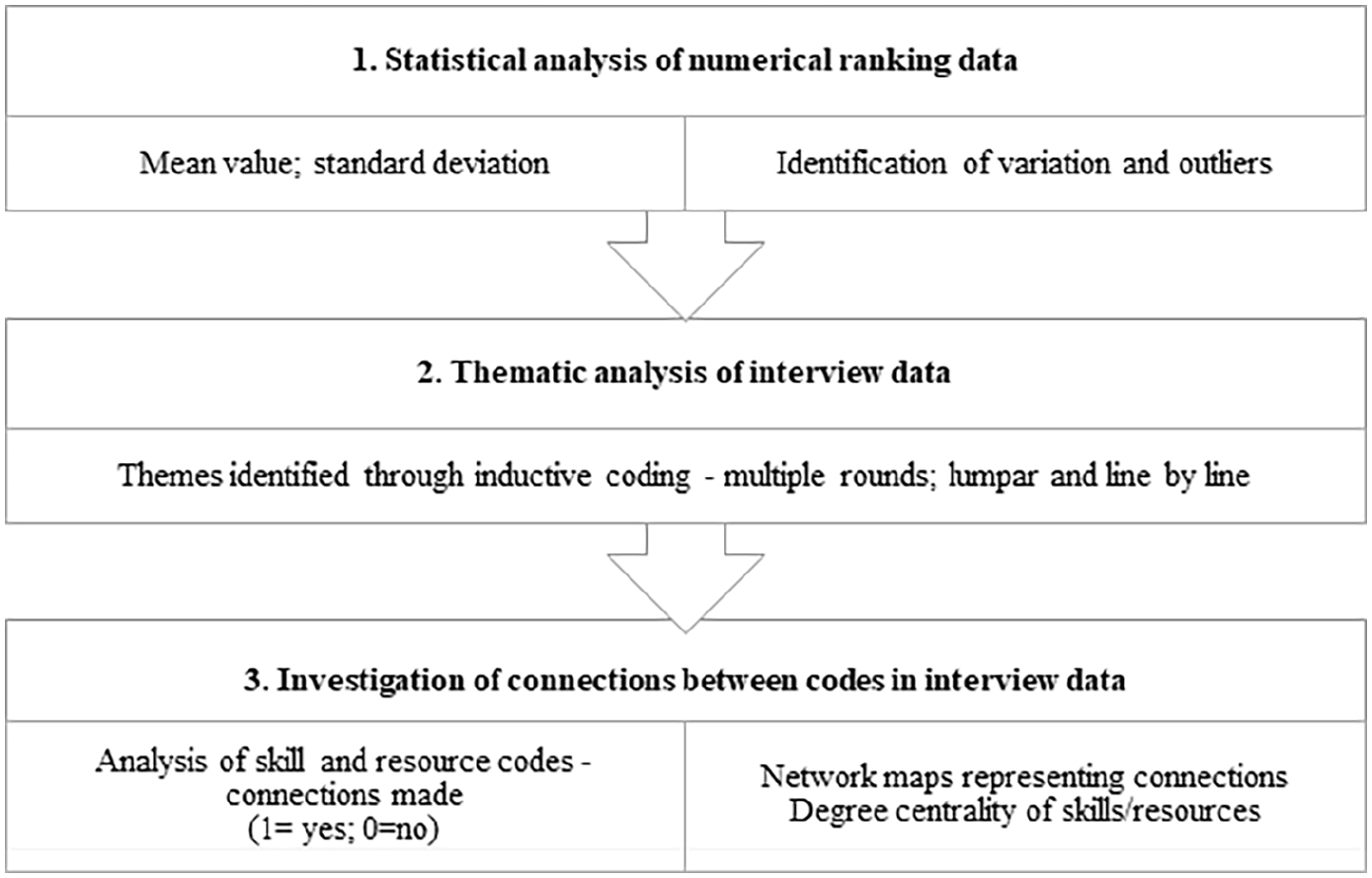
Analysis of skills and resource ranking.
Skills and resource priorities
The findings of the skills and resource ranking exercises are presented in Figures 2 (skills) and 3 (resources) in order of priority according to their mean value. This is followed by reflection on the relative importance of these areas and the interconnected nature of the skills and resources developing creative practice and starting a creative business after university. Discussion then turns to the potential for inequalities to be reflected in these prioritisations.
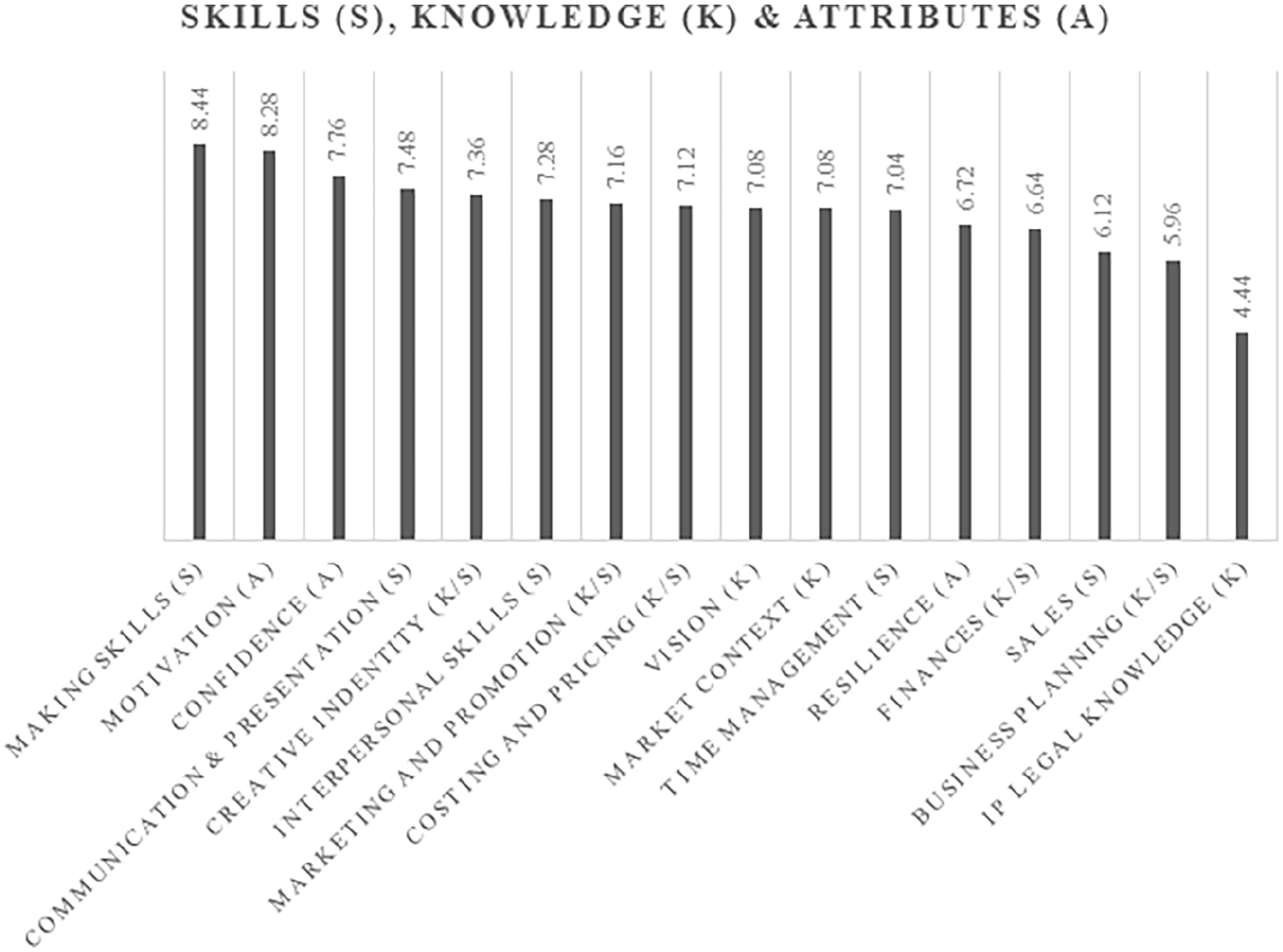
Skills, knowledge and attributes (mean value).
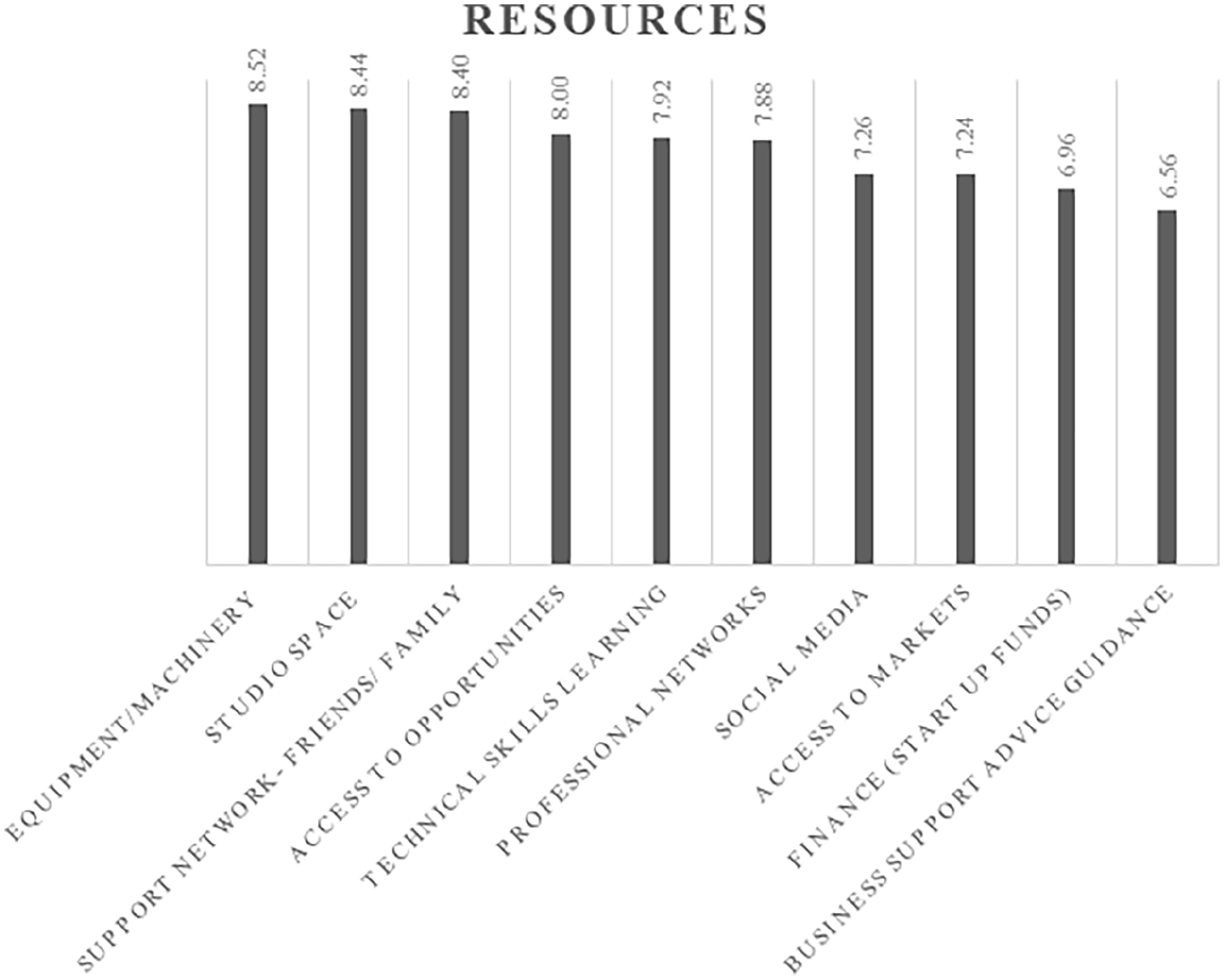
Resources by rank priority (mean value).
The highest-ranking item in the skills ranking was making skills (mean = 8.44, standard deviation = 2.1), followed closely followed by motivation (M = 8.28, SD = 2.2). Confidence also ranked highly (M = 7.76, SD = 2.3), alongside other more intangible skills, knowledge and attributes including communication and presentation (M = 7.48, SD = 2.1), creative identity (M = 7.36, SD = 3.0) and interpersonal skills (M = 7.28, SD = 1.6). More traditional business practice, including as IP/Legal knowledge (M = 4.44, SD = 3.2), business planning (M = 5.96, SD = 2.3), sales (how to sell your work; M = 6.12, SD = 2.5) and finances (taxes, book-keeping etc.; M = 6.64, SD = 2.7) were all given lower rankings. Certain items associated with market activity were however ranked higher – marketing and promotion (M = 7.16, SD = 2.1), costing and pricing (M = 7.12, SD = 2.3) and market context (M = 7.08, SD = 2.3), suggesting that such considerations do play a significant role in approaches to creative practice, but they are not perceived to be drivers of professional practice.
The highest-ranking resources – equipment/machinery (M = 8.52, SD = 2.0) and studio space (M = 8.44, SD = 2.2) – highlight the importance of hard infrastructure in developing and sustaining a creative practice and generating income. Meanwhile, access to opportunities (exhibitions, commissions etc.; M = 8.00, SD = 1.8) reflects the importance of soft infrastructure. Support networks (friends and family; M = 8.40, SD = 1.5) also highlight the role of social capital and personal networks. As with the skills ranking, resources explicitly associated with business and money – finance (start-up funds; M = 6.96, SD = 3.0) and business support, advice and guidance (M = 6.56, SD = 2.4) – were given lower ratings than resources that enabled the physical making process and/or establishment of professional status. Again, there was a close clustering of resources around rank 7, indicating the complexity of early-career resource needs.
The numerical findings were supported by the narrative surrounding the ranking exercises. In the interview quote below, a graduate reflects on their own prioritisation of making over business planning and finance: it [finances] should be more important [. . .] As a creative person it’s like you need it and you need those finances to come in but when it comes to like actually predicting cash flow and doing your accounts to know where you are, yeah, it always gets put to the bottom of the pile. Probably the same with business planning. You get caught up in making but planning and stuff just goes out the window. (PCA Graduate 5)
In addition to rank value similarities, the theme of interrelation and co-dependency also emerged from graduates’ reflections on connections between particular skills and resources. The next section discusses the connections articulated by graduates before discussion turns to the inequalities reflected by skills and resource priorities and their interconnections.
Connecting skills and resources
The analysis of the discussion (thematic and mapping of connections) identified that motivation, interpersonal skills, confidence, communication and presentation, time management and resilience enabled the pursuit of the creative endeavour and the communication of creative identity and professional expertise. This was seen to assist building a professional reputation. Furthermore, they facilitated sales, access to markets and opportunities, the delivery of commercial projects and sustaining a presence in the market. It was often noted that the relevance of one skill was related to another, or that there was a ‘core’ group of skills required, as illustrated in the interview quote below: these are the real core [. . .] So if you don’t know the costing of your product, how much it costs, how you’re going to make it. If you’re not resilient as a person you’re not going to carry on doing it against the odds. If you’re not confident you’re not going to turn up to do the work. And if you don’t have any money you can’t do anything, it kind of throws all of them. (London Met Graduate 5)
While the skills and resource rankings were conducted separately, analysis of the discussion around graduates’ professional practice needs identified links between them. Figure 4 presents a skills and resource network illustrating the connections between skills and resources identified during the interviews.
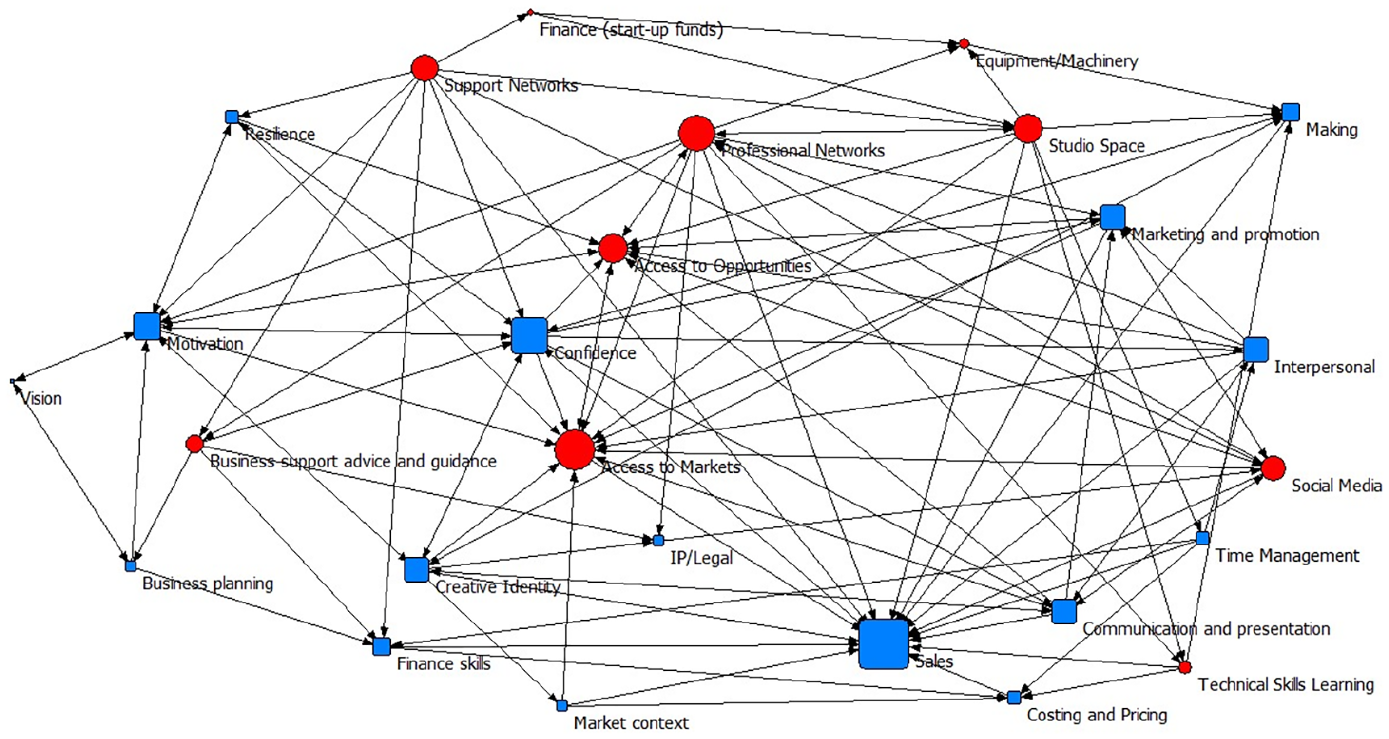
Skills and resources connections.
Sales skills, in particular, were identified as an amalgamation of other skills and resources. This suggests that being able to sell work is not a skill that can be achieved in isolation; it requires the confident communication of skill and creative identity, applied in the right market, promoted to the right audience, by the right people at the right price. Connections between sales and confidence are illustrated in the interview quote below: how confident you are kind of does sell your work to a certain extent. I think I’ve got a fair amount of work because the clients that I talk to feel comfortable with me telling them what I’m gonna do or how I’m gonna do it, and they can see that you’ve got knowledge, and the skills needed. (London Met Graduate 1)
Confidence was identified as an attribute that both supports and is supported by the development of other skills, knowledge and attributes, notably motivation, resilience, sales and creative identity. Graduates also identified that it supported marketing and promotion, communication and presentation and interpersonal skills: if you’ve got the confidence then you don’t have to be resilient I guess [. . .] I think they’re almost synonyms, but one comes before the other. If you’re confident going into something then you don’t have to be resilient. Whereas if you’re not confident then you have to be really good at taking blows, because you’re always gonna be taking those blows to heart. (PCA Graduate 2)
Creative identity was also well connected, particularly with attributes such as motivation and confidence, but also with how work was made, ideas were communicated, relevant markets were identified, and how work was marketed, promoted and eventually sold. A graduate reflects on these connections below. Here, the formation of a creative identity was positioned as both informing the production and sale of work but also as a result of a sustained and evolving creative practice: creative identity, it’s like knowing who you are and where you are and where you’re placing yourself and having a passion behind a business or an idea, a practice, that’s where your identity comes from. As in like if you haven’t got your identity or like your passion, then there’s nothing to drive why you do things and why you have a practice. (PCA Graduate 1)
As with skills, graduates also identified connections between resources for professional practice. The most prominent interrelation of resources identified from the interviews was around professional networks, as represented in the degree centrality of this node in the network (Figure 4). Professional networks both supported and were supported by other resources. In particular, they were positioned as a means of accessing markets and opportunities, as suggested here: to be considered as a quality maker and then have an outlet and stuff with what I’m doing, you know professional networks, it takes people to talk about it, to promote it, to want it, and that’s why professional networks has gotta be important. (London Met Graduate 4)
This included previous tutors providing a ‘foot in the door’ through their personal connections, but also other professional makers sharing relevant opportunities such as competition entries and exhibition calls. Professional networks also provided informal business support, advice and guidance, particularly in studio management and every-day business practice and could be called on for technical support and advice.
Studio space could both be accessed through professional networks and/or used to facilitate network development. Studio space was also well connected as a supported and supporting node; in addition to professional networks, it facilitated access to equipment and machinery and subsequently facilitated technical skill development by providing space to practice and experiment. In some cases, larger studio complexes and venues could also provide access to markets and opportunities through resident exhibitions, sales, open studio events, workshop space and specialist equipment that ‘broadens the possibilities that you can have’ (Sunderland Graduate 6).
Support networks, especially family, were identified as an important means of accessing other resources. As articulated by a graduate here, family could provide access to studio space and equipment through a dedicated space at a family home or provide financial support for studio hire and purchasing equipment: my studio space is through my support network! Currently. And therefore that’s kind of, it’s the starting point in a sense that I don’t pay for it so it’s kind of, yeah, so that’s all like under the same thing. (London Met Graduate 2)
As explained in the interview quote below, family and friends could also act as initial audiences and clients for first jobs, small sales and commissions which supported the graduate’s ability to keep making and get work on display. Here, a graduate reflects on the connection between sales and support networks: I’d say this [support networks] is fundamentally key when you first start. Um, because maybe that’s where you get your first few jobs, like through family and friends. [. . .] other people will see it, go oh that’s a good job, and then that word of mouth starts spreading. (London Met Graduate 1)
Business advice and finance skills were also obtained through family networks as graduates took advantage of the knowledge and expertise of family members, particularly in accounting. For example, a Staffordshire graduate explained that ‘luckily my mum, she runs her own business as well, or used to. So she was able to talk through it more, because I had no idea how to do my books or anything like that’. This supports the argument that accessing information and expertise from other sources can mean that makers do not need to have all of these skills themselves (Bridgstock et al., 2015). Relationships and expertise can however change over time, and not all graduates had access to such knowledge among familial contacts, requiring more autonomous learning.
Social media was also associated with access to markets and opportunities. As reflected in the following interview quote, this included direct sales and commissions, the identification of potential markets and opportunities and relevant galleries or retailers: ‘I’ve had a lot of opportunities that have come through, to me through social media. It’s given me access to markets and you know galleries and things like that and it’s given me access to commissions and exhibitions’ (Staffordshire Graduate 2). As well as maker-initiated research and communication with audiences, makers were also contacted directly through social media by gallerists, buyers and competition organisers.
The use of social media to ‘tell a story’ about yourself and your work was also highlighted as a sales mechanism, linking with research on self-work in craft, particularly through online platforms in how graduates presented themselves and their work online to both establish a presence and sell their work (Bell et al., 2018; Luckman and Andrew, 2018). Support networks including friends and family were also drawn on to help promote makers through social media through sharing. Professional networks could also be used in this way, and social media was used as a communication method between professionals and groups.
The lower prioritisation of business support, advice and guidance, finance skills and IP/Legal knowledge identified in the skills and resource rankings may be related to their interrelation with other areas – they can be accessed as a result of having other things in place such as professional and support networks, as suggested in the interview quote below. They may also be of greater importance once the work has been made (requiring making skills and studio space) and markets and opportunities have been accessed: I’ve got IP/Legal knowledge which is important, but it’s hard to have all of the skills so like you’re better off going to someone who actually knows that sort of thing rather than having the knowledge myself. (Sunderland Graduate 5)
However, the narratives of Staffordshire graduates who had received formal business support and financing highlighted the potential importance of external provision for graduates without access to similar support, advice and guidance or finances from their support network. This is articulated by a graduate in the interview quote below: I’ve never had someone actually sit down and look at my work from a business perspective before, I think that’s what pushed me, that’s what made me realise I could make a lot of money out of my business, because she looked at it from a business perspective. (Staffordshire Graduate 5)
The findings highlight the complexity of the skills and resource requirements for professional creative practice. They suggest that a combined skillset and an ability to balance the demands of each developing skill and its associated activity is required, but also that certain skills, knowledge and attributes could be leveraged from the acquisition of other skills. However, the prioritisation of certain skills and resources, and their interconnection also highlights the potential for inequalities (or conversely privilege) to be compounded during the early-career period.
Inequalities
Crafting the entrepreneurial self
One way in which inequalities (potential and experienced) can be identified in skills and resource priorities is in the way graduates can be seen to position themselves as self-governing and self-motivated, creative entrepreneurial subjects (Scharff, 2016). As articulated by two graduates below, motivation was identified as a driving force for creative practice and was also associated with bolstering other skills, knowledge and attributes, particularly confidence and resilience, helping makers cope with competition, set-backs, rejection, low incomes, the demands of self-employment and the long-term commitment required for creative practice: you are basically competing in this really huge market these days with the likes of Etsy and Not On The Highstreet and Folksy and all these online stores [. . .] you have to be motivated to do it, you really do have to want to do it and be determined [. . .] you have to make sure that you’re gonna get out of bed and you’re gonna carry on and do what you do because in your heart of hearts you know it’s the right thing that you, you’ve got something that’s worthwhile. (Staffordshire Graduate 2) if I don’t have motivation I don’t really have anything because I have no space or time or money. So I feel like I’m motivated even though I’m a product of my circumstances. (Sunderland Graduate 3)
This crafting of an entrepreneurial self (Luckman, 2015) in which ‘being motivated’ is a key and constitutive part has the potential to justify certain people or groups being excluded from or leaving a craft career – that is, they just were not motivated enough. This individualising (Lee, 2019) can mask the financial and social barriers in entering and sustaining a craft career, as discussed later on. Conversely, it could be used to minimise the role of accumulated privileges of wealthier graduates.
Alongside this, the emphasis on creative identity and its connections with motivation and confidence promotes further entrepreneurial subjectivity (Scharff, 2016) and individualisation of career trajectories, including success and failures (Brook and Comunian, 2018; Frenette and Dowd, 2018; Lee, 2019). However, even more concerning is that the connections made between creative identity and market opportunities and outcomes (sales) has the potential to narrow who is able to succeed in craft – and wider art and design – markets that prioritise Eurocentric narratives and aesthetics (Patel, 2020c). There is also potential for this to be further reinforced by the role of professional networks (including university educators) in defining who is ‘considered as a quality maker’ (London Met Graduate 4) and mediating access to markets and opportunities (England and Comunian, 2016; England, 2022a). From wider literature we know that gender, race and class can also impact the communication and perception of craft expertise on social media (Patel, 2020b) and that this has implications for craft careers (Patel, 2020a). This is particularly problematic if creative identity is to be considered as part of one’s wider cultural identity (Bennett et al., 2014), or if this connection may be assumed for ethnically diverse makers (Patel, 2020c). In this context, rather than providing an advantageous strength in creative identity, the connection to cultural identity could position their work outside of the dominant market aesthetic.
Social and economic capital
The equal importance of support networks and studio space raises critical questions about the role of social and economic capital in creative career development (Banks, 2017). Graduates often acknowledged the importance of family in being able to sustain and develop their creative practice after university: ‘I’ve been massively supported by my family. So I’ve lasted a lot longer than I would have if I didn’t have them’ (Sunderland Graduate 1). This included moral support and feedback on creative projects, but also for financial support, accommodation or studio space. For one graduate, this meant being able to live at home – in London, for free – while pursuing unpaid internships. The capacity for significant, multiple advantages to be accumulated by graduates with parental support and financing post university is clearly identifiable in the interview quote below: I live with my parents and my dad and I are renovating my Gran’s house when she passed away. We are selling that and that is where the capital will come from for the studio. So in terms of my job like you know my Dad foots the bill and then I help him with the development of the house. So I’m investing into my future by doing that. I know from having tried sometimes to get a job it’s difficult here. [. . .] I make money from my sales and then I put that into my buying new tools, resources [. . .] And I put stuff aside so that I can go to America, I can go to these places to learn more. [. . .] if I really needed to do something and I was in a big hole then um, my parents wouldn’t take up the slack but there’s a security there in my financial status. Um, and the money that I make from making glass I don’t, I don’t have an obligation to pay them back or anything. (Plymouth College of Art Graduate 2)
This is perhaps the most prominent area in which inequalities may emerge or be exacerbated in the early stages of developing a craft career once graduates lose access to university facilities and materials at heavily subsidised costs (and student loans). A lack of access to family finance (the bank of mum and dad, inheritance or spousal support) makes graduates reliant on generating income from alternative, often unrelated employment to support their creative practice (England, 2022b). This in turn reduces the time and funds available to develop artwork/products, pursue opportunities and their business, as noted by a glass artist who worked full-time as a school teaching assistant: ‘I find it difficult to kind of establish a practice, you know, the lack of time and money’ (Sunderland Graduate 3). Alternatively, they must rely on external finance (grants and loans) as discussed later on. In support of the literature on social class advantages in creative careers (O’Brien et al., 2016) and in accessing career-enhancing activities (Shade and Jacobson, 2015), these findings show how graduates with family resources are in a highly privileged position compared to others (and are often aware of this). Here, privilege manifests in access to space and the advantage of reduced start-up costs and overheads compared to hiring external space, but also access to opportunities for career development. As it was noted earlier that friends and family also provided first jobs, small sales and commissions, those with network contacts with greater purchasing power – graduates from wealthier backgrounds but also older graduates (mature students) – are also able to derive a social capital advantage: friends are good to start selling to in a small way, or even just making for, and hopefully then telling other friends who you can then sell to. [. . .] I’m older, I’ve got friends who have money and are now buying things, um most of the young ones won’t. So, and even it’s still difficult for me. (London Met Graduate 3)
The earlier discussion on skills and resource connections also indicates that expertise in small business management and accounting is sought primarily from family or close contacts which requires specific social capital. Although, such knowledge is not limited to those in professional occupations and may be found within the networks of graduates from working-class backgrounds. Nevertheless, there is a need to support equitable access to support, advice and guidance in key areas and facilitate network building. This could be achieved through graduate support programmes or wider sector initiatives.
External space and finance
For those hiring external studio space (through necessity or choice), promoted sites of cultural regeneration investment (such as Ocean Studios, Plymouth, the National Glass Centre, Sunderland, Spode Works and Middleport Pottery, Staffordshire) were seen as particularly valuable locations (Dinardi, 2019) – that is, public presence/marketing and associated tourism and sales opportunities. However, such spaces often come at a higher cost (Sargent et al., 2021), restricting who is able to access them (without subsidies or access to external finance) and the subsequent opportunities they provide. Below, a Plymouth College of Art graduate based at Ocean Studios reflects on the commercial advantages and opportunities afforded by their studio location (at the time of writing, a studio space at Ocean Studios cost £250 per month to rent): they have the exhibition space [. . .] and then they have a couple of makers tables so there’s workshops going on there within the cafe. So those sorts of opportunities I couldn’t get at Flameworks. [. . .] it’s all smoke and mirrors it is really. And the whole story, oh look I’m an artist at Ocean [. . .] when [a fellow maker] and I decided to take this, knowing it would be more expensive but we realised it would give us these opportunities to be seen in a place that was really worth being. (Plymouth College of Art Graduate 3)
Only a small number of Staffordshire graduates had received external financial support (grant or loan). While this had been instrumental in their ability to establish their practice by hiring space (including at Spode Works and Middleport Pottery) and buying equipment and materials, it is important to acknowledge that access is often competitive and in limited supply and therefore cannot be relied on as an income source. This competition is heightened for national funding schemes, that is, Arts Council grants. Awards are also not typically means tested. Furthermore, certain funding models – such as reimbursement schemes – could be easier for graduates who already have financial security and the capacity to utilise them. In the interview quote below, a Staffordshire graduate discusses the challenges associated with both a reimbursement scheme (grant) run by their University and Princes’ Trust (loan) funding: the way Be Inspired work [. . .] they sort of reimburse you. Um so it meant that you still have to sort of use your own money um to begin with. [. . .] if you’ve not got the money there in the first place you’re a bit sort of stuck! Um, and through Princes’ Trust it’s like a business loan. So again I’ve sort of been a bit limited with that because I’ve had to work out how much money I can afford as regards to sort of paying it back. (Staffordshire Graduate 3)
Discussion and recommendations
This article has presented the skills and resource priorities of crafts graduates in relation to establishing and sustaining their professional practice, thereby contributing to the wider literature on creative graduate experiences and their skillsets (Bridgstock, 2011; Haukka, 2011) in the specific context of craft. While the findings indicate that priority is still given to the creative aspects of professional practice, there was an awareness of the competitive market context in which graduates approached their professional practice. Potentially influenced by the costs of university or their economic situation, the graduates had an acute understanding that their practice must either generate income or be supported by alternative means in order to be viable.
Furthermore, the connections identified between skills and resources suggest that when considering the needs of recent graduates, this diverse and complex set of professional development assets should be understood as an amalgam rather than isolated components. The acquisition of skills and resources appears accumulative and there are indications that certain skills and resources can be accessed from pre-existing areas or the acquisition of other new skills or resources. It is argued these leveraging and ongoing acquisition processes should be taken into consideration when arguing for professional ‘preparation’ from HE as it suggests that a full set of skills and resources may not be required at the point of graduation.
The centrality of sales in particular highlights this skill as an amalgam and something that can be advanced by the acquisition and utilisation of other skills, knowledge, attributes and resources such as access to studio space, markets, opportunities and networks. This could in part explain the challenges faced by graduates in generating income from the sale of creative products in the early-career period but also give rise to inequalities in craft careers and craft markets.
In particular, such leveraging and acquisition processes raise important questions regarding the role of social capital and how it may deliver advantages to certain graduates who are able to access support (especially business or financial support) and studio/making space easily and/or for free. It could also indicate that the lack of a central resource such as support networks, professional networks or studio space could disadvantage some early-career makers. This links with the literature on the role of social, cultural and economic capital (Bourdieu, 2010) in the creative industries (Brook et al., 2020) and the pathways of creative graduates (Allen et al., 2013; Banks, 2017) and implies the need for initiatives, by HE and wider sector organisations, that facilitate equitable access to key resources for creative work. By highlighting how creative graduate skillsets (Bridgstock, 2011) connect with early-career development and potential inequalities in craft, this research can therefore be seen to contribute to literature on creative working practices and career trajectories (Taylor and Luckman, 2020), through the specific lens of craft entrepreneurship (Naudin and Patel, 2020).
To address the inequalities highlighted in this article, there should be more opportunities for crafts graduates and early-career makers to engage with business advisors and mentors and access seed-funding (grant or loan), potentially means-tested, or for specific funds or subsidies to be made available to those from disadvantaged backgrounds. It is also recommended that alumni services and/or crafts organisations support the establishment and growth of professional networks for graduates in order to support access to opportunities and markets, but also to preserve their access to a creative community for critical feedback and create opportunities for knowledge sharing. As this study has shown, access to low-cost space, equipment and storage are also critical to the development of craft practice and businesses. This calls for policies (local, regional and national), development plans and funding for the establishment or maintenance of affordable workspaces, including open access studios (England, 2020) that can attract, incubate and retain creatives in certain areas, and also reduce reliance on familial support (financial or in providing space at home). This could also partly be addressed by the extension of studio access to alumni by universities.
Beyond supporting access to craft infrastructure and finance, to support greater diversity in craft – particularly racial diversity (Patel, 2020a, 2020b, 2020c) – there is a need to address inequalities in craft education and market perceptions of what is ‘good’ craft by decolonising the spaces in which craft is taught, practised, exhibited and consumed.
Conclusion
Beyond highlighting the multifaceted dimensions of professional creative practice and how the acquisition of skills and development of resources cannot be approached in isolation, this article seeks to challenge the idea that success (or failure) in craft careers is determined by an individual’s motivation or their level of creativity (or skill). It is argued that such a position is reductive and perpetuates both a misconception of those who pursue creative practice as a profession and an elitist entry system to the creative careers (Banks, 2017; Brook et al., 2020) whereby the capacity to preserve ‘artistic integrity’ and become the ideal entrepreneurial subject (Scharff, 2016) is reliant on an individual’s pre-existing economic and social capital (Lindström, 2015). Instead, in crafting careers, it is argued that we need to take a hybrid perspective that acknowledges the demands of both the creative pursuit and economic sustainability (England, 2022b), and to actively tackle persistent inequalities in the craft sector.
The COVID-19 crisis has already exacerbated the precarious nature of creative work (Comunian and England, 2020) and is set to challenge progress in increasing diversity across the creative and cultural industries (Eikhof, 2020). Increased reliance on networks (professional and personal) to access work (Brook et al., 2020) heightens the need for HE and sector organisations to support those without resources and reserves and help develop new forms of sustainable craft practices and enterprises.
Footnotes
Funding
The author(s) disclosed receipt of the following financial support for the research, authorship and/or publication of this article: This research was supported by a Sir Professor Richard Trainor PhD Scholarship at King’s College London. The author would also like to acknowledge the support of Crafts Council UK as a collaborative doctoral partner.
