



Abstract
This project explored the relational context between parents and their autistic children in middle childhood. Familial, parental and child factors may significantly impact outcomes for autistic children, and represent a vital area for research. Specifically, the influence of the caregiver representations, child attachment patterns and parent–child interactions upon each other were investigated. All three constructs were separately assessed in 11 parent–child dyads (22 participants), with children aged 6–11 years who had received a diagnosis of autism. The study employed a multiple case-study methodology utilising Miles and Huberman’s abductive method of data reduction, display and conclusion development, to explore the complexity and connections in the data. The project highlighted high levels of adversity in the backgrounds of parents of the autistic children; an elevated level of unbalanced caregiving representations amongst the parents; and evidence of high-risk attachment patterns identified in the autistic children. Looking at the interaction of these factors, the study showed: 1. The relational nature of the behaviour of the autistic children; 2. mutual difficulties with emotional engagement, intimacy and co-regulation of affect; 3. the irreducibly unique nature of the relationships between autistic children and their parents, suggesting a need for bespoke, idiographic understanding of them rather than one size fits all explanations; and 4. that security and sensitivity can co-exist with an autism diagnosis, highlighting the limits of attachment theory to explain all difficulties experienced by these families. We suggest that a systemic attachment framework may broaden clinical and research enquiry, revealing the multiple challenges these families are facing, and the significant strengths and resources possessed, offering new avenues of support.
Keywords
Introduction
Autism is a relatively common neurodevelopmental diagnosis associated with differences in social communication and restricted repetitive patterns of behaviour, interests or activities. Raising an autistic child is described as a rewarding and meaningful experience (McConnell and Savage, 2015). However, parents of autistic children are more likely to experience heightened levels of stress and reduced psychological wellbeing than parents of children with other disabilities or with typical development (Yorke et al., 2018). They are also at increased risk of mental health difficulties, the onset of which may predate the birth of the autistic child (Ayano et al., 2019). Adverse Childhood Experiences (ACEs), including child maltreatment and household dysfunction, are significantly elevated among caregivers of autistic children, suggesting an ‘urgent need to consider intergenerational continuity of trauma in autism’ (Andrzejewski et al., 2023: p. 2678).
Previous exposure to adversity may have life-long effects on close relationships, and can potentially influence later parenting, especially where that adversity has severely impacted on early parent–child relationships and the child’s ability to find protection and comfort from parents or other attachment figures (Savage et al., 2019). The challenges associated with parenting an autistic child, alongside these background risk factors, may contribute to increased parental stress, lowering mental health and self-efficacy in parents (Yorke et al., 2018). Decreased parental agency and pessimism (Grey et al., 2021), and increased parental shame (Conrad et al., 2025) may perhaps contribute to emotional-behavioural difficulties in autistic children. Autistic children are at increased risk of adverse childhood experiences, particularly bullying, parental mental health difficulties and child maltreatment, although they are not over-represented in state child-protection services (Hartley et al., 2024; Hoover and Kaufman 2018).
Attachment and autism
Differences in joint attention, empathy, symbolic play and reflective functioning, which are associated with autism, may place greater demands on parents in creating secure attachments (Slade, 2009). However, despite these differences, autistic children show attachment-seeking behaviours, and have been found to develop secure attachments to their caregivers at slightly lower rates than children without autism (Teague et al., 2017). Higher rates of insecurity are also observed in autistic adults (Sonfelianu et al., 2025).
Attachment security has been associated with a range of positive developmental outcomes in autistic children including language, play, social communication, empathy and ability to be educated in a mainstream setting (Rozga et al., 2017). Some have argued that the attachment assessment procedures used in the attachment and autism research, and the modifications made to them, may have led to an over-estimation of secure classification among autistic children (McKenzie and Dallos, 2017). This contention finds support in the evidence already discussed of increased levels of parental stress, trauma and adverse childhood experiences in parents of children diagnosed with autism, all of which potentially influences the parent–child relationship. Research has identified qualitative differences in attachment behaviour in autistic children classified as securely attached (Teague et al., 2017) in comparison to typically developing children. Crowell et al. (2019) suggested that the adaptive benefits of attachment security regarding emotional regulation may not be fully developed in autistic children. Despite much research in this area, Teague et al.’s (2017) review observed crucial unresolved questions in the study of attachment and autism, with reference to the paucity of data about predictors, correlates and outcomes of attachment in autistic children.
Most research on the attachment of autistic children in middle childhood has been based on child self-report measures, revealing limited group differences on security of attachment between autistic children and typical developing children. Two studies were identified exploring implicit attachment representation with this age group. Keenan et al. (2017) found that autistic children in middle childhood had difficulty using their parents as a safe haven and as a secure base. Giannotti et al. (2022) found that school-age autistic children used a high level of insecure attachment strategies. Thus, there is very limited research exploring attachment at this developmental stage and findings are contradictory depending on whether self-report measures or attachment representations are assessed.
Caregiving representations
Caregiving representations have been found to predict both caregiving behaviour and child attachment strategy, with some hypothesising that risk features in representations may be central to the transgenerational transmission of dysregulating attachment relationships and consequential psychopathologies (Madigan et al., 2015). Case-based research has shown consistently high levels of non-balanced caregiving representation amongst parents of autistic children (Dallos et al., 2023; Grey et al., 2021). Analysis of parents’ discourse has revealed high levels of unresolved trauma from childhood resulting in high levels of attachment insecurity (see also Conrad et al., 2025). Parents were noted to articulate corrective intentions to parent differently than they had been parented. However, autism was constructed as a challenge to achieving this aim. Failed corrective intentions were found to elicit and compound feelings of reduced parental self-efficacy, guilt and shame, which these parents are already highly exposed to, given the stigma associated with autism.
Caregiving behaviour
The impact of caregiving behaviour can be seen in research indicating that caregiver behaviour such as sensitivity (Baker et al., 2010), responsiveness (Hirschler-Guttenberg et al., 2015), insightfulness (Di Renzo et al., 2020), emotional co-regulation (Guo et al., 2017) and dyadic synchrony (Kellerman et al., 2020) are associated with social and communicative gains in autistic children. Parental mental health, stress and reduced feelings of self-efficacy may interact with child characteristic and influence parental ability to provide responsive and sensitive caregiving behaviour (Chetcuti et al., 2020). Autistic traits of emotional dysregulation, lability, negativity and delayed emotional regulation development (Sivaratnam et al., 2015) alongside hypo- and hyper-sensory responsiveness may lead to autistic children communicating attachment needs in ways which are more challenging for parents to respond to contingently and responsively. Rejection of parental overtures and lack of responsiveness may lead parents to respond in a more directive and controlling manner (Wan et al., 2019). Parental stress, poor mental health and child internalising and externalising behaviour, which exert bidirectional influence on each other, are also implicated in directive and harsh parenting behaviour (Ku et al., 2019).
Rationale, aims and questions of the research
This study aimed to triangulate information regarding a child’s attachment pattern with caregiving representation and parent–child relational behaviour. This combined focus brings a new dimension when compared to previous research which has explored caregiving representations (e.g. Dallos et al., 2023; Grey et al., 2021), child attachment representations (Giannotti et al., 2022), and parent–child interaction (Siller and Sigman 2002) separately in the context of autism. This study is novel in its focus on all three and how they might connect. In particular, we asked. 1. What are the nature of the caregiving representations, child attachment representations, and parent–child interaction and how might they relate to one another? 2. How helpful is a relational approach in understanding the presenting issues for these families? 3. What commonalities and discrepancies are there between the cases and what can be learned from them?
Methodology
This project employed a qualitative, multiple case-study design which supported the aim of developing a richer understanding of the quality of parent–child relationship during middle childhood in the context of autism. A case-study design was selected due to its capacity to explore meaning-making at the level of the individual and the dyad without losing sight of the social and cultural context. Research which explores specific relationships in their context may prove particularly fruitful and avoid reifying incompletely understood constructs (Grey et al., 2021). By preserving rich data about multiple relationships it also facilitates the exploring the relational complexity and connections in each participants lives.
Participants
Twelve parent–child dyads were recruited through disability and psychology services in an Irish context, using purposive sampling. One parent withdrew during data collection. As such the sample consisted of 22 participants: 11 children (six boys and five girls), ten mothers and one father. Child participants were aged between 5 and 12 years, had a diagnosis of autism without an intellectual disability as per DSM-5 (American Psychiatric AssociationDSM-5 Task Force, 2013), and to be able to communicate verbally. Participants were predominantly white with one black child, and had mixed socioeconomic backgrounds.
Data collection and analysis
Three assessments were conducted with each dyad: a Meaning of the Child Interview (MotC) with the parent, a Child Attachment and Play Assessment (CAPA) with the child and Marshak Interaction Method (MIM) play assessment with both parent and child.
Meaning of the Child Interview (MotC)
The Meaning of the Child Interview (MotC: Grey, 2025) utilises a standardised, semi-structured interview conducted with parents about their children and caregiving. It employs a method of attachment-informed discourse analysis derived from the Adult Attachment Interview (Crittenden and Landini 2011) which explores the self- and child-protective function of how parents make sense of their caregiving experience (Dallos et al., 2025). The MotC analysis explores how parents use language and frame their story to create distance from or involve others in painful aspects of their experience, and maps these patterns onto the different ways in which parents seek to protect and nurture their children in the context of their experiences of adversity or threat. Grey (2024, 2025) delineates three primary caregiving patterns: Sensitive (which are collaborative, seeking to protect the child in the context of an attuned and mutual relationship), Unresponsive (or child-led in facilitating a greater role of the child in their own protection and nurture; a reluctance of the parent to ‘interfere’ with the child’s development) and Controlling (or parent-led in holding onto a greater parental role in the child’s nurture and protection; an impulse to ‘make sure’ the child stays closely aligned to the parent). These patterns label a relationship rather than the parent, describing how caregiving functions to protect the child and enable parental functioning in sub-optimal conditions. The health and welfare benefits that sensitive/collaborative relationships enjoy in relatively safe conditions may not be achievable in more challenging ones, where swift (often pre-conscious) action is needed to protect the child or parent (Grey, 2025). The MotC therefore provided an understanding of parental caregiving situated within the parent’s and child’s ecological and social context.
Adverse Childhood Experiences
Given their prominence in existing research, Adverse Childhood Experiences were extracted from the section of the MotC transcript that addressed the parents’ childhood experiences. This contextual rather than questionnaire approach may have sacrificed completeness (as some may be omitted), but allowed us to explore the developmental context and meaning around them.
Child Attachment and Play Assessment (CAPA)
The Child Attachment and Play Assessment (Farnfield, 2015) is a narrative doll play procedure that explores attachment, trauma, mentalising and play in children aged 3–11. The CAPA involves an interviewer telling seven to eight story stems (beginning of stories) designed to elicit themes concerning the child’s expectation of relationships between parents and children. It draws upon Crittenden’s Dynamic Maturational of Attachment and Adaptation (DMM), specifically using the understanding of preschool children’s behaviour in the DMM Preschool Assessment of Attachment (Crittenden and Landini, 2011) and the discourse analysis developed for the DMM-AAI (Crittenden and Landini, 2011). Importantly, the CAPA gives equal weight to children’s verbal and non-verbal narrative responses, while also considering the child’s arousal level, offering a window into children’s verbalised and embodied scripts for human relationships. The value of using the CAPA is in its clinical complexity and specificity of child attachment representations and its explicit attention to the relational management of arousal (Farnfield 2025), a particularly salient issue for the group being studied.
Children’s narratives can be classified as being type A, B, or C using the DMM. Individuals using a type A strategy prioritise the processing of cognitive information and attempt to supress negative feelings, do what they expect will be reinforced and avoid behaviours they believe will be punished. Individuals using type A strategies are vulnerable to difficulties with inhibition and compulsion, due to too great a reliance on cognitive information (Crittenden et al., 2021). Individuals using this attachment pattern have generally received care which was predictable but not attuned. Their attachment figures tended to reject their attachment behaviour or to reject them personally (Crittenden and Landini, 2011). These children learned to instinctively distance their own emotions and, therefore, they did not learn how to meet their needs in collaboration with others or show vulnerability when needed.
Individual using a type C strategy focus on processing of affective information and are motivated by somatic feelings. Lacking confidence in what will happen next, they focus on feelings to guide behaviour, and negative feelings are prioritised. The pattern is associated with unpredictable and variably attuned responses from attachment figures. In these circumstances, an infant learns that exaggerated negative feelings such as sadness, hunger, tiredness, pain, or fear are more likely to get the caregiver’s attention. This dyadic process leads the infant to become affectively organised, prioritising feelings over thoughts. This produces affectively driven struggles which see adult and child in an increasing spiral of frustration (Crittenden et al., 2021).
In individuals using type B strategies, cognitive and affective information is integrated. The type B pattern of psychological balance is the least vulnerable to psychopathology. Individuals using this attachment pattern have generally received care that was both attuned and predictable and, as such, they learn to value their cognitions and feelings as both types of information have self-protective value (Crittenden and Landini 2011).
Sub-classifications of all three (A,B, and C) are also given but are used here only to differentiate between high-intensity patterns (in the DMM noted as A+ and C+), which signify major transformations of cognitive and affective information, and are usually associated with clinical cases and complex relational histories. Where the child’s developmental and social history has presented challenges such that one single predominant pattern of relating could not be made to work, mixed patterns (A/C, A+/C+, etc.) describe the strategic (purposeful, though usually unconscious) alternate use of both A and C patterns in different contexts (e.g. when highly threatened) or in different relationships (e.g. with mother/father). Unresolved trauma signifies the breakdown of strategic attachment behaviour in the face of relational dangers or challenges that the child is unable to find a way of feeling safe around. Patterns of attachment, even complex or intense ones are patterns of social engagement, of staying connected even in a limited or challenging manner; unresolved trauma represents a brief or enduring loss of relational connection or purpose (Farnfield 2025). It is important to note that these complex attachment presentations do not signify maltreatment and occur in non-clinical populations in sizeable numbers.
The CAPA interviews were video recorded and transcribed, and the narratives were formally analysed (coded) using the CAPA guidelines. In the current project, developmental expectations regarding narrative coherence in the context of autistic children were recognised while coding the participants’ story stems.
Marshak Interaction Method (MIM)
The Marshak Interaction Method (Booth and Jernberg, 2010) was used to assess parent–child interaction. The Marshak Interaction Method (MIM) is a play-based structured technique for observing and assessing the overall quality and nature of relationships between caregiver and child. It consists of a series of nine simple tasks designed to elicit behaviours in four primary dimensions to evaluate the caregiver’s capacity to provide structure, engage the child in mutual interaction, meet the child’s needs for nurture and reassurance, and offer appropriate developmental challenge. It also assesses the child’s ability to respond to the caregivers’ efforts along these four dimensions.
Classification of procedures for whole sample.
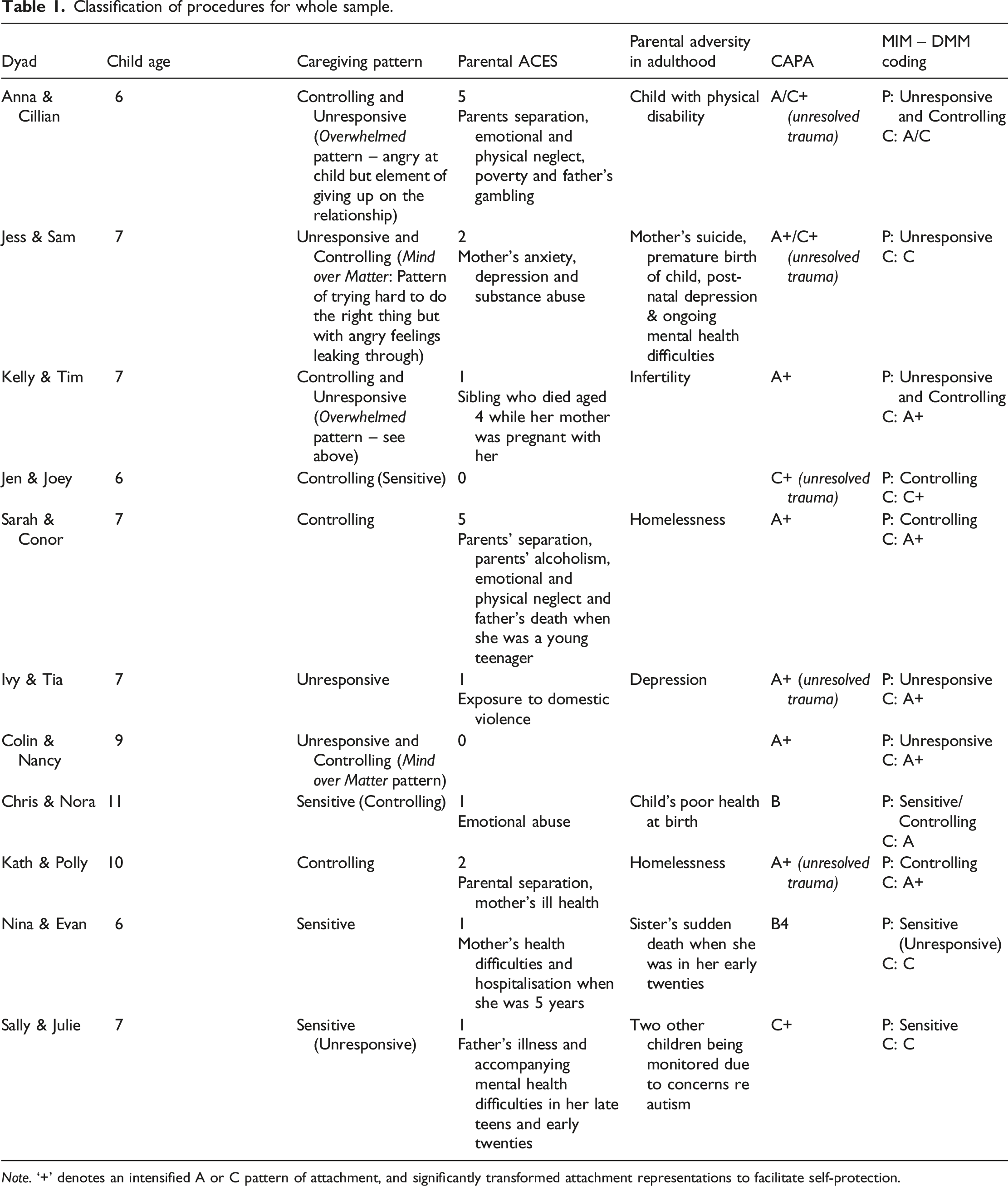
Note. ‘+’ denotes an intensified A or C pattern of attachment, and significantly transformed attachment representations to facilitate self-protection.
Data collection procedure
The assessment protocol began with the parent interview, followed by the narrative story stem assessment with the child, and then the play assessment involving parent and child. The assessments were completed over two or three separate appointments depending on what was most convenient for the dyad. Interviews and assessments were carried out in participants’ homes.
Case analysis
In line with the approach for attachment-informed case-based research suggested by Grey and Dallos (2025), following on from the analysis of interviews and assessment, a within-case understanding of the difficulties and resources of each relationship was developed first, integrating information from the parent, child and interaction procedures to arrive at the most likely explanation of how they fitted together.
Subsequently, cross-case analysis sought to capture key similarities and differences in the relationships of all the participants. Tentative abstractions were then generated to form more general cross-case formulations (Grey et al., 2021). Miles et al.’s. (2018) approach to qualitative analysis, which is a blend of ethnographic and grounded theory methods, was employed. This abductive process involves moving from one inference to another, comparing and contrasting material in search of patterns, seeking more data to support or qualify these clusters, and gradually refining them. Three inter-connected, mutually influential, processes of data condensation, data display and conclusion drawing/verifying were interwoven before, during, and after data collection, in a continuous, iterative process (Miles et al., 2018).
Ethics
This study received ethical approval from a university ethics committee and a relevant healthcare provider. All parents gave informed consent. Personally identifying information has been removed, or altered in ways irrelevant to the analysis, to protect the identity of participants.
Peer review and validity
Initial analysis was completed by the first author. The CAPA and MIM were subsequently blind coded by other trained and reliable coders and their analysis incorporated into case formulations. Four of the MotC transcripts were blind coded to ensure the integrity and reliability of the coding. Dyadic formulations were separately developed, discussed and revised to integrate the insights of the different coders. In keeping with qualitative research sensibilities that emphasise the researcher-generated nature of analysis, the purpose of the use of standardised coding of attachment procedures, reliability and double blind coding is not to eliminate subjectivity. Instead, operating within a critical-realist epistemology (Pocock, 2025), they enrich observation, and resolve differences of observation and interpretation within a shared theoretical language, offering a transparent and communicable framework for the explanatory power of competing interpretations to be evaluated.
Findings
The results from each assessment are depicted in (Table 1).
The table indicates a high level of congruence between parental adverse experiences in childhood and adulthood, transformed self-protective (and compromised) representations of caregiving employed to manage these, complex attachment insecurity in their children, and difficulties in affect co-regulation observed within the parent–child relationship. The rate of Adverse Childhood Experiences exposure within this sample was high, with 81% disclosing one or more ACE. This is higher than the 65% found in McCutchen et al. (2022) study which included a nationally representative Irish adult sample. From the sample of 11 children, two showed a type B pattern; thus, over 80% of patterns might be labelled ‘insecure’. There was evidence of trauma in five children’s narratives. Nine children were judged to be using intensified insecure attachment patterns. These are the DMM patterns seen as emerging from complex attachment dynamics, the hallmark of which are significant transformations of information, such as the self-protective exclusion of information. Almost half the children were classified as using Type A patterns (either on its own or as a mixed pattern). This attachment pattern relies on deactivating the attachment system which is achieved through focusing on cognitive information, self-reliance and the dismissal of affective information, which may result in consequent difficulties with mentalising and arousal regulation.
Parental adversity, defensive scripts and caregiving and impact on child attachment – example relational formulations.
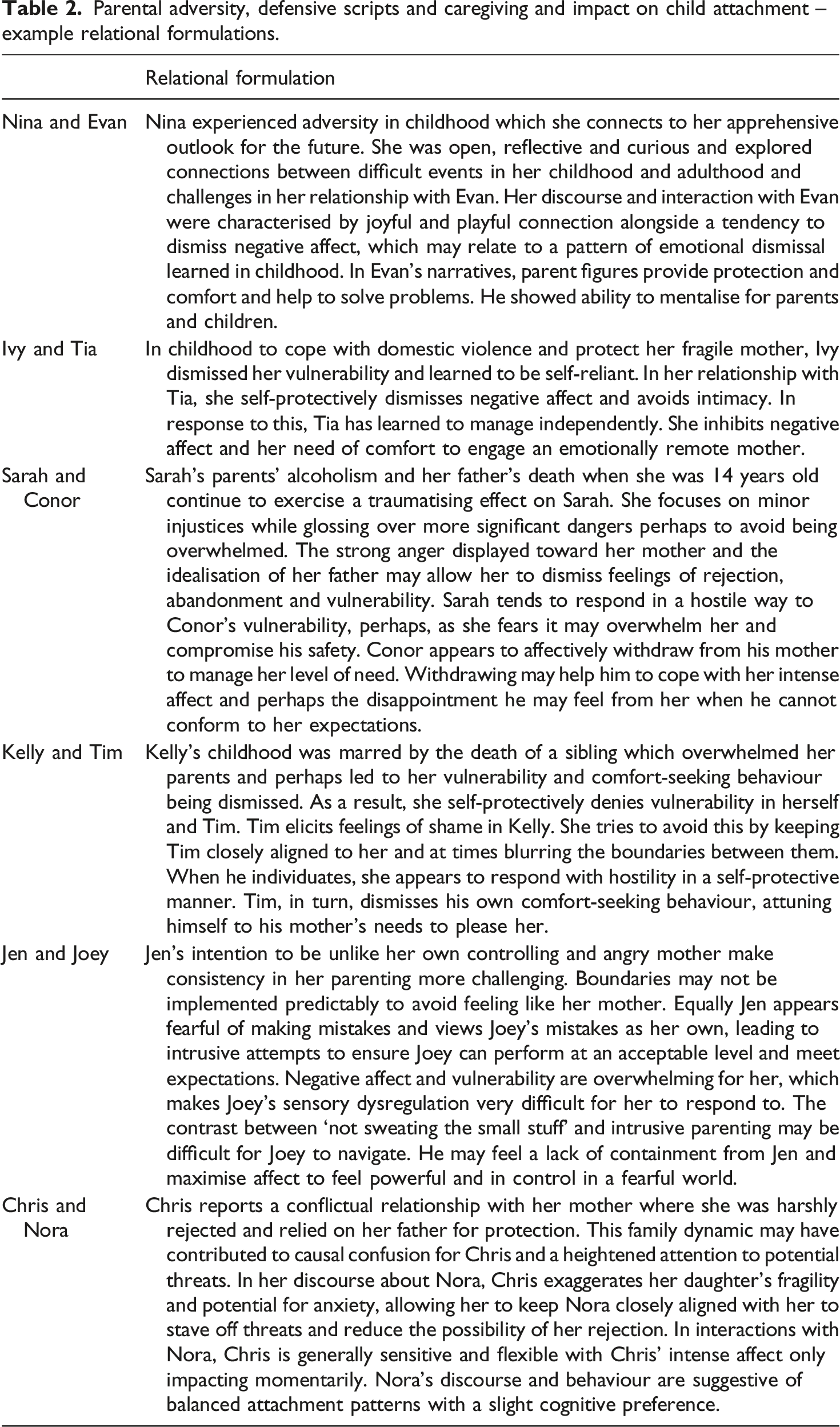
A more detailed formulation is given below to illustrate the richness of the interplay between the representations of attachment from both child and adult.
Case example – Colin and Nancy: Dismissing negative affect and comfort-seeking behaviour
Family context
Colin and Nancy’s family: Nancy is 9 years old. She lives with both her parents, and her older brother. Colin, her father, is a stay at home parent, and Serena, her mother, works full time.
The assessment results for Colin and Nancy are noted in Table 1.
Parental attachment and caregiving representation
In Colin’s description of his childhood, there is a sense of feeling trapped, loneliness and anxiety. Colin attempted to foresee his mother’s demands and meet them without reference to his own needs. He learned to be vigilant to avoid being rejected. This vigilance required careful monitoring of his parent’s affect and his own behaviour. ‘I guess that fear, the discipline...my mother if we annoyed her enough, she was a shouter…. She’d let rip…. You'd know you were in trouble and I suppose that's where the fear came from, you'd be fearful of the next time it might happen’.
Given this background, Colin seems to find negative affect in himself and others overwhelming. When discussing his relationship with Nancy, there is a sense of Colin wanting to keep her at arm’s length. Nancy’s negative affect may trigger feelings of vulnerability and overwhelm in Colin who cannot provide the comfort and the containment she seeks. He appears to cope by distancing himself from Nancy and managing her functionally. A lack of joy and connection pervades his accounts. His fearfulness of his mother’s negative affect has perhaps been overlayed onto Nancy whose negative affect may trigger this implicit script and lead to a sense of overwhelm and rejection.
Colin’s discourse is suggestive of a script emphasising the importance of logical and rational thinking as a way of dealing with negative affect.
‘I suppose the emotional feelings should only occur when the event is happening and maybe she should be able to talk about it, I suppose, kind of with not as much emotion’.
This cognitive approach may help to maintain an affective distance between Colin and Nancy.
This script is undermined by exaggerated images of need and intense affect:
‘Sometimes she can just completely sort of fly off the handle, like screaming and shouting at something very, very minor. There was one, a couple of weeks ago, where she was in bed and whatever she did, she banged her hand off the bed frame. She started screaming and I was downstairs, thought “This will stop” and it just went on and on, kept getting louder and louder’.
There is perhaps a sense of depersonalisation of Nancy (‘it just went on and on'). This pathologisation of affect may function to legitimatise Colin’s passivity and lack of response to Nancy when she is upset.
Child attachment representation
Such depersonalisation invites the deactivation of attachment in the child and this appears to be reflected in Nancy’s attachment narratives. She hugged herself often as a form of self-comfort. Her low arousal, flat affect, sense of futility and lack of resolution brought a depressive quality to her narratives. In Nancy’s stories, comfort was not offered by adult figures, and stems which pressed for comfort provoked high anxiety in Nancy, as marked by dysfluency and cut offs. For example, in a story stem where a child figure is crying, Nancy pinched herself on her arm, but did not show this to the interviewer or look in her direction while pinching. Communication of anger appears to be forbidden for the child figure. This means the child figure, who is angry in several stories tries to regulate her affect independently. For example, Nancy was dysfluent at the point of reunion between parent and child figures after a parent night away. The mother figure was absent, unpacking, and the father figure after a pause tells the girl figure the parents will go away ‘every Friday night, so the girl gets really annoyed and she goes upstairs and starts shouting’. The granny figure follows the girl figure and told her ‘she isn’t allowed to get upset about that’. She cuts off at this point and says that’s all. The child figure is angry but retreats and does not direct her feelings towards her parents and is uncomforted.
Parent–child relational behaviour
Colin’s guidance was intermittent and varied from task to task sometimes tipping into passivity or authoritativeness and with a few angry spikes. For example, he shouted at Nancy ‘palms up’ when she did not immediately respond to instructions to turn her hands over. However, she did not appear frightened of him. Another spike occurred when he read out loud an instruction card as ‘Adult kills child’ rather than ‘Adult tells child’.
Nancy was comfortable taking control of tasks and giving instructions but knew when to pull back and give control to Colin. Nancy initiated often with Colin and frequently sought physical contact with him. Colin did not respond to this and withdrew physically on occasion. He tended to be quite serious but with some brightening up. Colin seemed uncomfortable with nurturing tasks while Nancy was sensitive to her father’s responses. This dyad appeared to operate from a script where Nancy is seen as precocious and her father appeases her. Nancy was very attuned to her father’s responses to her precociousness. Her clinging behaviour is thus carefully calibrated to meet her father’s needs and she draws back when he verbally and non-verbally indicates for her to do so. This cyclical process is illustrated in Figure 1. Dyadic regulation of affect – Colin and Nancy.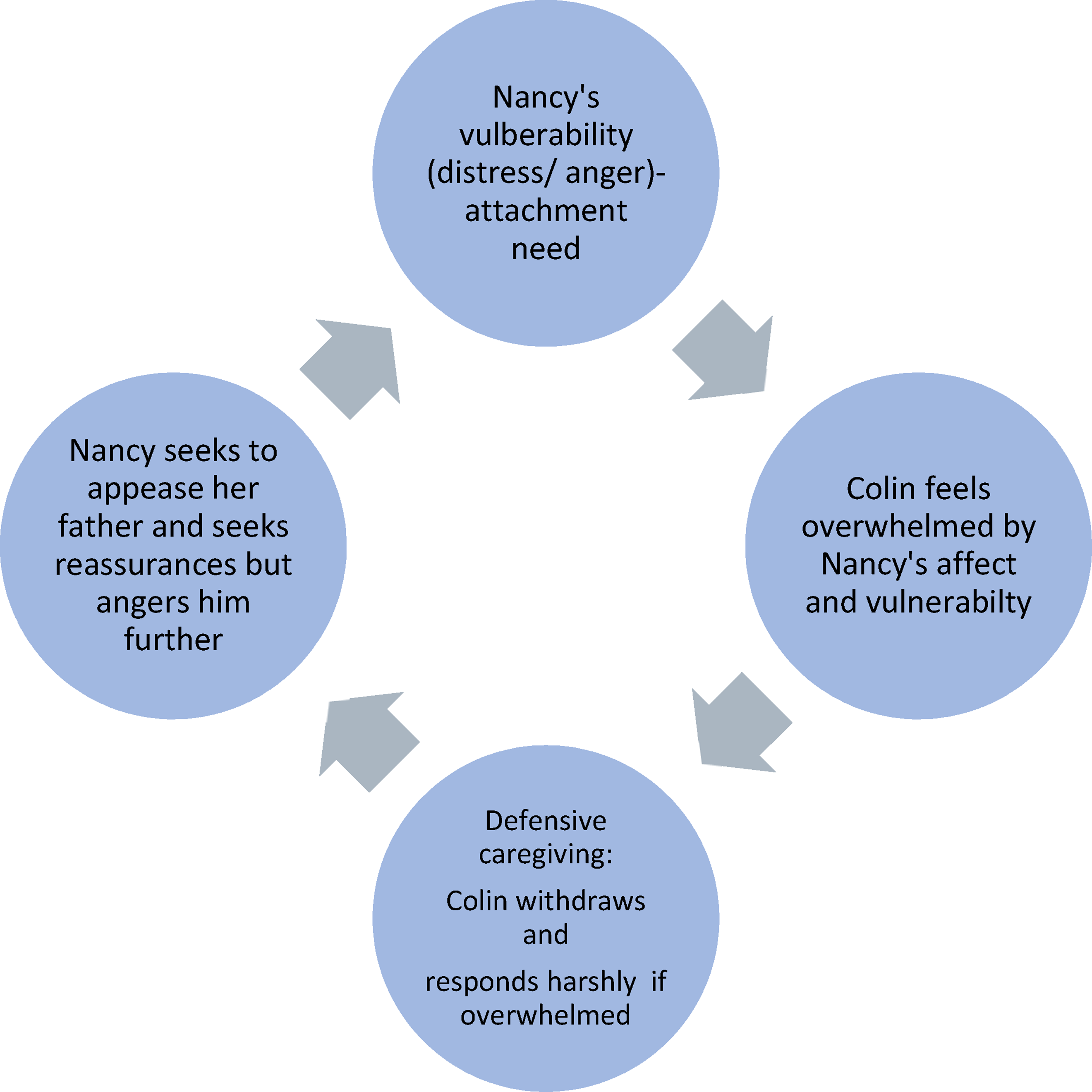
Case summary
For Colin, Nancy’s relational signals may be perceived as threatening because they connect him with his feelings of fear and loneliness that he has needed to suppress in order to manage his childhood and adult life. Colin appears to remain at an affective distance from Nancy to avoid feeling overwhelmed, but in the face of strong negative affect which he cannot fend off, he responds in a manner that Nancy may experience as a rupture, something she needs to organise self-protectively around. Building connection may be difficult, as Colin and Nancy react to environmental conditions and relational overtures self-protectively, leading to frequent ill-repaired ruptures, causing confusion and distress to them both. The combination of Colin’s anxiety and quick temper may result in Nancy being vigilant and modifying her behaviour to placate her father. Negative affect may be a double edged sword for Nancy. It is forbidden and may invoke an angry response and rejection but also may draw an unresponsive father in. Nancy’s Autism diagnosis may function to depersonalise her behaviour, removing the relational context of her negative affect, making it easier for both to manage, but excluding attention to the relational processes involved.
Between case findings
Looking at this example, together with the other formulations, a number of connecting threads became apparent.
Discussion
This research explored parents’ caregiving representation, children’s attachment representations and observations of relational behaviour in the parent–child dyad to allow for a detailed analysis of the relational context between parent and child. While previous research has explored these strands in isolation, this study is novel in focusing on all three together. The project highlighted the high levels of adversity present in the backgrounds of the parents of the autistic children; an elevated level of unbalanced caregiving representations; and evidence of high-risk attachment patterns identified in the autistic children. This tallies with previous research, finding a high rate of ACEs among parents of autistic children (Andrzejewski et al., 2023) as well as unresolved trauma (Conrad et al., 2025). The links between ACEs and medical and mental health difficulties and the possible implications of parental trauma for caregiving, alongside the growing evidence that children may be affected by parents’ trauma exposure through epigenetic mechanisms (Brazee, 2021), indicate that parental trauma and ACEs exposure is an area that requires both clinical attention and further research.
Looking at the interaction of these factors highlighted the relational nature of the behaviour of the autistic children, mutual difficulties with emotional engagement, intimacy and co-regulation of affect, the irreducibly unique nature of the parent–child relationships, and the limits of attachment theory to explain all difficulties experienced by these families. In line with Chetcuti et al. (2019), the findings of this project emphasise the need for more research exploring transdiagnostic factors implicated in developmental outcomes for autistic children, such as caregiver representations, caregiver behaviour, and child–parent interaction.
The findings of this project suggest that an attachment perspective has much to offer families with an autistic child. A focus on development and adaptation emphasise that attachment is not fixed, engendering hope rather than hopelessness. It is a strengths-based approach which avoids pathologising, with attachment assessments being used to sensitise practitioners, not to label or diagnose. It focuses on the adaptiveness of behaviour, the family as a whole and the wider context, including social supports and socioeconomic circumstances, and, consequently, moves beyond the narrow gaze on the mother–child dyad.
The formulations developed within this project elucidate the usefulness of applying attachment theory to family relationships to facilitate an understanding of how attachment connections are being maintained and reproduced in the present. In this way, attachment theory is not limited to a search of the past; instead, it can clarify how past experiences and current dynamics are persistently interlinking. Formulation, which focuses on identifying and responding to needs, can add much to current diagnostic processes.
A key finding of the study is the interaction between parents’ defensive scripts from their own childhood, including unresolved trauma in some cases, and their children’s attachment needs. Child difficulties (arousal regulation difficulties in children underpinned by hypo- and hyper-sensory responsiveness and difficulties with emotional regulation and intersubjectivity) were found to interact with aspects of parental care which were opaque to children (defensive scripts and unresolved trauma among parents). As Hammarlund et al. (2022) state, attachment quality is not a mirror image of caregiver sensitivity, and ‘insecure’ attachments and caregiving may be an adaptation to social and economic (as well as relational) adversity (Grey, 2024). The positive impact of parents on their children was abundantly clear in the study. Our findings emphasise the need for intervention at the family level rather than delivering child-centred treatment in isolation. Trauma informed interventions with a focus on parental distress, parental mental health and parental self-efficacy alongside autism psychoeducation and parent–child interaction supports, may be most beneficial.
Study limitations
Participants consisted of a self-selecting sample. The parents who opted to participate may have been sensitised to issues surrounding attachment, given their own life experiences, and this sensitivity may have prompted their volunteering to participate. Due to this, there may be an over-representation of attachment issues within participants’ backgrounds in this project’s sample. This may over-exaggerate the role of attachment and trauma when thinking about autism as a whole.
The sample did not include children with intellectual disabilities or co-occurring diagnoses, such as anxiety disorder and ADHD, which are very common amongst autistic individuals. The children were also mainly aged between six and 7 years. These factors limit the transferability of the findings.
This project would have benefited from the inclusion of information from secondary caregivers, especially fathers, and also siblings. While attachment research has tended to focus on the dyad, systemic therapy emphasises the importance of considering triadic relationships (Dallos et al., 2023, 2025). This is particularly significant in the context of autism as parents need to support each other and work together to care for an autistic child and also ensure that any other children in the family are adequately attended to. Extending the framework of attachment research beyond the caregiver-child dyad to the triad of the mother–father–child is vital (Dallos et al., 2023, 2025). Research exploring the quality of relationships across different family constellations, including multigenerational influences, family interactions involving siblings and triadic influences between separated parents and their autistic children is required.
Conclusion
The theoretical model employed in this study provides a basis for formulating the factors contributing to the maintenance of presenting difficulties for parent–child dyads in the context of autism. Functional formulations allow us to explore the bidirectional nature of ruptures experienced by parent and child. They enable us to see the relational function of behaviour, such as meltdowns, rather than ascribing them purely to traits associated with autism, such as rigidity or preference for sameness. This approach makes visible the efforts that parents are making to implement positive changes in their relationship with their children and acknowledging this may open up the potential for reflection and, with appropriate support, may offer paths to change. A systemic attachment framework may broaden our area of enquiry, and help to bring the multiple burdens these families are facing, and the strengths and resources these families possess into view, offering new options to the families themselves and to professionals supporting them.
Footnotes
Acknowledgements
The authors would like to thank Dr Steve Farnfield and Joanna McCoulough for their assistance in this research.

Funding
The authors received no financial support for the research, authorship, and/or publication of this article.
Declaration of conflicting interests
The authors declared no potential conflicts of interest with respect to the research, authorship, and/or publication of this article.