



Abstract
This paper offers a qualitative exploration of the influence of attachment patterns on individual social worker-client relationships. An attachment theory-informed IPA methodology is employed to gain insight into the experiences of three practicing social workers. The Adult Attachment Interview and Meaning of the Client interview (adapted version of the Meaning of the Child Interview) are used alongside Interpretive Phenomenological Analysis, triangulating findings and common themes. We found evidence of specific childhood experiences and dangers replayed in interactions with their client, albeit in an individualised and context-dependent rather than uniform way. Also, the dangers inherent in the institutional context of child protection work can intensify tensions from workers’ past history, resulting in a more defensive and self-protective approach than might have been expected from considering the professional’s childhood attachment relationships alone. Therefore, expectations of the professional-client relationships in this context should be realistic on what can be achieved, focussing less on transformation and ‘certainty’, and more on increasing awareness and capacity to tolerate difficult feelings arising from past history that may be elicited in the professional-client relationship.
Keywords
Introduction
Social work is a value-based profession underpinned by theoretical knowledge across many disciplines; psychology, sociology, social administration, politics, philosophy and law (Collingwood and Davies, 2008). Social workers were originally thought of as coordinators or ‘caseworkers’ in a welfare state (Wooton, 1959). However, limiting the social work role to this alone did not account for the full reality and scope of what social workers do. As Horner (2018, p. 220) observes: ‘Social work is not rocket science: it is far more complex than that … A social worker is a person who understands the structural issues faced by human beings, the impact of these, and how they manifest themselves in behaviours’.
In making sense of that impact, social work theory has made use of psychoanalytical and psychodynamic perspectives, acknowledging the work of Freud and Jung, particularly where this contributes to knowledge regarding what is conscious and unconscious to the human mind, as well as the impact of past experience on current behaviour (Padykula and Horwitz, 2012). Encapsulating what is now commonly referred to as the ‘wounded healer’ complex, Jung, (1921, p.437) states: ‘The analyst must go on learning endlessly. We could say without too much exaggeration that a good half of every treatment consist of the doctor examining himself, for only what he can put right in himself can he hope to put right in the patient’.
In accordance, psychotherapy programmes usually require trainees to access personal therapy during their course of study, viewing this as ‘an essential prerequisite to safe clinical practice’ (Rizq and Target, 2010, p.459). Social workers may perhaps be gravitating towards a helping profession, vicariously seeking to better understand a traumatic or complex past, through interaction with issues presented by the client (Michalopoulos and Aparicio, 2012). Personal therapy is not required of qualifying social workers, although self-awareness and reflection are considered essential during training and professional development (Trevithick 2018). Despite widespread agreement that personal experience supports professional competence, the effectiveness of reflective models in social work remains under researched (St Jean et al. 2021).
Attachment theory, reflective functioning and the therapeutic relationship
Bowlby (1980) viewed the role of the therapeutic relationship as one that provides a secure base upon which an individual can begin to reappraise the internal working models that have dominated their sense of self and relationship to others. This assumes that the therapist has the capacity to reappraise their own internal model and has the autonomy and awareness to give the client sufficient freedom to do the same. The term ‘working alliance’ or ‘therapeutic alliance’ has been described as a ‘reciprocal partnership’ which requires the therapist or analyst to be ‘respectful, considerate, courteous, tactful and empathetic’ (Meissner, 1996). The concept has been considerably debated and researched in the psychotherapeutic literature, with widespread agreement as to its importance and influence, if not how it is conceptualised and tested (Elvins and Green 2008). Looking at the issue from an attachment perspective, (Sauer et al., 2003) studied graduate psychotherapists found that clinician’s own attachment anxiety/insecurity correlated with poor working alliance as reported by the client after the sixth session. Similarly, O’Connor (2019) found therapists and clients who shared insecure attachment profiles, more frequently ‘avoidant’ (inhibiting) styles of attachment, were less likely to agree on the strength of their therapeutic alliance.
Crittenden’s Dynamic Maturational Model of Attachment and Adaptation (DMM: Crittenden 2016) expanded upon and developed Bowlby’s later focus on information processing, making it central to how individual differences in attachment are understood (Landa and Duschinsky, 2013) Information about the temporal order of experiences of safety and danger (cognition), intensity of arousal (affect) and physiology (soma) is emphasised, discarded or otherwise transformed by individuals using different attachment information processing ‘strategies’, according to what has led to safe or dangerous outcomes in the past (Crittenden 2016; Crittenden and Landini 2011). This obviously suggests that therapists’ past attachment experiences of safety and danger shape not only the working relationship but how the therapist makes sense of the client’s experience. An Italian study using the DMM found that 40% of therapists were using highly transformed information processing strategies, suggestive of serious endangerment, with over a third carrying unresolved issues of trauma and loss from their childhood (Lambruschi 2008). The impact of this upon the outcome of therapy was unassessed here, but the relevance of looking at how therapists interpret information about danger and safety would seem evident.
Similar territory has been researched using mentalisation theory, which attends to ‘the mental process by which an individual implicitly and explicitly interprets the actions of herself, and others, as meaningful on the basis of intentional mental states such as personal desires, needs, feelings, beliefs and reasons’ (Bateman and Fonagy, 2004, p.21). Mentalisation, operationalised as reflective functioning (RF), involves ‘adopting multiple perspectives on the same interpersonal situation’ (Allen et al. 2008, p.92). Accordingly, Cologon et al. (2017) assert that therapists with high mentalising capacities may be better able to create the kind of therapeutic space needed for change. Higher levels of RF were positively correlated with therapist effectiveness, but not, surprisingly, attachment security (Cologon et al., 2017), although the latter was measured only by a self-report questionnaire on close relationships, rather than the Adult Attachment Interview, which allows for evaluation of the process of interpretation (Crittenden and Landini 2011).
Attachment and mentalising in social work
Attachment theory plays a pivotal role in the identity and practice of children and family social work (White et al. 2019), although these same authors note its potential to direct attention away from the impact of structural issues, such as power and poverty, and pathologise client distress. However, attachment theory has the potential to turn the lens the other way, illuminating the relationships of professionals rather than simply their clients, and so evaluating the impact of the former on the latter. This has the potential to draw out the personal impact of structural power on professional-client relationships, which could otherwise remain hidden by an exclusive focus on the deficiencies of the client. Theoretical literature regarding social work/client relationships regularly speaks of ‘relationship-based practice’ and ‘use of self’ (Trevithick 2018; Coulter et al., 2019). However, the attachment patterns of social workers are largely invisible, as is consideration of the impact of this upon their work or their clients. Studies utilising attachment-informed assessments usually focus on client-child dyad as opposed to exploring professional-client relationships.
Akin to the role of therapist and client, the social worker is expected to form a working partnership with the client, with the aim to support and empower potentially vulnerable people or safeguard children or adults ‘at risk’ (Coulter et al., 2019). This involves drawing upon a similar range of interpersonal skills, such as empathy, and a capacity to listen and respond to the client with sensitivity and understanding. The analogy of course can only be stretched so far. The social work ‘client’ in a child protection context is usually a parent who is compelled to enter into a relationship with the social worker, who is legally obliged (in the UK, through the Children Act, 1989) to prioritise the welfare of the child, not the adult with whom they are likely to have the most contact and influence. The child protection social worker acts as a representative of the state, which possesses the power of removing the child. Given that the attachment system is activated by danger, this implicit threat exerts its own influence on the relationship between social workers and parents who are required to work with them (Buckley et al. 2011; Crittenden et al. 2021). Whilst the current study focusses on this heavily contested child protection arena, the powers held by the state in all statutory social work contexts, with social workers often gatekeeper to essential services, suggest that compulsion and the threat of withdrawing services depended upon by the ‘client’ are difficult to avoid.
Within this context, relational approaches to social work practice can become lost (Coulter, 2019). Gordon and Dunworth (2017) argue that the centrality of relationship-based practice in social work has changed over time as political influences and austerity demand that safeguarding procedures become bureaucratic and process-driven. Consequently, social workers report feeling pressured to attend to corporate priorities over and above building relationships with their clients (Ridley et al. 2016). Ruch (2007, p. 372) notes that supervision of social workers has moved away from reflection to a model of ‘surveillance rather than support, with the emphasis on monitoring, management and narrowly conceived performance indicators’. This represents not only a shift away from considering relationships, but also adds to the sense of threat that social workers as well as their clients are operating under.
St Jean et al. (2021 p.1151) powerfully highlight the emotional effect on social workers of being ‘chronically exposed’ to trauma, child abuse and neglect and family violence. The social worker-client relationship is seen as unique as the social worker ‘unavoidably weaves into the lives of the families they work with’. Such relationships are high in both psychological cost and reward. Social workers usually have experienced greater than average adverse childhood experiences (ACE’s) and commonly experience their work as psychologically ‘triggering’ (St Jean et al. 2021). Bride et al. (2007) estimated that 34% of child protection social workers met the ‘core’ criteria for work related PTSD. Nelson-Gardell and Harris (2003) found a link between child protection workers’ personal history of trauma and secondary traumatisation from their work. Such findings affirm Ferguson’s (2017) view that social workers, overwhelmed emotionally, often resort to ‘superficial, non-intimate practice’ (p.1012). Equally, their supervisors, threatened by their supervisees’ traumatic experience, can themselves become hardened and encourage avoidance (Foster, 2013). Both reactions, in attachment language, would be seen as a strategic self-protective response to a relational problem.
Reflection is described as the tool through which social workers are taught to retain necessary awareness of the power imbalances that exist between themselves and their clients and personal prejudices that may compromise their understanding or empathic approach with their client (Sicora, 2019). Cree et al. (2016) found that critical reflection workshops have the capacity to enhance learning and reflexive capabilities of individual social workers. Padykula and Horwitz (2012), claiming to be the first to apply attachment theory and mentalising capacity to social workers, examined both in 64 US social work students. Social workers classified as insecure were less accurate in their perception of non-verbal communication. The study argued that this particular form of mentalisation especially would require workers to draw upon their internal models (representations of past relational experience) to make sense of these particular interpersonal exchanges.
Thus, whilst current research attests to the influence of attachment, mentalising and relational danger on social workers’ relationships with their clients, the current literature lacks the kind of qualitative exploration that would help understand how social workers make meaning about their clients, how this is influenced by either or both their past and the current context in which they operate, and in turn influences the social worker/client relationship. Attachment theory, and in particular the DMM, links context with experience in a way that offers considerable potential in shedding light on this process.
Research questions
This study sought to explore the relationship between the child protection social worker and their ‘client’ both from their own perspective and understanding offered by attachment theory. In particular, we sought to: 1) Explore how social workers made meaning of their childhood experiences and attachment relationships, and how this might function self-protectively; 2) Consider how social workers experienced their clients and made sense of the social worker/client relationship; 3) Explore any links or discontinuities between how social workers experienced and gave meaning to their childhood attachment relationships and more recent social worker/client relationships and 4) Examine any differences and similarities between the social workers studied in the ways they thought about their experience.
Methods
Research design
This study used an Attachment-Informed Interpretative Phenomenological Analysis (AI-IPA) to explore the relationship between social workers and their client(s) and the influence of childhood attachment relationships, and the meaning-making derived from it. In particular, traditional IPA methods were combined with attachment theory-informed discourse analysis to make sense of how social workers interpreted the professional-client relationship in the light of their attachment history. We wanted to examine the interplay between current context and early experience necessitating methods that were both ideographic (specific enough to consider what is salient in the particular context of each individual studied) and qualitative (in our focus on how each participant gives meaning to their experience). Whilst this is a relatively novel research design, a comparable synthesis of attachment discourse and IPA has been used fruitfully by a range of different researchers (e.g. Howe et al., 2022; Rizq and Target, 2008; Stoneman and Dallos, 2019), and the use of triangulation of methods to strengthen analytic claims in qualitative research is commonplace (Smith, 1996).
Participants
Three child protection social workers were recruited via the first author’s own professional network using a snowball technique. None of the participants were known to the researcher personally. Given the complexity of the analytic strategy (see below), the selection of three participants allowed some considerations of individual differences, without losing ideographic context through adding too many perspectives. Participants volunteered and formed a homogenous group, all practicing in the same field, at a similar level, although with varying years of experience. All were practicing in the South-West of England and consented to participate. Ethics permission was granted by the University of Roehampton.
Data collection
Two semi-structured interviews were used with each participant; one to analyse attachment discourse and the other to explore the specific social worker-client relationship.
The Adult Attachment Interview protocol (AAI: George et al., 1985) was selected for its ability not only to produce a formalised coding of attachment pattern, but to understand participant’s relational history and the meanings attached to it. The interviews were analysed using the DMM-AAI (Crittenden and Landini 2011), because of its focus on the manner in which the need for self-protection, and past danger shapes the meaning derived from present experience.
The Meaning of the Client Interview
The Meaning of the Child Interview (MotC: Grey and Farnfield 2017a; 2017b) uses a modified version of the Parent Development Interview (PDI(PDI: Aber et al., 1985) to ‘capture the interrelated nature of the parent-child relationship’ (Grey and Farnfield 2017a, p5). Using a similar method of attachment-informed discourse analysis to the DMM AAI, it focusses on how the parent experiences the child, and in turn how this might be experienced by the child. The Meaning of the Client (Mot-Client) Interview is an adapted version of the PDI/MotC. Questions explicit to parent and child are translated to social worker and client. Where parents are asked about their experiences of parenting, and social workers are asked about their professional role. The Mot-Client analysis therefore explores the role of self-protection and attachment in shaping how the client is experienced by the social worker.
All interviews were conducted, audio recorded and transcribed. Interviews took place by video call due to the timing of data collection conflicting with an expected global pandemic which prevented direct social contact between the researcher and participants.
Data analysis
Two types of analysis were undertaken: attachment theory-informed discourse analysis and Interpretative Phenomenological Analysis (IPA: Smith et al., 2012) to meet the dual objectives to this study and to explore both personal meaning and its context in past and present attachment relationships. An epistemological tension needs to be acknowledged here between these two methods and objectives. Attachment classification is more closely associated with a ‘suspicious’ expert-led approach to research, whereas IPA argues for ‘empathetic’ subject led approach to individual meaning (Smith et al. 2012). However, IPA is traditionally a dialogue between the researcher’s voice in interpreting the speaker interpreting their own experience. By adding attachment-informed discourse analysis of both the Mot-Client and the AAI, this study adds a ‘triple hermeneutic’ (Howe et al., 2022; Rizq and Target, 2008) to situate this dialogue in the past and present relational context of the speaker. The aim of the research is not to replace speaker-led meaning with researcher interpretations, but instead use the latter to pay attention to the relational context of the speaker’s experience, attending to aspects of it that might otherwise remain hidden. In order to ensure that each ‘voice’ was heard in the analysis, the research team separated out the process, with IPA analysis taking place independently of the results from the AAI’s and Mot-Client classifications or discourse analysis, which was supplied by coders trained and accredited as reliable in each method without reference to any other aspect of the research. This analysis was then folded back into the IPA analysis to find an interpretative synthesis of these different and potentially competing ‘voices’, adding a more systemic, relational quality to the research findings.
Findings
Attachment analysis
Table of classifications.
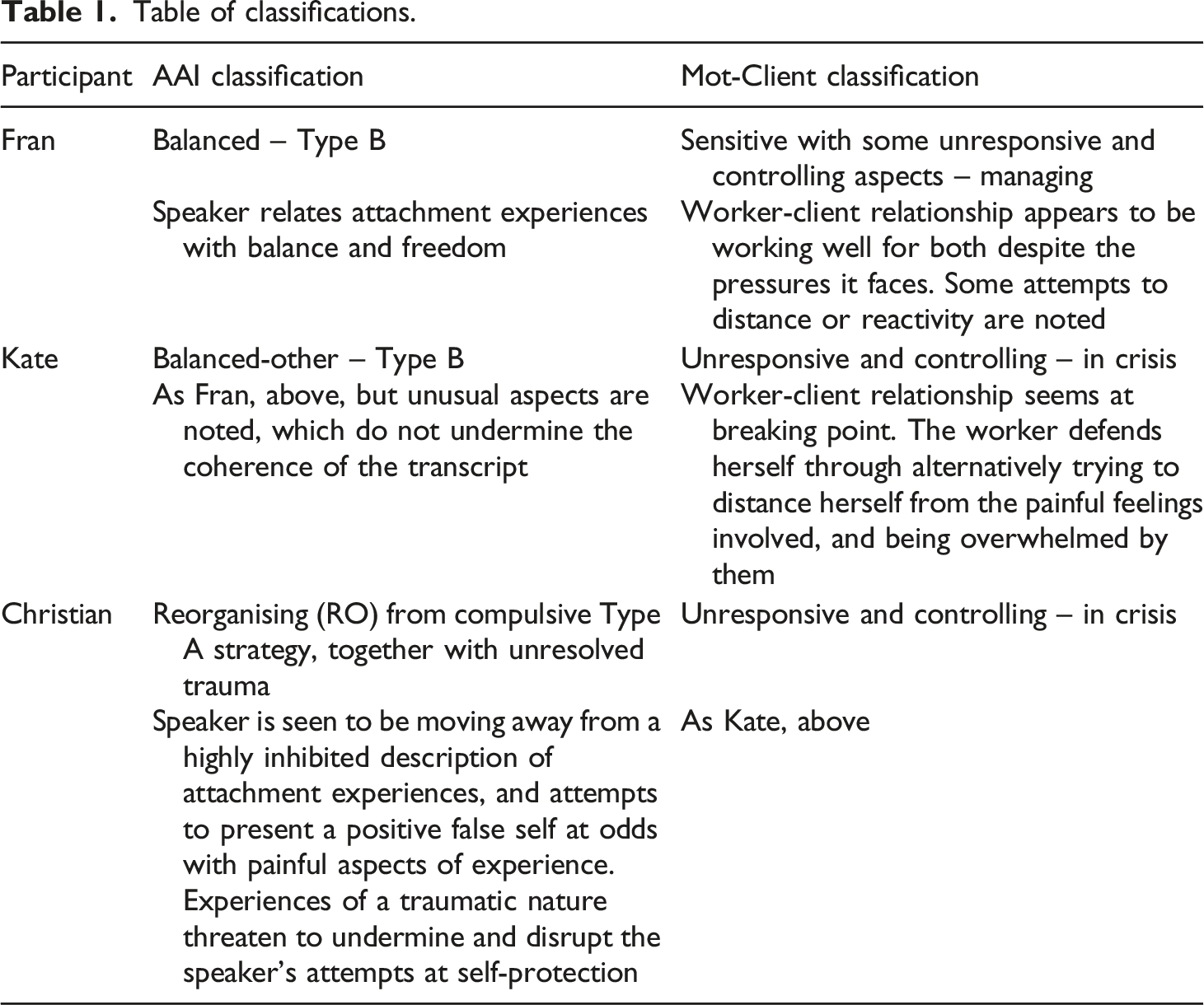
Kate and Fran both related only limited experience of dangerous episodes during childhood. Both seemed to have integrated their more complex experiences, speaking of them in a coherent and emotionally congruous way. For Fran, this included the experience of harsh discipline (not abuse) and parental conflict. Both shared close relationships with their parents in adulthood and could speak about the changes the relationship had been through over time. During childhood and adolescence, Kate was aware of her parent’s marital difficulties and spoke of some episodes during times of conflict in the family in ways which were discrepant with the overall Type B classification and general integration of her experiences. Christian’s AAI suggested that a compulsive performing strategy, which focussed on meeting external expectations of attachment figures whilst inhibiting difficult feelings and his own internal responses, preceded the steps he was making towards the integration of both perspectives. However, a substantial amount of discourse illuminates the inhibiting self-protective strategy used in childhood. For Christian, there is also evidence in his transcript of unresolved trauma, psychological danger and a lack of comfort. This would have facilitated Christian developing the false positive self we saw in his AAI discourse, aimed at performing for others rather than seeking nurture and protection for himself. Christian has some partial recognition of his tendency to idealise his parents, but loses awareness of this when speaking of painful or distressing topics.
Integrated Attachment-IPA analysis
Table of themes.
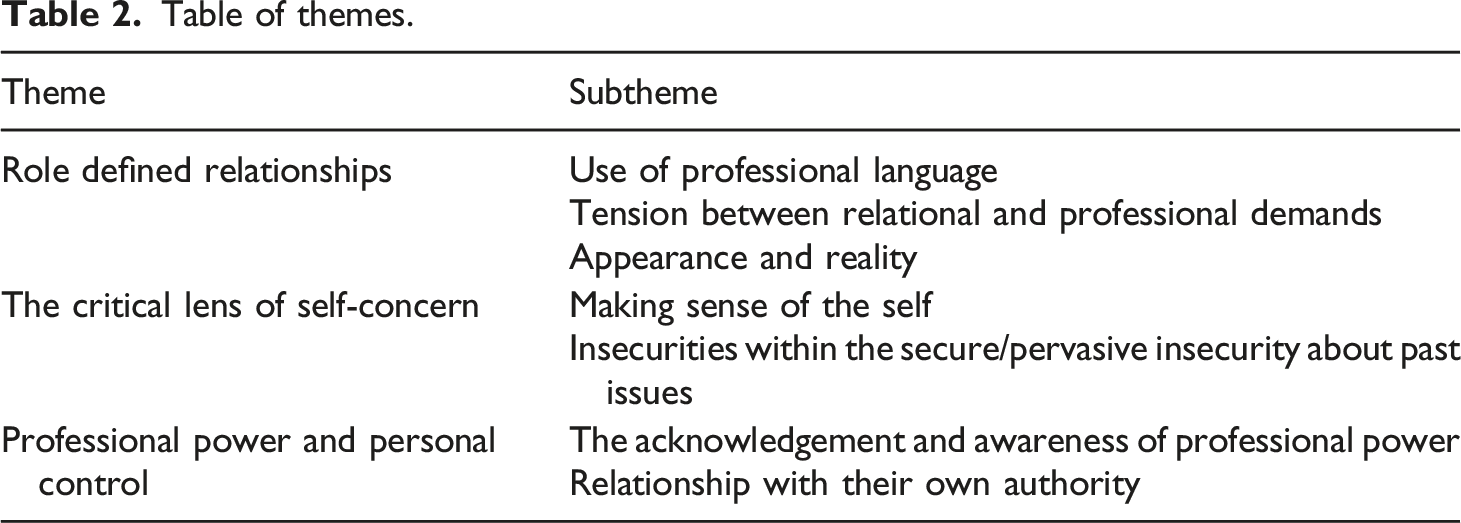
Role-defined relationships
Central to this first theme was the way in which relationships were initially overlooked when each participant was asked to describe the social work role. Attachment pattern seemed to have little influence on this as a generalised, semantic question, although differences were noted when more contextual questions prompted participants to talk of their actual experience. The use of external professional language and social work terminology such as ‘cases’ and ‘assessment’ with emphasis on task and procedure, lack interpersonal detail or the worker’s internal experience: ‘To make sure children are alright and they’re safeguarded, and parents are supported to make sure they are safe from risk’. ‘We work from pre-birth to 18 erm so yeah, so I complete assessments, do visits, erm risk assessments’. ‘My job is to assess risk for children who are in danger of being harmed essentially’.
Participants were however aware of the interviewer’s role as a practicing child protection social worker, and so the speaker’s discourse at times may have reflected that deemed appropriate to professionals speaking to one another, rather than reflective of their own individual meaning-making.
A similar pattern emerged when they were asked to say ‘what kind of person’ their client is. When the question was repeated to Christian, he responded saying ‘oh right, as a person’. This seemed to characterise the default pull that each participant experienced as they began to name and list generalised ‘case’ categories and presenting risks to the children; ‘domestic violence, exploitation and mental health’. By contrast, Kate and Fran both paused, asked the question to be repeated and then gave answers more congruent to the question asked. Their greater confidence in their attachment relationships may also indicate an ability to utilise the relationship with the interviewer to check in and refocus more collaboratively.
Although not at the fore, relational importance was attributed to the social work role for all three participants. One participant (Kate) referred to the relationship when discussing her qualities as a social worker: ‘I was also sad that I wasn’t able to make that relationship with her, because I think that’s one of my strengths in social work is that I can kind of form a relationship, a working relationship with anyone’.
Of note here is Kate’s specificity around the term ‘relationship’, reframing this as a ‘working relationship’. This suggests she keeps in focus a professional boundary when relating to her clients. The sadness for Kate seems to arise out of awareness that the reality of her relationship with her client is discrepant with how she perceives herself as a social worker (able to get on with anyone). A nuanced distinction between appearance and reality characterises Type B attachment discourse. In contrast, when asked what gives him the most joy as a social worker, Christian responds ‘having relationships with people like Kelly... for all the complexity that comes with it I think’. There is partial recognition that the relationship is ‘complex’ but he did not integrate this positive assessment with the pain and anger emerging from much of his interview. This is in keeping with his AAI pattern of shutting down awareness of negative feelings, which, if felt, might be unbearable. Whereas Fran is able to name and think about her sadness, Christian struggles with this, resulting in parts of his interview that were not connected or incongruous with the rest.
The critical lens of self-concern
Questions in the AAI and Mot-Client ask explicitly how participants see themselves as a person and as a social worker and provides space for reflection about how past experiences have impacted adult personality. Each participant reiterated a key concern during their developing years that is also repeated and expressed within their relationship with their client.
The repetition of a key phrase in Fran’s AAI reveals a fundamental self-concern, conceived in childhood, which is expressed with her client. For Fran, the issue of fairness is of particular significance. Fran used the phrase ‘I got in trouble a lot’ repeatedly throughout her AAI. The form of punishment she received from her parents often felt ‘disproportionate’ or ‘unfair’ in the context of what she had done to get into ‘trouble’: ‘I mean often when I got in trouble, it just felt, like it, it just felt quite unfair like I often felt that... yeah that things were like dis, and I wouldn’t have been able to name that when I was younger, but now it’s like a disproportionate feeling’.
This tension is echoed in the relationship between Fran and her client. When describing a time they didn’t ‘click’, Fran described an episode whereby her client became frustrated and angry with her for ‘taking the side of the father’.
When asked how she feels about this Fran says: ‘I feel, I feel like I, I feel a bit defensive, like I need to defend myself and erm because it just because I... because what she’s saying is I’m not being professional, and I’m not being fair, whereas I think that I am balanced, and I am fair'.
Although Fran does not go as far as making this link herself, she is aware that this issue triggers a defensiveness in her, which is to say that she feels threatened. In her role as a social worker, there seems to be a sensitivity towards associations with unfair treatment, potentially an unconscious desire not to repeat the treatment that caused her some distress as a child. It is through this lens that she assigns importance to fairness and balance as professional qualities, and she becomes aroused when her attempts at this are challenged by her client. Fran seems to be using her experience of unfair treatment as a child to monitor her own actions in her role as a social worker, at least with this client.
Kate and Christian both experienced relational issues with peers during childhood and adolescence. Kate’s AAI notes a particular self-concern around being ‘liked’ which she associates with an aunt who her mother told her: ‘She decided when I was about three that she didn’t like me’. Kate also notes that she was ‘bullied’ in high school and said ‘I didn’t really know who my friends were’. Kate notes that in her adulthood she remains ‘dependent’ on her parents for support and finds it hard to trust the reliability of friends or others outside her immediate family unit. In relationship with her client, Kate’s affect and arousal increased when speaking about her client’s feelings towards her: ‘I just knew that she didn’t want me’ … ‘I just know that she absolutely hates my guts’… ‘she’s just never gonna actually like me as a person’… ‘she absolutely hated everything about me’.
The language used in relation to her client is noticeably more affectively driven and evocative than when speaking of her friendships as a child, although the commonality between them is the concern of being disliked. Comments of this nature feature throughout the transcript, making clear that the dominant experience for Kate in relationship with this client is one of being ‘hated’ and ‘unwanted’. Kate appears highly threatened by her client disliking her, and the conflictual nature of this relationship is at odds with her experience of the safe, stable, loving relationships she describes in childhood. Her experiences have taught her that relationships are predictable, comforting, reciprocal and rewarding. Consequently, when faced with a relationship of a hostile or conflictual nature, she seems to associate this with the aspects of her history which are not as well integrated. Her response to this perceived threat is to react with some hostility and then withdraw.
Christian notes he was ‘teased a lot’ and identifies himself as ‘desperately searching to want to be a part of this teenage world’ which he perceives himself to have had a ‘great hopeless failure at it’. Interestingly, when asked what he likes least about his client Christian states: ‘When she is with others, she’ll take on their er least pleasant aspects, she’s very easily erm taken on board by having friends like “wow I’ve got friends”, and this means, erm this means erm that everything is great’.
In seeing the two passages together, there is the sense that Christian is talking about his own experience when describing his client’s. Although he uses the words ‘desperately searching’ which emotively describes a kind of yearning in him when comparing himself to his peers and talking of his ‘failures’, there was still an absence of feeling and explicit emotion in his accounts. His language was distanced from his emotions, and he frequently cut off sentences just at the point where difficult feelings might be expressed. It appears here that Christian’s perception of his client’s experience is influenced by his own painful experiences in this area of teenage life, an influence that remains largely inaccessible to explicit reflection. His experience and self-perception appear projected onto his client, resulting in a negative reaction to the aspects of her character which he most dislikes in himself.
Professional power and personal control
Each participant referred to an awareness of the power imbalance between them and their client, and connections are identified between professional power and their individual representations and personal experience of control.
Alongside the issue of feeling liked, control features strongly in the relationship between Kate and her client. One of the words that Kate used to describe the relationship was ‘unequal’. To illustrate, she said; ‘I feel like cos the role’s got more power, but with her I often feel like she’s got the power and control over me and I feel like really like kind of small, like in our conversations’…I think maybe she controls the conversations even if I think that I’m in control of the conversation... so I don’t like that about her’.
The issue of control here is represented as a problem for Kate, in that she fears being controlled by her client, and feels ‘small’ as a result of feeling controlled, even though her professional role makes her the more powerful. Her experience of control in other aspects of her life are mentioned in both interviews and appear, at least on the surface, to be at odds with the struggle for control with her client. When discussing a time that she felt she needed someone to take care of her in the context of her work, Kate speaks of her dissatisfaction that her manager was not as supportive as she felt she needed her to be. ‘I really needed my manager to literally like just take me under her wing and just like control of everything that I was doing’.
In this situation, Kate wishes not to have control but to relinquish it to her manager, a person of authority, to support and ‘take control of everything’. This oscillation between wanting control in her relationship with her client, as we have seen above, and wanting to relinquish it here, is perhaps more typical of a coercive attachment strategy where alternated, exaggerated vulnerability and invulnerability may be used to push attachment figures into being more responsive and predictable. Although classified as Type B overall, Kate related a triangulated episode in which she positions herself in between her parents, expressing vulnerability to seek comfort from her father, who would then request an ‘apology’ from her mother to Kate, exonerating her from responsibility for her part in her conflict with her mother.
When feeling out of control, Kate’s response towards her client tended towards hostility. This seems at odds with Kate’s Type B AAI classification, which would suggest she could draw upon reflective functioning and mentalising to make sense of her own and her client’s experience to resolve the conflict. However, Crittenden and Dallos (2009) note that children can be said to have an attachment towards their parent’s relationship, not just with each parent separately. This undeniably puzzling finding, might be explained by the possibility that her conflict with her client specifically elicits in Kate feelings related to the triangulation evident in her involvement in parental conflict, disposing her to greater defensiveness than was apparent in her discussion of her childhood relationships more generally. Furthermore, her clients’ perceived control threatens the position of power Kate considers she needs to hold as a professional, and this seems to evoke a defensive, hostile reaction, at odds with the more balanced perspective taking and mentalising she also demonstrated.
Christian also spoke overtly of the use of power and control within his role as a social worker: ‘I like using er using the power that I have in a way that is effective, but is also empathic and also leaves as little unpleasant impact on people as possible’.
However, there were incongruities between this aim and the experiences he described: An episode which best demonstrates the way this plays out interpersonally is included when talking about his client’s ‘compliance’. ‘I was just kind of chatting to her and I remember seeing her eyes, and she just suddenly looked a bit like a rabbit in a headlight, do you know what I mean and she was eyeing up the door a bit’ … ‘no, no, no, no, she wasn’t, ah she wasn’t scared, that sounds scared, she wasn’t scared (sigh) I just noticed I think at that point for the first time that she.. that’s right it was something that had happened with me, it was my realisation, it was just a subtlety of body language do you know what I mean’.
Sensory images usually relate the affective content of experience, experience that literally ‘left an impression’ on the speaker, emerging from pre-conscious implicit memory (Crittenden and Landini 2011). The image of a ‘rabbit in a headlight’ suggests real terror. Subsequently, rowing back from this, Christian transformed this evocative image to a more emotionally distanced term ‘a subtlety of body language’, which is not imaged. There is a sense that Christian is uncomfortable, if not distressed (notice also the sigh), by the thought that his use of power may have caused fear in his client and also that the interviewer may have perceived him to have caused his client fear. Themes of powerlessness were prominent in Christian’s descriptions of his childhood, particularly around his parent’s decision for him to go to boarding school against his wishes. This was seen as unresolved (ongoing) trauma in his AAI, likely associated with feelings of abandonment at a young age with little power to prevent or change his circumstances, despite attempts to make his feelings known to his parents during adolescence.
As a result, Christian seems unable to tolerate the discomfort of his own experience, and of what the interviewer may be thinking of him, perhaps because his own feelings of powerlessness are elicited by his clients’ fear. In keeping with how he might have defended himself in childhood, Christian resists the discomfort, making light of it, or turning his attention away without reflecting on its impact. The continuing influence of past trauma, as suggested by his AAI, may have limited the response options available to Christian both in interview and in person with his client, meaning that his distress, anger and fear remain part of his experience and are felt by his client but cannot be openly attended to.
Discussion
Overall, our findings did illustrate how attachment can influence the relationship social workers form with their clients. However, this did not turn out quite as expected, in that Kate and to a lesser extent Fran’s balance and autonomy in considering their childhood attachments, did not straightforwardly translate into how they experienced their relationship with their respective clients. This is of course a small-scale qualitative study rather than an attempt at statistical generalisation, but the findings remain challenging to understand ideographically in the lives of our specific participants, given the theoretical as well as statistical links between attachment security and mentalising (Fonagy and Bateman, 2015).
Interestingly, this echoes findings from a study by Rizq and Target (2010) who explored the role of attachment and reflective functioning in psychologists who had undergone personal therapy. These authors noted that it was too simplistic to conclude that high levels of RF and attachment security were ‘uniformly advantageous’ for therapists, with a negative case example suggesting that mentalising and reflective functioning can provoke a self-preoccupation in some contexts. Given the threatening contexts that speakers with relatively safe backgrounds are working in, what may be self-protective for the worker, may not necessarily improve the relationship with an endangered and traumatised client. The straightforward high/low dichotomy frequently applied to RF masks the fact that different kinds of reflection may be more self-protective in different contexts, as Crittenden and Landini (2011) argue.
This study would also suggest that further thinking is needed about the distinctions between a caregiving context (between parent and child) and the context within which the professional-client relationship is situated, especially when that context is as contested and threatening for both professional and client as child protection social work. Attachment theory is rooted in evolutionary and developmental psychology, which speaks of the dual or mutual biological function that attachment relationships serve between parent and child; survival and reproduction (Crittenden 2016). ‘Helping’ relationships may elicit the social worker’s caregiving impulse but may equally elicit a more critical need for self-protection when ‘caring’ for someone to whom one is not biologically related, in a conflict-ridden environment. The opportunity for social workers to vicariously resolve aspects of their own adverse or traumatic history may well be a strong motivating factor for some, but this is somewhat risky in working with traumatised clients in an organisational context that is frequently defensive and experienced as unsafe by those who work within it (Grey and Gunson, 2019; St Jean et al., 2021). Indeed, the caregiving impulse may make it harder to acknowledge rage or fear towards clients, without jeopardising a feeling of being a ‘good social worker’.
In a caregiving context, a child who is simultaneously fearful of their parent, yet reliant on them for protection and comfort, is highly unlikely to experience attachment security. Similar conditions arise within the social worker-client relationship. Many studies report on the fear that the client often has of the child protection worker who they see first and foremost as having the power to endanger them by taking away their child (Buckley, et al. 2011). Yet if the child is to remain with the parent, a positive working relationship between parent and worker is expected. If, as this study would suggest, attachment security within the social worker did not automatically create sensitivity and attunement between worker and client, this is an important relational context to consider.
However, this study did highlight distinct parallels between attachment history and experiences of danger with how the social worker experienced their relationships with their client. For Christian, we argued ongoing traumatisation and a partial preference towards turning attention away from painful experience made sense of striking incongruities in how he experienced his client. Kate and Fran could name relational difficulties more openly, but Kate appeared to struggle in utilising the mentalising capabilities she had developed, when in relationship with her client.
Projection of a personal self-concern of the social worker into the professional-client relationship was apparent for each participant. All three placed importance on aspects of the relationship or the client’s character connected to a pervasive self-concern easily traceable to key developmental stages in their respective childhoods. Acknowledging both the complexity of the discussion and the case-based methodology, this study does offer some support to Trevithick’s (2012) conclusion that the use of attachment could be used effectively within reflective processes and supervisory relationships within social work. This may be difficult to achieve as ‘the lasting effects of trauma and loss can be difficult to recognise and painful to sit alongside and attend to’ (Dallos et al. 2015, p.155). Those with traumatic or endangering experiences and losses are more likely to be emotionally harmed in the process, resulting in the higher levels of PTSD in child protection already noted (Bride et al., 2007).
Crittenden (2016) argues that the frequently expressed injunction that the therapist needs be a secure base for the client requires more careful thought. Afterall, if the client was able to use others as a secure base, they would be unlikely to need the assistance of a social worker or therapist. Instead, the issue is whether the professional can tolerate not being accepted as secure base and remain available even when the client does not reciprocate this understanding of the relationship. Especially in fraught contexts such as the child protection arena, it is wise to be realistic about the expectations of professional relationship-based practice, which may add to the burden (and potentially, defensiveness) of those working in such contexts. Rather than idealistic expectations of ‘transformation’, with a defined outcome in mind, it might be more pertinent to aim at being able to sit with and tolerate the ways in which the trauma and defensive responses of the client evoke painful experience in the worker, and seek to prevent this exacerbating an already fraught situation. This has some overlap with Barry Mason’s (2022) call for professionals to create an environment of ‘safe uncertainty’ for themselves and their clients, noting how this goes against the grain of child protection agencies trying to create an illusion of ‘safe certainty’ through checklists and procedures. This he argues, leaves social workers in ‘despair and depression’ (p.7) caught between the rhetoric of ‘safe certainty’, and the reality of ‘unsafe uncertainty’. Similarly, Ruch (2007, p. 337) advocates ‘not knowing’, ‘toleration of uncertainty’ and ‘curiosity’ as a foundation for practice in a child protection context. Our analysis would suggest that this should include the toleration of personal and difficult feelings in both client and professional; a kind of ‘safe insecurity’. That is, maintaining curiosity as to any connection with past and present experience, between personal history and the professional relating, and giving these the opportunity to emerge without pressure for them to be ‘sorted’, ‘dealt with’ or otherwise ‘solved’.
Conclusion
This study used an innovative, information rich, methodology, to explore qualitatively the connection between how child protection social workers experienced their client and their attachment relationships. In all participants, childhood experiences were replayed in some form in the relationship with their client. This was not an explicit process for any of the social workers in this study; however, balance and autonomy in thinking about childhood attachments was mirrored in intrapersonal reflection for one particular social worker. The two participants with more inter-personal conflict in their attachment histories did to some extent experience their clients in more conflicted and defensive ways, although, perhaps reflecting the dangers inherent in the child protection context, there was more hostility and/or a need to distance from painful experience than the attachment context alone might have suggested.
These findings captured the way meaning was ‘co-constructed’ in the specific client relationship; the relationship between the workers’ attachment and client relationships was not a mechanical, uniform or generalisable one, but was idiosyncratic and alive to specific dangers in the local and wider systemic context. There is scope perhaps for both the AAI and MotC, or comparable processes (as Trevithick 2012 suggests), to be used in social work to enhance social workers reflective processes regarding their own psychological functioning. With supervisory support, providing what Ruch (2007, p. 372) calls ‘emotionally informed thinking spaces’, the particular influences on professional-client relationships of past threatening or traumatic experiences could be considered with curiosity and tolerance of a lack of ‘security’ and ‘resolution’. Paradoxically, our study suggests to us that such an approach might be safer for children, parents and the professionals who work with them.
Footnotes
Declaration of conflicting interests
The author(s) declared no potential conflicts of interest with respect to the research, authorship, and/or publication of this article.
Funding
The author(s) received no financial support for the research, authorship, and/or publication of this article.