



Abstract
The caregiving of fathers, especially adoptive fathers, is currently under-researched. This study explored the experience of adoptive fathers whose children displayed aggression and violence. Six Parent Development Interviews from a larger study were analysed using an attachment-informed Interpretive Phenomenological Analysis. Attachment discourse analysis derived from the Meaning of the Child Interview (MotC) and Parental Reflective Functioning Scale acted as ‘third voice’ in dialogue with the researchers’ and participants’ to explore the fathers’ experience interpersonally, in the context of their family relationships. Four superordinate themes were identified, with these fathers feeling ‘The Problem is in the Child’, at times sensing themselves persecuted by their child and lacking agency as a parent. ‘Confusion and Comparison’ highlighted the fathers’ sense of helplessness and longing for the ‘normal’ family life they associated with being a biological parent. The fathers also talked of ‘The Mixed Blessing of Feeling like a Father’, expressing extremes of anger but also fondness for their children. Participants engaged in ‘Looking Back’ both at their child’s trauma history and their own history of being parented, which in all but one father, also involved trauma. This left the fathers searching for answers to questions around biological versus relational origins of difficulties, and also pain arising from their own frustrated intention to create a better family life than they had experienced themselves in childhood. Common to all of this was the fathers’ sense of helplessness in being unable to contain or influence their child’s difficult behaviour, that negated or challenged their sense of fatherhood. We suggest a more relational approach that explicitly includes the father’s past and present experience, rather than treating the child’s aggressive behaviour in isolation. This could support fathers in recovering an internal experience of a shared relationship with, and being a father to, their adopted child.
Introduction
Caregiving and parenting research, particularly regarding adoptive parenting, has focussed primarily on mother-child relationships, leaving the role of father in adoption largely invisible (George et al., 2008; Siegel, 2014). Most children, whether adoptive, step, birth or foster children live within a family, a complex system, of behavioural exchanges and habitual patterns of interaction between members. It is within this context that desirable and problematic behaviours occur (Johnson and Ray, 2016). Infant and child behaviour is adaptive to caregiving environments, with children organising a protective attachment response to maximise the nurture they receive from the complex network of social relationships in which they are situated (Crittenden and Dallos, 2009). A number of studies have identified social, cognitive, and emotional outcomes of father-child relationships (Cabrera, 2020; Lewis and Lamb, 2003; Pleck, 2012). Currently, few UK adoptions are infants or voluntary relinquishment; most adopted children emerge from the care system having experienced abuse, trauma, and loss (Department for Education, 2021). Their behaviour will have developed in response to this, but once placed within adoptive families, the child will begin to adapt to the new caregiving environment and relationships existing therein (Crittenden, 2015). The neglect of fathers in research into the relationships of adopted children, is a neglect of the context in which all the adopted child’s relationships are formed.
Reflective functioning
Reflective functioning (RF) is the ability to reflect on and think about your own internal world, thoughts, and feelings, also to consider the internal world of others (Fonagy et al., 1991). RF in parents is understood to be salient to successfully navigating the challenges of parenting (Benbassat and Priel, 2015). High RF allows self-awareness while accepting that others are psychologically distinct, it is both cognitive and imaginative, enabling regulation and understanding experience of self and others (Slade, 2005). Children of parents willing to explore and talk about emotions are better able to understand their own and other’s minds (Laible and Thompson, 2002; Ruffman et al., 2002). Parental RF also has role mediating parenting stress (Nijssens et al., 2018).
Adopted children often display problematic externalising behaviour and regulatory problems (Elias, 2019). A link has been found between regulatory problems, externalising behaviours, anxiety disorders and low parental RF (Camoirano, 2017; Zeegers et al., 2018). Further, higher RF among parents increases sensitivity towards a child’s emotional needs and ability to help children cope with their feelings (Walker, 2008; Zeegers et al., 2018).
Fonagy et al. (1991) linked a child’s attachment security with fathers’ RF. Buttitta et al. (2019) identified father’s reflective functioning (RF) as central to emotional regulation of their children. They found direct association between father’s RF and social emotive supportive behaviours, which also moderated links between autonomy supportive behaviours and low income. Some studies found fathers' reflective functioning scores were lower than mothers (Esbjorn et al., 2013), and also empathy and ‘theory of mind’ ratings were lower in men (Eisenberg and Lennon, 1983). Nevertheless, adopters' RF was found to be higher than in general population (Leon et al., 2018).
Aggression and caregiving
The presence of aggression during childhood, and its management, is related to problems within the individual and relationships, causing long-term consequences (Estevez et al., 2014; Reef et al., 2011). Studies suggest the mix of genetic make-up, and environment, impact the propensity to aggressive behaviour (Simons et al., 2011). The developing child’s environment is largely impacted by parent-child relationships, with positive relationships a buffer against adversity (Hazel et al., 2014). Linking attachment to aggression and violence, Savage (2014) found a persistent correlation with attachment insecurity. Roskam and Stievenart (2014) found that the pathways to maladjusted behaviour was the same in adopted and non-adopted adolescents. However, increased levels of externalising behaviour were displayed by adopted children, which links to the higher prevalence in externalising behaviours among adopted young people mentioned above.
Kawabata et al. (2011) found both positive and negative parenting behaviours are linked to aggression from children. Specifically, father’s psychologically controlling parenting was related to increased levels of aggression and positive parenting to lower levels. Grey and Farnfield suggest that controlling parents see the child’s separateness as a threat, something that can become particular acute in adoptive parent-child relationships because the child’s biological relation to birth-parents is frequently considered dangerous (Farnfield, 2019; Grey and Farnfield, 2017a). These parents may control their child to neutralise the potential for the child to hurt them and may feel they are protecting the child from the consequences of their own behaviour. Crittenden (2007) links controlling caregiving with either overly-compliant or ‘difficult’ babies, as the child must either fight or internalise the parents’ control (Grey and Farnfield, 2017a).
Glover et al. (2010) found little or no difference between adoptive and biological parents’ self-reported warmth and negativity towards the child dependent on the child’s adoptive or non-adoptive status, or their gender. However, they found significant correlation between the parent’s negativity and child’s externalising behaviour. These combined findings highlight the impact of parental environment on the adopted child’s display of externalising/aggressive behaviour, not just the child’s pre-adoptive experience.
Research questions
There is a paucity of literature focusing on adoptive fathers’ relationships, and the research on the caregiving of fathers generally, tends to take a quantitative approach that excludes exploration of systemic complexity in family relationships, as well as the interpersonal meaning that fathers given to their experiences. As a result, we wanted to understand the experience of adoptive fathers whose children display aggression and violence within the framework of attachment and reflective functioning. Specifically, we asked: (1) How do adoptive fathers understand their relationship with their adoptive child in the context of violence and aggression? (2) What sense do these fathers make of their child’s aggression and violence? (3) What implications for the family system are there of the way in which the adoptive fathers experience their relationship with their adoptive child?
Methodology
Study design and methodology
This study utilises data taken from a larger ongoing investigation into parental sensitivity and RF changes around an intervention for adopters with children who exhibit aggression and violence. The interviews used for this paper were pre-intervention and the majority of those attending were at crisis point, with several talking about adoption breakdown. Many attendees reported little training prior to adoption and after completion of intervention reported a wish that they had this knowledge and training earlier in their adoptive journey.
This study uses a qualitative, attachment-informed, Interpretive Phenomenological Analysis (IPA: Smith et al., 2009) to explore the lived experience of adoptive fathers of these children, and its interpersonal implications. Six fathers were interviewed using the Parent Development Interview (PDI: Aber et al., 1985) that was developed to help understand the parent’s representation of child, the parent-child relationship, and their own experience of being parented. The discourse within the interview transcripts was analysed using the frameworks of both the Parent Development Interview Reflective Functioning Scale (PDI-RF: Slade, 2005) and the Meaning of the Child analysis (MotC: Grey and Farnfield, 2017a, 2017b) followed by Interpretive Phenomenological Analysis.
The Reflective Functioning (RF) scale was developed by Fonagy et al. (1998) for adults talking about their childhood relationships, before it was adapted by Slade (2005) for the PDI. Originally used with mothers, the PDI-RF changed the focus to the parental understanding of the child and the parent-child relationship, giving attention to how and whether the parent constructs the child as an experiencing self.
The Meaning of the Child (MotC) uses attachment theory-informed discourse analysis to understand the psychological meaning a child has to their parent, and its implications for the parent-child relationship. It is suggested that the adult’s need protection and comfort, and their perceptions of danger in their current context, transforms the meaning given to their relationships and parenting. That is, past experiences of relational danger inform what is attended to in the present, and what is disregarded, transforming the experience of the present moment to facilitate self-protection action (Crittenden and Landini, 2011) This self-protective transformation of meaning by the parent shapes their parenting and the parent-child relationship itself, especially when the parent feels threatened (Grey et al., 2021). The MotC analysis of parental discourse highlights the relational and self-protective context of the fathers’ experience of their child, and suggests how it may influence how the father interprets the child and his or her experience. The MotC analysis links the mentalising directly to the dyadic context of the parent-child relationship and the wider familial and social systems in which the dyad are located, thereby highlighting both the nature reflective functioning and its interpersonal and systemic meaning and function (Grey and Farnfield, 2017b).
Once analysed using the PDI-RF and MotC, Interpretive Phenomenological Analysis (IPA) explored the father’s subjective experience. Early analysis included familiarisation with transcript through a process or reading and re-reading followed by notating the transcript multiple times; notations and interpretations were collected and sorted into themes, then sorted into subordinate and superordinate themes. This was repeated with each transcript, before comparison and the creation of subordinate themes for the whole sample.
Smith et al. (2009) suggest that qualitative analysis is a ‘double hermeneutic’ process: the participant attempting to make sense of their world while the researcher attempts to make sense of the participants’ process of interpretation. In using an attachment-informed IPA, this study is not trying to replace the participants’ interpretation with an external theory-driven one. Rather, as Rizq and Tagert (2010) suggest, when using IPA alongside the mentalising and adult attachment analysis, the attachment-theory informed analysis offers a third or ‘triple’ hermeneutic, from which to make sense of the participants’ experience, drawing out possible relational and self-protective aspects of the meaning-making studied. The interview context is itself a social encounter rather than offering direct access to participants’ experience, and the inclusion of attachment analysis as a ‘third voice’ gives this explicit attention in the analytic process. The attachment analysis was therefore brought into the overall IPA at the stage of critical engagement with the text of each interview, and the drawing together themes for each transcript and the group as a whole.
Participants
Interview transcripts from the first 6 fathers attending the course who gave research consent were used. Ages ranged for 39–50, all were married and had up to 3 adopted children and no biological children. Children’s ages at time of interview ranged from 6 to 10 years and placement age ranged from 4.5 months to 3 years. All but 2 children were female. The focus on six fathers allows for comparison across the group without losing the ideographic focus that is central to IPA, a particular threat given the complexity of the analytic process employed.
Ethics
Full ethical approval was gained from the University of Roehampton. Data protection procedures were followed, with names and personal details changed to maintain anonymity.
Peer review
Each interview was analysed with PDI-RF and MotC by the first author, a certified reliable coder, then a selection of transcripts were sent to reliable coders blind to the study to incorporate perspectives not influenced by the concerns of the study or the relationships developed within it. Analysis from these coders was incorporated into the findings in keeping with the study’s qualitative methodology. The overall analysis was considered by all authors of the study and integrated into the final presentation.
Analysis and discussion
Table of themes.
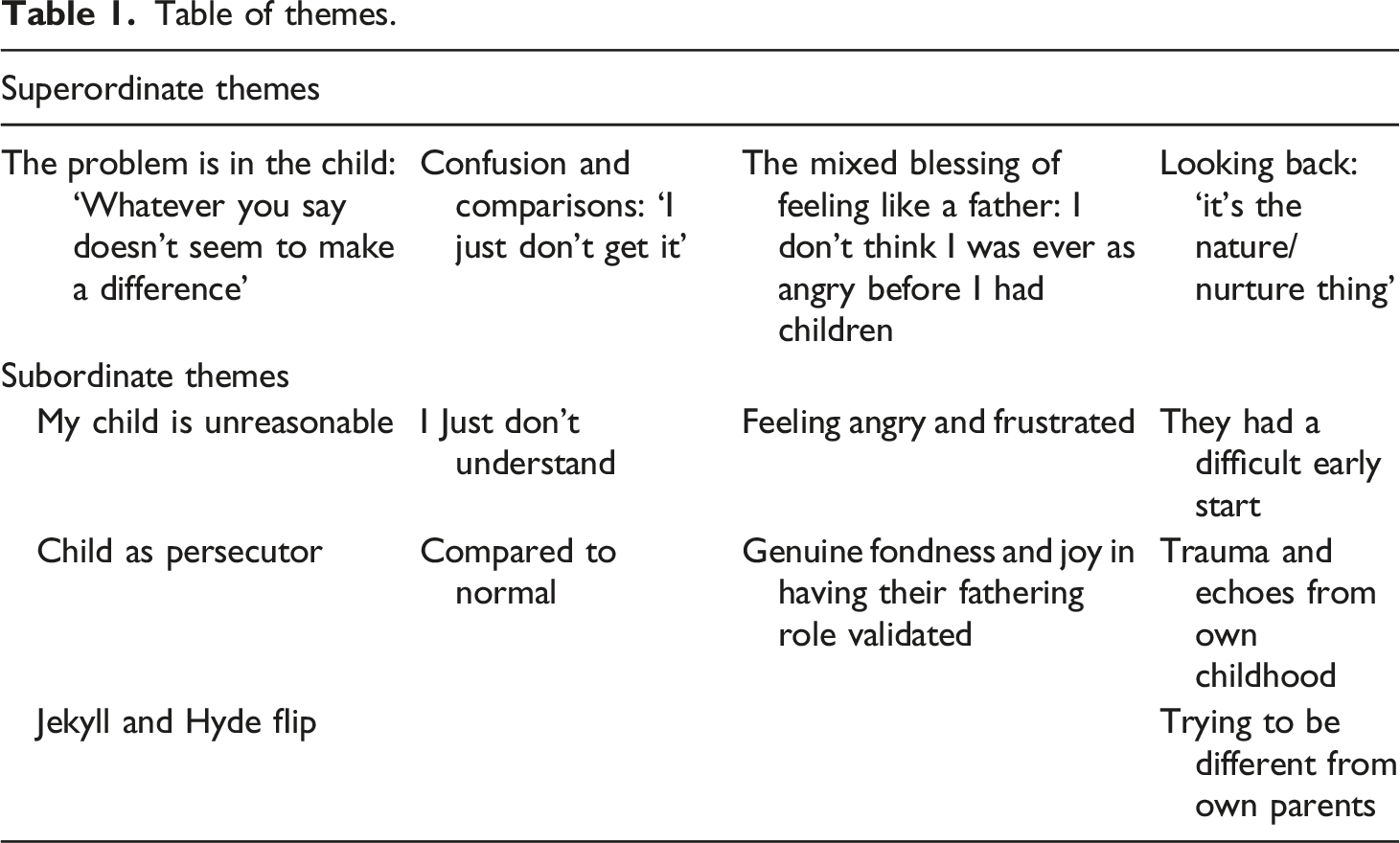
Theme 1––The problem is in the child: ‘Whatever you say doesn’t seem to make a difference’
Most of the participants located the problem firmly within the child.
My child is unreasonable: ‘Are we going to be doing this forever?’
Participants had multiple examples of children’s behaviour they considered unreasonable, often seeming at pains to communicate just how alien their child’s behaviour was to them:
John “she was unbelievable, as soon as we come in through the door and she would… you know, we would say ‘We have got to go in babes, it’s late, we are going to go upstairs, brush your teeth, we are all going to go to bed’ and she just kicked off, no reason at all, and started to do these stupid (noises), we were just trying to get her to brush her teeth and get her clothes on.”
Simon “We have been through this, explained this, we have said this is what is going to happen, I have asked you not to do that, you are still doing it ... are we going to get beyond this, or are we going to be doing this forever?”
‘Meltdowns’ were experienced as almost incomprehensible in their frame of reference, with no identifiable triggers. Simon seems desperate, feeling they’re caught in a loop with no sign of change.
Richard “It’s just the, we have the meltdowns, and sometimes there is no, couldn’t tell you what her trigger… general sort of, disobedience, you know, even though we will warn and say, right you know another 2 min in the bath and you’re set a timer, so in two minutes it goes de,de,de, then, ‘can I have another minute,’ ‘no problem,’ and then you to get out, you get the meltdowns and not triggers, and just the, I say, unwillingness to do the (sighs) very, very basic requests, it is not like it is something difficult.” “Despite warning, warning, warning, warning, World War 3 when we take it away”
Interestingly, although Richard says he doesn’t understand, he does look to himself occasionally and wonders about his actions, failing to find a helpful answer as to what could be done differently to help his daughter. However, Richard experiences his daughter is mechanically, ‘from the outside’ without an internal perspective, motivation or rationality; ‘triggers,’ ‘meltdowns,’ ‘unwillingness to do,’ and ‘World War 3’ refer to her observed behaviour, without him being able to see a self, with human feelings and logic behind her difficult behaviour. Her behaviour is therefore experienced as an impersonal explosion against which he has no protection, rather than human interaction with someone with whom he is in relationship.
Callum “Whatever you say doesn’t seem to make any difference, all the distracting things you can think of.”
Ben “The transitional thing when she flips it’s really nasty, umm, [pause], I could probably think, I want nothing to do with you now, I am, not getting involved here, but she’s still screams, and shouts, and I would say that’s probably the worst.”
Participants experienced these incidents as unreasonable and incomprehensible, experiencing little sense of personal agency, it almost just happens to them. Whilst this protected them to some extent from a sense of shame arising from these relationship ruptures, this offered no room to see themselves as parents, in the sense of offering nurture, protection or containment. In these moments of threat, they do not experience themselves as relating to a person.
Child as persecutor: ‘She is playing games with us’
The lack of agency these fathers experienced went further in that they frequently saw themselves as victims of their children:
John “I can’t help but feel like she is playing games with us” “The girls bickering … it’s like Japanese water torture, it never stops”
Richard “I will walk into the room and just get growled at, for, just literally, just get, growled at!” “It’s difficult to cope with and difficult to deal with because well, what was the trigger I have done? I don’t, I’ve not consciously done anything wrong, but you know all of a sudden, ‘Daddy, don’t like you!”
Again, though seemingly feeling the victim of his child, Richard is searching, wondering if there is something that he has done to trigger his child, but fails again in finding answers. He talks as if he is trying to placate a tyrant, trying to work out whether he is doing the right or wrong thing. He is trying to fathom the impersonal rules he has to follow, rather than feeling as able to help or manage his child as a parent.
Simon “I think it’s the obsessing, the obsessing over the minutest of things, … we seem to be putting ourselves through torture.”
Callum “Like I said before if he is trying to hit you or attack you and he just won’t give up.”
Ben “Her shriek, her screaming… when she is in a bad mood, it’s just not pleasant to be around and that’s at times when you just think, ‘Do you know what? I just can’t cope with this, I am just going to take a step away’, but they just keep pushing, pushing.”
Images of torture and violence are woven throughout several transcripts, also the use of violent language. Noticeably with Ben, his daughter shifts from being a ‘she’ to an impersonal ‘they’ who just keeps ‘pushing, pushing’. Participants seemed to experience desperation and feel trapped by a violent unknowable threat they must accommodate rather than feeling in a relationship with someone they have an influence over. Seeing their child as an impersonal, alien aggressor helped these fathers organise to meet the threat, minimising the pain of being hurt by someone they love. At the same time, it robbed them of being a parent to a child who is ‘theirs,’ whom they can influence and contain by virtue of their relationship with her/him.
‘Jekyll and Hyde’ flip
At times, participants found their children highly unpredictable and frightening, and used strong language to convey this. They wanted others to understand how hard, perhaps impossible, a job parenting their children is:
John “It can be from one minute she can be the most loving, beautiful little angelic thing and then just turn into this monster where she is literally, I and not exaggerating, literally a monster, you think it’s like a Jekyll and Hyde type thing, it’s unbelievable goes from one thing to the next.”
Some fathers felt misunderstood, they saw something different to the rest of the world but wanted others to know and validate their experience.
John “A lot of people almost don’t see and believe there is this, this other side, they kind of see this wonderful, loving child, and, and, she genuinely is, you know, loving and affectionate like the cuddles and stuff, then the devil is a bit too far, but you, there is just this other side where it is disobedient, meltdown, etc.”
The fathers were at pains to articulate two different sides to their children.
John “Volatile would be a step too (sigh) it, it’s a step too harsh but it…, it’s, the, we are fine, she has snapped, I don’t know, what I had done wrong, so is that volatility?”
Harry “It is normally when she’s going to bed… a couple of nights ago, I was sat on the bed next to her, and then, as she was falling asleep, she woke up again and just started kicking me for no reason, and trying to bite me and scratching me.”
Callum “Very energetic, enthusiastic, umm, but flips very quickly from one thing to another (pause) flips very quickly in mood, from this is amazing, to this is, you know, worst thing ever (laughs).”
By splitting the child into 2 opposite, ‘Jekyll and Hyde’ selves these fathers can find part of their child to love: ‘beautiful little angelic thing’, this ‘wonderful, loving child’, projecting the difficult aspects of the relationship on to the ‘devil’. However, in both aspects of this split they have lost the experience being a parent to a child in whom they are in relationship (note for example, the distance in language in John’s ‘beautiful, little angelic thing’). They do not know which child they will face and experience the changes as ‘for no reason’, without any sense of their own influence.
Theme 2––Confusion and comparisons: ‘I just don’t get it’
By the same token, this meant that the fathers experienced their child as unknowable and outside their control, leaving them helpless in their role as an adoptive parent.
‘I just don’t understand!’
A sense of confusion permeated the scripts. Some participants particularly stressed their lack of understanding or ability to fit their child’s behaviour with their expectations of normal development, or reasonable responses to their own behaviour.
John “She can lose her temper over the most, smallest, trivial things and I’ll, I don’t know, I just don’t get it (laughs), I just don’t understand!” “I could understand if… I was really abusive or something like that, and you get that return back.”
Simon “Things that they might not like but are, you know, pretty low level will induce tears and crying and that or shouting and shouting and screaming which I think other, of the same, 6 years olds wouldn’t be doing.”
This confusion led to feelings of disempowerment.
John “I don’t know how to deal with it. You know, I wish I was a crystal ball, and I could just see well this is why she is acting like this.”
Richard “It’s just helplessness and frustration.”
Compared to a normal family: ‘The simpler thing is to have your own birth children’
The theme of wanting a ‘normal family’ with a ‘normal child’ suggested the participants did not experience their family or child as ‘normal’. Normality seemed something they desired and regretted they did not have.
Richard “It obviously looks like a normal family unit, it’s not the hold on your both kind of ginger and your blonde child and you know, she’s really short and both really tall, and it, we look like as sort of a, regular family unit.”
Richard became emotionally overwhelmed, crying when mentioning his child looking quite like him and his partner. The repeated ‘it’ adds to his sense of a chasm between that appearance, and his actual experience of family life as anything but ‘normal’ or ‘regular’.
Callum also articulated the perceived difference to having a birth child and how he feels you can’t parent in a normal way: “Well, I guess the simpler thing is to have, your own birth children.” “If you reacted normally, or as a parent would normally with a child doing that sort of thing, just up the stakes even more and then he would try and turn the pram over or whatever.”
The final ‘or whatever’ emphasises the futility of trying to make sense of, or predict, what his child might do.
Sharing his fellow participants desire for normal family life, Ben talked with warmth about good times that he felt were ‘normal’: “Just feels like a normal household for once, you think yeah that’s quite pleasant.” “Seeing them actually play together when we are able to have shopping days, when we go to the shops as a family, or go to the movies when you feel like a normal family there, they are good days and things that make me feel happy I suppose”
However, even these accounts are tinged with doubt, with qualifying statements like ‘for once’, ‘they are good days’, and ‘I suppose’, showing his underlying experience of disappointment and loss of the normal family life he had hoped for.
All participants did not have birth children, coming to adoption through infertility. Infertility is frequently compared to both trauma and loss (Jaffe and Diamond, 2011) at times leading to considerable psychological distress (Klock, 1993), as well as confusion about caring for a child who is not genetically your own (Farnfield, 2019).
Theme 3––The mixed blessing of feeling like a father: ‘I don’t think I was ever as angry before I had children’
Feeling angry and frustrated: ‘I don’t like how cross it has made me’
Despite the need to impersonalise the child and push difficulties outside the parent-child relationship, ruptures in their relationship with their children still felt personal to these fathers. Feelings of frustration appeared often, and some participants talked about anger, whilst others shied away, seemingly shamed by it, with their anger apparent in the language and imagery they used.
Simon “I don’t think I was ever angry ever as, before I had children, now I am about 25% cross all the time (laughs, pause). I don’t like how cross it has made me and how cross it makes me about tiny things.”
For Simon, parenting has evoked emotions that he was not aware of having before being a parent. He has nowhere to go with his anger and is simply left regretting it.
Richard acknowledged getting angry is not helpful, but struggled to regulate himself in the face of extreme behaviour: “All I wanted to do was shout ‘enough, stop it!’ you know, don’t, we don’t hit mummy, we don’t throw things at mummy, that’s not nice.”
Callum “He can be fine one minute and the next minute umm, you know throwing something across the room, he’s quite happily destroy, destroy his toys, things, clothes anything umm, as well as anybody else err, which in a way I suppose (laughs) shows he is not particularly discriminatory.”
Callum’s sense of the child being outside the realm of human relating is tinged with pain and anger; he destroys ‘happily’ and is not ‘discriminatory’. It is not just that his child is outside the range of someone who can be ‘seen’ and mentalised for, Callum’s own pain of not being seen or regarded by his child is apparent in his language.
Ben wished to emphasise that his anger did not originate in him but was created by his children’s behaviour. This helps him create distance from his angry feelings and avoid seeing them as interpersonal, which would increase the sense of pain and rejection in his relationships with his daughters:
Ben “It’s normally triggered by them, so they’re normally in a bad mood anyway, and there normally screaming and shouting at us and then we are reacting to that. I don’t think there has ever been a time where I have come home in a bad mood and I have just shouted at the girls because I am in a bad mood… it is always triggered by the way they behave that creates that, environment.”
Ben’s anger becomes an ‘environment’ created by the girls’ behaviour, rather than something that is happening between them. Ben protects himself from the pain of experiencing the conflict as a ruptured relationship, but as we have seen loses a sense of himself as a person and parent in the process.
In contrast, “I feel disappointed with me, because I am the adult, and I feel sorry for [child] that I have, got angry with her over, stupid things”
What cannot be projected outwards in anger, is taken onto the self, illustrating the dilemma that drives the way in which the fathers’ experienced their children as an impersonal source of violence and aggression; the alternative may be unbearable and make it difficult for them to function as fathers.
Genuine fondness and joy in having their fathering role validated: ‘When we are having a nice daddy-daughter time, I love it’
At the same time, this residual sense of being a father, although challenged by the sense of the child being something ‘other’ than a child, also made way for experiences of being rewarded by their children. Several participants spoke of warm moments and seemed to especially to appreciate when their children showed them physical affection.
John “And she just give you everything, she gives you 100% love, without a shadow of a doubt, she will just come in and she’s straight over to you and she will just cuddle you straight away.”
Richard “When we are having a nice Daddy, Daughter time I love it… she will just be nice and in the mornings, cuddle up in bed and it’s just, it’s, it’s bliss.”
Harry “Any point during the day, she’ll come up and give you a cuddle and say ‘my lovely daddy’ and, hug you, and hold you or if we have gone out somewhere, all she wants to do is hold your hand and walk along.”
There are explicit links here between receiving affection and feeling a ‘lovely daddy’, illustrating the importance of these experiences not just as being nice, but as affirming of their fatherhood. For some this was found was in seeing the children achieve:
John “When the girls achieve something, off their own back. I love that! If they come home from school with a certificate because they did this and they did that, that’s brilliant, because you think yeah you have really earnt that.”
Simon “I think seeing the boys do well, I think yeah both of them have learnt to swim without any sort of floats on, both of them have learnt to ride a bike without any stabilizers.”
Callum “Seeing them being able to do things themselves; when he is riding off on his bike for the first time or whatever, painting or [pause] able to climb higher than he could the last time.”
For some fathers, slightly more concrete and externally focussed activities were easier to experience as a confirmation and acknowledgement of their fathering role, and affirmation of the sense of normality they had expected from being a father.
Theme 4––Looking back: ‘It’s the nature/nurture thing’
Although much of the discussion was caught up with the pain of the present, many of the participants were still able to make relevant connections with the past.
A difficult early start: ‘A lovely kid that’s just been dealt a wrong deal’
Participants found it difficult talking about their child’s early history, sadness was evident as well as some awareness of its effects as shown by John’s profound comment about his daughter’s lack of birth-family knowledge.
John “I think she is just such a lovely kid that’s just been dealt a wrong deal personally.” “I think she carries, the not knowing of, I think for her, the not knowing who her family is even though she has seen them in the books and the pictures and stuff.”
Harry “The first 6 months, where she lived with her birth-parents [pause]. I think that is possibly, the worst part of her life.”
Callum “The effects of drug, possibly quite likely alcohol, outside of that, who knows what he might have heard or outside of that in the first few months.”
Whilst the children’s past experiences of abuse and trauma explained the difficulties they faced and helping fathers like John to see their child as a ‘lovely kid’ who was ‘dealt a wrong deal’, the questions in Callum’s mind, and John’s sense of what his daughter does not know, also reflect fear that these children bring danger with them. This may contribute to the sense of otherness that seemed to characterise their experience of the children.
Trauma and echoes of own childhood
All but one of the participants described their own childhood experiences in negative terms and experienced situations that were either traumatic or even abusive, with absent or unavailable fathers a common theme, as well as controlling behaviour.
John described his father as being “pretty absent all the time.” He then explained that his father had a secret other family: “I felt like he betrayed my mum.”
Richard “Dad actually has a very short temper, very short temper, that doesn’t help by the fact he, probably still drinks too much… I can always remember and think, the association between alcohol and anger… I just never drunk because I had that connection of, alcohol, violence, all the rows I remember with my mum and dad you know, my dad was always drunk.”
Simon “My dad used to work a lot of shift work, so I definitely remember him not being, … I would use absent but not absent because he wasn’t physically there.”
“Say you were walking along and an adult barges into you by mistake, or whatever, they would tell you off (laughs) that kind of thing, it would always be something you have done wrong.”
“I was running a bath and I think he had worked nights or something ‘cause he was a police force, umm, so I was running a bath (laughs), but the water wasn’t flowing out as fast as he liked, and he said, ‘are you running that bath properly?’ and I said, ‘Yeah of course I am’, knowing that he wanted me to get the taps running faster, but I was like ‘No! That’s how it is’ and he flipped at me and stormed in there.”
In keeping with Farnfield’s (2019) study it was clear in these powerful and evocative stories that past trauma was very much alive for these fathers, with the strong feelings expressed containing echoes of their experiences of being controlled or ignored by their adopted children. For example, compare Callum’s sense of always being in the wrong with his many descriptions above of having no influence in his relationship with his child, and Ben’s talk of how his father ‘flipped’ and ‘stormed’ and his children’s volatility and the aggressive response they ‘trigger’ in him.
Trying to be different from own parents: ‘I … actively didn’t want it to be like that’
These fathers want to be different and better than their parents, what Dallos (2019) calls ‘corrective intentions’ to offer their children a different experience from their own.
“The big thing is too much of my own, it’s the nature/nurture thing and how much has my father’s parenting effected the way I parent, and I don’t think I am better than him, or a long way, but it is still probably, impacting me.”
While wanting to be different from his father, he recognised that in some ways he was still like him, particularly in unemotionality, and while comfortable for him it may not be best for his children: “I am quite, still quite unemotional, which, I, like, ‘cause that is what I am used to but I can see how that might be a, sort of not fit with, or probably better for me, may help the boys more if I was a bit more emotionally attuned to them. Yeah, what they are thinking.”
“I like to think I am quite reasonable as a parent, I look back at what my parents did and, and, not saying they did a terrible job… but I try and, make sure that, I am avoiding the things that annoyed me as a child.”
“For the adoption stuff you have to go through and think about…. parenting styles, and because they were so authoritarian and the rest of it, I didn’t want that, actively didn’t want it to be like that.”
The difficulty with such intentions is that parents experience shame when things don’t turn out as they intended (Grey et al., 2021). This may be driving the parent’s difficulties in placing themselves relationally in their conflict with their children; their descriptions of being helpless bystanders may be less painful than experiencing themselves as not living up to being the kind of father they intended to be. At the same time, these fathers showed a greater willingness to think about the ways in which their past may still be impacting them that might have been thought likely, given how threatened they evidently felt in their role. Despite their confusion and lack of a sense of being able to influence their situation, these fathers were actively thinking things through and trying to adapt.
Conclusion
This study explored the experience of 6 fathers in depth, and so by the same token did not research the perspective of others in the family, although the MotC analysis considered the participants’ experience dyadically and with the wider systemic context. Our aim was to explore the perspective of fathers of adopted children who displayed violence and aggression specifically looking at how they understood their relationship with their child, made sense of the problems in the family.
Most of these fathers found their children’s behaviour illogical and at times incomprehensible, struggling to understand where the behaviour came from or to reflect on what may be going on for the child. The route they have taken to parenthood is unusual, and a considerable commitment, it would be of interest to have known if they expected gratitude from their children. Terms such as ‘Jekyll and Hyde’ showed the extent to which fathers experienced their child’s difficulties as suddenly coming from the outside, leaving them bystanders to their children’s difficulties, rather than parents involved supporting them with their difficult emotions. Incomprehension led to feelings of anger, frustration, and helplessness.
These fathers had also experienced difficulties and trauma in their own childhoods, which has likely impacted upon how they mentalise their relationships (Fonagy et al., 1991), but also added to their sense of failure and shame, at not being able to create a the more positive family life they had intended. The fathers’ frustrated dreams of ‘normality’ suggested a sense of shame, that may have been driving their experience of their children as ‘other’ and beyond parenting (Grey et al., 2021). Further research could consider whether societal expectations around adoption may contribute to these parents’ sense of blame when things don’t work out, and the relational consequences of this that were evident in our study. We also wonder what contribution societal discourses of maleness and fatherhood may be making to the sense of failure experienced by the fathers in the study.
In addition, Farnfield (2019) found many prospective adopters carried unresolved loss and showed marked ‘disorientation’, a chronic relational confusion which he suggested may reflect profound confusion around nurturing the genes of strangers in their non-biologically related children. As Grey et al. (2021) note, the experience of the child as not reflecting anything about yourself powerfully challenges the caregiving system, in a way that is particularly problematic for adoptive parents. Having this powerfully brought home in relational ruptures, these parents experienced an ‘assault on the caregiving system’ resulting in ‘caregiving helplessness’, a collapse in the parents ability to experience themselves as effective in nurturing and protecting their child (George et al., 2008: p. 848).
This offers a way of understanding what Hughes and Baylin (2012) termed ‘blocked care’, sometimes known as ‘compassion fatigue’ or ‘carer burnout’: a state that parents may experience when their capacity to cope has been exhausted, which the majority of these fathers reported. We wonder as a result whether, instead of simply focussing on explaining the child’s trauma in ways that emphasise the child’s ‘otherness’, helping professionals should look at ways in which the fathers’ own experience, including their experiences of trauma, could become more visible, recognising its impact on the child. Paradoxically, if done sensitively, it may help fathers in this state feel more involved – more of a parent to the child than a helpless observer. Whilst adopters’ reflective functioning has been found to be higher than in the general population (Leon et al., 2018), this group of fathers RF was assessed as considerably lower than normative, using the parental RF scale. This may reflect our choice to study adoptive fathers in crisis, where higher awareness of difficult feelings in self and other may be unbearable at this particular time. Nonetheless, we found the fathers in the study much more willing and active in considering these issues (see 3.4.3 above), than might have been apparent from their helplessness when thinking about the child’s behaviour in isolation. This was also the experience of McKenzie et al. (2021) in their evaluation of a multi-family intervention with parents of autistic children, where comparable problems of feeling their child as ‘other’, and blamed for their problems were also evident. Far from blaming fathers, such an approach takes seriously their role and influence, supporting them in such a way that affirms both their own and their child’s experience in challenging circumstances.
Footnotes
Declaration of conflicting interests
The author(s) declared no potential conflicts of interest with respect to the research, authorship, and/or publication of this article.
Funding
The author(s) received no financial support for the research, authorship, and/or publication of this article.