




Abstract
Increasingly children have been referred for assessment and treatment because they used sexual behavior including “sexually harmful behavior.” Such children are often treated as a source of danger to others rather than as neglected or abandoned children who used sexualized behavior to protect themselves. In this exploratory paper, we present a series of case examples, arranged developmentally from infancy to puberty. All had standardized assessments of attachment from which detailed descriptions of behavior were derived. In addition, we have information about the parents that we used to help explain their behavior. We also review briefly the scientific basis for understanding how smell and touch affect sexualized behavior involving children. We conclude that children’s sexualized behavior and sexualized behavior from parents to young children is usually not sexually motivated. Instead, the behavior appears to serve attachment functions for both children and parents when their needs for protection and comfort have not been met. We note that sexual bonds are formed very rapidly whereas attachment bonds are formed slowly. Under urgent and dangerous conditions, sexuality may make bonds more quickly than slower attachment processes could do, thus providing the advantages of attachment (protection and comfort) quickly. Of course, this short-cut comes at a developmental cost. We close with recommendations for research and for professional practice.
Introduction
When a baby is conceived, the first thing people want to know is whether it is a girl or a boy; everything, it seems, hinges on that. Even the current emphasis on varied forms of gender identity attests to the power of sex to permeate human functioning. In this paper we explore a new way of looking at the functions of sex in the early years of life.
Our goal is to propose a new way of looking at sexual signals and behavior with and by children and to do so with enough theory, evidence base, case examples, and reference to newly published research to convince readers that these ideas should be seriously considered. Our central point is that sex permeates life and, when survival is threatened and attachment does not function protectively, sexuality can take on the functions of attachment. It does so on the basis of feelings (i.e., “affect”); we think that in instances of unprotected threat the feeling is almost always desire for closeness and comfort and not sexual desire. These feelings motivate sexualized behavior without either parent or child being consciously aware of what they are doing or why they are doing it. Because sexuality establishes bonds more rapidly than does the process of attachment, sexualized behavior is often used when attachment is failing or has repeatedly failed in the past. But this short-cut to closeness comes at a developmental cost. This cost is described by the many associations between sexualized parent–child relationships and forms of child maltreatment, psychopathology, and criminality—without these associations being specific or unique to any.
This topic is important because current clinical work has increasingly identified children who receive and use sexual signals and behavior. An unfortunate outcome of this is that some children can be labeled as using sexually harmful behavior and subjected to various forms of treatment or social exclusion. We think children’s use of sexual signals and behavior needs study, just as child sexual abuse did when it was “discovered” four decades ago. We expect that the outcome of knowing more about sexualized forms of connection between parents and children will be more supportive forms of intervention.
Past misunderstandings about sexuality and sexual abuse
When sexual abuse of children was identified in the 1980s, it was sometimes over-identified. These errors occurred in part because adults were horrified by child sexual abuse and wanted to protect every possible victim. In erroneous cases, the consequences included unwarranted alienation of fathers and daughters and, sometimes, conviction and imprisonment of innocent men. Over time, developmental and clinical information helped to clarify what was normal behavior and what was indicative of probable child sexual abuse.
A similar problem exists now for children’s use of sexual signals and behavior, with similar outcomes except that the mistakenly identified offenders are children themselves. Relatively little is known about the prevalence of sexual signals and behavior in children and even less is known about its origins and possible functions for the child. In this paper, we use a developmental series of clinical cases to generate a set of ideas about the conditions leading to sexualized behavior involving children. Although our cases cannot indicate prevalence in the population, they can pose important questions for researchers to explore in methodologically sound studies. They can also help professionals to respond more appropriately and empathically to children and parents who show sexual signals and behavior.
The structure of this paper
We divide our discussion into five parts: (1) attachment and reproduction, (2) 13 case studies of the developmental functions of sexualized behavior (including our methodology), (3) the scientific evidence-base for smell and touch, (4) some general hypotheses about sexuality, attachment, and survival, and (5) recommendations for professionals’ response when a parent–child relationship has become sexualized. Because the paper is quite long, readers can select which sections to read initially, hopefully returning to the other sections later.
Attachment and reproduction
Attachment is universal among humans; it functions to protect and comfort humans of all ages and to shape their early neurological development so that children learn to protect and comfort themselves (Bowlby, 1969/2008). This increases children’s probability of survival.
Sexual behavior is also universal; it promotes the survival of our species.
Both attachment and reproduction depend on behaviors that people use without considering their ultimate functions of protection and reproduction (Crittenden, 1997).
1
Attachment behavior includes signals that communicate a state of discomfort or danger, and actions that comfort or protect. Similarly, sexual behavior includes signals that can attract others’ sexual attention, and actions leading to reproduction. Both attachment and sexuality, therefore, involve signaling that can elicit actions that promote the survival of individuals and species. Moreover, attachment and sexual behaviors are almost identical, differing only by the greater intensity of sexual behavior and the addition of interpersonal genital contact to sexual behavior. See Figure 1. Overlapping behavioral systems (Crittenden, 2016, used with permission).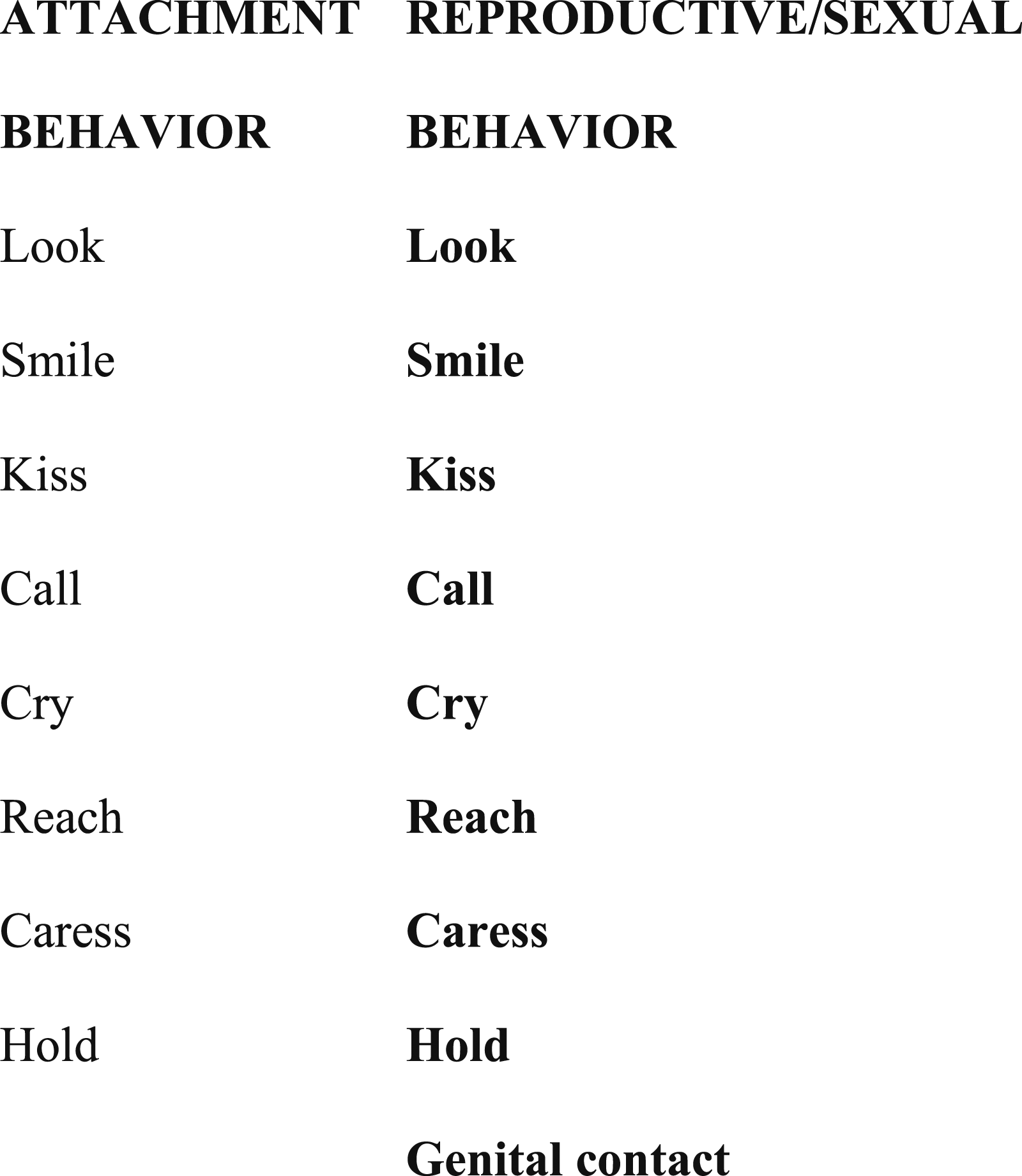
Not only does the overlap reflect the general parsimony of evolution, in which existing structures are modified for later evolved functions, it also creates a more nearly failsafe survival system of interlocking neural components and processes. If attachment fails to function protectively, sexuality can maintain connection with a protective person. If sexual attraction fails to function, attachment can hold parental pairs together. Given this similarity, it is not surprising that behaviors meant to comfort or protect are sometimes misunderstood as being used for sexual functions. The factors influencing the use of these behaviors are maturation and experience. Maturation expands the functions of attachment behavior by adding reproduction and experience refines how the functions are implemented strategically.
Another difference between attachment and sexuality is the speed with which bonds are formed. Attachment takes at least several months, but it endures for years, even lifetimes. Sexual attraction can be immediate, even if it is not necessarily enduring. If the sexual bond holds long enough to permit an attachment to form, its protective function would be fulfilled.
In this paper, we take a descriptive and functional perspective on sexual signals and behavior in children. We acknowledge the moral and legal implications of some behavior, but choose first to lay a descriptive and functional basis from which to consider the adaptiveness and implications of children’s “sexual” behavior. We think the social, ethical, and legal responses should follow a phenomenological understanding.
Below we describe a series of cases in which attachment and sexual functions are misunderstood or confused. The series is developmentally ordered and reveals a process by which infants and children can learn to use sexualized behavior that sometimes is deemed harmful to themselves or others. As is demonstrated in these cases, the consequences when professionals act with erroneous understanding of such behavior can be quite unfortunate for children and their families.
Developmental differences in sexual signals and behavior
Infants, of course, are sexually immature. By early adolescence, children will have mature sexual organs, hormonal changes and accompanying feelings of sexual desire. By late adolescence, they will be ready to find sexual partners and to conceive and raise children of their own, that is, the expected sequence that maintains our species. But it does not always go that way. This paper focuses on a few cases in which infants are exposed to inappropriate sexuality and children use sexual behavior in inappropriate and sometimes harmful ways. Rather than defining specific behaviors morphologically (e.g., a genital touch and a kiss), we focus on the interpersonal functions of the sexual signals and behavior.
The purpose of examining these cases is to find a thread of meaning in the distress of the parents and children, and in the community response to them. The ideas are speculative and lack scientific studies to confirm or disconfirm them. The first step is observing, followed by forming hypotheses. The goal of this paper is to do that and to examine the implications of these hypotheses to inform intervention when action needs to be taken despite the lack of an empirical evidence base to support it. We note that cases such as ours already produce professional action, action that is based more on beliefs than empirical evidence.
Methodological considerations
This is a case-dependent theoretical treatise with clinical implications. It is written in an unconventional manner to emphasize both the process of discovery and the feelings of the described parents and children. We wrote the paper as we experienced it: as a series of puzzling cases for which familiar explanations seemed inadequate. We collected the cases, ordered them developmentally, and divided them into groups based on neurological maturation, that is, how the child’s brain would be able to process information about the child’s experience. Our focus is sexuality; some of the cases involve other issues, for example, foster care, institutional placement, and adoption or psychiatric disorders. Our focus is not these co-occurring conditions and we do not want to diminish our focus on sexuality and attachment by pursuing discussion of them.
Our paper is a hybrid: not a review, but it references some academic literature; not a research study, but with development of hypotheses to be tested in sound research designs; not a case study, but with 13 cases presented from which theory can be proposed; not a new approach to clinical assessment or treatment, but with recommendations to consider until empirical research based on its ideas can inform practice. We expand on our version of a sequential, cross-sectional longitudinal case methodology in the accompanying paper (Crittenden, 2023).
Our method uses anonymized case material, drawn from standardized and validated assessments of attachment; for a description of the assessments and validity studies, see Farnfield et al. (2010). The case material was given to us with informed consent by the parents and older children. We considered including unidentifiable screenshots but were warned that some clinicians might be retraumatized by seeing behavior similar to what they themselves had experienced. In addition, we were warned that some professionals might seek to identify and prosecute the individuals. We want to avoid both consequences so we will describe the behavior in words. The full video-recordings can be shown upon request in restricted, confidential settings. Because imaged information conveys information differently from verbal information, we have sought other ways to retain the affective information that the photos would have conveyed. Specifically, we have chosen connotative monikers for the cases and used colloquial and connotative language whenever feeling needed to be conveyed (see Crittenden, et al., 2021 for a discussion of how affect is represented in images and connotative language).
We are well aware that the hypotheses and explanations that we propose are different and sometimes contradictory to those that are common among professionals. We emphasize these differences with questions. The questions suggest new interpretations, mark issues that could only be resolved with additional cases or research, and highlight aspects of professional practice that are taken for granted, but which might not function as intended. Because we want to suggest new interpretations, but do not have sufficient evidence to assert that they are accurate, we leave them as questions.
Infancy and the preschool years
Infants’ bodies, including their genitalia, are cared for by their mothers and other caregivers. Tender and comforting touch is essential to children’s survival and well-being (Spitz and Wolf, 1946). For example, institutionalized infants who are touched infrequently and by many different people (who act in an efficient but non-affectionate manner) experience distress, depression, and even death (Gray, 1989; Spitz, 1945). In less extreme cases, we propose that caregivers who have a history of broken attachment and sexualized behavior serving attachment functions might use sexualized behavior to attach to their infants and this, in turn, might unintentionally shape the development of their infants.
Confusing babies with men—in dangerous circumstances
When a mother treats her 3-month-old son, “Little Man,” as a sexually mature man, she can so over-stimulate him that he must retreat psychologically from awareness of signals from his own body. In a videorecorded 3-min Infant CARE-Index (ICI, Crittenden, 1981a, 2005) play interaction, an immigrant mother from Southeast Asia to a Nordic country sang cheerfully to her son as she changed his diaper. She was oblivious to his signals of distress as she rubbed his genitals vigorously, even eliciting an infant erection that she then off-handedly brushed against quite hard. Her baby tried to block his face with a powder bottle, stretched out his legs as if to push her away (but without any force), and eventually looked away with sadly blank eyes. Flipping Little Man on his back, and still singing brightly, she opened his knees and kissed his penis.
Although most professional viewers cringe when viewing this sequence, many attributed it to cultural difference and were hesitant to judge it adversely. Nevertheless, the developmental outcomes to Little Man of such painfully intense sexual stimulation being used to express maternal love were severe. By a year of age, the boy no longer gave evidence of feeling any discomfort, not even pain; instead, the inhibition of negative affect during genital touch expanded to inhibition of negative affect in general. For example, Little Man made no sound when he fell and cut himself while learning to walk. Not feeling pain puts survival at risk because the child neither protects himself, nor signals with crying for others to protect him.
The backstory was that the mother was abandoned when she was 13 years old to earn her living as a prostitute; that is, she learned to use false sexual interest with men for survival. Later she was brought to a Nordic country as the wife of a lonely old bachelor farmer who had hired her services during his vacation. Just as she had used prostitution to obtain protection and comfort from men whom she did not know, the isolated man used sexuality to promote the opportunity for mutual attachment and reproduction between them. Put another way, they both used sexual strategies to initiate and speed attachment. Neither recognized the inappropriateness of sexualized contact with an infant.
To make matters worse, the husband died shortly after their son was born; after that, the mother had men visiting her home because, as a foreigner, she felt lonely and unsafe. If the professionals had seen the humanity in all the family members without culturally normalizing the Asian adolescent being a prostitute, the European father’s marrying a prostitute (as some isolated men do), and their infant son being treated as a sexually mature male, the mother might not have lost her son to foster care and the son might not have experienced separation from his mother. In addition, the son might not have learned a protective strategy of inhibiting awareness of and response to unpleasant touch, including sexual touch, in the earliest period of neurological development. Such early neurological conflation of attachment and sex bodes poorly for a child’s future adaptation.
As this case shows, our bodies are universally human as are our needs for protection and comfort. So is the appropriation of sexual behavior to elicit attachment when survival is at stake, as it was in this case of an adolescent mother, an isolated older man and their infant. The ultimate functions of survival and reproduction were met even in extreme conditions.
Interlocking irresolvable dilemmas vs psychiatric diagnoses
At 14 months, “Toy Truck” should have been learning to walk; instead, in a Strange Situation Procedure (Ainsworth et al., 1978/2009), he crab-crawled awkwardly across the floor, just by-passing his mother who sat smiling down at him, but with her hands, knees, and ankles closed, leaving no place for him to approach. He grunted, while looking blankly at the ceiling. She smiled and said, “Lights.” He swished a toy car back and forth, but held his other arm still, as if it were frozen in place. An unfamiliar woman, the Stranger, came in and his mother brightened, engaging in pleasant small talk. His mother left. Toy Truck crawled to a chest, pulling up on it and pressing forward and back, forward and back, forward … Suddenly he slipped, falling forward and hitting his face sharply. He made no sound as he fell to the ground, but looked up with an odd worried face. The Stranger came over and touched him comfortingly, but he didn’t respond. His mother returned, sitting again in her chair, smiling but with a closed position and her hands covering her pubic area. The Stranger left and a few minutes later, the mother left again. She touched her son’s head lightly as she passed by and he almost fell over. He was alone, but relaxed, until the stranger returned and came near him. At that point, his eyes glazed over, he leaned back very slowly—until he actually fell backwards, without any falling reflex. The Stranger checked that he was not hurt, and then returned to her seat. Toy Truck was holding his toy truck and moved it to his genital area, where he began to drive it forward and back over himself, as if masturbating. As he did so, his eyes closed, he began making rhythmic guttural moans, and his legs extended and contracted in a pelvic rock. Toy Truck seemed to be in a trance, but after a few moments, he jerked alert. His mother returned and he followed to her chair, half pulling up, then backing down, several times. Eventually, she lifted him, but he thrust his legs out to avoid contact. All the while his face was blank and his eyes sadly empty. Toy Truck and his mother moved in contorted ways, never able to settle until his mother found his toes and, together, they watched his motionless foot. Toy Truck was conflicted around meeting his need for comfort while obeying his mother’s demand for distance. He tried to comfort himself sexually but had to zone out to do it. Appearance and reality were so discrepant that the observer was forced to accept one appearance by denying the other. Understanding both with compassion is extremely difficult 20 minutes had passed and the Manager came in to say the Strange Situation Procedure was finished.
The mother asked how she had done. When reassured, she said she was relieved because she feared that her post-natal depression might have affected her son. Observing clinicians thought Toy Truck had autism. We thought both Toy Truck and his mother faced irresolvable conflicts: he that he must approach, but knew he must not, and she that she loved him and wanted to care for him, but could not bear to touch him. Did both “post-natal depression” and “autism” refer, in this case, to these dilemmas, with Toy Truck’s “masturbation” functioning as self-comfort that lowered his intense arousal tied to forbidden, but desperately desired, human contact?
A mother’s need to be mothered herself
“Give Me Sugar” and her 18-month-old son were videorecorded during foster care contact. Give Me Sugar held her son tenderly, but he looked away. She whispered and cooed softly; he stilled but didn’t look at her. She raised him high in the air, then dropped him close to her face in a nuzzling game. His eyes grew big and fearful, but he made no sound.
She murmured “Give me sugar”, but he did not move. She play-bit his arm, then kissed the “wound.” His body became hers, but his eyes were far away. Even when he tried to smile, his eyes were distant.
Give Me Sugar’s backstory of maternal abandonment when she was a child, sexual abuse by her father and his buddies, and her five fostered children by different fathers suggested the improbability of her ever raising a child of her own. Then she met a man who lived with his mother; she moved in and had her sixth baby with him. The man eventually left, but Give Me Sugar had found a mother to protect and comfort her. Together they raised her last baby who grew into a healthy normal child. Meeting mothers’ basic attachment needs can free their children from being objects of their mothers’ desperate use of sexual seduction to create attachment with their children. Again, the backstory provided the key to our understanding, while compassion for the troubled young woman enabled the grandmother to apply the solution.
Learning to use sexual signals in the context of danger
“Sexy Arms” was a young woman who dressed like a toddler in a black romper with shorts and a bib, but her blouse had sexy slit sleeves laced to the shoulder. Bare legs and black leather boots completed her blatantly sexual outfit. She was videorecorded with her 24-month-old daughter in a Toddler CARE-Index (TCI, Crittenden, 1992a-present). The TCI has 3 minutes of play, 1 minute of frustration, and closes with 1 minute of repair. In the play segment, the daughter played with a cardboard tube while her mother watched. On the signal to frustrate her daughter, Sexy Arms grabbed the tube, without explanation. The girl exploded into a screaming tantrum, then instantly fell backward silently onto the mat with arms and legs splayed open. She pulled her skirt up disarmingly revealing her undergarments. Her body was totally vulnerable to attack, including to her genital area. Sexy Arms laughed as she poked the tube in the tender area of her daughter’s spread upper thighs.
On the signal to repair the relationship, Sexy Arms returned the tube. Her daughter immediately accepted it with no residual signs of the tantrum, submission, or attack that had occurred moments before. Like the two infants described above, Sexy Arm’s daughter had split (dis-associated) her mind from her body. More than that, as a toddler, she also actively participated in her mother’s strategy of sexualized dominance and submission. Her strategy, however, was immature, with her anger and distress being expressed only briefly before being inhibited and replaced by abject submission. The mother’s backstory included physical and sexual abuse, as well as severe neglect, and a diagnosis of borderline personality disorder. 2 At just 2 years of age, her daughter was learning an extreme and dangerously sexualized strategy (Crittenden et al., 2021) for blocking out her own feelings and maintaining life-preserving submissive attachment to her emotionally volatile mother.
Rejection combined with intimacy
Moving forward developmentally, 4.5-year-old “Green Tent” (Crittenden, et al., 2018) had mastered the lessons of using sexual signaling that Sexy Arms’ daughter was learning. In a TCI, Green Tent’s mother spooked him from behind by suddenly popping her face into his; he crawled into a green play tent as if to escape. As she tried to lure him out, she made an “Eww” sound and flapped her hand in front of her nose as if to waft away the air coming from the tent’s opening. Was she disgusted by his smell? By him? As Green Tent came out, his mother wrapped her arms around him from behind and walked him toward the floor-to-ceiling window—20 stories above the ground. She pushed him forward, holding him tightly to her. He ran behind her and pushed her hard toward the window. They laughed very loudly.
Green Tent lifted his mother’s clothing from behind, exposing her bare skin; she pulled her shirt down. When the signal for frustration came, she sat in a chair and pulled him onto her lap, facing her. He braced his open palms on her breasts, then one hand played with the pendant necklace that hung between her breasts. Green Tent’s father, who was watching, coughed. Was this a male-on-male territorial dispute?
In the TCI with his father, Green Tent first ignored his father and then moved toward the opening of the tent, giving big disarming, open-mouthed smiles, speaking in a high babyish voice and caressing his father’s hair. His father followed on hands and knees. As Green Tent crawled into the tent, he brought his face intimately close to his father’s, then pulled him in for a hug; they both squealed loudly. As Green Tent disappeared into the tent, his father restrained him and seemed to mount him, while kissing him and squealing.
Green Tent struggled out of the tent while his father yipped as if chasing him. They play wrestled until his father caught him in a tight hug. Green Tent put his hands on his father’s cheeks and brought the father’s face close to his own, while squeezing his father’s face into a grotesque expression and giving a long, very high-pitched shriek. Then he threw his head back into a surrender position while his father looked at him threateningly.
His father growled, then on the frustration signal released Green Tent who rolled away. Green Tent looked out the window silently, then moved away when his father joined him. On the repair signal, his father again grabbed him. Green Tent resisted with his hands, then his father pulled him between his legs and close to his face.
Pressing on his father’s genital area with his knees (while his father screamed loudly), Green Tent pinched his father’s cheeks increasingly hard until his father yelped in pain. The father pulled his son’s hair, then they pulled each other’s. The repair episode ended with Green Tent mounting his father who assumed the surrender position.
The TCI with Green Tent’s therapist highlighted two points. First, the family was reluctant to let the therapist in. But once he was permitted to engage with Green Tent, the interaction was quite normal with repetitive turn-taking and only mild distancing through omission of eye contact.
For this family, we also have a Parents Interview (Crittenden, 1981b) with Green Tent’s mother and father. The parents were entirely cut off from each other. The mother sat stiffly still and answered the questions while the father focused on his computer and two mobile phones. Their voices and answers were monotone, but otherwise quite normal—except for their positioning and the electronic distractors.
The mother’s backstory, as she told in her Adult Attachment Interview (AAI, Crittenden and Landini, 2011), involved repeated separations, first from her parents and then from her grandparents; later she was sent to a girls’ boarding school where her father strongly admonished her to stay away from boys. Nothing is known about the father’s childhood because he refused the AAI.
In the genogram below, the family is shown as closed to outsiders; the therapist is represented as a green triangle beside a tiny opening in the family’s structure. The parents (represented by a dark blue square and pink circle) seemed blocked from direct communication with each other and instead engaged in a struggle enacted through their spousified son (represented as a light blue square). See Figure 2. Green Tent’s family genogram. (Crittenden et al., 2018, used with permission.)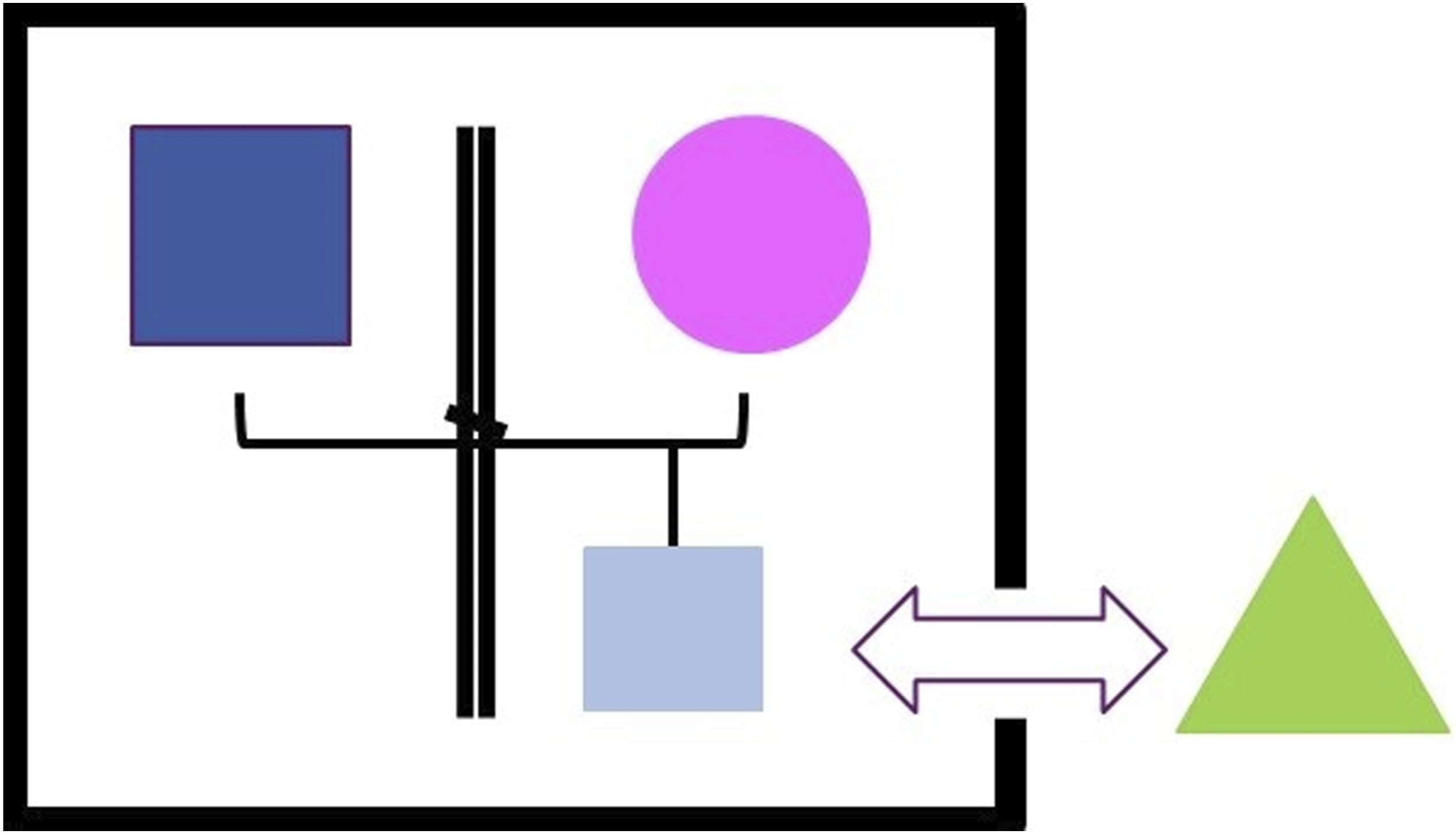
Green Tent was allied uneasily with his mother and in an open struggle with his father. His feeling of desperation with both parents is indicated by the extent of sexualized signals that were used in their two TCIs and the absence of spousal connection in the Parents Interview. Compared to the two-year-old daughter of Sexy Arms, Green Tent is far more competent at both sexualized seduction and sexualized submission as he tries to navigate a safe pathway between his alienated and strikingly asexual parents. Not surprisingly, it was Green Tent, and not his parents, who bore a diagnosis, even though the set of assessments suggests that the hidden spousal problem affected Green Tent very adversely.
Although one might at first reading be alarmed by the family relationships, especially the boy’s sexualization, a fuller understanding can yield reasons for optimism. The family sought and paid for long-term treatment of their son; put another way, they knew he was in trouble and wanted very much to help him. But they thought of him as having an individual disorder rather than as displaying symptoms of family problems whose roots probably resided in their spousal relationship and separate childhood experiences. The professionals held the same understanding of individual pathology and diagnosed Green Tent as having autism.
This case is informative and precious because, after a half century of intense effort advocated by parents of children diagnosed with autism, there are almost no data on their families. Are families of children with autism typified by internal conflict almost to the point of dissolution? Are they excessively private? There are no current data to address these questions. Do children diagnosed with autism use sexualized signaling with their parents while avoiding contact with all outsiders, including the professionals who diagnose their disorders? There are no data. The data that do exist appear compatible with some of the observations relevant to our cases (Hudson et al., 2017; McKenzie and Dallos, 2017); there is also compatibility with the finding that parents of children with diagnosed disorders almost always have diagnosable disorders themselves (Landini et al., 2016). This one case can only lead to questions while suggesting that parents of children diagnosed with autism fervently want the best for their children. This is an essential and optimistic starting point to an exploratory process that might redefine both autism and our understanding of children’s use of sexualized behavior.
Early childhood development
Considering these five children, it seems reasonable to propose that, when parents had experienced in the past and currently fear abandonment, they sometimes use intense sexual signaling and behavior to tie their children tightly to them. This can initiate a developmental process of children’s learning to use sexual signaling and behavior in their self-protective relationships. In early infancy, the babies could only inhibit their negative feelings, thus dis-associating their bodies and minds. Later they learned to show false positive affect while inhibiting true negative affect. At about 2 years of age, children could show brief, but intense, negative affect while still relying on inhibition and sexualized submission to stay safe. As they approached 5 years old, however, children whose parents used sexualized signals and behavior became able to themselves use sexualized aggression and submission in flexible ways to protect themselves.
All of this was happening while the brain was using contextual input to organize its own structure and development (Lewis, 2005; Singer, 2009). Next to life maintaining processes, like breathing and heartbeat, attachment, and reproduction are basic to survival; they do not depend on late maturing parts of the brain that include language and executive decision-making. This probably promotes individual survival and survival of the species, but, in cases of early sexualization of babies and young children, the neural networks representing the early conflation of attachment and sexuality can be expected both to have long-term consequences and also to resist change even when maturation makes awareness and choice possible. The earlier, more frequently, and in association with more conditions these networks are activated, the more an individual’s perceptions and responses are likely to become sexualized, without conscious awareness.
Our five examples, however, have some special characteristics. They were provided by professionals attending assessment courses offered by The Family Relations Institute—and none of the professionals articulated concerns about sexuality. Instead, the concerns were language development, foster care, autism, and family violence. In addition, the overwhelming majority of the video-recordings provided by professionals involved mothers, not fathers. In fact, in the few cases of fathers, child sexual abuse was often the stated concern. Nevertheless, in those cases, fathers only sometimes displayed sexual behavior; instead, it was the children, not the fathers, who showed sexualization. Notably, in one such case, the mother used sexualized behavior with her sons while accusing the normal-appearing father of child sexual abuse. We conclude that many more mother, father, and child video-recordings need to be evaluated and that mothers’ roles in generating sexualized child behavior need to be explored. We note, clinically, that professionals are generally reticent to ask about or even note their observations regarding sexuality.
The school years
Once a child who uses sexualized strategies goes to school, it might become possible for adults to see the child as the initiator of sexually inappropriate or harmful behavior. For example, in the UK, 10-year-old children can be considered criminally responsible for sexual behavior that adults consider harmful. Knowing what is harmful to the children, however, requires longitudinal studies, either new studies or re-assessment of original films and discourse assessments in existing longitudinal studies, for example, the Sroufe-Egeland (Sroufe et al., 2006) and Grossmann (Grossmann et al., 2006) samples. Green Tent provides one peek at possible negative effects in the school years. On the other hand, Give Me Sugar demonstrated that, when parents’ attachment needs for safety and comfort were met, their children too could grow up in safety and comfort and without needing to highjack the powerful sexual system for attachment functions.
Children who are vulnerable to problems in family relationships, particularly problems involving staying connected, are likely to feel more vulnerable when they go to school. This is because school involves daily separations from parents. If protection, comfort, or connection are problems, there is the possibility that anxious children will apply their sexualized self-protective strategies to other children or teachers. If they do so, they might be identified as using “sexually harmful behavior.” Such labeling might exacerbate their need for comfort and connection or, conversely, initiate a pathway toward isolation.
Although this makes good theoretical and developmental sense, we did not find many examples of 6–9-year-old children showing or being reported for sexualized behavior. Instead, the general concern in the school years seems to be bullying and behavior problems (not sexual behavior). Whether these problems have any relation to early sexualization is unknown because current diagnostic procedures focus almost exclusively on individual children and not their relationship history in early childhood. Moreover, there are almost never films that could be reviewed for evidence of interpersonal sexualization. Nevertheless, we have several cases of school-aged children, who came to attention for other reasons, but also showed sexualized behavior.
Spousification of a son
“Ms Luston” was facing child care proceedings because of her drug use, sexually violent relations with men and unstable housing. A Family Functional Formulation (Dallos et al., 2019) was undertaken in the hope of finding a means to prevent her 6-year-old son from being placed in foster care. She welcomed and cooperated with the male social worker who carried out the TCI and Parents Interview. The outcome of the assessment was identifying the son’s protective strategy of sexualized caregiving of his mother and the mother’s sexual signaling toward the professional—which strikingly he failed to mention.
Was it unprofessional to acknowledge such blatant attempts to engage him? It is an important question because resolving her difficulties needed to account for her protective use of sexuality to solve the problems of abandonment in adolescence. Drug use, sexual violence, and instability followed as she tried to find safety through relationships, including sex work, with men. The important take-away points are (1) to notice that Ms Luston used sexual signaling whenever she felt unsafe, including when threatened by professionals with removal of her son, (2) her backstory explained her need for acceptance and stability, (3) Ms Luston had personal attachment and sexual needs, as did “Give Me Sugar,” that needed to be addressed before she could release her son from a spousified attachment with her, and (4) the professional did not address sexuality in his report even when he was the object of her sexualized protective strategy. Is the topic unspeakable? Is it forbidden to even notice? What are the cultural and individual factors that prohibit the identification of sexualized behaviors, even when displayed overtly and blatantly?
When being male and masculine elicits maternal rejection
“Bad Boy” was referred for predelinquent behavior and an interest in homosexual pornography in which the focal male was submissive. He was only 14 years old, but already it looked as though he would be like his 18-year-old brother who had been kicked out of the home at only 16 for petty criminal acts. Now the older brother wanted to come back, unlike his older sister who, at 22, had successfully started her own family. The next youngest after Bad Boy was 10-year-old “Susan” who had transitioned from being a boy to a girl named “Susan” when (s)he was 7 years old. The youngest was a 6-year-old boy. All the biological males had diagnoses of ADHD and were on the autism spectrum. The referring social worker was not concerned about “Susan” and kept redirecting attention back to Bad Boy. The only concern expressed about “Susan” was the mother’s worry about how to protect “Susan” when (s)he began secreting male sexual hormones. Our observation was that only the female child developed normally, whereas all the biological males had problems and two of them showed signs of discomfort with traditional male roles. It appeared that Susan was on a developmental pathway of sacrificing sex to preserve attachment. Two questions can be posed: did the mother fear sexually mature males and did both Bad Boy and “Susan” discover ways to reduce the threat of their masculinity? Our information cannot answer these questions, but we think they might be important to pursue.
Triangulation with hypo- and hypermasculinity
‘Graeme’ had a 12-year longitudinal history (Brewerton et al., 2017; Crittenden et al., 2014). At 3 years of age, Graeme came to school attention because he was disruptive, non-compliant, and excessively concerned with his stylish appearance; he was evaluated for ADHD, but not given a diagnosis. When he was 5.5 years old, he was referred to an attachment research project because his relationship problems with peers and teachers were escalating. He was first filmed in a Preschool Assessment of Attachment (PAA, Crittenden, 1992b) where he was evaluated as using an extreme and “spousified” compulsive caregiving strategy, that included inhibiting negative affect, with his mother. His attention to his appearance and to his mother’s need for a spouse both suggest that Graeme was struggling to find an appropriate sexual role and doing so beyond his zone of proximal development. At 6 years, the School-age Assessment of Attachment (SAA, Crittenden, 2015) provided more detail that showed a compulsively compliant boy who had intrusions of negative affect; it was these that most concerned his teachers.
Graeme was referred to a research project when he was 5 years old because he was disruptive in school. Although most of his problem behaviors were typical of troubled school-aged children, his feminized interest in personal fashion was not. Moreover, Graeme’s problems with his parents, particularly his feeling rejected and fearing family conflict, were new information to school personnel who were focused on Graeme’s behavior. His mother’s AAI indicated that she was still caught in her parents’ struggle, idealizing her mother and derogating her father. She also confused this struggle with the conflict with her ex-husband, seeing both herself and her son as trying to negotiate this triangulated conflict. Her inability to see Graeme as separate from herself probably confused Graeme. For example, she implicitly attributed to him personal information about herself, such as using feminine pronouns for him (for further details, see Brewerton et al., 2017). Nothing changed appreciably until Graeme was 15 and was diagnosed with autism. At that time, he moved to his father’s home where he suddenly turned hyper-masculine, spending hours each day in body-building in the hope of being selected to a major football team. When that failed, he wanted to become independent of his parents so as to escape his non-residential father’s rejection and his parents’ on-going conflict. Graeme provides important information about sexualized children in the school years, but the school had not noticed this because they focused almost entirely on him as an individual (and not on family relationships), paid more attention to problems that interfered with classroom functioning (and less on Graeme’s sexual confusion), and did not track his development across years and different schools.
Loneliness and love
‘Loney’ had exhausted many foster placements and finally, at puberty, ended up in a children’s institution. Her unhappiness was so intense that she was returned to foster care. Her behavior and mood remained unstable. By her 20 s, she was in a mental hospital diagnosed with borderline personality disorder. An AAI was administered in which she described going to the park as a young girl to meet an old man who brought her lunch and bread to feed the ducks. She said he was the only person who cared about her. Loney then said that her social worker told her that he was “grooming” her and had “sexually abused” her. Loney had chosen freely to meet the old man and described him, in her AAI, in ways that suggest an attachment relationship with him. The jarring disconnect between her experience of “love” and the social worker’s notion of “grooming” made it hard for her to trust professionals, even into the present. She told her AAI interviewer that she had never mentioned him again to anyone—until now. Nevertheless, she had made hundreds of nearly identical figurines, one of which she gave to the interviewer. See Figure 3. Figurine representing Loney’s relationship with an old man feeding ducks. Used with permission of Patricia M. Crittenden.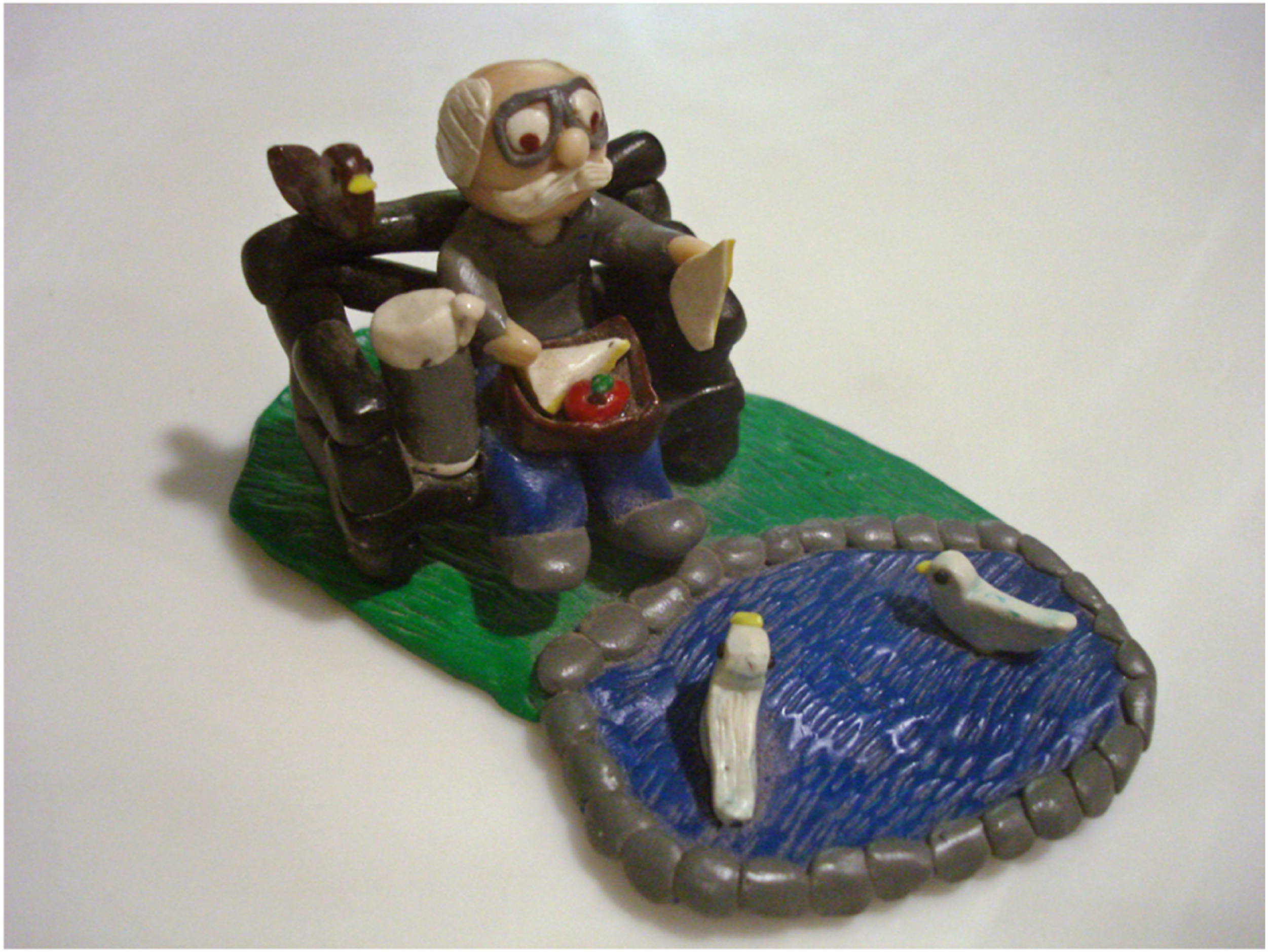
We wonder if the figurines tell – and retell and retell – positive aspects of a story that the social worker’s misunderstanding and pejorative language had made “unspeakable.” Reducing Loney’s experience of a desperate form of affection to the term “sexual abuse” also precluded knowing exactly what sexual behavior occurred. Because such terminology substitutes a moral evaluative interpretation for accurate information about the event, it can make personal information less available for later reflection and integration, even in the context of therapy.
It is striking that Loney did not include herself in the sculpture and the old man looked sad and lonely. Again, we are forced to consider the role of sexual behavior in quickly establishing and maintaining attachment for both a lonely adolescent and a lonely old man. We also wonder how the social worker’s judgment affected Loney’s understanding of herself, her needs, and her responsibility for what happened. A misunderstanding about the function of the sexual behavior and Loney’s needs and preferences might have left Loney feeling unspeakably worse about herself and about her feelings for the attentive old man. Feeling shame and unacceptability might even have influenced her choosing to marry a lonely boy with addictions, by recognizing their fit and feeling unable to seek a better situation; feeling depressed about her choices might have contributed to her later self-harm. We wonder if seeking and using Loney’s own words could have helped them both to find positive meanings to this relationship and if these meanings could have contributed to a different pathway toward adulthood.
Soothing rejection with sexualized comfort
Ten-year-old “Don Juan” lived in a foster home with several foster siblings who came and departed unpredictably. Don Juan himself had been in several previous foster homes. However, unlike many of the children, Don Juan knew his biological mother—and knew that she had a new partner with whom she shared two young children. He was not wanted in that family and, although he would see his mother from time to time, he knew he would not rejoin her. Don Juan came to attention because he hugged, kissed, and reached under his schoolmates’ clothes to touch their underwear. Although he did not use violent or coercive behavior, most of the children did not respond positively and some told their parents. When several parents complained, the police were brought in; Don Juan was treated as a sexual offender and placed in a supervised institution.
Examination of 6 years of his assessments of attachment in a longitudinal study of fostered children revealed intense distress and desire for comfort from the foster mothers, including attempts to cuddle with them in bed. These attempts to get close to motherly women had ended several foster placements, especially as he approached puberty and was perceived as threatening by the foster mothers. At no point did the record mention Don Juan’s need for comfort, nor had any effort been made to help him to feel loved and accepted. To the contrary, he was thought to be over-sexed and placed in homes that permitted increasingly less close relationships with mothering women. The question of sexual versus comforting motivations was not considered and, from the developmental perspective offered here, that failure of adults’ understanding of a child’s needs and ways of expressing need for protection and attachment might have led to interventions that exacerbated Don Juan’s need for comfort and harmed him.
It is our observation that sexual approaches by children to other children, especially their own siblings, occur most frequently when the children have not been able to form attachments with adults either because the parents were very neglectful or because the children were moved from one caregiver to another frequently. In such circumstances, children sometimes approach other children in sexualized ways for attachment purposes.
The smell of closeness
An extreme example of the same misunderstanding is “Sneak Thief.” Because of his minority ethnic status, a foster home could not be found for him and he was placed in a children’s home at age six. By 8 years of age, he was sneaking girls’ soiled panties out of the laundry and hiding them under his pillow where he could sniff them. In a training session, his care team offered his situation as an example of sexualized behavior that was not related to attachment or desire for comfort. Given that panties are very personal and intimate and that smell is strongly associated with intimate relationships (e.g., Schäfer et al., 2019), even from the first days of life (Macfarlane, 1975), it seems likely that Sneak Thief was not seeking to be close to the girls or to harm them in any manner; instead, it is more likely that he was desperately lonely and sought a powerful sensory signal of closeness to a woman/mother. Strikingly, he already knew that his need for comfort had to be hidden. Again, the professional response, based on attributing sexual motivation to a young boy, was harmful to the boy in that he both found himself labeled a sexual offender and had his freedom of movement in the institution limited. More importantly, he was not helped to understand his behavior and to find appropriate ways to experience comfort in relationships.
Pre-puberty and puberty
Stressed girls enter puberty earlier than non-stressed girls (Belsky et al., 2010). Foster care is stressful, especially when there have been multiple placements. Fostered girls might be expected to show sexual behavior to meet attachment needs more often than home-raised girls.
Sexual signals of desire for comfort and stability
After many foster placements and an adoption that failed suddenly and without explanation, “Restless Nellie” was adopted at 10 years of age by an older childless couple. Her adoptive mother worked and her father was a stay-at-home dad. When she was 13, Restless Nellie ran away to a friend’s home where the friend’s mother overheard Nellie talking. The mother concluded that Nellie had been sexually abused by her adoptive father. Investigation revealed that Nellie had been very anxious and that this showed in her intense tantrums (her adoptive mother sometimes had to wrestle her to the floor) and her inability to sleep alone (she needed her parents to lie on her bed with her while she fell asleep). They alternated nights doing this and it escalated to sexual behavior with her adoptive father (who was later convicted of child sexual abuse and sent to prison). Nellie was placed in foster care. In her video-recorded Parents Interview, Nellie was observed flirting with the new foster father; she even wrote her name below his name on his coffee cup. He did not respond to these bids. But we are left wondering if her desperate need for a home had led to sexualized behavior, serving an attachment function, that had possibly destroyed two adoptions and put a well-intentioned but misguided man in jail. Support for the notion that he was well-intentioned was his choice of pleading guilty instead of requiring his adoptive daughter to appear in court to testify against him. Carried a bit further, this suggests that, if sexual signals had sped the process of attachment, by the time the sexual abuse was discovered, he was attached to his daughter and sought her best interest over his own. We cannot say that this interpretation is accurate for Nellie and her adoptive father, nor for any other case. We do, however, think that if professionals understood the possible function of sexuality to speed the process of attachment, they might choose placements for children more carefully or alert families to the possibility of sexualized behavior as a signal of the child’s need to feel secure.
In addition, this case highlights the difference between causal contribution and responsibility for behavior. We think Nellie might have contributed to the process which resulted in sexual abuse, but we do not think she had the developmental capacity to be responsible for that contribution or its effects. Because men do have the capacity to know what they are doing and to predict its effects, they can be held responsible for their actions. We doubt that Nellie, her adoptive father or the professionals thought about the tendency of children with multiple placements to use sexualized behavior to create bonds more rapidly than can attachment. This accelerating effect might be especially advantageous to children when the adults do not have a biological relation with a child.
Sexuality as the language of love
In a final example, 13-year-old “Bessy” described behavior that her teacher thought was sexually abusive. After the teacher’s required report, Bessy and her four siblings were picked up without warning from their schools and put in foster homes. Bessy’s older sister refused to corroborate the charges and Bessy denied them. Investigation identified chronic neglect of the children, chronic maternal depression, and the father functioning as a homemaker and child carer; he fed and clothed his children and sent them to school each day while his wife was mostly confined by depression to her bedroom. In foster care, the older daughter ran away, the younger boys developed severe behavior problems, and, against a court order, the father kept sneaking back into the home. A sixth infant was born 10 months later. The court and the professionals did not know how to stop the escalating problems.
Again, a backstory can help. Based on what the parents said in their AAIs, both had grown up in emotionally and physically neglectful families. Because of her own mother’s chronic severe depression, Bessy’s mother had been shunted among relatives for her whole childhood. Bessy’s father was raised by a depressed and abused mother and an alcoholic father. His only brother had died in gang violence. Both parents expressed a very strong desire to have a large and loving family in which there was no violence. The bleakness of their histories and their spare style of speaking was overpowering.
After assessment, it seemed likely that the father did use sexualized affection with his daughters; indeed, it seemed that the only affection he himself had ever experienced was the sexual relationship with his wife. The children were born at 2-year intervals, attesting to the couple’s sexual activity. Both parents were emotionally flat, but the father provided conscientious physical care. Based on the assessments, it was concluded that the dad probably used a reversal parenting strategy (Crittenden, 2008, 2016) to reverse the neglect he had experienced, but having not experienced parental affection, he substituted sexualized affection with his daughters. It was recommended that the children be returned home, that the father be taught how to show affection to children of different ages and genders, and that the couple receive help with depression. Again, the central point is that sexual behavior, in both adults and children, can serve attachment functions. When that happens, attachment-based solutions may be needed.
Scientific underpinnings for the perspective offered here
Through the use of interpersonal cases, presented developmentally and rooted in specific family contexts, we have offered an evolutionary perspective on the possible meanings of sexualized signals used with and by children. We have developed these ideas over two decades (Crittenden, 1997, 2008, 2016), but without strong scientific evidence. That is beginning to change and to do so quite rapidly with regard to smell and touch, both of which were affected by the Covid pandemic, thus producing new and relevant research.
Smell and human bonds
Smell has long been known to influence fear-based protective behavior and sexual-based reproductive behavior very rapidly because of its single-synapse connection to the limbic system (Firestein, 2001). Smell has been implicated in immediate responses of sexual attraction (Lübke and Pause, 2015; Spence, 2021), fear (De Groot et al., 2014), and disgust (Prokosch et al., 2021). Some of our cases, for example, Little Man (genital intimacy), Green Tent (disgust), and Sneak Thief (genital intimacy), suggest how these universally human processes might function when children’s need for protection and comfort is threatened, especially when children need a rapid bonding process.
Touch and protection
Other very recent work suggests a dynamical systems perspective on universal aspects of touch. Understanding touch is crucial to mental health professionals for two reasons. One is its privileged neurological pathway from genetic predisposition to sensory stimulation to neurology (including dopamine and oxytocin release) to psychological feelings to behavioral pair bonding (both protective and reproductive attachment). These components of the pathway have most often been studied in isolation (e.g., genes, neurotransmitters, and pair bonding), but the most recent studies make connections across levels of representation (from genes through neurology and behavior to cultural contexts). This facilitates an understanding of complex dynamic processes and their diverse range of outcomes. See Figure 4. A hierarchy of influences on behavior and development. Used with permission of Patricia M. Crittenden.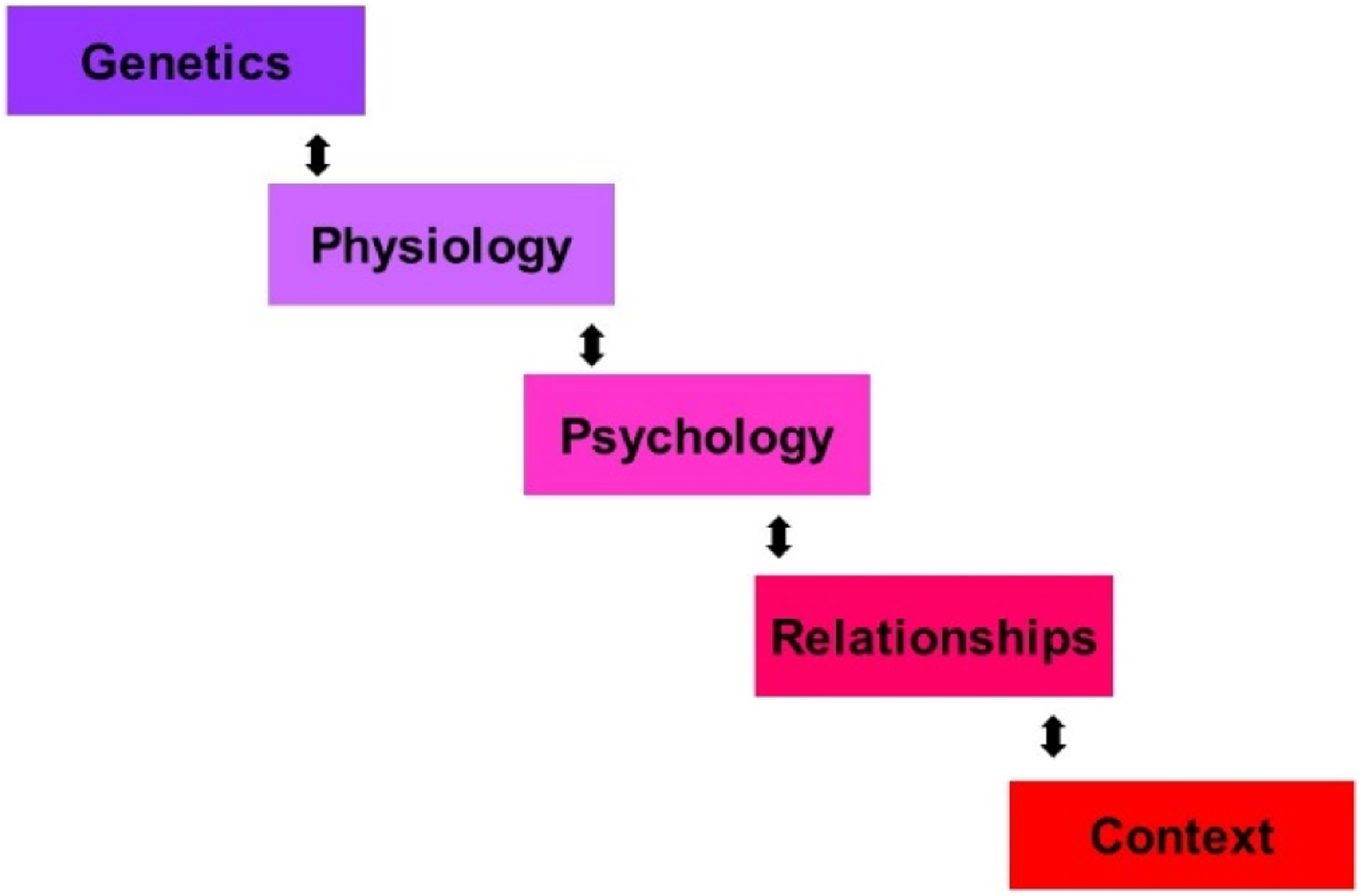
The second reason for the importance of understanding touch is that, compared to non-tactile sexualized behavior and signals, touch elicits the strongest response from professionals. We have proposed that in most cases sexual touch between children and adults is intended to protect and comfort the child by rapidly establishing an emotional bond. Without an understanding of the physiological processes and interpersonal needs of the individuals, professionals’ protective responses, that often involve separating children from the caregiving adult (Crittenden and Spieker, 2023), can have unexpected and harmful effects on both children and parents.
Current research indicates that all mammals have genes for specific skin cells (in skin that produces hair) that respond to stimulation with release of dopamine and consequent feelings of pleasure and sexual availability (Elias et al., 2023). Slow stroking (i.e., soothing touch) produces release of oxytocin that is experienced as affection and reduces anxiety and pain (Von Mohr et al., 2017). Deprivation of such touch produces feelings of loneliness and depression (Von Mohr et al., 2021). Further, this response to touch is limited to intimate relationships and not social relationships—where it might even produce negative feelings. Additionally, there are individual differences in the need for touch (von Mohr, as quoted in Sims (2023, February 9)). Abdus-Saboor noted the evolutionary advantage for both attachment and reproduction of these privileged processes (Abdus-Saboor, as quoted in Sims (2023, February 9)).
Although no single study demonstrates all these links shown in Figure 2 in humans, nor in child-adult pairs, the set of findings is coherent with our hypotheses about children’s self-protective use of sexualized touch. This review suggests expanding the range of possible professional responses from constraining children, separating them from caregiving adults, and trying to change their behavior to considering whether they need protection from rejection, isolation, and abandonment. Of course, individual differences should be attended to, in a case-by-case manner, when applying these ideas clinically.
Hypotheses about sexuality, relational bonds, and survival of individuals and the human species
Because sexuality and attachment are crucial to our ideas about sexualized signals used with children, we offer a very brief overview of the evolution of the functions of sexuality and attachment.
Universal aspects of sexuality and attachment
Combining the cases, the research, and existing theory, yields several connected ideas about the relation of sexuality to attachment. Both attachment and sexuality function to preserve life, with attachment functioning at the individual level and sexuality functioning at both the individual and species levels. Moreover, from an evolutionary perspective, sexuality preceded attachment very greatly, with only the most evolved species displaying person-specific attachment. An evolutionary perspective suggests that pair bonding for reproduction preceded attachment to and protection of individual progeny. For example, some bird species bond for life, but none attach to individual chicks. Chicks, on the other hand, attach to their parents (Lorenz, 1935) 3 and bear some part of the responsibility for staying with, calling for, and following the parent. In most mammalian species, mothers bond to newborns based on the release of oxytocin accompanying birth, but do not necessarily attach to individual young immediately. Again, phylogenetically, reciprocal person-specific attachment is present only in species with both greater neurological capacity and fewer young, usually only one or two. Person-specific attachment of both parents and infants is delayed considerably after birth and relies on a combination of innate (genetically timed) and experiential factors. These experiential factors can include sexualized behavior. For example, nursing of infants provides sexualized pleasure for females because suckling elicits oxytocin release and ovarian contractions that are experienced like orgasmic contractions (Grussu et al., 2021; Nishimori et al., 1996).
The central points to be drawn from this are, first, that sexual bonding is critical to survival of some species, including the human species, and thus has primacy over person-specific attachment. Second, person-specific attachment is temporally delayed after sexual bonding in both adults and progeny. Third, aspects of sexuality are an inherent and inextricable part of attachment. Fourth, sexuality is very versatile in its functions and behavioral display. The desire to regulate conception and the conflation of the several functions of sexuality might contribute to the ethical and legal issues around sexual behavior. Fifth, in the context of this paper, it is individual differences in the sexualization of attachment that are of interest.
Individual differences in the use of sexualized signals to initiate or strengthen attachment
When there is sufficient threat to attachment relationships, sexuality might “fast-track” the formation of bonds which later can develop into attachment bonds. Sexuality might work faster because it is embedded in neuro-sensory processes (particularly processes with one or few synapses) within the pre-cortical, that is, pre-conscious, areas of the brain.
Sexuality promotes survival of many species, that is, worms, insects and most fish, that were evolved before the more sophisticated process of attachment had evolved. In these earlier evolved species, individual survival did not depend on caregiving from a parent and choice of sexual partner was not relevant to the quality of life.
In humans, on the other hand, choice of partner is very relevant to the spouses’ ability to care for each other and for their children. Sexual attraction speeds the forming of bonds and might do so without regard to the quality of the sexual partner as a parental caregiver. This drawback to sexual bonding is often managed by sequestering pubescent girls and arranging early marriages to men whom the girls’ parents deemed appropriate (based on cortical processing, not sexual attraction).
In cases of threat to attachment, sexual signals can harness the sexual response system to bolster attachment. But this short-cut to attachment, that by-pass cortical processes, can cause both children and adults to accept potentially harmful partners. Especially in children whose cortical processes have not yet matured, a harmful match could lead to an array of somatic, emotional, and behavioral problems. These in turn sometimes meet the criteria for psychiatric disorders, particularly the more serious disorders. In the cases described in this paper, a number of disorders were associated with sexual signals used with and by children: promiscuity/prostitution, post-natal depression, chronic depression, autism, PTSD, ADHD, gender dysphoria, borderline personality disorder, and disruptive behavior problems. While determining the direction of effects requires longitudinal research, we are proposing that very anxious or absent attachment might lead to sexualized short-cuts to interpersonal bonds, with symptoms of disorder resulting from both the failed attachment and the inappropriate use of sexuality.
Hypotheses regarding sexuality with children
The discussion above can be reduced to four hypotheses regarding sexual signals and behavior in children:
1. Interpersonal behavior that appears sexual can function to speed the process of forming attachment bonds and to preserve endangered attachment relationships.
2. When sexualized behavior is imbedded in protective strategies, the strategies become increasingly complex as children develop and the children take an increasingly active role in the sexualization of attachment relationships.
3. When sexualized behavior and strategies are used, knowing the backstory can show how the behavior is or was adaptive in particular family contexts.
4. Treatment that is individualized to meet unique person- and family-specific needs for protection and comfort, that is, attachment, will be more effective than treatment aimed at inhibiting sexualized behavior or separating children and parents.
Clinical implications for professionals
The evidence base for these ideas is not yet sufficient to warrant definitive treatment guidelines for professionals. Nevertheless, these cases and their implications, together with the principle of “first do no harm,” suggest three basic principles:
1. Obtain the backstory before intervening, ensuring at least a three-generational, family-specific perspective.
2. Provide for both parents’ and children’s attachment and survival needs.
3. Avoid parent–child separation if at all possible (Crittenden and Spieker, 2023).
The importance of backstories
The first principle appears obvious, but is often omitted from practice. The usual analysis begins with the current “sexual inappropriate behaviors,” and these are very often labeled in ways that define their meaning even before assessment (e.g., “sexual abuse” or “sexual harm”, Crittenden, 2016: p: 8). This makes it hard to formulate questions about the function of the behaviors. Therefore, before seeking the backstory, an accurate description of relevant behaviors and their context should be obtained.
If the current context involves separation from attachment figures, the possible attachment functions of sexual behaviors is readily apparent. Alternatively, if the child lives in a family context that appears stable, then a closer look at the family current functioning might be warranted.
The use of video is recommended. It permits professionals to review the observation when they are not having to interact concurrently with family members. It also permits professionals to review sequences multiple times, thus discovering micro-expressions that might not be noticed in real time. This allows more sensitive and complete evaluation of the quality of connections between family members. Sometimes the facts are obvious (e.g., when it is impossible to have the family members together in the same room); at other times the problems are very subtle. Even if inconclusive, contextualized videorecorded observation allows framing the problematic behaviors in ways that address their function. More importantly, it allows others to see and interpret for themselves the basis for a professional’s conclusions.
When separation and isolation are the critical dangers organizing the family’s functioning, the threatening conditions can be either in the present or in the past. In other words, past events of separation might influence the family’s current functioning in ways that are not immediately evident. An exploration of adverse life events for all family members (including those who are not currently living together) is relevant to understanding possible non-sexual functions of sexual behavior. Attuning the intervention to family members’ specific responses to past dangers can be key to establishing therapeutic relationships and using these for family members’ benefit. Individualizing psychological treatment is the parallel of physical medicine’s “personalized treatment.”
Providing for parents’ and children’s basic attachment and survival needs
The second principle is to use intervention to address the actual causes of problematic behaviors, rather than trying to stop the behaviors themselves (etiologic vs symptomatic treatment). Depending on the developmental stages of family members, the behaviors can range from sexualized caregiving by the parent of an infant or a toddler, to enacted sexual behavior by an older child. The causes of inappropriate sexual behavior can be more easily clarified when basic needs are fulfilled. Screening using Maslow’s hierarchy (Maslow and Lewis, 1987) can guide these early interventions. The outcomes can help refine the functional diagnosis regarding these behaviors.
Very frequently parents are admonished to prioritize their children’s needs, especially when foster care is being considered. If the parents’ own needs are intense and not addressed, this advice can increase their self-protective functioning, with the consequence of exacerbating the presenting problems. We recommend the opposite approach: to promote exploration of problems, parents should be assisted to be in safe and comfortable conditions.
Avoiding separation of children from parents or foster parents
Turning to children’s needs, when children are placed in care for their safety, children suffer psychological trauma that can never be fully erased; see Crittenden and Spieker (2023) for a full review of this literature. Moreover, it is not enough to assume that foster or adoptive families are more protective and comforting than families of origin (Gogarty, 2002; Dozier et al., 2014). Therefore, the actual fulfillment of basic needs should be monitored carefully. Also, the contribution of the children’s self-protective strategies should be considered. Especially when the stability of the placements is uncertain, children’s sexualized strategies can backfire and harm not only the children, but also the adults trying to care for them.
Further research is needed to both refine the indications for intervention on sexually inappropriate behaviors, and also to define the limits of these behaviors (e.g., it is not yet clear whether or not issues related to gender identity in children are always relevant to distressed attachment or have specific other differentiating features).
Early work on sexualized behavior with children has tended to be dogmatically disapproving. We suggest a more nuanced approach of first describing the behavior interpersonally, looking for its current function, exploring the backstories of the adults to discover earlier contexts in which the behavior might have been adaptive, and beginning the intervention by seeking to support family members so that they don’t need to use extreme self-protective strategies. In brief, some unsafe children and adults use sexual behavior to meet basic safety and attachment needs.
Understanding and responding to sexual behavior toward and by children
Although we do propose that sexual behavior toward and by children is often misunderstood as being sexual in function when instead it serves an attachment function intended to make children safer, we do not think that such behavior is safe, nor do we think it should be dismissed by professionals. To the contrary, in every one of our case examples, sexualized attachment behavior occurred when attachment had failed to protect children and children were at very severe risk. Put another way, our message is not to redefine and dismiss sexualized signals with children, it is to redefine and redouble our efforts to protect children and parents who use sexualized behavior to meet protective attachment needs. Compared to other cases of distressed children and dysfunctional parent–child dyads, those with sexualized behavior tend to be more severe.
Thus, our examples indicate that professionals should be very alert to sexualized behavior with children and should respond by identifying and responding to the dangers faced by parents, first, and children, secondarily. Contrary to the notion of prioritizing children’s needs by addressing protective action toward children, we see parents as children’s most effective protectors. When parents are or feel unsafe and uncomforted, they need immediate and direct help. Our thinking is that promoting parents’ safety and comfort will enable them to provide for their children. Of course, they might need help with this, but help that overlooks parents’ own safety and comfort will be wasted and not benefit children.
Finally, the help that parents need most immediately is often structural and physical, not psychological. Such things as safe housing in safe neighborhoods, sufficient food and clothing, dedicated and long-term personal support (i.e. attachment figures for the parents) are more often the initial keys to change than psychological services like parent education, parent–child treatment, or individual treatment of parent or child. One might argue that parents are responsible for these basic safety needs, but we think that, when parents have not been able to protect themselves, the professional community should set beliefs about personal responsibility aside and help parents to help their children.
Limitations
Every paper has limitations, but these are especially extensive when case studies are used to build theory. The greatest limitation to our ideas is that we have no information on the prevalence among children of the sorts of conditions we describe. Our cases may reflect common aspects of endangered children’s functioning or we may have stumbled upon a unique set of cases that are not typical of endangered children. In addition, we have not described every case we have seen, but we did not identify any cases that contradicted the ideas we offer.
We also base our ideas on a few assumptions. One is that a behavior or body organ can serve different functions in different situations. A hand can caress or slap. A kiss can greet, comfort, or initiate sexual activity. We think this is true of other sexualized behaviors and sexual organs. Another assumption is that both parents and children act so as to retain or strengthen family relationships. This suggests that, when sexuality is used to maintain connection, professionals should work to make the context safer. The underlying assumption is that when the sexualized behavior is no longer needed, it will be replaced with less desperate behavior. Finally, we differentiate adaptation to difficult conditions and threats from security in safe and comforting circumstances. With this idea, context-specific adaptation can result from using sexualized behavior in some threatening circumstances. Under such circumstances, it becomes crucial to focus on removing the threat before trying to eliminate the sexualized behavior.
We don’t want to overstate what we know. We offer a model that describes how experiences are related, and we have actual observations. There is, however, a gap between these. This is an exciting place for scientists and clinicians to be: right at the interface of the known and the unknown.
Conclusion
It is our hope that redefining sexualized behavior with children as part of strategies to maintain protective parent–child relationships will encourage empathic attention to the needs of children’s parents, reduce the designation of children as sexual perpetrators or offenders, and reframe sexualized behavior with children as a sign of an intense need for safety and comfort. Professionals who use these ideas will be released from judgmental “police” duty and freed to focus on their core motivation: helping people to live safer and more satisfying lives.
Footnotes
Acknowledgments
The authors wish to thank the reviewers for their detailed and thoughtful comments. In addition, we appreciate the suggestions of Clark Baim, Mike Blows, Susan Spieker, and Simon Wilkinson.
Declaration of conflicting interests
The author(s) declared no potential conflicts of interest with respect to the research, authorship, and/or publication of this article.
Funding
The author(s) received no financial support for the research, authorship, and/or publication of this article.