



Abstract
Recent breakthroughs in Al combined with steady advances in information technology change the physics of organizational and institutional design. Discussions and deliberations can now include people in disparate locations speaking simultaneously. This opens up new possible designs for interactions that will enhance our ability to produce collective intelligence.
How do we make collective intelligence happen? Who should be in the room, and how do we design and structure their interactions? Design-minded social scientists approach these questions by embedding them within a variety of formal frameworks. Economists design markets and matching processes to produce efficient, fair allocations with aligned incentives. Political scientists create voting rules to select winners with broad support. Organizational scientists design communication and authority structures capable of generating innovative solutions and thoughtful strategic decisions.
These design-minded social scientists operate within sets of constraints. Some are cognitive. People can only store, attend to, and process so much information. Some are physical. Rooms can only be so large. Some are temporal. Everyone must be available Tuesday at 4pm. These constraints limit possible designs, and that reduces the efficiency, fairness, representativeness, and innovativeness of the outcomes that we might achieve.
Those constraints have now changed. Recent breakthroughs in Artificial Intelligence (AI) combined with steady advancements in information technologies have altered the physics of organizational and institutional design (Farrell et al., 2025). In doing so, they have expanded the set of possible designs. The logic is straightforward: Removing constraints allows us to achieve more.
The impact on our ability to produce collective intelligence may be substantial. Many of the key, if unstated, constraints in Arrow, Debreu, and McKenzie’s economies, Simon’s organizations, Habermas’ deliberative bodies, and Ostrom’s communities have been relaxed. These include the fundamental constraints of space and time.
The transcendence of space is well underway. We now join into meetings held in Berlin, Beloit, and Bogota in a single morning. People in disparate locations now brainstorm, vote, deliberate, and collaborate (nearly) as effectively as if they were co-located. We now change who is “in” or “out” of a meeting with a few clicks. The erasure of physical space has expanded the space of designs and structures. Subgroups break out. People with germane ideas or knowledge break-in.
The transformation of time has been less appreciated and leveraged. Almost all collaborations, deliberations, and discussions remain sequential. One person talks, then the next, and so on. Interruptions and talking over do occur. But humans cannot attend to multiple simultaneous conversations for more than a few seconds.
What is not fully understood is that these restrictions on simultaneity no longer apply. Advances in LLMs make simultaneous collaborations possible. Large numbers of people can share ideas, thoughts, predictions, insights, and solutions simultaneously. LLMs can then filter, synthesize, and sort that content and make it comprehensible to humans instantaneously.
The content rectangle
A logic for why the new physics of interaction will produce greater collective intelligence rests on simple algebra. Consider a group of twenty-five people making a single decision during a 60 minute meeting. This could be an elected body making a policy decision, an academic department deciding whom to hire, or the leadership of a large company deciding where to locate a new facility. It could be teachers, parents, and a school board selecting a new superintendent, venture capitalists deciding on an investment, or the members of a sorority deciding on a theme for a fall fundraiser. 1
Currently, that decision making process would include a sequential discussion. One person talking and then the next. Sequenced discussions have multiple shortcomings. First, they limit the amount of content and analysis that can be shared. Second, contributors need not be representative. Higher status, more confident people consume more meeting time. These traits need not correlate with quality of content. Third, to the extent that people who talk are similar, the group will be less likely to encounter, let alone engage, novel ideas present in the minds of those attending. Fourth, sequential interactions also invite strategic behavior. Who speaks and what they offer becomes path dependent. Finally, in a sequential discussion, stated “facts” often go unchecked. This may be especially true for “facts” put forth by powerful people.
We can represent the content produced in a sequential discussion – the ideas, information, insights, opinions, knowledge, and objectives – as a sequence of rectangles allocated across rows (see Figure 1) Each row represents a person, and time proceeds along the horizontal axis. Wider rectangles correspond to longer comments. In an hour long meeting, at most 60 minutes of content can be introduced. In a typical discussion, people repeat ideas, make irrelevant comments, and ask for clarifications, so that maximum is never met. Time is spent structuring the conversation, supporting prior ideas, and so on. As a conservative estimate, a sequential meeting might produce 20 minutes of content and 20 minutes of analysis Sequential deliberation.
Imagine instead that this same group of twenty-five people engages in simultaneous deliberation. In the first ten minutes, everyone shares their thoughts and ideas. Simultaneity guarantees equal sharing of content, no bias due to power or similarity, no strategic sequencing of who says what, and allows for fact checking.
Far more information, ideas, and knowledge are put on the table. We can measure it by redrawing the content rectangle. The total content equals the product of the number of people and the average content each contributes (see Figure 2). In 10 minutes, twenty-five people produce more than four hours of content, a 12 and a half-fold increase over the sequential discussion. To be fair, not all of that content will be useful or even correct. And a great deal may be redundant. Simultaneous deliberation.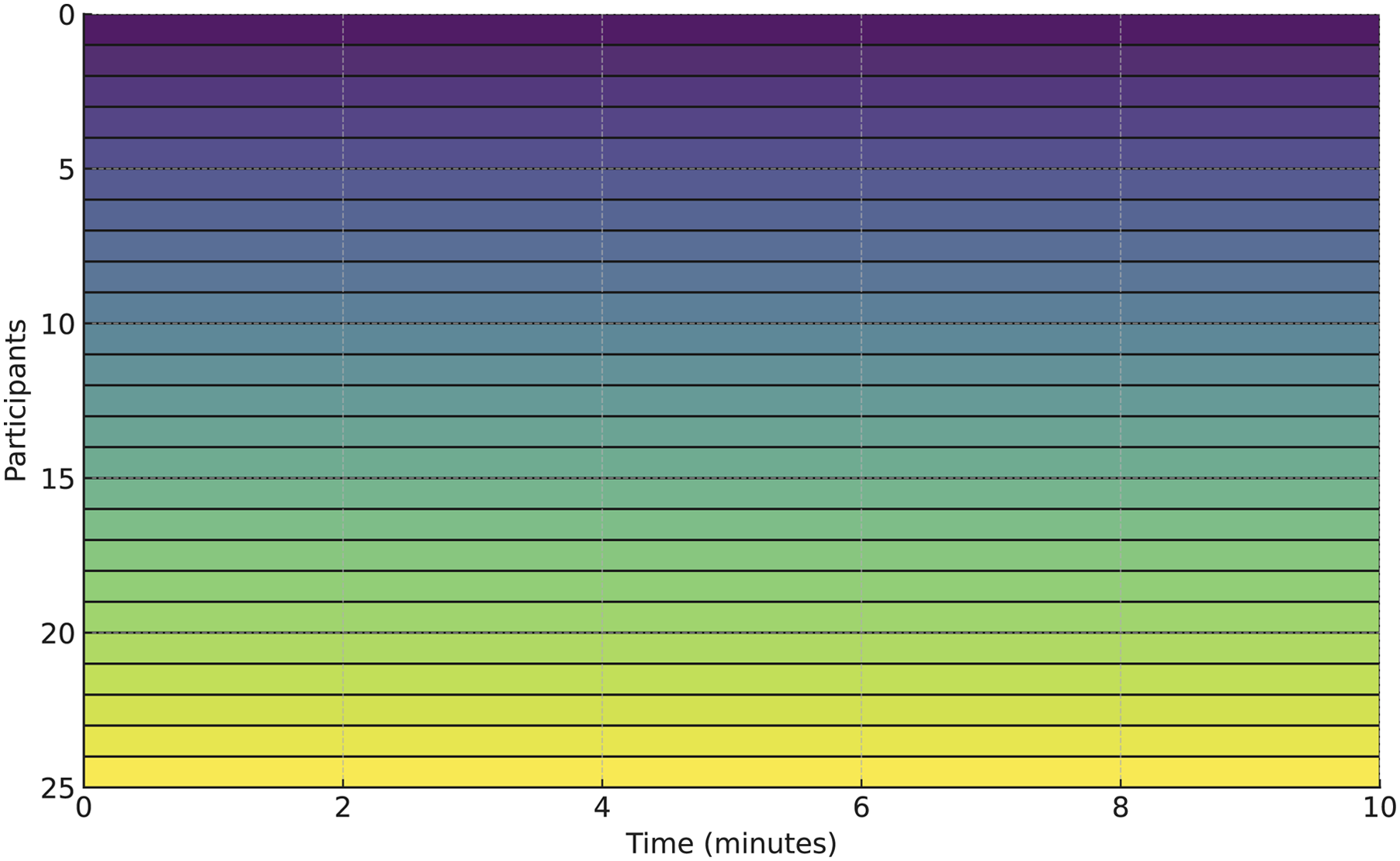
In the past, this much content would have overloaded human cognitive capacity. No person could possibly make sense of it all within an hour.
That bottleneck no longer exists.
In less time than it takes a person to refill their coffee, an LLM can summarize, fact check, categorize, organize, and structure the content rectangle. It can cancel out redundancies, identify discordant information and beliefs, and present the content in the form of themes, ideas, concepts, or potential solutions to facilitate further discussion.
Those same twenty-five people could then spend ten minutes each evaluating that content – another twelve-and a half fold increase. Finally, an LLM could be instructed to summarize those evaluations and even construct an agenda for the final forty minutes.
Something big is on offer here. Forty minutes of content and analysis versus five hundred. That's not even considering that AI agents could also produce and evaluate content. Given this new physics of human interaction, one wonders how much better might our decisions be? How much more accurate our predictions? How much more innovative our solutions? How much more capable might we be at solving societies most complex problems (Taylor and Krishna 2025)? How much more inclusive might we make our democratic institutions be (Delacroix 2024; Small et al., 2023)?
The answers to those questions depend on our ability to design AI architectures for simultaneous contributions and analysis that can capture knowledge, allocate attention and support collective reasoning by challenging and refining ideas and by surfacing new ones (Riedl and De Cremer 2025). Central to these designs will be how humans react. Will people feel heard when their contributions are “dimensionally reduced” by AI? Will people still be able to “read the room”? Will outcomes feel legitimate (Tessler 2024)? At process end, will people feel dehumanized or enfranchised?
Progress will require both the formal mechanism design approach favored by economists along with the more flexible, interdisciplinary approach of Human-Computer Interaction scholars. Both will help us to design systems that produce better outcomes and also strengthen our capacity to understand one another, and to become better people (Lazar and Manuali 2024).
Footnotes
Declaration of conflicting interests
The author declared no potential conflicts of interest with respect to the research, authorship, and/or publication of this article.
Funding
The author received no financial support for the research, authorship, and/or publication of this article.