



Abstract
AI has emerged as a transformative force in society, reshaping economies, work, and everyday life. We argue that AI can not only improve short-term productivity but can also enhance a group’s collective intelligence. Specifically, AI can be employed to enhance three elements of collective intelligence: collective memory, collective attention, and collective reasoning. This editorial reviews key emerging work in the area to suggest ways in which AI can support the socio-cognitive architecture of collective intelligence. We will then briefly introduce the articles in the “AI for Collective Intelligence” special issue.
Keywords
In recent years, artificial intelligence (AI) has emerged as a transformative force in society, reshaping economies, work, and everyday life. This is happening at a time that humanity faces a plethora of global crises including climate change, destabilizing war and conflicts, social instability resulting from inequality, polarization, and spread of misinformation (Drori et al., 2025; Holliday et al., 2024; Jerit and Zhao, 2020). These societal challenges exceed the capacity of humans operating as individuals; instead they require collective intelligence (CI). Augmenting human CI with AI could be a crucial ingredient that allows us to develop large scale solutions to complex problems, and strengthen existing democratic institutions. Leveraging AI to activate collective intelligence may become the next frontier for organizations and society at large. If used right, AI has the potential to advance science, lead to innovation, and help address the polycrisis.
While AI is often defined by its capability to imitate intelligent human behavior, its true potential lies in collaboration. As a collaborator, AI can augment human abilities and enhance human intelligence (De Cremer and Kasparov, 2021). In other words, the two types of intelligence (artificial and human) can work together to enhance and improve outcomes. For this reason, the concept of collective intelligence becomes essential to inform how AI can be leveraged most effectively. Collective intelligence refers to the enhanced capacity created when humans and machines work together, producing outcomes greater than each could achieve alone (Riedl et al., 2021). Thinking about AI in terms of how it can support collective intelligence of human groups, as opposed to how it can automate tasks previously done by humans, opens new opportunities not only on how to design AI systems but also on how to study them.
AI can strengthen collective intelligence by supporting collective memory, collective attention, and collective reasoning.

AI can be used to enhance each of these aspects and therefore can not only improve short-term productivity of collectives but also increase their long-term performance—and as such increase our capacity to address complex society scale challenges like climate change. This enhancing ability presents an opportunity for society to employ AI in human-centered ways that amplify human creativity and thriving. Such collaboration can empower us to address issues with a depth and breadth previously unattainable.
Potential roles of AI agents to enhance collective intelligence.
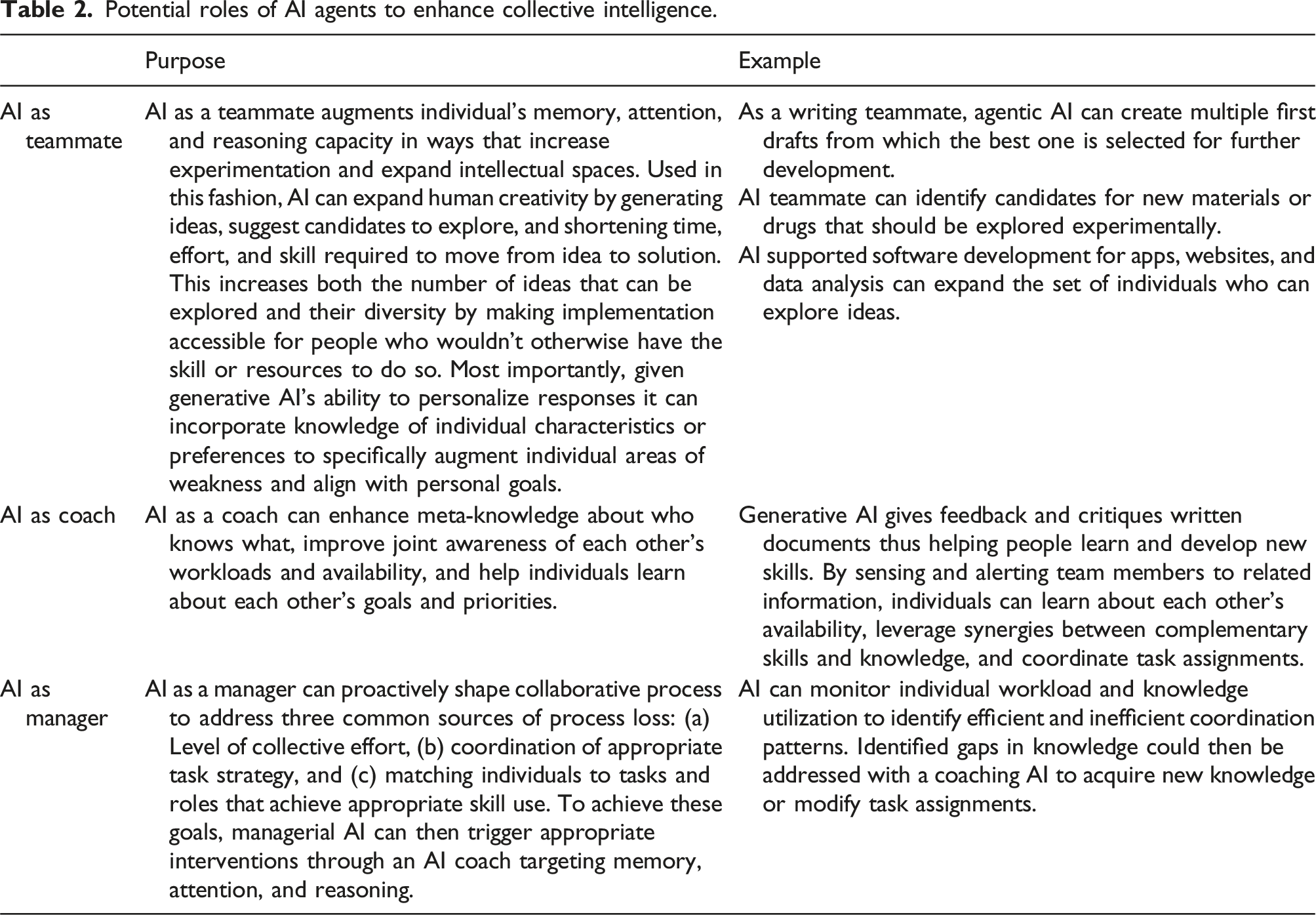
Applying the lens of AI for CI directly suggests direct ways in which agentic generative AI can be evaluated: does the agentic AI increase (or limit) the memory, attention, and reasoning capacity of individuals and groups? For example, an AI agent could be evaluated by measuring how much it increase the amount or diversity of knowledge that individuals or teams draw on in their work. This applies to both achieving and amplifying process gains in collective memory, attention, and reasoning, as well as limiting process losses in the same three areas. Including process losses is crucial as they may be unintentional. For example, an AI intended to enhance a group’s collective memory may inadvertently disrupt their collective attention by introducing subtle shifts in language use (Zvelebilova et al., 2024).
The lens of how AI can augment collective intelligence in human groups can also inform the design of AI systems. As the AI field moves to assemble multi-agent systems from the building blocks of individual agentic generative AI agents, the field of collective intelligence can offer valuable insights on how to assemble and coordinate such multi-agent systems. For example, the rich research on collective memory (Theiner et al., 2010) and specialization (Roberts and Goldstone 2011) may inform how multi-agent systems can form distributed cognition.
AI risks
The deployment of AI is not without risks. AI can lead to rigid structures, can be inherently deskilling, can amplify inequality, can perpetuate biases (Bengio et al., 2024), and can homogenize solutions and reduce intellectual diversity (Riedl and Bogert, 2024), all of which undermine collective intelligence rather than amplify it. Awareness of such unintended consequences is needed to ensure AI strengthens rather than weakens collective intelligence. For example, research has shown that AI can significantly affect what teams pay attention to, irrespective of the quality of the AI’s contribution or whether teams report trusting the AI or not (Zvelebilova et al., 2024). By considering both positive and negative effects of AI on collective memory, attention, and reasoning, researchers can more systematically evaluate AI risks.
In this special issue of ACM Collective Intelligence on “AI for Collective Intelligence,” we explore how this partnership can be harnessed by presenting a collection of diverse articles. The first article is an empirical study highlighting AI’s role in enhancing creativity—a frequently cited benefit of AI—through tools like chatbots and large language models (LLMs). The second article showcases practical applications of how AI can be leveraged to accelerate progress toward the Sustainable Development Goals (SDGs), how AI can help tackle problems that are collective in nature, and to scale community-led deliberation. These discussions aim to reveal how AI, in tandem with human effort, can drive innovative solutions and creative processes that benefit humanity at large.
We believe the field of collective intelligence holds the potential to deeply inform how AI can more effectively serve human interests. Collective intelligence sees AI not merely as a tool but as a collaborator capable of elevating intelligent approaches to significant problems. Such an integrative approach respects both types of intelligence (artificial and human) and uses the strengths of both to arrive at a better and more powerful outcome. We encourage scholars to integrate AI into their frameworks for addressing humanity’s challenges. By doing so, we not only define the role of AI but also enhance our capacity to solve complex problems collectively, marrying human creativity with computational power. Furthermore, we encourage scholars to study AI from a perspective of collective intelligence. Such a perspective allows us to advance science on how to productively design AI systems (e.g., multi-agent systems) and allows us to draw on a vast existing body of knowledge of how collectives form their emergent properties and structures.
Footnotes
Declaration of conflicting interests
The author(s) declared no potential conflicts of interest with respect to the research, authorship, and/or publication of this article.
Funding
The author(s) received no financial support for the research, authorship, and/or publication of this article.
