



Abstract
Digitally enabled means for judgment aggregation have renewed interest in “wisdom of the crowd” effects and kick-started collective intelligence design as an emerging field in the cognitive and computational sciences. A keenly debated question here is whether social influence helps or hinders collective accuracy on estimation tasks, with recent results on the role of network structure hinting at a reconciliation of seemingly contradictory past results. Yet, despite a growing body of literature linking social network structure and collective accuracy, strategies for exploiting network structure to harness crowd wisdom are underexplored. We introduce one such strategy: rewiring algorithms that dynamically manipulate the structure of communicating social networks. Through agent-based simulations and an online multiplayer experiment, we provide a proof of concept showing how rewiring algorithms can increase the accuracy of collective estimations—even in the absence of knowledge of the ground truth. However, we also find that the algorithms’ effects are contingent on the distribution of estimates initially held by individuals before communication occurs.
CCS Concepts
•Human-centered computing → Collaborative and social computing• Applied computing → Psychology.
Many collective decision-making contexts involve communication among individual group members, such as business executives making an investment forecast or a local community choosing whether to endorse proposed legislation. Sometimes, this communication helps the collective reach an accurate decision because it allows individuals to gain otherwise unknown information from their peers; other times, this communication is bad because it gives rise to detrimental social influence or “groupthink.” Building on recent results linking communication, social network structure, and collective accuracy, we developed and tested different rewiring algorithms—programmable rules for manipulating who communicates with whom in online social networks—as a way of steering communicating groups towards more accurate decisions when the ground truth is unknown. Our results show that rewiring algorithms affect collective accuracy in different ways depending on a group’s distribution of individual beliefs and the decision task it faces, ultimately providing a proof of concept for using rewiring algorithms as tools for collective intelligence design.Significance statement
Introduction
Researchers have long demonstrated so-called “wisdom of the crowd” effects, wherein the collective judgment of a group is more accurate than the judgments of individual experts or the individual group members themselves (Condorcet, 1785; Galton, 1907; Grofman et al., 1983; Surowiecki, 2005). Yet, with new digitally enabled means for judgment aggregation giving rise to modern applications such as online prediction markets (Arrow et al., 2008; Wolfers and Zitzewitz 2004), crowdsourcing (Howe, 2006), and digital democracy (Morgan, 2014; Simon et al., 2017), the impetus for crowd-wisdom research has been rejuvenated. Thanks to successes of these applications, there is now an emerging field in the cognitive and computational sciences dedicated to collective intelligence design, whereby digital tools (e.g., algorithms, artificial intelligence, and collaborative interfaces) are developed so as to effectively extract wisdom from ever-present crowds (Mulgan 2018). In this paper, we draw from existing literature on wisdom of the crowd effects and propose a new tool, familiar from network science, that can enhance the accuracy of collective decisions in the absence of ground truth knowledge: rewiring algorithms.
Social influence, network structure, and collective estimation
The earliest results on wisdom of the crowd effects in collective estimation tasks assumed that individuals’ judgments are made independently, meaning that their errors are likely to be uncorrelated and thus cancel out in aggregate (Condorcet, 1785). However, this independence assumption often goes unmet in the real world because people communicate with or otherwise influence one another. Following this line of thought, past research on the effects of social influence in collective estimation tasks has produced seemingly contradictory findings. On the one hand, there is evidence that social influence indeed undermines crowd wisdom by causing individuals’ judgments to become correlated (Hahn et al., 2019; Lorenz et al., 2011; Muchnik et al., 2013), while on the other, there are studies that report an increase in collective accuracy following social influence (Almaatouq et al., 2020; Becker et al., 2017, 2019; Gürçay et al., 2015).
Formal results that incorporate the possibility of non-independence provide a potential explanation of these seeming contradictions (e.g., Ladha, 1992; Page, 2008). That is, social influence is neither inherently beneficial nor inherently detrimental to crowd wisdom; rather, its effects depend on whether the benefits of communication to individual accuracy outweigh the detrimental effects of non-independence on collective accuracy. The logic of this is made clear in the Diversity Prediction Theorem (Page, 2008):

To provide predictions for when groups will benefit from social influence, recent research has turned towards studying how different social network structures affect collective accuracy (e.g., Almaatouq et al., 2020; Becker et al., 2017; Hahn et al., 2018a, 2019; Jönsson et al., 2015). Since social network structures delineate the paths through which social influence can be exerted in a group, it follows that different structural characteristics will feature in determining whether the net effect of social influence will be beneficial for collective accuracy. For example, high levels of connectivity and free-flowing information can lead to a homogenization of individuals’ beliefs that harms collective accuracy (Jönsson et al., 2015), high levels of centralization can lead to certain individuals wielding excessive influence over the network (Becker et al., 2017), and a lack of structural plasticity can prevent networks from effectively responding to feedback about individuals’ performance (Almaatouq et al., 2020).
Rewiring algorithms for collective accuracy
A reading of the literature linking network structure and collective accuracy raises the question: can we build optimal social network structures for eliciting the wisdom of the crowd? Despite the abundance of knowledge on the relationship between network structure and collective accuracy, strategies for exploiting network structure to increase collective accuracy remain underexplored. While there may be considerable difficulties in manipulating the structure of social networks in the analog world, the programmability of the digital world provides new opportunities. In fact, the structure of online social networks (e.g., Facebook and X/Twitter) are already being manipulated through opaque recommender systems and promoted content. However, this manipulation has generally been conducted for commercial, revenue-generating interests rather than social good.
We propose that—just as algorithms have already been used to mediate the information presented to online social networks (Lazer, 2015) and to identify influential nodes in social networks (Wei et al., 2018)—it seems plausible that algorithms could be used to rewire the structure of online social networks to boost the wisdom of crowds. Specifically, we explore the viability of rewiring algorithms—programmable rules for manipulating who communicates with whom—as a tool for enhancing the accuracy of collective estimations. We develop and test three candidate algorithms through simulation and experimentally evaluate their effects on the accuracy of collective estimates made by communicating social networks. In addition, we conduct follow-up simulations for the purpose of providing a reconciliation of our initial simulations and our experimental results.
Modeling and simulations
Given the exploratory nature of this work, we first employed agent-based modeling and simulation to operationalize the parameter space and prototype different algorithm designs. Our modeling framework uses networks of 16 simulated agents who are tasked with judging the probability of a single binary hypothesis (i.e., each agent can favor either 0 or 1, with exact beliefs falling between these points). Such judgments readily map to a broad range of real-world scenarios: assessing the truth or falsity of proposition or predicting whether or not a future outcome will occur.
Our model is initiated by first sending “evidence” to each agent, represented as samples from a Bernoulli distribution, which they integrate with a starting prior of 0.5 via Bayes’ theorem. This procedure serves to simulate how individuals would have accrued their own independent knowledge on a given topic, rather than entering a discussion with a purely indifferent prior of 0.5. To represent a population of individuals with varying knowledge about the hypothesis at hand, we vary the amount of evidence each agent receives such that some individuals may be more familiar with or knowledgeable about a given hypothesis. We additionally vary the quality of the evidence sent to the agents by introducing two parameters: sensitivity, the probability of receiving positive evidence when the hypothesis is true (i.e., the so-called “hit rate” familiar from signal-detection theory), and specificity, the probability of receiving negative evidence when the hypothesis is false (i.e., the so-called “correct rejection rate”). These parameters allow us to model “kind” environments where true positive and true negative evidence is prevalent and a majority of the population is already nearly certain of the truth, as well as less favorable environments where true evidence is rare and the beliefs possessed by the population are more widely distributed.
Once their initial estimates are assigned, the agents communicate with one another across a small-world network structure
1
(Watts and Strogatz, 1998) over the course of four discrete time points, t = 1,2,3,4. At each time point, each agent i revises their estimate in light of those communicated by their network neighbors according to a DeGroot belief updating rule (Becker et al., 2017):
2


Network conditions
Of particular interest to the present work is how different network conditions perform in the general modeling framework outlined above. Here we consider collective accuracy in four conditions: static networks (i.e., unchanging network structure) and networks to which we apply one of three candidate rewiring algorithms. For static networks (our control condition), the initial small-world network structure does not change and each agent communicates with the same neighbors at each time point. Such static network structures have been the main focus of existing research on social influence and collective intelligence (Becker et al., 2017, 2019; Golub and Jackson, 2010; Hahn et al., 2018a, 2019; Jönsson et al., 2015; Zollman, 2013), and thus provide this exploratory work with a natural starting point of comparison. 3 In our three experimental conditions, we introduce rewiring algorithms that add and/or remove connections between agents at each time point so that certain agents are exposed to the beliefs (estimates) held by certain other agents. We specifically consider three such algorithms: a mean-extreme algorithm, a polarize algorithm, and a scheduling algorithm. Example animations of each network condition can be viewed here: https://tinyurl.com/network-animations.
The mean-extreme algorithm aims to increase the average accuracy of individuals in a network by directing social influence towards individuals with potentially erroneous, outlying estimates. The algorithm first calculates the mean estimate in a network at a given time point and identifies which side of the scale’s midpoint (0.5 on a 0–1 probability scale) the network’s mean estimate lies. If the network’s mean estimate is less than the midpoint, the algorithm identifies the agent with the lowest estimate and adds directed, outgoing ties to the three agents with the highest estimates. If the network’s mean estimate is greater than the midpoint, the algorithm identifies the agent with the highest estimate and adds directed, outgoing ties to the three agents with the lowest estimates. This procedure effectively brings the estimates of the outliers closer to the mean.
The polarize algorithm aims to maintain the diversity of estimates in a network and prevent a potentially biasing homogenization. It first identifies the two most extreme agents on either side of the current distribution of estimates (i.e., the agent with the highest estimate and the agent with the lowest estimate) and cuts all incoming ties to these agents so as to preserve their beliefs from social influence (i.e., the agents with the most extreme beliefs cannot observe any other agents). Then, the influence of these extreme agents is increased by granting each of them two directed, outgoing ties to “core” agents. These core agents are the four individuals with the median estimates in the network (e.g., in a 16-agent network, the agent with the lowest estimate receives outgoing ties to the agents with the 7th and 8th lowest estimates, and the agent with the highest estimate receives two outgoing ties to the agents with the 9th and 10th lowest estimates). The net effect of this procedure is that the diversity of beliefs (measured as variance) is increased by ensuring both extreme, “polar” sides of the belief spectrum are heard.
The scheduling algorithm differs from the mean-extreme and polarize algorithms in that it prescribes (or “schedules”) a network structure of intermixing dyads, irrespective of individuals’ estimates. Specifically, the algorithm pairs agents at each time point such that no agent speaks to the same agent twice, but each individual will, in principle, have the opportunity to be exposed to all the available information in the network by the end of the four rounds of communication. In this way, scheduled networks will have achieved a maximum diversity in interactions—each dyad at each time point will consist of two individuals sharing aggregated information received from individuals in the network that the other has not interacted with; the algorithm prevents any redundant interactions from taking place. However, for this algorithm to function, it assumes that each individual effectively fully communicates all information they possess and fully integrates all information communicated to them by their peer at each time point. This algorithmic approach offers an alternative for situations where access to individuals’ current estimates at each time point are not available.
Simulation results
With the model and rewiring algorithms described above, our simulations proceed along the following steps: 1. Agents’ initial estimates are determined according to the Bayesian framework, which produces a distribution of continuous probability estimates between 0 and 1. 2. Agents are then able to observe the estimates of some subset of their peers in the social network. 3. Agents revise their estimates according to the rule given in equation (2) and equation (3). 4. The network is then rewired according to the appropriate algorithm (unless it is a static network). 5. The collective estimate is then calculated as the average probability. 6. The Brier score is then calculated on the collective estimate and used as the metric for error.
Following 500 iterations in nine different information environments (i.e., pairwise combinations of sensitivity = {0.2, 0.4, 0.9} and specificity = {0.2, 0.4, 0.9}) in which four matched networks are simulated (i.e., one of each network condition starting from an identical initial network), we assess collective accuracy by calculating the squared error of the mean estimate post-communication as in the Diversity Prediction Theorem (equation (1)) and consistent with the Brier scoring metric (Brier, 1950; Rufibach, 2010), henceforth referred to as collective error squared (CES). The Brier score was invented to assess the performance of meteorological predictions of single events with a binary resolution of 0 or 1, such as “there is a 60% chance of rain tomorrow,” just like the task faced by our simulated agents (Brier, 1950). The Brier score is also particularly relevant here because it can be decomposed mathematically into a component that rewards calibration and a component that rewards resolution (i.e., how many different probability levels an agent distinguishes), as shown by Murphy (1973). Nevertheless, further investigation of rewiring algorithms’ effects on calibration—the degree to which objective probabilities match subjective ones (Fischhoff et al., 1977; Lichtenstein et al., 1977)—is a potential avenue for continued research.
In addition to CES, we also calculate the average individual error squared (AIES) and diversity, measured as variance (VAR), present in each network as a way of better understanding each algorithm’s effects in the context of the Diversity Prediction Theorem (equation 1) (Page, 2008).
Figure 1 displays the results of these simulations by showing the difference between matched static and experimental networks on each measure in each possible information environment. This visualization shows that the algorithms’ effects vary across information environments. For example, consider the panels containing the results where sensitivity and specificity are symmetrically high (sensi = 0.9, speci = 0.9). In such information environments, no algorithm is able to substantially influence collective accuracy because agents in the network are able to form accurate beliefs based on their independently acquired knowledge, leaving little room for communication to improve the collective estimate. However, in each of the other information environments, the mean-extreme and scheduling algorithms improve collective accuracy (displayed here as decreased CES), with varying degrees of magnitude. When viewed in conjunction with the impact of the intervention on AIES, it can be deduced that these two algorithms succeed by improving the average individual accuracy at the cost of diversity (displayed here as decreased VAR). In contrast, the polarize algorithm aims to improve collective accuracy by increasing (or maintaining) the variance of beliefs at the cost of individuals’ accuracy. However, this algorithm displays adverse effects on collective accuracy in these simulations. The failure of the polarize algorithm here seems attributable to two aspects in our modeling: the use of unbiased, optimal agents and the failure to sufficiently balance the increase in individual error with an increase in variance. The unbiased, optimal agents simulated have the ability to distinguish “anti-reliable” evidence (Hahn et al., 2018b), meaning that before any communication takes place, the mean belief in the network is favorable and the distribution of beliefs is skewed towards the truth, regardless of the information environment imposed with the sensitivity and specificity parameters. Thus, broadcasting the extreme estimates to the median agents, who would otherwise converge towards the favorable mean estimate, will necessarily steer those receiving the erroneous extreme away from the truth. However, real human groups may possess biases that our simulated agents do not reflect, in which case the effects observed here may differ. Indeed, instilling a preexisting bias in our model by assigning each agent a starting prior of 0.1 when the truth is 1 changes the results such that the mean-extreme algorithm often decreases collective accuracy and the polarize algorithm more frequently increases accuracy, albeit only slightly (Figure 2). The simulated effects of each algorithm (network condition) on collective error squared CES, average individual error squared AIES, and belief variance VAR averaged across 500 iterations per panel. Y-axis values indicate the mean difference on a given measure as compared to a matched static network. A mean falling below zero indicates that the intervention resulted in a decrease of a given measure and vice versa. Black error bars indicate ±1 standard error. The simulated effects of each algorithm (network condition) on collective error squared CES, average individual error squared AIES, and belief variance VAR averaged across 500 iterations per panel when agents start with priors of 0.1 and the truth is 1. Y-axis values indicate the mean difference on a given measure as compared to a matched static network. A mean falling below zero indicates that the intervention resulted in a decrease of a given measure and vice versa. Black error bars indicate ±1 standard error.

Next, we proceeded to test each of the rewiring algorithms with actual human social networks in an online multiplayer experiment where participants were tasked with predicting the probability that various near future events would occur.
Online multiplayer experiment
To move from the simulations towards the real world, we built an online multiplayer experiment with the Empirica software (Almaatouq et al., 2021). This type of “virtual lab” approach allows for flexibility in the design of both a front-end user interface and an experimental back end where we could implement our rewiring algorithms. The preregistration for this study can be accessed here: https://aspredicted.org/9ny8i.pdf.
Method
Events predicted by participants in the “collaborative prediction game” experiment. An outcome of 1 indicates the event occurred in reality, and an outcome of 0 indicates the event did not occur in reality.

The four network treatments in the experiment were identical to those simulated with our agent-based model, described in the previous section. Participants in static networks (the control condition) were placed in a randomly generated small-world network structure for each round, and this network structure remained unchanged over each stage of communication. Participants in the mean-extreme, polarize, and scheduled treatments followed an identical procedure, but their network neighbors were subject to change between stages of communication, as determined by the given rewiring algorithm.
Experimental results
Our analyses of the empirical data focus on the accuracy of the collective mean responses of each network pre- and post-communication as assessed by the Brier scoring metric. In particular, we asked the following two questions: (1) How did the networks’ average collective error squared (CES) differ between treatments post-communication? (2) How did communication affect CES within each network, between treatments? 5
To address the first question, we followed the procedure we preregistered as the main analysis, which involved a linear mixed effects model with each groups’ average collective error squared (CES) across all events predicted as the dependent variable, the network treatment as a fixed effect, and random intercepts by group (Figure 3, panel A). This analysis suggests that there is no significant effect of the rewiring algorithms on collective accuracy (F (3, 436) = 0.78, p = 0.503), suggesting that, on average, networks to which a rewiring algorithm was applied did not achieve lower CES post-communication. The model’s intercept, corresponding to the static network condition (our control condition), is at 0.27 (95% CI [0.23, 0.30], t(434) = 16.02, p < 0.001), and the main effects of the rewiring algorithms are statistically non-significant (mean-extreme: β = 0.008, 95% CI [-0.04, 0.05], t(434) = 0.33, p = 0.742; polarize: β = −0.024, 95% CI [-0.07, 0.02], t(434) = −1.03, p = 0.303; scheduled: β = −0.017, 95% CI [-0.06, 0.03], t(434) = −0.71, p = 0.479).
6
However, this analysis does not account for certain key confounding variables—namely, the initial network structure and initial predictions in each network. While we could explicitly control for these in our modeling and simulation work by starting each iteration with perfectly identical networks, it was not possible to match these variables across treatments in the empirical study because each participant only completed the study one time, in one particular network, and in one particular treatment. Results of linear mixed effects models. Boxplots and semi-transparent points in the background display the spread of the raw data, and shaped, solid points indicate the model prediction with 95% confidence intervals represented by thick vertical bars. (a) Model with each group’s average collective error squared (CES) as the dependent variable, network treatment as a fixed effect, and random intercepts by group. (b) Model with each groups’ average change in CES as the dependent variable (i.e., the difference between post-communication CES and pre-communication CES), network treatment as a fixed effect, and random intercepts by group.
In addressing the second question, we conducted an unregistered analysis to side-step the potential confounding effects of initial network structure and initial predictions by evaluating the effect of communication within each network. That is, instead of directly comparing the accuracy of networks’ collective predictions post-communication between treatments, we compare the change in accuracy between each network’s prediction pre- and post-communication. Upon refitting our linear mixed effects model with the networks’ change in CES as the dependent variable, we find a significant treatment effect (F (3, 436) = 2.72, p = 0.044) that suggests networks mediated by our polarize algorithm were most likely to benefit from communication than (Figure 3, panel B). This model’s intercept, corresponding to the static network treatment, is at 0.02 (95% CI [0.00, 0.04], t(434) = 1.90, p = 0.058), the main effect of the polarize algorithm is statistically significant and negative (i.e., communication decreased error more) (β = −0.03, 95% CI [-0.05, 0.00], t(434) = −2.02, p = 0.044), and the main effects of the mean-extreme and scheduled algorithms are statistically non-significant (mean-extreme: β = 0.01, 95% CI [-0.02, 0.03], t(434) = 0.50, p = 0.615; scheduled: β = −0.02, 95% CI [−0.04, 0.01], t(434) = −1.34, p = 0.181). This result is encouraging because it suggests not only that the polarize algorithm prevented communication from leading groups astray through deleterious social influence but also that, in many cases, the algorithmic mediation actually led groups towards more accurate predictions than those that would have been produced by aggregating the individuals’ pre-communication predictions.
To further investigate this statistically significant but unregistered analysis, we refit the mixed model with alternative specifications. First, we added events (i.e., stimuli) as a random factor since statistical literature has argued that the failure to do so can inflate Type I error rates on fixed effect estimates (Judd et al., 2012; Yarkoni, 2022). This analysis also returns a significant treatment effect and does not change the interpretation of our results (F (3, 427) = 4.29, p = 0.005). Next, we checked whether our result is robust to other loss functions measuring collective accuracy, and found that it is not: we observed statistically insignificant results when applying the mixed effects model with groups as a random factor and either change in collective square root error (F (3, 436) = 1.02, p = 0.385) or collective absolute error (F (3, 436) = 1.54, p = 0.204) as the dependent variable. Finally, we noted that, although we planned and preregistered the use of mixed effects models, the models displayed singular fits—even when only random intercepts for groups are included—which indicates that our model specifications are unnecessarily complex for the data. We thus also tested for a treatment effect on the change in CES with a one-way ANOVA, which returned the same results as those reported in the previous paragraph.
Despite some fragility in the result, the finding of a significant treatment effect on how communication influenced CES within groups suggests that mediating communication in online social networks with different rewiring algorithms can—under specific conditions and operationalizations of error—steer the accuracy of collective beliefs. As such, these findings can be taken as a basic proof of concept. But on the other hand, our main preregistered hypothesis that there would be a statistically significant main effect between network treatments on post-communication CES was not supported, and our initial simulation results do not directly map onto the experimental results. In order to reconcile these findings, there are three key considerations for future work: (1) more closely controlling for the confounding effects of initial network structure and individuals’ differences, (2) applying the rewiring algorithms to networks of more knowledgeable individuals, and (3) better accounting for potential context-dependent effects of each algorithm.
In the experimental design we originally conceived, we sought to control for the confounding effects of initial network structure and individuals’ differences by randomly reassigning each participant into one of four identically structured but differently treated networks between each round. Unfortunately, because this procedure involves running 64 participants simultaneously on a single server, and because our experiment necessarily involves algorithmic computation between each stage of each round, we were unable to run this design with the software used because participants experienced significant lags and crashes. This unexpected obstacle forced us to adjust our design such that participants were randomly assigned to a network condition upon signing up for the experiment, and then sent to a separate server depending on the condition (i.e., one network per server at a time). Though this adjustment was necessary to ensure participants could provide quality responses, it means our analysis of a main effect between network conditions may be confounded. To remedy this in future work, one could opt for different software or replicate the experiment with increased statistical power.
Tally of groups in each treatment that made the correct binary prediction (0.5 cutoff) on each event post-communication. A correct prediction means that the group’s collective prediction what greater than 0.5 if the true outcome was one and vice versa. maximum of 11 per cell.

Finally, it is important to note that our experiment focused on one particular prediction context: probabilistic estimates on events where individuals’ initial estimates display little to no skew towards one alternative or another (Figure 4). It may be worthwhile to experimentally explore how the rewiring algorithms presented here would fare in other prediction contexts (e.g., continuous, numeric predictions rather than probabilistic predictions); however, several past studies already provide data from crowd-wisdom experiments in which communication took place over static network structures that are ripe for re-analysis (e.g., Becker et al., 2017, 2019; Gürçay et al., 2015; Lorenz et al., 2011). In fact, a re-analysis of the data from those studies demonstrates that the optimal network structure for eliciting the wisdom of the crowd depends on the estimation context—the specific population of individuals faced with a specific estimation task (Almaatouq et al., 2022). Specifically, that work shows that when a group’s initial estimates are highly skewed or heavy-tailed, a centralized network structure can promote collective accuracy, whereas decentralized network structures might hinder collective accuracy in such contexts (and vice versa). Given that our rewiring algorithms affect network centralization in different ways—namely, the mean-extreme algorithm increases it while the polarize algorithm decreases it—this insight could explain our experimental results and why they differ from our simulations. This is because in our simulations with optimal Bayesian agents, the networks’ initial estimates always display a skew towards the truth, but in our experiment, initial estimates displayed no such skew (Figure 4). Thus, the polarize algorithm may simply have been better suited to the particular prediction tasks considered in our experiment, and the mean-extreme and scheduling algorithms may be better suited to other contexts, such as those simulated with our initial modeling. To explore this point on potential context-dependent effects, we next conducted follow-up modeling using empirical data from past crowd-wisdom experiments to initialize simulations of our algorithms in numeric prediction contexts, which characteristically display highly skewed distributions of initial predictions (also see Figure S4).
Follow-up simulations of numeric estimation contexts
We set out additional simulations to explore how the rewiring algorithms might perform in numerical estimation contexts—where the 16-agent networks estimate (or predict) some unknown positive number—rather than probabilistic estimation contexts. Such tasks map onto classical crowd wisdom scenarios such as estimating the weight of an ox, as well as high-stakes, real-world scenarios like forecasting the number of ICU admissions per week during a pandemic.
We follow the procedure described in the previous section on “modelling and simulations” and initialize our model by randomly generating an undirected small-world network (Watts and Strogatz, 1998), have our agents follow the same updating rule borrowed from Becker et al. (2017), and consider the same four network conditions (static, mean-extreme, polarize, and scheduled). However, instead of having each agent integrate evidence (represented as samples from a Bernoulli distribution) via Bayes’ theorem to establish their initial estimate, we assign each agent an initial estimate by sampling from a compilation of empirical data from four previously published experiments (Becker et al., 2017, 2019; Gürçay et al., 2015; Lorenz et al., 2011). This compiled dataset spans a total of 54 estimation tasks on which 2,885 individuals provided independent estimates (Almaatouq et al., 2022). Each task—or “estimation context”—in this dataset is represented by a distribution of independent estimates and a true value. For example, one task contains 278 participants’ estimates of the London population in July 2010, with the true value of 7,825,200 (Gürçay et al., 2015). Note, however, that we normalize the estimates for each task to be between 0 and 1 in order to suit our belief updating rule and mean-extreme rewiring algorithm while maintaining the distributions’ shape.
Following 500 iterations of each of the 54 estimation tasks in which four matched networks are simulated (i.e., one of each network condition starting from an identical initial network), we assess collective accuracy by calculating the squared error of the mean estimate post-communication (CES; i.e., the Brier score). While other loss functions such as absolute error and square root error may be applicable in some task domains, our pattern of results is consistent across these loss functions; thus, and also because of the theoretical link of CES to the Diversity Prediction Theorem, we focus on CES for the sake of this paper.
Across all of the estimation tasks considered, the four network conditions’ CES was nearly equal on average (static networks, M = 0.016, SD = 0.031; mean-extreme networks, M = 0.017, SD = 0.033; polarize networks, M = 0.016, SD = 0.029, scheduled networks, M = 0.016, SD = 0.031). However, these averages overlook potential context-dependent effects. An analysis of CES task-by-task, rather than in aggregate, reveals that mean-extreme networks achieved the highest accuracy on 31 tasks, polarize networks achieved the highest accuracy on 15 tasks, and scheduled networks achieved the highest accuracy on eight tasks. Static networks did not achieve the highest accuracy on any tasks.
To further understand these context-dependent effects of the rewiring algorithms, we characterized each task by the skewness of the distribution of individuals’ initial estimates and then observed how each network condition’s average CES varied across the skewness parameter space. As shown in Figure 5, the rewiring algorithms display a clear favoritism for certain regions of the skewness parameter space: mean-extreme networks were the most accurate for tasks with highly skewed estimate distributions (n = 31, M = 9.47, SD = 9.33), polarize networks were the most accurate for tasks with estimate distributions that display low skewness (n = 15, M = 1.56, SD = 1.38), and scheduled networks were the most accurate on tasks with mid-range skewness (n = 8, M = 3.21, SD = 3.55). The skewness parameter space. (a) The distribution of skewness in the 54 estimation tasks considered. (b) The distribution of skewness where each network condition produced the lowest collective error as compared to the other conditions.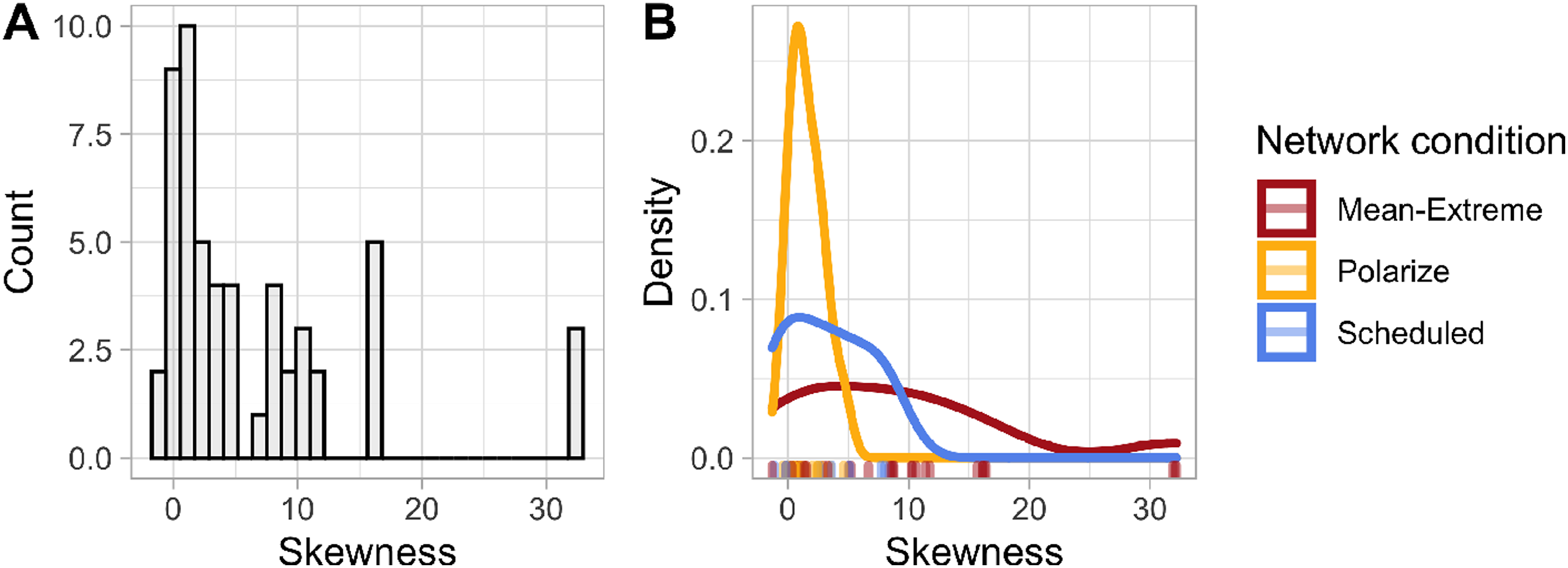
In Figure 6, we further investigate how the effects on collective accuracy produced by the rewiring algorithms track over skewness. Using the CES of static networks as a baseline condition, we calculated three measures for each of the 54 estimation tasks for mean-extreme, polarize, and scheduled networks: the average effect on CES (i.e., the average change in error), the average relative effect on CES (i.e., the average change in error divided by the average error of matched static networks), and the probability of improvement (i.e., the proportion of the 500 iterations of each task where a given network condition was more accurate than a matched static network). This analysis suggests not only that the different rewiring algorithms prefer different estimation contexts, but that there is an important interaction: the mean-extreme algorithm actively increases collective error on tasks with low skewness and the polarize algorithm actively increases collective error on tasks with high skewness. Network performance over skewness as compared to matched static networks. (a) The average effect on CES across skewness (i.e., the average change in CES compared to matched static networks). (b) The average relative effect on CES across skewness (i.e., the average change in error divided by the average error of matched static networks). (c) The probability of improvement across skewness (i.e., the proportion of the 500 iterations of each task where a given network condition was more accurate than matched static networks). Lines represent local regressions (LOESS) fitted to the data with a polynomial degree of 2.
The results of these follow-up simulations add value to our investigation of rewiring algorithms as a tool for collective intelligence design in three ways. First, we once again find evidence suggestive of a basic proof of concept: rewiring algorithms can boost the accuracy of collective estimates/predictions in social networks under certain conditions. Second, we gain clarity around the context-dependence of rewiring algorithms’ effects and around why our experimental results seem to depart from the results of our initial simulations: whether a rewiring algorithm helps or hinders collective accuracy (or has no effect) depends on the distribution of initial pre-communication estimates. In our original modelling where agents first integrated evidence independently via Bayes’ theorem, the distribution of initial estimates was always skewed, which suits the mean-extreme algorithm (Figure 1, Figure 5). Whereas in our experiment, the distribution of initial estimates displayed no such skew and were more uniformly or normally distributed (Figure 4), which suits the polarize algorithm (Figure 5). This reconciliation of our results in turn brings us to the third insight gained from the follow-up simulations: it may be possible to identify distributional characteristics of estimates (e.g., skewness) that allow one to select a rewiring algorithm capable of increasing the accuracy of social networks’ collective estimations before communication takes place. Crucially, this means that algorithms could be efficiently selected and applied in contexts where there is no track record of individuals’ predictive success and the truth or falsity of individual estimates is not (yet) known. Where sufficient ground truth data on accuracy exists, such as in expert judgments of medical scans, that data can unquestionably be used to fine-tune networks of judges (Kurvers et al., 2019). However, that leaves many of the most pressing real-world judgment tasks unaccounted for. In particular, we may want collective judgments to derive high-quality predictions for consequential unique events for which, by definition, ground truth data will be unavailable. Rewiring algorithms, as a method that enhances collective accuracy in such contexts, may thus provide a valuable prediction tool for many domains.
Conclusion
Can rewiring algorithms enhance collective decision-making in online social networks? In the context of modern-day social media, where algorithms are already deployed to mediate social interactions for commercial interests, it seems worthwhile to investigate whether algorithms can be (re-)designed for epistemic interests. Naturally, this first requires exploratory research to test whether such effects can be made to occur (as opposed to whether such effects will necessarily occur) (Brauer and Kennedy 2023; Mook 1983), as we have sought to deliver here. While our results are not to be interpreted as a suggestion that the specific algorithms presented should be deployed in practice, the present findings provide a proof of concept and encourage continued research.
Supplemental Material
Supplemental Material - Algorithmically mediating communication to enhance collective decision-making in online social networks
Supplemental Material for Algorithmically mediating communication to enhance collective decision-making in online social networks by Jason W Burton, Abdullah Almaatouq, M Amin Rahimian and Ulrike Hahn in Collective Intelligence
Footnotes
Author contributions
Declaration of conflicting interests
The authors declare no potential conflicts of interest with respect to the research, authorship, and/or publication of this article.
Funding
The author(s) disclosed receipt of the following financial support for the research, authorship, and/or publication of this article: This research was supported by a grant from Nesta’s Centre for Collective Intelligence Design awarded to Ulrike Hahn and Jason W. Burton. M. Amin Rahimian was partially supported by NSF SaTC-2318844.
Ethical statement
The experimental work presented in this paper received ethical approval from the Departmental Ethics Committee of the Department of Psychological Sciences, Birkbeck, University of London. Reference number: 181950. All participants in the experiment provided informed consent.
Open science statement
All data and code used in this paper is publicly available on GitHub: https://github.com/jwburton/bbk-nesta-ci. The preregistration for the online multiplayer experiment can be accessed here:  .
.
Data Availability Statement
All data and code used in this paper is publicly available on GitHub: https://github.com/jwburton/bbk-nesta-ci. The preregistration for the online multiplayer experiment can be accessed here: .
Supplemental Material
Supplemental material for this article is available online
Notes
References
Supplementary Material
Please find the following supplemental material available below.
For Open Access articles published under a Creative Commons License, all supplemental material carries the same license as the article it is associated with.
For non-Open Access articles published, all supplemental material carries a non-exclusive license, and permission requests for re-use of supplemental material or any part of supplemental material shall be sent directly to the copyright owner as specified in the copyright notice associated with the article.
