




Abstract
Drawing on a lifestyle-routine activity framework, this study explores associations between lifestyle/routine activities and worry about personal victimisation across months, days and moments. A bespoke smartphone application employing both traditional questionnaires and an Experience Sampling Method design was used by a convenience sample of students who responded to surveys regarding worry about victimisation. Lifestyle/routine activity measures showed varying associations with worry. The most consistent finding was that spending time with friends in the city-centre was significantly and negatively associated with worry across months and moments, but just failed to reach the level of significance for daily worry. Overall, the somewhat varying results indicate that worry cannot be assumed to be equally associated with lifestyle/routine activities across months, days and moments. These findings also imply more generally that research on worry about victimisation and other similar phenomena needs to consider how the outcome is measured in terms of reference periods and unit of analysis. Future research using more representative samples is needed to confirm the findings from this exploratory study.
Keywords
Introduction
Fear of crime can be described as an umbrella term covering different reactions to crime, such as worry about becoming the victim of a crime. Several different theoretical explanations of why some people are more worried about victimisation than others have been proposed (see Farrall et al., 2009). However, one less-well-studied theoretical approach involves treating fear of crime as being contingent on what people do in their everyday life. The importance of everyday life is emphasised in Lifestyle-Exposure Theory and Routine Activity Theory, which state that victimisation is a result of exposure to environmental circumstances favourable to victimisation (Cohen & Felson, 1979; Hindelang et al., 1978). Although less common, research based on these theories has also examined whether activities from daily life are related to fear of crime (see e.g., Alvi et al., 2001; Choi & Dulisse, 2021; Crowl & Battin, 2017; Lee & Hilinski-Rosick, 2012; Melde, 2009; Mesch, 2000; Rengifo & Bolton, 2012).
However, there are two prominent issues related to the study of lifestyle/routine activities and fear of crime. First, the findings from previous research are rather mixed, with the same activity being found to be either positively or negatively associated with fear of crime outcomes, or to be unrelated to these same outcomes (cf., Otis, 2007; Rengifo & Bolton, 2012; Rountree, 1998). Second, when examining associations between activities and fear of crime, the outcome is often studied at a general level using measures based on averages, which often refer to an individual's aggregate level of fear during the last 12 months (e.g., national surveys, for an example, see Molin & Lifvin, 2019). Although this approach provides important knowledge about general fear of crime, there is a need to consider fear of crime in relation to shorter reference periods as well, since long reference periods are associated with various forms of biases (Gray et al., 2012; Solymosi et al., 2015; see also Lynch & Addington, 2010). Such research is indeed becoming more common, at least in the form of a focus on fear of crime as a specific everyday experience, limited in space and time (e.g., Chataway et al., 2017; Engström & Kronkvist, 2023; Solymosi et al., 2021).
Using a unique set of self-reported data collected by means of a bespoke smartphone application (STUNDA), the current study explores the relationship between lifestyle/routine activities and fear of crime in the form of worry about personal victimisation across three different reference periods in a convenience sample of students. More specifically, worry about victimisation is initially examined with reference to the last month, while subsequent specific analyses are carried out using days and moments as the units of analysis. With this focus, the current study adds an important perspective to both fear of crime research in general and to studies of fear of crime based on Lifestyle-Exposure Theory and Routine Activity Theory in particular. The former refers to the possibility of studying fear of crime as a dynamic phenomenon (across days and moments) while the latter explores these dynamics in relation to general measures of everyday-life activities.
Background
Lifestyle-Exposure Theory and Routine Activity Theory
What people do in their everyday lives constitutes the common denominator of Lifestyle-Exposure Theory and Routine Activity Theory, which are here treated as a merged Lifestyle-Routine Activity Theory (L-RAT, see McNeeley, 2015). Lifestyle-Exposure Theory postulates that victimisation is a result of criminogenic exposure; the more one is exposed to criminogenic circumstances, the greater the risk for victimisation (Hindelang et al., 1978). How individuals lead their lives (i.e., their lifestyle) thus determines their level of exposure to circumstances in which victimisation is more likely to occur. Similarly, Routine Activity Theory departs from the notion that victimisation occurs when a suitable target converges in time and space with a motivated offender in the absence of capable guardians (Cohen & Felson, 1979). Exposure to circumstances of this kind is determined by individuals’ routine activities. Both Lifestyle-Exposure Theory and Routine Activity Theory are located within an opportunity perspective (Wilcox & Cullen, 2018), as they emphasise that what people do affects their risk for exposure to opportunities for victimisation (Maxfield, 1987).
Fear of crime, including its many dimensions (see Ferraro & LaGrange, 1987), may also be placed within the L-RAT framework (e.g., Choi & Dulisse, 2021; Crowl & Battin, 2017; Lee & Hilinski-Rosick, 2012; Melde, 2009; Mesch, 2000; Rengifo & Bolton, 2012). However, the way in which various activities may help explain differences in fear of crime can be interpreted quite differently (see e.g., Crowl & Battin, 2017). On the one hand, different lifestyles may expose individuals to more or less fear-generating opportunities which suggests that individuals with a “risky lifestyle” are at greater risk of experiencing fear of crime (e.g., Melde, 2009; Mesch, 2000; Rountree, 1998). On the other hand, individuals may in fact be less likely to experience fear of crime because of a “risky” lifestyle. From this point of view, being exposed to fear-generating circumstances may increase individuals’ resilience against experiencing fear of crime in relation to seemingly risky circumstances. This could be explained as a developmental process whereby a given lifestyle, or set of routine activities, exposes individuals to different everyday-life circumstances, with this resulting in a feedback loop that affects the individuals’ dispositional fear of crime (i.e., their tendency to perceive moments as frightening; see Gabriel & Greve, 2003).
Fear of crime
Definitions of fear of crime have varied substantially in the existing research (for a discussion of conceptualisations see, e.g., Ferraro & LaGrange, 1987; Gray et al., 2012). Fear of crime is therefore perhaps best described as an umbrella term covering different reactions to crime, and is typically divided into different dimensions, such as affective, behavioural, and cognitive aspects (Jackson & Gouseti, 2014). Affective aspects refer to, for instance, feelings of worry about becoming the victim of a crime, while behavioural aspects focus on changes in behaviour as a consequence of fear, such as refraining from certain activities. Cognitive aspects are centred on the way in which people think about crime, often with a focus on perceptions of the likelihood of victimisation (i.e., risk perceptions). However, the plurality of definitions has also resulted in disagreements and confusion regarding measurements of fear of crime. For instance, Farrall et al. (1997) found that the participants in their study used different words to describe fear of crime, which they claim, “reinforces the assertion that the ‘fear of crime’ field may be plagued by poor conceptualisation and subsequent poor operationalisation” (p. 672).
Another conceptual issue that remains less well-studied in previous research is fear of crime in relation to different reference periods. For instance, fear of crime is mainly examined in relation to general beliefs about crime in annual surveys, whereas more dynamic approaches using shorter reference periods are less common (Farrall et al., 2009). The former refers to fear of crime as a stable phenomenon, which is perhaps best represented by global measures in traditional surveys (e.g., “in the past 12 months, how worried have you been about becoming the victim of a crime?”). At the other end of the scale, fear of crime is seen as a purely momentary concept, experienced as transitory events in people's lives (e.g., Chataway et al., 2017, 2019; Engström & Kronkvist, 2023; Solymosi et al., 2015). Neither of these perspectives is more relevant than the other, but by considering both, fear of crime can be understood as a concept that varies not only in terms of its dimensions (e.g., risk perception or worry), but also in terms of the level at which these dimensions are located (e.g., general vs. momentary fear of crime). These different levels can also be labelled as expressive (inner thoughts and beliefs) and experiential (real-life experiences) fear of crime (Farrall et al., 2009; Jackson, 2004). Since fear of crime is both an expressive and an experiential concept, consideration in relation to the methodological approaches employed to measure it is required. Of particular importance here are the reference periods employed. For instance, while a conventional global measure of fear often refers to the past 12 months, a daily survey could refer to the past 24 h. However, it is common to only rely on global measures of fear of crime which is problematic since this approach is associated with biases when it comes to measuring experiences (see Gray et al., 2012; Solymosi et al., 2015). More generally, conventional retrospective self-report surveys with long reference periods risk inaccurate reporting of the phenomena of interest during that period, whereas shorter reference periods provide more accurate responses (Lynch & Addington, 2010), as do studies that assess phenomena in real time (Schwarz, 2012). While expressive aspects may generally be adequately measured in conventional fear of crime surveys, one promising approach to examining experiential fear consists of using so-called experience methods. These refer to methods that focus on surveying individuals in real time or in near retrospect in order to capture actual experiences (see e.g., Csikszentmihalyi & Larson, 1987; Stone & Shiffman, 1994). This approach minimises biases such as memory and aggregation bias (e.g., Solymosi et al., 2015) and involves repeatedly collecting data across multiple occasions using short reference periods, often simply referring to “here and now”. Smartphone applications may facilitate this kind of data collection, since they can incorporate both longer and shorter reference periods by combining different kinds of surveys (see e.g., Kronkvist & Engström, 2020). In recent years there has also been an increase in studies that use smartphones to collect data about fear of crime (Solymosi et al., 2021).
Associations between lifestyle/routine activities and fear of crime
Although the specific activities included may vary across studies to fit the target populations, for instance, students (e.g., Lee & Hilinski-Rosick, 2012) or the elderly (e.g., Ward et al., 1986), the main focus of most L-RAT research on fear of crime relates to leisure activities. However, it is difficult to specify the nature and direction of the associations between specific activities and fear of crime, which is also reflected in the rather inconsistent findings reported in previous research. For instance, visiting pubs/nightclubs has been found to be both negatively (Rengifo & Bolton, 2012) and positively (Rountree, 1998) associated with fear of crime outcomes, but also to be uncorrelated with such outcomes (Otis, 2007). Similar mixed results have also been found for partying (Crowl & Battin, 2017; Hilinski, 2009; Lee & Hilinski-Rosick, 2012; Özascilar, 2013; Özaşçılar & Ziyalar, 2017). Travelling on public transport is another activity that has been suggested to be risky, and as such to increase fear of violent crime (Rountree, 1998). However, when examining fear of crime specifically on public transport, those who travel alone at night may in fact be less fearful (Scott, 2003), which adds complexity to the potential associations between public transportation and fear of crime.
It should also be mentioned that L-RAT research generally acknowledges the importance of demographic variables (see e.g., Hindelang et al., 1978; see also Cohen et al., 1981). For fear of crime, two of the most employed demographic variables are sex and age where the former has been suggested as a particularly important factor since women are commonly found to report higher levels of fear of crime than men (Collins, 2016). One explanation for this recurrent finding is the vulnerability hypothesis, which states that women report higher levels of fear due to perceptions of being physically inferior to potential (male) attackers and being more socially vulnerable in terms of the ability to recover from or cope with potential victimisation (e.g., Skogan & Maxfield, 1981; see also Rader et al., 2012). Another common explanation is the shadow of sexual assault hypothesis, which highlights that the ever-imminent threat of sexual violence, especially rape, has a spillover effect on women's fear of other types of crime (Ferraro, 1996). Yet another explanation is the feminist hypothesis, which postulates that women's fear is more rational than previously implied because surveys have failed to empirically assess women's full victimisation experiences, which in turn foster a broader fear of becoming victims of male violence (Smith, 1988). Finally, L-RAT research on fear of crime often includes measures of victimisation where different studies have found both positive and negative associations between fear of crime and victimisation (e.g., Hilinski, 2009; Lai et al., 2017).
The present study
The aim of the present study is to examine associations between L-RAT factors and worry about personal victimisation. This includes examining associations between general lifestyle measures of leisure and public transport activities, and worry about victimisation across months, days and moments.
Data
Data for the present study were collected in the research project STUNDA: Examining experiences of situational fear of crime through smartphone applications among young adults in Malmö. The research project has been approved by the Regional Ethical Review Board (ref. 2018/464). STUNDA is a smartphone application specifically developed to examine fear of crime as it unfolds in everyday life (for more information, including screenshots and an overview of all functionalities, see the online supplementary appendix in Kronkvist & Engström, 2020). During the fall of 2018, a convenience sample of students at Malmö University was recruited in classrooms and via staffed displays around the campus. Potential participants were provided with a flyer containing the unique user credentials needed to use the app. This recruitment strategy makes it impossible to know the exact number of students who were informed about the project, but a total of 933 students retained a flyer, of which 191 (20.5%) downloaded the app and completed the baseline survey. Once enrolled in the study, participants could choose to respond to additional surveys, of which two constitute the focus in this article. In total, 163 participants completed at least one daily assessment (956 in total), while 131 participants completed at least one signal-contingent survey (1,305 in total). In the present study, individuals with missing data on any of the study variables were excluded (see note 4 for an exception), which resulted in a final sample of 175 individual baseline surveys, 916 daily assessments reported by 150 participants and 1,250 signal-contingent surveys reported by 120 participants. 1
Due to the technical specifications of STUNDA and the research design employed, it is not possible to determine the exact number of surveys provided to each participant which in turn makes it impossible to report exact compliance rates (i.e., the share of all possible surveys that was completed by the participants) for the daily and momentary surveys. 2 However, based on the individuals included in the current study, it is estimated that the compliance rate ranges from 61.5% to 68.9% for the daily survey (150 participants) and from 31.1% to 35.0% for the signal-contingent survey (120 participants; for a discussion and formulae for estimations, see Kronkvist & Engström, 2020).
Procedure
The baseline survey was launched as soon as the participants downloaded the app and consented to participate in the study. This survey includes questions on various types of fear of crime (e.g., worry about victimisation), previous victimisation, routine activities and demographic information. Following the baseline survey, participants were asked to complete the daily assessment once a day before going to bed. This survey includes several questions relating to, among other things, worry about victimisation during the past 24 h.
The signal-contingent survey was activated three times per day via notifications in the app and consists of items regarding, for instance, momentary worry about victimisation. The notification schedule was based on a stratified sampling approach, with notifications being sent at random times within each of three time slots (07:30–12:30; 12:31–17:30; 17:31–22:30) in order to provide data on different times of the day (see Shiffman et al., 2008). 3 After receiving a notification, the respondents had to complete the survey within 20 min before it was deactivated in order to ensure that assessments were made momentarily and thus had high ecological validity (see Scollon et al., 2003). About half of all signal-contingent surveys were in fact initiated within one minute of receipt of a notification, and the vast majority within 15 min (Kronkvist & Engström, 2020).
Study variables
Dependent variables
Three different dependent variables measuring worry about personal victimisation were used in three different analyses (see Table 1). To only include personal offences is important since the idea of L-RAT is that the activities of our daily lives expose us to certain circumstances of which some might be perceived as more frightening than others due to what might happen to us directly in those circumstances.
Individual-level (N = 175), daily level (N = 916), and momentary level (N = 1,250) variables included.
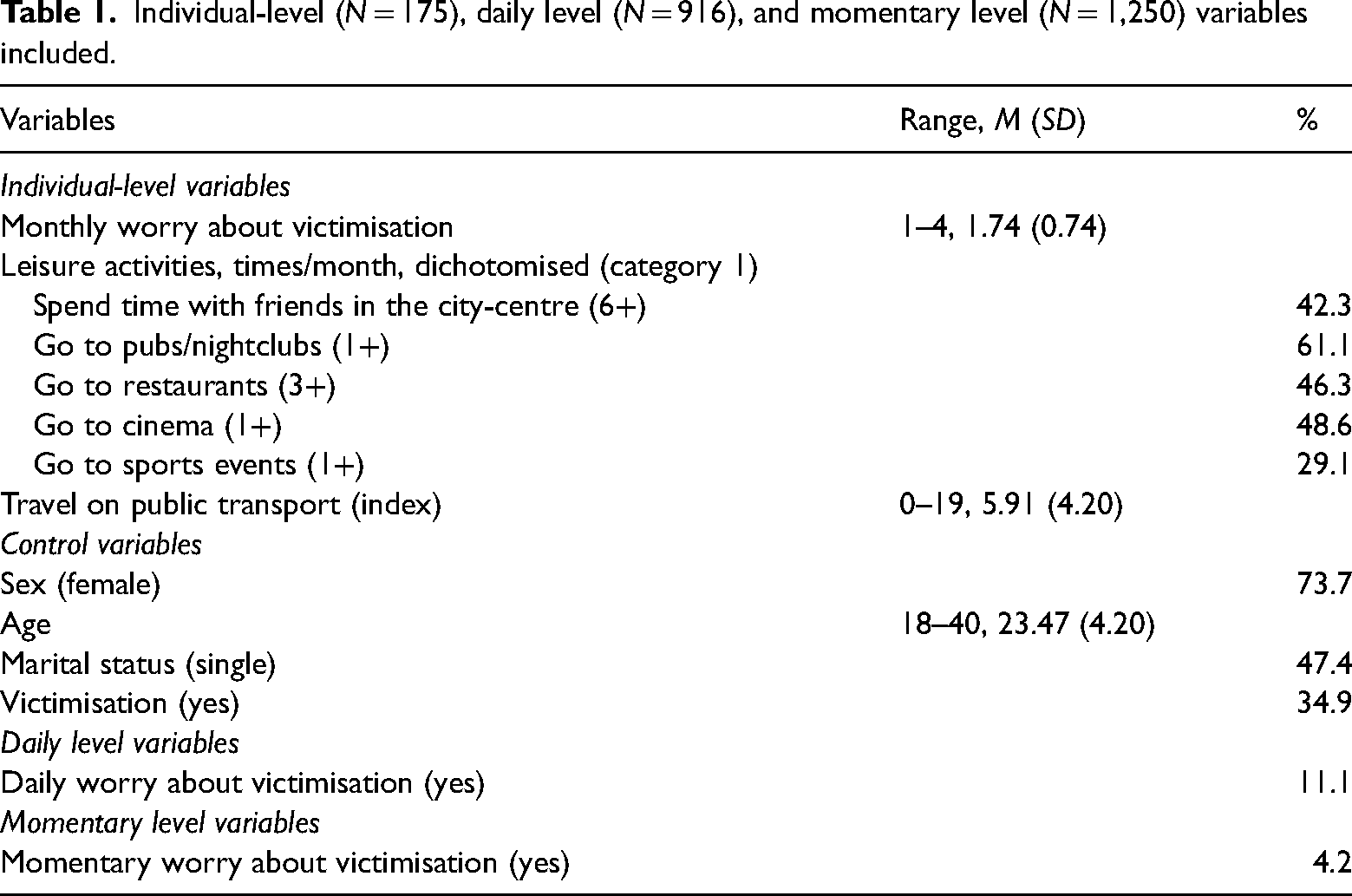
Monthly worry about victimisation is based on three offence categories included in the baseline survey (attack/assault/robbery, threat/harassment in person and sexual harassment in person) and refers to how often participants had worried about these different types of personal offences during the past month, with the response options “never” (1), “rarely” (2), “quite often” (3) and “very often” (4). The final dependent variable consists of each participant's mean value across these three offences (mean across all participants = 1.74). 4
Daily worry about victimisation is based on an item from the daily assessment asking participants “during the past 24 h, have you been worried about becoming the victim of a crime?” The response options (and the item dispersion) include “no” (86.2%), “yes, once” (11.7%), and “yes, several times” (2.1%). Respondents reporting any of the latter two alternatives were asked to state whether their most recent experience of worry was related to worry about becoming the victim of any specific offences. If the respondent had been worried about personal victimisation, that particular day was coded as containing a moment of worry (1) while days not containing such worry were coded as 0. The final dependent variable is thus a dichotomous variable measuring whether a day contained a moment of worry about personal victimisation. In total, 11.1% of the days contained a moment of worry about personal victimisation.
Momentary worry about victimisation was measured using an item from the signal-contingent survey asking participants “how worried are you about becoming the victim of a crime right now?” Participants used a slider to report their level of worry, which ranged between not worried at all (0) and very worried (100) (range = 0–82, M = 3.13, SD = 10.07). Respondents reporting at least 10 on the slider scale (i.e., they were at least somewhat worried) were asked to state whether their current experience was related to worry about becoming the victim of any specific offences. 5 If the respondent had been worried about personal victimisation, that particular moment was coded as containing worry (1), while moments not containing such worry were coded as 0. The final dependent variable is thus a dichotomous variable measuring whether a moment was related to any worry about personal victimisation. In total, 4.2% of the moments contained worry about personal victimisation.
Independent variables
A total of six independent variables collected during the baseline survey, and which refer to various aspects of the participants’ general lifestyle/routine activities, were included in the analyses. These variables by no means constitute a complete representation of an individuals’ lifestyle/routine activities (for a discussion, see Engström, 2021) but reflect some different types of activities that are theoretically relevant to explore in relation to worry about victimisation. Five separate baseline survey items constitute the variables that measure leisure activities. The participants were asked how often they: “spend time with friends in the city-centre”, “go to pubs/nightclubs”, “go to restaurants”, “go to the cinema” and “go to sports events” on a monthly basis (0, 1–2, 3–5, 6–10 or more than 10 times). Due to the small sample size, many response categories contained few cases which can be problematic for the statistical analyses. The leisure variables were therefore systematically dichotomised by splitting them as close to the centre of the distribution as possible (see Table 1). Note that the reference categories consist of all values lower than those reported within parentheses in Table 1. Finally, one variable measures travel using public transport and consists of a summary index based on three survey items that measure the number of days per week that each participant travels with trains, regional buses and/or local buses (possible range 0–21 but no participant scored higher than 19).
Control variables
Three demographic control variables often used in lifestyle-routine activity research were included, namely age (years), sex (0 = male, 1 = female) and marital status (0 = in a relationship, 1 = single). The sample is mainly female (73.7%) which roughly reflects the sex distribution at the university. In terms of age, the sample is typical for the university setting with an age range of 18–40 years (Mage = 23.47), and just less than half of the sample is single (47.4%). Further, victimisation of any of four personal crime types (robbery or attempted robbery, physical violence, sexual harassment in person and threats in person) during the past 12 months was included as a control variable. In total, 34.9% of the sample reported victimisation and were thus coded as 1 while the rest were coded as 0.
Analytic approach
The overall analytic approach was centred on maximising the use of the available data. Therefore, the study does not use data from an identical sample of individuals across the three different surveys (e.g., some participants did not complete any daily assessments but still completed signal-contingent surveys and vice versa). Further, the data have unique properties that resulted in the use of two different statistical approaches. The analysis of monthly worry employs Ordinary Least Squares (OLS) linear regression models with individuals as the units of analysis because all participants were asked about their worry about victimisation during the past month in the baseline survey. The analysis of daily worry refers to days as the unit of analysis while the analysis of momentary worry refers to moments as the unit of analysis. Both daily and momentary worries were fitted in logistic regression models since they are based on binary outcomes. Since days and moments are nested within individuals, Generalised Estimating Equations (GEE) were employed in these specific analyses because this approach offers the possibility of accounting for the correlation across observations within individuals. GEE may also provide reliable results despite unbalanced data and a small number of observations within clusters (McNeish, 2014). This is important since the number of surveys completed varies across participants, from one to 56 per participant (M = 6.1, Mdn = 4, SD = 6.71) in the daily survey and from one to 121 (M = 10.42, Mdn = 5, SD = 14.73) in the signal-contingent survey. In the GEE, an exchangeable working correlation matrix was selected (i.e., all observations within individuals are hypothesised to be equally correlated) and a robust estimator (Huber/White/Sandwich) was employed.
The analyses focus on monthly, daily and momentary worry separately, but follow the same approach by examining associations between lifestyle/routine activities and worry about crime in the initial analyses. Thereafter, these associations were examined again in analyses including control variables. Unstandardised and standardised coefficients are reported for the OLS analysis while odds ratios (OR) and their 95% confidence intervals are reported in the logistic regression. The interpretation of the OR refers to an increase or decrease in the odds ratio for a day or moment to contain any worry about personal victimisation compared to not having this type of worry. Standard errors and p-values are reported in all analyses.
Since the analyses have been carried out to fit the data and thus differ across surveys (i.e., different sub-samples, operationalisations of the outcome variable and statistical approaches), it is important to stress that direct comparisons across the analyses cannot be made in terms of effects (i.e., OR). This is also the case for the separate analyses within daily and monthly worry since logistic regression models with different variables (i.e., with or without controls) cannot be directly compared in terms of their effects (see Mood, 2010). The analyses are therefore centred on examining which variables that are statistically significant in different models rather than focusing on changes in the sizes of the OR across models.
Finally, the small sample size and the fact that worry about victimisation is relatively rare (particularly for momentary worry) can make logistic regression analyses less reliable. Therefore, a series of sensitivity analyses were performed to assess the stability of the findings.
Findings
The first analysis (Model 1, Table 2) suggests that three variables have a statistically significant association with monthly worry about victimisation, net of all other lifestyle/routine activity variables. Spending time with friends in the city-centre exhibited a negative association with monthly worry about victimisation (β = −0.16, p = .050) as did going to sports events (β = −0.20, p = .007), whereas going to pubs/nightclubs showed a positive association (β = 0.27, p = .001). The second model in Table 2 includes the control variables and shows that females report significantly higher levels of worry (β = 0.34, p = .001). In addition, previous victimisation exhibited an independent positive association with monthly worry about victimisation (β = 0.31, p = .001). The second model also showed that going to pubs/nightclubs was no longer significantly associated with monthly worry, while the significant associations remained for spending time with friends in the city-centre (β = −0.15, p = .043) and going to sports events (β = −0.14, p = .032).
OLS regressions with monthly worry about victimisation as the outcome (N = 175).
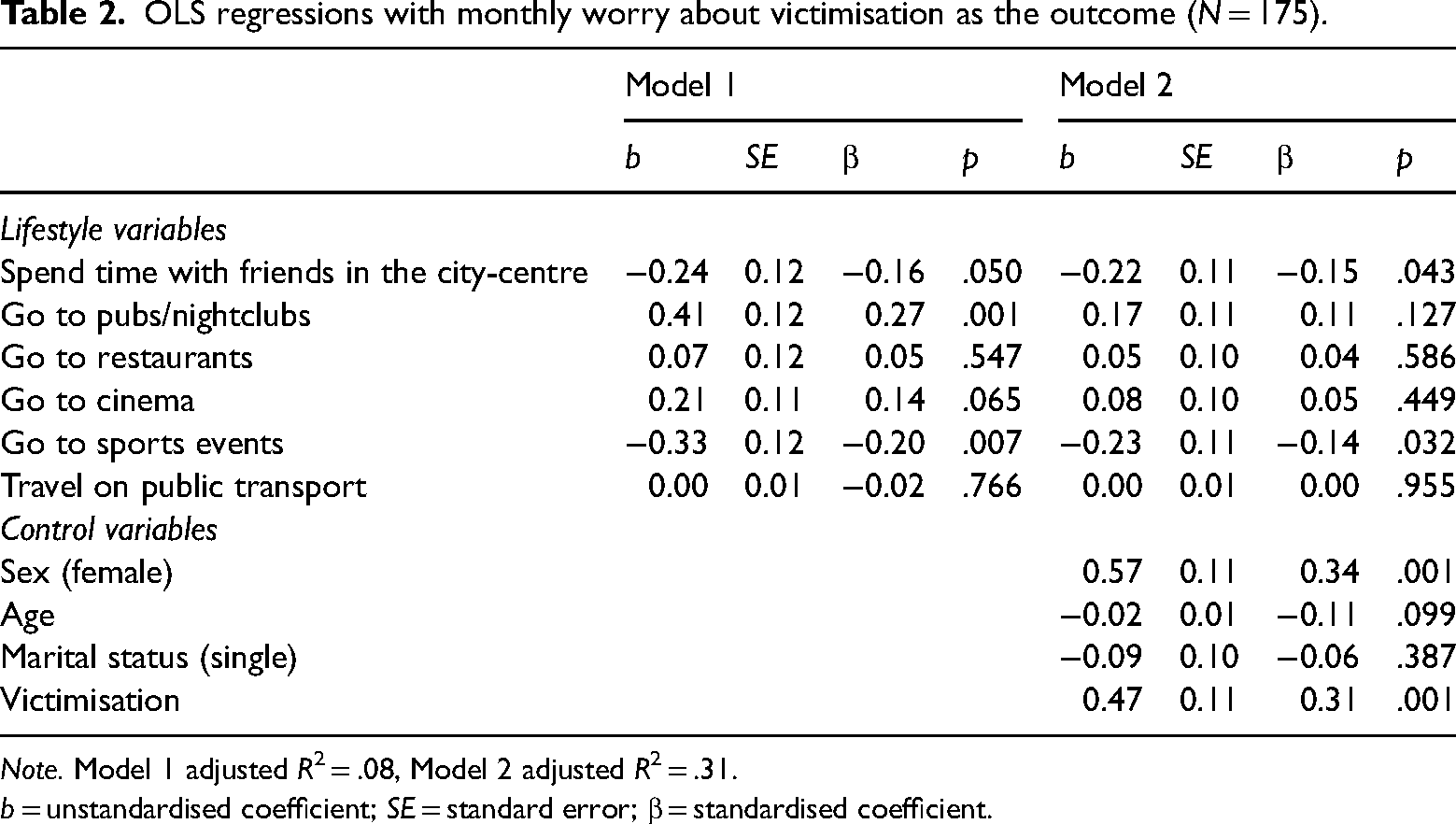
Note. Model 1 adjusted R2 = .08, Model 2 adjusted R2 = .31.
b = unstandardised coefficient; SE = standard error; β = standardised coefficient.
The results from the analysis of daily worry (Table 3) suggest that only one lifestyle/routine activity variable was significantly associated with daily worry about victimisation in the model without controls. More specifically, going to pubs/nightclubs was positively associated with daily worry (OR = 2.05, p = .032) net of all other lifestyle/routine activity variables. In the second model with control variables, the only significant association found was that a day experienced by a woman had a higher odds ratio for including any worry about victimisation (OR = 2.94, p = .045). Thus, the model with control variables did not reveal any significant associations between lifestyle variables and daily worry about victimisation.
Binary logistic regressions examining whether a day was reported as containing a moment of worry about victimisation (N = 916).
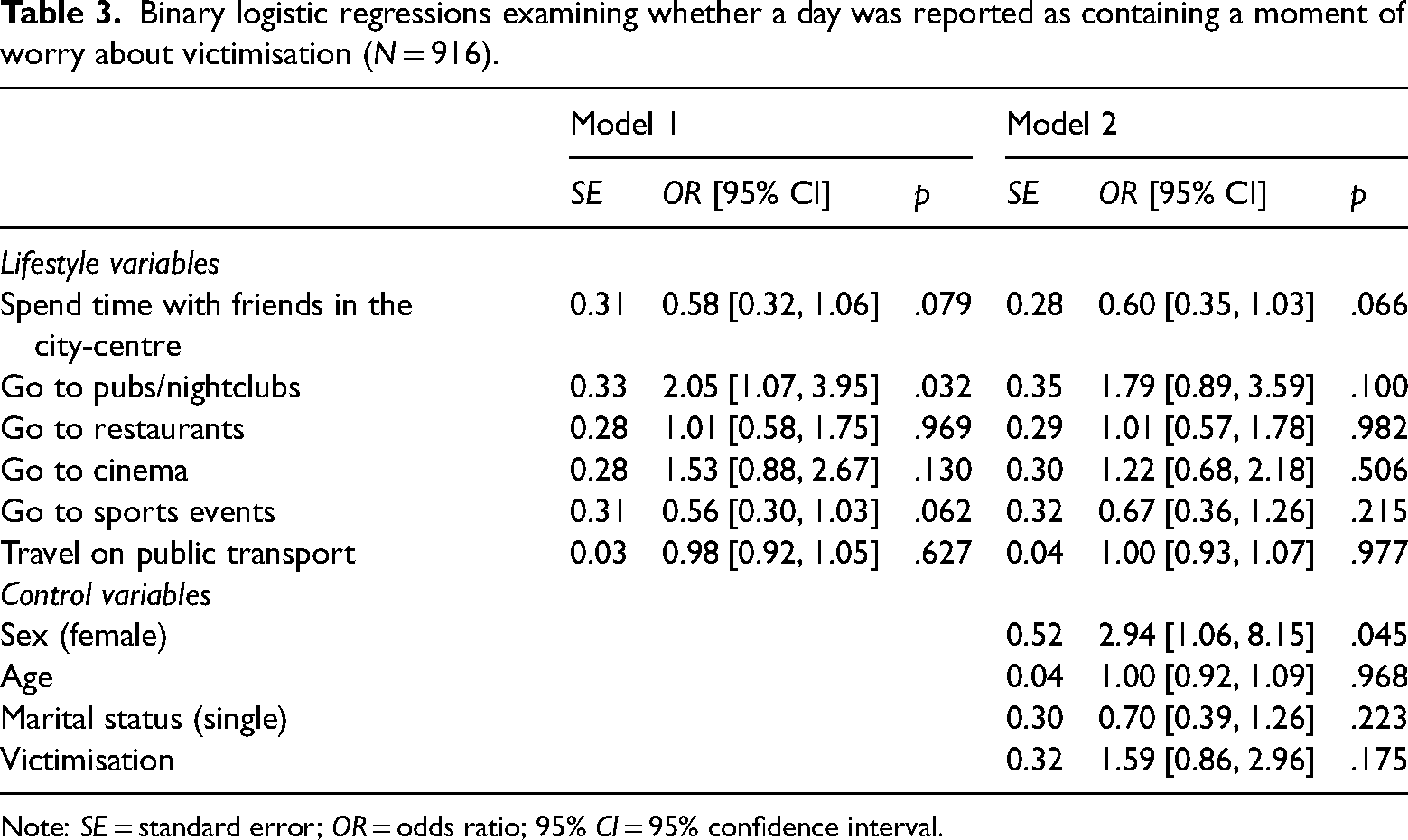
Note: SE = standard error; OR = odds ratio; 95% CI = 95% confidence interval.
The third and final analysis (Table 4) shows that three lifestyle/routine activity variables were significantly associated with momentary worry about victimisation net of all other lifestyle variables. Spending time with friends in the city-centre was negatively associated with momentary worry (OR = 0.38, p = .023), while a positive association was found for going to pubs/nightclubs (OR = 2.98, p = .003) and travelling with public transport (OR = 1.10, p = .015). In a model including controls (Model 2, Table 4), the results were similar except the fact that travelling on public transport was no longer significantly associated with worry. Interestingly, no control variable showed any significant associations with the outcome.
Binary logistic regressions examining whether a moment contained any worry about victimisation (N = 1,250).
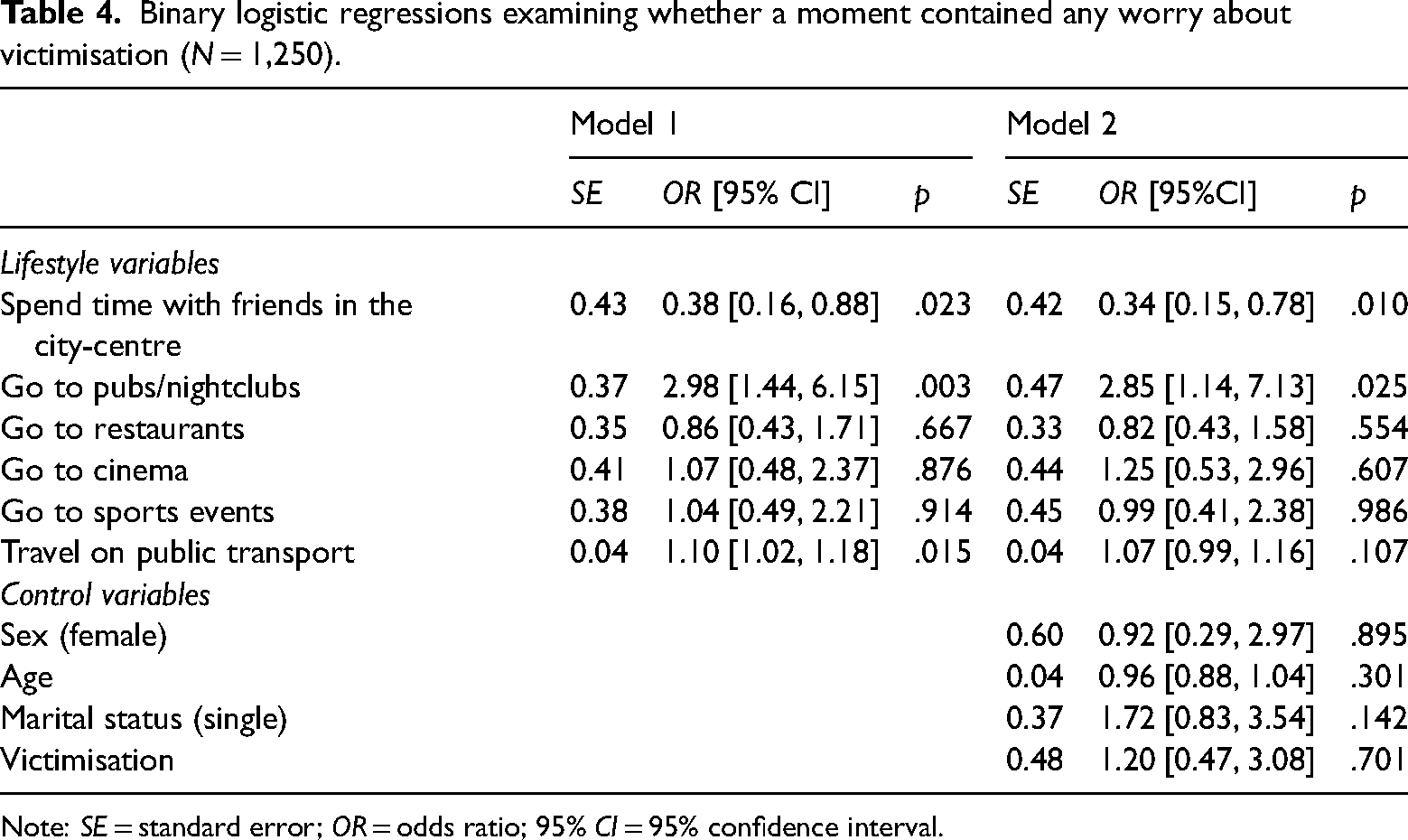
Note: SE = standard error; OR = odds ratio; 95% CI = 95% confidence interval.
Sensitivity analyses
A large proportion of the participants provided only one or two of the repeated surveys. More specifically, a total of 121 participants reported at least two daily assessments (n = 887) and 94 participants reported three or more daily assessments (n = 833). A total of 102 participants reported at least two momentary surveys (n = 1,232) and 81 participants reported three or more momentary surveys (n = 1,190). Although the analytic approach can handle imbalanced data, participants who only participated once may nonetheless be different from those who provided more data points (Kronkvist & Engström, 2020). To account for this, participants reporting at least two or at least three assessments were included in a reproduction of the analyses where the control variables were included. In difference from the original analyses, spending time with friends in the city-centre exhibited a significant and negative association with daily worry in the sensitivity analyses including participants who responded to at least two daily assessments. Further, in a model only including those who had responded to at least three daily surveys, sex was no longer statistically significant. For the momentary surveys, the only noteworthy difference from the original analyses is that marital status (being single) fell below the threshold for statistical significance in the analysis including only respondents who provided at least three momentary surveys, indicating a significantly higher OR for momentary worry about victimisation.
While there are some differences in the results between the main analyses and the robustness tests, the main results are still quite consistent. However, it is important to remain aware of the exploratory nature of the current study and the limitations of the data used. Some associations in the sensitivity analyses fell just on the other side of the 0.05 significance threshold by comparison with the original analyses which is not surprising when results are borderline significant/non-significant. Furthermore, logistic regression models with different variables cannot be directly compared, which means that the above sensitivity analyses should be interpreted as a rough indication of the stability of the findings in terms of statistical significance when using different sub-samples. Full information about the sensitivity analyses is available upon request.
Discussion
The results suggest that the more or less one is involved in different activities is related to worry about victimisation to some extent, but the specific associations differ in significance and direction. The most consistent finding is that spending a substantial amount of time in the city-centre with friends is negatively associated with worry about victimisation across both the monthly and the momentary analyses. A similar association is also found for daily worry in the sensitivity analyses, but it failed to reach statistical significance in the main analysis (p = .066). One interpretation of this finding is that a general lifestyle involving a great deal of social interaction makes one feel safe or become more resilient to experiencing worry about victimisation.
Another noteworthy finding is that going to pubs/nightclubs was significantly associated with an increase in momentary worry, but not with monthly and daily assessments of worry. While these findings corroborate some previous research (e.g., Rountree, 1998), they contradict the findings of other studies (e.g., Rengifo & Bolton, 2012). Moreover, going to sports events was negatively associated with monthly worry, which is similar to some findings reported in previous research (e.g., Özaşçılar & Ziyalar, 2017). Furthermore, while previous research has found travelling on public transport to be associated with increased levels of fear of crime (e.g., Rountree, 1998), this is not generally supported by the findings presented here, although momentary worry about victimisation indicated such a relationship in a model without controls. It should also be noted that going to restaurants and the cinema does not seem to be associated with worry about victimisation since these variables did not reach statistical significance in any models.
Finally, it should be noted that the above-discussed associations between L-RAT factors and worry about victimisation were found net of control variables. The only significant results for these variables involved being a woman, which was positively associated with monthly and daily worry, and previous victimisation being associated with a significant increase in monthly worry. These findings are in line with other fear of crime research (e.g., Collins, 2016) but they also suggest that the significance of these variables varies across different reference periods. One potential interpretation of their varying importance is that these variables may be of different significance when examining an expressive compared to an experiential dimension of worry about victimisation (see Farrall et al., 2009; Jackson, 2004). For instance, sex was significantly associated with monthly worry (i.e., expressive worry) while not significantly associated with momentary worry (i.e., experiential worry). In a more general sense, these findings indicate that different independent variables may be of different importance when analysing worry about victimisation across different reference periods (i.e., expressive vs. experiential dimensions of worry) which must be explored further in future research.
A related question refers to how associations between activities and worry about victimisation should be interpreted. For instance, in the current study, momentary worry about victimisation was to some extent associated with the lifestyle/routine activities of the person experiencing these moments. This might be interpreted as indicating that lifestyle/routine activities affect exposure to settings (that in turn generate various levels of worry) across moments. For instance, an individual who spends a lot of time with friends in the city-centre may less often become exposed to settings that generate worry, and thus report lower levels of worry about victimisation. However, another interpretation is found in the possibility that the individual “propensity” to experience worry about victimisation in a given setting may be related to lifestyle/routine activities. Here, lifestyle/routine activities may be seen as leading individuals to become more or less familiar with certain types of circumstances, which then affects whether these circumstances are perceived as frightening. For instance, an individual who spends a lot of time with friends in the city-centre may in general perceive certain settings as less worrying, and consequently report lower levels of worry. Thus, lifestyle/routine activities may function to habituate (or sensitise) individuals to various circumstances, which in turn affects whether a setting is experienced as fearful or worrying (i.e., a type of “fear propensity”; see also Gabriel & Greve, 2003). This is important because being exposed to any given circumstance may generally not be enough for fear to occur; fear demands some kind of interaction and interpretation between the environment and the individual experiencing it. Clearly, this is an important topic for future research.
While most discussions in fear of crime research pertain to various definitions of fear (e.g., worry, risk perception, etc., see e.g., Ferraro & LaGrange, 1987), this study offers another perspective by allowing worry about victimisation to vary across days and moments. The main contribution of this study is therefore to treat worry about victimisation as a phenomenon related to different reference periods. The results indicate that treating fear of crime in this way may both provide some similar results across monthly, daily and momentary worry but also some differences. Future research must further explore this approach by using random samples in a research design that examines various types of fear of crime in relation to different reference periods. The smartphone app used here allows for such a study design (see Kronkvist & Engström, 2020) but there are now several potential solutions available within the growing field of app-based fear of crime research (see Solymosi et al., 2021). There are clearly good reasons for this field to grow in the near future, not least as a result of the ability of these studies to use shorter reference periods and real-time sampling, which provide a possibility to overcome measurement issues associated with traditional methods (e.g., Lynch & Addington, 2010; Schwarz, 2012).
Limitations and future directions
The findings must be understood against the background of the exploratory nature of the study and its use of a convenience sample. The results are thus mainly of relevance from a conceptual or theoretical perspective rather than providing generalisable conclusions. Despite the convenience sampling approach, the response rate must still be considered low with only 20.5% of students invited to the study participated in the baseline survey. This may be explained by the somewhat burdening nature of participation. Moreover, this study examined worry about victimisation across different reference periods in separate analyses. However, monthly, daily and momentary worry may be interrelated which is clearly an important topic that deserves attention in future research. Further, this study has focused on a general lifestyle measured in the baseline survey. This approach downplays the potential role of lifestyle/routine activity factors at the daily and momentary levels. For instance, future research that measures daily fluctuations in involvement in various activities is important to fully understand the association between daily routines and daily fear of crime. Still, using L-RAT predictors from the baseline (monthly) level to predict daily and momentary worry is important because a general lifestyle should be reflected in the types of days and moments that an individual experiences. Moreover, no items regarding details of public transport use were included in the survey (e.g., when it is used, for what purposes, etc.), which could be useful to consider in future research to examine how differences in the use of public transport may be associated with varying levels of worry about victimisation. Finally, the study only collected a few daily and momentary surveys from most participants, which is not sufficient to provide a representative picture of the types of days and moments experienced by the participants. Future research should therefore attempt to maintain participation over time in order to collect more daily and momentary data.
In addition to the limitations outlined above, future research employing an L-RAT framework to explain fear of crime, regardless of the level of reference, is encouraged to include measures that have been omitted in the current research project but may be important for better framing and understanding the findings reported here. This could include, for instance, more well-developed items on gender to capture aspects relevant to the vulnerability hypothesis (e.g., Rader et al., 2012) and the shadow of sexual assault hypothesis (e.g., Ferraro, 1996). Including items on minority group identification, such as ethnicity and lesbian, gay, bisexual, transgender and queer (LGBTQ) group belonging, could also advance the field by better understanding how routine activities/lifestyles and individual/group attributes contribute to variations in fear of crime.
Conclusion
The results support the general notion that lifestyle/routine activities are associated with worry about victimisation across months, days and moments. However, the associations differ in many respects and the more specific interpretations of these associations are difficult, which warrants further attention in future research. This study's main contribution to fear of crime research, however, is that it includes measures of worry about victimisation across different reference periods. It thus taps into both expressive and experiential dimensions of worry about victimisation, and highlights that the drivers of worry may differ when being treated as a dynamic rather than static phenomenon. This way of examining worry about victimisation requires adequate data collection methods, such as experience methods, which were implemented here within a smartphone app framework. Future research is needed that further examines various forms of fear of crime in relation to different reference periods, both within L-RAT but also more generally within fear of crime research.
Footnotes
Declaration of conflicting interests
The authors declared no potential conflicts of interest with respect to the research, authorship, and/or publication of this article.
Funding
The authors received no financial support for the research, authorship, and/or publication of this article.
