



Abstract
Situational data have become more frequently used in research on offending and victimization. However, one outcome that has received less attention is fear of crime. The current study uses situational data collected through a smartphone application (STUNDA) to examine fear of crime as it is experienced in daily life among a sample of university students. Roughly 1200 situations reported by 129 students were analysed using generalized estimating equations. The results indicate that experiential fear of crime, in the form of worrying about victimization, is related to features of the immediate settings. More specifically, the odds ratio for experiencing fear of crime is significantly higher in places away from home and after dark, whereas social activities are associated with a significantly lower odds ratio, net of individual-level controls (gender, age, previous victimization and fear propensity). Yet, fear propensity, measured here using items that refer to an individual’s general worry about victimization, has an independent significant effect on fear of crime. As a result of the study’s convenience sample, the generalizability of the findings is limited, but a more general theoretical conclusion can nonetheless be drawn; features of settings and individual characteristics are both of importance. Further, the use of experience methods via a smartphone application provided detailed and unique situational data, which suggests that future research should further employ these methods to study situational phenomena such as fear of crime.
Keywords
Introduction
There is a growing interest in using situational data for studying the dynamics of crime. However, whereas previous research has focused on offending (for example, Bernasco et al., 2013; Wikström et al., 2012) and victimization (for example, Ruiter and Bernasco, 2018), one outcome that has received less attention is fear of crime. One potential reason for this is that much previous fear of crime research has relied on data collected using traditional global survey methodologies (for example, large-scale national surveys, such as the Swedish Crime Survey; see Molin and Lifvin, 2019), which limits the possibilities of providing insights into fear as a temporary state experienced in a given setting. It has therefore been argued that methodological improvements are needed for fear of crime research to capture the complex nature of the phenomenon under study (Gray et al., 2008). A promising alternative approach to examining experiences of fear of crime is to use smartphone-based experience methodologies, which have been employed in a handful of recent studies. Overall these studies provide empirical support for the notion that fear of crime varies across space and time (Chataway et al., 2017, 2019; Irvin-Erickson et al., 2020; Solymosi and Bowers, 2018; Solymosi et al., 2015), thus highlighting that fear of crime, at least to some extent, should be studied as a dynamic phenomenon. However, this small but growing field of research varies in many respects, for instance in terms of survey items and research design, and also in terms of the way in which fear of crime is framed within a wider theoretical framework.
This study explores the relationship between features of settings and experiential fear of crime, while also accounting for individual characteristics. The empirical material consists of 1232 situations reported in situ by a convenience sample of 129 university students via STUNDA, a smartphone application specifically developed to survey fear of crime. This study contributes to the current body of knowledge by examining fear of crime in the form of experiences embedded in settings of everyday life. It also contributes new methodological knowledge, since this novel and innovative way of collecting data may present new opportunities and spark interest in further research focusing specifically on experiential fear of crime.
Background
Framing experiential fear of crime
In the absence of a universal definition, fear of crime may be referred to as an umbrella concept covering multiple dimensions of fear (for discussions on definitions, see, for example, Farrall et al., 2009; Ferraro and LaGrange, 1987; Hale, 1996). Regardless of definition, however, fear of crime is often discussed as either a stable phenomenon, mainly explained by traits among those experiencing it, or as a temporary state that varies across time and place (Gabriel and Greve, 2003; see also Gray et al., 2012). The latter refers to the more general notion that thoughts, feelings and emotions vary across space and time (for example, Liddle et al., 2017; Shoval et al., 2018), including fear of crime (for example, Solymosi and Bowers, 2018; Solymosi et al., 2015). This type of fear of crime refers to what Farrall et al. (2009) label experiential fear, which is related to actual experiences that unfold at given moments in space and time, as opposed to expressive fear, which refers to more general beliefs about crime. In the current article, the focus is on experiential fear of crime (EFC) situated within individuals’ immediate environmental contexts (that is, settings); this is similar to others who discuss fear of crime in relation to situations (for example, Ferraro, 1995; Gabriel and Greve, 2003; Vitelli and Endler, 1993). 1 Since both individual and environmental factors may explain fear of crime (for example, Vitelli and Endler, 1993; Ward et al., 1986), the present study views EFC as being dependent on specific features of environmental settings and individual characteristics (see Engström and Kronkvist, 2018). As such, EFC may here refer to both cognitive and affective experiences of fear of crime (for example, worry, fear, risk perception; see Ferraro and LaGrange, 1987), but considers these dimensions at a situational level.
Studying experiential fear of crime
One possible approach to studying fear of crime in relation to specific settings is to ask respondents how safe they feel walking alone in their own neighbourhood after dark, an item that is frequently employed in national crime surveys (for example, Molin and Lifvin, 2019; see also Chataway and Bourke, 2020). This item clearly relates to fear being dependent on the circumstances of the immediate environment, including where (own neighbourhood), when (after dark), what (walking) and with whom (alone). However, it is limited in the sense that it provides insights only with regard to an expressive account of fear of crime by measuring beliefs about how one would feel in such a setting as opposed to how the setting is actually experienced (see Farrall et al., 2009). Furthermore, asking about only one type of setting limits the possibility of examining variations in fear of crime across different settings. Accordingly, after finding that the age–fear of crime relationship differed across contexts, Jeffords (1983) suggested as early as almost 40 years ago that there is a need to develop items with higher content validity than the commonly used ‘walking-outdoors-alone-late-at-night’ item (see also Chataway and Bourke, 2020).
Although alternative approaches to assessing fear of crime have been introduced, such as the use of vignettes or multiple setting-specific items (for example, Kappes et al., 2013; Van der Wurff et al., 1989), the arguably most promising alternatives are those referred to as everyday experience methods (Reis et al., 2014), in this article simply labelled experience methods. These methods, which include for instance Ecological Momentary Assessments and the Experience Sampling Method (for example, Csikszentmihalyi and Larson, 1987; Stone and Shiffman, 1994), examine experiences as they occur in situ and provide a rich picture of the phenomena studied (Hektner et al., 2007). The typical methodological approach consists of sending repeated randomly distributed signals to participants asking them to make an immediate assessment of their current situation by means of a short survey (Scollon et al., 2003). Research using experience methods has flourished since smartphones were introduced owing to their unique ability to trigger participant responses, provide questionnaires and collect auxiliary data through sensors (see Van Berkel et al., 2017). Experience research is of particular importance when studying EFC in particular, and holds some major advantages compared with conventional methodologies.
Traditional methodologies using global survey items (for example, worrying about becoming the victim of a particular crime during the past year) rely on insecure assumptions, such as respondents’ ability to identify, retrieve and estimate the number of times they have experienced a certain outcome during a given reference period (Schwarz, 2012). This process is vulnerable to various forms of bias, such as memory and aggregation biases (see Gray et al., 2012; Solymosi et al., 2015), and the use of global survey items has further been criticized for providing only vague general estimates of fear, worry and unsafety (Farrall et al., 2009). For instance, Farrall et al. (2009) found that many respondents who reported feeling worried in global items did not state having experienced any actual incidents of worry, suggesting that global items may overestimate fear of crime (see also Farrall et al., 1997). This issue is not unique to fear of crime research since the correspondence between global retrospective surveys and experience methods is far from perfect (for example, Scollon et al., 2003; Shiffman et al., 2008). More specifically, individuals tend to be biased towards reporting recent or extreme events in global measures, rather than providing an estimate across all experiences over a given reference period (Stone et al., 2000). Thus, as argued by Reis et al. (2014: 378), global measures do not really capture experiences but rather consist of ‘reconstructed interpretations of personal experience’, an issue related to the fact that individuals are generally asked to assess fear of crime at the time of completing a survey as opposed to when fear of crime may be experienced (Gray et al., 2008). This issue also makes it difficult to know whether suggested predictors of fear actually have an explanatory role in relation to settings that elicit fear, because independent and dependent variables are not measured as they converge in space and time (for a general discussion of this issue, see Hardie, 2020).
Experience methods examine participants in the actual settings they are experiencing (for example, Reis et al., 2014; Van Berkel et al., 2017), making results generalizable across similar settings in the real world (Shiffman et al., 2008). Ecological validity is therefore a central benefit of experience methods because, ‘[i]f one is interested in how subjects feel at work, there is no point asking them how they feel in the research clinic – or at home, for that matter’ (Shiffman et al., 2008: 4). Today, experience research is employed across several scientific disciplines (see, for example, Reichert et al., 2020; Van Berkel et al., 2017), examining phenomena such as quality of life (Liddle et al., 2017) and emotional arousal (Shoval et al., 2018). However, these methods are rare in crime-oriented research (for an exception see, for example, Goldner et al., 2011). Although this methodology was mentioned in relation to fear of crime some time ago (Farrall et al., 2009; Gray et al., 2012), it is not until recently that fear of crime research has come to employ this increasingly popular methodological approach by examining fear of crime as a dynamic feature that varies across space and time (Chataway et al., 2017, 2019; Irvin-Erickson et al., 2020; Solymosi and Bowers, 2018; Solymosi et al., 2015; see also Chataway, 2019).
Factors of relevance for experiential fear of crime
Features of settings
Important features of a setting include where and when fear is experienced, what one is doing and who else is present (see Pervin, 1978; Wikström et al., 2012). Although these elements have been examined to a varying extent in relation to offending and victimization (for example, Bernasco et al., 2013; Ruiter and Bernasco, 2018; Wikström et al., 2012), they are also of theoretical relevance for EFC owing to their focus on the essential characteristics of the immediate environment.
Where a setting is located relates to the functional location (for example, home, school or workplace). For instance, being away from home or in unfamiliar places may lead to increased fear (Brantingham and Brantingham, 1995; Warr, 1990), whereas familiarity is generally associated with lower levels of fear of crime (Lorenc et al., 2013; Solymosi and Bowers, 2018). Using experience methods, Birenboim (2018) found that the type of place was in fact the main feature affecting insecurity. More specifically, being at home, at the university or at others’ houses was related to lower levels of insecurity whereas being in open spaces and travelling/moving around increased the level of insecurity. However, not all types of crime conform to this logic, with one exception being domestic offences (for a discussion, see Pain, 2000). When in time a setting is experienced is of relevance, because fear may increase ‘at night, in the dark’ (Brantingham and Brantingham, 1995: 9). Thus, one typical time-related feature of a setting of relevance for fear is darkness (see Warr, 1990), which adds complexity to the perceptions of a given location, since a place considered safe during the day may be considered unsafe at night (see Nasar et al., 1993). What one is doing in a given setting may also be related to fear of crime, because individuals’ activities constitute part of the setting (Ferraro, 1995). For instance, individuals with a more home-oriented lifestyle and those who refrain from risky activities, such as going to a party on campus or going to a café at night, tend to be more fearful (Crowl and Battin, 2017; Mesch, 2000), whereas being involved in partying activities is related to lower levels of fear of aggravated assault (Lee and Hilinski-Rosick, 2012). Who else is present in a setting is important because fear can increase as a result of being alone but also as a function of ‘encounters with “scary” people’ (Brantingham and Brantingham, 1995: 9). The presence of other people may be perceived as a threat, as in the case of women’s fear of men as a form of ‘stranger danger’ (Scott, 2003). However, the presence of unspecified ‘others’ can both increase and decrease the level of fear of crime depending on who these others are (Warr, 1990), indicating that it is important to specify which kinds of people are present in a given setting.
Individual characteristics
When studying EFC, differences across individuals in their tendency to experience fear of crime need to be considered. Women consistently report higher levels of fear than men (see Collins, 2016), which may in part be explained by women’s fear of sexual offenses (for example, Ferraro, 1996). Further, age is often associated with increased levels of fear (for example, Molin and Lifvin, 2019), although not conclusively across different studies (for example, Collins, 2016; Jackson, 2009; Jeffords, 1983). Victimization experiences are commonly used as predictors of fear of crime, with results showing that those with a victimization history report higher levels of fear across different studies (Collins, 2016). Importantly, gender, age, and previous victimization are merely proxies for other unmeasured factors affecting EFC, which indicates a need to also use other measures of ‘dispositional fear’ (that is, the propensity to perceive a setting as frightening, see Kappes et al., 2013). However, the definition of EFC outlined here is understudied, making it difficult to understand which individual-level factors may measure a propensity to experience fear of crime. One possible option explored in this study is that of using fear of crime in a traditional survey (expressive fear) as an indicator of the propensity to experience fear of crime in a given setting. Although this reasoning may seem tautological, it is important not to expect beliefs about crime to be identical to actual experiences of fear of crime.
The present study
The overarching research question posed in the present study is which features of a setting are related to experiential fear of crime? By also including individual-level control variables, the importance of both features of settings and individual characteristics is acknowledged.
Data
The data are drawn from the research project ‘STUNDA: Examining experiences of situational fear of crime through smartphone applications among young adults in Malmö’. STUNDA is a smartphone application specifically developed to study fear of crime (for an overview and detailed description of the methodology, see Kronkvist and Engström, 2020). The aim of the project is primarily exploratory and focuses on the feasibility of utilizing a smartphone application in experience research on fear of crime. The study has been approved by the Regional Ethical Review Board in Lund (ref. 2018/464).
Participants are composed of a convenience sample of students enrolled at Malmö University, Sweden, during the fall of 2018. Students were recruited in classrooms and in manned displays across campus by being handed fliers with project information and unique user credentials for the smartphone app. The exact participation rate is unknown but, based on a liberal estimate, no more than 2000 students came into contact with the project and were thus offered the possibility of participating. A total of 933 students were definitely informed of the project, because that is the number of students who retained the flier. Of these, 191 individuals (20.5 percent) downloaded the app, completed a baseline survey and thus qualified as participants in the study. Participants then decided themselves how they wanted to use the app, which resulted in 131 individuals choosing to answer at least one signal-contingent survey. Across all participants, 1305 such surveys were completed. Cases with missing data on the study variables were deleted listwise, resulting in 1232 cases with complete data, clustered in 129 participants.
Procedure
Signal-contingent surveys were activated among participants at three random times per day via notifications in the app, one per time slot (07:30–12:30; 12:31–17:30; 17:31–22:30), in order to collect data across different periods of the day (that is, using stratified sampling; see Shiffman et al., 2008). 2 Participants were required to allow STUNDA to send notifications in order to participate in the survey, which contained items on various aspects of fear of crime and the current setting. 3 Data were also collected passively via smartphone sensors (time and geographical location). Each survey expired 20 minutes after receipt of the notification to ensure high ecological validity (that is, that participants answered the survey in the sampled situation; see for example, Scollon et al., 2003). The number of notifications (that is, possible surveys) received by each participant is unknown (for example, participants might have turned off notifications), for which reason it is not possible to report an exact compliance rate. However, based on estimates of received notifications among the participants in this study, the compliance rate is estimated at between 31.2 and 35.0 percent (for details regarding these estimations, see Kronkvist and Engström, 2020).
Study variables
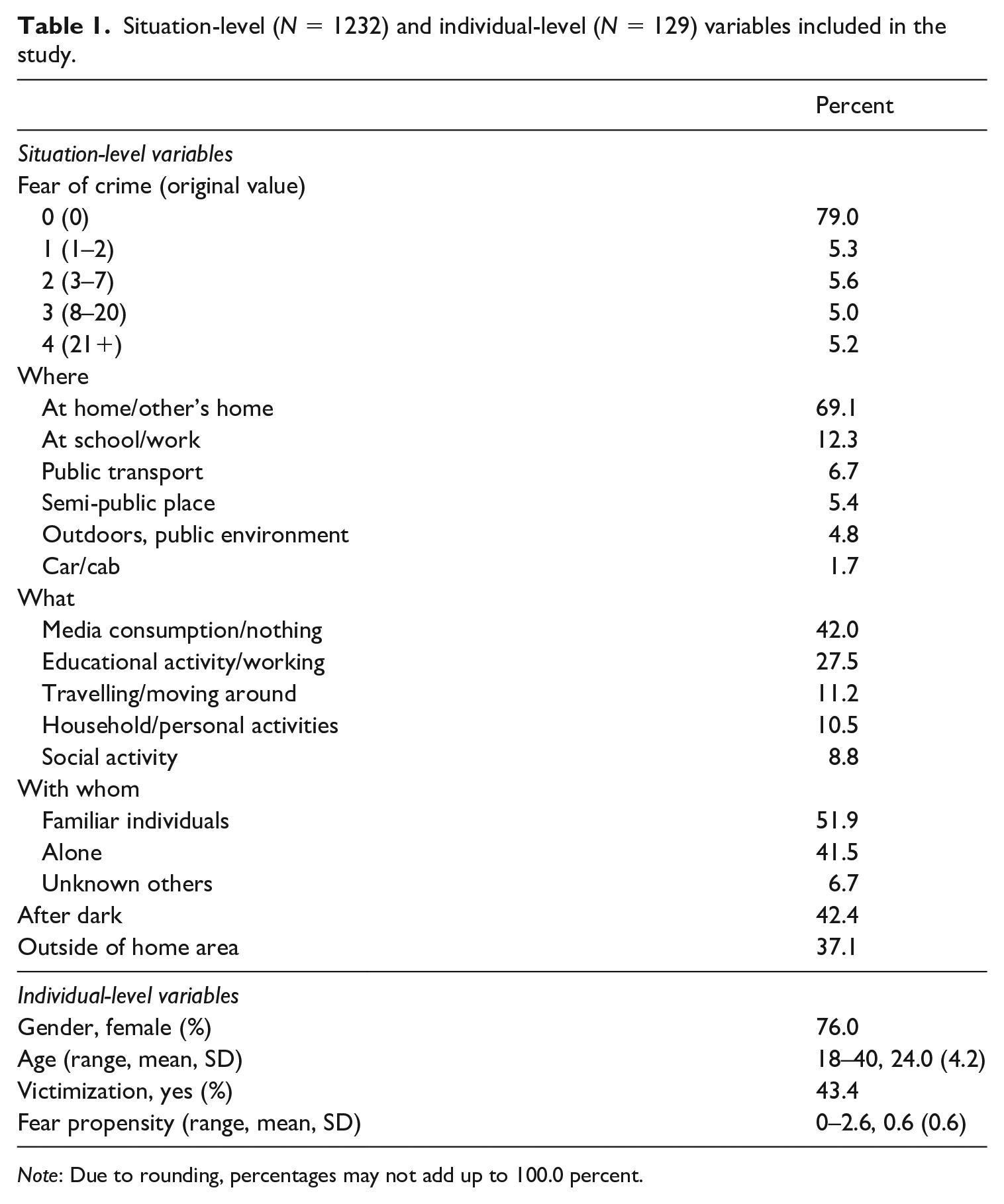
An overview of the study variables is provided in Table 1 (see also Table 3 in the Appendix).
Situation-level (N = 1232) and individual-level (N = 129) variables included in the study.
Note: Due to rounding, percentages may not add up to 100.0 percent.
Dependent variable
EFC is here measured via the item ‘How worried are you about becoming the victim of a crime right now?’ Participants selected the level of worry using a slider with underlying integer values (not visible to participants) ranging between the two extremes ‘not worried at all’ (0) to ‘very worried’ (100). Given that most situations were experienced as safe, which resulted in an excessive amount of zeros in the data (79 percent), the outcome variable was transformed into an ordinal variable (range 0–4). As shown in Table 1, the first category consists of zeros only while the remainder are based on the cumulative number of responses with cut points at each quartile of the values over zero (with roughly 5 percent of the total number of situations in each category).
Independent variables
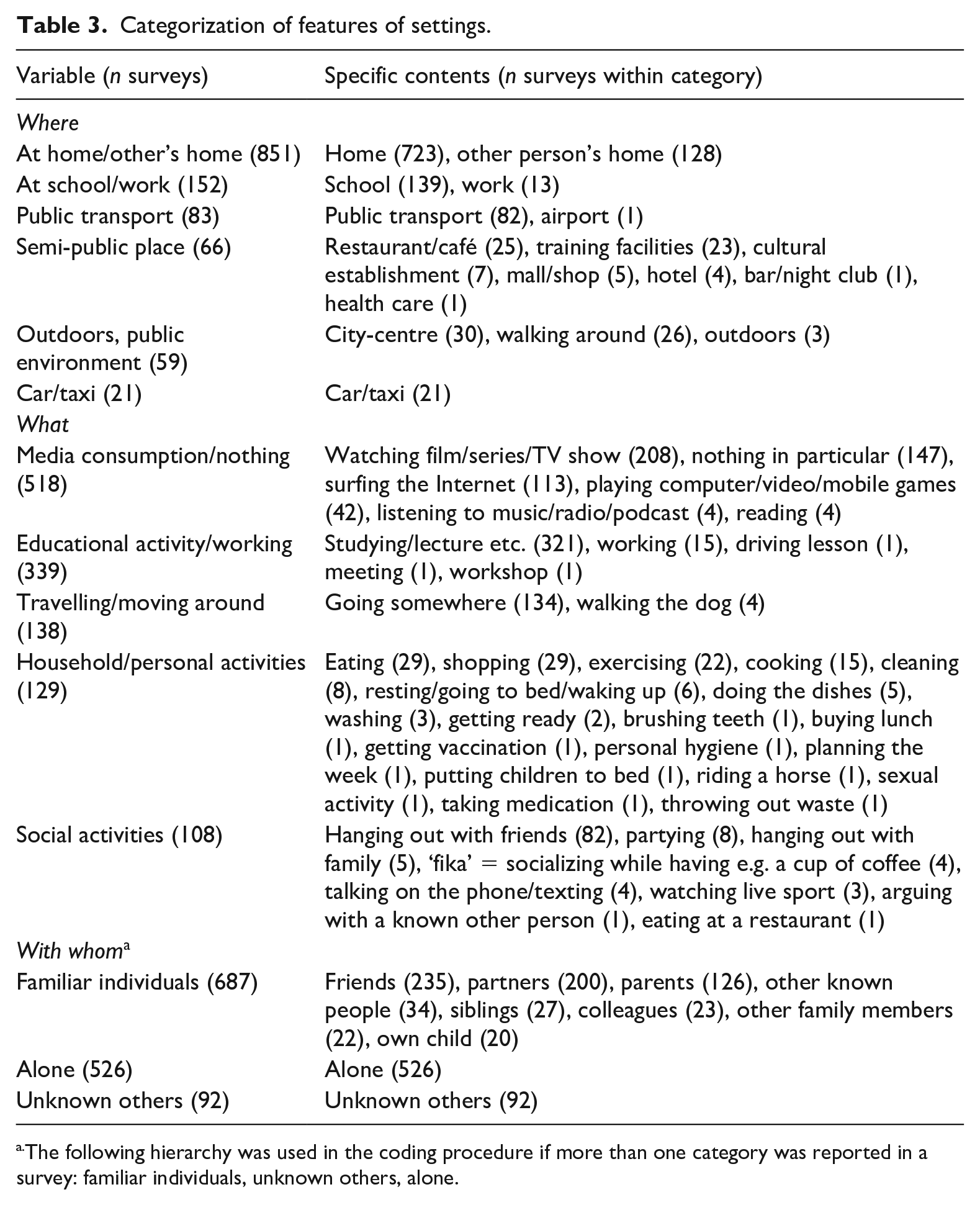
A set of variables were included that tap into the features of a setting that have been employed in criminological space–time budget research (for example, Wikström et al., 2012), in crime-related research using experience methods (Goldner et al., 2011) and in experience research on perceptions of insecurity (Birenboim, 2018). Three variables are based on survey items referring to different features of settings: the functional place, what the participant was doing at the time, and the presence of other people. The last feature refers to both familiar and unfamiliar individuals who were present in the setting and thus not necessarily interacting with the participant. Although participants could select from among predefined categories or use an open-ended response option, the original categories were reduced to a smaller set of categories by merging similar responses. Reference categories were selected based on the most commonly reported categories within each item: ‘at home/other’s home’ (where), ‘media consumption/nothing’ (what), and ‘familiar individuals’ (who). Full information about the categorization is available in Table 3 in the Appendix.
Two variables were created from data automatically collected by STUNDA. Time was logged for each situation, and this was then paired with data from an online resource (Time and Date, 2020) in order to create a variable measuring whether a setting was experienced after dark. A variable was also created that measures whether a setting was experienced outside of the home area. The participants’ home area was defined by their postal code, as reported in the baseline survey. 4 The geographical midpoint of this area was selected as an individual’s home. Geodata on the specific location of each survey were then compared with this midpoint; surveys reported more than 500 metres away from home were coded as occurring outside of the home area. The 500-metre limit is an arbitrary cut-off but seems reasonable, because most people are likely to be familiar with the surrounding area within such a distance.
Control variables
Individual-level control variables were included from the baseline survey. Gender is a variable in which females are compared with a combination of the other two categories (19.4 percent males and 4.7 percent who did not state their gender). Age (years) was also included, as was a dichotomous variable measuring victimization. The latter variable measures whether a participant had been victimized in the form of any of the following offences in the past 12 months: robbery (including attempts), physical violence, sexual harassment in person, sexual harassment online, threat in person, and threat online. How worried participants were about becoming the victim of a crime during the past month is here used as a proxy measure of fear propensity because it refers to a general or expressive level of fear, which may reflect an individual tendency to also perceive settings as eliciting fear (experiential fear). This variable is a mean index (Cronbach’s alpha = .79) of responses relating to items referring to specific personal offences in the baseline survey (attack/assault/robbery, threat/harassment in person, threat/harassment online, sexual harassment in person and sexual harassment online). Although this proxy variable by no means captures all of the possible individual variation in fear propensity, it is here nonetheless considered a reasonable means of acknowledging the importance of dispositional fear.
Analytical approach
The signal-contingent surveys are the units of analysis in this study. The number of completed surveys with non-missing data on the study variables ranges from 1 to 120 per participant (mean = 9.6, median = 4, SD = 14.0), indicating that the data are clustered and unbalanced, which is typical in studies of this kind (Solymosi et al., 2020). Since the clustering violates the assumption of independence across observations, analyses were performed with robust standard errors using generalized estimating equations (GEE). This method can handle few observations per cluster and provide reliable results despite unbalanced data (McNeish, 2014). Because this study mainly controls for the clustering rather than drawing cluster-specific conclusions, the GEE method is utilized here instead of multilevel modelling (see McNeish, 2014). A robust estimator (Huber/White/Sandwich) was employed in conjunction with an exchangeable working correlation matrix. The latter was selected because experiences within an individual are here hypothesized to correlate to the same extent, regardless of their order in time. The GEEs were estimated by first specifying an ordinal distribution with a logistic function.
Three separate analyses were carried out. First, bivariate associations were examined with each independent variable regressed on EFC. Second, a multivariate analysis was performed in order to examine associations when considering all features of settings simultaneously. Finally, a multivariate analysis was employed in which both features of settings and individual-level controls were included. Across all analyses, standard errors, odds ratios (ORs) and significance levels (p-values) are reported to describe associations between dependent and independent variables. The ORs refer to the increase or decrease in the odds of having a higher value on EFC. Multicollinearity was examined using a regular ordinary least squares regression model (categorical variables recoded into dummies). Although it does not account for the clustering of the data, this analysis did not reveal any variance inflation factor (VIF) values that indicated a high level of multicollinearity (highest VIF value = 2.6). Excluded cases consisted of 73 surveys, 71 of which had missing data on the variable measuring being outside of the home area, which may be due to technical problems or that participants declined the option for STUNDA to collect spatial data. The remaining two excluded surveys contained open-ended answers that did not provide an accurate response to the relevant survey items.
Findings
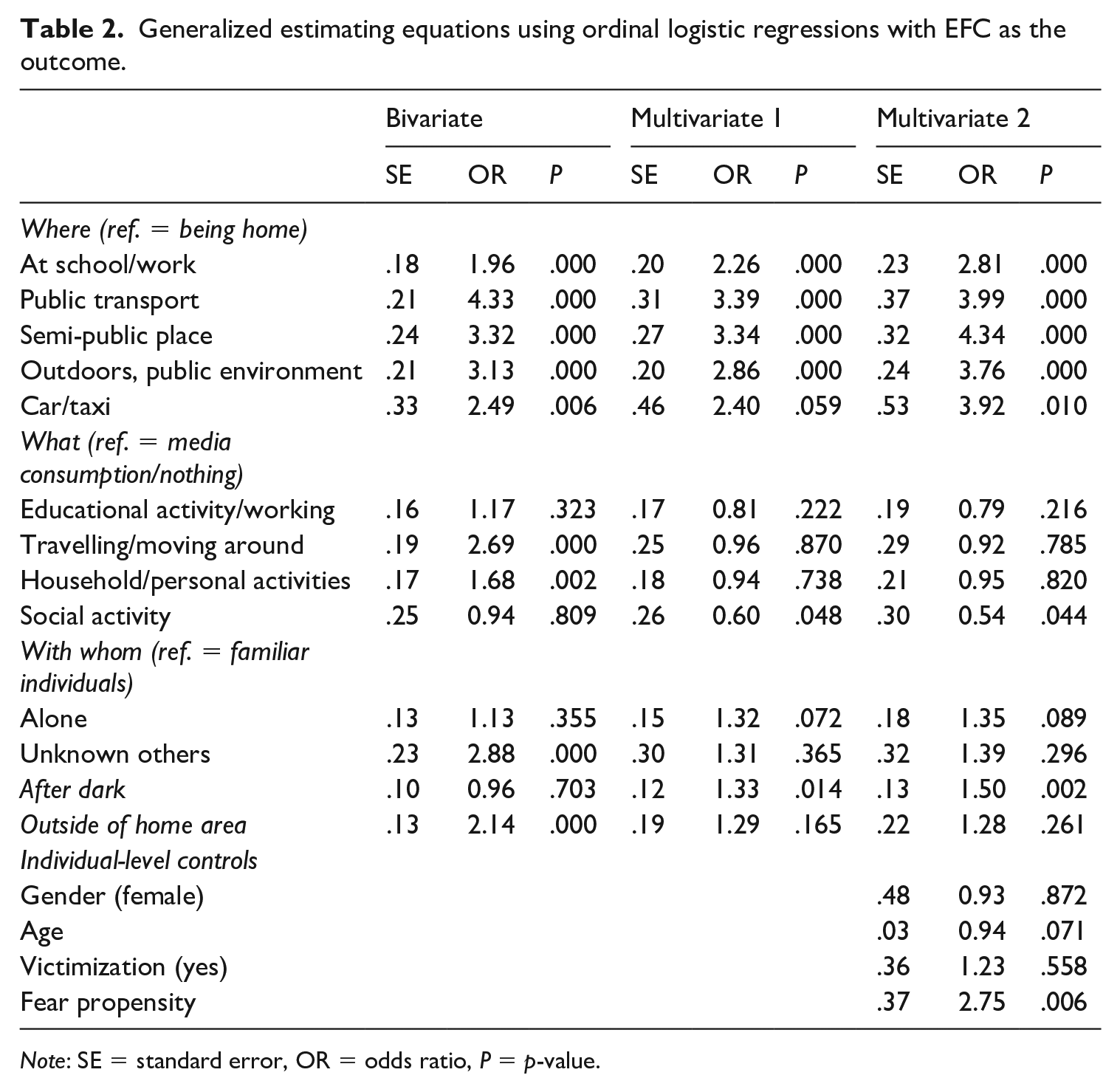
Table 2 presents the three different analyses. The bivariate analyses reveal that all functional places were related to a significantly higher OR for fear of crime compared with being in a home, of which being on public transport was related to the largest OR (4.33). Compared with media consumption/nothing, travelling/moving around (OR = 2.69) and household/personal activities (OR = 1.68) were the only activities showing a statistically significant relationship with fear. Being with unknown others was significantly related to higher levels of fear compared with being with familiar individuals (OR = 2.88). Settings experienced after dark were not related to higher levels of fear, whereas settings experienced outside of the home area produced a significantly larger OR compared with being in the home area (OR = 2.14).
Generalized estimating equations using ordinal logistic regressions with EFC as the outcome.
Note: SE = standard error, OR = odds ratio, P = p-value.
In the first multivariate analysis, all variables measuring functional place were significant except for being in a car/taxi. However, travelling/moving around and household/personal activities were not significant in this analysis, whereas social activities were significantly associated with a lower OR for fear compared with media consumption/nothing (OR = 0.60). Further, being with unknown others compared with being with familiar people was not significant. The multivariate analysis also showed that settings experienced after dark were significantly associated with an increase in the OR for fear compared with settings experienced during daylight (OR = 1.33). However, settings experienced outside of the home area were not significantly related to a higher level of fear.
The final multivariate analysis included variables measuring individual characteristics. Most relationships between features of settings and fear were similar to the previous analysis, with the exception of being in a car/taxi, which was significant in the final analysis. The only individual control variable significantly associated with fear was fear propensity (OR = 2.75), with neither gender, age nor previous victimization showing any significant associations with the outcome.
In sum, bivariate analyses revealed that most features of settings are associated with the level of fear compared with their reference categories. Some associations were different in the multivariate analyses, with the final analysis showing that all functional places are related to higher fear compared with being in a home, net of all other variables. Social activities decrease the OR for fear, whereas darkness is associated with a larger OR. In relation to individual-level controls, only fear propensity showed a significant association with fear.
Sensitivity tests
Given the arbitrary definition of being away from the home area, alternative categorizations were tested (1000 and 1500 metres away from home) in the final multivariate analysis. However, no significant differences were found in relation to the main analysis. The final multivariate analysis was also carried out without this variable and using two different samples: the sample with complete data (N = 1232) and a sample including the cases omitted owing to missing data on this variable (N = 1303). An analysis was also performed using a sample in which the cluster size encompassed at least two observations (N = 1211). The only noteworthy difference in all these alternative analyses was that social activities were not statistically significant. Gender was also examined using an alternative categorization (female and those not stating their gender as the reference category) but no significant differences emerged. Full information regarding the sensitivity analyses is available upon request.
Discussion
The results from the present study support the notion that fear of crime can be referred to as an experience (see Farrall et al., 2009) or as a transitory state (see Gabriel and Greve, 2003), depending on features of the immediate environmental setting (for example, Solymosi and Bowers, 2018; Solymosi et al., 2015) and on individual characteristics (Engström and Kronkvist, 2018; see also Vitelli and Endler, 1993; Ward et al., 1986). Further, because fear propensity (that is, baseline worry about victimization) was not the only significant factor affecting EFC, it can be assumed that EFC is different from other forms of fear of crime. More specifically, this result highlights that those who report elevated levels of fear of crime using conventional global survey items are not necessarily fearful all the time, across all settings, a pattern that is similar to that found in similar research on offending (for example, Bernasco et al., 2013; Wikström et al., 2012).
Given the use of a convenience sample, the more specific findings need to be interpreted with caution. However, the most consistent finding in the current study is that functional place is related to EFC, which is similar to results from previous experience research (Birenboim, 2018). More specifically, settings away from a home were more likely to be associated with higher levels of fear, as would be expected (for example, Brantingham and Brantingham, 1995). However, the variable measuring whether a setting was located outside of one’s home area was not significant in multivariate models. This finding may be interpreted as indicating that the familiarity of a place may not be of particular importance for EFC, which is at odds with much previous research (Brantingham and Brantingham, 1995; Lorenc et al., 2013; Solymosi and Bowers, 2018; Warr, 1990). However, individuals are also probably familiar with several places that are more than 500 metres away from home, such as their workplace, school and the homes of friends and family, making the interpretation of this variable difficult. Future research clearly needs to use more refined measures to study this issue further and more generally develop the use of geodata by including other relevant factors related to geographical locations.
Social activities were associated with a lower level of fear compared with media consumption/nothing in the final multivariate analysis. However, the results relating to activities are somewhat difficult to interpret in relation to previous research given the lack of fear of crime studies that focus on this specific feature. For instance, a home-oriented lifestyle and refraining from risky activities, such as going to parties on campus or to cafés at night, are both more common among people who in general report higher levels of fear (Crowl and Battin, 2017; Mesch, 2000). However, these cannot really be compared to the operationalization of activities in the current study as a result of these earlier studies’ use of items that mix activities and places. The sensitivity analyses also showed that social activities were not significantly associated with fear. Therefore, the role of activities in EFC remains unclear and should be examined more thoroughly in the future.
No significant associations were found for the variable measuring the presence of other people in the final multivariate analysis. This is somewhat surprising because it has been argued that the presence or absence of people affects fear of crime (Brantingham and Brantingham, 1995; Scott, 2003; Warr, 1990). One possible interpretation may be that the functional place is simply more important than the presence of people (and also the activities one is involved in), which was indicated by the final multivariate analysis and also reflects previous research using a similar methodology (Birenboim, 2018). However, it is also possible that the results would be different if the measures captured more precisely the kinds of ‘other people’ present in the setting and how these are perceived. In other words, aspects beyond whether the people present are unknown may affect the level of fear, which is a question that needs additional consideration in future research. Further, darkness showed a significant positive association with fear in the multivariate analyses, thus indicating that settings may be perceived as eliciting more fear if they occur after dark, which is in line with previous research (Brantingham and Brantingham, 1995; Nasar et al., 1993; Warr, 1990).
Despite gender being one of the most well-established individual-level predictors of fear of crime in previous research (for example, Collins, 2016), the results from this study indicate that it may not be of significance for EFC. This finding warrants attention in future research because it implies that women are perhaps more worried when examined using traditional surveys than they are using methods that encompass experiences. Clearly, the small convenience sample used does not allow for any further conclusions, but future research should examine associations between gender and EFC in depth, including potential selection effects (for example, gender differences in self-selection into certain kinds of settings). Age was not significantly related to EFC, although it is necessary to bear in mind that the variation in this variable is relatively limited (that is, the age range 18–40). A wider sample age range is needed in future research. Although victimization has been found to be related to fear of crime in much previous research (for example, Collins, 2016), it did not show a significant association with EFC. This may be due to the inclusion in the analysis of baseline worry about victimization as a proxy measure of the individual propensity to experience fear. An analysis that excluded fear propensity (not reported, available upon request) did indeed exhibit a significant effect of victimization on EFC (OR = 1.89, p = .047), thus indicating that fear propensity eliminated the effect of victimization in the current study. Nevertheless, fear propensity was included in the main analysis and should have had a substantial effect on the results if fear were not dependent on features of settings (that is, if fear-prone individuals are fearful all the time). Although showing a positive association with EFC net of the other predictors, the analysis including this variable showed similar associations for features of settings as in the first multivariate analysis. Thus, EFC may be attributable not only to individual propensity but also to specific features of the settings in which fear is experienced.
While providing insights regarding EFC, the current study also contributes methodologically to the growing body of experience research on fear of crime. Although the exclusively methodological considerations related to the present project are discussed elsewhere (Kronkvist and Engström, 2020), this study shows that rich quantitative data can be collected using a fairly simple approach. The random sampling strategy is important here because it provides information of both safe and unsafe situations, which makes it possible to study variations in fear more fully.
Limitations and future directions
Owing to the exploratory nature of this article, a number of important limitations point to avenues for future research. First, the uneven number of surveys completed across participants is not randomly distributed (Kronkvist and Engström, 2020). Although such participation bias is common in this kind of research (Solymosi et al., 2020), future studies should attempt to minimize the imbalance in the data. Further, although many findings are in line with previous research, future studies on EFC should attempt to use random probability samples to improve the generalizability and examine whether the findings can be replicated. Improved measures of individual characteristics that constitute fear propensity are also warranted, which may be achieved by including variables based on validated scales that tap into personality traits (for example, Guedes et al., 2018). This may also provide opportunities to study the interaction between individual characteristics and features of settings as proposed in relation to crime causation (see Hardie, 2020; Wikström et al., 2018), which could develop into a full causal test and an elaborated model of situational fear of crime and not just the environmental aspect examined in this study (that is, features of settings). In such future research, features of settings may also be further explored and combined into multidimensional settings that typically elicit fear. This could be further assisted by collecting data in late hours as well in order to better grasp the time dimension of fear but also by a more comprehensive data collection approach in general, perhaps by using device sensors to collect data without bothering the participants (see, for example, Reichert et al., 2020; Van Berkel et al., 2017). Further, although this study focused on worry about victimization in generic terms, crime-specific worry was not assessed, which could be another important development for EFC research. Another limitation is related to the study’s assumption that the scale measuring EFC is interpreted as being equally representative across participants, although this may not be the case. Centring the variable within individuals would solve this problem, but the large number of participants who provided only a few surveys did not allow for such an approach in the current study. Future research should thus try to collect more data points from each participant or focus on sub-samples of participants with more data entries.
Finally, one possible more general limitation pertaining to experience research is reactivity (for example, Reis et al., 2014), an issue that has also been raised in relation to smartphone-based experience research on fear of crime (see Jackson and Gouseti, 2015). Since participants are assessed repeatedly and intensively, they may start to think more about themselves and their behaviour, and potentially also change their behaviour (Hufford et al., 2002; Scollon et al., 2003). However, studies examining reactivity show varying results (for example, Hufford et al., 2002; Labhart et al., 2019), which indicates that it is not clear how much studies are affected by it (Shiffman et al., 2008). Nonetheless, future research clearly needs to study reactivity in relation to experience methods in fear of crime research.
Conclusion
The findings from the present study provide empirical support for EFC as dependent on features of settings and individual characteristics. Various types of functional places outside of homes, darkness and fear propensity increase the odds ratio for experiencing higher levels of fear. Social activities, on the other hand, are related to a lower odds ratio for fear compared with activities related to media consumption/nothing, although this finding is not supported by the sensitivity analyses. Thus, although EFC is in part contingent on more general beliefs about crime (that is, fear propensity), its significant associations with some features of settings suggest that EFC must be studied as a phenomenon that is distinguishable from other forms of fear of crime. Further, the present study contributes methodologically by showing that rich situational data can be obtained by employing experience methods based on smartphone applications. However, random probability sampling and a more well-elaborated operationalization of the individual-level variables that might affect EFC are only two of many important developments needed in the future.
Footnotes
Appendix
Categorization of features of settings.
| Variable (n surveys) | Specific contents (n surveys within category) |
|---|---|
| Where | |
| At home/other’s home (851) | Home (723), other person’s home (128) |
| At school/work (152) | School (139), work (13) |
| Public transport (83) | Public transport (82), airport (1) |
| Semi-public place (66) | Restaurant/café (25), training facilities (23), cultural establishment (7), mall/shop (5), hotel (4), bar/night club (1), health care (1) |
| Outdoors, public environment (59) | City-centre (30), walking around (26), outdoors (3) |
| Car/taxi (21) | Car/taxi (21) |
| What | |
| Media consumption/nothing (518) | Watching film/series/TV show (208), nothing in particular (147), surfing the Internet (113), playing computer/video/mobile games (42), listening to music/radio/podcast (4), reading (4) |
| Educational activity/working (339) | Studying/lecture etc. (321), working (15), driving lesson (1), meeting (1), workshop (1) |
| Travelling/moving around (138) | Going somewhere (134), walking the dog (4) |
| Household/personal activities (129) | Eating (29), shopping (29), exercising (22), cooking (15), cleaning (8), resting/going to bed/waking up (6), doing the dishes (5), washing (3), getting ready (2), brushing teeth (1), buying lunch (1), getting vaccination (1), personal hygiene (1), planning the week (1), putting children to bed (1), riding a horse (1), sexual activity (1), taking medication (1), throwing out waste (1) |
| Social activities (108) | Hanging out with friends (82), partying (8), hanging out with family (5), ‘fika’ = socializing while having e.g. a cup of coffee (4), talking on the phone/texting (4), watching live sport (3), arguing with a known other person (1), eating at a restaurant (1) |
| With whom a | |
| Familiar individuals (687) | Friends (235), partners (200), parents (126), other known people (34), siblings (27), colleagues (23), other family members (22), own child (20) |
| Alone (526) | Alone (526) |
| Unknown others (92) | Unknown others (92) |
The following hierarchy was used in the coding procedure if more than one category was reported in a survey: familiar individuals, unknown others, alone.
Acknowledgements
We thank the anonymous reviewers for their constructive and helpful comments, which greatly improved the manuscript.
Author Note
An early draft of this article was presented at the 19th Annual Conference of the European Society of Criminology in Ghent, 19 September 2019.
Declaration of conflicting interests
The author(s) declared no potential conflicts of interest with respect to the research, authorship, and/or publication of this article.
Funding
The author(s) received no financial support for the research, authorship, and/or publication of this article.
