




Abstract
Criticism is commonly directed at research based on lifestyle-exposure theory and routine activity theory for the use of imprecise measures. To examine this issue further, this systematic review maps activities used as indicators of lifestyle and routine activities in studies on direct-contact crime among young individuals (mean age of 24 or younger). The results indicate that a broad range of activities are used as measures of lifestyle and routine activities in the 101 included studies. Studies on victimization often use illegal activities and substance use as measures of lifestyle or routine activities while studies on offending mainly rely on measures of unstructured and peer-oriented leisure activities. Overall, most studies seem more concerned with specific activities rather than routines or lifestyles.
Introduction
Lifestyle-exposure theory (Hindelang et al., 1978) and routine activity theory (Cohen & Felson, 1979) have become well established in criminology, and are often treated as a single integrated lifestyle-routine activity theory (L-RAT) (e.g., Garofalo, 1987; Lemieux & Felson, 2012; McNeeley, 2015; Spano & Freilich, 2009). Early studies of L-RAT showed that lifestyles and routine activities affect the risk of encountering opportunities for both victimization (e.g., Cohen et al., 1981) and offending (Riley, 1987). Overall, as a situational opportunity theory (Birkbeck & LaFree, 1993; Wilcox & Cullen, 2018), L-RAT focuses on relationships between everyday activities and exposure to circumstances in which victimization and offending are more likely to occur. Although not limited to youth crime, much empirical research in L-RAT focuses on young individuals, which can be interpreted as concentrating on “an at-risk group” (Spano & Freilich, 2009, p. 310).
However, despite its position as an influential criminological theory, L-RAT is often discussed as being characterized by methodological limitations and a need for methodological improvements (e.g., Gottfredson, 1981, 1984; Meier & Miethe, 1993; Mustaine & Tewksbury, 1997; Pratt & Turanovic, 2016; Tewksbury et al., 2010). The main criticism refers to an absence of agreement regarding the measurement of routine activities and lifestyle, the core theoretical concepts. Although this is a recurrent criticism, little is known about its relevance for current L-RAT research.
As a means of bringing some clarity to this issue, the current study systematically reviews L-RAT research on direct-contact offenses, and aims to provide an overview of conceptualizations of the core theoretical concept in L-RAT, namely lifestyle or routine activities. With a focus on self-reported individual-level measures employed in research on youth (here defined as sample mean age of 24 or younger), this study synthesizes and categorizes activities that have been used as measures of lifestyles or routine activities over the last decade (2009–2018). This is ultimately a matter of focusing exclusively on the types of measures that researchers decide to use in their studies, which means that the results of these studies are not assessed. While this approach may seem somewhat unusual, it offers a possibility to focus on measures in depth, which is often overlooked in previous research on L-RAT. The scientific contribution of this review is twofold. First, it is important to look back at recent research in order to assess the approaches used to operationalize the theory’s core concepts. Second, reviewing and synthesizing measures may provide insights into both problematic and good theoretical conceptualizations. Thus, this systematic review may assist L-RAT researchers in selecting from among different L-RAT measures, and it may also inspire researchers to think more carefully when operationalizing lifestyle and routine activities.
Background
In lifestyle-exposure theory, as originally outlined by Hindelang et al. (1978) (for a revised model, see Garofalo, 1987), demographic characteristics are the foundation from which role expectations (e.g., cultural norms) and structural constraints (e.g., economic, familial etc.) develop. Structural constraints limit behavioral choices and affect role expectations and vice versa, in turn leading to individual and subcultural adaptations, which generate variations in lifestyles. Differences in lifestyles account for variations in criminogenic exposure, both in terms of direct exposure to criminogenic circumstances and in terms of exposure to individuals with similar lifestyles (e.g., risky lifestyles). Routine activity theory explains crime as an outcome of the spatiotemporal convergence of motivated offenders and suitable objects (e.g., victims) in the absence of capable guardians (Cohen & Felson, 1979). Although there is an overlap between the two theoretical models, routine activity theory provides extensive information about crime events (e.g., Felson & Boba, 2010) whereas lifestyle-exposure theory is perhaps somewhat more developed when it comes to explaining how individuals become exposed to victimogenic and criminogenic circumstances. Empirical research within both theories consists of studies on different types of populations but youth are frequently in focus, such as college students (e.g., Spano & Freilich, 2009).
Altogether, L-RAT focuses on crime events (McNeeley, 2015), an approach that integrates victim and offender theories into theories of crime (Meier & Miethe, 1993). This is not to say that victims and offenders are the same individuals (although there is a considerable overlap, see Jennings et al., 2012), but is rather a recognition of the fact that both offenders and victims must converge spatiotemporally for a direct-contact crime to occur (Cohen & Felson, 1979; Gottfredson, 1984; Hindelang et al., 1978). Thus, opportunities are central to L-RAT, in particular in the form of immediate circumstances that increase the risk for crime (e.g., Agustina & Felson, 2015; Cohen & Felson, 1979; Gottfredson, 1984; Ruiter & Bernasco, 2018), although critics argue that offender motivation should not be excluded (e.g., Tittle, 1995). The term exposure is central here and refers to “the physical visibility and accessibility of persons or objects to potential offenders at any given time or place” (Cohen et al., 1981, p. 507), and “[. . .] the centrality of lifestyle derives primarily from its close association with exposure to victimization risk situations” (Hindelang et al., 1978, p. 250, emphasis in original). Differences in exposure across individuals are the consequence of different lifestyles and routine activities (Meier & Miethe, 1993).
Further, lifestyle-exposure theory is probabilistic (Garofalo, 1987; Meier & Miethe, 1993), postulating that the more one is exposed to criminogenic circumstances, the greater the probability of becoming a victim of a crime (Gottfredson, 1981; Hindelang et al., 1978). Similarly, routine activity theory encompasses, if not originally then at least recently, a probabilistic view of the relationship between activities and crime (e.g., Lemieux & Felson, 2012), although some disagree (see Pratt & Turanovic, 2016). The basic idea of L-RAT thus consists of the notion that there is an increased risk of crime in certain circumstances (e.g., Agustina & Felson, 2015; Meier & Miethe, 1993).
However, there has been much debate regarding the definition of lifestyle across scientific disciplines and over time (e.g., Garofalo, 1987; Sobel, 1981; Zablocki & Kanter, 1976) and also regarding which lifestyles and routine activities are risky (e.g., Pratt & Turanovic, 2016; Tittle, 1995). Nevertheless, Hindelang et al. (1978) were clear in their original definition: “[. . .] lifestyle refers to routine daily activities, both vocational activities (work, school, keeping house, etc.) and leisure activities” (p. 241), and Cohen and Felson (1979) define routine activities as “[. . .] any recurrent and prevalent activities which provide for basic population and individual needs” (p. 593). This highlights the consensus within L-RAT that routine activities are essential for explaining variations in exposure to criminogenic opportunities. It is thus important to consider the characteristics of different routine activities, such as “when, where, with whom, and in what types of contexts/settings these activities occur” (Tewksbury et al., 2010, p. 188), because “[w]hat people do, how they behave, places them at more or less risk of criminal victimization” (Maxfield, 1987, p. 275). At the same time, however, many activities are carried out routinely without affecting the risk for crime (Tittle, 1995) and many risky activities are not very common (i.e., not routines or lifestyles). Having said this, studies using young samples to study individual-level routine activities often focus on more specific, risky activities, such as unsupervised, unstructured socializing with peers (Osgood et al., 1996), which constitutes a step toward a more precise examination of risky activities.
Measuring Lifestyle and Routine Activities
Since routine activities are essential for both lifestyle-exposure theory and routine activities theory, L-RAT research requires measures that capture daily life in an appropriate way. However, aware of their reliance on data not collected for their theoretical propositions, Hindelang et al. (1978) highlighted the preliminary nature of lifestyle-exposure theory. More specifically, Gottfredson (1981, 1984) argued for the use of more precise situational measures of lifestyle and exposure that measure “how, where, and with whom people spend their time” (Gottfredson, 1981, p. 721) and similar suggestions have also been expressed more recently (Tewksbury et al., 2010). Despite early attempts to promote methodological development (e.g., Gottfredson, 1981, 1984; Hindelang et al., 1978), scholars have over the years continuously raised concerns regarding the measurement of the theoretical concepts in L-RAT (e.g., Maxfield, 1987; Mustaine & Tewksbury, 1997; Pratt & Turanovic, 2016; Spano & Freilich, 2009; Tewksbury et al., 2010). Overall, these measurement issues are related to a number of different, specific problems.
Proxy measures are often highlighted as a problem in L-RAT research, mainly because of the frequent reliance on secondary data (Meier & Miethe, 1993; Mustaine & Tewksbury, 1997). These indirect measures may fit several theoretical explanations, making them insufficient as tests of specific theories (Meier & Miethe, 1993) and thus leading to underdetermination. Studies using proxies simply infer a lifestyle connection between, for instance, age and victimization (e.g., Cohen et al., 1981) and “[s]uch inferences introduce conceptual leaps from the demographic characteristics of survey respondents to assumptions regarding such ‘types’ of persons’ activities” (Mustaine & Tewksbury, 1997, p. 184). Direct measures of activities are essential because they should, according to the theory, rule out correlations between status or demographic variables and victimization (Mustaine & Tewksbury, 1997) and also reduce the problem of theoretical underdetermination.
Another measurement issue in L-RAT research is the common use of lifestyle indicators that may also be outcomes of lifestyle. This issue is also present in sociological lifestyle research, in which it has been argued that “[t]he causes and consequences of lifestyles are not separated analytically from the phenomenon itself” (Sobel, 1981, p. 2). In criminology, a criminal or delinquent lifestyle has been included as a predictor in several L-RAT studies (e.g., Lauritsen et al., 1992) and highlighted as the most important lifestyle feature in relation to the risk of victimization (see the review by Wilcox & Cullen, 2018). Although criminal acts clearly put individuals at risk, using such acts as indicators of routines or lifestyles can be problematic, since they are also outcomes that are hypothesized to be the result of certain lifestyles and routine activities. Further, at least in routine activities theory, there is also an explicit focus on crime as feeding on legal routine activities (Cohen & Felson, 1979), which makes the use of illegal activities as indicators of lifestyle and routine activities a poor match to the theory (although crime itself can be a routine activity according to Cohen and Felson).
Pratt and Turanovic (2016) highlight another measurement issue by arguing that many studies include measures of activities that are not in fact risky, such as sleeping (see also Tittle, 1995). Criticism has also been directed at the use of broad categories of activities, such as the amount of time spent working or the level of non-household activity (e.g., Meier & Miethe, 1993; Pratt & Turanovic, 2016), since such broad measures allow for ambiguous interpretations (e.g., as both increasing and decreasing risk). However, it was actually suggested quite early that there should be a focus on more specific risky activities and the circumstances in which they take place (Gottfredson, 1984). The importance of considering the details of different activities has been further emphasized by a focus on more precise situational aspects, such as whether activities engaged in by youth are unstructured (Osgood et al., 1996).
In sum, L-RAT research is commonly criticized for its operationalization of lifestyle and routine activities, indicating a need for methodological development. However, the criticism has generally not been based on a systematic approach employing a broad review of different measures of lifestyle and routine activities.
Methods
This study aims to systematically review L-RAT research that employs individual-level self-report measures of lifestyle and/or routine activities, with an exclusive focus on contemporary studies of young populations. A systematic methodology provides more reliable and less biased results by comparison with other review designs (Farrington & Jolliffe, 2017; Siddaway et al., 2019), making it a useful approach for producing a broad synthesis of the activity measures employed in L-RAT research. The overarching question posed in this review is:
Which individual-level activities are used as measures of lifestyle/routine activities in contemporary L-RAT research on direct-contact violent offenses in young populations?
Importantly, the study focuses exclusively on measures of lifestyle and routine activities. Theoretical relevance in terms of researchers’ variable selection is thus at center whereas the potential statistical significance of relationships between L-RAT variables and various outcomes is not examined.
Search and Selection Strategy
A 10-year period (2009–2018) was selected as pilot-searches indicated that a longer period would render too many articles for a useful synthesis. The search strategy consisted of systematic searches in criminologically relevant databases. 1 No searches for unpublished or gray literature were conducted. 2 Search words related to L-RAT were selected based on review articles (McNeeley, 2015; Spano & Freilich, 2009) and other articles within the field. 3 All searches were limited by employing additional words to add criminological relevance, since “lifestyle” and “routine activities” are also common terms in other scientific disciplines. 4 All searches were conducted on May 17 and May 20, 2019 and were repeated on 12–13 November 2019. 5 Finally, reference lists from all the included studies were screened in order to find additional studies that fit the inclusion criteria.
The selection strategy generally followed the PRISMA model but without including a methodological quality assessment (i.e., all studies were of interest, regardless of quality differences). Following the deletion of duplicates, titles and abstracts were read in order to include studies for full text screening that fulfilled the basic inclusion criteria: being written in the English language, criminological, original studies (e.g., not reviews), employing data from year 2000 or later, being quantitative, including individual-level outcomes and violent direct-contact offenses as the main outcome, having a sample mean age of 24 years or under, and an explicit focus on L-RAT. Studies that could not be assessed due to a lack of information were also selected for full text screening. The full text eligibility process adopted a hierarchical approach (see Figure 1 for all criteria). Some of the employed criteria need to be discussed briefly since they reflect the limitations of the study.
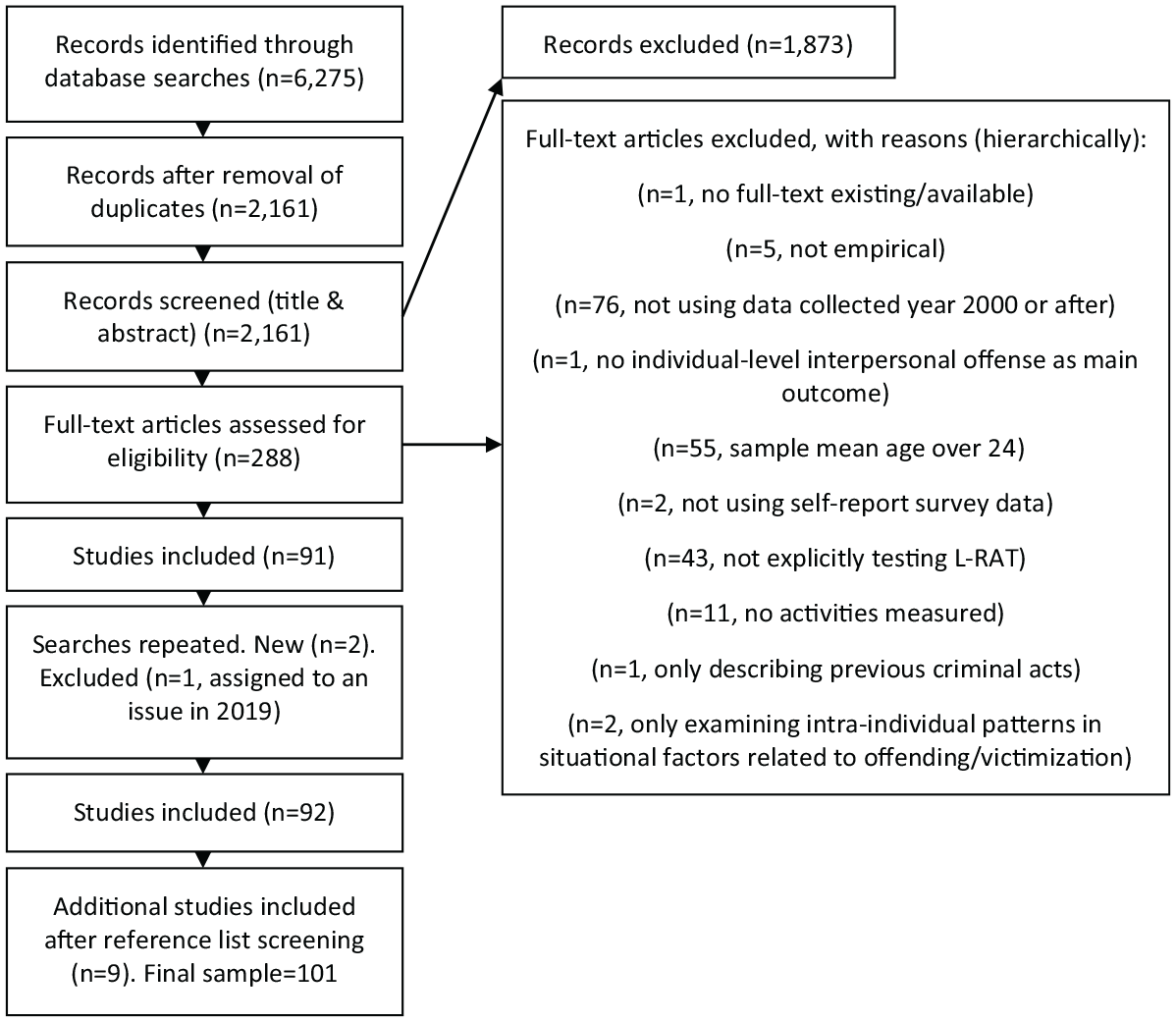
Flow chart of the search, screening and eligibility process.
The review only included studies that employed data collected in the year 2000 or later as a result of the focus on contemporary research. 6 Studies that did not provide information about the data collection year were browsed for additional information until it could be confirmed when the data had been collected. Young samples are defined as consisting of individuals with a mean age of 24 or under, in line with the upper limit in the UN’s definition of youth. 7 There was no minimum age threshold. To use sample mean age to determine whether studies focus on youth is based on the fact that, in most cases, at least half of the individuals in these studies are of age 24 or younger (unfortunately, most studies do not report median age). Therefore, it is assumed that these studies must have been at least partially designed to examine L-RAT among younger individuals. A focus on young individuals was adopted since the inclusion of older populations would make interpretations of the results more complicated (e.g., variations in the meaning of risk across different age groups). Studies that did not report the age or grade of respondents were included if they employed samples of typically young individuals (e.g., school, college, and university samples).
Outcomes could be of any type, as long as they contained a direct-contact violent offense, including threats. These offenses require the involved persons to converge in space and time (i.e., their being exposed to a criminogenic setting), putting them at the center of L-RAT and thus of this study. Bullying is a borderline case but studies on bullying were included if they used at least one outcome item referring to physical violence. Studies using crime indices as outcomes were included if the indices included at least one direct-contact violent offense. A qualitative approach was used to decide whether a study was testing L-RAT, since studies vary in terms of the extent to which they are centered on the theory. To be included, a study had to explicitly discuss L-RAT in relation to the empirical research conducted in the study.
Only studies that employed at least one direct measure of individual-level activities were included, regardless of whether these activities were used as controls, mediators or main independent variables (needless to say, even a study only using L-RAT variables as controls requires adequate measures). An activity was defined as something individuals do as opposed to who they are. Some variables nevertheless constitute borderline cases, such as being a member of an organization (which was excluded unless explicitly referred to as “active” membership). Historical variables (e.g., adverse childhood experiences at age 10) were excluded, since they are not considered to constitute activities that reflect one’s current lifestyle. Some studies only describe characteristics of previous criminal acts and some studies only center on intra-individual patterns in situational factors related to offending/victimization. These kinds of studies were excluded since they do not provide any general lifestyle/routine activity measures.
Data Extraction and Synthesis
All included studies were screened for information, as were additional studies if authors explicitly referred to these for more information. No information was extracted from additional studies if the author(s) did not specify exactly what had been taken from them. Studies that lacked any information vital to the current study were cross-checked with other included studies that used the same data in order to find the required information. 8 In the case of inconsistencies within an article, the methods section was deemed the most reliable source. Studies employing multiple waves of data, or with different numbers of participants across analyses, were reported in terms of the largest N stated in the article. School grades were converted into an approximate age if no age information was provided. 9 Dependent variables were extracted and coded as either “violent” or “sexual”, the two overarching offense categories included in this study. 10
Any variable explicitly labeled as lifestyle or routine activities in an article’s methods section, and which measured an activity, was included. Variables measuring activities but that were not included in a study’s L-RAT section (if one existed) were excluded. Activity variables in studies that lacked an explicit L-RAT section were included if the author(s) did not state that they were explicitly being used to measure concepts from other theories. Activity variables were always included in the case of any uncertainties. 11 The most specific level of information available about the activities used in the articles was extracted, such as the actual item used in a survey. 12 For instance, if a variable labeled “unstructured activities” consisted of more specific activities (e.g., “hanging out with peers”, “driving around”), these detailed activities were extracted. Some studies only provide examples of activities and in these cases, these examples were all that could be extracted.
In the synthesis of all activities found among the included studies, identical or similar activities were merged, such as “attacking someone with a weapon” and “severely beating others”, with these two activities, along with other similar activities, being coded as “Attack/beat/hit someone with/without weapon”. Similarly, various forms of drug consumption were labeled as “drug use”, whereas alcohol use was mainly divided into “alcohol use” and “binge drinking”. To ensure that no essential information was lost in this merging process, the kind of activity (what), the place in which it occurs (where), other people being present or absent (with whom), and time (when) were never excluded (although exact wordings may differ slightly across studies despite their using more or less identical measures). After this process, 238 unique activities remained, which warranted additional categorization in order to produce a synthesis that offers an overview of the types of measures employed. Eight categories were identified that tap into different aspects of L-RAT, although there is of course heterogeneity within these categories (see Appendix). Given the lack of a standardized categorization of routine activities besides the overarching higher-order categories (e.g., leisure, vocational activities), activities were categorized in regards to the main orientation of each activity. Importantly, the categorization is only a means to organize the results and it is essential to consult the Appendix in order to understand more closely which activities were coded in the respective categories.
The final part of the synthesis consists of an overview of the relationships between categories of L-RAT measures and the outcomes in the included studies. Sankey diagrams illustrate the proportional relationships between these L-RAT categories and the outcomes. 13 If a study examined both outcome types (victimization and offending) and/or both offense categories (violence and sexual offenses), each outcome was counted as one (1) study in the diagrams. 14 Each specific outcome in a study was then paired with each activity category that had been employed in the study. The Sankey diagrams thus show how frequently (i.e., in how many studies) each activity category is used in relation to the outcomes.
Findings
The database searches rendered 2,161 articles after duplicates had been removed (see Figure 1).
Title and abstract screening resulted in 288 articles that were selected for full text screening, which in turn rendered 91 articles that met the final inclusion criteria. The repeat searches resulted in the identification of two additional articles and the deletion of one study. 15 Reference list screening of the included studies yielded an additional nine articles that fit the inclusion criteria. The final sample consists of 101 studies (listed in Table 1). Note that each study has a unique number in the table, which is used when the article is referred to in the text.
Sample Characteristics, Outcomes and Activities in the included Studies.
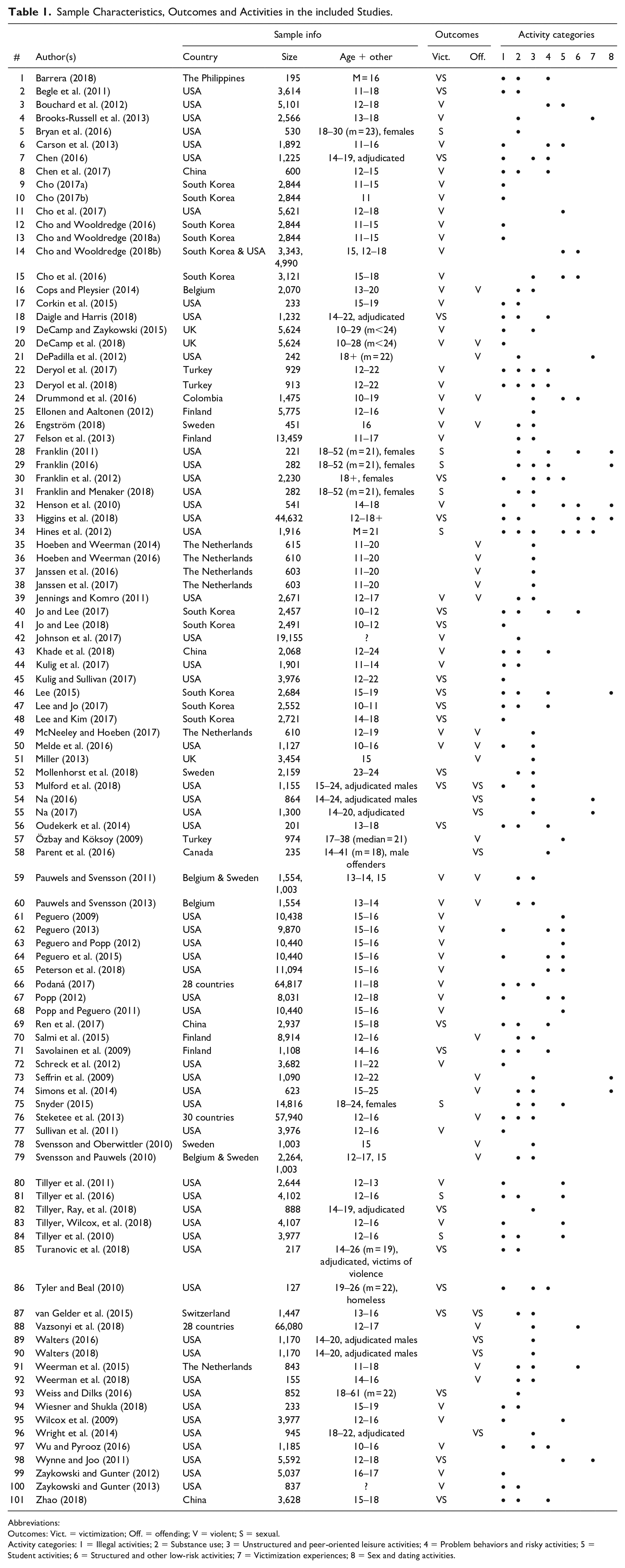
Abbreviations:
Outcomes: Vict. = victimization; Off. = offending; V = violent; S = sexual.
Activity categories: 1 = Illegal activities; 2 = Substance use; 3 = Unstructured and peer-oriented leisure activities; 4 = Problem behaviors and risky activities; 5 = Student activities; 6 = Structured and other low-risk activities; 7 = Victimization experiences; 8 = Sex and dating activities.
Sample Characteristics
Most studies employ data from the US (n = 57), followed by South Korea (n = 11), the Netherlands (n = 6), and Sweden (n = 5). It should be noted, however, that the included studies stem from approximately 50 research projects/data sets, making the contribution of each specific study less unique in terms of variation in the measures of L-RAT concepts employed. 16 Sample sizes range from 127 to 66,080 (median = 2,069) and the sample age varies from 10 years of age and upwards. Six studies employed female-only samples (5, 28, 29, 30, 31, 75), while five studies included samples comprised only of males (53, 54, 58, 89, 90). Most studies employed samples that are fairly “general”, such as university or college samples and other forms of school-based samples, but there are also studies focusing explicitly on offenders or individuals involved in the criminal justice system (7, 18, 53, 54, 55, 58, 82, 85, 89, 90, 96). One study is based on a sample of homeless youth (86).
Measures of Lifestyle and Routine Activities
Since studies that do not measure activities were excluded, the issue of proxy measures is not fully examined here. It should be noted, however, that eleven studies were excluded due to them not including variables that measure activities according to this particular criterion outlined earlier (see Figure 1). These studies used a wide range of different L-RAT measures, such as parental monitoring, peer deviance, demographics, and neighborhood-level variables. It is thus difficult to establish any patterns with regard to the types of proxies being used. 17
The 238 unique activities employed in the included studies as measures of lifestyle or routine activities are here discussed in relation to eight categories, as delineated in the methods section. The categories are described in terms of their main characteristics, together with some examples and information on whether the activities are contextualized (e.g., including information about where, when and with whom they occur).
Illegal activities
This category contains all activities that pertain to law-breaking (with the exception of drug use). Since the category encompasses both minor offenses (e.g., theft) and serious violent crimes, activities in this category vary, making it heterogeneous, with varying risk levels. Many illegal activities are likely to be high-risk activities, since they expose the perpetrator to settings and people that are risky. However, some illegal activities, such as jaywalking and using illegal software, cannot really be defined as risky in relation to direct-contact offenses. Many studies employ several different measures of illegal activities (i.e., different offense types), explicitly assuming that different offense types may affect exposure to a varying extent. A few studies also examine illegal activities by including contextual information, such as whether crimes are carried out with peers and/or at school.
Substance use
This category is perhaps not intuitively perceived as being an activity, but using substances does involve doing something. This category includes alcohol use, both general use and binge drinking, and also drug use, ranging from soft to hard drugs. Substance use may be risky in general but the risk level is likely to vary according to the substance (e.g., alcohol vs. hard drugs), and the frequency of use (e.g., alcohol use vs. binge drinking). Using drugs and alcohol (particularly binge drinking) may affect both an individual’s level of aggression or propensity to seek conflict with others, and also the individual’s self-defense capabilities. Substance use is thus an activity that may be related to an increased risk of both offending and victimization. Interestingly, one study focuses on activities that entail precautionary alcohol consumption (42), which shows that this category not only encompasses measures of risky but also protective activities. Some studies include a contextualization of the measures, such as substance use with peers and/or at specific locations.
Unstructured and peer-oriented leisure activities
This category encompasses a large number of different kinds of activities pertaining to either explicitly defined unstructured activities or activities that logically occur in the presence of friends, and in the absence of adults and which lack any structured content. It may reasonably be concluded that the characteristics of many of these activities expose people to settings in which it may be more likely for victimization and offending to occur. For instance, several measures are well contextualized via the inclusion of specific, potentially risky locations (e.g., pubs, bars), the presence or absence of other people (e.g., peers and adults respectively), and the time of the day (e.g., evening). Still, many activities cannot be considered risky as a result of their being too vaguely defined by a lack of contextual information (e.g., “spend time with friends”).
Problem behaviors and risky activities
This category consists of activities that are presumed to be risky while at the same time not encompassing illegal behaviors or substance use. These are activities that logically increase the risk for offending and victimization by exposing individuals to risky settings and to other people involved in these risky behaviors. However, truancy is the most common activity in this category which of course may not necessarily be related to increased risk (e.g., truancy may be a result of personal problems, being bullied etc.). This category also entails high-risk activities, such as prostitution. The context of problem behaviors and risky activities may be important, with some studies explicitly asking about truancy that occurs with friends, for example, which constitutes one way of contextualizing activities so that they are better understood in terms of risk (e.g., truancy with friends may indicate that one is exposed to other people and their respective criminal propensities).
Student activities
This category reflects the review’s focus on young populations. Various forms of extracurricular activities (e.g., clubs, sports) are often employed in studies focused on high school, college and university samples. Some studies also focus on outcomes that occur at school (not specified in Table 1), making the use of student activity variables logical. If a study examines victimization at school, for example, it is of course vital to examine activities that affect criminogenic exposure at school. Protective activities may be more common in this category, since students involved in certain extracurricular activities (e.g., clubs) may prefer these activities over other riskier activities. Overall, this category is often contextualized in advance (i.e., being at school), making contextualization of the actual measures fairly uncommon.
Structured and other low-risk activities
This category includes a wide range of diverse activities that are structured or associated with a low-risk for direct-contact offenses. In relation to L-RAT, this category includes structured activities, such as working, which should theoretically be associated with a lower risk of victimization and offending. Other low-risk activities are also included in this category, such as watching TV or playing videogames. In difference from unstructured and peer-oriented leisure activities, these activities do not refer to any contextual information (e.g., presence of peers, type of location) that can be associated with an increased risk of direct-contact crime. Nevertheless, this category also encompasses activities that are contextualized, for instance by explicitly asking about the presence of parents, a factor which should typically lead to activities being associated with lower risks.
Victimization experiences
Victimization experiences include an array of different activities, ranging from behavioral aspects of the fear of crime to violent victimization. Although victimization is a result of others’ behavior, it is here treated as an activity due to it being a clearly defined event that occurs at a specific point in time and space, thus potentially having an effect on what happens in that particular moment. As with illegal activities, victimization experiences are naturally linked to offending since situations may occur that turn the victim into an offender as well. By comparison with illegal activities, there is less variation among the victimization experiences which is probably a result of the dominance of studies that examine victimization as an outcome rather than offending. Nonetheless, studies that include victimization experiences focus on a number of different offense types, such as assault, sexual offenses, bullying, and theft. In most cases, however, these activities are not specified in terms of their contextual circumstances, which constitutes a difference in relation to the other categories.
Sex and dating activities
Sex and dating activities were merged into a single category since they encompass some features that make them different from other activities. First, sex and dating activities refer to spending time with people with whom individuals have a different type of relationship, as compared to general peer activities for example. As such, these activities mainly occur with partners or persons with whom an individual wishes to become sexually and/or romantically involved. Several activities in this category may be directly related to criminogenic exposure, since these activities, such as having sex, expose individuals to other people, of whom some may be offenders or victims. Most sex and dating activities are not explicitly contextualized, but the presence of other people is implicit in most measures.
Activity Categories and Different Outcomes
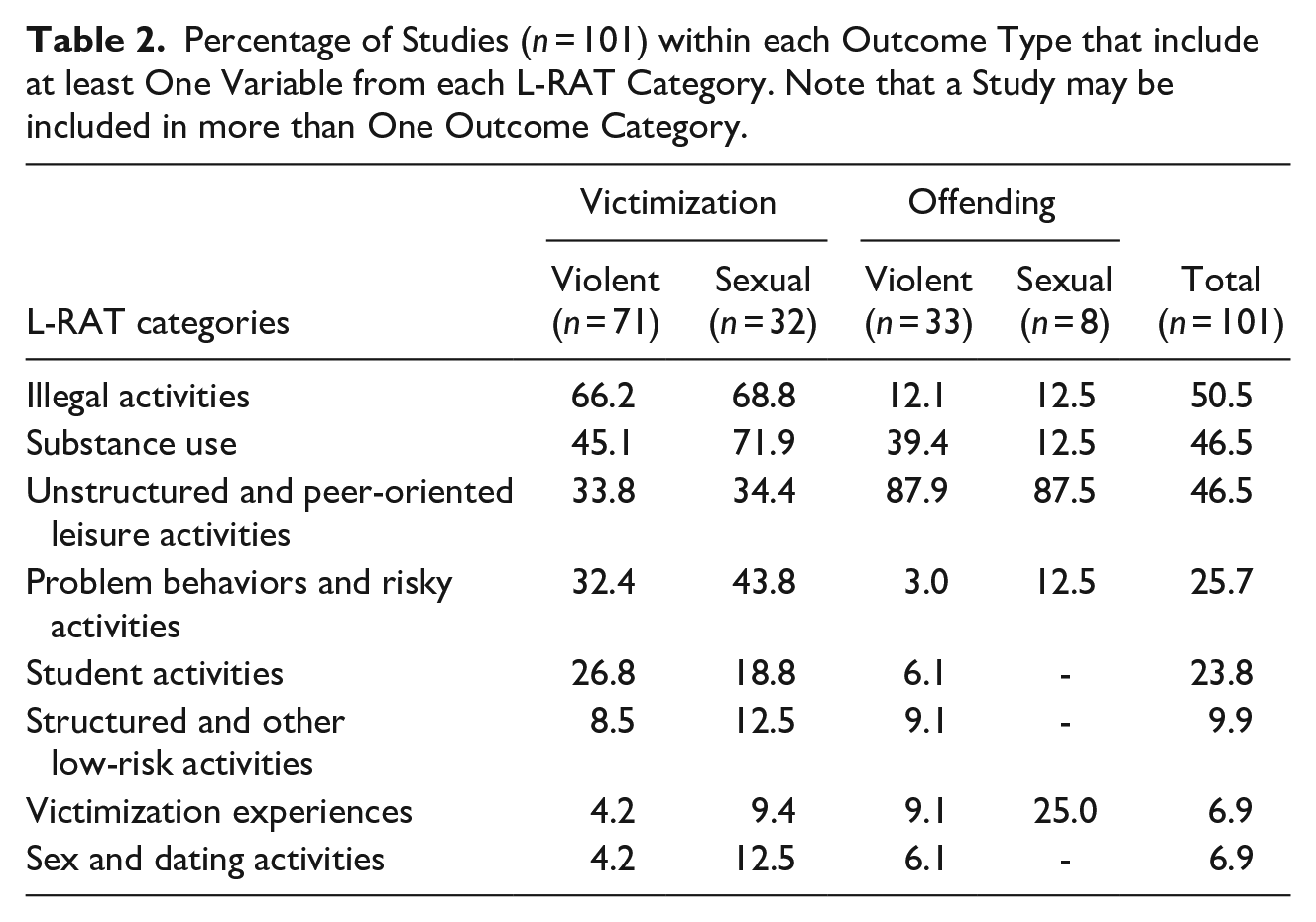
Since L-RAT was initially outlined as a theory of victimization, it is not surprising that most of the included studies focus on victimization (see Table 2).Violent victimization represents the most common outcome examined (n = 71), followed by violent offending (n = 33), sexual victimization (n = 32), and sexual offending (n = 8). It should be noted that several studies focus on more than one outcome and are therefore included in more than one category. Three activity categories are particularly common in the included studies. These are illegal activities (50.5 %), substance use (46.5 %), and unstructured and peer-oriented leisure activities (46.5 %). Two categories are fairly common: problem behaviors and risky activities (25.7 %) and student activities (23.8 %). Finally, the categories employed more infrequently include structured and other low-risk activities (9.9 %), victimization experiences (6.9 %), and sex and dating activities (6.9 %). This shows that L-RAT research varies in terms of which types of activities are used as indicators of lifestyle and routine activities. However, the picture is somewhat different when we look at how the activity categories are employed in relation to victimization and offending respectively. Two Sankey diagrams (Figure 2 and Figure 3) graphically illustrate the relationships between these outcomes and the different activity categories.
Percentage of Studies (n = 101) within each Outcome Type that include at least One Variable from each L-RAT Category. Note that a Study may be included in more than One Outcome Category.
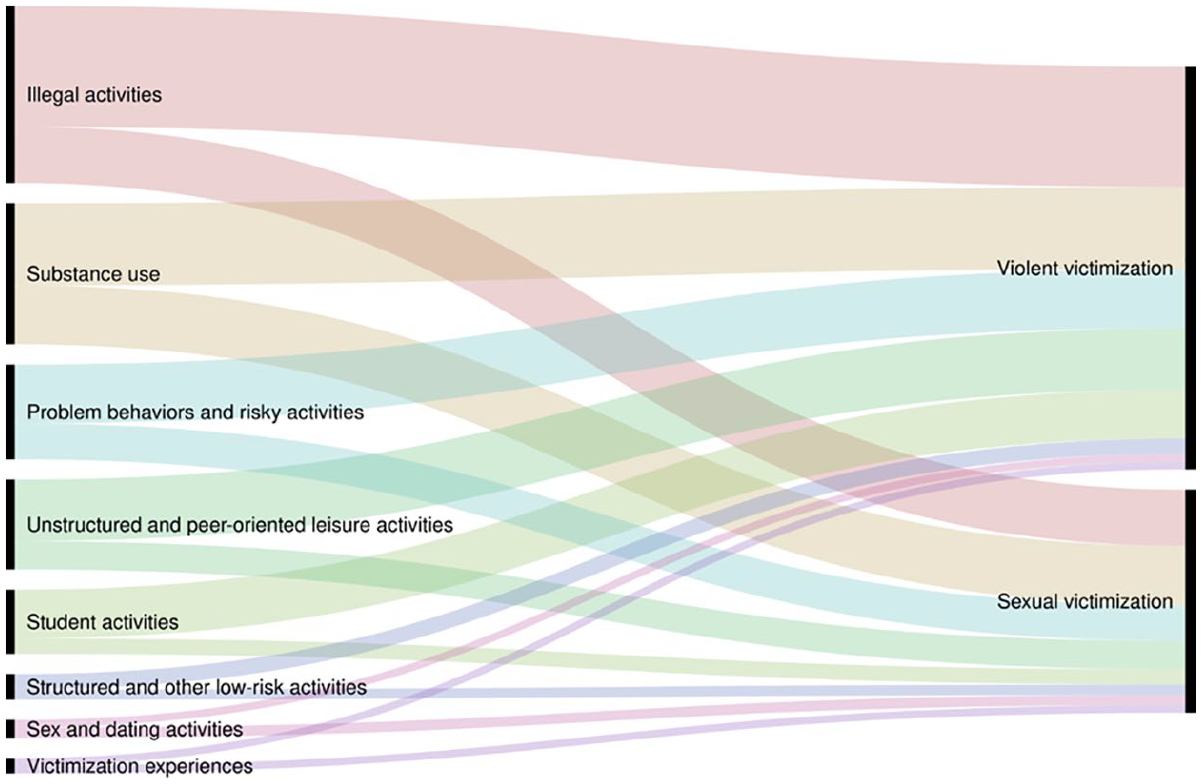
Sankey diagram showing the activity categories used in relation to the victimization outcomes.
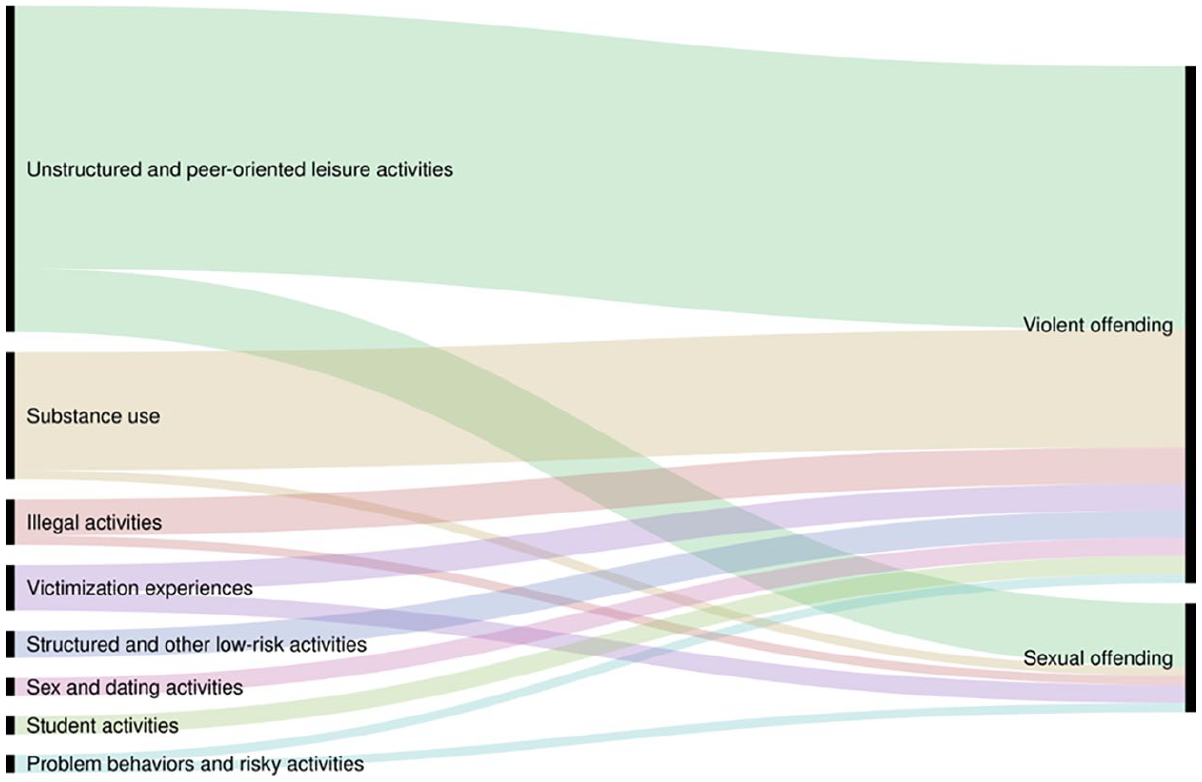
Sankey diagram showing the activity categories used in relation to the offending outcomes.
The nodes in the diagrams represent the size of each category (i.e., the number of times an activity category has been used to measure lifestyle or routine activities in relation to the particular outcome), making it possible to see which activity categories are more commonly used in relation to each outcome.
Victimization
Figure 2 shows the connections between the different activity categories and offense types in studies examining victimization. All activity categories are connected to both violent and sexual offenses. This indicates that L-RAT research as a whole considers all these kinds of activities as affecting the risk for victimization (both in terms of increasing and decreasing risk). However, there is variation in how frequently the different categories are employed in L-RAT research on victimization. Illegal activities are the most common predictors, followed by substance use. This indicates that these presumably high-risk activities constitute the most frequently used indicators in L-RAT research on victimization. Problem behaviors and risky activities, unstructured and peer-oriented leisure activities, and student activities are also fairly common, showing that studies on victimization also consider these activities to affect victimization. Structured and other low-risk activities, sex and dating activities, and victimization experiences are used infrequently in victimization studies.
Offending
As was shown earlier, offending is less frequently employed as an outcome in L-RAT research by comparison with victimization, which means that Figure 3 is based on a smaller number of studies and the results must therefore be interpreted with caution. All activity categories are found in analyses focused on violence, whereas only five categories are found in analyses focused on sexual offenses. The activities used differ in some important respects from those used as predictors of victimization. First, the nodes to the left in Figure 3 reveal that unstructured and peer-oriented leisure activities are by far the most common activities used in the relevant studies. Second, problem behaviors and risky activities were very rarely used in any of the studies focused on offending. This implies that these activities are considered to be more important L-RAT predictors in relation to victimization than in relation to offending. Third, in contrast to victimization studies, student activities are infrequently used in relation to offending. Nonetheless, as with victimization studies, illegal activities and substance use are fairly commonly employed as L-RAT indicators in studies on offending, thus confirming that offending is commonly viewed as a result of other illegal activities and substance use. Victimization experiences are employed as measures of L-RAT in some studies, showing that these activities are regarded as having an impact on offending. Further, structured and other low-risk activities, and sex and dating activities are fairly uncommon in studies on offending, as was also the case in studies on victimization.
In sum, it is clear that there are differences in the use of L-RAT activities depending on the outcomes studied (victimization or offending) and also to some extent in relation to the offense types studied (violent and sexual offenses). Although all activity categories may affect criminogenic exposure (increasing or decreasing it), this shows the diversity in L-RAT research with regard to the use of indicators of lifestyle and routine activities.
Discussion
This study has aimed to provide a systematic overview of measures of lifestyle or routine activities in research that examines direct-contact violent offenses in young populations. It is particularly relevant to examine such measures since L-RAT research aims to offer explanations of the relationship between daily life and victimization and offending, and, in a wider perspective, adequate measures are of course also important for developing any prevention initiatives. The results indicate that L-RAT research on youth focuses on a wide range of different activities that tap into lifestyle and routine activities. Specific activities employed in the included studies can be categorized into eight categories, all of which are characterized by some level of heterogeneity but which also have some common features, with each category focusing on a particular aspect of young people’s lives. It is clear that researchers use these categories differently with regard to the outcomes studied.
Overall, the findings show a varying correspondence with the definitions and meanings of lifestyle and routine activities as outlined earlier (Cohen & Felson, 1979; Hindelang et al., 1978). Two aspects are particularly relevant to discuss in relation to the results: the focus on exposure to opportunities for victimization and offending, and the notion of “routines” or “lifestyle”. In addition, the criticisms raised over the years by scholars with regard to the measurement and operationalization of core concepts (e.g., Maxfield, 1987; Mustaine & Tewksbury, 1997; Pratt & Turanovic, 2016; Tewksbury et al., 2010; Spano & Freilich, 2009) also need to be considered in relation to the measures employed in the studies included in the review.
Opportunities and Criminogenic Exposure
Some of the activities in the included studies may clearly expose youth to potential offenders and victims, which is in line with the theory’s focus on exposure to crime opportunities and thus ultimately on the spatiotemporal convergence of victims and offenders (Cohen & Felson, 1979; Gottfredson, 1984; Hindelang et al., 1978). More specifically, illegal activities and victimization experiences are the activity categories that best fit this aspect of L-RAT, since they explicitly include crime as part of the activities. On the other hand, these activities differ from the idea of the centrality of routine daily activities (Hindelang et al., 1978) and of crime being dependent on legal activities, as suggested by routine activities theory (Cohen & Felson, 1979). Activities such as substance use, problem behaviors and risky activities and unstructured and peer-oriented leisure activities, on the other hand, do not violate the notion of legal routine activities as being central to understanding crime (at least for routine activities theory), and still have the potential to themselves be defined as daily routine activities.
Since opportunities for offending/victimization are central to L-RAT as a result of its emphasis on immediate circumstances that increase the risk for crime (e.g., Agustina & Felson, 2015; Cohen & Felson, 1979; Gottfredson, 1984; Ruiter & Bernasco, 2018), measures that tap into detailed exposure to such opportunities should constitute a focal part of any L-RAT study. Many of the activities in the unstructured and peer-oriented leisure activities category follow this idea, since they both focus on what youth do and on the circumstances in which these activities are carried out. However, it is also common to use fairly unspecific activities in both this and other activity categories, such as “spending time with friends”, which makes it difficult to assess whether an individual is actually exposed to criminogenic circumstances. Such vague or unspecific measures may fit the idea of routines or lifestyle to some extent, but they lack the risk aspect needed for an individual-level L-RAT approach (e.g., Pratt & Turanovic, 2016).
A Focus on Activities Rather Than Lifestyle and Routines
L-RAT was originally based on the concept of routine activities, which refers to activities that individuals carry out routinely, such as working, studying, and leisure activities (Cohen & Felson, 1979; Hindelang et al., 1978). However, the activity categories found among the included studies correspond to this interpretation to a varying extent. For instance, illegal activities and victimization experiences are activity categories that likely do not constitute general routines for most young individuals. Unstructured and peer-oriented leisure activities probably constitute a better fit with the routine activities concept, particularly when considering the individual-level development of the theory (Osgood et al., 1996). At the same time, two of the most typical routine activities described by the theory, working and studying, are fairly uncommon in the studies included in this review, which indicates that leisure activities appear to be what most L-RAT researchers consider to be most important.
The focus on leisure is logical since other routine activities, such as working and studying, would appear to be more meaningful for explaining differences in crime rates at an aggregate level (e.g., Cohen & Felson, 1979) compared to an individual level. For instance, proposing that individuals who go to work have a risky lifestyle because there may be aggregate patterns of victimization based on an association between working and victimization, risks opening oneself up to the ecological fallacy (see Pratt & Turanovic, 2016), since it is not really meaningful for work per se to be considered as a risky activity for any given individual. Based on the types of activities employed in the studies included in this review, it seems like many researchers perceive the youth’s risk for victimization and offending to be conditioned by specific risky activities rather than, for instance, the amount of time spent at school. In a more general sense, it could therefore be argued that individual-level L-RAT focuses on how specific activities put youth at varying risk for offending and victimization, regardless of whether these activities are part of one’s lifestyle or routines. By centering on activities in general, without the “routine” or “lifestyle” label, the criticism regarding the lack of risk associated with many routines (Tittle, 1995) may become less challenging for L-RAT. Focusing on those activities that are most strongly related to risk may thus be fruitful, a view which is similar to ideas outlined by other scholars (Pratt & Turanovic, 2016) but which also remains somewhat at odds with L-RAT’s notion of routine activities as comprising recurrent daily activities (Cohen & Felson, 1979; Hindelang et al., 1978). At the same time, however, the definitions of lifestyle and routine activities offered by Hindelang et al. (1978) and Cohen and Felson (1979) do not exclude a focus on more specific activities. The routine or lifestyle terminology may be seen as merely being a means of categorizing activities, for example in terms of their being vocational or leisure related, while at the same time acknowledging that these categories are characterized by a great deal of heterogeneity.
Measurement Issues
This review cannot evaluate the often discussed problem of the use of proxy measures in L-RAT research (e.g., Mustaine & Tewksbury, 1997) since studies that only use proxy measures of lifestyle and routine activities (i.e., not direct measures of activities) were not included in the study. However, another kind of proxy measure constitutes a potential problem in several of the included studies, since activity items may be used as proxies for other activities, particularly when it comes to very broad activity categories. One example is “spend time/hang out in public places”, which does not say much regarding the kind of activity youth are engaged in and under what circumstances they take place (e.g., time, with whom etc.). This activity can thus be interpreted as a proxy for other, more specific activities that occur in public spaces (e.g., youths who spend a lot of time in public spaces tend to hang out with friends informally in unsupervised settings). These “proxy activities” may thus contribute to the aforementioned problem of underdetermination (see Meier & Miethe, 1993), since these variables do not exclusively test L-RAT, but may rather also fit other theories.
It is clear that current L-RAT research uses measures of activities that may both indicate a risky lifestyle and be outcomes of a risky lifestyle, thus potentially having difficulties in separating outcomes from predictors. As has already been discussed, illegal activities are often used as predictors of victimization in some studies, whereas other studies examine offending by means of measures of victimization experiences. Interestingly, however, the results of this review show that using illegal activities to predict victimization is far more common than using victimization experiences to predict offending. These findings indicate that the potential problem of separating outcomes from predictors may be less of an issue in L-RAT research on offending than in research on victimization.
If L-RAT is to be practically relevant for preventing both offending and victimization, it is necessary to consider activities that occur chronologically prior to a crime or victimization event. Although reducing offending may constitute an effective means of reducing victimization, there is nonetheless a missing piece (i.e., another activity) that affects youth to commit an offense in the first place by exposing them to the opportunity. Studies that primarily focus on illegal activities as predictors of violent victimization also risk omitting the victimization experienced by those who are not involved in crime, which is problematic since this group may be large among youth (see e.g., Engström, 2018).
What, Where, When and With Whom
Drawing on the discussion so far, it would be reasonable to highlight a number of suggestions regarding theoretically sound conceptualizations of lifestyle and routine activities. Although there are good examples to be found among the studies included in the current review, more can be done in the future in this area to respond to the recurrent suggestion to employ more precise measurements (Gottfredson, 1981, 1984; Tewksbury et al., 2010). A good measure generally includes several dimensions of an activity, since it has been suggested that it is not only the activity itself that is important but also where, when and with whom it occurs (e.g., Tewksbury et al., 2010). It is thus important to begin by specifying what an activity is, even if it is just “hanging out”. Second, activities are likely to have different risk levels depending on where they occur, highlighting the need to include place. Third, other people exert a high degree of influence over what youth do (e.g., peers, parents, partners, etc.), showing the importance of including information about the presence (or absence) of other people. Finally, time aspects, such as time of the day and day of the week, affect the characteristics of activities. Contextualizing activities in this way may lead to more specific knowledge about the offending and victimization risks associated with different activities, which may in turn be useful for crime prevention purposes. An activity that does not logically, and theoretically, affect exposure in any direction is not a useful L-RAT variable because its effect on crime may be spurious, indicating that important variables have been omitted.
One practical way forward toward the more adequate measurement of daily life may be to use diary methods and time budgets, as proposed by Hindelang et al. (1978) and Gottfredson (1981), which have been employed in some of the studies included in this review (26, 35, 36, 37, 38, 49, 91) and in other L-RAT related research (see e.g., Wikström et al., 2012). Although Riley (1987) was early to show that instruments of this kind could be incorporated in L-RAT research, the increased use of space-time budgets in criminology (see Hoeben Bernasco et al., 2014) provides good opportunities for L-RAT testing.
Limitations and Future Research
Some limitations associated with the current study need to be mentioned. First, while explicitly focusing on recently collected data, this study omits several recently published studies that use data collected prior to the year 2000. This decision has led to the exclusion of several studies since, for example, researchers have argued that the National Crime Victimization Survey (NCVS) stopped including several L-RAT variables in these surveys from the year 2000 onwards, thus forcing researchers to use older NCVS data sets in their L-RAT studies (e.g., Clay-Warner et al., 2016). Second, although the review focuses on young populations, there is heterogeneity within this group that has not been examined. It is likely that certain activities are more relevant as measures of risky activities when the age aspect is taken into consideration (e.g., alcohol use is likely to be riskier at age 12 than at age 20). Third, this study has not differentiated between how different studies make use of activities in their measures (e.g., lifestyle indices vs. single item measures). However, the quantitative measurement of lifestyle and routine activities is ultimately a matter of using actual survey items, which thus justifies this study’s focus on specific activities rather than on how the scales are constructed. It is nevertheless still important for future research to further examine the qualities of the scales and indices used in L-RAT research. Fourth, other approaches to categorizing and analyzing the measures may lead to different conclusions. For instance, the Sankey diagrams are based on the prevalence of L-RAT categories in the studies included in the review, not on the number of measures found in the different categories (although this information is available in the Appendix). Fifth, this study did not examine any specific offense types besides the broad categories of violent and sexual offenses. Future research could further examine whether there is even more variation in L-RAT research with regard to the activities employed in relation to more specific offenses. Finally, given this study’s exclusive focus on measurements per se and not their statistical relationships with victimization and offending, future research should also focus more closely on these associations. However, statistical significance does not necessarily correspond with the accuracy of theoretical conceptualizations.
Conclusion
A wide range of activities are used in L-RAT research on direct-contact offenses in young populations, spanning over eight different activity categories. In studies on victimization, illegal activities and substance use are often used as indicators of lifestyle or routine activities. Offending studies, on the other hand, often rely on measures that have here been defined as unstructured and peer-oriented leisure activities. Overall, researchers use many different kinds of activities, of which many cannot really be defined as lifestyles or routines but simply as specific activities that may affect individuals’ criminogenic exposure. Thus, it seems as though individual-level L-RAT research on youth is mainly focused on activities rather than on lifestyles or routines, if the latter are defined as common and recurrent activities in people’s lives. Further, the varying levels of specification applied to the characteristics of the activities identified in this review indicate that measures range from extremely broad and vague to very specific. It seems reasonable that detailed measures are particularly useful, since they may better encompass various risky dimensions of a given activity, such as where it occurs, who else is there and also the temporal dimension. By using better measures, more can be learned about the relationship between daily life and victimization and offending, which in turn may provide useful knowledge that can be of use for both theory testing and potentially also for developing prevention strategies. The current study may here be of practical use by providing an overview of various L-RAT measures in relation to different outcomes, and by highlighting the need for adequate measures of lifestyle and routine activities.
Footnotes
Appendix. Activities *
Acknowledgements
The author would like to thank Marie Torstensson Levander and Anna-Karin Ivert for their valuable comments and support throughout the work with this paper. Nina-Katri Gustafsson and Robert Svensson provided much appreciated comments on an early draft of this paper.
Declaration of Conflicting Interests
The author declared no potential conflicts of interest with respect to the research, authorship, and/or publication of this article.
Funding
The author received no financial support for the research, authorship, and/or publication of this article.

*
Indicates that a measure was based on a space-time budget methodology with a large number of different specific activities that cannot fully be described here.