




Abstract
This study was conducted to produce a novel construction material by using two different types of waste material consisting of fly ash and fragmented polypropylene (PP). These two materials were mixed on various ratios, and samples with smooth surface were obtained by compressing with 50 kg of weight after each mixture is heated on temperatures of 225°C, 250°C, and 275°C and poured into the molds. Thermal and mechanical tests were performed on the prepared samples. As a result, with the evaluation of two waste materials such as fly ash and PP, (i) the contamination caused by the waste materials will be prevented; (ii) as the fly ash rate increases, the thermal properties of samples produced under 225°C of temperature will be enhanced; (iii) as the fly ash rate increases, the thermal properties of samples produced under 225°C of temperature will be enhanced, and PP ratio and production temperature must be high in order to improve mechanical properties; (iv) the produced composite materials bear the low-cost heat, acoustics, and water insulation, while it will also be possible for the same to be used as coating materials on the walls and tiling in the buildings.
Introduction
Fly ash and polypropylene (PP) wastes are two of the industrial wastes that cause environmental contamination in today’s world. These wastes, as similar to the other industrial wastes, affect natural balance negatively. 1 Hence, reevaluation of industrial wastes is critical for reducing environmental pollution.
The ashes used in this study are the fly ashes of Soma (west of Turkey) Thermal Power Plant and ashes taken from the bottom of the plant’s electro filters. While being transported, they gain pozzolanic feature by contacting with air as a result of a sudden cooling out. A large part of the fly ash is poured into empty spaces on thermal power plants and they are not utilized. 2
Plastic utilization areas expanded widely today and the demand for these materials increased. Plastics took the place of many materials, primarily metals, and have become an indispensable material of packaging industry especially. 3 Popularization of plastic material use has led to an increase of plastic’s share as scrap and waste material. One of the important plastic materials that turned to waste in both industrial areas and packaging sector is PP.
The studies conducted for these two waste materials are classified into two groups. The first group includes the studies conducted about the use of fly ash partially or completely in place of classic aggregates and some of these are outlined below.
Nordin et al. 1 studied the potential of hundred thousand tons of scrap generated annually in Malaysia for being used as fly ash. Bicer 2 determined thermal and mechanical properties of fly ash–cement composites and the usability of them as construction materials. Rafieizonooz et al. 4 conducted a study to examine the physical properties of concrete prepared by using bottom ash instead of 0%, 20%, 50%, and 100% sand and by using fly ash instead of 20% cement. Thirumal and Harish 5 prepared a high performance concrete that was able to flow under its own weight with no mechanical vibration by producing self-compacting concrete with adding fly ash or silica fume or both to the concrete in the ratios of 10% and 30% as to reduce concrete costs. Bicer et al. 6 have studied thermal and mechanical properties of concretes with additives of rice husk ash in amount of 5%, 10%, 15%, and 20% and have indicated the fact that 15% additive of rice husk ash had improved the mechanical properties of concrete. Arif 7 within the study they have executed, because of addition to construction materials such as fly ash, cement, concrete and clinker has emphasized the transition from “Waste Material” category into “Source Material” category. Terzic et al. 8 have indicated the usage of fly ash that has released as a waste from Serbian Power Plants that burn lignite coal, and then used in cement, concrete, clicker, and tile. Yoshitake et al. 9 have examined fly ash additive (40%) of the concrete pavement abrasion and skid resistance. Rivera et al. 10 received pressure strengths higher than 30 MPa by using both cement and aggregate in concrete. Weerachart et al. 11 investigated the effect of ash grain diameter on compressive strength, tensile strength, and elastic modulus of concrete by adding fly ash to concrete. Karaşin and Doğruyol 12 stated the fact that via adding fly ash to concrete in amount of 20%, there was no change in strength values of concrete. Siddique 13 investigated the mechanical properties of the concretes prepared by adding 10%, 20%, 30%, 40%, and 50% fly ash in place of fine aggregates (sand) in concrete. Shafigh et al. 14 investigated the mechanical properties of low-density concrete consisting of high amounts of (50% and 70%) fly ash, oil palm bark that is used as gross aggregate, and cement. There are many other studies carried out as similar to those above stated. 15 –25
The second group includes the mixtures of fly ash and plastic-type material and some of these are outlined below.
Babu et al. 26 examined the mechanical features of light concretes produced using fly ash (50%) with expanded polystyrene (from 0 to 66.5%) instead of regular aggregate and compared with the literature values. Mohseni et al. 27 studied the mechanical properties of composites consisting of a mixture of PP fiber-reinforced rice husk ash, nano-aluminum, and cement. Zhang and Li 28 investigated the effect of PP fiber on the workability and resistance of the concrete composites consisting of fly ash and silica fume in their experimental study. Karahan and Atis 29 investigated the resistance properties of concretes consisting of PP and fly ash. Garbacz and Sokołowska 30 studied the effect of fly ash on the mechanical properties such as compression strength, bending strength, and tensile strength of polymer concretes. Satapathy et al. 31 investigated the mechanical properties of the composites prepared by melting reclaim rubber and adding waste polyethylene with fly ash in different ratios. Kaya and Kar 32 identified thermal and mechanical properties of expanded polystyrene–resin–cement composites and the usability of them as construction materials. Kaya and Kar 33 studied some properties of expanded polystyrene–resin–gypsum composites and the usability of them as insulation plaster. Tiwari et al. 34 investigated the effect of fly ash on thermal and mechanical properties of fly ash–polystyrene composites. Singla and Chawla 35 carried out a study on mechanical properties of specimens prepared by mixing of epoxy resin and glass fiber-reinforced fly ash in different ratios. Balo et al. 36 researched thermal and mechanical properties of class C fly ash and soybean oil composites at different process temperatures.
In this study, fly ash and PP mixture in specific ratios were heated separately at production temperatures of 225°C, 250°C, and 275°C, poured into metal molds, and compressed, and composite materials were obtained. The effect of process temperature on thermal and mechanical properties of specimens was investigated and their usability as insulation materials against thermal, sound, and moisture factors in the form of wall cover, flooring, and ceiling cover was investigated.
Experimental
Materials
Properties of fly ash and PP materials used in the study are specified below.
Fly ash: It is generated during burning of low-calorie coals in thermal power plants at 1100–1600°C of temperatures, and it accumulates in cyclone or electro filters of the power plant as it is carried along with flue gases. While being transported, they gain pozzolanic feature by contacting with air as a result of a sudden cooling out. A large part of the fly ash is poured into empty spaces on thermal power plants and they are not utilized. Their structure is made of amorphous (glassy), hollow spheres, mineral fragments, and unburned particles (Figure 1). They consist of very small gray-colored particles (with (1−200) × 10−6 m of diameter) darker than cement. Their densities range between 2 g/cm3 and 2.2 g/cm3. Properties of fly ashes change depending on the coal type, burning, and ash collection methods. However, fly ashes consist of SiO2 + Al2O3 + Fe2O3 as basic components. In the study, the fly ash of Soma Thermal Power Plant in Turkey was used and its chemical composition is shown in Table 1.
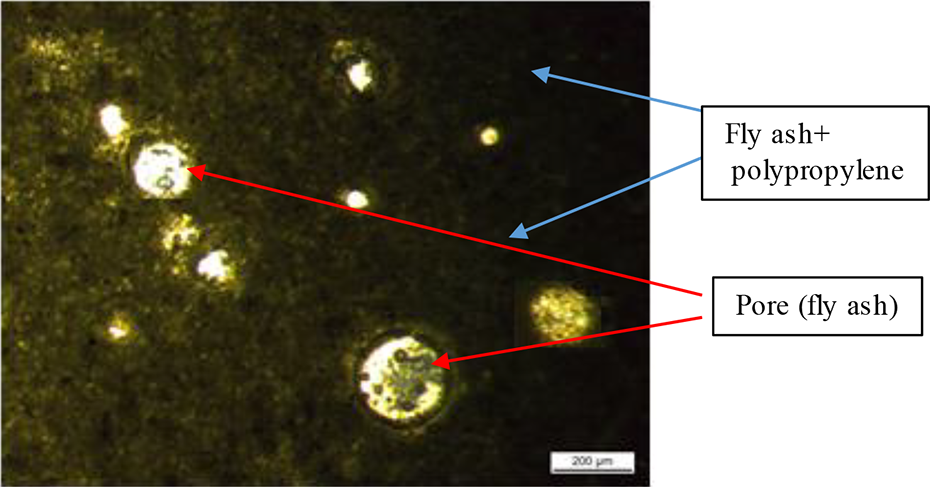
View of samples under microscope.
Chemical composition of fly ash used (%).

Polypropylene: PP plastics are polymers included in thermoplastics group. PPs have chemical strength with an insulation property. Nearly all materials used in packaging are prepared by polymeric materials. Many similar materials are used at homes. Some of these materials are made of PP, polyester or PP. Boxes, trays, bottles, lids, and gears are produced from PP by molding. PP used in paint and textile industries is also used in thermal plastic pipe manufacturing. In the experimental study, nylon bags that are used as packaging materials were used and some of their properties can be seen in Table 2.
Physical and mechanical properties of PP. 4
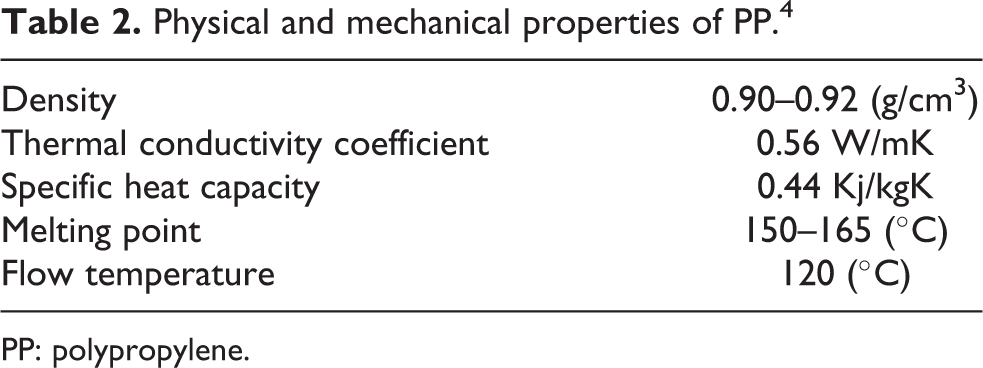
PP: polypropylene.
Sample preparation
PP in the form of waste packaging material was fragmented until the dimensions of 0.5–1 cm and it was added to fly ash in the ratios of 30%, 40%, 50%, 60%, and 70% until each sample’s weight was stabilized as 100 g. The mixtures were heated for 3 h being mixed once in every 30 min, separately on the production temperatures of 225°C, 250°C, and 275°C, thus obtaining mixtures with the consistency of plastic. Each mixture was poured in metal molds of 20 × 70 × 70 mm3 dimensions, 50 kg of pressure force was applied, and the samples were made hollow and they gained the right dimension.
Testing methods
Thermal conductivity of samples was measured with the Isomet 2104 (Applied Precision Ltd, Bratislava-Slovakia) unit, which uses hot wire method according to DIN 51046 standards. Its range and sensitivity were 0.02–10 W/mK and ±5% of its scale, respectively. 32,33 Measurements were taken for all samples on their three different points at the room temperature (22–25°C). Thermal conductivity values were determined by calculating arithmetic averages of those measurements.
Compressive strength tests were performed on the samples prepared according to the ASTM C 109-80 standard. 37 The tensile strength and elasticity module values were calculated according to the TS 500 standard by equations (1) and (2) 38


The abrasion loss (AL) values are determined by equation (3) 36 and presented in Table 3 and Figure 4

Thermal and mechanical properties of samples.
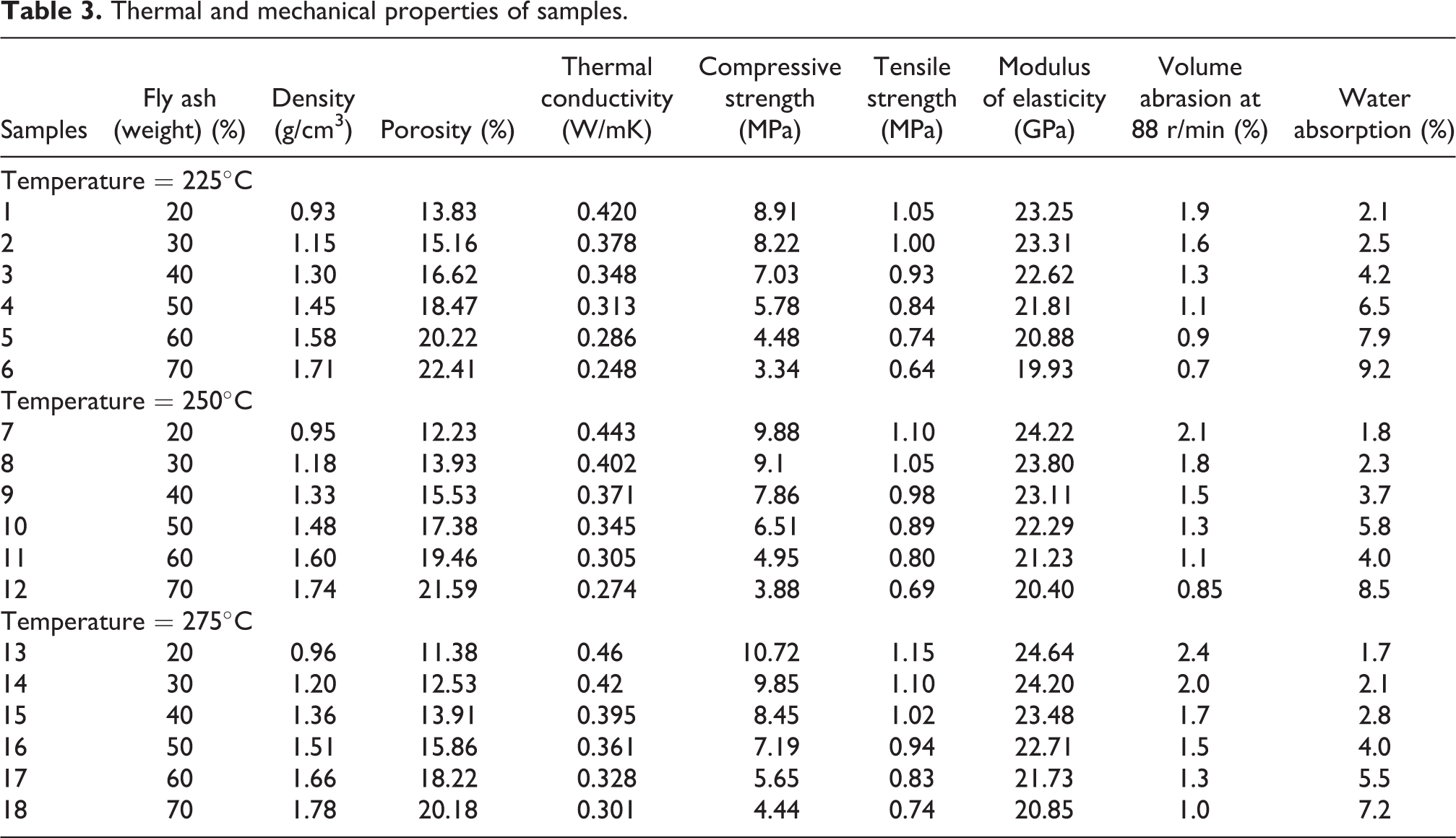
The water absorption test is of vital importance within the scope of determining the suitability of a material to resist freezing hazards. The critical amount of moisture is 30% of the total dry volume, below which the material doesn’t deform due to freezing. 39 The experiments were performed according to the BS 812-109 standard. 40 The water absorption values were calculated by equation (4) and are presented in Table 3

Porosity of samples was determined by using equation (5). 32 Porosity values of samples are shown in Table 3

Result and discussions
There was no chemical reaction occurring between the components as a result of the tests performed on fly ash-PP composites produced at three different temperatures. As the production temperature increased, the values of thermal and mechanical properties increased and, instead, values of porosity decreased.
Density and total pore
Table 3 shows that densities of specimens produced at 225°C were lower than densities of specimens produced at 275°C, and on the contrary, their porosities were higher. This stems from the porous structure of fly ash. In cross-sectional picture under the microscope shown in Figure 1, a portion of fly ash has a structure with closed pores and another portion has a structure with partially open pores. As the production temperature of specimens increased, PP fluidity increased and a portion of fly ash with open pores was filled with PP as a result of pressure application during pouring into molds, and as the density values increased, although slightly, porosity values decreased.
In specimens produced at the temperatures of 225°C and 275°C, fly ash ratios increased from 20% to 70%, density values increased, respectively, from 0.93 g/cm3 to 1.71 g/cm3 with a ratio of 45.61% and from 0.96 g/cm3 to 1.78 g/cm3 with a ratio of 46.07%. This increase is due to the component PP density of 0.90–91 g/cm3 and fly ash density of 2–2.2 g/cm3. Similarly, porosities increased, respectively, from 13.83% up to 22.41% with a ratio of 62.03% and from 11.38% to 20.18% with a ratio of 77.33% (Figure 2).

Porosity variations according to fly ash.
Thermal conductivity
As the concentration of fly ash of the samples increased, their thermal conductivity values decreased (Figure 3(a)). Thermal conductivity values of specimens produced at 225°C were lower than those of specimens produced at 275°C. This was due to PP fluidity increase with the increase of specimen production temperature and porosity decrease with the pressure applied to the production dish. When fly ash ratios increased from 20% to 70%, thermal conductivity values decreased, respectively, from 0.420 W/mK to 0.248 W/mK with a ratio of 40.95% and from 0.460 W/mK to 0.301 W/mK with a ratio of 34.56% (Figure 3(a)). Considering thermal conductivity value change depending on density; as PP ratio decreased due to fly ash which is heavier than PP, ash ratio and sample density increased, and micropores included in ash increase with porosity, and thermal conductivity values decreased (Figure 3(b)).
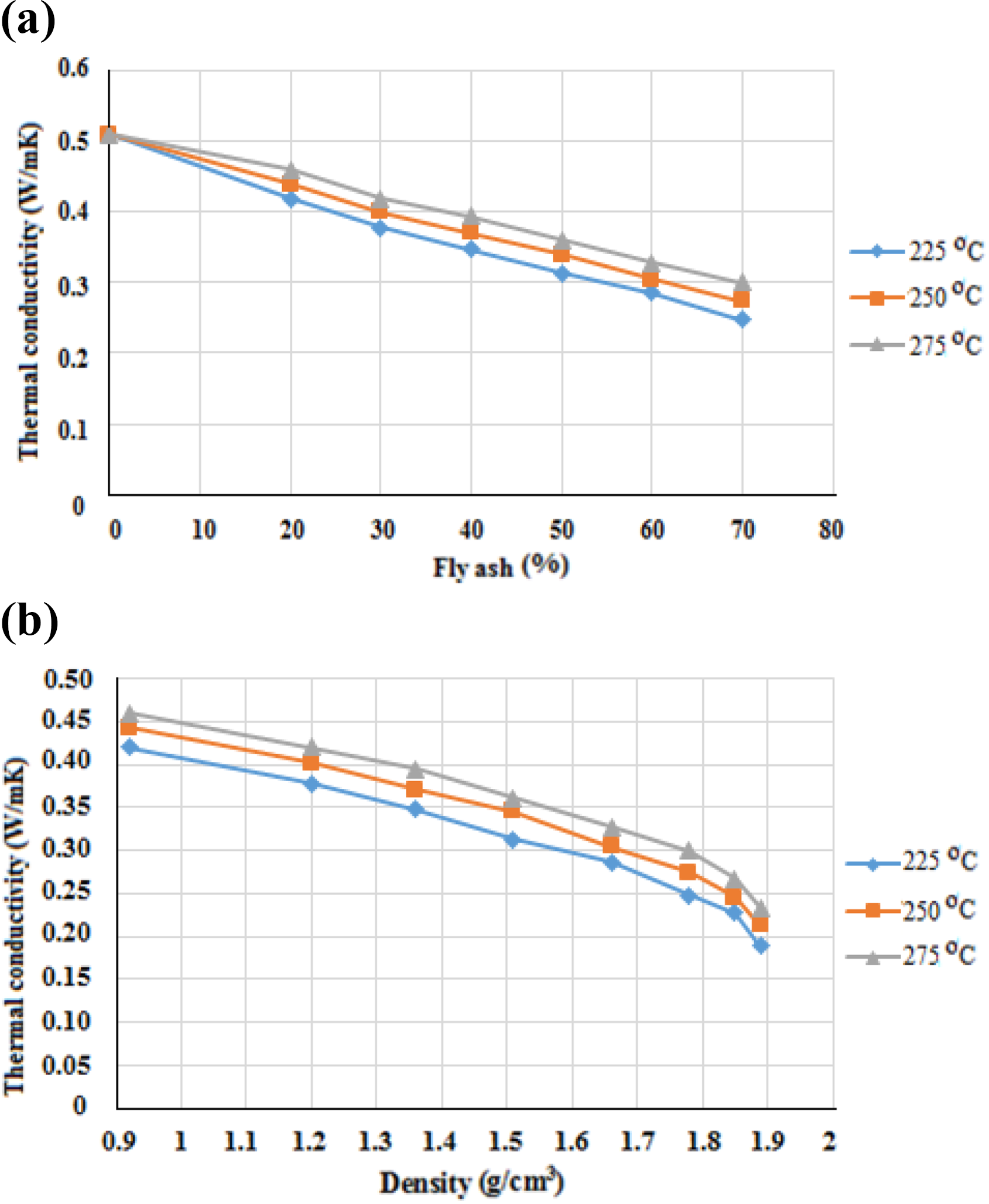
Thermal conductivity variations according to (a) fly ash and (b) density.
Table 4 presents the thermal conductivity values from some literature. For instance, the thermal conductivities of the samples are lower than those obtained by Kaya and Kar 32 (EPS 20% + cement 80%), Balo et al., 36 Khedari et al. 41 (cement + sand + coconut fiber (10%)), and Benazzouk et al. 42
Physical properties of similar studies.

ESO: epoxidized soybean.
Compressive and tensile strength
In specimens produced at the temperatures of 225°C and 275°C, as the concentration of fly ash increased from 20% to 70%, compressive and tensile strength values decreased, respectively, from 8.91 MPa to 1.58 MPa and from 1.04 MPa to 0.44 MPa (Figure 4). Similarly, modulus of elasticity values increased from 23.90 GPa to 18.09 GPa (Table 3). These increases are due to PP’s ash particle binding effect under heat and pressure. Table 4 shows that compressive strength values (samples 16–18) are greater than those obtained by Babu et al.,
26
Li et al.
19
(density: 1.150 g/cm3), Kaya and Kar
33
(EPS (80%) + cement (20%)), Khedari et al.,
41
and Devecioglu and Bicer.

Strength of the samples versus fly ash percentages: (a) compressive and (b) tensile.
In the abrasion test performed on the samples, as PP ratio increased, abrasion ratio decreased from 1.90% to 0.5% with a ratio of 73.68% (Figure 5).
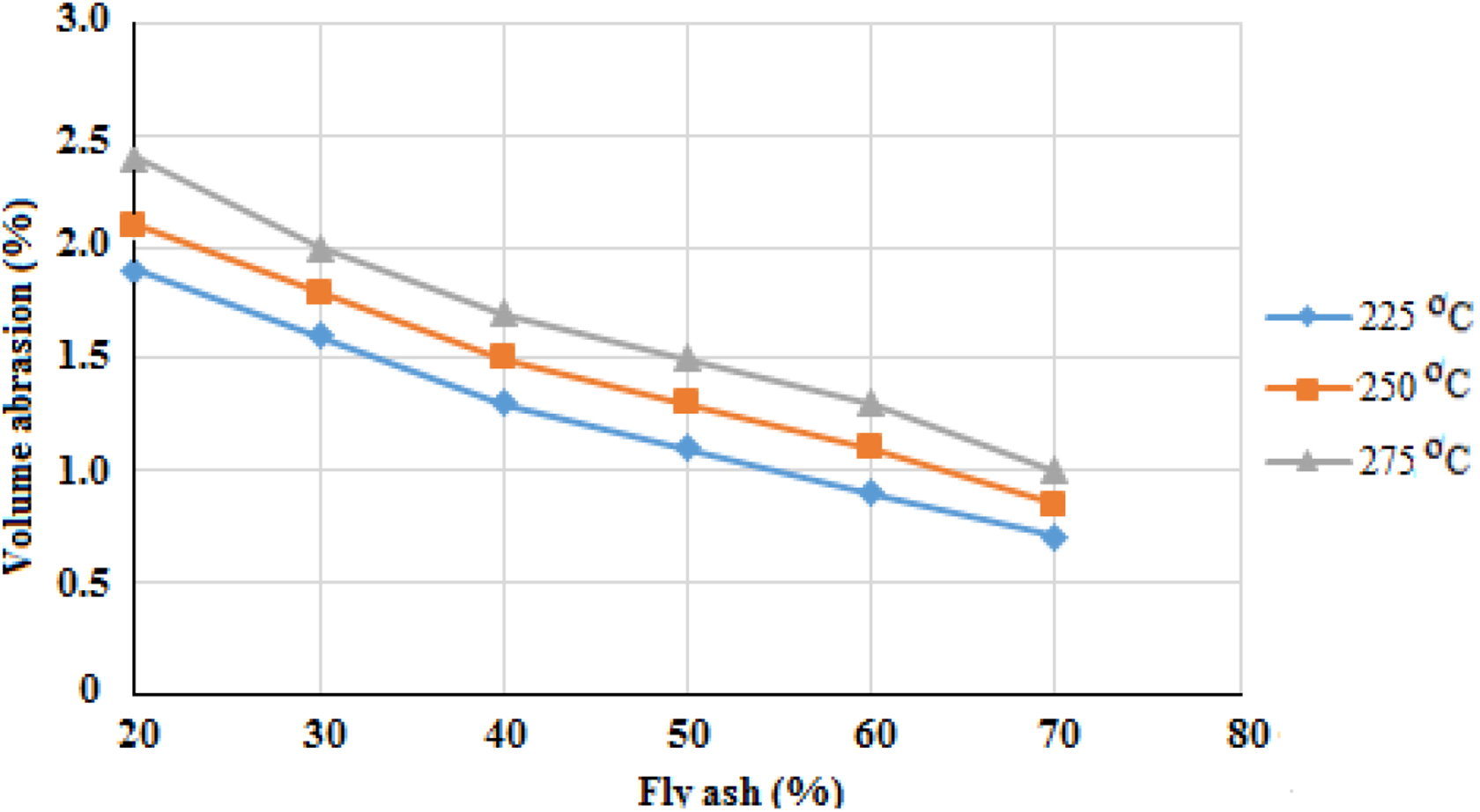
Volume abrasion ratio of samples versus fly ash percentages.
Water absorption
Figure 6 shows that as the production temperature increased (275°C), water absorption ratio decreased. Water absorption ratios of the samples were lower than 30% critical value (1.7–11.5%). Therefore, there is no sample freezing risk at temperatures under 0°C. Therefore, it will be possible to use such type of materials for roof insulation and covering of building facades that are in direct contact with water. It was determined that specimens could be used as floor covering owing to low abrasion values of specimens.
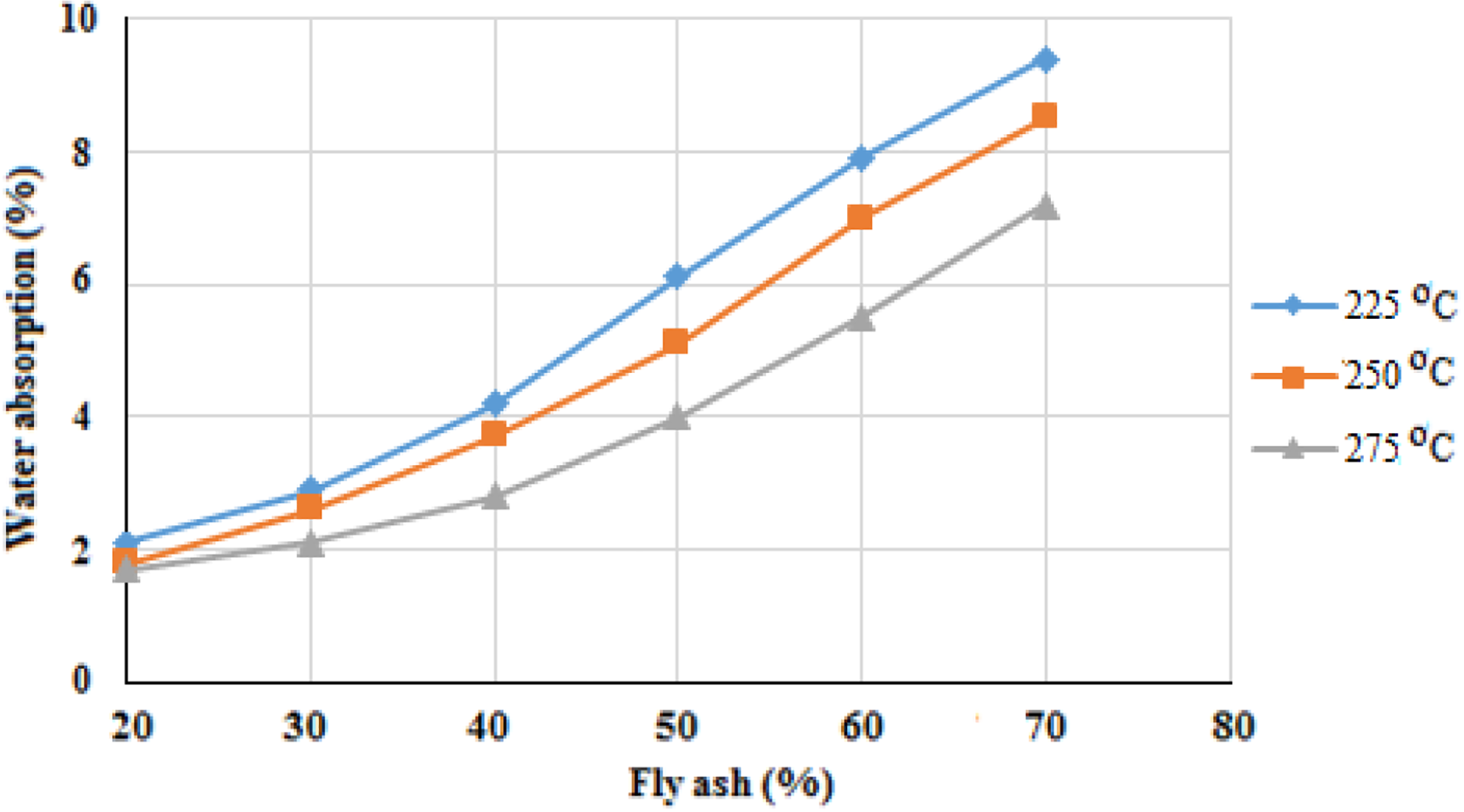
Water absorption ratio of samples versus fly ash percentages.
Conclusions
In this study, fly ash consisting of pores at the level of 10−6 m and PP as a binder were mixed at various production temperatures of 225°C, 250°C, and 275°C, and novel materials with two components were produced. Despite both of the used materials were wastes, the usability of the novel material formed by these materials in construction sector made up the fundament of this study and the following conclusions were derived from this study. ✓ It was found that there was no chemical reaction taking place between components during fly ash-PP composite production, and as the production temperature increased, thermal conductivity coefficient increased and mechanical properties improved, and in return, porosity values decreased. ✓ Thermal conductivity coefficients of specimens produced at 225°C and having a high fly ash ratio were lower than thermal conductivity coefficients of the others. Energy savings will be achieved by using these materials as insulation materials against sound, temperature and moisture in the form of outdoor wall cover, ceiling, and flooring. The samples were prepared to have smooth surfaces. ✓ The mixture should be adjusted so that PP ratio and production temperature (275°C) should be high in places where strength is important. ✓ Water absorption ratios of the samples were under the critical value. Such materials can be used without freezing risk at places having direct contact with water such as sidings.
As a result, the material containing fly ash and PP is a potential construction material and can simultaneously solve environmental problems by recycling of waste fly ash.
Footnotes
Nomenclature
PP: Polypropylene
Φ: Porosity, (%)
E: Elasticity module, (GPa)
fck : Compressive strength (MPa)
fctk : Tensile strength (MPa)
ρ fly ash: Density of fly ash, (g/cm3)
ρ fly ash matrix: Density of fly ash with 0% porosity ratio (after milling and so causing no porosity), (g/cm3)
ρ PP: Density of polypropylene, (g/cm3)
ρ PP matrix: Density of polypropylene with 0% porosity ratio, (g/cm3)
AL: Abrasion loss, (%)
WAP: Water absorption percent, (%)
W d: Dry weight of sample, (g)
W w: Wet weight of sample, (g)
Z: Fly ash ratio, (%)
(1−Z): Polypropylene ratio, (%)
ESO: Epoxidized soybean
Declaration of conflicting interests
The author(s) declared no potential conflicts of interest with respect to the research, authorship, and/or publication of this article.
Funding
The author(s) received no financial support for the research, authorship, and/or publication of this article.
