




Abstract
Background:
Housing insecurity can be linked to bereavement and is often caused or exacerbated by loss of household income and restrictions to some tenancy agreements. Housing insecurity can result in significant practical disruption, increase risk of adverse health outcomes and decrease quality of life. However, despite the impact of housing insecurity on experiences following bereavement, little is known about its underlying risk factors.
Aim:
To investigate characteristics associated with housing insecurity, defined as odds of having to move home following bereavement.
Methods:
This exploratory, cross-sectional analysis used data from an online survey commissioned by Marie Curie in November 2023. The survey investigated administrative difficulties faced by UK residents who had experienced a close bereavement in the past five years. Logistic regression modelling was used to quantify the strength and direction of the association between characteristics and odds of having to move home.
Results:
In all, 2901 bereaved people were included in the analysis. The incidence of having to move home following bereavement was 11.2% (n = 324). Characteristics associated with significantly increased odds of having to move in fully adjusted models included being younger, being male, renting privately, bereavement following the death of a younger person, being bereaved in the last 12 months and completing practical tasks following bereavement, a proxy measure for the relationship between the bereaved and deceased. Living in Wales, living in Scotland and living in Northern Ireland were each associated with significantly lower odds of having to move compared with living in England. Data on ethnicity or socioeconomic factors were unavailable.
Conclusion:
Certain groups of people may have an increased risk of having to move home following bereavement. This highlights inequity in experiences of bereavement and emphasises the need for research to explore other aspects of housing insecurity and the means to address potential inequities.
Keywords
Introduction
Preferences for the location of dying and death have received considerable attention in recent literature, and both are influenced by sociodemographic factors, experiences of illness and care, and the availability, or otherwise, of resources. 1 Dying at home has been associated with feelings of autonomy, dignity and proximity to family and friends. 2 However, home does not have the same connotations for all, as social identity and previous experiences influence meaning-making. 3 For some, dying and death at home can be linked to a fear of burdening others or anxiety about appropriate symptom management. 1 Whilst there is growing discussion about places of dying and death, the impact of housing insecurity in bereavement is less researched.
Consultation by the UK Commission on Bereavement heard from more than 1000 bereaved individuals, as well as organisations and professionals, on their experiences of bereavement during the COVID-19 pandemic.4,5 The commission highlighted housing insecurity as a key challenge faced by bereaved people. Housing insecurity refers to a state of uncertainty or instability regarding a person’s access to safe, appropriate and affordable housing, including whether a person is vulnerable to disruptions to their current housing situation. 6 The challenges of housing insecurity for bereaved people are often caused or exacerbated by loss of household income. This can occur both before and following a bereavement. Progression of terminal illness can result in premature unemployment for working-age people 7 and, for households where a person reduces or stops employment to care for a person living with terminal illness, the impact on income is twofold.5,8 Moreover, expenses associated with terminal illness are vast and include costs associated with travelling to medical appointments, costs for medical equipment and adaptions to the home, costs for social care and increases in the cost of utility bills. 9 Even where not preceded by terminal illness, the bereavement period poses its financial strains in terms of loss of benefits or pension-based income, difficulties in paying for funeral costs and dealing with debts or creditors. 10 Other precipitators for housing insecurity include restrictions to some tenancy agreements. 4 Death of a tenant can be a legal reason for eviction in the social and private rented sectors, though succession rights provide some limited protections. 11
Housing insecurity can compound the intense vulnerability often experienced in bereavement by causing profound practical, physical and emotional disruption. The process of having to move home brings with it the immediate concern of finding alternative accommodation, which can be time-consuming, financially burdensome and typically requires the navigation of complex bureaucratic processes. This can disrupt daily routines and stability, potentially forcing people to live in temporary housing and, in turn, hinder their ability to maintain employment, sustain social connections or access essential services. 12
Housing insecurity is also reported to increase the risk of adverse health outcomes; both mental, including psychological distress, depression and anxiety,4,10,12 and physical, including poor self-reported health and chronic disease. 13 Adverse health outcomes can lead to difficulty in focusing on the provision of palliative care, prior to bereavement, 14 and the inhibition of grief, leading to increased feelings of guilt and decreased quality of life for the bereaved.12,15
Evidence suggests that social and structural inequities intersect with bereavement-related outcomes.10,16 Women are more likely to take on the role of an informal caregiver prior to a bereavement, experiencing greater financial strain, 17 poorer psychological well-being and less support than men during the caregiving period. 18 People bereaved following the death of a younger person, people facing greater socioeconomic deprivation and people from minoritised ethnic groups are also reported to experience heightened grief or psychological distress19 –21 and may face inequities in access to bereavement support.17,18,22
Despite the significance of housing insecurity for bereaved people, as well as the association between social and structural inequities and bereavement-related outcomes, little is known about how such inequities may also impact upon risk of housing insecurity. There is tentative evidence from the descriptive analysis of a 2015 survey to suggest that women may be more likely to move home following bereavement than men, 16 but this requires further exploration. Our study therefore aims to address this gap by investigating risk factors for housing insecurity, measured as odds of having to move home as a result of a bereavement of a family member or close friend, in UK survey respondents.
Objectives
Using data from respondents to a UK-based survey and an exploratory, cross-sectional study design, the objectives were to:
Describe the characteristics of people who had to move home as a result of a bereavement
Identify characteristics associated with having to move home as a result of a bereavement
Quantify, using regression modelling, the strength of the association between identified predictors and odds of having to move home as a result of a bereavement
Methods
Study sample
This analysis used data from an online survey commissioned by Marie Curie in November 2023. The survey was conducted by Opinium (https://www.opinium.com), a market research and insight agency, to investigate administrative difficulties faced by UK residents who had experienced bereavement of a family member or close friend in the past five years, including bereavement not following terminal illness. The survey was conducted among 2000 people aged over 16 years from proprietary and external panels. This sample was boosted among the devolved nations of Wales, Scotland and Northern Ireland, to result in a final dataset of 2901 people.
Measures
The outcome variable in this analysis was binary (yes/no), indicating the odds of having to move home as a result of a close bereavement. This was measured through respondent responses to the question: ‘Did you have to move home as a result of your bereavement?’
The following predictors were considered in these analyses: age, gender, employment status at the point of bereavement, location of usual residence, tenure type at the point of bereavement, age of deceased, recency of bereavement and completion of practical tasks related to bereavement. Completion of practical tasks was considered a proxy measure for the closeness of the relationship between the bereaved and the deceased. This was based on the assumption that people who complete practical tasks were more likely to have had power of attorney, previously cohabited with the deceased or to have shared financial burdens. These variables were measured using relevant survey questions (Supplemental Material 1).
All variables were recorded as categorical, except age. For these analyses, age was categorised into three groups (comprising 16–34 years, 35–54 years and 55 years and over) according to the distribution of data. Location of usual residence was categorised by country, including England (comprising all relevant regions), Wales, Scotland and Northern Ireland. Tenure type at the point of bereavement was categorised into owned (comprising owned outright and owned with a mortgage or loan, collapsed due to insufficient numbers), rented from a private landlord, rented from a social landlord and other (comprising living rent-free and shared ownership). Though reasons for having to move home were given, analyses were not stratified by this due to insufficient numbers. All other variables were categorised as recorded in the survey.
Handling missing data
The number and proportion of people with missing values in both the outcome and covariates were described. Patterns of missing data were investigated by describing the characteristics of people with and without missing data, with p values for chi-squared tests and Fisher’s exact tests, where appropriate.
In total, 5.3% (n = 154) of the 2901 respondents had missing data in either of five predictor variables: gender, employment status, tenure type, age of deceased, and practical tasks, as well as missing data in the outcome variable, having to move following bereavement. The majority of this was due to missing data in tenure type (Supplemental Material 2, Table 1). 1.2% (n = 35) of people had missing data in more than one variable (Supplemental Material 2, Table 2). Missing data was considered missing at random.
Respondent characteristics.

Proxy measure for the relationship of bereaved family members.
Results of logistic regression modelling with multiply imputed data.

CI, 95% confidence interval.
p < 0.05.
p < 0.001.
Adjusted for age, gender, employment status, usual residence, tenure, age of deceased, recency of bereavement and practical bereavement-related tasks, as appropriate.
Proxy measure for the relationship of bereaved family members.Bold indicates statistically significant at 95% confidence.
People with missing data more frequently moved as a result of bereavement, were more frequently in the youngest age category, less frequently female, less frequently in full-time employment at the time of bereavement, less frequently homeowners and less frequently involved in practical tasks related to bereavement, than people without missing data (Supplemental Material 2, Table 3). Therefore, our primary analysis used Multiple Imputation by Chained Equations 23 with five iterations to account for missing data.
Statistical analysis
Characteristics of the sample were described according to whether they had to move home as a result of a bereavement. These were compared with p values for chi-squared tests. Logistic regression models were then performed to estimate odds ratios (ORs) and 95% confidence intervals (CIs) of the odds of having to move home among people with each level of each variable identified as being significantly associated with having to move home in the previous step. The first model of this analysis was unadjusted, the second model adjusted for age and gender and the final model adjusted for all relevant predictors. Relevant predictors were selected using stepwise selection and the Akaike information criterion, to obtain the best model fit for the available data.
The primary analysis was conducted using the final dataset of 2901 people with imputed data for missing values. Two sensitivity analyses were completed. First, analyses were repeated in the complete case sample, including only people without missing data. Second, analyses were repeated including only the 2000 people in the original dataset, prior to the survey being boosted, as this dataset was nationally representative after being weighted by age group, gender and region. Results from sensitivity analyses were compared with the results of the primary analysis.
All analyses were carried out using R version 4.3.3. (https://www.r-project.org/)
Results
Respondent characteristics
Respondent characteristics are given in Table 1. Out of 2901 respondents, 11.2% (n = 324) reported having to move home as a result of their bereavement. Respondents were most frequently aged 35–54 years (n = 1145, 39.5%) and a small majority of respondents were female (n = 1602, 55.2%). More than half of respondents worked full time (n = 1613, 55.6%), lived in England (n = 1672, 57.6%) or owned their property (n = 1638, 56.5%). Over a third (37.9%, n = 1099) of respondents were bereaved following the death of a person aged 75 years and over, a further 33.6% (n = 975) were bereaved following the death of a person aged 55–74. Respondents were most frequently bereaved in the last 12 months (n = 1180, 40.7%), and 41.2% (n = 1196) reported completing practical tasks related to bereavement.
Chi-squared tests revealed significant associations with all predictors (age, gender, employment status, usual residence, tenure type, age of deceased, recency of bereavement and practical bereavement-related tasks) and moving home as a result of bereavement (Table 1).
Logistic regression models
The best model fit included all relevant predictors (Supplemental Material 3, Table 1). All relevant predictors were therefore included in the fully adjusted model. Results of the unadjusted model, the model adjusted for age and gender and the fully adjusted model (adjusted for age, gender, employment status, usual residence, tenure type, age of deceased, recency of bereavement and practical bereavement related tasks, as appropriate) are given in Table 2. The results of the fully adjusted model are also shown in Figure 1.
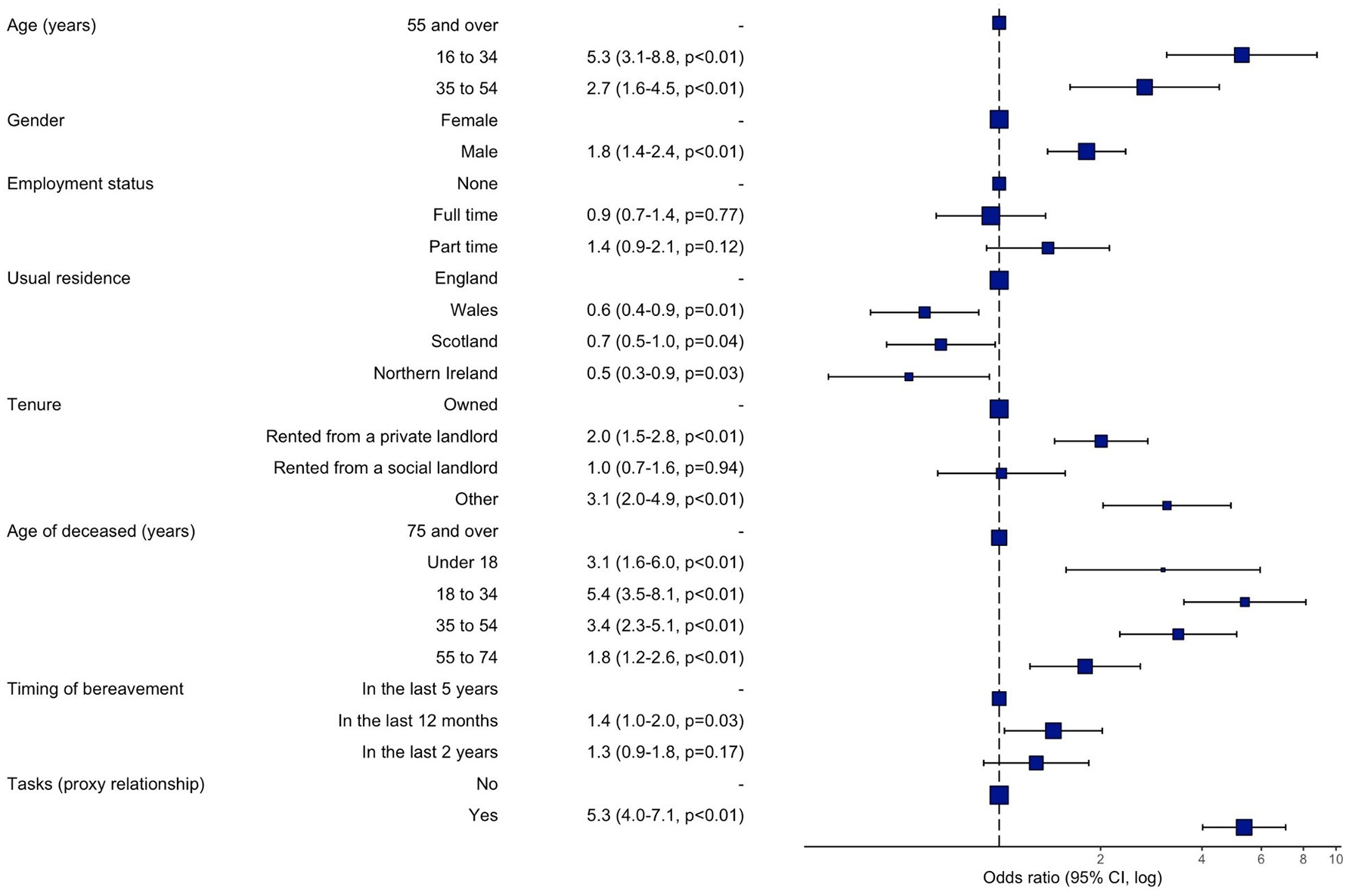
Results of fully adjusted logistic regression modelling with multiply imputed data.
Younger age was associated with significantly increased odds of having to move as a result of bereavement. In the fully adjusted model, people aged 16–34 years had over five times greater odds (OR 5.25, 95% CI 3.20–8.98, p < 0.001), and people aged 35–54 years had over 2.5 times greater odds (OR 2.70, 95% CI 1.65–4.61, p < 0.001) of having to move compared with people aged 55 years and over. The association between gender and having to move following bereavement was significant in all statistical models but increased with adjustment, with men having 82% greater odds of having to move following bereavement than women (OR 1.82, 95% CI 1.39–2.23, p < 0.001). There was an association between being employed at the point of bereavement and significantly increased odds of having to move following a bereavement in unadjusted models, but this effect was attenuated following adjustment. Living in Wales, living in Scotland and living in Northern Ireland were each associated with 40%, 33% and 46% lower odds of having to move following bereavement than living in England, respectively (OR 0.60, 95% CI 0.41–0.86; OR 0.67, 95% CI 0.46–0.97; and OR 0.54, 95% CI 0.30–0.91, respectively, all p < 0.05).
Compared with people who owned their property at the time of bereavement, people who rented from a private landlord and people who had other tenure status had more than two times and more than three times greater odds of having to move home, respectively (OR 2.01, 95% CI 1.46–2.76, p < 0.001, and OR 3.15 2.03–4.87, p < 0.001). There was no association between renting from a social landlord and the odds of having to move home in either model. Bereavement following the death of a younger person was also associated with consistently increased odds of having to move following a bereavement, with bereavement following the death of a person aged 18–34 years associated with more than five times greater odds of having to move, compared with bereavement following the death of a person aged 75 years or over (OR 5.36, 95% CI 3.55–8.18, p < 0.001). Recency of bereavement was an additional risk factor. Compared with people who were bereaved in the last five years, people who were bereaved in the last 12 months had 45% greater odds of having to move following bereavement (OR 1.45, 95% CI 1.04–2.03, p < 0.05). The association between bereavement in the last two years and having to move was significant only in the unadjusted model. Finally, the association between completing practical tasks related to bereavement, a proxy variable for the closeness of the relationship between the bereaved and the deceased, and having to move following bereavement was significant in all models but increased with adjustment. In the fully adjusted models, people who completed practical tasks had more than five times greater odds of having to move, compared with people who did not report completing such tasks (OR 5.34, 95% CI 4.03–7.12, p < 0.001).
Sensitivity analyses
The analysis was repeated in the complete case sample of 2747 people. The results of this were similar to those based on multiply imputed data, except the association between living in Northern Ireland and the odds of having to move home was no longer significant in either model (Supplemental Material 4, Table 1 and Figure 1).
The analysis was also repeated in the nationally representative sample. After the exclusion of missing values, this analysis was conducted in a complete case sample of 1879 people. The results were similar to those based on the original plus boosted sample, except the association between living in the devolved nations of Wales, Scotland and Northern Ireland and odds of having to move home were no longer significant in most models, and the association between being bereaved in the last 12 months and increased odds of having to move was no longer significant in the fully adjusted model (Supplemental Material 4, Table 2). These findings were likely due to the smaller sample size leading to greater uncertainty in effect estimates.
Discussion
This exploratory, cross-sectional study used data from a UK sample of 2901 people who experienced a close bereavement in the past five years. Younger people, men, people who rented from a private landlord or who had other tenure status, people who were bereaved following the death of a younger person, those who were bereaved in the last 12 months and those who completed practical tasks related to bereavement (a proxy measure for the closeness of the relationship between the bereaved and deceased), each had significantly increased odds of having to move as a result of bereavement. People living in Wales, living in Scotland or living in Northern Ireland each had significantly lower odds of having to move as a result of bereavement, compared with living in England.
Though no data on socioeconomic factors were available, socioeconomic differences may help to explain some of the findings observed in this study. Our findings that being younger and being bereaved following the death of a younger person were each associated with increased odds of having to move as a result of bereavement are in line with findings that younger people experience greater financial disadvantage in bereavement, 16 possibly leading to increased risk of housing insecurity. Younger people are often more likely to have outstanding debts, to lack savings or to be supporting young children, potentially adding to financial strain. 5
Households from deprived socioeconomic groups are significantly more likely to rent in either the social or private sectors, compared with households from the most affluent socioeconomic groups who are more likely to own their property. 24 In our study, people who rented from a private landlord or who had other tenure status (including living rent-free and shared ownership) had increased odds of having to move as a result of bereavement, compared with people who owned. This association may also have been due, in part, to current restrictions to tenancy agreements in England.4,11 These include restrictions in the private sector whereby the statutory right to succeed tenancy on the death of a tenant only applies to spouses or civil partners (s.17, Housing Act 1988), thus leaving other cohabitants at risk of no-fault eviction.
The finding that men have increased odds of having to move as a result of bereavement compared with women is in contrast to findings from previous research 10 as well as evidence to suggest that women face greater financial disadvantage in bereavement.5,10,17 This requires further exploration in future studies.
Finally, evidence suggested greater odds of having to move as a result of bereavement in the past year compared with the past five years, as well as evidence to suggest that people living in the devolved nations had lower odds of having to move compared with people living in England. Such findings may be due to differing degrees of pressure on housing as well as to changes or differences in local policy. Housing is devolved in the UK, meaning that housing policy and legislation in England, Wales, Scotland and Northern Ireland is generally a matter for that nation’s government and legislatures.
Limitations
Some limitations of this research are inherent to the survey data. First, potentially important variables were missing from the survey. For example, there is a need to investigate the role of ethnicity. People within different ethnic groups often face unique challenges, including access to resources or bereavement support,20,22 which can influence their vulnerability to housing insecurity. Moreover, it would have been beneficial to have data on socioeconomic factors including income, occupation type and education, to assess the extent to which socioeconomic differences help to explain some of the observed findings. It is also not known whether respondents were previously cohabiting with the deceased, which may be an important risk factor for housing insecurity. Understanding the nature of the relationship between the bereaved and the deceased would offer valuable insights for shaping policy and practice, with the strength of the association between completing practical tasks relating to bereavement and the odds of having to move home indicative of its importance.
Second, the definition of housing insecurity is potentially reductive. For some people, having to move home following a bereavement is a positive experience. 10 The meaning of home can vary greatly, with home encompassing different emotional, cultural and social experiences. 3 Response options to the question regarding having to move home as a result of bereavement focused on restrictions to tenancy agreements or financial strain. This prevented further exploration of the range of meanings of moving home and potentially affected respondents’ ability to respond in a way that accurately reflected their experience.
Third, for people who were bereaved most recently, the pressure or need to move home may not have yet arisen. Moving house may not take place until several years post-bereavement, owing to less immediate changes in circumstances including the longer-term depletion of savings.16,25 This would lead to an underestimation of the magnitude of housing insecurity following bereavement.
Finally, the sample was insufficiently sized to explore whether the relationship between characteristics and odds of having to move home varied within different subgroups of respondents. For example, it would have been useful to explore whether characteristics associated with housing insecurity differed by usual area of residence.
Implications for policy and practice
Findings that the impact of bereavement on housing insecurity is influenced by factors including the age of both the bereaved and the deceased, gender, tenure status, recency of bereavement and closeness of the relationship, and location of usual residence within the UK highlight important areas for further research and policy. Specifically, the vulnerabilities of younger people, men and people living in England merit targeted investigation and intervention. Younger individuals may be at increased risk of housing insecurity following bereavement due to greater financial disadvantage, underlining a need for widened entitlement to and longer duration of financial support as well as flexible working agreements to support working-age informal carers to continue in employment both before and following bereavement.4,5,26 Similarly, men may experience different social and emotional responses to bereavement that could impact their ability to maintain stable housing, suggesting a need for a gender-sensitive approach to access bereavement-related support. Disparities in experiences faced by those in England compared with the devolved nations, potentially shaped by regional differences in legislation governing benefits and social and private rented sector tenancy agreements, housing availability and bereavement services, also warrant more localised research to understand how policy can better address these challenges. Policymakers should consider these nuanced intersections when developing legislation and health and social care strategies, ensuring that support systems are accessible and responsive to the needs of these vulnerable groups to mitigate the risk of housing insecurity following bereavement.
To help understand more about the relationships observed in this secondary analysis, future research should strive for the involvement of a diverse range of people with lived experience to share the context and insights needed to work toward reducing inequity in experiences of bereavement.
Conclusion
To the best of our knowledge, this study is the first of its kind to explore risk factors for housing insecurity in bereavement. Further research is required to explore these issues in greater depth. Future studies should address the limitations of this study including exploring the role of ethnicity, the cultural and social implications of moving home as a result of bereavement and the long-term risks of housing insecurity. Future work is also required to identify strategies to address potential inequities.
Supplemental Material
sj-docx-1-pcr-10.1177_26323524241306122 – Supplemental material for Risk factors for housing insecurity following bereavement: a cross-sectional analysis of UK survey respondents
Supplemental material, sj-docx-1-pcr-10.1177_26323524241306122 for Risk factors for housing insecurity following bereavement: a cross-sectional analysis of UK survey respondents by C. R. L. Simpson-Greene and B. F. Hudson in Palliative Care and Social Practice
Footnotes
Acknowledgements
The authors would like to acknowledge and thank Rachel Warren for her role in commissioning the survey. The authors would also like to acknowledge and thank Christine Irvine, Emma Maun, Kellie Payne, Matthew Whittley and Natasha Wynne for their feedback and guidance throughout this project.
Declarations

Supplemental material
Supplemental material for this article is available online.
References
Supplementary Material
Please find the following supplemental material available below.
For Open Access articles published under a Creative Commons License, all supplemental material carries the same license as the article it is associated with.
For non-Open Access articles published, all supplemental material carries a non-exclusive license, and permission requests for re-use of supplemental material or any part of supplemental material shall be sent directly to the copyright owner as specified in the copyright notice associated with the article.
