




Abstract
Study Design:
With the patient’s desire to shorten the treatment time and to avoid an edentulous condition, immediate loading of implants has emerged as an alternative approach as compared to delayed loading implants for replacing missing natural teeth. The aim of this study is to evaluate the primary stability in immediate loading of dental implants.
Objective:
To evaluate primary stability and postoperative complications clinically and radiographically.
Method:
Total 50 patients were treated with immediate loading dental implants. Withdrawal criteria includes patients not returning for checkup, follow-up, or documentation, and patients not following postoperative instruction.
Result:
Primary stability increases in immediate loading protocol; mean stability was 57 which was adequate at the time of surgery and during healing period.
Conclusion:
Our study concludes that under appropriate circumstances, medical condition and maintenance of good oral hygiene provide better primary stability in immediate loading protocol.
Introduction
Osseointegration of implant is the prerequisite for a successful outcome. There are 2 protocols available for the implant placement. One is a traditional 2-stage surgery, delayed implant loading and another is immediate loading protocol. These methods are recommended to the patient who needs the replacement of partially edentulous jaw or completely edentulous jaws. In the case of 2-stage protocol, implant were placed and left to heal for a period of 3 to 4 months in mandible and in maxilla 6 to 8 months. 1
There are various reports and clinical studies that have documented high survival and success rate using immediate single tooth provisionalization. 2 A meta-analysis confirmed neither radiological nor clinical differences in among the various loading protocols in terms of aesthetic result or implant survival rate. 3
First report was published in 1990 suggesting that osseointegrated implants could be loaded immediately or early in mandible of selected patients. 4 A systematic review of randomized controlled clinical trials showed that immediate loaded implants in selected cases of mandible can be effective as those loaded 2-stage protocol. 5
The purpose of this study is to evaluate primary stability of dental implant in partially edentulous region.
Material and Methods
Study was approved by the ethical committee. Patient were selected according to the following inclusion and exclusion criteria. Inclusion criteria were: partially edentulous region, stable interocclusal contacts, residual bone height >10 mm, minimum bone width 4.5 mm, and age >18 years. Exclusion criteria were ASA-I patient, lack of occluding dentition in the area intended for immediate loading, patients with insufficient bone width and height, previous history of irradiation of head and neck area, smokers, and inability to complete follow-up >6 months. Fifty patients were selected for the study using abovementioned criteria. Withdrawal criteria includes patients not returning for checkup, follow-up, or documentation, and patients not following postoperative instruction.
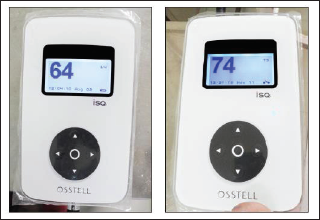
All selected cases underwent thorough investigation and treatment planning. Radiographs were done, that is, intraoral periapical radiograph and orthopantomogram and cone beam computer tomography (CBCT) (optional). Assessment of quality and type of bone was done as per anatomic location and radiograph. Model fabrication for mandibular as well as maxillary arches was done. Preoperative antibiotic was given to patients, that is, Amoxicillin 500 mg TDS 2 days before the procedure. Prior to implant placement, patients rinsed for 1 min with 0.2% Chlorhexidine mouthwash and local anesthesia was induced using 2% lignocaine with adrenaline (1:80,000). Implant length and diameter was selected based on clinical assessment and buccolingual width of bone with the help of OPG/CBCT. Implants were placed using a conventional approach: an intrasulcular and crestal incision was performed and a mucoperiosteal flap was elevated. All implants were installed with an insertion torque >35 Ncm and <45 Ncm measured with a manual torque wrench. Drilling was done as per scheduled drill sequence protocol. Implant was placed in bone and primary stability was measured with implant stability quotient (ISQ) device (Figure 1). Suturing done with (3-0) silk suture. Immediate postoperative OPG was taken. An impression was then taken, an acrylic crown was fabricated and was placed the day after surgery in the immediate loading protocol. Care was taken that provisional crowns did not have any static or dynamic occlusion contacts.
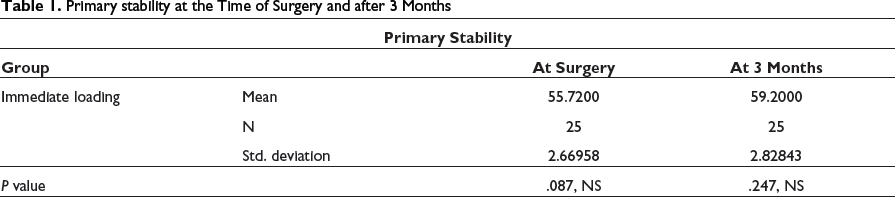
Primary Stability at the Time of Surgery and after 3 Months.
Outcome Measures
Primary stability at the Time of Surgery and after 3 Months.
Result
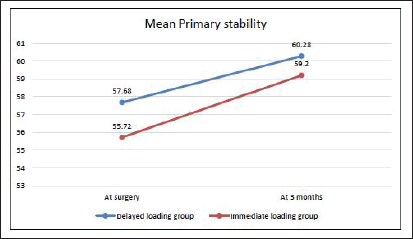
The mean primary stability score at the time of surgery and after 3 months, in delayed loading group was found to be higher than that among immediate loading group but the difference failed to reach the level of statistical significance (Figure 1 and Figure 2).
Mean Primary Stability.
Discussion
The ultimate goal of an immediate loading protocol is to reduce the number of surgical interventions and shorten the interval between surgery and prosthesis delivery, without compromising the success rate of the procedure. 6 Mandibular first-molar implants (Replace Select Tapered TiUnite) placed with flapless guided surgery and immediately loaded with premanufactured individualized abutments and crowns. All 51 tapered implants placed were stable and successful in function after 1 year, providing a 100% survival rate. 7
Implant primary stability was first assessed by finger pressure exerted on the implant mount. If clinically stable, implant stability was further measured by resonance frequency. The ISQ value at implant placement was blindly recorded and did not influence the surgical or prosthetic treatment. The ISQ was measured by an Osstell apparatus with a commercially available transducer (type L4F5) adapted to ITI implants. 8
Bischof et al 8 showed that data are in line with those obtained with Branemark implants, where implant stability was higher in the mandible than in the maxilla. The mean ISQ in the mandible was still higher than in the maxilla but the difference between bone type which was a determinant for the ISQ was leveled out. After 3 months, the effect of bone was leveled out but still the ISQ in the mandible was significantly higher. Over a 3-month period, the radiofrequency ablation method did not reveal any decrease in implant stability either in the delayed loading or the immediate loading groups. This might explain why immediate loading protocols may be as predictable as delayed loading ones. The mean ISQ remained stable or slightly increased during the first 4 to 6 weeks and then increased more noticeably. 8
In our study, we measured primary stability at the time of surgery and after 3 months. According to our study, primary stability increases in immediate group and mean stability was 57 which was adequate at the time of surgery and during healing period.
Conclusion
According to literature, immediately and conventionally loaded implants showed equally successful clinical results regarding soft tissue healing, implant survival rate, and marginal bone loss.
In addition to the benefits that an immediate loading protocol can provide, long-term outcomes have been reported to be favorable even in areas where bone quality is not adequate. The overall implant survival rate of immediately loaded implants is similar to the conventional 2-stage implant loading protocol. Our study concludes that immediate loading under appropriate circumstances, medical condition, and maintenance of good oral hygiene provided good success rate.
Footnotes
Declaration of Conflicting Interests
The authors declared no potential conflicts of interest with respect to the research, authorship, and/or publication of this article.
Funding
The authors received no financial support for the research, authorship, and/or publication of this article.

Statement of Informed Consent and Ethical Approval
Necessary ethical clearances and informed consent was received and obtained respectively before initiating the study from all participants.