




Abstract

When treating oral submucous fibrosis (OSMF), our part as a clinician and a surgeon revolves around attaining goals like quitting of deleterious habits by the patient, achieving improved mouth opening and attaining near to normal mucosal suppleness. Loss of mucosal suppleness is majorly due to development of fibrotic bands and recurrent scarring in OSMF patients. This leads to symptoms like progressive inability to open mouth, change of gustatory sensation, dryness of mouth, and impaired mouth movements (eg, eating, whistling, blowing, sucking). 1
In order to better treat OSMF patients, there should be a constant effort to quantify the improvement of mucosal softness and elasticity and should not merely revolve around the furtherance of mouth opening ability. Over the years, many classifications have been put forth but none of them have taken into account quantification of mucosal suppleness as a factor in grading the severity of the OSMF.
Till date, there are only 2 reported methods to compute suppleness of buccal mucosa, both of which rely on linear measurements.
We hereby propose a novel, simple, and a potentially reliable method which we are calling as maximum water holding capacity within the oral cavity to assess the buccal mucosa suppleness. In this method, the patient is asked to take in and hold water within his oral cavity without drinking it, till the time he is absolutely unable to hold more water or the water starts spilling out of his mouth (Figure 1A). This method stretches the buccal mucosa to its maximum and is a more reliable method as we are using a physical entity like water in place of depending on patient to perform mouth blowing to stretch the buccal mucosa and then making linear measurements.
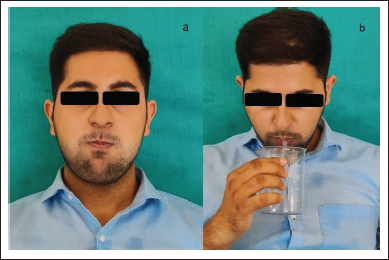
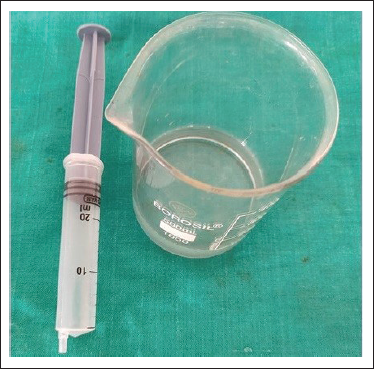
The water is then carefully emptied in a beaker (Figure 1B) and its quantity is measured using a 20-cc disposable syringe (Figure 2). As the elasticity, softness, and mouth opening increases post treatment, the ability to hold more quantity of water within the oral cavity also increases. This method can be used by self at home or by clinicians to assess the overall improvement in mucosal suppleness following surgical/nonsurgical treatment of OSMF.
The proposed advantages of the abovementioned method are as follows:
Can be performed by the patient at the comfort of his/her home to evaluate the outcome of physiotherapy. Can be utilized as method of physiotherapy. Can be used for self-motivation among patients. Does not require any technical/clinical expertise. Painless method as compared to forceful mouth opening using physical devices.
Primary findings suggest the only disadvantage is that some patients find it difficult to perform this test in their first few attempts and are unable to hold maximum water and tend to drink it, hence patient requires to be self-motivated to perform this test.
This technical note is based on the preliminary examination of an ongoing case control study, further understanding of the method will become clearer after all of the data is collected and analyzed.
Footnotes
Declaration of Conflicting Interests
The authors declared no potential conflicts of interest with respect to the research, authorship, and/or publication of this article.
Funding
The authors received no financial support for the research, authorship, and/or publication of this article.

Statement of Informed Consent and Ethical Approval
Necessary ethical clearances and informed consent was received and obtained respectively before initiating the study from all participants.