




Abstract
Background:
A human body keeps changing physiologically, biologically, and psychologically from birth to death. There is always a change in all human faculties. But adolescence is a phase earmarked where a human body experiences drastic changes among all these faculties. And any such bodily change carrying baggage of shame, insecurity, stigma, and concealment demands on-time awareness and intervention.
Aim:
The aim of the study is to understand the knowledge and level of awareness regarding sexual and reproductive health among the school-going adolescents of Kashmir Valley where majority of the population belongs to Muslim conservative culture.
Methodology:
Due to COVID-19 lockdown, the inability of access to schools and children gave the researcher the opportunity to utilize the alternate places and a total of 550 students from classes 8, 9, and 10 were selected for the purpose. The permission was sought from the respective teachers and then the parents. The sample was a combination of boys and girls, students from both private and government-run schools. The researcher collected the data and it was tabulated systematically and analyzed using Microsoft Excel. P value was evaluated by using an application “P Value: A Statistical Tool” from Play Store.
Results and Conclusion:
The results depicted that higher the level of class, more the knowledge they had about the matter. Girls had a little knowledge about sexual and reproductive health than boys. This study felt a dire need of educating both parents and adolescent boys and girls regarding sexual health. The shame does not lie in educating the children but in the mishaps that may result due to unawareness about the same.
Introduction
The term “Adolescence” comes from the Latin word “adolescere” that means “to grow” or “to grow to maturity”. 1 Maturing is a phenomenon that involves not only physical but also mental growth. It is a period generally seen filling the gap between childhood and adulthood. According to A T Jersild, “Adolescence is a span of fears during which boys and girls move from childhood to adulthood mentally, emotionally, socially and physically”. 2 The World Health Organization defines an adolescent as any person between ages 10 and 19. The classic age-wise grouping for adolescence is between 11 and 18 years for girls and between 12 and 18 years for boys. 3 And India has the largest 243 million adolescents living here. 4 The data itself identifies the need and level of concern that should be given to this lot of people, be it education, awareness, counselling, and other intervention strategies.
Adolescence undoubtedly is the most fluctuating and crucial part of our life. In addition to a number of changes that take place to our body, our behavior and sum total of our personality undergo a tremendous change. There is a substantial impact of the whole environment on adolescents. These may include the modern technologies, modernization, westernization, capitalism, materialism, individualization, liberalism, and so on. Adolescents are deprived of imbibing the culture and traditional values. Further, adolescent children forebear many external and internal pressures like peer pressure, educational stress, familial expectations, competition on many fronts and so on. According to Bunsel, the psychological reasons for suicide are the inferiority complex and its fulfillment. 1 They are always on the cross fire of our society. In addition to that, India is a nation of multicultures, ethnicities, belief systems, and religions. People are conservative, orthodox, and are usually seen clung fast with their religious and cultural beliefs. The rapid changes that accompany sexual maturing make adolescents unsure and insecure of themselves, and their capacities leading to feelings of instability, which get intensified by the irrelevant treatment they receive from parents and teachers and society as a whole. These facts put hurdles in communicating the sexual and reproductive health education to the youngsters and the children. Even school curriculum is devoid of sex education and parents feel shame educating their children especially daughters regarding sex and sexual health. But according to the biological explanations based on psychological tranquility, adolescent is confronted with a chaotic and strong sexual drive. So, contesting the two opposing trends, an adolescent is sandwiched between the two opposing forces.
Methodology
This work is a first attempt of its kind to work with the adolescent boys and girls in Kashmir, a more religious and conservative society with a vast gap in literacy rates of males and females (76.75% male and 56.43% female as per 2011 census), amongst the known literature available and reviewed by the researcher. Due to COVID-19 lockdown, when schools are shut, where it was not possible to earn any sample size, the researcher had to look for the alternative options. During the beginning of June 2020, when the country is observing some sort of respite and unlock 1.0 and has started performing day-to-day chores, the teachers in Kashmir have started looking for alternate modes to impart education to the school children at other than schools or any recognized tuition centers. The teachers teach students in open gardens, parks, orchards, and house lawns while strictly following the COVID-19 protocols. The limitation, however, was that all available students were made part of the sample not caring their ranks in the class, the socioeconomic background, and the area they come from. Some were urban, some semi urban, and majority belonged to the rural background.
A total of 550 students were first selected for the purpose. After filtering, the final sample came down to 390. Some students were reluctant filling the questionnaire and some were not given permission by parents. Even two teachers were reluctant allowing their pupil filling the questionnaires. A questionnaire utilized by Deepanjali and Sukhjeet was used for the purpose. 5
The questionnaire included questions about knowledge, attitude, and practices regarding sex, sexuality, human reproductive system, contraception, sexually transmitted diseases (STDs), reproduction, and reproductive health information. The research ethicalities were prioritized and the already selected random sample was authenticated at many levels. Permission was sought from the parents (by means of a printed letter) and teachers after a precise discussion about the topic and its importance. Some parents did not allow their children to become part of it and two teachers also were reluctant permitting their pupil to fill the questionnaire where most of the students were female. But it was seen among the total sample size of 390, 209 of them were girls and 181 were boys.
Before introducing the topic, the researcher broke some ice with the students by explaining the need and importance of sex education in presence of teachers (mostly male). It was felt at many occasions that the students would feel some shame and teachers also expressed some concern mostly while answering some questions regarding sex and reproductive health. In collaboration with their respective teachers, the questionnaire was well read and explained to the students. The questionnaires contained only 2 pieces of personal information which included age and gender and hence confidentiality was given its due place.
After collecting the filled questionnaires from the respondents, 64 of them were rejected for many possible reasons including partially filled questionnaires, torn questionnaires, multiticks, and so on. So, a total of 326 (390 − 64) response sheets were utilized, then analyzed and interpreted by using Microsoft Excel for this research. P value was evaluated by using an application “P Value: A Statistical Tool” from Play Store on a smartphone.
Analysis and Results
Although there were some mixed responses from respondents, the overall results were very interesting and concerning as well. The major results can be described as:
The number of girl respondents (171; 52.45%) was bigger than that of boys (155; 47.54%).
The number of students from class 8 was 82 (25.15%), from 9th class 112 (34.35%), and from class 10 there was 132 (40.49%).
The class-wise gender distribution was: 8th (36: M; 46: F), 9th (54: M; 58: F), and 10th (65: M; 67: F), where M denotes male and F denotes female.
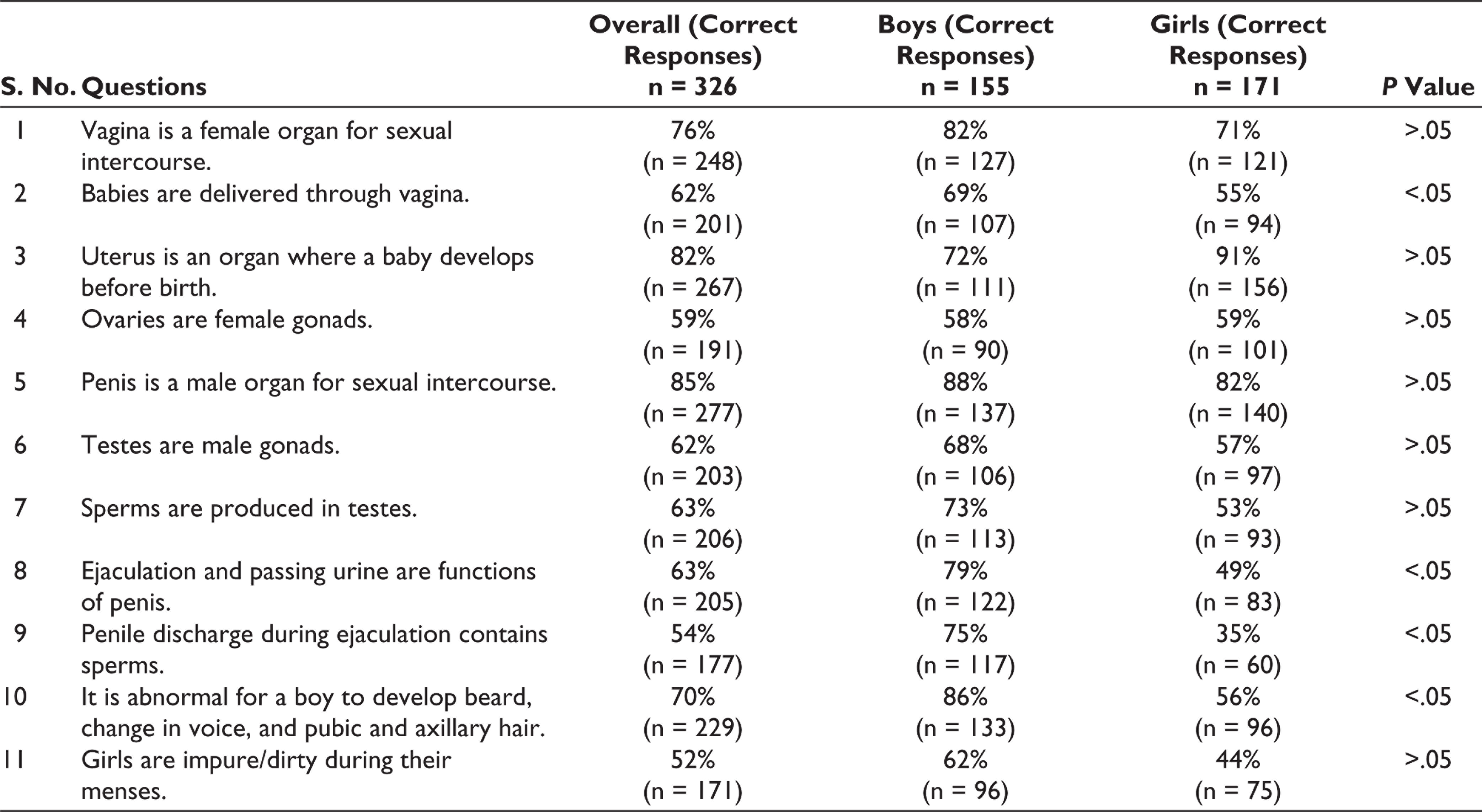
Male students seem to have more awareness than girl students. Only 55% of girls knew the babies are delivered through vaginal passage but 91% of them knew that babies are developed in the uterus of mothers. Only half of the girl students knew about the male and female gonads and sperms are produced in testes. Only 49% of the girls had knowledge about ejaculation of penis and only 35% of them knew that penile discharge contains sperms. Only 44% of girls said “no” to the question whether they are impure/dirty during monthly menstrual cycles (Table 1).
Knowledge About Female and Male Reproductive System
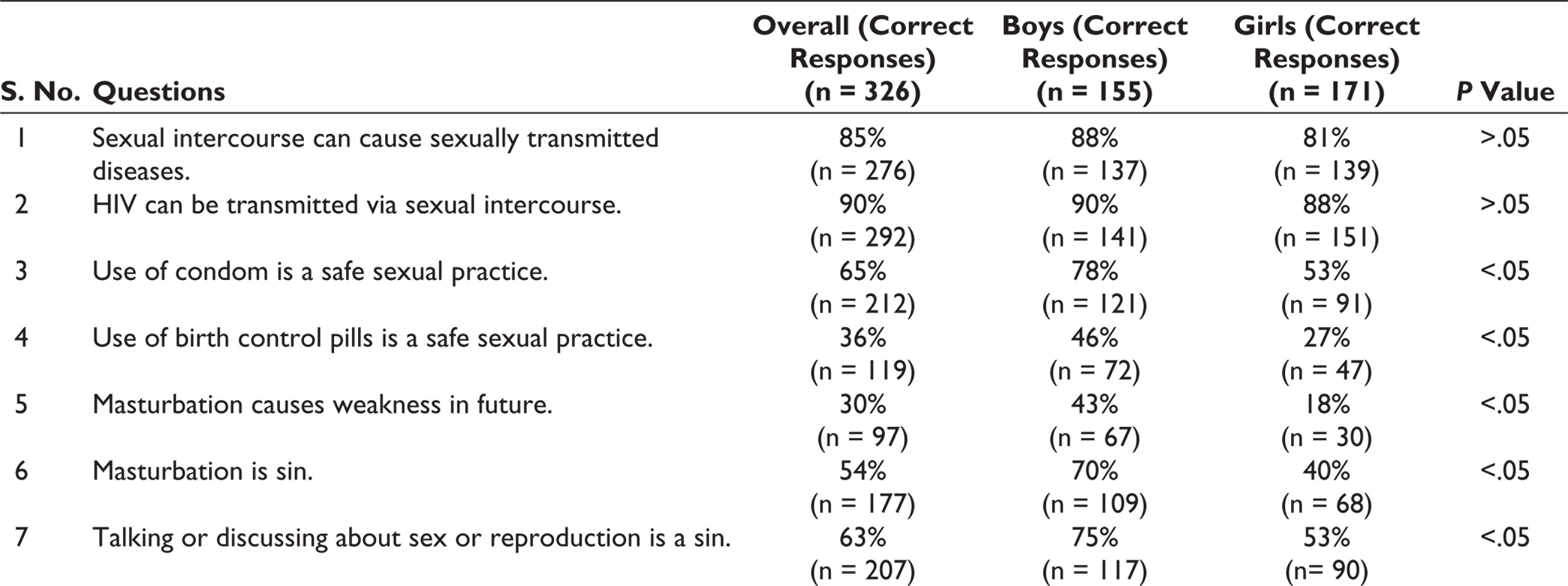
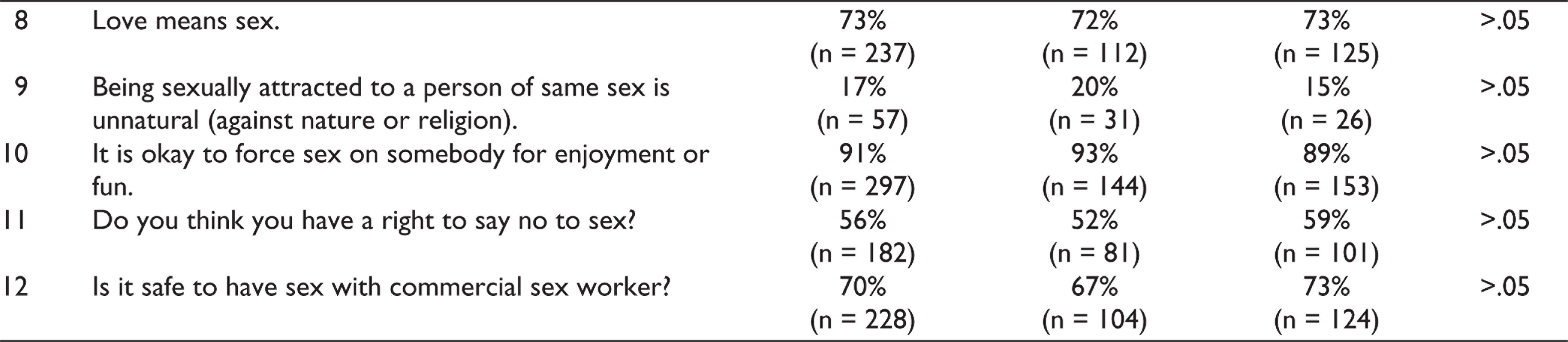
Both boys and girls seemed to have good knowledge regarding STDs and HIV. This may be for the reason that huge number of awareness campaigns are run in social and print media by health department and the government itself. Only 53% of girl students knew about the condom as a safe sexual practice and as low as 27% of them knew that birth control pill is also a safe sex practice. “Masturbation causes weakness”, only 18% of girls said “no” to this assertion and “masturbation is sin”, only 40% said “no” to this one, but 73% girl students knew love does not mean sex. Around 17% total (20%: M; 15%: F) believed that sexual attraction toward the same gender is unnatural (Table 2).
Knowledge Regarding Sexually Transmitted Diseases, Contraception, Masturbation, and Sex-Related Questions
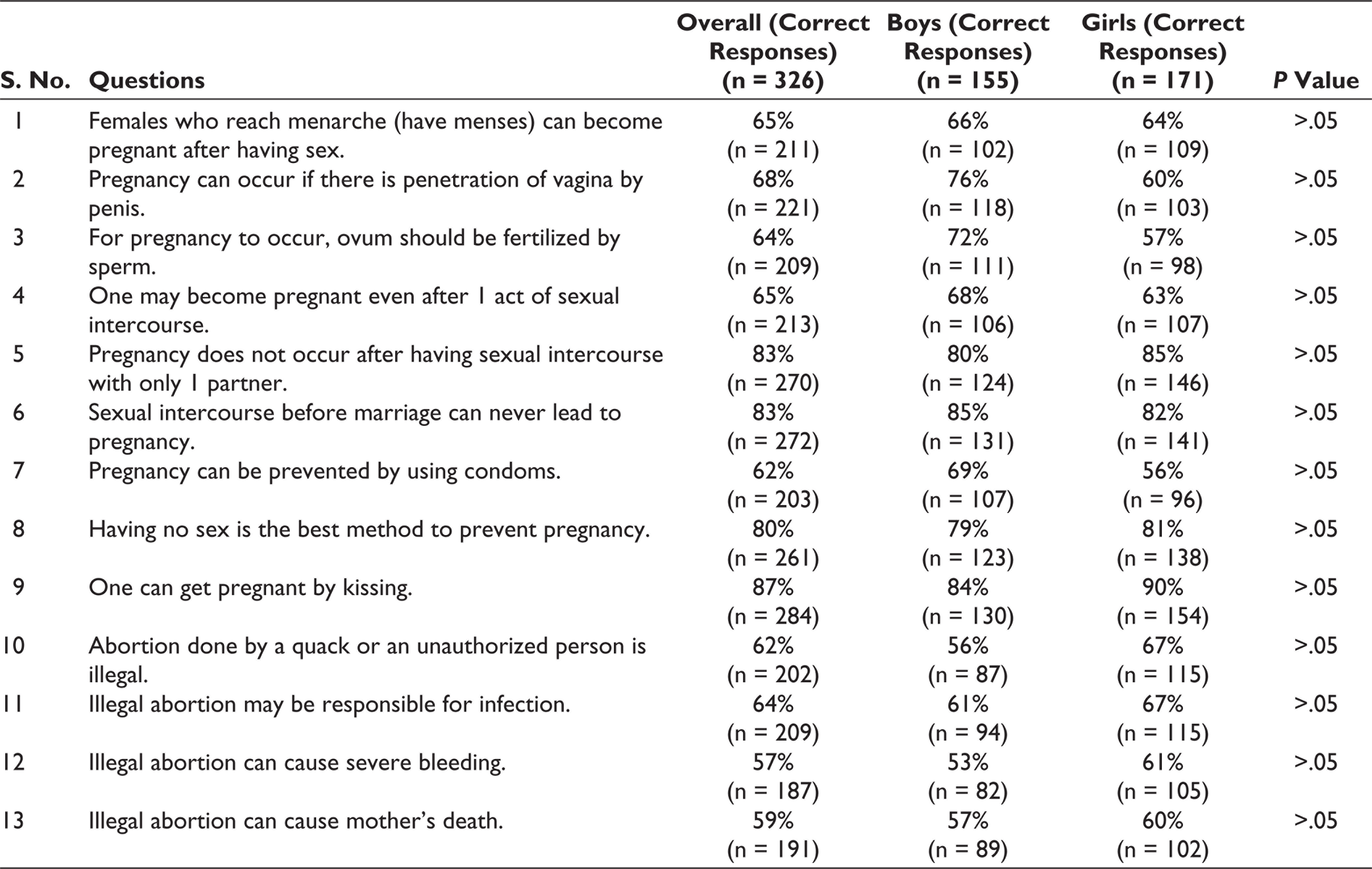
The highlights of Table 3 depict that only 64% of girls knew they can become pregnant after experiencing menarche and only 60% of them knew that penetration of penis can cause pregnancy. Only 57% of girls knew that the ovum needs sperm for fertilization. Only 56% of girls knew that pregnancy can be prevented by using condoms. Further, girl students seemed to have comparatively good information about abortion and its risk factors as compared to boys but inadequate which lays around 60%.
Knowledge Regarding Pregnancy and Abortion
Answering the questions in Table 4, 19% of students responded that they had been engaged with masturbation. While only 2% turned to have been engaged in physical relationship with the opposite sex, 7% of them had been engaged with physical relationship with the same sex. And 3% are of the opinion that they were forced to have physical relationship against their wish.
Regarding Indulgence in Sexual Activities

Discussion
The overall health during childhood and during adolescence and adulthood sets the base for health beyond the reproductive years for both women and men and impacts the health of the next progeny. 6 The National Adolescent Reproductive and Sexual Health strategy promotes a framework for sexual and reproductive health services for adolescents. It incorporates a core package of services including preventive, promotive, curative, and counseling services. A similar study by Sabahat et al 7 in Kashmir depicts that there is a need of providing correct scientific information to the adolescent regarding reproductive health. The study conducted with the higher secondary students finds that students with science background had satisfactory knowledge about the matter while arts and social science students were devoid of the knowledge. This study suggests the relevant curriculum to be implemented for all students. As far as the present study is concerned, sex and reproductive health knowledge was more in boys than girls and similar result has been observed by Gupta et al. 8 Most girls are unaware and unprepared for menarche as they are not informed or ill-informed about menstruation. 9 This study has similar results to offer in this case. Santhya et al 10 suggest in their study that girls lacking awareness regarding their physical and emotional maturity weakens the ability of young girls and women to make informed decisions about their lives. 10 One of the important and concerning results of this study is also the inadequate information among girl adolescent students with regard to contraceptives like pills and condoms. A lack of knowledge of contraceptive methods or its source of supply, the cost, and poor accessibility and awareness are the barriers that exist in developing countries. 11 In our study, a total of 30% students (43% boys and 18% girls) agreed that masturbation is a normal phenomenon, hence cannot affect the health or cause any weakness. In contrast to it, a study done by Kushwah et al 12 shows that 58% of adolescents knew that masturbation is a normal process. 12 Whether masturbation is a sin or not, the religious bent among the respondents who were Muslims pushed them to say “Yes” and a total of 54% students (70% boys and 40% girls) were among the affirmative answer givers and why only 40% girls, perhaps they didn’t know about it as the previous question related to the masturbation depicts that. There was no reference available to support this data within the known and reviewed literature.
According to UNAIDS, currently there are 33.2 million adults and children living with HIV/AIDS. 13 As far as STDs such as HIV are concerned, the study suggests that adolescent students have satisfactory awareness regarding the same. This may include one of the reasons that Kashmir has very less HIV prevalence. In our study, a total of 68% students (76% boys and 60% girls) knew that penetration of penis into the vagina leads to pregnancy and an equal percentage of 65% from both genders had the knowledge that girls can become pregnant after reaching the age of menarche. These findings are almost similar to the finding of the study done by Ademola Ajuwon et al. 14 In their study done on male and female students, Netsanet Fentahun and Abebe Mamo found that 33.1% of male and 44.6% of female students had physical relationship at least once with an individual of opposite sex. But this is opposed in our study in which only 2% of the total students responded in affirmative tone to the assertion whether they have been engaged in a physical relationship with opposite sex and 8% choose to keep quiet. Further, 3% of the total respondents agree that they have been forced to have a physical relationship and 6% choose to keep quiet. In both these cases agreement is surpassed by keeping quiet. This may be due to the fear and stigma prevalent in a conservative society. One more striking feature of the study was that 7% of the total students have been engaged in physical relationship with the similar sex at least once in their life.
There are some important observations of this study that were observed during the interaction and introduction with the students and the teachers at different stages. Although the observations cannot be depicted in figures, but are very important to note. While explaining and discussing the questions, most of the students especially girls would feel shame and would lower their gaze. There was almost no cross-questioning from the student’s side. This was felt whether they understand the question or not, they won’t open the mouth. On certain questions, there was a complete hush. It was observed that certain girls blush while listening to certain questions. Such observations conclude that how challenging it was to carry out this study but at the same time it also explains that there is a dire need to end this menace of shyness and conservatism with regard to this important aspect of human life—the sexuality and reproductive health. It is need of the hour to make sex and reproductive education as common as arts and other sciences. The school curriculum and pedagogy must include the syllabi related to these burning issues at the levels even before the onset of puberty. Teachers, schools, and mass media have a vital role to play to act as a source of information to the adolescent and the younger generation. Parents as well play an important role imparting a genuinely needed information and knowledge by bridging the gap between their adolescent children and their own selves.
Conclusion
In this day or modernity, science, Internet, mass media, and liberalism, the information and awareness regarding sex, sexuality, and reproductive health was found inadequate among the adolescent. Girl adolescent students were found having far less awareness than their counterpart boys which should have been otherwise. This is for the reason reproductive health concerns women more than men for they experience menstrual cycle, get pregnant, and have to undergo abortions and miscarriages and so on. This indicates the load of sexual and reproductive health is more inclined toward women, but unfortunately they are less informed about what concerns them most. Discussing and analyzing all the above findings, however, the sample was taken from a particular region/district of Kashmir, hence cannot be generalized.
Footnotes
Declaration of Conflicting Interests
The author declared no potential conflicts of interest with respect to the research, authorship, and/or publication of this article.
Funding
The author received no financial support for the research, authorship, and/or publication of this article.