




Abstract
Abstract
Introduction
Adolescence is a developmental bridge between childhood and adulthood. This term is derived from the Latin verb adolescere, which means to grow up. 1 It is a period between 10 and 19 years of age as per the WHO (World Health Organization Expert Committee). 2 This age group consists of 20% of the total population of the world and about 85% of the adolescents live in developing countries. 2 India has the largest national population of adolescents (243 million) 3 followed by China.
Adolescence is a period of rapid growth along with physical and emotional changes. It is a stage of life in which an individual attains sexual maturity, and in spite of this, it has been observed that adolescents lack basic information about their body, sexuality, and contraception. Discussing about reproduction is still considered a taboo in our country. But nowadays due to media exposure adolescents find themselves sandwiched between conservative Indian culture and glamorous Western culture. 4 Adolescents have many doubts and questions about their sexuality, giving rise to anxiety and confusion. Also our current education system has limited contribution in providing this knowledge to the adolescents, and this leads to many misbelieves and indulgence into unsafe or risky sexual activities by this group of individuals. Thus, sexually transmitted diseases (STDs), unwanted pregnancies, substance abuse, and unsafe abortions are important problems in adolescents. Girls are more vulnerable in this group because of marked unawareness and biological susceptibility to STDs. 5
Adequate reproductive health education is the need of time. Debates are still going on about who should (eg, teachers, parents, etc.) and to what extent educate adolescents about sexual matters.
With this background in mind, the current study was planned with aims of assessing knowledge, attitude, and practices of adolescents toward reproductive health, STDs, and common secondary sexual changes, and to find out the source of information of knowledge.
Materials and Methodology
This was a cross-sectional single interview study carried out in 2 Central Board of Secondary Education high schools in the city in central India, after seeking permission from the institutional ethics committee. A self-rating questionnaire was prepared which included questions about knowledge, attitude, and practices regarding human reproductive organs, pregnancy, contraception, STDs, and sexual and reproductive health information. Each question has 3 options (yes/true, no/false, don’t know). The prepared questionnaire was validated by 5 different psychiatrists in Nagpur. After getting the questionnaire validated, principals of 5 schools were approached for permission. 2 schools denied permission with the reason of upcoming exams at that time and 1 school expressed concern regarding the topic. Finally, we got written permission from 2 schools to conduct the study and prior appointment was taken. A day prior to the study, both schools were visited and consent forms for parental permission were distributed to all the students studying in 8th, 9th, and 10th standards. All the students were instructed to bring signed forms with them the next day. Students whose parents consented for the same were included in study. Beginning from roll number 1, odd roll numbered students, totaling to 650, were selected. The questionnaire was given to each participant and it was made sure that they understood questions before marking the answer. About 350 students did not get permission letters from parents so could not be included in study. Confidentiality of the participant was maintained by not mentioning the name or any other identity. The data thus collected was statistically analyzed under the guidance of the statistician, using Epi info-7 (statistical software for epidemiology developed by CDC, Atlanta, GA, USA) software. For analysis and comparison of data, chi-square test was used.
Results and Observation
Results of the study were tabulated and analyzed as follows:
Out of the total participants, 57% (171) were boys, while the remaining 129 were girls.
Almost equal numbers of participants were selected from each class. About 29% belonged to 8th standard, 33% to 9th, and 36% from 10th class.
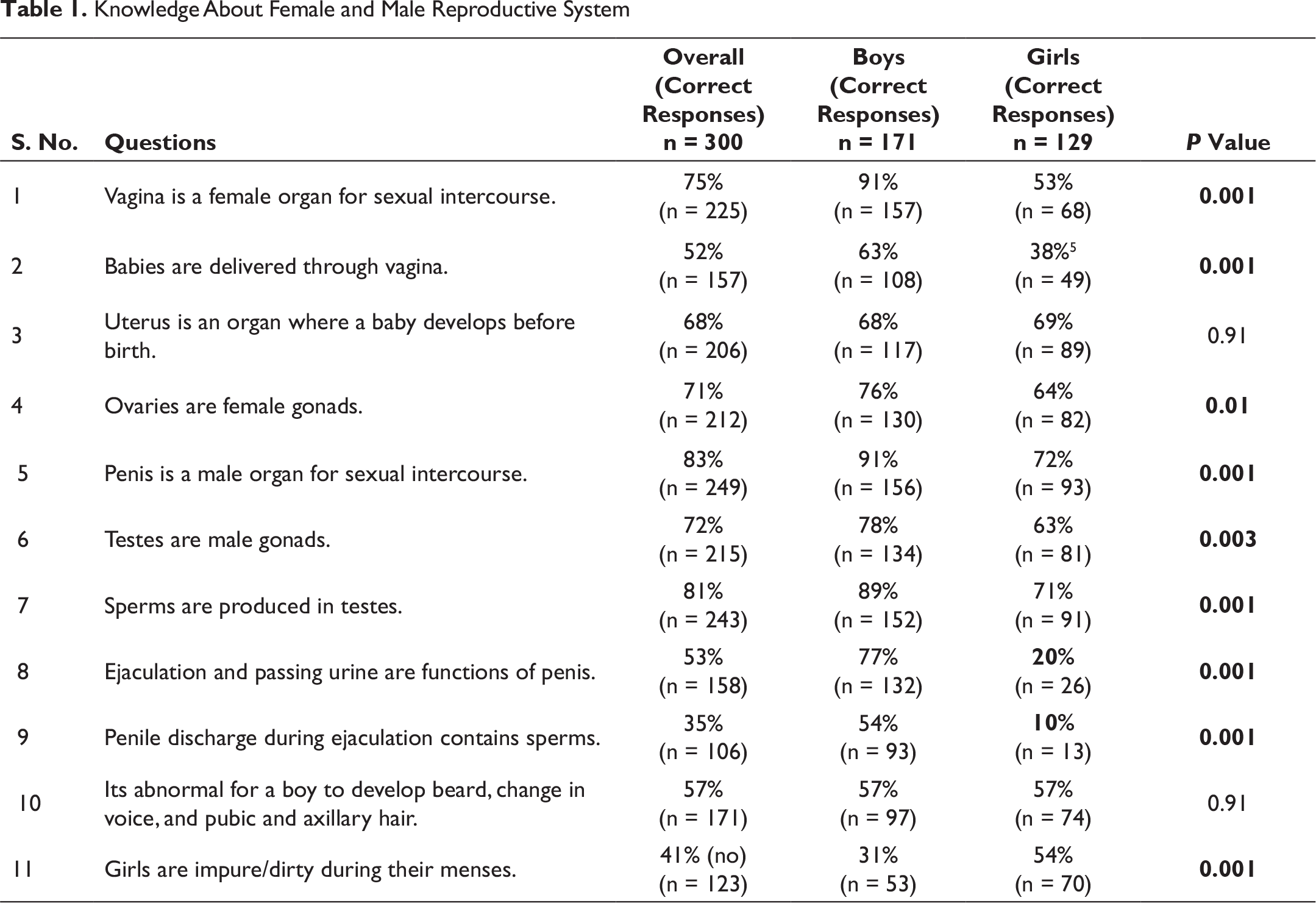
Only 38% girls knew that babies are delivered through vagina. Majority of the students, ie, 59%, believed that girls are impure/dirty during their menses. Only 20% of girls were aware about the functions of penis and only 10% knew that penile discharge contains sperms, which points toward the fact that most of the girls were ignorant about the anatomy of the opposite sex (Table 1).
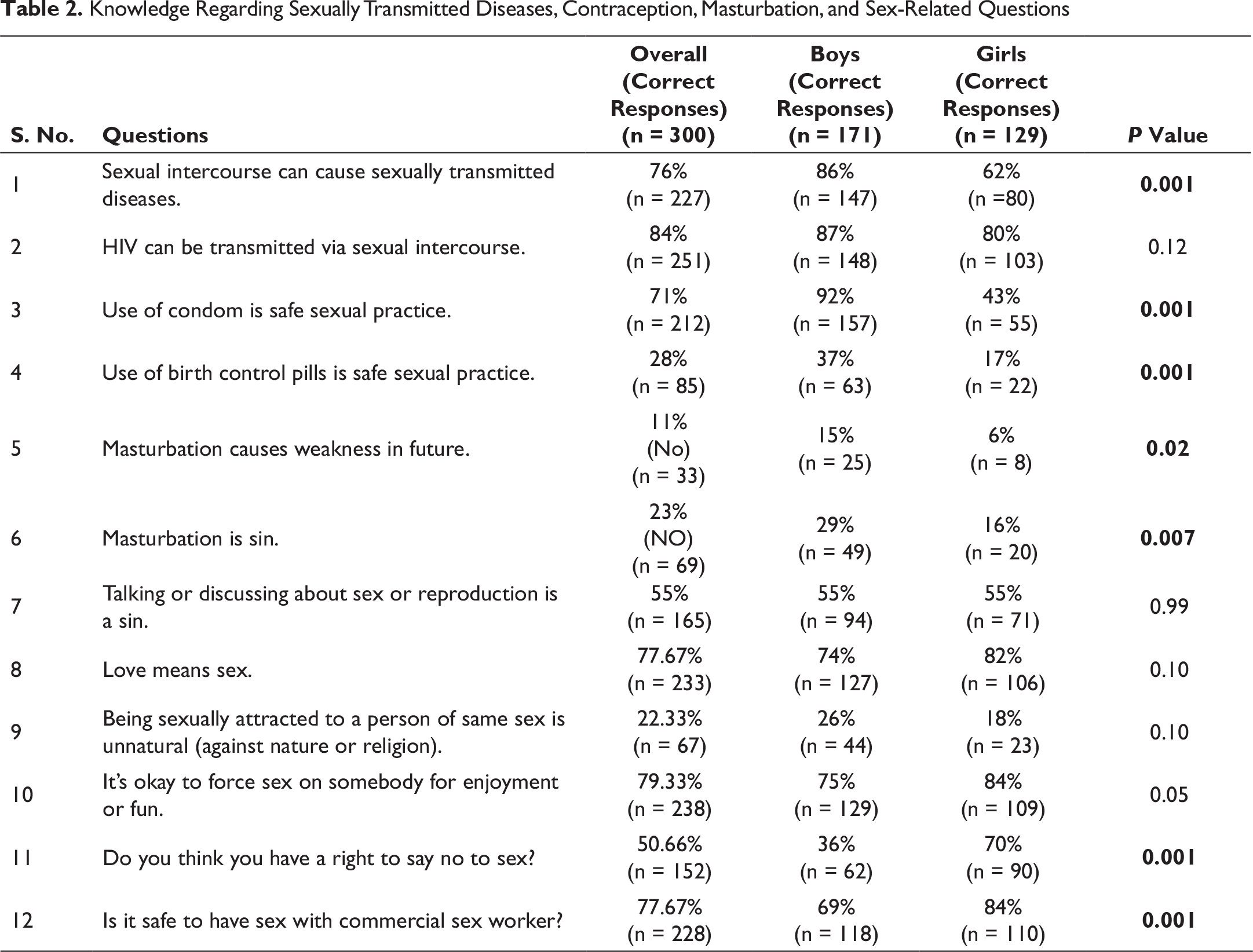
92% of boys knew that use of condoms was safe sexual practice but only 43% girls. had awareness about the same. Only 28% of the students were aware that the use of birth control pills is a safe sexual practice. Regarding masturbation, 89% were not aware of the fact that it does not lead to weakness in future. Only 23% of students were sure about the fact that masturbation is not a sin, while 56% of them did not know the answer. Majority, ie, around 78%, of the total students believed that being sexually attracted to a person of the same sex is unnatural. Only around 50% of the students were aware that they have a right to say “no” to sex. Majority, ie, approximately 78%, of the total students were aware that it is not safe to have sex with commercial sex workers (Table 2).
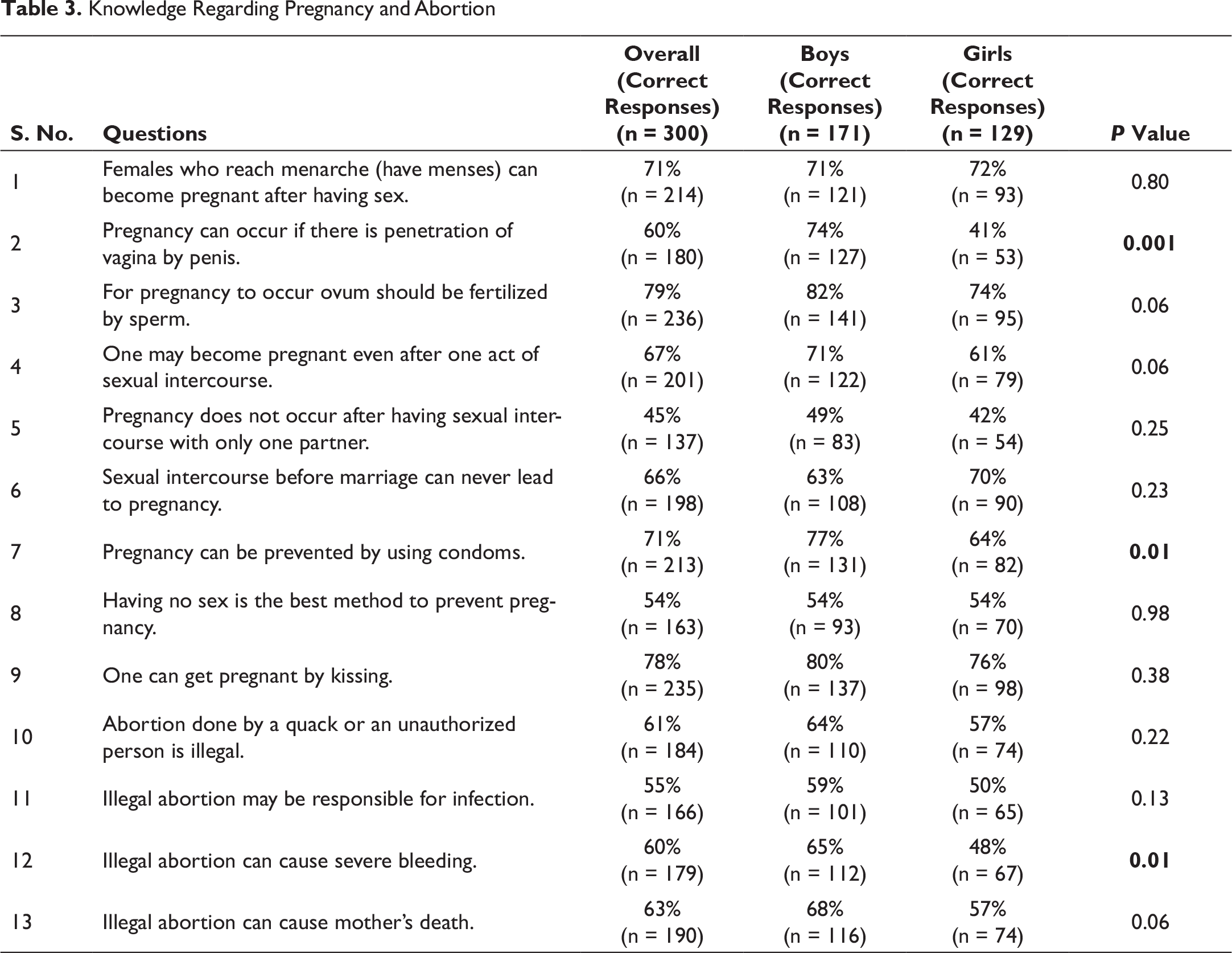
Most of the participants had satisfactory knowledge about pregnancy-related issues. Still it was found that only 41% girls knew that penetration of vagina by penis can lead to pregnancy. 61% of the total students were aware that abortion done by a quack or an unauthorized person is illegal (Table 3).
Knowledge About Female and Male Reproductive System
Knowledge Regarding Sexually Transmitted Diseases, Contraception, Masturbation, and Sex-Related Questions
Knowledge Regarding Pregnancy and Abortion
Regarding Indulgence in Sexual Activities.

Discussion
In our study, more boys than girls knew about the female reproductive system and menstruation. This was similar to the observations made by Gupta et al 6 who found that awareness of all reproductive health matters was more in boys than girls. Only half of the participants knew that babies are delivered through vagina, while in a study done by Kushwah et al, 7 most of the respondents were aware about the birth passage. Majority of the students believed that girls are impure or dirty during their menses. Whereas in a study done by Kushwah et al 7 only 24% respondents thought that menstruation is shameful, 33% agreed that girls are not to be touched, and 30% considered menstruation as a disease. But another study by Bobhate et al 8 found that most of the girls faced restrictions during menstruation. This is indicative of the prejudice view of Indian society toward menstruation and points toward the prevalent misconception about the same.
Regarding the male reproductive system, again, most of the girls were not fully aware, eg, about the functions of penis, and still less number of girls knew that penile discharge during ejaculation contains sperms. This finding is similar to that of Gupta et al, 6 in which boys were more aware than girls regarding all reproductive health matters. When taken together, about 3/4th of all the participants knew about the transmission of STDs and HIV, but here also more number of boys were aware than the number of girls. Only 1/4th of the students were aware that the use of birth control pills is a safe sexual practice. Kotecha et al 9 conducted a study as per which all the boys had heard about garbha nirodhak goli (birth control pill), but very few knew about condoms, and half of the participants were aware about the mode of transmission of HIV and STDs. Interestingly, we found that a few students had an unusual misconception that having sex with animals or younger children can cure STDs. We were unable to find any reference to this finding in the literature.
In our study, only 11% students agreed that masturbation is a natural process and that it does not cause weakness in future and a few more agreed to the fact that it is not a sin. Whereas in a study done by Kushwah et al, 7 58% of adolescents knew that masturbation is a normal process. Lacuna in knowledge about this sensitive issue explains the origin of culture-bound syndrome like Dhat syndrome in the population. Masturbation though commonly practiced especially among boys has been criticized sharply in society, probably because it is a private behavior rarely shared or discussed in public with even the closest of friends, and thus leads to various myths associated with it. When thrown with the question that whether they masturbated at least once, only 11% agreed to the same, while 33% chose not to answer the same.
While most of the participants had satisfactory knowledge about pregnancy-related issues, still less than half of the girls knew about the process leading to pregnancy. In our study, 60% (74% of boys and 41% of girls) knew that pregnancy can occur if there is penetration of vagina by penis and ejaculation. This finding is almost similar to the finding of the study done by Ademola et al, 11 in which approximate half of the students knew about the same. As far as the definition of legal abortion is concerned, only 1/4th of the students knew the upper limit of gestation for abortion. In another study by Bhobhate et al, 8 90% of females were not aware about the legal status of abortion in India.
In a study done on male and female students by Netsanet Fentahun and Abebe Mamo, 10 it was found that 33.1% of male and 44.6% of female students had physical relationship at least once with an individual of opposite sex as opposed to our study in which only 4% of the total students confessed to have sexual relationship at least once, while 15% chose not to answer the question. The lack of answer could be due to shyness and stigma associated with it in Indian culture, even though the names of the participants were kept anonymous. Around 13% of the students were not willing to answer the question that whether they were forced into having any physical relationship against their wish ever in their life, while 5% were bold enough to accept it. Supporting findings were seen in a study by Ademola Ajuwon et al 11 on secondary school students in Nigeria, in which 6% of the males and 4% of the females were forced to have physical relationship. Around 2/3rd of the students felt the need for more education regarding sexual and reproductive methods as is evident in the question of need for more knowledge about the reproductive and sexual health. Literature shows that adolescents are willing and interested in the topic and that more than 2/3rd want to talk and know more about STDs, contraception, and other sex-related issues. 12 A study on the level of knowledge and behavior of adolescent male and female students in Turkey on the matter of reproductive health by Saadet Yazıcı et al 13 showed that 62.8% of the total students wanted to be informed on the above-mentioned issues. They also found that most of the students (60.7%) wanted this information prior to the onset of puberty changes. 13
Teachers, mass media, and friends were found to be the most common sources of information regarding these matters, while parents and siblings were the least. Similar findings were observed in an American study that school was the main source of information (54.7%), while parents were among the least (0.8%). 14 This highlights the important role played by teachers, mass media, and friends in imparting information regarding sexual matters. In yet another study, it had been found that adolescents who had a talk about sex-related matters with their parents were more likely to delay the initiation of sexual activities15, 16 and increase the use of safe sexual practices such as using condoms and contraceptive pills.15, 17, 18 Tesfaye et al 19 in their study observed that out of the total participated parents, only 28.76% of them reported that they discussed about reproductive health-related matters in the last 6 months with their adolescent children. But very few parents were bold enough to discuss about the same with their children at home. This study also found that the most common reason for no communication with their adolescents was either lack of awareness of reproductive health (60.75%), fear that this discussion may encourage premarital sex (51.40%), and sociocultural norms that prevented them from free communication. However parental communication is a potential effective tool for promoting healthy and safe sexual practices. For this, teaching parents and teachers regarding certain general communication skills might prove helpful.
Conclusions
Overall, the knowledge regarding matters related to sexual and reproductive health was inadequate in this study sample. Thus, there is a need for providing more information about the same to adolescents.
Girls were found to have less knowledge compared to boys. Parents need to have adequate communication with their adolescent regarding sex-related topics, as parents were found to be among the least common sources of information regarding the topic; however, imparting the correct information, with an open-minded approach, by them while talking to their children about these matters is equally important. Teachers were the most common source of information regarding the topic; thus, school plays an important role in providing knowledge about the same in adolescents.
However, the main limitation of the study was that since it was carried out in private schools, the findings cannot be generalized.
Footnotes
Declaration of Conflicting Interests
The authors declared no potential conflicts of interest with respect to the research, authorship, and/or publication of this article.
Funding
The authors received no financial support for the research, authorship, and/or publication of this article.
