




Abstract
Abstract
Keywords
Introduction
It has been estimated that more than 90% of world’s population will get married at least once. 1 The satisfied marital relationship and its determinants are always of interest to social scientists globally. Sexual issues, such as sexual satisfaction, are one of the biggest determining factors in marital adjustment and satisfaction.2, 3 In recent times, there has been tremendous increase in studies focusing on male sexuality and its relationship with psychosocial phenomena, but the role of sexuality in women’s lives is largely ignored. 4 The available studies are done with Western women only. 5 In countries like Pakistan, it has not always been easy to study the link of sexual processes with other psychological phenomena such as marital satisfaction in women. Pakistan is a conservative Islamic country which has Eastern collectivistic values culture. It is deeply ingrained in Women in Pakistan not to openly discuss their marital and sexual matters and honor the dignity of their husbands and families. The patriarchy and collectivistic nature of decision-making in Pakistani society left little room for studies related to sexual satisfaction in the context of marital relationship among women. 6 The present research was conducted to fill this gap.
Ellis defined marital satisfaction as a state of contentment, satisfaction, and pleasure that each member of a married couple enjoys mutually when all aspects of their living together are taken into account. 7 It depicts the overall state of affairs of each member of a married couple. 8 There are several dimensions of the concept of marital satisfaction such as sexual satisfaction, receiving support from partner, participation in decision-making process, relationship with partner’s family, social support, psychological well-being, and satisfaction with life.9-13 Marital satisfaction depends on variables such as the gender of partner, 12 duration of being married, 14 age, 15 age at the time of marriage, 16 the number of marriages, 16 the number of children,17-18 socioeconomic and work status,16, 19 and education. 20
The association of several demographic variables with marital satisfaction has different results. The duration of being married has mixed results on marital satisfaction. Some studies report that marital satisfaction decreases as the time of being married increases,21, 22 whereas some other studies report the opposite.23, 24 Age also influences marital satisfaction. The individuals in middle age group experience more marital problems and less satisfaction as compared to individuals in old age.21, 25-28 Similarly, age at the time of marriage is also important in marital satisfaction.29, 30 More age at the time of marriage is associated with greater marital satisfaction and less divorce rates. Number of marriages also impacts marital satisfaction. It has been shown that marital satisfaction was high within first marriages than in second or later marriages. 31 Duration of marriage appeared to affect marital satisfaction significantly in first marriages as compared to second or later marriages. 31
The presence of children in a marital relationship is associated with marital satisfaction although increase in the number of children could lead to marital problems.26, 32 In Asian cultures, having a male child significantly contributes towards marital satisfaction. 33 The effects of education and work status of women on marital satisfaction are mixed. Majority of studies associate education and employment of women with marital satisfaction, some studies report no effects of women education and employment on marital satisfaction while some others report lowered marital satisfaction in employed women as compared to unemployed women.24, 34-42
Sexual satisfaction of a woman can be understood by applying one of the many models of female sexual response or functioning. Sexual functioning of a woman can be understood in terms of phases or stages of sexual response cycles presented by various theorists. One such theory was presented by Masters and Johnson involving 4 stages of sexual response in women, namely excitement, plateau, orgasm, and resolution. This model was presented in the 1960s and is known as the linear model of female sexual response. 43 This model views female sexual response progressing from the first stage till the end in a linear fashion. The successful experience through these stages often results in sexual satisfaction. Sexual satisfaction is the end product of the sexual response cycle in women.44, 45 Renowned sex therapist Helen Singer Kaplan revised the stage model of Masters and Johnson and presented her 3-stage model consisting of desire, arousal, and orgasm. 46 The model of Masters–Johnson–Kaplan has been criticized as it did not take into consideration non biological factors of sexuality like relationship. 47
In 1977, 2 researchers Whipple and Brash McGreer suggested another model of female sexual functioning known as the circular model. 48 This model noted that females’ sexual function does not always function in a biological linear way. 49 This model has been based on the work done by Reed and outlines 4 stages of female sexual response, namely seduction (desire), sensations (excitement and plateau), surrender (orgasm), and reflection (resolution). If a woman’s sexual experiences demonstrate satisfaction and pleasure for her, she will be seeking another such experience hence making the cycle circular.
Contrary to the circular model, Basson and colleagues presented another model of female sexual response known as the non-circular model.44, 50-53 Basson’s model considers the female sexual function distinctively different from the male sexual function. The female sexual function is affected by psychosocial factors such as relationship satisfaction and past sexual experiences. Unlike male sexuality, female’s sexual function is guided by her partner and her attraction toward the partner and not by her own biological libido. Females seek out sexual activity in the context of a relationship. According to Basson, the goal of female sexuality is emotional satisfaction and not always physical satisfaction.44, 53 Basson’s model places more emphasis on emotional, psychological, and relational aspects of a woman’s sexual response, whereas the Masters–Johnson–Kaplan model places more emphasis on physical aspects of a woman’s sexual response. 54
The current studies regarding the female sexual function model view female sexuality from the biopsychosocial model taking into consideration physical and psychosocial factors surrounding sexual expression.44, 49, 55 But majority of studies report that healthy women endorsed circular models of sexual response. 56
Studies have found a significant relationship between improved sexual functioning and high sexual satisfaction.57-60 The latter is defined as one’s subjective evaluation of all aspects related to one’s sexuality within a relationship. 61 Sexuality is an integral part of a woman’s marital satisfaction and satisfaction with life.62-65
Failure in satisfaction of sexual needs results not only in physical and mental symptoms but also ruins the quality of marital relationships, thus leading to decreased marital satisfaction.66, 67 Factors such as number of children, being pregnant, and relationship quality determine the quality of sexual functioning. 68 Previous studies establish that marital satisfaction leads to improved sexual functioning in women and vice versa.2, 69, 70
Marital relationships are the strongest indicators of psychological well-being and satisfaction with life in married individuals. 71 Sexual satisfaction is one of the factors leading to satisfaction with life. 72 Sexual dysfunctions lead to lowered psychological well-being and satisfaction with life among women. 73
Satisfaction with life is a subjective concept. It includes concepts such as happiness, peace of mind, and fulfillment. Studies have established a direct link between marital satisfaction and satisfaction with life. 74 The studies indicate that the relationship between marital satisfaction and satisfaction with life is 2-way.75, 76 Numerous studies show that sexual satisfaction is an essential condition of satisfaction with life, well-being, quality of life, emotional satisfaction, and happiness.77, 78 Sexual health and satisfaction has been shown to help lead to a satisfied life in women, but this variable is under explored when it comes to its relationship with other variables of human importance. 79 The essential nature of sexual satisfaction in securing one’s well-being makes it one of the important variables to be researched.
Given the importance of sexual satisfaction in maintaining a satisfied life and marriage, the present study investigated the mediating role of sexual satisfaction in marital satisfaction as predicting satisfaction with life in married women. It was assumed that the linear relationship between marital satisfaction and satisfaction with life in women was mediated by the presence of variable of sexual satisfaction.
Materials and Methods
Participants
A total of 100 married women of reproductive age ranging from 18 years to 48 years (M = 29 years) were included in the sample. The sample was selected conveniently from the outpatient gynecology departments of three hospitals in Bahawalpur in South Punjab state of Pakistan.
Inclusion Criteria
The married women of child-bearing age residing in Bahawalpur in South Punjab state of Pakistan were included in the sample.
Exclusion Criteria
The single, widow, pregnant, or menopausal women or women under the age of 18 years were excluded from the sample.
Instruments
Demographic Information Questionnaire
A demographic information questionnaire was designed to record the demographics of the married women including duration of marriage, age, age at the time of marriage, number of marriage, number of children, work status, and education of married women.
Kansas Marital Satisfaction Scale
The Kansas Marital Satisfaction Scale 80 (KMSS) is a 3-item self-report, quick, and easy-to-administer standardized scale to measure marital satisfaction. The items are scored on 7 point Likert scale ranging from extremely dissatisfied (1) to extremely satisfied (7). The scale score is a sum of the total obtained score of the participant. The total scale score may range from minimum 3 to maximum 21. The higher scores mean better marital satisfaction. The Cronbach alpha reliability of the scale has been estimated to be 0.84. The discriminant validity of the scale has been estimated to be 0.76.
The Index of Sexual Satisfaction
The Index of Sexual Satisfaction 81 (ISS) is a self-report short scale to measure the degree of satisfaction or dissatisfaction in a dyadic relationship. The scale consists of 25 Likert-type items. The maximum score is 100. The higher scores above 30 indicate the degree of sexual dissatisfaction in the dyadic relationship. The scale has internal consistency and test–retest reliability of 0.90. The discriminant validity of the scale is 0.76.
Satisfaction With Life Scale
The Satisfaction with Life Scale 82 (SWLS) is a 5-items scale designed to measure one’s overall general satisfaction with life. This is a 7-point Likert scale and the responses are recorded either strongly agree (7) to strongly disagree (1). The score can range from minimum 5 to maximum 35. The higher scale score indicates higher satisfaction with life. The Cronbach alpha reliability of the scale is 0.87, whereas test-–retest reliability of the scale is 0.82.
Procedure
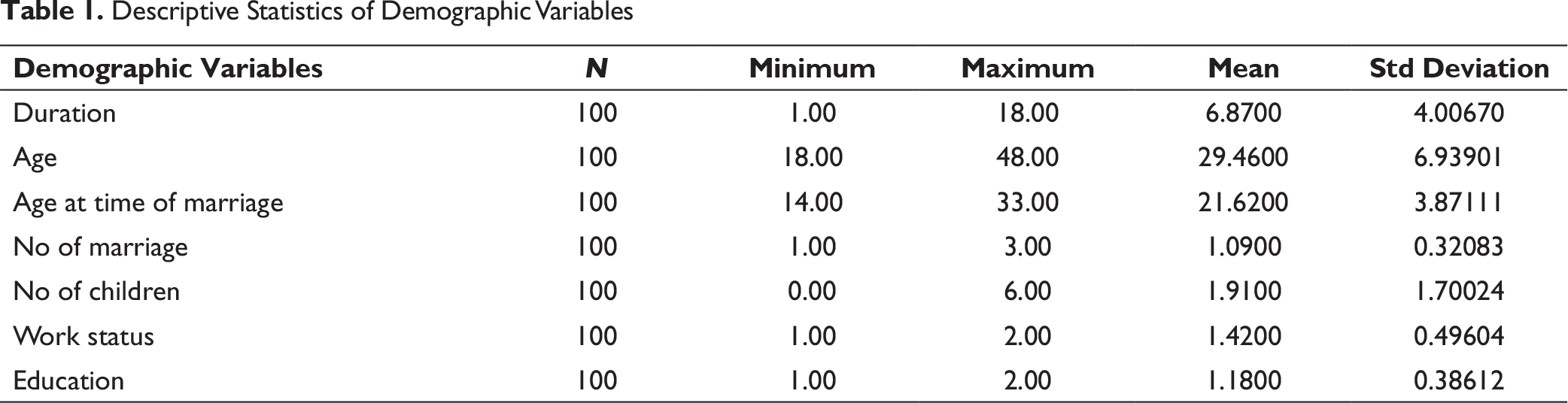
Descriptive Statistics of Demographic Variables
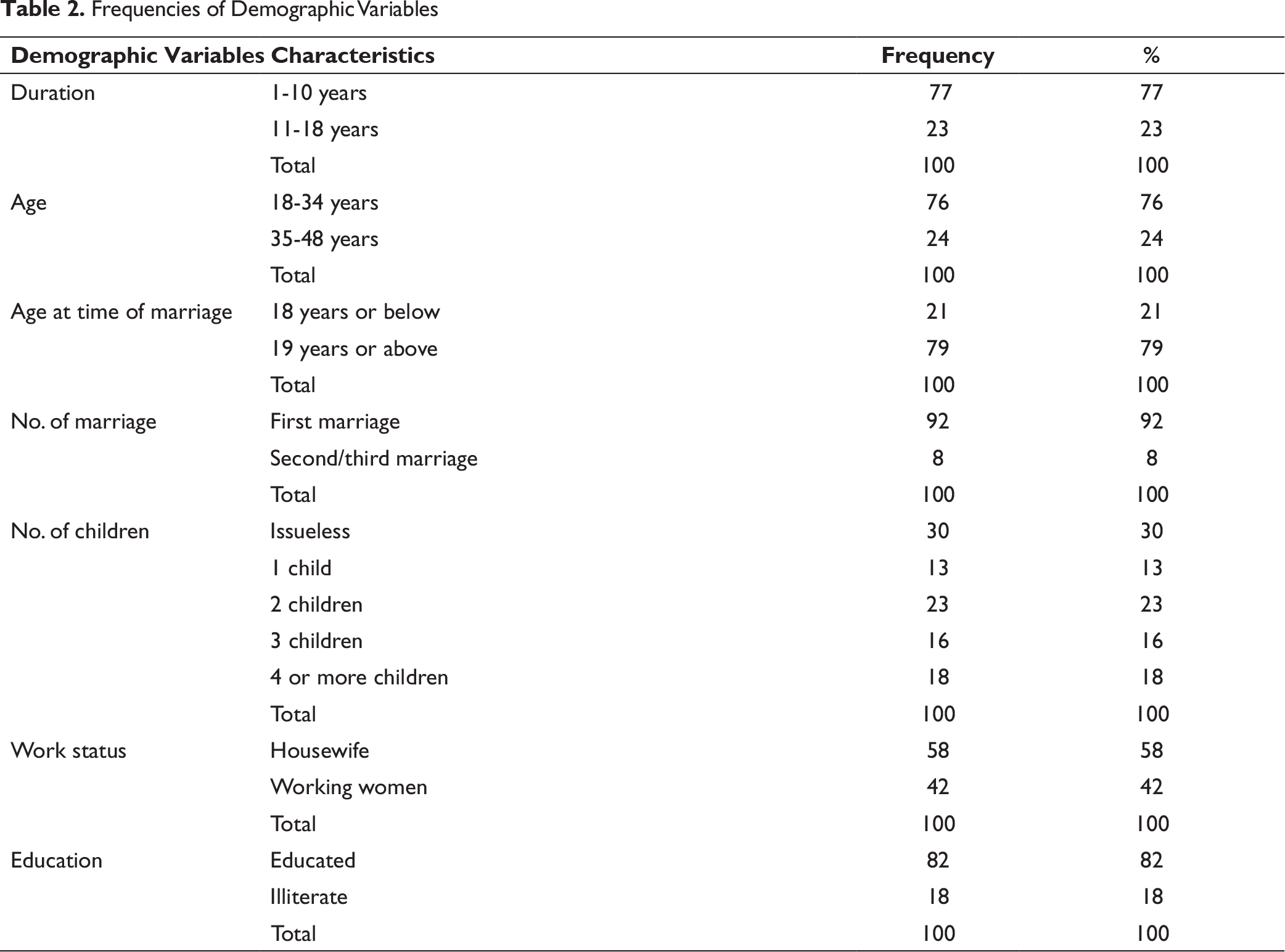
Frequencies of Demographic Variables
Statistical Analysis
Data was analyzed by the Statistical Package for the Social Sciences (IBM, USA), version 25, and Macro Process, v3.4. The analysis were presented by descriptive statistics including mean, standard deviation, frequencies, mediation analysis, analysis of co-variance, analysis of variance, and independent samples t test. In these analyses, mediation is significant when the 95% bias corrected and accelerated confidence intervals for the indirect effect did not include zero.83, 84 The data were collected after obtaining the approval from the Research Ethics Committee at the institution of the authors’ affiliation.
Results
Tables 1 and 2 describe the descriptive statistics including mean, standard deviation, and frequencies of the demographic variables. A total of 100 married women participated in the study whose age ranged from 18 to 48 years (M = 29.4600, SD = 6.93901). There were 76% women in the age range of 18-34 years while there were 24% women in the age range of 35-48 years. They had been married for at least 1 year and maximum for a period of 18 years (M = 6.8700, SD = 4.00670). Majority of the women had been married for 10 or less years (77%), while only 23% had been married for more than 10 years. At the time of marriage, their minimum age was 14 years and maximum age was 33 years (M = 21.6200, SD = 3.87111). A total of 21% women had been married when they were 18 or less years, while majority (79%) had been married when they were 19 years or above. The majority (92%) had been married for the first time (M = 1.0900, SD = 0.32083). The minimum number of children was none and maximum number of children was 6 (M = 1.9100, SD = 1.70024). A total of 30% women were issueless whereas 13% had 1 child, 23% had 2 children, 16% had 3 children, and 18% of the women had 4 or more children. A total of 58% women were housewives whereas 42% were working women. A total of 82% women were educated whereas 18% were illiterate.
Results of Mediation Analyses (With Process, v3.4)
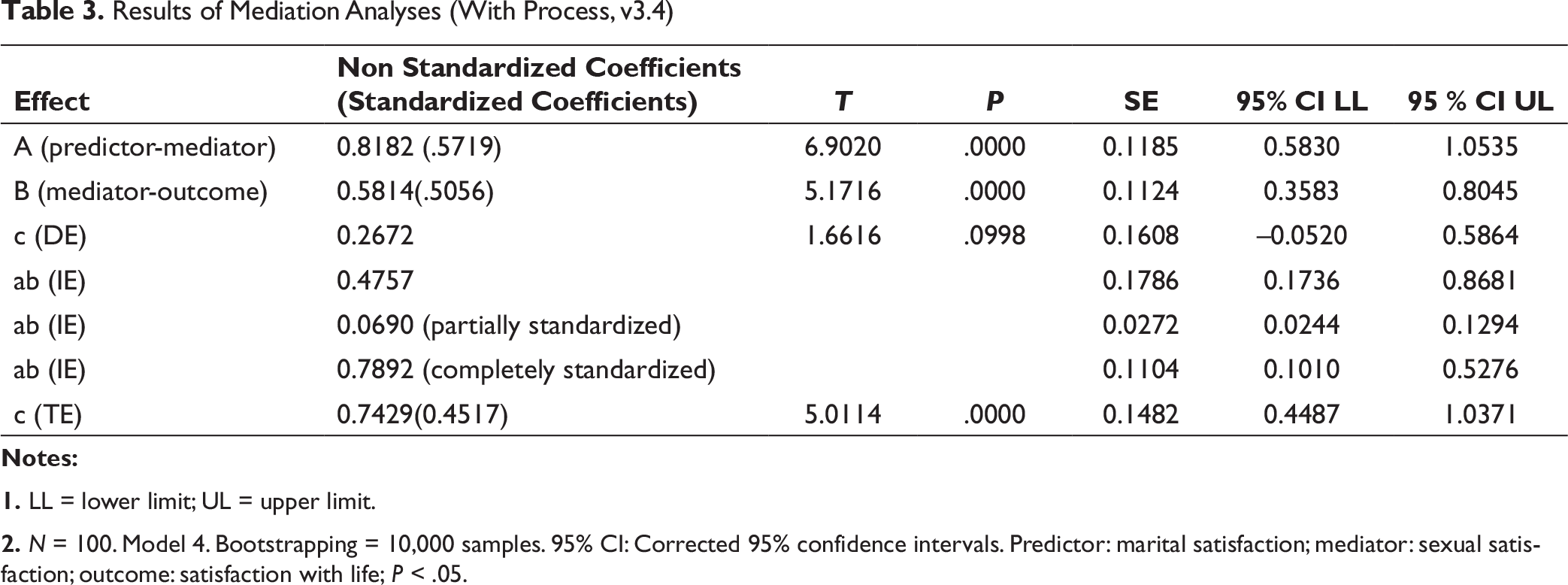
1. LL = lower limit; UL = upper limit.
2. N = 100. Model 4. Bootstrapping = 10,000 samples. 95% CI: Corrected 95% confidence intervals. Predictor: marital satisfaction; mediator: sexual satisfaction; outcome: satisfaction with life; P < .05.
Results of Analysis of Covariance (ANCOVA)

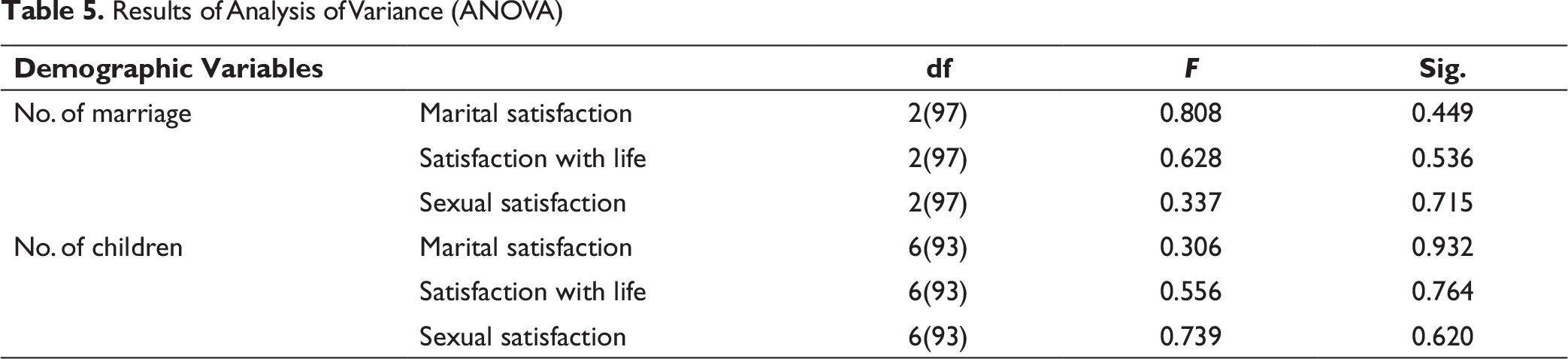
Results of Analysis of Variance (ANOVA)
Results of Independent Samples
t
Test
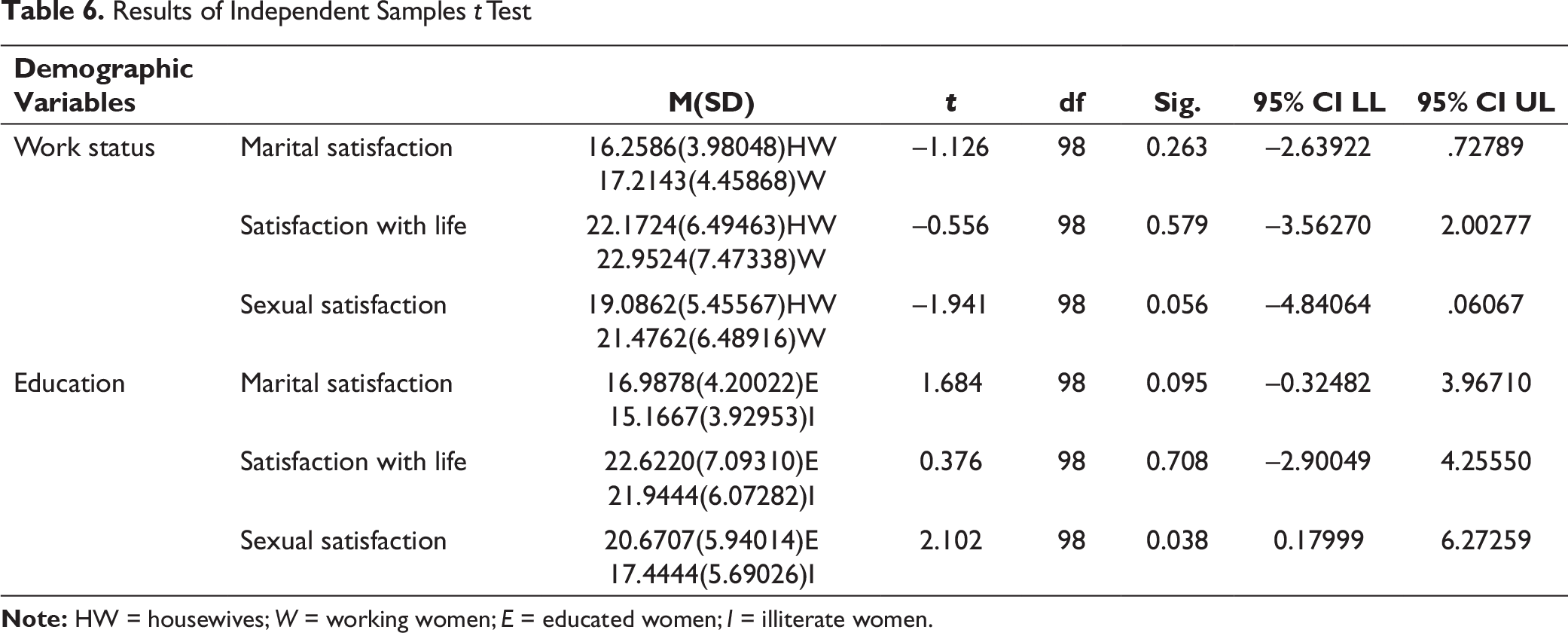
Table 4 outlines the results of analysis of covariance run to see the effect of marital and sexual satisfaction on satisfaction with life when controlling for duration of marriage, age, and age at the time of marriage among women. There was found no significant effect of marital and sexual satisfaction on satisfaction with life among women when duration of marriage (F(1,51) = 0.000, P > .05), age (F(1,51) = 0.541, P > .05), and age at the time of marriage (F(1,51) = 0.091, P > .05) were controlled.
Table 5 gives the results of analysis of variance calculated to see the effects of demographic variables, namely, number of marriage and number of children on marital and sexual satisfaction and satisfaction with life among women. There was no significant effect of number of marriage (F(2,97) = 0.808, P > .05); (F(2,97) = 0.337, P > .05); (F(2,97) = 0.628, P > .05); and children (F(6,93) = 0.306, P > .05); (F(6, 93) = 0.739, P > .05); (F(6,93) = 0.556, P > .05) on marital and sexual satisfaction and satisfaction with life respectively among women.
Table 6 describes the results of independent samples t test calculated to see the difference in means of work status and education for marital and sexual satisfaction and satisfaction with life among women. Statistically non-significant difference was found in housewives (M = 16.2586, SD = 3.98048; M = 19.0862, SD = 5.45567; M = 22.1724, SD = 6.49463) versus working women (M = 17.2143, SD = 4.45868; M = 21.4762, SD = 6.48916; M = 22.9524, SD = 7.47338) on marital (t(98) = –1.126, P > .05) and sexual satisfaction (t(98) = –1.941, P > .05), and satisfaction with life (t(98) = –0.556, P > .05), respectively. Non-significant difference was found in means of educated (M = 16.9878, SD = 4.20022; M = 20.6707, SD = 5.94014; M = 22.6220, SD = 7.09310) versus illiterate women (M = 15.1667, SD = 3.92953; M = 17.4444, SD = 5.69026; M = 21.9444, SD = 6.07282) on marital satisfaction (t(98) = 1.684, P > .05) and satisfaction with life (t(98) = 0.376, P > .05). However, statistically significant difference was found in educated and illiterate women on sexual satisfaction (t(98) = 2.102, P < .05). Educated women were found to be more sexually satisfied as compared to illiterate women.
Discussion
Marital satisfaction not only leads to a happy family but also plays a pivotal role in satisfaction with life of women. Women especially in the eastern part of the world derive special meanings from marriage and places heavy emphasis on marital relationships. In the cultural context of Pakistan, marital satisfaction is a big determinant of satisfaction with life, especially in women. 6 This holds true for women of other similar cultures too, like Iran. 85
But previous studies report that marital satisfaction is dependent upon certain other areas of marital relationship such as sexual satisfaction, which is a key component of a woman’s marital satisfaction. 86 Sexual satisfaction has been found to be a main factor in one’s marital satisfaction and satisfaction with life. Lack of sexual satisfaction has been shown to lower marital satisfaction and satisfaction with life in women. There has been a negative relationship between lack of sexual satisfaction and marital satisfaction among women. 87 The same relationship has been expressed true by this study.
Current models of sexual functioning of women attribute the lack of sexual satisfaction to many factors including biopsychosocial factors. These factors may include marital issues, partner performance during the sexual activity, sexual dysfunctions, lack of emotional satisfaction, and childbirth. The construct of sexual satisfaction is inseparable from marital satisfaction in women. Together, they lead to satisfaction with life in women. 33 Satisfaction with life is considered synonymous with general well-being, psychological well-being, and happiness. Sexual satisfaction alone can lower a woman’s satisfaction with life, but sexual satisfaction’s combined effect with marital satisfaction is similar and can lower satisfaction with life.
Together marital satisfaction and sexual satisfaction depend on a number of demographic factors such as duration of being married, age of woman, age at the time of marriage, number of marriages, number of children, work status of woman, and her educational qualifications.16, 87 These demographic variables impact marital and sexual satisfaction in a number of ways. It is worth mentioning that none of these demographic variables were found to affect marital and sexual satisfaction of women in this study. The only difference was noted among educated and illiterate women in sexual satisfaction. This difference could be attributed to the role of education in making a woman sensible enough to become sexually satisfied as compared to illiterate women.72, 85 The education equips a woman in a better way to deal with her sexuality leading to sexual satisfaction in a relationship. Being educated provides a woman chances of comprehending different aspects of her sexual and reproductive life thereby increasing her sexual satisfaction in the relationship.
Limitations
Further studies may be conducted with a larger sample size drawn from other areas of Pakistan and should involve women from all segments including other demographics as well.
Further research needs to be done on other mediators of relationship between marital satisfaction and satisfaction with life in women.
Conclusion
Marital satisfaction is an area of ultimate importance for Pakistani women. It is considered the ultimate goal of a successful woman in a Pakistani society. 6 But marital satisfaction cannot lead to satisfaction with life of a woman in isolation from sexual satisfaction, which has been shown to affect marital satisfaction and various aspects of a woman’s well-being. It is important to educate married women about the importance of satisfied sexual health and its role in maintaining a satisfied marital life and satisfaction with life. 88 This education can be imparted at the time of marriage and periodically later on by family physicians and mental health and marital counsellors. Moreover, women should undergo screening of sexual dysfunctions periodically so as to keep them healthy both sexually and psychologically.
Author Contributions
Ahmad Bilal: Conceptualization; Samina Rasool: Data curation; Ahmad Bilal: Formal analysis; Ahmad Bilal: Methodology; Ahmad Bilal: Supervision; Samina Rasool: Writing—original draft; Ahmad Bilal: Writing—review and editing.
Footnotes
Acknowledgments
We acknowledge the original contribution of the participating women. Without their participation, the present research would not have been possible. We also like to acknowledge the support of the hospital management for allowing us to collect data from their outpatient departments.
Declaration of Conflicting Interests
The authors declared no potential conflicts of interest with respect to the research, authorship, and/or publication of this article.
Funding
The authors received no financial support for the research, authorship, and/or publication of this article.
