




Abstract
Organizational democracy is often grounded in humanist assumptions—such as individual rights, rational agency, and procedural equality—while overlooking the ecological and material entanglements that sustain both organizations and life itself. Framing this humanist foundation as the “Anthropocentric Dilemma of Democracy,” this article reimagines democratic organizing through the lens of Rosi Braidotti’s posthuman feminist theory. A speculative vignette set in 2050—featuring democratic organizing with previously excluded others, such as a heatwave, an extinct bee, or a future child—illustrates how organizations might engage with material interfaces, embodied and affective attunement, and ethical responsiveness to and with forgotten kin. At its core, the paper theorizes three interrelated registers of posthuman organizing that reposition democratic subjects within interdependence and vulnerability: (I) acknowledging “heterogeneous assemblages,” (II) attuning “zoe/geo/technobodies,” and (III) cultivating “affirmative relational ethics.” This contribution advances democratic organizing literature by embedding democracy within asymmetrical ecological and techno-material becoming. It further extends new materialist and posthuman organizational theorizing through a critical and feminist exploration of how organizing can understand itself as part of—and be driven by—planetary fragility, technological exuberance, and pervasive inequity that call for affirmative responses. Finally, the paper proposes a speculative and affirmative mode of theorizing.
Keywords
The year is 2050.
High above the dense humidity of São Paulo, The Canopy sways—an urban office that is also a forest, breathing with vines, sensors nurturing the lush green. On floor 87, twenty-five consultants gather to decide on a major company’s future. At first glance, the scene recalls familiar democratic rituals: chairs in a circle, Post-its at hand, positions prepared. Yet something is different. Democracy no longer begins and ends with sovereign humans but decenters into the unseen kin without whom the company and the city could never survive.
A bell chimes, and the circle of humans dissolves into a widening spiral of forgotten others. First, they are collected on Post-its, then attached to chairs. The emergent seating itself maps consequence: Mayor, Investor, Senior Employee, and Solar Grid are shifted outward if their power has long dominated, while fragile kin—a Migrant, the Pigeon, Child of 2090, Lithium Vein from Congo, Heatwave, Probiotic Strain 7.2 —are drawn inward. When the list becomes too vast, an AI algorithm tilts selection toward marginality and surprise, unsettling who counts. No longer do humans merely represent, sit, speak for themselves; they entangle with absent and silenced presences, becoming conduits in a heterogeneous assembly. Democracy begins not with rights or procedures, but with the recognition of uneven dependencies and fragile interconnections (I: Acknowledging Assembled Becoming).
The consultants spread out: there is silence, then sound. Tablets and headsets whisper dossiers into ears: the Cobalt Child speaks through AI-generated data on extractivism; the dying Woolly Spider Monkey (Muriqui) appears in a short film of displacement; a simulation features staggeringly rising heat. But this is not data alone. One participant presses bare feet onto a shard of mineral; another smells fermented soil and learns of its microbiome. Time stretches—assemblies pause for days or weeks to allow urgency to sink in. Bodies become porous nodes in more-than-human flows: the Extinct Bee buzzes faintly through algorithmic hum; Heatwave presses as suffocating rhythm; Future Child interrupts with long silences. They do not always make sense, but they make feel. They make pressure. A posthuman voice comes forth from the midst of attunements—it has always been there, but never listened to. The assembly no longer speaks about others, but lets itself be spoken with (II: Attuning Zoe/Geo/Technobodies).
Enriched by the attunement, the assembly of chairs is shifted, re-arranged again—the powerful, further out, the vulnerable, stumbling in front of everyone’s eyes. The atmosphere thickens. Power is felt as weight on the body: heat heavy in the lungs, silence of the extincting bee echoing in the ear, displacement sharp against the skin. This imperfect cartography of the assembly renders hidden lines visible, making histories of violence palpable. Dialogue begins not to erase pain, but to let it move—transforming into direction and possibility. The circle holds devastation without despair, opening fragile yet forceful and hopeful decisions: pausing a deforestation-linked project, rewilding rooftops for pollinators, embedding intergenerational justice in hiring. Democracy here unmasks domination but is not immobilized by negativity and critique. It affirms, transmuting negativity into solidarities across species, alliances across time, responsibilities across uneven dependencies. What is sensed and understood becomes the ground for care, imagination, and responsibility—a practice of cultivating affirmative ethics, rooted in shared vulnerability and directed toward hopeful becoming (III: Cultivating Affirmative Relational Ethics).
While the democratic assembly dissolves for now—its urgency threads through the everyday. Meetings begin with breath and stillness, returning to the body and invitations to think-feel beyond the immediate. Democracy is no longer confined to decisions but becomes a daily practice of sensing fragility, attuning to the murmur of life, and responding with situated, generous ethics. Democracy, here, is rewilded into a vulnerable, forceful, interconnected world—deeply critical, yet insistently hopeful.
Organizational Democracy Beyond the Human
Resisting the staggering inequities and top-down domination of financialized global economies, democratic organizations—such as cooperatives, and mutuals, and at times B Corps, and foundation-owned enterprises—have long empowered members with rights, recognition, and voices (Battilana et al., 2025; Ferreras et al., 2022a; Mair & Rathert, 2021). Yet, organizational democracy has largely remained mired in the social promise of egalitarian organizing—an ideal that often proves fragile amid neglecting marginal voices and ideological, colonial, or masculinist dominance (Friedrich & Steyaert, 2024; Hossein et al., 2023; Sobering, 2016). Through democratic practices, capital owners, chief executive officers, and heroic leaders are restrained in their directive social power (Adler, 2019; Davis, 2021; Palazzo & Scherer, 2008); however, nature and more-than-human others remain sidelined and decremented (Battilana et al., 2022). We lack theories that dethrone human democracy for a system that is embedded in ecology and—as the speculative introduction suggests—leans into organizing amid nature and webs of interdependence.
The omission of more-than-human considerations in organizational democracies is particularly consequential, as the climate crises and related natural disasters are not only intertwined with existing global inequities but also exacerbate them. They disproportionately impact marginalized groups, such as women and children of color in the Global South (Gloor et al., 2022; Lee et al., 2023), while driving mass extinctions of more-than-human others at an unprecedented scale (Tallberg et al., 2024). This ecological blindness of democratic organizing calls for urgent interventions that extend the transformative social ethical impetus and moral legacy of democratic theorizing (Adler, 2019; Battilana et al., 2022, 2025).
Ecological organizational scholarship has critiqued Anthropocentric epistemologies, ontologies, and conceptions of sustainability management that place humans at the pinnacle of evolution and view them as separate and superior to nature (Banerjee & Arjaliès, 2021; Crutzen, 2006; Jørgensen & Fatien, 2025; Purser et al., 1995; Wright et al., 2018). Despite being firmly embedded in the Anthropocene, much of democratic organizational theory relies on humanist ideas—such as the rational individual, rights, and formal equality (Adler, 2019; Alvarez et al., 2020; Blakeley, 2024)—and fails to “dismantle what is perhaps the biggest political boundary of them all: that between the human and the nonhuman world” (Dryzek, 2002, p. 153). The difficulty of reconceptualizing organizational democracy beyond human-centered frameworks (Banerjee & Arjaliès, 2021; de Vaujany et al., 2024) and of becoming “rooted to the soil” (von Redecker & Herzig, 2020, p. 658) stems from what I term the Anthropocentric Dilemma of Democracy. The dominant vocabulary of democracy—focused on sovereign individuals, rights, and principles of justice such as freedom and equality—remains bound to humanist thinking, which often overlooks humans’ intricate dependence on and embeddedness within nature. This raises the following research question: What are the implications for theorizing organizational democracy when humans’ intricate relationships and interdependencies within natural systems are recognized as constitutive?
To address this question, I turn to new materialist and posthuman scholarship by the contemporary philosopher Rosi Braidotti. Her concept of “posthuman feminism” (Braidotti, 2013, 2019a, 2022) dethrones the Western, White, male, able-bodied “hu-man” as “the measure of all things” and the so-called “Man of reason” (Lloyd, 1984). Braidotti develops a conceptual vocabulary to overcome dualisms such as “human/nature,” enabling the reimagining of “becoming naturecultural” in posthuman organizational relations (Ergene & Calás, 2023; Katila et al., 2023). Braidotti (2022, p. 3) locates “the present historical condition of the Anthropocene” in three interrelated transformations: rapid ecological decay, staggering social inequities, and technologized global capitalism. She argues that “biology gets technologized as much as technology gets biologized” (p. 59), while “environmental scarcity clashes with technological abundance within the fast flows of capital” (p. 57), triggering unpredictable planetary crises. Unlike humanist theorizations of democracy, a posthuman feminist re-reading recognizes the complexity, fragility, and ethical potential of global techno-cultural-environmental entanglements—offering a constructive and affirmative critique of what democracy can become.
Advancing “feminist answers to the grand challenges” (Benschop, 2021) and resisting the perpetuation of the Anthropocene (Banerjee & Arjaliès, 2021; Jørgensen & Fatien, 2025), this paper introduces three interrelated concepts central to Braidotti’s posthuman feminism: (a) “heterogeneous assemblages,” (b) ”zoe/geo/technobodies,” and (c) “‘we’-who-are-not-one-and-the-same-but-are-in-this-together.” These concepts provide the foundation for a feminist and speculative mode of “critical meta-theorizing” dedicated to “deconstructing and mapping existing strands” of humanist conceptions in democratic organizing and interrogating “their paradigmatic or ideological assumptions” (Cornelissen et al., 2021, p. 13). Thereby, it follows an affirmative perspective in theorizing that does not get caught in critique or rigid, singular answers, but explores creative and generative possibilities. At its core, the paper demonstrates how posthuman feminism can reframe the Anthropocentric Dilemma of Democracy by re-reading the democratic subject in posthuman organizing to account for multiplicity. It theorizes three possible registers for posthuman democratic organizing that depart from and complement humanist concepts, such as rationality, rights, and formalist procedures: (I) acknowledging assembled becoming; (II) attuning to zoe/geo/techno spheres; and (III) affirming ethical-relational responsibility.
With its affirmative and speculative, while “messy” and unfinished, mode of feminist meta-theorizing (Benschop, 2021; Cornelissen et al., 2021; Cunliffe, 2022; Lantela, 2024, p. 3), this paper, first, contributes to reframing democratic organizing beyond humanism and the exclusion of nature by embedding democracy and the democratic subject within interdependent becoming and a relational ethics of hope (Braidotti, 2022). This posthuman reading advances scholarship on the importance of the body and affect in democratic organizing (Harding et al., 2022; Pallesen et al., 2025; Pullen & Rhodes, 2025; Wickström et al., 2025) and calls for technology- and power-sensitive conceptualizations of processual and relational theorizing (Friedrich & Lüthy, 2025; Husted et al., 2026; Shanahan, 2023). Second, this paper advances posthuman feminist scholarship in organization theory. Building on new materialist scholars, such as Haraway (2016) and Barad (2007), whose work is often read as a flat ontology of interdependent becoming devoid of explicit politicality, posthuman feminism emphasizes its queer, feminist, and decolonial political heritage (Harris & Ashcraft, 2023). It equips the posthuman with “a different notion of political subjectivity” (Braidotti, 2022, p. 6). Finally, Braidotti (2019a) interweaves ethical new materialist scholarship with the concept of affirmation (Bennett, 2006; Sayers et al., 2022), promoting a transformative mode of criticality that transcends binary, negative, or rigid paradigmatic thinking. This approach encourages future organizational scholarship toward speculative, explorative, and hopeful theorizing (Alacovska & Holt, 2023; Gümüsay & Reinecke, 2024; Martin et al., 2025), fostering ethical alliances across naturecultural and technological interdependencies.
Organizational Democracy’s Disconnects
The surging interest in democratic organizing to promote sustainable and inclusive futures is exemplified by the all-female-authored manifesto Work. Democratize. Decommodify. Decarbonize (Ferreras et al., 2022b), signed by more than 6000 academics from 700 institutions. At the organizational level, democratic organizing has been found to enhance empowerment, trust, legitimacy, and commitment (Battilana et al., 2018; Seibert et al., 2011), as well as to improve workers’ psychological well-being, job satisfaction, and sense of accountability (Weber et al., 2020). Other studies have documented higher productivity and better decision-making under democratic organizing (Battilana et al., 2025, p. 12; Young-Hyman et al., 2023). Meanwhile, democratizing work is linked to urgent societal outcomes, such as public participation and community engagement, as “workplace dignity and co-determination provide the psychological and social foundations for an active citizenry” (Honneth, 2023, p. 1). It also helps curb economic inequality (Adler, 2019; Blakeley, 2024; Piketty, 2017). For instance, Dudley and Rouan (2021, p. 4) project that implementing employee stock ownership plans in the United States could quadruple “the share of wealth held by the bottom 50%.”
Nevertheless, the contribution of democratic organizing to ecological sustainability remains uncertain. Its effectiveness is context-dependent and often requires explicit inclusion in a company’s constitution and mission, additional ethical procedures, and supportive industry policies and regulations (Battilana et al., 2022; Ferreras et al., 2022b; Friedrich & Lüthy, 2025). Consider, for example, a “dirty” industry that, from an ecological perspective (e.g., the Paris Agreement), must be dismantled, but the decision must be democratically approved by employees who would thereby render themselves redundant—a democratic ecological bind (see, e.g., Battistoni, 2022). At the social inequity level, research shows that democratizing work “itself is by far no guarantee for emancipation: the majority can (over)rule, masculinist dominance or regressive ideologies may flourish, and exclusions occur” (Friedrich & Steyaert, 2024, p. 1). Even terrorist organizations can operate with formal democratic structures (Parker et al., 2014). The demos of a democratic organization “may still even unwittingly replicate wrongs such as racism, sexism, ageism, or classism” (Battilana et al., 2022, p. 12). Little research has explored how democratic organizing can mitigate its vulnerabilities to ideological co-optation and, especially, how it might connect with ecological others while sustaining its power-sensitive and egalitarian potential.
Democratic organizing’s disconnects are rooted in the Enlightenment tradition, with its emphasis on rights, rational deliberation, and formalist morality—such as securing formal equality for human members of a group—while often neglecting inequities based on citizenship, gender, sexual orientation, religion, socio-economic status, and the subjugation of nonhuman others. For example, Diefenbach (2020, p. 155), in his “general model” of democratic organizations, proposes a “libertarian constitution” guaranteeing “self-ownership and inalienable rights, private ownership and property rights, and a partnership agreement”—or what Birchall (2011) calls a rights-based “People-Centred Business.” Democratic organizing is often theorized in terms of deliberations among rational human subjects (Felicetti, 2018; Griffin et al., 2022) and structured voting or decision-making procedures (Cornforth, 2004; Hahn & Weidtmann, 2016; Michaud & Audebrand, 2022; Pek, 2021). Finally, democratic organizations are constructed as striving to formally embody moral principles such as freedom (Brenkert, 1992), justice, and equality (Ferreras & Landemore, 2015). In the context of dominant neoliberal organizations, this represents a significant achievement: top-down organizations deprive workers of “self-respect and a sense of one’s own value” (Honneth, 2023, p. 6) and the dignity to determine their immediate work environment, including the “key features of working conditions, such as safety, compensation, and opportunities for advancement” (Battilana et al., 2022, p. 6). Nevertheless, the humanist focus has been insufficient in addressing mass extinction and the climate crisis of the Anthropocene (de Figueiredo & Marquesan, 2022; Purser et al., 1995; Wright et al., 2018). A vocabulary is missing that considers relationships, interfaces, and interdependencies between humans and nature, and how these can be incorporated into democratic frameworks. Even Spinosa et al.’s (1999) phenomenological and processual understanding of democratic organizing—as an entrepreneurial activity of “world disclosure” where citizens “make history” by enacting new, more inclusive cultural practices and narratives—remains centered on humanist superiority and Anthropocentrism.
An emerging strand of posthuman scholarship questions whether centering the “(hu)man,” considered the pinnacle of evolution, can adequately address the ecological crises and social inequities of our time (Banerjee & Arjaliès, 2021; Burbano et al., 2023; Dyllick & Hockerts, 2002; Ergene et al., 2018; T. Hahn et al., 2014). Acknowledging human-induced climate change in the Anthropocene (Crutzen, 2006), these scholars criticize the historical dominance of men over the Earth—a paradigm that has also shaped democratic theory (de Figueiredo & Marquesan, 2022; Delbridge et al., 2024; Gibson-Graham, 2011; Purser et al., 1995). Posthumanism offers a rich conceptual vocabulary that de-centers humanist superiority and the autonomous human subject within broader webs of relations and naturecultural dependencies. Drawing on new material, science, and technology studies, as well as feminist and Indigenous perspectives, posthumanism can generatively reframe democratic theorizing and challenge its humanist, Enlightenment focus (de Vaujany et al., 2024; Ergene & Calás, 2023; Gherardi et al., 2024).
The Enlightenment-embedded, humanist foundations of much democratic theory—rooted in Enlightenment ideals such as inalienable rights, rational subjectivity, and formal principles like freedom and equality—give rise to what I term the Anthropocentric Dilemma of Democracy. Centering on the humanist concepts fractures against the urgency to acknowledge the material and more-than-human entanglements of the human as part of nature. Humanist concepts have been limited in acknowledging foundational dependencies and relationships that can make human and non-human life possible or diminish their ability to flourish. This tension gives rise to the central research question: What are the implications for theorizing organizational democracy when humans’ intricate relationships and interdependencies within natural systems are recognized as constitutive?
To explore potential answers, Braidotti’s (2013, 2019b, 2022) work on “posthuman feminism” is introduced as a conceptual repertoire for “critical meta-theorizing” (Cornelissen et al., 2021), enabling a re-reading of humanist and nature-exclusive assumptions in favor of ones centering on interdependence and responsibility.
Posthuman Feminism and Subjectivity
Posthuman feminism has emerged as a field of “post-disciplinary scholarship,” partly in response to a new planetary age defined by human- and technology-driven climatic, biological, and geological transformations accelerated by globalized capitalism. It also serves as a philosophical critique of humanism, traditionally centered on the figure of the “Man” as rational, sovereign, and historically male, White, able-bodied, and European (de Vaujany et al., 2024, p. 2; Gherardi et al., 2024). In essence, posthumanism responds to the convergence of anti-Anthropocentrism and anti-humanism by providing a generative and affirmative theoretical repertoire to regard the earth in man-made crises (Braidotti, 2016, 2022). The first element of this perspective emphasizes how technological and scientific advances—genetic modification of plants, stem-cell research, bioengineering, and reproductive technologies—reshape the categories of “human,” “animal,” and “machine” (Braidotti, 2016; Sayers et al., 2022). This repositions humans along “a continuum with nonanthropomorphic, animal or ‘earth’ others,” which are themselves always technical and capital-driven (Braidotti, 2013, p. 95). Concomitantly, recognizing that humans are already engaged in processes of posthuman becoming requires a rethinking of humanist subjectivity, which can no longer be conceived as separate, self-sufficient, rational, or superior. Posthumanism proposes, instead, a relational ontology that recasts subjectivity and agency within the webs of interdependence, unequal relations, and inescapable naturecultural-technical vulnerabilities. This paper leverages these insights through critical meta-theorizing to advance the concept of posthuman democracy (Costello, 2024; Gherardi et al., 2024).
Firmly challenging the Western Enlightenment conception of the human as the “Man of reason,” the posthuman turn does not proclaim the “End of Man” but rather critiques the superiority, exclusivity, and violence embedded in this notion, calling for an end to a “man-centered” universe. As de Vaujany et al. (2024, p. 2) note, “it is about the end of ‘humanism’ that long-held belief in the infallibility of human power and the arrogant belief in our superiority and uniqueness.” Reflecting on the history of posthuman thought, Braidotti (2022) observes that earlier poststructuralist rejections of Enlightenment ideas failed to dismantle the humanist image of man as the pinnacle of world history. She critiques Marxist and Foucauldian writings for maintaining master theories with unitary subjects, noting that it is “impossible to speak in one unified voice about any category, may it be women, LGBT’s, Indigenous people and marginalized subjects” (Braidotti, 2016, p. 14). In theorizing posthuman feminism, Braidotti (2013) emphasizes the “dialectics of otherness” as driving the “inner engine of humanist Man’s power, who assigns difference on a hierarchical scale as a tool of governance” while “sexualized,” “racialized,” and “naturalized” bodies of those who do not “fit,” or who can only aspire to the classical image of the knowing (White, male) subject, are relegated to a position of relative inferiority (p. 68). Extending ecofeminist, new-materialist, and Indigenous scholarship, posthumanism not only displaces humans from their traditionally elevated position over social others but also dethrones them from dominance over nature. The posthuman is situated within a naturecultural continuum that remains power-sensitive, attentive to both humanist and species egalitarian concerns (Braidotti, 2022).
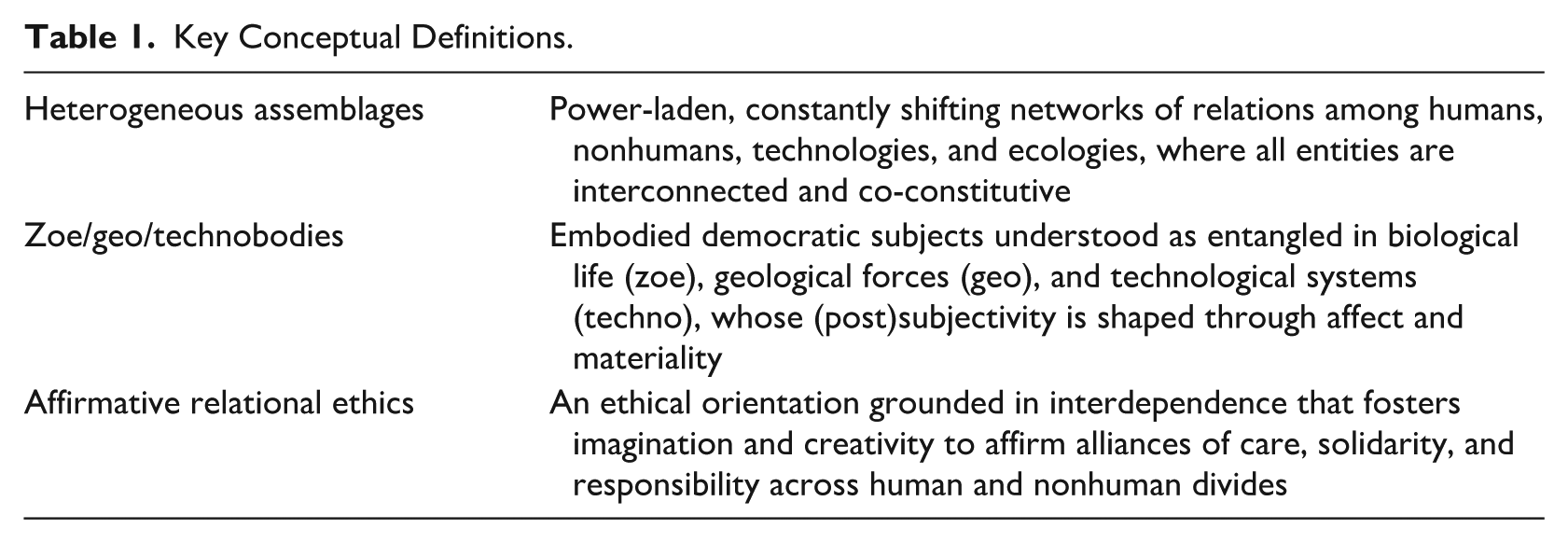
Importantly, Braidotti situates the posthuman debate within the “transdisciplinary borderlands” of feminist and queer (“binary sexed and gendered dehumanization”), decolonial, Black (“racialized dehumanization”), eco-feminist, Indigenous, and new materialist scholarship (“naturalized dehumanization”) (Åsberg & Braidotti, 2018, p. 17). The authors frame the posthuman turn on a critical feminist plane that embodies an affirmative relational politics of inclusive worldmaking, where a porous, affectively engaged, yet ethically responsive posthuman subject position emerges (Braidotti, 2006, 2013, 2022). Given the terminological complexity of her work, this paper introduces three interlinked concepts of Braidotti’s feminist posthumanism: (i) a relational ontology of heterogeneous assemblages, (ii) the decentering of subjectivity in zoe/geo/technobodies, and (iii) an affirmative relational ethics expressed through the simultaneous vulnerability and hopeful responsibility of “we-are-(all)-in-this-together-but-we-are-not-one-and-the-same.” Together, these concepts aim to critically reposition democratic subjects as porous, multiply connected, and interdependent, yet also responsible and responsive.
A Relational Ontology of “Heterogeneous Assemblages”
Rejecting binary distinctions such as nature/culture, male/female, mind/body, or science/humanities—which position the social as constructed and the natural as separate, inferior, exploitable, and controllable—Braidotti (2013, 2019a, 2022) draws on Deleuze and Guattari’s (1987, 1994) assemblage theory to reconceptualize ontology as an ongoing, interconnected becoming in which “bodies and actors in a network, or assemblage, can no longer be thought as subjects and objects” (Mazzei & Jackson, 2016, p. 3). By foregrounding multiplicity, complexity, and emergence, she follows Deleuze and Guattari’s critique of static ontologies that treat entities as separable and instead advocates for a relational, processual understanding of being, situated within webs of interdependence that stabilize (territorialization) and are open for change (deterritorialization) (Gehman et al., 2022). Assemblages become sites of continual negotiation and transformation, where entities—including human subjectivity—are defined not by inherent attributes but by relationships, interactions, and capacities to affect and be affected. The posthuman is not a “free entity” but moves through and with assembled connections that are simultaneously biological, social, cultural, and technological. Linking to a more analytical strand of assemblage theorizing (DeLanda, 2006, 2016), Braidotti offers a critical feminist re-reading of Deleuze and Guattari’s insistence on assembled becoming by adding a power-sensitive analysis of marginalization and oppression within a technologized, globalized economy. She emphasizes that constantly reconfiguring assemblages are “heterogeneous,” since not all forces across this plane have equal power or capacity to become. This suggests, democratic posthuman subjects are continuously embedded in, shaped by, and responsive to heterogeneously assembled naturecultural becoming—they are always in unequal relation.
Decentering Subjectivity in “Zoe/geo/technobodies”
Conceiving a relational ontology of interconnection and flux enables a rethinking of humanist, essentialist notions of subjectivity through the concept of heterogeneously assembled zoe/geo/technobodies, which captures the entanglements of biological life forces (zoe), planetary ecosystems (geo), and technological mediations (techno). Zoe, in contrast to bios, which reflects a humanist view of nature, denotes “generative vitality [. . .] that cuts across and reconnects previously segregated species, categories and domains” (Braidotti, 2022, p. 126). While humanist, Cartesian perspectives emphasize cogito ergo sum, the human subject’s rational capacity to doubt and reason, or a Kantian view of the human as “creator, and master of meaning, truth, freedom, and reality” with a priori knowledge “without an appeal to experience” (de Vaujany et al., 2024, p. 5), posthuman subjects possess “bodies [that] have mutated into complex relational nodes” integrating the zoe/geo/techno spheres (Braidotti, 2022, p. 12). Affect links bodies to these spheres: posthuman bodies are embedded and attuned—yet attunable—to affective currents circulating in heterogeneous assemblages (Roelvink & Zolkos, 2020). These relational forces can empower and enable others (potentia) or inhibit and diminish them (potestas), supporting life or evoking death (Sayers et al., 2022, p. 599). Together, affectively embedded zoe/geo/technobodies articulate a posthuman subjectivity “worthy of the urgency and complexity of our times” (Braidotti, 2022, p. 42). This subjectivity is always entangled with life-threatening forces such as viruses (e.g., Covid-19), region-specific geological effects of climate change disproportionately affecting women and children, and ongoing technological developments in medicine, biotechnology, and warfare that shape what the posthuman can become.
Affirmative ethics of “We-are-(all)-in-this-together-but-we-are-not-one-and-the-same”
Posthuman feminism, crucially, develops a relational, affirmative ethic of hope and transformation, grounded in “alternative ways of becoming human, as heterogeneous processes of composing a missing people” (Braidotti, 2022, p. 238). Departing from “hu-man” superiority, previously forgotten or marginalized others are included in “multiple assemblages of people, of anybodies, rejecting structural injustices but also affirming relational ethics and love for the world” (Braidotti, 2022, p. 238). First, an affirmative relational ethics emerges as posthuman subjects are recognized as responsive to their embodied and affective entanglements with dehumanized, gendered, racialized, and naturalized others. The notion of “having-the-other-in-one’s-skin” instantiates responsibility and accountability, rather than positioning oneself as an external rights-bearer or separate moral object (Barad, 2007, p. 393). Second, Braidotti (2022, p. 119), drawing on Spinoza and overcoming the “mind–body dichotomy,” conceptualizes the posthuman as recognizing the “embodiment of the brain and the embrainment of the body.” This imbricated embodied knowing forms the foundation for ethical action (Pullen & Rhodes, 2025). Centrally, Braidotti’s relational ethics affirms that “we-are-(all)-in-this-together-but-we-are-not-one-and-the-same,” calling for creative, novel alliances across webs of interdependence and inequity that the embodied, nomadic posthuman subject can sense, engage with, and act upon. Building on thinkers such as Bennett (2006, 2010), who have theorized affirmation as “enchantment” for and within the web of life, affirmative relational ethics invites radically imagining new configurations of multi-species care and flourishing amid pervasive death and destruction of our times. Enacting this ethic requires collective imagination, speculation, and a hopeful orientation to the future, transforming the “negative” forces of critique into “possibilities” (Braidotti, 2019a, p. 470) (Table 1).
Key Conceptual Definitions.
On Theorizing with Posthuman Feminism
Before further conceptualizing Rosi Braidotti’s work in the context of democratic organizing embedded in nature and material interdependence—as one possible application of posthuman feminism to organization and management theory—it is necessary to consider an analytical strategy capable of doing justice to posthuman feminist thought. Most centrally, the subsequent approach to knowledge production responds to calls for a feminist mode of organizational theorizing that is critically affirmative, power-sensitive, and attentive to complexity, provisionality, and imaginative openings. Three elements define these feminist theoretical sensitivities:
I. The subsequent theorizing follows what Cornelissen et al. (2021, p. 13) term “critical meta-theorizing,” a strategy that interrogates the ontological assumptions and theoretical foundations of democratic organizing through the lens of Braidotti’s posthuman feminist thought. The first section of this paper initiates this endeavor by examining the “disconnects” in democratic theory and its humanist assumptions—such as individual subjectivity, rights, and notions of social equality—while situating them in relation to three concepts of posthuman feminist theorizing that enable ontological interrogation.
II. The approach also departs from what Cunliffe (2022, p. 22) describes as a “‘malestream’ fast lane” of mechanistic theorizing, which emphasizes “abstracted” and “streamlined theoretical models.” Instead, it engages a feminist mode of imagination and speculation, as exemplified by the opening speculative vignette and the use of purposive, imaginative questions (Alacovska & Holt, 2023; Gümüsay & Reinecke, 2024; Martin et al., 2025). This recasts theory “not the end product” but emphasizes “theorizing through discovery and imagination (not justification)—exploring interesting questions; searching for different ways of being, thinking about issues, or doing something, . . . offering insights and possibilities [. . .] welcoming many forms of knowing” (Cunliffe, 2022, p. 22).
III. Finally, the text leverages generative “messiness” and provisionality (Lantela, 2024) to explicate Braidotti’s three concepts alongside existing work on new materialism and posthumanism by management and organization scholars. Together with the speculative vignette, this multimodal material is mobilized to theorize three registers of posthuman democratic organizing. Each section concludes with imaginative questions that invite the reader into a space of co-creation, further elaborating the possibilities of posthuman democratic organizing. In doing so, critical meta-theorizing becomes affirmative: it transcends binary thinking of a dialectical template, invites hopeful speculation, and remains open to further development (Braidotti, 2019a).
Consequently, the following theoretical explorations cannot be conceived as a neat confrontation between an Anthropocentric, humanist democracy and a post-Anthropocentric, posthuman feminist democracy as distinct paradigms. Rather, posthuman democratic organizing selectively distances itself from older frameworks while integrating novel ideas, staying generative and open. It embraces “intergenerational and transversal thinking” (Braidotti, 2022, p. 9) instead of juxtaposing bounded paradigms in oppressive binaries (Tallberg et al., 2024), thereby supporting “theoretical pluralism” (Cunliffe, 2022, p. 22). Importantly, the text and theorizing are intended to be read alongside literature, scientific data, art, and biology, as well as through embodied knowing and imagination (D’Antone et al., 2024; Haider & Rieser, 2025). The following section thus engages in affirmative, speculative critical meta-theorizing, integrating Rosi Braidotti’s concepts across three registers of posthuman democratic organizing.
Toward Posthuman Democratic Organizing
Re-reading the Anthropocentric Dilemma of Democracy through Braidotti’s posthuman feminism, first and foremost, invites theorizing democratic organizing that accommodates heterogeneously assembled posthuman subjectivities. Moving beyond rights-based, rationalist, and humanist equality-centered procedures, this approach emphasizes the relational embedding of the posthuman within its naturecultural dependencies. The guiding question is no longer how to include more entities—such as individuals, species, or material elements—in decision-making or how to adopt a rights-to-nature approach (Cano Pecharroman, 2018; Epstein, 2023). Rather, it asks how to organize with and through the heterogeneous, affective, and vulnerable becomings of posthuman democratic subjectivities—what Braidotti (2022, p. 237) terms a “general ecology of alternative ways of becoming subjects.” Embracing posthuman subjectivities, in turn, enables a posthuman politics of democratic organizing that operates amid planetary fragility while being oriented toward collective flourishing. Accordingly, the following section theorizes three interrelated, practice-oriented registers of posthuman democratic organizing. First, acknowledging assembled becoming reframes organizations as emergent, relational, and embedded forms. Second, attuning to zoe/geo/techno spheres centers bodily capacities to affectively engage and respond within multispecies and technological entanglements. Third, affirming ethical-relational responsiveness emphasizes care, solidarity, and situated responsibility across uneven interdependencies.
Acknowledging assembled becoming
Posthuman democratic organizing begins by unsettling the humanist notion that democracy rests on constituted rights, procedures, and institutions accommodating autonomous individuals. Instead, it foregrounds organizations as interdependent nodes within heterogeneous assemblages—webs of human, more-than-human, and technological relations that both sustain and constrain collective life. Rather than treating organizational democracy as a system of enfranchised subjects, this register frames it as an ongoing process of recognition: making visible how organizations exist only through entanglements with fragile ecologies, material flows, and intergenerational dependencies. Organizing, from this perspective, does not start with pre-given rights but with the situated task of learning to live, decide, and respond within the unequal interdependencies of which humans are only one part.
Existing organizational literature provides multiple points of departure for this reorientation for organizing to acknowledge assembled becoming. Ecological critiques, such as those by Banerjee and Arjaliès (2021), reveal how Anthropocentric epistemologies dominate sustainability management and call for theorizing with relational and Indigenous ontologies that embed humans within nature. Heikkurinen et al. (2021, p. 279) similarly theorize post-Anthropocentric sustainability policy by “blurring the boundaries of earthbound others” and augmenting the “physical capacities of non-human matter” (Fox & Alldred, 2020, p. 126) such as “heat” (Dentoni, 2024). Pérezts et al. (2025) describe “breathing” as a “political model of organizing,” offering a metaphor for interdependent becoming that exemplifies moving beyond humanist constitutions in democracy, as it suggests organizing sensitivities for posthuman interfaces in a naturecultural and technologically mediated “fabric of relations” (p. 136). This metaphor highlights organizations’ dependence on clean air and underscores that oxygen intake depends on endangered natural habitats, such as rainforests and coral reefs. Studies of craft and microbial organizing similarly highlight “intimacy with non-human others” (Haraway, 2016, p. 149). Verduijn (in Cnossen et al., 2024, p. 62) shows how cheesemakers confront “bad bacteria” that shape outcomes, emphasizing that “‘we’ do not just make the cheese, but the cheese also produces ‘us,’” within a web of bacterial, mineral, and natural interdependencies. Similarly, Bell (2025) theorizes how “fermentation” assemblages in baking intrinsically entangle craft entrepreneurs with more-than-human others in ongoing processes of becoming (Hjorth et al., 2015). Collectively, these studies suggest an organizing that cultivates space, routines, and moments to acknowledge assembled becoming, inquiring into and mapping the interdependencies among posthuman subjects, organizations, and multiple complex worlds.
Yet, such assemblages are not neutral. Braidotti (2013, p. 68) emphasizes that humanist Man’s “dialectics of otherness” hierarchizes “sexualized, racialized, and naturalized” bodies, asymmetrically diminishing their capacities to flourish (Braidotti, 2022, p. 111). Posthuman democratic organizing must, therefore, not only acknowledge dependence but also examine stratified ecologies of domination, rejecting the flatness of purely descriptive assemblage theory in favor of a feminist, power-sensitive relationality (Asenbaum & Bussu, 2025).
The speculative vignette illustrates this shift toward heterogeneously assembled becoming: at The Canopy in 2050, the democratic circle of consultants transforms into an assembly that remaps power. Historically, central actors—Mayor, Investor, Senior Employee, Solar Grid—are displaced outward, while previously sidelined presences, such as the Migrant Pigeon, Lithium Vein from Bolivia, Extinct Bee, and Child of 2090, are drawn inward. This unsettling spatial choreography does not expand rights but redirects attention to neglected interdependencies, making them visible.
At its core, organizing for posthuman democracy requires cultivating awareness of the organization’s significant interfaces with “dehumanized” others. Democratic members can perceive, investigate, and map the webs of relationships on which they and others depend, addressing the failure “to recognize the unique, life-giving combinations” (Muñoz & Branzei, 2021, p. 508). Propositional questions that may guide such organizing efforts to inquire into and acknowledge assembled becoming in posthuman democratic organizing include
I. How can organizing continually acknowledge and investigate material interstices and dependencies with ecological and social others—beyond humanist sustainability reports, supply chain charts, and stakeholder maps?
II. How can organizing cultivate curiosity about intricate interdependencies with air, water, minerals, animals, plants, electricity, data flows, and other material contingencies—e.g., through periodic rituals of organizational “interfacing”? How are these interfaces shaped by inequity, power, and asymmetric capacities to act and flourish?
III. What organizational measures can foster learning and recognition of the organization’s, members’, and stakeholders’ vulnerabilities to these natural, cultural, and technological dependencies, revealing how the organization persists through the support of fragile, often unseen kin?
Attuning to zoe/geo/techno spheres
Humanist democracy has traditionally emphasized individual rationality, in which deliberation, speech, and voting presuppose boun-ded, rational subjects. Posthuman democratic organizing departs from this assumption by conceiving subjects as porous mind–bodies embedded in zoe (life forces), geo (earthly conditions), and techno (technological mediations). Democracy, in this view, emerges not from rational argument alone but from cultivating the body’s capacity to affect and be affected, situating itself within interdependencies. Organizing attunement to zoe/geo/techno spheres, therefore, aims to develop relational capacities that enable posthuman democratic subjects to sense their dependencies, vulnerabilities, and responsibilities through affective, embodied encounters, sensory experience, and technological mediation.
A growing body of organizational scholarship challenges the humanist reliance on rational individuality by emphasizing embodiment and affect. Braidotti (2022, p. 107) calls this “carnal empiricism,” where knowledge emerges through the body’s capacities and its corporeal affective entanglement with the living and non-living world, including technological meditations—emphasizing what the materially interrelated zoe/geo/techno “body can do” (Harding et al., 2022). Studying the transformation of sustainability professionals that embodiedly entangle with the Amazon region—its natural intensities and indigenous life worlds—Aguiar and Cunliffe (2025) theorize an ontological shift toward relational interdependences. Through embodied experience of nature, sustainability is no longer a separate objective but an entangled responsibility and urgent practice. Pullen and Rhodes (2025, p. 6) further emphasize the body’s role in “democratic dialogue,” where it “speaks and acts in situations of precarity and exclusion,” while Gherardi (2019) underscores that learning, research, and knowledge production are sensory and relational, demanding openness to being affected. Ergene and Calás (2023) similarly conceptualize research as “a material-discursive assembling process of more-than-human and more-than-capitalist entanglements” (p. 1978). Their multi-sited ethnography of organic cotton shows how “sound, smell, touch, and visuals of machines, workers, cotton, and managers” (p. 1967) reshape inquiry as part of “research assemblages” (Cozza & Gherardi, 2023b). These studies resonate with Braidotti’s conception of bodies mapped along affective entanglements related to “zoe” (the life world) and “geo” (the geographical location), both of which have to be understood in their “techno”-logical mediations. Posthuman democracy thus calls for organizing multiple attunements of members’ bodies to intersecting dimensions of domination, oppression, and possibility (Benozzo et al., 2024; Martin et al., 2025).
The speculative vignette illustrates that, at The Canopy, participants attune through AI-generated whispers of histories, short films on urban wildlife, and tactile encounters with rare earth minerals and soil microbes. Time stretches as assemblies pause for days or weeks of multiple attunements, allowing urgency to seep into bodies. When speech resumes, it is layered: the Extinct Bee buzzes with corporeal understanding, the Heatwave presses as a suffocating rhythm, and the Future Child interrupts ego- and present-centric thinking. These voices do not always make logical sense, but they make bodies feel; they exert pressure. Here, democracy unfolds not only through rational persuasion but also through embodied entanglement with zoe/geo/techno worlds.
Fundamentally, posthuman organizing is called to create spaces, routines, and moments for affective attunement, implying that the democratic posthuman subject does not produce knowledge “over the world” but rather intertwines their mind-body with more-than-human and dehumanized others. This enables the co-construction of knowledge “as part of the world reframing of sustainability studies questioning the human/earth entanglement and the Anthropocentric present” (de Vaujany et al., 2024, p. 13). Propositional questions that may guide an organizing effort toward affective attunement of mind-bodies to the zoe/geo/techno spheres in posthuman democratic organizing include:
I. Which spaces, moments, and routines can be created to slow down or de-focus and extend the rational mind while activating multiple bodily senses—seeing, hearing, tasting, smelling, and touching—to convey and amplify democratic urgencies?
II. How can affective connections to life forces (zoe) be cultivated as the organization fosters proximity and entanglement with more-than-human others—through forest bathing, phenomenological observation, multisensory listening, stillness walks, or other embodied practices?
III. How can technologies (techno) be leveraged to extend organizational attunement, activating corporeal and material sensitivities to ecological and geopolitical differences, and democratizing empathy across time, scale, and species—through immersive VR forests, heatwave simulators, deep-time data interfaces, or live artificial intelligence inputs?
Affirmative ethical responsiveness
Humanist democracy has often relied on abstract principles such as freedom, justice, and equality, framed as universal ideals detached from culture, lived experience, and natural-material interdependence. Sayers et al. (2022, p. 606), for example, criticize “a false dichotomy” in applying traditional moral principles of sameness and difference to the “male standard,” which reinforces dualistic understandings of social categories, including human versus nature. Posthuman feminist democracy departs from this oppositional abstraction by grounding ethics in embodied relationality, shared vulnerability, and affirmative responsibility. Ethics are no longer external rules but situated practices aimed at transforming devastation into possibility and fostering hopeful alliances across uneven dependencies.
Organizational scholarship has begun to articulate frameworks akin to organizing affirmative ethical responsiveness. Building on Indigenous and decolonial concepts (Alacovska et al., 2025; Banerjee & Arjaliès, 2021; Kimmerer, 2013), Pavlovich and Roche (2024) develop “ecologies of care” grounded in Aotearoa New Zealand Māori Indigenous knowledge, highlighting three “touchpoints” for organizing responsibility webs of interdependence: “relationships (whanaungatanga), stewardship (kaitiakitanga), and support (manaakitanga).” Von Redecker and Herzig (2020, p. 664) theorize La Via Campesina’s “parliament with soil” as democratic accountability rooted in multispecies entanglement. However, ethical-relational affirmation arrives not only “as a consequence of the interdependence of all living systems, of constantly being in relationship,” but demands that humans seize concrete activities of “responsibility and commitment to others” (Ehrnström-Fuentes et al., 2025; Pavlovich & Roche, 2024, p. 464). The organizational principle manaakitanga (support) is especially powerful in realizing such ethical action, emphasizing the “quality of caring practices, of hospitality, and showing respect and support to others as connected collective selves” (Pavlovich & Roche, 2024, p. 465). Posthuman democratic organizing entails not only creating spaces to inquire (acknowledge interdependence) and attuning affectively to the body and senses (affectively attune) but also acting on ethical-relational sensitivities “to and with, rather than for, multiple others” (Sayers et al., 2022, p. 597). It demands inquisitive, attuned action to care for, commit to, and support dehumanized and oppressed more-than-human others. Paradoxically, recent scholarship has highlighted that the “radical alterity” of human and more-than-human others may even require “refusal” to intervene or “detach” from them—which can, in turn, “help multi-species flourishing in a time of planetary ecological crises“ (Sage, 2025, p. 11). Leaning on the principle of “we-who-are-not-one-and-the-same-but-are-in-this-together” signals the need to respond to power asymmetries and a “multiplicity of intersecting differences,” diverse histories, and unequal capacities to act and flourish (Martin et al., 2025, p. 512). Speculative fiction, such as Atwood’s MaddAddam trilogy analyzed by Sayers et al. (2022), provides an entry point for posthuman organizing that envisions interspecies cooperation and embodied response-ability amid catastrophes. Together, these studies converge on the need for ethical orientations that affirm life and possibility without ignoring grief, violence, and destruction—fiction, poetics, and speculative narration are seen as an essential tool for this (Alacovska & Holt, 2023).
The vignette dramatizes this third register as The Canopy’s democratic, power-sensitive assembly thickens into a cartography of consequence. Pain becomes tangible—heat presses on the lungs, the silence of the lost bee reverberates, and displacement cuts through skin. Yet, the assembly does not collapse into despair. Dialogue carries the pain long enough for it to transform: destructive projects are paused, rooftops are pledged for pollinators, and intergenerational justice shapes hiring practices. These are fragile yet forceful gestures—not universal solutions but situated, emergent alliances. Democracy here unmasks domination without succumbing to paralysis. It affirms, transforming grief into solidarities, care, and hopeful commitments that stretch across time, species, and uneven dependencies.
Organizing posthuman democratic affirmative ethical-relationality entails a normative commitment in which all participants assume stewardship and response-ability within webs of interdependence—acknowledging that “we are all together” but “not one and the same.” Dehumanized and more-than-human others demand heightened care, support, and situative sensitivity. This form of organizing cultivates spaces for collective imagination, speculative thinking, and engagement with post-Anthropocentric worlds, creatively addressing intersecting oppressions. Propositional questions that may guide organizing for ethical-relational responsiveness and affirmative alliances in posthuman democratic organizing include the following:
I. Which spaces, moments, and routines can be created that not only acknowledge and attune to socio-ecological and technologically mediated interdependencies, risks, and vulnerabilities amid stark power differentials but also explore the enactment of ethical responsibility-taking and relational alliance-building?
II. How can posthuman stewardship and care activities secure resources, support, and endorsement within an organization’s everyday operations to sustain the guardianship of watersheds, migratory paths, extinct kin, and displaced minerals alongside workers?
III. In what ways should organizational meetings be structured to invite collective imagination and creative, poetic, and aesthetic experimentation in envisioning desirable futures? How can hopeful speculation be practiced so that ethical orientations arise from storytelling, imaginative worldbuilding, and sensing into not-yet, more equal worlds? (Table 2).
Toward Posthuman Democratic Organizing.

Posthuman democracy and affirmative organizational theory: Contributions and conclusions
This paper presents a critical and affirmative intervention in organizational theory by introducing a posthuman strand of feminist theorizing (Benschop, 2021; Cunliffe, 2022; Lantela, 2024), which meta-theoretically challenges (Cornelissen et al., 2021) the persistent Anthropocentric core assumptions of democratic organizing (Battilana et al., 2025; Birchall, 2011; Diefenbach, 2020). By carefully dismantling the humanist and nature-exclusive underpinnings of democratic thought—such as rights, individual rationality, and humanist moral principles—it repositions democracy as a materially grounded, affectively attuned, and technologically mediated practice of becoming with and among more-than-human and dehumanized others (Cozza & Gherardi, 2023b; de Vaujany et al., 2024). Accordingly, it reframes democratic organizing as a situated and ethical process emerging through fragile entanglements of bodies and organizational interfaces with planetary and social interdependence—thereby bearing the potential to create alliances for a hopeful future. The following sections discuss this posthuman feminist contribution in relation to contemporary scholarship on (I) democratic organizing, (II) posthuman organizational theory, and (III) affirmative and speculative theorizing, and outline a series of potential openings for research.
Posthuman democratic openings
The ecological crises and mass extinctions of more-than-human others require an urgent reconceptualization of democratic organizing beyond frameworks centered on the sovereign, self-reliant human and detached agency—including the illusion of human control in the Anthropocene (Albareda & Branzei, 2025; Banerjee & Arjaliès, 2021; Purser et al., 1995; Wright et al., 2018). This paper presents a decisive departure from democratic organizing theory historically grounded in “self-ownership and inalienable rights” and “private ownership and property rights” (Diefenbach, 2020, p. 45), as well as a long tradition striving for dignified and ethical organizing beyond top-down and capitalist dominance (Adler, 2019; Battilana et al., 2022; Rothschild-Whitt, 1976) that nevertheless remains ardently Anthropocentric. I frame this tension as the Anthropocentric Dilemma of Democracy—a disjuncture between inclusive democratic ideals and the persistent ecological exclusions they reproduce (Banerjee & Arjaliès, 2021; Cielemęcka & Daigle, 2019; Ergene et al., 2018). In contrast, posthuman democratic organizing shifts attention to the fragile, uneven, and techno-naturecultural assemblages in which all beings—human and more-than-human—co-emerge and bear responsibility. This ontological reorientation dissolves the subject–object divide, insisting that posthuman democracy is rooted in embodied entanglements rather than formal abstractions—allowing us to theorize responsibility in the ecological crises and social precarities (Cozza & Gherardi, 2023b; de Vaujany et al., 2024).
Posthuman democratic organizing builds upon emerging scholarship that explores the agentic power of the “flesh/body” (Harding et al., 2022), that entails a corporeal responsibility for the other (Rhodes, 2019), and advances theorizing on “corporeal democratic dialogue” (Pullen & Rhodes, 2025) and vulnerable, “resonant listening” (Pallesen et al., 2025). For Pullen and Rhodes (2025, p. 6), the body is a political site that “speaks and acts in situations of precarity and exclusion.” Pallesen et al. (2025) extend this attentiveness to the body into a phenomenology of listening, ethical attunement, and resonance, allowing the self to be “undone” by the presence and difference of others—“embracing vulnerability as generative” (p. 34). Yet, across these essential interventions, corporeal relations remain predominantly conceptualized in terms of the social. Posthuman democratic organizing extends the conceptualization of “agentic flesh/body” (Harding et al., 2022; Lüthy, 2024) by fully integrating new materialist and (heterogeneous) assemblage ontologies: bodies are not merely social or sensuous but material nodes embedded in techno-natural interrelations. Rather than beginning with intercorporeality among humans, democratic posthuman subjects emerge through webs of dependency with lithium veins, rare bacteria, or dislocated energy grids (Bell, 2025; Ergene & Calás, 2023; Sayers et al., 2022), as “bodies do not pre-exist their relational entanglements” (Harding et al., 2022, p. 653). This perspective asks how democratic organizing transforms when entanglements are fundamentally more-than-human. Future research can build on the notions of dialogue (Pullen & Rhodes, 2025), listening (Pallesen et al., 2025), and voice (Mazzei & Jackson, 2016) and extend them into contexts of unequal naturecultural assembledness and interdependence.
Furthermore, posthuman democratic organizing concretizes recent foundational posthuman scholarship by Wickström et al. (2025, p. 11), which explores “how care emerges through performative ‘responses’ to ‘calls’ that support the maintenance, continuation, and repair” of alternative organizations and their interdependent others. The three registers of posthuman organizing pull human subjects out of their navel-gazing solipsism by inviting them to think-feel urgencies as “‘calls’ and ‘respond’ to them in ways that do not solely privilege their own interests and needs” (Wickström et al., 2025, p. 36). In particular, this paper argues (I) acknowledging assembled becoming, (II) affectively attuning bodies, and (III) enacting life-affirming ethics together articulate a mode of posthuman care in democratic organizing (Pavlovich & Roche, 2024; Sage, 2025; von Redecker & Herzig, 2020). Further research should investigate how posthuman care “calls” can be thoroughly attended to and how “responses” contribute to multispecies flourishing (Wickström et al., 2025), particularly considering heterogeneity, power differentials, and the inherent conflicts of care within assemblages (de la Bellacasa, 2017; Ehrnström-Fuentes et al., 2025; Friedrich & Lüthy, 2025). Among other contributions, this paper speculates about such answers in concrete organizing, such as a power-sensitive rearrangement of chairs in a posthuman assembly, creating cartographies of ethical and political consequence. Such practices may serve as reference points for further theorizing and enacting posthuman care in organizational contexts.
This paper also extends emergent literature on alternative organizing that employs relational views (Daskalaki et al., 2019; Farias, 2017; Pohler, 2024; Sobering, 2019) and sharpens the processual understanding of how counter-hegemonial organizing can effectively sustain itself (Husted et al., 2026; Pietinalho & Martela, 2024; Shanahan, 2023). “Democratic revisability” in Shanahan’s (2023) important work is, for example, achieved through embedding decision-making in information and communication technology (ICT) affordances, while a more comprehensive posthumanist approach—entangling decision-making with naturecultural interdependencies, or what might be termed decision-taking-making—remains an open avenue for future research. Relational and processual approaches have also been linked to ethicality (Daskalaki et al., 2019; Friedrich & Lüthy, 2025; Huber & Knights, 2023), emancipation (Friedrich & Steyaert, 2024), and decoloniality (Ramirez et al., 2024). Building on these, this study invites posthuman organizing that situates itself as deeply embedded and interdependent with nature (Beacham, 2018; Ehrnström-Fuentes & Biese, 2023; Nadegger & Porzionato, 2025). In such a framework, posthuman relations encompass human and more-than-human actors, are technologically mediated, and unfold within ongoing processes of naturecultural becoming and ethical responsibility (Cozza & Gherardi, 2023b; Ergene & Calás, 2023). Posthuman feminist organizing thus opens the way to explore relational infrastructures and processual alternative organizing that correspond to and are rooted in unequal, plural, and technological interdependencies driven by capital.
Finally, alongside important work on right-to-nature approaches (Cano Pecharroman, 2018; Epstein, 2023), which advance formalist strategies to represent more-than-human others in democratic theory, this research both challenges and complements such frameworks by theorizing democratic organizing as heterogeneous, technologically mediated, and ecologically embedded. It rests on the foundational posthuman critique of humanism, which interrogates the historically normative image of the White, male, wealthy, able-bodied, and heteronormative “Man of reason” (Braidotti, 2013, 2019, 2022). This perspective calls for a future research agenda that leverages new materialist and relational ontologies to understand democracy as inseparable from nature, material interdependencies, and broader cultural and social assemblages (Asenbaum & Bussu, 2025; Eadson & Van Veelen, 2021).
Posthuman feminism for organization theory
Responding to the urgency of the climate crises, organization theory more broadly—beyond managerial approaches to sustainability, CSR, or circular economy that often remain tied to the “business case for sustainability” (Dyllick & Hockerts, 2002)—has initiated vital rethinking of the core assumptions and ontological relationships among humans, organization, economy, and nature (Aguiar & Cunliffe, 2025; Banerjee & Arjaliès, 2021; Wright et al., 2018). Ecocentrism, for example, regards “humanity” as a “subset of nature,” recognizing “the inherent value of all life forms and ecosystems, irrespective of the utility they might have for humans” (Allen et al., 2019; Hernández & Muñoz, 2022, p. 284). Building on this, the present paper advances a deeply relational approach in which both humans and non-human entities are understood as interfaced agencies. As Aguiar and Cunliffe (2025, p. 4) claim, “disrupting human privilege requires a fundamental ontological shift in the way we understand, experience, feel about our relationship with nature, not just as embedded, but interconnected.”
This paper has advanced new materialist relational theorizing by meticulously explicating Rosi Braidotti’s posthuman feminism to organizational research, by building upon, but not focusing on, pathbreaking theorizing of scholars such as Barad (2007), Haraway (2016), and Bennett (2010). This work addresses critiques within new materialist organizational scholarship that tend to “erase” its feminist legacy (Cozza & Gherardi, 2023a) through a “deferral of difference,” overlooking its “feminist, queer, and decolonial” roots (Harris & Ashcraft, 2023, p. 1989, italics in original). Braidotti (2013, 2019b, 2022) “re-relationalizes relational theory” (Harris & Ashcraft, 2023) through a “zig-zagging” and “transversal” feminist mode of theorizing, integrating eco-feminist and Indigenous perspectives with assemblage theory and critical, decolonial, intersectional conceptions that “reject[s] an undifferentiated system that would form flat equivalences across all species, all technologies and all organisms under one common signifier” (Braidotti, 2022, p. 111). This approach is exemplified in power-sensitive concepts, such as “we-are-(all)-in-this-together-but-we-are-not-one-and-the-same,” and advances feminist and “critical” posthuman theorizing in organizational studies (de Vaujany et al., 2024, p. 317). By imbricating ontological relationality with a strong power-sensitive feminist lens, this work opens multiple avenues for theorizing, showing how natural and social exclusions are intertwined and offering a novel “feminist answer” to the interlinked “grand challenges” of our time (Benschop, 2021).
Such critical feminist research politics also engage with ongoing debates on the application of assemblage theory to democratic organizing and organization studies more broadly, where its emancipatory and power-sensitive orientation may be at “odds with assemblage theory’s analytical and descriptive purpose expressed in its flat ontology” (Asenbaum & Bussu, 2025, p. 3; Atkinson, 2024). The posthuman feminist reading of democracy developed here moves beyond merely “analyzing” and “describing” the naturecultural and technologically assembled interdependencies. Rather, it explicitly embraces a feminist normative stance, articulating a “political agenda for change” within an entangled world (Asenbaum & Bussu, 2025; Lemke, 2021, p. 9). This approach opens avenues for embedding normative layers into assemblage theorizing in organization studies, which has been fruitfully applied to institutional entrepreneurship (Gehman et al., 2022) and artificial intelligence, where “agency resides in assemblages—not humans, algorithms, or data” (Gehman et al., 2025; Glaser et al., 2024, p. 2755), thereby advancing “relational perspective on technology” (Hinds & von Krogh, 2024). Braidotti (2019a, p. 466) further extends assemblage theory by supplementing “Deleuze with heavy doses of feminist theory,” noting that “he does not do all the work of critique and creation for us.” A challenge of Braidotti’s critical affirmative theorizing is, however, her eclectic “zigzagging” between various theoretical traditions, which come with as much analytical openness as uncertainty—one which contrasts with the more analytical and parsimonious assemblage theorizing of DeLanda (2006, 2016). The strength of posthuman feminism, however, is that it opens a critical and affirmative, assemblage-based research agenda in organization theory.
The possibilities to theorize rapid technological developments through assemblage theory sit in a queer tension, partly at odds with, yet connected to, eco-centric, monist, eco-feminist, and Indigenous relational approaches that primarily focus on interrelations with more-than-human others. This paper also opens a posthuman research agenda that takes the materiality of technology seriously as part of the “posthuman convergence” (Braidotti, 2022, p. 3): “The status and condition of the human is being redefined by the life sciences and genomics, neural sciences and robotics, nanotechnologies, the new information technologies” that coincide with “structural injustices through the unequal distribution of wealth, prosperity and access to technology” and the “devastation of species and a decaying planet.” This convergence calls for rethinking organization theory not only as a social, discursive, ecological, and material assemblage but also as a technologically mediated one that unfolds amid global neoliberal extraction, ecological collapse, widening social inequities, and geopolitical crises. Importantly, technology is not only an ontological given in posthuman organizing but is also deployed as a tool for attuning and learning for the posthuman in this convergence. This dual role demands the utmost critical scrutiny in future research, as technological instruments—biotech, AI, military applications, green tech, and so on—are themselves entangled in power-laden assemblages.
On affirmative and speculative theorizing
Finally, Braidotti develops an ethical stance of affirmation that enables the theorization of creative alliance-building and naturecultural solidarity, envisioning “a future which is open to diverse others” (Sayers et al., 2022, p. 606). Beyond being an ethical posture, which I suggested as part of posthuman organizing, this stance provides a broader orientation for organization scholarship itself—one that is critical and affirmative. Amid the cruelties, exclusions, and pervasive negativity of our time, building on affirmative stances may advance scholarship on grand challenges (Benschop, 2021; Ferraro et al., 2015; Oliver et al., 2024), desirable futures (Coffman et al., 2025; Gümüsay & Reinecke, 2024), or wicked crises (Meyer, 2025). For Braidotti (2019a, p. 470), reading Spinoza and Deleuze, affirmation “is a confrontation with and a transformation of negativity.” While it is “easy enough to make a list of all the negatives” and feel disempowered, disoriented, and diminished (p. 469), critique, negation, and dialectics alone are insufficient as “the source of the Ethics is the necessity and the desire to extract knowledge from pain” (p. 470, italics in original). Affirmative ethics entails a “Yes, but we are in the process of becoming something else,” an interruption of the “flow of negativity” as “critical practical exercise” (p. 472), which “minimize[s] fractures and seek[s] for generative alliances [. . .] justice, respect, solidarity, and affirmative transformation” (Braidotti, 2022, p. 238; see also Holt & Hjorth, 2014). This calls for an orientation in organizational theorizing that reframes critique as insufficient in addressing contemporary crises, demanding a theorization of transformation grounded in affirmation, creation, and alliance-building with post-binary, post-dialectical, and transversal thinking.
This also has implications for the process of theorizing itself. This text explores a speculative, feminist, and affirmative mode of critical meta-theorizing (Cornelissen et al., 2021). The imaginative vignette set at The Canopy in 2050 invites the reader into a speculative and aesthetic space, thinking-feeling into the possibilities of democracy, which are later connected to existing studies and the newly introduced concepts of Rosi Braidotti. Imagination here does not have to be “rigorous” (Gümüsay & Reinecke, 2024) in a “masculinist,” “linear,” and strictly “logical” sense (Cunliffe, 2022). Rather, it allows thought to cut across research paradigms, avoiding getting lost in the critique of humanist, nature-exclusive organizing or creating an entirely detached, oppositional paradigm. For posthuman democratic organizing, this approach demonstrates that theorizing can propose novel registers while still drawing on the rich legacy of conventional democratic frameworks, conjointly aiming to foster hopeful future alliances—a post-binary, affirmative mode of critical meta-theorizing that embraces speculation.
Footnotes
Acknowledgements
I thank the handling editor, Emma Bell, and the anonymous reviewers for their attentive, thorough, and generative feedback throughout the review process. I am also thankful for discussions and feedback at the GWO workshop “Resisting Business-as-Usual: Organizing for Hope & Justice in Times of Socio-Ecological Crises,” organized by Laura Dobusch, Dide van Eck, Katharina Kreissl, and Monica Nadegger, and the EGOS sub-theme “Organizing with Nature: Systems, Scale, and More-than-Humans,” convened by Jonathan Feddersen, Amanda Williams and Daniel Nyberg.

Funding
The author received no financial support for the research, authorship, and/or publication of this article.
Declaration of conflicting interests
The author declared no potential conflicts of interest with respect to the research, authorship, and/or publication of this article.