




Abstract
With the looming planetary emergency, the future will be anything but an extension of the past. Yet theorizing the future poses a peculiar problem. By definition, it is not present yet. The conundrum of the future is that it requires conceptualizing and theorizing what is not (yet) observable and does not (yet) exist. Scholars have called for more impactful theories; we argue that one powerful avenue to make organizational theories more impactful is to make them more future-oriented. In this article, we call for prospective theorizing, which we define as a future-oriented approach to theorizing that is concerned with imagining desirable futures. First, we argue that prospective theorizing involves a shift along two dimensions (onto-epistemological and axiological): from projection to imagination, and from values-neutral to values-led theorizing. Second, we suggest and promote prospective theorizing practices that might enable such a shift, distinguishing between inputs, throughputs and outputs of theorizing. Third, for such prospective theorizing to be scientifically evaluable and rigorous, we develop the notion of speculative rigour, and outline criteria of generative potency, process transparency, plausible desirability and speculative plausibility. Overall, we argue that prospective theorizing adds to greater plurality in our theorizing towards (re)generative scholarship for imagining desirable futures.
There is a growing demand for impact-driven management and organization theory (Reinecke et al., 2022; Wickert et al., 2021) and engaged scholarship (Ergene et al., 2021; Sharma & Bansal, 2020; Van de Ven, 2007) to address societal grand challenges (Ferraro et al., 2015; George et al., 2016; Gümüsay et al., 2022). Scholars have long lamented that the process of theory construction ‘is hemmed in by methodological strictures that favor validation rather than usefulness’ (Weick, 1989, p. 516). While accounts of theorizing have perhaps become more pluralistic (Cornelissen et al., 2021), one persistent methodological stricture prevails – the overriding temporal orientation within almost all theorizing towards the empirical past.
This past-orientation is at odds with the ambition that organization theorists might or should generate forward-looking thought leadership that could inspire and guide meaningful change forward in the world. However, the methodological consensus of our theorizing confines us to be largely followers of a present or past empirical reality. At best, we are following the cutting edge of empirical reality and are able to conceptualize and translate it into common theoretical vocabularies. However, with the looming planetary emergency (IPCC, 2023), not only are we running out of time (Nyberg & Wright, 2020; Williams & Whiteman, 2021), but the future is unlikely to be anything like the past. This realization limits the usefulness of theories based on empirically observing existing reality. Moreover, machine learning models such as ChatGPT are soon likely to outperform humans in some theorizing-related tasks such as certain forms of data analysis, able to perform them at larger scale and speed and with greater accuracy and reliability. However, their predictive outputs are likewise backward-oriented, as these language models are trained on data inputs sourced from the empirical past. For organizational scholarship to offer thought leadership instead of followership and move to the forefront of societal debates around the climate, justice, or AI, we argue in this article that collectively as organization scholars, we need to develop theories that are future-oriented, imagination-focused and values-based.
Management and organization scholars have recently begun theorizing how individuals and organizations in the field make sense of the future (Beckert, 2021; Flammer & Bansal, 2017; Flyverbom & Garsten, 2021; Hernes & Schultz, 2020). Less attention, however, has been paid to the question of how, as scholars, they can themselves orient their theorizing towards the future in generative and rigorous ways. The future poses a peculiar problem – by definition, it is not present yet. As an empirical social science, management and organizational scholarship deals primarily with the social world as it exists and came to be. Its methodological tools are centred around data sourced from observable events that have already occurred (Bell et al., 2022). Yet an emphasis ‘on the emergence of theory from data’ (Eisenhardt et al., 2016, p. 114) binds theorizing to the past and present. The conundrum of the future is that it requires conceptualizing and theorizing what is not (yet) observable and does not (yet) exist.
As a result, theorizing in management and organization scholarship is largely past- and present-oriented. As the future unfolds and materializes in the present, theorizing remains reactive. But instead of appreciating theoretical prescience, which is ‘the process of discerning or anticipating what we need to know and, equally important, of influencing the intellectual framing and dialogue about what we need to know’ (Corley & Gioia, 2011, p. 13; see also Kuhn, 1962), future-oriented thinking is too often dismissed as ‘pre science’ in the sense of being non-scientific. At the same time, many management and organization scholars aspire to expand their traditional role of theorizing about society towards a role that sees them having an impact on society (Gümüsay, 2023; Wickert et al., 2021). As part of such an emerging ambition, ‘good theory’ provides ‘one of the most powerful means we have for helping social systems evolve, adapt, and alter their patterns over time’ (Cooperrider, 2021, p. 79). Relatively little work has explored the implications for such a future-focused process of theorizing (Reinecke et al., 2022). In our view, the goal is not to enable better predictions or forecasting of a likely future but to use our theorizing to cultivate the creation of desirable futures by imagining, or helping others imagine them in the first place.
Such prospective theorizing, as defined here, not only allows stakeholders to prepare for such futures but also embraces its performative potential (Ghoshal, 2005; Gond et al., 2016), making desirable futures more likely or feasible by theorizing them. We join an emerging group of scholars calling for alternatives to conventional forms of theorizing based on prospection (Cooperrider, 2021; Laszlo, 2021; Muñoz & Dimov, 2023), developing a future-forming orientation to research (Gergen, 2015; Gümüsay & Reinecke, 2022) and ‘generative scholarship’ (Pavez et al., 2021). In this article, we expand and elaborate on this call in three ways.
First, we specify the two core shifts that we see as entailed in such generative, prospective theorizing – towards imagination and towards values. Combined together, they foster the double leap that, we argue, propels prospective theorizing towards imagining desirable futures. By advocating for a shift in the general onto-epistemological orientation from projection to imagination, we encourage theorizing to extend beyond extrapolating from the past and, instead, imagine a break from it. And by advocating for a shift in our axiological orientation from values-neutral to values-led theorizing, prospective theorizing becomes anchored in values. Combining the two orientations, we first of all present four general modes for theorizing: projected factual futures, imagined (counter-)factual futures, projected desirable futures and imagined desirable futures.
Second, to help extend our theorizing along these axes, we develop a framework for prospective theorizing practices as pathways for imagining desirable futures. Specifically, we consider how these shifts towards imagination and values could be accomplished along the input, throughput and output dimensions of theorizing. While our framework leaves much scope for refinement, we hope to at least offer a foundation for how to engage in prospective theorizing in disciplined, systematic and nuanced ways.
Third, while theorizing the future beyond traditional forecasting approaches may appear to be a speculative endeavour, we argue that it can also be rigorous in its own way. We therefore develop the concept of ‘speculative rigor’ (Gümüsay & Reinecke, 2022) and propose four epistemic criteria to judge the quality of prospective theorizing: generative potency, process transparency, plausible desirability and speculative plausibility.
By developing a framework for prospective theorizing and offering criteria to evaluate its speculative rigour, we seek to open up new forward-looking avenues for theoretical development that are not constrained by the straitjacket of the past. In renewing our theory building to match the ambition of impactful and engaged scholarship, we hope that our article helps foster a move away from the ‘safe’ terrain of theorizing from facts and observations of the past and present, and towards developing new tools and approaches that allow us to theorize what does not (yet) exist. Our aim is to offer promissory glimpses into a potential future for our field.
Prospective Theorizing
As the future is likely to be radically different from the present, scholars across the social sciences have started to question the usefulness of a ‘research tradition that attempts to mirror a stable state of affairs’ in a world of ‘unpredictable fluctuation’ (Gergen, 2015, p. 297). Some years ago, de Jouvenel (1967, p. 10) already noted that ‘the future validity of our knowledge becomes increasingly doubtful as the mood of society inclines toward change’. To realize our ambitions for theory to be impactful, theorizing has to deal with such a future that is different from the present. Here, an emerging group of scholars have started to ‘challenge the basic structure of inquiry’ (Gergen, 2015, p. 290) and call for an embracing of prospection – ’the mental representation and evaluation of possible futures’ (Laszlo, 2021, p. 19; see also Cooperrider, 2021; Muñoz & Dimov, 2023) – as a basis for developing a future-forming orientation to research (Gergen, 2015) or ‘generative scholarship’ (Pavez et al., 2021).
These scholars build on an emerging consensus in cognitive psychology (Seligman et al., 2016), also reflected in sociology (Beckert, 2021; Emirbayer & Mische, 1998), that human behaviour is not a function of past patterns, events and processes but is equally shaped by prospective images of the future. Reviewing the evolution of prospection, Laszlo (2021, p. 19) highlights that prospection serves as an important driver of human behaviour, motivating us to seek to realize prospective images deemed as desirable and avoid those deemed undesirable. The function of prospection in the theory-building process is similar to envisioning an emerging future and inspiring its realization. Thus, prospective theorizing envisions the co-creation of futures not by developing prescriptive interventions based on a ‘positivist’ approach, which has been criticized as premised on instrumental reasoning (Horner et al., 2024), but instead by fostering imaginative capacity about what the future could be. In previous work (Gümüsay & Reinecke, 2022), we have therefore also suggested that such future-oriented theorizing should be concerned with ‘desirable futures’, or what Gergen (2015, p. 287) called ‘value based exploration into what it [the future] could be’. Building on this, Pavez et al. (2021) proposed five pillars – inspiring, discovering, envisioning, activating and savouring – of how collective imagination of such a ‘desired future’ can lead to its conscious enactment by inspiring processes of collective experimentation and learning. This particular focus on prospection chimes, we believe, with recent calls to theorize the social construction of the future in organization and management studies (Wenzel et al., 2020) and widen what theorizing is and how it is practised (Cornelissen et al., 2021; Reinecke et al., 2022).
Bringing future-orientation, values-based exploration, and theorizing together, the form of prospective theorizing that we are proposing here – and unfold in more detail below – challenges the nature and aims of the more traditional and predominantly positivist-empiricist tradition of management and organization theory in at least three interrelated ways: it is pragmatist in its orientation to knowledge and truth, preparatory in its emphasis on potentiality and prefigurative in its ambition to bring forth the future it envisions.
First, prospective theorizing, as we define it here, aligns with pragmatist philosophy (Dewey, 1998; Peirce, 1998) and its adoption in organization theory (Farjoun et al., 2015; Lorino, 2018; Wicks & Freeman, 1998). It does not seek truth as a fixed and objective property of beliefs or propositions, but is concerned with the practical consequences of theorizing and its usefulness in solving problems and achieving desired outcomes. For pragmatists, truth is a dynamic, contingent concept shaped by the practical consequences of beliefs and actions in a particular context. By recasting science as a technique for coping with a complex and uncertain world, the question pragmatism poses is no longer whether theories accurately represent reality, but whether they ‘help humans find their place in a hectic, complex, and often dangerous world’ (Farjoun et al., 2015, p. 1789; see also Wicks & Freeman, 1998). Pragmatism helps us to consider and construct theory not as ‘a timeless expression of truth’ but as a more or less useful perspective to ‘understand how humans could collectively evolve intelligent yet democratic ways of organizing in the face of complexity and uncertainty’ (Farjoun et al., 2015, p. 1789).
Second, prospective theorizing is not about predicting, but preparing for diverse futures. This premise extends the idea from pragmatist philosophy that science is ‘one more technique (albeit very useful and powerful) for coping with the world’ (Wicks & Freeman, 1998, p. 126), anticipating what in turn may prepare people for such future possibilities. The guiding assumption here is that we require a priori contemplation of alternatives to the dominant paradigm. Such preparatory theorizing is especially important when the challenges we are confronted with as scholars and humans ‘are more and more frequently characterized by [an]. . .emerging complexity’ (Scharmer & Kaeufer, 2010, p. 21). Climate change is a prime example of such complexity. While complicated challenges can be addressed in a rather linear fashion, climate change is complex with many interconnected changing parts. We thus need to be prepared for eventualities that may not even be conceived as possible under existing conditions, yet imaginable and plausible under others.
Third, prospective theorizing is about changing the future through prefiguring desirable futures. Similar to prefigurative organizing, which involves bringing about a desired future reality through practising it in the present (Reinecke, 2018; Schiller-Merkens, 2022), theorizing can be prefigurative by bringing about a desired future reality through theorizing into the present. While scholars tend to reproduce the status quo when theorizing from the past, prospective theorizing activates ‘the potential of science to shape the meaning systems of the society and thus [its] common activities’ (Gergen, 1978, p. 1349). As Cooperrider (2021, p. 4) similarly notes, ‘The theory building’s primary task would be one of anticipation and projecting possibilities for betterment.’ In this way, prospective theorizing calls forth a possible future reality. Rather than being reactive to depict past reality, it is proactive in co-creating a future one. It foregrounds agency as it moves from theorizing existing pressures to pressuring existing theorizing. Such a shift, in turn, promotes theorizing’s (re-)generative potential by both challenging the status quo and generating alternatives in the future. Such prefiguration in theorizing resonates with notions of ‘engaged scholarship’ in which social scientists and practitioners co-create social reality (Van de Ven, 2007), but tunes it towards a collective imagined future. As alternatives are imagined, realities are altered: ‘The aim of research would not be to illuminate what is, but to create what is to become. Herein lies the essence of a future forming orientation to research’ (Gergen, 2015, p. 294).
Performativity scholars have long recognized that through the act of theorizing reality, scholars effectively co-create that reality, even if unintendedly so (Ghoshal, 2005; Giddens, 1984). But instead of explaining (and unintendedly shaping) the present, prospective theorizing instead seeks to theorize (and intentionally shape) the future. The idea that management and organization theory might be concerned with intentionally shaping social systems also resonates with Herbert Simon’s design theory. In The Sciences of the Artificial, Simon (1996, p. xii) argued that social sciences such as organization studies are concerned ‘not with how things are but with how they might be’ and ‘with how things ought to be’ (Simon, 1996, p. 5). Its core design activity is ‘the act of envisioning possibilities and elaborating them’ (Simon, 1996, p. 164). In similar ways, prospective theorizing helps scholarship to be about ‘world making’ and ‘future forming’ as ‘[w]e replace the captivating gaze on the world as it is with value based explorations into what it could be’ (Gergen, 2015, p. 287). Such imaginative work produces new real options (Cork et al., 2023). Laszlo (2021, p. 30) similarly notes: ‘Scholars have a major role to play in this adventure, not only in studying such social phenomena ex post facto, but in theorizing about possible futures in ways that help bring these movements into existence.’
The above considerations – prioritizing practical usefulness over objective truth, preparing for potentialities over predicting reality, and performativity over representation – suggest that prospective theorizing involves quite a radical departure from traditional empiricist orientations to theory building, a meta-theoretical paradigm shift in the Kuhnian sense (1962). Once we abandon the requirement that our theories are valid to the extent that they mirror empirical reality as it exists via scientific modelling, we can embrace more diverse, imaginative and action-orienting theorizing approaches that seek to consciously co-create a future empirical reality.
A Double Leap into the Future
So far, we have argued that prospective theorizing involves a departure from traditional positive-empiricist approaches. In this section, we develop a framework that conceptualizes the moves through which this departure may be accomplished. We follow Cornelissen et al. (2021) in using the verb ‘theorizing’ rather than ‘theory’. Theory has been defined as ‘a statement of relations among concepts within a set of boundary assumptions and constraints’ (Bacharach, 1989, p. 496). In contrast, theorizing emphasizes a pluralistic practice, or broadly ‘the scholarly work that researchers do in pursuit of making informed knowledge claims’ (Cornelissen et al., 2021, p. 3). All forms of theorizing involve making an inference or ‘conceptual leap’ from the phenomenon to the theoretical concept (Cornelissen et al., 2021; Klag & Langley, 2013). Typically, this is understood as abstracting from a particular observed event, fact, or process to a more general conceptualization of it. Here, we argue for a conceptual leaping of a different kind – a conceptual leap into the future. This leap is much needed, since we cannot assume that our future society will look like the present or that the knowledge we have built about it will accordingly remain valid. Based on different approaches to prospection (Laszlo, 2021) and normativity in theory building (Wicks & Freeman, 1998), we propose that prospective leaping into the future can be conceived along two axes (see Figure 1). While a double leap along both axes is, as we will argue, necessary to fully realize the potential of prospective values-driven theorizing, there is analytical value in first considering them separately.

Modes of theorizing futures.
Onto-epistemological and axiological orientations
Prospective theorizing involves a double leap in our onto-epistemological and axiological orientation to theorizing. The onto-epistemological orientation is about the space–time (dis)continuity that we factor into our theorizing, while the axiological orientation is about how it is anchored on values and normativity. The two axes are not binary and distinct, but continuous and overlapping.
Along the onto-epistemological orientation, prospective theorizing encourages a leap from projection towards imagination. Projection extrapolates from the past and present into the future (Lord et al., 2015). The ontology of the future is hereby conceived as largely an extension of the present, and planned for through prediction, modelling and forecasting. Projection tends to be the dominant way of conceptualizing the future, extrapolating towards what is likely to happen based on current thinking and action through ‘weak-signal processing, planning, affective forecasting, and simulation based on what is known today’ (Laszlo, 2021, p. 25). Economic thinking in strategy also evolves around a careful planning of what is likely to happen under conditions of uncertainty; strategic actors extrapolate from the present or past as a basis for projecting sense into an uncertain future (Kaplan & Orlikowski, 2013). As a forward projection, the ontology of the future is, however, the same as the ontology of the present. Such ontological congruence serves as a base assumption in many finance and accounting models. For instance, the discounted cash flow valuation method determines the present value of future cash flows by discounting the future as if it was a linear extension from the present.
A leap towards imagination, in contrast, construes the future as to a lesser or greater extent discontinuous and different from the present; the future ‘presents a discontinuity with present reality and is not grounded in present experience’ (Augustine et al., 2019, p. 1931). Here the idea is that as futures cannot be fully grasped by projections from the present or past into the future, it requires the production of imaginaries. Imagination is the faculty of forming new ideas, or images or concepts of external objects not present to the senses nor presently realized. While projections imagine the future as the extended present (Nowotny, 1985, p. 15), we reserve the term imagination here for leaps forward that break with the onto-epistemological orientation of the present. Such an imaginative break, when given the space, can counteract ‘early dismissals of such [bold, systemic] interventions based on historically grounded feasibility judgments’ (Grimes & Vogus, 2021, p. 1). Conceived in this way, and in contrast to projection, imagination widens the future potential towards what is plausible, possible and even preposterous. It assumes thinking in possibilities, not only for practitioners (Grimes & Vogus, 2021) but also for scholars. Imagination thereby includes not only unlikely futures, but also (seemingly) impossible ones, for two reasons. First, even what we deem to be an impossible future may occur due to a misjudgement on our part. Second, even if this future might never occur, theorizing may still be useful for reflecting on what will not, could not, or should not happen.
The second leap involves a shift from values-neutral to values-led claims along the axiological orientation. The question of whether social sciences can and should be values-neutral is a matter of ongoing debate. The top half of Figure 1 reflects the positivist and more dominant tradition of value-neutrality in the social sciences; this holds that social scientists should strive for objectivity and value-neutrality in their analysis of social phenomena. Positivist philosophers such as Auguste Comte and Emile Durkheim believed that social phenomena should follow the model of the natural sciences to advance the ‘objective’ pursuit of knowledge. Others have argued that complete value-neutrality is not just impossible but perhaps even undesirable in the social sciences. Interpretivist scholars such as Max Weber and Clifford Geertz have emphasized the importance of understanding social phenomena from within, through interpretive frameworks and cultural contexts. They contend that social research is inherently shaped by the values and assumptions of the researchers themselves and the contexts in which they operate. Acknowledging and addressing these values is, in turn, deemed essential to understanding the complexities of human behaviour and society.
Even if interpretivist organization theorists might reject the possibility of ‘unbiased analysis’ in favour of a certain reflexivity on values, there has nonetheless been a tendency to incorporate positivist assumptions of neutrality, transferability and generalizability in much organizational research. Reflecting ‘the quantitative refashioning of qualitative research’, even more interpretivist-leaning styles of organizational theorizing often end up focusing on abstracting transferable models and concepts devoid of normativity (Cornelissen, 2017, p. 379). Therefore, while we assume that all theory building is inherently based on certain normative assumptions, values-neutral prospective theorizing, as one possible axiological orientation, (cl)aims to be as values-neutral as possible.
In contrast, the values-led end of the axis sides with a tradition in the social sciences that argues that theory should not only describe society but also ‘provide room for ethics’ (Wicks & Freeman, 1998, p. 123). Social scientists are believed to have a responsibility to consider ethical and moral implications and engage with values explicitly in order to contribute to discussions about socio-ecological justice, equality and human well-being. This view is historically rooted in critical theory. Critical theorists such as Theodor Adorno, Max Horkheimer and Jürgen Habermas emphasized the need to analyse power structures, social inequalities and ideological biases. Feminist theorists, including Judith Butler, Nancy Fraser and J. K. Gibson-Graham, have similarly argued that the social sciences should acknowledge the influence of gender, power and social relations in shaping knowledge. They emphasize the importance of incorporating feminist values, perspectives and critiques to challenge traditional biases and promote gender equality. Post-colonial scholars such as Homi Bhabha, Edward Said and Gayatri Chakravorty Spivak have made similar assertions, arguing that Western values have shaped knowledge production. Hence, scholars need to incorporate non-Western perspectives and values in order to challenge Western-centric views.
The possibility of such values-led theorizing, broadly conceived, invites prospective theorizing about alternative modes of organizing our futures, and confronts us with inherently normative and values-led questions. Making the question of normativity more explicit opens up opportunities for greater reflexivity about what normatively valued assumptions dominate theory and how our theories might change if we consider values that may not (yet) be prevalent. Such a values-led form of prospective theorizing could in turn help us question base assumptions such as competition, profit or growth and envision a change in the focus and purpose of scholarship and organizing towards, for example, human flourishing and regeneration of nature. Values-based prospecting could result in prospective theorizing about a post-growth, commons or solidarity economy, and a transition away from harmful business models such as fast fashion, industrial farming and the military-industrial complex towards centring on biodiversity, ecosystem regeneration, human flourishing, care and compassion. The (re)orientation to values may help free future scholarship to imagine settings without company ownership, without a focus on growth, or without hierarchies – imagining instead sharing systems, degrowth strategies and heterarchies writ large. In summary, the values axis makes explicit the basic distinctions between the intentions to pursue values-neutral and values-led normative theorizing.
Four modes of theorizing the future
The two axes describing the onto-epistemological and axiological orientations together point to four modes of theorizing the future. We argue that a double leap along both axes – towards mode 4 – holds the greatest promise towards realizing the potential of prospective theorizing. At the same time, modes 1 to 3 can still provide useful starting points for prospective theorizing, albeit in different ways.
Mode 1’s theorizing, based on projected factual futures, uses inferred future states in our theorizing that extend the present forward. Based on ‘if then’ types of reasoning, it extrapolates from present facts and projects them into the future. Such extrapolations do not confine projections to forecasting one single future alone but might consider multiple possible projections. As illustrated by the IPCC’s five climate scenarios, this form of theorizing can project possible evolutions of the climate as a function of different greenhouse gas emission trajectories and their implications for human societies. If global CO2 emissions are cut to net zero around 2050, then the IPCC’s most optimistic scenario of keeping global warming to around 1.5 degrees Celsius can be reached. In contrast, if economic growth is further fuelled by the exploitation of fossil fuels and energy-intensive lifestyles, then apocalyptic warming of 4.4°C is projected. Prospective theorizing could analogously build on these different pathways to project different models of organizing associated with each pathway, such as green growth and net zero strategies. This could take the form of scenario-based theorizing and backcasting from these projected futures, working backwards from a particular scenario to identify policies and programmes. For instance, how would different climate pathways impact organizing differently, including the behaviour of people and institutions?
Mode 2’s theorizing, based on imagined (counter-)factual futures, is about future constructions of a possible imagined reality at the intersection of real (factual) and imaginary (counterfactual) events (Seelos & Mair, 2014; Todorova, 2015). Such constructions are based on a form of imagination-based theorizing without making normative claims, while suspending the methodological constraints of following the empirical present. Counterfactual futures, for example, explicitly demand discontinuity from the present because they imagine the consequences for the future if something had not happened (‘if had not’). Yet like mode 1, their axiological orientation leans towards values-neutral and factual claims. Counterfactual thinking more broadly refers to the mental process of imagining alternative outcomes or events that differ – typically, from what actually occurred in the past (Cornelissen & Durand, 2014). Similarly to how an alternative account of our human history can break free from a deterministic vision of civilization and help imagine plausible alternatives (Graeber & Wengrow, 2022), mentally revising history and contemplating scenarios that might have transpired with different choices, actions or circumstances prompts us to move away from taken-for-granted assumptions about the nature of human capacities and organizational principles. Counterfactual thinking of this kind allows for an exploration of the causal factors and consequences of different paths and trajectories that were not taken, helping to understand the influence of specific events or variables on alternative outcomes. Such counterfactual futures may provide theoretical insights based on imagining and probing alternative scenarios, and often without having to (already) validate such insights.
Mode 3’s theorizing, based on projected desirable futures, extends desirable states forward from the present. While rooted in the present, these projections are simultaneously based on a normative, values-led axiological orientation. They ask ‘what if’ questions to specifically project desirable organizational models. Here, theorizing may be based on existing alternative forms of organizing that are already manifested in small-scale organizational experiments at the fringe of society, such as a feminist living collective or an ecovillage. Such experiments are real and exist in the present, yet are utopian to the extent that they are not fully developed at the broader societal level. For instance, one of the defining features of the Occupy movement was the establishment of protest encampments in public spaces, such as Zuccotti Park in New York City or St Paul’s in London. These encampments operated on principles of horizontal decision-making, direct democracy and communal living that reflected their vision of a more equitable and participatory society (Reinecke, 2018). While spatially bound, we can theorize their prefigurative potential. Scholars can study the microcosm of envisioned future societies within the present moment and analyse the values, relationships and consequences, such as how decision-making unfolds in the absence of formal hierarchical power structures.
Mode 4’s theorizing, based on imagined desirable futures, is the most ambitious and radical form of prospective theorizing, as it involves a double leap towards both imagination-guided and strong values-led theorizing. It moves away both from the projective ways of theorizing the future and the more dominant values-neutral paradigm. It is imaginative and avowedly utopian as it seeks to explicitly theorize desirable futures based on imagined phenomena that do not (yet) exist by asking ‘if only’ type questions. For instance, if only we existed in a large-scale ecotopia? Such an ecotopia may never be realized but may nonetheless be worth theorizing. Mode 4 prospective theorizing thus has a double prospectivity or double discontinuity; it breaks with the continuity of the present reality as well as any sense of values-neutrality.
These four modes are ideal types based on analytical distinctions that help organize our thinking and specify how imagination and values each animate prospective forms of theorizing. Moreover, this directs our attention towards the intersection(s) between the onto-epistemological and axiological axes, as a guide to theoretical progress and contributions. Below, we leverage our framework to identify multiple pathways to realize the shifts on either or both axes towards diverse forms of prospective theorizing.
Theorizing Practices for the Double Leap into the Future
To enable the two shifts towards imagination and values in theorizing desirable futures, we explore specific theorizing practices along three dimensions: input, throughput and output of theorizing. The aim is to foster a form of prospective scholarship that is pragmatist, preparatory and prefigurative. Table 1 provides an overview. While the two shifts towards imagination and values are closely interrelated and the associated theorizing practices are in reality likely to overlap, we suggest conceiving of them as ideal types that accentuate certain characteristics.
Theorizing practices for the double leap.
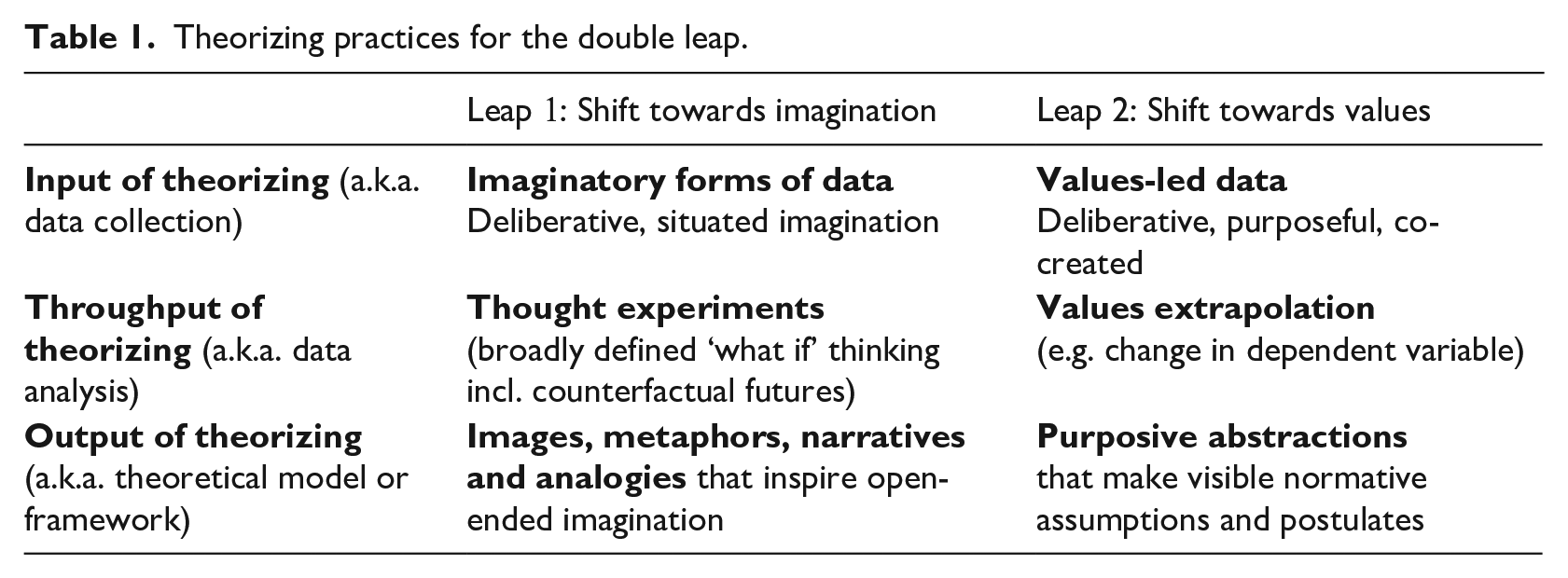
First, since the processes of theorizing and data collection are often inherently intertwined, we suggest rethinking the inputs of theorizing, which is akin to data collection in standard theorizing. Prospective theorizing similarly suggests re-imagining what data is and how it is collected. As a form of theorizing, it starts with specifying the target for theorizing; this could be concrete and contemporary problems in the world such as decarbonizing a specific industry or reducing economic inequality in a supply chain, regardless of whether these scenarios already exist in the world. Similarly to Simon, who argued that ‘the heart of the data problem for design is not forecasting but constructing alternative scenarios for the future’ (Simon, 1996, p. 148), we argue that the data for prospective theorizing is not necessarily about the world ‘as is’, but about how it could be. This anchoring can also stimulate creativity in what we theorize about because it creates the possibility for addressing new problem statements driving the theorizing process. In traditional theorizing, the problems posed by organization theorists are largely determined by the availability of empirical data and methodological tools to answer these problems. As a result, organization theorists tend to tackle tractable rather than necessarily ‘relevant’ problems (Weick, 1989); those problems that most urgently require solutions but lack empirical data are likely to be ignored or deselected.
For the shift towards imagination, scholars could effectively consider imaginatory forms of data, for instance, by focusing on deliberative instantiations of how real-world problems could be solved. This could involve interdisciplinary work at the intersection between science and fiction (Mikes & New, 2023; Negarestani, 2008; Robinson, 2021; Savage et al., 2018) and by accepting not only data that is, but data that is not (yet). Consider the challenge of theorizing the goal of COP28 of ‘transitioning away’ from fossil fuels, which illustrates the limitations of theorizing from existing data; not only does a fossil-free society that could be studied not exist, but existing carbon lock-ins limit our ability to even envision a truly decarbonized future. This data constraint (in the traditional sense) highlights the importance of theorizing desirable visions of a not-yet-existing future by co-creating imaginaries (Augustine et al., 2019).
Rather than confining ourselves to traditional data and research settings, we could venture into novel ‘research sites’ where the power of imagination takes centre stage – such as deliberative arenas for heightened public debate about potential futures. In such sites, termed ‘sites of hyper-projectivity’ by Mische (2014, p. 437), actors engage in projective deliberation, a process of envisioning and elaborating possible futures collaboratively. Mische’s work examining future projections at the People’s Summit and the UN Conference of Sustainable Development illustrates the usefulness of accessing future-oriented narratives as data-based catalysts for reflective learning and imaginative reformulation.
We could deliberately create these sites of hyper-projectivity by expanding our methodological toolkit to create different types of spaces for collaborative imagination or ‘future labs’ for fostering thought experiments and utopian thinking focused on specific problems and socio-economic or environmental challenges. The set-up of these labs could borrow from future scholars who have developed science fiction-based imagination exercises. Finn and Wylie (2021) experimented with imaginative methods such as ‘narrative hackathons’ that invited diverse participants such as science fiction writers and social and natural scientists to envision how the climate crisis will shape our future. This collaborative and imaginative process sought to harness the participants’ intersubjective imagination in ways that inspired them to reach beyond disciplinary or professional frameworks to explore different forms of knowledge, experience and possibility to break away from established conceptions of what the future might be like. The usefulness of studying and leveraging such sites lies in the externalization of imagined futures through actors’ talks, texts, expressions and narratives, rendering them visible and empirically accessible. Data, in this sense, could include future-oriented narratives, fictional stories, scenarios or images that emerge from these conversational interactions – as inputs into the theorizing process.
For the shift towards values, we may similarly focus on values-led data, such as in settings where problems have been addressed and desirable values may have been instantiated in action, even if only partially or imperfectly, but to an extent that we can transparently observe how certain values animate, are realized, or hindered in and through forms of organizing. Scholars might specifically look at organizational alternatives that manifest certain values such as inclusivity, non-hierarchy, regenerativity or decarbonization. Such data may then also be deliberative and purposefully co-created in empirical or imagined settings. One empirical pathway towards examining values in action is, as already mentioned, to focus on ‘real utopias’ and prefigurative forms of organizing. They often exist on the periphery of mainstream society and demonstrate on a small scale what could be possible (Wright, 2010). In prefigurative forms of organizing, the desired future society or system is actively created and embodied within the present. Examples include a digital social incubator (Gümüsay & Smets, 2020), intentional communities (Clarence-Smith & Monticelli, 2022) and the Occupy movement (Reinecke, 2018).
By existing in the present, these kinds of data-based instances allow scholars to examine desirable alternatives, including possibly ‘utopian’ principles instantiated in the present under real-world conditions – and theorize what may be needed or possible to realize such utopias at scale. Equally, such data may alert scholars to the unintended and undesirable consequences of enacting utopian ideals within the constraints of present reality (Reinecke, 2018). Data here essentially offer promissory glimpses of what may be possible, even if the (current) empirical instantiation does not endure or results in failure (a clear break with the conventional focus of traditional theorizing on validity). Focusing on concrete examples allows scholars to access existing empirical data while also generating novel insights and implications for creating more sustainable or equitable organizations (Wright, 2010). Based on these insights, scholars can then identify concrete institutional designs or normative organizing principles and practices that could implement the desired institutions (while anticipating or averting undesirable outcomes) in a different setting or at a larger scale.
Second, prospective theorizing invites us to reconceptualize the throughput of theorizing, which is akin to data analysis in standard empirics-based theorizing, but goes beyond such strict empirics-based analysis. For the shift towards imagination, thought experiments about both potentially real or counterfactual hypothetical scenarios can offer a valuable tool for prospective theorizing. Aguinis et al. (2023) define thought experiments as ‘judgments about what would happen if an imagined scenario were real’. A thought experiment is a cognitive exercise or mental simulation in which researchers contemplate a hypothetical scenario, problem or situation to explore and analyse its implications, without any need for practical experimentation or real-world testing. Not bound to existing data, they allow for creativity in conceptual development. Reflecting on the power of thought experiments, Folger and Turillo (1999, p. 752) note that ‘many of the greatest advances in science have proceeded from virtually no data, or certainly from highly insufficient data’. But while thought experiments have played a crucial role in the progress of science, including physics and psychology (Folger & Turillo, 1999), and are used in many humanities and social sciences to investigate abstract or complex concepts and stimulate critical and creative thinking, they are virtually absent in management theorizing (Aguinis et al., 2023).
To this end, Kornberger and Mantere (2020) proposed that thought experiments offer a genuine philosophical method that extends organization theory’s conceptual toolkit. Mental-model reasoning in thought experiments ‘help[s] theorists to construct imaginary worlds to draw out implications of new assumptions’ (Folger & Turillo, 1999, p. 745). For instance, the famous ‘trolley problem’ – a hypothetical scenario to understand decision-making in situations characterized by moral dilemmas – can shed light on the design of algorithms for autonomous driving. Similarly, organization theorists can use thought experiments to examine the potential consequences of imagined changes in organizational or governance models. For instance, they can stimulate imaginary scenarios that allow us to explore organizing principles for the circular economy. By abstracting out idealized versions of variables of theoretical interest (in this case, linearity vs. circularity), we can then think of imaginary scenarios that would unfold as consequences of changes in such variables. This would allow us to think through in a disciplined manner how product design or supply chains would have to change accordingly. Or it could allow us to think through the consequences of different design options for carbon markets or accounting systems for nature. What if we valued a living tree (as natural capital) more than a dead tree (as wood)? What if we valued companies based on their ‘net positive’ contribution to society (Polman & Winston, 2021) instead of profits? While a growing number of consultancies and initiatives are developing such valuation metrics for carbon accounting and social impact measurement and so on, organization theory is largely silent on the organizational dynamics of these highly consequential valuation methods. This is a missed opportunity; organization theorists could develop prospective theories of different valuation methods, convening stakeholders and offering a critical voice in these debates.
Imagining alternative hypothetical scenarios is also at the heart of counterfactual analyses, which are useful for imagining a reasonably different explanation to an actual scenario (Tsang & Ellsaesser, 2011). Such analyses can help to problematize (problematic) base assumptions and conceptual frames, such as the default devaluing of the future or short temporal frames in many valuation models and business cycles. Questioning such default logics stimulates reflexivity and can help us see the potential for changing problematic default logics.
For the shift towards values, scholars could engage in values extrapolation, which proceeds by a conscious consideration of values. Normative principles can be identified and incorporated into models of organizing. Such normative principles of ‘how things ought to be’ are not about a moral imperative about what one ‘should do’ but about reflecting on and selecting criteria of a goal-seeking social system, and ‘devising artifacts to attain [such] goals’ (Simon, 1996, pp. 5, 114). Such normative experimentation can be based on observing positive yet incomplete examples in the present, such as real utopias, and extrapolating broader normative principles that can inform other organizational systems or governance models. Elinor Ostrom’s (1990) groundbreaking work on polycentric governance provides one example. Her work is based on existing cases of community-based organizing to govern communal resources and overcome collective action dilemma. She and her team developed a set of ideal organizing principles for polycentric governance – a community-based alternative to both state-based hierarchic regulation or privatization and property rights.
Similarly, scholars could rethink the normative assumptions that often only implicitly underpin research, such as assumptions that lead to devaluing the future (e.g. discount rates), failing to account for the economic value of natural capital (e.g. soil) or ecosystem services (e.g. the value of bee pollination in food supply chains) or failing to cost externalities (e.g. the health and environmental costs of fossil fuel production). They could also explicitly change the target of theorizing, as operationalized in a study’s outcome or dependent variable. Instead of choosing growth or stock market returns as the dependent variable (or ‘outcome of interest’ in qualitative scholarship), we could theorize practices and business models that maximize the conservation of scarce resources, reduction of GHG emissions, attainment of social impact or regeneration. In sum, including a conscious consideration of values not only makes implicit normative assumptions explicit but also provides grounds for challenging the instrumental reasoning embedded in many organizational models.
Third, prospective theorizing suggests rethinking the output of theorizing, which is akin to the creation of theoretical models, frameworks, concepts and constructs in standard forms of theorizing. This dimension is effectively about developing alternative modes of articulating and presenting theory. Rather than presenting authoritative and methodologically vetted models that seek to represent reality as is or prescribe theory-based interventions, we envision theory instead as generative outputs that stimulate discussion, debate and engagement with imaginative accounts of what the future could be.
For the shift towards imagination, scholars could embrace imagination-focused scholarship with more open-ended imaginary, conceptualizations and promissory notes such as images, metaphors, narratives and analogies in contrast to more conventional, explanatory and factor-analytic outputs of theorizing (in the form of hypotheses or propositions, etc.). The aim is to stimulate and open up further thinking about desirable futures, shifting from accurately mirroring or representing reality to better imagining what reality could or should be. For instance, future scholars have advocated for the production of ‘imaginative narratives’ – ranging from stories to immersive theatrical performances – that engage the perceptual faculties of their audiences with visceral experiences of the future (Finn & Wylie, 2021). Rather than providing authoritative accounts, they can be deliberately scripted as intellectual provocations that foster imaginative capacity and invite imaginative participation from audiences. Such artifacts can then be used to foster cultural and social practices of collective imagination like discussions and shared reflections. Similarly, metaphors (Boxenbaum & Rouleau, 2011; Cornelissen, 2005, 2006) can be a powerfully generative output of theorizing. By fusing the realms of experience and imagination through conceptual blending, metaphors create semantic innovation so that ‘the resulting image and meaning is creative’ (Cornelissen, 2005, p. 751). Rather than fixing meaning, metaphors provide a heuristic device that stimulates imagination by ‘opening up new and multiple ways of seeing, conceptualizing, and understanding organizational phenomena’ (Cornelissen, 2005, p. 753). Due to their generative potential, metaphors stimulate what Emirbayer and Mische (1998) call the projective dimension of agency – actors’ capacity to conceive new realities and potentialities.
For the shift towards values, scholars may develop purposive abstractions that provide theoretical, values-based tools for improving the condition of humanity. Pragmatism (Dewey, 1998; Farjoun et al., 2015) and design science (Simon, 1996; van Aken & Romme, 2009) advocate for knowledge creation that provides useful ways to think about the world – not as authoritative causal claims, but as invitations for thinking. The output of prospective theorizing may also be a provocative challenge to the implicit values hidden in organization and management theories’ base assumptions, as illustrated by Banerjee and Arjaliès’ (2021) alternative decolonial imaginaries that challenges anthropomorphic biases. Their critical and reflexive theorizing based on ‘decolonial imagination’ seeks ‘not just to change the conversation about the ecological crisis, but to change the very terms of the conversation’ (p. 17). They use post-colonial theory to deconstruct Western ideas such as the Anthropocene and Gaia, revealing that they carry colonial legacies and foster instrumental and economic ways of ‘dealing with’ nature. Such decolonial imagination can help replace notions such as accumulation, extraction and competition, and replace them with notions of distribution, regeneration, restoration and cooperation.
As examples of both prefigurative and open-ended imaginary, the metaphors of the ‘doughnut’ economy (Raworth, 2017) or planetary boundaries (Rockström et al., 2009) have already powerfully stimulated the imagination of desirable (and undesirable) futures. Kate Raworth’s (2017) doughnut economy illustrates a double move towards imagination-based and values-based theorizing. The doughnut image serves as a central visual framework of Raworth’s proposed regenerative and distributive economic model. The outer boundary of the doughnut represents the ecological limits of the planet. The inner boundary represents the social foundation, which outlines the minimum social standards necessary for human well-being. The space between the ecological boundary and the social foundation – the ‘doughnut’ – is the ‘safe and just space for humanity’. The visual framework seeks to inspire ways of imagining how our economic systems need to be redesigned to operate within this safe space, striking a balance between the ecological limits of the planet and the social needs of humanity. It is generative to the extent that it encourages theorizing through thought experiments that imagine ‘what if’ each business operated within the doughnut. Similar metaphors that widen both our temporal and spatial lens by engaging with broader socioecological phenomena and context along a systems perspective that takes into account complexities and interconnectivities (Bansal et al., 2018; Grewatsch et al., 2021) would be highly beneficial to our scholarly field.
In sum, while all processes of theory construction involve imaginative reasoning (Weick, 1989) and normative assumptions, we are usually expected to mitigate them – if we even acknowledge their presence at all. Prospective theorizing, instead, embraces the creative and generative potential of imagination and values to develop more relevant, impactful and forward-looking theories.
Speculative Rigour of Prospective Theorizing
To perform the double shift towards values and discontinuous theorizing, more imagination in theorizing is required. At the same time, imagination needs to be balanced with analytical rigour to allow scholars to evaluate both the process and outcomes of theorizing. Prospective theorizing therefore involves a balancing act of achieving both speculation and rigour, or ‘speculative rigor’ (Gümüsay & Reinecke, 2022). Speculation etymologically means both reflection of the past and conjecture towards the future. The rigour qualifier suggests that scholars need to account for how they imagine such futures in a systematic way; not everything works. We need to establish criteria for speculative rigour to guide the theorizing process, legitimatize its knowledge products, and offer epistemic criteria for our theorizing that are analogous to classic notions. While promoting a pluralistic and inclusive view of theorizing, Cornelissen et al. (2021, italics added) argue that researchers must make a ‘qualified assertion regarding how something can generally be understood or explained’. Scholars have previously stressed the significance of rigour, as well as the challenges and opportunities to combine rigour with relevance (Gulati, 2007). Complementing the debate about possible trade-offs between rigour and relevance, we focus on speculation and its connection to rigour. How can we achieve speculative rigour in prospective theorizing?
Different methodological communities have developed their own canon of (epistemic) criteria. In positivist social science, scientific progress is seen as cumulative knowledge premised on an objective truth, whereby the validity of theories is assessed based on a set of criteria that prioritize empirical rigour and the scientific method. The primary focus is on the theory’s capacity to generate predictions that can be empirically tested and verified. In their classic work on naturalistic inquiry, Lincoln and Guba (1985) applied this thinking to qualitative research and suggested four general criteria for the trustworthiness of qualitative research rigour: credibility, transferability, dependability and confirmability. In comparison, as defined here, prospective theorizing involves the development of new theories, models and promissory notes to imagine future social phenomena.
Given its future-orientation, prospective theorizing cannot be simply tested and ‘validated’ against data extracted from empirical reality. Therefore, we have to rethink the guardrails and rules for imagination by making prospective theorizing a transparent methodological process whose assumptions and underlying axioms can be assessed and evaluated by the academic community. Adopting a pragmatist philosophical position that challenges positivist notions of objectivity and replicability and instead advocates for a more pragmatic, context-sensitive approach to understanding and evaluating knowledge claims, we argue that prospective theorizing should ultimately be judged against how well it helps organizations and people with imaginative possibilities cope with a complex and uncertain future in the present. In line with the pragmatist take on ‘truth’ as contingent on its utility and relevance to a given situation or problem, we argue that prospective theorizing should be judged particularly against its intellectual and practical usefulness; this can be appraised through its generative potency, transparency, desirability and plausibility (see Table 2).
Speculative rigour of the double leap.

Generative potency
In line with pragmatist philosophy, prospective theorizing can be evaluated not against its ability to mirror reality, but against its ability to generate insights that are useful for making reality. Challenging the traditional notion of truth, pragmatists argue that the meaning and value of truth are determined by its practical consequences and usefulness in solving problems and achieving desired outcomes. Truth is not a static state but rather an ongoing process of inquiry and revision, as our understanding of the world evolves and our needs change. Adopting this pragmatist approach, the usefulness of prospective theorizing is based on the theory’s ability to generate imaginative possibilities, or what Gergen (1978, p. 1344) calls generative potency – ‘the capacity to challenge prevailing assumptions regarding the nature of social life and to offer alternatives to contemporary patterns of conduct’. A relevant question is the extent to which prospective theorizing offers new and innovative concepts, models or frameworks to imagine desirable futures; and whether and when it fosters open debate and dialogue about them. Cooperrider (2021, p. 18) argues that ‘good theory, in this view, is not just backward looking,’ focused on identifying ‘yesterday’s patterns,’ but instead offers ‘a rich cultural resource for creating, elevating, and shaping the world in a future forming way to our most imaginative ideals and purposes.’
The case of universal basic income illustrates the generative potency of prospective theorizing. Based on thought experiments by the Belgian philosopher and economist Philippe van Parijs (1992) and others, it imagines a system in which every individual within a society is guaranteed a regular income regardless of their employment status. What was once a speculative discussion has now inspired several pilot programmes and social experiments to test its feasibility and potential benefits in various parts of the world, including in Finland, Canada, the USA, Namibia and Kenya. The generative potency of theorizing about values-driven principles and concepts is thereby manifested by its subsequent impact. Generative potency can be assessed, in principle, even when not yet realized, by its potential ability to trigger transformations in thought and/or practice. This may include whether and how prospective theorizing changes the way we understand problems and situations; or whether it opens up new ways for thinking about how we could organize in new, improved or alternative ways to move towards desirable futures.
Process transparency
Scholars must ensure that the process of prospective theorizing is transparently documented. This includes clearly articulating the steps taken, the (imaginative and normative) assumptions made, and the reasoning behind their theory development across the input, throughput and output stages of prospective theorizing practices. Transparency is of particular importance given the double prospective leap that needs to be understood and made accountable. With regard to the shift towards imagination, theorizing needs to be clear about how data is imagined as input to theorizing. Transparency is also required with regard to the shift to values-based theorizing, such that scholars are transparent and reflective about the normative assumptions on which theorizing rests as well as who participated and whose voices were considered. In sum, prospective theorizing needs to be sufficiently transparently documented to allow for contestation over imaginative and normative assumptions and scrutiny over the process through which its results are developed.
Speculative plausibility
Even if prospective theorizing does not strive for representation of reality or truth in the positivist sense, the theoretical underpinnings of prospective theorizing can nonetheless be assessed for their plausibility. This criterion aligns with Weick’s suggestion that ‘the contribution of social science does not lie in validated knowledge’ and that, instead, ‘plausibility is a substitute for validity’ (Weick, 1989, pp. 524, 5). Plausibility of prospective theorizing means that the process of theorizing is itself internally coherent and structured with logical inferential processes of reasoning (Harley & Cornelissen, 2020). There is also an opportunity to engage in conversation with other disciplines as a way of assessing the plausibility of any speculations. Does it make logical sense and align with existing scientific knowledge and empirical evidence, for instance, from climate science? The scientific consensus around the planetary boundaries (Rockström et al., 2009) denotes the limits of Kate Raworth’s metaphor of the doughnut economy. It envisions a set of boundaries or limits within which we should strive to meet the needs of all people without overshooting the environmental boundaries that scientific consensus has identified. Similarly, the five climate scenarios developed by the UN’s Intergovernmental Panel on Climate Change (IPCC, 2023) provide a useful reference point that renders implausible any imaginative economic model based on assumptions of unlimited economic growth.
Plausible desirability
The desirability of theorized future alternatives is, of course, values-laden. And not all values are unproblematic. Any prescriptions and theory-based interventions might even be ‘outright dangerous’ (Horner et al., 2024, p. 7). This becomes immediately clear when we consider, for instance, aspirations for fascist ecovillages or libertarian enclaves seeking to evade taxation or regulation. Therefore, a normative axiological orientation should be developed in open deliberative processes and grounded in a set of mutually agreed basic provisions for ‘values guardrails’ to evaluate the plausible desirability of futures conceptualized through prospective theorizing. These include principles such as upholding human dignity, rights and welfare of (present and future) individuals and groups, planetary boundaries, sustainable development goals or principles of responsible science (e.g. see Co-founders of RRBM, 2020). Prospective theorizing would be evaluated by whether it serves the common good and reduces or prevents harm, discrimination or inequality across generations. Values infringement would then denote the limits of speculation.
To be sure, we cannot know the specific preferences and goals that are desirable to future generations, nor can we assume that what is desirable today will still be so in the future. In complex systems, utopic solutions that we imagine to be desirable might fail or yield unintended, possibly devastating consequences beyond our imaginative capacities. In the face of uncertainty of what desirability will mean in the future, plausible desirability could endorse the principle of ‘future flexibility’ whereby goals may evolve and emerge from theorizing for an evolving system (Simon, 1996, p. 163). Such flexibility aims at avoiding irreversible damage to societal and planetary health and leaving in place desirable initial conditions and a range of options that allow future generations to realize their own goals and preferences.
Beyond a basic consensus on values guardrails and future flexibility, the assessment of desirability will inevitably involve relevant stakeholders beyond scholars and researchers (such as affected communities) in the development and assessment of prospective theorizing to incorporate diverse perspectives and foster dialogue. Prospective theorizing should seek to consider, and be reflexive on, its very own probable long-term impacts on society, policy and the field of study, and consider its potential harm or negative consequences. This includes openly declaring and debating trade-offs, for instance between environmental protection and economic gain. This must also leave room for diverse values and values disagreement. There is even value in theorizing undesirable futures – whether to prepare for or caution against such alternative (un-)desirable ideas or practices that may exist at the fringe of society or in the minds of people. Whether an actualization of desirable futures is pursued is not for academics to decide alone, but we can contribute to more imaginative, transformative and transparent societal deliberation.
We argue that speculative rigour is enhanced when multiple criteria are satisfied. While individual contributions to prospective theorizing might not embody all criteria simultaneously, speculative rigour serves as a guiding principle and collective aspiration for the broader scholarly endeavour towards generative, future-oriented scholarship. Overall, evaluating prospective theorizing against criteria of speculative rigour rather than empirical validation has the potential to challenge and transform organizational scholarship. An extrapolation towards the future can then be just as rigorous, while simultaneously allowing for generative and forward-looking theories instead of restricting our theorizing to a backward-looking focus on causal relationships and processes. Our collective theorizing about alternative systems that are not yet in existence, for example, commons, decolonial, deep ecology, feminist, or heterodox systems perspectives, could advance significantly if we evaluate theories against their generative potential rather than traditional criteria. This is because speculative rigour changes what we consider as ‘good theory’ worth pursuing, publishing and contributing to. By developing generative and plausibly desirable theories we could play a much more important role at the forefront of debates about how we account for externalities or measure the true (social and environmental) impact of organizational activities, or how we organize for a just transition to net zero.
A New Purpose for Theorizing
Prospective theorizing offers an amended purpose – fostering generative scholarship through impactful, future-oriented theory. Most theoretical models seek to represent and explain features of a current social reality. Yet by focusing on the past and present, we effectively colonize the future with cognitive limitations, instead of freeing it through imagination. Likewise, by focusing only on future probabilities, we miss desirable future potentialities, thereby decreasing the likelihood of their actualization and generative impact. As a result, we risk stumbling into the future. Rather than offering thought leadership, as management and organization scholars we are confining ourselves to empirical followership as we develop theories based on observing an empirical reality that gradually unfolds.
We advocate here not for abandoning our existing processes of theorizing but for opening them up to an alternative and complementary approach. Prospective theorizing can prepare for and prefigure a (future) social reality. By opening up theorizing in this way, it asks us to embrace volatility, uncertainty, complexity, ambiguity and paradox (vucap). It allows for more imagination rather than moving away from it or confining it in specific ways. It effectively allows us to theorize the world economy as a doughnut before it is one. Theorizing is then not about accuracy nor a fitting to reality, but about the interplay of reality and imagination – an imagined reality.
Prospective theorizing generally provides, we believe, a welcome departure from empiricist-positivist science by re-imagining theory’s relationship with empirical practice. It opens up new possibilities for engaging with different epistemological orientations and disciplines, embracing creativity, imagination and experimentation. We believe that diverse ways of theorizing futures are helpful and healthy. Akin to biodiversity, the goal here may be to embrace theorizing diversity as well as diversifying theory. This moves us from a singular present, differently interpreted, to the potentiality of multiple futures. Alternatives coexist in the present at times, but especially in futures; this realization presents an opportunity to theorize the plurality across space and time. However, to heed such a promise we need rigorous, values-based imagination to theorize alternative organizing as well as alternative socio-economic systems. Such a world may exist at the fringes and can morph towards the centre. The world-in-the-making may be multipolar and multi-system, based on diverse socio-economic paradigms and multiple alternative economies – which then require much more research on their interfaces; research which can already be conducted now through a futures-orientation.
The broader mandate that we envisage and call for through prospective theorizing comes with huge responsibility, as our scholarship would essentially move from understanding the present to both understanding and co-creating the future present. With prospective theorizing, we focus on imagined futures of non-existing phenomena. This results in interventions through imagination rather than theoretical abstractions and depictions through observation. We move from distant observer to hopefully an openly embracing, kind and humble co-creator of future desirable realties, who has shifted from a mindset of ‘don’t get your hands dirty with your data’ to one of ‘get in and help sort out the (planetary) mess’.
To be sure, prospective theorizing is a bold endeavour and not immune from fallibility or criticism. Yet given our planetary crisis and looming climate catastrophe, it is worth being bold now as it may be too late otherwise. We hope that management and organization scholars will be compelled to join this endeavour, and help shed light on the many questions that are still unanswered, such as how our academic ecosystem might change to enable and encourage the role of imagination and values in the theorizing process. Our notion of speculative rigour provides a starting point to outline how such theorizing can be made evaluable according to epistemic criteria. We encourage future scholarship to work on the imagination infrastructure that will underpin the kinds of prospective theorizing that we have outlined here, such as by developing future labs and other methodological avenues to actively co-create desirable futures. Additionally, scholars may consider more collaborative ways of theorizing together, by developing larger and more diverse collaborative research projects and teams as desirable futures are co-created, programmatic and at scale – including potentially a reflexive component of researching the researchers.
Footnotes
Acknowledgements
We are indebted to Joep Cornelissen and Markus Höllerer for their excellent and generative editorial guidance and review process. We are also grateful for feedback from Tima Bansal, Emilio Marti, and Garima Sharma on earlier versions of the manuscript. Our gratitude also extends to those who will engage with the article in the future.
Declaration of conflicting interests
The author(s) declared no potential conflicts of interest with respect to the research, authorship, and/or publication of this article.
Funding
The author(s) received no financial support for the research, authorship, and/or publication of this article.
