



Abstract
The practice turn creates possibilities for more relational approaches to entrepreneuring that challenge anthropocentric logics which exclude naturalized others, including animals, plants and ecologies, from consideration. This article uses feminist materialism to develop a more-than-human understanding of entrepreneurship, drawing empirically on qualitative data collected from a study of artisanal bakeries. I show how practices of craft, that rely on embodied proximity to materials and care(ful) making, require bakers to engage affirmatively with and become relationally dependent upon the microorganisms needed to make bread. The heterogeneous elements of artisanal bread making become connected and acquire agency through fermentation, which alerts bakers to invisible life forces they do not control and must treat with care. Through empirical insights of proximity, connections and collective agitation, fermentation offers a transversal metaphor for thinking differently about what entrepreneurial bodies can do. The article contributes to understanding craft entrepreneuring as a vital, self-organizing, emergent process of meeting with and extending care to others. By drawing attention to the more-than-human relations of artisanal bread making, it demonstrates the ethical possibilities of an entrepreneuring that remains open, attentive and curious towards others and the capacities of matter, as a basis for collective future-making.
Introduction
The practice turn has allowed researchers to study the unfolding processes of entrepreneuring as relational, material enactments and entanglements (Thompson et al., 2020, 2022; Verduijn and Andersen, 2022). It has thus sought to acknowledge the significance of nonhuman bodies, including technologies, artefacts, tools and other living beings, in supporting and influencing the human performance of a practice (Champenois et al., 2020; Teague et al., 2021). Moving away from the ontological individualism that positions entrepreneurship as the property of individual people and their relations (Thompson et al., 2020) has created possibilities for entrepreneuring to be understood as an ongoing sensitivity towards, and disclosure of, emerging possibilities through processes and practices of organization creation (Hjorth, 2014) as a basis for collective future-making (Daskalaki et al., 2015; Gherardi, 2016, 2019a, 2019b). This potential has been explored by studies that use actor-network theory and focus on socio-spatial practices (Barinaga, 2017) as embodied, relational performances (Elias et al., 2022). Recently, however, there have been calls for greater consideration of living and non-living materiality as constitutive of entrepreneurial practice (Thompson et al., 2022).
Drawing on the scholarly tradition of feminist materialism (Coole and Frost, 2010; Dolphijn and van der Tuin, 2012; Fox and Alldred 2017), this strand of scholarship takes a more radically relational approach by confronting the assumed boundaries between nature and culture and moving beyond humanist approaches to thought. Building on feminist scholarship that explores how gendered power relations shape identities and social lives in ways which privilege a white, masculine entrepreneurial subject (Calás et al., 2009), it disrupts the individualist ontology that portrays entrepreneurs as autonomous, rational agents. By rejecting the Cartesian mind–body split and emphasizing the body ‘as the primary capacity for being affected by forces’ (Hjorth, 2015: 43), entrepreneuring is understood as a relational, material, processual process of organization creation that is realized through proximity to others (Hjorth, 2014, 2015). This social ontology of relatedness rejects the centrality of humans as the primary site of intentional action (Steyaert, 2007) and creates opportunities for posthumanist or more-than-human studies of entrepreneurship (Cnossen et al., 2024; Ergene and Calás, 2023).
In this article, I build on this work by taking a feminist materialist approach (Calás and Smircich, 2023) to understanding craft or artisanal entrepreneurship (Pret and Cogan, 2019; Sirois, 2020; Tregear, 2005). I treat craft entrepreneurship as a socio-spatial, embodied relational practice that is the outcome of collective entanglements of humans and nonhumans that, in the process of connecting, acquire agency. Previous research suggests craft gives rise to more local, pro-social approaches to entrepreneuring that treat social and cultural capital as collective resources shared between artisans (Drakopoulou Dodd et al., 2021). This work suggests craft can become a site of alternatives that challenge the conventional positioning of entrepreneurship as a mechanism for capitalist growth and emphasize its importance in addressing environmental and societal challenges (Lindbergh et al., 2022). By drawing attention to the distributed nature of agency in craft entrepreneurship, I explore how embodied proximity to, and manual engagement with, lively matter that has agentic capacities can help to foster more affirmative ethics and politics (Bell and Vachhani, 2020; Dey, Fletcher and Verduijn, 2022; Weiskopf and Steyaert, 2009).
The article draws on a qualitative study of craft bakers in the United Kingdom who use traditional fermentation methods to make bread. Bread, as the ‘paradigmatic food of settled agriculture and its inequities’ (Steel, 2018: 162), carries meanings related to sustenance, food and wealth, as well as ideas of the ‘good society’ and how it should be organized (Bobrow-Strain, 2012; Cutler Shershow, 2016). Craft bread making is also a ‘process-oriented’ practice that foregrounds relations between humans, objects and their environments and ‘recognizes the importance of becoming, together’ (Gruwell, 2022: 31–32). Using feminist materialist and posthumanist theory (Bennett, 2010; Braidotti, 2019, 2022), I explore how the practices of craft disrupt humancentric visions of entrepreneurship in ways that enable a more-than-human worldview. I treat bread dough as a living thing ‘in the making’ (Hjorth, 2014: 99) with ‘vital, immanent qualities and self-organizing capacity’ (Braidotti, 2019: 96) that constrain what can be done to and with it (Moser et al., 2021). I show how the artisanal practice of making bread is a site where the effects of multispecies entanglements in the becoming of food can be felt. By linking heterogeneous elements together, including the microorganisms that act as crucial ecological elements in the fermentation process, insight is generated into what craft entrepreneuring can do. By analysing how bread takes form, and the affective intensities generated by these engagements, I explore the possibilities of fermentation as a creative resource for thinking differently about what living, breathing bodies are capable of doing, and a transversal metaphor for imagining how entrepreneuring helps us to move beyond an anthropocentric worldview.
The vital materiality of craft entrepreneuring
Bennett’s (2010) concept of vibrant matter draws attention to the agency that circulates between elements that act together to produce a phenomenon. Such an approach is an ‘invitation to see the world as the movement of relationships between things rather than the things in themselves’ (Benozzo and Gherardi, 2019: 145). It provides a basis for exploring how material and social, human and nonhuman elements become entangled and acquire the capacity to act by becoming connected. Things, including inorganic matter, are not regarded as passive and lifeless but as possessing a force that exists independently of human beings who attribute meaning to them (Bennett, 2010). This is captured by the notion of ‘thing power’, as the ‘strange ability of ordinary, man-made items to exceed their status as objects and manifest traces of independence or aliveness’ (Bennett, 2010: xvi). For Bennett, ethics begins with the recognition that we are participants in a shared, more-than-human vital materiality and involves cultivating the ability to discern and become ‘perceptually open’ (Bennett, 2010: 14) to it. Bennett’s work provides the basis for a less instrumentalized approach to matter that ‘feeds human hubris and our earth-destroying fantasies of conquest and consumption’ (Bennett, 2010: ix). It relocates the human species ‘within a natural environment whose material forces themselves manifest certain agentic capacities and in which the domain of unintended or unanticipated effects is considerably broadened’ (Coole and Frost, 2010: 10). This enables a move beyond the dominant anthropocentric frame and paves the way towards more inclusive practices of becoming-human (Braidotti, 2019, 2022).
While a materialist approach to craft decentres humans and recognizes the agency of nonhumans, it does not absolve humans of agentic responsibilities. One criticism of materialist social inquiry arises from the proposal of a flat, relational ontology that risks obscuring the power relations that structure the intra-actions of agents. Gruwell’s (2022) materialist analysis of craft engages with this issue directly through the concept of ‘craft agency’. For Gruwell (2022: 31), ‘because craft sees materiality as inherently political, it recognizes that building, dismantling, or abstaining from particular intra-actions is an ethical practice’. In the context of craft making, a relational ontology draws attention to how power emerges from the affinities between diverse human and nonhuman agents that create ethical obligations between co-actors. By foregrounding ‘the alliances that enable any act of making’ and regarding the material as ‘mutable’ – dynamic and continually changing, craft creates political and ethical possibilities for change through ‘the (re)arranging of entanglements among material actors’ (Gruwell, 2022: 14). These ideas are further explored in Paxton’s (2013) ethnographic study of artisan cheesemakers in rural America, a practice that relies upon working with lively microbial agents. For these craft entrepreneurs, agency depends on intimate collaboration. This is a moral as well as an economic struggle, where the purpose is to make and sell food that calls ‘attention to their own labor, as well as to the productive contributions of farm animals, bacteria, and fungi’ who work in concert to transform matter (Paxton, 2013: 14).
Feminist materialist posthumanism (Bennett, 2010; Braidotti, 2019) thereby extends previous studies of craft entrepreneurship that have drawn attention to the role of place-specific traditions and communities of making in creating economic and social value (Drakopoulou Dodd et al., 2021; Kraus et al., 2018; Pret and Carter, 2017; Pret and Cogan, 2019). By making explicit the material relations that imbue everyday objects with ethical, as well as deep cultural and political, meanings (Gasparin and Neyland, 2022), this literature highlights the distinctiveness of craft entrepreneurship as practices of making that combine aesthetic or expressive features with utilitarian function and carry high cultural value (Sirois, 2020; Tregear, 2005). Previous research has shown how craft organizing necessitates acknowledgement of the vitality of matter that gives rise to ethical possibilities that stem from a willingness to be open to other, nonhuman bodies and forces and enter into productive collaboration and cooperation with them (Bell and Vachhani, 2020). As argued by Holt and Yamauchi (2023: 841), the ethical experience of craft ‘emerges through a felt intimacy and sympathy with things that is generated by a disciplined and skilled willingness to give voice to accident and chance’. By drawing attention to affect, the invisible flows of energy that possess the power to change, move and modulate other bodies and materialities (Seigworth and Gregg, 2010), craft allows appreciation of the precarity, unpredictability and co-dependency that arises when connections are made between living and non-living matter. Affects arise ‘in the midst of in-between-ness: in the capacities to act and be acted upon’ (Seigworth and Gregg, 2010: 1, emphasis in original). This approach assumes that entities never exist as discrete beings but rather always in relation to others in their environment with which they ‘intra-act’ (Barad, 2007). It provides a radically different way of understanding agency as emerging from spaces, capacities and forces between objects or entities in relation.
Building upon a philosophical tradition that critically reassesses humanism in modernity and ‘disenchantment with the unfulfilled promise of the humanist belief in science-driven progress’ (Braidotti, 2022: 20), materialist posthumanism challenges humancentric logics that position entrepreneurs as the only, or main, source of agency and regards animals, plants and ecologies as their benevolent concerns (Gruber and MacMillan, 2017). Entrepreneuring is thereby understood as a self-organizing process of multispecies becoming through perpetual emergence that involves learning to treat nonhuman others with care (Puig de la Bellacasa, 2017). Through the concept of zoe – a ‘life-process’ that humans do not control, which carries on ‘ruthlessly and regardlessly’ (Braidotti, 2002: 132), it becomes possible to explore craft entrepreneuring as an open-ended gathering of species that influence one another (Tsing, 2015). Posthumanism thus provides a way of doing and valuing entrepreneuring that is rooted in awareness of, and sensitivity towards, more-than-human others, rather than founded on privilege based on a belief in human infallibility and superiority (Cnossen et al., 2024; Gherardi et al., 2024).
Fieldwork entanglements
Feminist, materialist and posthumanist scholarship seeks to move away from the Cartesian mind/body split that designates the researcher as the data collecting knowing subject who is separate from the studied subject/object (Benozzo et al., 2024; Cozza and Gherardi, 2024; St Pierre, 2014; St Pierre and Jackson, 2014). Instead, making knowledge is seen as an ‘ethico-onto-epistemological’ practice (Barad, 2007) that seeks to transcend the ‘I’ of the humanist subject (Cozza and Gherardi, 2024; Murris and Bozalek, 2019). This necessitates moving beyond language and interpretation by becoming ‘sensitive to the more-than-human elements that make up the space of work’ and the relations between temporarily assembled elements (Benozzo et al., 2024: 87). Inquiry was therefore directed towards understanding how baker entrepreneurs become active as organization-creative agents (Cnossen and Bencherki, 2019) that are ontologically inseparable from other matter, including microorganisms, ingredients, machines and tools they are entangled with, by following the processes whereby heterogeneous elements become connected. I also concentrated my fieldwork efforts on capturing the liveliness of material transformations, as well as the passions and beliefs that these practices generate (Gherardi, 2016). Through this, I sought to move beyond understanding the body as a privatized realm and towards a relational understanding of practices as inter-embodied – affected by other bodies and objects. It is also important to acknowledge the limits of humanist embodied experience, which mean I cannot speak for the nonhuman elements I studied and instead can only write from my more-than-human shadowing (Nadegger, 2023) of them, following, or moving with, material elements in the craft assemblage.
The article draws on a qualitative study of craft bakers in the United Kingdom who use traditional fermentation methods to make bread. These small-scale, artisanal food entrepreneurs (Blundel, 2002; Lindbergh and Schwartz, 2020) emphasize tradition and authenticity, using methods of handicraft, locally sourced, natural ingredients and avoiding artificial additives. Traditional making uses a few simple ingredients – flour, water and salt, and relies on the process of long fermentation to make sourdough bread. Like other artisan food entrepreneurs, they also position their businesses as an attempt to address environmental and health issues associated with global industrial food production. They are thus aligned with the Slow Food movement, which advocates the protection of artisanal traditions seen as essential in producing superior quality and taste from being undermined by homogeneous, large-scale industrial food production (Van Bommel and Spicer, 2011). Previous research has highlighted the tensions that arise in reconciling a business logic of profit and growth alongside the anti-growth constraints of an artisanal logic (Lindbergh and Schwartz, 2020).
I began the fieldwork in 2021 by conducting initial exploratory interviews with bakery owners to explore their life histories and everyday lived experiences, mostly online owing to pandemic restrictions in the United Kingdom on face-to-face meetings. Through these conversations, it became clear that, while artisanal bread is a material artefact that is shaped by craft labour, its aesthetic and commercial value arises from the aggregate efforts of the distributed community that supports craft bread making (Paxton, 2013). I therefore sought support from two non-profit associations that support and represent artisanal bakers. I carried out a national survey of 200 small bakery business owners, which provided contextual data related to business size, age and commercial opportunities and challenges faced. In addition to qualitatively interviewing 30 bakers, I gained access to several bakeries where I conducted periods of participant observation. Typically, I arrived at the bakery at the beginning of a shift, at around 6–7 am. I spent 3–4 hours standing and hanging around and observing each section, including dough mixing, shaping and putting the dough into tins or bannetons, oven loading and unloading, and patisserie work including lamination, cake, pie and sausage roll-making. I asked bakers to explain their practice to me as they worked, taking detailed field notes and over 300 photographs. These methods were used to represent the sensory affective experience of being in a bakery, including colours, patterns, smells, flavours, textures, rhythms, movements, sights and sounds (Vannini and Vannini, 2019). I also sought to retain openness to resonances with other bodies I was entangled within the bakery, maintaining awareness of bodily expressions, practices and felt experiences and reflecting on how my own body was changed by the fieldwork (Gherardi, 2019a; Michel, 2018; Thanem and Knights, 2019). I was particularly struck by the ‘muscular effort’ (Vannini and Vannini, 2019: 7) of human bodies being shaped by the practice of craft bread making that required them to ‘transform’ their ‘body completely . . . into a quick tool . . . to acquire the rhythm necessary to make it in the artisanal relations of production’ (Bertaux and Bertaux-Wiame, 1981: 175).
As the fieldwork progressed I was invited to join a network of craft bakers, farmers, millers and brewers. I took part in online and in-person meetings where I presented my research and carried out interviews with some of the organizers. I conducted participant observation at a bread industry conference, a formal craft guild dinner and meetings attended by large and small bread retailers, equipment and ingredient suppliers and sales representatives and technical consultants. These conversations offered me an opportunity to understand concerns and debates in the commercial bread world from the perspective of both industrial and artisanal producers. I also carried out an archival analysis of a leading bakery industry trade journal to understand historical changes in the UK craft bakery sector. Finally, my research involved eating – shopping for and tasting bread allowed me to better appreciate the judgement and skill involved in artisanal bread making. As an eater, I did not simply apprehend the edible parts of my surroundings but became ‘mixed up with them’ (Mol, 2021: 30) as they became assembled, or incorporated (Valentine, 2002) into me. This involved learning how to taste bread by separating the crumb, or mie, from the crust, chewing it slowly to experience the range of flavours before moving on to the crust (Sethi, 2015). Through this I sought to understand eating, and the practices through which food comes to be eaten, as ‘a series of mutual transformations between human and nonhuman materials’ (Bennett, 2010: 40). Regarding ‘edible material as an agent inside and alongside’ (Bennett, 2007: 134) human bodies offered me a way to acknowledge the agentic capacities of ‘nonhuman things and systems that act, influence, shape and make food for humans possible – or not’ (Beacham, 2018; Elton, 2019: 6).
I approached these entanglements by becoming attuned to their unpredictable capacities to generate wonder, a ‘potentiality [that] can be felt on occasions where something – perhaps a comment in an interview, a fragment of a field note, an anecdote, an object, or a strange facial expression – seems to reach out from the inert corpus (corpse) of the data, to grasp us’ (MacLure, 2013: 228; see also Cozza and Gherardi, 2024). Wonder, as a state of ‘interactive fascination’ and disruption (Bell et al., 2021b: 256; Bennett, 2001), is relational and can emanate from a particular fragment of the text, an image or object or be located ‘in’ a person who is affected. Photographs provided a particular source of fascination, or ‘glow’, stimulating my bodily attention and having ‘the capacity to animate further thought’ (MacLure, 2013: 228). I explored these affects further using Barthes (1981/2000) concept of the punctum, objects and relationships in photographs that do something to the viewer. The punctum reflects an object’s capacity to affect, which may only be revealed in retrospect. However, while ‘every photograph is a certificate of presence’ (Barthes, 1981/2000: 87), not all matter is accessible to the human eye (Quattrone et al., 2021). The analysis therefore also involved thinking about what was not visible in the photographs but could be touched, smelt or tasted.
Becoming with bread
In the analysis that follows, bread and the elements from which it assembled appear as actants alongside humans in the assemblage referred to as craft entrepreneuring. The concept of assemblage or agencement draws attention to how elements within practices of craft acquire collective agency through becoming connected (Cozza and Gherardi, 2024; Gherardi, 2019b). Bread is thus positioned as an actant, characterized by a ‘self-altering, dissipative materiality’ that ‘enters into what we become’ (Bennett, 2010: 51). The analysis explores how bakers become with bread through the empirical insights of proximity, connections and collective agitation.
Proximity
Making bread is a lively practice where ‘matter pushes back and disrupts’ (Bennett, 2010: xiv) through the microbial transformation enabled by fermentation. A machine mixes the starter, flour, water and salt while hands are used to judge the water temperature. ‘When the baker takes a small piece of dough, stretches and angles it towards the light to check the gluten – it looks like skin’ (field notes). The dough is then lifted, in huge armfuls from the mixer into plastic tubs. This is the moment when the matter comes fully into motion with a human body and they come together. A splash of wet dough sticks to the baker’s skin (Figure 1). It seems to reach out from the massed body of dough, attaching itself to the baker’s body, stretching across the back of his hand – skin on skin, each absorbing, resisting and being transformed by ‘that which it comes into contact’ (Brewis and Williams, 2019: 91).
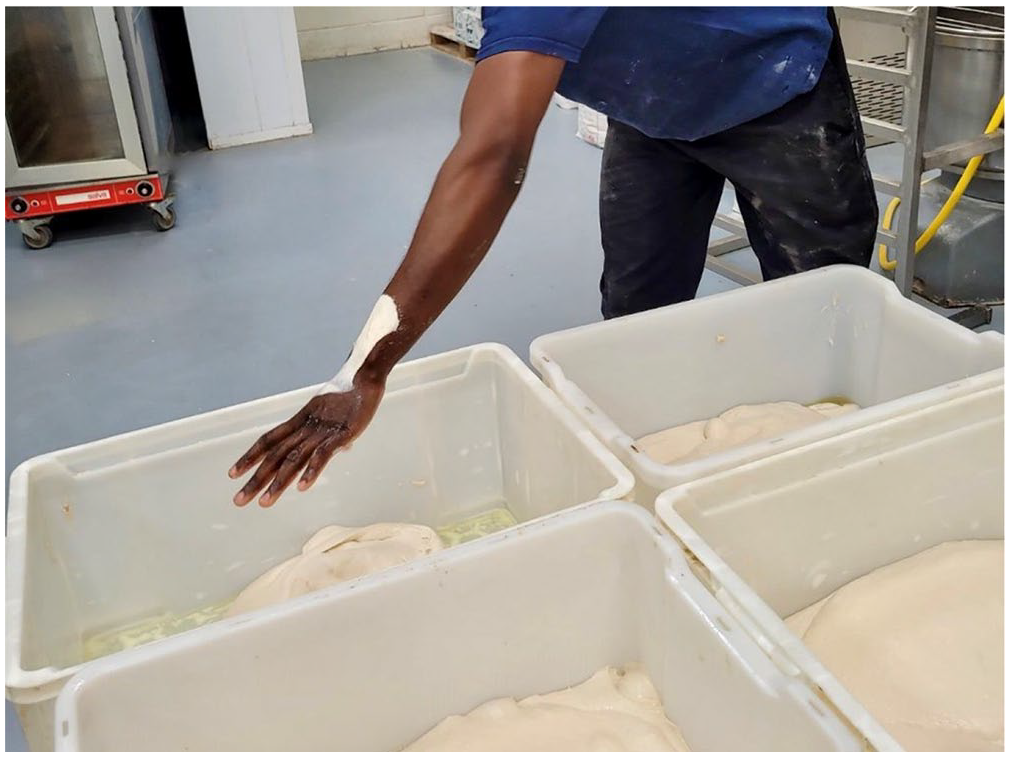
Mixing the dough.
For bakers like Stuart (bakery established in 2019, sole trader), their practice relies upon the ‘sensory experience . . . of being connected to what you’re doing’, which comes from working with the hands. Anna (bakery established in 2020, one employee) tells me that knowing the bread is a ‘sensory’ practice that requires recognition of its continual ‘variation’ when ‘working with something that’s alive and soft and changes’. Her way of doing this is accomplished through trial and error, by forming connections that are situated and continually changing, thus always incomplete. She explains that she sees herself as ‘nursing something through to its baked point’ and says, ‘there’s something beautiful about that’. I am brought back to Anna’s maternal metaphor of nursing the bread as I watch a baker turning the dough in the process of bulk fermentation: Sam turns the dough now resting in stacked large plastic boxes. Periodically, he opens the box, lifts the dough and folds it back over itself. I notice its fleshiness. He handles it firmly but gently, almost like a baby. Sometimes he turns the dough three times, sometimes four. He tells me he can feel how many times to turn it. (Fieldnotes)
I am struck by this moment in motion. The tattooed skin of the baker’s arms is gently illuminated by morning light coming through the window (Figure 2). The fine hairs on his skin are in touch with the air that surrounds him, blurring the boundary between his body and its surroundings. The shining film of water on his hands acts as another skin, preventing them from sticking to the dough. Care is also apparent in how the portioned dough is shaped, the baker cupping his hands around the dough as he pulls it towards him, ‘rounding it against the work surface to tighten the tension and stretch the outer surface’ (Robertson, 2010: 58, see Figure 3). This is followed by scoring the tops of loaves before they are put into the oven: The bakers gently tip dough from bannetons onto stretched canvas frames. The soft dough plops out and the top is scored, almost tenderly, with a razor blade. It looks like an incision into flesh. They seem to care for it, sometimes almost caressing the dough as they make the cut. (Fieldnotes)
The touch of the baker’s hands signifies gentle caring, a sensorial experience that makes the baker’s body susceptible to being affected (Figure 4). A beam of sunlight acts as the punctum that pricks me as I watch. Its radiation touches the baker’s hand and the dough simultaneously, connecting the ‘body of the photographed thing’ to the viewer. ‘[L]ight, though impalpable, is here a carnal medium’ (Barthes, 1981/2000: 81) that touches me afterwards, as I look again at the photograph, wonder residing in and radiating from it in the form of an affective glow.
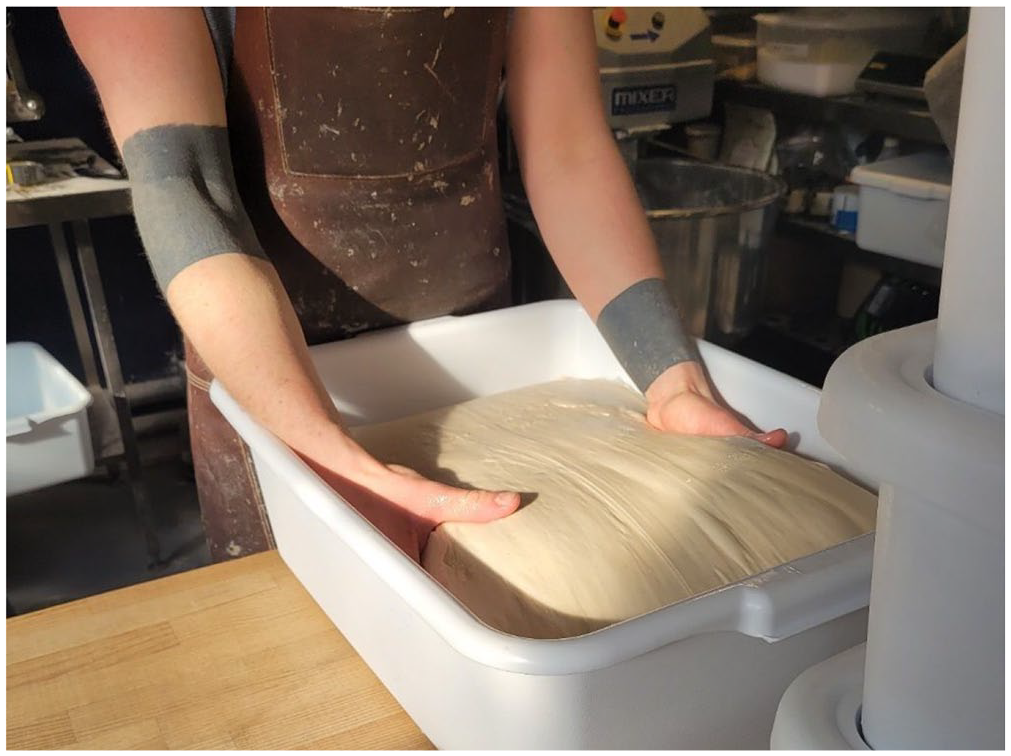
Turning the dough.
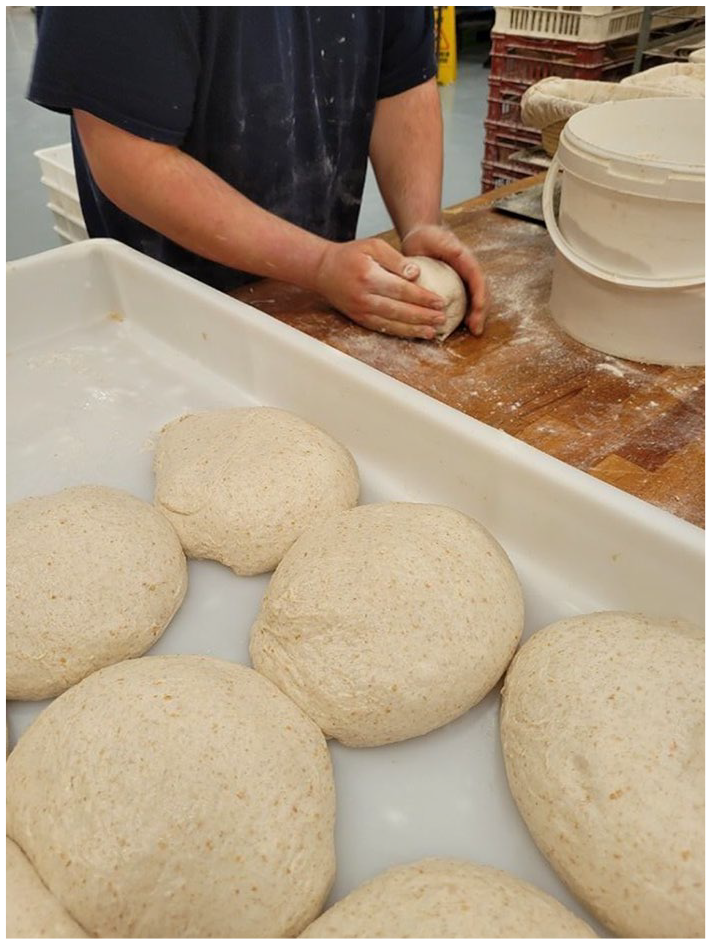
Shaping loaves.
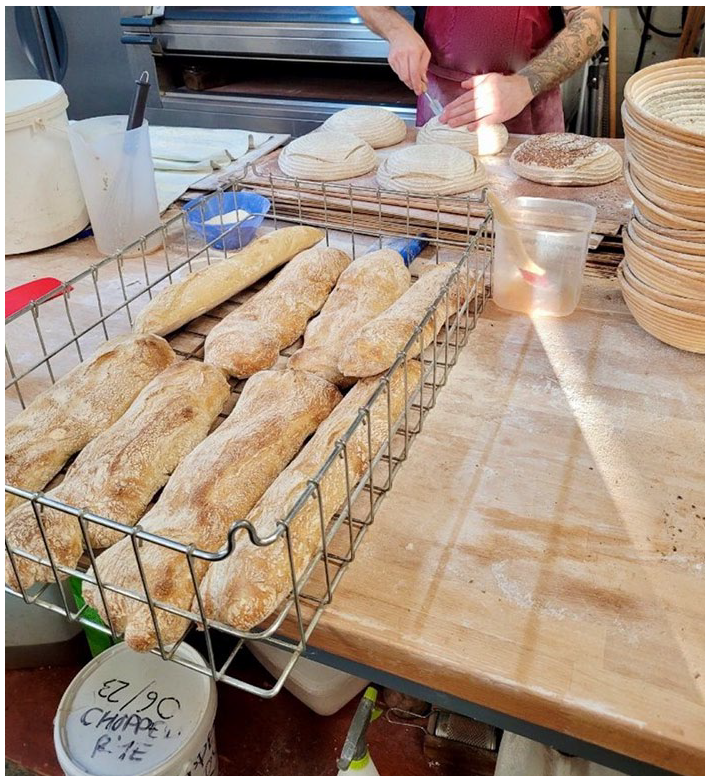
Scoring a loaf.
Human and more-than-human skin becomes ‘an active living surface’ and a ‘site of possibility’ (Castañeda, 2001: 232–234) that gives rise to ‘a particular form of collective reciprocity’ related to ‘the ability and responsibility to respond to being touched’ (Puig de la Bellacasa, 2017: 116). Through its ‘unique quality of reversibility’, the touch of the hand offers a way of expressing ‘a sense of material-embodied relationality’, providing not only a sensorial experience but also an ‘affective charge’ (Puig de la Bellacasa, 2017: 20, 98). By being ‘in touch’ with other matter, practices of craft draw attention to the relationship between ‘the flesh effects of connections between beings’ through which the ‘boundaries between self and other are blurred’ (Puig de la Bellacasa, 2017: 96). Becoming with bread thus becomes a practice of ‘empathic proximity and intensive interconnectedness’ (Braidotti, 2002: 8).
Connections
The process of making bread involves creating a sourdough leaven or ‘starter’ by mixing flour and water and allowing it to ferment (Robertson, 2010; Whitley, 2006). The starter is made up of hundreds of wild yeasts, found in the flour, on the baker’s hands, and to a lesser extent in the air, plus thousands of bacteria. Sue (bakery established in 2012, sole trader) tells me about her enchantment with ‘the miracle of bread. You take these three, four ingredients and you combine . . . these completely passive elements, and suddenly the amazing chemistry of these things turns into something that’s living, breathing and ultimately gorgeously flavoured’. I think about the starter as a collective body that resonates and transmits affective intensity. This ‘multispecies crowd’ (Gherardi, 2019a: 746) is a collaborator in the making of bread as an expression of life (Deleuze, 2007).
To make sourdough bread, bakers must become attuned to these multi-species relations. The bacteria must be nourished by regularly adding fresh flour and water, a process referred to as ‘feeding’. bread making books explain how the skill of the baker is connected to their knowledgeable handling of the starter and their attunement to the process of fermentation as ‘the soul of bread making’ (Robertson, 2010: 71). Some bakers attribute meaning to the provenance of their starter, its time and place of origin, which may be several decades old (Pallant, 2021). A few bakers give their starter a name, a gesture that acknowledges the intimacy and mutuality of these multispecies relations (Arantes, 2020; Siragusa, 2021). I learn that keeping a starter healthy and lively requires ‘skilled vision’ to interpret the activity of the microorganisms and to work their rhythms into the baker’s timetable (Arantes, 2020: 41; Robertson, 2010). Such knowledge is sensory, ‘actively smelling (in order to know whether the sourdough has not gone too sour) and tenderly feeling-moving (when kneading, folding . . . and scoring the dough) are equally crucial sensory experiences requiring interpretational skills’ (Arantes, 2020: 41).
Making time for bread is an everyday caring practice that can be enjoyable but is also mundane and tiresome, involving ‘hovering and adjusting to the temporal exigencies’ (Puig de la Bellacasa, 2017: 206). Bread requires bakers to work to temporal rhythms that allow time for fermentation, a process that can take up to 48 hours. Rather than positioning microorganisms as recalcitrant species that must be tamed by industrial science to maximize the extraction of value for human consumption, artisanal bread making slows down the velocities of capitalism and attends to the active vitality and rhythms of things that live and the connections between them. Fermentation is described by one baker as ‘time invested in the making’ (Whitley, 2006: 29). This is contrasted with the accelerated productionist bread making rhythms developed in the United Kingdom in 1961 at Chorleywood, a ‘no-time dough-making process’ that, with the addition of additives and enzymes, removed the need for fermentation and a ‘prolonged resting period’ (Cauvain and Young, 2006: 17–18). I learn, from talking to a global bread industry consultant involved in its development, that this method accounts for the majority of UK bread consumption. Yet, making time for bread is sometimes at odds with keeping the baker’s body going, as Alan (bakery established in 2013, 40 employees) tells me, baking is ‘the hardest thing he has ever done’.
Lively matter ‘can express its agentic capacity only within an assemblage congenial to it’ (Bennett, 2007: 133–134). While bakers rely on the commodification of what lives through what these microorganisms can do, they do not control them in a dominating sense. Bakers’ engagements with bread making elements are marked by unpredictability and variation, for example, caused by changes in the weather related to temperature and humidity. Human and nonhuman bodies that breathe the same air are open to invisible forces as they intermingle with their environment – relational, vulnerable and unstable (Allen, 2020). As Jon (bakery established in 2020, 30 employees) observed, while he ‘might be a bread master one day’, he will never master bread, instead ‘it will always be the boss’.
The bakers’ hands allow the breathing, bubbling yeast to become animated in a vibrant entanglement that defies boundary-making (Yates, 2017). I think about the wild yeasts and bacteria as destabilizing participants within agencements of bread making that can produce movement and enter into material relations with other forms of life and nonlife, resulting in their mutual transformation (Hird and Yusoff, 2018). I talk to the founder of a start-up bread innovation and food technology company, Kelvin, who tells me the food industry needs to radically change to deal with the devastating impact of diet-related chronic illness. He explains the impact of ultra-processed food on human health, which has come to light because of recent scientific developments in understanding the gut microbiome. His company has ‘found a way to be able to put health into an industrial loaf’, which is ‘the UK’s most consumed ultra-processed food’. He thinks that health officials ‘should ban’ industrial bread. He says the fermentation process ‘is good in its own right’ but ‘it’s only useful to a point’: [Fermentation is] a very powerful process with all sorts of alchemical benefits . . . We’re . . . looking . . . [at] how we can concentrate that into something much more usable by plant bakeries around the world . . . We’re not using artificial chemicals and enzymes . . . stuff that consumers feel uncomfortable about.
I read more about the human microbiome, intestinal bacteria that live exclusively in/on humans and are necessary for digestion. This reconceptualization of the materiality of the human body ‘bears witness to a growing awareness that every individual human is a microcosmic homeland or pasture for other swarms of life, indifferent to our parochial illusion of solitude or self-mastery’ (Steel, 2018: 160). The activity of microbes doing their digestive work in the fermentation process makes it easier for humans to digest bread (Mol, 2021). Agency in bread making is thus a force that is ‘distributed across multiple, overlapping bodies, disseminated in degrees – rather than the capacity of a unitary subject of consciousness’ (Bennett, 2007: 134). Understanding human bodies ‘as an assemblage of microbial colonies of dynamic bacteria decentralizes the notion of the human individual as some exceptional entity’ (Braidotti, 2022: 123). However, Kelvin’s approach conforms to a mainstream entrepreneurial logic. His ‘solution’ to the negative effects of industrial bread on human health involves developing ‘a new generation’ loaf of bread that is ‘half the price and twice as healthy’ and yet remains ‘recognizable’ to the artisanal market. By seeking to ‘distribute this globally’, the practice of artisanal bread making becomes subsumed within a logic of economic value creation that is based on the idea of entrepreneurship as economic venturing. Kelvin’s humancentric approach is at odds with the artisanal practice of making bread by creating connections between human and nonhuman bodies; instead, it commodifies and profits from scientific and economic understanding of microbial life (Braidotti, 2019).
Collective agitation
Fermentation is a process of collective agitation that has the capacity to generate world-making affects that shake up humancentric understandings of entrepreneurship. I observe these affective possibilities when attending a baking industry conference: The owners of a successful, award-winning craft bakery, a man and woman, stand up to speak. They are invited guest speakers but this is not their usual space and they are apprehensive. The room is filled with people in suits, most of whom represent big businesses that do not make bread of the kind that these bakers would recognise as real bread. The man speaks after his wife. He asks the audience if they remember the bread they ate at the conference dinner last night. He tells them he was watching and none of us ate the bread, which in his view was not surprising because it wasn’t good bread. He remarks on the sadness and wrongness of this for him, at a baking industry conference. He tells us he wants to put bread back in its rightful place, at the centre of the table. (Fieldnotes)
What model of being is implied by this ‘fleshy affair’ between kin (Haraway, 2008; Mol, 2021: 53)? If the human eater ‘keeps taking without giving, receiving without caring in return, then . . . there will be . . .. no more companions with which to play. And no more vital others to eat’ (Mol, 2021: 124). Placing bread at the centre of the table changes how it takes shape by being oriented differently towards us (Ahmed, 2010). The table marks out the space and positions human bodies in a position of apprehension – we have the bread within our view and are aware of it before gradually incorporating it into our bodies. These orientations leave an impression by tending towards the object that takes time and care. They also orient us towards the future differently (Ahmed, 2010) by developing more care(ful) practices of incorporation: I am in a bakery. A lot of bread has been made in the four hours since I arrived. It has been looked at, touched, tasted and evaluated on a scale from ‘fucking amazing’ to ‘shit’. The bakers haven’t taken a break since the start of their shift. They drink tea or instant coffee. The doughnuts have been cooked and we taste a piece. Later, someone brings in pieces of cooked sausage and offers them round, we each take a piece. At 10am coffee orders are taken for each baker from the adjoining café. One of the bakers makes some cheese on toast in the bread oven. He tells me it’s important to eat and drink, otherwise you get too tired. A few customers sit at tables in the covered outdoor seating area in front of the bakery where they can look in through the full height windows and watch the bakers at work. I take a break and sit outside with them to eat a doughnut and drink my coffee. (Fieldnotes)
Eating the doughnut takes place in a place where I am attuned to registering bodily sensations in myself as an eating subject in relation to food. I come to know bread by ingesting it. I am changed by valuing and engaging perceptively with it. It is the same for many bakers whose desire to make bread is often driven by relations that exceed conventional entrepreneurial thinking. For Lucy (bakery established in 2004, five employees), a lifetime of thinking about ‘connections between soil, plants, animals, people and the environment’ is what brought her to bread. Anna puts this more urgently, saying she is driven by the ‘impending doom of climate change’ to do something that addresses issues related to ‘sustainability . . . community and communication and how we might be more resilient in the future’. These bakers are aware that, while making (and eating) bread is a local everyday practice, the elements from which it is assembled are part of a global food system, as Anna explained: The commodity grain market . . . [means] farmers are producing grain for yield and not [necessarily] for flavour . . . They get penalties based on the quality of the grain. So it’s a very detached model of food production and it’s a [volatile] global market . . . It’s a disconnected way of growing food and you don’t know who your customers are or who is eating it. The variety [and] choice is very narrow, which is a very fragile position to be in . . . So, this is a way of being a baker that takes back control of something. (Bakery established 2020, one employee)
Anna’s account points to how the food we ingest ‘has travelled towards’ us (Mol, 2021: 46). Humans, like bread, are multisited, dispersed entities, ‘far from remaining distinct’ these bodies incorporate ‘bits and pieces of the outside world’ (p. 49). For some of these bakers, their journey towards making money by making bread was prompted by disillusion with disembodied labour, such as managing projects and IT systems or analysing data. For others it is a response to, or reparation for, a life lived according to the market: I was 25 years . . . working in financial services in London . . . I ended up in the investment world because I was very good at selling complex products . . . And then I went into the hedge fund industry . . . The idea would have been by the time I was 50 . . . I’d be walking away with five, ten million quid or something like that . . . And [then] they became the biggest investor in Northern Rock at the very, very worst moment . . . They also were involved quite heavily with Lehman Brothers . . . They made 75% of the workforce redundant immediately . . . And . . . I said, ‘right, I’m out of this . . . I want to do something with my life which I think has some value for me’. (Alan, bakery established 2013, 40 employees)
Alan’s connection to bread stemmed from the ‘alchemy’ of its becoming, combined with the democratic possibilities that emerge from making an ‘absolutely outstanding’ food affordable even for people on lower incomes. Yet, as Ben explained, ‘there’s a huge . . . group of people who can’t afford . . . [my bread] who should have it, but I can’t make bread that cheap for them’ (bakery established 2018, 30 employees).
Following the bread leads me to a local grain network of bakers, brewers and grain farmers: On a beautiful sunny day in June, I drive to visit Thomas, a farmer who owns 2000 acres of productive land where he grows, and now mills his own wheat, having recently bought a New American Stone Mill. He is working with Georgia, whose family owns land which they hope to farm eventually. They are growing all kinds of wheat experimentally, including heritage and diverse population varieties, to find out which grow best here. Thomas, a third-generation farmer, wants to farm agroecologically. For this to work, he needs to create an ‘alternative market’ to the one that categorizes ‘the stuff that we grow as not fit for human commodity, when clearly it is’. He tells me that he recently ‘sold some grain to a . . . very large bakery in London that would’ve been sold for cattle feed because the protein was too low . . . They milled it, and they said, ‘it’s the best flour we’ve ever had’. (Fieldnotes)
The practice of making bread relies on the skill of the baker to deal with variations that more agroecological farming methods produce. By recognizing flour as an active participant in the becoming of bread, these bakers can stay ‘one step ahead of the material’ (Ingold, 2013; Sennett, 2008: 175). Artisanal bread making also benefits human bodies because more diverse, older grains are easier to digest. ‘Hence the doing involved in digestion is spread out over space . . . it also stretches out in time, reaching back to earlier centuries’ (Mol, 2021: 92). We humans are made by these distributed digestive efforts that ‘elude the control of a wilful center’ and are stretched out beyond our skin (p. 94).
Thus, while bakers value bread, their appreciation of it is ‘not a matter of accepting the world for what it is’ but rather a process of ‘actively interfering with it’ (Mol, 2021: 62). In so doing, the reintroduction of microbes as an unruly agent in making bread becomes a potentially ‘reparative practice’ in the Anthropocene (Fjalland and Samson, 2019, cited in Sariola, 2021). Knowing that making good sourdough bread is made possible by a caring, practice of ‘negotiating, tinkering, trying and trying again’ (Mol, 2021: 77) becomes a source of ‘proximal intimate knowing’ that shapes how the bakers think and live (Puig de la Bellacasa, 2017: 20) Appreciating that practices of craft are made possible by nonhuman others changes these human subjects who nurture ‘hope about what the world could be’ (Puig de la Bellacasa, 2017: 110). Fermentation thus becomes a creative resource for thinking differently about what human and nonhuman bodies can do through a process of collective agitation that mixes up humancentric understandings of entrepreneurship and generates world-making affects.
Discussion
This article has proposed craft entrepreneuring as an ontological site of ‘becoming-otherwise-human’ (Braidotti, 2022: 6) that has affirmative ethical potential. It has shown how practices of artisanal bread making are characterized by ‘entangled relations of obligation’ (Barad, 2012: 22) between ontologically diverse actants that depend on each other holistically. The practices of craft require humans and metabolizing microorganisms to act as companion species – from cum panis meaning ‘with bread’ (Cutler Shershow, 2016; Yates, 2017), keeping one another company, their generative potential ‘always ready to erupt’ (Haraway, 2008: 17). Through the empirical insights of proximity, connections and collective agitation, it has explored how these bodies come to matter through craft making. Craft is characterized by care(ful) relations that require humans to remain open, attentive and curious, acknowledging the unknown capacities of more-than-human matter. Holding themselves open to entanglements with nature and the force of otherness, through the vital materiality of raw materials, tools and the things that are made, allows craftspeople to gain insight into their agentic potential (Holt and Yamauchi, 2023).
The more-than-human relations of craft bread making create a ‘particular ecology of production’ (Paxton, 2013: 31, emphasis in original) in the form of an assemblage of organic, social and symbolic forces through which things, including organizations, come into being. By cultivating a way of thinking that is based not on oppositions, between humans/animals, nature/culture, practices of craft allow us to think about the challenges that we face differently, by shifting away from a critical oppositional stance, and towards an affirmative ethical position that prioritizes mutual coextensive relations (Braidotti, 2019; Fox and Alldred, 2020; Sayers et al., 2022). Practices of craft thus create the conditions for ethics of entanglement (Gruwell, 2022), where human agents are responsible for their actions but also other agents in the ‘webs . . . [they] weave’ (Barad, 2007: 384). These ethics are determined by ‘[t]he very nature of matter [which] entails an exposure to the Other. Responsibility is not an obligation that the subject chooses but rather an incarnate relation that precedes the intentionality of consciousness’ (Åsberg, 2013: 11). Consequently, the cultivation of an ‘ability to discern nonhuman vitality . . . [and] become perceptually open to it’ (Bennett, 2010: 14) renders human relations with the world more affective and affecting in ways which create capacities for ‘intended and unintended socially transformative events’ (Daskalaki et al., 2015: 420).
By working in ways that are attuned to multispecies experiences and the lively power of material formations, craft can become a basis for collective future-making (Bell et al., 2021a), encouraging a materializing, active relation to the future that is dedicated to ‘a world continually being made, not given’ (Holt and Yamauchi, 2023: 838). These possibilities are derived from an ethics of affirmation, where what is affirmed is the becoming of all other living entities (Braidotti, 2022). Craft thereby creates possibilities for transforming what entrepreneuring can become by offering a creative resource for thinking differently about what bodies can do, and who they are responsible to in the assemblages they work to create, alter or fracture.
This leads to a further contribution of this article by drawing attention to fermentation as a material process of microbial transformation that prompts artisan bakers ‘to tune in to other ways of being’, changing how they see themselves and the world around them (Fournier, 2020: 98). Fermentation, as a state of collective agitation (from the Latin fevere, to boil), offers a transversal metaphor for flexible, mutable processes of social change that involve the incorporation of diverse, permeable elements and the passage of time (Fournier, 2020; Katz, 2020). By drawing attention to the ‘microbiopolitics’ (Paxson, 2014) of human interrelationships with microorganisms, fermentation provides insight into human relationships with all other living things (Fournier, 2020). Driven by bacteria as a fundamental source of life, through its infinitely regenerative power and symbiotic nature, fermentation offers an affirmative metaphor for thinking ‘across previously segregated species, categories and domains’ (Braidotti, 2019: 144). It disrupts boundaries and hierarchies and resists the nature/culture dualism that positions humans as ontologically separate and superior.
Through these insights, the article contributes to developing more ecologically responsible ways of constructing entrepreneurial value and imagining future worlds (Elias et al., 2022; Mösching and Steyaert, 2022; Thompson and Byrne, 2022). Recognizing the entanglement of humans with more-than-human others is of increasing importance in understanding how entrepreneuring happens and deciding which entrepreneurial stories to tell (Cnossen et al., 2024). Craft entrepreneuring can connect humans and nonhumans in ways that cut through existing orders and enable alternatives to be imagined (Bell et al., 2021; Hjorth, 2014; Holt and Yamauchi, 2023). It can help to destabilize humanist ontological privilege by making human bodies more open to the surprise of nonhuman others and entering into care(ful) relationships with them. Proximity and touch are an essential aspect of these material practices because it is through ‘messy material constraints rather through moral dispositions . . . [that] people become “obliged” to care’ (Puig de la Bellacasa, 2017: 204). These relational arrangements connect human and more-than-human others in grounded ways that recognize their differential co-constitution. Through this, craft invites new definitions and practices of entrepreneurship that are based on meeting with and extending care to others.
Conclusion
This article has argued that craft creates the conditions for destabilizing the humanist ontological privilege that surrounds mainstream entrepreneurship, which is founded on a universalist ideal of the white, male, western subject who exerts mastery over other human and nonhuman others. Using feminist materialist and posthumanist philosophy, and drawing empirically on a study of artisanal bakers, it has argued that craft entrepreneuring can allow a ‘differential sense of being’ (Barad, 2003: 817) to be enacted. By ceasing to regard matter as a passive, inert substance and recognizing its self-creative and unpredictable agency, it has shown how artisanal bakers who make bread develop awareness of, and sensitivity towards other matter that has trajectories, propensities and tendencies of its own. The affirmative ethical potential of these entanglements arises from the cultivation of care(ful) relations between human and nonhuman elements, including the microorganisms that bakers rely on to make bread.
Craft entrepreneuring creates opportunities for collective future-making by remaining open, attentive and curious about the capacities of matter and charting alternative, transformative pathways of human becoming based on care for all that lives. Acknowledging and working together with vital matter to develop more liveable collaborations between species contributes to an enlarged, transversal sense of the collective, rather than focusing on individual, entrepreneurial subjects. Thus, the microbial species that go unseen in making bread do not merely influence the practices of craft, rather, they are constitutive of what it is and can become.
Understanding the more-than-human relations of organization-creation (Hjorth, 2014) thus becomes an ‘ethico-onto-epistemological’ (Barad, 2007) project that involves disrupting humancentric subjectivities and imagining posthuman alternatives. Yet, exploring and comprehending the possibility of more-than-human subjectivities that can help to dismantle the oppositions that humanist ontological privilege is founded upon, remains conceptually and methodologically challenging. This article has introduced fermentation as a transversal metaphor for imagining alternative processes of knowing subject formation and showing what matter can do in the context of organization creation. The process of fermentation is unruly, defying boundary-making and resisting control, requiring ‘acceptance of constant flux and perpetual reconsidering’ (Bobrow-Strain, 2012: 192). Fermentation provides a basis for understanding organization creation as the flow of relations with multiple others, ‘always negotiated, relational and changing’ (Bobrow-Strain, 2012: 195), unfolding back and forth in ways that foster acceptance of unknowability and contradiction. It thereby offers a way of understanding the significant challenges faced by human and nonhuman biological entities and knowing how to organize differently in response to them.
Footnotes
Acknowledgements
Thank you to members of the New Organisation and Management Practices (NOMP) group at Mälardalen University for helping me to develop this article and to the bakers, farmers and millers who participated in the research for their tolerance of my efforts to understand their practice.
Funding
The author received no financial support for the research, authorship and/or publication of this article.
