




Abstract
An increasing body of work investigates the participation of a diverse set of actors in strategy making. We argue that extant research tends to gloss over a fundamental condition underpinning such participation: while participation may reflect a hierarchical mandate, insofar as it relates to the actual involvement of employees, it is the result of a process of self-selection. From this perspective, forms of participative strategizing are neither fully the outcome of deliberate top-down choice, nor do they form a random pattern that is subject to the whims of individual employees. Such forms of strategizing are rather, as we argue in this paper, based on an endogenous logic of whether and how an individual self-selects, and in turn involves her/himself in the process, or not. To conceptualize the broader phenomenon of strategy participation, we draw on practice theory to conceptualize how individuals knowingly choose to involve themselves in strategizing events and we develop in turn a process model of self-selection as an ongoing social accomplishment. This model elaborates different patterns of participation in strategy making (stabilizing and shifting trajectories) with variable emergent outcomes. We end the paper by discussing the implications of our theorizing for ongoing research on open and participatory strategizing, and for the body of work on strategy as practice.
Introduction
How is strategy work coordinated and accomplished? Traditionally, research assumed that accountability for firm strategy was located at the level of corporate elites (Chandler, 1962) and that strategy work was carried out as part of a rationally planned process involving environmental scanning and budgeting decisions (Bower, 1970). Over the last four decades, strategy practice and process research has substantially challenged this understanding by showing how planned forms of strategy formation are complemented or even replaced by emergent forms of strategizing (Mintzberg, 1978; Mirabeau & Maguire, 2014). This stream of research has shown how the very creation of strategic issues is shaped by a diverse set of actors (e.g. Floyd & Wooldridge, 2000; Rouleau, 2005), potentially as an autonomous activity (Burgelman, 1983a, 1983b) and often involving skilled political bargaining among the individuals involved (Dutton et al., 2001). These findings and insights resonate with the current trend of widening participation in strategy making, giving rise to what has since come to be called ‘open strategy’ (Hautz et al., 2017; Whittington et al., 2011). Open forms of strategizing aim by definition to be inclusive and often involve catering to actors across the organization with an intrinsic motivation to participate (Dobusch et al., 2019).
To date, the findings of extant practice and process research seem to converge regarding the positive implications of these emergent and inclusive forms of strategy making. Such participative forms have been found to foster variety (Whittington et al., 2011), facilitate the development of new capabilities (Pandza, 2011), allow firms to break out of strategic inertia (Burgelman, 2002), facilitate strategic change (Dutton et al., 2001) and mitigate the risk of disruption (Huy, 2011). Importantly, current research findings furthermore build a coherent picture of the strategic importance of involving individual actors across organizational levels (Jarzabkowski et al., 2022; Vaara & Whittington, 2012; Whittington, 2006), emphasizing that wider participation in the strategy process seems to be a means to corporate renewal and firm success (Stadler et al., 2021). Still, prior research also tends to gloss over a fundamental condition underpinning such types of participative strategizing: regardless of the structures for participation that have been put in place by an organization, participation is ultimately the result of actors ‘getting involved voluntarily’, a process often called ‘self-selection’ (Ketkar & Workiewicz, 2021; Raveendran et al., 2022). Such wilful involvement interacts with, and in some cases, reconfigures the structures for participative strategy making in an organization, giving rise to emergent, and in some instances unforeseen, strategizing dynamics.
From this perspective, the more fundamental question to ask is when and how do individuals select themselves into processes of strategizing, in particular when there is no top-down mandate to do so? An answer to this question seems of crucial importance for strategy research. In the absence of a clear mandate for participation, strategy work is not the outcome of a top-down and enforced choice. Yet, when we consider the various ways in which individuals may involve themselves, it does not form a random pattern either. Rather, the form that strategy processes take is shaped by an ‘endogenous’ logic, based on how and why actors get involved (Borjas, 1987). In other words, it is the specifics of the individual choices made and the social dynamics of self-selection over time, that ultimately determine specific participatory dynamics and lead to strategic outcomes (Anand et al., 2016; Chang et al., 2016). The overall aim of this paper is to offer such a process understanding of self-selection in strategy work.
To be clear, taking individual choices seriously by focusing on the process of self-selection is not an attempt to reduce participation to individual-level choices that maximize the utility of actors (Coleman, 1990). Drawing on structuration theory (Giddens, 1984, 1991), we instead develop a process understanding of self-selection as an ongoing social accomplishment. This perspective emphasizes that individual action is always enabled and constrained by structural characteristics (Giddens, 1984; Jarzabkowski, 2004). We argue that actors make participation choices by ‘morally evaluating’ the ‘selection context’ of particular strategy events. This context comprises the set of formal and informal rules of participation. For instance, such an informal rule may be that only staff with a certain level of seniority are expected to participate. While these rules of participation may be deliberately set, they will also be shaped over time based on emergent patterns of voluntary participation. Yet, how the selection context shapes individual choices depends on actors’ engagement with these formal and informal rules. We argue that this engagement takes the form of ‘moral evaluating’ (see Thévenot, 2001). We use this notion to capture the fact that self-selection is always shaped by actors’ evaluation of prior as well as future strategizing events, based on individuals’ values, beliefs and aspirations. Self-selection into strategizing events is thus shaped both by the selection context and actors’ moral evaluating. This conceptualization of self-selection allows us in turn to theorize different patterns of participation in strategy making: stabilizing trajectories lead to decreasing variety in participation (due to the reproduction of participation rules) and shifting trajectories are characterized instead by an increasing variety in participation. Moreover, we also describe the transition between these patterns of participation. We argue that such transitions are triggered by ‘critical participatory situations’; situations in which rules of participation become dysfunctional and are explicitly questioned by individuals, such that they may lead to overt changes to the selection context and give rise to a new stabilizing trajectory.
Our conceptualization of processes of self-selection and the strategizing dynamics they give rise to has implications for different theoretical discussions in strategy research. First, our paper contributes to the growing body of research on the conditions, processes and outcomes of participation in strategy formation. Indeed, the recent open strategy debate is built on the very premise of self-selection (Whittington et al., 2011). This paper critically examines the partially normative assumptions underpinning open strategy, highlighting instead the social dynamics of self-selection as an important empirical question that helps to illuminate how and why participatory forms of strategizing succeed or fail. To illustrate, a focus on self-selection promises insights into the unintended participatory consequences of open forms of strategizing (such as the unintended exclusion of certain actors). Second, a growing debate in strategy research is concerned with the conditions that enable participation in strategy work (e.g. Mantere & Vaara, 2008; Seidl & Werle, 2018; Tavella, 2020). The process understanding of self-selection developed in this paper complements this stream of research. It develops valuable insights into the social accomplishment of participation and its contextual constraints. In particular, we contend that the set of formal and informal rules that may remain unquestioned over long periods of time are subject to moral evaluating and ultimately shape choices of participation. Finally, while strategy-as-practice research has mainly focused on strategic practices and their implications for organizational outcomes (e.g. Jarzabkowski & Seidl, 2008; Rouleau & Balogun, 2011; Vaara & Whittington, 2012), our focus on self-selection offers an additional perspective on how strategic practices are enacted. Thus, our paper adds theoretical nuance to practice perspectives on strategy by addressing a simple but important question: why do actors get involved in strategy making in the first place?
Self-selection in Strategy Work: What Do We Know?
For decades, issues of self-selection have been an inherent, yet mostly implicit, part of strategy practice and process research. This body of work has been concerned with unpacking the practices through which individual actors shape strategy formation (e.g. Vaara & Whittington, 2012; Whittington, 2006); both enabled and constrained by wider organizational and societal contexts (e.g. Burgelman, 1983a, 1983b; Pettigrew, 1985). Thereby, scholars have emphasized the importance of individual actors beyond the top management launching strategic initiatives and fostering strategic change (e.g. Dutton et al., 2001; Friesl et al., 2019; Rouleau & Balogun, 2011). This argument, however, rests on a key condition: it implies that the ‘right actors’, the ‘change champions’ (Balogun, 2006), ‘product champions’ (Burgelman, 1983b) or ‘project champions’ (Mirabeau & Maguire, 2014), become involved in strategic initiatives that potentially affect a firm’s strategic direction. Remarkably, such processes of volitional participation, or what we term self-selection, may come with significant consequences for the actors involved. In particular, in instances where such wilful actions challenge the existing strategic intent of the organization, these individuals may take career, credibility and reputational risks (e.g. Dutton et al., 2001), as well as risk being excluded, marginalized or ridiculed (e.g. Laine & Vaara, 2007; Mantere & Vaara, 2008; Westley, 1990), making them, as Burgelman (1983b, p. 241) put it, ‘tragic hero[es]’. Consequently, Floyd and Wooldridge (1997, p. 470) highlight that ‘upward [strategic] influence is probably not something that middle managers pursue with equal intensity at all times or that all middle managers engage in equally at any particular point in time’ – a statement we deem to be even more true for non-management employees invited to participate in strategy processes. Therefore, the crucial questions arising from these core findings of strategy practice and process research are: what are the social processes that influence why certain actors become involved in strategy making and what are the participatory implications for strategy work?
Despite being a fundamental aspect of strategy, self-selection largely remains an implicit phenomenon in the literature without being explicitly theorized. Prior strategy research offers a fragmented array of insights into the possible reasons why individuals become involved in strategy processes (e.g. Pandza, 2011; Tavella, 2020). To some extent, it also shows how those choices may be affected by contextual constraints which, however, do not yet form a unified model of self-selection. These scholars have approached self-selection in the strategy process literature by drawing on individual or social conditions of choice. For instance, at the level of the individual, Burgelman (1983b, pp. 234, 241) cites actors’ extrinsic career ambitions to become general managers as a reason for self-selection, while Friesl et al. (2019, p. 73f.) refer to the intrinsic motivations and emotions driving the ‘tragic hero’. With regard to social aspects, Chandler’s (1962) DuPont case illustrates how autonomous actions arose out of collectively felt grievances. Relatedly, Pandza (2011), drawing on social identity theory, highlights how unfavourable social comparisons between groups explain why R&D teams take the initiative to develop new capabilities. And, building on the behavioural theory of the firm, Tarakci et al. (2018) find that performance comparisons to peers and other organizational units, as well as individual performance deviations moderated by organizational identification, are important drivers of actors’ self-selection into strategy work.
Prior research has also highlighted the importance of broader structural conditions for individual choices to get involved in strategy work. For instance, Mantere and Vaara (2008) identify several strategic discourses which, when present in an organization, may facilitate or inhibit self-selection in an organization’s strategy process. In the case of open strategy, Brielmaier and Friesl (2022) point to structural factors such as an organization’s prevailing ‘rules of the game’ in order to explain when actors may be caught between their functional roles and participation in strategy work. Similarly, the growing body of work on open strategy emphasizes that the creation of inclusive and supportive contexts entices actors throughout the organization to participate (Hautz et al., 2017). Yet, at the same time, and despite such proclamations, we do not have a detailed understanding of how such contexts affect individual choices of participation in strategy work (Dobusch et al., 2019).
This brief overview of extant strategy practice and process research shows that although it is a fundamental aspect of a number of classic strategic phenomena, self-selection in strategy work remains poorly understood. As shown above, in prior research (and particularly in the growing debate on open strategy), participation is largely a normative presupposition, such that the reasons why individuals become involved is largely an implicit assumption that remains untheorized. Thus, this paper aims to fill this conceptual void by directly theorizing processes of self-selection and the participatory dynamics that in the aggregate they give rise to. In this way we model strategy participation as a social accomplishment that puts the interplay of choices of participation and contextual characteristics at the centre. The conceptual building blocks of the practice theory perspective underpinning our theorizing are developed below.
Building Blocks of a Practice Theoretical Perspective of Self-selection
It is tempting to consider self-selection as a rational choice that maximizes the utility of individual actors (Coleman, 1990). Yet, below, we argue that self-selection can be considered a social process that is shaped by explicit and implicit rules of participation. We draw on a practice approach (Giddens, 1984; Jarzabkowski, 2004; Whittington, 2006) to theorize self-selection as a social process that envelops individuals. This perspective does not render strategy work as one-off events but as an ongoing social accomplishment (Rouleau & Cloutier, 2022), ‘grounded in the reflexive rationalization of action’ as Anthony Giddens (1977) put it (p. 130). Such a perspective is therefore sensitive to the characteristics and dynamics of social events and the intricacies of how and why choices are made across individual actors (Cloutier & Langley, 2020; Werle & Seidl, 2015). Taking this approach allows us to put the individual at the centre of strategy work without neglecting the significance of the wider organizational environment. Below, we outline the main theoretical principles that inform our theorizing of self-selection.
For practice theory ‘a fundamental component of day-to-day activity is [. . .] choice’ (Giddens, 1991, p. 85); hence any analysis of human conduct needs to be sensitive for the subtle social forces that constitute the very ‘potential for action’ to occur (Giddens, 1984, p. 6). Based on this perspective, self-selection unfolds as a duality of structure and agency. Action is influenced by structural conditions, such as particular norms and values regarding how or by whom strategy work is legitimately conducted. These structures enable yet also constrain individual action, in our case self-selection (Bourdieu, 1977; Giddens, 1984). At the same time, structures are maintained by the actions that gave rise to them, while also potentially changing them. This is because actors are knowledgeable and purposeful and are thus able to act accordingly. Individual actors aspire to achieve objectives (individually or for the firm) and thus ‘choices will be influenced by their consideration of what is possible’ (Jarzabkowski, 2004, p. 532). This requires actors to constantly ‘monitor aspects social and physical, of the context in which they move’ (Giddens, 1984, p. 5). It is in this reflexive monitoring that actors’ values, intentions (Thévenot, 2001) and social identity (Vaara & Whittington, 2012) come to bear on their subsequent actions, such as their wilful choice of participating in strategy making.
In the following sections, we build on Giddens’ structuration theory to develop a process perspective of how actors self-select into strategic events. We will develop our argument in three steps: (1) We will argue that strategy work may involve events of participation that are not mandated by the leadership or management of the organization. This point is important as (2) practice theory informs that self-selection is subject to formal yet also subtle informal social rules (the ‘selection context’) that influence, yet do not determine, whether participation is considered appropriate. Finally, (3) we argue that actors’ monitoring of this selection context can be theorized as, what we call, ‘moral evaluating’. Actors evaluate how these social norms relate to their own personal beliefs and aspirations. It is this interplay of participation rules (selection context) and ‘moral evaluating’ that gives rise to or undermines self-selection into strategy events. Below, we elaborate on these theoretical arguments in greater detail.
Strategy work may involve events of unmandated participation
This paper rests on the conceptual assumption that the conduct of strategy work involves strategic events that encompass various degrees of individual choice and that this choice may or may not be subject to formal mandates. The short reflection on strategy practice and process research above highlights the importance of self-selection in strategy work. On the one hand, strategy making may, of course, be driven by clear objectives and defined mandates regarding which individual or collective actors are involved (Jarzabkowski & Spee, 2009). Such mandates may be based on top-down perceived capabilities or functional roles (Floyd & Wooldridge, 2000), hierarchy or political affiliation (Cyert & March, 1963). Furthermore, they may be temporally bounded (Orlikowski & Yates, 2002) for the purposes of a particular strategic initiative or project. On the other hand, strategy making may also be emergent, lack any top-down intent (e.g. Mintzberg, 1978; Mintzberg & Waters, 1985) and ultimately depend on the voluntary contribution of individuals (e.g. Burgelman, 1983b; Mirabeau & Maguire, 2014). Thus, an inherent characteristic of strategizing events may be that unmandated participation can also be legitimate (Lave & Wenger, 1991) – that any individual actor in the organization may have the potential to participate and make a contribution to strategy work. Based on these arguments we consider choices of self-selection as the unmandated decision to participate in strategy work. Still, while individuals may not have a mandate, self selection does not happen in a social void, as we point out below. Furthermore, even when participation in strategy work is mandated, the actual involvement and commitment still depends to a substantial degree on intrinsic motiviation that can – by definition – not be mandated; to some degree, self-selection is thus relevant for any strategy process, whether formally mandated or not.
Selection context: Managed or unmanaged rules of participation
Theorizing self-selection based on the recursive interplay of structure and agency requires us to elaborate on the characteristics of the structural context (‘self-selection context’) that shapes and is shaped by specific choices of self-selection (cf. Giddens, 1984). For the purpose of a process theory of self-selection, we focus on two key aspects of the selection context within which self-selection occurs: rules of participation and the extent to which these rules are deliberately managed.
Rules of participation
We argue that the self-selection context can be considered as a portfolio of rules of participation. Giddens’ (1984) theory of structuration argues that social conduct is shaped by structure. By that he refers to the rules (and also resources) that underpin social interactions. While such rules may take the form of formalized laws, most rules have a different quality. They are shared assumptions about what is appropriate in particular settings that have emerged over time. Such rules permeate everyday life (such as what constitutes punctuality or politeness), and compliance with such rules reinforces them (Jarzabkowski, 2004). By the same token, such rules also shape participation in certain events (such as strategy meetings, workshops, and so on). For any actor, these rules are reflected both in past as well as future strategizing events (Emirbayer & Mische, 1998). While most of these rules are not formalized and implicit, they might still become manifest in the way certain events are set up (e.g. Johnson et al., 2010). This for instance might refer to the timing and place of such events and the people who have participated in the past. These aspects may constitute cues for participation rules. This implies that the historicity of strategizing events matters as actors reflect upon prior as well as future strategizing events, their role in it, as well as the specific social setting of the events (Giddens, 1984). For instance, such rules may imply that strategizing events are competitive settings in which different political agendas clash, attracting those actors confindent in political manoevring This can be illustrated by prior research on self-selection. Actors may avoid self-selection into particular situations because they consider it a competition (Chen & Gong, 2018) viewing other actors as more capable than them (Brown, 2011). Thus, the selection context provides cues for rules of participation that actors may act upon.
Managed and unmanaged selection context
While many (participation) rules in organizations have emerged over time and may be part of an organization’s cultural background (Van Maanen & Schein, 1977), they may also be deliberately set to instigate particular forms of participation. Thus, the selection context may be managed or unmanaged shaping how participation rules become manifest and guide actors’ activity. Below we describe managed and unmanaged self-selection in strategy work in greater detail.
Managed self-selection is an oxymoron. While firms aim to benefit from the power of individual choice and initiative, at the same time they often try to limit such choices to a specific group of actors (Laine & Vaara, 2007; Mantere & Vaara, 2008; Splitter et al., 2021). Thus, the invitation to participate is often linked to articulated rules such as roles, a certain skillset or a specific background. Managed self-selection has an anticipatory and purposive character with obvious appeal. By inviting several actors deemed most valuable to particular strategic questions, firms are able to embrace a focused search process while at the same time benefitting from a certain degree of variance (e.g. Hardy et al., 2006). For instance, Seidl and Werle (2018) show that collaborators in inter-organizational strategy workshops invited further actors to participate by balancing the need for diversity and efficiency. Splitter et al. (2021) furthermore provide an extreme case in this regard. In their study, employees were initially free to apply for an open strategy initiative, yet ultimately, top management decided which people were most suitable for the strategy process (by balancing various characteristics they deemed important).
A second form of self-selection underpinning strategy work is ‘unmanaged self-selection’. Born open organizations (Luedicke et al., 2017), such as Wikimedia (Dobusch et al., 2019), and also open strategy online communities in large organizations (Plotnikova et al., 2020) are examples of how strategy work is accomplished by largely unmanaged self-selection, meaning that it involves the participation of an unsolicited group of people and without a deliberate setting of boundaries. Unmanaged forms of self-selection also face constraints, yet with an important difference: in unmanaged settings, self-selection is is even more strongly subject to individual backgrounds as well as personal and societal circumstances in addition to the wider set of rules around strategy work in a particular organization. However, these rules have not deliberately been decided upon and, rather than as an antecedent, are thus an emergent characteristic of unmanaged strategizing events.
Moral evaluating of the selection context
In the previous section, we argued that the selection context comprised managed or unmanaged rules of participation matters for self-selection into strategizing events. Yet, how does the selection context come to bear on individual choices to participate in such events? After all, the selection context only provides the grounds for choice (Giddens, 1991); it ‘envelops what people can do’ but without directly determining behaviour (Seidl & Whittington, 2014, p. 1414). This view implies that self-selection into strategizing events is neither fully determined by the selection context and its set of participation rules, nor simply the result of actors’ idiosyncratic choices. Rather, it is important to note that participation in strategy work is shaped both by individual aspirations (such as career choices, strategic goals, and so on), as well as the selection context which, as mentioned, comes with certain rules of participation. Practice theory thus, in the way in which we have developed it here, provides us with the means to unpack how both individual aspirations and beliefs as well as rules come to bear on specific selection choices. We call this process ‘moral evaluating’.
Indeed, theories of practice inform us that actors understand the framework of rules and norms within which they operate and that they can reflexively monitor and evaluate (Giddens, 1977, 1984) past and future strategizing events with its set of formal and tacit rules. In the words of Thévenot (2001, p. 59), the ‘moral element [values, beliefs, aspirations etc.] is crucial [. . .]. [It] drives both the agent in his conduct and determines the way other agents take hold of or seize this conduct’. This understanding must not be mistaken for calculative rationalization. Rather, it rests upon actors’ idiosyncratic system of values, beliefs and aspirations that influences how they make sense of participation rules governing prior and future strategizing events (Arieli et al., 2016; Weick, 1995). How rules of participation come to bear on choices of participation very much depends on individual-level characteristics. For instance, if an unwritten rule of strategizing events is that it constitutes a competitive setting of vested political interests, it is likely to entice those actors to self-select who consider themselves capable of performing under such conditions. Thus, the very reason that entices some actors to self-select in strategy work and participate in a strategy workshop, for instance, becomes the reason for others to withdraw.
Thus, self-selection rests upon the assumption that actors are capable of acting in self-determined ways, pursuing individual goals and preferences (Emirbayer & Mische, 1998) by striving for and being ‘committed to a particular good’ (Thévenot, 2001, p. 60). At the same time, strategy settings may be characterized by specific strategic objectives, a particular understanding of corporate purpose and, with that, a set of explicit or tacit rules of participation. Such a setting may trigger actors to reflect on their own values, beliefs and aspirations and therefore informs subsequent decisions (Banerjee et al., 2015; Roach & Sauermann, 2010). Thus, strategizing events may involve ‘moral’ tensions between actors’ own and somewhat idiosyncratic set of values, beliefs and aspirations and the characteristics of strategizing events that actors use to judge the situation (Wynn, 1999). Prior research already provides tentative insights into these dynamics. For instance, Beech and Johnson (2005) show how organizational-level choices are often underpinned by a CEO’s individual identity. Similarly, Friesl et al. (2019) show how an actor’s view of the firm’s purpose and his aspiration to change how the organization in question operates shaped her/his engagement in strategy work. Moreover, research in the healthcare sector provides several examples of how individual-level values and aspirations underpin self-selection (e.g. Kolstad & Lindkvist, 2013).
Theories of practice also suggest that the practice of moral evaluating encompasses both strategizing events that have already happened and those that are about to happen in the future. In theoretical terms, self-selection is based on actors’ reflective (Weick, 1995) as well as anticipatory evaluations of the selection context (Stigliani & Ravasi, 2012). Indeed, strategy work in organizations is not a one-off exercise that is limited to the here and now. Like other activities in organizations (Orlikowski & Yates, 2002), strategy work itself is an ongoing accomplishment that has a history, a manifestation in present activity and also projects into the future with regard to any planned activities (Kaplan & Orlikowski, 2013). And, in fact, both past and future events are characterized by a set of participation rules. It is through such reflective and anticipatory moral evaluating that actors form tentative assumptions about the rules of participation and how this relates to, for instance, personal aspirations (Weick et al., 2005).
A Process Model of Self-selection in Strategy Work: Stabilizing and shifting participative trajectories and their emergent consequences
Above we drew on structuration theory, as a particular practice-theoretical approach, to delineate the building blocks of a process understanding of self-selection in strategy work. In this section, we build on this theoretical foundation and elaborate how this conceptualization of self-selection helps to theorize different trajectories of self-selection. We believe that this is important, as strategy work usually does not happen in one-off events, but rather unfolds through a multiplicity of events over time with varying degrees of participation (Cohen et al., 1972; Dobusch et al., 2019). The understanding of self-selection developed above allows us to unpack why (despite self-selection) a decreasing variety of participation in strategizing events may emerge (stabilizing trajectories), yet it also offers us the means to explain under which conditions we would expect ‘shifting trajectories’, characterized by an increasing variety of participation over time. As we will argue, the interplay between rules in the selection contexts over time and the choices made by individuals at each point is key to the patterns, or trajectories, of strategy participation that ensue. In this respect, building on Giddens’ (1984) theory of structuration, we introduce the further concept of ‘critical participatory situations’ to describe events in which established rules of participation are disrupted, giving rise to shifting trajectories of participation.
Both stabilizing and shifting trajectories may have obvious appeal for different types of strategy work. ‘Stabilizing trajectories’ provide the continuity that facilitates the implementation of a particular strategic intent (Mantere, 2008; Nutt, 1989); in contrast, ‘shifting trajectories’ may allow firms to harness the strategic knowledge of a wider range of actors and break out of a particular strategic path (Seidl et al., 2019; Stadler et al., 2021). Yet, at the same time, these trajectories are related to negative spirals and emergent outcomes as well. Below we describe the self-selection dynamics in each of these trajectories, including the transitions between trajectories (via critical participative situations) as well as the overall consequences for strategy work in organizations. Figure 1 visualizes our process model of self-selection.
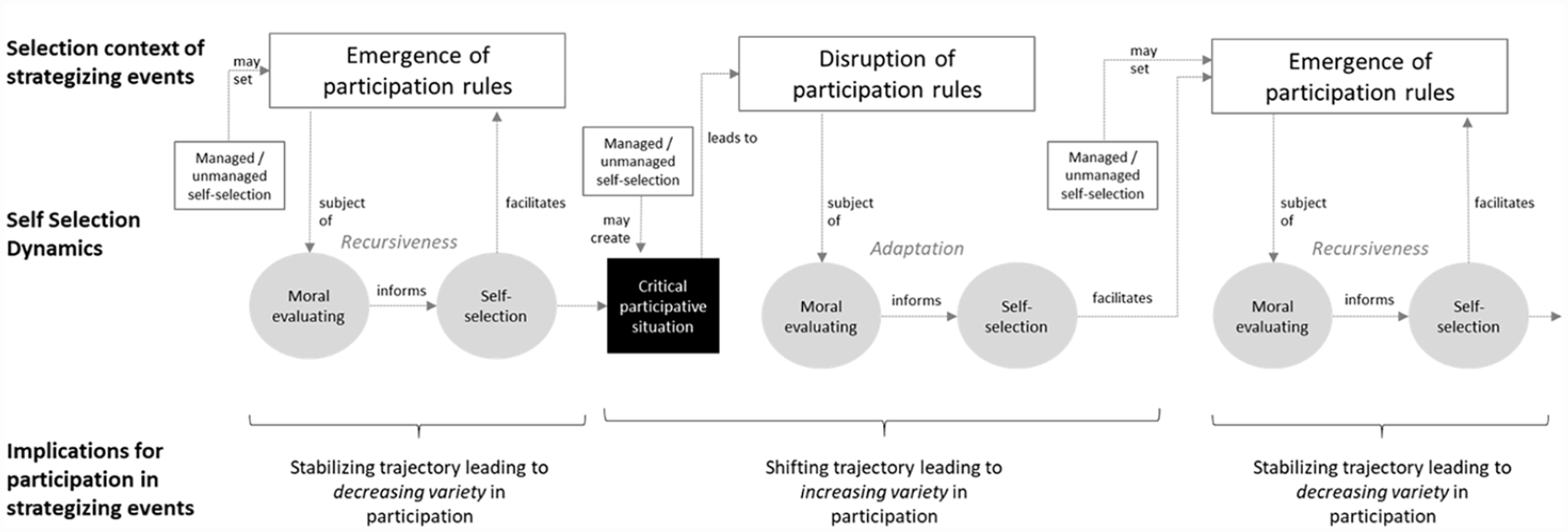
A process perspective of self-selection in strategy work.
Stabilizing trajectories: Recursiveness of self-selection and participation rules
We tend to assume that organizing strategy work via self-selection attracts different actors and thus produces, by definition, participative variety. Indeed, this is an important (tacitly normative) assumption of the growing debate on open forms of strategizing (e.g. Stadler et al., 2021). Yet importantly, counter to this understanding, a practice perspective implies that over time self-selection leads to stabilizing trajectories of participation, i.e. fairly homogeneous participation in strategy events (see Figure 1). This is due to the coupled and recursive nature of the selection context (participation rules) and individual action (self-selection) (Giddens, 1984; Jarzabkowski, 2004): As argued above, participation does not happen in a contextual void. Rather, actors are confronted with rules of participation that have been explicitly set (managed self-selection) or have been deliberately left open to interpretation (unmanaged self-selection). In both cases, self-selection of a particular set of actors into strategy events over time gives rise to the confirmation and/or emergence of (implicit or explicit) participation rules (e.g. a certain expertise or hierarchical level is required to participate in a strategy event). These rules in turn reinforce actors’ self-selection decisions, thereby reproducing participation rules. Such recursiveness is the consequence of actors’ retrospective evaluations of past strategizing events, seeing who was involved and what the character was of those events and thus being ‘knowledgeable’, i.e. being able to ‘morally evaluate’ whether, under the given rules, it is appropriate for them to join at this point and in line with their own set of values, beliefs and aspirations for participation (Giddens, 1984). This is important since the selection context per se does not determine behaviour. A remarkable example in this regard is the case of the premium cola collective (Luedicke et al., 2017). Following the principle of radical openness, the collective invited all of its 1650 members to participate in strategy making and to identify key strategic issues for the future. Yet, ultimately, the key organizer collective raised by far the most strategic issues and defined the strategic direction of the collective. Luedicke et al. (2017) reveal that this pattern emerged due to the lack of members’ access to strategic information. They also show that this pattern was sustained and reproduced through actors’ subsequent lack of participation in the collective’s strategy making. Moreover, and as another example, Johnson et al. (2010) show how strategy workshops over time become a ritualized activity, in which participation rules become entrenched and condition choices for wilful participation.
Stabilizing participatory trajectories are of crucial importance in various strategic settings such as strategy implementation (Friesl et al., 2021), post-merger integration (Graebner et al., 2017) or radical organizational restructuring (Huy et al., 2014). Such contexts require firms to frame issues such that they can mobilize a stable group of actors over an extended period to enact a particular strategic intent (Gilbert, 2006). Accomplishing such mobilization via self-selection promises various benefits such as higher levels of intrinsic motivation and commitment (Hautz et al., 2017) or higher organizational identification (Pandza, 2011) among a group of like-minded individual actors.
Shifting trajectories: Disruption of participation rules and adaptation of self-selection
Above we argue that stabilizing participatory trajectories may be a common phenomenon that might actually constitute the rule rather than an exception (Jarzabkowski, 2004). Indeed, albeit in different theoretical guises, management and organization research is replete with examples of stabilizing trajectories in the form of ‘dominant coalitions’ (Cyert & March, 1963; Man Chang & Greve, 2019), middle manager coalitions (MacMillan & Guth, 1985) or informally organized teams that affect a strategic transformation, even over longer periods of time (e.g. Chandler, 1962). Also, while these stabilizing trajectories may prove conducive to strategy work, as argued above, they might also become problematic as they become a hindrance for ‘requisite variety’ (Ashby, 1956) in some instances of strategy work.
Yet, how do shifts in self-selection dynamics occur in strategy work? Building on Giddens (1984, p. 60f.), we argue that overcoming established modes of participation requires a ‘critical participative situation’, i.e. a ‘radical disjuncture [. . .] that threaten[s] or destroy[s] the certitudes of institutional routinization’ (see Figure 1). This view is in line with other concepts in strategy research such as the ‘punctuated equilibrium’ (Romanelli & Tushman, 1994) or ‘path dependence’ (Sydow et al., 2009), suggesting that crises are required to challenge the status quo and the recursive nature of a given set of participation rules. In strategy work, such a ‘criticial participative situation’ may be evoked both by forces endogenous to strategic events (e.g. by shifting managed to unmanaged forms of selection or vice versa if participation proves unconducive to strategic outcomes), yet might also be exogenous (such as in cases of legal frameworks governing participation in certain events). For instance, Whittington et al. (2011) argue that external forces (cultural, societal and technological changes) require firms to become more transparent and inclusive in their strategy making. Similarly, Stadler et al. (2021) demonstrate that environmental pressure triggered a number of firms such as Ericsson or Barclays to (at least temporarily) invite a broader set of actors into their strategy process; in other words, such external pressure challenges established participation rules. Additionally, strategy practice and process research has long shown how internal actors, particularly middle managers, may themselves question participation rules of who is legitimate to participate in strategy events. This stream of research suggests that such attempts are particularly prevalent in instances of (radical) change, and with varyng degrees of success (e.g. Floyd & Wooldridge, 2000; Laine & Vaara, 2007).
Thus, critical participative situations may result in a disruption of the selection context, leading to the questioning and potential revision of participation rules. This does not mean that actors’ self-selection decisions are no longer influenced by the rules of participation. Yet, it does imply that this context becomes less pervasive as far as the previously established rules are concerned. It is in these situations that the individual actor gains centre stage (Giddens, 1984). As the participation rules of past strategizing events no longer apply, or at least not fully, actors may more strongly engage in anticipatory moral evaluating, contemplating various possibilities of participation (Giddens, 1991; Jarzabkowski, 2004). For instance, some actors may self-select into a new open strategy event as they may see the opportunity to push their own career or agendas, while others may consider it as an opportunity to be finally heard by top managers (Westley, 1990).
This aniticipation in turn may give rise to a ‘shifting trajectory’ of participation, i.e. an increasing variety of participation in strategizing events. These shifting trajectories have value in a broader sense for the organization, as they may enable adaptation to changed conditions such as the societal or intraorganizational pressure towards inclusion in strategy (Whittington, 2019; Whittington et al., 2011). Yet importantly, a practice perspective implies that the described ‘void’ of participation rules is often just temporary (Giddens, 1984; Jarzabkowski, 2004). Over time, we would expect that the selection context is reconstituted with the emergence of a new set of participation rules, informing (yet again not strictly determining) actors’ subsequent self-selection decisions. As such, it gives rise to yet another stabilizing trajectory (see Figure 1). Furthermore, firms may establish unmanaged open strategy initiatives in order to deliberately break out of a situation that has proven dysfunctional for successful strategy work (‘critical participative situation’) by using the wisdom of new and different actors (e.g. Plotnikova et al., 2020; Stadler et al., 2021). Yet, at the same time, the inherent tendency of self-selection towards stabilizing trajectories may create difficulties in fulfilling such promises over a longer period.
Negative emergent consequences of stabilizing and shifting trajectories
The process model outlined above argues that self-selection into strategy work unfolds in sequential phases of stabilizing and shifting trajectories. This perspective also allows us to theorize various negative emergent consequences of self selection for strategy work, which so far have not been recognized.
Our process model of self-selection implies a convergence towards stabilizing trajectories and thus essentially a decreasing variety in participation over time. Such a driving force matters, since stabilizing trajectories are related to inertia. The striking case in point is Burgelman’s (2002) classic paper on the strategy process at Intel and the issue of co-evolutionary lock-in. In this case, Intel’s management vectorized its strategy towards a particular product market. Autonomous initiatives (driven by self-selection) that focused on alternative product areas were increasingly opposed and thus dwindled, reinforcing a particular selection context. Thus, the recursiveness of self-selection and the selection context may be a crucial factor for strategic inertia and the reinforcement of existing strategic paths (Sydow et al., 2009).
In line with Giddens (1984), our process model highlights that shifting trajectories emerge as a result of the disruption or destruction of established participation rules. Shifting trajectories may increase the complexity of decision making and thus impede effective strategy making (Hautz et al., 2017). As described above, this void of established participation rules may attract a variety of actors, gaining freedom to morally anticipate various opportunities of the new selection context. In the words of Giddens (1991, p. 84), this gives rise to a ‘pluralism of choice’ that is ‘rendered visible to anyone who cares to glean the relevant information’ (Giddens, 1991, p. 84). This pluralism has already been identified as a challenge in organization theory. Indeed, Cohen et al. (1972, p. 1) highlighted that in situations where a multitude of problem definitions and incoherent preferences exist, decisions may take the form of an ‘organized anarchy’, in which the link between problem definitions and related options becomes problematic.
Yet, the lack of participation rules may also result in a ‘tyranny of structurelessness’ in the words of Freeman (1972). In such instances participation rules may be appropriated by a group of actors or a ‘dominant coalition’ over time (Cyert & March, 1963; Mithani & O’Brien, 2021). This dominant coalition fills a void of rules by imposing their own, usually informal and non-transparent, participation rules and thus shaping in turn who is allowed or able to participate as well as in which form. Such creation of stabilizing trajectories by certain actors may then inadvertently result in the opposite of what was intended with open strategy initiatives: a narrow logic of strategizing enacted by a stable group of actors.
Relatedly, in the absence of established participation rules, self-selection decisions into strategy events are vulnerable to unintended and unconscious biases (cf. Dean, 2016). For instance, frontline workers or employees distant from a corporation’s headquarters may not evaluate their engagement in an open strategy event, theoretically open to all employees, as legitimate, undermining the variance promise of such events. In other words, based on their anticipatory moral evaluating of cues provided by the selection context, only a certain group of individuals may feel addressed and/or capable to self-select themselves into the process.
Discussion and Theoretical Implications
A large body of work over the last decades has demonstrated how strategy is shaped by a diverse set of actors, some of whom are mandated to do so (typically the top management) and others who choose to do so (typically the middle management and a select group of operational employees) (Burgelman, 1983b; Floyd & Wooldridge, 1992; Friesl et al., 2019; Mirabeau & Maguire, 2014). It is the latter phenomenon that forms the context for this paper. Yet, while a substantial body of work has emerged on how these actors gain voice (Rouleau & Balogun, 2011), sell issues (Dutton et al., 2001) and acquire and maintain strategic agency (Mantere, 2008) in order to complement top-down strategy making, key questions remain: Why those individuals? What made those individuals choose to engage and participate in strategy work? And, importantly, to what extent are the practices and processes deployed in strategy work contingent on the people involved? These questions have to date remained largely unanswered. This paper therefore addresses these questions and does so by proposing a process theoretic perspective of self-selection in strategy work that allows us to unpack the social dynamics of self-selection and how these dynamics create different trajectories of participation (stabilizing and shifting) over time. Self-selection is, as we have argued, not a singular rational choice. Rather, it unfolds throught the interplay of a ‘selection context’ (with a set of participation rules) and actors’ ‘moral evaluating’ of this context. Our arguments have a number of important broader theoretical implications for strategy research:
First, our paper has substantial implications for research on strategy formation that aims to theorize the conditions, processes and outcomes of employee involvement. In particular, the growing debate on open strategy is built on the very premise of self-selection (Whittington et al., 2011). Research on open strategy has stressed that the variety of options generated as part of strategy development may benefit from the inclusion of a broad set of internal as well as external actors (Seidl et al., 2019; Stadler et al., 2021). Prior research on open strategy has already critically examined how the practices and processes deployed to facilitate such forms of strategy making affect participation (Dobusch et al., 2019). Unveiling the social processes underpinning self-selection allows future research to study why certain actors participate in open strategy or why they abstain from doing so. Such a research effort is of great relevance as actors’ self-selection is the prerequisite for creating the ‘shifting participative trajectories’ which open strategy initiatives promise (Brielmaier & Friesl, 2022). What is more, this paper points to inherent problems lurking within the concept of open strategy and its specifically normative character (Dobusch & Dobusch, 2019). We tend to assume that including a broader range of actors in strategy making is per se desirable for firms. Yet, we forget to consider under which circumstances this might be the case. Our differentiation between ‘unmanaged’ and ‘managed’ self-selection contexts allows important insights into this question. Firms that open up the strategy process (perhaps with the honest intention of including all employees) must be aware of tacit structural constraints that may hinder employees with certain values, beliefs and aspirations from self-selecting into the process. We argue that while rules of participation may be deliberately set, they also emerge over time and that these tacit constraints towards particular actors may give rise to unintended ‘stabilizing trajectories’ that do not yield the intended variety (see Luedicke et al., 2017). Thus, in order to accomplish genuine ‘inclusive openness’ in strategy work, the emergence of participation rules has to be reflected on, understood and potentially addressed if participation proves dysfunctional (‘critical participative situation’) to trigger a shifting trajectory. Thus, exploring the often tacit dynamics of self-selection is a crucial task for future research on openness in strategy and beyond.
Second, by theorizing the conditions of self-selection this paper forms part of the wider research stream investigating voluntary participation in strategy work more generally. Indeed, participation has gained increasing attention in the last few years (e.g. Mantere & Vaara, 2008; Seidl & Werle, 2018) and has been defined as ‘an activity comprising structures, practices and processes that help lower-level organizational actors (i.e., middle managers and operating employees) to take part in strategy work’ (Tavella, 2020; p. 579). This definition implies that participation essentially has two sides. On the one hand, it involves the willingness and choice of a particular individual to do so, yet also the possibility of engaging (in terms of processes and structures). So far, previous research has particularly considered the latter structural aspect. For instance, Laine and Vaara (2007) show how top managers aim to limit middle-managers’ participation in strategy work and leverage, as well as maintain, their position by employing distinct strategy discourses. Similarly, Mantere and Vaara (2008) as well as Tavella (2020) show how top managers discursively construct participation options for lower-level employees. Our findings further contribute to and deepen this line of argument by showing that intentions to participate are very much intertwined with the context of particular strategizing events. While we do not take a discursive perspective in this paper, one way through which the selection context could come to bear on individual action are discourses conveying rules of participation that actors morally evaluate. Their evaluation takes place in such discursive contexts leading actors to either accept or reject the implied rules (for instance, based on individual and idiosyncratic sets of values, beliefs and aspirations) and thus act accordingly by choosing to participate or not. It is through this mechanism that such discourses (and the rules of participation that they invoke or imply) are reproduced or potentially become problematic in critical participative situations. Thus, future research on participation could evaluate how such critical situations become manifest in discourse and how actors verbalize and re-evaluate rules of participation in order to instigate, for instance, a ‘shifting trajectory’.
Finally, our conceptualization of self-selection adds important theoretical nuance to the link between strategic practices and organizational outcomes, a key line of argument in practice perspectives on strategy (for instance, Whittington et al., 2006). The main thrust of this line of research has been to understand how strategy is developed or changed by investigating the practitioners involved, the practices drawn upon, as well as the situated enactment of these practices in particular circumstances (Jarzabkowski & Spee, 2009; Jarzabkowski et al., 2007; Whittington, 2006). This perspective emphasizes that actors are enabled and constrained by contextual characteristics; yet individual actors matter as they exercise strategic agency by, for instance, shaping structures and systems of meaning or by engaging in skilful political behaviour (e.g. Jarzabkowski et al., 2022; Mantere, 2008; Rouleau & Cloutier, 2022). Even so, prior strategy practice research has largely taken the actors present in a particular setting for granted and has focused on the organizational and strategic implications of particular practices instead (e.g. Jarzabkowski & Seidl, 2008; Mantere & Vaara, 2008). An important implication of this paper is that how practices are enacted in particular strategizing events is not just a matter of contextual constraints but is also influenced by the people present. Hence, when theorizing the outcomes of strategizing events we need to acknowledge the multiude of strategizing practices enacted but also the self-selection dynamics that gave rise to a particular trajectory of participation. Indeed, the presence of certain individuals might indeed have been crucial for how strategy-related events unfold (see for instance Friesl et al., 2019). This realization renders self-selection an important theoretical boundary condition for empirical studies investigating strategizing practices.
Conclusion
Strategy work has significant consequences for the future of organizations. Its raison d’être is to ensure a firm’s viability by shaping its product market focus, its geographic footprint, its vertical scope and the very principles on which business is conducted. Thus, for strategy work to be accomplished ‘well’, it requires the careful coordination and ‘coming together’ of individuals with appropriate insights and skills as well as political influence (Howard-Grenville, 2007). Therefore, it is not surprising that we tend to think of strategy work as being accomplished largely via hierarchy that affords the necessary level of ‘control’. This paper highlights that extant research on strategy practice and process already reveals that this hierarchical coordination of strategy work is often complemented (e.g. Burgelman, 2002), or in some cases even substituted, by individual- (or group-) level self-selection as the coordinating force (Hautz et al., 2017; Pandza, 2011).
As an increasingly larger share of strategy work actually relies on self-selection, we argue that both strategy research and strategy practice benefit from a deeper understanding of why actors become engaged in strategy work. We know that the development and implementation of strategy is ultimately down to particular actors in specific situations (Jarzabkowski & Spee, 2009; Jarzabkowski et al., 2022; Whittington, 2006). The conceptual ideas developed in this paper therefore have the potential to inform future empirical research on self-selection and the coordination that is involved in the practice of strategy work. In particular, the extent to which features of the selection context as well as actors’ individual circumstances shape self-selection requires greater research attention. Due to the ‘counter-factual’ nature of these questions (Kornberger & Mantere, 2020), even ethnographic studies reach their limits; after all, we can only observe the participation that actually happened. Indeed, one would need to manipulate particular features of the selection context in order to make inferences about their implications for actors with particular characteristics. This could be achieved via different forms of action research or carefully crafted field experiments. Thus, this theoretical frontier for strategy process research is also a methodological one. Yet, it is also an issue of practical concern. Understanding why exactly ‘this motley crew’ of people gets involved is of utmost value as it is they who will shape a firm’s strategic direction. Answers to these questions therefore stand to illuminate why a firm’s strategy has developed in a certain way and, more broadly, allow us as well to approach one of the central problems of strategy research (‘why do firms differ?’) from a fresh perspective (cf. Nelson, 1991). Therefore, we hope that this paper helps to instigate further empirical research on the conditions and consequences of self-selection in strategy work.
Footnotes
Acknowledgements
We would like to thank our editor Joep Cornelissen for his guidance throughout the review process. We are also indebted to David Seidl for his encouraging feedback on the first draft of this manuscript. An earlier version of this paper received the Strategy Practice IG Best Paper Award at the Strategic Management Society Conference, London. The paper was also presented at EGOS Vienna 2022, the SIME Brown Bag at King’s College London, the Forschungswerkstatt at FU Berlin and the WK Org Workshop in Linz. We thank all participants at these events for their helpful comments.
Declaration of Conflicting Interests
The author(s) declared no potential conflicts of interest with respect to the research, authorship, and/or publication of this article.
Funding
The author(s) received no financial support for the research, authorship, and/or publication of this article.
