




Abstract
While research has become increasingly receptive to the construction of strategy in dedicated forms of strategy communication – such as managerial speeches or strategic plans – little work has looked at how strategy is constructed in more broadly focused communicative media, such as corporate magazines. By analysing over 500 magazine issues from six different firms, this article reveals three fundamental mechanisms by which corporate magazines shape strategy: (i) familiarization – or shaping strategy by connecting it to the everyday; (ii) confirmation – or shaping strategy by aligning it with standing norms and expectations; and (iii) regeneration – or shaping strategy by advancing it through ongoing cycles of creation and destruction. In doing so, this article makes three specific contributions. First, by highlighting how corporate magazines construct strategy through a reconciliation of different narrations, narrators and narrative contexts, it extends earlier research’s emphasis on senior leadership with insights into the more collective sensemaking processes underlying strategy development. Second, by unveiling how corporate magazines often draw on affective expressions that humanize strategy within organizational life, it enriches our predominantly rational take on strategy-making with a more pronounced understanding of the role of emotions. Finally, by showing how corporate magazines progressively tie an organization’s strategy to ongoing developments and occurrences, it expands earlier work’s emphasis on grand and singular strategy communication with a reappreciation of the small and iterative – demonstrating how firms’ successful conception of tomorrow is often based on their developing understanding of today.
Introduction
Over the past decade, there has been increasing interest in the role of ‘sayings’ in strategy-making (Vaara & Langley, 2021). In this line of inquiry, strategy is conceptualized as constructed by actors drawing on linguistic resources, often in singular communications – such as board meetings, committee meetings and strategy seminars (Kohtamäki, Whittington, Vaara, & Rabetino, 2022) – or official documentation – such as strategic plans (Cornut, Giroux, & Langley, 2012). By leveraging linguistic resources in these settings, actors have been discussed as enhancing the authority of decision-makers while downplaying that of others (Vaara, Sorsa, & Pälli, 2010); they have been shown to establish excitement for strategic initiatives (Wenzel & Koch, 2018); and when utilized well, language has even been marked to bring about the strategic reality it often only purports to describe (Cabantous, Gond, & Wright, 2018).
Yet despite this evolving understanding of how organizational directions are developed in dedicated forms of strategy communication (Cornut et al., 2012; Vaara & Langley, 2021), we still know little about how strategy is constructed in communicate forms that are more broadly focused, such as corporate magazines – or periodical publications that are produced by an organization for its employees and that deal with subjects relating to the organization (Heller & Rowlinson, 2015; Jarzabkowski, Seidl, & Balogun, 2022; Sternadori & Holmes, 2020).
This omission seems critical for three main reasons. First, as corporate magazines have been characterized as forms of in-house communication aimed at countering the ‘depersonalization of systematic management’ (Yates, 1993, p. 20), they represent communicative platforms that are distinctly different in aspiration from other, more commonly studied documents in strategy-making. In this sense, studying how strategy is formed in corporate magazines may yield important new insights into how strategy can be ‘humanized’ through language (Heller & Rowlinson, 2020), and how ‘small’ aspects of communication may matter more than anticipated (Vaara & Langley, 2021). Second, as more commonly studied instruments of strategy communication such as plans or townhall meetings typically construct an organization’s direction in a singular message (Spee & Jarzabkowski, 2011; Wenzel & Koch, 2018), they offer little understanding of the way in which language can shape and remodel strategy over time. As such, studying strategy in a periodically recurring medium such as a corporate magazine may offer relevant new understandings of how communication may help take strategy beyond formalized end results (Burgelman et al., 2018; Jarzabkowski et al., 2022). Finally, as corporate magazines represent forms of communication that typically involve organizational members beyond top echelons (Yaxley & Ruck, 2016), they may offer an understanding of interpersonal exchanges that more leadership-driven forms of corporate communication miss out on (Vaara & Langley, 2021). For these reasons, this paper advances the following research question: How do corporate magazines shape strategy?
To address this question, this work looks into corporate magazines as disseminated across six different organizations. Building on the qualitative analysis of more than 500 magazine issues, this article reveals three primary mechanisms through which corporate magazines shape strategy: (i) familiarization – or shaping strategy by connecting it to the everyday; (ii) confirmation – or shaping strategy by aligning it with standing norms and expectations; and (iii) regeneration – or shaping strategy by advancing it through ongoing cycles of creation and destruction.
In doing so, this study contributes to the literature in three main ways. First, by highlighting how corporate magazines construct strategy through a reconciliation of different narrations, narrators and narrative contexts, it extends earlier research’s emphasis on senior leadership in strategy-making with insights into the more collective sensemaking processes underlying strategy development. Second, by unveiling how corporate magazines often draw on affective expressions that humanize strategy within organizational life, it enriches our existing rational perspective of strategy-making with a more pronounced understanding of the role of emotions. Finally, by showing how corporate magazines progressively tie an organization’s strategy to ongoing developments and occurrences, it expands earlier work’s emphasis on grand strategizing moments with a reappreciation of the small and iterative, demonstrating how firms’ effective conception of tomorrow is often based on their repeated connection to the humdrum of today.
In what follows, I will start by looking into extant knowledge on shaping strategy through language and communication, focusing on what we currently know about corporate magazines and their role in setting organizational directions. After describing my methodology, I present the findings of this study by elaborating on the three main mechanisms by which corporate magazines were found to shape strategy. Finally, I conclude this article by discussing the implications these findings have on strategy-making, and advance tracks for further research.
Theoretical Background
Shaping organizational strategy through language and communication
Traditionally, the strategy discipline treated strategy as an attribute of organizations, implying that organizations ‘possess’ a certain strategy (Jarzabkowski et al., 2022). More recently, strategy has been increasingly reformulated as a ‘practice’ or ‘something that people do’, thus emphasizing what takes place in the act of realizing strategy (Kohtamäki et al., 2022). By shifting attention from results to processes, researchers have started to concentrate on the micro-level activities that typically went unnoticed in traditional strategy research: for despite their seemingly inconspicuous nature, these actions can have profound consequences for organizations and their members (Jarzabkowski et al., 2022).
One of such inconspicuous yet highly consequential actions is the use of language and communication (Whittle, Vaara, & Maitlis, 2023). Historically, language has been given little attention within strategy research (Vaara et al., 2010). Yet in the field of strategy as practice, interest in the use of language and communication has been steadily developing (Vaara & Langley, 2021). Over time, researchers have brought a range of linguistic approaches to the strategizing agenda, ranging from post-structural perspectives and critical discourse analyses to narrative and metaphor analyses (Balogun, Jacobs, Jarzabkowski, Mantere, & Vaara, 2014; Kohtamäki et al., 2022). Such variety in approach notwithstanding, their central theme always revolves around the importance of communication in strategy work – that is, around the ways in which various ‘sayings’ (Vaara et al., 2010) may impact, or even perform, strategy.
Across the literature, this sense of impact or performativity has been highlighted in several ways. One of these ways is that, through language, issues and actors can be allotted strategic importance (Splitter, Seidl, & Whittington, 2024). Bencherki, Sergi, Cooren, and Vásquez (2021), for example, examined the different communicative tactics that determine which matters gain emphasis during a strategic planning procedure, with Cabantous et al. (2018) highlighting how simply labelling certain activities as ‘strategic’ can imbue them with attributes associated with strategy. Communication, it thus seems, can determine what we regard as strategically important, and what we do not (Gond, Cabantous, & Krikorian, 2018). Similarly, language has been shown to greatly determine which agents we allow to construct organizations’ strategy. Samra-Fredericks (2003), for example, examined how strategists may utilize rhetoric to involve others and exert influence over the process of strategizing; and Vaara et al. (2010) investigated how the use of such jargon – including ‘SWOT analysis’, ‘scenarios’, ‘vision’, and ‘key success factors’ – significantly bolstered the power that managers have in the strategizing process. As these studies illustrate, the function of language in strategizing can extend well beyond merely reflecting an existing reality; rather, it can serve as the very foundations on which strategy is essentially created.
The role of internal written text in strategy-making
While previous research has predominantly focused on language’s role in strategy-making via interpersonal interaction and verbal communication (Jarzabkowski et al., 2022; Ocasio, Laamanen, & Vaara, 2018; Vaara & Langley, 2021), there is a noteworthy body of research examining the importance of written text, such as strategic plans or annual reports (Logemann, Piekkari, & Cornelissen, 2019). If texts are crafted well, they can help organizations establish a level of consensus that proves vital for effective execution; if they are not, strategies may not materialize at all (Desmidt & George, 2016). To this end, strategists must weave a narrative from a diverse range of potential characterizations, plot lines and themes, ultimately paying attention to develop an account that is both credible and novel. Strategic texts, in this sense, have been argued to represent a rather specific genre, which aims to be ‘distinctively inspirational and unifying, [and is] characterized by the language of optimism, collaboration and achievement’ (Cornut et al., 2012, p. 44).
To craft a compelling story that readers will eagerly embrace and act upon, strategic texts often do not stand alone but complement the strategic decision-making as reflected in verbal communication. Spee and Jarzabkowski (2011), for example, characterized meaning-making in strategic planning activities as being shaped by the iterative and recursive interplay between verbal communication and written documentation. As individuals articulate their understandings of the existing strategic plan through discourse, they can introduce modifications to the documentation, subsequently influencing subsequent iterations. This process is repeated recursively, culminating in a mutually agreed-upon plan. Such findings reflect earlier observations by Robichaud, Giroux, and Taylor (2004), who noted how written text often represents a foundational segment of a larger ‘metaconversation’, ultimately linking communication channels together by advancing a more common understanding of the strategy as processed over time. In this way, text has been noted to be a rather critical medium for strategists to revert to: making it so that ‘even if managers have different interest and goals, alignment may be created precisely by texts or ideas that are jointly attended to’ (Ocasio et al., 2018, p. 162).
Corporate magazines as form of in-house communication
Among the many forms of internal written communication that contribute to the construction of organizational life, corporate magazines have long stood out as particularly ubiquitous – with most sizeable organizations producing a periodical publication, meant for employees, that deals with subjects relating to the organization (Heller & Rowlinson, 2020; Jeffers & Bateman, 1980; Sternadori & Holmes, 2020). While physical copies of corporate magazines remain prevalent, the rapid digitalization of the workplace has also led to their increasing presence on internal virtual platforms, embedding them even more deeply into the fabric of organizational communication (Abrahamson & Prior-Miller, 2015; Yaxley & Ruck, 2016).
Although often considered trivial at first, corporate magazines have been argued to represent somewhat unique organizational media, with a number of characteristics making them stand out from other written formats (Abrahamson & Prior-Miller, 2015; Sternadori & Holmes, 2020; Viererbl, Koch, & Denner, 2021). First, while most forms of written in-house texts often serve a single communicative purpose, corporate magazines have been argued to span a much broader range, with content typically including a variety of events, happenings and information. Such information can be high key – such as critical decisions and occurrences – but can also relate to relatively small matters, such as who won the company’s soccer game. Second, unlike many other forms of written organizational communication, corporate magazines are typically published at regular, and often relatively frequent, intervals. This consistency of publication gives corporate magazines a sense of continuity that few written in-house texts can match: while documents such as annual reports may also be distributed at a regular pace, the yearly publication rate of these documents make them far less of a consistent presence in everyday organizational life. Third, despite being typically funded by management, corporate magazines rarely contain only managerial voices: mostly, editors feature a variety of organizational contributors, ranging from staff members to external partners. In this sense, corporate magazines are ‘polyphonic’ (Vaara & Rantakari, 2024): they simultaneously combine diverse voices, perspectives or narratives within the same medium. This polyphony is notably cross-functional and inclusive: typically, organizational members of all kinds of echelons and departments may feature. Finally, in terms of tone and style, corporate magazines typically adopt a conversational and approachable tone, whereas other corporate media often tend to be more formal or technical. Such approachable style is often reinforced by magazines’ design and layout, which is usually more polished and creative as compared to other media like policy documents or emails.
At their most basic level, corporate magazines can be understood as instruments of conveying information (Heller, 2009). By disseminating content in a broadcasting fashion (Cornelissen, 2023), corporate magazines act as media of internal communication, enabling the corporation to ‘talk to itself’ (Heller, 2008, p. 187). As they offer employees updates on a broad range of aspects – including promotions, retirements, upcoming events, relevant external developments or changes in working practices or products (Heller, 2009) – corporate magazines contribute a form of transparency that has been considered essential for organizations to both understand themselves and be held accountable for their actions (Christensen, 2002). In this way, corporate magazines can be understood as facilitating a clear dispersal of information, which allows improvement of organizations’ cooperation and efficiency (Heller & Rowlinson, 2020; Yates, 1993).
Yet more than just conveying what is happening across organizational life, corporate magazines have also been raised as important for drumming up support for happenings as described (Heller & Rowlinson, 2020). By creating discourses which establish sanctified forms of behaviour, corporate magazines interpret information and create a sense of legitimized practice – persuading employees to ‘take a specific stance’ (Jeffers & Bateman, 1980, p. 13) and do something ‘in one way instead of a myriad number of alternative possibilities’ (Heller, 2008, p. 188). Typically, such persuasion does not only draw on supplying timely and accurate information, but also builds on sparking the imagination and feeding the emotions of the audience addressed (Sternadori & Holmes, 2020). While this persuasive function has at times been deemed a constructive force, it can also turn corporate magazines into mouthpieces for senior management (Viererbl et al., 2021), resulting in a solidification of labour control.
Finally, corporate magazines have been regarded as playing an important role in creating reality itself (Abrahamson & Prior-Miller, 2015; Sternadori & Holmes, 2020). As they often function as a link between readers, corporate magazines create an ‘imagined community’ of employees that may have never met each other but are connected to their place of work and to each other through their engagement with the same medium (Heller & Rowlinson, 2020). This imagined community gradually reinforces its shared values and beliefs by articulating, negotiating and representing their individual points of view, gradually constructing a communal ‘esprit de corps’ (Heller, 2008, p. 187). Such reified expression of the whole organization shapes what the organization believes itself and its reality to be – with organizational life ultimately being performed through a totality of interconnected messages that constitute a sense of unity, wholeness and cohesion (Christensen, 2002; Sternadori & Holmes, 2020).
Together, these studies offer general insight into the role that corporate magazines can play in both the implementing and constructing of organizational reality. What is still lacking, however, is a more pronounced understanding of how corporate magazines may matter specifically to the shaping of strategy. This omission is deemed important for three reasons. First, as corporate magazines are characterized by features that are much more broadly focused than those of more commonly studied strategy documents, examining how strategy is articulated in them can unveil novel insights into the humanization of strategy through language (Heller & Rowlinson, 2020). Second, as corporate magazines offer a sense of temporal repetition that very few corporate communication instruments have, studying them can offer interesting new insights into how language can dynamically shape and reshape strategy over time (Vaara & Langley, 2021). Finally, as corporate magazines typically engage organizational members beyond top management, they may offer insights into interpersonal exchanges that are often overlooked by more leadership-centric forms of corporate communication (Balogun et al., 2014). To quote Vaara and Langley (2021, p. 550): By digging into the textual traces organizations leave behind, [. . .] we defamiliarize that world, enabling us to understand aspects of it that are often invisible, revealing how and why things might have been different, and even potentially opening up that world to critique.
For these reasons, I advance the following research question: How do corporate magazines shape strategy?
Methods
Research design
This study draws on corporate magazines disseminated by six different organizations. These organizations were sampled based on four criteria (Silverman, 2020): (i) accessibility – or offering access to data that is relevant to the research question; (ii) representativeness – or being illustrative of the norm; (iii) comprehensiveness – or being rich and detailed; and (iv) distinctiveness – or being contextually complementary to cases already selected.
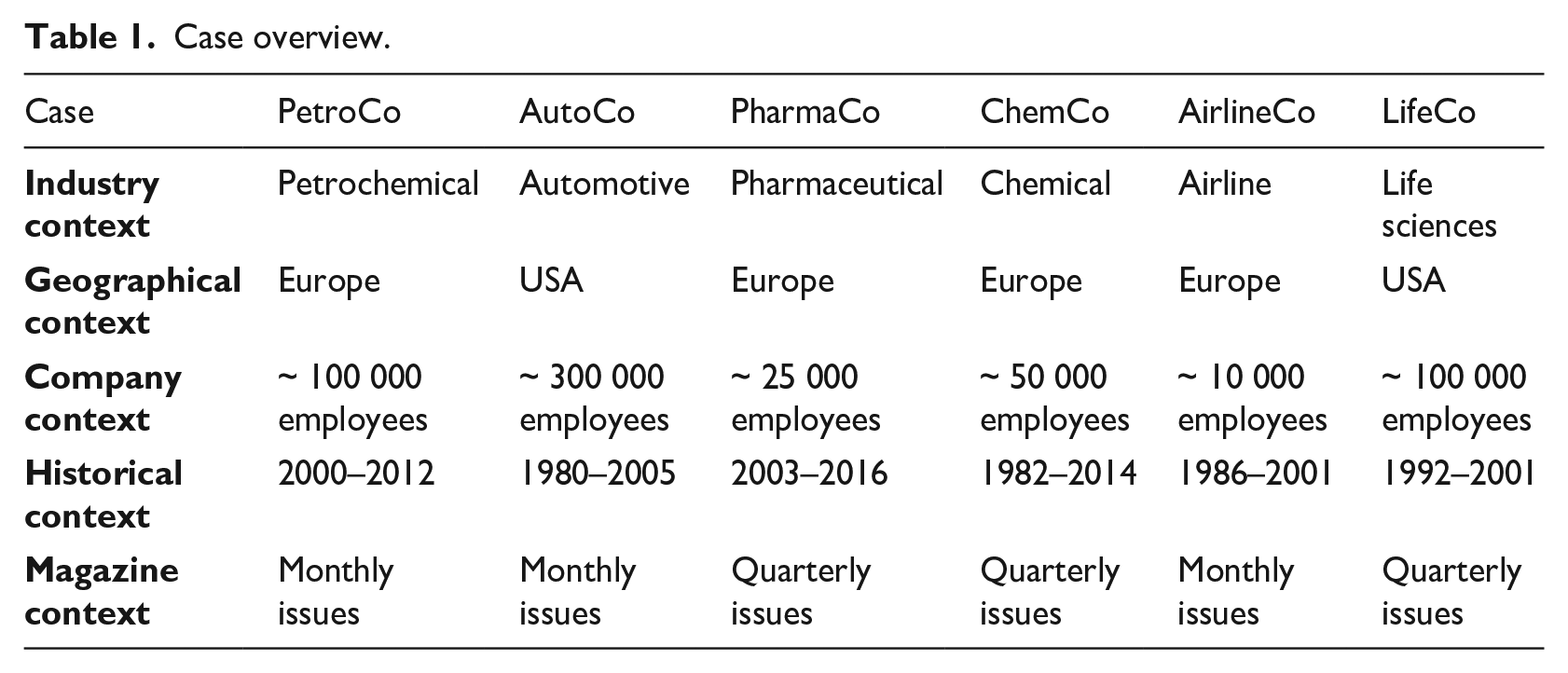
First, based on several index searches conducted in multiple databases – including public and university libraries, city archives, investor platforms and company repositories – a list was put together of organizations that had disseminated corporate magazines, and that had retained them in either physical or digital form. Next, a preliminary search was conducted in these corporate magazines to sift out organizations whose approach was notably off from the norm – such as magazines that only consisted of pictures and captions, or magazines that were written for customers rather than employees. For those organizations that were retained, another round of scanning removed cases that were considered insufficiently comprehensive in terms of data, such as companies who had only disseminated a corporate magazine for a limited amount of time, or whose retained copies were either incomplete or damaged in the archives available. Finally, when cases proved very similar in terms context (e.g. same industry), only those cases were retained that scored best on other sampling factors. Based on this sampling protocol, six organizational settings were eventually selected. For an overview, see Table 1.
Case overview.
Data collection
Primary data source
This study’s primary data source was a large set of corporate magazines. By scouring several archives – such as public and university libraries, company websites, city archives and investor platforms – issues of the corporate magazines as published at the selected organizations were collected. As all magazines included in the final sample were only physically available, copies were first digitized to ease eventual analysis.
While the magazines considered in this study were from different time periods due to data availability, no definitive differences in their features emerged. All magazines in the sample consistently adhered to the fundamental characteristics of corporate magazines outlined in the theoretical background section, including broad focus, frequent publication, polyphony and a creative, approachable style. That said, some magazines did evolve over time, with minor changes such as renaming or slight design adjustments, and in some cases, variations in publication frequency. However, these changes were assessed as having a minimal impact on the magazines’ overall focus and approach. As such, all issues of the organizations’ available magazines were secured, ultimately resulting in 558 issues being collected.
Secondary data sources
While in-house corporate magazines represented the primary data source, other sources were gathered to establish organizational and industry background. Specifically, three main sources of secondary data were collected. A first source concerned third-party documents that focused on the history of either the organization or its main leaders, including 13 books and 7 video documentaries. A second source concerned more than 100 annual reports, published by the respective organizations in the timeframe for which corporate magazines were available. Finally, a concluding source consisted of roughly 300 newspaper articles from major newspapers, printed about the organizations in question throughout the indicated timeframes.
Data analysis
To respect organizational and individual boundaries, all references to people, places and institutions were anonymized. As the core dataset consisted of in-house corporate magazines that were often only available in specific archives, this anonymization was a conscious choice to process data in a manner that warranted privacy rights and confidentiality while also ensuring representation.
To explore how organizations’ corporate magazines had shaped strategy, data analysis involved three distinct stages: (i) identifying organizational backgrounds and strategy trajectories, using narrative analysis; (ii) identifying the specific dimensions by which corporate magazines had tied into and constructed such strategic trajectories, using content and context analysis; and (iii) identifying the theoretical mechanisms underlying and interconnecting such strategic dimensions, using cross-case pattern matching.
Stage 1: Identifying organizational backgrounds and strategy trajectories. In a first stage, cases’ general backgrounds and strategies were tracked through narrative analysis, hereby reconstructing the contextual stage against which corporate magazines had featured.
To make sense of corporate magazines as collected, it was deemed necessary to first establish an understanding of the context in which magazines had been disseminated: what had the organizations been going through, and what had their industries been like? To address these queries, I systematically explored the secondary dataset per case considered, covering third-party documents that focused on the history of either the organization or its main leaders, annual reports and newspaper articles. These efforts culminated in a set of thick descriptions, which offered information on the socio-historical context in which the corporate magazines had appeared.
While these initial organizational narratives offered a relatively detailed overview of companies’ general conditions and outlooks at the time when corporate magazines had been disseminated, they did not yet offer a focused understanding of companies’ strategic trajectories at such time: that is, what directions had companies aimed for or effectuated when magazines had been distributed? Hence, to answer this question, I went back to the secondary dataset but now paid explicit attention to cues specifically indicating (elements of) strategy, such as related terminology (e.g. ‘strategy’, ‘mission’, ‘vision’, ‘directions’, ‘objectives’) or dedicated strategic announcements (e.g. ‘Our Way Forward’). By doing so, thick descriptions as developed earlier were enriched with dedicated sections on each case’s strategic developments – an exercise that ultimately yielded a detailed understanding of both the general and strategic background against which corporate magazines had featured.
Stage 2: Identifying the dimensions by which magazines tied into and constructed strategy. In a second stage, magazines’ references to strategy were labelled and categorized in terms of both content and context, this to gain a detailed understanding of the various dimensions by which magazines tied into and constructed strategy trajectories as identified.
Having gained a clearer sense of the contextual background against which corporate magazines had featured, a next stage of analysis focused on being able to describe and categorize all dimensions by which magazines tied into and constructed strategic trajectories as highlighted: that is, how did magazines feature organizational strategy in terms of both content and context?
To be able to address this question without losing track of the woods for the trees, I first marked all articles that were deemed relevant for further inquiry (Sternadori & Holmes, 2020), extracting all pieces that were explicitly concerned with the organization’s strategy based on their title (e.g. ‘Today’s strategy: Where we want to be in the world of tomorrow’). Next, all editorial messages were examined, with those pieces being added in which narrators discussed aspects of strategy such as the organization’s overarching direction, the key resources and activities that it advanced, or the position it aimed to occupy in the competitive landscape. Finally, all articles were scanned that did not mention strategy in their titles, but that could be expected to involve strategic aspects nonetheless (e.g. ‘Letter to the editors: Where are we going?’). Eventually, these efforts culminated in the identification of 364 articles.
Based on this sample, I proceeded with an analysis of the magazines’ discourse based on the precepts of content analysis (Gioia, 2021). Specifically, this meant that the content of all articles was scanned and descriptively coded, with codes being subsequently classified into more overarching themes. Ultimately, this coding exercise generated a list of content-based categories, offering a detailed understanding of how corporate magazines tied into or constructed organizational strategy through discourse.
However, to also take the specificity of corporate magazines as communicative media into account, I then considered how articles’ contextual dimensions tied into strategic trajectories as identified. To this end, I went back to the article sample as highlighted, but now paid specific attention to contextual dimensions such as contributors and addressed audiences, structure or visual and design elements (Heller & Rowlinson, 2015, 2020). This effort resulted in a long list of additional contextual descriptives, which was subsequently coded to distinguish common themes (Gioia, 2021).
Stage 3: Identifying the theoretical mechanisms of how corporate magazines shape strategy. In a third and final stage of analysis, codes as identified were connected through pattern matching, this with the intention to uncover the more overarching theoretical mechanisms by which corporate magazines had shaped strategy.
As corporate magazines’ ties into strategy in terms of content and context were exposed, a final stage of analysis focused on unveiling the more theoretical mechanisms underlying such case-specific dimensions: that is, how did corporate magazines ultimately shape strategy in general? To address this question, I engaged in a process of cross-case pattern matching, consisting of focusing on commonalities across cases. Specifically, dimensions as identified in each organizational case were laid out according to the organization’s respective strategy trajectory, and were then cross-referenced for correspondences and shared patterns. At its most basic level, this consisted of drawing six separate strategic timelines on a whiteboard, highlighting corporate magazines’ strategic dimensions on coloured post-it notes, and looking for similarities and interconnections – both across time, and across cases. After having iterated through several of such physical runs, this exercise was further developed and finetuned in a digital setting, which ultimately led to the development of three main mechanisms. In the Findings section that follows, it is this set of mechanisms that I will set out.
Findings
This Findings section will outline three primary mechanisms through which corporate magazines were found to shape strategy: (i) familiarization – or shaping strategy by connecting it to the everyday, thus fostering a deeper understanding and connection; (ii) confirmation – or shaping strategy by aligning it with standing norms and expectations, thus ensuring relevance and acceptance; and (iii) regeneration – or shaping strategy by advancing it through ongoing cycles of creation and destruction, thus allowing for adaptation and evolution in response to changing circumstances. For an overview, see Table 2.
How corporate magazines shape strategy.
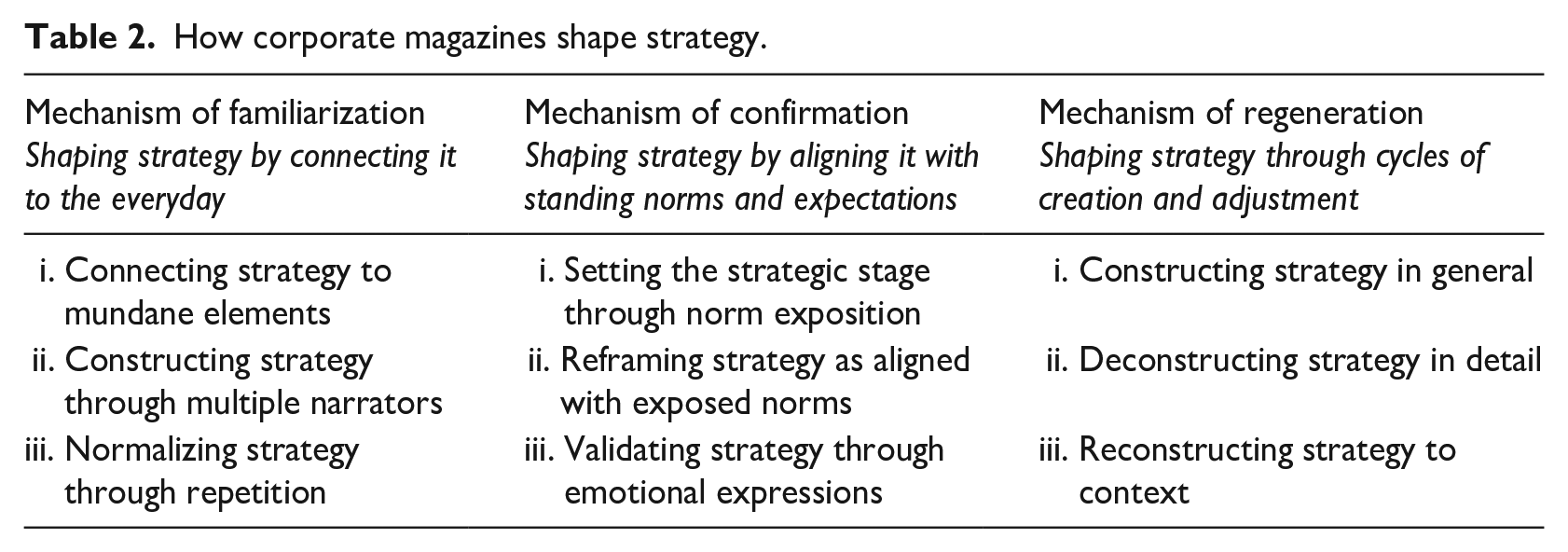
In what follows, I will explain and demonstrate each of these (sub)mechanisms based on short case vignettes. For space reasons, I will limit myself to one vignette per section. For additional examples, please refer to Appendix 1.
Mechanism of familiarization
In a mechanism of familiarization, corporate magazines shape strategy by connecting it to the everyday. As strategy is associated with mundane elements of organizational life, it is made more relatable and accessible, rendering a sense of proximity that is further developed by the featuring of multiple narrators. Ultimately, this sense of closeness is solidified through the continuous repetition of the medium as well as its message.
Connecting strategy to mundane elements
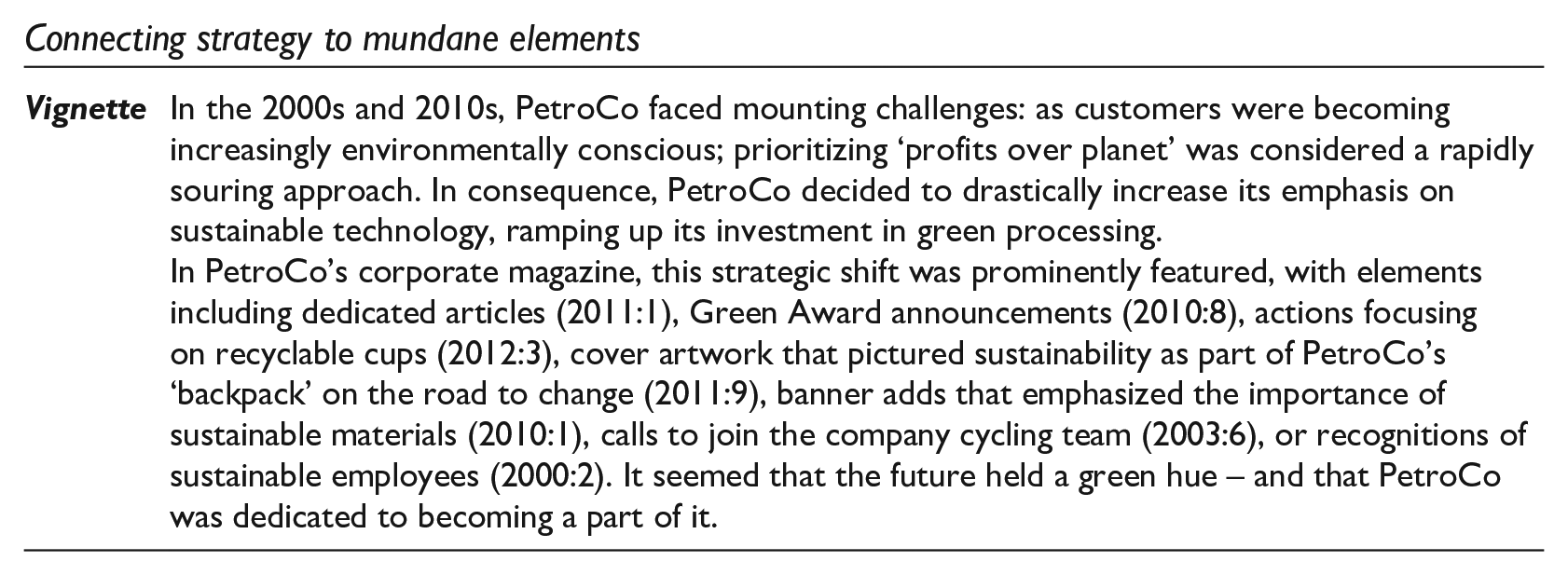
In most forms of strategy communication distributed by the companies considered – such as board meetings or strategic plans – strategy was given almost exclusive focus. Corporate magazines, however, proved different. While magazines regularly featured articles discussing strategy, such excerpts were typically surrounded by elements of a more mundane nature. At PetroCo, for example, it is worth noting how articles focusing on its sustainability strategy were surrounded by related, yet more ‘trivial’ notifications – such as narratives on how to join the company’s cycling team, or how to best recycle cups and other containers. Interestingly, such diverse ‘trivialities’, often advanced by different narrators, could also be observed in magazines’ design elements: for example, while most of PetroCo’s documents were visualized along a formal corporate style, their magazine regularly included design elements that were notably more inspired – with artwork referring to sustainability being represented in banners, or quirky drawings on ‘going green’ adorning cover pages.
While such juxtaposition of strategy with commonplace elements might seem trifling at first, its implications may be profound: for by leaning more closely into broadly spawned mundane elements, corporate magazines seemed to set a very different scene than was the case in other forms of corporate communication. While strategy was shaped, it was not shaped in isolation from the more tangible aspects of individuals’ sense of organizational life, and by doing so, it was constructed as something that could be deemed accessible and relatable to all: We must maintain a smart balance between [all] aspects of our daily work. We shouldn’t be shortsighted here. (Manager A.D., PetroCo, 2001(12), p. 2)
Constructing strategy through multiple narrators
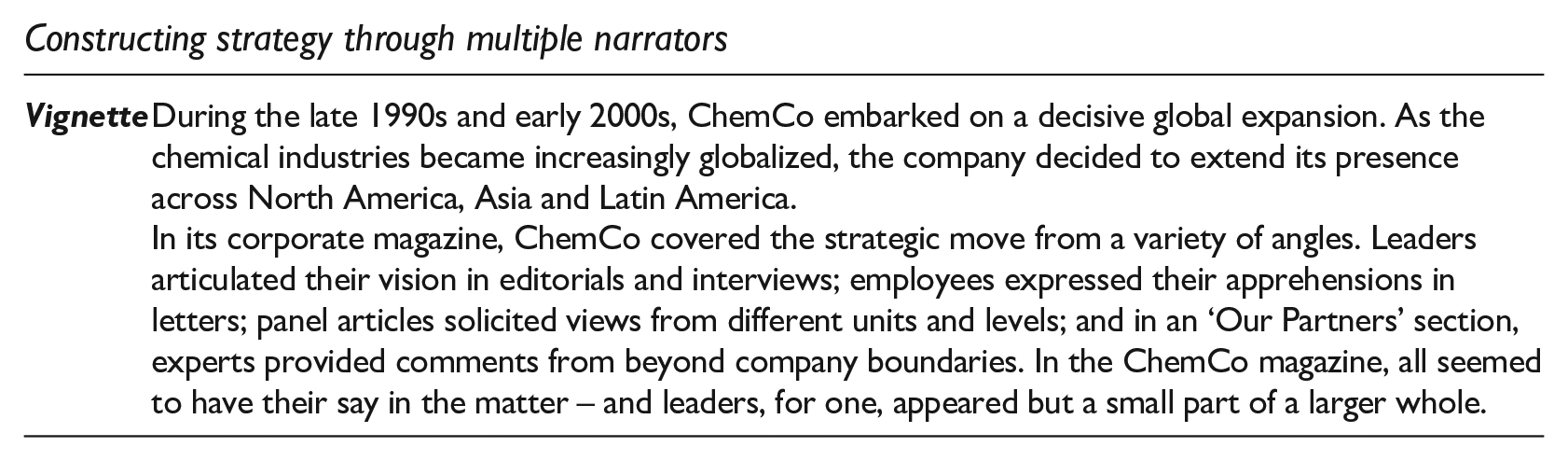
Of all organizational topics, strategy seemed one of the most leadership-driven in terms of communication; in companies’ corporate magazines, however, those talking strategy were found to be far more dispersed. Typically, narrators varied in terms of seniority or functional roles. In some instances, such polyphony was extensive – such as at ChemCo, which regularly featured dozens of hierarchical levels and departments; in others, it was more limited, with mostly different managerial levels being featured. Some magazines integrated various narrators across all sections; in others, diversity was confined to specific areas such as employee letter boards.
Yet regardless of the approach, all corporate magazines were found to cover strategy through various actors – with strategy being discussed by many, rather than a few. The significance of such featuring of multiple narrators in discussing strategy is underscored by the following statement from ChemCo’s senior leadership, elaborating on their intention to use the magazine as a platform for co-development: I wish to highlight the road that we have covered in transforming from colleagues into co-developers. [. . .] The hierarchy, on all levels, is expected to not only promote the dialogue but also initiate it and participate in it. Employees, on all levels, are expected to voice their opinions, share their knowledge and experience, and engage in a dialogue. This requires us all to listen, to respect other opinions, and to accept decisions that have been made collectively after an exchange of thoughts. (Manager J.C., ChemCo, 1996(3), p. 3)
By featuring a variety of narrators’ opinions, feedback or reinterpretations, corporate magazines seemed to move an organization and its intended direction closer to the everyday understanding of different organizational members – thus making strategic decisions seem more like a joint endeavour, ‘made collectively after an exchange of thoughts’.
Normalizing strategy through repetition
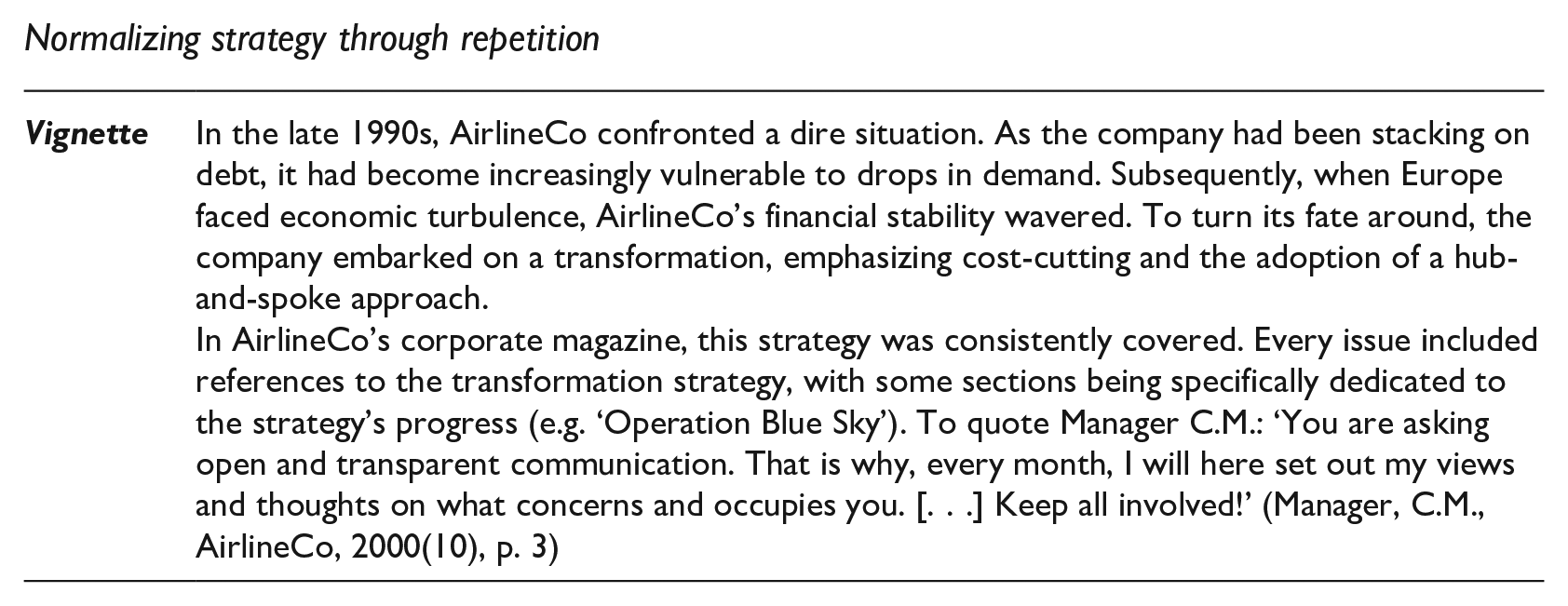
While most forms of strategy communication at the companies considered were noted to be one-off releases, corporate magazines offered a remarkable sense of repetition. On a macro level, this related to the reappearing of corporate magazines in their entirety: although magazines’ publication rate could vary, they all represented media coming out at frequent intervals – such as the monthly issues at AirlineCo. However, on a micro level, corporate magazines also demonstrated remarkable recurrence in their conversations. At AirlineCo, for example, sections on ‘Operation Blue Sky’ became a consistent part of the company’s magazine from the strategy’s announcement onwards, with the conversation on how to materialize cost-cutting and the hub-and-spoke system running for years on end. As time progressed, such repetition often did not stay limited to dedicated strategy sections, but typically also spread out across Q&As or news overviews – with ‘openness and transparency’ (Manager C.M., AirlineCo, 2000(10), p. 3) being highlighted as key to moving forward.
This contextual feature, trivial as it may appear, seemed to have important repercussions for the way in which corporate magazines grounded organizations’ strategy-making process – for more than anything else, it allowed magazines to push strategy more decidedly towards the audiences for which it was intended: OUR AirlineCo: A corporate magazine brought to live at the request of the AirlineCo council, to bring information to AirlineCo personnel. (Editor G.V.B., AirlineCo, 1990(1), p. 1)
In this sense, by constructing strategy more closely to the everyday lives of organizational members, corporate magazines seemed to render such strategy more relatable – with strategy ultimately becoming an effort of all, rather than a few.
Mechanism of confirmation
In a mechanism of confirmation, corporate magazines shape strategy by aligning it with standing norms and expectations. By integrating input from a diverse range of organizational actors, magazines first progressively expose shared norms and expectations. These collective beliefs, in turn, validate and subtly steer the ongoing framing of strategy. Over time, as norm-consistent strategies are repeatedly reinforced through emotional affirmation, they gain increasing legitimacy as cogent organizational directions.
Setting the stage for strategy through norm exposition
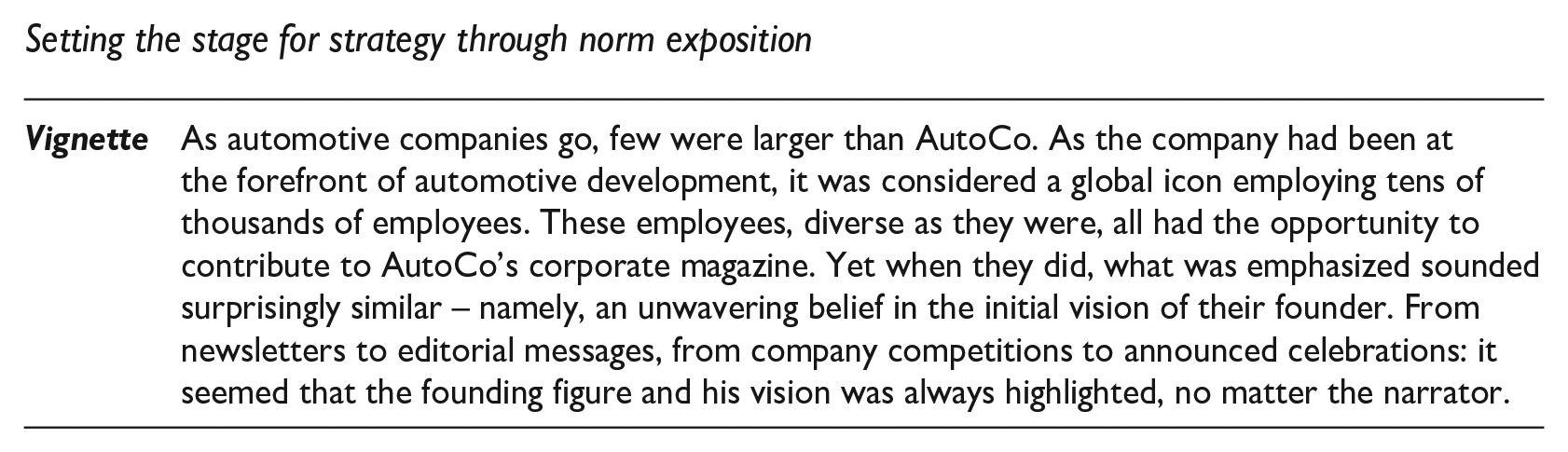
As organizations consist of a range of people, coming to terms with what they all hold dear is not an easy feat: ‘You, me, anybody – we’re all individuals. We need to consistently remind each other to think and act like a team’ (Manager N.S., AutoCo, 2000(8), p. 3). Yet as corporate magazines featured different narrators and narratives, they did make salient commonalities in members’ norms and expectations. At AutoCo, such commonalities seemed to revolve around the founding figure, and his vision of building ‘innovative and dependable quality products’: [Our founder] succeeded because he built the innovative and dependable quality products that customers asked for. That was his success formula, which helped us overcome every challenge of our competition over the past century. (Manager L.B., AutoCo, 2003(6), p. 3)
While this statement was put out in an editorial section, it was surprisingly similar to those made by other members, such as in pieces focusing on the company’s logo (‘Openness, innovativeness, drive – our logo still emits the values our founder promoted’; Manager T.H., AutoCo, 1999(3), p. 3), division exposition pieces (‘Our founder won the race in X, thus laying the groundwork for the sportive tradition at AutoCo’; Manager K.D., AutoCo, 2000(4), p. 14), or biography articles (‘Our founder – Businessman of the century’; AutoCo, 1999(12), p. 1).
In this sense, rather than instating beliefs through leadership, magazines seemed to render salient what members implicitly shared by featuring contributions from different narrators: Different voices, same message [. . .] I am convinced that communication, both internally and externally, is becoming increasingly critical. [. . .] We want employees to internalize our strategic direction and become committed to realize the objectives that come with it. (Manager N.G., AutoCo, 2003(10), p. 3)
By hosting ‘different voices, same message’, magazines exposed what norms employees collectively upheld – and what strategy, in turn, should be mindful of.
Reframing strategy as aligned with exposed norms
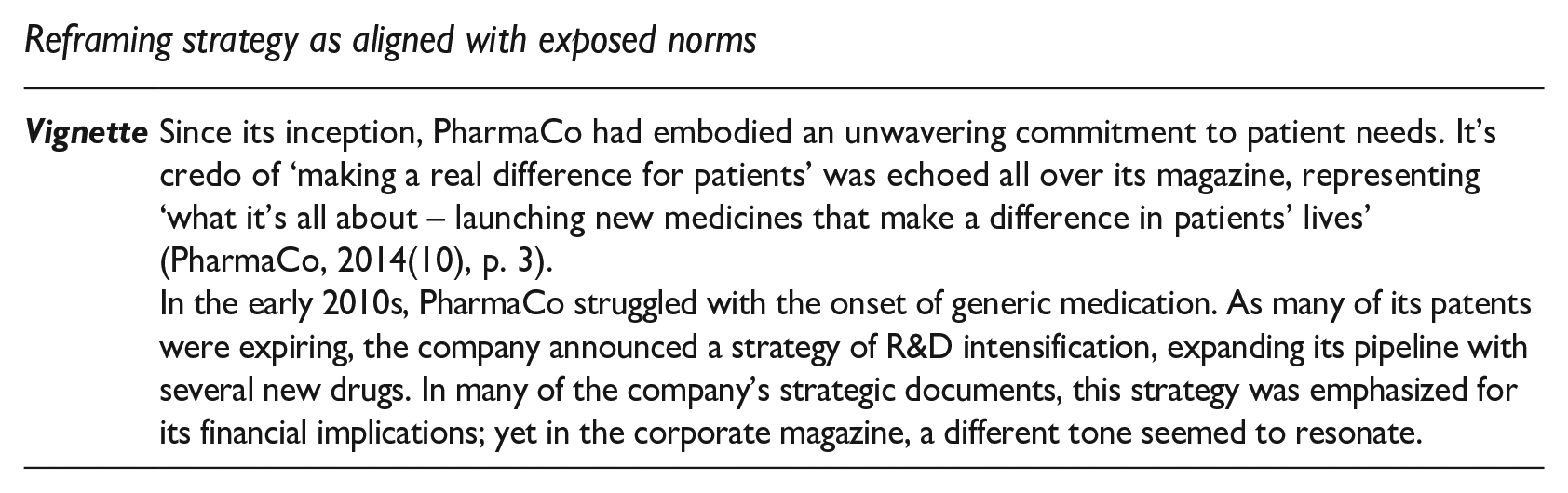
When considering how strategy was advanced in most corporate communications, rationality often reigned supreme – aiming for ‘above-market growth’ (PharmaCo, secondary data – Annual Report, 2019), or an ‘improved competitive position’ (PharmaCo, secondary data – Press Release, 2012). In corporate magazines, however, a different approach was noted. Rather than drawing on rational argumentation, strategies seemed tailored to fit the shared beliefs resonating within the company at large. For example, consider the following excerpt, published soon after PharmaCo had decided to ramp up its R&D investments: A pharmaceutical company develops, produces, and sells medicines. That economic approach also goes for us but does not suffice to capture the entirety of activities here at PharmaCo. [. . .] As big actor on the world’s stage, we also play a societal, ethical, and ecological role. It’s a role we primarily put down on ourselves. It’s what we talk about in Our Crede. And in this issue of our magazine, I see many stories that illustrate this role very well. (Manager T.H., PharmaCo, 2015(13), p. 3)
In this statement, note how this manager does not construct strategy based on financial improvements or competitive progress: instead, PharmaCo’s strategy is worked to align with the standing beliefs of the organization at large – more specifically, that of playing a societal, ethical and ecological role. In a follow-up statement, this becomes even more pronounced: Commercially speaking, [some of these new drugs] are expensive but not very profitable initiatives. But they do demonstrate that we mean it when we say that the patient comes first. (Manager T.H., PharmaCo, 2015(13), p. 4)
In this way, by tailoring strategy to the micro-level dynamics that underlaid organizations as social settings, corporate magazines helped shape a shared strategic narrative. This process gradually consolidated various viewpoints into a unified direction, reinforcing the notion that the strategy reflected a broad consensus within the organization.
I am increasingly convinced that the way we function here every day as individuals and colleagues fundamentally contributes to the direction in which PharmaCo evolves. (Manager T.H., PharmaCo, 2013(8), p. 3)
Validating strategy through emotional expressions
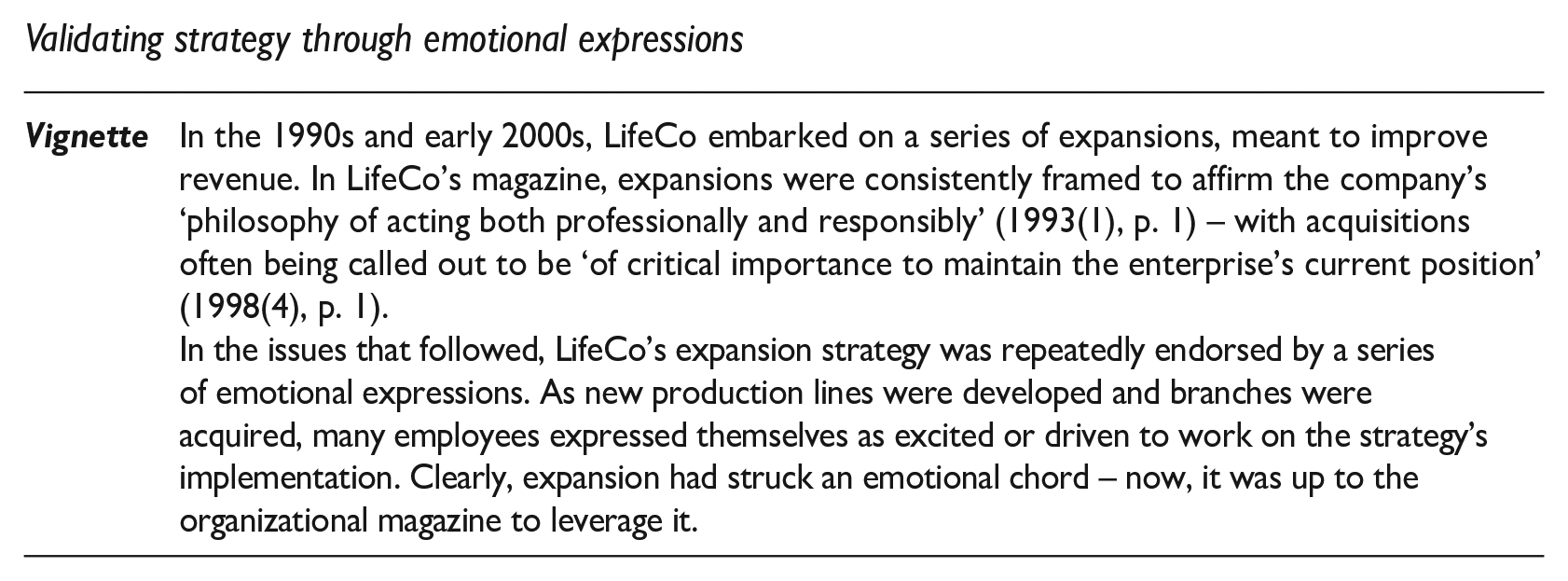
As corporate magazines set out a communicative stage that was often quite informal, they offered a platform for expressions that were largely absent in more traditional media covering strategy – i.e. expressions of emotions, moods or affect. At LifeCo’s magazine, for example, project leaders expressed themselves ‘positively stunned by the vibrant spirit with which people try to make [expansion] projects happen’, claiming it to be ‘beautiful to see how people were working on these projects with full conviction!’ (Project Leader R.D.C., LifeCo, 2000(4), p. 2). As magazine articles regularly embarked on ‘an exploration of the general mood’ (LifeCo, 2000(2), p. 10), they featured feelings like pride, shame, happiness or fear – all exhibited in response to the organization’s (intended) directions.
More than anything else, these emotional expressions seemed to reaffirm strategy by tying back into what organizational members collectively held dear. Consider, for example, the following excerpt, addressing LifeCo’s expansion strategy by looking into a newly acquired branch: On April 1st, the time had come. After the emotions of the first days, employees had come to know that LifeCo stands for trust. [. . .] ‘We have been able to establish, during our LifeCo introduction, that LifeCo people hold dear to things like an optimal management of processes and the business – just like we do,’ so speaks a clearly moved plant manager. ‘Hence, we will do everything in our power to seize the opportunities provided!’ (LifeCo, 2000(2), pp. 10–11)
Note how, in this excerpt, LifeCo’s expansion strategy was validated through the emotional confirmation of how it would further the company’s shared beliefs – namely, to be a company of ‘trust’, that relished an ‘optimal management of processes and the business’. Later, such emotionality converged in a statement of affirmation: With these wonderful developments, our new branch seems well equipped – productively as well – to make a very successful LifeCo start! We wish you the very best, colleagues! Full steam ahead! (LifeCo, 2000(2), p. 11)
Hence, by reporting emotional responses that validate norm-consistent directions, corporate magazines seemed to ultimately render such directions more acceptable – resulting in directions that, for many, could effectively be endorsed with a ‘full steam ahead!’
Mechanism of regeneration
In a mechanism of regeneration, corporate magazines shape strategy by advancing it through ongoing cycles of creation and destruction. To do so, narrators initially set the scene and offer a bird’s-eye perspective on directions considered, only to flesh out such directions in greater detail later on. Ultimately, such fleshed-out strategies are carefully reconstructed through iteration, with narrators nudging strategies away from what proved controversial in organizational life.
Constructing strategy in general
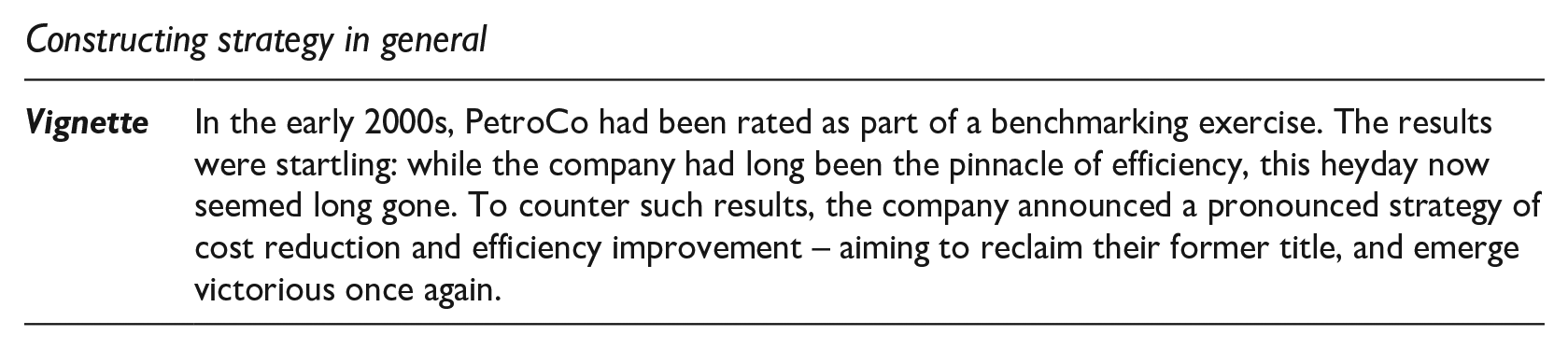
While most forms of corporate communication deliver strategy in a singular message, such one-stop sense of totality was typically not present in corporate magazines: specifically, when mentioning a strategy for the first time, magazines often only set the general scene. Consider, for example, the following excerpt from PetroCo: A high degree of efficiency is critical for us. [. . .] The fact that we are not in the leading group should by no means demotivate us, but rather inspire us to make every effort to be among the leaders. [. . .] It is necessary to work in a more systematic manner, with a bit more discipline in completing daily tasks. (Manager J.D., PetroCo, 2004(6), p. 2)
Note how this excerpt refers to a direction of efficiency, meant to lead the organization out of harm. Yet what such strategy exactly involves still proves hard to tell: while the manager refers to broad practices such as ‘work[ing] in a more systematic manner, with a bit more discipline’, the strategy is only sketched in a general sense. Such broad construction is continued later with the analogy of ‘a mountain stage in the Tour de France’: What we need to do in the coming months and years is comparable to a mountain stage in the Tour de France. [. . .] Indeed, with the significant expansion in Asia and the diminishing availability of projects in Europe, we are facing a climb. (Manager J.D., PetroCo, 2004(6), p. 1)
While this analogy offers a representation of the road ahead, note that it does little to explain exactly what moving forward will entail. In the final paragraphs of the article, the manager sets out a quantitative interpretation – yet while numeric, it offers little in terms of implementation: So, to achieve a good ranking in the Tour, one must be a proficient climber. Our industry is no different. [. . .] That is why we are advancing an ambitious and tangible goal: to increase our overall efficiency by 10% over the upcoming two years. (Manager J.D., PetroCo, 2004(6), p. 1)
In this sense, while corporate magazines initially set out the scaffolding on which the organization’s strategy will develop, such scaffolding still proves general and undefined. In doing so, strategies can be introduced in ways that rally rather than divide: Efficiency represents a key that we can handle ourselves. Because if we can improve our efficiency, we will become more attractive for taking care of new projects. That is why everyone should endorse this new way forward! (Manager J.D., PetroCo, 2004(6), p. 1)
Deconstructing strategy in detail
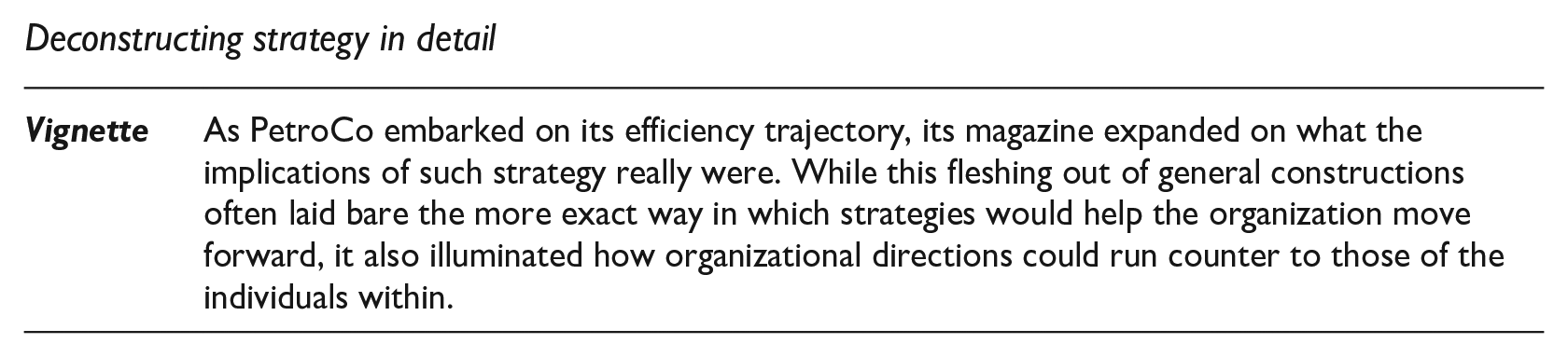
As time passed, corporate magazines typically deconstructed strategies by considering their specific implications. At PetroCo, for example, several follow-up pieces were printed to drill down on what the efficiency approach meant in practice. This included interviews and panel conversations with chief executives (2004:7–8), showcase articles (2004:7–8), and pieces that considered implications for specific units (2004:10). In these articles, broad directions were gradually broken down, breathing life into an idea formerly inanimate. Such deconstruction of strategy in terms of elements also typically involved a deconstruction of who would develop such elements: BRING FORTH THE IDEAS! [. . .] As you know by now, we’re too expensive. Efforts will need to be made [. . .] Hence, I would like to emit a call to come forward with ideas on how to realize this. (Manager J.H., PetroCo, 2004 (7–8), p. 1)
While such breaking down of strategy in terms of content and participants offered a clearer picture of ramifications, it also incited a variety of questions, reservations and objections: During the latest ‘Tell it yourself’ meeting, some points of discontent were raised. [. . .] At a certain point, chairman H-P N. became very specific by requesting to be directly informed when proposals for efficiency collide with certain obstacles within the organization. (PetroCo, 2004(10b), p. 1)
As the efficiency strategy was fleshed out in detail, it thus exposed points of controversy and debate. Such controversy proved most pernicious as employees started to question whether the strategy would not translate into a direction that ran counter to their own interests: The last few weeks [. . .] a number of persistent rumours have started to pop up. Allow me to be clear on a couple of issues. Today, there is no scenario of bare layoffs. We do, however, have the ambition to improve our efficiency by 10% over the next two years. And that is why we are developing several projects within our firm. (Manager J.D., PetroCo, 2004(10), p. 2)
In this sense, while the deconstruction of strategy allows a clearer sense of what will happen, such increased clarity also stimulates the emergence of criticism and dissent – with strategy thus gaining in contrast, by moving away from the blank slate it initially represented.
Reconstructing strategy to context

As it became clear that PetroCo’s efficiency strategy was proving increasingly contentious, leaders started to reiterate its meaning and implications. In a remarkable leadership editorial, Manager J.D. exemplifies such reiteration by asking employees for some understanding that initial decisions can only be improved after having solicited a ‘second opinion’: We must be able to tell each other openly when we do not agree with the way things are going. [. . .] We have to remain aware that, sometimes, things take time because we seek a second opinion. (Manager J.D., PetroCo, 2004(12), p. 2)
In consequence, in the issues that followed, the proposed efficiency strategy was slightly reworked – with the most controversial elements being nuanced or altered: Nobody has an answer to all questions. So it was during the third ‘Tell it yourself’ meeting. [. . .] But sometimes, questions do get a response. And in some cases, there is even a nudge to change things in the pipeline. (Editor J.A., PetroCo, 2005(4), p. 1)
As the editor continued his report, it became clear what changes he exactly referred to: First of all, the 10% issue. [. . .] Has this number become a fetish? ‘Target figures are necessary for focused actions that can be monitored’, was the answer of manager W.D.G. But a target figure needs to be put in perspective as well. Let’s say we improve our efficiency with 3% over several years in a row – then we will have reached our goal. (Editor J.A., PetroCo, 2005(4), p. 1)
In this excerpt, note how the strategic goal of a 10% increase in efficiency – a goal that was originally tied to a strict two-year timespan – is now reinterpreted: while the goal still stands, it is ‘put in perspective’, with a timespan that can be significantly more extended.
Another iteration of strategy is made later in the article on the topic of layoffs. While initial announcements had not included a strict denouncement of layoffs – ‘Can we guarantee that we will be able to continue working with the same number of people? The answer is no’ (Manager J.D., PetroCo, 2004(6), p. 1) – such forceful statements are now nevertheless put down: There will be no layoffs in this context. (Manager W.D.G, PetroCo, 2005(4), p. 1)
In this way, by picking up on organizational controversies, corporate magazines seemed to subtly nudge strategic directions to better align with the realities of everyday organizational life – thereby refining the firm’s trajectory for tomorrow, based on its experience of today.
Discussion
This study examined how corporate magazines shape strategy. While earlier research has portrayed strategy as something that is mainly ‘done’ in dedicated moments or documents (Kohtamäki et al., 2022; Vaara & Langley, 2021), this study adds to such earlier work by revealing how strategy can also be critically shaped in more broadly oriented forms of in-house communication. Although corporate magazines have seldom been examined within the realm of organizational strategy (Jarzabkowski et al., 2022; Vaara & Langley, 2021), the findings presented in this article highlight how their very divergence from more commonly considered media may render them surprisingly compelling for strategy work: for rather than being just another addition to the existing system of communication, corporate magazines may be a useful extension to the strategic ‘genre’ (Cornut et al., 2012) by means of being everything that traditional media are not.
Specifically, this study unveiled how corporate magazines shape strategy through three key mechanisms – familiarization, confirmation and regeneration. These mechanisms, while distinct in their focus, often operated in conjunction across all cases examined (see Appendix 1 for further reference). Furthermore, despite their differences, they all seemed to interconnect around the same foundational driver, i.e. constructing strategy closer to the organizational reality as experienced by members (Heller & Rowlinson, 2020; Sternadori & Holmes, 2020). In this sense, while former studies on the use of communication in strategizing have highlighted how language can work to either reflect or perform the directions an organization is setting out (Bencherki et al., 2021; Cabantous et al., 2018; Kohtamäki et al., 2022), this study extends such earlier work by disclosing how such directions can be moulded into more valid parts of everyday organizational life, with strategy becoming inherent to the efforts of all, rather than just a few.
For the literature on strategy work and strategy-as-practice, this article broadens our understanding of how organizations shape strategy, recognizing that constructive practices can extend into fora that are not traditionally seen as ‘strategic’ (Jarzabkowski et al., 2022; Kohtamäki et al., 2022). By highlighting the strategic significance of a seemingly non-strategic and ‘trivial’ medium (Heller & Rowlinson, 2020), this study demonstrates that the continuous efforts to shape and develop strategy within organizations often extend far beyond formal, structured moments, and instead permeate the more everyday activities and communications that form the fabric of organizational life. In this sense, this study encourages strategy-as-practice scholars to go beyond traditional fora for developing strategy (Jarzabkowski et al., 2022; Prashantham & Healey, 2022) and to look more closely at informal, everyday practices as key sites of strategy-making – broadening the lens through which strategic action and influence are understood, and exposing how non-traditional media may contribute to organizational directions in subtle but meaningful ways.
Furthermore, for the conversation on language in strategy, the findings of this study are significant because they reveal that, counter-intuitively, communication may not need to be overtly ‘strategic’ to influence strategy-making. In fact, while previous research has focused on how certain expressions or terms can elevate issues into the strategic domain (Bencherki et al., 2021; Gond et al., 2018; Splitter et al., 2024; Vaara et al., 2010), this study extends such earlier work by demonstrating the reverse, that is, how the use of certain language and communicative media can help to ground strategy more firmly in everyday organizational life. Here, corporate magazines have been considered, but there is every reason to believe that such strategic grounding also occurs in other media that lean close in to members’ everyday experiences – such as internal newsletters, intranet fora or even internal podcasts (Cornelissen, 2023). Rather than positioning strategy as something exclusive, this study shows how language can help to weave it more securely into the frame of daily life, ultimately making strategy more accessible and relatable to all organizational members.
In what follows, I will delve further into the different drivers underpinning these more general implications.
Advancing collective sensemaking of strategy through polyphony
First, while past work on language and strategy has often considered how strategy is constructed in communication led by senior narrators (Jarzabkowski et al., 2022; Ocasio et al., 2018; Vaara & Langley, 2021; Whittle, Gilchrist, Mueller, & Lenney, 2021), this study extends such earlier research by unveiling how the incorporation of diverse narrations, narrators and narrative contexts can advance collective sensemaking processes underlying strategy development.
Scanning over the observations and the cases underpinning them, the findings of this study corroborate earlier research that underscores the constructive importance of language for strategy (Kohtamäki et al., 2022; Vaara & Langley, 2021): as strategies were formulated in written text, they gradually constituted the very lines according to which organizations further developed (Cabantous et al., 2018). However, the findings of this study also show that, in corporate magazines, the use of language in strategizing goes well beyond a ‘one-size-fits-all’ approach: as perspectives, narrators and contexts differed, so did the way in which actors evoked strategy in their communication. At ChemCo, for example, this was highlighted most explicitly with an expansion strategy being constructed from different angles. While such featuring of different voices may not have offered the most homogeneous of strategy constructions, it did seem to become all the richer for it, nonetheless. Similarly, at PetroCo, employees and leadership were illustrated as going back and forth in a communicative process that ultimately reshaped the company’s strategy according to emerging conflict and concern; and at AutoCo and PharmaCo, magazines’ broad staging of diverse narrators and understandings was shown to sow the seeds for strategies that explicitly tied in to members’ shared norms and expectations. As corporate magazines’ conversations on strategy proved inherently polyphonic (Vaara & Rantakari, 2024), this multiplicity of voices seemed to yield significant implications for how members collectively made sense of strategies as unfolding.
To fully appreciate why such sense of polyphony may matter, it is useful to contrast corporate magazines’ communicative stage to that of more commonly studied documents in strategy-making, such as strategic plans or annual reports. In these documents, strategy is constructed almost exclusively by senior leadership (Balogun et al., 2014; Burgelman et al., 2018; Schildt, Mantere, & Cornelissen, 2020). While such strategy communication may be homogeneous, it has been regularly criticized as undermining what it essentially aims for, with organizational members often failing to recognize how a construction shaped exclusively by management relates to them as individuals (Ocasio et al., 2018; Wenzel & Koch, 2018). Corporate magazines, in contrast, offer fora for strategizing that are multi-vocal by design, with ‘greater employee involvement’ often being part of the reason why they were produced in the first place (Yaxley & Ruck, 2016). Although such a stage can sometimes seem to offer mere sensations of involvement rather than involvement itself (Yaxley & Ruck, 2016), it does appear to expand how strategies can be made sense of in ways that more traditional strategy communications cannot, with strategy ultimately being constructed through the conversing of organizations ‘as whole, total, or “bodily” entities’ (Christensen & Cornelissen, 2010, p. 387).
I believe that the implications of these findings for the conversation on strategy work and the use of language in strategizing are substantial, especially as they challenge conventional approaches of strategy-making as a leadership-heavy process (Burgelman et al., 2018; Wenzel & Koch, 2018). As strategies shift from univocal to more polyphonic fora, they become continuously re-created and re-shaped by different organizational actors. Such recreations seem not to be trivial, but indeed essential to the meaning that strategies come to embody in everyday organizational life (Whittle et al., 2023). Consequently, these findings imply that a broader understanding of strategy work is needed (Jarzabkowski et al., 2022), which explicitly recognizes the importance of narrative diversity and the collaborative nature of strategizing through language.
Additionally, for those researching or practising corporate communication, these observations imply that corporate magazines should not be dismissed as mere impression management tools (Heller & Rowlinson, 2020; Sternadori & Holmes, 2020), but should be fully embraced for the rare multi-angled setting they offer, and for the use such polyphony has for members making sense of organizational life as developing. If anything, these findings show that all contributions to a conversation do matter, even if they appear ‘small’ or ‘banal’ at first glance (Heller & Rowlinson, 2020; Sternadori & Holmes, 2020): for by representing voices that are altogether different from those of others, such contributions nudge organizations into more complete representations of their internal social dynamics – and ultimately help them break free from the predominance of senior representation.
The role of emotional expressions in shaping organizational strategy
Second, while prior research on strategy-making has largely limited itself to a rationalized perspective driven by the study of formal strategy documents (Bencherki et al., 2021; Cornut et al., 2012; Ocasio et al., 2018), this study extends such earlier work with a more pronounced understanding of the role of emotions.
Looking over the findings of this study, one thing that stands out in magazines’ conversations is the remarkable use of emotional expressions. At LifeCo, these emotional expressions have been highlighted most explicitly, with expressions including being ‘positively stunned’ or seeing someone ‘clearly moved’. Here, emotions helped customize a strategy’s connection to members’ standing norms and expectations: as strategy was materializing in real life, emotional expressions seemingly functioned as seals of passage, legitimizing how initiatives were valid efforts to pursue given the organization’s background. However, when considering the findings more closely, the use of emotional expressions can also be noted in other mechanisms. At PetroCo, for example, it was angry statements and observations of frustration that led to the regeneration of strategy in more lenient terms. In this case, emotional expressions seemed to act as warning signals, nudging strategy into shapes that avoided major conflict. Similarly, emotions could also be understood as playing a part in familiarization: for by juxtaposing strategy with elements that were much more mundane in topic or design, magazines typically set a scene that proved relatively comforting. Strategy, in this sense, gained an air of apparent tranquillity, which seemed to ‘massage’ it more gently into acceptance.
Why would emotions and their expressions be so notable in corporate magazines? The answer, I believe, lies in the extent to which interactions are ‘nested’, or have to be mindful of the context in which they take place (Heller & Rowlinson, 2020; Yates, 1993). Specifically, when strategy is being developed as a ‘staged performance’ (Wenzel & Koch, 2018) – i.e. when strategy is constructed in formal documents or meetings, such as strategic plans or seminars – those working on it convene in a rather generic setting, largely uprooted from the organization’s everyday context. Here, strategic interactions can adhere to a more uniform mode: as discourse is formed in a specific, almost secluded socio-temporal space, rational argumentation to ‘improve competitiveness’ can reign supreme (Cornut et al., 2012). In corporate magazines, however, strategic interactions only briefly interrupt people’s everyday behaviour (Heller, 2009). Such strategic interactions, in consequence, may need to pay much closer attention to the ways in which people move through their organizational lives – i.e. they are much more ‘nested’ (Cornelissen, 2023), or rooted in the collection of human experiences by which people construct their corporate reality. As a result, strategists may need to connect their strategy constructions more directly to the organizational conditions in which such work takes place, and to do so, emotions may prove exceptionally potent.
For the literature on strategy work and strategy-as-practice, these findings underscore the importance of considering not just the content of strategy (Jarzabkowski et al., 2022; Kohtamäki et al., 2022), but also how it is conveyed and internalized through emotional cues. Emotions, as observed in corporate magazines, appear to function as powerful mediating mechanisms that can bridge formal directions with the lived experiences of organizational members. This reinforces the notion that strategy work is not solely a cognitive or rational process (Burgelman et al., 2018) but is profoundly tied to an organization’s socio-emotional fabric. As such, this study contributes to a more holistic view of strategizing as a dynamic and embodied activity, where emotions serve not merely as byproducts but as essential components of the strategic process.
Furthermore, for those practising corporate communication, these observations imply that constructing strategy through language need not always be heavily tilted to the rationalized tone of formal documents (Logemann et al., 2019; Vaara et al., 2010), nor that such strategizing should necessarily be ‘distinctively inspirational and unifying, [and] characterized by the language of optimism, collaboration and achievement’ (Cornut et al., 2012, p. 44), as mission and vision statements often are (Cornelissen, 2023). Rather, by drawing on a wider range of emotional expressions, it seems possible to construct strategy in ways that may be more relatable, relevant and adapted to members’ developing organizational experiences. Such ‘humanization’ (Heller & Rowlinson, 2020) of strategy through emotional expressions (the good, and the bad) may push strategy conversations beyond the mere installation of ‘control’ (Yates, 1993) and help connect it more directly to the individual experiences that make up organizational reality.
Invoking the exceptional through a reiteration of the everyday
Finally, while past research has highlighted how language can perform strategy in grand singular moments where strategists ‘take the stage’ (Wenzel & Koch, 2018; Whittle et al., 2021), this study adds to such earlier work by showing how strategy can also be performed through repetition and iteration.
Looking over the findings of this study, it is remarkable how corporate magazines were drawn upon to revert to, re-develop or nuance strategic statements as having been made before, sometimes only a couple of issues ago, sometimes several years past. For example, while PetroCo initially constructed a strategy of increased efficiency, such strategy was only given real meaning in subsequent issues. As the ramifications of the efficiency strategy were gradually put together, they unveiled potential conflicts, leading to revisions in the strategy that – although nuanced – were certainly not immaterial. In the other cases studied (see Appendix 1) a similar sense of repetition and recurrence was highlighted in the context of bringing strategy closer to the audiences for whom it was purportedly intended. As such, what seemed to matter most was not what organizations portrayed as their strategy at any given time, but how they continuously reconstructed the way forward through repetition and reiteration.
To fully appreciate how this development occurs, it may be helpful to emphasize how magazines, as periodical forms of communication, offer fora that are continuously renewed (Heller & Rowlinson, 2020), providing strategists the space to rework more closely to the (in)direct feedback a strategy generates when first constructed. When talking strategy in a managerial presentation or a strategic plan, possibilities for iteration are limited: either strategists convincingly construct the strategic trajectory, or they do not (Vaara & Langley, 2021). Even when discussing strategy in recurring media such as annual reports, the timeline to reiterate on strategic statements is extensive: if strategists don’t get it right now, they can only redirect their words in next year’s print (Cornelissen, 2023). Yet when talking strategy in more routine media such as corporate magazines, whose temporality typically spans either a few weeks or months, the possibilities for narrators to revise or restate their strategic discourse expand dramatically. Words that generate backlash can be soothed later on; and words that do not properly incite or inspire can be pepped up in later discourse. As such, in corporate magazines, how actors ‘construct’ strategy at any given time (Vaara & Langley, 2021) may be less important compared to how they continuously tune and revise such strategic language over time.
For the literature on strategy work, this observation highlights the critical importance of temporality and – more exactly – recurrence. Specifically, while time has often been viewed as a key boundary factor in strategy-making (where strategists adapt their language based on the specific moment; Bencherki et al., 2021; Cornut et al., 2012; Whittle et al., 2021) this study extends such earlier work by underscoring how media’s recurrence may offer important opportunities for strategy re-work or re-practice. Through iteration, recurring media such as corporate magazines enable strategic messages to evolve, be reinterpreted and become more deeply embedded in the organization’s everyday activities. This underscores the importance of communication’s frequency and rhythm for strategy work, thus turning what might seem ‘merely routine’ into a powerful tool for strategic alignment.
Additionally, for those practising corporate communication, this suggests that frequently recurring media should be recognized for their value in shaping how organizational directives are processed and internalized. These media, through repetition and iteration, offer opportunities for organizational choices to be continuously conceived and reconceived in ways that one-off communications cannot (Cornut et al., 2012). What managers say on the ‘dramaturgical stage’ of specific strategic events (Whittle et al., 2021) may set the tune; yet what they talk about in everyday life is likely to deliver the actual melody. Hence, media such as corporate magazines should not be seen as forms of communication that carry little to no consequence for an organization’s choices, but should instead be recognized as communicative fora that bring many of such choices into actual shape – for it is what is being said in the ordinary, that ultimately works to achieve the most extraordinary of directions.
Conclusion
This article unveiled how strategy is shaped by corporate magazines. Based on the qualitative analysis of over 500 magazine issues, this paper illuminated three primary mechanisms through which corporate magazines ‘work’ strategy: (i) familiarization – or shaping strategy by connecting it to the everyday; (ii) confirmation – or shaping strategy by aligning it with standing norms and expectations; and (iii) regeneration – or shaping strategy by advancing it through ongoing cycles of creation and destruction.
In doing so, this study offers three key takeaways. First, it extends earlier research’s emphasis on leadership in strategy-making with insights into the collective sensemaking processes underlying strategy development, showing how the staging of various narrations, narrators and contexts may contribute to a strategy that is more relatable for organizational members. Second, it enriches our existing rational perspective of strategy-making with a more pronounced understanding of the various roles of emotions, highlighting how expressions of affect can be utilized to humanize and tailor strategy according to organizational life as it is experienced. Finally, it expands earlier work’s emphasis on grand strategizing moments with a reappreciation of the small and iterative, demonstrating how firms’ conception of tomorrow is often based on the recurring humdrum of today.
Like all studies, this work has certain limitations and boundary conditions. To begin with, while cases selected were accessible, representative, comprehensive and distinctive, they were primarily located in the United States or Europe due to the researcher’s geographical constraints. This raises an intriguing avenue for future research: how might corporate magazines be utilized in rapidly developing regions where the strategic environment is less established?
Next, as with all studies, the author had to establish boundaries regarding what would be included in the current paper and what would be reserved for future research, mostly due to constraints of space. Specifically, while this study has identified and explored the different mechanisms by which corporate magazines shape strategy, it did not yet pinpoint how these mechanisms might be exactly interrelated. That is, how do these mechanisms connect, and how might they cross-pollinate each other in the development of strategy? I believe a more systematic study of the configuration of these identified mechanisms would represent a valuable direction for further research.
Furthermore, while corporate magazines were focused on as medium, this communicative format may not be the only one featuring strategy in more polyphonic and dynamic ways. For example, enterprise social network platforms, such as Yammer, Chatter or Google Workspace, have nowadays come to offer digital communication tools that allow organizational employees to contribute to and follow along with strategic conversations in near real time. As studying these digital grassroots tools may further granulize the insights of this study, I argue that they represent interesting tracks for further research.
Finally, while this study explores how strategy is shaped in corporate magazines, it does not address whether this strategy-making ultimately leads to successful implementation. Future research could build on these insights by examining their strategic impact, either through interviews and observations or by tracking key strategic KPIs.
Footnotes
Appendix
Cross-case examples of how corporate magazines shape strategy.
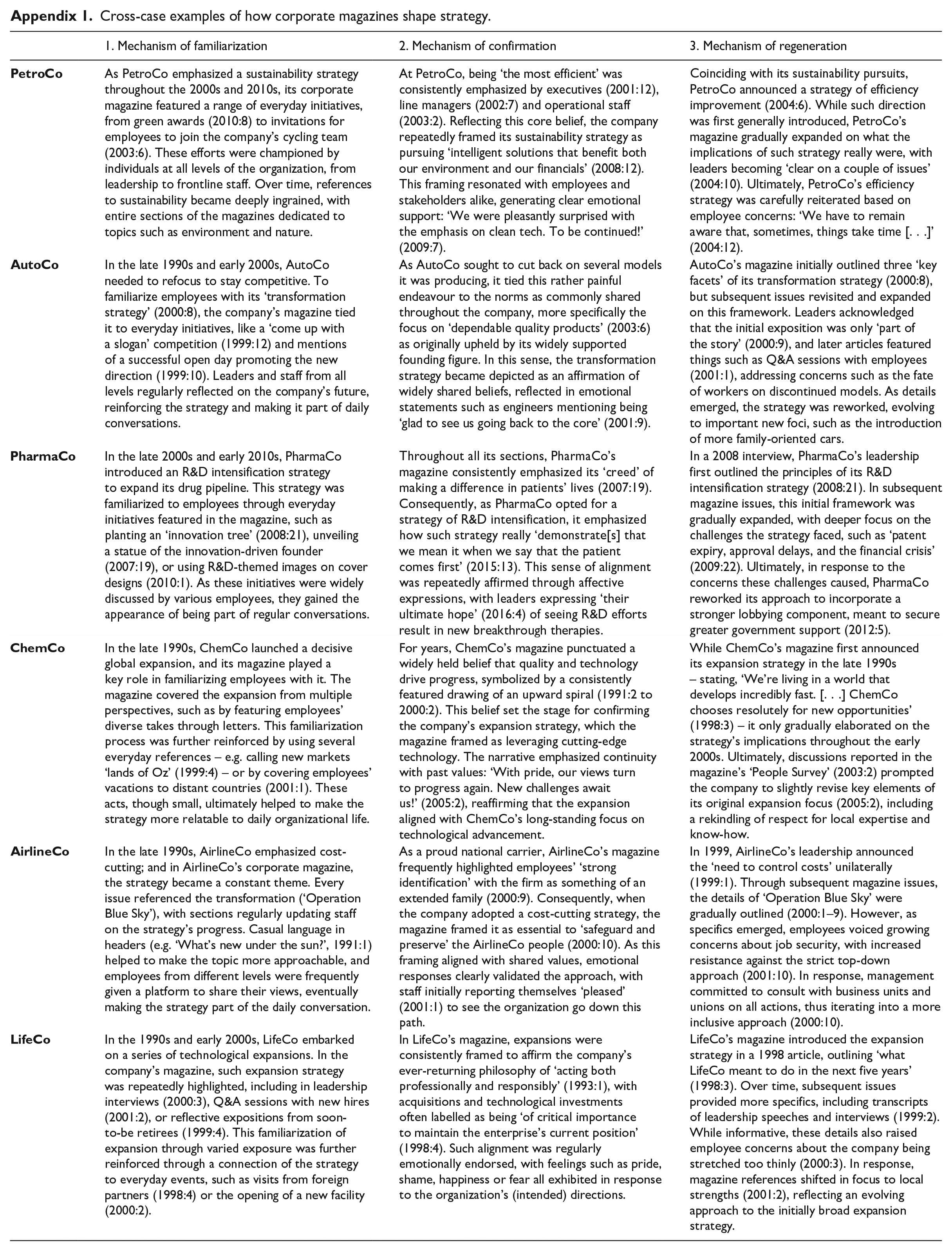
| 1. Mechanism of familiarization | 2. Mechanism of confirmation | 3. Mechanism of regeneration | |
|---|---|---|---|
|
|
As PetroCo emphasized a sustainability strategy throughout the 2000s and 2010s, its corporate magazine featured a range of everyday initiatives, from green awards (2010:8) to invitations for employees to join the company’s cycling team (2003:6). These efforts were championed by individuals at all levels of the organization, from leadership to frontline staff. Over time, references to sustainability became deeply ingrained, with entire sections of the magazines dedicated to topics such as environment and nature. | At PetroCo, being ‘the most efficient’ was consistently emphasized by executives (2001:12), line managers (2002:7) and operational staff (2003:2). Reflecting this core belief, the company repeatedly framed its sustainability strategy as pursuing ‘intelligent solutions that benefit both our environment and our financials’ (2008:12). This framing resonated with employees and stakeholders alike, generating clear emotional support: ‘We were pleasantly surprised with the emphasis on clean tech. To be continued!’ (2009:7). | Coinciding with its sustainability pursuits, PetroCo announced a strategy of efficiency improvement (2004:6). While such direction was first generally introduced, PetroCo’s magazine gradually expanded on what the implications of such strategy really were, with leaders becoming ‘clear on a couple of issues’ (2004:10). Ultimately, PetroCo’s efficiency strategy was carefully reiterated based on employee concerns: ‘We have to remain aware that, sometimes, things take time [. . .]’ (2004:12). |
|
|
In the late 1990s and early 2000s, AutoCo needed to refocus to stay competitive. To familiarize employees with its ‘transformation strategy’ (2000:8), the company’s magazine tied it to everyday initiatives, like a ‘come up with a slogan’ competition (1999:12) and mentions of a successful open day promoting the new direction (1999:10). Leaders and staff from all levels regularly reflected on the company’s future, reinforcing the strategy and making it part of daily conversations. | As AutoCo sought to cut back on several models it was producing, it tied this rather painful endeavour to the norms as commonly shared throughout the company, more specifically the focus on ‘dependable quality products’ (2003:6) as originally upheld by its widely supported founding figure. In this sense, the transformation strategy became depicted as an affirmation of widely shared beliefs, reflected in emotional statements such as engineers mentioning being ‘glad to see us going back to the core’ (2001:9). | AutoCo’s magazine initially outlined three ‘key facets’ of its transformation strategy (2000:8), but subsequent issues revisited and expanded on this framework. Leaders acknowledged that the initial exposition was only ‘part of the story’ (2000:9), and later articles featured things such as Q&A sessions with employees (2001:1), addressing concerns such as the fate of workers on discontinued models. As details emerged, the strategy was reworked, evolving to important new foci, such as the introduction of more family-oriented cars. |
|
|
In the late 2000s and early 2010s, PharmaCo introduced an R&D intensification strategy to expand its drug pipeline. This strategy was familiarized to employees through everyday initiatives featured in the magazine, such as planting an ‘innovation tree’ (2008:21), unveiling a statue of the innovation-driven founder (2007:19), or using R&D-themed images on cover designs (2010:1). As these initiatives were widely discussed by various employees, they gained the appearance of being part of regular conversations. | Throughout all its sections, PharmaCo’s magazine consistently emphasized its ‘creed’ of making a difference in patients’ lives (2007:19). Consequently, as PharmaCo opted for a strategy of R&D intensification, it emphasized how such strategy really ‘demonstrate[s] that we mean it when we say that the patient comes first’ (2015:13). This sense of alignment was repeatedly affirmed through affective expressions, with leaders expressing ‘their ultimate hope’ (2016:4) of seeing R&D efforts result in new breakthrough therapies. | In a 2008 interview, PharmaCo’s leadership first outlined the principles of its R&D intensification strategy (2008:21). In subsequent magazine issues, this initial framework was gradually expanded, with deeper focus on the challenges the strategy faced, such as ‘patent expiry, approval delays, and the financial crisis’ (2009:22). Ultimately, in response to the concerns these challenges caused, PharmaCo reworked its approach to incorporate a stronger lobbying component, meant to secure greater government support (2012:5). |
|
|
In the late 1990s, ChemCo launched a decisive global expansion, and its magazine played a key role in familiarizing employees with it. The magazine covered the expansion from multiple perspectives, such as by featuring employees’ diverse takes through letters. This familiarization process was further reinforced by using several everyday references – e.g. calling new markets ‘lands of Oz’ (1999:4) – or by covering employees’ vacations to distant countries (2001:1). These acts, though small, ultimately helped to make the strategy more relatable to daily organizational life. | For years, ChemCo’s magazine punctuated a widely held belief that quality and technology drive progress, symbolized by a consistently featured drawing of an upward spiral (1991:2 to 2000:2). This belief set the stage for confirming the company’s expansion strategy, which the magazine framed as leveraging cutting-edge technology. The narrative emphasized continuity with past values: ‘With pride, our views turn to progress again. New challenges await us!’ (2005:2), reaffirming that the expansion aligned with ChemCo’s long-standing focus on technological advancement. | While ChemCo’s magazine first announced its expansion strategy in the late 1990s – stating, ‘We’re living in a world that develops incredibly fast. [. . .] ChemCo chooses resolutely for new opportunities’ (1998:3) – it only gradually elaborated on the strategy’s implications throughout the early 2000s. Ultimately, discussions reported in the magazine’s ‘People Survey’ (2003:2) prompted the company to slightly revise key elements of its original expansion focus (2005:2), including a rekindling of respect for local expertise and know-how. |
|
|
In the late 1990s, AirlineCo emphasized cost-cutting; and in AirlineCo’s corporate magazine, the strategy became a constant theme. Every issue referenced the transformation (‘Operation Blue Sky’), with sections regularly updating staff on the strategy’s progress. Casual language in headers (e.g. ‘What’s new under the sun?’, 1991:1) helped to make the topic more approachable, and employees from different levels were frequently given a platform to share their views, eventually making the strategy part of the daily conversation. | As a proud national carrier, AirlineCo’s magazine frequently highlighted employees’ ‘strong identification’ with the firm as something of an extended family (2000:9). Consequently, when the company adopted a cost-cutting strategy, the magazine framed it as essential to ‘safeguard and preserve’ the AirlineCo people (2000:10). As this framing aligned with shared values, emotional responses clearly validated the approach, with staff initially reporting themselves ‘pleased’ (2001:1) to see the organization go down this path. | In 1999, AirlineCo’s leadership announced the ‘need to control costs’ unilaterally (1999:1). Through subsequent magazine issues, the details of ‘Operation Blue Sky’ were gradually outlined (2000:1–9). However, as specifics emerged, employees voiced growing concerns about job security, with increased resistance against the strict top-down approach (2001:10). In response, management committed to consult with business units and unions on all actions, thus iterating into a more inclusive approach (2000:10). |
|
|
In the 1990s and early 2000s, LifeCo embarked on a series of technological expansions. In the company’s magazine, such expansion strategy was repeatedly highlighted, including in leadership interviews (2000:3), Q&A sessions with new hires (2001:2), or reflective expositions from soon-to-be retirees (1999:4). This familiarization of expansion through varied exposure was further reinforced through a connection of the strategy to everyday events, such as visits from foreign partners (1998:4) or the opening of a new facility (2000:2). | In LifeCo’s magazine, expansions were consistently framed to affirm the company’s ever-returning philosophy of ‘acting both professionally and responsibly’ (1993:1), with acquisitions and technological investments often labelled as being ‘of critical importance to maintain the enterprise’s current position’ (1998:4). Such alignment was regularly emotionally endorsed, with feelings such as pride, shame, happiness or fear all exhibited in response to the organization’s (intended) directions. | LifeCo’s magazine introduced the expansion strategy in a 1998 article, outlining ‘what LifeCo meant to do in the next five years’ (1998:3). Over time, subsequent issues provided more specifics, including transcripts of leadership speeches and interviews (1999:2). While informative, these details also raised employee concerns about the company being stretched too thinly (2000:3). In response, magazine references shifted in focus to local strengths (2001:2), reflecting an evolving approach to the initially broad expansion strategy. |
Acknowledgements
The author would like to thank editor Davide Nicolini and three anonymous reviewers for their constructive and developmental feedback.
Funding
The author(s) received no financial support for the research, authorship, and/or publication of this article.
