




Abstract
We propose that the pre-eminent ‘grand challenge’ for organization theorists today is the societal control of powerful corporations. This grand challenge is the more urgent because of the contemporary inadequacies of markets, hierarchies and regulations as instruments of control. We argue for the potential role of ‘open strategy’ in mobilizing normative controls over big business. We develop a distinction between the managed and unmanaged practices of open strategy. Both can help expose corporations to normative pressures, but we highlight the unmanaged open practices of collective subpolitics and individualist whistleblowing. Especially when mobilized by globally networked professionals, these unmanaged practices can subject corporations to normative pressures where markets, hierarchies and regulations fail. We propose two broad research themes relevant to the effectiveness of managed and unmanaged practices of strategic openness: on the one hand, there are material issues to do with labour markets, organizing and technologies; on the other hand, there are discursive questions of authenticity, capability and identity.
Keywords
Introduction
In July 2019, Meredith Whittaker, leader of a wave of staff walkouts at Google, finally resigned from the company where she had founded the Google Open Research group twelve years before. The walkouts were the culmination of rising internal dissent over Google’s problematic approaches to sexual misconduct and citizen surveillance. However, after her resignation, Whittaker issued a widely publicised note explaining that her fundamental issue was corporate power: The reasons I’m leaving aren’t a mystery. I’m committed to . . . organizing for an accountable tech industry – and it’s clear Google isn’t a place where I can continue this work. . . . Google is one of the most powerful organizations on the planet . . . How this vast power is used is one of the most urgent social and political (and yes, technical) questions of our time. (Whittaker, 2019)
In calling for greater accountability, Whittaker puts her finger on a general problem: the control of corporate power. We too focus on the control of private corporations that have, in recent decades, attained extraordinary influence and reach within contemporary societies. Very often, these corporations achieve great things for the world. However, some have repeatedly failed to exercise their vast powers with due responsibility. Corporations such as Alphabet (Google), Baidu, Boeing, Facebook, Purdue and Volkswagen have, respectively, manipulated markets, facilitated medical malpractice, risked lives, influenced elections, promoted addiction and polluted the environment, all on massive scales. These individual corporations are not unique in their powers, whether for good or for ill. For all today’s fashionable talk about disrupted and disintegrated organizations (e.g. Davis, 2016, 2017), we are in fact in an age of very big business (Lepore, 2014). Lamoreaux (2019) argues that the threat to contemporary competition and politics posed by digital giants such as Alphabet, Amazon, Apple and Facebook is at least equivalent to that of the great American trusts, led by Standard Oil, more than one hundred years ago.
Our argument is that the societal control of powerful organizations should be the pre-eminent grand challenge for organization theory. For sure, the world faces many vast and urgent ‘societal grand challenges’, such as climate change, poverty and health (George, Howard-Grenville, Joshi, & Tihanyi, 2016). To all of these, organization theorists have a great deal to contribute. However, we contend that control over organizations, and especially over powerful corporations, is the challenge for which our intellectual resources and our very title give us the best knowledge and the most direct responsibility. Certainly, large enlightened organizations such as Unilever are potentially important partners in tackling societal grand challenges, capable of the ‘responsible innovations’ necessary for progress (Ferraro, Etzion, & Gehman, 2015; Scherer & Voegtlin, 2020). But it remains an ‘inconvenient truth’ (Wright & Nyberg, 2017) that large corporations are often significant contributors to the very pathologies that underlie many conventional grand challenges and that their engagements can end up as merely diversionary. In addressing the grand challenge of corporate control, the task for organization theorists is to understand better both how to enrol the power of large corporations constructively and how to rein in their more pathological tendencies.
This challenge of corporate control sets a stretching research agenda for organization theory. Traditional instruments of control face four potential fail-points in responding to contemporary big business. Market disciplines are undermined by monopolistic power; hierarchical control through national ownership is thwarted by globalism; regulations are confused by complexity; normative sanctions are diluted by cultural fragmentation. Understanding these various fail-points and their remedies makes urgent demands upon researchers across the discipline. If they are to meet the challenge of corporate control in current conditions, organization theorists must develop new ways of steering big business in pro-social directions. There will be an important role for innovative iterations of market, hierarchical and regulative controls. However, we shall argue that normative systems (Scott, 2013) have an under-exploited potential for matching the peculiar features of contemporary big business. Moreover, while norms may guide managers in private, they operate most forcefully when decisions are in open view.
This more visible form of normative control can draw upon mechanisms advanced by both proponents of deliberative governance (Scherer & Palazzo, 2011; Scherer & Voegtlin, 2020) and ‘open strategy’ (Hautz, Seidl, & Whittington, 2017; Seidl, von Krogh, & Whittington, 2019). The notion of deliberative governance calls for greater participation and reflexivity in corporate decision-making, while open strategy proposes the related notions of stakeholder inclusion and transparency for organizations’ most consequential decisions. In various ways, both deliberative governance and open strategy allow either stronger normative influence during the decision-making process or sharper normative judgement after the event. Transparency, reflexivity and participation all exert control by holding management decisions to account against normative standards. Control is exercised through the court of opinion, whether public or internal.
The mechanisms of open strategy are therefore potentially as relevant to governance issues as those of deliberative governance itself. However, both are limited: deliberative governance relies heavily on ownership or legal changes that are particularly hard to enforce upon contemporary big business, while open strategy researchers have mostly focused on the voluntary initiatives of corporations themselves. As one means of addressing these limitations, we build on the underdeveloped notion of inadvertent openness (Whittington, Cailluet, & Yakis-Douglas, 2011) by distinguishing between two kinds of open practices: managed and unmanaged. Managed open practices are the formal managerial initiatives that already feature prominently in research on deliberative governance and open strategy, for example, mandatory strategy reporting or the all-hands fora of Facebook or Google. By contrast, unmanaged open practices are independent of management: here they are exemplified by both the renegade transparency brought about by corporate whistleblowers (Porter & Ronit, 2018) and the insurgent inclusion of subpolitical dissent (Beck, 1997a). Google’s Meredith Whittaker at the start illustrates both kinds of unmanaged openness, as she moved from internal dissent to public whistleblowing. These unmanaged practices do not rely on the conditional initiatives of corporate managements, nor do they wait upon compulsory changes from governments or regulators. Given the nature of contemporary big business, these kinds of independence make unmanaged openness especially important today.
Unmanaged forms of openness can be practised by many kinds of actor and with a variety of effects. However, we shall highlight the normative power of networked professionals. These professionals have the potential to match the global reach of today’s big business both culturally and organizationally. First, as products of ‘reflexive modernity’ (Beck, Giddens, & Lash, 1994), these professionals lean towards universalistic values, providing a common moral inspiration for whistleblowing and dissent across the world. These values potentially override the cultural fragmentation so pernicious to normative control. Second, these professionals are skilled networkers, connecting across organizations and nations (Henriksen & Seabrooke, 2016). Advances in information technology have latterly given their networks still greater global connectivity (Almeida & Chase-Dunn, 2018; Barnett, Henriques, & Husted, 2020). The organizing capacity of networked professionals amplifies the voice of protest and provides the scaffolding for subpolitical mobilization worldwide.
Frail though they still are, we propose that the common values and international connections of contemporary professionals do allow for the cultural cohesion necessary to normative control. Professional networks constitute a transnational normative infrastructure; open strategy provides the means to weaponize it. Our research agenda therefore addresses the material and discursive requirements for more effective normative pressure through open strategy. On the material side, we need better understanding of at least three factors: the labour market conditions that give professionals the confidence to engage; the modes of subpolitical organizing by which they do engage; and the information technologies that they actually use as they engage. On the discursive side, the concerns are with evaluating the authenticity of corporate strategy discourse, the capabilities required effectively to participate in it, and finally how discourse defines who has the right and the responsibility to participate in open strategy practices, both managed and unmanaged.
In sum, this paper builds on the open strategy literature to develop a distinction between two kinds of open practices, managed and unmanaged. Especially as they focus on the strategic decisions with most impact, both kinds of openness respond to the grand challenge of corporate control. Openness exerts control by exposing corporations to normative judgement and challenge. This exposure is the more powerful to the extent that the transnational normative infrastructure of networked professionals corresponds to the global scope of contemporary big business. Potentially at least, professionals have both the moral inspirations and the mobilizing networks required to pressure corporations across international borders. In particular, the unmanaged practices of open strategy can offer a final recourse when deliberative consensus or managed openness fail. However, this combination of open strategy and networked professionals is underdeveloped. As organization theorists, our contribution to more effective normative control over the world’s most powerful corporations should be more research into the material and discursive conditions for opening up their strategies to greater scrutiny.
The Challenge of Corporate Control
Developed economies are seeing a scale of corporate market power reminiscent of the early twentieth century (Lamoreaux, 2019). This power extends beyond the usual suspects of contemporary technology companies: since the 1990s, more than three quarters of United States industries have seen increases in their concentration ratios and in nearly a third of industries the share of the largest four firms has increased by more than 40 per cent (Grullon, Larkin, & Michealy, 2019). But this market power does come with a new twist. Meredith Whittaker at the start was protesting about the kinds of power acquired by such digital giants as Google and Facebook through their pervasive technologies of behavioural tracking and modification. Such powers are not confined to the new tech industries. As new behavioural technologies are harnessed by corporations of all kinds, Zuboff (2019) describes the emergence of a whole new economic order, ‘surveillance capitalism’. Surveillance technologies are being taken up increasingly by the suppliers of our automobiles, our domestic appliances, our financial services and much more. These technologies give extra heft to the whole range of corporations. Surveillance power is combined with market power. JPMorgan, Volkswagen and Walmart dominate their markets in very traditional ways. But now they know more about us than ever before.
The control of such powerful corporations, both traditional and tech, represents an urgent ‘societal grand challenge’ for organization theory. Powerful corporations fit exactly the definitional criterion of an important societal problem whose remedy would have a high likelihood of global impact through widespread implementation (George et al., 2016). They are problematic and impactful through the scale of their operations and the intrusiveness of their technologies. Corporations’ powers over markets, behaviours, technologies and politics give to their strategies the potential to bring great good but also great harm. Not on every detail perhaps, but on the big issues that matter, society needs the capacity for control.
But today’s large corporations raise awkward problems even for organization theorists. The characteristics of contemporary big business exposes failings in organization theory’s most prominent instruments of control: on the one hand, markets and hierarchies drawn from transaction cost economics (Williamson, 1975); on the other, the regulations and norms of institutional theory (Scott, 2013). Figure 1 indicates the conditions under which each of these control instruments can be effective. The unfolding sequence suggests how failures in market structure, information characteristics and ownership base undermine these conditions for markets, regulation and hierarchy in turn. This leaves normative controls as a final resort. Normative controls too have their potential fail-point in cultural fragmentation, but we shall argue that for this an important remedy lies in the cohesive pressures of contemporary professionals, especially as reinforced by openness.
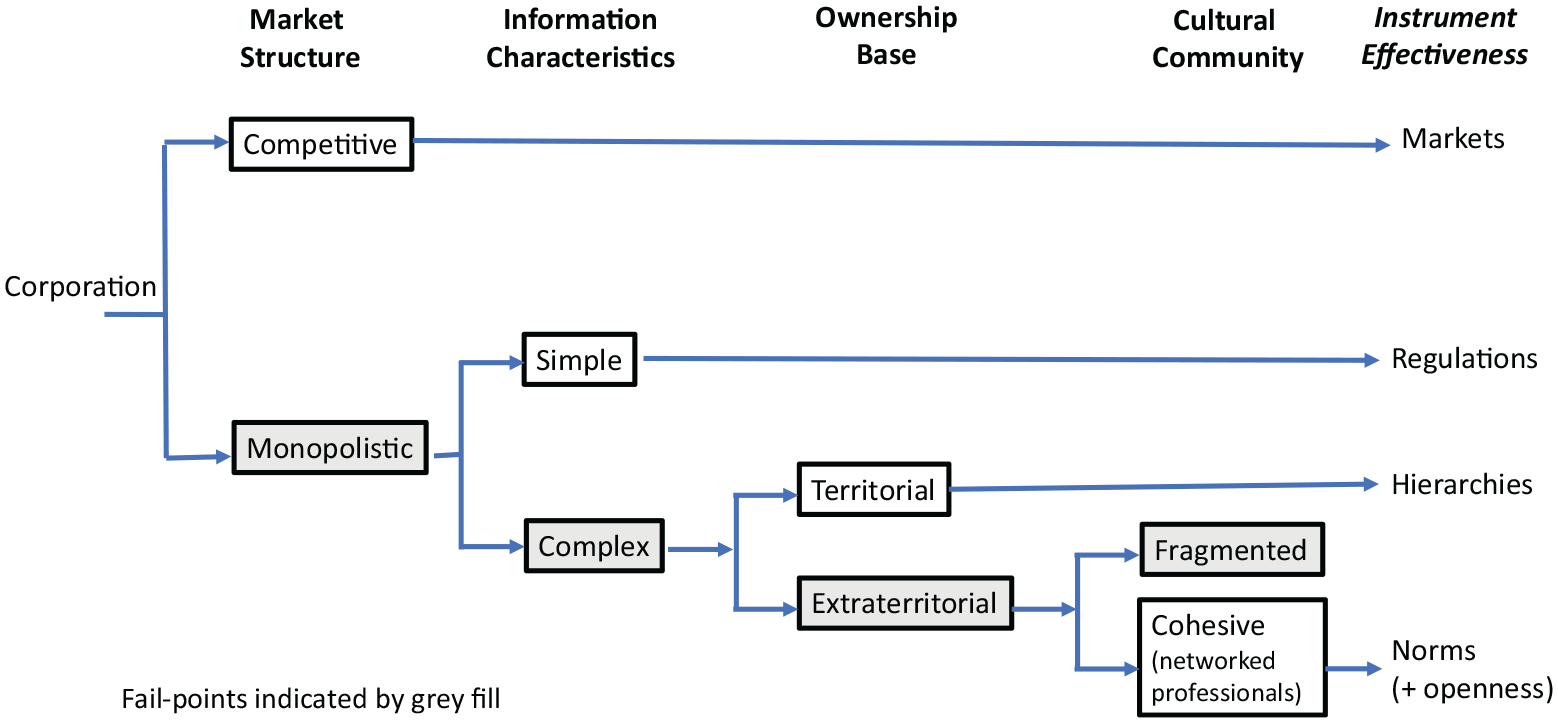
Fail-Points in the Societal Control of Contemporary Large Corporations.
In assessing alternative control instruments, Williamson (1975, p. 20) provides an analytical starting place: ‘In the beginning there were markets.’ Markets control business through competitive disciplines (Adler, 2001; du Gay, 2000; Ouchi, 1980; Williamson, 1975). Where competition is present, therefore, markets are effective control instruments, at least in protecting consumers from such abuses as price gouging and deceptive promises. But for contemporary big business, Figure 1 identifies monopolistic market structure as the first fail-point for corporate control (indicated by the grey fill). Williamson (1975) warns that markets fail when dominated by small numbers of participants. Unfortunately, it is precisely the most impactful corporations whose markets are least competitive: Airbus and Boeing together control 91 per cent of the global airliner market; Intel has over 60 per cent of the global microprocessor market; Google has 86 per cent of the world search market. Moreover, these businesses are hard to break up into smaller, competing units: Google’s usefulness derives precisely from harnessing the whole world’s information; the practical value of Facebook relies on its ability to integrate its original social media platform with complementary platforms such as Instagram and WhatsApp. Markets fail because monopoly removes competitive disciplines from the corporations that most need controlling (McNamee, 2019).
When markets fall short in terms of corporate control, Figure 1’s sequence suggests the resort of regulation (Scott, 2013). Pro-social regulators set the rules; corporations follow them. But here we run into the asymmetries brought about by informational complexity (Breyer, 1979). Regulation is potentially an effective control instrument in simple industries such as water or gas, involving undifferentiated products and slow-moving technologies. But today’s big corporations are typically technologically dynamic and organizationally complex, operating in many products, services and geographies. There are whole new technologies for regulators to deal with, such as platforms, artificial intelligence and blockchain (Müllner & Filatotchev, 2018). But even old industries possess complexities that give them information advantages over regulators: car-makers such as BMW, Mercedes and Volkswagen evaded detection of their excessive diesel emissions for half a decade (Clemente & Gabbioneta, 2017). Faced by technological or organizational complexities, regulators often find themselves at an ‘epistemic disadvantage’ and therefore dependent on the corporations themselves for the information required to design and enforce the rules (Rahman, 2018). Regulators risk either constant catch-up or corporate capture. The US Federal Aircraft Authority is alleged to have been captured by Boeing in the approval process for the fatal 737 Max (Economist, 2019). As Figure 1 suggests, informational complexity is a critical fail-point for the regulatory control of many contemporary corporations.
Figure 1 takes us next to the option of hierarchical control based on the legal rights of ownership (Williamson, 1975). State ownership by partial or complete nationalization was long a favoured means of controlling natural monopolies in the twentieth century and remains an important factor in many large economies, including China and Russia (Megginson, 2017). The hierarchical privileges of ownership overcome many of the challenges of information asymmetry (Williamson, 1975). Owners have access to information by right and they can demand representation at the highest level of internal decision-making. They are not like regulators, external actors to be captured or bamboozled. In theory at least, some form of nationalization (e.g. ownership stake or representation rights) is therefore particularly apt for complex monopolies. But of course the hierarchical control of today’s global corporations immediately faces the problem of extraterritorial ownership bases, the third fail-point in Figure 1. For the most powerful corporations, key activities are often located outside the territorial jurisdictions that seek to control them. Europe depends for information on Google and for social life on Facebook, but these companies originate far away in California. Their extraterritoriality renders them unamenable to state control from overseas: nationalization of the whole is no more feasible than nationalizing just a local subsidiary would be useful. Ownership base is therefore a crucial fail-point for hierarchy as an instrument for control.
Figure 1’s succession of fail-points directs attention to the potential for normative controls (Adler, 2001; Ouchi, 1980; Scott, 2013). With these, corporate conduct is governed by collective norms of appropriateness and steered by fear of shame or desire for approbation (Scott, 2013). It is these kinds of normative sanctions and incentives that may motivate the enlightened strategies of Unilever and similar (Ferraro et al., 2015). However, the potential fail-point for norms is the contemporary fragmentation of the cultural communities on which they rely. Scherer and Palazzo (2011) warn that even at the level of nation states cultural homogeneity is under challenge from new kinds of cultural pluralism and flux. Norms lose their force as they become incoherent. At first glance, the prospect of consistent normative controls commensurate with the global scale of big business today might therefore seem remote. Figure 1 allows for the control void of fragmentation, therefore.
However, pessimism about contemporary cultural fragmentation may underestimate the growing cohesion brought about by the globally networked professionals of reflexive modernity (Beck et al., 1994). Reflexive modernity refers to a post-industrial world in which established categories and boundaries are dissolved through constant change and confrontation. Thus contemporary politics spills out of the formal political system into all kinds of other subsystems within society, including those of science, religion and business. Society is continuously agitated by what Beck (1997b) calls the ‘subpolitics’ of all its various subsystems. This looks like the kind of flux warned about by Scherer and Palazzo (2011).
Yet reflexive modernity allows for a paradoxical cohesion. The ‘subpolitics’ of society’s various subsystems is energized by new groups of professionals, experts, scientists, journalists and social activists. On the one hand, these professional groups are reflexively modern in refusing to confine themselves to politics with a capital P, taking their battles into many subsystems, including business. On the other hand, these professionals are also no longer fragmented by national borders. They possess a characteristic ‘supranationality’ that makes them natural ‘agents of global solutions’ (Beck, 1997b, p. 157). Computer scientists, engineers, health workers, academics, lawyers and similar professionals are highly mobile within international labour markets (Harrington & Seabrooke, 2020). They organize loosely in informal networks that stretch around the world, using the information technologies created by the same tech giants that they are often seeking to influence (Almeida & Chase-Dunn, 2018; Barnett et al., 2020). They appeal not to the self-interest of traditional trade unionism, but rather to universalistic values such as environmentalism, feminism and third world rights (Antonini, Beck, & Larrinaga, 2020; Knight & Greenberg, 2002). These professionals – especially the most dedicated ‘issue professionals’ (Henriksen and Seabrooke, 2016) – look, think and feel more or less the same wherever they are. They are good with information and they know how to communicate. They perform a spontaneous ‘globalism from below’ (Beck, 2006). In short, informal networks of professionals have the potential to overcome cultural fragmentation and build in its place cohesive communities capable of exerting effective normative sanctions on corporate power around the world.
Returning to Figure 1 therefore, where corporations face cohesive cultural communities, then norms become a plausible instrument of control. Particularly promising as a source of this cohesion are networked professionals. Both their values and their organizing capabilities transcend the territorial boundaries that limit the hierarchical controls of ownership. Indeed, by mobilizing counter-movements across the world, they can even enlist the market, substituting consumer boycotts for traditional competitive disciplines (de Bakker, den Hond, King, & Weber, 2013; Hadler & Haller, 2011). Moreover, with access to both internal and external expertise, professional networks also overcome many of the informational disadvantages suffered by outside regulators. In short, the normative power of globally networked professionals is not a matter of empty idealism. In principle at least, networked professionals can fill in for the weaknesses of markets by mobilizing consumer buying power; they can compensate for the ignorance of regulators by aggregating knowledge; and they can match the hierarchies of global business through supranational values and organization.
Although still in formation, global networks have already shown themselves capable of exerting normative influence on big business, both supportive and critical. On the one hand, there is the supportive power of crowd wisdom: for example, engineers in the blogosphere frequently use Internet rumours and gossip to assess corporations’ technology strategies, nudging them along approved lines or warning them off implausible ones (Hannigan, Seidel, & Yakis-Douglas, 2018). On the other hand, there is the critical power of shame, with some scattered successes in recent years. For example, NGOs and campaigners have successfully mobilized internationally to oblige large corporations to adopt anti-corruption measures in the extractive industries (David-Barrett & Okamura, 2016). The digital giants have proven sensitive to the collective outrage of their users and employees, even outside their home territories. As the case of Meredith Whittaker indicates at the start, it is possible to engage employees around the world to influence Google’s strategy on issues such as sexual misconduct and artificial intelligence: the 2018 walkouts mobilized 20,000 employees stretching from Singapore through London to New York, and brought responses on at least some issues direct from the chief executive (Washington Post, 18/11/2018). Protests and communications from Amazon employees across North American and Europe have prompted the delivery company to commit to tougher carbon emission targets (Wired, 2019). The global storm after the Cambridge Analytica scandal shamed Mark Zuckerberg into revising Facebook’s privacy strategy (Politico, 2018).
Not sufficiently for sure, but none the less sometimes, big business does therefore show itself to be responsive to normative pressures, often resonating around the world. If markets, regulations and hierarchies do not match the case, then this sensitivity to normative influences, especially those exercised by networked and idealistic professionals, is likely to become increasingly important. However, as indicated in the final line of Figure 1, the cohesion of professional networks may not be enough on its own: we propose openness as the extra ingredient for effective normative control. The more open powerful corporations are, the more far-reaching normative scrutiny and pressure can be. We shall explore first the different types of openness available and then the research implications that follow.
Managed and Unmanaged Practices for Corporate Openness
We have argued that normative coherence among networked professionals offers one potential means of corporate control, filling in where competitive markets are absent, regulators face complexity and ownership lies beyond sovereign borders. In the case of today’s big business, these limits apply very widely: they hold for Boeing as well as for Alphabet. However, normative controls depend upon capacities to scrutinize and pressure corporations on a global scale. Although we have sketched some promising examples of global normative interventions, they remain patchy and weak. Scrutiny and pressure gain by more open access to information and more effective means to distribute it. As it happens, there are a variety of both managed and unmanaged forms of openness that offer accessible and practical means of exposing corporate strategies to greater normative control.
Various forms of openness have been explored by both theorists of deliberative governance (Scherer & Voegtlin, 2020; Voegtlin & Scherer, 2017) and open strategy (Seidl et al., 2019). The systems of deliberative governance foster openness by encouraging reflexive and participative debate within and outside corporations, with the aim of arriving at well-informed consensus. Distinct perspectives are brought into alignment as the deliberation process leads to the revision of initial positions and the recognition of previously unsuspected mutuality. Scherer and Voegtlin (2020) suggest that such systems of deliberative governance can be advanced by formal regulative or hierarchical measures, for example mandatory public reporting, changes in ownership and the introduction of new legal forms such as the American ‘benefit corporation’. Rather similarly, open strategy refers to a range of practices that promote wider inclusion in strategy processes and greater transparency with regard to strategic decisions, in each case either within or outside formal organizational boundaries (Hautz et al., 2017). Openness can increase scrutiny on all kinds of issues, but open strategy concerns those whose strategic nature implies radical change for the individual corporation or repercussions that stretch beyond it. Compared to the deliberative governance literature, open strategy puts little weight on formal regulative or hierarchical measures, tending instead to emphasize managerially driven initiatives and designs. Thus open strategy practices encompass both the staged inclusion of internal strategy jams and the calibrated transparency of chief executive strategy presentations (Seidl et al., 2019; Whittington, Yakis-Douglas, & Ahn, 2016). Such open strategy practices are very much managed.
Both deliberative governance and managed openness provide means for introducing normative controls into the strategic decisions of powerful corporations. Internal debate introduces normative critique into the very process of decision-making. External transparency allows judgement upon final decisions. However, deliberative governance and managed forms of open strategy do face substantial practical limitations, particularly in terms of international jurisdictions and managerial conditionality. For most of the world, the powerful corporations of China and the United States lie well beyond the reach of the formal regulative or hierarchical mechanisms emphasized in the deliberative governance literature. Similarly, the managerially driven practices of open strategy are conditional on support from the top, and subject to revision or withdrawal. For instance, after a series of leaks and confrontations, in 2019 Google’s CEO Sundar Pichai cut back the company’s traditional weekly all-employee ‘TGIF’ town-hall fora to just once a month, at the same time as introducing tight restrictions on agendas (The Verge, 2019a). Thus neither the formal measures of deliberative governance nor the managed initiatives of open strategy is likely soon to bring powerful corporations under consistent and effective normative control.
This is where unmanaged openness can kick in. Here we develop the notion of inadvertent open strategy: for corporations, sometimes ‘greater openness comes willy-nilly and unwelcome’ (Whittington et al., 2011, p. 531). Unmanaged open practices are spontaneous and independent, beyond the authority of managerial elites. These unmanaged practices capture a wide range of phenomena, many long established but all apparently growing. In some instances, unmanaged practices can be positive for corporate interests. The Internet rumour-mill is a form of inadvertent transparency that often helps companies in their product development strategies (Hannigan et al., 2018). Intel’s middle managers spontaneously created informal strategy networks to share strategic information and develop understanding (Whittington, 2019). While such instances can finally be helpful for management, we shall emphasize two unmanaged practices that are more awkward: first, inclusion through collective subpolitics; second, transparency through whistleblower exposure, typically individualistic. Both have the capacity to open up the strategic issues of greatest import to society. Both also draw often on the supranational ideals of reflexive modernity (Beck et al., 1994). Consequently, they are each capable of reinforcing normative controls on global big business, either by enhancing normative pressure during the strategy process or by increasing sanctions on unpalatable strategy outcomes.
In the first place, normative pressures can be exerted collectively through the kind of subpolitical activity that increasingly spills over from the system of formal politics into the subsystem of the corporation (Beck, 1997a). As demonstrated by the Google walkouts, contemporary professionals are capable of mobilizing around such universalistic norms as feminism or privacy across the world. To this extent, subpolitical activists share the idealism of the organizationally loyal ‘tempered radicals’ described by Meyerson and Scully (1995). However, subpolitical activists are typically less patient and more public, with some prepared to sacrifice organizational careers for their cause. As a result, their mobilizations can be decidedly bad-tempered.
Although corporate subpolitics is typically inspired by universalistic concerns, it can have strategic implications for particular organizations. Subpolitics becomes an open strategy practice when it influences fundamental corporate interests. For example, in 2020, following President Trump’s controversial Facebook posts about Black Lives Matter, outraged employees – including managers at fairly senior levels – staged collective walkouts, circulated internal petitions, bombarded internal message boards, protested on internal polls, posted on Twitter, commented on public blogs and engaged in fierce questioning at an emergency all-hands meeting (New York Times, 2020). A few even resigned their jobs or turned down offers. In the face of employee discontent and public embarrassment, Mark Zuckerberg finally promised to flag problematic content wherever it came from. Although Black Lives Matter involves the kind of universal principles typical of contemporary subpolitics, for Facebook this was also a strategically significant admission of publishing responsibility, something that Zuckerberg had previously resisted. As the internal activists knew, accepting the role of publisher rather than mere platform potentially poses a fundamental challenge to the company’s basic business model. It also forced the company into alignment with the strategy of an important competitor, Twitter, which has been quicker to take responsibility. Here, strategy inclusion was insurgent, not managed.
The second unmanaged open practice we emphasize aims more at transparency: corporate whistleblowing. Whistleblowers are defined in the broadest sense as organizational insiders who inform the public sphere about the illegitimate as well as the illegal (Porter & Ronit, 2018). These whistleblowers differ from subpolitical activists in typically being isolated individuals, though they may also be motivated by similar forms of supranational idealism. They contrast with privately motivated leakers in being pro-social truth-tellers. Their ideals are offended by some corporate action and they respond by exposing it to normative (or regulative) sanction. Whistleblowers become conduits of internal information to external communities, with expert knowledge important to the outside world. Indeed, the European Parliament (2019) has already identified corporate whistleblowers as crucial sources of intelligence on opaque technologies such as algorithmic systems. While not a new phenomenon, whistleblowing is on the increase (Expolink, 2019): for example, tipoffs to the US Securities and Exchange Commission (SEC) rose by 76 percent in the period 2012–18 (Olesen, 2019).
Cambridge Analytica’s whistleblower, Brittany Kaiser, personifies the contemporary supranational professional. Educated in the United States, Hong Kong and the United Kingdom, and with a PhD in international law and diplomacy, Kaiser had worked on both sides of the Atlantic. As such, she exposed the compromising emails between Cambridge Analytica and Facebook about data used in the American presidential election of 2016, testifying both to the British House of Commons and the American Robert Mueller investigation (Kaiser, 2019). However, whistleblowing escalates into a form of strategic openness when it extends beyond specific breaches of legal or moral practice to raise more general strategic issues. Kaiser’s whistleblowing challenged Facebook fundamentally with regard to its control and use of private information. In this sense, whistleblowing contributes to an informed public discourse on corporate strategy. Drawing on their insider information, whistleblowers are well-placed to expose deviations from corporations’ own claims about strategy: illegitimacy lies in the gap between strategic talk and strategic walk. The risk of shame as a minimum, or legal sanction at worst, provides incentives for corporations to cleave to normative conformity.
While the formal mechanisms of deliberative governance are difficult to enforce internationally (Scherer & Voegtlin, 2020), subpolitical activists and whistleblowing individuals can be supported effectively by local states. Too often, internal activists and whistleblowers have suffered harsh personal consequences: Meredith Whittaker was manoeuvred into resignation by Google (Venturebeat, 2019). Such consequences are important inhibitors to the open measurement of corporate conduct against societal norms. Yet, as Whittaker herself has asserted, individual territories do have the power within their own jurisdictions to provide legal protections, trade union rights and compensation and incentives (Whittaker, 2019). Countries can offer themselves as safe havens: controversial examples of such are the Venezuelan embassy for Julian Assange and Russia for Edward Snowden. One supportive country can provide a base from which corporate activism or whistleblowing can resonate around the world. The larger the national economy, the more likely corporations will be obliged to employ locally the kinds of professional staffs most capable of dissent. In other words, support for activists and whistleblowers need not wait on comprehensive international regulation. It can be promoted by lead territories on their own.
The intimate knowledge of internal activists and whistleblowers is a significant safeguard against mere symbolic conformity to normative controls (Waldron, Navis, & Fisher, 2013), the bending of information (Heimstädt, 2017), or manipulative forms of inclusion (Lee & Romano, 2013). Insiders are harder to fool. The next section will consider how research can help their engagement with strategy further. However, normative controls cannot do everything and research is required to test their limits. After all, the risk of normative shame is not equally felt. Corporations vary in their sensitivity according to their resource endowments and their exposure to outraged consumers (Barnett et al., 2020; Durand, Hawn, & Ioannou, 2019). Moreover, shame may leave a stigma, but it need not delegitimate a corporation altogether (Helms, Patterson, & Hudson, 2019): despite episodes of popular disgrace, Boeing, Google and Facebook have retained their moral licence to operate. Norms can be defied. Moreover, some forms of openness may fail to prioritize societal interests and be captured instead by the sectional interests of participants: including worker representatives on Volkswagen’s supervisory board did not save the world from the emissions scandal (Ohlson & Yakis-Douglas, 2019). Corporate control is likely to require a mix of instruments – markets, hierarchies, regulations and norms (Adler, 2001). Our argument here is that, with the emergence of global professional networks and the growth of both managed and unmanaged openness, norms are likely to play a larger role in corporate control and that research is needed to underpin this.
Researching Control Through Openness
We have argued so far that norms, as reinforced by openness, are increasingly relevant to the grand challenge of corporate control. Researchers in organization theory have a special responsibility to understand how these norms work and how to make them more effective. Particularly important will be the roles of today’s reflexive professionals, whose expertise, idealism and global networks are central to both managed and unmanaged forms of openness. However, their influence cannot be taken for granted and the conditions for their effectiveness need investigation. Open strategy researchers have already provided insights, many relevant across both managed and unmanaged forms of openness (Seidl et al., 2019). However, significant research opportunities remain, falling for analytical purposes under two broad categories (Putnam, 2015): the material and the discursive. With regard to the first, we shall consider particularly labour market conditions, organizational arrangements and technologies. With regard to the second, we shall consider discursive authenticity, capability and identity.
To start with the material labour market conditions, it is clear that some professionals are more equal than others when it comes to unmanaged practices of openness. Google’s engineers protested openly about artificial intelligence, but Boeing’s kept their doubts about the 737 Max in-house. The Congressional inquiry into the 737 crashes revealed over 100 pages of anxious internal messages about the aircraft’s safety, but nobody had gone public (Financial Times, 2020). Research on whistleblowing more generally has established that whistleblowers tend to come from the highly educated strata of contemporary professionals (Mesmer-Magnus & Viswesvaran, 2005). However, the likelihood that they will actually blow the whistle is also connected to their material position, particularly their power and leverage (Miceli, Near, Rehg, & van Scotter, 2012). Boeing’s aeronautical engineers, many located in Seattle and with few local alternative employers, may have perceived their employment situation as very different to that of Google software engineers working in the heart of the Californian tech industry. In other words, the propensity to engage in whistleblowing may rely not only on cultural participation in reflexive modernity, but on material standing in the labour market. The same is plausible for corporate subpolitics too. Research here should explore the material conditions that empower employees to engage in subpolitical activism and external whistleblowing. Both employee protections and labour market power are likely to feature significantly.
The second material condition is organizational. Whistleblowing is typically individual, but subpolitics involves a degree of collective action that needs at least some organization. This collective action typically differs from trade union organization, not only in expressing its objectives in more universal terms (e.g. environmentalism) but also in organizing more loosely. Facebook employees’ rapid mobilization around Black Lives Matter involved only pockets of organization: while they coordinated petitions and circulated emails among internal contacts, the activists appear not to have made the kinds of decisions about membership or leadership that might have given them a more sustained organizational presence (Ahrne, Brunsson, & Seidl, 2015). Other kinds of internal activism are less fleeting, as for example Meredith Whittaker’s longstanding campaign over artificial intelligence within Google. Like social movements more generally, sustained subpolitical action might involve ‘partial organizing’ along at least some of the dimensions of formal membership, rules, monitoring, sanctions and hierarchy associated with formal organizations (Ahrne et al., 2015; de Bakker et al., 2013). The research question becomes the degree and dimensions of ‘organizationality’ (Dobusch & Schoeneborn, 2015) required for effective subpolitical action.
Finally, there is the materiality of technology. The campaigns within Google and Facebook involved many digital technologies – email, blogging, Twitter and the like. The new digital information and communication technologies help make possible exactly the fluid, transnational organizing characteristic of these kinds of social movements (Barnett et al., 2020; Dobusch & Schoeneborn, 2015). On the other hand, and as earlier, the new digital technologies also increase corporate powers of surveillance (Zuboff, 2019); they can be used to inhibit subpolitical organizing and trace individual whistleblowers. In 2019, three Google activists were sanctioned after the installation by the company of a new Chrome browser extension that automatically reported the creation of internal calendar events with more than 10 rooms or 100 participants, suspiciously large numbers (The Verge, 2019b). Even permissive forms of digital technology can be laden with unintended and unfortunate consequences, as discovered in Neeley and Leonardi’s (2018) study of social media within corporations. Research on this third dimension of materiality should therefore explore the ways in which technologies can both assist and inhibit unmanaged forms of openness, and be alert to unexpected or ambivalent effects.
The second set of research opportunities involves discourse. Here an initial challenge is that of discursive authenticity. Corporations are prolific publishers of information about their strategies, through strategic reporting or chief executive strategy presentations for example (Integrated Reporting Council, 2020; Wenzel & Koch, 2018). However, information never speaks simply for itself (Christensen & Cornelissen, 2015) and the discourse of strategy is particularly exclusive and obscure (Balogun, Jacobs, Jarzabkowski, Mantere, & Vaara, 2014). Critical scrutiny of corporate strategy pronouncements is important to allow the normative control of discrepancies between what is said and what is done. A first direction for research therefore is developing tests of discursive authenticity. We have long known of the potential disparity between designed strategy and actual emergent strategy (Mintzberg & Walters, 1985). There is too the temptation towards ‘cheap talk’ in official strategy statements, empty or misleading prognoses of the future (Whittington et al., 2016). Here researchers might draw upon findings from the literature on ‘plausibility’ in the parallel phenomenon of entrepreneurial pitches, which make similar claims about future action as strategy (Garud, Schildt, & Lant, 2014; Navis & Glynn, 2011). Researchers should identify the narratives and tropes that may be regularly associated with weak or non-existent followthrough. All consumers of strategy communications, including activists and whistleblowers, need help in spotting cheap talk’s tell-tale signs. If powerful corporations are to be held to account, then it is crucial to understand better how to judge strategic discourse as authentic.
This question of judgement takes us to discursive capabilities with regard to strategy. Both internal and external scrutiny rely on participants having the discursive skills to engage. However, Mantere (2005) warns that many discursive practices subtly disable would-be participants in strategy. For example, excessively technical or mystificatory forms of discourse can work to exclude the uninitiated from open strategy processes (Mantere & Vaara, 2008). The efforts around the Sustainable Sydney initiative to create public dialogue throughout the city were undermined, or perhaps manipulated, by the expert discourse of economics and urban planning (Kornberger & Clegg, 2011). Even the professionals of reflexive modernity may be subtly disabled by their very professionalism: allegiance to the technical discourses of a profession can lead to marginalization in more general strategic interactions, as Oakes, Townley and Cooper (1998) found in museum organizations. A key task for research therefore is to develop understanding of the discursive capabilities required of openness, ensuring the widest possible inclusion and transparency.
The third discursive theme is that of identity. Regardless of capability, strategic openness should not simply assume the psychological readiness of all stakeholders to scrutinize and participate: many potential participants in open strategy initiatives simply ignore invitations to join (Dobusch, Dobusch, & Müller-Seitz, 2019; Luedicke, Husemann, Furnari, & Ladstaetter, 2017). People need to be willing as well as able. This is partly a question of identity – whether employees see concerns for strategy and its societal effects as part of who they are. Again, discourse plays a role, influencing the confidence and responsibility to get involved. Strategy discourse defines who can be a strategist and what it takes to be one (Dameron & Torset, 2014). The strategist identity is not an easy one, however. While senior managers can draw on established forms of strategy discourse to construct themselves as legitimate strategists, even they confront discursive ambiguity about how to engage effectively (Dameron & Torset, 2014). The elevated discourse of strategy leaves many managers ontologically insecure as they move into strategy roles beyond their functional or professional comfort zones (Mantere & Whittington, 2020). If strategy discourse challenges managerial self-confidence, it is likely to do so even more for the non-managerial employees upon whom unmanaged openness often relies. The research agenda here concerns how employees can construct from what is typically an elitist discourse the identifications that allow them to participate confidently in strategic issues. For the unmanaged practices that constitute the final backstop of openness, particularly important is understanding the kinds of identities associated with those who are prepared to call out management on strategy, even to the extent of engaging in conflict-ridden subpolitics or whistleblowing.
Conclusions
We live in a time of giant business. With market powers not seen for a century at least and with new capacities for intimate surveillance, these large corporations have immense impact upon the world. We argue that the societal control of these organizations is the pre-eminent grand challenge for organization theory. It is the one for which we have the most direct responsibility. It is one for which we have apt intellectual resources.
In identifying corporations themselves as a grand challenge for organization theory, we add to recent conversations about the potential role of business in society’s problems. Solutions to these problems are often seen as coming from collaboration between business and partners in government and civil society (Ferraro et al., 2015; George et al., 2016). Given their resources and skills, big business engagement is indeed a critical element in the response to societal grand challenges more generally. The grand challenge of corporate control is therefore in good part about how to guide corporations still more effectively towards the wider societal grand challenges that George and colleagues (2016) highlight. However, this should not obviate the fact that big business is often not only part of the solution: sometimes it is part of the problem as well (Wright & Nyberg, 2017). Business needs constraining as well as channelling.
In contemporary conditions, responding to the challenge of corporate control is liable to overwhelm the traditional instruments of markets, hierarchies and regulations. We identify several key fail-points with regard to large corporations today, namely monopolistic power, extraterritorial bases and informational complexity. Together these fail-points set a large research agenda for organization theorists working from a variety of perspectives. Experts on markets will need to find means of sharpening competitive pressures on dominant players; those concerned principally with hierarchies should explore innovative forms of ownership control for geographically remote businesses; regulatory specialists need to address the information asymmetries posed by today’s complex, hi-tech, diversified conglomerates.
However, the insufficiencies of traditional control instruments have pointed us particularly towards a greater appreciation of normative controls. These have their own potential fail-point in the fragmentation of contemporary cultures, but we have emphasized the growing cohesion of professional networks as a platform for normative pressure. We propose also that the normative pressures of professional networks can be enhanced by greater openness. Addressing the most consequential corporate decisions, the practices of open strategy can be particularly helpful here. We have distinguished between managed open strategy practices, such as strategic reporting and internal fora, and unmanaged practices, such as corporate subpolitics and whistleblowing. In principle, these kinds of practices are capable of mobilizing social norms on behalf of society. As they become more inclusive and transparent, the search for approval and the avoidance of shame prompts large corporations to make socially desirable strategic adjustments.
Both managed and unmanaged practices have parts to play. Managed forms of openness do have the capacity to introduce pro-social norms into strategic decisions and evaluation, and their reach can be extended by the kinds of formal measures proposed by Scherer and Voegtlin (2020) as well as voluntarily by enlightened management teams (Whittington, 2019). However, we have emphasized the unmanaged practices of corporate subpolitics and whistleblowing, especially as exercised by the supranational networks of idealistic professionals. These professionals have the inside knowledge to inform and connect on complex issues. They increasingly coordinate through professional communities that stretch around the world. Already they have mobilized market boycotts where competitive pressures are absent. In these various ways, they do begin to address the particular challenges posed by contemporary big business. Moreover, unlike deliberative governance (Scherer & Palazzo, 2011), these unmanaged practices do not rely upon consensus, but allow for outright opposition. Nor do they require international regulation or ownership change; they can be promoted by nations individually through local protections and incentives.
Including these unmanaged practices under the rubric of open strategy is useful both because it draws attention to normative mechanisms that are shared with managed practices and because it allows researchers to build upon relevant research within or close to that tradition. For open strategy researchers, the task is to understand better how actors can participate more effectively in open practices, both managed and unmanaged. Significant material and discursive barriers stand in the way of strategic engagement. On the material side, the full range of open practices is likely to require labour market security, sustained collective organization and supportive information and communications technologies. On the discursive side, effective engagement makes non-trivial demands in terms of authenticity, capability and identity. Overcoming these material and discursive barriers is important if actors are to move from specific and local engagements to more comprehensive practices of strategic openness. It is a large step from exposing specific issues to tackling the overall strategies of which they are often just a part. Open strategy research already has relevant things to say on making this step, especially in relation to information and communications technologies and discursive capability and identity. The research agenda now is to understand what it takes to raise these material and discursive conditions to the supranational level required for the control of contemporary big business. In particular, the kinds of unmanaged practices of corporate subpolitics and whistleblowing described here require a larger vision, wider reach and greater courage than typical of the open strategy initiatives usually considered.
In expanding the scope of open strategy research to include the societal grand challenge of corporate control, we also contribute to enlarging the responsibilities of strategy researchers more widely. Within organization theory as a whole, the strategy discipline has been particularly preoccupied with questions of organizational performance, while keeping noticeably silent on issues of public moment (Agarwal, Barney, Foss & Klein, 2009; Gartenberg & Pierce, 2017; Starkey, 2015). Conceptualizing corporate control as organization theory’s most immediate societal grand challenge can help redirect research attention to a problem with which strategy scholars are especially closely bound. Beyond open strategy, the strategy discipline has insights into strategic issue management, decision-making and resource allocation that are highly relevant to the challenge of corporate control. The redirection we propose here can help develop the greater sensitivity to the kinds of ‘big issues’ (Vaara & Durand, 2012) and ‘big strategy’ effects (Whittington, 2012) that, despite the relevance of its intellectual resources, the strategy discipline has largely ignored.
To conclude, organization theory has unique expertise and direct responsibility with regard to powerful organizations. Organizations are what organization theorists do. We have valuable knowledge to offer the world. More effective organizing is of course important to all the United Nations’ development goals (George et al., 2016). However, as organization theorists, our special grand challenge is controlling the world’s most powerful organizations. While other forms of control have parts to play, normative controls have an under-exploited potential that is particularly apt for contemporary big business. The research agenda is to understand the conditions required for these controls to be applied more widely and more effectively than they currently are. Energized by the idealism of global professionals, we propose that strategic openness is an important facilitator of such normative controls – often to the advantage of corporations themselves, but especially to the benefit of the societies in which they occupy such dominant positions.
Footnotes
Acknowledgements
This paper has benefited greatly from the feedback of participants at seminars at the KPM Center, University of Bern, and the Business Research Hub, Saïd Business School, as well as from the detailed guidance of the editors.
Declaration of Conflicting Interests
The author(s) declared no potential conflicts of interest with respect to the research, authorship, and/or publication of this article.
Funding
The author(s) received no financial support for the research, authorship, and/or publication of this article.