




Abstract
The need for an alternative understanding of leadership that can address grand societal challenges, like the climate crisis, has inspired a rich research field under the umbrella of responsible leadership (RL). This paper explores how alternative meanings and understandings of RL emerge through the language leaders use. Using discourse analysis of speechmaking at COP26, we show how different leadership actors (politicians and climate activists) engage in sensemaking when constructing an RL discourse. We find that RL emerges in the ways in which leaders talk about separation versus unification of plan and action, chronological versus existential time, and individualistic-anthropocentric versus collective-ecocentric understanding of responsibility. We show that RL originates neither in the virtuous qualities of the leader nor in the social interactions and relations that the leader cultivates with stakeholders, but in the meaning-making practice worlds they inhabit. We discuss the theoretical relevance of these findings for developing an alternative sensemaking of responsible leadership outside the traditional business and corporate sphere.
Introduction
At the time of writing, catastrophic floods in Spain have resulted in over 200 fatalities and damage across communities. This event, like other grand societal challenges (GSCs), highlighted the growing social and political pressures on corporations, states and governments to be responsible (Schoeneborn et al., 2022; Voegtlin et al., 2022), in which leaders play a fundamental role (Grint, 2024; Tourish, 2020). In response to these pressures, the concept of responsible leadership (RL) has gained attention as a leadership approach that emphasises care and ethical commitment to societal and environmental wellbeing (Pless et al., 2012; Voegtlin et al., 2020; Waldman et al., 2020).
To date, RL has predominantly been discussed in the context of the tension between the corporate sphere and society (Winkler et al., 2020). Consequently, theorising has centred almost exclusively on business leadership (Johnson, 2018; Tirmizi, 2023). The literature is largely silent on the relevance of RL at national and global levels (Tirmizi, 2023). Since addressing GSCs pose entrenched issues that far exceed the corporate realm spanning natural, social and political environments (Roulet and Bothello, 2022), there is scope to expand RL theorising beyond organisational and business contexts (Tirmizi, 2023). Moreover, RL is often treated as a fixed set of virtuous qualities (Maak and Pless, 2009), behaviours (Maak and Pless, 2006), a belief system or a mindset (Waldman et al., 2020) rather than as a socially constructed and contested phenomenon that emerges through relations and interactions (Meliou et al., 2021). Expanding RL theorising thus requires attention to how a wide range of leadership actors 1 ‘inside and outside formal leadership roles’ (Fairhurst and Uhl-Bien, 2012: 1044), construct responsibility in ways that shape action at local, national, international, and multiple levels (Voegtlin et al., 2022), Such recognition has the potential to reveal multiple, often conflicting, meanings around RL that are significant to understanding interpretations around what is responsible and the consequences of these interpretations (Maitlis and Christianson, 2014).
In this paper, we examine how RL is made sense of by various leadership actors by analysing speechmaking at COP26 2 , a critical multilateral forum where leadership roles are more fluid and where competing understandings of responsibility are made visible. COP26, held in 2021 as the first major global event after the pandemic, provided a valuable context for exploring how leaders from corporations, states, governments, and communities articulate RL in response to GSCs. Additionally, COP26 was one of the bigger summits organised every 5 years for nations to update their national climate plans, making it the first of its kind since 2015. Its significance was evidenced by the profile and diversity of attendees. Unlike typical COPs, which feature state representatives like ministers or experts, COP26 attracted many heads of state. It also saw a notable increase in the presence of community leaders, activists, and representatives from civil society compared to many previous COPs, since there was a stronger emphasis on just transition and local-level solutions, alongside heightened public and media scrutiny that pushed for greater inclusivity. With these qualities, COP26 provided broader access to leadership discourses.
Our contribution is twofold. First, we extend RL research beyond the corporate domain by examining how multiple leadership actors construct responsibility in the context of GSCs. Second, using a discursive sensemaking approach, we show how RL emerges through competing linguistic repertoires that shape understandings of both leadership and responsibility. Specifically, we identify two distinctive discourses and three representations of RL, demonstrating how tensions between separation versus unification of plan and action, chronological versus existential time, and individualistic-anthropocentric versus collective-ecocentric responsibility shape RL constructions. Our findings reveal that RL is not a singular construct, but a contested process shaped by discourse.
To proceed, we first provide an overview of RL scholarship before presenting our sensemaking perspective to extend theorising. We then outline our methodological approach and analyse how RL is constructed through speechmaking at COP26. Finally, we discuss the theoretical significance of our findings and conclude with reflections on future research directions.
Theoretical background
Responsible leadership scholarship
Although states and communities in the Global South contribute the least to environmental degradation, they are disproportionately affected by the impact of the grand challenge of the climate crisis (Jimenez-Luque, 2024). This disparity has heightened expectations for corporations, states and governments, particularly their leaders, to be more cosmopolitan and contribute to a just and sustainable global society (Maak and Pless, 2009). Existing research broadly agrees that leadership studies need to recognise leaders’ responsibility and accountability toward others, whether that be individual people, animate beings (e.g., animals) or more inanimate objects or systems (e.g., an organisation or the environment), even though leaders may differ by degree in their perceptions of their responsibility towards these entities (Pless et al., 2012). Recognising leaders' responsibility towards broader stakeholder values, beyond their shareholders (Doh and Quigley, 2014; Tsui, 2021), has created a rich research field investigating RL to promote environmental stewardship (Miska and Mendenhall, 2018).
Building on this, Voegtlin (2016) argues that RL is not merely a distinct leadership style but a fundamental dimension of leadership itself. His conceptualisation highlights three key aspects that make RL particularly suited to addressing GSCs such as the climate crisis: (a) RL is inherently relational, emerging through interactions between leaders and diverse stakeholders; (b) it emphasises the long-term societal implications of actions; and (c) it promotes shared problem-solving and collective responsibility rather than remaining leader-centred.
With these characteristics, RL provides a useful framework for studying leadership in the climate crisis, which involves complex, interdependent risks across environmental, social, and political dimensions (Pless et al., 2022) and underscores stakeholder interconnectedness (Stahl and Sully De Luque, 2014), including with the natural environment (Driscoll and Starik, 2004). By embedding leaders’ ethical obligations to address GSCs, RL helps explain how leadership emerges in contexts demanding shared accountability. This applies both in contexts where leadership roles are formalised and accepted as part of a political or organisational system but also where alternative forms of leadership that are more informal, distributed and networked are enacted such as in ‘leaderless’ social movements (Western, 2014) which ultimately become ‘leader-full’ organisations, enhancing climate action (Fotaki and Foroughi, 2022). RL thus supports collective deliberation and meaning-making, recognising the agency of all leadership actors and fostering accountability (Sutherland et al., 2014).
A key perspective in RL scholarship, virtue ethics, focuses on leaders’ values, orientation, and mindset. Through this lens, scholars have identified qualities such as ethical intelligence (Maak and Pless, 2006), authenticity (Freeman and Auster, 2012), and a cosmopolitan ethos (Maak and Pless, 2009). These qualities are thought to shape leaders’ influence over followers (Han et al., 2019), ultimately determining an organisation’s responsible orientation and behaviour. However, this perspective conflates leaders, particularly senior leaderss, with their organisations, emphasising their role in ‘revitalizing humanism on a global scale’ (Maak and Pless, 2009: 543). Empirically, it also risks treating senior leaders as a homogeneous group, overlooking variability in responsible leadership practices across an organisation (Waldman et al., 2020).
A stakeholder perspective shifts RL away from leader-centric understandings, framing it as a relational and interactional process between leaders and stakeholders (Tirmizi, 2023). It extends beyond traditional leader-follower relationships (James and Priyadarshini, 2021), emphasising the quality of relationships within and outside the organisation (e.g., Maak and Pless, 2006; Pless and Maak, 2011). This perspective recognises that leaders are embedded in complex relations involving employees, shareholders, and customers (James and Priyadarshini, 2021) as well as broader communities and environments (Han et al., 2019). They use their relational intelligence (Maak and Pless, 2006), relational competence (Tirmizi, 2023) and relational transparency (Taştan and Davoudi, 2019) to enable positive stakeholder interactions (Nicholson and Kurucz, 2019). By building strong relationships with stakeholders, fostering collaboration, and engaging in shared problem-solving, responsible leaders develop the capability to navigate complexity and volatility inherent in GSCs (Tirmizi, 2023). However, this perspective continues to emphasise an individual leader’s relational behaviour – what they do for stakeholders, for example, through weaving, cultivating and facilitating relational processes (Maak and Pless, 2006) with a collaborative and consensus orientation (Tirmizi, 2023). In this sense, while the value of shared processes and stakeholder engagement are acknowledged (e.g., Tirmizi, 2023), the leader remains central (e.g., Waldman and Balven, 2014). This leader-centred framing is precisely what environmental social movements challenge, questioning the notion of leadership as tied to a single individual (Sutherland et al., 2014).
Both the virtue-ethics and stakeholder perspectives, whether explicitly or implicitly, assume that an understanding of responsibility pre-exists—either as an intrinsic quality of the leader (Maak and Pless, 2009) or as something revealed through dialogue with stakeholders (Nicholson and Kurucz, 2019). This assumption is problematic given the complexity, diversity, and evolving nature of GSCs. While Tirmizi (2023) acknowledges that leaders must adapt to new information and changing contexts, their study does not fully explore how responsibility itself is shaped through stakeholder interactions, where collective concerns and expectations influence what is perceived as RL.
An emergentist perspective (Meliou et al., 2021), addresses this gap, arguing that responsibility in RL emerges from shared and nested concerns shaped by the social, regulatory, and commercial contexts in which leaders operate. This approach, rooted in social constructionism, examines how relationships inform what is considered ‘responsible’ for the other/Other 3 (De Gama et al., 2012). It significantly broadens the concept of responsibility to include an ethic of care (Meliou et al., 2021; Mussel, 2016), when engaging in RL as a broader shared, collective and communicative endeavour (Voegtlin, 2016). Gram-Hanssen (2021) extends this idea by conceptualising RL as a process of ‘individual-collective simultaneity’, where leadership emerges relationally within the collective while still depending on individual contributions toward equitable and sustainable futures. These leadership practices are fluid, evolving with changing contexts, and may not always be recognised as leadership in conventional terms (Western, 2014). Yet, they reflect the need for individuals to engage in leadership roles while remaining accountable to the shared goals of the collective (Fotaki and Foroughi, 2022; Sutherland et al., 2014).
Insights from other leadership literature further help us understand how social influence processes (Uhl-Bien, 2006) contribute to RL’s emergence through discursive engagement (Raelin, 2016) and how knowledge development enables leaders to influence debates in more dynamic and reciprocal ways (Carberry et al., 2019). Building on this, our paper adopts an emergentist approach, exploring how language contributes to the emergence of the meaning of ‘responsible’ and ‘responsible leadership’. Two implications arise from this. First, this perspective views responsibility and RL as emerging from discursive accounts, which shape thought and action (Sandberg and Tsoukas, 2015). This is a dynamic process in which multiple actors co-create meaning through sensemaking and sensegiving. Recognising the plurality in RL’s discursive construction ontologically separates ‘leadership’ from ‘the leader.’ This distinction leads to our second implication; we conceptualise RL as communicatively constituted amongst multiple (leadership) actors, where responsibility is articulated through narratives that guide action (Sandberg and Tsoukas, 2015: S15). In the following section, we examine how these narratives emerge.
Leadership as management of meaning – sensemaking perspectives
Sutherland (2018) argues that leadership is constituted through meaning-making, both intersubjectively—via the language a speaker employs—and extrasubjectively, through broader discourses that shape social understandings of leadership. The concept of leadership as the management of meaning (Smircich and Morgan, 1982) highlights how, through sensemaking processes, individuals assign meaning to behaviours deemed necessary in specific circumstances (Bruner, 1990), providing cues for action (Weick, 1995) and fostering a shared understanding of those actions (Czarniawska, 1997). For example, analyses of tropes in political leaders’ speeches (Adebomi, 2023) illustrate how ‘presidential discourse’ is strategically crafted to shape others’ sensemaking (Gioia and Chittipedi, 1991) and to influence public debate to achieve political objectives (Calderwood, 2019). In this regard, framing, narrating, and communicating do not merely describe RL but actively constitute its meaning, providing the ‘ground’ for its performance (Sutherland, 2018).
Sandberg and Tsoukas (2020) offer a valuable typology that differentiates modes of sensemaking based on the extent to which actors are absorbed in the situations they seek to interpret. They distinguish four types—immanent, involved-deliberate, detached-deliberate, and representational—each varying in how sensemaking is distanced from action in practical/contextual, temporal, bodily, and discursive terms. Immanent sensemaking involves grasping an evolving situation through direct, practical, and immediate engagement, where sense and action are fused. At the other end of the spectrum, representational sensemaking is primarily intellectual and conceptual, detached from practice, with sense and action separated. (Sandberg and Tsoukas, 2020). The different types of sensemaking suggest that different actors are likely to interpret (and shape) the scope of RL in addressing the climate crisis in varied ways. Exploring how RL ‘emerges’ through the framing and communication of what is deemed responsible thus presents a valuable avenue for empirical research.
From this perspective, high-profile rhetorical events such as COP26 serve as arenas in which leaders deploy ‘CEO speak’ to influence stakeholders’ ethical or unethical behaviour (Armenic and Craig, 2022) through sensemaking and sensegiving processes. While a detailed analysis of individual speech is beyond our scope, previous research has shown how leaders strategically craft their rhetoric – for example, by evoking emotion (pathos), establishing credibility (ethos), and appealing to reason (logos) (Adebomi, 2023) – to persuade specific audiences. Such rhetorical strategies rely on the assumption that audiences will recognise the speaker’s intent and feel compelled to act; for instance, by aligning their beliefs with the speaker’s (Bach and Harnish, 1979, in Lazuka, 2006). Indeed, the aspiration to influence an audience is often cited as a primary motivation for engaging in discourse (Grosz and Sidner, 1986).
Yet, implied in their individual speech is an assumption of a degree of shared understanding between the speaker and the audience. At summits such as COP, this may be a reasonable expectation. However, as Isaacs (1999) observes, an expressed common purpose does not necessarily equate to a shared understanding of that purpose. For such understanding to emerge, participants must engage with what he terms the three transcendentals: the true (logos: the language of meaning), the good (ethos: the language of power and action), and the beautiful (pathos: the language of feeling and aesthetics). Looked at in this light, a sensemaking perspective can reveal the multiplicity of contested, conflicting, and evolving interpretations of what constitutes ‘responsible’ leadership. Rather than erasing these tensions, RL discourse must acknowledge and engage with them; constructing a collective sense that accommodates ongoing contestation while building alignment around shared issues and purposes that can guide emerging views and actions for RL (Hartley and Stansfield, 2021).
Research design
We adopted a ‘language in use’ approach through discourse analysis to examine ‘talk and texts as instances of social practice’ (Grant et al., 2004: 9) of RL. Discourses shape how people understand phenomena (Phillips and Hardy, 1997) by ‘ruling in’ certain acceptable ways of speaking or behaving while ‘ruling out’ other ways (Hall, 2001: 72). Unlike other text-based methods, discourse analysis reveals the contrasting elements within discursive accounts, focusing on how different actors construct versions of social reality through language. This makes it particularly relevant for studying responsible leadership (RL), as it often involves navigating contradictions (Fairhurst and Putnam, 2019) such as balancing ethical duties with financial goals or short-term needs with long-term sustainability. Moreover, different leadership actors – whether corporate, political, or climate leaders –, interpret responsibility and leadership differently due to their varying positions in social structures. By examining these varied interpretations through discourse analysis, we can study RL as a communicative, socially constructed process (Schnurr and Schroeder, 2019), shaped by the interaction of discourse, text, and action (Phillips et al., 2004).
Corpus building
One of the first steps in discourse analysis is creating a ‘corpus’ – a carefully selected body of texts that represents a specific language variety (Baker et al., 2006). Following Neumann (2008), who argues that the anchor points of discourse are contained in a relatively limited number of texts, we identified our corpus as the speeches in the COP26 and Fringe Conferences.
In total, 204 country leaders and representatives of supranational organisations spoke during COP26, and five activists were invited to speak at the opening ceremony. In addition, over 1500 fringe events were listed through the COP Fringe Portal (climatefringe.org). Given the vast size of this corpus, we used a stratified random sampling strategy (Sönning and Krug, 2022) to create a sub-sample amenable to detailed, qualitative analysis. In this strategy, the speeches are grouped at the speaker level (the language producers) to ensure enough speakers from different subgroups (i.e., climate leaders from diverse realms of political and community leadership across the world) are included for capturing all significant categories of experiences 4 .
The transcripts of speeches were retrieved from the web and categorised into three groups: (1) politicians from G20 countries and intergovernmental/supranational organisations; (2) politicians from affected nations and tiny islands; and (3) climate activists, citizen Others, who are not speaking on behalf of a government or an organisation. These three groups of speakers, owing to their different positions within established power structures, articulate distinct viewpoints on leadership responsibility. Their discursive positioning enables us to juxtapose dominant interpretations, such as those of G20 politicians, with more marginalised perspectives, such as those of climate activists, capturing the ways power shapes meaning (Fairhurst and Putnam, 2019), and thereby affecting the interpretations and narratives that emerge with respect to leadership responsibility (Schildt et al., 2020).
Corpus of speeches available for sampling.
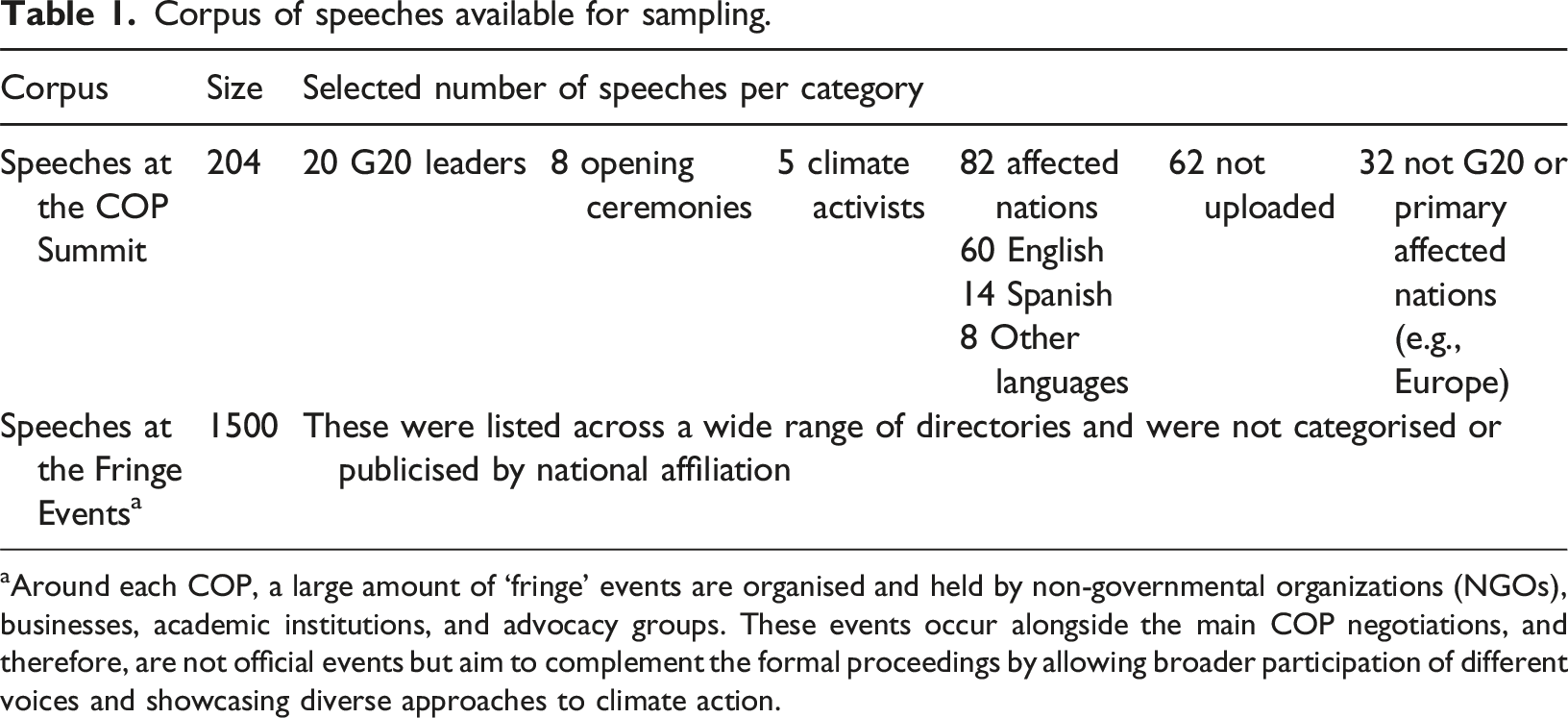
aAround each COP, a large amount of ‘fringe’ events are organised and held by non-governmental organizations (NGOs), businesses, academic institutions, and advocacy groups. These events occur alongside the main COP negotiations, and therefore, are not official events but aim to complement the formal proceedings by allowing broader participation of different voices and showcasing diverse approaches to climate action.
Sample selection.
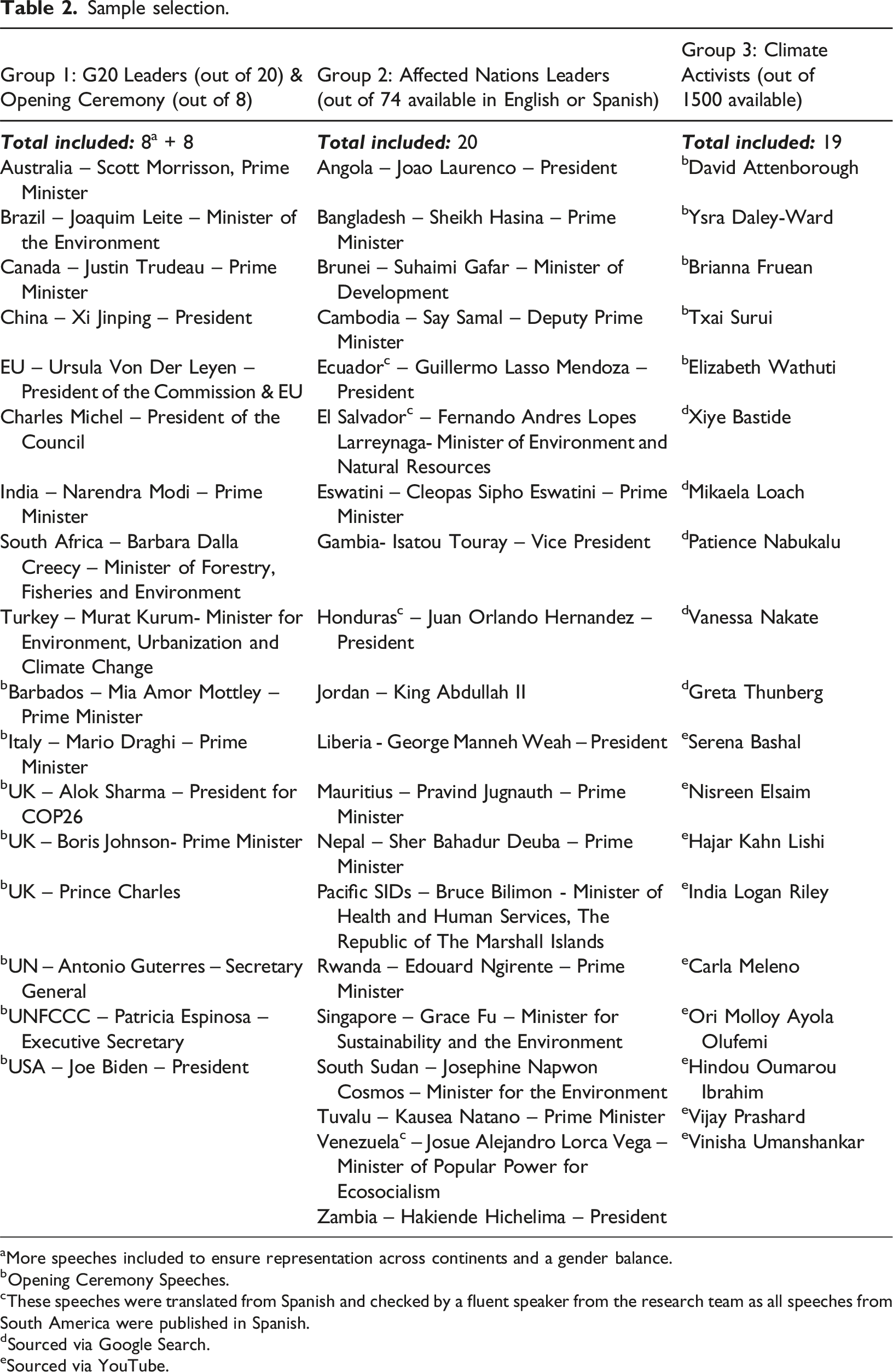
aMore speeches included to ensure representation across continents and a gender balance.
bOpening Ceremony Speeches.
cThese speeches were translated from Spanish and checked by a fluent speaker from the research team as all speeches from South America were published in Spanish.
dSourced via Google Search.
eSourced via YouTube.
Data analysis
We employed integrative discourse analysis methodology, which combines grounded theory with discourse analysis (Fairhurst and Putnam, 2019) to move from textual manifestations of the studied phenomenon to higher levels of abstraction. Fairhurst and Putnam’s (2019) integrative methodology is intended to help researchers identify oppositions and tensions in discursive constructions, going beyond what a traditional discourse analysis would reveal, making this methodology suitable to capture different meanings of RL. The analysis unfolded in three stages:
Step 1: Spotting repertoires
The first and second authors coded the speeches line-by-line to examine the language-in-use, ‘little “d” discourse’ (Fairhurst and Putnam, 2019: 921) by focusing on the choices of words and tropes (Adebomi, 2023). This revealed codes such as ‘goal, plan, strategy, framework, control’ for G20 and other state and international leaders. For the activists, the codes included ‘action, now, I have, Earth’. Once we curated a ‘laundry list’ of codes, in the second step, we used thematic patterning to group codes into broader categories (Fairhurst and Putnam, 2019). For example, ‘goal, plan, target, result’ were grouped under ‘planning vernacular’, while ‘time horizon’ included ‘by 20XX, now, in X years’. To achieve inter-coder reliability, we used collaborative coding (Krippendorff, 2004) and bi-weekly meetings during solo coding to resolve differences.
Step 2: Generating points of contrast
The four authors analysed the themes and used constant comparison technique between the ‘discourse’ repertories to generate points of contrast to identify the ‘Discourses’ and the clash between them (Fairhurst and Putnam, 2019). This stage revealed two primary discursive categories – Politician and Activist. Although some overlap occurred between the two, where some activists occasionally used features of the Politician Discourse, such as ‘targets’ and ‘budgets’, and vice versa, these two categories captured the dominant patterns. To our surprise, the affected nations leaders (Group 2) also mobilised the same discursive features as the G20 leaders in Group 1 and coalesced under the Politician Discourse.
Thus, while the dataset represented three distinct groups of speakers, only two contrasting Discourses remained that pointed towards a set of contrasts. For example, the Politician Discourse had a noun-heavy language, as captured under the theme of ‘planning vernacular’ in Step 1, detaching responsibility from the realm of action. Such use of language contrasted with the Activist Discourse, which employed dynamic verbs, such as ‘planting trees, growing fruit, working together, generating novel solutions’, that connected responsibility to immediate action. Focusing on grammatical structures revealed other oppositions; for example, the present-centred language of the Activist Discourse that was oriented towards a temporality portraying responsibility in the living present, in contrast to the Politician Discourse that constructed responsibility as causal events taking place in linear time (past or future) in the chronological counting of moments. Emotional language was another way to get at points of contrast (Fairhurst and Putnam, 2019) when we noticed that the Activist Discourse freely expressed emotion through a more visceral language while the Politician Discourse had a more scholastic language.
Step 3: Developing theoretical categories
In the final stage, we developed more abstract theoretical categories, which we used to organise our findings in the next section. This process was centred around ‘casing’ the data using alternative theoretical frameworks informed by our iterative engagement with the literature (Timmermans and Tavory, 2012). We iterated back and forth between data analysis and literature on sensemaking, specifically the work of Sandberg and Tsoukas (2020), which served as a ‘sensitising notion’ (Timmermans and Tavory, 2012: 173) that illuminated different aspects of the data. It is important to note that sensitising notions did not ‘determine the scope of perceivable findings’ (Timmermans and Tavory, 2012: 173) since we did not use the literature as a priori categories to impose explanations before the discourses and their points of contrasts have been understood from within. The data structure resulting from this three-tiered analysis is shown in Figure 1. Data structure.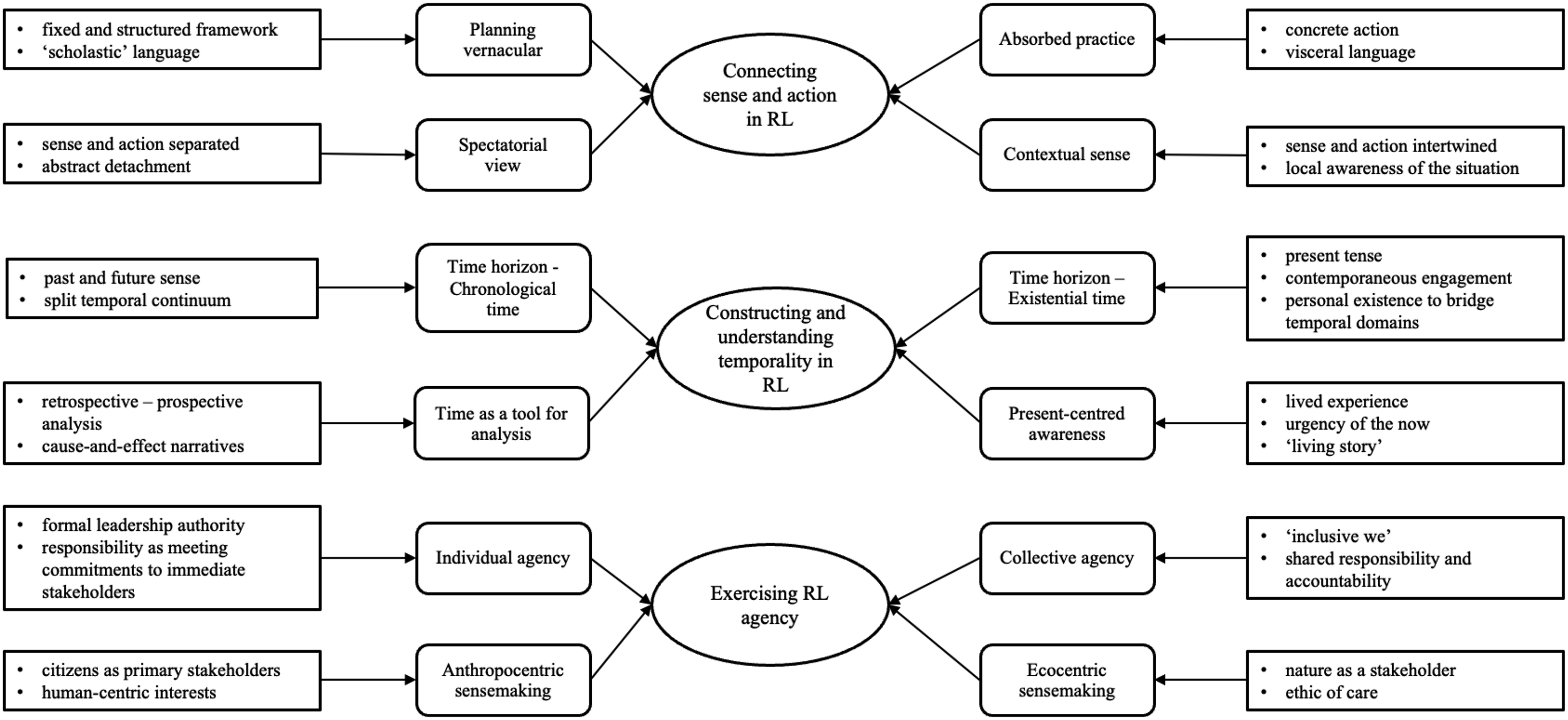
To ensure the validity of our analysis, we followed Georgaca and Avdi’s (2012) quality criteria for discourse analysis. First, we ensured internal coherence by constructing consistent repertoires. The stratified sampling strategy allowed us to adjust the sample size as needed until we reached a coherent explanation. However, this was not required, as a paucity of new information was reached after analysing the selected speeches, indicative of coherence and congruence. Second, we maintained rigour by actively seeking and discussing contradictions through negative case analysis (Lincoln and Guba, 1985). Finally, we made our research process transparent by grounding our findings in illustrative examples from the data, provided in Appendix A1 to A3.
Findings
When structuring themes, two dominant discourses emerged: Politician Discourse and Activist Discourse. As noted above, these labels represent the dominant speaker group reflected in each discourse, though crossovers between groups were present, with some leaders employing elements from both. In these two discourses, three distinctive representations of RL were identified concerning (1)
Connecting sense and action in RL
Findings suggest that politician and activist discourses construct different relationships between the sense given to RL and RL action in the context of the climate crisis. Politician discourse, driven by the intention of inspiring credibility, suggests a sense of disconnect between sense and action, given the static and detached spectatorial qualities evident in their discursive construction of responsibility. In contrast, in activist discourse, the intention is to provoke action by using a more emotive repertoire; here, sense and action are simultaneous and unified. Considering that individuals and organisations act based on their sensemaking, we can expect the more representational sensemaking in politician discourse to lead to different ways of engaging with RL than activists who exhibit a more involved type of sensemaking. Appendix A1 overviews the unique linguistic repertoire of the two discourses.
In politician discourse, a planning vernacular is evident which revolves around static nouns denoting a fixed and structured framework to communicate responsibility. Examples include devising ‘a robust framework of rules’, ‘protocols’ and ‘commitments’ that are universally understood and agreed upon by all Parties. RL is presented as the power to act by exerting influence over the ‘emission reduction targets’, ‘cost targets’, ‘climate finance goals’, the ability to develop a ‘long-term strategy’ and ‘regional and local action plans on climate change’, and the capacity to ‘mobilise the necessary resources to achieve the desired goals’, to ‘find an intelligent way to spend the private money available and spend them quickly’ and to ‘track the progress made in climate mitigation’ and ‘track climate finance’.
These frameworks are then used to guide the performance of RL action through a logic of compliance to the demands in the framework: ‘We are doing more than our fair share… The Gambia’s updated nationally determined contributions is recognised by Climate Action Tracker as a fundamental commitment to reducing global temperature rise to 1.5
o
C’. (Isatou Touray, Gambia, Vice-President)
Whilst these frameworks are pronounced authoritatively, they are communicated through a more ‘scholastic’ language. The climate crisis is interpreted as a logical, intellectual problem that can be made sense of in an abstract way with a thorough understanding of ‘scientific data’ on ‘carbon emissions’, projections about ‘global warming trends’, cumulative ‘economic loss and damage’ and total investment to be deployed to address it. The intentions here are to demonstrate that leaders can be trusted to make ethical decisions (ethos) and that their proposed actions have a logic (logos). However, making sense of responsibility through such decontextualised features of climate crisis detaches RL from the specific locations or the diverse experiences across different communities. ‘We can phase out the use of cars with hydrocarbon internal combustion engines – by 2035... We can end the use of coal fired power stations… We can plant hundreds of millions of trees, a trillion, it’s not technologically difficult and [will] halt and reverse deforestation by 2030.’ (Boris Johnson, United Kingdom, Prime Minister)
In the quote above, the sense given to RL becomes representational because it has become an abstract object of discussion with no situational features that would ground it in a local context. The responsible leader is discursively positioned as an external, objective/neutral spectator who lacks direct, involved experience of the situation they are making sense of. In this respect, in politician discourse sense and action are separated. Arguably, making representational sense from a spectatorial viewpoint involves action, such as obtaining and declaring the figures, assessing them against benchmarks, and setting the measures taken to mitigate the discrepancy between the two. However, the language used detaches responsible leadership action from its local context, where practical accomplishments would have been visible.
In activist discourse RL is presented as an absorbed practice that involves keeping in tune and coping with the climate crisis by gradually developing a pragmatic sense of what is responsible and possible, emphasising the importance of acting. ‘Promises will not stop the suffering of the people, pledges will not stop the climate from warming, only immediate and drastic action will pull us back from the abyss.’ (Vanessa Nakate, Youth Activist)
In this type of sensemaking, responsibility is understood and interpreted as concrete, signalled by dynamic and active verbs denoting practical accomplishments. ‘Every time we have people doing their best, all of the possible and a little bit of the impossible to actually make things work.’ (Nisreen Elsaim, Youth Activist)
Furthermore, findings point towards the use of visceral language invoking emotions as activists talk about the ‘animals and people dying’, the ‘children crying’, and the ’Pacific youth fighting’ as they reflect on the ‘suffering’, ‘starvation’, ‘struggle’, and ‘heartbreak’. Providing emotion through speech contrasts with the method of influence evident in politician discourse that relies on factual language for logical appeal. By drawing on emotions, activist discourse suggests that the leader is deeply engaged with the situation so that the boundary between them and the context they are interpreting dissolves. It emphasises that sensemaking is more than a cognitive understanding and draws on pathos to appeal to others’ emotions using personalised narratives. RL is made sense of as a deeply embodied and situated activity, where the understanding of leadership responsibility and its performance are intertwined. ‘I have asked myself over and over what words might move you. And then I realised…my story will only move you if you can open up your heart. I cannot urge you to act at the pace and scale necessary… Your will to act must come from deep within. I need to tell you what is happening in my home country.’ (Elizabeth Wathuti, Youth Activist)
The emphasis on absorbed practice in activist discourse suggests taking responsibility without waiting to have all elements of the plan, all resources needed, and all roles and remits clarified before acting. In their sensemaking, activists, unencumbered by the desire to devise a universal framework to shape the scope of responsible action, act on the insight and assets available to them now at a local level with an awareness of the situational features of the unfolding climate crisis. Consequently, sense and action merge, fusing the sensemaker and the situation. Activists are no longer consciously reflecting on the context in a detached or abstract way. Instead, they are fully immersed, acting intuitively and responsively based on their contextual sensemaking of the evolving situation.
Constructing and understanding temporality in RL
Findings suggest that leaders’ engagement with the climate crisis is temporally constituted in that their perception of responsible action unfolds in and through time. These temporal features are communicated through discursive features that either emphasise a chronological, linear understanding of time, where past and future guide present actions, or suggest a more existential, present-centred awareness. Appendix A2 outlines how temporality is illustrated in the speeches.
The temporal dimension of the climate crisis might be expected to inject a sense of urgency into leaders’ sensemaking; it is imminent and takes place simultaneously with COP26. On the one hand, politicians’ speeches reflect this immediacy, expressing a desire to generate action in the present: ‘It’s one minute to midnight on the doomsday clock, and we need to act now. If we don’t get serious about climate change today, it’ll be too late for our children to get serious about it tomorrow.’ (Boris Johnson, United Kingdom, Prime Minister)
On the other hand, the language remains tethered to a discourse of past data, present plans and future goals. This reflects a reliance on chronological time whereby the temporal continuum is split into regions of past, present, and future. Politician discourse positions RL within a linear continuum, allowing retrospective reflection and prospective planning of responsibility towards the climate crisis. First, retrospective analysis establishes historical accountability for RL. Past progress is reflected upon to explain present challenges, thereby crafting narratives that assign responsibility through causal linkages between past and present: ‘Climate finance to frontline SIDS [small island developing states] declined by 25% in 2019. Failure to provide this critical finance…is measured in lives and livelihoods being lost in our communities.’ (Mia Amor Mottley, Barbados, Prime Minister)
Second, prospective analysis is used to project and plan future commitments. Future expectations of RL performances are framed in relation to present action plans, drawing a linear trajectory against which progress can be evaluated in later COP Summits. By outlining a path from the present to the future, temporality provides a distinct rhythm to direct future enactment of RL. ‘We fully subscribe to the achievement of SDG7 on clean and affordable energy for all by 2030, and net zero emissions by 2050.’ (Bruce Bilimon, The Republic of the Marshall Islands, Health Minister)
In this way, in politician discourse, time is employed as an analytical tool that enables structuring a sense of leadership responsibility both retrospectively, by examining past actions, and prospectively, by forecasting future outcomes. ‘Climate change is…costing our nations trillions of dollars. Record heat and drought are fuelling more widespread and more intense wildfires in some places and crop failures in others… But within the growing catastrophe…we have the ability to invest in ourselves and build an equitable clean-energy future and in the process create millions of good-paying jobs and opportunities around the world.’ (Joe Biden, United States of America, President)
In contrast to this chronological and analytical sensemaking of temporal framing of RL action, activist discourse suggests an existential sensemaking grounded in immediate lived experience. This discourse focuses on the ongoing, contemporaneous engagement with responsibility for mitigating the climate crisis, rooted in the present tense where past and future intersect with the current moment. Activists themselves become a bridge across these temporal domains, making their sensemaking inextricably tied to their personal existence. ‘When we talk about the impact of the climate crisis on future generations, we speak of them as if those generations were not here, but we’re present. By 2050, I’ll be 48 years old, and when I look out of the window, I’ll see the world you’re negotiating right now.’ (Xiye Bastide, Youth Activist)
This existential engagement with time reflects a present-centred awareness in the here and now that actively delves with the immediate, lived experience of the climate crisis. Responsibility is not a distant goal to be achieved. A lived, felt urgency guides RL action in the present moment. ‘Right now, as we sit comfortably here in this conference centre in Glasgow, over two million of my fellow Kenyans are facing climate related starvation.’ (Elizabeth Wathuti, Youth Activist)
In the statement above, there is no deferral to the past or projection of the future; there is only the urgency of the now. With this sense of urgency, the sensemaking of RL becomes dynamic, akin to a ‘living story’, filled with experiences, and a continuous unfolding as new events shape their understanding and practice of RL. The intention is to establish a shared ethic based on these experiences, which are inherently existential. ‘Nine million people, dying every year from breathing toxic air, from fossil fuel driven air pollution, don’t have time to wait for oil, gas and coal to be phased out.’ (Vanessa Nakate, Youth Activist)
Exercising RL agency
We found that leadership actors differed in their perceptions of where the agency resides to take RL action. These perceptions are communicated through discursive features that emphasise the focus on individual agency of specific people in formal positions, or a linguistic repertoire that contextualises individual RL actions in wider textures of community practices and assets. Appendix A3 summarises points of contrast we revealed through data analysis.
In the politician discourse, responsible leadership (RL) is framed as the exclusive domain of world leaders. Leadership agency is concentrated within the individual leader, who is positioned as a decision-maker operating from a higher authority to influence outcomes, often detached from the daily experiences and input of citizens and communities they represent. Responsibility for addressing the climate crisis is thus seen as the prerogative of this elite group of leaders. ‘When will we as world leaders address the pressing issues that are cause [sic] our people to worry ..? When will leaders lead?... What the world needs now is less than 200 persons who are willing and prepared to lead!! Leaders must not fail those who elect them to lead.’ (Mia Amor Mottley, Barbados, Prime Minister,
The ‘we’ in Mottley’s statement is an exclusive leader, ‘fellow leaders’, in that it presents the climate crisis as a responsibility that lies primarily within the hands of an elite group of world leaders, who are seen as possessing the unique capacity to take action. This collective responsibility, however, is framed in a way that reinforces detachment of leaders from broader society – intellectually, emotionally, and sometimes physically (e.g., in the COP summit). The call for action is directed at a small, powerful group of individuals, further solidifying the notion that RL is the domain of a few, rather than a shared responsibility across society. In this way, RL becomes about wielding authority from an elevated, symbolic status to claim the power of acting ethically: ‘I know all of us in this room want to be on the right side of history. This is why I call on all of us to do what is necessary for keeping the limit of 1,5°C warming within reach. This is our opportunity to write history.’ (Ursula von der Leyen, European Commission, President)
Furthermore, the responsibility for action is framed as contingent on all nations taking action, implying that RL is only meaningful if undertaken by all nations in unison. Even in the face of a global crisis, individual leaders often prioritise national interests, reinforcing a notion of RL that is primarily directed toward their immediate stakeholders: ‘Our carbon price trajectory is…designed not just to make life cleaner, but also make life more affordable and less expensive for Canadians.’ (Justin Trudeau, Prime Minister, Canada)
RL action is narrowly defined as meeting pre-defined commitments for pre-defined stakeholders. Meeting these commitments becomes the benchmark of RL, where success is measured by the degree of alignment between promised and realised outcomes: ‘Our installation of renewables is eight times faster than the global rate and three times faster than some of the most advanced economies. We have already reduced emissions by more than 20% since 2005. We are ahead of the pack.’ (Scott Morrison, Australia, Prime Minister)
Some politicians describe their leader(ship) responsibility more broadly. In the quote above, we see that Trudeau perceives his primary responsibility towards the Canadians. But some politicians take a more expansive interpretation of RL in recognising their responsibility towards the developing nations, like Joe Biden or Scott Morrison, who talk about ‘climate finance support for developing countries’ and ‘our Pacific family…and partners’. Some other politicians consider the interests of present and future generations. However, the anthropocentric sensemaking of leadership responsibility is evident. Humans are still at the centre of moral consideration of RL. Consequently, responsibility towards the environment becomes a trade-off between human-centric interests and the integrity of the environment. ‘Singapore will work with all Parties…to identify pragmatic solutions to achieve a credible and balanced package…that meets the needs of all Parties, while safeguarding environmental integrity.’ (Grace Fu, Singapore, Minister for Sustainability and the Environment)
In activist discourse, we observe a shift towards collective RL, moving away from the notion that responsibility for the climate crisis rests solely on individuals occupying formal leadership positions. The frequent use of inclusive ‘we’ in their speeches, including the addressee, suggests a broader interpretation of RL, where all are invited to take action. ‘We use our Indigenous peoples’ traditional knowledge as a tool to protect nature… We have the map. We know where we are going, and we know how to drive. So give us the keys.’ (Hindou Oumarou Ibrahim, Indigenous Activist)
As the quote above suggests, this inclusive ‘we’ reinforces the idea that RL is not confined to formal positions of power but emerges from the collective agency that is released when multiple actors share the responsibility and accountability for leadership action. ‘If working apart, we’re a force powerful enough to destabilise our planet, surely working together, we’re powerful enough to save it.’ (David Attenborough, Climate Activist)
In this context, RL is seen as a shared practice that recognises the value in unrealised (or ignored) resources, including personal leadership attributes and skills in the community and relationships among people. Consequently, RL is framed as polyphonic, allowing leadership to emerge in multiple ways through collaboration and improvisation among peers. ‘You can’t always predict what’s going to happen thus we as a society need to ensure that we are always one step ahead of this continuously evolving thing that’s happening.’ (Serena Bashal, Youth Activist)
Furthermore, activist discourse points towards an ecocentric perspective, where the responsibility of leadership extends beyond human interests to include the broader ecological world. Nature is elevated as a stakeholder, and consequently, RL embraces a new role as a global citizen, encompassing an ethic of care for Others (Mussel, 2016) by balancing the needs of humans and non-humans. ‘We must listen to the stars, the moon, the wind, the animals and the trees.’ (Txai Suni, Youth Activist)
This is one area where the speeches of leaders of affected nations diverge from politician discourse, as they, too, call for a sense of collective responsibility that transcends national borders: ‘Together, we can heal the world from the scourges of climate change. Together, we can save this Earth from the deadly consequences of global warming. Together, we can bring humankind into harmony with nature.’ (George Manneh Weah, Liberia, President)
Discussion
In this paper, we argue that understanding the meaning of RL, as constructed by different leadership actors through speechmaking at COP26, is relevant to discussions of RL for two reasons. First, we engage with recent critiques of RL scholarship that highlight its exclusive focus on business leadership (Johnson, 2018; Tirmizi, 2023) – a limitation that it particularly problematic in the context of the climate crisis and other GSCs, since these issues exceed the corporate realm, spanning natural, social and political environments (Roulet and Bothello, 2022). By expanding RL’s conception to include leadership actors inside and outside formal leadership roles, operating at multiple levels and in diverse spheres, we enhance RL’s relevance across different sectors and contexts, including social movements in climate activism. Second, we contribute to the contemporary shift in RL research that emphasises responsibility as a shared (Voegtlin, 2016) and emergent phenomenon (Meliou et al., 2021), which may offer a more palatable sense of “leader-full” leadership that reframes responsibility in a more egalitarian way (Fotaki and Foroughi, 2022) .We extend the emergentist perspective by exploring the language used by multiple leadership actors, drawing on discursive theories of leadership (Fairhurst, 2008) to examine how RL emerged through the sensemaking processes at COP26. In doing so, we offer an important contribution by extending RL’s theorical domain.
Our findings reveal distinct forms of sensemaking used by different groups of leaders in their discursive construction of RL. Specifically, we identify two competing discourses with divergent understandings of ‘responsibility’. We show that in politician discourse, sensemaking typically separates sense and action, reflecting an ‘outsider’ perspective on climate leadership that is abstracted and detached from immediate responsible actions. We characterise this as representational sensemaking (Sandberg and Tsoukas, 2020), which seeks to explain problematic activities requiring leadership intervention by appealing to logic and evidence – logos (Adebomi, 2023). In contrast, activist discourse demonstrates a more involved form of sensemaking, from the ‘inside’, that emerges from direct engagement with the climate crisis. This form of sensemaking emphasises lived experience and immediacy, leveraging emotional appeals – pathos – (Adebomi, 2023) to influence audiences.
A differentiated view of sensemaking of responsibility and responsible leadership.
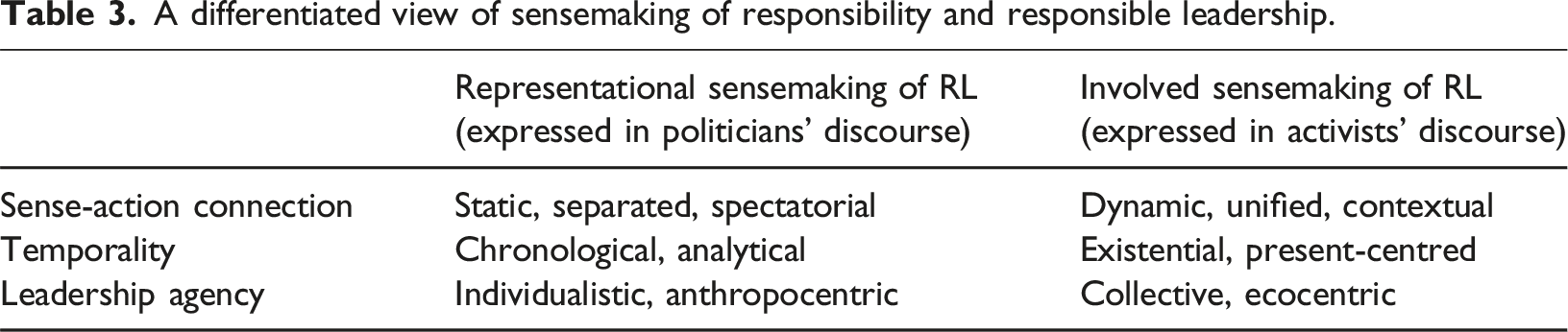
At face value, these forms of sensemaking appear oppositional. However, rather than reinforcing polarised conceptions of RL, we argue for a more integrative approach that acknowledges the complexity and diversity of leadership responsibility. Recognising divergent perspectives and disruptive experiences enables a shift from binary, either/or framings to a both/and perspective that harnesses the strengths of each approach while exploring their synergistic potential (Lewis et al., 2014). We propose that RL can be reframed as an ongoing negotiation between dualities rather than dualisms (Smith et al., 2016), facilitated by rhetorical strategies that enable oscillation between competing perspectives (Simpson et al., 2022).
Both static and responsive
When leaders’ sensemaking of RL demonstrates a static and spectatorial engagement, leading responsibly becomes hidden behind static nouns, such as ‘plans’, ‘targets’ and ‘goals’. Bohm (1980) argues that ‘nounisation’ fragments thought ‘tending to divide things into separate entities…conceived of as essentially fixed and static’ (p. 29). In RL literature, this is reflected in the prevailing view of RL as an abstract construct, reduced to a fixed set of components detached from contextual realities. For example, Pless et al. (2012), break down RL into leadership characteristics, the nature of stakeholder relations and a firm’s strategic emphasis, with four fixed stances across these categories defining a leader’s orientation toward RL. This approach leads to ‘petrification’ (Czarniawska, 2004), treating RL behaviour as an artefact waiting to be leveraged. While such ‘nounisation’ and ‘petrification’ may impose structure and clarity on complex challenges like the climate crisis (Adebomi, 2023) and positions RL as a rational framework for addressing the scholarly and intellectual problem of the climate crisis, it also creates a detached sequence between the conceptualisation of responsibility (i.e., sense) and its enactment (i.e., action) (e.g., Foldøy et al., 2021).
The activist discourse illustrates a more dynamic engagement with RL, recognising its ongoing nature enacted through lived experience. The use of verbs in the present continuous tense (like doing, growing, providing, working) shifts RL from the completed actions of the past to the practical, embodied concerns rooted in the unfolding environmental and societal situation (Adebomi, 2023). This linguistic shift embeds RL within concrete activities – actions that are not just decided upon but physically carried out, often through collective practice in the moment. Instead of reducing leadership to predefined attributes or retrospective evaluations, the activist discourse emphasises how responsibility is continuously shaped through situated interactions, material engagements, and local contingencies. In this way, language unites sense and action in RL, accounting for the fluid, fluctuating nature of leadership becoming, as it constantly adjusts to ongoing experiences (Tsoukas, 2017).
Based on these insights, we propose that the discursive construction of RL can manage this opposition through careful oscillation (Simpson et al., 2022) between sense and action aimed by balancing the multiple logics of technical rationality with practical accomplishment.
Both linear temporality and existential living story
Much of the existing literature frames RL as a linear process, structured around a retrospective-prospective understanding of temporality. Leaders will prospectively be ‘determining how [stakeholders’] needs, expectations, or interests can and should best be served’ (Waldman et al., 2020: p. 6) in the present, and then then retrospectively evaluate past performance, and, if those needs or interests are not adequately met in the present, suggest corrective future action. (Waldman et al., 2020). This chronological framing of RL in the familiar temporal domains of past, present and future reinforces causal linkages, positioning leadership responsibility as a continuous cycle of evaluation, adjustment, and forward planning.
The activist discourse offers an alternative view of RL as a living story, one that unfolds in the immediacy of experience. Here, action and meaning emerge simultaneously, not as a linear cause-effect relationship but as an ongoing, recursive process. Past, present, and future are dynamically enmeshed, with leaders engaging fully in the present while reinterpreting the past in light of emerging realities (Boje, 2014). This existential, present-centered awareness moves RL beyond ‘planning-based futures’ (Wenzel et al., 2020: p. 1448), generating multiple, continually evolving pathways for RL action, which are never quite in a settled, completed position (Boje, 2014).
Tension emerges between the demands of differing chronological and existential understandings of temporality; as RL must navigate structured, linear timelines of objectives and the immediate, lived experiences of stakeholders. Reframing this relationship through an ‘integrative rhetoric’ (Simpson et al., 2022) which reconciles structured planning with the spontaneity and moral immediacy of lived interactions, can transcend this contradiction.
Both individualistic and collective
When leaders’ sensemaking positions themselves at the centre of responsible actions, this reflects the dominant perspective in RL literature, which constructs RL primarily as an individual-level phenomenon tied to executive authority (e.g., Waldman et al., 2020). This framing reinforces the notion that ‘only outside experts can provide real help…[and] denies the basic community wisdom’, treating the community like ‘consumers’ of government services without the incentive to be producers (Kretzmann and McKnight, 1993: 4). The prerogative for those taking up a leadership role is then to influence through displaying expertise and claims of power, legitimising their decisions and directing the process of responsibility enactment in ways that prioritise the interest of immediate stakeholders.
In the context of the climate crisis, this individualistic view of RL is incomplete since any leader’s contributions are constrained by the multitude of interrelationships that constitute GSCs (Voegtlin et al., 2022). Also, ideologically, the concentration of leadership and power in a few designated individuals is problematic, as it disregards the value of wider, mutual participation (Western, 2014). The activist discourse highlights the importance of RL as an emergent, collective construct rooted in shared social and ecological interdependencies, through personalised narratives. Rather than centring leadership on an individual, RL becomes embedded in place-based, community-driven initiatives, co-created practices, and reciprocal responsibilities, generating a ‘we-narrative’, that deepens and stabilises shared agency. This collective leaderfull-ness reimagines new ways of organising (Fotaki and Foroughi, 2022) and moves beyond the fantasy of leaderlessness to embrace context-responsive engagements (Tollefsen and Gallagher, 2017). Consequently, a ‘plurality of future making practices’ (Wenzel et al., 2020: 1448) can emerge from unexpected places in a multilocal and polycentric fashion (Meliou et al., 2021).
Our analysis illustrates that RL is both individual and collective. It shows how individuals and groups co-emerge through a shared process of co-becoming, where each individual’s actions shape the trajectory of the collective, while the community’s responses shape the individual leader’s sensemaking (Gram-Hanssen, 2021). The emergence of RL within this framework demands continual balancing of personal agency with a commitment to the collective wellbeing, as leaders navigate between their contributions and their embeddedness in the community’s evolving story.
Conclusion
In this paper, we illustrate how discourses of RL can become oppositional, and then argue for a creative, both/and approach that leverages the benefits of each side, tapping into their synergistic potential (Lewis et al., 2014). This is important because, dominant, one-sided narratives can distort democratic processes (Gallagher and Tollefsen, 2019), and when one narrative dominates, leaders may struggle to shift their rhetoric, reinforcing a singular discourse (Smith and Lewis, 2011). While this may offer a sense of stability and continuity to the audience and the stakeholders, it can also create a vicious circle of adversarial debate (Tsoukas and Cunha, 2017) that overlooks the complexity of contemporary challenges (Smith et al., 2016).
First, we argue that RL is inherently immanent and practical, requiring concrete action, while also necessitating a level of detachment to explain causal mechanisms and learn from past practices (Sandberg and Tsoukas, 2020). Second, we reveal how the latter would require a chronological understanding of temporality that allows retrospective and prospective analysis while also staying attuned to the present moment through existential time for instant adjustments to the unfolding situation (Boje, 2014). Finally, we show the importance of holding the tension of individual responsibility in the sense of the collective to allow individual contributions and perspectives toward the common good (Gram-Hanssen, 2021). By embracing tensions inherent in RL’s sensemaking, we can envision paths toward sustainable futures (Smith and Lewis, 2011), addressing a key tension between leadership and leaderlessness in climate social movements voiced by previous scholars (Fotaki and Foroughi, 2022) and recognising emergent RL practices.
This paper broadens RL research in two ways. First, we extend the empirical scope of RL beyond business organisations to political, institutional, and community leadership. Second, we broaden the disciplinary bandwidth of RL by introducing a discursive sensemaking perspective (Fairhurst, 2008; Sandberg and Tsoukas, 2020), and shifting the focus from unitary notions of leadership to a processual understanding where leadership emerges through communicative interactions among multiple actors. We show that RL research can benefit from considering not only what happens in the ‘foreground’ (the leadership qualities and behaviours) but also the ‘background’ (the language) that shape alternative understandings of RL.
Our findings have implications for future COPs, climate activism and other environmental forums. Formats that move beyond conventional speechmaking toward more dialogical and participatory engagements that bring together leadership actors from diverse spheres, who operate at multiple levels, can bridge representational and involved forms of sensemaking. Structured debates requiring leadership actors to engage with opposing perspectives can promote reflection on different senses of responsibility. At COP26, we saw how incorporating storytelling and lived experiences into policy-driven discussions highlighted RL’s complexity. Encouraging such spaces for dialogue that fleshes out analytically climate crisis and responsibility towards it through representational sensemaking and, at the same time, considers the urgency of involved sensemaking could help create a more holistic sense of RL. Leadership actors who deliberately engage with multiple sensemaking approaches can transcend entrenched rhetorical divides, enhancing the legitimacy and effectiveness of RL.
We acknowledge the limitations of our study. Discourses of RL do not necessarily indicate whether leaders act responsibly. Our focus on discourse helps understand how the ways in which issues are framed at a given time can inform subsequent actions (Watson, 2001). Whilst this makes sensemaking a crucial micro-foundation of RL, future research is needed to investigate whether RL rhetoric translates into concrete social and environmental impact. Furthermore, given the evolving nature of GSCs, exploring how RL discourse shifts over time and across social, institutional and organisational contexts is a promising avenue for further study.
We also recognise that the structure of COP26, with its monological speeches and fragmented fringe events, reinforced the division of discourses and hindered mutual sensemaking. Future RL research could explore the role of multi-way communication in leadership processes. By embracing different senses of responsibility, we can develop a new paradigm of RL that is equitable and sensitive to diverse ways of knowing and being in the world.
Footnotes
Declaration of conflicting interests
The author(s) declared no potential conflicts of interest with respect to the research, authorship, and/or publication of this article.
Funding
The author(s) received no financial support for the research, authorship, and/or publication of this article.

Notes
Appendix A1. Illustrative examples of data structure of the interplay between sense and action
Politician discourse
Activist discourse
Clusters of meaning
Units of meaning-illustrative quotes
Clusters of meaning
Units of meaning-illustrative quotes
Fixed and structured framework
‘These measures will form a “1+N″ policy framework for delivering carbon peak and carbon neutrality, with clearly defined timetable, road map and blueprint.’ (Xi Jinping, China, President)
Concrete action
‘I have been doing what I can… I have founded the Green Generation Initiative, a tree growing initiative that enhances food security for young Kenyans. So far, we have grown 1000 fruit trees to maturity, providing desperately needed nutrition for 1000s of children.’ (Elizabeth Wathuti, Youth Activist)
‘Leaders in Glasgow face clear tasks. They must agree on a comprehensive package of outcomes that will set us on an accelerated pathway towards closing the gap to the Paris agreement’s goals… A new work program for action for climate empowerment must ensure better mainstreaming of the relevant work streams through human rights-based approaches and coherent and incremental five-year plans.’ (Hajar Khan, Climate Activist)
‘We don’t believe that banks will suddenly put trillions of dollars on the table for climate action when rich countries have struggled since 2009 to raise 100 billion dollars for the world’s most vulnerable countries. We don’t believe that promises made by financial companies to end deforestation will actually prevent trees from being cut or burnt down, we simply don’t believe it. But I am here right now to ask business and finance leaders, show us your faithfulness, show us your trustworthiness, show us your honesty. I am here to say, prove us wrong.’ (Vanessa Nakate, Youth Activist)
Scholastic language
‘We should move to agree the following: (1) clear, deep and real cuts in green house gas emissions to be addressed by all countries with the developed countries taking the lead; (2) adequate and predictable financing to enable us the developing countries to make impactful contributions to address this critical global challenge; (3) support with technologies and the capacities that the world needs to shift from carbon intensive development paths to low carbon green economies;(4)… (5)…’ (Hakiende Hichelima, Zambia, President)
Visceral language
‘We’ve caused so much suffering and the demise of these countries from all over the world in these areas and these communities and it’s our fault. And emotionally this is actually really really quite difficult to live with.’ (Serena Bashal, Youth Activist)
‘True to the letter and spirit of the Paris Agreement, the lower end of our 2030 updated target emission range is consistent with a 1.5- degree pathway, while the upper end of the range is consistent with a 2-degree pathway. Where we get to in this range will depend on the international support we receive.’ (Barbara Creecy, South Africa, Minister of Forestry, Fisheries and the Environment)
‘Last week my heart was broken by the people…who tell us that action needed to prevent sea level rise engulfing my ancestral home in Jamaica is impossible or not practical. In this heartbreak, fear and despair, I felt weak. But I will allow myself the space for my heart to break. So that the gold of community can be poured into those cracks and make it stronger, make it bigger,’ (Mikaela Loach, Climate Activist)
Sense and action separated
‘We know the problem about climate change; we know the effects and the impact we must foster forward to what is next. And the main target is to reduce average temperature to 1.5 degrees by 2030. That’s the major target…and this will mean a revolution in our use and exploitation of natural resources. Having known the target, we move over to the solutions which is to bring in new ideas and new ways of creating a sustainable future.’ (Ayoola Olufemi Orimoloye, Youth Activist)
Sense and action intertwined
‘I see a lot of fuss, a lot of noise around reaching net zero targets and so on. But what about the investments, what about the decisions, what about the actual extractive operations happening on the ground’ (Carla Meleno, Youth Activist)
‘The recent IPCC report gave us a clear diagnosis of the scale of the problem. We know what we must do. So, how do we do it? First: how do we get the private sector all pulling in the same direction? After nearly 2 years now of consultation, C.E.O.s have told me that we need to bring together global industries to map out, in very practical terms, what it will take to make the transition. Second, who pays, and how? … Third, which switches do we flick to enable these objectives? … This is the framework I have offered in the Terra Carta roadmap, created by my Sustainable Markets Initiative, with nearly one hundred specific actions for acceleration.’ (Charles III, Prince of Wales)
‘A few days ago a climate action tracker report showed that COP26 is actually putting us on a pathway for a 2.4
o
C world. We have two pathways. There is the pathway of commitments and hype and promises and fanciful net zero targets and happily ever after. And then there is the pathway of the best available science, of ever stronger storms and droughts and floods, of toxic polluted air, of real people suffering and dying. And these two pathways are diverging. The truth is the atmosphere mostly it doesn’t care about commitments it only cares about what we put into it or what we stop putting into it.’ (Vanessa Nakate, Youth Activist)
Abstract detachment
‘We also recognize that where there is a lot of forest there is also a lot of poverty. And, to promote sustainable development in the region, we created the National Program for Payments for Environmental Services Floresta+, which seeks to promote the market for environmental services, recognizing and providing payments to those who take care of the forest.’ (Joaquim Leite, Brazil, Environment Minister)
Local awareness of the situation
‘I need to tell you what is happening in my home country. Right now, as we sit comfortably here in this conference centre in Glasgow, over 2 million of my fellow Kenyans are facing climate related starvation.’ (Elizabeth Wathuti, Youth Activist)
‘The data is unequivocal: climate change is widespread, rapid, intensifying and already impacting every region on Earth, both on land and in the oceans.’ (Patricia Espinosa, UNFCCC, Executive Secretary)
‘On a visit to Jomsom in Nepal, in the Hindu-Kush region I spoke to communities literally displaced from their homes from a combination of droughts and floods. In Barbuda I met communities still suffering from the ravages of Hurricane Irma 4 years ago. I have spoken with communities in East Africa fighting plagues of locusts spawned by climate change. And earlier this month I spoke to a group of women in Madagascar, determinedly coping with what some describe, as the first climate induced famine in the world.’ (Alok Sharma, COP President)
Appendix A2. Illustrative examples of data structure of the temporal construction of RL
Politician discourse
Activist discourse
Clusters of meaning
Units of meaning-illustrative quotes
Clusters of meaning
Units of meaning-illustrative quotes
Past and future tense
‘Investing in the net zero, climate resilient economy will create feedback loops of its own – virtuous circles of sustainable growth, jobs and opportunity. We have progress to build upon. A number of countries have made credible commitments to net-zero emissions by mid-century. Many have pulled the plug on international financing of coal.’ (António Guterres, United Nations, Secretary General)
Present tense
‘Meanwhile, our rivers are running dry, our harvests are failing. Our store houses stand empty. Our animals and people are dying.’ (Elizabeth Wathuti, Youth Activist)
‘We are going to cut U.S. greenhouse gas emissions by well over a gigaton by 2030, while making it more affordable for consumers to save on their own energy bills with tax credits for things like installing solar panels, weatherizing their homes, lowering energy prices. We will also deliver cleaner air and water for our children, electrifying fleets of school buses, increasing credits for electric vehicles, and addressing legacy pollution. It will incentivize clean energy manufacturing, building the solar panels and wind turbines that are growing energy markets of the future, which will create good-paying union jobs for American workers — and something that none of us should lose sight of.’ (Joe Biden, USA, President)
‘With temperatures rising higher than global average, glaciers are receding, snowfall is decreasing and permafrost is melting in the Himalayan region.’ (Sher Bahadur Deuba, Nepal, Prime Minister)
Split temporal continuum
‘Brazil, as a key player in the negotiations, made important moves during the first days and we announced even more ambitious climate targets: 50% reduction in emissions by 2030 and climate neutrality by 2050; eliminate illegal deforestation by 2028.’ (Joaquim Leite, Brazil, Environment Minister)
Personal existence to bridge temporal domains
‘I have seen with my own eyes, three young children crying at the side of a dried up river after walking 12 miles with their mother to find water… And by the time I’m 50, the climate crisis will have displaced 86 million people in Sub Saharan Africa alone.’ (Elizabeth Wathuti, Youth Activist)
‘While COP26 will not be the end of climate change it can, and it must mark the beginning of the end. In the years since Paris the world has slowly and with great effort and pain, built a lifeboat for humanity. Now is the time to give it a mighty shove into the water, like some great liner rolling down the slipways of the Clyde, take a sextant sighting on 1.5
o
C, and set off on a journey to a cleaner, greener future.’ (Boris Johnson, United Kingdom, Prime Minister)
‘I’m the same age as these negotiations. I’ve grown up, graduated, fallen in love, fallen out of love, stopped and changed a couple of careers along the way, all while the global north colonial governments and corporations fudge with the future.’ (India Logan Riley, Climate Activist)
Retrospective-prospective analysis
‘In Rwanda, we have seen first- hand the impact of climate change. Floods, droughts and landslides have damaged livelihoods and property, and tragically, cost too many lives. That is why Rwanda is committed to reducing emissions by 38% in the next decade and reach Net Zero by 2050. Rwanda looks forward to working with partner states and institutions, to ensure our mitigation and adaptation plans can be effectively implemented and make impactful contribution to global efforts.’ (Edouard Ngirente, Rwanda, Prime Minister)
Lived, felt urgency
‘If we were to stop emissions right now, we would leave the world with an increase of 1.1 degrees of warming, which is already causing immense damage in the form of floods, wildfires, hurricanes, biodiversity loss, forced migration and more.’ (Xiye Bastide, Youth Activist)
‘Places that were once considered safe are no longer so. But climate impacts are only increasing in frequency and severity. Are we content to create for our children and their children a future of constant fear and uncertainty? A future replete with conflict as climate impacts exacerbate social tensions?’ (Kausea Natano, Tuvalu, Prime Minister)
‘They don’t have a future. They don’t have a present. They’re not worried about the future. They’re worried about their present.’ (Vijay Prashad, Historian)
Cause-and-effect narratives
‘We have implemented a carbon tax...And we are reviewing the level and trajectory of our carbon tax to reflect the cost of carbon in investment decisions effectively. We will announce the outcomes of our review early next year.’ (Grace Fu, Singapore, Minister for Sustainability and the Environment)
Living story
‘2.7 billion people can’t eat now and you’re telling people “Reduce your consumption”. How does this sound to a child who hasn’t eaten in days? You’ve got no clue into. This movement will have no legs in the third world.’ (Vijay Prashad, Historian)
‘Our gathering here is evidence that the larger international effort has not been enough. We see this, not only in extreme events—firestorms, flooding, deadly landslides. But we also see it in the inch-by-inch loss of healthy, essential environment, lands and waters that are the lifeblood of billions of people…In Jordan, reduced rainfalls and high evaporation have combined to a deadly effect...All this compounds our extreme water scarcity…This is why Jordan is committed to the climate change fight.’ (Abdullah II, King of Jordan)
‘I hope that you can appreciate that where I live, a 2-degree world means that a billion people will be affected by extreme heat stress, in a 2 degree world, some places in the Global South will regularly reach a temperature of 35
o
C. At that temperature the human body cannot cool itself by sweating, at that temperature even healthy people sitting in the shade will die within 6 hours.’ (Vanessa Nakate, Youth Activist)
Appendix A3. Illustrative examples of data structure of RL agency
Politician discourse
Activist discourse
Clusters of meaning
Units of meaning-illustrative quotes
Clusters of meaning
Units of meaning-illustrative quotes
Formal leadership authority
‘Fellow Leaders, over the coming days, we need to demonstrate our collective leadership and solidarity in taking urgent decisions to address all the outstanding matters before us.’ (Bruce Bilimon, Republic of the Marshall Islands, Health Minister)
Inclusive we
‘To the world’s most vulnerable who need us to act, to Indigenous peoples who can show us the way, to young people marching in our streets in cities around the world: We hear you. It’s true, your leaders need to do better. That’s why we’re here today… This is our time to step up, and step up together.’ (Justin Trudeau, Canada, Prime Minister)
‘Will we act in the interest of our people who are depending on us or will we allow the path of greed and selfishness to sow the seeds of our common destruction? Leaders today, not leaders in 2030 or 2050, must make this choice. It is in our hands. Our people and our planet need it.’ (Mia Amor Mottley, Barbados, Prime Minister)
‘We have ideas to postpone the end of the world. Let us stop emitting lies and fake promises; let us end the pollution of hollow words and let us fight for a liveable future and present.’ (Txai Suruí, Youth Activist)
Responsibility as meeting commitments to immediate stakeholders
‘As a responsible member of the international community, Singapore is committed to playing our part in the global fight against climate change. We take our Paris commitments seriously and are taking bold climate actions.’ (Grace Fu, Singapore, Minister for Sustainability and the Environment)
Shared responsibility and accountability
‘Us, who are the young people, we are the next generation of leaders and the other is currently at tipping point. And we now have a duty to the planet now to do absolutely everything we can to champion climate action.’ (Serena Bashal, Youth Activist)
‘Since signing the Paris Accord, Liberia has lived up to its promise to reduce deforestation from logging and timber production and from agriculture.’ (George Manneh Weah, Liberia, President)
‘Ancestors of tomorrow. This is an intervention!.. Be architects of something new, protectors of the day. Be shining final hopes, designers of chance and change…We are human, and we owe our home. Let’s pay our home dues… Nothing will change without you.’ (Yrsa Daley-Ward, Author)
Citizens as primary stakeholders
‘El Salvador reiterates its support to continue facing the effects of climate change, building resilience and moving towards decarbonization, in order to ensure its sustainability, development and the welfare of citizens.’ (Fernando Andres Lopes Larreynaga, El Salvador, Minister of Environment and Natural Resources)
Nature as a stakeholder
‘The earth is speaking. She tells us that we have no more time.’ (Txai Suruí, Youth Activist)
‘Technology will have the answers to a decarbonised economy, over time. And achieve it in a way that does not deny our citizens, especially on developing economies, their livelihoods or the opportunity for a better quality of life.’ (Scott Morrison, Australia, Prime Minister)
‘The truth is the atmosphere doesn’t care about commitments it only cares about what we put into it or what we stop putting into it.’ (Vanessa Nakate, Youth Activist)
Human-centric interests
‘According to the Economic Commission for Latin America (CEPAL), these unprecedented catastrophes due to climate change leave us with a strong economic impact in losses, of almost 6000 million dollars; 22,000 dead, 11,000 missing and that affect the lives of millions of Honduran families who lose their homes and sources of income.’ (Juan Orlando Hernández Alvarado, Honduras, President)
Ethic of care
‘We must be decolonial, rooted in justice and care for communities like mine who have borne the burden of the Global North greed for far too long.’ (India Logan Riley, Climate Activist)
‘The climate crisis threatens all forms of life on our Mother Earth, human life, as well as the prospects for sustainable development of our countries.’ (Josué Alejandro Lorca Vega, Minister of People’s Power for Ecosocialism, Venezuela)
‘We do this as a duty, not as a job, because we must protect the forest and land that give us all what we want: food, medicine, knowledge and so on.’ (Hindou Oumarou Ibrahim, Indigenous Activist)