




Abstract
This review paper extends our understanding of organizational deception. We focus specifically on the telling of lies – defined as a false statement with the intent to deceive – as the most common form of deception. We draw new insights from the limited number of existing studies of organizational deception in order to develop a taxonomy of lies and provide an integrative framing for the analysis of lying in organizational contexts. We engage relational sociology to develop this theoretical framing around three key dimensions: organizational context, social relations and actors’ behaviours. From a detailed examination of eleven prior studies, we interrelate these dimensions to identify distinct patterns of lying that are triggered or enabled by social relations or organizational contexts, or both. Based on this theoretical synthesis of prior work, we then demonstrate the utility of the framework in fostering comparative analysis by examining four recent studies of strategic deception in depth. We conclude the paper by discussing the implications of our framework and suggesting an agenda for further research.
Keywords
Introduction
Lying is an intrinsic feature of human behaviour. Psychological studies such as DePaulo, Kashy, Kirkendon, Wyer and Epsteinet al.’s (1996) examination of everyday forms of lying based on diary entries have identified that we lie at least once per day. However, while lying and deception are understood as endemic features of society (Bok, 1980), they have rarely been the central concern of organization studies. In this paper, we examine deception that takes place in organizational settings. We provide a definition of organizational deception ‘as intentional behaviour to deceive that takes place within an organizational context and has a specific motivation and purpose for the actor(s) involved’. Lying is the most common act of deception, where a lie is defined as ‘a false statement made with intent to deceive’ (Oxford English Dictionary). While there are other ways in which deception may be undertaken, we concentrate our attention here on lying (‘the telling of lies’) in organizations. This delimitation in our scope and definition allow us to identify different types of lying in an organizational context and to differentiate conscious intentions to deceive from other wider societal forms such as ‘pragmatic lying’ (i.e. deception associated with the everyday, mundane nature of ‘white lies’ that are linked to upholding social interactions) and broader organizational phenomena such as corruption.
Our primary objective is to understand better how various organizational contexts and social relations inform the actions of those individuals engaged in deception. To this end, we evaluate existing research and offer an integrative framework for the assessment of lying in organizations that builds on insights derived from a review of the literature. We briefly review broad traditions of research on lying in social psychology (Grover, 1993a, 1993b; Edelman & Larkin, 2015; Leavitt & Sluss, 2015) and business ethics (Tenbrunsel & Smith-Crowe, 2008; Trevino, den Nieuwenboer, & Kish-Gephart, 2014; Fleming & Zyglidopoulos, 2008), before turning to a more systematic review of studies of lying in organizational settings. This review consists of eleven detailed sociological studies of lying in organizational and occupational settings. Our aim here is to provide an integrated assessment of the varied behaviours of actors in these contexts, rather than isolating the traits or behaviours of individuals as social psychologists tend to do or narrowly focusing in a more structural manner on the ‘ethical infrastructure’ within organizations. We adopt a relational sociology perspective which requires an analysis of organizational contexts and of the social embeddedness of agency (Emirbayer, 1997; Mutch, Delbridge, & Ventresca, 2006). By adopting this lens, and through our integrated approach, we are able to identify the variety of contextual and relational settings which promote and support lying in organizations.
The integrative and relational framework that we develop on the basis of our review offers a taxonomy of specific types of lies that are uttered in organizational contexts. Our taxonomy illustrates that lying is an activity which may have a specific material, defensive or malicious intention, and is, to a greater or lesser extent, inspired by values and principles within specific organizational and/or occupational contexts. The taxonomy thus establishes the different motives and purposes for lying in organizations by examining the range of behaviours which leads people to enact deception. It also enables us to interrogate the role of different organizational contexts in promoting and supporting particular types of lying. In addition, the taxonomy illustrates the significance of the relational nature of agency inherent in understanding organizational deception.
By elaborating these relational patterns of lying we ‘situate’ deception and elaborate a novel theoretical framing by inductively identifying how deception is shaped in different organizational contexts wherein lying is variously coerced, compensated or condoned. This integrated framework also identifies the varied social relations (cooperative, caring and conflictual) among peers, between employees and customers, and between employees and managers within these contexts that may trigger or enable lying. Finally, these organizational contextual features and social relations imply differing forms of agential responses to deception (complying, coping, challenging) on the part of individuals who lie at work. A relational approach thus emphasizes that any form of agency is embedded.
We then use this theoretical framing to analyse and assess four recent case studies of ‘strategic deception’ (Patwardhan, Noble, & Nishihara, 2009) in interactive service work (Brannan, 2017; Jenkins & Delbridge, 2017a; Nath, 2011; Sallaz, 2015). This further analysis allows us to compare observations and elaborate the way lying represents differing agential responses linked to organizational contexts and social relations within the workplace. In doing so, we demonstrate the utility of the theoretical framework in facilitating a comparative and more in-depth examination of organizational deception.
The paper proceeds through the following stages: an overview of the literature on lying and an introduction to the relational sociology approach, the inductive development of a taxonomy of lies from this literature review, the situating of patterns of lying behaviour to develop a theoretical framing of the relational and behavioural realms of organizational deception, the application of this framework to explore the complexities of organizational deception with reference to specific cases, and the explication of a relational sociology approach and research agenda for the further examination of lying in organizational settings.
Overview of Literature on Lying
As Grover (2005, p. 155) observed, ‘very little is straightforward about lying and honesty’. Therefore, our first challenge in studying lying is to define it. For Bok (1980, p. 13), lying involves the intention to mislead: ‘when we undertake to deceive others intentionally, we communicate messages meant to mislead them, meant to make them believe what we ourselves do not believe’. Lying is when we conceal the truth, act in a dishonest manner and provide false information with the intention to deceive. We concur with Leslie’s (2011) observations that deceitfulness is a natural part of being human and that facile distinctions between ‘honest’ people and ‘liars’ merely obscure subtler realities about our conduct in different environments. Consequently, ‘The mistake we make too often is in viewing honesty solely as a trait – something that individuals have or don’t have – rather than a state: something that people adapt to under conducive conditions’ (Leslie, 2011, p. 235). This acknowledgement lies at the heart of our relational approach to organizational deception. As such, examining lying involves assessing a multitude of agents’ motivations and rationales for deception within different settings and giving primacy to the interactions between actors within their relational contexts. We thus define organizational deception ‘as intentional behaviour to deceive that takes place within an organizational context and has a specific motivation and purpose for the actor(s) involved’. This is consistent with the definition provided by Bok, but makes clear that our interest is specifically in deception that takes place in an organizational context. To this end, we review the existing studies of lying in organizations, incorporating work from social psychology, business ethics, the sociology of work and occupations, and organization studies more broadly. There are patterns in these literatures which we briefly review before providing an in-depth review and analysis of a smaller set of detailed studies that is directly relevant to our objective of understanding lying in organizations. From this analysis, we develop the taxonomy of lies that is presented in the subsequent section.
Psychological studies of lying
Within social psychology there are few empirical studies which focus on lying in organizational contexts. Studies of lying behaviours in relation to behavioural traits are primarily examined outside of any organizational setting and routinely use student participants to examine the nature of lying (DePaulo et al., 1996; Gino & Pierce, 2009; Gaspar & Chen, 2016)). This often includes laboratory experiments (Hegarty & Sims, 1978; Jacquemet, Luchini, Rosaz, & Shogren, 2019; O’Reilly & Doerr, 2020). Additionally, surveys have been employed to seek to predict lying behaviour among the general population (Boyle, Clements, & Proudfoot, 2018), again outside of any social setting. For example, Boyle et al.’s (2018) research used Ekman’s (2001) examination of five types of emotions associated with lying to develop a model to predict lying behaviour based on an individual’s propensity to deceive others.
Social psychology’s most significant contribution to our current objective of exploring organizational deception is the recognition that an individual’s lying behaviour and their motivation to lie is at least in part influenced by their social setting. However, psychological studies remain focused on the individual. Most significantly, the research has been dominated by assumptions of instrumental rationality; the primary explanation for lying has been that it promotes individual self-interest. The limitations of this literature have been recognized within psychology itself. Leavitt and Sluss’s (2015, p. 587) review argues that ‘the extant organizational literature on lying generally has focused on instrumental, non-reciprocal, and/or short-term situations, such as lying for one’s own self-gain’. This recognition has prompted social psychologists to expand explanations for lying in organizations beyond pure self-interest to embrace pro-social motivations for lying, including managing identity threats (Leavitt & Sluss, 2015) and resolving role conflicts in organizations. For example, Grover (1993a, 1993b) developed a model of individual lying in organizations (he used survey and experimental research methods to test the model) to emphasize how conflicts between professional and bureaucratic roles resulted in employees’ misreporting information as a way of resolving this tension. Thus, in some rare examples, the influence of organizational settings and workplace roles has been acknowledged as important to the ways in which employees resort to lies to deal with conflicting pressures.
Addressing relational features of lying more comprehensively, Leavitt and Sluss (2015) draw upon social identity theory to conceive of lying as an outcome of identity threats; these can be located at the personal, relational or collective level. Their assessment encompasses how lying is used as a tool to secure identity-based motives when valued identities are threatened. In this way, lying provides a mechanism for identity maintenance, intended to protect valued personal, relational and collective identities within the workplace. The model produced by Leavitt and Sluss represents an important advance by viewing deception as a response to identity threats within organizational settings. Their work thus acknowledges how these aspects have been largely ignored in social psychology, a limitation they seek to address by ‘conceptualizing lying as a social-functional and socially embedded workplace behavior’ (Leavitt & Sluss 2015, p. 604). Their model extends our understanding of the varied motivations for lying and the significance of social relations. In another recent contribution, Edelman and Larkin (2015, p. 93) examined the links between social comparison and deception. Adopting an experimental design, they found that employees of higher status and success are more likely to react to unfavourable comparisons with peers by engaging in deception designed to make the comparisons less unfavourable. In addition, Kilduff, Galinsky, Gallo and Reade (2016) advance that people are more likely to engage in unethical behaviour including deception when competing against their rivals. In short, recent studies from a psychological perspective have broadened the conception of lying but have generally remained limited to experimental research designs that make these studies largely blind to the influence of organizational context. Although there has been more emphasis on social context within psychological explanations of lying behaviour, the focus remains on the individual. Thus, the complexities of social relational dimensions are not fully developed and examined.
Lying and business ethics
In contrast to the individual trait and behavioural focus of psychologists, the business ethics literature tends to centre attention on the nature of specific organizational climates to explain ethical or unethical behaviour, including but not limited to lying. This has the advantage of bringing the organizational context into scope but has often resulted in explanations that downplay the agency of individuals. Foremost, Tenbrunsel and Smith-Crowe (2008) refer to the organization’s ‘ethical infrastructure’ to explain employees’ behaviour. The infrastructures most commonly studied include ethics codes, ethics programmes, ethical climate and ethical culture. This emphasis has led to a growing body of research into moral decision-making concerned with the cognitive processes of individuals and groups and their moral awareness and judgements made in relation to ethical frames. For Trevino and colleagues (2014, p. 641) important components of ethical culture at the organization level are formal systems, including decision-making processes, organizational structure and performance management systems. However, as Trevino et al. (2014, p. 653) concede, the potential effect of structural features of organizations has been neglected. For Palmer (2012, p. 124), the limited empirical assessment of behaviour within specific organizational contexts means that ‘the ethical decision literature might be more relevant to decision making in the laboratory than to decision making in work organizations’ – a complaint that echoes the concerns regarding the social psychology literature on lying outlined above.
Within the broad business ethics field, lying has not been the specific focus of organizational-level empirical research but organizational contexts feature more prominently in studies of large-scale corporate corruption. Here, researchers consider how organizations develop deceitful and/or corrupt practices through the acceptance of deception within the culture and structure of the organization. Drawing on secondary sources, Fleming and Zyglidopoulos’ (2008, p. 837) study of Enron, WorldCom and Arthur Andersen shows there was a gradual escalation of dishonesty resulting in an ‘increase in the ease, severity and pervasiveness of deceit until the organization cannot operate without lying’. Lying became institutionalized into the informal structures and norms of the organization to the extent that it directly and indirectly affected much of the day-to-day procedures and behaviours. This approach suggests that research needs to take more seriously the relational interplay between structures and agency, a point that we will return to below.
In sum, the overview of the psychology-based literature has identified that empirical studies of lying in organizations are rare. More recently, psychological studies have contributed important insights into employees’ motivations to lie that extend beyond self-interest, including identifying the significance of relational features oriented around identity threats in organizations (Leavitt & Sluss, 2015) and role conflicts which are likely to lead to lying at work (Grover, 1993b, 2005). Where studies have begun to focus on organizational contexts, there is a continued concentration on the individual. Social contexts are conceived as little more than a backdrop against which individual employees are motivated to undertake workplace deception. In short, the business ethics literature has contributed to our understanding of the significance of organizational contexts by identifying the ‘ethical infrastructure’ (Tenbrunsel & Smith-Crowe, 2008) which can give rise to ethical and unethical behaviour in organizations including lying (Trevino et al., 2014). However, both empirical testing of these relations and scrutiny of contexts in real-world organizational settings are under-developed. In addition, the focus on typifying ethical climates and corrupt organizations limits a more comprehensive assessment of the varied motivations for lying in organizations. This literature has downplayed the scope for agency, with explanations centred on the organizational level.
Sociological studies of lying in context
The research conducted in the sociology of work and organizations, particularly that under the heading of ‘workplace and occupational studies’, provides more directly relevant material in developing our understanding of organizational deception. This stream of research draws attention to interpreting acts of deception in their wider organizational context without assuming a determining nature to that context. As Barnes (1994, p. 166) explains, sociological approaches centre on the influence of ‘domain, culture and structure’ on lying. Our review therefore now turns to a more detailed assessment of key texts in this literature. We identified our selection of eleven detailed empirical studies of lying in organizations (the search covered a 30-year period from 1990) on the basis that these studies explored the context of deception as well as the act of lying. We focused in particular on in-depth qualitative case studies or ethnographic research which allowed an assessment of contextual and relational features and actors’ varied motivations to lie. The selected studies include cases where lying is an explicit focus of the study and where lying features as part of the lived experiences of work.
One observation that is common across these studies is that deception is a central characteristic of work. Alpert and Noble’s (2009) study of the ubiquity of lying behaviour engaged in by police officers in the United States identified a ‘continuum of intent’(Alpert & Noble 2009, p. 240) from what they refer to as ‘acceptable lying’ – such as excusable lies (lies made in jest socially) and justifiable lies (defendable based on circumstances) – to lies which included intentional, malicious conduct. Their study highlights the different demands required as part of an officer’s roles which gave rise to lying. These ranged from protecting their self-interest by ignoring a call when a shift was ending, to using ‘excusable’ lies in the questioning of suspects, to more serious deception such as fabricating evidence to secure a conviction. Bone’s (2006) ethnography of direct sales workers also details the ubiquity of lying. In this case, lying was considered an acceptable feature of sales settings where workers were required to achieve targets. Bone highlights how the industry introduces recruits to a particularly insular life-world and moral career. The internal culture operates to distance insiders from the general public, protecting their tactics from public scrutiny, while promoting a distinctive set of norms and values within the bounds of a community that normalises insiders’ activities. (Bone, 2006, p. 93)
In such settings, lying was sanctioned by the occupational community through ‘the construction of difference’ between themselves and the customers they sold to, such that customers were constructed as the ‘common enemy’ (Bone, 2006, p. 118). Scott’s (2003) examination of dishonesty among airline cabin crew also highlights the role of group norms and peer relations in the way lying was enacted, but reports different motivations. Scott’s (2003, p. 322) study posits that when employees are required to lie they do so because they are ‘selected, trained, or encouraged by organizational characteristics’.
Organizational characteristics, peer social group relations and employee identities all feature in these studies. Peer relations help us understand how deception evolves in different settings because of the way workers are socialized into lying by the behaviour of co-workers. Employee identities (both occupational and professional) are also significant in examining the extent to which different groups may endorse deception as acceptable. The role of identities was also a significant theme in O’Mahoney’s (2007) personal reflections of being a management consultant. His account identifies that, as trust relations between consultants and their employer, client and co-workers corroded due to the way social relations were constructed and structured within management consultancy, it became easier for consultants to engage in deception, and lies thus became an accepted part of their identity. Particular professional identities may be particularly important in understanding pro-social motivations to lie; for example, Jackson’s (1991) study of doctors illustrated that lying was perceived as justifiable to protect patients.
Other sociological studies examine the ways in which lying is engaged in as a form of employee agency in the workplace. Although these studies do not focus explicitly on lying at work, they identify that lying was engaged in episodically as a form of resistance and survival. These studies involved cases of ‘workplace misbehaviour’ (Ackroyd & Thompson, 1999). One example is Vandenbroek and Dundon’s (2012) assessment of resistance in a range of occupational groups. Here workplace relations between co-workers are important in the way workers are able to collectively organize to resist management power in contexts of asymmetrical power relations. Hence, the nature of relations between managers and employees informs the extent to which lying as a form of misbehaviour is used to challenge and curtail excessive management power. Resistance – and lying – is not only directed at managers. Taylor and Tyler’s (2000) study of a call-centre setting highlights how women workers lied to sexually abusive customers as an act of resistance. In both of these cases, lying at work is the outcome of processes of negotiation and collectively constructed, particularly where co-workers provide legitimacy, rationalizations and/or encouragement for lying against a defined group of others.
The final group of sociological studies reviewed can be categorized as cases of ‘strategic deception’ (Patwardhan et al., 2009) and represent more recent empirical studies of organizational settings where deception is core to the business strategy. All of these studies examine interactive call-centre settings; Nath’s (2011) study of offshored Indian call centres, Sallaz’s (2015) ethnography of an outsourced call centre in the US, Brannan’s (2017) ethnography of a financial call centre in the United Kingdom, and Jenkins and Delbridge’s (2017) detailed qualitative study of a virtual reception service in the UK. In each of these settings, organizations seek to ensure that employees engage in lying to customers as an intrinsic part of their job. However, there are important variations across the cases and these studies show both the different ways in which organizations promote lying and the varied responses and rationalizations actors develop in order to lie as part of the job. In some cases, lying is normalized and workers enjoy discretion in engaging in lying, whereas, in other cases, lying is experienced as a negative and coercive feature of work. All of the studies highlight the complexity of deception in neither being wholly structurally determined by the organization, nor entirely the outcome of the free will of organizational agents, emphasizing as well as the central importance of social relations. Consequently, informed by these observations, we draw on a relational sociological approach to lying which allows us to explore and account for the interactional nature of structures and agency and to analyse the social relations that underpin acts of organizational deception.
A relational sociology approach
In this paper we embrace a relational sociological approach and its implications for organization theory, building on the outline provided by Emirbayer (1997) in his ‘Manifesto for a Relational Sociology’ (see also Mutch et al., 2006). Emirbayer’s article operates primarily at the ontological level and advances the understanding of social reality ‘in dynamic, continuous, and processual terms’ which he presents in contrast to ‘substantialist’ approaches that give analytical primacy to static entities (Emirbayer, 1997, p. 281). He draws from a range of theorists and sources in his essay, and these ideas have been adopted and adapted widely across the social sciences.
In work that is of specific relevance to organization theorists, Emirbayer’s (1997) ideas have been particularly significant as part of a ‘relational turn’ in the analysis of social networks (see Pachuki & Breiger, 2010). This turn has highlighted the cultural and relational aspects of networks, challenging structural analyses that are seen as having obscured or simplified understanding (Pachuki & Breiger, 2010, p. 207). A relational analysis brings closer attention to meaning-making in networks in particular and the construction of social relations more broadly (Mische, 2014); moves which have been likened to symbolic interactionist approaches (Pachuki & Breiger, 2010) but have also been extended (for example, Somers, 1998) in an approach that takes the relational process of interaction between and among entities as the basic unit of social analysis. Consistent with this, Emirbayer (1997) argues for an approach that focuses on the dynamics of ‘supra-personal’ relations that transcend individual actors and proceeds to examine the implications for both psychological and sociological analysis. His focus is on the ‘transaction’ through which ‘units’ (such as the individual or society) ‘derive their meaning, significance and identity’; this transaction is ‘seen as a dynamic, unfolding process’ and ‘becomes the primary unit of analysis rather than the constituent elements themselves’ (Emirbayer, 1997, p. 287). This represents a particular challenge to the individualistic and substantialist approaches in psychology since ‘Individual persons, whether strategic or norm following, are inseparable from the transactional contexts within which they are embedded’ (Emirbayer, 1997, p. 287).
This article draws on insights from previous work advancing a relational sociology of organizations (Mutch et al., 2006, p. 622) with respect to two key features. First, a relational analysis recognizes and engages with connections both within and across organizations and with their wider contexts to address concerns over how action is understood and situated. Second, a relational analysis identifies the importance of recognizing the constraining and enabling character of social relations and the prospects of agency on the part of social actors (Delbridge & Edwards, 2013). In addition, we draw on a relational approach in our interpretation of individuals within organizational settings. As Emirbayer (1997, p. 302) notes, relational studies do not treat individuals as entities with fixed traits or dispositions that remain constant across times and places, but rather conceptualize them as a configuration of ‘if-then situation behavior transactions’ or patterns of behaviour ‘within distinct but meaningfully similar circumstances’. The emphasis shifts from traits that a person has to what that person does in specific circumstances.
Our review of workplace and organizational studies demonstrates both the significance and variability of organizational contexts in understanding organizational deception. In some cases, employees are compelled to lie while in others it is less direct; organizations provide the necessary conditions to stimulate lying behaviour through incentives as well as in some instances through providing a culturally positive legitimation for lying. The studies also highlight the importance of understanding social relations in the workplace – including those between employees and employers, among employee peers and with customers. To understand lying requires nuanced explanations of behaviour while accounting for both structures and agency as evident in relational sociological approaches. By inserting this approach, we incorporate the significance of organizational contexts, social relations and agents’ motivations to lie into an integrated framework of lying in organizations. We develop this framework in the subsequent section, starting with a definition of core forms of lying and then expanding out to the specific contextual and relational dimensions which give rise to these different forms of lying in context.
A Taxonomy of Lies
We inductively developed a set of categorizations from our in-depth analysis of the eleven sociological empirical studies. The ensuing taxonomy identifies different types of lie based on agents’ motivations (see Table 1). These types of lie are described in some of the existing literature but we label two new categories – defensive and principled lies – which emerge from the studies reviewed.
A Taxonomy of Lies.

Lying in the workplace
Defensive lies
Defensive lying is used to protect and defend the interests of actors and to cope with conflicting organizational demands. These interests may be threatened in contexts where work demands are viewed as transgressing the boundaries of workers’ sense of fairness in relation to effort that they can be expected to put in. Employees reflect on these demands and attempt to mediate power relations, particularly where managerial power is perceived by them to be damaging to themselves or the group. Consequently, in some organizations, defensive lying is engaged in as a coping mechanism. But it may also be a form of challenge, potentially leading to a heightening of conflictual relations between management and workers. In certain corporate contexts, employees may feel compelled to lie to deal with competing demands. Defensive lying is often a response to the setting of unrealistic performance targets that can only be met by engaging in deception either through the manipulation of sales figures or of customers (Bone, 2006; Sallaz, 2015). Workers deal with the competing work targets by engaging in customer deception to curtail the excessive demands of the workplace as a coping mechanism.
Defensive lying is also evident when the employment relationship is marked by conflicts over time and where collective and cooperative social relations among employees result in deception being exercised as a challenge to managerial power. A good example is Vandenbroek and Dundon’s (2012) examination of delivery drivers who sought to resist the electronic surveillance technology in their cabs by parking at busy interchanges and junctions, making it difficult for management to detect whether they were stuck in traffic. In a second case, ‘Water Co’, employees responded to the removal of the ‘perk’ of being able to use company vehicles outside of working hours by collectively arriving late to work. They claimed that this was a result of having to use public transport. Thus collective deception was used to challenge managerial power and ultimately led to management restoring the right to use vehicles outside of work hours. In other settings where time is contested but agency is individualized rather than collective, individual workers engage in lying to cope with management demands. Alpert and Noble’s (2009, p. 241) examination of police officers used the label ‘administrative lies’ to describe ‘intentional acts of deception aimed to prevent some type of employment action’. In their study, officers lied about completing a crime report and claimed to be unable to take a call when actually available because they were nearing the end of a shift.
Scott’s (2003) study of flight attendants highlighted how relations between workers and customers became conflictual when customers made demands that impacted working time. For example, the flight attendants lied to reduce their work during long flights by claiming that they were out of certain drinks or pillows when they were requested by customers. Peer relations were important for legitimizing and sanctioning such instances of lying. Flight attendants learnt from one another through informal socialization when and how it was acceptable to lie. The workplace culture based on collective peer relations condoned deception against customers. Workers determined the boundaries of acceptable demands versus excessive demands and peer relations help us understand how lying evolves in different settings, thereby informing the nature and degree of organizational deception.
In general, defensive lying is an expression of workers’ agency to mediate the power relations within the workplace. In organizational contexts where there are contestations over working time, or where management and customer demands are considered to be excessive, workers responses include lying as a form of coping mechanism or as a collective challenge in order to resist or reform worker–employer or worker–customer relations.
Malicious lies
Malicious lying is undertaken with the intention of harming individuals or groups. Alpert and Noble (2009, p. 243) state that malice on the part of the communicator includes both lies told for personal gain and lies that exceed the limits of legitimacy (that is, lying which goes beyond conventions that are collectively understood in a specific context). The extent to which employees engage in malicious lying depends on how ‘malice’ is conceived. For example, Alpert and Noble (2009) studied police officers who falsely testify against suspects to ensure a conviction. Here, lying is legitimized within an occupational culture which conceives of lying as a way of ‘the ends justifying the means’ – hence lying is provided with an ‘ethical infrastructure’ (Tenbrunsel & Smith-Crowe, 2008) within highly cohesive occupational cultures. Social groups reflect and develop their own moral code of behaviour within the specific workplace setting. These occupational and organizational boundaries can lead to members becoming complicit in lying.
Malicious lying is also evident in workplace contexts where relations between colleagues are marked by a high degree of competition or conflict. For example, employees may engage in ‘dark acts’ to sabotage the career of a colleague, including activities such as spreading false rumours and causing reputational harm to an individual. O’Mahoney (2007) noted how, in the management consultancy Zantax, consultants would attempt to negatively portray one another to higher management to ensure they secured the next project or position ahead of their competitor. In such settings, the micro-politics of the workplace promotes malicious lies and ensures that co-workers lie to secure self-interest. For O’Mahoney (2007, p. 298), the paradox of consulting is that consultants cannot be trusted by their own company, their clients nor their own colleagues – however, in order to function they have to trust. Deception is promoted because of the absence of trust from relationships with the organization, the client organization, employees of the client organization and co-workers.
The corporate contexts which are most likely to promote malicious lies are those where there are conflictual workplace relations, especially where competition for scarce resources is evident. Such forms of deception can highlight power asymmetries in the employment relationship or conflicts between employees in internally competitive or divided organizational contexts.
Material lies
Material lies involve engagement in deceptive practices to elicit financial gain either directly for the individual or for the organization in which they work. Acts of material deception are most obvious in relation to large-scale corporate corruption such as occurred in Enron and World Com (Fleming & Zyglidopoulos, 2008) but include the actions of fraudulent individuals such as Madoff’s notorious theft of $65bn as part of a Ponzi selling scheme. In such cases, deception is fuelled by overwhelming excesses of self-interest and greed. But material lies are also to be found in more commonplace and less exaggerated forms. Material lies are evident in Bone’s (2006) ethnography of a direct selling organization, where workers intentionally mis-sell to customers to generate financial returns. Bone (2006, p. 118) highlights that an aspect of the way in which deception was sanctioned by the occupational community was through ‘the construction of difference’ from the customers they sold to, such that customers were conceived as the ‘common enemy’ and were represented by the sales staff as ‘gullible’, ‘stupid’ and ‘boring’. Bone described how the development of the in-group of salespeople and the out-group of customers allowed employees to develop a sense of superiority. In this context, peer relations were cooperative and supportive, resulting in the sanctioning of deception. In a workplace context which materially compensates for deception and where the target of lies are customers, the social relations between workers and customers become conflictual in order to legitimize this deception.
Corporate support for material deception was evident in O’Mahoney’s (2007) autobiographical account of being a management consultant, which demonstrates how clients were often ‘dehumanized’ to enable consultants to legitimize deception. He conveys the angst experienced by individual consultants caught between their employer and the client. This is vividly portrayed by the example of a consultancy firm with a material interest in a client purchasing a telecoms licence. A consultant was placed with the client to provide expert advice on the merits of the purchase. But when the consultant concluded that the expenditure would not accrue a financial benefit to the client, they were promptly informed by their manager to change their advice and recommend the purchase. The consultant was placed in the client firm in a trust relationship to provide ‘honest’ advice, but the consultancy firm had a prior intention to recommend purchasing the licence because it was in its own best interests.
How individuals experience and respond to a context such as that described by O’Mahoney (2007) will vary. For example, if the management consultant believes that engaging in material deception for the good of the organization is beneficial to their long-term career, then agents are more likely to cooperate with management demands. However, if the consultant is morally opposed to such practices, as in the case of O’Mahoney (2007), then these actions were interpreted as illegitimate and resulted in him resigning from the organization. Hence, individual agency is important in interpreting how workers reflect on and experience such practices and in the degree to which they feel they have the power to act. Following Delbridge and Edwards (2013) in examining the prospects for agency within such interactions, we can assess how workers interpret and navigate the constraints and opportunities in specific organizational contexts from their own life histories. As a former PhD student, O’Mahoney could reflect on whether he wanted to work in such a setting from a position of having life chances in an alternative career path. As an individual with limited power to change the organization, and without cooperative peer relations, agency was enacted by choosing to quit.
Material deception is evident in research undertaken in a variety of organizational contexts. However, the experience of employees in enacting material deception varied within these contexts. The nature of power–distance relations and the specifics of contexts which promote deception are key to understanding the experience of lying.
Principled lies
Principled lying is undertaken by individuals to protect others from harm. In such cases, actors use lies as a way to protect and/or enforce some value position. Consistent with Leavitt and Sluss (2015), this category allows for a broader understanding of the motivations for lying in organizations beyond the dominance of self-interest to encompass pro-social motivations. For example, a principled motivation to lie is associated with the normative positions evident within some caring professions and occupational groups engaged in service work. For example, Jackson’s (1991) examination of the medical profession refers to ‘benevolent deception’ as necessary when it is in the patient’s interests to be lied to, that is when it is considered therapeutically necessary. In such cases, the profession condones lying and professionals reflect upon the nature of caring relations which legitimate lying in specific circumstances.
Principled lies may also be viewed as a form of resistance, as in Taylor and Tyler’s (2000) study of female airline call-centre workers who were expected to deal with ‘sexualized banter’ from male callers. The women were instructed by managers that, as customers paid their wages, they were entitled to talk to the employees as they wished. In response, the employees would use informal resistance to such interactions and instead of providing accurate flight information they would deliberately and intentionally conceal information and mislead callers who engaged in sexualized talk which they regarded as crossing the line of appropriate behaviour.
Studies of interactive service workers also indicate how principled lying is an expression of agency if workers consider this to be in customers’ interests. For example, Scott (2003) notes how flight attendants lied about the availability of sugar drinks to parents because they believed it was harmful to the health of young children to consume too much sugar. In addition, Scott (2003) further identified how flight attendants lied to passengers by concealing information in relation to flight safety so as not to unduly cause passenger anxiety (and also to protect the image of the organization). In this way, they enacted what is considered to be ‘just, fair or right through lying and concealing’ (Scott 2003, p. 334).
Principled deception is most common where employees recognize a divergence between their social norms and the expectations of their organization and have the necessary agency to interpret collective understandings of behaviour external to the espoused organizational values. In these contexts, cooperation between peers may furthermore promote and support collective norms to enable principled deception. However, in workplace settings where employees develop their own principled sense of appropriate action, it is likely that conflicts will emerge in relation to what the organization perceives to be acceptable and what employees consider to be appropriate.
Situating Patterns of Lying Behaviour
Our taxonomy of lies is derived from the existing literature on organizational deception and is informed by a relational sociology framing, embracing both the action of lying (which we term here the behavioural realm) and the relational context of that action (relational realm). We elaborate on the contribution of relational sociology in this section by developing a theoretical framework to assess organizational deception. In this framing, we consider the various organizational contexts which enable deception and reflect on different managerial approaches to lying (labelled organizational context), as well as describing in more detail the nature of social relations between employees and managers, among employees, and between customers and employees (collectively labelled social relations), that can be variously categorized based on different relational dynamics. These relational features inform and stimulate the type of lie enacted in organizations and influence different agential responses to deception in the behavioural realm.
Relational features of lying: the relational realm
Organizational context
Our theoretical framework includes three categories of organizational context which variously compensate, condone or coerce lying. In certain organizations, lying is compensated by management who provide material or other rewards for employees when they deliver on the organizational strategy of deception. Under such circumstances, management works to enable lies, typically in misleading customers to generate sales revenue or in maintaining lies that if revealed might undermine customer perceptions of the quality of the service. Managers may also ‘turn a blind eye’ to employee lying. Following Gouldner (1954), some contexts support and promote certain workplace behaviours through ‘indulgency patterns’ where managers condone deception on the part of employees. This may occur when employees lie to customers to make their tasks more straightforward, or do so in order to meet challenging management targets. In coercive settings, management requires employees to lie, and closely monitors their actions in order to ensure they are doing so. In such organizations, lying is an integral job feature and prescribed as part of the employee’s role. Management approaches to deception result in contexts which variously enable, constrain and/or constitute different forms of lying within organizations. Further, these different organizational contexts produce different social relationships among employees and with customers, and varying behavioural patterns in the constitution of organizational deception.
Social relations
Within the different organizational settings shaped by relations between employers and employees there are also networks of social relationships between employees which influence the extent to which lying is accepted, legitimated and rationalized, or resisted. Palmer (2012, p. 145) argues that we should see ‘organizations as systems of localized social interactions’ wherein organizational participants, by nature or necessity, become attentive to the attitudes and behaviours of those in their immediate environment. Lying at work is, therefore, the outcome of processes of negotiation and collectively constructed through the interactions with organizational actors. The relevance of social relations is also evident through studying social and collective identities in how deception becomes an accepted feature of the occupational and professional cultures (Schein, 2004; Scott, 2003). In such cases, peer relations can play a significant role in embedding lying behaviour in organizations which can either correspond to, or contravene, the broader norms of the organization.
In the framework we categorize the nature of these interrelationships between employees and managers and among employees as being variously conflictual, cooperative, or caring. These categories would appear to work equally well when considering the social relations between customers and employees. Conflictual relations with customers are evident in competitive sales contexts where material lying to customers is condoned and compensated as a legitimate activity to meet sales targets and achieve bonuses (Bone, 2006; Brannan, 2017). Conflictual relationships can, of course, also characterize management and worker interactions. These are often evident in cases where power relations are asymmetrical and, particularly in such contexts where there are also collective peer relations, this can result in lying as a form of resistance and challenge (Vandenbroek & Dundon, 2012).
Cooperative relations can also be stimulated by management relations in collaborative settings where relations are more equal. This may be more likely in professional contexts. Finally, due to the significance of service sector employment and the ideology of customer care, our framing also explores how, in some contexts, caring relations between workers and managers, peers and customers are stimulated and promoted especially in cases where lying is enacted as a principle to protect and support clients (Jenkins & Delbridge, 2017).
Agential responses: the behavioural realm
The adoption of a relational sociology approach brings an analytical focus to the relational realm but also to the patterns of behaviour in actors’ interactions. We elaborate three different agential responses which are stimulated from the organizational contexts and social relations within which deception is enacted. These three responses are coping, challenging and complying. First, lying may be a way of coping with the pressures, tensions and contradictions within the workplace as evident in the studies of defensive lying. Hence, lying can emerge in some settings as a survival strategy, as the only way to cope with the demands placed upon employees by either managers or customers. Under such circumstances, deception becomes a way of dealing with the pressures of organizational life. Second, deception can be viewed as a form of resistance as workers engage in lying to challenge their employers/managers, peers or customers. In these cases, workers either collectively or individually use deception to challenge the power of these groups. Finally, agents can also be complicit in lying, complying either to organizational objectives or with social norms and principles. As the taxonomy indicates, compliance can emanate from different motivations; for example, there may be a material motivation to engage in deception if workers are compensated for lying. Workers may accrue benefit and advantage from these acts. In contrast, in other cases, lying may be seen as a legitimate pursuit where the motivation may be based on principles derived from the organizational setting, occupational norms or societal conventions. Compliance may also result in circumstances where employees feel unable to challenge managerial prerogatives, particularly in coercive contexts.
The purpose of our integrated framing is to acknowledge the significance of differing organizational contexts, social relations and agentic responses in understanding organizational deception at a fundamental conceptual level and to signal the importance of their interactions. This framing draws directly from relational sociology and provides both the key elements for interpreting organizational deception in action and also the patterns of these interactions within their relational contexts. In the next section we apply this framework to a detailed assessment of four studies.
Examining the Complexities of Organizational Deception
The four studies that we examine here share a number of characteristics: all are examples of interactive customer service labour processes and all of the organizations engaged in ‘strategic deception’ through location concealment (though they are operating in different market segments). Lying was embedded in these workplaces and workers engaged in deception as an intrinsic job feature. Hence lying was a temporally enduring work requirement. However, there were different approaches to the way lying was enacted in these settings and the experiences of employees who engaged in lying varied. Workers exercised varying degrees of discretion in how they enacted the deception, subject to the management approach and their relations with peers and customers.
We identify one case as condoning deception (Sallaz, 2015), one as an example of working in a coercive context (Nath, 2011), and the other two are organizational settings which compensate deception but with differing social relations and outcomes (Brannan, 2017; Jenkins & Delbridge, 2017a). Deeper analysis of these examples allows an elucidation of how different patterns of lying emerge from these contexts and are shaped by the social relations within them.
Condoning contexts
Sallaz’s (2015) study of CallCo is an example of a condoning organizational context. CallCo is an outsourced global call-centre organization which manages customers’ calls for a shipping delivery firm, ShipIt. ShipIt’s service agreement rewarded CallCo for maximizing overall call volumes, rather than call quality. Consequently, CallCo’s managers enforced strict call handling time (CHT) targets which required staff to deal swiftly with customer calls. Due to the complexities of customer inquiries, call handlers were afforded discretion in how they managed callers’ requests. However, the pressure to meet CHT targets meant that workers often curtailed their impulse to help address and resolve customers’ inquiries; the emphasis was on shortening the call rather than dealing effectively with the customer inquiry.
Sallaz vividly portrays the importance of ensuring that workers took ‘control’ of the call to deal with customer demands as efficiently as possible and to ensure that CHT targets were met. Take the example of where customers had missed their delivery from ShipIt. They would contact CallCo for their package to be re-delivered with the expectation that this would be on the same day. However, this was not part of ShipIt’s commitment. Communication of this fact would often result in what were labelled ‘drama calls’ as customers would become angry, termed as ‘irates’. To disarm these customers and ensure the call came to a quick conclusion, CallCo staff would often lie by pretending that a same day re-delivery was indeed a possibility. To effect this deception, they would state that they would put the request for re-delivery through to the driver immediately, while being fully aware that it would not be delivered that day. By enacting this deception customers would be pacified and the call completed quickly. Furthermore, CallCo staff were able to directly contact the delivery depot to re-arrange delivery but concealed this information from customers because doing so would elongate the call duration and make them less likely to achieve their CHT target. These instances represent examples of defensive lying as employees exercised their agency to manage and cope with the contradictions and tensions of meeting performance targets, delivering a service and dealing with the expectations of customers which they were unable to meet.
However, even within the context of a high-volume call centre with competitively priced outsourced contracts, workers had a degree of discretion in how to navigate these contradictions. For instance, a central feature of this study is that employees were not directly coerced or instructed to lie. But as Sallaz (2015, p. 22) indicates, lying was acknowledged, condoned and even encouraged by managers. In response to the failure to meet CHT targets due to dealing with customers’ ‘drama calls’, workers were addressed by managers with the aim of supporting them to meet the target. In these briefings, management condoned ‘twisting the truth to sound better’ and encouraged employees to ‘lie with style’ (Sallaz 2015, pp. 21–2). This was recognized by employees as a viable coping mechanism to deal with ‘irates’. Hence, as Sallaz (2015, p. 22) observed, to attempt to take control of the service interaction, workers increasingly perceived that it was necessary to ‘come to tolerate and, even enjoy, lying’. Employees thus engaged in defensive lying as a coping strategy due to the nature of the organizational context and this had implications for the social relations between employees and customers.
In CallCo, relations between workers and customers were often conflictual with customers conceived as the legitimate target of deception. However, not all employees were willing to be complicit in defensive lying to the detriment of customers. In one case, an employee with a strong religious identity refused to engage in deception. Another employee morally objected to CallCo not being transparent with customers about the terms of their agreement with ShipIt. Her refusal to lie, however, meant that she had to regularly deal with angry customers, thus making her work unbearable. In both cases, the employee resigned. The broader point is, however, that individual identities play a significant role in influencing whether, or to what extent and outcome, employees will use deception as a form of agency in response to different contexts.
In sum, this organization condoned deception and promoted conflictual social relations between customers and employees in order to meet its efficiency targets and service agreement with ShipIt and employees typically engaged in defensive lying behaviours.
Coercive contexts
In coercive corporate contexts, lying behaviour is an explicit organizational requirement. Nath (2011) reports on outsourced high-volume Indian call-centre employees who were required to conceal their ethnicity and the location of their workplace. Managers required call-centre employees to invent Anglicized names, speak with British accents and fabricate stories in order to build rapport with customers in the UK. Nath’s is one of a number of studies of Indian call centres that has reported how employees are required to undergo ‘accent training’ to neutralize their native speech patterns and to adopt other methods of ‘de-Indianizing’ themselves. Respondents reported that adherence to these management expectations was strictly enforced. Call monitoring was used to evaluate the ‘quality’ of the employees’ accents and this was linked to their performance assessment and potential earnings. The deception here thus has a material component both for the employer and the individual employee.
Nath reports the psychological demands and stress that is generated in such coercive contexts by the management policing of deceptive identity projections. The experience of deceiving customers in coercive organizational contexts is often very negative for employees, particularly when employee agency in interpreting what is appropriate is highly circumscribed by management. Deceiving customers about their Indian ethnicity led employees to experience a great deal of stigma as their Indian identity was seen to be the source of shame. It also created problems for employees when customers realized the deception and became angered, exasperated or offended. Nath reports that employees felt high levels of uncertainty and expended greater levels of emotional energy during such calls. Call-centre employees ‘found themselves reconciling management demands for pretence with customer scepticism’ (Nath 2011, p. 716). Where customers perceived deception, Nath reports offensive behaviour including overt racism was frequently experienced by the employees.
These conflictual social relations with customers made a further and significant contribution to the difficulties experienced by the employees in such a coercive context. Nath (2011, p. 720) reports that, whereas deception could be experienced positively by individual employees as it signalled their proficiency and provided some escapism from the monotony of call handling, the evidence was overwhelmingly of a challenging, disempowering and stressful experience for employees. The organizational contexts constituted by management–worker relations were marked by unequal power relations and this resulted in employees experiencing stress, role ambiguity and alienation; feelings that were often compounded by conflictual interactions with customers. In such coercive contexts, employee agency is circumscribed by the power of the employer to define and enforce the required lying behaviour.
In this study, the coercive context promoted material deception which financially benefited the contracting organization as outsourced call centres sought to adhere to the service-level requirements, which included location concealment. This organizational context served to shape conflictual social relations with customers and, with limited power resources, employees engaged in lying to cope with challenging organization demands. As such, ‘agents could neither redress the power imbalance between themselves and the customer because of the call monitoring activities at their centre nor turn to the organization for support to counter the abuse directed at them’ (Nath, 2011, p. 718).
Compensatory contexts
An illustration of a compensatory context which promoted and supported lying as an intrinsic job feature is to be found in Brannan’s (2017) ethnographic study of Praetorian. In this organization, ‘strategic deception’ was integral to their operations: when customers phoned a number to activate a new credit card they were redirected to Praetorian which aimed to sell them insurance cover without customers knowing this was a separate firm, not their own bank. Indeed, it was not necessary to call a number at all to activate the credit card. As Brannan (2017, p. 659) states, it was ironic that this organization pretended to be the customers’ bank when its business was based on selling identity protection to insure customers against fraud. To justify the sale of these products, the risks of identity theft and fraudulent activities were often significantly exaggerated to customers. In addition, Brannan (2017, p. 659) reported how insurance policies were overpriced and, in many cases, ‘customers were paying for protection that they already possessed rendering the policy literally worthless’.
In this case, employees were complicit in material deception as managers promoted lying as a necessary feature of sales work and compensated employees through a commission-based incentive system. Deception became embedded in this setting and shaped the nature of social relations which centred on competitive peer relations and conflictual relations with customers. The ritual provided interactive space for employees to draw on sophisticated sales repertoires to persuade customers to purchase Praetorian products and services. Managers operating in a highly cost-competitive market conceived selling as a form of military conquest; senior management referred to the sales floor as a ‘bear pit’ and told staff to consider sales interactions with customers as a ‘war – it’s about you versus them on the phones’ (Brannan, 2017, p. 650).
For Brannan (2017, p. 661), the explanation for why employees are complicit in mis-selling requires us not to see deception as merely a product of culture, but as an act of agency and a response to organizational practices which are upheld through rituals which result in the production of culture. This approach is consistent with a view of relational sociology in emphasizing how actors’ behaviour patterns vary according to the different organizational contexts and the nature of social relations established within the setting.
Jenkins and Delbridge’s (2017) study also presents an organizational context which compensated lying. Social relations were underscored by care and cooperation and the organization promoted principled lying as an intrinsic job feature of quality customer service and consequently this resulted in agents not just condoning lying as a worthy and legitimate activity but also enjoying the experience of lying for a living. A significant feature of this organization compared to Praetorian was that it was a family-owned firm which was a market leader in the high-quality segment of virtual reception services. A core part of the service offer was to provide professional and dedicated receptionists to its clients who would never disclose that they were providing a virtual service. Instead, receptionists communicate to the customers of their clients that they are working on the premises of each organization they work for. This type of service provision required technological sophistication such that customers were not aware that their calls were being re-routed to a call centre, but also a dedicated workforce who would uphold these values and accept lying as an intrinsic job feature. Receptionists over time became adept at engaging in principled lies to protect their clients – and this relied on workers’ inventiveness and creativity to make up ‘white lies’.
A number of contextual and relational factors at VoiceTel resulted in workers’ overwhelmingly positive response to the requirements to lie. There are some similarities to Sallaz’s study but the reasons for deception and the outcomes for employees and customers were very different. At VoiceTel, there was an emphasis on providing a high-quality, professional and discrete service to customers which appealed to employees’ sense of value. Professionalism was promoted and reinforced within the organizational context and the social relations both between employees and between employees and customers were based on trust. Trusting relations were also fostered between employees and managers and owners in the way receptionists ‘owned’ the service offer; they determined and negotiated the details of it in conjunction with their clients directly. Hence there was a high degree of discretion as employees had the space to interpret the nature of the service provision and the degree to which deception was required. We refer to this type of discretion as ‘value discretion’ (Jenkins & Delbridge, 2017b) as agents had the space to interpret the values of their organization in their interactions. This case represents a vivid demonstration of Gouldner’s (1954) ‘indulgency pattern’ as the workplace was marked by high trust relations, autonomous work and limited direct supervision
Lying was also experienced positively because social relations were caring and cooperative between peers and between workers and customers. Employees worked together in teams and covered for each other when handling calls. In addition, the informal social relations influenced how lying for a living was experienced. Lying became a shared workplace activity and acted as a source of humour, which consolidated positive social relations. Those who were particularly adept at crafting lies to convey that they were physically located in their clients’ premises enjoyed high status as ‘professional’ liars. As such, lying became embedded into the organization as a normalized and routine job feature (Jenkins & Delbridge, 2017a). Employees were complicit with the need to lie as a legitimate work feature and experienced lying as creative, inventive and satisfying. This contrasts with the Nath study where workers were much less likely to be able to overcome the negative features of such work.
Both Praetorian and VoiceTel are organizational contexts which compensate for deception. In Brannan’s study, material lying is embedded within the sales ritual and social relations with customers are conflictual. Employees are complicit with material deception as they directly benefitted from it. In contrast, Jenkins and Delbridge’s study demonstrates how, in a high-quality service call centre, deception was partly compensated by an organizational context that sustained caring social relations between employees, and employees and customers. This approach corresponded to the market segment in which VoiceTel operated where competitive advantage was based on client care and quality of service.
The review of these four cases demonstrates how a relational sociology approach provides insight into the connections both within and across organizations (as well as their wider contexts) to inform a situated understanding of organizational behaviour (Mutch et al., 2006). The case firms were all involved in ‘strategic deception’ as part of their business strategy, but they operated under different market conditions which informed how each organization approached the requirement for employees to lie. This in turn shaped the extent to which local management could establish enabling contexts by variously compensating or condoning lying or whether constraints led to more coercive contexts of deception. For example, the contractor of customer services in Nath’s study made the concealment of location and ethnicity a contractual requirement. The compensating and condoning contexts were reflective of local management attempting to deal with the various tensions of their market positioning.
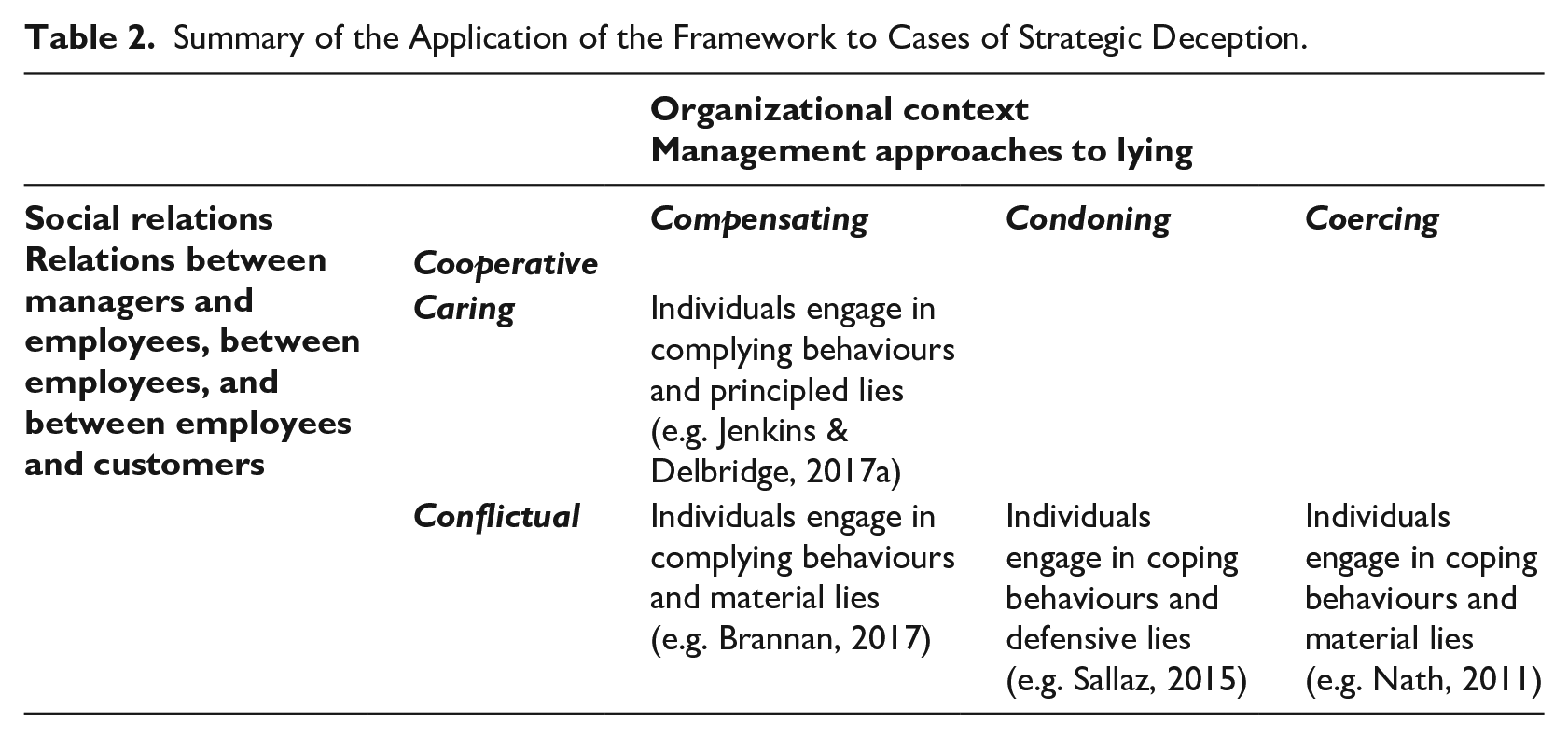
Further, a relational approach draws attention to how agents’ responses to these various contexts are shaped by their own social relations (Delbridge & Edwards, 2013). These relations frame patterns of lying behaviour and action. Our review of the strategic deception cases shows the importance of understanding the tripartite nature of social relations within customer service settings; relations between managers and employees, between co-workers, and with customers were all relevant for understanding patterns of lying behaviour. For example, as Table 2 highlights, while the context may compensate lying behaviour, employees’ relations with customers may be conflictual (Brannan) or caring (Jenkins and Delbridge) which informs the type and meaning of lies in these contexts; hence, the nature of social relations can result in different interpretations of lying. The meaning of lying behaviour for those involved varied markedly depending on the nature of social relations despite both organizational contexts creating enabling conditions to compensate for this behaviour. As Emirbayer (1997) states, a relational assessment conceptualizes individuals as configurations of patterns of behaviour within distinct but meaningfully similar circumstances. By focusing on lying as a ‘pattern of behaviour’ within these various settings we provide an insight into how configurations of contexts and social relations inform agents’ actions and meanings. This relational sociology approach to examining the interplay between these organizational contexts, social relations and agential responses to deception provides the basis for a comprehensive explanation of organizational deception.
Summary of the Application of the Framework to Cases of Strategic Deception.
A relational sociology approach to exploring organizational deception
Our discussion up until this point has demonstrated how the framework that we have developed helps interpret and assess specific cases of strategic deception in customer-facing service organizations. In this final section before concluding, we elaborate the general value of the framework, advancing a research agenda that draws on the framework in order to show how it can be utilized to examine organizational deception across a variety of organizational settings. The four elements that we have identified from our review of the literature – organizational context, social relations, actors’ responses and types of lie – have been brought together through a relational sociology approach in order to provide an integrated framing that allows us both to explore interrelationships between these and to profile varying organizational cases within which different forms of deception take place. Our intention in this brief overview is not to anticipate the full range of possibilities and interactions, but rather to be suggestive of how the framework might be deployed in informing further research.
Through comparative analysis of the cases of strategic deception in the literature, we have been able to populate four cells of the table that is derived from the various combinations of relations in our framework (see Table 2). The framework offers a large number of combinations since in principle each of the nine cells might also contain pairings of any combination of the four types of lie and the three sets of behaviours. However, in practice, while the framework offers a heuristic for exploring any organizational deception, one would anticipate that some ‘patterns’ or combinations are more likely than others. For example, it seems likely that lying that is motivated by a commitment to uphold a principled or moral position will be accompanied by organizational contexts which are condoning of that deception. This combination may be more commonly found to be associated with cooperative and caring social relations and a compliance on the part of the actors involved. One might consider this a form of ‘positive’ organizational deception, that is, a case where lying is undertaken for reasons of morality or principle and is experienced positively by both the organizational members and those that they are interacting with. Conversely, it also seems likely that there will be patterns in what might be referred to as ‘negative’ forms of organizational deception. One such example would be where material lying takes place in a coercive context with conflictual social relations and, as a result, the greater likelihood that actors are left to cope with or challenge their situation. This will be more likely in organizations which are established to undertake fraud or corruption. Malicious lying in a condoning context is also likely to result in conflictual social relations and actors who are left coping with their experiences. Such cases could involve organizations that are characterized by a ‘toxic’ culture where the ethical infrastructure promotes organizational wrongdoing. However, detailed research is needed to understand both the specifics of these organizational processes and in exploring the individual circumstances and outcomes for actors within such organizational contexts.
The framework identifies a dynamic set of relationships that shape and are shaped by their interactions over time. Further research is needed to explore the nature of these interactions and the ways in which the different elements influence each other. For example, in our discussion of cases that enact strategic deception, we have given pre-eminence to the organizational context and types of lying which inform the agential responses and nature of the key social relations. As is shown in Table 2, we have identified examples of each of the three different organizational contexts which inform patterns of lying behaviour. However, we were only able to address some aspects of social relations within these contexts from the four cases that were analysed.
In considering the gaps highlighted by Table 2, further research could assess how cooperative social relations can inform different patterns of lying behaviour and types of lie. For example, it may be that compensating contexts with cooperative social relations are to be found in third-sector organizations such as charities and NGOs where principled lying is likely in order to protect vulnerable client groups. Similarly, we envisage that condoning contexts for deceptions such as those associated with target-driven settings will come up against resistance from employees where their social relations with colleagues or client groups are cooperative or caring. For example, public services organizations such as hospitals and schools where performance targets clash with the cooperative social relations between fellow professionals or with patients or students may lead to the manipulating of performance figures as a form of defensive lying.
Further research on coercive organizational contexts is also required; for example, to explore cases where organizations engage in fraudulent activities and employees comply with these in the knowledge that the firm is harming individuals. In such settings, it may be that ensuring workers are complicit relies on social relations that are cooperative or caring rather conflictual. These relations are not represented in Table 2 but future research could consider how paternalistic management cultures which are based on caring social relations between managers and workers may give rise to material lies in organizations if these are framed as being necessary for the firm to function and survive. Such a framing may provide novel insights into high-profile cases of organizational deception such as the Volkswagen emissions scandal. A relational sociological approach moves beyond some of the limitations of the business ethics literature which emphasizes ethical infrastructures in decision-making (Tenbrunsel & Smith-Crowe, 2008); indeed the interconnectedness of organizational- and employee-level behaviours in the Volkswagen case has been acknowledged (Yanga, Manikab, & Athanasopoulou, 2019). A relational assessment of the Volkswagen case involves examining the extra-organizational context and its influence in shaping whether the internal context enabled lies through compensating or condoning such behaviour; or whether this helped establish a more coercive setting for deception. In addition, it would examine the nature of social relations within this context to assess whether these were cooperative, caring or conflictual in terms of shaping the lying behaviour.
In some of these cases and examples for future research, we would anticipate that there will be discernible paths of development over time including how social relations and contextual features influence identity constructions which inform actors’ responses to their context, and the types of lying that are observed. This elaborates existing research since, for example, although the social psychology literature has started to explore the role of identities in lying behaviour (see Leavitt & Sluss, 2015), our assessment seeks to contextualize identities within organizations to better appreciate how identity constructions are implicated within these contexts (see Brown, 2015). A relational approach, therefore, assesses the specifics of organizational contexts and the social relations within them which influence identity constructions including how lying is informed by identities.
One area for future research would be to examine the processual nature of these interactions and to assess the relative influences of each of the elements on the nature of organizational deception in specific circumstances and over time. Relatedly, processes of identity construction in the context of organizational deception are likely to be a fertile avenue for further research, building on previous studies that have highlighted how occupational and professional identities inform patterns of lying behaviour (e.g. Alpert & Noble, 2009; Jackson, 1991).
Our framing provides the means for evaluating both peer relations and the wider organizational context in examining these processes. The VoiceTel case shows how the sense of collective group identity among team members was promoted through – and helped sustain – lying over time (Jenkins & Delbridge, 2017a). In other cases where lying is an enduring job feature, it may be that such roles are perceived as those of ‘dirty workers’ and are stigmatized (Ashforth & Kreiner, 1999). In such settings, collective and cooperative social relations may support the reframing of the stigma of lying for a living through the crafting of positive collective social identities at work. When the organizational context compensates or condones lying, and where social relations between peers are cooperative, lying is framed as a positive experience, thus overcoming the stigma of lying for a living. The framework thus also offers a potentially valuable contribution to the ways in which organization studies scholars may examine identity threats and the construction of social identities as part of the wider interpretation of organizational cultures.
In significant cases of strategic deception (such as Worldcom, Enron, VW), the nature of the organizational context and the form of deception are central to the organization’s strategy and our framework has helped interpret variation within this subset of organizations. Further research is required to understand the wider range of possibilities in the relationship between organizational strategy and forms of organizational deception. As is the situation in the cases that we have examined, our anticipation is that formal strategy helps to shape but does not determine the organizational context nor the interactions across the elements of the framework. A relational sociology approach sensitizes researchers to the power relations of these interactions. Furthermore, we should not assume that organizational deception is only promoted and developed ‘from above’; it is highly likely that in certain circumstances, actors develop lying behaviour to meet their own ends – either as ways of coping with or challenging their circumstances but also on occasions for material gain – and this will potentially have both direct and indirect impacts on organizational context and social relations. Future research will be able to develop categories that differentiate both between various forms of strategic deception and those forms that develop ‘organically’ from within the organization. Further in-depth studies that explores how the power relations within an organizational setting inform – and are shaped by – lying behaviour is also needed. Where the organizational context is experienced as coercive, this research could build from previous work on organizational misbehaviour and worker resistance (Ackroyd & Thompson, 1999) in foregrounding deception in a relational sociology analysis of workplace relations. Here one might expect defensive lies and challenging behaviours to feature prominently. But the nature of social relations will vary depending on whether the organization is characterized by a coherent base of employees who feel part of a collective and who may come together to challenge management. In a similar vein, we could envision that within contexts where relations with management are conflictual then whistleblowing may emerge as an expression of agency as workers act either individually or collectively to expose lies at work.
Conclusion
In this paper we have provided a definition of organizational deception as ‘intentional behaviour to deceive that takes place within an organizational context and has a specific purpose for the actor(s) involved’. We have concentrated on lies and lying as the most prevalent form of deceit. This has allowed us to differentiate organizational lying from wider conceptions of deception and provided a focus for our review and extension of the existing literature. We have drawn insights from research on lies in organizations across psychology, business ethics, sociology and organization studies. Our review has emphasized the need to understand better actors’ broad motivations to engage in lying and how this behaviour is situated within specific organizational contexts and patterns of social interaction. To extend our understanding of organizational deception, we have utilized a relational sociology approach to develop an integrative framework which provides for an assessment of the interactions between organizational contexts and actors’ behaviours. Such an approach to the examination of organizational deception provides a better appreciation of the way organizational settings variously inform social relations and actions, thereby giving rise to different patterns of interactions in the enactment of how deception takes place. By examining these interactions and their various configurations, we can better assess how deception is understood and experienced by actors. Our analysis has produced a taxonomy of four types of lie: principled, defensive, malicious and material, and distilled three key dimensions through which to study organizational deception: organizational context, social relations and actors’ behaviours.
We then applied this theoretical framework through the detailed examination of four recent studies of strategic organizational deception (Brannan, 2017; Jenkins & Delbridge, 2017a; Nath, 2011; Sallaz, 2015). We identify differences in the organizational context of strategic deception where management variously compensates, condones or coerces employees to lie to customers. Such organizational contexts shape the agentic responses of employees which may result in complying, coping or challenging behaviours. These interactions inform and are informed by the social relations between managers, employees and customers which are observed as either cooperative, caring or conflictual. These interrelationships shape the nature of lying in any particular organizational setting. This application demonstrates the value of a framework that differentiates empirical examples on the basis of organizational context, social relations and actors’ behaviour and provides the foundation for further detailed examination of organizational deception.
The framework is also suggestive of a research agenda for the further examination of organizational deception. Future research may examine in more breadth and depth the nature of the interrelationships that are hinted at in our cases. For example, under what circumstances do compensating contexts elicit agentic responses beyond compliance; how do challenges emerge to coercive contexts and what is the nature of social relations in such circumstances; what organizational contexts promote caring or cooperative social relations during processes of organizational deception? A relational sociology approach also allows for a more thorough analysis of the wider relational context of organizational deception. Our understanding of deception must be grounded in its organizational context – and the social relations within that setting – but our analysis should not stop there. The relationships between market contexts, organizational strategy and deception are worthy of further study, emphasizing the importance of considering the wider institutional context of organizational deception. Social and political contexts of organization are likely to be significant in how processes of deception unfold. In short, there is much work to be done if we are to expand our understanding of this largely hidden but fundamental organizational phenomenon. We hope that our framing of organizational deception will both stimulate further research on this under-examined issue and also prove valuable to organizational scholars who undertake such research.
Footnotes
Acknowledgements
We thank Mike Reed and Tim Edwards for comments on an earlier draft on the paper. We are very grateful for the support, patience and insightful guidance on the development of the paper from the Editor, Joep Cornelissen.
Funding
The author(s) received no financial support for the research, authorship, and/or publication of this article.
