



Abstract
The institutional perspective on corporate social responsibility (CSR) has discussed two diametrically opposed hypotheses about how institutional context influences CSR. Whereas the mirror hypothesis suggests that CSR is stronger in institutional contexts with stringent CSR-related regulations, the substitute hypothesis posits that CSR is stronger in weakly regulated contexts. Drawing on the micro-CSR literature, we propose that examining individual CSR motivation can help to better understand the effect of institutional context on CSR because it makes focusing on substantively motivated CSR possible, and it can shed light on the hitherto neglected psychological moderators in this relationship. We conducted three studies, obtaining results indicating that institutional trust is an important moderator of the institutional effect on individual CSR motivation. Overall, we found the highest individual CSR motivation when regulatory stringency and institutional trust were high, supporting the mirror hypothesis. However, in contexts of low institutional trust, this positive effect of a strong institutional context was reduced or even reversed. Our study contributes to the literature on the institutional perspective on CSR, micro-CSR, and institutional theory, and it has important practical implications for CSR management.
Keywords
Institutional context represents an important driver of corporate social responsibility (CSR), an umbrella term for “policies and practices of corporations that reflect business responsibility for some of the wider societal good” (Matten & Moon, 2008: 405). Building on institutional theory (North, 1990; Scott, 2014) and the literature on comparative business systems (Hall & Soskice, 2001; Maurice & Sorge, 2000; Whitley, 1999), the institutional perspective on CSR argues that “CSR is a social phenomenon [that] doesn’t exist independent of the firm’s institutional context” (Wang, Tong, Takeuchi, & George, 2016: 540). Both theoretical and empirical works allow us to conclude that national institutions such as laws, regulations, and norms affect the implementation of CSR in organizational contexts (e.g., Aguinis & Glavas, 2012; Campbell, 2007; Jackson & Apostolakou, 2010; Matten & Moon, 2008; Wang et al., 2016).
However, despite the considerable body of institutional research on CSR, the direction of the effect that institutional context has on CSR remains theoretically and empirically equivocal. One important stream of this literature argues that business firms mirror the CSR efforts of their institutional context—that is, if governments, regulators, and other institutional actors prioritize CSR, firms will emulate it (Campbell, 2007; Favotto, Kollman, & Bernhagen, 2016; Midttun, Gautesen, & Gjølberg, 2006). According to this line of research, in institutional contexts in which CSR is prioritized—for instance, in countries that have stringent CSR regulations—CSR is treated as essential to the legitimacy and reputation of firms, which are therefore motivated to maintain and strengthen their CSR engagement. Conversely, a second line of research proposes that CSR functions as a substitute for institutional context. According to this argument, firms operating in countries that have few or no CSR regulations in place engage in CSR to compensate for the insufficient levels of institutionally induced CSR engagement (Jackson & Apostolakou, 2010; Kaplan, 2015; Kinderman, 2012; Matten & Moon, 2008). Overall, the mirror and substitute perspectives’ respective arguments appear contradictory in terms of institutional context’s effects on CSR. Whereas the mirror hypothesis suggests that institutional contexts in which CSR is stringently regulated positively impact CSR, the substitute hypothesis argues the opposite. Given that empirical and theoretical research has produced evidence for these contradictory perspectives, it remains unclear whether and under which conditions the mirror or substitute hypothesis is valid (Jackson & Apostolakou, 2010; Kinderman & Lutter, 2018).
This contradiction presents a key challenge to advancing scholarly understandings of the implementation and durability of CSR. Hence, this paper seeks to further examine the contradiction between the mirror and substitute perspectives by introducing, conceptualizing, and testing the microfoundations of CSR and its relation to institutional context. The micro-CSR perspective greatly complements the organizational-level approach to CSR (Aguinis & Glavas, 2012; Jones, Willness, & Glavas, 2017; Shea & Hawn, 2019; Wang et al., 2016) and thereby enables us to address several limitations encountered by prior research. First, it enables us to focus on the essential motivational antecedents of CSR—a construct we name “individual CSR motivation.” Even though CSR represents organizational-level policies and actions (Matten & Moon, 2008), these policies and actions evolve from the individual motivation of employees and managers (Aguinis & Glavas, 2012, 2019). Focusing on the individual level instead of the organizational level helps to narrow the broad and contested umbrella term of CSR down to its essential motivational origin, and thereby allows us to work according to a specific individual-level definition. Importantly, this more specific focus on individual CSR motivation also allows us to identify substantive CSR approaches that truly improve “the wider societal good” (Matten & Moon, 2008: 405) and go “beyond short-term shareholder wealth maximization” (Glavas & Kelley, 2014: 170), these being criteria that have often been demanded by researchers and broader society (Barnett, Henriques, & Husted, 2020; Wang, Gibson, & Zander, 2020). For instance, Patagonia is often praised for its substantive CSR approach, which includes, among other factors, charitable giving, political activism, recycling programs, and cooperation with nongovernmental organizations (NGOs) or CSR-oriented associations, such as the Fair Trade Associations. However, research has repeatedly shown that many organizations engage in CSR only superficially and symbolically, doing so with the main purpose of profit maximization and without paying attention to its actual contribution to society and the environment (Bromley & Powell, 2012). A case in point is net zero commitments by companies that advertise them strongly but do not implement minimum procedural standards to achieve them (Montgomery, Lyon, & Barg, 2024). To focus on substantive CSR, the underlying motivation of which is to address societal issues and contribute to society even if personal resources are at stake, we define individual CSR motivation as the motivation of an individual organizational member to sacrifice his or her resources to improve the organization’s contribution to the common good.
Second, the micro-CSR perspective allows us to examine psychological moderators in the relationship between institutional context and CSR. Specifically, we introduce institutional trust, which is defined as an “individual-level judgment regarding the performance of political institutions and actors” (Hakhverdian & Mayne, 2012: 470), as a key factor in this relationship. Generally, trust in institutions is a major prerequisite for sacrificing self-interest for the greater good, which is essential for substantive CSR (Fairbrother, 2016; Letki, 2006; Macias, 2015; Smith & Mayer, 2018). We therefore theorize that institutional trust is particularly important for individual CSR motivation in contexts of highly institutionalized CSR, because institutions demand a high level of cooperative engagement in CSR.
We conducted three empirical studies to examine how the institutional CSR context affects individual CSR motivation, and the role that institutional trust plays in the relationship between them. Studies 1 and 2 are vignette experiments that enable us to test the effects of manipulated institutional context and trust on individual CSR motivation. Study 3 retests our hypotheses via a study design with higher ecological validity, surveying managers about their current perceptions of the institutional context and of institutional trust, as well as of their CSR motivation. Our findings show that institutional trust is an important moderator of the effect of the institutional context on individual CSR motivation. Across all three studies, our findings consistently show that individual CSR motivation is highest in contexts characterized by high CSR institutionalization and high institutional trust, supporting the mirror hypothesis. In turn, in contexts of low institutional trust, the results are less consistent, suggesting that high trust is essential for a strong mirror effect.
Our contribution is threefold. First, we contribute to a comprehensive understanding of how institutional context influences CSR (Campbell, 2007; Matten & Moon, 2008; Jackson & Apostolakou, 2010; Kinderman & Lutter, 2018). By applying a micro-CSR perspective, we are able to examine an important psychological moderator—institutional trust—in the relationship between institutional context and CSR. Specifically, we found that a high level of institutional trust is important for individuals’ motivation to mirror the CSR endeavors observed in the institutional context. Second, our study contributes to the growing field of micro-CSR (Aguinis & Glavas, 2019; Cooper, Stokes, Liu, & Tarba, 2017; Gond, Akremi, Swaen, & Babu, 2017), which hitherto has rarely discussed how different levels of analysis interact (Aguinis & Glavas, 2012; 2019), and in what ways individuals are connected to macrostructures (Barney & Felin, 2013; Cooper et al., 2017). In our study, we theorize and test institutional context as an important driver of individual CSR motivation, and introduce institutional trust as a psychological bridge between the microconstruct of CSR motivation and the macroconstruct of institutional context. Third, our research advances the scholarly understanding of institutional theory by contrasting sociological neo-institutional theory (DiMaggio & Powell, 1983; Meyer & Rowan, 1977) with rational choice institutionalism (Alasuutari, 2015; Hall & Taylor, 1996). Whereas sociological neo-institutional theory has been predominant in management research in general (Greenwood, Meyer, Lawrence, & Oliver, 2017; Heugens & Lander, 2009), and in CSR research more specifically (Campbell, 2018; Jackson & Apostolakou, 2010; Matten & Moon, 2008), management scholars have rarely applied rational choice institutionalism. However, our findings demonstrate the analytical benefits of considering both approaches.
Theoretical Background
Mirror Hypothesis
In management research, Campbell (2007) was among the first to theorize the potential impact of institutional context on CSR (see also Campbell, 2018). Specifically, Campbell (2007: 955) proposed that businesses “will be more likely to act in socially responsible ways if there are strong and well-enforced state regulations in place to ensure such behavior.” He argued that if states establish strong norms and regulations for CSR, firms will be pressured to behave in socially responsible ways so that they avoid sanctions on the one hand and stabilize their reputation and legitimacy on the other. Campbell’s argument corresponds to sociological neo-institutional theory, which postulates that firms engage in a certain business practice once it has gained legitimacy and become taken for granted (DiMaggio & Powell, 1983; Meyer & Rowan, 1977). Applied to CSR, this postulation implies that what drives firms to engage in CSR is a shared understanding that CSR is appropriate and essential for a firm’s legitimacy in its institutional context. For example, if there are strict regulations that require businesses to increase their CSR (i.e., coercive pressure), if CSR becomes common practice in an industry (i.e., mimetic pressure), or if most stakeholders strongly value and require businesses to demonstrate CSR (i.e., normative pressure; DiMaggio & Powell, 1983), CSR will achieve a taken-for-granted status. In the literature, this proposition is referred to as the “mirror hypothesis” because it postulates that companies’ CSR engagement reflects the dominant expectations in their institutional surroundings (Campbell, 2018; Jackson & Apostolakou, 2010; Kinderman & Lutter, 2018).
Several empirical studies have found support for the mirror hypothesis. For example, Ioannou and Serafeim (2012) found that countries with powerful labor movements exhibit higher levels of CSR adoption. Rathert (2016) showed that in societies where non-shareholding stakeholders have considerable power, multinational enterprises adopt CSR policies focused on labor standards and rights. Brieger, Terjesen, Hechavarría, and Welzel (2019) found evidence that owners of businesses operating in countries with strong citizen rights and good governance prioritize more strongly socially responsible business activities, and Favotto et al. (2016) detected signs that CSR engagement—particularly that focused on labor and human rights aspects—is stronger in the reports produced by companies operating in Europe’s coordinated market economies than it is in those produced by companies operating in the United States’ liberal market economy. Finally, several studies have shown that companies in Nordic European countries, where CSR regulations are particularly prominent, exhibit the best CSR performance worldwide (Gjølberg, 2009; Midttun et al., 2006; Strand, Freeman, & Hockerts, 2015).
Substitute Hypothesis
The substitute hypothesis, on the other hand, argues that CSR thrives in less regulated and economically more liberalized institutional environments or in countries whose institutions are absent or weak (Jackson & Apostolakou, 2010; Kaplan, 2015; Kinderman, 2012; Marens, 2012; Matten & Moon, 2008). This hypothesis is theoretically grounded in rational choice institutionalism, which has been mainly prevalent in political science (Alasuutari, 2015; Hall & Taylor, 1996; Kinderman & Lutter, 2018; Scott, 2014). Rational choice institutionalism proposes that “actors have a fixed set of preferences, the attainment of which they aim to maximize by behaving instrumentally in environments that are shaped by the institutional arrangements” that are in place (Alasuutari, 2015: 165).
In contrast to economic rational choice models, rational choice institutionalism acknowledges that institutions play an important role in instrumental decision-making (Alasuutari, 2015; Hall & Taylor, 1996). Specifically, this perspective posits that institutions structure interactions between actors “by providing information and enforcement mechanisms that reduce uncertainty about the corresponding behavior of others” (Hall & Taylor, 1996: 945). Accordingly, if demonstrating that CSR is instrumental for an actor in a given institutional context, CSR motivation should be correspondingly high. Rationally, there is greater potential as well as a greater need for businesses to contribute to solving certain problems in contexts where CSR is weakly institutionalized than there is in contexts where CSR is highly institutionalized. One reason why CSR motivation is a rational choice for businesses in laxly regulated contexts is that the absence of laws and regulations may harm them if they do not engage in CSR (Kinderman & Lutter, 2018). For example, if a firm operating in a country where workers’ rights are not protected by law wants to improve employee outcomes, it might need to invest in CSR measures that maintain and enhance its employees’ quality of life (e.g., Moon, 2005). Another reason is that in contexts where little is done and nobody is obliged to contribute, every voluntary CSR action seems particularly noble and is likely to translate into a good reputation and a rise in legitimacy. Accordingly, organizations can “deploy CSR strategically as a point of differentiation to harness competitive advantage” (Skandera, McKenny, & Combs, 2022: 2; see also Vishwanathan, van Oosterhout, Heugens, Duran, & van Essen, 2020).
In line with the substitute hypothesis, Matten and Moon (2008) suggest that in countries where the economy has always been weakly regulated—the United States, for instance—the institutional context forces companies to adopt CSR voluntarily and proactively, whereas in more regulated economies—for example, those of many European countries—there is less scope for businesses to impress stakeholders with voluntary CSR because they have to comply with regulatory requirements for socially responsible business activities anyway. Jackson and Apostolakou (2010), who empirically tested Matten and Moon’s theory, found evidence supporting the substitute hypothesis in the social and environmental domains of CSR. Other studies also support it, showing that CSR is most prevalent in highly liberal and laxly regulated economies such as those of the United States (Kaplan, 2015; Kinderman, 2012; Marens, 2012). Overall, this line of research suggests that firms use CSR more often when they are embedded in contexts with lax CSR regulations.
Disentangling the Effects of Institutional Context on CSR From a Micro-Level Perspective
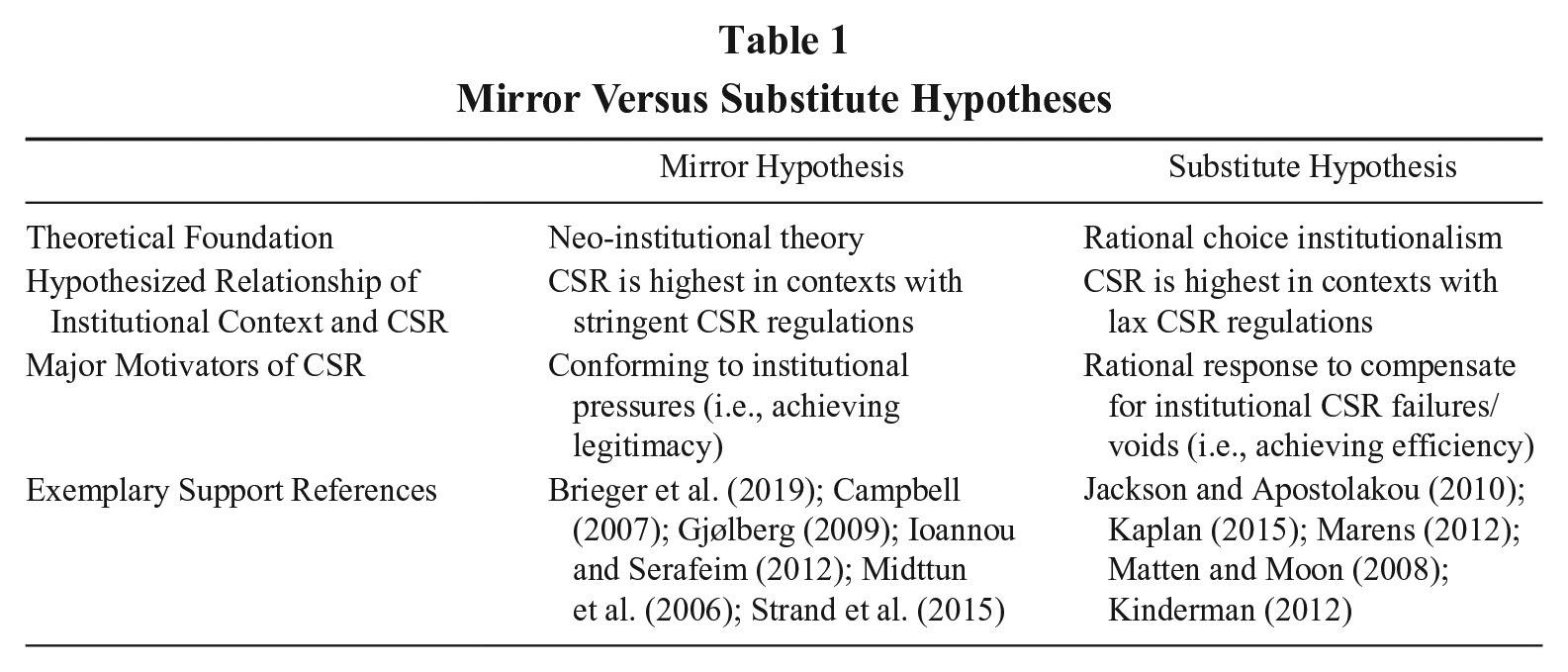
The mirror and substitute hypotheses’ respective arguments appear to be diametrically opposed with regard to the effects of institutional context on CSR (see the summary in Table 1). Whereas the mirror hypothesis argues that contexts with highly institutionalized CSR have a positive impact on CSR, the substitute hypothesis argues the opposite. We propose that a focus on the microfoundations of CSR could help to resolve this debate by shedding light on the so far neglected individual motivational antecedents. This approach allows for a more precise examination of substantively motivated CSR, and facilitates the identification of key psychological moderators that influence the effects of institutional context on CSR.
Mirror Versus Substitute Hypotheses
Individual CSR Motivation: Foregrounding Substantive CSR to Tackle the Mirror Versus Substitute Debate
One problem facing research on CSR in general, and the institutional perspective of CSR in particular, is the contested and broad definition of CSR (Aguinis & Glavas, 2012; Matten & Moon, 2008). Most CSR definitions generally reflect “business responsibility for some of the wider societal good” (Matten & Moon, 2008: 405) and often address at least the social and environmental aspects of it (e.g., Glavas & Kelley, 2014; Hafenbrädl & Waeger, 2017). For example, the environmental dimension of CSR typically includes the reduction of pollution or investment in green innovations, whereas the social dimension includes employee- or community-oriented approaches, such as humanitarian aid or support for minorities (e.g., El Akremi, Gond, Swaen, De Roeck, & Igalens, 2018). Moreover, CSR’s strong connection to stakeholder theory has led several CSR scholars to argue that CSR is mostly about “the role and impact of the firm on primary stakeholders (i.e., customers, employees, shareholders, suppliers) as well as secondary stakeholders (i.e., community, environment, government, and society in general)” (Glavas & Kelley, 2014: 170).
But even though CSR is mainly about the contribution to the common good, which should go “beyond short-term shareholder wealth maximization” (Glavas & Kelley, 2014: 170), many CSR studies focus on strategic activities that have the highest potential for profit maximization instead of on substantial activities that are relatively costly but have a high potential to contribute to the common good (Barnett et al., 2020; Combs, Jaskiewicz, Ravi, & Walls, 2022; Wang et al., 2016). For example, prior research has often focused on voluntary explicit CSR practices (e.g., donations) instead of on implicit CSR undertaken in response to regulations (e.g., following labor laws correctly), even though research indicates that organizations use explicit CSR strategically to maximize profit rather than to contribute to society and the environment (Bromley & Powell, 2012; Matten & Moon, 2008). Moreover, the “focus has been mainly placed on the social actions themselves, while the authenticity or sincerity behind the social acts is often overlooked” (Wang et al., 2020: 4). However, authenticity and sincerity are an essential motivational starting point for substantive CSR because they demonstrate a genuine intention to contribute to society and go beyond the motivation of profit maximization or other forms of self-enrichment (Girschik, Svystunova, & Lysova, 2022; Wang et al., 2020). In turn, a focus on individual CSR motivation helps to identify the motivational underpinnings of authentic and sincere actions.
The emergent field of micro-CSR has acknowledged the importance of motivational antecedents of CSR, yet it has hitherto mostly focused on individuals’ reactions to CSR (Gond et al., 2017). Girschik et al. (2022: 8) criticize this approach for portraying organizational members as “passive recipients of organizational CSR,” even though they play an active role in CSR formation. We propose to address these shortcomings by placing the individual at the center of our studies and by focusing on his or her authentic and sincere motivation to contribute to the common good, even if doing so may require him or her to sacrifice personal benefits or resources. In fact, “sacrificing profits in the social interest” is a common definition for CSR in economics, and it can arguably contribute to the development of micro-CSR research (Bénabou & Tirole, 2010; Reinhardt, Stavins, & Vietor, 2008). Accordingly, we define individual CSR motivation as the motivation of an individual organizational member to sacrifice his or her resources to improve the organization’s contribution to the common good.
To understand the effects of institutional context on individual CSR motivation, we focus on a state’s CSR-related regulation, which, according to Campbell (2007: 954), is “the most obvious institutional explanation of socially responsible corporate behavior.” Specifically, we aim to compare the effects of stringently and laxly regulated contexts on individual CSR motivation. Regulatory stringency represents the strength and effectiveness of regulations (Kruse, Dechezleprêtre, Saffar, & Robert, 2022). In stringently regulated contexts, there are several major sets of regulations in place, and these are strictly enforced. For example, Scandinavian countries are known for their uniquely stringent regulations in areas such as environmental protection, worker rights, product safety, and corporate governance (Strand et al., 2015). Often surpassing European Union requirements, these regulations enforce higher national standards that aim to drive companies to adopt practices benefiting the common good (Gjølberg, 2009; Midttun et al., 2006; Strand et al., 2015). By contrast, in laxly regulated contexts, regulations are fewer, and their enforcement is limited. A case in point is the United States, where, compared to many European countries, stringent regulation and enforcement in areas such as environmental protection or worker rights tend to be weaker (Bradford, 2020; Matten & Moon, 2008).
Applying the mirror hypothesis to individual members of an organization, we would expect stringent CSR regulations to motivate individuals to improve the organizational contribution to the common good, even if doing so may require them to sacrifice personal resources. Sociological neo-institutional theory, the theoretical base on which the mirror hypothesis is built, suggests that “the adoption of components of formal structure is often driven by decision-makers’ observations of [. . .] pressures to meet the expectations of external constituents, rather than by independent calculations of how to accomplish work tasks efficiently” (Tolbert & Darabi, 2019: 272; see also Meyer & Rowan, 1977). Accordingly, we can infer that individuals would conform to the institutionalized CSR expectations reflected in the stringent regulations and would be motivated to mimic them because CSR practices are necessary to gain legitimacy in this context (Campbell, 2007; DiMaggio & Powell, 1983). Based on this reflection on applying the mirror hypothesis at the individual level, we formulate our first hypothesis as follows:
Hypothesis 1: The more stringent the local CSR regulations, the higher the individual CSR motivation (mirror hypothesis).
In contrast, when applying the substitute hypothesis to an individual’s CSR motivation, expectations about the effect of stringent CSR regulations on individual CSR motivation would go in the opposite direction. Based on the substitute hypothesis and its theoretical grounding in rational choice institutionalism (Alasuutari, 2015; Kinderman & Lutter, 2018), we hypothesize that stringent CSR regulations would lower the motivation of the individual organizational member to improve the organizational contribution to the common good. Accordingly, individuals would have a strong CSR motivation only when they perceive a clear need for, or benefit from, their engaging in CSR. For example, an individual could perceive investing in CSR to be beneficial if it is likely to result in a competitive advantage (e.g., a manager may invest in his or her employees’ well-being so that they become more productive than their counterparts at competitor firms). Another example of potential benefits that could heighten individual CSR motivation is the reputational advantage of being among the few organizational members who make this pro-social effort. In contrast, if CSR is already highly institutionalized—and the individual therefore assumes that almost all other organizational members are engaging in it to some degree—the motivation to invest in CSR is reduced, because the rational need to do something personally and the corresponding benefits are strongly reduced but the potential sacrifices still remain. Based on this reflection on applying the substitute hypothesis at the individual level, we formulate our second hypothesis as follows:
Hypothesis 2: The more stringent the local CSR regulations, the lower the individual CSR motivation (substitute hypothesis).
Institutional Trust: A Psychological Moderator
In addition to shedding light on the motivational underpinnings of CSR, a focus on the microfoundations of CSR also helps to identify and test psychological moderators that influence the institutional effect on CSR. Research from sociology and political science suggests that individuals’ perceptions of the institutional context strongly affect how individuals form their pro-social or pro-environmental intentions and behaviors in these contexts (Fairbrother, 2016; Letki, 2006; Macias, 2015; Smith & Mayer, 2018). Based on this literature, we propose that institutional trust serves as a crucial moderator in understanding the impact of a stringent regulatory context on individual CSR motivation. Generally, trust represents “a psychological state comprising the intention to accept vulnerability based upon positive expectations of the intentions of another” (Rousseau, Sitkin, Burt, & Camerer, 1998: 395). Having a high degree of trust in another actor implies perceiving the risk of being betrayed or exploited by that actor as low (Bachmann, 2001; Letki, 2006; Levi & Stoker, 2000). Trust can result from rational considerations, as well as from cognitive and affective processes (Holtz, 2013; Lewicki, Tomlinson, & Gillespie, 2006). It develops over time, based on an individual’s personal experience and socialization, as well as on subjective evaluation of other actors’ attitudes and behavior (Mishler & Rose, 2001). Prior research proposes that trust is a prerequisite for cooperation and a willingness to sacrifice self-interest for the greater good (Fairbrother, 2016; Letki, 2006; Macias, 2015; Smith & Mayer, 2018).
Recent research suggests that institutional trust, in particular, is more predictive of cooperative behavior that entails pro-social sacrifices than is the more general form of trust (Fairbrother, 2016; Harring, 2013). Hakhverdian and Mayne (2012: 470) describe institutional trust “as a product of individual-level judgment regarding the performance of political institutions and actors.” The evaluation that political institutions are effective, honest, and not corrupt plays a significant role in motivating individuals to cooperate with the government and society (Harring, 2013; Rothstein & Stolle, 2008; Warren, 2004). In other words, the more individuals trust political institutions, the lower the perceived risk of investing effort in cooperating with these institutions to achieve mutual goals. Conversely, a lack of trust in critical political institutions reflects the perception that cooperation entails considerable risks and reduces willingness to make personal sacrifices for common goals. Consequently, we expect that trust in institutions affects how institutional context influences individual CSR motivation. High institutional trust, therefore, should motivate organizational members to commit to the CSR goals that a trusted institution sets, and to cooperate with institutional actors to achieve these goals, whereas low institutional trust should reduce their willingness to cooperate.
Importantly, prior research suggests that institutional trust is particularly consequential where cooperation carries a high risk and interdependence, in the sense that individuals are required to make significant sacrifices with unknown outcomes (Bachmann, 2001; Rousseau et al., 1998). Therefore, in settings where institutional CSR demands are high and individuals do not trust their institutions, the motivation to mirror and support regulators’ CSR goals is likely to be lower because individuals are likely to expect that their considerable personal investments and sacrifices for the sake of CSR will not pay off. Conversely, when individuals trust institutions, they are likely to be more confident that their personal sacrifices and investments will improve the status quo. In such settings, therefore, we expect that individuals are more likely to be motivated to invest in CSR, mirroring institutional CSR efforts. Accordingly, we expect that institutional trust would matter most in contexts where CSR-related regulations are stringent, because these institutions demand high CSR investments or strictly prescribe which kinds of CSR investments are obligatory. We thus expect that in stringently regulated contexts individuals exhibit stronger CSR motivation when their institutional trust is high compared to when it is low. By contrast, we expect that institutional trust plays a less critical role in contexts with more relaxed regulations, where cooperation carries a low risk and minimal sacrifice. Accordingly, we formulate the third hypothesis as follows:
Hypothesis 3: Institutional trust moderates the effect of local CSR regulatory stringency on individual CSR motivation, such that regulatory stringency has a more positive effect in contexts of high institutional trust than in contexts of low institutional trust.
Empirical Studies
In our research, we aim to take advantage of the conceptual and methodological benefits of a micro-CSR approach to better understand the effect of institutional context on CSR. We conducted three studies to examine the effect of regulatory stringency and its interaction with institutional trust on individual CSR motivation. In the first two studies, we employed an experimental vignette methodology (Alexander & Becker, 1978; Wombacher & Felfe, 2017), which “enhances experimental realism and also allows researchers to manipulate and control independent variables, thereby simultaneously enhancing both internal and external validity” (Aguinis & Bradley, 2014: 352). In these vignette experiments, we asked participants with management experience to imagine what their CSR motivation would be if they were managing a business in a country with either high or low levels of institutional trust and regulatory stringency. In Study 3, we surveyed managers from the United Kingdom and South Africa to understand how their current perceptions of regulatory stringency and its interaction with institutional trust affect their CSR motivation in their current organizations.
In all three studies, we focused on the environmental dimension to manipulate regulatory stringency and measure individual CSR motivation. There has been “a significant shift in CSR studies from examining CSR as an aggregate of multiple social dimensions to focusing on a specific element of social activities” to further narrow down the construct’s definitional broadness (Wang et al., 2016: 537). Prior research has shown that an aggregate of various social, environmental, and economic dimensions of CSR makes for an insufficiently precise basis for making clear predictions about specific drivers or outcomes of CSR, because each of the dimensions is unique and might be based on different motivations and strategies (Wang et al., 2016). The environmental dimension of CSR is one of the most widely studied aspects of CSR (Wang et al., 2016) and, in terms of addressing the global challenge of climate change, one of the most critical. The environmental dimension is also well represented at a regulatory level in the form of, for instance, environmental taxes and laws limiting greenhouse gas emissions. In all three studies, we focused on managers’ individual CSR motivation because managers play an important role in forming CSR practices and represent a central and unique building block in management theory (Aguinis, Audretsch, Flammer, Meyer, Peng, & Teece, 2022).
Study 1
In our first study, we aimed to test our hypotheses using a vignette experiment in which we manipulated the level of regulatory stringency and institutional trust and measured the resulting level of managers’ individual CSR motivation.
Procedure
We chose a 2 × 2 between-subjects design for the vignette experiment to compare the manipulated effects of high versus low levels of regulatory stringency and high versus low levels of institutional trust on individual CSR motivation. We used vignettes that had been applied in previous experiments to manipulate trust and regulatory stringency (e.g., Batrancea et al., 2019; Wahl, Kastlunger, & Kirchler, 2010), adapting them to the context of our study. After providing their demographic information, the participants were asked to imagine living and managing a business in a fictitious country called Varosia. Their business was described as a mid-sized beverage production company that makes a small but growing profit. Next, participants were randomly assigned to one of the four experimental conditions. Depending on the condition, the participants were told that Varosia’s citizens generally have high or low trust in Varosia’s political institutions and that the country has either stringent or lax CSR regulations in place.
Specifically, in the high institutional trust condition, the description stated that most citizens of Varosia have high institutional trust because Varosia’s political system is stable, the government enjoys a good reputation, referendums are held regularly, national budget expenditures are monitored and transparent, taxpayer money is used sensibly, and corruption is low. In the low institutional trust condition, the description stated the reverse—that is, most citizens have low trust in Varosia’s institutions because the political system is unstable, the government’s reputation is poor, referendums are never held, citizens do not know how taxpayer money is spent but are aware it is mostly not spent sensibly, and corruption is rife. In turn, in the high regulatory stringency condition, the participants were told that the government of Varosia had implemented—and consistently enforces—strict regulations to protect the environment. In the low regulatory stringency condition, the participants were told the complete opposite—that is, the government of Varosia had not implemented environmental regulations, and the few CSR regulations that are in place are neither strict nor consistently enforced. Participants in the high regulatory stringency condition were additionally told that citizens and companies pay high environmental taxes, whereas in the low regulatory stringency condition, they were told that such taxes are low. After reading the vignette, participants answered questions about what their perceptions and motivations would be if they lived and managed a business in the version of Varosia that had been described to them. We present the full vignette manipulation in Appendix A in the online supplemental material.
Measures
The survey started with demographic questions about participants’ age, gender (0 = male, 1 = female), education (1 = No formal qualifications to 7 = Doctoral degree [PhD/other]), and management experience. For the manipulation check of institutional trust, we measured participants’ perceived institutional trust by asking for their level of agreement with the following three statements: “I trust the government of Varosia,” “I trust the parliament of Varosia,” and “I trust the political parties of Varosia” (Cronbach’s α = .99). To check the manipulation of regulatory stringency, we measured participants’ perceived regulatory stringency using an adapted version of a stringency measure from the World Economic Forum’s (WEF) Executive Opinion Survey (ρy1y2 = .97; “How would you assess the stringency of Varosia’s environmental regulations?” and “How would you assess the enforcement of environmental regulations in Varosia?”). Respondents answered these questions on a Likert scale ranging from 1 (Very lax) to 7 (One of the most stringent in the world).
To measure individual CSR motivation, we adjusted a two-item measure from the World Value Survey (WVS) because it represents a validated measure of individual commitment to engage with environmental issues, and it places clear emphasis on individuals’ personal sacrifices for the common good (Gelissen, 2007), which is a central criterion of substantive CSR and our definition of individual CSR motivation. Specifically, we asked participants to what extent they agreed with the following statements: “As a business manager in Varosia, I would share part of my business profit if I were certain that the money would be used to prevent environmental pollution” and “As a business manager in Varosia, I would agree to an increase in business taxes if the extra money were used to prevent environmental pollution” (ρy1y2 = .90). Just as there is currently no agreement regarding the definition of CSR, neither is there consensus on a single CSR measurement scale, and, to our knowledge, no scale has been developed specifically to measure managerial CSR motivation. Moreover, most CSR scales neglect the aspect of individual sacrifices for the common good, despite research indicating that this is an important component of substantive CSR that goes beyond profit maximization (Bénabou & Tirole, 2010; Girschik et al., 2022; Wang et al., 2020). Hence, we decided to use a measure that emphasizes personal sacrifices for the common good and adjust it to the managerial CSR context. Initially, we also included the original WVS measure in this and another study. However, the original WVS measure failed the content validation proposed by Colquitt, Sabey, Rodell, and Hill (2019), because the individual motivation had no connection to the organizational level, which is central to the construct definition of individual CSR motivation. Hence, we focus here on the results of the measure adjusted to the organizational context (i.e., business managers’ motivation) and report the results with the initial measure and its validation in Online Appendix B. Table 2 presents the means, standard deviations, and correlations of the variables used in this analysis.
Study 1: Descriptive Statistics and Correlations
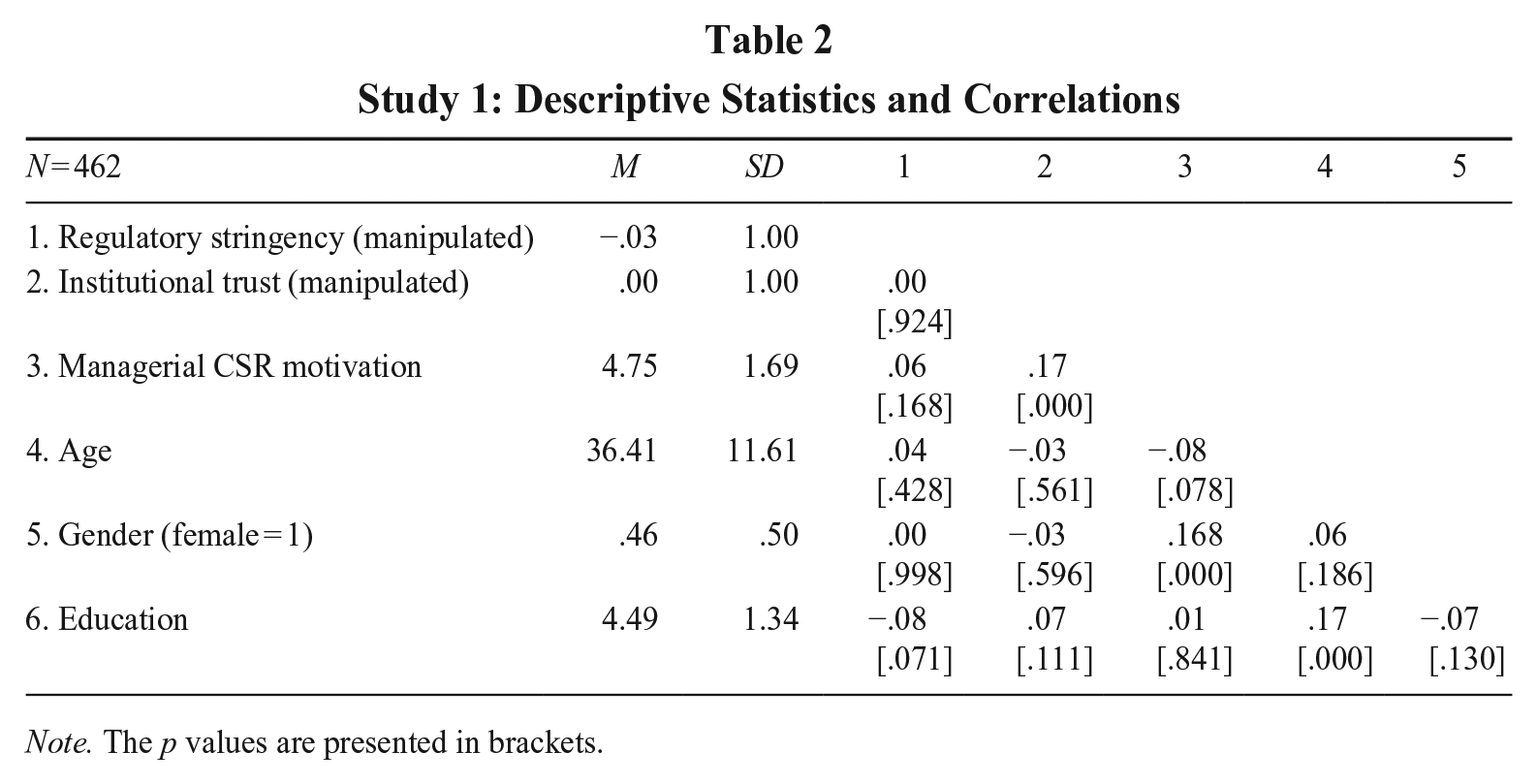
Note. The p values are presented in brackets.
Participants
We used the Prolific.co survey platform to recruit 480 U.S.-based managers. The final sample consisted of 462 participants, because 10 did not finish the questionnaire and eight failed the attention check. The participants’ mean age was 36.41 years (SD = 11.61); 53.7% were male; and 70.6% had at least an undergraduate college degree (see Table 2). On average, the participants needed 8 minutes to complete the survey and received a reward of £1.25 ($1.76).
Analysis and results
First, a manipulation check confirmed that manipulating institutional trust and the stringency of CSR regulations had worked as intended. Specifically, we found that Varosia’s CSR regulations were perceived as more stringent in the high stringency condition (M = 5.91, SD = .97) than they were in the low stringency condition (M = 1.57, SD = .81, t(460) = −52.08, p < .001). Similarly, the respondents reported higher institutional trust in the high institutional trust condition (M = 5.07, SD = 1.25) than they did in the low institutional trust condition (M = 1.60, SD = .79, t(460) = −36.06, p < .001).
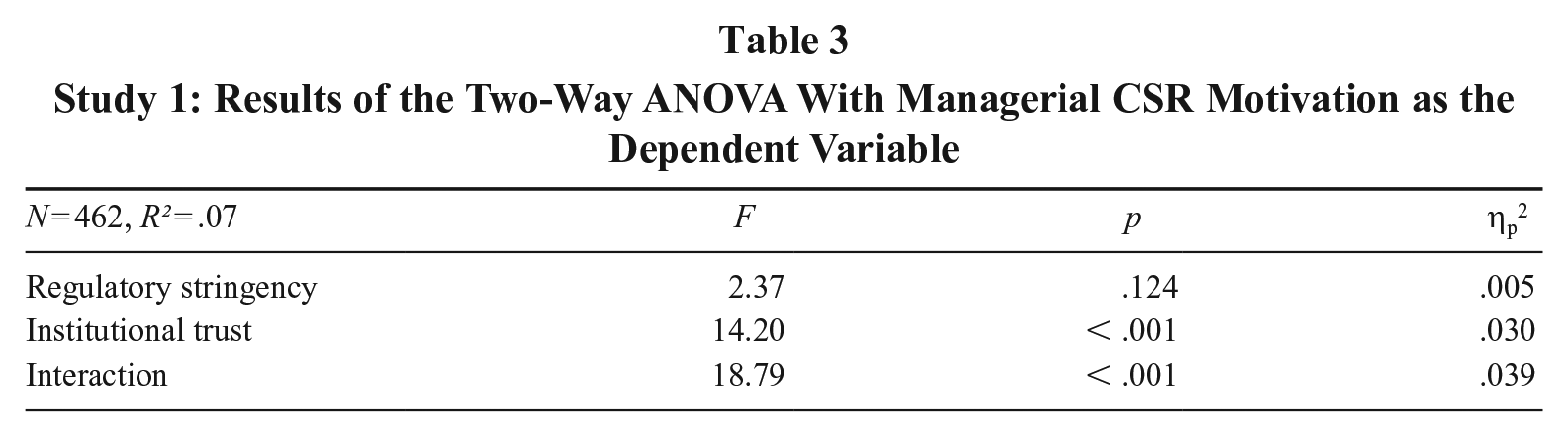
To test our hypotheses, we conducted a two-way ANOVA in which the dummy variables of manipulated regulatory stringency (high = 1, low = 0) and institutional trust (high = 1, low = 0) as well as the interaction of the two variables are the independent variables and managerial CSR motivation is the dependent variable. As reported in Table 3, the analysis reveals that the effect of the manipulated stringency was not significant (F = 2.37; p = .124; ηp2 = .005), whereas the effect of trust (F = 14.20; p < .001; ηp2 = .030) and the interaction effect of the two dummy variables (F = 18.79; p < .001; ηp2 = .039) on managerial CSR motivation were significant. The interaction effect is visualized in Figure 1. The pairwise comparison of the estimated marginal effects shows that managerial CSR motivation was higher in the low compared to the high regulatory stringency condition if the manipulated institutional trust was low (Mstringency-low = 4.68, SD = .15; Mstringency-high = 4.26, SD = .15; F = 4.03, p = .045, ηp2 = .009). However, in the high institutional trust condition, managerial CSR motivation was higher in the high compared to the low regulatory stringency condition (Mstringency-low = 4.60, SD = .15; Mstringency-high = 5.49, SD = .15; F = 16.75 p < .001, ηp2 = .035). The effect sizes of the means comparisons, measured by ηp2, show that the positive effect of stringency in the high trust condition was approximately four times higher than the negative effect of stringency in the low trust condition. These results suggest that in low trust contexts, a small substitution effect is likely, while in high trust contexts a stronger mirror effect applies. Importantly, managerial CSR motivation was highest overall in the high stringency and high trust condition, further supporting the mirror hypothesis.
Study 1: Results of the Two-Way ANOVA With Managerial CSR Motivation as the Dependent Variable
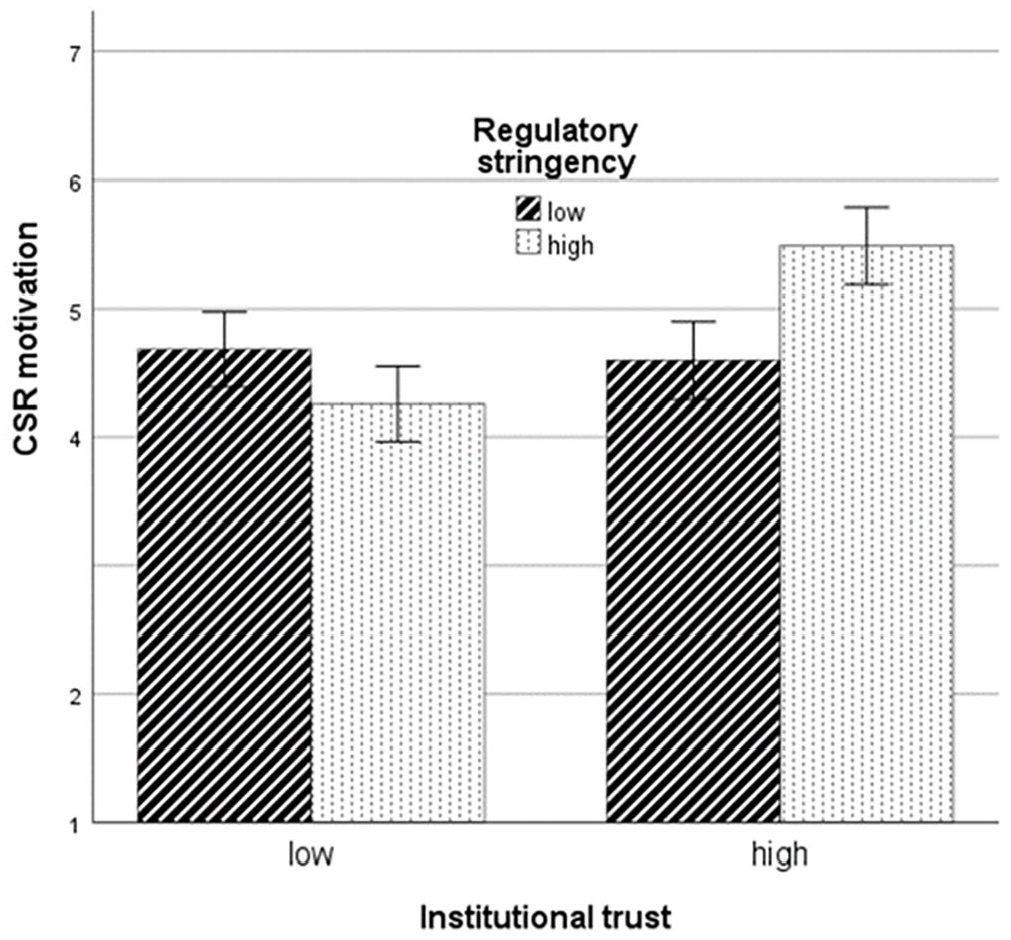
Study 1: Interaction Effect Between Regulatory Stringency and Institutional Trust on CSR Motivation
The R² of the full model is .07, implying that the full model explains approximately 7% of managerial CSR motivation. The partial eta-squared (ηp2) represents the effect size of each variable and can be interpreted as the proportion of variance in the dependent variable explained by each of the variables (Iacobucci, Popovich, Moon, & Román, 2023). Concerning the interpretation of effect sizes, current research suggests comparing these with effect sizes that are typical in the field of study (Funder & Ozer, 2019; Iacobucci et al., 2023). A large-scale meta-analysis found that the mean size for different published effects on motivation is r = .15 (Richard, Bond, & Stokes-Zoota, 2003), which translates to an η2 of .022. However, “these results are very likely to be overestimates of the true effects of the variables studied, because of publication bias that privileges significant findings (and so, on average, larger effects)” (Funder & Ozer, 2019: 159). For example, a “many-labs” study found that the average effect size of published effects in psychological research (d = .60 or η2 = .083) is much higher than the effect size from replications (d = .15 or η2 = .006; Klein et al., 2018). Hence, we conclude that the effect of stringency is relatively small but still comparable to the benchmark of psychological effect by Klein et al. (2018), whereas the effects of trust and the interaction of the two variables present effects of a size that exceeds the typical effect size for motivational research (Richard et al., 2003).
Discussion
Overall, the results support our moderation hypothesis (Hypothesis 3), showing that institutional trust moderates the effect of CSR stringency on individual CSR motivation, such that regulatory stringency has a more positive effect in contexts of high institutional trust than in contexts of low institutional trust. Specifically, we found a negative effect of regulatory stringency on individual CSR motivation in the low trust condition, but a positive effect in the high trust condition. Accordingly, Study 1 supports the mirror hypothesis (Hypothesis 1) for high trust contexts, and the substitute hypothesis (Hypothesis 2) for low trust contexts. However, it is important to note that the mirror effect was four times stronger than the substitute effect. Accordingly, we found the highest levels of individual CSR motivation in contexts of high trust and high stringency, further supporting the mirror hypothesis (Hypothesis 1).
Study 2
In Study 2, we retested our hypotheses using an improved measure of individual CSR motivation and experimental design. The individual CSR motivation measure of Study 1 consisted of only two items, a choice that made the study more efficient but may have imposed limitations in terms of construct validity (Eisinga, Grotenhuis, & Pelzer, 2013). Accordingly, in Study 2 we used a more comprehensive measure of individual CSR motivation that consists of seven items adapted from two validated CSR scales (Glavas & Kelley, 2014; Hafenbrädl & Waeger, 2017). Building on scales developed in the CSR literature allowed us to capture the environmental dimension of CSR to a more precise degree than we had been able to achieve using Study 1’s two-item measure. Additionally, we enhanced participant screening to ensure a high level of attention, which is crucial for effective manipulation and the validity of the resulting effects. Whereas in Study 1 we used manipulation checks based on participants’ perception of stringency and institutional trust to validate the effectiveness of our manipulations, in Study 2 we used comprehension checks to screen out participants who did not read or understand the vignette manipulation. Moreover, to further improve participant selection, we defined additional screening criteria based on a reCAPTCHA question and the time taken to complete the task.
A post-hoc power analysis using G*Power (Version 3.1.9.7) revealed that our sample was large enough to identify medium effects (Power ≥ .95) but not smaller effects (Power ≤ .54) such as the direct effect of regulatory stringency. Accordingly, we calculated the necessary power a priori. Additionally, to enhance the transparency of our research process, we pre-registered our experiment on AsPredicted (https://aspredicted.org/bwd6-z588.pdf).
Procedure
We conducted a 2 (high versus low stringency) × 2 (high versus low institutional trust) vignette experiment using the vignette manipulations from Study 1 (see Appendix A in the online supplemental material). After providing their demographic data, participants read a vignette that began with an introduction asking them to imagine living and managing a business in Varosia. Each vignette then presented one of the four manipulation conditions of trust and stringency. After reading the vignette, participants answered questions about what their perceptions and motivations would be if they lived and ran a business in the version of Varosia that had been described to them.
Measures
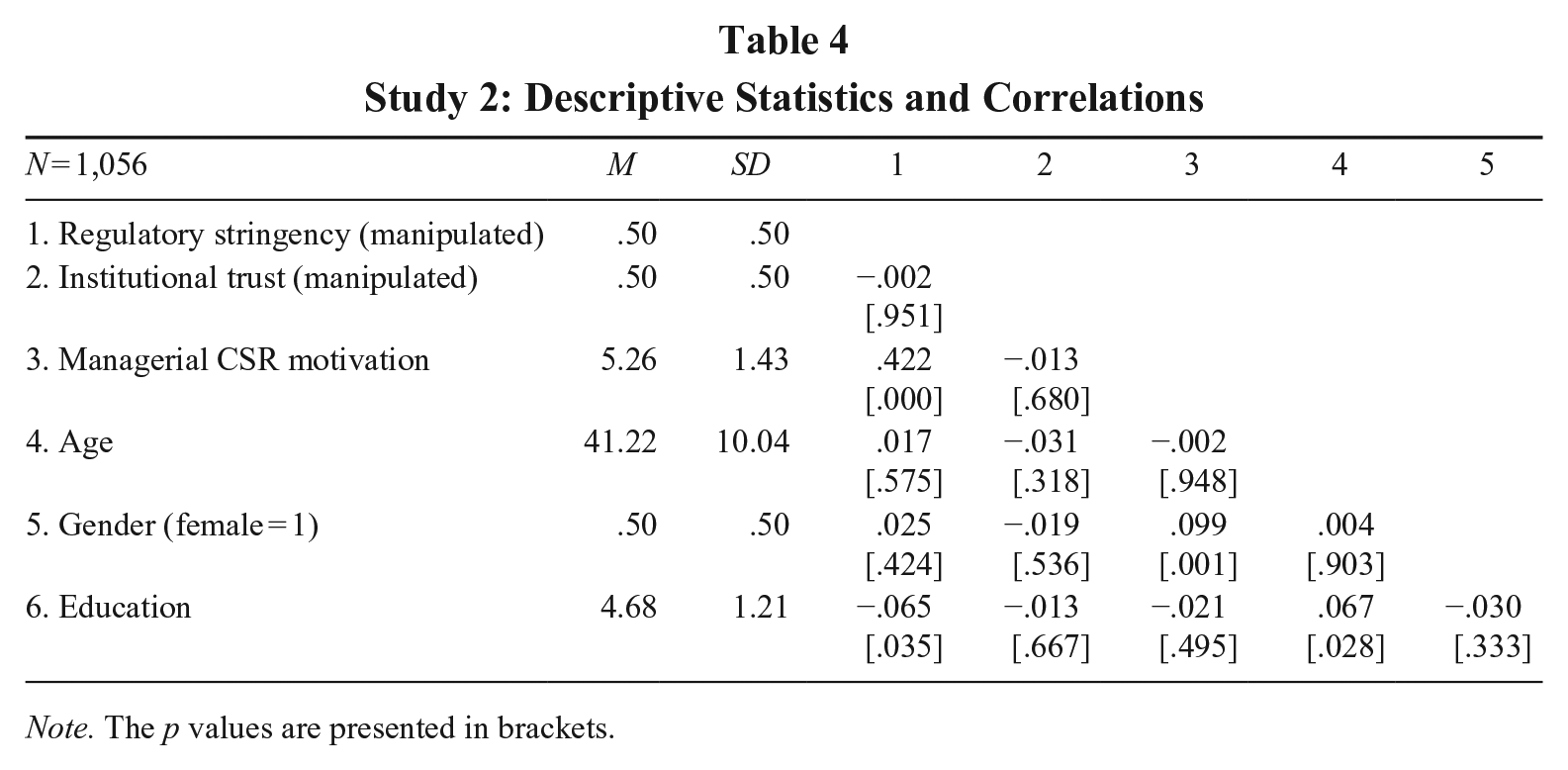
As in Study 1, we asked about participants’ age, gender, education, employment status, and management experience. To measure our dependent variable managerial CSR motivation, we used an adjusted version of the environmental dimension of two validated CSR scales. The first scale we included in our study was developed by El Akremi et al. (2018) and has already been applied in the managerial context by Hafenbrädl and Waeger (2017). We used the version from Hafenbrädl and Waeger (2017), slightly adjusting it to fit our context (three items; Cronbach’s α = .95; e.g., “I would ensure that my company contributes toward saving resources and energy [e.g., recycling, waste management] even if it leads to financial sacrifices for me.”). The second scale was the environmental dimension sub-scale by Glavas and Kelley (2014; four items; Cronbach’s α = .96; e.g., “I would ensure that environmental issues are integral to the strategy of my organization even if it leads to financial sacrifices for me.”). We decided to combine the two managerial CSR motivation scales because their item formulations were very similar, and the combined scale had a slightly higher Cronbach’s α compared to the separated scales (seven items, α = .97). We measured all items except the demographic data on a 7-point Likert scale ranging from 1 (Strongly disagree) to 7 (Strongly agree). Table 4 presents the means, standard deviations, and correlations of the variables used in this analysis.
Study 2: Descriptive Statistics and Correlations
Note. The p values are presented in brackets.
Participants
We estimated the necessary sample size using G*Power (Version 3.1.9.7). Following the guidelines of Brysbaert (2019), we selected f = .10, α = .05, and Power = .90. The resulting minimal sample size was 1,053, which we adjusted to 1,056 to allow equal sample sizes for the four conditions. As in Study 1, we used the Prolific.co survey platform to recruit U.S.-based full-time employees who had management experience and spoke English fluently. We used a ReCAPTCHA question to screen out bots automatically at the beginning of the survey. Moreover, we asked three comprehension check questions about the vignette manipulation (e.g., “What is the current level of environmental regulations in Varosia?”). Most participants were able to pass these questions immediately, and 79 participants passed them after re-reading the vignettes once. Participants who failed to answer these questions correctly twice were automatically screened out and were not allowed to continue with the main questionnaire. Moreover, we excluded participants whose completion time was three standard deviations or more above the mean completion time, because a long completion time suggests that participants are multitasking and not fully focusing on the survey. We excluded 23 participants on this basis. Additionally, we excluded participants who spent on average less than 2 seconds on each item of the dependent variables (Bowling, Huang, Brower, & Bragg, 2023). We excluded 10 participants on this basis. Overall, we collected data from 1,089 participants to achieve the planned sample size of 1,056 valid participants after applying all exclusion criteria. The average age in the final sample was 41.22 years (SD = 10.04); most participants (79.2%) had at least an undergraduate degree; 51% were male, while 49% were female. The median duration for completion was 5.41 minutes, and participants received a reward of £1.10 (£11.61/hr or US $14.77/hr).
Analysis and results
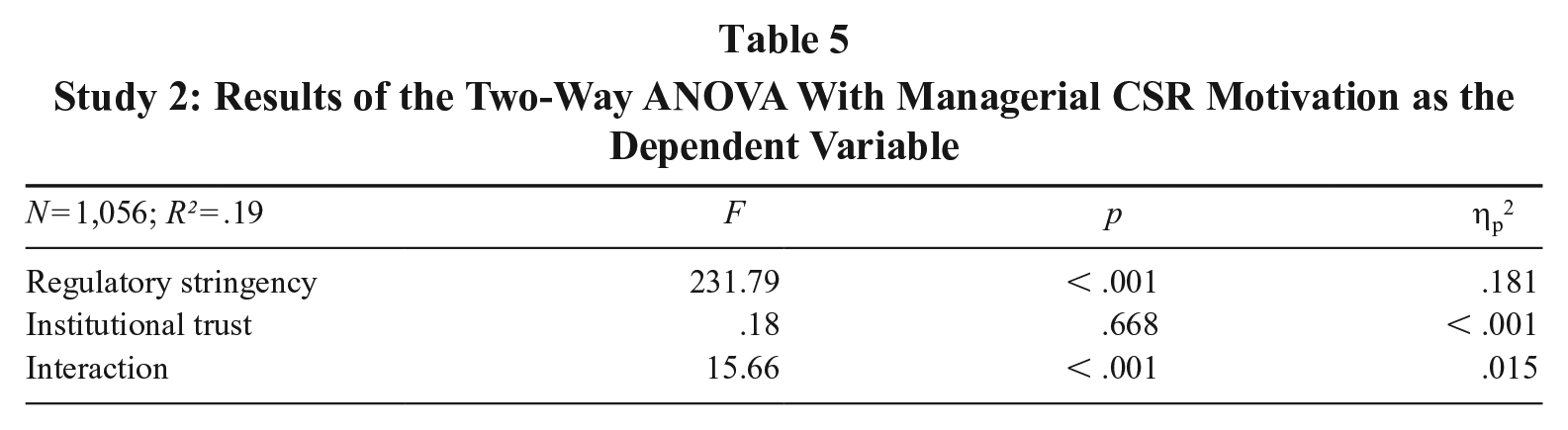
To test our hypotheses, we conducted a two-way ANOVA in which the dummy variables of manipulated regulatory stringency (high = 1, low = 0) and institutional trust (high = 1, low = 0) as well as the interaction of the two dummy variables are the independent variables, and managerial CSR motivation is the dependent variable. As reported in Table 5, the analysis shows that regulatory stringency had a significant effect on managerial CSR motivation (F = 231.79; p < .001; ηp2 = .181), institutional trust had an insignificant effect on it (F = .18; p = .668; ηp2 = .000), and the interaction of these two independent variables had a significant effect on it (F = 15.66; p < .001; ηp2 = .015, see Figure 2).
Study 2: Results of the Two-Way ANOVA With Managerial CSR Motivation as the Dependent Variable
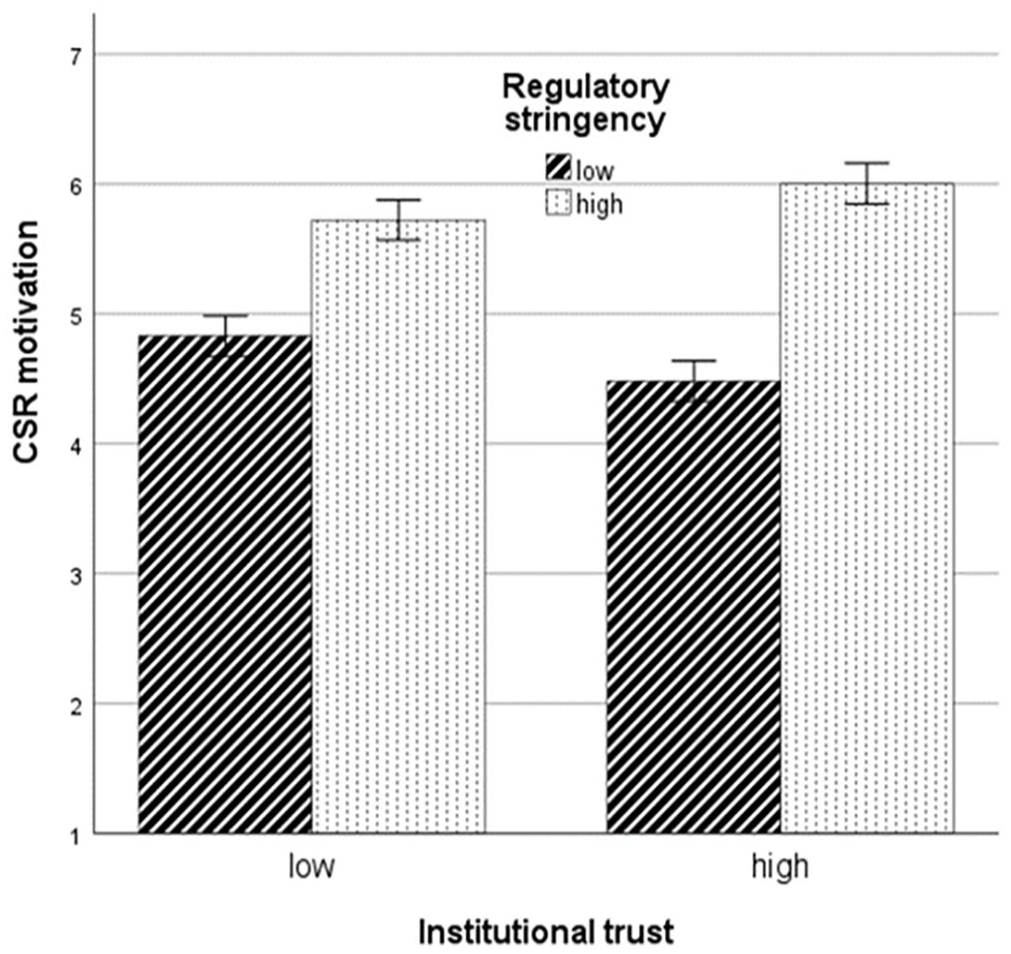
Study 2: Interaction Effect Between Regulatory Stringency and Institutional Trust on CSR Motivation
Pairwise comparison of the marginal effects reveals regulatory stringency had a positive effect on managerial CSR motivation in the low (Mlow-stringency = 4.83, Mhigh-stringency = 5.72, F = 63.85, p < .001, ηp² = .057) as well as in the high trust condition (Mlow-stringency = 4.48, Mhigh-stringency = 6.00, F = 182.92, p < .001, ηp² = .148). However, the positive effect is approximately 2.60 times higher in the high compared to the low trust condition, resulting in the highest values of managerial CSR motivation in the high trust and high stringency condition. The R² reached 19%, which is almost three times higher than our results in Study 1, most likely due to a better pre-selection of attentive participants.
Discussion
In Study 2, we aimed to retest the results of Study 1 using an improved study design and measurement instrument for managerial CSR motivation. Our findings replicate the moderation effect of institutional trust (Hypothesis 3) on the relationship between regulatory stringency and managerial CSR motivation. As in Study 1, we found that regulatory stringency had a strong positive effect on managerial CSR motivation in the high trust condition. This finding replicates Study 1’s support for the mirror hypothesis (Hypothesis 1) in the high trust condition. However, for the low trust condition, there was a weak positive effect in Study 2, whereas the effect was weak and negative in Study 1. In other words, in the low trust condition, we found a weak substitute effect in Study 1 (supporting Hypothesis 2) and a weak mirror effect in Study 2 (supporting Hypothesis 1). In both studies, we found a strong mirror effect in the high trust condition, with the highest managerial CSR motivation occurring when both stringency and trust were high.
Study 3
Study 3 improves the ecological validity of our research by examining managerial CSR motivation and its relationship to perceived regulatory stringency and institutional trust in real-world contexts. Although the method of the first two vignette experiments had a strong internal validity and was suitable for testing the hypothesized causality under manipulated extreme contexts of regulatory stringency and institutional trust, it was limited in the sense that it only allowed hypothetical motivation to be measured under the imagined circumstances described in the vignettes (Aguinis & Bradley, 2014). Hence, in Study 3 we asked managers about their current CSR motivation in their organization, and about their perceptions of regulatory stringency and institutional trust in their country. To differentiate between high and low stringency conditions, we surveyed managers from South Africa and the United Kingdom (UK) because these two countries differ regarding their level of environmental regulatory stringency. In the Organization for Economic Co-Operation and Development (OECD) Environmental Policy Stringency Index, which measures the extent to which national environmental policies put a price on environmentally harmful behavior (Kruse et al., 2022), the UK’s score is 3.61, whereas that of South Africa is 0.92 (on a 7-point Likert scale from 0 to 6). Based on results from the Edelman Trust Barometer 2024, which indicate that 29% of citizens in South Africa and 30% in the UK trust their government, we expected no significant difference in institutional trust between the two countries. Moreover, including these two countries in the study allowed us to keep the questionnaire language and the recruitment platform constant, because English is an official language in both countries, and Prolific offers large participant samples from both countries. We pre-registered Study 3 on AsPredicted.org (https://aspredicted.org/kfq8-j6rq.pdf).
Procedure
At the beginning of the survey, participants were asked about their demographics and current work role. Only those currently holding a position as a manager or senior manager were allowed to proceed to the main questionnaire, where they reported, in a randomized order, their managerial CSR motivation, their perception of environmental regulatory stringency, and their trust in institutions in their country. At the end, we showed them a short debrief.
Measures
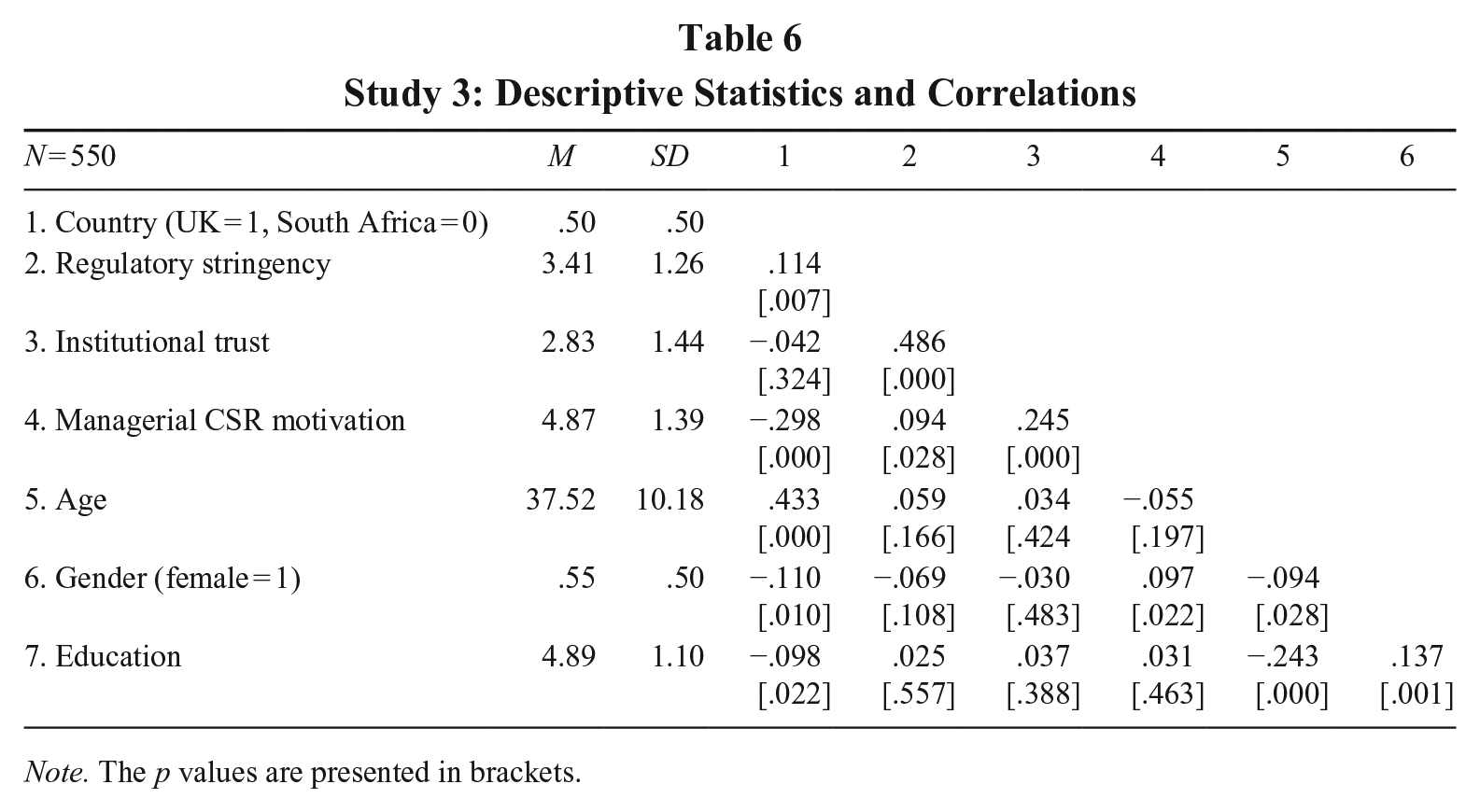
We started the survey with the demographic questions used in the prior two studies. However, instead of asking about prior management experience, we asked participants to select their current work role, with the answers “manager” and “senior manager” among the options. These roles were also used as a sample criterion during pre-screening on Prolific, and they were verified at the beginning of the survey. To measure our dependent variable managerial CSR motivation, we used the two scales of managerial CSR motivation from Study 2 (Glavas & Kelley, 2014; Hafenbrädl & Waeger, 2017). We asked the managers to rate their CSR motivation for their current management position by changing the hypothetical item formulation “I would ensure” from Study 2 into “I am motivated to ensure.” As in Study 2, we combined the two scales into one because they showed high reliability (seven items, Cronbach’s α = .97). We used Study 1’s three institutional trust items (Cronbach’s α = .92) and its two perceived regulatory stringency items (ρy1y2 = .85) and adjusted the formulation to “my country” instead of “Varosia.” We measured all other items except the demographic data on a 7-point Likert scale ranging from 1 (Strongly disagree) to 7 (Strongly agree). Table 6 presents the means, standard deviations, and correlations of the variables used in this analysis.
Study 3: Descriptive Statistics and Correlations
Note. The p values are presented in brackets.
Participants
As in Study 2, we estimated the necessary sample size using G*Power (Version 3.1.9.7) and following the guidelines of Brysbaert (2019). To test the main effect between the two groups (UK vs. South Africa) with d = .25, α = .05, and Power = .90 a minimum total sample size of 550 participants was necessary. For a regression analysis with three predictors and f² = .03, α = .05, and Power = .90, a total sample size of 477 participants was recommended. We chose the higher sample size of 550 participants (i.e., 275 participants per group). We used the Prolific.co survey platform to recruit full-time employees who had a management role, spoke English fluently, and were based in either the UK or South Africa. We used a ReCAPTCHA question to screen out bots at the beginning of the survey. Moreover, we had one attention check; participants were automatically screened out if they failed it. As in Study 2, we excluded participants whose completion time was three standard deviations or more above the mean completion time, a criterion that led to the removal of eight participants. Additionally, we excluded participants who spent on average less than 2 seconds on each item of the dependent variables (Bowling et al., 2023). One participant was removed on this basis. Overall, we surveyed 559 participants, obtaining a final sample of 550 participants after exclusions. The average age was 37.52 years (SD = 10.18). Most participants (75.3%) had at least an undergraduate degree and 45.5% were male. The median duration for completion was 3.03 minutes, and participants received a reward of £0.60 (£11.87/hr or $15.03/hr).
Analysis and results
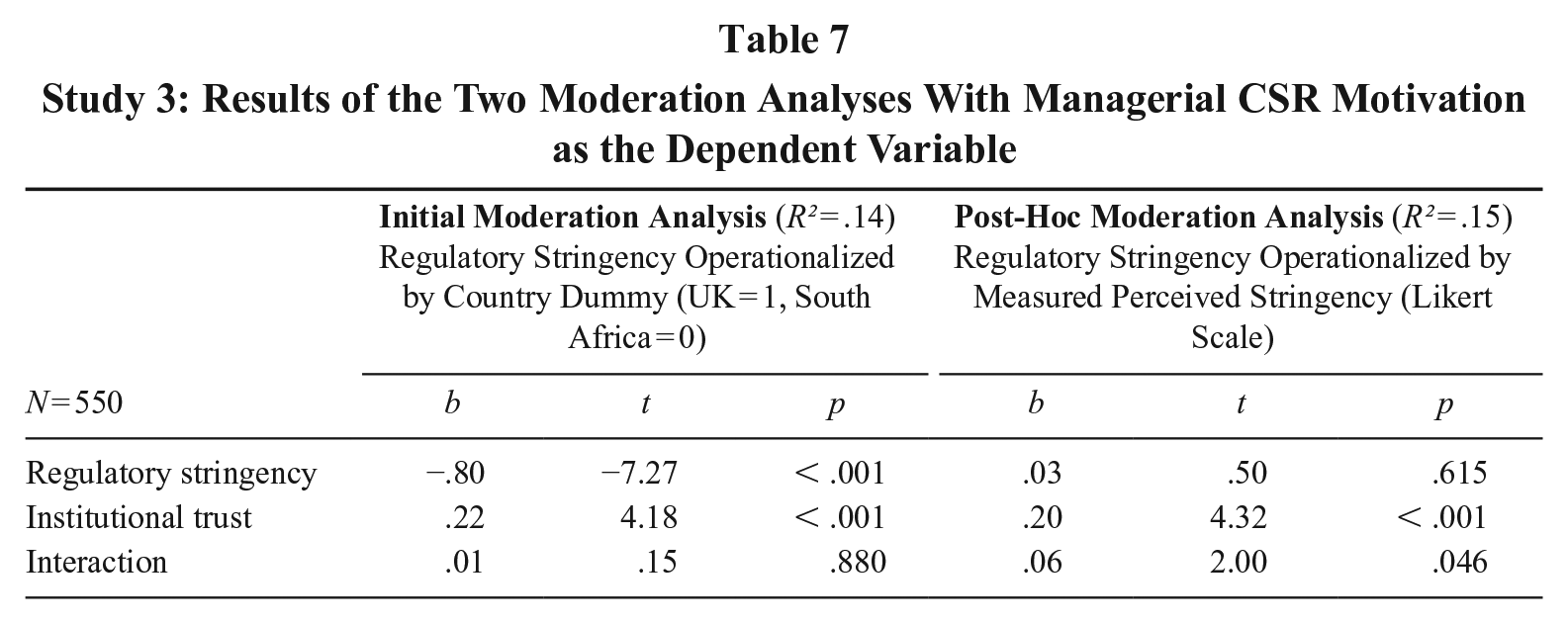
First, a t test between the UK and South African samples reveals that regulatory stringency was indeed perceived to be significantly higher in the UK (M = 3.55) than in South Africa (M = 3.26, t(548) = 2.69, p = .004). There was no significant difference in the level of perceived institutional trust (MUK = 2.77, MSA = 2.89, t(548) = .99, p = .162). The between-country comparison shows that managerial CSR motivation is significantly higher in South Africa (M = 5.28) than it is in the UK (M = 4.45, t(548) = 6.88, p < .001). As reported in Table 7, a moderation analysis using the country dummy (South Africa = 0, UK = 1) as the independent variable and perceived institutional trust as the moderator reveals that the country dummy had a negative effect on managerial CSR motivation (b = −.80, t(446) = −7.27, p < .001), perceived institutional trust had a positive effect on it (b = .22, t(446) = 4.18, p < .001), and the interaction between the two had an insignificant effect on it (b = .01, t(446) = .15, p = .880). The R² reached 14%.
Study 3: Results of the Two Moderation Analyses With Managerial CSR Motivation as the Dependent Variable
It is important to note that the two countries differ on many other factors aside from regulatory stringency (e.g., economic development, culture, institutions, environmental problems), which could also explain the difference in managerial CSR motivation (Inglehart & Welzel, 2005; Koyama & Rubin, 2022; Szirmai, 2015). In fact, although the difference in perceived regulatory stringency between the two countries was significant, it was much lower than expected, given that the OECD Environmental Policy Stringency Index indicates an actual difference of 2.69 scale points on a 7-point Likert scale. The difference in perceived regulatory stringency in our study was only .29, suggesting that other differences between the UK and South Africa that are more salient than regulatory stringency—GDP or local environmental problems, for instance—may explain the difference in managerial CSR motivation better than stringency does.
Post-hoc analysis
To better isolate the effect of regulatory stringency, we analyzed another moderation model, in which we defined the perceived regulatory stringency as the independent variable (instead of the country dummy) and left institutional trust as the moderator and managerial CSR motivation as the dependent variable. Moreover, we included the country dummy as a covariate in this model to control for potential confounding effects of national-level variables that were not directly measured in this study. Here, we found regulatory stringency had an insignificant effect on managerial CSR motivation (b = .03, t(545) = .50, p = .615), institutional trust had a significantly positive effect on it (b = .20, t(545) = 4.34, p < .001), and the interaction between the two (b = .06, t(545) = 2.00, p = .046, see Figure 3), had a significant effect on it. A Johnson-Neyman analysis revealed that the effect of stringency became positive when the trust values were high (> 6.08) but remained insignificant for lower trust values. Also, the significance of the effects remained the same in a moderation analysis without the country covariate. The R² reached 15%, which is slightly lower but comparable to the results of Study 2.
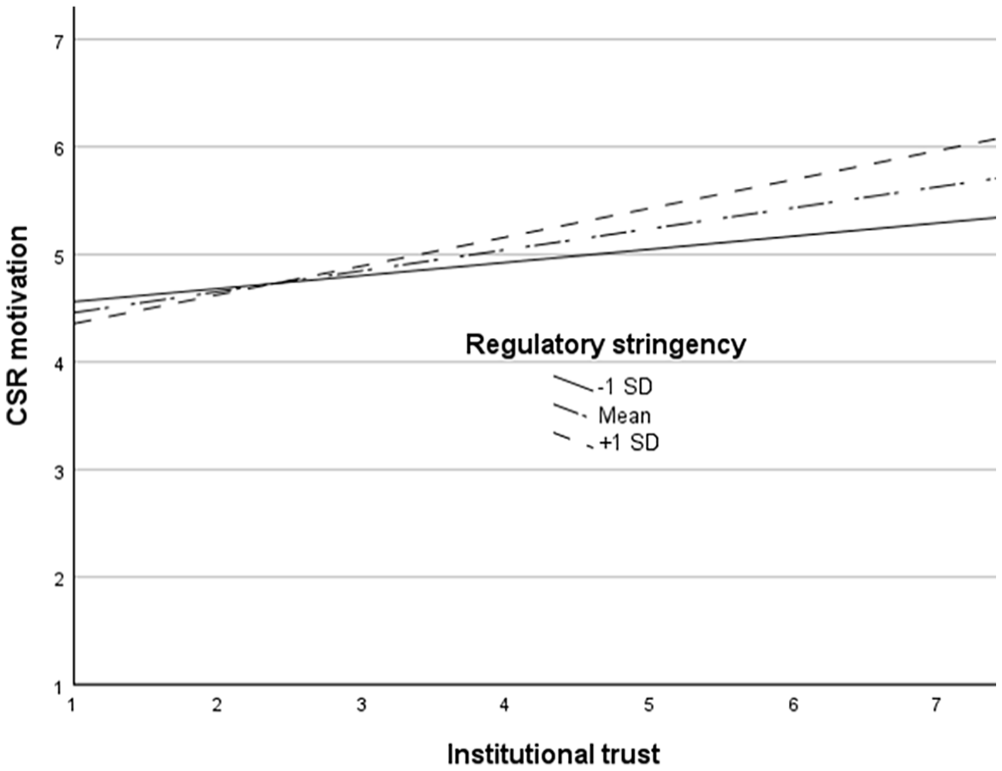
Study 3: Interaction Effect Between Regulatory Stringency and Institutional Trust on CSR Motivation
Discussion
The results with perceived regulatory stringency as the independent variable replicate most of the findings from the prior two studies. As in Studies 1 and 2, we found support for the moderation hypothesis (Hypothesis 3) of institutional trust in the relationship between regulatory stringency and managerial CSR motivation. Once again, we found a mirror effect (Hypothesis 1) when institutional trust is high, and the highest values of managerial CSR motivation occur when institutional trust and stringency are high. For lower trust values, we found that regulatory stringency has no significant effects on managerial CSR motivation, suggesting that the mirror hypothesis (Hypothesis 1) holds only in high institutional trust conditions. Conversely, the substitute hypothesis (Hypothesis 2) receives no support in either low or high trust conditions.
Additionally, the results suggest that objective regulatory stringency does not directly translate into perceived stringency. Even though the objective OECD measure of regulatory stringency implied a big difference between the UK and South Africa (i.e., 2.69 scale points), the difference in perceived regulatory stringency was minimal (i.e., .29 scale points). The perception of regulatory stringency can be strongly biased by local public and political discourse on this topic, which is often framed by the media or politics. In fact, research indicates that there is a general tendency of individuals in South Africa to overestimate the quality of their institutions, while individuals in the UK tend to underestimate it (S. Kruse, Ravlik, & Welzel, 2019). This tendency of over- and underestimation strongly correlates with differences in countries’ educational achievements, levels of political interests, and emancipatory values (S. Kruse et al., 2019). Moreover, there is evidence that individuals tend to make their judgments based on a comparison to their close environment (Gugushvili, 2021). Although the OECD index indicates that the UK is in the global top 10 when it comes to environmental regulatory stringency, UK citizens will likely compare their country’s level of regulation with those of neighboring countries in Europe, which have on average comparably stringent regulation. In turn, in South Africa, where only marginal regulation is in place, citizens will compare their country with its neighbors, which have even less stringent regulations. This may explain why South Africa’s perceived stringency values were higher and the UK’s lower than the objective values of the OECD index, resulting in a lower difference in the perceptions between the countries.
General Discussion
We conducted three empirical studies to test how and under which conditions institutional context (operationalized by the stringency of local pro-environmental regulations) affects individual CSR motivation (operationalized by managerial CSR motivation). Prior literature has proposed two opposing hypotheses about how institutional context influences CSR: the mirror hypothesis and the substitute hypothesis. According to the mirror hypothesis, an institutional context characterized by more stringent CSR regulations would result in increased CSR, whereas the substitute hypothesis suggests that institutional contexts with less stringent regulations should result in increased CSR. Drawing on the micro-CSR literature (Aguinis & Glavas, 2019; Gond et al., 2017; Rupp & Mallory, 2015), we have proposed that a focus on the microfoundations of CSR could help to resolve this debate by shedding light on the so far neglected individual motivational antecedents, which allow for a specific focus on substantively motivated CSR.
Importantly, the micro-level approach also helps to identify and test psychological moderators of the effect of institutional context on CSR. We hypothesized and found in all three empirical studies that institutional trust moderates the effect that the stringency of local CSR regulations has on individual CSR motivation, such that a high degree of regulatory stringency has a more positive effect in contexts of high institutional trust than it does in contexts of low institutional trust. Specifically, our studies consistently support the mirror hypothesis (Hypothesis 1), provided that trust in institutions is high. In conditions of low institutional trust, our findings on the effect of regulatory stringency are less consistent: Study 1 indicates a substitute effect, Study 2 a mirror effect, and Study 3 no significant effect. This confirms the contradictory results identified in the literature. When there is no trust in institutions, outcomes can vary significantly, and both the mirror and substitute hypotheses can apply. However, neither the positive nor negative effects of stringency in the low trust condition are as strong as the mirror effect in the high trust condition. Across all three studies, the consistent finding is that this mirror effect under high trust leads to the highest levels of individual CSR motivation.
Theoretical Contribution
Contributions to the institutional perspective on CSR
Our research makes several important theoretical contributions. First, we contribute to the literature on the institutional perspective on CSR (e.g., Aguinis & Glavas, 2012; Campbell, 2007; Jackson & Apostolakou, 2010; Matten & Moon, 2008; Wang et al., 2016). While previous research has acknowledged that institutional context influences CSR, there has been no consensus on how it does so. By focusing on the micro level of CSR, we were able to overcome several theoretical and empirical barriers that researchers have encountered in the past. The micro-CSR perspective allowed us to focus on substantively motivated CSR instead of on strategic or symbolic CSR outcomes, the delineation of which is often complicated in organizational-level studies (Glavas & Kelley, 2014). Moreover, the micro-level focus enabled us to investigate an important psychological moderator in the relationship between institutional context and CSR: institutional trust. Specifically, we found that a high level of institutional trust enhances the mirror effect, while a low level reduces it. Taking institutional trust into consideration enables us to account for some inconsistencies in previous research, and to understand why some researchers, for example, found the strongest empirical support for the mirror hypothesis in Scandinavian countries (Gjølberg, 2009; Midttun et al., 2006), where mutual trust and cooperation are core values (Strand et al., 2015).
Our findings also have important theoretical implications for research on other tensions or paradoxes in the field of CSR. For instance, institutional trust may help to explain “the paradox of CSR standards” (De Colle, Henriques, & Sarasvathy, 2014). Despite their great potential for improving CSR, CSR standards often appear to have important drawbacks—for instance, obsession with compliance and communication (De Colle et al., 2014; King, Lenox, & Terlaak, 2005). Our findings suggest that these drawbacks might be caused by relatively low trust in CSR standards. Low trust could hinder the full potential of these standards’ mirror effect on individual motivation, because individuals might question the standards’ value and therefore might focus on compliance and communication, which consume relatively few resources and have the highest potential for reputational benefits, instead of focusing on what is much more important—that is, systematic changes (Barnett et al., 2020). Conversely, high trust in CSR standards and the institutions behind them could improve individual CSR motivation and minimize negative outcomes.
Contributions to micro-CSR research
Our findings also contribute to the literature on the microfoundations of CSR (for a review, see Aguinis & Glavas, 2019; Gond et al., 2017). Scholars have so far identified moral, relational, and instrumental drivers of micro-CSR (Gond et al., 2017) but neglected the potential institutional drivers we consider in this study. Our analysis suggests that institutions such as CSR-related regulations significantly affect individual CSR motivation. We therefore argue that institutional context is an essential aspect of predicting individual CSR motivation, because, if we neglect the context within which individuals “are embedded, we may miss some of the most informative bits and pieces that constitute micro-CSR” (Gond & Moser, 2019: 13).
Our research provides insights into micro- and macro-level interactions in the context of CSR by considering contextual effects on individual CSR motivation and the individual’s relation to the institutional context. Scholars have criticized management scholarship for becoming “bifurcated into camps of micro and macro experts who rarely engage each other in debates or collaboration” (Hitt, Beamish, Jackson, & Mathieu, 2007: 1385), and for paying little attention to how different levels of analysis interact in CSR (Aguinis & Glavas, 2012). Our study tackles the question of how the individual connects to the macro level by introducing institutional trust as a bridge between the micro and the macro levels. Our approach shows that individual motivation is informed by institutional context and, accordingly, that reliable predictions of individual motivation need to take into account the effect of the macro-level context.
Contributions to institutional theory
Our research also contributes to institutional theory. We clarify that the conflicting predictions regarding the effect of institutional context on CSR motivation are grounded in different institutional theories, namely sociological neo-institutional theory (DiMaggio & Powell, 1983; Meyer & Rowan, 1977) and rational choice institutionalism (Alasuutari, 2015; Hall & Taylor, 1996). This theoretical distinction based on different forms of institutionalism contributes to an important debate in institutional theory—that is, whether behavior is shaped more by the structural context or by individual agency (Heugens & Lander, 2009). Whereas sociological neo-institutional theory emphasizes the effects of the structural context, rational choice institutionalism stresses the importance of rational agency.
Our findings propose a mixture of the two theoretical approaches and highlight the importance of a balance between agency and structure. On the one hand, we found the highest levels of individual CSR motivation in highly regulated contexts, suggesting that individuals are, overall, most motivated to invest in CSR if CSR is already institutionalized, as sociological neo-institutional theory suggests. On the other hand, we found that the positive effect of institutionalization on individuals’ CSR motivation depends on trust. Individuals do not mimic institutionalized practices passively; instead, they actively and rationally evaluate whether and how much the institutionalized behavior is worth following, as the rational choice institutionalists suggest. Thus, we propose rational choice institutionalism as an important but hitherto largely underexplored theoretical complement to sociological neo-institutional theory, which has become one of the dominant approaches in organization and management studies (Greenwood et al., 2017; Heugens & Lander, 2009). Taking both theoretical perspectives into account can help to reveal and develop a comprehensive understanding of discrepancies in prior work that are similar to those we have identified in our discussion of the mirror versus substitute debate.
Limitations and Directions for Future Research
The contributions of our research to understanding the impact of institutional contexts on CSR motivation come with certain limitations that offer opportunities for future research. First, although focusing on the micro level offers the important advantages that we have presented in this article, it can limit our ability to predict behavior on the organizational level. Predicting how an organization will behave by simply aggregating individual perceptions, intentions, and behaviors is prone to failure (Barney & Felin, 2013), because organization-specific variables such as leadership style, culture, and the level of internationalization can affect CSR on a firm level. Future research can therefore investigate how these specific organizational attributes affect reactions to CSR-related regulations on the individual and organizational levels. For example, an organizational culture that values social contributions and is not limited to striving for profit maximization might positively influence individual members’ evaluations of regulations and lead them to mirror those regulations in their motivation and behavior. Conversely, an organizational culture focused on profit maximization might reduce individual members’ willingness to imitate what the regulations prescribe.
Another interesting avenue for future research would be to examine individual CSR motivation among other organizational roles, such as employees or startup founders. In our studies, we focused on the individual CSR motivation of managers because they have an important and powerful role in CSR and represent a central and unique building block in management theory (Aguinis et al., 2022; Gond & Moser, 2019). However, individuals holding other organizational roles may also contribute to the formation and implementation of CSR. For example, micro-CSR research suggests that employees can contribute to the formation and implementation of CSR, even if they do not have the same degree of power as managers in this process (Girschik et al., 2022; Gond & Moser, 2019). Another interesting organizational role in this context is the startup founder. These individuals have considerable power in CSR-related decision-making, and they generally also have an even greater appreciation than managers do of the risks and opportunities CSR poses to their organization (Brieger et al., 2019; Saebi, Foss, & Linder, 2019). It would be worthwhile to ascertain whether institutional context has the same impact on these different organizational members’ CSR motivation as it has on managers. Organizational identification, and more generally social identity theory, may be a promising theoretical lens through which to understand potential differences in the effects of institutional context on CSR motivation (Riketta, 2005). Prior research suggests that, compared to lower-level employees, individuals in more senior positions—founders or managers, for instance—have a higher organizational identification and a stronger commitment to the organization’s success (Riketta, 2005). Consequently, individuals in more senior roles could be more sensitive to threats to their organization’s success. Hence, they may be more attuned to the institutional context with a view to maintaining organizational legitimacy, but they might also be more attuned to institutional trust with a view to preventing organizational sacrifices whose outcomes are unclear. Future research is needed to test these assumptions in more detail.
Moreover, more research is needed to understand how institutional context, institutional trust, and the interaction of the two affect individual CSR motivation when a CSR dimension other than the environment is being considered. In our studies, we focused on the environmental dimension of CSR because prior research suggests that an aggregate form of CSR is not specific enough to allow clear predictions to be made (Wang et al., 2016). However, there are also other dimensions of CSR—such as the social dimension—which are conceptually equally important for the CSR construct (e.g., El Akremi et al., 2018; Wang et al., 2016). According to our theory, the effects should be similar for other dimensions of CSR that aim to contribute to the common good. A preliminary study we conducted confirmed this assumption, showing that regulatory stringency had a strong mirror effect on pro-social CSR motivation when institutional trust was high, and a lower mirror effect when institutional trust was low (see https://osf.io/bdkce/?view_only=7d0ad2e2c4b842c9a433738b778cd313), in line with our findings on the environmental dimension of CSR.
However, there may also be important differences. For example, social outcomes are more immediate and have a more direct impact on specific stakeholder groups than environmental outcomes do. Addressing climate change, for instance, provides only medium- to long-term benefits, and these benefits will also be diffused among many stakeholders worldwide, whereas improving working conditions and paying a living wage have an immediate and tangible impact on employees. If the social domain of CSR is highly institutionalized, but the individual ignores this and disregards the well-being of his or her organization’s stakeholders (i.e., he or she does not mirror the strong regulations), the latter could be motivated to voice their disapproval of this deviant behavior, making social sanctions more likely. Hence, institutional trust may be less important for the social dimension than it is for the environmental dimension.
Practical Implications
The many documented corporate scandals suggest that, without stringent regulations, firms not only are unable to manage societal challenges but also frequently exacerbate them (Crane, Palazzo, Spence, & Matten, 2014; King & Pucker, 2021). Many governments, however, fear that stringent CSR regulations will reduce motivation, and so, as the substitute hypothesis posits, they opt for lax regulations in the hope that these will motivate greater corporate CSR commitment (Matten & Moon, 2008). Our research shows that stringent regulations do not diminish but rather increase individual CSR motivation, especially when individuals trust their political institutions. Accordingly, our findings indicate that governments and other authorities should aim to improve regulatory stringency in combination with the improvement of institutional trust by, for example, being transparent or involving corporate representatives in planning processes that relate to CSR issues. At the same time, firms could contribute to a better trust relationship with public institutions. For example, they could actively demand more transparency and cooperation in the development of new regulations, and they could work on better and more efficient regulatory propositions within their industry.
Moreover, our research helps managers striving for more CSR to better understand the CSR motivation of organizational members in different institutional contexts. CSR depends on the daily actions of all organizational members (e.g., Aguinis & Glavas, 2019). If these individual members are not motivated to invest in CSR, it will hardly be possible to maintain a good CSR performance on the organizational level. Our research indicates that individual CSR motivation is particularly weak in institutional contexts of low regulatory stringency and low institutional trust. Managers and other powerful firm representatives operating in such contexts need to invest in counterbalancing strategies to keep up their organizational members’ CSR motivation and develop strategies to increase individual CSR motivation. To increase regulatory stringency, firms could actively support and cooperate with regulators to develop more stringent regulations. They could also implement and test specific policies on a voluntary basis and support the transposition of these policies into national regulation. To increase trust in institutions, managers could voice their support for existing institutional regulations and clarify how this helps them to keep the firm’s CSR engagement strong. Another potential strategy to increase individual CSR motivation could be to counterbalance the negative effect of low regulatory stringency and/or low institutional trust using the alternative drivers identified in prior micro-CSR research (see Gond et al., 2017 for a review). For example, managers could strengthen employees’ moral drivers of CSR (Gond et al., 2017) by increasing awareness and knowledge of how individual CSR actions contribute to the common good.
Conclusion
We adopted a micro-CSR perspective to examine the contradiction between the mirror and substitute hypotheses that previous research has proposed. We examined how institutional context, which we operationalized as the stringency of local CSR regulations, influences individual CSR motivation, and how institutional trust affects this relationship. Overall, we found the highest individual CSR motivation when regulatory stringency and institutional trust were high, supporting the mirror hypothesis. Our findings underline and clarify the key role of regulatory institutions in CSR and show that to understand the effects of institutions on CSR, it is essential to consider how individuals perceive these institutions. Although we agree with Wang et al. (2016: 549) that “CSR is a social phenomenon” that cannot be separated from an organization’s institutional context, we would add that CSR is not independent of individual perceptions and motivations either. Consequently, to understand heterogeneity in CSR at the macro level, research must also examine the micro level and focus in particular on the psychological moderators underlying the observed variance.
Supplemental Material
sj-docx-1-jom-10.1177_01492063241299403 – Supplemental material for Mirror Versus Substitute: How Institutional Context Affects Individual Motivation for Corporate Social Responsibility
Supplemental material, sj-docx-1-jom-10.1177_01492063241299403 for Mirror Versus Substitute: How Institutional Context Affects Individual Motivation for Corporate Social Responsibility by Anna Jasinenko, Steven A. Brieger and Patrick Haack in Journal of Management
Footnotes
Acknowledgements
We would like to thank editor Christopher Rosen and two anonymous reviewers for their very constructive guidance, support, and many valuable comments during the review process. An earlier version of this paper was presented at the annual meeting of the Academy of Management 2021 and at the EGOS conference 2023.

Supplemental material for this article is available with the manuscript on the JOM website.
References
Supplementary Material
Please find the following supplemental material available below.
For Open Access articles published under a Creative Commons License, all supplemental material carries the same license as the article it is associated with.
For non-Open Access articles published, all supplemental material carries a non-exclusive license, and permission requests for re-use of supplemental material or any part of supplemental material shall be sent directly to the copyright owner as specified in the copyright notice associated with the article.
