



Abstract
Collaborations between organizations from different sectors, such as those between firms and nonprofits or governments, can offer effective solutions to complex societal problems like climate change. But complications arise because organizations operating in different sectors rely on the approval of different audiences, who may not view these relationships positively, for resources and survival. I show how concerns about audience approval impede cross-sector collaborations forming between firms and social movement organizations (SMOs) despite their potential societal benefits. Firms wanting to signal their efforts in support of a movement’s cause may be eager to form collaborations with SMOs. But when SMOs’ supporters and/or peers define their identity in opposition to firms—when they are oppositional audiences—collaborations do not form. I argue and find that SMOs who cooperate, and don’t compete, with oppositional peers can better navigate the constraint of oppositional audiences. Firms, in contrast, aggravate the constraint of oppositional audiences. Firms’ inclination to seek collaborations to repair their reputations with their own audiences after being contentiously targeted by a movement compounds the challenge to SMOs of partnering with the enemies of their friends. My arguments on countervailing audience effects stifling collaborations are corroborated in 25 years of data on interactions between SMOs in multiple environmental movements and Fortune 500 firms.
Keywords
As demands for social and environmental responsibility grow from firms’ stakeholders, including shareholders (Reid and Toffel, 2009), consumers (Baron, 2012), and employees (Briscoe and Gupta, 2016), firms increasingly seek collaborations with social movement organizations (SMOs) in their efforts to improve. Collaborations between firms and SMOs are thought to be critical to making progress on societal grand challenges (George et al., 2016). Through collaboration, firms can leverage SMOs’ expertise on social or environmental issues to improve the quality (Yaziji and Doh, 2009; Odziemkowska and Zhu, 2021) and acceptability (Olsen, Sofka, and Grimpe, 2016) of their social and environmental initiatives. Collaborations offer SMOs the opportunity to advance the goals of their movement by shaping how firms improve their social and environmental practices. Collaborations can also catalyze institutional change (den Hond and de Bakker, 2007) by drawing attention to movement causes and propagating socially responsible practices (Briscoe, Gupta, and Anner, 2015). Firm–SMO collaborations have been instrumental in making progress on issues as varied as conflict minerals (Yaziji and Doh, 2009), deforestation (Zietsma and Lawrence, 2010), and waste reduction (Stafford and Hartman, 1996). In leveraging the capabilities and resources of distinct sectors, such collaborations are thought to offer solutions to complex issues that exceed the capacity of single organizations or sectors to create (Austin and Seitanidi, 2012).
Yet the optimism around cross-sector collaborations overlooks the challenge to collaborating when distinct audiences on whom two organizations rely have contradictory interests or expectations. Sociological perspectives on interorganizational relationships emphasize they are not simply means to access partner resources but also subjects of audience evaluations (Podolny, 2001). Audience evaluations of interorganizational ties loom large in the decision to collaborate (Jensen and Roy, 2008), because organizations depend on the approval of important audiences for resources and survival (Pfeffer and Salancik, 1978; Oliver, 1991). Audience scrutiny leads organizations to avoid ties to actors of poor quality (Jensen, 2006), while ties to esteemed actors are sought to improve audience approval (Stuart, Hoang, and Hybels, 1999; Podolny, 2001).
Organizations operating in different organization fields, or sectors, rely on different audiences with distinct interests and expectations that influence their evaluation of cross-sector collaborations. This article documents how concerns about the social approval of relevant audiences impede the formation of firm–SMO collaborations when they cross strongly oppositional field boundaries. Oppositional organizational fields, such as social movements or oppositional market categories, form “in direct ideological opposition to the existing dominant logic embodied by incumbents” (Mathias, Huyghe, and Williams, 2020: 2549) and seek to address the problematic elements or practices of incumbents (King and Soule, 2007; Hsu and Grodal, 2021). Members of oppositional fields are thus perceived as independent challengers of incumbents. These independent challenger identities make SMOs valuable collaboration partners for firms seeking to signal to audiences their genuine support for a movement cause and efforts to address their problematic practices (Baron, 2012). However, the very thing that makes SMOs persuasive with firms’ audiences—their membership in movements—can render collaborations problematic for maintaining the approval of their own audiences. As members of social movements who “adopt oppositional identities” with respect to incumbents (King and Soule, 2007: 414), SMOs who collaborate with firms may be seen as defectors by their supporters or peers. Social movements, like other oppositional fields, delineate clear boundaries between themselves and the incumbents they oppose to mobilize resources and supporters (Hunt and Benford, 2004; Rao, Monin, and Durand, 2005). Firm–SMO collaborations effectively breach these boundaries. This suggests a distinct challenge to firm–SMO collaborations: partnering with the enemies of one’s friends and supporters.
I explore how and when this challenge can be successfully overcome to enable firm–SMO collaborations to form. SMOs are accountable to their supporters (e.g., donors, volunteers) who provide resources, as well as to the social movement whose goal they identify with (McCarthy and Zald, 1977). When their supporters or movement peers define their identity in strong opposition to incumbents—when they are oppositional audiences—SMOs forgo collaborations to ensure continued access to resources and to avoid disruptive audience scrutiny, including accusations of “selling out” (Zald and McCarthy, 1980: 12). The risk of collaborating in the face of oppositional audiences can be attenuated by an SMO’s preexisting relationships with highly oppositional factions of a movement or exacerbated when an SMO directly competes with them. Firms themselves exacerbate oppositional audience effects by favoring collaborations for reputation repair after they have been contentiously targeted by movements. Organizational concerns about the social approval of relevant audiences thus manifest in countervailing effects that impede the formation of cross-sector collaborations that cross boundaries of strongly oppositional fields.
Thus, despite their potential societal benefits, firm–SMO collaborations face a considerable obstacle because they bring together two organizations that rely on distinct audiences who can have conflicting evaluations of the same relationship. This offers a new perspective on the tensions inherent in cross-sector relationships. To date, scholars have emphasized partners’ embeddedness in distinct organizational fields and examined how their own beliefs, norms, and goals can be a source of tension within collaborations that have formed (Selsky and Parker, 2005; Bode, Rogan, and Singh, 2019). I show that the need for social approval from cross-field audiences can inhibit the actual formation of cross-sector collaborations. When potential collaborations involve partners whose audiences have contradictory interests or behavioral expectations, partners’ conformity to audience preferences suggests they will not form. This helps explain why interorganizational relationships with such promise to address pressing societal issues are in short supply on some issues, a question that has vexed both scholars (Hoffman and Bertels, 2010) and practitioners (Langert, 2019). While scholars have documented audience-based constraints on interorganizational relationships (e.g., Jensen, 2006; Jensen and Roy, 2008), relationships that cross oppositional field boundaries pose a distinct challenge. The challenge is not a status-based constraint (Jensen, 2006) but a role-based constraint due to one partner’s membership in a field that defines itself in opposition to another. I explore my arguments drawing on over 160,000 hand-coded archival documents on 14 environmental movements and all contentious, cooperative, and collaborative interactions between 136 environmental movement organizations and 500 of the largest U.S. firms between 1988 and 2012.
Explaining Firm–SMO Collaborations
As the world increasingly grapples with seemingly intractable issues like climate change, emphasis has been placed on partnership-based models (Bendell, 2017) that leverage capabilities, resources, and expertise across sectors to tackle these issues. The emphasis on cross-sector collaboration stems from the complexity of the underlying issues, whose solutions are not thought to originate in any one sector (i.e., government, business, civil society). An increasingly prevalent cross-sector collaboration is between firms and SMOs (Yaziji and Doh, 2009; Baron, 2012; Heyes and King, 2020). Firm–SMO collaborations are not mere transactional or arm’s-length relationships, such as philanthropy, but interactional relationships involving the commitment of resources by both parties to achieve an outcome (Wood and Gray, 1991; Rivera-Santos, Rufín, and Wassmer, 2017). Collaborations in which an SMO works with a firm to change its practices are critical to addressing pressing societal issues because of firms’ considerable environmental, social, and economic footprints. For example, a waste-reduction collaboration between McDonald’s and the Environmental Defense Fund (EDF), a prominent SMO, reduced waste by 30 percent in the world’s largest fast-food chain, eliminated 150,000 tons of packaging, and boosted recycled product markets with $3 billion worth of purchases (Langert, 2019).
While the question of when cross-sector collaborations form remains open (Montgomery, Dacin, and Dacin, 2012), one motivation is “access to needed resources different than those one possesses” (Austin and Seitanidi, 2012: 729). SMOs offer firms contextual knowledge about issues important to stakeholders that can improve the quality and acceptability of resultant social and environmental initiatives (Yaziji and Doh, 2009; Olsen, Sofka, and Grimpe, 2016; Odziemkowska and Zhu, 2021). In the case of McDonald’s and EDF, waste issues were brought to McDonald’s attention by protests, letter-writing campaigns, and “customers mailing their polystyrene clamshells back to the company” (Svoboda, 1995: 3). The EDF shared its expertise in waste reduction and product life-cycle analysis, and it helped McDonald’s develop waste-reduction solutions consonant with changing consumer values (Langert, 2019). For SMOs such collaborations offer a direct say in shaping practices within a firm, with the prospect of those practices diffusing to other firms. SMOs describe the benefits of collaborations as accessing firms’ market power and prominence to effect institutional change (Murphy, Arenas, and Batista, 2015; McDonnell, Odziemkowska, and Pontikes, 2021). The EDF engaged McDonald’s because its purchasing power and visibility offered the possibility of large impact by transforming entire input markets—in this case, packaging products—and changing public opinion via its 18 million daily customers (Svoboda, 1995). Firms’ purchasing power offers the possibility of changing whole product categories and markets, and their visibility draws attention to a movement’s cause and can set new standards for a broad swathe of firms seeking to emulate their peers.
Audience Effects in Interorganizational Relationships
The idea that firms tap SMOs’ expertise and SMOs tap firms’ market power and visibility accords with a view of interorganizational relationships as opportunities to access knowledge and resources. In contrast to this view, sociological perspectives emphasize the role that organizations’ relevant audiences play in interorganizational relationships (Podolny, 2001; Jensen, 2006). Organizations rely on the social approval of their audiences in order to obtain resources and ensure their survival (Pfeffer and Salancik, 1978; Oliver, 1991). To maintain audience approval, organizations employ various strategies, including taking into account audience preferences in selecting courses of action (Lerner and Tetlock, 1999), conforming to field norms (Phillipe and Durand, 2011), and engaging in impression management when their social approval or reputation is threatened (McDonnell and King, 2013).
Audience social approval plays an important role in interorganizational relationships, because interorganizational ties are means by which partners are evaluated (Stuart, Hoang, and Hybels, 1999; Podolny, 2001; Jensen, 2006). When the quality of an organization’s products, services, or practices is not easily discernable, for example, external audiences (e.g., consumers, investors) make quality inferences based on the status of those with whom the focal organization has a relationship (Podolny, 2001). Audiences view favorably ties to high-status (Podolny, 2001) or prominent organizations (Stuart, Hoang, and Hybels, 1999). Thanks to their positive effect on audience perceptions, ties to estimable partners can improve access to resources (Stuart, Hoang, and Hybels, 1999) and organizational survival (Baum and Oliver, 1991). Audience effects also result in organizations being discriminating about which relationships they form, forgoing relationships viewed unfavorably to avoid disruptive audience scrutiny and to ensure access to resources controlled by audiences (Jensen 2006). One such audience effect is status anxiety; Jensen (2006) provided evidence that concerns of devaluation by relevant audiences lead organizations to disassociate from actors of questionable quality. Thus the need for audience approval can also result in relationship or partner avoidance.
Audience Effects in Firm–SMO Collaborations
While research on audience effects in interorganizational relationships emphasizes partners’ status in tie formation, in firm–SMO collaborations it is the SMO’s membership in an oppositional field that is influential with firms’ audiences. Members of oppositional fields, which emerge in opposition to incumbents (e.g., craft producers, Carroll and Swaminathan, 2000; social movements, King and Soule, 2007), are imbued with identities independent of incumbents and centered on addressing their problematic elements or practices (Mathias, Huyghe, and Williams, 2020; Hsu and Grodal, 2021). Ties to oppositional field members are valuable to incumbents seeking to signal to audiences their authentic support for an issue and willingness to address their problematic practices (Baron, 2012; Li and Soule, 2021). 1 A director at Coca-Cola commenting on its work with SMOs explained, “It’s very powerful for a company to be associated with an [SMO], especially if it’s an activist one” because its “recognizable brand as an environmental campaigner gives the companies it chooses to work with credibility” (Financial Times, 2007).
Similar to the unobservability of quality that drives quality inferences from ties to high-status actors, the difficulty of observing firms’ motives and effort in addressing social issues drives audience inferences of credibility based on ties to members of oppositional fields. The uncertainty stemming from inherent unobservability of motives and effort is acute for firms because their identity as profit-seeking actors leads to audience skepticism when they pursue social and environmental goals (Li and Soule, 2021), risking audience perceptions of greenwashing (Kim and Lyon, 2011) and hypocrisy (Carlos and Lewis, 2018; Li and Soule, 2021). Collaborations with SMOs effectively overcome this challenge by offering an independent, credible certification of their support and efforts for a cause or issue persuasive with important audiences, including consumers (Baron, 2012), the general public (Li and Soule, 2021), regulators (Bertrand et al., 2018), and other activists (McDonnell, 2016). 2 Unsurprisingly then, reputational benefits often top lists of firms’ motivations for collaborating with SMOs (Selsky and Parker, 2005; Murphy, Arenas, and Batista, 2015; Georgallis, 2017).
But the very feature that makes an SMO valuable for firms’ audience approval—its membership in an oppositional field—can render collaborating with firms dangerous for maintaining the approval of its own audiences. SMOs depend on the approval of supporters (e.g., donors, volunteers) who supply them resources, as well as the movement whose goals they seek to advance (Zald and McCarthy, 1980; Soule and King, 2008). Social movements adopt oppositional identities with respect to powerful incumbents like firms and tactical repertoires (e.g., protest) that reflect their outsider status (King and Soule, 2007). Fields that coalesce around collective opposition to incumbents work hard to clearly identify boundaries between themselves and their opponents to mobilize supporters and resources (Hunt and Benford, 2004; Rao, Monin, and Durand, 2005). From the point of view of an SMO’s relevant audiences, then, collaborations with firms may violate behavioral expectations (i.e., of tactics), and those violations occur with the very category of actors they define their identity in opposition to. The McDonald’s–EDF waste collaboration, rather than being praised as a vehicle for social innovation, was met with criticism from other SMOs and references to the EDF working with the “capitalist enemy” (Gifford, 1991). Similarly, firms operating in oppositional market categories that partner with incumbents are seen by customers and peers as “turning [their] back on the very movement that allowed [their] success” and “joining the enemy” (Mathias, Huyghe, and Williams, 2020: 2564). For members of oppositional fields, collaborating with incumbents runs counter to the idea that social relationships evolve toward balanced structures of cooperation and conflict. 3 Put more simply, such collaboration violates the adage that “the enemy of my friend is my enemy.”
Collaborative relationships that cross oppositional field boundaries hence pose a distinct challenge for partnering organizations accountable to different audiences. The challenge is not a status-based constraint on relationship formation (Jensen, 2006) but a role-based constraint due to one partner’s membership in a field that defines its identity in opposition to another. Because behavioral expectations are anchored in social systems, social approval is conditioned on members’ conformity to the field’s “understanding of what forms of action and organization are viewed as legitimate” (Fligstein and McAdam, 2012: 11) and also, in oppositional fields, to members’ stance against the “common enemy they collectively contest” (Mathias, Huyghe, and Williams, 2020: 2549). Deviating from these behavioral expectations risks the approval of relevant audiences and could result in loss of support or, worse, precipitate intra-field conflict.
These countervailing audience effects can stymie the formation of cross-sector collaborations that offer the possibility of addressing pressing societal issues. Firms eager to convince their audiences of the credibility of their social or environmental initiatives may be rebuffed by SMOs fearing loss of support or reprisal from their audiences. A Fortune 500 executive with 20 years of experience collaborating with SMOs explained how oppositional audiences constrain collaboration: Here you had all these [SMOs] that want to better the world . . . and no one wanted to work with us. Some of it was motivated in a broader concern: it’s that whole idea that you’re going to work with the enemy . . . and pressure from their own community that if somebody gets in bed with [the enemy firm], “what are you doing?”
Research has yet to explain the conditions that enable collaborations that cross oppositional field boundaries to form. Although the preceding arguments and examples suggest that concerns about audience approval may lead organizations to forgo collaborations, their existence implies heterogeneity in this constraint. My aim is to uncover the conditions under which collaborations can emerge against a backdrop of oppositional audiences. I focus my theorizing on SMOs and firms as organizations taking into account audiences important to them in selecting courses of action (Lerner and Tetlock, 1999). 4 I begin by considering how within-movement supporter heterogeneity and across-movement differences in oppositional ideologies enable some SMOs to more easily navigate the tactical dilemma of firm collaborations with their supporters and peers. Given that inter-SMO competition and cooperation influence their choice of tactics (McCarthy and Zald, 1977; Soule and King, 2008), I also explore how an SMO’s competitive and social position within a movement can attenuate the constraint of oppositional audiences. I close by positing that firms’ motivations in using SMO collaborations to repair their own reputations with relevant audiences exacerbate the constraints of oppositional audiences on SMOs.
SMO supporters
SMOs rely on the social approval of movement supporters who provide resources (McCarthy and Zald, 1977; Soule and King, 2008). Supporters of a broader movement channel their support to individual SMOs within that movement based on their tactics and goals (Soule and King, 2008). SMOs differ in the tactical repertoires they deploy to achieve the goals of their movement and thus attract different supporters from within the movement (McCarthy and Zald, 1977; den Hond and de Bakker, 2007; Soule and King, 2008; Baron, 2012). Tactics vary from contentious, such as civil disobedience, protests, letter-writing campaigns, or regulatory actions against incumbents, to more cooperative, such as accepting donations from incumbents or engaging them in dialogue. Given this tactical heterogeneity, SMOs within a social movement are referred to by scholars as “confrontational” versus “cooperative” (Baron, Neale, and Rao, 2016), as “radicals” versus “moderates” (Haines, 1984), or as “radical” versus “reformative” (den Hond and de Bakker, 2007). Although membership in a movement is defined by a shared collective identity (i.e., common purpose and commitment to a cause), “nearly all social movements divide into ‘moderate’ and ‘radical’ factions at some point in their development” (Haines, 1984: 31). Given that tactics are the products SMOs offer their supporters (Soule and King, 2008), the participation of both radical and moderate SMOs in a movement suggests within-movement heterogeneity in supporter preferences for interacting with incumbents.
Supporters of radical SMOs expect the contentious targeting of incumbents, and deviations from contentious tactical repertoires risk alienating supporters (Wang and Piazza, 2016). Thus radicals avoid even arm’s-length cooperation with firms (e.g., they refuse corporate donations) to preserve their purity and independence from incumbents (Bertels, Hoffman, and DeJordy, 2014). Conversely, supporters of moderate SMOs understand them to blend advocacy or protest tactics with arm’s-length cooperation. Moderate SMOs that take corporate donations and engage in co-marketing and other transactional cooperation with firms are more likely to see formal collaborations as a means by which to influence corporate behavior—and do not see such tactics as being at odds with their supporters’ preferences. So while tactics have been variously linked to an SMO’s ideology (den Hond and de Bakker, 2007) or professionalization (Staggenborg, 1988) and to inter-SMO competition (McCarthy and Zald, 1977; Soule and King, 2008), they exhibit path dependence over the short term, as SMOs are hesitant to deviate significantly from their tactical repertoires for fear of alienating supporters. This suggests that to maintain their supporters’ approval, SMOs that rely exclusively on contention will avoid collaborations. Conversely, SMOs that have previously relied more heavily on cooperation with incumbents face lower risks of losing supporters should they enter a formal collaboration with other incumbents.
Collaborations with SMOs with reputations for challenging incumbents send a stronger signal to firms’ audiences of their genuine efforts to address a movement’s criticisms (Odziemkowska and McDonnell, 2019). However, the transparency of firms’ practices typically required in formal collaborations raises the concern that radical SMOs could openly criticize their partners. Collaborating with a moderate SMO reduces the risk that the SMO will publicly criticize the firm if controversial practices are revealed during the collaboration (Desai, 2018) or if the firm is unable to meet its collaboration commitments. In their case study of Earthwatch, Seitanidi, Koufopoulos, and Palmer (2010: 145) noted that its non-threatening identity as “a non-political, non-confrontational, non-campaigning organisation would allow it to partner with almost any business.” Given that decision makers weigh potential losses more heavily than gains (Tversky and Kahneman, 1981), firms are likely to prefer collaborating with moderate SMOs, which are less likely than more-radical SMOs to endanger firms’ audience approval through criticism but which still offer benefits of associating with a movement organization.
Thus, within a social movement, the likelihood that a firm and SMO collaborate is heightened when the SMO’s past repertoire is more cooperative, relying more heavily on arm’s-length cooperation with firms (e.g., taking corporate donations). Formal collaborations with incumbents do not significantly deviate from the behavioral expectations of moderate SMOs’ supporters, and they reduce risks to firms.
SMO movements
SMOs are equally attuned to the preferences of the movement whose goal they identify with and their movement peers with whom they work to achieve the goal. Social movements that challenge powerful incumbents delineate clear boundaries between the movement (“us”) and its targets (“them”) by diagnosing an issue and making attributions for its cause (i.e., criticizing incumbents’ practices). Because collaborating with incumbents involves crossing these boundaries, SMOs take into account the reactions of their movement peers. This is consistent with the view that an organizational field exerts pressure on members to conform to its shared understandings of what tactics are legitimate (Fligstein and McAdam, 2012). Thus, in addition to attending to supporters’ behavioral expectations, SMOs are also attuned to the expectations of the movements of which they are members.
Whereas deviating from supporters’ expectations risks withdrawal of resources, deviating from movement peers’ expectations can precipitate open conflict or criticism. In movements with strong oppositional identities against incumbents, other SMOs expect and desire antagonistic relationships with firms. In highly oppositional movements, collaborating with incumbents is likely to be seen as a betrayal, resulting in open criticism accusing the moderate of “selling out” (Zald and McCarthy, 1980) or “sleeping with the enemy” (Burchell and Cook, 2013). Open criticism is damaging to SMOs that rely on their credibility with supporters to mobilize resources. For example, a collaboration between environmental activist Pollution Probe and a grocery retailer to certify its products was met with a public attack from Greenpeace. Greenpeace’s protests and satirical leafleting against the collaboration attracted widespread public attention, leaving Pollution Probe with a battered reputation, staff layoffs, and the resignation of its executive director (Stafford and Hartman, 1996). The risk of open criticism is also salient for firms because criticisms of collaborations often involve claims the firm is greenwashing its reputation. In the face of active radical SMOs like the Sierra Club, firms have been shown to avoid initiatives that tout environmental performance through cherry-picked projects to “avoid the risk of being labelled a greenwasher” (Kim and Lyon, 2011: 324).
The preceding suggests that collaborations are avoided in movements with strong oppositional identities as open criticism endangers the social approval of both the SMO and firm. What remains an open question is which movements have strong oppositional identities. I argue the answer lies in the social structure of the movement. The structure of social relations within a field evolves through several mechanisms that constrain or enable network building, including similarity (i.e., homophily), resource dependence, and competition. In movement fields, however, social structure is also driven by the ideology of its members (Diani and McAdam, 2003). In movements that challenge market incumbents, moderate SMOs “believe that although companies are part of the problem, they can also be part of the solution,” while radical SMOs are skeptical about firms being part of the solution (den Hond and Bakker, 2007: 903). If ideology segments social relationships in movements, the degree to which radicals cooperate with moderates in a movement is an indicator of their ideological commitment or purity with respect to incumbents (Diani and McAdam, 2003; Bertels, Hoffman, and DeJordy, 2014). 5 In other words, SMOs’ ideological commitments manifest in observable social relations within a movement. Shifts in ideological commitments over time will likewise be reflected in shifting relations within the movement.
In movements with little cooperation between radicals and moderates, radical SMOs are more likely to have a purely oppositional ideology toward firms. For such SMOs, “alliances with corporations are anathema” (Hoffman and Bertels, 2010: 60). In segmented movements, in which ideological commitments are stronger, the probability of open conflict between SMOs is heightened because conflict over ideology “normally takes the form of open attacks” by radicals on moderates for “selling out” (Zald and McCarthy, 1980: 12). This is consistent with evidence that open conflict is most prevalent between radical and moderate factions of a movement rather than within a faction (Benford, 1993).
While most movements are populated by moderate and radical factions, they are not all relationally segmented along these lines. Laumann, Marsden, and Galaskiewicz (1977) showed that if two groups with different preferences can negotiate instrumentally on an outcome, they create cross-group ties to bargain despite their differing opinions and practices. Mair and Hehenberger (2014) likewise found that actors who support practices with dissimilar underlying ideologies can transition from conflict to peaceful coexistence through interactions that enable negotiation. In movements with cross-faction ties between moderates and radicals, radicals are less likely to have a purely oppositional ideology with respect to incumbents. They are more likely to view collaboration as a legitimate tactic—one that they avoid to maintain the approval of their supporters but that can nevertheless supplement their contentious repertoire in advancing the goals of the movement.
Thus the social structure of a movement matters for the formation of firm–SMO collaborations because collaborations in segmented movements are viewed unfavorably by radicals with oppositional ideologies. In such movements, the probability of open conflict is heightened. Therefore, in movements with few ties between radicals and moderates, collaborations with firms face heightened risk of criticism from more contentious segments, dampening the proclivity to collaborate.
This is not to suggest that social structure is purely deterministic. SMOs interact with their movement peers in myriad ways, which may attenuate or exacerbate the constraints of strong ideological opposition in segmented movements. The degree to which a moderate SMO competes and cooperates with its movement peers, particularly radical ones, influences the risk that its oppositional peers will not approve of collaborating with incumbents.
The degree to which a moderate competes directly with radicals for resources from movement supporters is likely to condition radicals’ response to collaboration. SMOs that combine contentious and cooperative tactics are more likely to rely on supporter segments that overlap with those of more radical SMOs in a movement. They may be seen as free-riding on the authenticity of more radical SMOs while at the same time leveraging new avenues for mobilizing resources, such as corporate donations. Moreover, by straddling contentious and cooperative categories, such SMOs render category boundaries fuzzier (Negro, Hannan, and Rao, 2011) because audiences may regard them as members of the original category (i.e., radicals). This could alienate supporters of radical SMOs, who expect and desire SMOs to be contentious. Radicals with oppositional ideologies can use open criticism of collaboration to actively defend their distinction from these partial defectors (Negro, Hannan, and Rao, 2011). This seems to be the underlying aim of the criticism leveled at the EDF after it signed on as a partner in the Center for Sustainable Shale Development. While the EDF continued to draw on contentious tactics against companies when necessary, it diversified into cooperative tactics in the 1990s (Bertels, Hoffman, and DeJordy, 2014). Following the EDF’s partnership announcement, a coalition of 67 SMOs opposed to shale development, including Greenpeace and Friends of the Earth, publicized a highly critical letter they sent to EDF’s executive director that emphasized their disagreement and distinctiveness. SMOs that specialize in cooperative repertoires with incumbents are less threatening to radicals than those that compete for similar supporters and whose conception of tactics required to effect change differs. The latter are more likely to risk the costly consequences of open criticism in strongly oppositional movements.
In addition to competitive positions, social positions within movements also enable or constrain SMO tactics (Bertels, Hoffman, and DeJordy, 2014). Facing the prospect of open criticism from radicals, an SMO socially proximate to radicals in a movement can leverage its preexisting ties to minimize such risk. Preexisting ties enable the sharing of trustworthy and nuanced information about a potential collaboration or partner firm and facilitate the exploration of possible bases of compromise (Laumann, Marsden, and Galaskiewicz, 1977) between a moderate and its radical peers. The role of preexisting cooperative ties in attenuating the risk of peers’ criticism is supported by qualitative research suggesting SMOs consult each other on possible collaboration partners. For example, Earthwatch consulted other SMOs prior to collaborating with Rio Tinto, asking whether they would regard Earthwatch negatively if it entered the partnership (Seitanidi and Crane, 2009). In the face of a strongly oppositional movement, moderate SMOs may rely on preexisting ties with radicals to grease the wheels of collaboration.
Thus the focal SMO’s competitive and social positions within a movement moderate the risk that its peers will openly disapprove of collaboration. SMOs that specialize in cooperative tactics may face less criticism from their radical peers than SMOs that straddle tactical categories because they draw on resources from different segments of supporters (Soule and King, 2008). SMOs with thicker ties to movement radicals can leverage those trusted relationships to mitigate the risk of open criticism from their peers.
Firms’ audiences
Firm–SMO collaborations are equally consequential to audiences’ evaluations of firms. Collaborations with SMOs are thought to elicit positive audience evaluations because they act as an independent and credible certification mechanism for firms’ social or environmental initiatives (Baron, 2012). Returning to the McDonald’s example, prior to its collaboration with the EDF, McDonald’s developed countless waste-reduction initiatives (e.g., McRecycle USA), none of which succeeded in shifting negative consumer or activist perceptions of its practices (Langert, 2019). After its own initiatives did little to convince critics or attenuate protests, McDonald’s realized it needed an independent and well-respected entity to endorse its waste-reduction initiatives (Langert, 2019). This experience accords with arguments that firms changing their practices to reflect evolving audience expectations lack a mechanism to assure those audiences that the practice change is effective (Baron, 2012) and not simply a greenwashing effort. SMO collaborations can provide that assurance because SMOs’ membership in movements imbues them with identities as challengers, independent from firms, which lend credibility persuasive with audiences.
Such independent, credible certification is particularly important for firms that have been contentiously targeted by a movement. Contentious targeting not only threatens firms’ reputations (McDonnell and King, 2013) but can also render go-it-alone reputation repair efforts ineffective by triggering audience perceptions of hypocrisy (Carlos and Lewis, 2018). In response to contentious targeting, firms seek to repair audience perceptions using prosocial claims (McDonnell and King, 2013), by terminating the criticized practice (Briscoe, Gupta, and Anner, 2015), or via private certifications (Bartley, 2003). But these efforts can trigger audiences’ perceptions of organizational hypocrisy when they target the same domain in which firms’ performance has been questioned via movement contention (Carlos and Lewis, 2018). SMOs’ identities as challengers focused on addressing problematic features of incumbents can help firms avoid hypocrisy perceptions. Collaborating with an SMO offers more credible assurance to audiences of a firm’s efforts to change than it could alone or with another partner (e.g., a consultant) and can signal greater authenticity of its support for the issue (Odziemkowska and McDonnell, 2019). In line with the preceding, Li and Soule (2021) found that collaborations with SMOs specializing in issues on which firms’ performance has been questioned via movement contention allow firms to avoid perceptions of hypocrisy. As Seitanidi, Koufopoulos, and Palmer (2010: 151) recounted, what prompted Rio Tinto to reach out to moderate SMOs was the need to change audience perceptions after contention, when “public criticism from the radical side of the nonprofit sector forced Rio Tinto to realize the need to build its reputation through active involvement with an [SMO].” SMO collaborations can also be influential with other activists in the movement, offering firms a shield from future contention and its associated costs (Baron, 2012; McDonnell, 2016; Odziemkowska and McDonnell, 2019). That shield is particularly valuable to contentiously targeted firms because firms targeted in the past are more likely to be targeted in the future (King, 2008; McDonnell, 2016). Mindy Lubber (2018), president of a moderate SMO, explained how contentious targeting of firms can catalyze collaboration: The effect that some of the grassroots activists go after banks or other companies, we get the phone call the next day saying “what do we do?”, our answer is “this is how you get them off your back,” our answer is well “you’re asking for this, we’ll help you get there, let’s figure out how to make it happen.”
Given the myriad means by which firms can influence their audiences’ perceptions on social and environmental issues, and the comparatively higher costs of collaboration, the preceding suggests collaborations with SMOs will be favored by firms facing contention from the movement. 6
The same movement contention that drives firms toward collaboration also brands firms adversaries of the movement, thus exacerbating the tactical dilemma for SMOs operating in highly oppositional movements. Movements engage in contentious targeting to problematize practices and targets. In naming and shaming firms, contentious targeting clearly delineates those firms as the adversaries of the movement (Hunt, Benford, and Snow, 1994). Burchell and Cook (2013: 511) summarized the challenge to SMOs considering collaborations with contentiously targeted firms as balancing the potential for change on the issue advocated by the movement with “a continuing commitment to reflect the concerns and demands of their own stakeholders whose support for direct action activities provided the basis for gaining influence in the first place.” I expect that balance to tip in favor of avoiding movement adversaries in strongly oppositional movements. In segmented movements in which radicals have purely oppositional stances toward firms, collaborating with the very firms a movement has targeted is certain to be perceived as a betrayal, raising the risk of open criticism. Thus contention against a firm, which prompts the firm to seek collaboration, has countervailing effects on SMOs that are members of movements with a strong oppositional identity against incumbents. To the extent that firms can evaluate the prospect of open criticism, contentiously targeted firms may also avoid collaborations in segmented movements because they face higher risk of greenwash allegations (Durand and Georgallis, 2018). Accordingly, the impact of movement structure is more pronounced for firms the movement has targeted previously—the movement’s adversaries.
Data and Methods
Sample and Data Sources
I tested these hypotheses using a novel 25-year database of all contentious, arm’s-length cooperative (e.g., donations) and formal collaborative interactions between 136 U.S.-based environmental SMOs and a sample of 500 large U.S. firms between 1988 and 2012. The panel begins in 1988 because the 1990 waste-reduction collaboration between the Environmental Defense Fund (EDF) and McDonald’s is considered by some to be the first firm–SMO collaboration on an environmental issue (Svoboda, 1995; Langert, 2019). The head of EDF’s corporate partnerships suggested firm–SMO collaborations did not exist previously: “At the time, it was heresy to say that companies and NGOs could work together; now it is dogma, at least for the Fortune 500” (The Economist, 2010). Beginning data collection two years before the EDF–McDonald’s collaboration ensures the panel tracks the evolution of firm–SMO collaborations. The panel ends in 2012 to ensure sufficient breadth in sampled firms given the data collection effort involved.
The 500 companies in the sample were randomly drawn from the pool of all companies that appeared in the Fortune 500 for three or more years during the sample period. The Fortune 500 list was sampled because prior research has shown activists tend to contentiously target large, high-status firms (King, 2008; McDonnell, King, and Soule, 2015) and engage them in collaborations, as suggested by the preceding quote from EDF. 7
The sample of SMOs was created using a combination of media-based search and an archival directory. First, I searched Factiva archives of U.S. newspapers for each organization described in the media as an “environmental activist group/organization” or “conservation activist group/organization” or “environmental advocacy group/organization” or “conservation advocacy group/organization.” I employed the search terms activist and advocacy because both are key functions of SMOs and necessary to classify an organization as belonging to a social movement (Soule and King, 2008). The media-based sample was complemented with nonprofit organizations classified as engaging in advocacy on environmental issues according to the National Taxonomy of Exempt Entities (NTEE) Core Code at any point between 1988 and 2012. The NTEE code C01, which indicates advocacy on environmental issues, encompasses a wide range of organizations, so I further verified these organizations as independent (i.e., not corporate-backed) and having interacted with the sampled firms at least once. 8 After these exclusions and removing any duplication of NTEE-classified advocacy organizations already identified by the media search, the final sample includes 136 environment SMOs matched with nonprofit tax filings made available by the National Center for Charitable Statistics (NCCS). SMO tax filings are used to control for SMO resources, which research suggests is one motivation for collaboration.
The SMO sample-generation approach distinguishes SMOs from other non-advocacy nonprofits in the NCCS database, such as service-oriented nonprofits, which are not part of movements. Moreover, by not relying exclusively on archival directories, it minimizes concerns of underrepresentation of protest organizations (Minkoff, 1999) or small organizations in archival directories (Larson and Soule, 2009). Nevertheless, matching SMOs to financial data means that nonregistered organizations or individual activists are not captured in the sample. To address possible undercounting in the contentious challenges against firms derived from this SMO sample, I relied on a secondary data source, explained below, to ensure results are consistent.
Firm–SMO interactions
I relied on media reports, press releases, and firms’ financial filings to collect data on interactions between a firm and SMO. Relying on media reports can create two forms of bias: selection bias (i.e., ideological biases, overreporting of negative events) and description bias (i.e., the veracity of the coverage) (Earl et al., 2004). To overcome selection bias due to ideological biases, the media source list includes all English-language North American sources included in Factiva’s categories of major news and business publications and press release wires, rather than relying on one media outlet. 9 Relying on multiple sources also mitigates selection bias caused by changes in Factiva’s database holdings over the long study period. 10 Finally, to overcome selection bias associated with overreporting of negative events (e.g., protests relative to collaborations), I included press releases and firms’ 10-Ks, which tend to report more positive news from the perspective of the issuer.
To mitigate description bias, I relied only on the “hard facts” of the event (e.g., who, what, when), which are relatively accurate in media reports (Earl et al., 2004: 65). I expected that bias resulting from underreporting of either contentious or collaborative interactions is mitigated by the incentives of firms, SMOs, and media to publicly disclose or report interactions. Firms are motivated to make public their collaborations with SMOs as one goal of these collaborations is reputation building. This is confirmed in my data, as collaborations are overwhelmingly reported in press releases. Contentious interactions are also likely to be reported because SMOs seek media attention for their issue and target and because media outlets are focused on the newsworthiness of events for audiences, which means negative news—particularly that involving prominent firms and SMOs—is more often reported (Earl et al., 2004). My approach of relying on media, press releases, and company filings is consistent with methods used by popular database providers in research on interfirm alliances (Schilling, 2009).
The source list was searched for instances when a firm name and SMO name appear in the same report, resulting in over 94,000 such news reports, press releases, or 10-Ks. Undergraduate student coders read each resulting report, and then I reviewed them again, selecting instances in which the SMO contentiously interacted with a firm (e.g., protests, boycotts, proxy proposals, lawsuits) or cooperatively interacted with a firm (e.g., donations, awards, collaboration). 11 Table A1 in Online Appendix A (http://journals.sagepub.com/doi/suppl/10.1177/00018392211058206) lists the most frequently occurring forms of contentious and cooperative interactions in the sample, as well as examples of report excerpts for each category. I coded each interaction by the specific environmental issue being advocated or addressed in the interaction based on the Comparative Agendas Project topics codebook (Baumgartner and Jones, 2002); Online Appendix B lists the environmental issues. Finally, all interactions were assigned unique identifiers to de-duplicate single events reported multiple times and to calculate media attention to each.
Identifying firm–SMO collaborations
Firm–SMO collaborations were identified in the broader population of cooperative interactions yielded by the search described above. I read each report carefully to identify those cooperative interactions that conformed with the definition of collaboration: organizations working together by committing resources to achieve mutually relevant outcomes. Similar to definitions of strategic alliances between firms (Kale and Singh, 2009), a collaboration’s key characteristics are that organizations interact (i.e., a relationship of some duration exists wherein parties interact directly) in a purposeful way (i.e., with a goal of creating outcomes) and that each party commits resources (financial, human capital, etc.). Collaboration does not include purposeful but arm’s-length transactions, such as when a firm donates to an SMO, licenses an SMO’s logo, or supports employees volunteering for SMOs. The mutually relevant outcomes to be created via the collaboration are broad enough to encompass the creation of changes within company practices, such as the use of recycled product packaging, as well as externally focused outcomes, such as when Starbucks and Global Green partnered to create an online climate change game. Further, the focus on outcomes means the firm and SMO can have separate motivations for entering the collaboration that are achieved through the pursuit of an outcome desired by both parties; for example, the firm may want to repair its reputation, and the SMO may be seeking to influence best practices in an industry. Online Appendix A provides additional details on the definition and key features of firm–SMO collaborations.
For each collaboration, I recorded the start date as corresponding to its first being announced, unless evidence suggests otherwise. In a small number of cases, the collaboration was revealed after its formation. Each collaboration’s end date or duration was determined in one of two ways. For 53 percent of collaborations, I retrieved duration directly from the announcement (e.g., “three-year partnership”) or from reporting on its outcomes (i.e., if the collaboration outcome was subsequently reported, I assumed the collaboration concluded when its objective was met). For the remaining 47 percent of collaborations, I assumed a three-year life span, which is the sample median for collaborations whose duration was observable and is consistent with the approach taken in alliances research (Schilling and Phelps, 2007). 12 Results are substantively unchanged if I assume a two-year or four-year life span for collaborations with missing information on duration.
Social movement structures
To understand how the structure of a movement impacts the propensity to collaborate with firms, I first defined movement populations and then collected data on relations between SMOs in a given movement. I followed Soule and King (2008) in classifying an SMO as belonging to a movement based on the issue it advocates for or campaigns on in a given year. As environmental issues, such as air pollution, water pollution, or deforestation, gain and lose salience with different stakeholders, the population of SMOs involved in each issue varies. I read media reports and press releases containing the name of the SMO to determine instances when it engaged in advocacy or activism (e.g., protest, lawsuit, press conference) against any target (e.g., state government, private company, regulator) in a given year. I then coded each instance by one of the 14 environmental issues. Some SMOs engaged in advocacy on several environmental issues in a given year and were assigned membership in all corresponding movements.
After identifying the population of SMOs belonging to a movement in a given year, I constructed movement networks by manually coding interactions between SMOs reported in news reports, press releases, or other public reports. I sought to be as comprehensive as possible in capturing cooperative ties between SMOs. This is because my arguments linking movement social structures to ideology, and in turn the probability of open criticism, are agnostic to specific forms of cooperation (e.g., co-participation in a protest versus co-filing a lawsuit). It suffices that a radical SMO cooperates with a moderate SMO at least once to suggest it is not vehemently opposed to the moderate’s more cooperative repertoire with firms. While past research has focused on one type of tie, such as protests (Wang and Soule, 2016) or board interlocks (Bertels, Hoffman, and DeJordy, 2014), to construct movement networks, I relied on the myriad ways by which SMOs cooperate to ensure all possible instances of cooperation are captured. Scholars of environmental movements note how time-varying and wide-ranging their repertoires are (e.g., providing information, lobbying), so they “cannot be subsumed under the label of protest. Research attention must be paid to the full array of activities in which the campaigners are involved” (Porta and Rucht, 2002: 8). Relying on multiplex ties to construct networks minimizes measurement error by ensuring that the ties of SMOs specializing in particular tactics are captured (e.g., litigious SMOs are rarely involved in street protests), and it minimizes unobservable variable bias associated with things like inter-SMO competition, which is associated with SMO tactical specialization (Soule and King, 2008) and plausibly with the propensity of SMOs to collaborate.
For greatest comprehensiveness of the inter-SMO interactions data, I expanded the Factiva source list to all English-language sources to ensure non-media and press release sources, such as congressional reports or legal alerts, were included. Over 87,000 documents, obtained from a search of Factiva archives in which the names of two SMOs appear in the same document, were carefully read and coded by undergraduate student coders. I then read each resulting document to determine whether two SMOs interacted cooperatively, and reports were de-duplicated to ensure only unique interactions were counted within a given SMO-SMO-year. Interactions between SMOs that constitute the ties within each movement took forms such as SMOs co-filing a lawsuit, co-organizing a rally or conference, co-producing reports, and giving joint testimony at congressional hearings. Online Appendix C lists the categories of interactions between SMOs and examples of report excerpts for each. I coded each interaction for the environmental issue on which the two SMOs cooperated (e.g., air pollution, recycling) using definitions from the Comparative Agendas Project codebook. Figure 1 provides examples of network graphs for three movements at three different points in time with grey and black nodes distinguishing radical and moderate SMOs based on tactical repertoires with firms on the environmental issue.
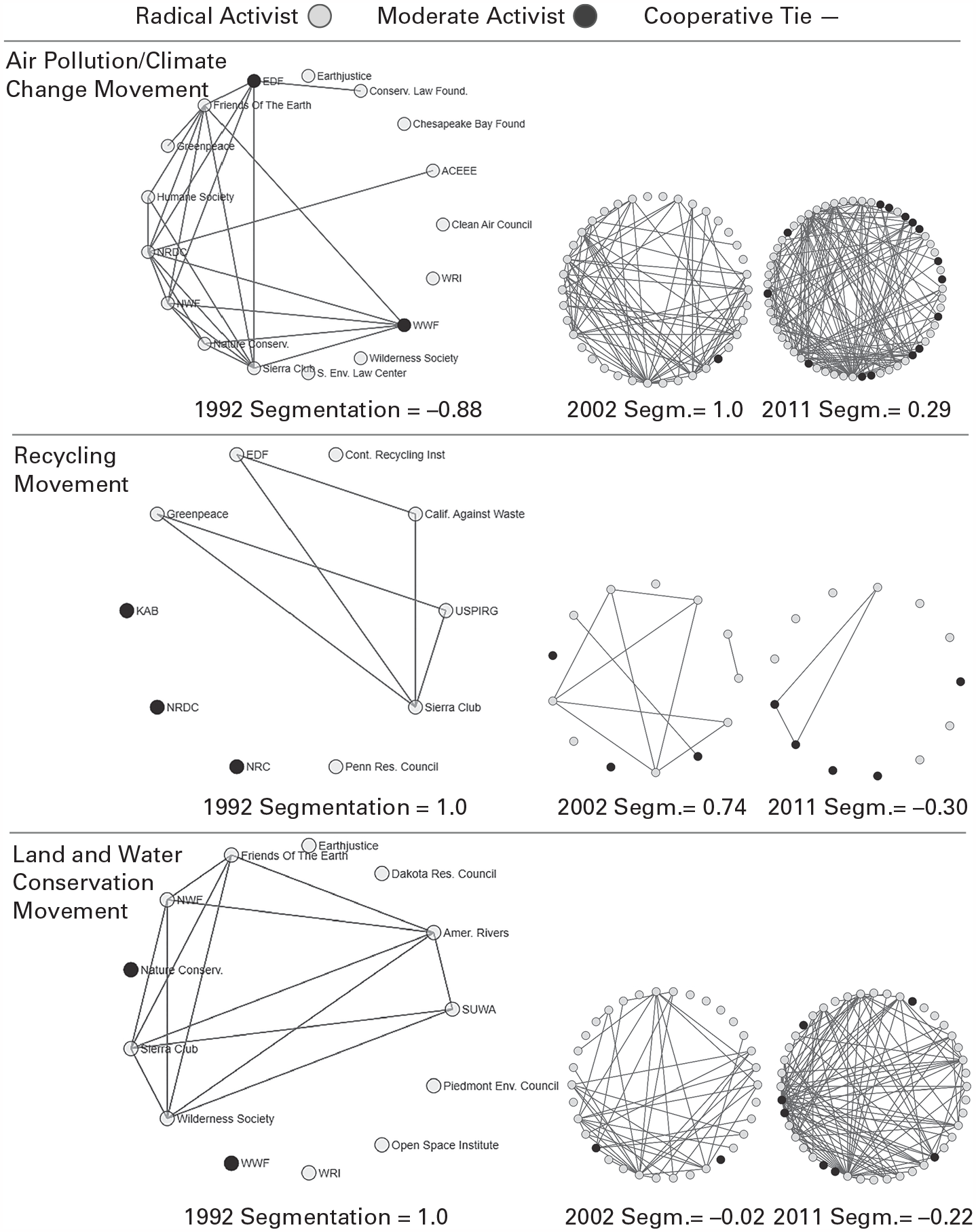
Networks of Three Example Environmental Movements in 1992, 2002, and 2011*
Measures
The existence of a collaboration between a given firm and SMO—firm–SMO collaboration—is the dependent variable used to test the hypotheses. The dependent variable is coded as 1 if a firm and SMO collaborated in a given year and movement and 0 if they did not.
The first hypothesis posits the likelihood of collaboration is heightened the more the SMO’s repertoire is nonconfrontational, focused on cooperating with firms (e.g., corporate donations, board interlocks). I used the Janis-Fadner (JF) coefficient of imbalance to measure each SMO’s repertoire in each movement-year. The JF coefficient assesses the relative proportion of contentious and arm’s-length cooperative interactions SMOs have with firms, while accounting for the total volume of interactions. 13 In constructing the measure, I took into account interactions taking place over the preceding three years because not all SMOs interact with firms every year on particular environmental issues. Formal collaborations are excluded from the measure to avoid confounding the outcome of interest (i.e., collaboration) with the measure and to disentangle repertoires from collaboration experience, which is controlled for separately. The SMO repertoire JF coefficient ranges from −1, indicating an SMO that relies on contention alone, to 1, indicating a purely cooperative SMO. SMOs falling between these values employ a combination of arm’s-length cooperation and contention in their interactions with firms on a given environmental issue.
The remaining hypotheses are tested using the subsample of moderate SMOs in a movement. Moderate SMOs are those that have shown a willingness to cooperate with firms on a given environmental issue in the past (den Hond and Bakker, 2007). I classified SMOs as moderate if their repertoire JF coefficient exceeds −1 in a given year, meaning they engaged in arm’s-length cooperation with any sampled firm at least once in the preceding three years on a specific environmental issue. SMO classifications change over time and are movement-specific because SMO ideology can change over time (e.g., Greenpeace began working with select firms on climate change in the mid-2000s) and varies across issues (e.g., cooperation on toxic chemicals is rare).
I tested the effect of movement structures proposed in Hypothesis 2a using Freeman’s (1978) segregation index to measure movement segmentation between moderates and radicals in each movement. Freeman’s index compares the proportion of observed between-group ties with the number expected under random mixing, accounting for the connectedness and size of the underlying network. I used Bojanowski and Corten’s (2014) reformulation of the index that allows between-group ties to exceed those expected under random mixing. I used the classification described above to identify SMOs in each movement as belonging to one of two groups: moderate or radical. Moderate SMOs are those that interacted cooperatively at least once with sampled firms on the movement issue in the preceding three years, whereas radical SMOs are those that exclusively used contentious tactics against firms on the issue. Movement segmentation can take both positive and negative values. Negative values correspond to movements in which cooperative ties between moderate and radical SMOs (i.e., between-group ties) are higher than expected under random tie formation; a value of zero corresponds to movements in which between-group ties are exactly as expected under random tie formation; and positive values correspond to movements in which between-group ties are less than expected in a purely random network with the same group sizes and connectedness as the observed one (Freeman, 1978). Figure 1 presents movement segmentation values corresponding to example movement network graphs.
To test the moderating effect of SMO specialization in more cooperative tactics posited in Hypothesis 2b, I compared the focal SMO’s repertoire JF coefficient with that of other SMOs in the movement. This conforms with Soule and King’s (2008) approach of measuring tactical specialization relative to the broader movement, but it differs from their focus on specialization in specific contentious tactics to instead focus on specialization in cooperative versus contentious tactics. I calculated the difference between the focal SMO’s JF coefficient and the median JF coefficient of other SMOs in the movement. Specialization in cooperative tactics increases in value the more cooperative the focal SMO’s repertoire is in comparison to the movement median up to a maximum of two, indicating the focal SMO employs only cooperative tactics (i.e., the SMO’s JF coefficient equals 1) while the median movement SMO employs only contention (i.e., the movement median JF coefficient equals −1). I tested the attenuating effect of an SMO’s social position in the movement posited in Hypothesis 2c using an interaction of movement segmentation and SMO ties to radicals: the sum of all cooperative ties the focal SMO has to any radical SMO in the movement in the preceding year (i.e., when negotiation over collaboration is most likely to occur), scaled by 10 for readability.
To test whether the likelihood a firm and moderate SMO collaborate on an environmental issue increases with the number of times the firm has been contentiously targeted, I summed all contentious challenges (e.g., protests, boycotts, lawsuits) a firm received on a given issue from SMOs in the movement in the preceding two years. I summed over two years because collaborations take time to negotiate (Seitanidi, Koufopoulos, and Palmer, 2010). For example, General Motors and the EDF began negotiations in 1991, a full year before a formal agreement was signed and announced. While results are robust to alternate windows, including one and three years, a two-year sum better captures the contention that precedes negotiation (i.e., when firms are most likely to seek help). Hypothesis 3b was tested by interacting contentious challenges against the firm with the movement segmentation measure.
I controlled in the empirical estimation for factors pertaining to the firm–SMO dyad, firm, SMO, and institutional environment, which may influence a given firm and SMO to collaborate and may be correlated with my hypothesized drivers of collaboration.
Dyad-level controls
The choice of collaboration partner is influenced by, among other things, the interactional history of the two parties. In a survey of Dutch firms, den Hond, de Bakker, and Doh (2015) found the frequency of contact a firm has with SMOs increases its propensity to collaborate with SMOs. Therefore, I summed the number of dyad cooperative interactions (e.g., donations, awards) between the SMO and firm in the preceding three years. Similarly, a history of conflict may attenuate the likelihood of collaboration. Therefore, I controlled for the sum of contentious challenges by the SMO against the focal firm in the preceding three years.
Firm-level controls
I controlled for a firm’s media attention, size, and public approval based on the characteristics of firms that ally with activists on boycotts (McDonnell, 2016). Firm media attention is the sum of all articles containing the firm’s name that appeared in the six largest U.S. newspapers in the prior year (scaled by 1,000 articles). I controlled for firm size using a firm’s logged employees and logged assets in the previous year, obtained from the Compustat database. I followed McDonnell (2016) in operationalizing public approval using the affective valence of all articles published about the firm in USA Today. Articles in this source are good candidates for capturing the valence of public attitudes toward firms because it regularly publishes character pieces on businesses and has the widest readership in the U.S. (McDonnell, 2016). Each article was analyzed using the Linguistic Inquiry Word Count (LIWC) program’s word dictionaries to calculate the extent of positively and negatively valenced words in each article. I used the JF coefficient (described above), commonly employed to control for the emotional valence of media coverage (Pfarrer, Pollock, and Rindova, 2010), to calculate a public approval measure that varies from −1 (only negative coverage) to 1 (only positive coverage). I used a cutoff of 60 percent for the LIWC scores (Pfarrer, Pollock, and Rindova, 2010) to classify an article as positive or negative.
I controlled for a firm’s environmental performance, as firms with greater commitments to environmental responsibility seek collaborations with SMOs (den Hond, de Bakker, and Doh, 2015) and may be contentiously targeted more often (McDonnell, King, and Soule, 2015). I relied on Kinder, Lydenberg, Domini Research & Analytics (KLD) environmental concern ratings to measure a firm’s environmental performance, because Chatterji, Levine, and Toffel (2009: 125) found KLD concern ratings are “fairly good summaries of past environmental performance” and predictive of future pollution and regulatory compliance violations. A firm’s environmental performance is the sum of seven environmental concerns evaluated by KLD in the prior year.
I also controlled for the possibility that SMOs will favor collaboration partners that can best propagate new practices resulting from collaborations. Board interlocks have repeatedly been shown to influence practice diffusion, as they serve as “conduits for the flow of information and norms” (Davis and Greve, 1997: 12). Therefore, I controlled for the degree centrality of each firm in the board interlock network of U.S.-based public and private firms (firm centrality), relying on BoardEx board interlock data.
I also controlled for firms’ receptivity to activism, which could inform SMOs’ selection of targets for contention (Baron and Diermeier, 2007) and may also increase either party’s propensity to collaborate. Consistent with past approaches (Briscoe and Safford, 2008; McDonnell, King, and Soule, 2015), I relied on a firm’s history of responses to being targeted and identified receptive firms as those that seek to address activists’ concerns. Firms’ responses to environmental and social issue shareholder proposals are one observable, unambiguous indicator of receptivity to activism (McDonnell, King, and Soule, 2015). 14 Firms respond to shareholder proposals in three distinct ways: positively, when the firm voluntarily cedes to the proposal, leading to its withdrawal; neutrally, when the firm does nothing and the proposal is put to a vote at its annual meeting; or negatively, when the firm petitions the U.S. Securities and Exchange Commission to exclude the proposal. I obtained firm responses to environmental and social shareholder proposals from the Interfaith Center on Corporate Responsibility and Institutional Shareholder Services. I followed McDonnell, King, and Soule (2015) in measuring firm receptivity to activism using the JF coefficient of imbalance, where a JF coefficient of −1 (minimum value) indicates that a firm challenged all proposals in a given year, while a firm with a JF coefficient of 1 (maximum value) voluntarily implemented all proposals it received. 15 Finally, I expect that firms are attuned to contentious targeting of their industry peers (Yue, Rao, and Ingram, 2013), which may drive propensity to seek collaborations. Therefore, I controlled for industry contentious challenges: the sum of contentious challenges that other firms in the same industry in which the focal firm operates (at the three-digit NAICS level) received in the previous two years on the environmental issue.
SMO-level controls
I controlled for SMO-level covariates that may be predictive of a firm’s desire to collaborate with it, and vice versa. Firms may seek out collaborations with highly reputable SMOs that may have fewer concerns about being criticized for collaborating with firms. I proxied SMO reputation using the number of congressional appearances an SMO made before congressional committee hearings, obtained from ProQuest’s Congressional Hearings data archives. Public policy makers’ evaluations of an organization’s sociopolitical reputation affect the number of congressional committee hearing invitations extended to that organization (Werner, 2015). Firms may also seek out collaborations with SMOs that have collaboration experience, as these SMOs may have built up alliance capabilities (Kale, Dyer, and Singh, 2002). Therefore, I controlled for SMO collaboration experience, which is the sum of collaborations the SMO has had with firms in the preceding three years. Finally, SMOs may vary in the degree to which they resist pressures for conformity from their field. Large, well-resourced organizations may be more financially insulated from the risks associated with peer criticism than smaller, resource-strapped organizations and therefore may be more likely to collaborate with firms, ceteris paribus. I accounted for this possibility by controlling for SMO resources: the SMO’s net assets at the end of the prior fiscal year (logged due to skewness), which I obtained from tax filing data from the National Center for Charitable Statistics (NCCS).
Institutional environment controls
SMOs’ choice of tactics is related to the prominence of the movement issue in the public policy space, which may likewise be correlated with movement segmentation (as prominent issues may attract more SMOs and those with strong ideological commitments). To minimize this potential bias, I used congressional hearing data from the Comparative Agendas Project to control for the prominence of the environmental issue in the policy space. Public policy openness is the count of congressional hearings held on a given environmental issue (e.g., climate change, recycling) that is the subject of the firm–SMO collaboration. Tactics are also likely influenced by the state’s openness to regulate industry, and firms in liberal states may be predisposed to collaboration; for example, liberal employees may have greater concerns about the environment. Therefore, I included a measure of the firm’s headquarter state governor’s political party—headquarter state party—coded 0 if the governor is Republican, 1 for Democrat, and 0.5 for other. To account for the possibility that resource partitioning within the movement (Soule and King, 2008) drives tactical segmentation, I controlled for the number of SMOs operating in a given movement and year.
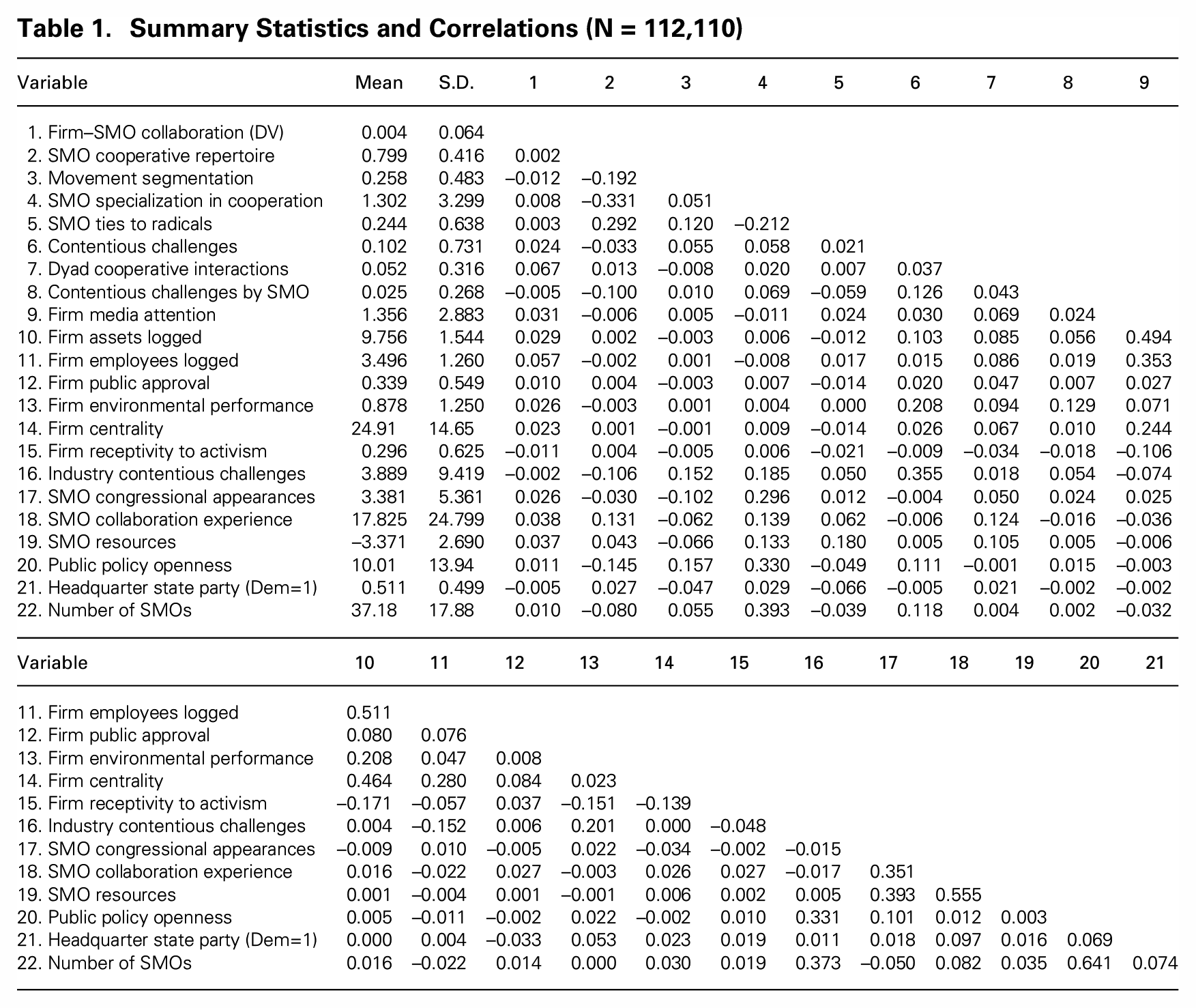
Table 1 shows descriptive statistics and correlations for the variables in the sample. In total, 1,822 contentious challenges took place and 357 collaborations were formed over the 25-year period between 136 environmental SMOs and 500 firms sampled. These interactions are far from distributed equally among either the SMOs or firms or over time. Table 2 lists the top 10 most contentiously targeted firms and those with the greatest number of collaborations, as well as the top 10 SMOs engaging in contention and collaboration. Firms with the greatest number of SMO collaborations are concentrated in consumer-facing industries (e.g., consumer products, retail) for whom audience perceptions are particularly important, while those most often the targets of contention operate in environmentally sensitive industries (e.g., extractives or energy). SMOs that engage in the most contentious challenges include organizations like Greenpeace and Friends of the Earth, often associated with contentious tactics, as well as a couple that combine contention and collaboration in their repertoires: the National Resources Defense Council (NRDC) and the EDF. However, collaboration is relatively more concentrated among SMOs (in comparison to firms), with only 28 of 136 SMOs having ever collaborated with a firm.
Summary Statistics and Correlations (N = 112,110)
Top 10 Firms and SMOs by Contentious Challenges and Collaborations*
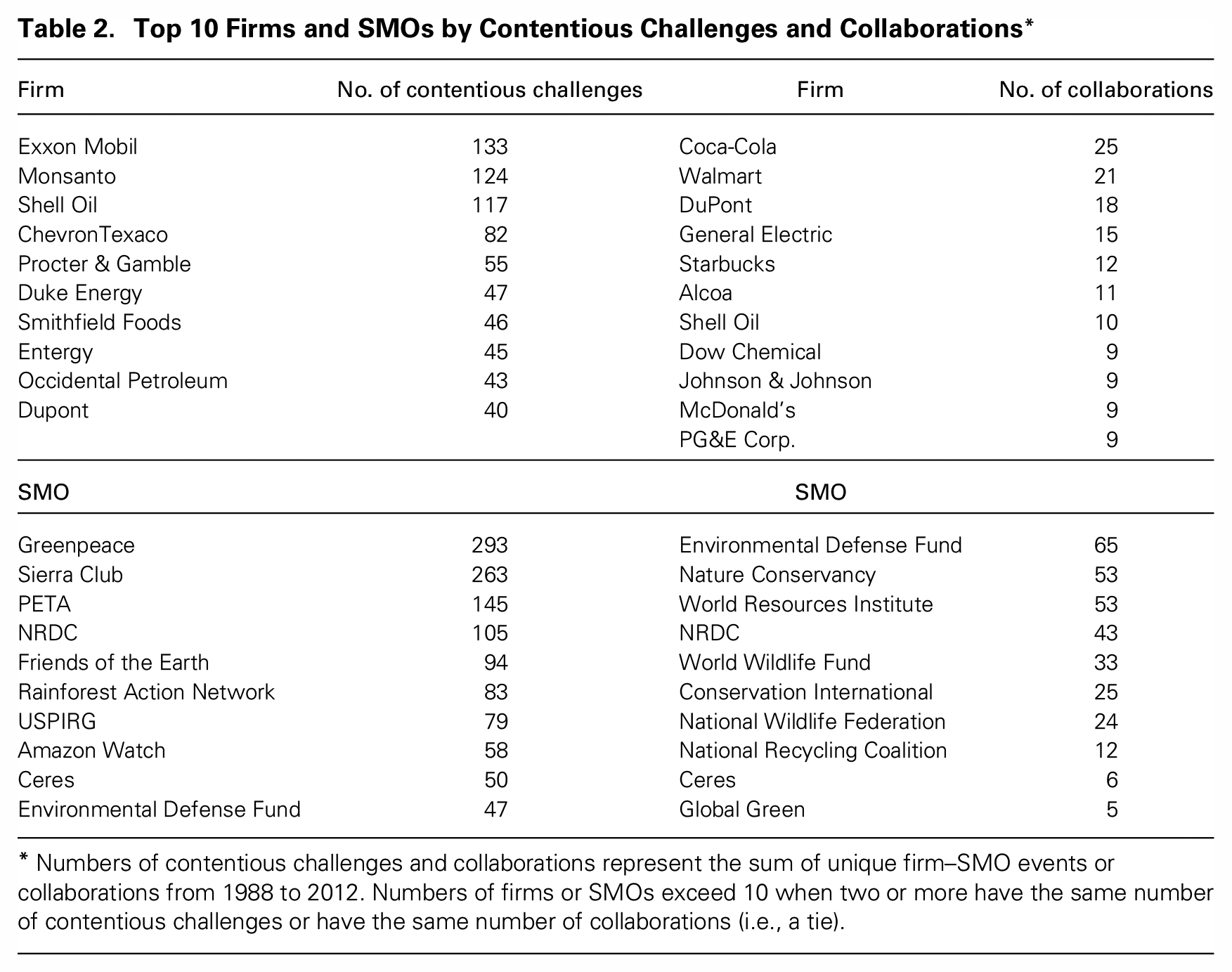
Numbers of contentious challenges and collaborations represent the sum of unique firm–SMO events or collaborations from 1988 to 2012. Numbers of firms or SMOs exceed 10 when two or more have the same number of contentious challenges or have the same number of collaborations (i.e., a tie).
Figure 2 graphs the 25-year trend in contentious challenges and collaborations disaggregated to the dyad level, i.e., where more than one SMO targeted, or collaborated with, one or more firms. After the first firm–SMO collaborations formed in 1990, there was modest but uneven growth in collaborations until 2007, when the number of collaborations more than doubled. This sharp jump appears to be driven by growth in both firm-level demand and SMO-level supply dynamics. In 2005 and 2006, two prominent firms (Walmart and Xerox) announced their first SMO collaborations, as did some activism-resistant firms (e.g., Smithfield Foods), which likely increased demand from peer firms for collaborations by demonstrating their value (Briscoe and Safford, 2008). Simultaneously, the number of moderate SMOs increased by 50 percent between 2005 and 2007—and by more than 70 percent in movements that experienced the greatest growth in collaborations. Thus the increased firm demand for collaboration was met with more willing partners for whom collaborations did not endanger supporter approval.
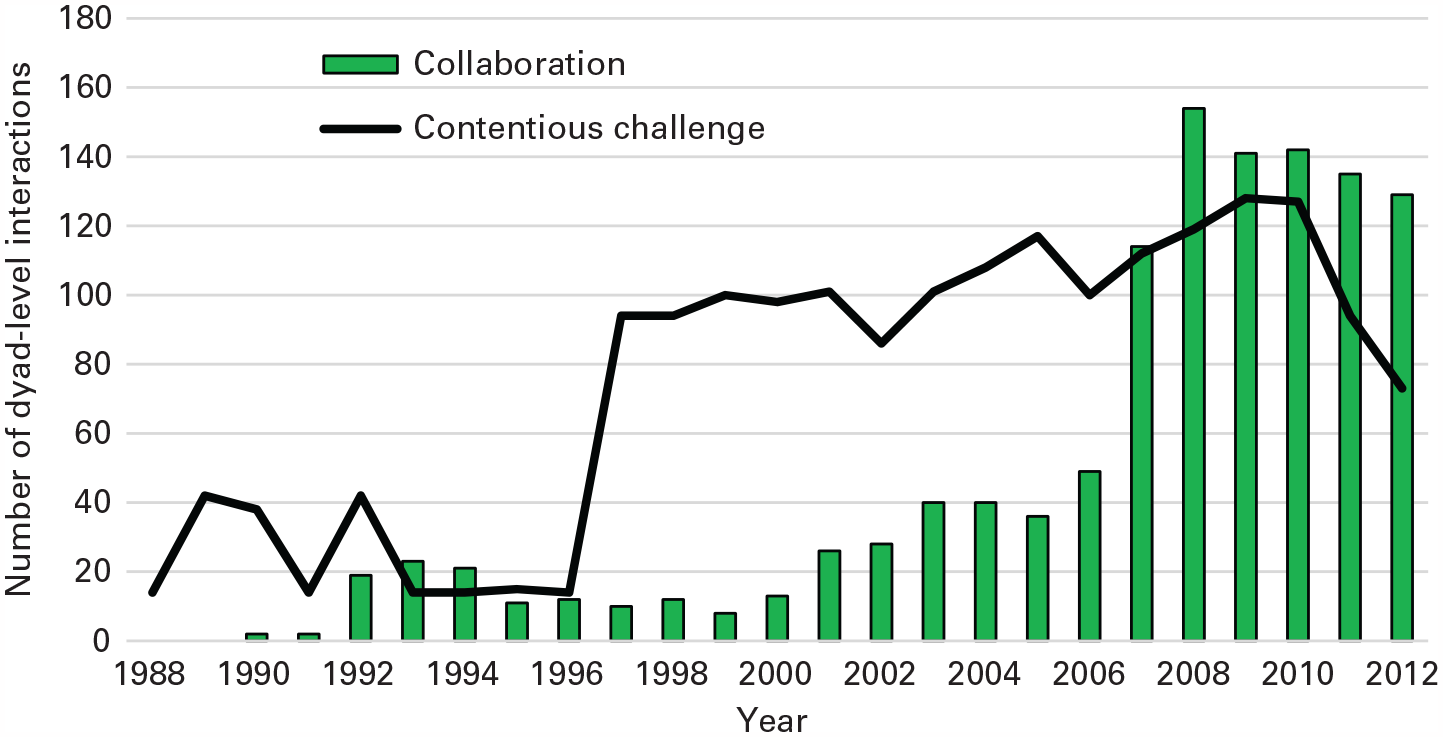
Contentious Challenges and Collaborations at the Firm–SMO Level, 1988–2012
Methodology
In line with the predominant approach in the literature on alliance formation, I used a discrete choice model to estimate the likelihood a firm and SMO form a collaboration on a particular environmental issue, within the set of all firm–SMO dyads with realized and unrealized (counterfactual) collaborations. To take account of the nesting of SMOs within movements, I used multilevel mixed-effects (MLM) panel probit regression with movement-level random effects and year and industry fixed effects. A multilevel model acknowledges that firms and SMOs choose partners within the constraints (e.g., segmented movements) and opportunities (e.g., contention against the firm) provided by the movement. Further recommending the multilevel model is an intraclass correlation coefficient of .13, which suggests a moderate amount of the difference in dyad-level collaboration stems from movement-level differences (Peterson, Arregle, and Martin, 2012). A likelihood ratio test comparing the full model with movement random effects to one without rejects the null that the random effect parameters of the mixed model are simultaneously zero (χ2 =144.3, p = .000). Standard errors are clustered at the movement to account for the non-independence of within-movement observations; that is, a firm’s or SMO’s choice to collaborate is likely correlated with choices of other firms, SMOs, or dyads and over time.
Results
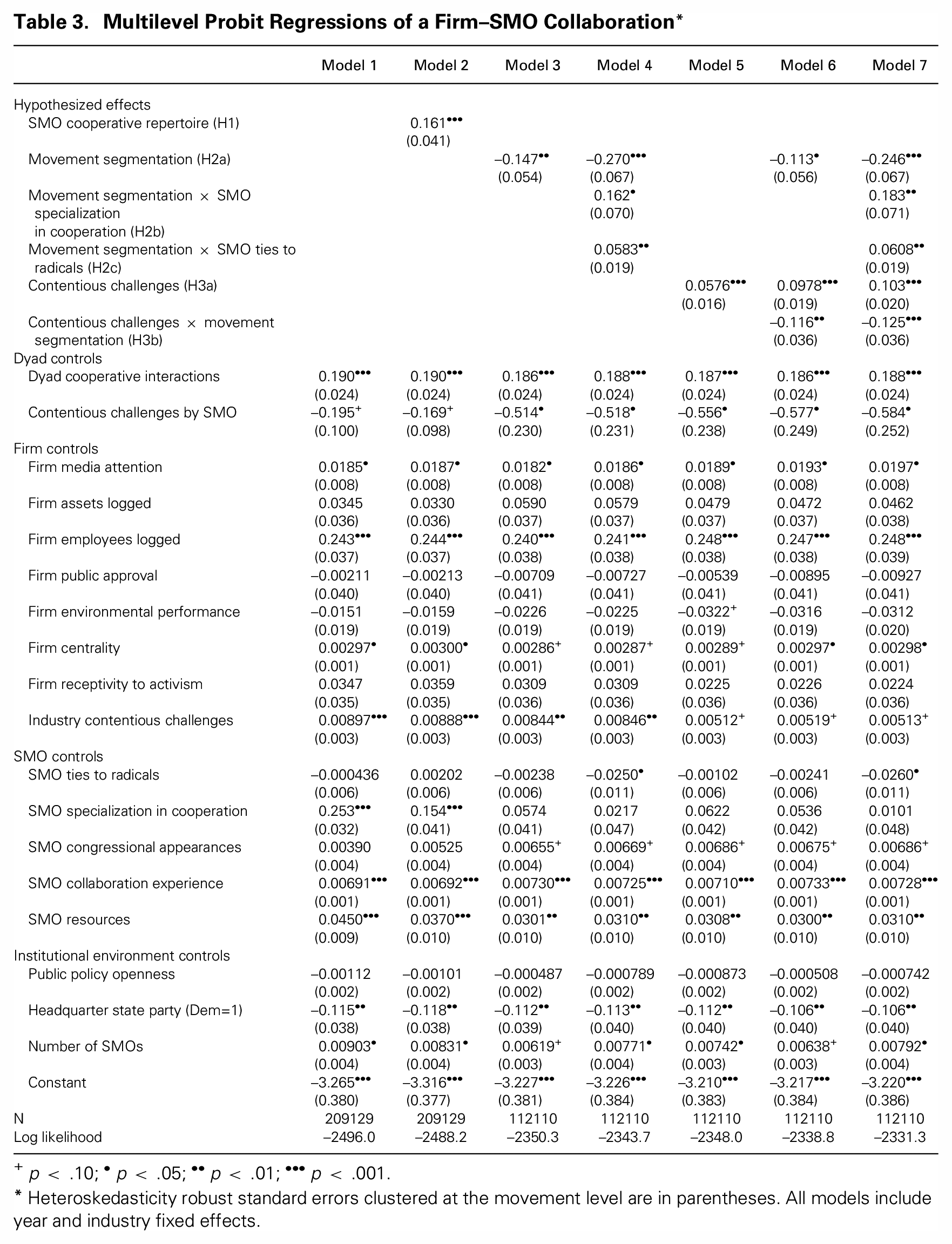
MLM probit regression results are reported in Table 3. In the controls-only model, I observe several significant coefficients consistent with alliances and cross-sector partnership research: partners with a history of arm’s-length cooperation are more likely to collaborate, whereas those with past conflict are less likely. Larger firms, with more media attention, and those more central in the board interlock network are more likely to have collaborations, consistent with the view that SMOs seek firms with market power and visibility for collaborations (McDonnell, Odziemkowska, and Pontikes, 2021). A movement’s contentious targeting of industry peers also increases the likelihood of collaboration, which suggests that information spillovers from contention (Yue, Rao, and Ingram, 2013) could prompt firms to seek collaborations preemptively. Meanwhile, SMOs with more collaboration experience and resources are those most likely to collaborate with firms.
Multilevel Probit Regressions of a Firm–SMO Collaboration*
p < .10; • p < .05; •• p < .01; ••• p < .001.
Heteroskedasticity robust standard errors clustered at the movement level are in parentheses. All models include year and industry fixed effects.
Turning to the hypothesized effects that SMO and firm audiences have on collaboration formation, H1 predicted that collaborations are more likely with moderate SMOs whose supporters are less likely to oppose formal collaborations. Model 2 confirms that as the cooperative repertoire of SMOs increases, the likelihood of collaboration increases (p = .000). A margins analysis, with other covariates set at the sample mean, indicates that an SMO with a highly cooperative repertoire (i.e., top quartile of observations) has a 50-percent higher likelihood of collaborating with a firm than an SMO with a moderately cooperative repertoire (i.e., sample median) and a 129-percent higher likelihood than a highly contentious SMO (i.e., bottom quartile). In fact, over the entire 25-year panel, only one collaboration was formed with a purely contentious, or radical, SMO—when Whole Foods collaborated with People for the Ethical Treatment of Animals to enhance its farm animal treatment standards. Thus the remaining hypotheses pertain to moderate SMOs—those that have cooperated with a firm at least once in the preceding three years—and are tested on the subsample of moderate SMOs.
Turning to movement-level effects, I find that the more relationally segmented moderates and radicals are in a movement, the lower the likelihood of a firm–SMO collaboration (p = .007; model 3). In relatively unsegmented movements (i.e., bottom decile of observations), the likelihood of a collaboration is more than double of that in highly segmented movements (i.e., top decile) where few ties exist between moderates and radicals (all other covariates set at mean values). I argued that the negative effect of movement segmentation on collaboration is driven by greater risk of peer criticism in such movements, and I find corroborative qualitative and quantitative evidence. In 2007, for example, a coalition of SMOs including Friends of the Earth, Greenpeace, and the NRDC criticized the EDF’s work with DuPont on nanomaterial waste in an open letter, stating “We strongly object to a process in which broad public participation in government oversight of nanotech policy is usurped by industry and its allies” (Inside EPA’s Risk Policy Report, 2007). A year later, the Rainforest Action Network criticized a climate change collaboration between the EDF, NRDC, and three major banks as not going far enough, suggesting that “a serious climate change policy would commit the banks to emissions reductions in their financing and extend beyond coal” (Bomkamp, 2008; emphasis added). Conversely, that same year, Greenpeace was much more positive about the EDF’s work with a grocery chain on an aquaculture purchasing policy, stating “many companies . . . have realized that there is a problem and to varying degrees are starting to work on it” (Mui, 2008). While the firms and specific initiatives involved varied, one striking feature of the aquaculture (sustainable fisheries) movement in 2008 was that it was entirely unsegmented along tactical lines (segmentation was –.27), while the other two movements (i.e., hazardous waste and climate change) were either perfectly segmented or nearly so.
I empirically investigated whether these cases generalize to other instances of peer criticism. An SMO–movement panel negative binomial regression of counts of peer criticism, with movement fixed effects, confirms that peer criticism increases the more segmented the movement (results are shown in Online Appendix D). 16 Moreover, the effect increases the more the focal SMO engages firms cooperatively on the issue, such as through collaborations or donations (p = .026; model D1 and Figure D1). Movement segmentation’s positive association with peer criticism is likewise greater for SMOs less specialized in cooperation, and therefore in direct competition with radical peers (p = .019; model D2 and Figure D2). These results are consistent with my theoretical arguments that cooperating with firms in segmented movements raises the risks of peer criticism, and even more so for those SMOs straddling repertoire categories.
In model 4, I find the threat to collaboration posed by segmented movements is reduced when the moderate SMO is relatively specialized in cooperation (p = .021) or has more ties to radicals in the movement (p = .002). For ease of interpretation, these findings are plotted in Figures 3 and 4, respectively. Consistent with H2b, results suggest that for SMOs whose repertoires deviate significantly from the movement, there is no negative effect of movement segmentation on collaboration. A one-standard-deviation increase in segmentation from the sample median corresponds to a 23-percent decrease in the likelihood of a collaboration with an unspecialized SMO (bottom decile) in comparison to a specialized SMO (top decile). In line with H2c, the negative effect of movement segmentation is attenuated for SMOs with a lot of ties to radicals in the movement. In highly segmented movements, the likelihood of a collaboration is 33 percent higher for SMOs with many ties to radicals (top decile) in comparison to those with few such ties (bottom decile).
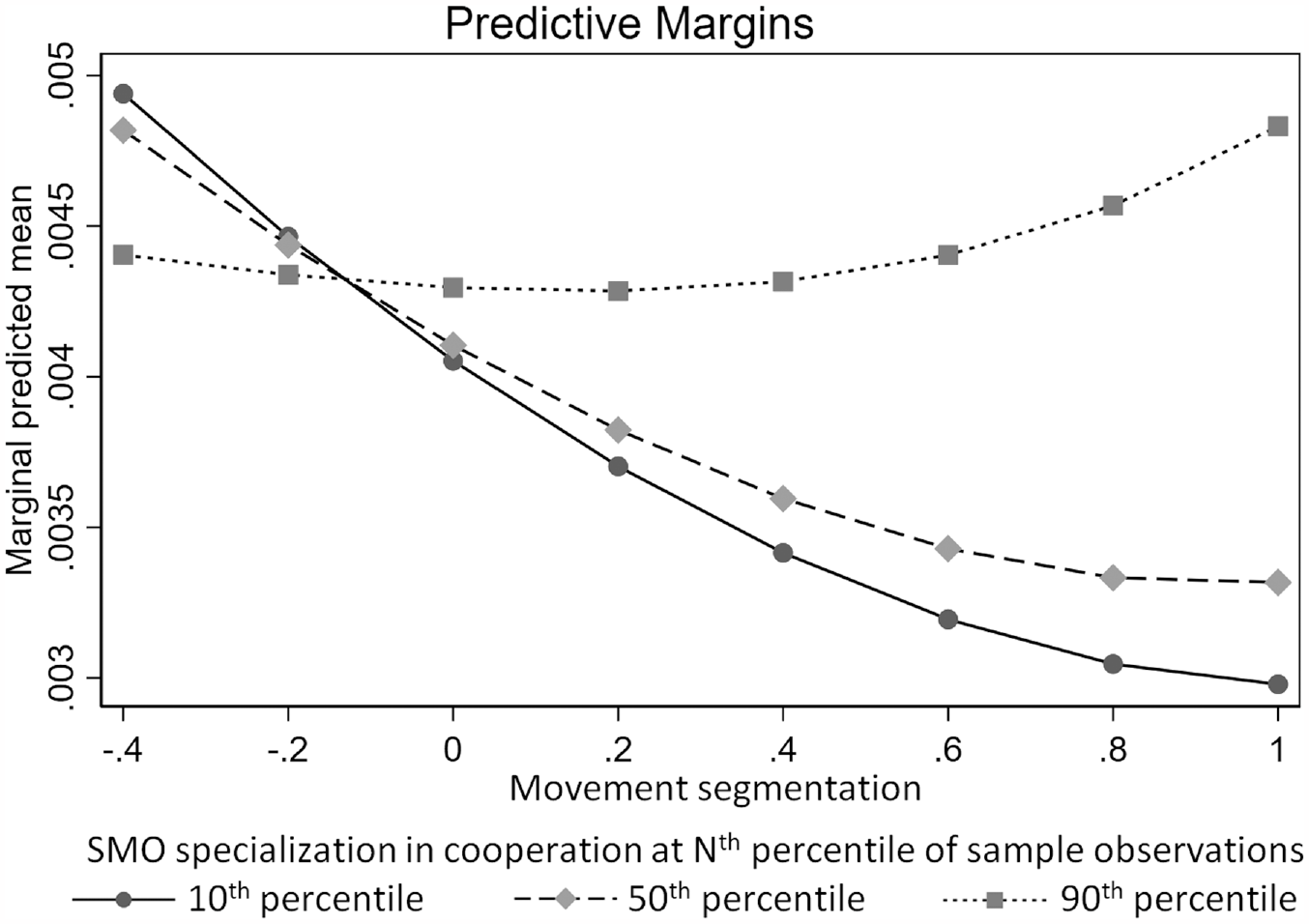
The Effect of Movement Segmentation on the Likelihood of a Collaboration at High versus Low Levels of the SMO Relative Specialization in Cooperation (H2b)
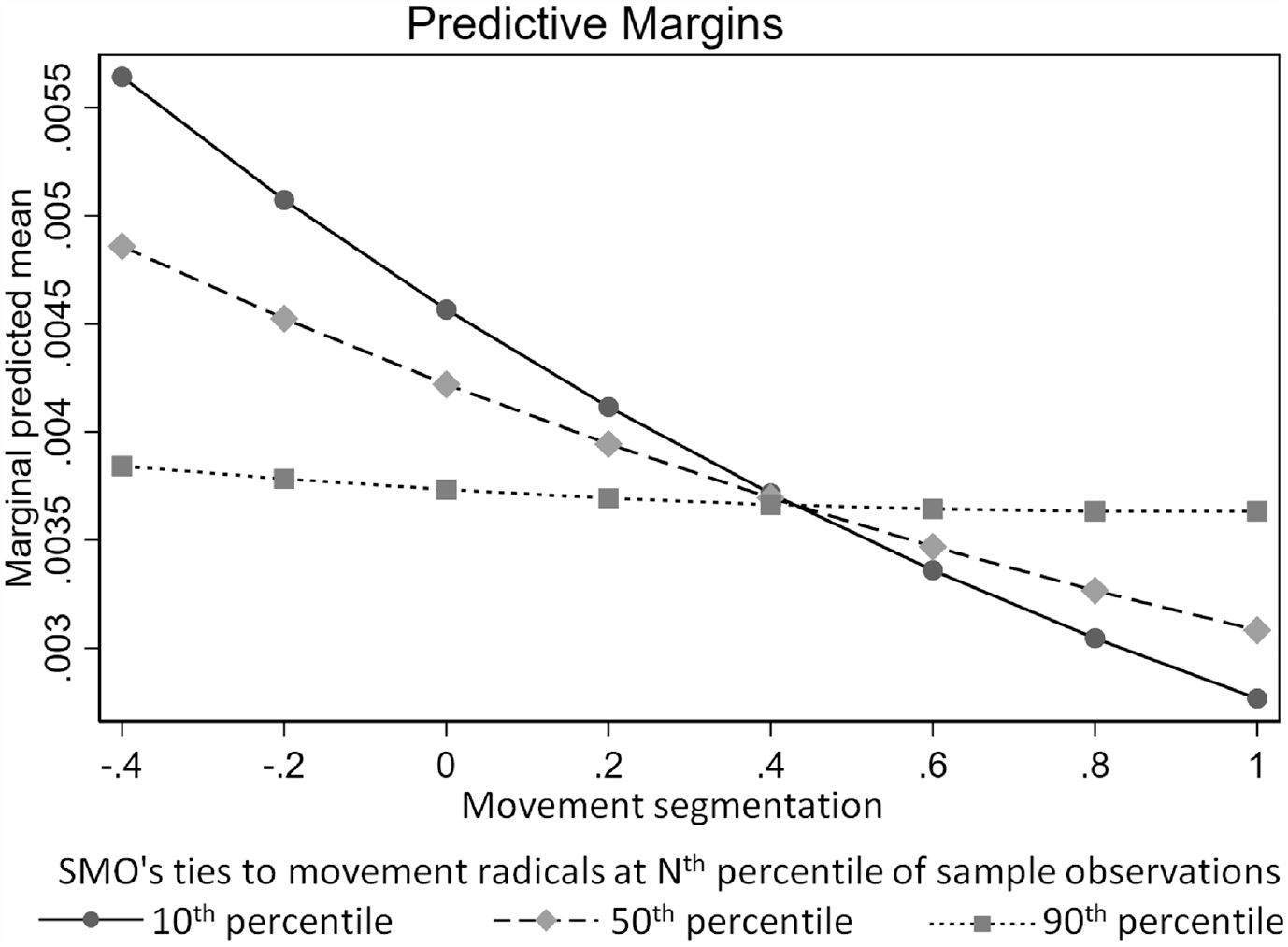
The Effect of Movement Segmentation on the Likelihood of a Collaboration at High versus Low Levels of the SMO Cooperative Ties to Radicals in the Movement (H2c)
I now turn to the idea that collaborations are a powerful means by which firms can repair their reputations after being contentiously targeted by a movement. Building on this idea, H3a and H3b posited that moderate SMOs are more likely to collaborate with firms facing greater contentious challenges from the movement but that contentiously targeted firms will be avoided in segmented movements. Results confirm this expectation: increased contention against a firm increases the likelihood of a firm–SMO collaboration (p = .000; model 5), but the positive effect of contention is attenuated as movement segmentation increases (p = .001, model 6). In unsegmented movements (bottom decile), firms that have been contentiously targeted twice have a 91-percent higher likelihood of collaborating than firms that have not. But the difference in likelihoods reverses in highly segmented movements such that firms are less likely to get a collaboration as they face greater contention from the movement, although the difference is not statistically significant. Figure 5, which plots the interacted results, suggests a strong symbiosis between contention and collaboration in unsegmented movements. In highly segmented movements, in contrast, moderate SMOs avoid collaborations with the enemies of their friends, i.e., firms their peers have targeted contentiously. In model 7, I estimate the full model, and all hypothesized effects remain significant and of similar magnitude.

The Effect of Contentious Challenges against the Firm on the Likelihood of a Collaboration at High versus Low Levels of Movement Segmentation (H3b)
Additional Analysis
I performed additional tests to assess the robustness of the findings to alternate estimation methods, measures, and controls and to address possible endogeneity in both firm-level and movement-level explanatory variables. Results are presented in Online Appendix E.
Alternate estimations
In the main models, I addressed the bias introduced by cross-sectional and time-series nonindependence of observations by clustering standard errors at the highest possible level: the movement. An alternative approach is to employ network estimation techniques that explicitly take account of network dependencies not accounted for by covariates. In model E1-1, I show robustness of the results to one such method, the multivariate application of the quadratic assignment procedure (QAP). QAP uses a permutation procedure to obtain dependency-corrected estimates (Krackhardt, 1988) and provides a conservative test of hypotheses by accounting for correlation in collaboration choices across movements (e.g., collaboration choice on recycling being influenced by climate change collaborations). Given the relatively rare occurrence of collaborations, I also confirmed the robustness of results (in model E1-2) to penalized likelihood estimation (Firth, 1993), which employs a bias-reducing penalty function when there are a small number of cases on the rare outcome.
Alternate measures and controls
Because media attention to contentious challenges influences firms’ responses (King, 2008), I confirmed that results remain unchanged when contentious targeting is measured using media attention (model E1-3) rather than unique targeting events. Further, the contentious challenges measure relies only on the 136 sampled SMOs, so I also checked the robustness of results to a more comprehensive measure of firm-level contention from Reprisk. Reprisk screens a broad set of media, stakeholder, and other third-party reports to derive various measures of criticism and mobilization against firms disaggregated by issue (Kölbel, Busch, and Jancso, 2017). These data are available beginning only in 2007, so my observations are reduced by over two-thirds, but results remain substantively unchanged with arguably a more comprehensive measure of contention the firm faces (model E1-4). Model E1-5 shows that results are robust to using another common approach to imputing collaboration duration: assuming termination occurs one year after the collaboration is established (Ahuja, 2000).
Given evidence that CEO political ideology affects both contentious targeting and firm responsiveness to activism (Briscoe, Chin, and Hambrick, 2014), I ensured results remain unchanged with a control for CEO ideology (model E1-6). 17 In the main models, I do not include firm or SMO fixed effects to avoid dropping all firms or SMOs without variance on the outcome variable (i.e., firm–SMO collaboration) from the models. Models E1-7 and E1-8 show that results are largely unchanged with the inclusion of firm or SMO fixed effects, respectively. The exception is the reduction in significance of the moderating effect of SMO ties to radicals in the SMO fixed effects model (p = .101). Ties to radicals exhibit considerably more across-actor variation than within-actor variation than other hypothesized covariates, which is absorbed with fixed effects.
Endogeneity
I sought to assess the robustness of the results to concerns about endogeneity resulting from nonrandom assignment of firm-level covariates and movement structures, which introduce unobservable variable bias. For firm-level endogenous regressors, I used an instrumental variable (IV) that I propose and empirically confirm is predictive of contentious challenges but that I argue is not correlated with the outcome (collaboration) except through its impact on the endogenous regressor. Here I focused my discussion on the relevance and exogeneity conditions of the instrument. Details of the IV measure, sources, and results appear in Online Appendix E.
I instrumented for contentious challenges against a firm using the number of legal cases brought by the EPA in a given year and on a given environmental issue. Legal cases against a firm on an environmental issue increase contentious challenges by SMOs by making the firm a more salient target for activism. A large and significant relationship exists between EPA legal cases and the number of contentious challenges against the firm in both the IV-probit regression (p = .000) and the two-stage least squares regression (p = .000), and an F-statistic of 231.95 also confirms the relevance and strength of EPA cases as an instrument for contention. Although EPA legal cases are not randomly assigned to firms, I posit that they meet the exclusion condition because they are unlikely to drive a firm’s propensity to collaborate with SMOs independent of their effect on contention. The rationale behind this assertion lies in costs firms incur in collaborating with SMOs, such as negotiation and coordination costs, higher investments (Boleslavsky, Chatterji, and Lewis, 2014), and the risk of public criticism. For collaboration to make sense in response to EPA cases and independent of contention, those costs need to be offset with a benefit related to the EPA legal proceeding. I find no evidence of such benefits. A t-test of differences in EPA case outcomes valuable to the firm, such as the dollar amount of penalties and the duration of cases, shows firms do not benefit in their EPA cases from having an SMO collaboration (Table E2). In other words, firms gain nothing with respect to their EPA legal proceedings from collaboration.
In the absence of an instrument for movement segmentation exogenous to firm–SMO collaboration, I relied on supplementary analyses to further investigate the mechanism underlying the findings and to attempt to rule out other possible explanations for the result. First, I investigated whether movement segmentation has a more pronounced attenuating effect on contentious challenges against the firm for those SMOs for whom peer criticism risks are more salient. Such risk is most salient for SMOs in precarious financial positions, because public criticisms by other SMOs could endanger their survival. Financially stable SMOs may be able to absorb peer criticism with less fear of dissolution. I calculated annual z-scores for each SMO, relying on Keating et al.’s (2005) adaptation of Altman’s z-score to nonprofits, which they found to be a good predictor of insolvency risk. A split sample analysis (models E5-1 and E5-2) shows that for SMOs in worse financial health, the attenuating effect of movement segmentation on contention against the firm is significant, while it has no significant effect for SMOs in good financial health.
Second, I looked for evidence that movement segmentation has a more pronounced attenuating effect on collaborations in the face of contention from radicals rather than moderates, which is consistent with moderate SMOs’ fear of retribution from radicals. Model E5-3 disaggregates contentious challenges into those coming from radicals in the movement and those from moderates. A t-test of coefficients of the simultaneously estimated effects confirms the attenuating effect of movement segmentation on contention is significantly larger if the contention is from radical activists (p = .0269). I also considered the degree to which the results are driven by inter-SMO relationships, as my theorizing argues, or the movement’s population ecology. If movements predominantly populated by radicals exert greater pressure to avoid collaboration and also manifest in more segmentation, my results may be driven by a different mechanism than ideology. Results remain unchanged with the inclusion of a control for the ratio of SMOs in the movement that are radical (model E5-4), which is negatively but not significantly (p = .150) correlated with collaboration. These results strengthen the evidentiary basis for the argument that it is not the composition of a movement but the relationships within it that matter.
Finally, I investigated whether in more socially cohesive movements, radicals and moderates cooperate to spur collaborations. For example, moderate SMOs may be incentivized to fund their radical peers’ campaigns because contentious targeting of firms increases moderates’ bargaining power in collaborations (Baron, Neale, and Rao, 2016). Interviews with SMOs did not surface this possibility, but interviewees may be hesitant to disclose collusion. Therefore, I further investigated this possibility by reading SMOs’ annual IRS tax filings. 18 In the subsample of SMOs that had a collaboration with a firm, I found no evidence they provided cash or in-kind support to radical SMOs for contentious targeting. This is consistent with Haines’ (2013) argument that purposeful cooperation between moderates and radicals to pressure firms into collaboration is a risky strategy if exposed to relevant audiences like SMO supporters.
Discussion
Cross-sector collaborations have been characterized as problem-solving mechanisms for complex societal issues that exceed the capacity of single organizations or sectors to solve (Austin and Seitanidi, 2012). While this accords with a view that interorganizational relationships bring together partners’ expertise and resources, it ignores the role that organizations’ relevant audiences play in their formation. This article documents how concerns about the social approval of relevant audiences can impede the formation of cross-sector collaborations that cross oppositional field boundaries. While collaborations offer an opportunity to advance the goals of their movement, SMOs hesitate to collaborate with incumbents when their supporters or movement peers are oppositional audiences, having a strong oppositional identity with respect to incumbents. Firms, in contrast, are most inclined to collaborate after being contentiously targeted by the movement, as they want to signal to their own audiences their genuine support for the movement’s cause. The intersection of these distinct audience effects poses a unique challenge for moderate SMOs: how to partner with the enemies of one’s friends. This challenge may lead to perverse welfare effects to the extent that firms contentiously targeted by movements, such as high polluters, are also those for which collaborations that address their problematic practices would offer the greatest societal impact.
This study reveals that movements are not simply catalysts for collaboration by threatening firms’ reputations through contentious targeting; movements are also arenas in which moderates compete and cooperate with radicals for whom collaboration may be anathema (Hoffman and Bertels, 2010). In movements in which radical SMOs rarely cooperate with moderates, open criticism of cross-sector collaborations ensues. Collaborations with firms almost always form only in movements in which moderates and radicals cooperate or in which the focal SMO does not compete with its radical peers for supporters. Thus cooperative ties between radical and moderate factions of a movement are critical precursors to cross-sector collaboration. Intuitively, we may think that SMOs will avoid collaborating with firms that are adversaries of their friends (or friends of friends) because field members have a desire to maintain their social bonds. Instead, I find that the existence of such social bonds within movements actually allows SMOs to “transform contestation into collaboration” (O’Mahony and Bechky, 2008: 422), and in the absence of such bonds collaborations fail to materialize.
Contributions to Research on Social Movements
This article is one of the first to study collaborations between movement organizations and firms, an undertheorized phenomenon in social movements research. Twenty-five years of interactions between 136 SMOs in multiple movements and 500 of the largest firms in the U.S. corroborate what researchers have been positing for years (Soule, 2009; Baron, 2012; Heyes and King, 2020): the rise of collaborations between SMOs and firms. At first glance, this is unsurprising. Collaborations allow SMOs to leverage firms’ market power and visibility to make progress on pressing social issues, while firms coming under increased stakeholder scrutiny are seeking the expertise and certification that allying with an SMO can offer (Baron, 2012; Li and Soule, 2021).
However, the rise of firm–SMO collaborations masks challenges that social movement theory does not address. Existing theory characterizes tactical boundary spanning in movements as a strategic opportunity (Wang and Soule, 2016) and posits a symbiosis between contentious and collaborative tactics (den Hond and de Bakker, 2007; Baron, Neale, and Rao, 2016; McDonnell, 2016), whereby moderate and radical SMOs select tactics and targets based on their expertise and probability of success (Baron, 2012). Contrary to this, I find that spanning tactical boundaries is a strategic challenge, with the choice to collaborate highly dependent on the approval of supporters and movement peers whose ideologies dictate whether the interplay of contention and collaboration is symbiotic or dangerous. The key difference underlying the theory and results presented here is collaborative tactics that deviate from the outsider tactics that typify most social movements research. Crossing boundaries to collaborate with incumbents the movement opposes may not only violate relevant audiences’ strongly held beliefs but also blur the boundaries between movements and those they challenge to effect change. This suggests a need to investigate the limits of existing social movement theory in the context of collaborative tactics. As SMOs increasingly choose between contention and collaboration, we know little about the consequences of this choice for their success, their targets, or their movement.
Answering the call to examine “how inter-organizational network dynamics . . . impact firm or organizational outcomes” (Soule, 2018: 135), this research also highlights the critical role that movement networks, and SMO positions therein, play. The influence of inter-SMO cooperation and competition on SMO strategy is well established (McCarthy and Zald, 1977; Soule and King, 2008) yet understudied in research on their engagement of firms. Studies of activists’ engagement of firms paint them as largely atomistic actors with more or less influence as a function of their tactics (e.g., Eesley, Decelles, and Lenox, 2016) or industry or firm opportunity structures (e.g., King, 2008). The findings here suggest SMOs’ strategy with respect to firms is highly dependent on their movement peers, who can simultaneously push firms to seek collaboration through contentious targeting and dampen it by threatening open criticism. This suggests that research on movements and firms needs to better account for the embeddedness of target and tactic choice within broader movement dynamics and networks, where inter-SMO competition and cooperation determine tactic and target choice, and the sequencing of distinct tactics likely influences target responsiveness.
This article also offers a new perspective on how radicals affect moderates’ success. In the original formulation of radical flank theory, Haines (1984) proposed that radicals affect moderates indirectly through their impact on movement supporters and outsiders. I present evidence that radicals affect moderates through direct means: open criticism or the threat of it. This article shows that radical segments of a movement are not silent bystanders as the positive radical flank effect materializes, i.e., as targeted elites seek to resolve crises brought by contentious targeting by cooperating with moderate activists (Haines, 1984). By problematizing firm–SMO collaborations as socially contested, I advance theoretical arguments on an important boundary condition on the positive radical flank effect: oppositional audiences who define their identity in opposition to firms. This complements findings that oppositional identities of movements can be equally (and detrimentally) consequential to audience evaluations of movement-affiliated organizations (Negro and Olzak, 2019).
The constraints movements place on SMOs’ strategy with respect to firms are driven by the oppositional ideologies of some radicals rather than by the sheer number or proportion of radicals in a movement. This echoes findings on the importance of ideology in political stakeholders’ willingness to engage firms cooperatively (Wang, Du, and Marquis, 2019). As organizational scholars increasingly theorize the role individual or organizational ideology plays in firms’ interactions with stakeholders (e.g., Gupta and Briscoe, 2020), research on the impact of stakeholders’ ideology is a necessary complement. In contrast to Wang, Du, and Marquis’ (2019) focus on a single stakeholder’s ideology, my research highlights that ideological commitments at the level of a broader field of stakeholders—a social movement—are equally consequential for firms’ interactions with stakeholders. Importantly, oppositional audiences are not fixed in their preferences, and future research exploring when ideological commitments shift could be fruitful in explaining the considerable heterogeneity in oppositional ideology within movements over time documented in this study (i.e., Figure 1). Equally, oppositional identity and audiences may vary by location as recent research points to place-based ideological differences within movements (Nelson, 2021). Given that so much firm–stakeholder collaboration is rooted in local communities, future research should also explore geographical variation in collaboration and oppositional audiences.
Contributions to Research on Interorganizational Relationships
This study explores a previously unexamined constraint on interorganizational ties: oppositional audiences. Past work exploring audience effects on interorganizational relationships has found that relationships with less-esteemed actors are avoided due to status anxiety (Jensen, 2006). While status is important in organizational fields with inherent status differentiations, economic sociology points to a number of organizational fields that differentiate themselves in opposition to another field (e.g., breweries, Carroll and Swaminathan, 2000; gastronomy, Rao, Monin, and Durand, 2005; winemaking, Negro, Hannan, and Rao, 2011). Interorganizational relationship research has not considered the effects of oppositional audiences (e.g., consumers, peers) in such fields. I find that actors avoid ties to those their field opposes when such ties risk audiences’ perceptions of defection and working with the enemy. Evidence of open criticism of those that collaborate with the field’s enemies suggests their avoidance is well-founded. At the same time, the findings here point to considerable heterogeneity in the intensity of opposition against incumbents in different fields and over time. Oppositional market categories may likewise differ in their intensity of opposition with implications for their evolution if category boundaries blur over time as field members collaborate with or sell out to incumbents. Exploring why some oppositional fields are more steadfast in their opposition than others and whether collaborations indeed blur field boundaries is an opportunity for future research.
This study also draws attention to the idea that cooperative interorganizational forms do not always have a taken-for-granted status, and when they do not, their formation can garner criticism. In such circumstances, partner selection may not be driven by partner capabilities or resource complementarities alone but also by the social acceptability of the tie to supporters or the field. Organizational fields have their own norms and collective understandings of what “forms of action and organization are viewed as legitimate” (Fligstein and McAdam, 2012: 11). Despite the ubiquity of the legitimacy construct in organizational theory, few studies have considered how the legitimacy of the interorganizational form itself impacts interorganizational strategy (see Dacin, Oliver, and Roy, 2007 for an exception). Interorganizational forms may lack legitimacy when they first emerge, as was the case in the early 1990s for firm–SMO collaborations, when it was “heresy to say that companies and NGOs could work together” (The Economist, 2010). However, the lack of legitimacy seems to persist when an organizational field defines its collective identity in opposition to another field, exacerbating tensions inherent in managing connections to multiple fields (Zietsma et al., 2017). This suggests future research investigating partner selection should pay greater attention to the constraints of potential partners’ organizational fields, because the legitimacy of interorganizational relationships is context bound (Ingram and Yue, 2008).
Additionally, by theorizing the impact of conflict and social sanctioning originating at the field level on dyad-level collaboration, this study addresses two blind spots identified by Lumineau and Oliveira (2018) in their review of research on interorganizational relationships: single-valence and single-level relationships. Counter to the idea that conflict crowds out collaboration (Sytch and Tatarynowicz, 2014), I theorize the strategic benefits of collaboration to actors besieged by conflict (i.e., contentious targeting by movements). This harkens back to the idea that interorganizational relationships are a powerful means by which organizations can neutralize opposition (Oliver, 1991) or internalize external threats (Selznick, 1949). Incorporating multiple levels of analysis revealed that the organizational fields in which counterparties are embedded are critical to those benefits materializing. Echoing Uribe, Sytch, and Kim (2019), a key precursor to collaborating in the face of conflict is the degree to which salient stakeholders, with the ability to impose social sanctions, approve of collaboration. Future research investigating how audiences influence interorganizational relationships through their expectations of relationship valence might look to a field’s social structure as an indicator of those expectations.
Limitations and Opportunities for Future Research
In focusing on the first-order question of which firms and SMOs form collaborations, this study is not without its limitations. First, it does not theorize or model broader trends in collaboration over time, which resemble a diffusion curve. Future research could evaluate the degree to which these trends are driven by diffusion processes among firms, changing movement supporter preferences, or changes in ideological opposition toward collaboration over time. Also, in focusing on Fortune 500 firms, the extent to which the theory and results translate to smaller firms is uncertain. The logic of movements as challengers to incumbents (King and Pearce, 2010), which undergirds the theory of oppositional audiences in this study, suggests small firms pose fewer of the risks that drive the patterns in partner selection here. Small firms are typically neither branded as incumbents the movement opposes nor selected as the targets of contention. Thus the avoidance of collaborations in segmented movements, or the symbiosis between contention and collaboration in unsegmented movements, may not apply.
Second, I have conceptualized collaborations absent the institutional environment. While I empirically control for public policy openness to movement issues, future research could more directly address how political or regulatory threats (Hiatt, Grandy, and Lee, 2015) influence firm–SMO collaborations. Evidence points to firms’ strategic use of donations to nonprofits to influence policymakers in their favor (Bertrand et al., 2018). Firms may likewise use SMO collaborations to fashion more favorable legislative or regulatory environments. Leveraging the social capital of SMO partners may be a particularly useful strategy for firms whose political capital is depleted through past contentious targeting (McDonnell and Werner, 2016).
Finally, this paper does not speak to the outcomes of collaborations that do materialize. Consequently, it is unclear whether firms succeed in repairing their reputations with important audiences and quelling contention from the broader movement or whether SMOs succeed at changing firms’ practices in ways that address the goals of their movement. This offers opportunities for future research to explore the outcomes of firm–SMO collaborations for the firm, SMO, movement, and society more broadly. Equally important are future efforts to evaluate the comparative efficacy of contentious and collaborative tactics in effecting institutional change. As both contention and collaboration likely play a role in advancing firms’ social and environmental performance, this article is a first step in eliminating an important blind spot in our understanding of such institutional change.
Supplemental Material
sj-pdf-1-asq-10.1177_00018392211058206 – Supplemental material for Frenemies: Overcoming Audiences’ Ideological Opposition to Firm–Activist Collaborations
Supplemental material, sj-pdf-1-asq-10.1177_00018392211058206 for Frenemies: Overcoming Audiences’ Ideological Opposition to Firm–Activist Collaborations by Kate Odziemkowska in Administrative Science Quarterly
Footnotes
Acknowledgements
I gratefully acknowledge Forrest Briscoe and three anonymous reviewers for their guidance during the revision process, and my dissertation advisors Witold Henisz, Zeke Hernandez, Mauro Guillén, and Mae McDonnell. Earlier versions of this paper also benefited from the comments of Ruth Aguilera, Tracy Anderson, Shaz Ansari, Grace Augustine, Sarath Balachandran, Ronnie Chatterji, Barbara Gray, Minjae Kim, Kyle Mayer, Alessandro Piazza, David Waguespack, and Anastasiya Zavyalova. Funding for this research is provided by the Strategic Management Society’s Strategy Research Foundation Dissertation Grant, Wharton’s Mack Institute for Innovation Management, and the Wharton Social Impact Initiative. All errors are my own.
1

2
I focus my arguments on the identity of SMOs being influential with firms’ audiences rather than the expertise of SMOs on particular issues because SMOs’ identities as independent challengers distinguish them from other actors that can provide firms expertise such as specialized (e.g., waste reduction) consultants (Boleslavsky, Chatterji, and Lewis, 2014) or service-oriented nonprofits.
3
Social structures are thought to exhibit a pull away from unbalanced triads (Heider, 1946; Sytch and Tatarynowicz, 2014), where conflictual relationships between two alters (e.g., an SMO and firm) disrupt ego forming a cooperative relationship with an alter (e.g., collaboration with firm) if ego has a cooperative relationship with the other (i.e., ego is cooperative with the SMO alter).
4
I set to the background, and empirically control for, concepts like complementary resources and the interactional history of partners common to cross-sector partnership or alliance scholarship. This is not meant to suggest a lower salience of such concepts in firm–SMO collaborations. Instead, in seeking to contribute new insights to research on movements, cross-sector collaborations, and interorganizational relationships, I focus on the effects of audiences.
5
My arguments focus on within-movement heterogeneity in SMOs’ ideology with respect to firms (Zald and McCarthy, 1980; den Hond and Bakker, 2007), in contrast to conceptualizations of movements themselves as ideologically structured action including beliefs of how the world should be to address movement grievances (e.g., Georgallis, 2017).
6
Collaborations with SMOs are generally more costly than unilateral actions firms take on social or environmental issues because of negotiation, coordination, and monitoring costs involved in interorganizational relationships. Moreover, SMO advice is “typically biased toward larger investments” (Boleslavsky, Chatterji, and Lewis, 2014: 3) because unlike paid external consultants, SMOs’ goal of effecting institutional change drives them to seek larger and costlier changes in firm practices. As information about a firm’s practices is revealed during a collaboration, the collaborating SMO’s asks can also escalate when transparency reveals unanticipated issues.
7
The bias toward collaborations with large firms was confirmed within the sampled firms, where a two-sided t-test of difference in means confirms that larger firms are significantly more likely to have collaborations, whether measured in assets (p = .004) or employees (p = .000).
8
9
The search focuses on North America because the impact of SMOs and their tactics varies by region (Durand and Georgallis, 2018), so SMOs’ decision making on campaign strategy is often geography specific. Firms’ environmental performance, a driver of contentious targeting, also varies across countries, and data are not available across countries for the same firm. The major news and business publications category includes over 100 print and online sources from outlets such as ABC News, The Boston Globe, and The Wall Street Journal, while the press release wire category includes over 200 press release wires such as Business Wire, Greenwire, and NASDAQ/GlobeNewswire.
10
An investigation of Factiva’s holdings of the most popular sources for contentious and cooperative interactions revealed that one source was newly added during the study period (M2 Presswires) and another (Associated Press) has uneven coverage over time (i.e., dropping to nearly zero between 1991 and 1996).
11
During the training period, spanning one month and approximately 2,000 articles coded by each coder, I read every article that the undergraduate students coded and provided feedback. Once each coder was trained to a performance level of at least 95-percent correct coding, I continued to read and enter into a database every article that was coded as containing either a contentious or cooperative interaction but not those that were coded as containing neither. Intercoder reliability tests conducted halfway through the coding demonstrated a high rate of agreement (95-percent average, three coders, random sample of 3,465 articles).
12
Duration data are disproportionately missing for intensive collaborations as opposed to interactive collaborations (Rondinelli and London, 2003). Interactive collaborations are more project-based wherein the parties collaborate to develop and implement an educational program or campaign, co-manage land assets, etc. Intensive collaborations tackle environmental problems inside the firm, which requires sharing internal data and business practices and research and evaluation of potential solutions. Over 83% of interactive collaborations have duration data, while only 44% of intensive collaborations have it, which logically corresponds to the nature of the work involved. Duration on clearly defined project-specific work is more easily anticipated and therefore reported, while intensive collaborations involving exploratory work may not disclose duration because of the uncertainty of when such work will conclude.
13
JF coefficienti = (Pi 2–PiNi)/Vi 2 if Pi>Ni; 0 if Pi=Ni; and (PiNi–Ni 2)/Vi 2 if Ni>Pi where Pi is the number of cooperative arm’s-length interactions the SMO had with any sampled firm on environmental issue i in the preceding three years, Ni is the number of contentious interactions, and Vi is the total number of interactions.
14
Firms’ responsiveness to other forms of activism, such as protest, is more ambiguous and challenging to identify because a firm may not respond publicly or may do so publicly months or years later while not attributing a new initiative to a particular contentious challenge. Conversely, firms’ responses to shareholder proposals are public and clearly linked to each proposal.
15
If a firm did not receive a shareholder proxy proposal in a given year, I carried over the firm’s past receptivity because reputations for receptivity are sticky (Briscoe and Safford, 2008), and I ran robustness checks omitting firm-years with no proxy proposals.
16
Instances of peer criticism were identified using the same method employed for cooperative ties between SMOs, i.e., coding of archival documents in which the names of both SMOs appear. In total I found 78 instances when one SMO publicly criticized another.
17
Using data from Fremeth, Richter, and Schaufele (2013), I controlled for the fraction of CEOs’ contributions to political campaigns that were to Republican candidates (CEO ideology).
18
In Part IV of their 990 forms to the IRS, nonprofits are required to disclose the name and amount of cash and non-cash assistance to other organizations (and its purpose) if the amount exceeds $5,000. I collected SMO IRS 990 forms from various online sources (e.g., Charity Navigator, SMO websites), generally available from 2001 onward.
Supplemental Material
Author’s Biography
References
Supplementary Material
Please find the following supplemental material available below.
For Open Access articles published under a Creative Commons License, all supplemental material carries the same license as the article it is associated with.
For non-Open Access articles published, all supplemental material carries a non-exclusive license, and permission requests for re-use of supplemental material or any part of supplemental material shall be sent directly to the copyright owner as specified in the copyright notice associated with the article.
