




Abstract
This article examines the influence of the European qualifications framework – a key European lifelong learning policy instrument for improving employability, comparability and mobility in the European educational space – on the establishment of national qualifications frameworks in Europe. The European qualifications framework and national qualifications frameworks are analysed through the lens of the process of the Europeanisation of education, and they are embedded in the broader context of the development of national qualifications frameworks in Anglo-Saxon and developing countries around the world. Against this background and through an analysis of established national qualifications frameworks in four European countries, i.e. Denmark, Germany, Portugal and Slovenia, we argue that the national qualifications frameworks in these countries cannot be understood to be tools for the deregulation, marketisation and commodification of education and knowledge, although this could be interpreted as one of the underlying hidden assumptions of the European qualifications framework recommendation.
Keywords
Introduction
As a result of globalisation and Europeanisation processes, educational policy has internationalised and become a product of supranational political organisations, i.e. the EU and international organisations such as the OECD, UNESCO, the World Bank and the IMF (Burbules and Torres, 2000; Dale, 1999). These organisations can be understood as new empires of knowledge in education (Klerides et al., 2014) which strive to promote precisely defined norms, values and discourses in the field of education, although their formal competences are limited. Consequently, a global and European education policy/space has emerged (Dale, 2009; Lawn and Grek, 2012; Nóvoa, 2010), in which a coherent range of themes, technologies and discourses are being established and through which global and European processes are transforming education policy and education systems (Fenwick et al., 2014). Moreover, global as well as European processes are shifting education policy from a focus on democracy, social justice and equality towards market strategies and neoliberal values, which are reflected in a culture of performativity, accountability, measurement and the effectiveness of education, human capital theory, evidence-based educational practice, outcome-based education, lifelong learning (LLL), etc. (Biesta, 2015; Olssen and Peters, 2005; Rizvi and Lingard, 2010).
The establishment of national qualifications frameworks (NQFs) around the globe is seen as one of the processes which support this shift in education policy. Studies have shown that the development of NQFs has been influenced by Anglo-Saxon countries and a global neoliberal policy that conceals tendencies towards the deregulation, marketisation and commodification of education and knowledge. This is based on evidence collected from the NQFs of ‘early starters’ (New Zealand, Scotland, England, Australia and South Africa) and those in developing countries, which draw heavily on models developed in the United Kingdom (Allais, 2010, 2014; Brockmann et al., 2009; Cort, 2010; Young and Allais, 2013). However, fewer studies focused on the impact and normative aspects of the NQFs that have been developed in Europe under the influence of the European qualifications framework (EQF). Using the Europeanisation process as a basis and by examining how member states adopt EU rules and implement EU policy instruments, the following research question was formulated in order to guide our research endeavours: Do the newly developed NQFs in the European countries selected, which are influenced by the EQF, represent neoliberal tools for the commodification of knowledge and the marketisation of education, as evidenced by the NQFs of early starters and developing countries?
Based on a comparative analysis of the NQFs in four European countries, i.e. Denmark, Germany, Portugal and Slovenia, we will argue that NQFs in all four countries developed under the influence of the EQF, that they differ considerably from the NQFs in Anglo-Saxon countries and developing countries around the globe, and do not represent neoliberal tools for the deregulation, marketisation and commodification of education and knowledge. It appears that European education policy concepts do not always have a direct causal impact on national/local education policy and practice; instead, they cut across local and regional histories and have intended and unintended impacts on concepts and practices (Hall et al., 2015; Rasmussen et al., 2015).
In the first part of the article, the EQF and NQFs are presented through the Europeanisation of the education process; in the second part, a comparative analysis is provided on the impact of the EQF on four European NQFs; and in the third and final parts, a cross-case discussion is undertaken and final conclusions are drawn.
Understanding European and NQFs through the Europeanisation of education
Analytical framework
The concept of Europeanisation first emerged in the 1980s in political studies literature and achieved greater recognition in the 1990s, although it does not have a single, clear-cut definition (Klatt, 2014). One of the most cited definitions is offered by Radaelli (2004: 3), who says that: Europeanisation consists of processes of (a) construction, (b) diffusion and (c) institutionalisation of formal and informal rules, procedures, policy paradigms, styles, ‘ways of doing things’ and shared beliefs and norms which are first defined and consolidated in the EU policy process and then incorporated in the logic of domestic (national and subnational) discourse, political structures and public policies.
In addition to this ‘top-down’ process, Europeanisation can be understood as a ‘bottom-up’ process that incorporates member state policies at the EU level and as a three-dimensional process that also includes a horizontal exchange process (Klatt, 2014). As noted by Lawn and Grek (2012), Europeanisation reflects ‘the complexity of processes which include, first, transnational flows and networks of people, ideas and practices across European borders; second, direct effects of EU policy; and, finally, the Europeanizing effect of international institutions and globalization’ (Lawn and Grek, 2012: 8). The Europeanisation process can therefore affect power relationships domestically and in the EU through various mechanisms such as financial resources, specific institutional requirements, new opportunity structures and beliefs of member states (Knill and Lehmkuhl, 1999), and also through learning and the creation of discourses that are based on various guidelines, peer pressure, monitoring, benchmarks, indicators, statistical data and networks (Lawn and Grek, 2012; Radaelli, 2008).
At the turn of the millennium, discussions on Europeanisation focused on education, and most authors identify the Lisbon Strategy as a key turning point in the Europeanisation of education 1 (Alexiadou, 2014; Antunes, 2012; Dale, 2009; Lawn and Grek, 2012; Nóvoa, 2010). Various authors (Fredriksson, 2003; Rasmussen, 2014; Rasmussen et al., 2015) have argued that the key elements envisaged by the Lisbon Strategy for education may be understood as the establishment of a European education policy defined by common goals, implementation tools and financial resources, although, owing to the subsidiarity rule, the Commission has very limited formal competences in the field of education. 2 The mechanism for the implementation of European education policy consists of an open method of coordination (OMC), which introduces a new form of multilevel governance in education that is exercised in the form of ‘soft law’ (recommendations, guidelines, indicators, benchmarks, statistical data, etc.) and takes place via established networks at the European level with the participation of public and private experts (Antunes, 2012; Lawn and Grek, 2012).
The development of the EQF and the implementation of its recommendation represent two of the outcomes of the Europeanisation of the education process. As a key European policy instrument for LLL (Elken, 2015), the EQF has been developed and monitored through various networks (EQF advisory group, EQF national coordination points, EQF peer learning activities), is governed by the OMC and promoted through ‘soft law’ (EQF recommendation), discourse creation (numerous publications and projects issued by the Commission and contracting agencies in the last ten years) 3 and common goals (greater employability, comparability and mobility) at the European level. At the same time, its implementation has been stimulated at the national level through various financial mechanisms (mainly the European Social Fund (ESF) and grants from the Commission’s European Qualifications Framework National Coordination Points), peer pressure (through appointed national representatives in different ‘EQF networks’) and monitoring (an established NQF is one of the indicators in two ‘flagship initiatives’ for the Europe 2020 member state strategy), all of which facilitated the development of NQFs in Europe. In this way, the doors are now wide open for the institutionalisation of ‘informal’ rules and the transfer of norms from the European to the national level in the field of education. The extent to which these doors have opened and how far these ideas have been translated from the European (EQF) to the national (NQF) level in the selected countries, is of interest here.
However, the scope of changes in member states can vary greatly. Hall (1993), for example, differentiates between three orders of change: the first corresponds to the adoption of existing policy instruments, the second refers to the development of new instruments and the third relates to the fundamental change in ideology and ideas. Following Hall’s notion of policy change, the scope of changes that the EQF has brought about in the countries selected will be evaluated. Furthermore, the scope of changes is also highly dependent on the ‘normative resonance’ (Sedelmeier, 2011: 16) between EU demands and domestic rules in the field of education, i.e. the cultural and historical match between the normative ideas that the EQF represents and the educational traditions in which the NQFs have been developed. For this reason, when analysing the impact of the EQF, special attention will be devoted to NQFs developed in different educational traditions in Europe, since different educational contexts have a crucial role in mediating the European effects (Rasmussen et al., 2015).
In this article, a ‘top-down’ perspective of the Europeanisation process (Radaelli, 2008) will be examined using the case of the EQF and its impact on establishing NQFs in different educational traditions in Europe. For the first part, the effects of European pressure at the domestic level shall be examined as well as the way in which member states adopt EU rules and implement EU policy, i.e. how member states develop the NQFs through the use of ‘soft law’ (EQF recommendation) and under the subsidiarity rule applicable in the field of education. This will be achieved through (i) an analysis of the context, purpose and scope of NQFs, and (ii) an analysis of NQF structure in the comparative analysis section of this article. Here, the extent to which particular ideas from the EQF regarding the goals, structure and categories used, as found in the NQFs selected, will be explored. For the second part, attention will be devoted to the discursive and normative aspects of the EQF, i.e. its role in spreading and disseminating specific European reform ideas and ideologies – the commodification of knowledge and the marketisation of education – and how these are being translated into the European countries selected through the NQF. This will be carried out in the comparative analysis section through an analysis of the roles that NQFs and the learning outcomes of qualifications play in the education and training system by exploring whether they are structured as ‘stand-alone elements’, i.e. independent from learning pathways, educational institutions and programmes, as envisaged by the EQF.
The following sub-section provides a brief outline of the general features of the EQF and its main ideas and concepts for the purpose of aiding a better understanding of the context in which NQFs in Europe have developed.
EQF as a policy instrument
In 2008, the European Parliament and Council issued the EQF recommendation which recommended that member states: (i) use the EQF as a ‘reference tool to compare the qualification levels of the different qualifications systems’, while respecting the diversity of education systems; (ii) ‘relate their national qualifications systems’ to the EQF or ‘where appropriate, by developing national qualifications frameworks’; (iii) ‘use an approach based on learning outcomes when defining and describing qualifications’; and (iv) ‘apply the principles of quality assurance in education and training’ (European Parliament and Council, 2008: 3). Two officially recognised goals of the EQF are to promote the mobility of citizens between European countries and to facilitate LLL by enabling qualifications to be compared across Europe. Prior to the adoption of the EQF, only Anglo-Saxon countries and France were familiar with qualifications frameworks and had adopted NQFs in Europe. However, as soon as the EQF was in the adoption process, European countries rapidly started developing their NQFs in line with the EQF’s recommendations – despite their non-binding nature. By the end of 2015, a total of 39 European countries 4 either had established or were in the process of establishing an NQF, 33 countries had proposed or adopted the EQF’s 8-level structure and 26 countries had linked their NQFs to the EQF (CEDEFOP, 2016). Moreover, it should be noted that the development of NQFs in Europe is also strongly connected to the Bologna process and the Qualifications Framework of the European Higher Education Area (QF-EHEA) legitimising the shift to learning outcomes, which was established in 2005 and functions as an overarching framework for 46 members of the EHEA despite only covering higher education qualifications (academic degrees) (Gehmlich, 2009).
Therefore, in recent years, the development of EQF-influenced NQFs in Europe has been remarkable, although the empirical data and evidence gathered from the NQFs of early starters around the world demonstrate that NQFs are in fact unable to fulfil the broader set of objectives and purposes they claim (Allais, 2010, 2014; Cort, 2010; Young and Allais, 2013). These objectives include: improving the functioning of economies and making education more socially and economically useful; enhancing relationships between education and training and labour markets; increasing the transparency of qualifications; minimising barriers to progression; developing the quality of the education system; increasing the flexibility of the provision of education and training; promoting parity of esteem for vocational learning; making the education and training system more demand-oriented; and recognising evidence of prior learning (see, for example, Allais, 2010, 2014; Raffe, 2013; Werquin, 2007).
Moreover, as some researchers have shown, the EQF is not a neutral European policy tool but rather a tool for the ‘transfer of policies from the ideologically dominating Anglo-Saxon countries’ (Cort, 2010: 312). In the foreground of this transfer are the concepts of qualifications frameworks, learning outcomes, skills, competence and qualification (Brockmann et al., 2008, 2009; Elken, 2015). Although each European country defines learning outcomes, competences and skills differently (Brockmann et al., 2009; Méhaut and Winch, 2012; Winterton, 2009), the EQF adopted the Anglo-Saxon ‘definitions of “knowledge”, “skills” and “competence” used as indicators of learning outcomes, without due consideration of the meanings of these terms in different national contexts’ (Brockmann et al., 2008: 548). The EQF is therefore based on the Anglo-Saxon idea of learning outcomes, i.e. the idea that ‘one can specify educational outcomes independently of the curricular or pedagogic processes that they result from’, which was ‘initiated by England in 1986 with the launch of National Vocational Qualifications’ (Méhaut and Winch, 2012: 372). 5
Learning outcomes represent a central mechanism to achieving the aforementioned goals of NQFs, have been adopted by the EQF from the Anglo-Saxon tradition and are supported by European policy documents which encourage a ‘shift to learning outcomes’ (CEDEFOP, 2009) – a new language of ‘paradigmatic change’ (Antunes, 2012: 453) – in all education subsystems (general, vocational, higher education). As such, we will elaborate upon the concept of learning outcomes in more detail further on.
Learning outcomes: Between Panakeia and Pandora
We believe that three starting points are important for understanding the concept of learning outcomes and the recent debates associated with this issue in Europe.
First, when discussing learning outcomes, it is important to note that the idea of learning outcomes embedded in an NQF has its roots in the competence-based approach to vocational education in England and derives from the belief that all qualifications should be expressed in terms of learning outcomes, independently of learning pathways and education programmes (Young, 2005). This idea is linked to the emergence ‘of neo-liberal economic policies of the 1980s and early 1990s, which emphasised the primary role of the private sector’ (Young, 2005: 5) in the economic development of society and expressed dissatisfaction with the model for formulating qualifications, for which the educational institutions were responsible. Young and Allais (2009, 2011) argue that the common aim of outcome-based NQFs has been to reduce the autonomy of educational institutions and improve their efficiency by encouraging them to compete with each other. As they point out, advocates of the learning outcomes approach at that time claimed that ‘once qualification outcomes were “freed” from the institutions through which the outcomes were achieved, education systems would become more flexible’ (Young and Allais, 2011: 3) and qualifications would become more transparent and transferable. As a consequence, institution-based education became just one of many ways to become qualified.
Second, the concept of learning outcomes appeared in European policy documents around 2004 (European Commission, 2004). Since then, learning outcomes have increasingly been presented as a ‘magic bullet’ or ‘Panakeia’ (Lassnigg, 2012: 305) that will resolve all the educational problems faced by Europe and are seen as a key instrument for policy reform (CEDEFOP, 2009). In this discourse, it is hoped that the concept of learning outcomes represents a crucial part of LLL strategies that successfully connect NQFs, quality assurance, credit systems and systems for the validation of non-formal and informal learning (VNIL) (Bohlinger, 2012). Learning outcomes are supposed to not only solve the problems associated with the transparency, comparability, quality and efficiency of learning and qualifications, they should also facilitate second chances and a learner-centred approach to education and bridge the gap between education, the economy and support mechanisms for VNIL (Allais, 2012; Lassnigg, 2012; Souto-Otero, 2012).
Third, the concept of learning outcomes used in European education policy is an extremely loose concept, i.e. a political construct without clear definition, which can be interpreted in several ways. In some countries, learning outcomes are understood as learning objectives, in others as occupational standards or standards of competencies, and in others still as educational standards; learning outcomes can also be interpreted differently in different education subsystems within one country (Allais, 2010; Brockmann et al., 2009; Méhaut and Winch, 2012). In order to aid understanding and clarity, a distinction can be drawn between the concept of learning outcomes used in countries with a more centralised system of education regulation (continental European countries) and countries with a more deregulated system of education governance (Anglo-Saxon countries) (Ermenc, 2012). Learning outcomes in the former are usually understood within the context of the formal education system, where they not only stipulate the knowledge the learner will acquire and its level of complexity, but also serve as a guide for the evaluation of knowledge and are set as targets (although they do not represent the learning outcomes achieved). The learning outcomes in the latter are understood as stand-alone elements, i.e. they are independent from education programmes and institutions, derived from economic goals, better matched to labour market needs and represent the learning outcomes achieved (measured) (Ermenc, 2012: 38–39).
In parallel with the discussions and advocacy on learning outcomes that are understood as ‘Panakeia’ in European policy documents, and on the basis of the evidence from pioneering NQFs, the concept of learning outcomes has also been heavily criticised in research literature and seen more as a ‘Pandora’s box’. Those authors who have applied a ‘radical critique’ (Lassnigg, 2012) to the concept of learning outcomes emphasise that those which are designed as stand-alone elements are a harmful and dangerous concept for education systems as not only do they reduce knowledge to standard units that hinder in-depth and creative learning but also the epistemological diversity of knowledge is lost and powerful knowledge neglected. Critics also warn that learning outcomes contain false clarity, precision, objectivity and measurability, and underestimate both the value of the learning process and other results of the educational process that are more difficult to measure (Allais, 2014; Antunes, 2012; Luke et al., 2010; Young and Allais, 2011, 2013).
Following the typology of NQFs made by Raffe (2013), we believe that this criticism of learning outcomes applies primarily to the type of ‘transformational framework’ that is ‘outcomes-led’, i.e. learning outcomes are the principal driver of change and qualifications are defined independently from inputs and education institutions. This also applies to the ‘reforming framework’ if that tends to be outcomes-led, but this is not relevant for a ‘communications framework’ that is ‘outcomes-referenced’ (Raffe, 2013: 148). In this type of NQF, learning outcomes play a more modest role and are led by education institutions. As some researchers have emphasised, learning outcomes that are understood in this ‘broader’ sense can also be useful for curriculum and assessment design if they are interpreted loosely, conceptualised broadly (Allais, 2010; Brockmann et al., 2008; Souto-Otero, 2012) and are useful for teachers if applied with flexibility and no detailed prescription as to the delivery of content (Hussey and Smith, 2003). Therefore, when a country reports that it is ‘shifting’ to a learning outcomes approach, this does not mean that qualifications are completely separated from educational institutions or that knowledge domains are subordinated to generic learning outcomes statements, although this is the main underlying assumption of the learning outcomes approach taken from the English NQF and incorporated into the EQF.
To summarise, we shed light on the Europeanisation of the education process within which European education policy has been developed and devote special attention to the recognition of qualifications and LLL. Following this agenda, we focused on the EQF policy recommendation as one of the main instruments of LLL, highlighted that the EQF was influenced by Anglo-Saxon traditions (especially its cornerstone concept of learning outcomes) and have shown that learning outcomes can be interpreted differently, i.e. as stand-alone elements leading to the deregulation, marketisation and commodification of education or as embedded elements in educational programmes and institutions, thereby ensuring different educational purposes (liberal, civic, vocational) and uniform quality and comparability of the expected knowledge, skills, attitudes and virtues of the learners. Below, we will explore established NQFs and the understanding of the concept of learning outcomes in four European countries that developed their NQFs under the influence of the EQF.
Impact of the EQF policy instrument on NQFs in four European countries: Denmark, Germany, Portugal and Slovenia
Methodology
Our research is based on a qualitative comparative analysis (Haralambos and Holborn, 2008). The basic data sources for the analysis are national ‘EQF referencing reports’ prepared by member states, and presented to and approved by the EQF advisory group. These reports represent the official outcome of the EQF referencing process in each country and can be deemed to be evidence that the four basic criteria of documentary sources analysis have been fulfilled: authenticity, credibility, representativeness and meaning (Scott, 1990: 6). They provide valuable data for identifying and analysing the extent to which particular ideas from the EQF can be found in NQFs. Furthermore, we draw on the existing research literature available in the countries selected and also rely on our involvement, knowledge and data gain continuing to be part of the following networks in the European educational space during the period 2010–2015: (i) the Commission expert group network ‘EQF – National coordination points’, 6 (ii) peer learning network activities organised by the Commission; and (iii) various conferences and seminars about NQFs and learning outcomes organised by member states or the Commission.
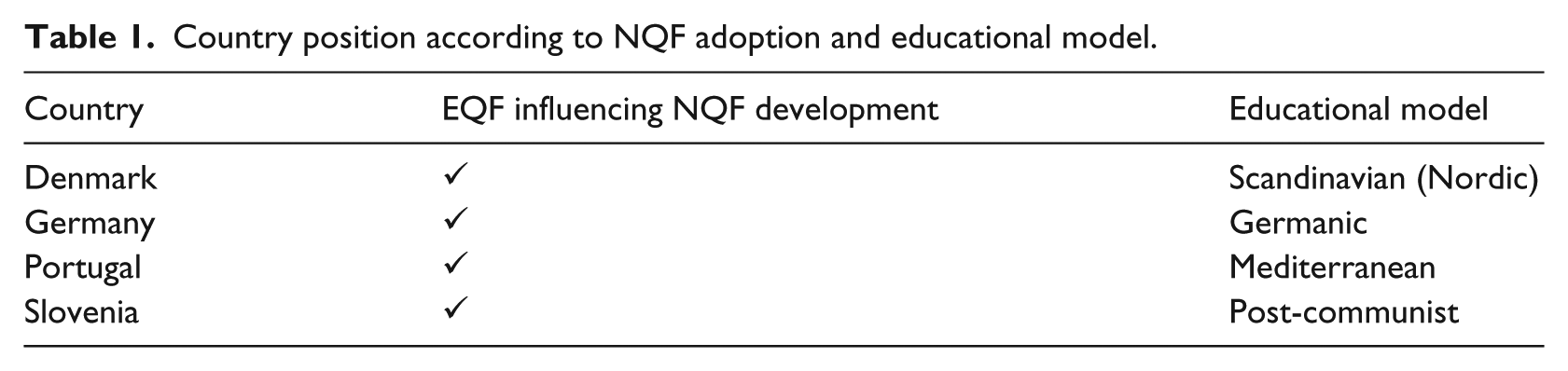
The countries included in the analysis were selected on the basis of two criteria: (i) the model of (vocational) education or prevailing skills regime; and (ii) whether the EQF has influenced the development of the NQF. Historically speaking, a distinction can be drawn between three basic (vocational) education models which lead to different skills regimes: the Germanic ‘dual-corporatist’; the Francophone ‘state-regulated bureaucratic’; and the Anglo-Saxon ‘liberal market economy’, all of which served as prototype models, in various guises, throughout Europe during the 19th and 20th centuries (Greinert, 2004; Winterton, 2009). Starting from different variations of these models, the Scandinavian (or Nordic) model, the Mediterranean model and the education model in post-communist countries have emerged, all of which reflect the diversity of Europe’s educational traditions (Bjørnåvold, 2000; Lundahl, 2016; Mohorčič Špolar et al., 2014). We can also differentiate between countries that adopted their NQF before and after the implementation of the EQF. Using these criteria, we sought to encompass the diversity of traditions in European education and evaluate the influence of the EQF on NQFs in Europe – the countries of Denmark, Germany, Portugal and Slovenia were used for comparison. The countries in Table 1 are classified according to the criteria selected.
Country position according to NQF adoption and educational model.
Comparative analysis
Context, purpose and scope of NQFs
All four of the NQFs selected originate from countries with different national, political, cultural and educational traditions. We will address these briefly below.
After the Second World War, education played an important role in Denmark in establishing its social democratic welfare system since this was perceived as being the main tool to not only achieve social justice and security but also to provide equal educational opportunities for all citizens and strengthen society and democratic ideals. Under the influence of the neoliberal ideas of decentralisation, school choice and new public management (NPM), Denmark and the other Nordic countries moved towards a more market focused form of education and away from a welfare state to a ‘competitive state’ during the 1990s and early 2000s. PISA results also encouraged the reform of basic and secondary education in Denmark based on learning outcomes and accountability measures (testing and examinations). Although today’s educational system still supports social justice and equality for all, with equal provision of education at all levels remaining high, these neoliberal measures (decentralisation, effectiveness and competitiveness) undermined the foundations of the Nordic model (Imsen et al., 2016; Lundahl, 2016). The education system has two main skill pillars: vocational, with the dual system; and academic (Helms Jørgensen, 2013).
Germany was divided into two parts after the Second World War: the Federal Republic of Germany, which was under the power of the West; and the German Democratic Republic, which was under the power of the Soviet Union. It was only in 1990 that the two states were reunited. Germany developed a continental educational model based on tripartite consultation, social partnership, vocational principle as the main didactic orientation – with the dual system being at the heart of the qualification model – and an education system with two main skill pillars: vocational and academic (Greinert, 2004; Wolter and Kerst, 2015). In vocational education and training (VET), where social partners are responsible for specifying state-recognised occupations in the sector, and content and examination of education and qualifications are collectively negotiated and recognised, initial vocational training represents a foundation for a career in intermediate working positions (Clark and Winch, 2015; Deissinger, 2015). From the 1990s onwards, neoliberal measures (privatisation, NPM) and global players (OECD with ‘PISA shock’) challenged the public administration and education system to reform. However, the education system (especially its VET part) remained rather stable in its features and defensive with regard to innovation and change (Kuhlee, 2015).
The evolution of the education system in Portugal is rather different from other Western European countries as Portugal was subjected to a dictatorship regime from 1926 to 1974. In the 1980s, while Portugal started to build its welfare system, with education aimed at democratisation and emancipation of society, global neoliberal policy measures, emphasising efficiency and evaluation culture in education, progressively invaded the welfare system. The tendency to link neoliberalism and welfare therefore resulted in mitigated neoliberalism in education (Fragoso and Guimarães, 2010). In the 1990s, adult education became a political priority in Portugal as many adults suffered from poor levels of education. With the help of the ESF, the emphasis for education became as a means for enhancing competiveness and employability, which is why in 2002 the system for the recognition, validation and certification of competencies was established as well (Guimarães, 2013). In recent times, under the structural reforms required by the ‘troika’ (the European Commission, the European Central Bank and the International Monetary Fund), education is facing severe cuts in public expenditure and is becoming more economised, privatised and commercialised (Antunes, 2016).
From the Second World War until 1991, Slovenia was part of the Socialistic Federal Republic of Yugoslavia, which was based on common ownership and self-management. Education was conceived as public and was harmonised through common curricular guidelines and assessment criteria across federal states. After independence in 1991, Slovenia reformed its entire education system (1993–1996) based on the principles of human rights and justice, student and teacher autonomy and quality with education being an important part of the welfare system, providing equal educational opportunities for all. Slovenia acceded to the EU in 2004 (with other ‘post-communist’ countries), which had a significant effect on its education system, especially VET and higher education (HE), due to the extensive financial support received from the European funds. In VET, a new decentralised curricula and teachers’ role were introduced, and in HE, where the Bologna reform was implemented, the economised purpose of HE prevailed and tendencies towards decentralisation and privatisation of HE emerged (Ermenc, 2011; Klemenčič and Zgaga, 2014).
Although the political and educational traditions of each country are rather different, they all started developing their NQFs on the basis of the 2005 EQF consultation process and its formal adoption in 2008 (Agência Nacional para a Qualificação (ANPQ), 2011: 13; Bundesministerium für Bildung und Forschung (BBF), 2013: 11; Center RS za poklicno izobraževanje (CPI), 2014: 27; Danish Evaluation Institute (DEI), 2011: 12). In Denmark, the idea of an NQF was also raised in the context of a national globalisation strategy, which included an LLL strategy linked to reforms in VET (DEI, 2011: 12). In Portugal, the NQF is part of the National Qualifications System that was established in 2007 for the purpose of promoting the ‘attainment of secondary education as a minimum level of qualification in Portugal’ (ANPQ, 2011: 13) by not only reinforcing the link between general and professional education with ‘double certification’, thereby strengthening the VNIL mechanism and categorising professional courses into modules, but also by preparing National Qualifications Catalogues 7 (NQCs) and establishing quality control mechanisms. Furthermore, by creating the NQF in Portugal, ‘the decision was taken to adopt the principles of the EQF, both in terms of organizing it into eight levels and of regarding the description of learning outcomes’ (ANPQ, 2011: 20).
The Danish NQF was adopted in 2009, the Portuguese in 2010 and the Slovene and German NQFs in 2011. All four countries developed comprehensive frameworks, which meant that the NQFs included qualifications from general, vocational, higher and adult/continuing education. Germany was the only country that did not include general education qualifications (Allgemeine Hochschulreife and Fachgebundene Hochschulreife) in its NQF, but plans to do so after a five-year trial period (2018) as stakeholders failed to reach a consensus on their levelling position (BBF, 2013: 56). The Slovene NQF includes qualifications from the VINL system that lead to national vocational qualifications (NVQs) (CPI, 2014: 34). All four NQFs are non-regulatory frameworks, which means that the NQF does not prescribe a uniform structure or predefined standardised criteria for the description and structure of qualifications in order to be included in the NQF. According to Raffe (2013), all four NQFs can be typologically classified as communication frameworks because they explain qualifications systems and try to make them more transparent. However, the Danish and Portuguese NQFs can also be classified as reform frameworks because they reform VET.
The NQFs’ common objectives are to support the transparency of qualifications systems, mobility and LLL strategies. The German, Portuguese and Slovene NQFs are intended to contribute to improving the standard of the education/qualifications system in the country and the integration of general, vocational and HE as well as education and training systems. The Danish, German and Slovene NQFs are intended to aid recognition of their qualifications in different European countries and vice versa. German and Portuguese NQFs should also foster the VNIL and promote the idea of qualifications based on learning outcomes (ANPQ, 2011: 20; BBF, 2013: 12; CPI, 2014: 30; DEI, 2011: 13).
NQFs structure
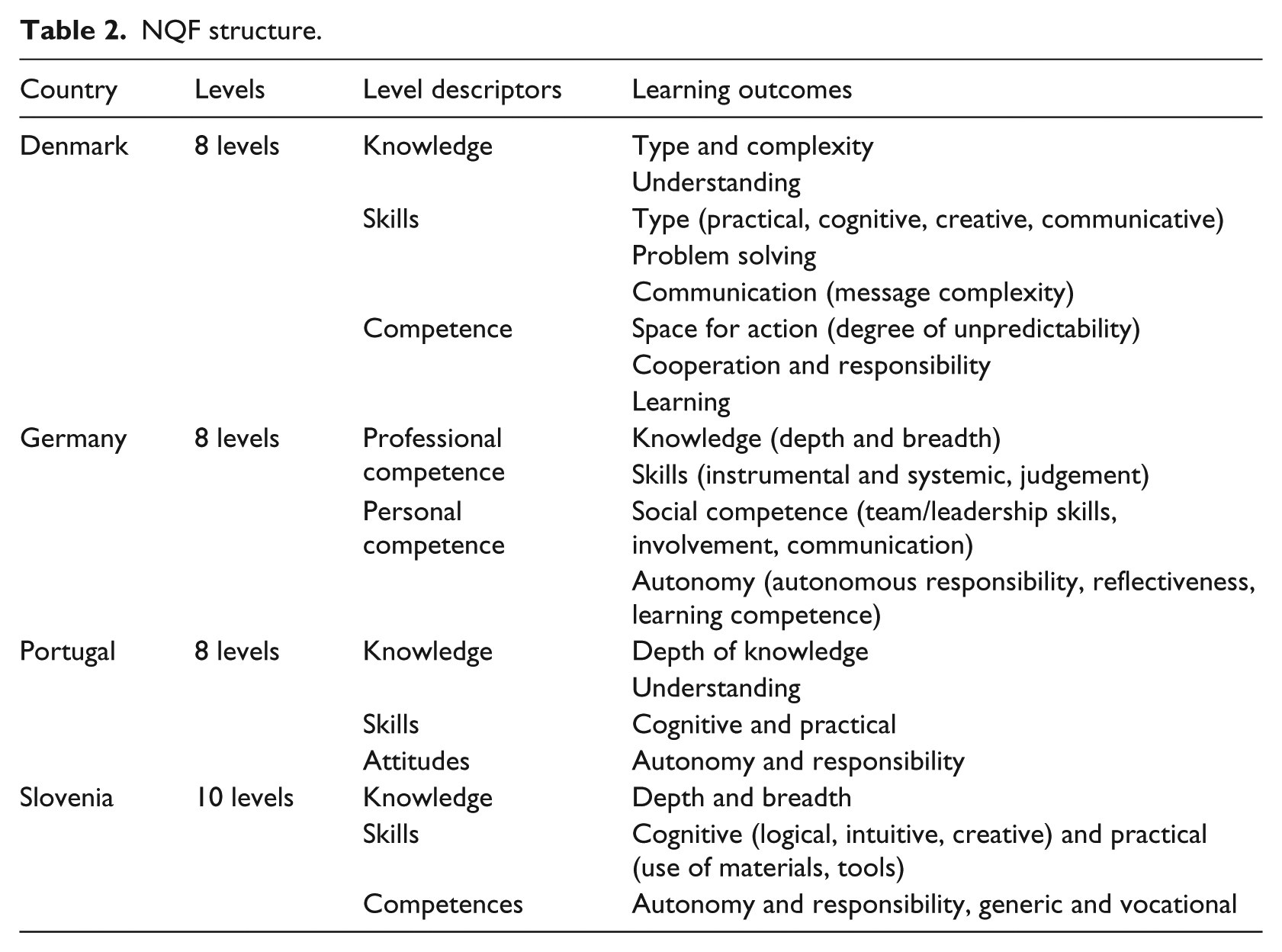
The Danish, German and Portuguese NQFs adopted an eight-level structure (as is the case with the EQF), which rises gradually from levels 1 to 8, whereas the Slovene NQF has a ten-level structure, reflecting its historical educational tradition (CPI, 2014: 30–31). All four NQFs adopted level descriptors based on learning outcomes; Danish, German and Slovene descriptors are designed broadly to reflect the ‘different types of learning outcomes, from the more theoretical to the more practical’ (DEI, 2011: 16). The level descriptors of the Danish, Portuguese and Slovene NQFs adopted the same categories of knowledge, skills and competence as the EQF – in the Portuguese NQF, competence was referred to as ‘attitude’ but functioned the same way as it means the ability to carry out tasks and solve problems, and represents the individual’s level of responsibility and autonomy (ANPQ, 2011: 21) – whereas the German NQF developed entirely new categories of professional (knowledge, skills) and personal competence (social competence, autonomy). ‘Competence’, understood as ‘comprehensive ability to act’, is a key concept of the German NQF and an umbrella term for all learning outcomes describing ‘the ability and readiness to use knowledge, skills and personal, social and/or methodological abilities in work or study situations and in professional and personal development’ (BBF, 2013: 58). However, although the Danish, Portuguese and Slovene NQFs followed EQF categories when describing level descriptors, these level descriptors or categories are further subdivided and ‘broader’ than their EQF counterparts. In the Danish NQF, emphasis is devoted to complexity of knowledge and understanding, problem solving skills, communications skills, cooperation and learning (DEI, 2011: 17–18). Depth of knowledge, understanding and critical thinking are emphasised in the Portuguese NQF (ANPQ, 2011: 21), whereas critical thinking and reflection are the focus of the Slovene NQF (CPI, 2014: 32). The German NQF descriptors are also broadly designed and include additional categories of competence, i.e. team/leadership skills, involvement, communication, reflectiveness and learning (BBF, 2013: 58–59). In all four countries, competence is defined in broad holistic terms as the ability to apply knowledge, skills and attitudes in educational, professional and personal situations. The NQF structures of the selected countries are summarised in Table 2.
NQF structure.
NQF and learning outcomes in the education and training system
The learning outcomes are defined very similarly to the EQF definition in all four NQFs: they represent a statement of what the learner knows (understands) or is able (and ready) to do as a result (or on completion) of a learning process (BBF, 2013: 78; CPI, 2014: 84; DEI, 2011: 17). The learning outcomes of a qualification mean what a person with a given qualification ‘is expected to know and be able to do’ or ‘ought to know’ (ANPQ, 2011: 62; BBF, 2013: 100; CPI, 2014: 48; DEI, 2011: 17) and are tested through (external) examination procedures. In general education in Denmark and Germany, learning outcomes are described as competence objectives and ‘competence-oriented education standards’ (BBF, 2013: 100). In Portugal, these are presented as outcome targets, defining the knowledge and basic skills learners are required to have in order to attain basic and upper secondary education as a set of competences and general objectives (ANPQ, 2011: 60). Learning outcomes in Slovenia are described in basic education as general and operational objectives and standards of knowledge (basic and minimum) and in general upper secondary education as general objectives and key competences, operational objectives and intended learning outcomes (CPI, 2014: 48). In VET in Denmark and Germany, learning outcomes are described as competences (general, personal/social, vocational/sector related) (BBF, 2013: 101); they are presented in Portugal as competence units in NQCs ‘describing the set of competences required for the qualification’ (ANPQ, 2011: 62) and in Slovenia as operational objectives and occupational competences, prepared on the basis of occupational standards (CPI, 2014: 48). The competence units (in Portugal) and the competences (in Slovenia) defined in the occupational standards also serve as the basis for the VNIL of adults. In the Danish HE system, there is an obligation for the learning outcomes of programmes to be described in the terminology of knowledge, skills and competence (DEI, 2011: 48), while in Germany, Portugal and Slovenia, the learning outcomes are described in terms of (general, subject-specific) competences (BBF, 2013: 98; CPI, 2014: 48).
By summarising learning outcomes in education and training settings, we can highlight that: (i) ‘the shift to learning outcomes’ is becoming a reality in all four countries; (ii) that learning outcomes are described differently in the education and training subsystems in each country and between countries – either as competence objectives, competence or knowledge standards, (key) competences or outcome targets, or as statements of knowledge, skills and competence – and do not necessarily follow the learning-outcome categories used in NQF descriptors; (iii) that learning outcomes are usually defined and understood as competences; and (iv) that they represent an integral part of general, vocational, higher and adult education subsystems, educational/study programmes and curricula.
Discussion
From a comparative analysis and an analytical framework of the Europeanisation of education, the following comments can be made and conclusions drawn.
By examining the impact of European pressure at the domestic education level using NQFs in Europe as an example and following Hall’s (1993) notion of policy change, we can identify the first and second order changes the EQF has brought about. Although the subsidiarity rule applies in the field of education and the field is governed by ‘soft law’, almost all European countries (member states and candidates) have either established or are in the process of establishing an NQF under the influence of the EQF. As already stated, the EQF has significantly influenced the establishment of the NQFs, their common objectives and structure and how the learning outcomes are defined in the NQFs in all four of the countries analysed, embedded in different educational traditions, and the same can also be said for other European countries (CEDEFOP, 2016). In this respect, it is interesting that, although all four analysed countries use the holistic and non-functional performance-based notion of ‘competence’ in their education and training systems, Germany was the only country which did not accept the EQF (knowledge, skills, competence) categories, while the other three countries adopted it. As Deissinger (2013: 300–301) explains, the German NQF: [h]as its roots in the concept of Berufliche Handlungskompetenz (vocational action competence) … and the term ‘competence’ is mainly used in combination with vocational initial training in the dual system. Berufliche Handlungskompetenz represents the objective that apprentices should attain the capacity for self-regulation and problem-solving in a broad context of occupational tasks.
Therefore, if in the German context competence (Kompetenz) means ‘the overall ability to perform’, the term in the EQF is limited to ‘acting responsibly and autonomously’ (Gehmlich, 2009: 746). As such, the EQF conceptualisation of competence is seen in Germany as being ‘detached from the holistic notion of an occupation’ and as an ‘unpedagogical didactical concept’ (Deissinger, 2015: 611). As Germany represents one of the three basic educational models, beside the Francophone and Anglo-Saxon, its ‘conservatism’ and aversion to the EQF (Anglo-Saxon) notion of competence is probably stronger than the Danish, Portuguese or Slovene NQFs.
It is also clear that the ‘success’ of the Europeanisation of NQFs is based on Commission financial support (European funds) to member states, the envisaged economic benefits of the NQFs, a common learning process and established networks in the European educational space governed by an OMC. Moreover, as already emphasised, the EQF is not a neutral European policy instrument, but instead represents a tool for a transfer of ideology from the dominant Anglo-Saxon education model and so the EQF could be also seen as an example of a ‘bottom-up’ process of Europeanisation.
However, the NQFs in the four countries analysed are not related to Hall’s (1993) notion of third order policy change, which implies a paradigmatic policy shift based on a fundamental change in ideology and ideas. Denmark, Germany, Portugal and Slovenia developed their NQFs under the influence of the EQF, but they differ considerably from the NQFs in Anglo-Saxon and developing countries around the world (Allais, 2014): (i) all four NQFs support the European comparability of qualifications; (ii) they are all mainly ‘communicative frameworks’, although the Danish and Portuguese NQFs can also be partly described as ‘reform frameworks’; (iii) they are all comprehensive frameworks that either include or will include qualifications from general, vocational, higher and adult education; (iv) they are intended to support national LLL strategies, i.e. to build bridges between subsystems and pathways (Deissinger, 2013; Ermenc, 2012; Helms Jørgensen, 2013), and address the needs of education systems and institutions to a greater extent than the needs of the labour market and economy; (v) they are non-regulatory frameworks in which learning outcomes are not prescribed uniformly; and (vi) they are ‘outcome-referenced’ and not ‘outcome-led’ frameworks (Raffe, 2013). As Deissinger (2015: 608) put it, in Germany ‘trade union representatives and employers’ organisations managed to fend off much of the Anglo-Saxon understanding of designing and sorting of qualifications, which was not seen as being compatible with the national understanding of a state-recognised occupational qualification’. The debate ‘dealing with the framework concept remains focused on input factors, such as course duration or curricular distinctiveness’ (Deissinger, 2013: 304). In all four countries, ‘trust’ in qualifications is not placed in the NQF, but there is a strong focus devoted to educational principles, institutionalisation and the regulation of education and training systems through laws in which the teaching/training strategies, teacher qualifications, content, duration, examination, etc. are prescribed (Cort, 2010; Gössling, 2015).
Moreover, the learning outcomes in all four countries’ education systems are understood as embedded elements in educational programmes and institutions and not as stand-alone elements; they are specified as targets and associated with a specific education programme leading to a qualification and do not represent (measured) learning outcomes actually achieved; they are placed in the wider context of educational inputs and are not specified independently from educational programmes and curricula. In the Slovene context, Ermenc (2012: 45) highlighted that ‘many stakeholders agree that educational programmes and learning outcomes should not be separated’ and explains that the NQF combines input, i.e. the allocation of qualifications to a certain level is based on ‘regulative acts and curricula, which determine the function and nature of each education programme and qualification’ (Ermenc, 2012: 42), and output (EQF) approaches. In the German context, Gössling (2015: 14–15) found that: [c]ompetence ascriptions in Germany are usually accepted only when obtained and verified within formalised programmes, which are linked to one of the major tests preceding the rites of passage. This means input factors of education are emphasised. Such competence verification has a significant bearing on the credibility of a formal institution.
Furthermore, ‘there seems to be pressure to masquerade an outcome-based competence assessment, while in fact the traditional institutional approach is preserved’ (Gössling, 2015: 15) meaning that the NQF ‘only maintains the illusion of competence assessments and competence-based levelling’ (Gössling, 2015: 18) and was implemented ‘like an input-based instrument dressed up in a decoupled outcome-based language’ (Gössling, 2015: 19). There is therefore a clear distinction between the EQF’s Anglo-Saxon ‘employer-, performance- and task-based understanding of learning outcomes’ and the ‘educational, social-partner- and occupational-based VET systems of many continental European countries’ (Clarke and Winch, 2015: 600).
Last but not least, the level descriptors and (sub)categories used in all four NQFs (but especially the Danish and German NQFs) are set broadly so they can support different conceptions of ‘knowledge’, from those closer to the labour market to those closer to humanistic, critical or transformative conceptions (see, for example, Habermas, 1971; Mezirow, 1991), as well as different educational purposes, from the more vocational to those closer to civic and liberal purposes (Brockmann et al., 2008).
Having said that, we believe that the NQFs structured in this manner in the European countries selected differ considerably from the NQFs in the Anglo-Saxon and developing countries around the globe (Allais, 2014) and do not in themselves represent strong neoliberal tools which lead to the deregulation, marketisation and commodification of education and knowledge. They can instead be seen as a country’s response to a European education policy agenda which facilitates learner/worker mobility to ensure access to a common European labour market, although there is no evidence yet to suggest that this is an achievable goal for European NQFs (Raffe, 2013). In addition, following the case of NQFs in Europe, we can also highlight that European education policy does not have a direct impact on national education policy and practice as it cuts across local histories and national political, cultural and educational traditions, generating different impacts and even reformulating original concepts; the selected European countries interpreted and reformulated the Anglo-Saxon concepts to be implemented within their EQF through their own political and cultural lenses and educational models. Therefore, in the field of education: Europe is characterised not only by very different levels of institutionalisation and participation but also by different ideas and practices of education, reflecting historical and cultural patterns in individual countries and regions. These different contexts mediate the introduction of transnational policy designs, even those that are given authority and partial funding by the EU (Rasmussen et al., 2015: 481).
Conclusions
In this article, we have analysed the NQFs of four European countries (Denmark, Germany, Portugal and Slovenia), which were developed under the influence of the EQF, one of the main policy instruments of LLL for achieving greater employability and worker mobility as well as improving the comparability and recognition of qualifications in Europe. We have demonstrated that the impact of the EQF in Europe was sufficiently influential in prompting the majority of countries to start developing their own NQFs, which followed the structure and categories used in the EQF, and encouraged a ‘shift to learning outcomes’ in all subsystems of education and training, as recommended by European education policy. However, the data gathered through comparative analysis also revealed that the impact of the EQF is rather limited as the core concept and philosophy of learning outcomes from the VET policy of Anglo-Saxon dominant educational model did not result in the fulfilment of the neoliberal objective to separate educational outcomes from the educational institutions and programmes below them. The learning outcomes in all four countries analysed are well embedded in educational institutions and programmes, are not ‘free’ from learning pathways and education institutions, and are not implemented as stand-alone elements. Following Hall’s (1993) notion of three order policy change, it can be argued that the NQFs implemented in all four countries and their ‘shift to learning outcomes’ are best understood as first and second order policy changes which do not result in a fundamental change to the ideas on which non-Anglo-Saxon educational models are based. Therefore, the normative resonance (Sedelmeier, 2011) between EQF (Anglo-Saxon) ideas and established NQFs in Scandinavian, Germanic, Mediterranean and post-communist contexts remains rather low. Furthermore, since the main goals of the EQF and NQFs in Europe stand and fall with the implementation of learning outcomes, the whole ‘NQF-[eu]phoria’ (Raffe, 2013) process is quite limited. As Allais (2012: 331) argues: Learning outcomes do not carry sufficient meaning if they are not embedded in knowledge within a curriculum or learning programme. But if they are thus embedded, they cannot play the roles claimed for them in assisting judgements to be made across curricula and learning programmes.
By using the example of qualifications frameworks in Europe, we draw attention to the impact of certain aspects of the Europeanisation of education processes. However, given that NQFs in Europe are a recent development, it could also be too early to reach conclusions about their long-term effects. Therefore, the impact of NQFs in Europe should remain the focus of European educational research, especially since their growing digitalisation through NQF databases and integration into the European Skills, Competences, Qualifications and Occupations (ESCO) tool are now high priorities for European education policy.
Footnotes
Acknowledgements
I am grateful for the careful attention that the reviewers have dedicated to this text and their relevant recommendations.
Declaration of conflicting interest
The author declares that there is no conflict of interest.
Funding
This research received no specific grant from any funding agency in the public, commercial, or not-for-profit sectors.