




Abstract
The development of comprehensive national qualifications frameworks (NQFs) across Europe has been sparked by the introduction of the European Qualifications Framework (EQF) in 2008. Taking an institutional perspective, this article examines the development of NQFs in three countries, in light of developments that have taken place at the European level. The three cases (Estonia, Ireland, Norway) show how these processes are highly dependent on the links to the European level, the sequence of the process, how the European initiative is coupled to national issues, actor involvement locally and the time available. The article shows the potentially problematic nature of introducing European solutions on a national level as agenda-setting processes can become omitted and ad hoc linkages to national policy domains can be weakly developed.
Keywords
Introduction
In the last five years, almost all European countries either have introduced, or are in the process of introducing, national qualifications frameworks (NQFs). In 2014, 34 countries worked towards comprehensive NQFs and 29 NQFs have already been formally adopted in European countries (CEDEFOP, 2015). For many of these countries the development of NQFs has been related to two European processes: the Qualifications Framework in the Bologna Process (QF-EHEA) for higher education, in 2005; and the EU-led European Qualifications Framework (EQF) in 2008. It is the latter in particular that has been the basis for developing comprehensive qualifications frameworks at national level. There has been a considerable amount of studies on the initial wave of NQFs (among others, see Allais et al., 2009; Young, 2007), including quite critical views regarding the implications of NQFs (see, for instance Allais, 2014; Blackmur, 2004; Young, 2007). However, fewer studies focus on conceptualizing the processes that have taken place at national level as a consequence of European level frameworks.
The EQF was introduced in 2008 as an EU Recommendation, with the stated aim of contributing to transparency, mobility and lifelong learning (European Parliament and the European Council, 2008). The framework functions as a meta-framework in multiple dimensions – by translating national frameworks, by linking various levels to the same framework, and by creating links between education and the world of work (Méhaut and Winch, 2012). It has been emphasized that it would be ‘stating the obvious’ that the EQF is not a neutral mapping instrument (Cort, 2010), because the EQF includes ideas about lifelong learning, parity of esteem and informal and non-formal learning, to name a few. At the same time, considerable ambiguity remains with respect to some of the core concepts – for example, competence (Méhaut and Winch, 2012). Nevertheless, viewing the EQF as a potential ‘catalyst for change’ is a prominent phrase used by the actors concerned with the EQF in Europe (Elken, 2015), implying its expected relevance for particular kinds of changes at the national level. Taking into account the complex nature of the EQF and that education is a constrained area for EU coordination, the question arises: how have these processes actually played out on a national level in the policy domain?
This article examines the process of developing NQFs in three European countries (Ireland, Estonia and Norway), in particular in light of the EQF. This addresses questions of why these countries opted to develop a NQF and how the process has been anchored in national policy problems. Analytically the article is rooted in an institutional tradition of analyzing the development of new policy solutions in a multi-level context.
In the next section, the analytical framework for the article will be outlined. This will be followed by information about case selection and methodology as well as an empirical analysis of the three cases. Lastly, a cross-case discussion and final conclusions are provided.
Coupling policy problems and solutions in a multi-level context
The analytical framework in this article builds on an institutional perspective, implying that decisions about policy instruments are taken in the context of specific institutional arrangements that provide rules for behavior (March and Olsen, 1989), what is considered appropriate (March and Olsen, 2008), and where past decisions and trajectories play a role for current decisions (Thelen, 1999). Such rules can be formal to a greater or lesser extent, and they both enable and constrain options (March and Olsen, 1989), with respect to the scope of issues that are considered relevant, in terms of the actors who have a formal decision-making capacity, and how legitimacy of decisions is assured. Taken-for-granted norms in institutionalized structures make introducing major changes difficult, unless there is a period of upheaval and sufficient support amongst actors with sufficient resources to induce change (Greenwood and Hinings, 1996). Actors are thus not following institutional rules blindly, they engage in shaping the institutions they operate in and can operate as agents for change (Holm, 1995).
The main analytical concept in this article is the notion of a policy solution, which is coupled to policy problems –societal issues that have made it to the national agenda and are in turn formalized as problems in various policy initiatives. While one could construct a neat process in which problems are agreed upon and then solved through appropriate solutions, policy-making processes rarely follow the sequence of a rational problem-solving perspective (Sabatier, 2007). Existing research has identified issues of ambiguity, information asymmetries and the role of context (Howlett, 2005: 40) that lead to sub-optimal outcomes and challenge this rational view. Furthermore, there might be preferences amongst actors for particular kinds of solutions (Gornitzka and Metz, 2015), where the coupling to problems is found ad hoc, and being pushed forward by actors with sufficient capacity. This suggests a distinction between problem-driven and solution-driven processes, and that the linkages between policy problems and solutions are not always equally strong. Furthermore, not all changes are alike and thus a new solution can represent, to a greater or lesser extent, substantial change from an existing trajectory.
While the main focus in this article is on the national level, the processes considered take place in a multi-level context. In the literature on European studies, the interaction between national and European levels has been conceptualized with regard to two reciprocal processes – simply put, how member states influence Europe, and vice versa. Börzel (2003) conceptualized the bottom-up process as a means of delegation of competencies, supranational institution building, and European policymaking – where European policies, norms, rules, procedures and political processes are in turn introduced to the national level. There are many reasons why countries can opt to upload their preferences. This can be strategic choice to influence European preferences in order to reduce costs of compliance (Falkner et al., 2004), or to use the European incentives as leverage in the national context (Börzel, 2003). Given that EU competencies in the area of education fall under the subsidiarity principle (Maassen and Musselin, 2009), initiatives at the European level have come as an additional layer rather than replacing national competence (Beukel, 2001). This would suggest that, for this case, in the upwards stream it would be more appropriate to focus on transference of preferences rather than formal legal competences, and there is more flexibility in the downwards stream in that the changes proposed often come in the form of standards, guidelines and recommendations – what could be considered typical soft-law instruments. These represent particular European policy solutions which then interact with the national level. Even if the downwards stream did not come in the form of formal legal obligations, research into the dynamics of a ‘Europe of Knowledge’ has shown that soft coordination mechanisms can create incentives for compliance, one example being the Bologna Process (Ravinet, 2008). Furthermore, European solutions are sometimes perceived as more binding than they really are (Vukasovic, 2014). In addition, national actors can nationalize such European solutions, to promote particular national courses of action (Gornitzka, 2006). These examples show that there can be considerable variety in how European solutions are taken up at national level.
What takes place is a matching process between European solutions and national policy problems and contexts (Gornitzka, 2006). In this matching process, the proposed European solution can either (a) be aligned with national policy problem(s) that already exist (country has uploaded preferences or there is a pre-existing match by coincidence); or (b) represent a new kind of solution. 1 In the latter case, the question is how this new solution fits with existing institutional norms. From an institutional perspective, one can argue that the smaller the gap, the easier the adoption process; the wider the gap, the more inertia one can expect, because institutionalized structures are difficult to change. However, even when inertia is high, institutional patching processes take place, in essence suggesting that local structures are added and purposes reassigned to create sufficient space for adaptation of existing practices (Genschel, 1997). Furthermore, as highlighted earlier, actors with sufficient capacity for change can also facilitate major changes (Greenwood and Hinings, 1996).
One can thus argue that there are two main dimensions here: whether the solution represents change; and how it is coupled to national policy problems. A policy problem can be argued to be ‘tightly coupled’ if the purpose of the new solution is embedded into existing national policy initiatives, and ‘loose coupling’ exists if the purpose is primarily framed as compliance with the EU and not substantially linked to national processes. With respect to the case in this article, this concerns the problem formulation for the national NQF processes – what is the issue that the NQFs are supposed to solve? Both of these divisions can be seen as a continuum rather than categorization, where four distinct patterns can be developed, as outlined in Figure 1.
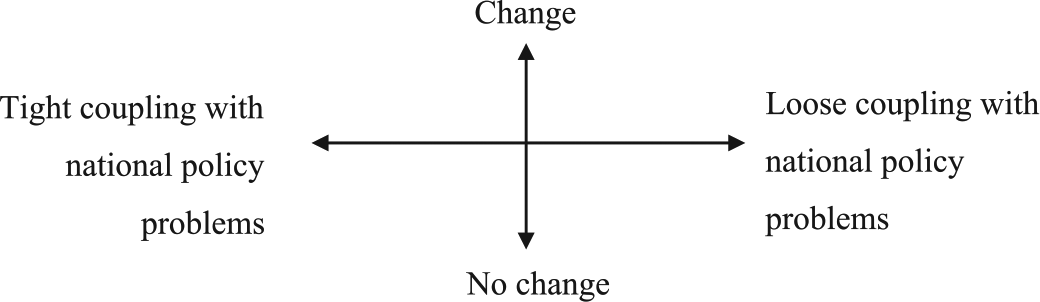
Two dimensions of coupling problems and solutions.
Based on these two dimensions, four possible patterns can be suggested. First, if the new European solution represents change but the coupling to national policy problems is loose, the introduction process is likely to be superficial, and possibly involve window-dressing. Second, if the solution represents change and it is linked to national policy problems, one can expect translation and/or contestation. This is particularly the case when the national anchoring requires a broad scope of actors with varying interests. Third, when the new solution implies no change with respect to existing national solutions, but there is a process of linking it to national problems, the process can become a process of re-emphasizing existing practices. Fourth, when the new solution represents no change and is simultaneously not coupled to existing national problems, the process would be mostly technical, or almost ignored.
The nature of change processes is dependent on actor involvement, because their preference for change and capacity to manage change is what can challenge the status quo (Greenwood and Hinings, 1996). Actors’ capacity to engage in this change process is essential because their preferences to couple solutions to specific problems can drive change processes forward, especially when there is a gap between the new solution and an existing national policy domain. How this process takes place is influenced by a number of variables. Studies examining the effect of certain global reform trends and their various impacts on national contexts have identified that local institutional arrangements, path dependencies, interplays between various policies as well as the temporal sorting all play a role (Gornitzka and Maassen, 2014). What this emphasizes is that the specific institutional context plays a role with regard to how the coupling process plays out.
Case selection and methodological approach
The three cases selected represent countries that have opted to develop an NQF, either nationally or as a result of a European initiative. 2 In the Bologna Process, all of the three countries are amongst those that appear to be well aligned with the principles, 3 providing a basis for arguing that these are countries aligned with European initiatives or, at the very least, aim to signal that they do so. One could expect that these three countries represent likely cases for aligning the national systems with the EQF. At the same time, these three countries provide a mix of differences in terms of historical trajectories, EU membership (old/new/non-member), policymaking traditions and educational traditions, as well as economic and social structures.
The empirical data include collected policy documents at national level, and legal documents, as well as various press releases, reports and other documents produced by the Ministries and other actors involved. Furthermore, 18 interviews with key policymakers, stakeholders and experts in the three countries have been conducted. Participants were purposefully selected on the basis of their competence and knowledge, first with regard to formal roles in various national structures and then through the snowballing technique. Specific attention was given to including views from different stakeholders, following the criteria of inclusion and variety identified by Ritchie et al. (2003: 82–83). Those taking part in the interviews included representatives from the Ministries, national qualifications/quality assurance agencies, representatives of the labour market (employers and employees), and student representatives, amongst others. The interviews were conducted as expert interviews (Littig, 2009) in a qualitative and semi-structured manner in spring 2013. The interview guide was prepared in advance and modified according to the role of various actors. Interview data were coded using predetermined categories/concepts from the analytical framework. Where these exist, secondary sources have been used.
The introduction of National Qualification Frameworks
In the description of the cases, the primary focus is on the process of adopting NQFs, followed by a cross-case discussion of the various national processes. The following elements were of particular interest: uploading/downloading; the scope of change; coupling of problems and solutions (European/national); actor involvement; and temporal ordering of the process.
Ireland: ‘death by consultation’
The qualifications framework in Ireland (NFQ) has a substantial head start on the other cases in this study, because the NFQ pre-dates European processes (both QF-EHEA and EQF). After the ‘first wave’ of developing QFs worldwide, Ireland was quick to follow – described by one of the respondents as not the second round but ‘round 1.5’. Historically, the country had been going through a rapid phase of economic development at that time. The NFQ development was a response to an ongoing discussion and debate at national level in the 1990s, linked to a very complicated and unclear system of extant qualifications that was perceived as a significant problem in the system.
Furthermore, there were high levels of dropouts as well as shortcomings and inequalities with respect to the non-formal learning sector (Maunsell and Downes, 2013), where developments in the area of further education formed a basis for the framework (Granville, 2003). The purpose of the NFQ was, according to the interviewees, linked to the ‘rationalization of the VET qualification system’, linked to a broader quality assurance reform of higher education (HE) and vocational education and training (VET), and the introduction of learning outcomes. The developments that had taken place in the UK and South Africa also provided inspiration.
The existing complicated sectoral awarding bodies were abolished in 1999 when the Qualifications (Education and Training) Act 4 established the National Qualifications Authority of Ireland (NQAI) in 2001. 5 The main objectives of the NQAI were to develop the policies and criteria for developing the NFQ, and its subsequent oversight. The key idea was that the proposed national framework could accommodate all kinds of learning – it would be ‘elastic, not didactic, and accommodate wide range of qualifications’, as emphasized in the interviews. Lifelong learning and recognition of informal learning have also been prominent in national policy debates, in particular due to the substantial ‘upskilling’ process in recent decades. This shows how, nationally, the development of the NFQ was a largely problem-driven development.
While the NFQ was proposed in 1999, it was not launched until 2003; the intervening four years were marked by consultation and constant discussions for each stage of the framework. In particular the years 2001–2003 were described in the interviews by one expert as a period when:
…a lot of brainpower (was used) to demonstrate how different types of learning could be mapped to the same framework and shown to be broadly equivalent in terms of levels, but not the same.
The national actors interviewed highlighted the extensiveness of the consultation process – both in terms of time and in terms of actor inclusion, covering as it did all educational sectors, the labour market, trade unions, and social partners. These discussions were conducted through workshops, national conferences and various consultative and advisory groups – such was the extent that it was described as ‘death by consultation’ by one of the interviewees. The trade unions were heavily involved, to the extent that the framework has been criticized by some for having a too heavy labour market focus. However, while there was a focus on consensus, the Irish universities were not initially supportive of this development.
When the NFQ was launched in 2003 it had ten levels, and a number of compromises were made with respect to simplification, this having been a difficult national process of contestations. The purpose of the framework was outlined in the formal document:
The single, nationally and internationally accepted entity, through which all learning achievements may be measured and related to each other in a coherent way and which defines the relationship between all education and training awards. (NQAI, 2003: this marked the framework a comprehensive)
Immigration and university autonomy were the two reasons that were highlighted in the interviews as the rationale for uploading the ideas underpinning the Irish framework to the international arena – the Bologna Process (BP). Because universities were autonomous, they could have blocked the process – so the BP was used to ensure their compliance. Arguably it is no coincidence that the Dublin descriptors that are used in the Bologna Process have their origin in Dublin. Not only did this uploading process assure compliance from the universities, it also increased the overall status of the framework on the national level:
We wanted to rather than to assert national authority to force the universities to join the framework say that, well if you join the framework you will be running with the European herd, which appears in the Bologna process, and that was a politically much more acceptable influence on the Irish universities than to try and force them by domestic political pressure. (Interviewee, national actor)
Ireland shows, in general, considerable overall uploading capacity in the early steps of European developments. At this point, the debates on European level were still considering whether the European level framework (the EQF) should be sectoral or comprehensive. In 2004 Ireland hosted a conference on the HE and VET linkages, and Irish actors worked actively to ensure that the EQF would be adopted as a comprehensive framework in Europe, in order to avoid having to reference the Irish national framework to an HE framework and a VET framework at the European level.
National actors highlighted that the time factor had been very important, and that various sectors had varying implementation speeds. Five years after its introduction there was a large scale evaluation of the framework (Collins et al., 2009), which established that despite substantial progress there were still some qualifications that had not been placed in the framework.
However, what was evident at the time of conducting the interviews was that the framework had been taken into use. A respondent working with the employment sector explained that the framework is now a widely used instrument at employment offices. Other respondents described the effect as incremental but also substantial, and that there is evidence to suggest that the framework has had an impact on access of non-traditional students to higher education. In the interviews the framework was also linked to a wider centralization trend. In 2012, a new act, the Qualifications and Quality Assurance (Education and Training) Act 2012, reaffirmed the statutory basis for the NFQ, and the agencies were further centralized, for economic efficiency and the consequence of the NFQ:
…if we have a single framework, it is very sensible, it is very logical to have a single agency dealing with that framework. (Interviewee, national actor)
What distinguishes the Irish case is that there is realism amongst the respondents with respect to the scope and aims of the framework that differs from the European focus:
They are tools that are very useful and they can transform education and training but they cannot deliver everything. I think some of the policy papers that are coming out of Brussels recently are a little bit too ambitious about what qualifications frameworks can deliver. (Interviewee, national actor)
The process of linking to the EQF has been a smooth but invisible process nationally. According to the respondents, there is a small gap between the European process and the Irish framework, suggesting that despite Ireland uploading their preferences the output at European level was not identical to the initial preferences. At the same time, the EQF process did not spark into motion anything new in Ireland. The development of the NFQ was nationally embedded, following identified national policy problems. Regarding some of the ideas that have been proposed within the EQF – transparency and parity of esteem, lifelong learning, informal learning, learning outcomes, and mobility – all of these had been established in the national policy domain. The focus on learning outcomes was closely linked to the shift towards ‘putting the learner at the center of learning’ which, according to the respondents, was one of the success factors for the framework. Because the process for this debate has not been time constrained in order to accommodate tight European deadlines, the debate appears to have been more substantial, with sufficient time available to work through contestations that took place when a new solution was introduced. Over time, one can argue that the instrument has become largely taken for granted in the system.
As the NFQ has become more institutionalized nationally, the respondents emphasized that the EQF did not introduce new changes, and the referencing process was linked hardly at all to national processes. Ireland had already referenced the NFQ to the EQF in May 2009. Overall, the referencing process was remarkably smooth and perceived as a mostly technical and almost insignificant exercise, because all the difficult stakeholder debates had already taken place during the national process.
Estonia: ‘too quick start’
Estonia regained independence from the Soviet Union in 1991 and has since embarked on a rapid reform process of the society, including extensive liberalization of the higher education sector and comprehensive reforms of other levels of education.
Estonia already had in place a five-level framework for occupational qualifications that had been introduced by law in 2000/2001 6 , a result of an earlier Phare funded project (in 1997) on common vocational standards, itself a follow-up to the 1985 EU decision on the comparability of vocational training qualifications (85/368/EEC). On the European level this process was later considered unsuccessful, but in Estonia it had led to the development of an occupational framework. An occupational qualification in this context was defined as a ‘qualification associated with a trade, occupation or profession resulting from work based learning’ (Estonian Qualifications Authority, 2011), being decoupled from educational qualifications. The standards for each occupational qualification were defined in cooperation with the employers and over 600 different occupational qualifications have been developed. The respondents highlighted issues with the methodology and weak horizontal linkages in the occupational framework.
When the EQF emerged, it was perceived by some in Estonia as a follow-up to this existing work, with a change from 5 to 8 levels. Questions were raised about the need for an educational framework, but the option chosen was to merge the NQF in the context of EQF with the existing framework for occupations. Changes in this policy area were considered uncontroversial, as a part of employment policy. Thus the Estonian Qualifications Framework (EstQF) was introduced to the law very quickly after the EQF recommendation in 2008, as an attachment to the new Occupational Qualifications Act.
7
The EQF was in essence simply translated into Estonian. While one could argue that this was reframing the issue, the rationale for this was pragmatic, described thus by one of the respondents:
…why should we develop and work on a completely new system if there is this reference framework already, so why shouldn’t we just take this and adapt this to our local needs?
The actual necessity to implement a new European solution was not questioned – it was highlighted in the interviews that ‘recommendations are usually perceived as obligations’. However, there was also some resistance nationally because the rationale for a new framework was not clear for everyone:
…for some, the natural reaction was that this was yet again some ‘nonsense from Brussels’ that we have to have this 8-level system. This was perceived as if we now have to place everything on those eight levels, even if the actual point of the EQF was to be a referencing framework, a currency exchange of sorts. (Interviewee, national actor)
By including the EstQF as a follow-up to the existing occupational framework, the entrance point of the EstQF was through employment, described by some as a ‘backdoor policy’, and some respondents within the formal education sector argued that the whole process had initially been ‘a misunderstanding’. The nature of the process created some confusion about concepts (i.e. ‘qualification’), because this national process merged the framework for occupational qualifications (standards) with educational qualifications. The question of what a qualification is has been an issue of considerable debate and had not been resolved at the time of the interviews.
Initially, the EstQF development was largely unknown in the higher education sector, which had been working on a sectoral qualifications framework for Bologna (QF-EHEA). By 2008, this sectoral framework had already been introduced into national regulation,
8
learning outcomes had been introduced, underpinned by the European Social Fund-funded project LÜKKA (2005–2008) for staff training.
9
However, as the EQF debate finally broadened nationally, the referencing processes to EQF and QF-EHEA were merged in 2010, for efficiency reasons according to the actors involved. This merger created a national advisory group which gathered all sectoral representatives as well as students and labour market representatives. The involvement of trade unions was described as a missed opportunity in the interviews, linked largely to the current national position of the unions – weak, for historical reasons. Participants described this as a parallel process, where debates were largely contained within the institutional boundaries of the various sectors, suggesting that the idea of more parity of esteem between sectors was not very visible in the national process. Creating more substantial debate on these issues was considered sensitive and difficult in the short time available before the deadline:
..if you start doing this kind of process, it would likely take years and if you have this European deadline.. Well, we in Estonia went for the rational path and thought, well, in this manner we will at least reach the target. (Interviewee, national actor)
At the same time, some interviewees argued that there was more awareness regarding the sectors as a consequence of this process.
Some of the main contestations in the process were concerned with certain of the initial level placements. Estonia initially placed upper secondary learning outcomes at EQF level 3 because labour market representatives were not convinced that graduates from secondary education would indeed possess the learning outcomes described in the framework on level 4. After recommendations from non-Estonian experts, a compromise was reached and secondary education was eventually placed on level 4. This decision emphasized the realization by some of the actors involved that this is a political process in Europe, and not merely a technical matching of learning outcomes.
The referencing report (Estonian Qualifications Authority, 2011) was completed in 2011 and the process of referencing was finished in 2012. It was in the process of writing the report that many national issues were finally debated, some of which remain unresolved. The speedy development of the EstQF as a response to the EQF is not unique; most of the actors involved mentioned that this somewhat rapid national implementation process has been typical in Estonia. Another explanation was that the system is small, and changes are easier to carry out – described by one of the actors as following Newton’s first law, that is, ‘small mass, small inertia’. Recent history means that there is a habit of continuous reforms, in particular those coming from Europe:
Estonia is always good in class, we always receive all initiatives with glee. Even if there are some grumpy tones to start with, we actually do things first and fastest. (Interviewee, national actor)
This suggests that rapid adoption and efficiency is an established norm within the system, further suggesting an environment of continuous change. The system for recognition of prior learning, VÕTA, 10 had been introduced before the EstQF, and debates about certification of informal learning are on the agenda, linked to the occupational issue. However, in the process of developing the EstQF these were not given strong emphasis. It appears that the primary focus was compliance with the European solution rather than embedding the process in national policy objectives.
Formally it was a success, we completed the referencing process. But, if you would ask me to point out what really changed as a consequence, I cannot point to anything specifically and say that something changed. At the same time, it did not make anything worse either…Perhaps it is too early to count the chickens. (Interviewee, national actor)
With respect to the anchoring in national policy problems, national actors highlighted the rather loose coupling. However, loose coupling here can be seen as an institutional defense mechanism in the context of constantly changing demands. There is some disagreement on the potential of the EstQF process as a source for change in the future, and the views are somewhat divided: some sector representatives would consider it ‘business as usual’ after the process; others regard the EQF as a Trojan horse that initiates ‘a whole educational reform’. The process raised questions about the lack of educational qualifications on EQF level 5, arguably the most significant direct outcome to date.
Norway: ‘hurrying slowly’
Policy-making in Norway is characterized by a tripartite system involving the trade unions, employers’ representatives, and the state, with a focus on consensus building. Debate on qualifications frameworks started in Norway prior to the EQF, because the QF-EHEA was adopted in Bergen in 2005.
We had not really looked at those issues before the Berlin Communique [2003], but when we saw it and became more acquainted with what it meant and how it was used in other countries, we realized it fit rather well with the things we also struggled with and wanted to do something about in Norwegian higher education. (Interviewee, national actor)
This suggests that for higher education the linkage to national policy issues was more evident. The development of a QF for higher education took place in the period 2005–2009, with broad representation from the sector and the Ministry. It was also in this process that the higher education institutions became aware of the issue of learning outcomes.
The decision to develop an overarching framework (the NKR) was taken, around the time EQF was agreed upon in Europe, by political leadership of the ministry and with a broad consensus amongst the stakeholders, emphasized by the inclusion of the EQF in the EEA agreement. A key element in the initial decision was that this new framework should only describe, and not change, the Norwegian system: thus the focus at the time was less on anchoring it to national policy problems as a specific kind of new solution.
Central actors in the process distinguished two key phases: one that led to the national adoption of the framework in December 2011, and the other related to the referencing process. The Ministry was initially somewhat cautious, characteristic of the consensus-oriented policymaking mode in Norway. The reference group that was established for the NKR had wide stakeholder representation 11 and it had already held meetings in 2008, at about the time when the EQF was formally launched. In the spring of 2008 one of the authors of the EQF report for CEDEFOP was in Norway to discuss the role of the EQF as a ‘platform for cooperation, integration and reform’, suggesting a reform agenda in the EQF that the Norwegian process had discarded.
Early in the process, a number of the labour market representatives expressed dissatisfaction, feeling they had not been involved in the decisions that had been made. This led to a formal complaint from several of these representatives, after which closer ties were established. Following this, the work was intensified and the project was further structured. The main work on the framework in the Ministry started in 2009 with the establishment of (a) a steering group consisting of various leaders in the ministry, (b) the project group, including members of the units involved, and (c) the continuation of the reference group that had already been established. This reference group met 3–4 times a year.
However, the process in Norway has been characterized by contestations and collisions; there was considerable diversity amongst actors’ interests. The trade unions protested frequently about the strong focus on describing a formal educational system, initially set as the basic premise for the process. There were debates about introducing the concept of a ‘qualifications system’ which would also include work-place qualifications. There were several difficult debates, and early in the process members of the reference group showed very different preferences in several key decisions. A crucial debate was on the placement of the tertiary vocational schools, a sector that had been established in 2003 and which had not quite found its place in the education landscape, to a large extent due to the wide variety of degrees offered (with degree programmes lasting 6–24 months). The question became whether these vocational schools should be placed on the same level as short-cycle higher education. The practical consequence of this could have been that these vocational schools would also have been integrated into the higher education credit point system. This process was described as very heavy:
Higher education has been very invested in this, as if one would put bachelor degrees and tertiary vocational qualifications on the same level, then the sectoral differences would become blurred…At the same time tertiary vocational schools have been very engaged in increasing their status and there seems to have been thinking that if we only get referenced to a higher level, things will be good. (Interviewee, national actor)
Several of the respondents highlighted the heated discussions took place concerning specific preferences expressed by the political leadership, and debates within the ministry, and some respondents highlighted that the likely decision had been moving back and forth at certain points of time, with actor mobilization from both sides. The solution to this disagreement was not found in consensus, but in a majority vote. The minority was offered the opportunity to make a statement of their position in the report when this was sent for referencing to the EQF. According to the respondents, Norway is probably the only country to include such a clause. The result was that vocational schools were placed on different levels but obtained two ‘sub-levels’, a decision perceived by some as political. Short-cycle higher education became a ‘sub-level’ of first-cycle higher education. Overall, the result that was achieved was the one that implied no system change. Had the vote been different, the interviewees argued that the new NKR would have implied an educational reform. This shows how sectors with different actors saw an option for coupling the instrument to the kinds of problems they perceived as relevant, creating frictions as earlier, taken-for-granted boundaries between sectors became destabilized. The political and critical debate about tertiary vocational schools indicates that the assumed transparency of the system was somewhat illusory.
The NKR went through a widespread national consultation process, as is commonplace in policy processes in Norway, and the framework was adopted in late 2011. Following this, the process of referencing to the EQF started. After the technical report was published, in 2012, the process slowed down due to the question of level placements of lower secondary education and Nordic comparisons. The report (Norwegian Ministry of Education and Research, 2012) was presented to the advisory group in 2014 and has passed the referencing process.
Anchoring the process to national problems has been piecemeal and has become tighter over time. While the initial position was to describe the system and thus not integrate the European solution to specific national problems, the national consultative mode for policymaking offered the opportunity for some actors to attempt to couple the solution with their own objectives. An interesting point is that lifelong learning has been included from the very beginning in the title of the framework in Norway. While this was downplayed in the first phase of the process, to the dismay of the unions and the labour market representatives, more recent developments include a new working group, an externally commissioned report on qualifications outside the formal educational system, and an emerging focus on the topic in the future. While not solely accountable to the EQF, the process of the NKR truly re-emphasized the learning outcome approach that had been introduced. This suggests that some aspects in the EQF have been linked to national policy processes over time.
While the NQF was a new development set in motion by European processes, this was also a more gradual process, because higher education enjoyed a head start with the Bologna Process and the shift to learning outcomes. This has possibly been one of the reasons why inertia was reduced. It was emphasized in the interviews that there was awareness of the time aspect, and a strong desire to give institutions sufficient time for introducing this, to avoid the processes being no more than superficial.
Cross-case overview and discussion
There is an obvious distinction between the process for developing a qualifications framework either as a result of a nationally identified policy problem in a more incremental manner (Ireland), or as a result of a European initiative (Estonia and Norway) (see Table 1 for overview). Having the capacity to upload preferences to the European level makes the later referencing process much easier, even if the output on the European level differs somewhat from the original preference.
Cross-case overview.
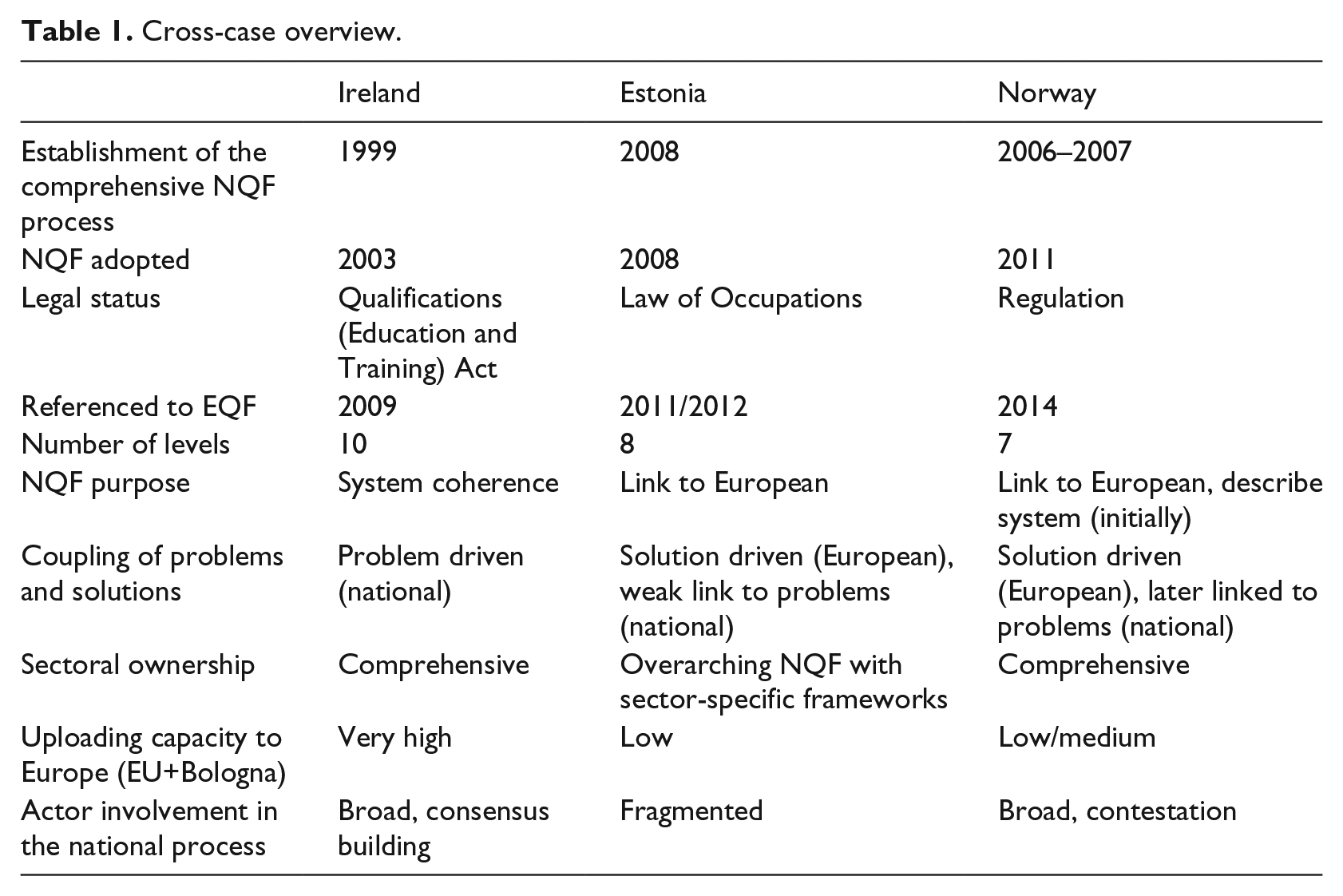
In terms of downloading, it appears that the necessity to develop an NQF and comply with European initiatives was taken for granted in both Estonia and Norway, even if their approaches were different. Where the Irish case showed how an NQF was developed in order to address nationally identified policy problems and was an incremental transformation, the Norwegian and Estonian cases showed how this process plays out when coupling to national processes is either ad hoc, or non-existent. What these national processes highlight is the complexity of joint coordination in Europe in the area of education, because these ad hoc linkages do not always emerge. This suggests some inherent issues with the process of how European joint coordination takes place. European solutions can remain loosely coupled and lack substance at national level. Here the distinctions regarding the relationship to EQF became clear. In Ireland this process was technical (the EQF did not introduce change and was loosely coupled to national processes); in Norway the process was typified by contestations and disagreement (change, (contested) coupling to national issues over time); and in Estonia it was an instrumental process (change, but loosely coupled).
Another issue with such multi-level processes is the coordination of actors and interests. The policy process of introducing new solutions at national level being a response to an external influence means that the processes leading to an issue being put on the agenda (agenda setting) have been largely skipped. This means that the mobilization and persuasion of actors, which usually takes place during the agenda-setting stage, might only occur after the decision to comply with a European solution is made. For instance, the divergence of interests that emerged after the decision in Norway indicates that this kind of introduction processes can generate problems where national actors disagree with some of the principal decisions that have already been made. In that context it was not only the idea of a qualifications framework that raised the threat of a possible collision with existing institutional norms, but also how the process took place. This highlights how these adoption processes can also challenge national modes for policymaking.
Finally, time pressures are an important element in the dynamics of the process. Where the Irish case was focused on consensus building and could use considerable time for the instrument to evolve and become mature, the European-initiated NQF processes in Norway and Estonia were carried out with a deadline in sight – time pressure was noted in both Estonia and Norway. While studies of the European level have highlighted how the need to keep to tight deadlines was a means of ensuring that the EQF ‘held momentum’ (Elken, 2015), the Estonian case shows that deadlines which are too short can lead to pragmatic choices – although this would not necessarily imply that pragmatic choices could not provide relevant outcomes. At the same time, this can lead to uneven processes in the various European countries, which can provide additional challenges for the coordination process at the European level. This raises a dilemma in such processes, concerning ‘keeping the momentum’ and the time it takes to achieve change. While the former appears to be prioritized, the cases here show the importance of the latter.
Conclusions
This article started with a key research interest in how NQFs are developed and linked to the EQF. Analyzing the processes through which particular policy solutions are developed has revealed valuable insights into some of the contestations that are built into the outcomes when European policy solutions are introduced at the national level. When European solutions are transferred to national contexts, both the process and the outcome are dependent on the national institutional context, as well as the scope of the change, coupling to local problems, the range of actors involved, the sequence in which such processes are conducted, and local policy-making traditions. This highlights how such processes are highly complex and dependent on a number of interrelated factors.
What the cases in this article have emphasized is the differentiated nature of national processes, a feature that has been highlighted in general studies concerning European integration (Holzinger and Schimmelfennig, 2012). Differentiation is also fueled by ambiguity that is built into the policy solutions such as the EQF, allowing for multiple translations at national level. In one of the interviews this was called ‘EU on demand’ because the broad set of ideas included in the EQF can also allow countries to pick and choose something from the issues that would echo their national debates. In a sense this can provide a means to ensure that policy solutions developed at European level have relevance to the large variety of national systems. However, ‘EU on demand’ also works the other way – for countries with uploading capacity it can be a strategic choice to link their national preferences with a particular EU policy objective. The manner in which the countries approached these opportunities varied considerably in these cases, and one can be reasonably certain that among the remaining 30 or so countries one can find a further variety of national processes. What does this mean for the EQF?
While there are high ambitions related to the EQF–NQF processes, analysis of more mature NQFs in South Africa and New Zealand shows that even when national frameworks are developed as a response to a particular local need, the likelihood of them delivering on all the promises is unrealistic (Young, 2008). The sense of the EQF being a potential catalyst for change is often highlighted at EU level. What, then, can the EQF deliver if the national processes have been driven by short deadlines across Europe? What we know about qualifications frameworks is that this set of ideas also has normative implications, by focusing on indicators, outcomes, measurability and a more managerial view on education (Blackmur, 2004; Allais, 2014). While the ‘EU on demand’ perspective would suggest that there is variety in the extent to which various ideas are picked up at national level, the kind of package that is provided by the EQF nevertheless provides a specific frame for available ideas from which to choose. To understand this process and the diversity of national mechanisms better, future studies could focus on those countries where NQF processes have slowed down or been challenged.
Footnotes
Acknowledgements
The author would like to thank Peter Maassen and Bjørn Stensaker for useful comments while writing this article.
Declaration of Conflicting Interest
The authors declare that there is no conflict of interest.
Funding
The author(s) disclosed receipt of the following financial support for the research, authorship, and/or publication of this article: The research was conducted as a part of a PhD position funded by the Norwegian National Graduate School in Educational Research (NATED).