



Abstract
Statistical-mediation analysis is a widely used method in psychological research that helps understand the intermediate variables, known as mediators (M), by which an independent variable (X) causes an outcome variable (Y). A major contribution to statistical-mediation analysis has been the incorporation of causal methods because it allows a clear definition of the causal direct and mediated effects and the specification of the assumptions to interpret such effects as causal. Modern causal approaches to mediation analysis encourage routinely investigating the extent to which unobserved confounders may explain the observed mediated effects. The recommendation acknowledges that even when X represents random assignment, participants are not usually randomly assigned to levels of M; hence, unobserved confounders may bias the M to Y relation (b-path). In this article, we describe unobserved pretreatment confounding of the M to Y relation in experimental mediation studies and three sensitivity-analysis methods to assess unmeasured pretreatment confounding of the M to Y relation: the correlated-residuals method, the left-out-variables-error method, and the phantom-variable method. We report the results of a simulation study that compares the routine application of the three sensitivity-analysis methods. Results generally indicate that larger effect sizes of the population b-path are less susceptible to confounding bias for all sensitivity methods. Thus, an initial approach to investigating confounding bias in experimental mediation studies is to assess the effect size of the path relating M to Y, and more details can be obtained by applying one of the three sensitivity-analysis methods.
Statistical-mediation analysis holds a widespread application in psychological research because it helps disentangle the mechanisms between an independent variable (X) and an outcome of interest (Y; Baron & Kenny, 1986; MacKinnon, 2008). Some psychology examples include investigating the mechanisms (e.g., self-efficacy, coping skills, craving) between a particular intervention and substance use disorders (e.g., alcohol use; Witkiewitz et al., 2022) or exploring the causal pathways, such as positive parent-child interactions, through which parenting interventions change children’s outcomes (e.g., social, emotional, and behavioral problems; Sanders & Mazzucchelli, 2022).
The single-mediator model (i.e., X → M → Y) is a causal model that assumes that an independent variable (X) causes the mediator (M), which, in turn, causes the outcome variable (Y; MacKinnon, 2008). Figure 1a shows the total effect from X to Y, which can be decomposed into the mediated effect (i.e., the effect from X to Y through M) and the direct effect (i.e., the effect from X to Y that is not mediated through M), shown in Figure 1b.

Path diagrams of the single-mediator model. (a) X to Y Model; (b) X to M to Y Mediation Model.
Several assumptions must be met to interpret the mediation-effects estimates as causal effects rather than associations between the variables. For instance, researchers could be interested in testing the mediated effect of a particular intervention (e.g., cognitive-behavioral therapy, X) on an outcome of interest (i.e., alcohol consumption, Y) through a specific mediator (i.e., self-efficacy, M). The strongest design to enhance a causal interpretation of the direct and mediated effects from X to Y involves random assignment of participants to levels of the treatment (X) and the mediator (M; MacKinnon, 2008). However, even in intervention studies, where X represents random assignment to treatment and control conditions, it is rarely, if ever, feasible or ethical to randomly assign participants to levels of the mediator. In the hypothetical alcohol-treatment example, researchers could randomly assign participants to levels of the treatment (X), but the individuals’ self-efficacy score cannot be directly manipulated. Hence, the mediator values (M) are observed. Unlike random assignment of X, the value of M for each participant is not randomly assigned. Thus, potential unmeasured confounders (i.e., common causes) between the mediator and the outcome could preclude the causal interpretation of the M to Y effect.
Researchers can measure an extensive set of pretreatment covariates to address confounding on the M to Y relation and estimate the mediated effect using different statistical techniques (e.g., inverse probability weighting or analysis of covariance). For an explanation of these methods, see MacKinnon and Pirlott (2015), Coffman et al. (2023), and Valente et al. (2017). However, such techniques assume that researchers have measured all the important pretreatment confounders of the mediation relations. In reality, it is often possible that some confounders were not measured in the study.
Sensitivity-analysis methods can help address pretreatment unmeasured confounding bias when participants were not randomly assigned to levels of X or levels of M; hence, these methods can assess the influence of unmeasured pretreatment confounding of the X–M, X–Y, and M–Y relationships. However, in this article, we focus on the common situation of randomized X, where X represents random assignment to treatment and control groups, and sensitivity analyses to assess the effect of pretreatment unmeasured confounding on the M to Y effect in statistical-mediation analysis. We focus on the randomized-X mediation design to more clearly introduce sensitivity to confounding in mediation analysis. Extensions to nonrandomized-X studies are also discussed in this article.
Three primary motivations drive the present study. First, researchers in psychology do not consistently address the unmeasured pretreatment confounding assumptions in mediation analysis. Second, even though sensitivity-analysis methods have been considered important in observational studies that aim to establish causal relationships (W. Liu et al., 2013) and using sensitivity analyses to test unmeasured pretreatment confounding is often recommended by methodologists (Cox et al., 2013; Frank et al., 2023; Imai, Keele, & Yamamoto, 2010; Lee et al., 2021; MacKinnon, 2008), their use is limited in applied research, including psychology. For instance, Stuart et al. (2021) extracted information from 206 articles published between 2013 and 2018 in top psychiatry and psychology journals that had conducted mediation analysis and found that only 60.7% of the studies adjusted for covariates in the regression equations as a way to address the unmeasured pretreatment confounding assumptions and that only 1.5% conducted a sensitivity analysis to test the assumptions. The results are comparable in epidemiological studies. Rijnhart et al. (2021) surveyed 174 articles from observational epidemiologic studies published between 2015 and 2019 in which mediation analysis was applied as a primary analysis method and found a slightly higher proportion of articles that adjusted for confounders in the regression equations (71.8%) compared with the survey of psychology and psychiatry journals (Stuart et al., 2021). In observational epidemiologic studies, the proportion of articles that conducted a sensitivity analysis to test for unmeasured pretreatment confounding was still low (1.7%). Finally, the third motivation for the present study is the lack of studies comparing sensitivity analyses that test unmeasured pretreatment confounding in mediation analysis, which have been recommended in the methodology-research literature.
Thus, in this article, we aim to compare three sensitivity methods to identify the unmeasured pretreatment confounding bias of the M to Y relation by simulating data that vary in the magnitude of the population confounding effect and the magnitude of the population mediated effect. The goal was to evaluate whether the methods worked as expected across a large number of data sets with different effect sizes and sample sizes. We expected that the required values of sensitivity parameters to render a mediated effect zero follow the size of the population mediation effect and are more accurate with larger sample sizes.
This article is divided into four parts. First, we present the single-mediator model and the assumptions to enhance a causal interpretation of the estimates of the product-of-coefficients method, which takes the product of the a coefficient (i.e., the effect of X on M) times the b coefficient (i.e., the effect of M on Y adjusted for the effects of X). Second, we describe the topic of sensitivity analyses, a group of methods that help assess the effects of unmeasured pretreatment confounders on the observed mediated effect. Third, we show the results of the three sensitivity-analysis methods applied to a substantive data example: (a) the correlated-residuals method (Imai, Keele, & Yamamoto, 2010), (b) the left-out-variables-error (LOVE) method (Cox et al., 2013; Mauro, 1990), and (c) the phantom-variable method (Harring et al., 2017; Lovis-McMahon & MacKinnon, 2014; MacKinnon, in press; Rindskopf, 1984). Finally, we describe a large simulation study that compares the results from the three sensitivity-analysis methods to test unmeasured pretreatment confounding in statistical-mediation analysis.
Single-Mediator Model
The single-mediator model consists of three variables: an independent variable (X), a mediator (M), and an outcome variable (Y); it is represented by Equations 1 through 3:


Figure 1 represents the single-mediator model path diagrams, where the coefficient c represents the total effect of X on Y, the a coefficient represents the effect of X on M, and the c′ coefficient, also known as the direct effect, is the effect of X on Y adjusted for the effects of M. The b coefficient represents the effect of M on Y adjusted for the effects of X. Finally, i1, i2, and i3 represent the intercepts, and e1, e2, and e3 represent the error terms. The mediated effect from X to Y through the mediator (M) can be calculated with the product-of-coefficients method, which multiplies a times b (ab), or with the differences-in-coefficients method, which subtracts the direct effect from the total effect (c – c′; MacKinnon, 2008); these methods have been considered part of the traditional mediation-analysis framework (MacKinnon et al., 2020).
Recent developments in the causal literature have clarified the definition, identification, and estimation of causal-mediation effects (Imai, Keele, & Tingley, 2010; Pearl, 2001; Robins & Greenland, 1992; VanderWeele, 2016). Even though these methods provide the advantage of clearly stating the assumptions needed for the causal interpretation of the direct and mediated estimates, these developments are not yet widely used in psychological research. The traditional approach, such as estimating the product-of-coefficients method (i.e., ab) without consideration of confounding, is still widely used in psychological research.
Imai, Keele, and Yamamoto (2010) provided the minimum conditions (i.e., sequential-ignorability assumption) that are required to identify the estimates from the product-of-coefficients method (ab), which the authors referred to as the “average causal-mediation effect” (ACME). The sequential-ignorability assumption encompasses two parts. First, it assumes that the treatment (X) is ignorable given pretreatment covariates. Second, it assumes that the mediator is ignorable given the observed treatment (X) and pretreatment covariates. It also excludes the existence of measured or unmeasured posttreatment confounders (Imai, Keele, & Yamamoto, 2010; Tingley et al., 2014). The first part of the sequential-ignorability assumption holds if X represents random assignment to treatment and control conditions. However, the second part is not guaranteed with random assignment of the independent variable (X). The sequential-ignorability assumption is equivalent to the following no-unmeasured confounding assumptions (Pearl, 2001; Valeri & VanderWeele, 2013; VanderWeele & Vansteelandt, 2009): (a) no unmeasured confounders of the X on Y effect conditional on covariates; (b) no unmeasured confounders of the M on Y effect conditional on X and covariates; (c) no unmeasured confounders of the X on M effect conditional on covariates; and (d) no measured or unmeasured confounders of M on Y that are affected by X.
Considering the mediation model described in Equations 1 through 3, the mediated effect (ab) is assumed to be the same for the control and treatment groups (Imai, Keele, & Yamamoto, 2010; MacKinnon et al., 2020) by specifying that the interaction between the independent variable (X) and the mediator (M) is zero (g = 0).
If one relaxes the assumption and specifies an interaction between X and M, then the mediated effect can still be causally identified but has different definitions. For instance, the pure natural indirect effect (PNIE), which represents the mediated effect in the control group, is defined as ab. The total natural indirect effect (TNIE), which represents the mediated effect in the treatment group, is defined as ab + ga. For more details on the definitions of the direct and mediated effects when allowing for an interaction between X and M, see Valeri and VanderWeele (2013).
The interaction between M and X is represented by the g coefficient, as shown in Equation 4 (MacKinnon et al., 2020):

In many applications of mediation analysis for experimental designs, the XM interaction is assumed to be zero because the mediators selected are expected to have the same relation with the outcome variable across groups (MacKinnon et al., 2020).
Implicitly, a correct order of the variables is also assumed in which X precedes M, M precedes Y (Cole & Maxwell, 2003; MacKinnon, 2008), and scores of X, M, and Y are valid and reliable measures of the constructs in the study (Gonzalez & MacKinnon, 2021).
Single-Mediator Model and Confounding Bias
In this article, we focus on “measurement-of-mediation” designs (Spencer et al., 2005) in which X represents random assignment to treatment and control conditions. However, the mediator is not randomly assigned because it would be unethical, unfeasible, or impractical to do so. Even with the random assignment of X, unmeasured pretreatment confounders may account for the M to Y relation (b-path). Figure 2 shows the path diagram of a single-mediator model with a pretreatment confounder (U) causing M and Y. The confounder does not cause X because X is randomly assigned.

Path diagram of the single-mediator model with a pretreatment confounder (U) causing the mediator (M) and the outcome (Y). The dashed line represents that the b-path does not have a causal interpretation because the pretreatment confounder U confounds the effect between M and Y (b-path).
The single-mediator model with a pretreatment confounder (U) causing M and Y is described by Equations 5 and 6, where the a coefficient represents the effect of X on M adjusted for the effects of U and


Sensitivity Analyses for Unmeasured Pretreatment Confounding Bias
In a measurement-of-mediation design (Spencer et al., 2005), researchers may measure an extensive set of pretreatment covariates to address pretreatment confounding on the M to Y relation and estimate the mediation effect using different statistical techniques. The recommendation assumes that using pretreatment covariates will generally lead to more accurate estimates of causal effects (MacKinnon & Pirlott, 2015; Valente et al., 2017; Wysocki et al., 2022), such as the total effect from X to Y, the direct effect, or the mediated effects in mediation analysis. However, statistical control improves inferences only under ideal scenarios (Rohrer, 2018), and it is recommended that researchers carefully select and justify, both theoretically and empirically, each pretreatment covariate to include in the model (Wysocki et al., 2022). Choosing inappropriate precovariates can lead to biased estimates and thus, to misleading conclusions (Simmons et al., 2011; Wysocki et al., 2022).
Even if researchers include pretreatment covariates in the model, it is still possible that some important pretreatment confounders of the M to Y relation could remain unmeasured. In this article, we focus on sensitivity to unmeasured pretreatment confounding analyses to strengthen the causal interpretation of the M to Y effect in measurement-of-mediation designs because this approach is often recommended by methodologists (Cox et al., 2013; Frank et al., 2023; Imai, Keele, & Yamamoto, 2010; Lee et al., 2021; MacKinnon, 2008, in press).
Sensitivity analyses were first developed to test unmeasured pretreatment confounding on bivariate relations in observational studies, such as the effect of an independent variable (X) on an outcome variable (Y). For instance, Cornfield et al. (1959) conducted the first sensitivity analysis to test unmeasured pretreatment confounding bias in the effect between smoking (X) and lung cancer (Y). This case exemplifies that randomly assigning participants to the independent variable (e.g., smoking vs. no smoking) would not be possible because doing so would be unethical. Cornfield et al. (1959) found that an unmeasured pretreatment confounder needed to be nearly perfectly related to the outcome variable (i.e., lung cancer) and that the confounder would need to be 9 times more likely in people who smoke than for people who do not smoke to make the relation between smoking and lung cancer disappear—such a large unmeasured pretreatment confounder is unlikely. The sensitivity-analysis results were used as additional evidence to support the causal claim of the effect between smoking and lung cancer.
The research area of sensitivity-analysis methods to test unmeasured pretreatment confounding in bivariate relations has seen significant advancements in recent years (e.g., Frank, 2000; Frank et al., 2013; Rosenbaum, 2005; VanderWeele & Ding, 2017). For example, the methods have been applied to test unmeasured pretreatment confounding in mediation analysis, enabling researchers to quantify the robustness of their empirical results to the potential violation of the unmeasured confounding assumptions, which are critical yet untestable assumptions for identification (Imai, Keele, & Tingley, 2010). Regarding the single-mediator model, a sensitivity analysis finds the size of the effect of an unmeasured confounder needed to modify the conclusions about the mediated effect (i.e., make the mediated effect zero or nonsignificant; Cox et al., 2013). With the random assignment of X, the sensitivity-analysis methods focus on the observational M to Y relation. Various sensitivity analyses have been developed to test the robustness of the mediated effect for studies when participants were not assigned to levels of the mediator. In the following section, we describe three popular sensitivity-analysis methods to assess unmeasured pretreatment confounding on the M to Y relation and briefly mention additional related methods.
Correlated-residuals method
Imai, Keele, and Yamamoto (2010) developed a sensitivity analysis derived from the potential-outcome framework of mediation analysis
1
(Imai, Keele, & Tingley, 2010; Pearl, 2001; Robins & Greenland, 1992; VanderWeele, 2016) that evaluates the robustness of ACME for unmeasured pretreatment confounders on the M to Y relation, assuming random assignment of X. This method assesses pretreatment confounding bias by analyzing how ACME changes as a function of the correlation between the residual terms e2 and e3 of the single-mediator-model equations (Equations 2 and 3), which is denoted as

Plot of the correlated-residuals method for the memory study. The solid curved line represents the estimated average causal mediated effect (ACME) for the imagery mediator for different values of the sensitivity parameter
LOVE method
Cox et al. (2013) adapted Mauro’s (1990) LOVE method to test unmeasured pretreatment confounding bias on the M to Y relation in the single-mediator model. The LOVE method is a correlational sensitivity-analysis method, such as the one developed by Frank (2000). As shown in Equations 7 and 8, this method includes the pretreatment unmeasured confounder (U) 2 in the single-mediator equations, where X is the treatment, M is the mediator, and Y is the outcome:


Based on Equations 7 and 8, one can estimate the standardized regression coefficients (



If there is a correlation between the unmeasured pretreatment confounder (U) and the other predictors (M and Y), then the estimates of the
The LOVE method requires as an input the estimates of three correlations: (a) the correlation between the outcome and the independent variable

Plot of the left-out-variables-error method for the memory study. The curved line indicates the combinations of correlations between an unmeasured pretreatment confounder and M (
Phantom-variable method
Rindskopf (1984) first used phantom variables
3
to constrain parameters in linear structural models. Harring et al. (2017) applied phantom variables to assess a model’s sensitivity to potential external misspecifications. The phantom-variable method can be used as a sensitivity analysis to unmeasured pretreatment confounding bias in the M to Y relation in the single-mediator model (Lovis-McMahon & MacKinnon, 2014; MacKinnon, in press). First, the method specifies a phantom variable that represents the unmeasured pretreatment confounder of the M to Y relation within the regression equations. Then, it fixes its variance to 1 and fixes the relation of the phantom variable and X to 0 because the variables are expected to be uncorrelated because X represents random assignment to conditions. Finally, it varies the effect of the phantom variable on the mediator (phantom variable → M) and the effect of the phantom variable on the outcome variable (phantom variable → Y) and estimates the mediated effect (ab) for each fixed value. The goal is to find the value of these effects (phantom variable → M, phantom variable → Y) that make the mediated effect zero. The phantom-variable method is visualized with a plot that shows the value of the phantom-variable effects on the x-axis and the mediated effect (

Plot of the phantom-variable sensitivity-to-unmeasured-confounding method for the memory study. The curved line indicates the mediated effect as a function of the phantom-variable effects. The dashed lines indicate the values of the phantom-variable effects on M and Y (–1.74 and 1.74) needed to make the mediated effect zero (ab = 0).
Table 1 summarizes the correlated-residuals method, the LOVE method, and the phantom-variable method based on their current description in the research literature. Each method provides a useful way to investigate how pretreatment confounding of M to Y would affect the mediation-analysis conclusions. The sensitivity parameters differ. The correlated-residuals method assesses pretreatment confounding on the M to Y relation by focusing on the correlation between the residuals from the mediator and outcome equations e2 and e3 (i.e.,
Comparison of Sensitivity-Analysis Methods
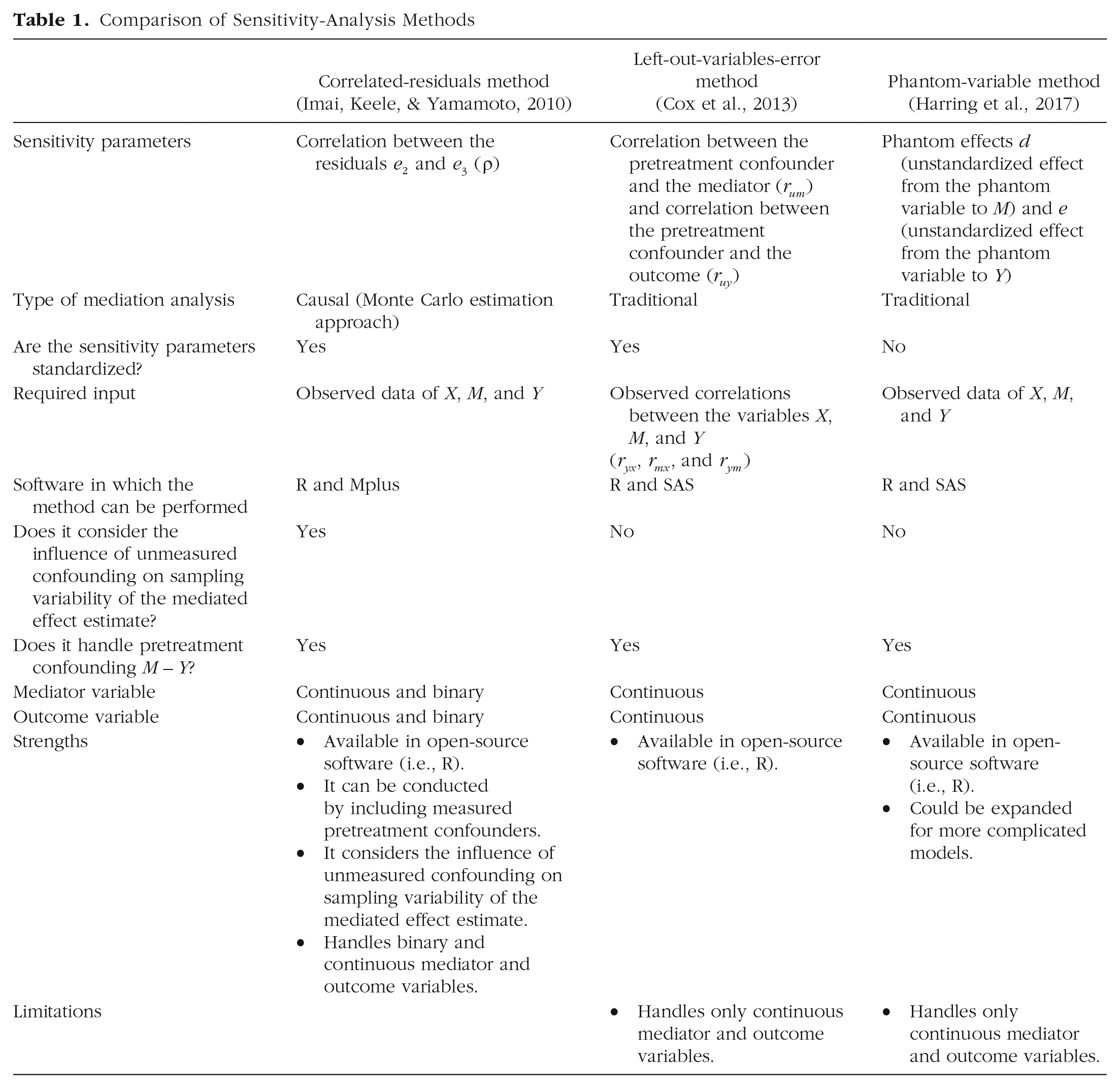
A strength of the correlated-residuals method is that it can be conducted in the widely used R mediation package (Tingley et al., 2014) and in the Mplus software, which allows the user to conduct the mediation analysis including measured pretreatment confounders. Additional programming could develop similar approaches for the LOVE method with the analysis of correlations between the pretreatment confounder with M and Y, adjusted for measured pretreatment confounders. In addition, the phantom-variable model could include additional predictors of M and Y representing measured pretreatment confounders. An additional advantage of the correlated-residuals method is that it considers the influence of unmeasured confounding on sampling variability of the mediated effect estimate, which could be added to the LOVE and phantom-variable methods, but this has not yet been done. Further strengths of the correlated-residuals method are that the current program conducts sensitivity analysis for binary and continuous variables.
Overall, the correlated-residuals method seems to be the method of choice because of the capabilities of the existing program in R, the straightforward inclusion of measured confounders, and extensions to more complicated models, such as models with binary variables. The phantom-variable method’s major strength is that with additional programming, it could apply to more complicated models, such as longitudinal models, in which the influence of confounding of one aspect of the model could be evaluated. Of course, it is assumed that each method operates as expected with data, which will be evaluated in the rest of this article.
In this article, we compare three sensitivity-analysis methods: the correlated-residuals method, the LOVE method, and the phantom-variable method. However, we also note the additional contributions to sensitivity-analysis methods for other scenarios. For instance, VanderWeele (2010) developed a sensitivity analysis derived from the potential-outcomes framework of mediation analysis that focuses on binary confounders. Hong et al. (2018) proposed a sensitivity analysis for causal mediation analysis based on the ratio-of-mediator-probability-weighting method (Hong et al., 2015) that tests the aggregate bias associated with multiple omitted confounders, which could be pretreatment or posttreatment confounder variables. The method developed by Hong et al. (2018) has the flexibility of incorporating interactions between the measured or unmeasured confounders and X or M, and it can be extended to nonexperimental designs (i.e., when X is observed). Qin and Yang (2022) developed a simulation-based sensitivity analysis for causal-mediation studies suitable for continuous and binary mediator and outcome variables and for randomized and observational studies, which is available in the mediationsens R package. McCandless and Somers (2019) proposed a sensitivity analysis that assesses unmeasured confounding bias in mediation analysis using Bayesian methods. In addition, researchers have developed sensitivity analyses that simultaneously test the no-unmeasured-pretreatment-confounding assumption and the no-measurement-error assumption (Fritz et al., 2016; Lin et al., 2023; X. Liu & Wang, 2021). Tofighi et al. (2019) developed a sensitivity analysis that tests unmeasured confounding bias for growth-curve mediation models. Table 2 summarizes the extensions of sensitivity analyses for other situations.
Extensions of Sensitivity Analyses to Test Unmeasured Confounding in Mediation Analysis

We selected the correlated-residuals method, LOVE method, and the phantom-variable method in this study to exemplify sensitivity to unmeasured pretreatment confounding in the simplest scenario, a single-mediator model, where X represents random assignment to treatment and control groups, assuming a continuous pretreatment confounder and no interaction between the independent variable and the mediator. Sensitivity analyses in Table 2 have capabilities beyond the focus of this study.
Applied Example
Memory study
We applied three sensitivity-to-unmeasured-pretreatment-confounding methods to a data set from a memory study (MacKinnon et al., 2018). Researchers randomly assigned 44 participants to two conditions: primary and secondary rehearsal groups. A researcher read aloud a list of words, and participants were given specific instructions depending on the group they were assigned to. Participants in the primary rehearsal group were asked to repeat the words they listened to, and participants in the secondary rehearsal group were asked to make mental images of those words. In the end, participants were asked to report the number of words they remembered. In the data set, X represents random assignment to conditions, coded 0 (primary rehearsal) and 1 (secondary rehearsal). The mediator (M) is the response to the question about how much each participant made mental images of the words, scored from 1 (not at all) to 9 (definitely), and Y represents the total number of words that people remembered (out of 20; for data set from the memory study, see Appendix A in the Supplemental Material available online).
Results
The results from the mediation analysis show that the mediated effect from the type of rehearsal (X) to the number of words remembered (Y) through imagery (M) was statistically significant:
To evaluate whether the mediated-effect estimate is robust to unmeasured pretreatment confounding, we conducted three sensitivity analyses: the correlated-residuals method, the LOVE method, and the phantom-variable method. We consider the knowledge of mnemonic techniques a possible unobserved pretreatment confounder.
Correlated-residuals method
We conducted the correlated-residuals method (Imai, Keele, & Yamamoto, 2010) in the R environment (R Core Team, 2021) using the mediation package (Tingley et al., 2014), adapting the code provided by Cox et al. (2013). First, we specified the mediator and outcome equations (i.e., Equations 2 and 3, respectively). Then, we used the mediate function to estimate the ACME and their 95% bootstrap CIs (ACME = 2.19, 95% CI = [0.64, 3.74]) and conducted the sensitivity analysis with the sens.out function. Figure 3 shows how the ACME changes as a function of the sensitivity parameter (
LOVE method
The LOVE method (Cox et al., 2013; Mauro, 1990) was conducted in the SAS programming language and the R environment (R Core Team, 2021) using the code provided by Cox et al. (2013). To assess unmeasured pretreatment confounding in the M to Y relation in the single-mediator model, the LOVE method uses the estimates of three correlations: (a) the correlation between the outcome and the independent variable
The code for this method generates values from 0 to 1 for two unmeasured correlations: (a) the correlation between the unmeasured pretreatment confounder (e.g., knowledge of mnemonic techniques) and the mediator (i.e., imagery;
For the code and output of the LOVE method, see Appendix D in the Supplemental Material. For the code in SAS, see Figure D1 in the Supplemental Material; for the code in R, see Figure D2 in the Supplemental Material.
Phantom-variable method
The phantom-variable sensitivity-analysis method was conducted in the R environment (R Core Team, 2021) using the lavaan package (Rosseel, 2012) following the description in MacKinnon (in press) and adapted from an earlier version of the code used in Georgeson et al. (2023). The phantom variable was specified with the two mediation equations, and its mean and variance were fixed to 0 and 1, respectively. The program varied the effect of the phantom variable on the mediator (phantom variable → M) and the effect of the phantom variable on the outcome variable (phantom variable → Y) and calculated the mediated effect (ab) for each fixed value. Figure 5 shows how the mediated effect (ab) changes as a function of the value of the phantom-variable effects. The sensitivity-analysis results show that the values of the effect of the phantom variable on the mediator and the effect of the phantom variable on the outcome that render the mediated effect (ab) to zero in this data set are −1.74 and 1.74. For the code to perform the phantom-variable sensitivity-analysis method, see Appendix E in the Supplemental Material.
Simulation study
Motivation
The goal of the simulation study was to evaluate whether the correlated-residuals method, the LOVE method, and the phantom-variable method work as expected across a large number of data sets with different effect sizes and sample sizes. We were interested in assessing the pattern of sensitivity-parameter values needed to make the mediated effect zero as the population confounding effect (de) increased and as the population mediated effect increased (ab) and whether the pattern changed as the sample size increased. We expected that the required values of sensitivity parameters to render a mediated effect zero follow the size of the population mediation effect and would be more accurate with larger sample sizes. We wanted to assess the extent to which the size of the confounding effect would influence the results of the sensitivity methods.
Method
Data generation
A Monte Carlo simulation study was conducted using the SAS 9.4 programming language and the R environment (R Core Team, 2021). The data were generated in the SAS 9.4 programming language based on a single-mediator model with a pretreatment confounder (U) causing the mediator (M) and the outcome (Y; Fig. 2), where M, Y, and U were generated as continuous variables and X was generated as a binary variable, representing random assignment to treatment and control groups. Residuals for each variable were generated as normal variates.
The simulation had five sample sizes (N = 50, 100, 200, 500, 1,000) and the following population-parameter values (
Correlated-residuals method
Each generated data set was analyzed with the single-mediator model (Equations 2 and 3) in the R environment (R Core Team, 2021) using the mediation package (Tingley et al., 2014), which was called from the SAS language programming with the proc iml function. In other words, the analysis omitted the pretreatment confounding variable (U) from the regression equations and did not include the interaction between the independent variable and the mediator (i.e., XM). The correlated-residuals sensitivity-analysis method was conducted using the sens.out function to obtain the sensitivity parameter
LOVE method
The LOVE method (Cox et al., 2013; Mauro, 1990) was conducted in the SAS 9.4 programming language and the R environment (R Core Team, 2021). Three correlations were estimated for each data set: (a) the correlation between the outcome and the independent variable
Phantom-variable method
The phantom-variable method (Harring et al., 2017; Lovis-McMahon & MacKinnon, 2014; MacKinnon, in press) was conducted in the R environment (R Core Team, 2021) using the lavaan package (Rosseel, 2012), which was called from the SAS language programming using the proc iml function. The code was adapted from an earlier version of the code used in Georgeson et al. (2023). We specified the phantom variable in the two mediation equations (Equations 2 and 3). The program varied the effect of the phantom variable on the mediator (phantom variable → M) and the effect of the phantom variable on the outcome variable (phantom variable → Y) from −2 to 2 in increments of .01 and calculated the mediated effect (ab) for each fixed value. The substantive example shows that this sensitivity-analysis method yields two sensitivity-parameter values, each possessing the same magnitude but a different sign. To simplify comparing the results between methods, we saved the absolute value for each replication, resulting in a single sensitivity-parameter value.
Results
Figures 6 through 8 show the simulation results for the three sensitivity-to-unmeasured-pretreatment-confounding methods: the correlated-residuals method, the LOVE method, and the phantom-variable method for sample size N = 200. The results for other sample sizes (N = 50, 100, 500, 1,000) followed the same pattern (see Appendix G in the Supplemental Material).

Average sensitivity-parameter values that make the mediated effect (ab) zero as a function of the population confounding effect (de), the population a-path, and the population b-path (a = nonzero, b = 0, N = 200). (a) Correlated-residuals method. (b) Left-out-variables-error method. (c) Phantom-variable method. The population confounding effect (de) is shown in the x-axis (zero = 0, small = 0.0196, medium = 0.1521, large = 0.3481). Results are shown for conditions in which the population b-path is zero (blue = zero = 0). The average values of the sensitivity-parameter values that make the mediated effect zero are shown on the y-axis.

Average sensitivity-parameter values that make the mediated effect (ab) zero as a function of the population confounding effect (de), the population a-path, and the population b-path (a = 0, b = nonzero, N = 200). (a) Correlated-residuals method. (b) Left-out-variables-error method. (c) Phantom-variable method. The population confounding effect (de) is shown in the x-axis (zero = 0, small = 0.0196, medium = 0.1521, large = 0.3481). The population b-path is shown with different colors (blue = zero = 0, yellow = small = 0.14, green = medium = 0.39, pink = large = 0.59). The average values of the sensitivity-parameter values that make the mediated effect zero are shown on the y-axis.
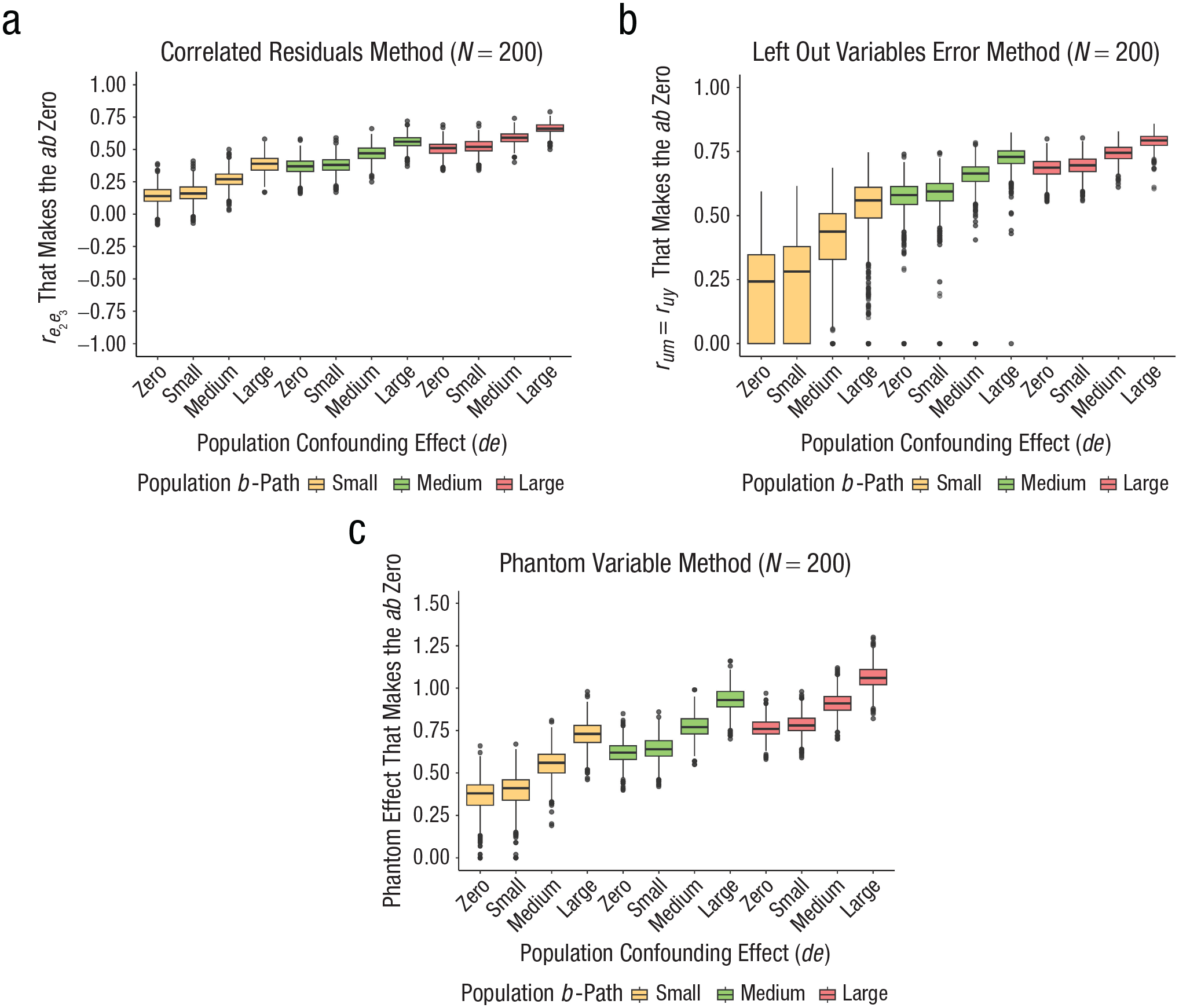
Average sensitivity-parameter values that make the mediated effect (ab) zero as a function of the population confounding effect (de), the population a-path, and the population b-path (a = nonzero, b = nonzero, N = 200). (a) Correlated-residuals method. (b) Left-out-variables-error method. (c) Phantom-variable method. The population confounding effect (de) is shown in the x-axis (zero = 0, small = 0.0196, medium = 0.1521, large = 0.3481). The population b-path is shown with different colors (blue = zero = 0, yellow = small = 0.14, green = medium = 0.39, pink = large = 0.59). The average values of the sensitivity-parameter values that make the mediated effect zero are shown on the y-axis.
Figures 6 through 8 show how the sensitivity parameters (shown in the y-axis) change as a function of different combinations of the population confounding effect (de) and the population b- and a-paths. The population confounding effect (de) is shown on the x-axis, where zero = 0, small = 0.0196, medium = 0.1521, and large = 0.3481. The population b-path is portrayed with different colors (blue = zero = 0, yellow = small = 0.14, green = medium = 0.39, pink = large = 0.59).
The sensitivity parameter for the correlated-residuals method is the
Figures 6 and 7 show the results for conditions in which the population mediated effect is zero (ab = 0). For these conditions, we expect that across samples from this population, a very small sensitivity parameter is sufficient for removing a mediated effect estimate in the sample if the population value of the mediated effect is zero. We assessed the results for the case when the population mediated effect was zero because the idea of this study was to conduct the sensitivity analyses using the mediated-effect-sample estimates when the researcher does not know the population value. In other words, the population mediated effects were zero; however, the mediated effect estimates will not be always exactly zero in the sample.
As shown in Figure 6, for conditions in which the population a-path is nonzero (small = 0.14, medium = 0.39, large = 0.59) and the population b-path is zero (b = 0), the results show that as the population confounding effect (de) increases, the mean of the sensitivity parameters, leading to a zero-mediated effect, also increases. The sensitivity-parameter results suggest that the sample mediated effect may be considered unaffected by confounding when there is a population zero mediated effect but confounding (de) is present. The pattern of results is consistent for the three sensitivity methods and shows some conflation of the mediated and confounding effects.
Figure 7 shows the results for conditions in which the population a-path is zero (a = 0) and the population b-path is nonzero. As the effect size of the population b-path increases (yellow = small = 0.14, green = medium = 0.39, pink = large = 0.59), the average sensitivity parameter that leads to a zero mediated effect also increases. In other words, as the effect size of the population b-path gets larger, the sensitivity analyses will suggest that the estimated mediated effect is less affected by unmeasured confounding. As in Figure 6, the results show that as the population confounding effect (de) increases, within each size of the population b-path, the mean of the sensitivity parameter that leads to a zero mediated effect also increases. There is a difference in the LOVE results compared with the other methods when the a-path is zero; the values of
Figure 8 shows the results for conditions in which the population mediated effect is nonzero (ab ≠ 0). For these conditions, we expect that the sensitivity parameters needed to make the mediated effect zero reflect the population mediated effect. As expected, as the effect size of the population b-path increases, the average sensitivity parameter that leads to a zero mediated effect also increases. And as the population confounding effect (de) increases, within each size of the population b-path, the mean of the sensitivity parameter that leads to a zero mediated effect also increases, showing some conflation of the population mediated and confounding effects.
Finally, results show that the variability of the average sensitivity-parameter values decreases as the sample size increases (for results for all sample sizes, see Appendix G in the Supplemental Material). In other words, the larger the sample size is, the smaller the range of the values of the sensitivity parameter that make the mediated effect zero is. The results are consistent across methods, except for the LOVE method, when the population a-path is zero, which has more variability in the sensitivity-parameter value that renders the standardized mediated effect zero.
A limitation of the LOVE method as used in this study was that it did not provide a sensitivity-parameter value for all the replications because of the way that the values of the unmeasured correlations
Discussion
Unmeasured confounding threatens the causal interpretation of the mediated effect estimates. Sensitivity analyses help deal with confounding bias in mediation analysis when potential confounders are not measured in the study. Lee et al. (2021) proposed guidelines for reporting mediation analyses of randomized trials and observational studies. They suggested that researchers routinely report sensitivity analyses used to explore the causal assumptions, including assumptions about confounding. These methods are recommended in the single-mediator model and more complex models (Tofighi et al., 2019), but the different sensitivity-to-confounding methods have not been compared. Our present research work was motivated by recommendations to investigate confounding in mediation analysis and the high probability of unmeasured confounders of the M to Y relation in most studies. It is important to evaluate how sensitivity-analysis methods to test unmeasured confounding work if researchers are encouraged to use and report them regularly.
The results are consistent across methods, showing that the effect size of the population b-path and the magnitude of the population confounding effect (de) determined the smallest size of the sensitivity parameters that make the mediated effect zero. There was a larger shift in the sensitivity parameter resulting from the b-path than the modest shifts in the sensitivity parameter from the confounding effect size (de). Overall, the results indicate that one method to assess sensitivity to unmeasured confounder bias is to evaluate the effect size of the b-path. If the b-path is large, confounder bias is less likely to render an observed mediated effect equal to zero. The critical role of the magnitude of the b-path for sensitivity to confounding in mediation analysis is consistent with Hill’s (1965) first consideration for a causal relation, which emphasizes the strength of the effect as evidence that the effect is causal, such as “strong associations are more likely to be causal than weak associations because, if they could be explained by some other factor, the effect of that factor would have to be even stronger than the observed association” (Rothman & Greenland, 2005, p. S148). That recommendation also applies to sensitivity to confounding in mediation analysis. A large b-path effect protects from unmeasured confounding because confounder effects would have to be larger to explain the observed large b-path.
There are some caveats about focusing sensitivity to confounding on the b-path. First, for mediation to exist, there must be evidence that X causes M. If X does not cause M, then there will not be mediation despite the size of the b-path. Second, there are other spurious influences that inflate the M to Y path, such as measurement overlap (i.e., using similar individual items for measuring M and Y), selection of the sample by a collider that alters the relation between M and Y, or more complicated models with additional mediators and confounders that may alter the relation between M and Y. Nevertheless, consideration of confounding of the M to Y path, including consideration of the size of the b-path, in experimental mediation analysis provides one way to evaluate sensitivity to unmeasured confounder bias.
General Recommendations for Substantive Researchers
In this section, we include general recommendations based on the existing literature and the current study’s results to improve the causal interpretation of the mediated effect.
First, whenever possible, we recommend that substantive researchers use design-based techniques (in which both the independent variable and the mediator are randomized) to enhance a causal interpretation of the mediated effect (e.g., sequential double-randomization design, concurrent double-randomization design, and parallel randomization). For a detailed description of these designs, see Pirlott and MacKinnon (2016).
Second, if randomly assigning participants to both the independent variable and the mediator is not possible, as is often the case, we encourage researchers to think about the potential confounders of their specific variables before conducting the study, measure the confounders at baseline, and adjust for them during the analysis. A variety of methods are available for adjusting for measured confounders, including analysis of covariance and weighting approaches (for an explanation of other statistical techniques to incorporate measures of confounding variables, see MacKinnon & Pirlott, 2015; Shadish et al., 2008; Valente et al., 2017). Overall, it is recommended that researchers carefully select and justify, both theoretically and empirically, each pretreatment covariate in the model (Simmons et al., 2011; Wysocki et al., 2022).
Third, if the independent variable was randomized but the mediating variable was not, we recommend using a sensitivity-analysis method described in this article to assess how robust the mediated effect is to unmeasured pretreatment confounding bias. We also recommend looking at the effect size of the b-path as an important first step in these analyses. The interpretation of the unmeasured pretreatment confounder effect sizes may depend on the area of research and should be interpreted considering the effect sizes typically observed in the research area.
Fourth, several reasons make the correlated-residuals method the overall method of choice for assessing sensitivity to unmeasured pretreatment confounding on the M to Y relation. The correlated-residuals method can be conducted in R and Mplus, easily incorporates measured confounders as predictors, can handle binary and continuous variables, and generates information about how unmeasured pretreatment confounding affects the sampling variability of the observed mediated effect. If a large structural equation model is part of the research project, then the phantom-variable method is ideal because the sensitivity to confounding could be included as part of larger models.
Limitations and Future Directions
The current study has some limitations, and in this section, we make suggestions for future research. First, in the present research, we focused on assessing the sensitivity of unmeasured pretreatment confounding in the M to Y relation (b-path) for the common experimental application of mediation analysis for continuous M and Y. However, future research could compare sensitivity-analysis methods that are suitable to test unmeasured pretreatment confounding of the X to M and X to Y relations when X is nonrandomized (e.g., Hong et al., 2018; Qin & Yang, 2022).
Second, in the present study, we focused on data with a continuous mediator and a continuous outcome variable. Future research could compare sensitivity-analysis methods that were developed to test unmeasured confounding when the mediator or/and the outcome variables are binary (e.g., Imai, Keele, & Yamamoto, 2010; Qin & Yang, 2022). Binary mediators or outcomes are frequently encountered in mediation analysis. Common examples in health-related research include variables such as health status (e.g., healthy vs. unhealthy), medical test results (e.g., positive vs. negative), smoking status (e.g., smoker vs. nonsmoker), and mortality (e.g., alive vs. deceased; Xu et al., 2023). The same issues discussed in this article will apply to binary variables, including the importance of measuring confounders and the evaluation of sensitivity to confounding by varying the strength of the relation of unmeasured confounders to M and Y.
Third, in the present research, we focused on comparing sensitivity-analysis methods while assuming that the mediator has been measured without error. Future research could compare sensitivity-analysis methods that test multiple assumptions simultaneously (e.g., Fritz et al., 2016; Lin et al., 2023; X. Liu & Wang, 2021).
Fourth, in the current study, we generated data for a zero value of the interaction between the independent variable (X) and the mediator (M; i.e., g = 0), as is commonly assumed in experimental mediation studies. A future study could generate data violating this assumption and assess how the sensitivity-analysis methods included in the present study perform compared with methods that incorporate the XM interaction (e.g., Hong et al., 2018; Imai, Keele, & Yamamoto, 2010; Qin & Yang, 2022). When there is an XM interaction, the mediated effect has several definitions, including the PNIE and the TNIE, as described in Valeri and VanderWeele (2013). The sensitivity analyses then focus on the size of confounder relations that reduce the PNIE and the TNIE equal to zero.
In conclusion, inference from statistical-mediation analysis relies on several assumptions, including no unmeasured M to Y confounding. Three methods to assess sensitivity to unmeasured pretreatment confounding of M to Y were clarified by their application to a real data set and in a large statistical simulation study. Overall, the different methods performed similarly such that larger effect sizes of the population b-path (and corresponding sample b-path) make the mediated effect estimates less affected by confounding bias. One recommendation for researchers investigating confounding bias in the M to Y relation in the single-mediator model when X is randomized but M is not is to assess the effect size of the path relating M to Y (b-path). More details about the role of confounding can be obtained by conducting one or more of the sensitivity-analysis methods in this article. At this time, the correlated-residuals method is the easiest to use and has the most capabilities.
Supplemental Material
sj-docx-1-amp-10.1177_25152459251355586 – Supplemental material for Three Sensitivity-Analysis Methods to Assess Unmeasured Pretreatment Confounding Bias in Experimental Mediation Analysis
Supplemental material, sj-docx-1-amp-10.1177_25152459251355586 for Three Sensitivity-Analysis Methods to Assess Unmeasured Pretreatment Confounding Bias in Experimental Mediation Analysis by Diana Alvarez-Bartolo and David P. MacKinnon in Advances in Methods and Practices in Psychological Science
Footnotes
Transparency
Action Editor: Rogier Kievit
Editor: David A. Sbarra
Author Contributions

Notes
References
Supplementary Material
Please find the following supplemental material available below.
For Open Access articles published under a Creative Commons License, all supplemental material carries the same license as the article it is associated with.
For non-Open Access articles published, all supplemental material carries a non-exclusive license, and permission requests for re-use of supplemental material or any part of supplemental material shall be sent directly to the copyright owner as specified in the copyright notice associated with the article.
