



Abstract
Theoretical models involving one or multiple intervening variables often posit whether a cause influences an outcome both directly and indirectly or only indirectly. In testing mediation, this distinction of partial and full mediation has become a subject of debate because of statistical issues. We extend the critique on this notion and provide insights into what a statistically significant direct effect between a cause and an outcome in a mediation model can mean. We also evaluate different effect size measures for direct and indirect effects and offer practical recommendations for assessing mediation mechanisms, which we illustrate using different examples. The broader relevance of these recommendations beyond mediation analysis is discussed.
Keywords
Mediation analysis has a long history (e.g., Hyman, 1955; MacCorquodale & Meehl, 1948; Wright, 1921) and currently enjoys a high popularity in the behavioral and social sciences that can be traced back to works published in the 1980s by, among others, Judd and Kenny (1981a, 1981b), James and Brett (1984), and of course, Baron and Kenny (1986). Over the last decades, statistical techniques have been developed that facilitate the assessment of mediation in simple and complex models involving multiple mediators or predictors and continuous and categorical variables (e.g., Hayes, 2018; Iacobucci, 2008; MacKinnon, 2008; Muthén et al., 2016; Pearl, 2009; VanderWeele, 2015). These advances provide researchers with insights into mediation mechanisms in models of causal relations as no other method does.
A distinction often made in mediation models is the one between partial and full mediation, also called incomplete and complete mediation (e.g., James & Brett, 1984; Kenny et al., 1998; Mathieu & Taylor, 2006; Shrout & Bolger, 2002). Over the last decade, there has been a debate surrounding the virtues of this distinction; some have advocated that it should be abandoned completely because of issues with how this distinction is assessed statistically (e.g., Hayes & Preacher, 2014; Preacher & Kelley, 2011; Rucker et al., 2011). Yet this distinction continues to be made in methodological articles (e.g., Sim et al., 2022), theoretical models (e.g., Schmader & Sedikides, 2018), individual studies (e.g., Le et al., 2024), and meta-analyses (e.g., Tran et al., 2022). A PubMed search revealed that in 2024, the terms “partial mediation” and “full mediation” appeared in 111 and 44 publications, respectively.
In this article, we extend the discussion of the distinction between partial and full mediation and the importance of additional statistical analyses, especially the calculation of effect sizes. We begin by showing that theoretical models involving one or multiple mediators often imply whether a cause (antecedent) influences an outcome (consequent) both directly and indirectly or only indirectly. Next, we extend the critique of this distinction and explain why it is problematic statistically. We also elucidate what a significant direct effect between a cause and an outcome can mean and discuss requirements for causal relationships. We then evaluate effect size measures for both direct and indirect effects and provide equations to convert the direct effects. Finally, we offer practical recommendations for assessing mediation mechanisms, which we illustrate using hypothetical and real data.
Theoretical Perspective
The distinction between partial and full mediation can be found in many theoretical models that implicitly or explicitly posit that one variable causes another variable both directly and indirectly or only indirectly. Full mediation is indicated when a theoretical model states that a cause influences an outcome only indirectly through one or more mediators (James & Brett, 1984). An example is Schmader and Sedikides’s (2018) conceptual model of state authenticity as fit to the environment. This framework posits that the fit between a person and the environment influences the person’s motivation to approach situations indirectly through state authenticity, which the authors defined as a sense of being in alignment with one’s own true self. Partial mediation is indicated when a theoretical model states that an antecedent influences an outcome both directly and indirectly through one or more mediators (James & Brett, 1984; Judd & Kenny, 1981b). For example, Karremans et al. (2017) hypothesized that mindfulness influences relational processes both directly and indirectly through awareness, emotion regulation, executive control, and self–other connectedness. Although often considered alone, theoretical models regularly combine partial and full mediation as smaller pieces of a larger causal model. A popular example is the theory of planned behavior (TPB; Ajzen, 1991). According to the TPB, people’s attitude toward a planned behavior and the subjective norm predicts their behavior indirectly through their intention, whereas people’s perceived behavioral control predicts their behavior both directly and indirectly through their intention.
These examples underscore that theoretical conceptualizations of causal frameworks often distinguish between partial and full mediation and that this distinction provides a more nuanced understanding of the process through which a cause is expected to affect an outcome. Once the mediation mechanism is identified, the distinction between partial and full mediation also provides researchers with insights into where it is appropriate to intervene to change the outcome (e.g., Ledermann & Macho, 2015; Loh et al., 2022). Although the statistical testing of partial versus full mediation is not without issues, this distinction provides easy to understand language to describe and discuss the mechanism by which a cause influences an outcome through one or more intervening variables.
Statistical Perspective
Consider the most basic mediation model that consists of a single cause, X, a single mediator, M, and a single outcome, Y. If M and Y are both continuous variables, then this simple mediation model (see Model A in Fig. 1) can be expressed by three linear equations:



where
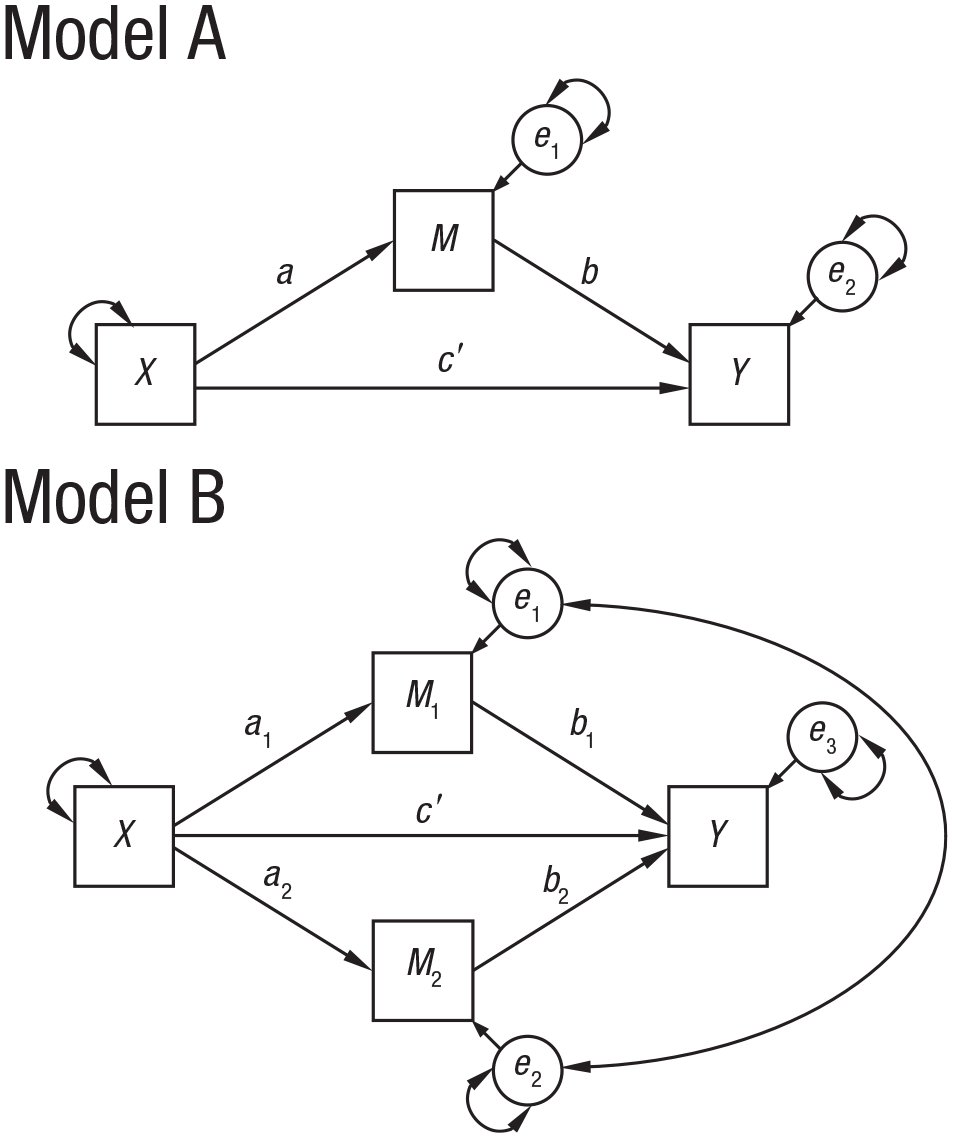
Path diagrams of a simple mediation model (Model A) and a model with two simultaneous mediators (Model B). Rectangles represent manifest variables, circles represent residuals, single-headed arrows represent regression weights, double-headed arrows pointing to single variables represent variance parameters, and double-headed arrows pointing to different variables represent covariance parameters.
The simple mediation model can be easily expanded by adding more intervening variables. Model B of Figure 1 shows a model with two simultaneous or parallel mediators. In this model, there are two specific indirect effects,
Now consider the case in which both
Issues in testing partial versus full mediation
In testing mediation, partial statistical mediation is said to occur when both the indirect effect and
A second issue concerns the practical implications of the distinction between partial and full mediation (Preacher & Kelley, 2011; Rucker et al., 2011). A researcher may be inclined to infer that results indicating full mediation suggest that a mediator is important and that results indicating partial mediation suggest that a mediator is less important. Such inferences are problematic, especially when relying solely on null hypothesis significance testing (Preacher & Kelley, 2011).
A third issue concerns the claim of full mediation. Claiming full mediation is tantamount to saying there is no direct effect between X and Y, which is essentially a claim of a null result. Claiming there is no effect can be problematic because there are almost always plausible alternative explanations that are often difficult to rule out because of the limitations of empirical studies (Wulff et al., 2023). These limitations include a lack of power to detect substantial effects, unreliable or invalid measures, undetected nonlinear relationships between the variables, violation of distribution assumptions, sampling error, the use of inappropriate statistical methods, or model misspecification. There may also be unmeasured subpopulations for which the null result is not true (see also Jacob et al., 2019; Landis et al., 2014). For example, the sample may consist of two subgroups, one group in which
What does a statistically significant direct effect mean?
Finding a significant
A significant
It is important to note that it is never possible to know with certainty whether all relevant variables have been included in a model and that a
Finally, a significant
Causal Relationships
Theoretical models often posit causal relationships between constructs. Although randomized experiments are the “gold standard” for making causal inferences (cf. Berk, 2005), researchers often employ regression analysis and related techniques, such as multilevel modeling (MLM) and structural equation modeling (SEM), to test hypothesized causal relationships. Inferring a causal relationship between two variables requires the fulfillment of three widely accepted criteria (e.g., Kenny, 1979): There is an (observed) association between the variables (e.g., a substantial correlation), there is temporal precedence of the variables (X precedes Y in time), and the association is nonspurious (i.e., the association is not due to a confounding variable). Nonspuriousness is arguably the most challenging criterion (Rohrer et al., 2022), requiring a strong theoretical rationale for the hypothesized model and a correctly specified statistical model that includes all relevant covariates. Note that these requirements are necessary but not sufficient for inferring causation (see also Sobel, 1996). In ruling out alternative explanations, it is crucial to use reliable and valid measures, ensure that the sample size is adequate, employ statistical estimation methods that are appropriate for the data, and control for all potential confounders (see also MacKinnon, 2008).
In specifying the model to be estimated, Pearl (2001) delineated four critical assumptions important for inferring causal indirect effects: (a) no unmeasured confounders of the X-Y relationship, (b) no unmeasured confounders of the X-M relationship, (c) no unmeasured confounders of the M-Y relationship, and (d) no confounders directly affected by X that also affect the M-Y relationship. A violation of any of these assumptions is likely to lead to biased estimates of the indirect effect of interest and jeopardize causal inferences about the mediation mechanism.
For randomized designs, MacKinnon et al. (2020) discussed the testing of the effect of the XM interaction (i.e., the interaction between X and M) on Y. If the effect of this interaction on Y is zero, then the b and
Another recommendation is the use of sensitivity analysis to assess the robustness of the effects to potential omitted confounders or mediators (Imai, Keele, & Tingley, 2010; Imai, Keele, & Yamamoto, 2010). This type of analysis can be used to determine how large the effect of an unmeasured confounder would need to be on the mediator and the outcome to explain an estimated effect away. Current sensitivity-analysis techniques are best suited for assessing potential confounding effects that affect path-b. If there is an unmeasured confounder affecting both the mediator, M, and the outcome, Y, then the residuals of these two variables will be correlated. The size of this correlation is an indicator of how robust b is to omitted confounders affecting M and Y.
Recommendations
As illustrated, distinguishing between partial and full mediation in a theoretical model can have substantial value even though its testing presents challenges. One of the biggest issues is the reliance on statistical significance tests for
Reporting effect sizes
A first recommendation is to encourage the practice of reporting and interpreting effect sizes (e.g., American Psychological Association, 2020; Cumming, 2014). Several effect size measures have been proposed for assessing mediation (e.g., Lachowicz et al., 2018; MacKinnon, 2008; MacKinnon et al., 2007; Preacher & Hayes, 2008; Preacher & Kelley, 2011). Table 1 provides an overview of effect size measures that can be used for direct and indirect effects and that meet the basic criteria to be deemed useful as an indicator of the size of an effect (Preacher & Kelley, 2011; Wen & Fan, 2015). Specifically, each of these measures quantifies the size of the effect independently of the sample size and the unit of measurement of the variables. Each of these effect size measures is also zero when the unstandardized estimate of the effect it quantifies is zero, and each satisfies the requirement of being a monotonic function of the unstandardized estimate, a criterion several effect sizes of indirect effects lack, including
Characteristics of Effect Sizes for Direct and Indirect Effects

Note:
Effect size measures for direct effects
For the b-paths and

where

Equations for Converting Effect Sizes

Note:
Standardized effects can easily be interpreted and calculated for simple and complex mediation models that include covariates, multiple predictor variables and mediators, and latent variables. They also provide information about the direction of the association between the variables. However, they also have several limitations. One is that standardized effects depend on both the proportion of total variance explained in the outcome and the proportion of variance explained by the other predictor variables in the model. This dependency limits the comparability of standardized effects across different models and studies. This limitation is related to another one, which is the lack of widely accepted benchmarks for classifying these effects as small, medium, or large. Another limitation is that standardized effects can be larger than 1 and smaller than −1 (e.g., Jöreskog, 1999), rendering their interpretation less intuitive than that of other effect sizes, such as the squared semipartial correlation. Finally, standardized effects are inappropriate for assessing the size of interaction and nonlinear effects because the standard deviations of product terms lack meaningful interpretation.
Another effect size measure is the squared semipartial correlation,

The squared semipartial correlation can also be calculated as a function of the standardized effect (Cohen & Cohen, 1975):

where
An interesting and often used effect size measure for specific effects in models with multiple predictors is Cohen’s

where
Effect size measures for indirect effects
For the indirect effects, we focus on three effect size measures (see Table 1). A simple effect size measure is the standardization of ab, which is the unstandardized point estimate multiplied by the ratio of the SD of X to the SD of Y (Alwin & Hauser, 1975):

This standardized indirect effect is an estimate of how much Y is expected to increase or decrease in standard deviations if X increases by 1 SD.
If the X variable is dichotomous, MacKinnon (2008) recommended a partial standardization by standardizing the indirect effect only by the metric of Y because the metric of X is naturally meaningful:

This standardized indirect effect is an estimate of how much Y is expected to differ in standard deviations between the two groups. These standardizations of the indirect effect,
Lachowicz et al. (2018) proposed parameter upsilon (υ) for simple mediation models, which reflects the variance in the outcome explained jointly by the mediator and the predictor variable, correcting for the spurious correlation associated with the indirect effect:

where
Conclusion
Undoubtedly, the
For simple mediation models with no covariates, we recommend reporting r for the a-path,
Being cautious in claiming full mediation
The second recommendation we have concerns the distinction between partial versus full mediation. Although this notion is appealing to many researchers because it facilitates the interpretation and discussion of findings of a mediation study, its testing, particularly full mediation, raises several questions, as discussed above and by others (e.g., Hayes, 2018; Montoya & Hayes, 2017; Preacher & Kelley, 2011; Rucker et al., 2011; Wood et al., 2008). We believe that the distinction of partial and full mediation makes conceptual sense and suggest retaining it for theoretical models. Claiming full mediation based solely on statistical results can be problematic because it requires the elimination of alternative explanations. In contrast, claiming partial mediation is less controversial, if at all, for two reasons. First, in a model with multiple simultaneous mediators, each mediator alone partially mediates the effect of the cause on the outcome. In a simple mediation model, it is unlikely that there would be an indirect effect but no
Sensitivity analysis
Sensitivity analysis can be employed to evaluate the robustness of the b-path to omitted confounders (Imai, Keele, & Tingley, 2010; Imai, Keele, & Yamamoto, 2010). To determine how large the effect of an omitted confounder that affects both the mediator, M, and the outcome, Y, would need to be for b to be 0 (or another value of interest), the correlation, r, between the residuals of M and Y can be calculated (Imai, Keele, & Yamamoto, 2010). The stronger this correlation is, the more robust the b-path is to omitted confounders that affect both M and Y. The residual correlation can be estimated using SEM or the R package mediation (Tingley et al., 2014). Using SEM, researchers can estimate this correlation by fixing b to 0 or another meaningful value and adding a covariance between the residuals of M and Y (see Fig. 2). A crucial question that remains is at what point a residual correlation can be considered sufficiently large enough to claim an effect is robust to violation of omitted confounders.

Path diagram of a simple mediation model with a residual covariance.
Power considerations
When determining the sample size for a planned study, it is essential that all effects of a mediation model that are expected to be substantial in magnitude are included in the power analysis. If
Conducting a power analysis after data collection, in which power is estimated based on the sample size, effect size, and significance level, has its proponents (e.g., Arend & Schäfer, 2019; Mathieu et al., 2012; Onwuegbuzie & Leech, 2004). Indeed, observed power can be useful for researchers interested in determining the sample size needed for a subsequent study examining the same or similar variables (e.g., K.-H. Yuan & Maxwell, 2005). In addition, post hoc power analysis can provide insight into the power of different effects in a mediation model. Using bootstrapping techniques, power estimates can also reveal two rare but possible scenarios: a high p value with high power (> .80) or a low p value with low power (e.g., < .50). In either case, the data should be examined further, particularly for potential outliers and violations of the assumptions underlying the statistical test used. What we do not recommend is the use of post hoc power analysis to explain away nonsignificant effects, which could be the result of a small sample size, an effect that is negligible in size, measurement error, unmeasured confounders, or the use of an inappropriate statistical method (see also Wang & Rhemtulla, 2021). Clearly, it cannot be emphasized enough that power estimates from an actual study should not be used to interpret results (e.g., Giner-Sorolla et al., 2024; Hoenig & Heisey, 2001; Pek et al., 2024). 3
Possible interaction effects
If X is a randomized variable, MacKinnon et al. (2020) recommend assessing the effect of the XM interaction on Y. This test provides a check of the assumption that b and

The effect of X on M is given by

For a binary variable, where 0 represents the control group and 1 represents the treatment group, five effects are of particular interest (as in MacKinnon et al., 2020): The mediating effect under the control condition is equal ab and referred to as the pure natural indirect effect. Under the treatment condition, this effect is equal
Illustrations
We illustrate the assessment of mediation for hypothetical and publicly available data. The first illustration uses a variance-covariance matrix for three variables with various sample sizes. The second illustration uses longitudinal data. We used R (R Core Team, 2024) and the package lavaan (Rosseel, 2012) for the analyses. Sensitivity analysis was conducted to assess the robustness of the b-paths to omitted confounders by calculating the correlation between the residuals of the corresponding mediator and outcome for b = 0. Percentile bootstrap confidence intervals (CIs) were calculated for the effects. For the b-paths and
Hypothetical data
Data and statistical analyses
We estimated a simple mediation model using a covariance matrix as input data. We followed MacKinnon et al. (2002) and fixed a to 0.14 and b and
Results
Table 3 provides the results. The direct effects were small in size, as indicated by the standardized estimates for a and Cohen’s
Results of the Analysis of the Simple Mediation Model
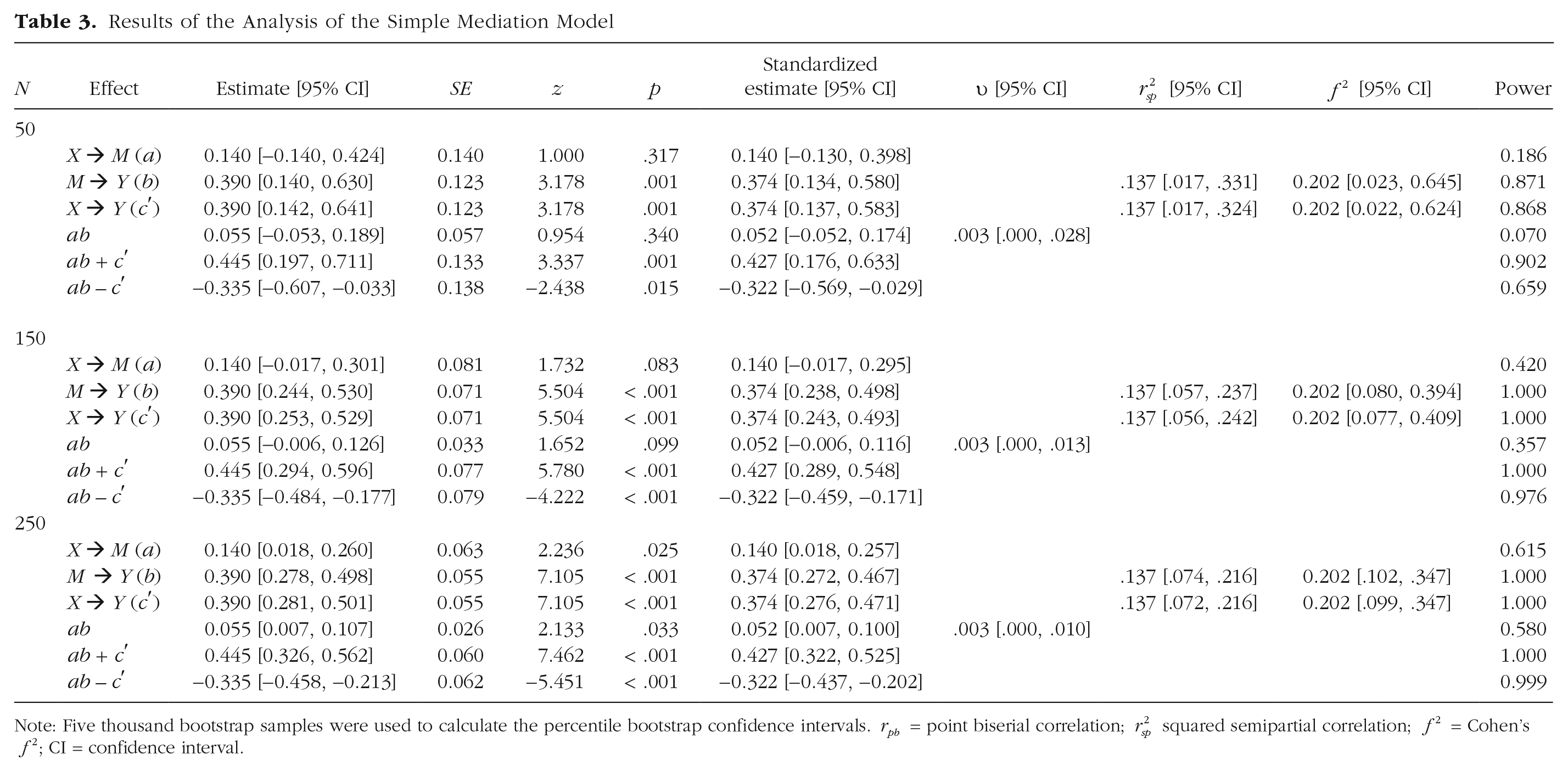
Note: Five thousand bootstrap samples were used to calculate the percentile bootstrap confidence intervals.
Longitudinal data
We used longitudinal data from the Midlife in the United States (MIDUS) survey (Ryff et al., 2007). We merged the data sets MIDUS 2 Project 1 and Biomarker Project (2004–2005) and MIDUS 3 Project 1 (2013), which are available from the Inter-University Consortium for Political and Social Research.
Sample and measures
There were 945 adults participating in the study (age: M = 52.22 years, SD = 9.63). We used emotional abuse in childhood as predictor variable (Childhood Trauma Questionnaire; 21% or 198 abused) and matched participants not reporting emotional abuse on their age and gender with the abused participants using the function matchControls from the R package e1071 (Meyer et al., 2021). This resulted in 198 abused and 198 not-abused participants (396 total) who provided complete data on self-esteem (Rosenberg Self-Esteem Scale; Rosenberg, 1965) and negative affect from the Positive and Negative Affect Schedule (Watson et al., 1988) measured in MIDUS 2 (Time 1) and MIDUS 3 (Time 2). Table 4 provides the descriptive statistics and the correlations of these variables.
Descriptive Statistics and Correlations
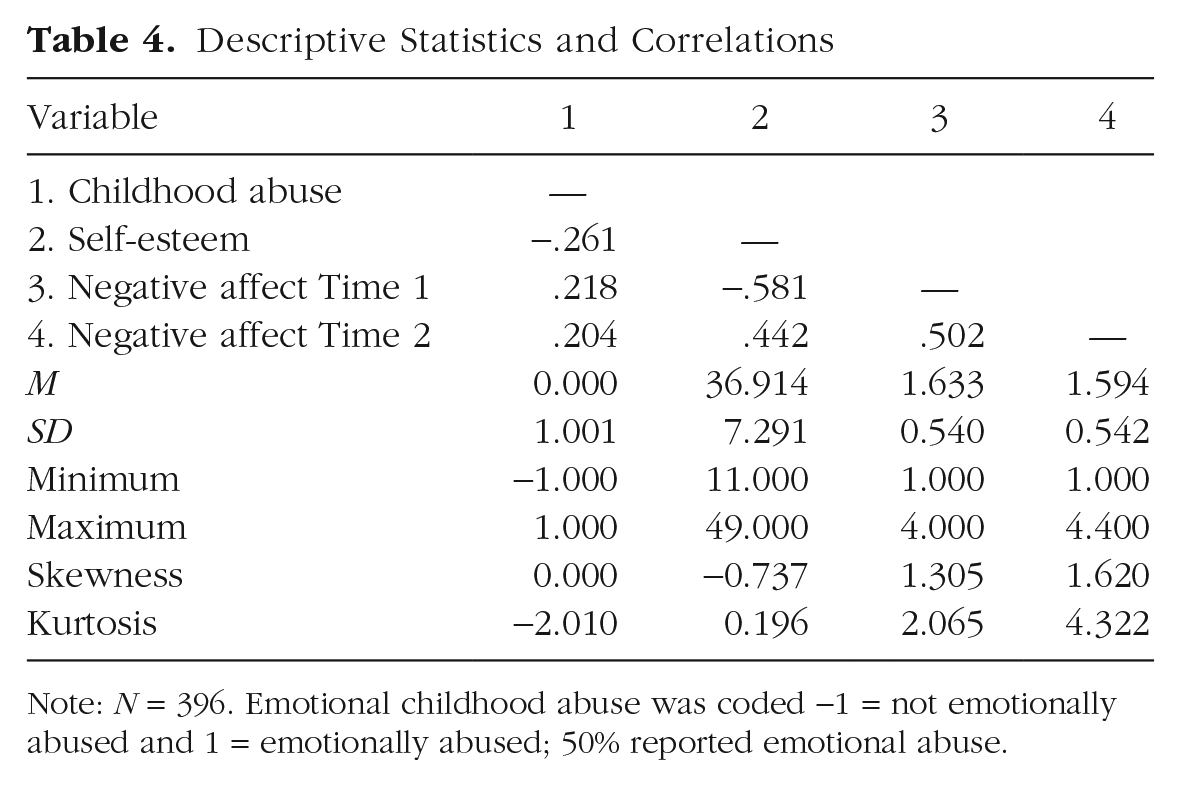
Note: N = 396. Emotional childhood abuse was coded −1 = not emotionally abused and 1 = emotionally abused; 50% reported emotional abuse.
Mediation model and statistical analyses
We estimated a longitudinal mediation model to test the hypothesis that self-esteem at Time 1 (M) mediates the effect of childhood abuse (X) on negative affect at Time 2 (Y). Following common recommendations (e.g., Maxwell & Cole, 2007; Mitchell & Maxwell, 2013), we included negative affect at Time 1 as a predictor variable to estimate and control for its autoregressive (stability) effect. We also estimated the effect between childhood abuse and negative affect at Time 1, which has the advantage that the statistical model is just identified (df = 0), meaning that it perfectly reproduces the sample covariance matrix. This setup enables the estimation of the total effect, which is identical to the effect between childhood abuse and negative affect at Time 2 without the mediator and negative affect at Time 1. Although the structure of this saturated model is identical to the mediation Model B of Figure 1, the focus in this longitudinal model is on the simple indirect effect through self-esteem and the direct effect and total effect between childhood abuse and negative affect at Time 2. We used effect coding for childhood abuse such that −1 = no abuse and 1 = emotional abuse in childhood. We calculated point biserial correlations for the effects from the predictor variable to self-esteem and negative affect. The squared semipartial correlation was calculated for the autoregressive effect, the effect from self-esteem to negative affect, and
Results
The results of the mediation analysis are presented in Table 5. Figure 3 shows the path diagram of the model. Both direct effects that make up the indirect effect through self-esteem (a1 and b1) were negative and statistically significant. Cohen’s
Results for Emotional Childhood Abuse Predicting Negative Affect at Time 2 Through Self-Esteem and Negative Affect at Time 1
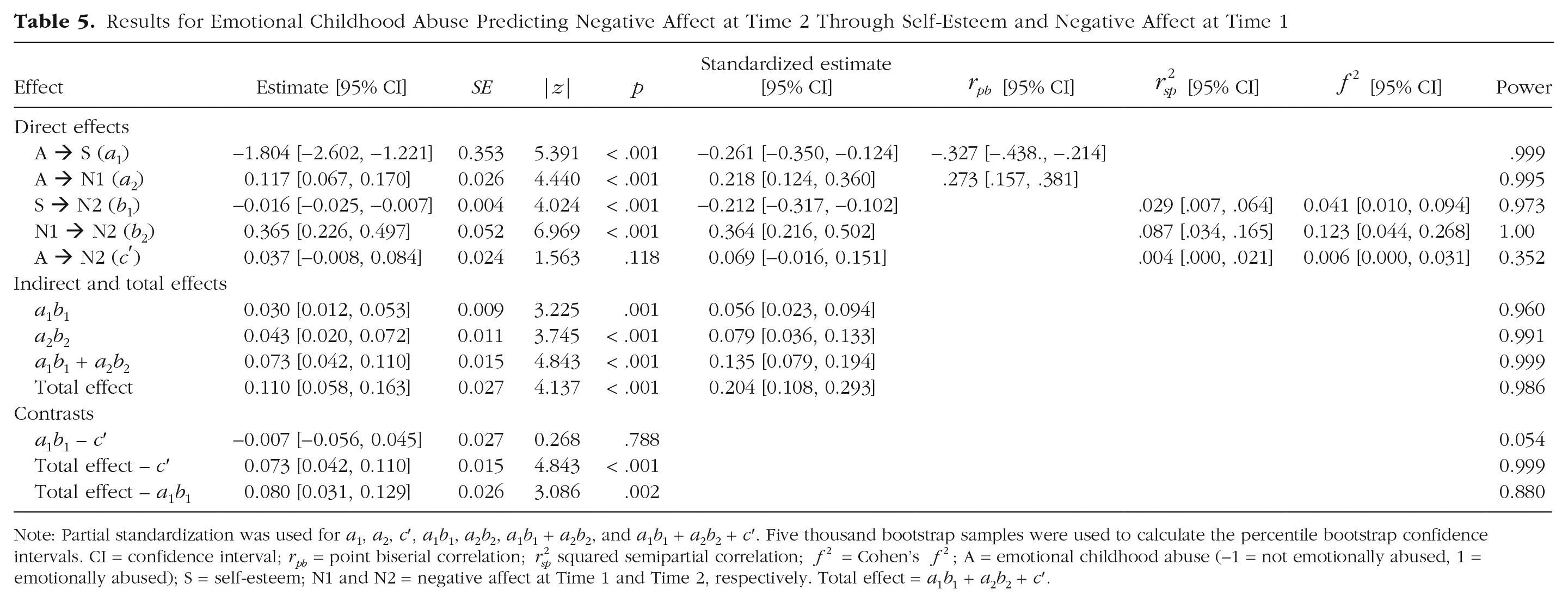
Note: Partial standardization was used for a1, a2, c′, a1b1, a2b2, a1b1 + a2b2, and a1b1 + a2b2 + c′. Five thousand bootstrap samples were used to calculate the percentile bootstrap confidence intervals. CI = confidence interval;

Path diagram of the mediation model with child abuse as the predictor variable, self-esteem as mediator, and negative affect as outcome. Abuse = Child Abuse (-1 = no abuse, 1 = emotional abuse), N = Negative Affect, S = Self-Esteem, T1 = time 1, T2 = time 2. The numbers represent unstandardized estimates.
The residual correlation between self-esteem and negative affect at Time 2 was −.165 (95% CI = [−.242, −.080]), indicating a substantial association, especially considering the inclusion of the autoregressive effect. Table 5 also presents the power estimates from the bootstrap power simulations. These estimates ranged from 0.960 to 0.999 for a1, b1, a1b1, and the total effect. Changing the sample size, power simulations revealed that 262 individuals would have been needed to achieve a power of at least 0.80 for these effects (0.804 for the indirect effect through self-esteem).
Conclusion
The results indicate that self-esteem partially mediated the effect of emotional childhood abuse on negative affect at Time 2, contributing 27.3% to the total effect. The power estimates reveal that this study was well powered to detect the substantial direct and indirect effects and that a sample size of 262 would have been sufficient to achieve a power of 0.80.
Discussion
The development of sophisticated frameworks and theories of causal relationships plays a pivotal role in advancing the knowledge base and is an indicator of the maturation of a discipline. Theoretical models involving multiple intervening variables often posit partial or full mediation (e.g., Karremans et al., 2017; Randall & Bodenmann, 2009; Schmader & Sedikides, 2018). From a theoretical perspective, we believe that this notion of partial versus full mediation makes sense and should continue to be used because it enhances theoretical precision and theoretical understanding of the mechanism through which a cause brings about an effect. Thus, theoretical frameworks involving one or multiple mediators should not only include all theoretically relevant variables and prescribe which variable comes first and what is the relationship between the variables (see also Sutton & Staw, 1995) but also be clear on whether a cause is expected to influence an outcome directly and indirectly or only indirectly. If partial or full mediation is equally plausible in a theoretical model, a statement like the one made by Rusbult et al. (1998) that the mediator “partially or wholly mediates the effects of” (p. 383) the predictor variables on the outcome is useful for scholars using a theoretical model to guide their research and for practitioners making decisions about where it is appropriate to intervene.
From a statistical perspective, the testing of the distinction between partial versus full mediation has been found to be problematic (e.g., Hayes, 2018; Montoya & Hayes, 2017; Preacher & Kelley, 2011; Rucker et al., 2011; Wood et al., 2008). We have extended this critique by underscoring that a claim of full statistical mediation is a claim of a null result, necessitating the elimination of alternative explanations for the absence of an effect, such as low power or poor measures. Less problematic are claims of partial mediation. In fact, a researcher can expect to find partial mediation in both a simple model with a single mediator and no covariates and complex models with multiple mediators in which each mediator alone may partially mediate the effect of a cause on an outcome.
Exceptions to this expectation are noteworthy. One is a longitudinal mediation model with cross-lagged and autoregressive effects involving three or more waves, where researchers often start with a model that does not include the
In assessing mediation mechanisms, we echo Kline (2015) in advocating against an overreliance on null hypothesis significance testing as a decision rule and, along with others (e.g., Lee et al., 2021), recommend conducting additional analyses. One recommendation is the calculation of effect sizes for the direct and indirect effects. The effect size measures for direct effects, especially the squared semipartial correlation and Cohen’s
Sensitivity analysis can provide insights into the robustness of the effects to potential unmeasured confounders (Imai, Keele, & Tingley, 2010; Imai, Keele, & Yamamoto, 2010). The correlation between the residuals of the mediator and the outcome is a standardized measure of the effect of an omitted confounder affecting both the mediator and the outcome. Although this approach is straightforward for b-paths, the analysis becomes complicated if an omitted confounder confounds not only the mediator and outcome but also the cause (e.g., Smith & VanderWeele, 2019; Tofighi, 2021; VanderWeele, 2010). For randomized designs, the testing of the XM interaction has been recommended (MacKinnon et al., 2020). This approach provides insights into whether the effects in a mediation model differ across conditions.
Power analysis is crucial in the planning phase of a study and can provide insight into the actual power of specifics effects. When determining an appropriate sample size for a planned study, it is essential to consider all effects that are expected to be substantial in size. Power estimates, especially from simulations, are a worthwhile afterthought because they can provide insights into the power of different effects and whether a smaller sample size would have been sufficient, which can be valuable information for both researchers and resource providers (see also K.-H. Yuan & Maxwell, 2005). However, it is crucial to reiterate that power estimates should not be used to interpret the results of a study (e.g., Hoenig & Heisey, 2001; Pek et al., 2024).
Although the consideration of the effect sizes, along with sensitivity analysis and power considerations, provides a more complete picture of the mechanism by which a cause impacts an outcome, a couple of points are important to note. First, no statistical effect is an unbiased estimate of a true effect because of the omission of putative confounders or mediators or violations of the assumptions underlying the mediation analysis (e.g., MacKinnon, 2008; MacKinnon & Pirlott, 2015; Pearl, 2014; VanderWeele, 2015). Moreover, it is important to keep in mind that all models, whether theoretical or statistical, are an approximation of the reality and that any direct effect may itself be mediated, highlighting the need to focus on not only the macroscopic role of mediators but also their microscopic role in more fine-grained models (MacKinnon, 2008). Second, the use of Bayesian analysis is becoming increasingly popular (Enders et al., 2013; Miočević et al., 2018; Y. Yuan & MacKinnon, 2009) for testing mediation in small samples. Finally, interpretability challenges can arise when the results are inconsistent. For example,
In conclusion, we have shown that the distinction between partial and full mediation is useful in the context of theoretical models because it provides common language that allows researchers to describe mediating mechanisms in simple terms many scientists are familiar with. Statistically, any claim of full mediation is essentially a claim of a null result, which requires the elimination of alternative explanations. To ensure a more nuanced understanding of mediation results, especially in underpowered or overpowered studies, we recommend accompanying unstandardized estimates with effect sizes, particularly for the direct effects, and the consideration of power. These recommendations extend beyond mediation analysis and are especially relevant to regression analysis and SEM. Conducting sensitivity analysis and testing for possible interaction effects in randomized designs can provide further insights into the mechanism through which a predictor variable affects an outcome.
Footnotes
Appendix
Acknowledgements
We thank Siegfried Macho and Damaris Aschwanden for their helpful feedback on an earlier version of this article and David Kenny for valuable discussion on the topic. We also thank two anonymous reviewers and the action editor for their helpful comments.
Transparency
Action Editor: Pamela Davis-Kean
Editor: David A. Sbarra
Author Contributions
