



Abstract
When experimental psychologists make a claim (e.g., “Participants judged X as morally worse than Y”), how many participants are represented? Such claims are often based exclusively on group-level analyses; here, psychologists often fail to report or perhaps even investigate how many participants judged X as morally worse than Y. More troubling, group-level analyses do not necessarily generalize to the person level: “the group-to-person generalizability problem.” We first argue for the necessity of designing experiments that allow investigation of whether claims represent most participants. Second, we report findings that in a survey of researchers (and laypeople), most interpret claims based on group-level effects as being intended to represent most participants in a study. Most believe this ought to be the case if a claim is used to support a general, person-level psychological theory. Third, building on prior approaches, we document claims in the experimental-psychology literature, derived from sets of typical group-level analyses, that describe only a (sometimes tiny) minority of participants. Fourth, we reason through an example from our own research to illustrate this group-to-person generalizability problem. In addition, we demonstrate how claims from sets of simulated group-level effects can emerge without a single participant’s responses matching these patterns. Fifth, we conduct four experiments that rule out several methodology-based noise explanations of the problem. Finally, we propose a set of simple and flexible options to help researchers confront the group-to-person generalizability problem in their own work.
Francis Galton attended the 1906 “West of England Fat Stock and Poultry Exhibition,” where attendees, hoping to win a prize, estimated an ox’s weight. Galton calculated that the crowd’s average estimate was 1,197 pounds, a perfect match to the ox’s true weight (Galton, 1907; Wallis, 2014). In this case, one might reasonably say that “people judged the ox’s weight perfectly.” Although this impressive example suggests the “wisdom of crowds” (Surowiecki, 2005), we note the considerable variability in person-to-person estimates, ranging below 1,000 pounds to above 1,400 pounds. In fact, the person-level data reveal that only one person guessed the correct weight of 1,197 pounds (Wallis, 2014). Consequently, one might question whether “people judged the ox’s weight perfectly” in truth describes what happened given that the group-level average represented only one person. Because of the ubiquity of aggregation approaches in experimental psychology, this “group-to-person generalizability problem” may hinder progress and understanding. Psychologists average sets of person-level responses—largely ignoring person-to-person variability—and then use these averages to make claims about the mind. However, if psychology aims to understand the mind as a property of persons—to uncover the uniqueness or universality of certain psychological processes—person-level responses ought to be the explananda.
In this article, we argue that although experimental psychologists often strive to describe person-level phenomena, they sometimes fail to do so. First, we make a data-free argument for closely matching experimental designs and analytic methods to precise research questions. Second, we report findings from a survey of laypeople and psychology researchers conducted to understand what is inferred about person-level phenomena from group-level analyses. Third, we document instances in published literature in which a person-level analytic approach yielded different conclusions than typical group-level approaches. Fourth, in a tutorial, we show readers how this can occur and how to describe person-level patterns in their own data. In addition, we demonstrate how claims from sets of simulated group-level effects can describe zero persons. Fifth, we report findings from four preregistered experiments conducted to rule out several methodology-based explanations of group-to-person generalizability failures. Finally, we propose a set of simple and flexible design and analytic strategies (ranging from descriptive to inferential) to address the group-to-person generalizability problem.
Psychology as the Study of Person-Level (Not Group-Level) Properties
Psychology is often defined as “the study of the mind and behavior.” Therefore, its essential goals are describing cognitive functions and uncovering their antecedents and consequences. We contend that researchers intend to apply these goals to the study of persons given that psychological processes are properties of minds and each mind resides inside a single person. To strengthen this argument, we ask readers to engage in a thought exercise. Recall your most recent meeting with collaborators in which you discussed hypotheses and experimental designs to test them. At any point in that meeting, did you reason about possible patterns in a way that reflected how persons may respond to different stimuli, or did you exclusively reason in a way that reflected how different stimuli would affect averages or locations of distributions? Furthermore, given the seeming frequency with which studied phenomena are described as applying to people generally (see DeJesus et al., 2019), we also contend that many experimental psychologists intend to uncover processes, regularities, and mechanisms that describe a majority of persons (i.e., “general psychological laws”; Hamaker, 2012). Therefore, what follows are the most important takeaways from this article:
Psychologists sometimes fail to design experiments that permit descriptive or inferential investigation of person-level hypotheses.
Even when appropriate experimental designs are used, psychologists often report only their group-level analyses and interpret them as if they support or falsify person-level hypotheses.
Because it is possible for the above statements to be misinterpreted or overgeneralized, we first communicate what we mean by “person-level,” and we then clarify our position on designing studies to test person-level hypotheses.
Examining “person-level” hypotheses
A “person-level” hypothesis is one that predicts some effect or effects on an outcome measure for a single person (e.g., the direction and magnitude of an effect for Person X). To test it, one can employ within-persons or “single-subject” analysis as seen in (relatively high-trial) neuroimaging designs (Friston et al., 1994) or “intensive” sampling in longitudinal designs (e.g., Kurz et al., 2019). If the goal is to know how many participants show a predicted effect, a “pervasiveness” proportion can be obtained (Speelman & McGann, 2020). By pervasiveness, we mean the choosing of one possible person-level pattern and investigating, descriptively, “How many persons match this pattern?” Randomization tests can examine whether the pervasiveness of the effect(s) in the sample is unrelated to experimental condition—that is, emerges more than “physical chance” (Grice, 2021; Grice et al., 2020). Finally, one can combine pervasiveness and within-persons approaches to estimate the prevalence of person-level effects in the population (see Allefeld et al., 2016; Donhauser et al., 2018; Ince et al., 2022) and test against a “global null hypothesis” (no effect in any subject in the population) or a “majority null hypothesis” (the effect is in less than or equal to half the population) if one is intending to test or make a general psychological claim about most people in the population.
Within-subjects (vs. between-subjects) designs for testing person-level hypotheses
Between-subjects experiments do not permit tests of person-level hypotheses (Speelman & McGann, 2020; Whitsett & Shoda, 2014). These common designs make it impossible to ask the simple question, “How many people’s responses match the pattern(s) indicated by the mean difference(s) between conditions?” (see Speelman & McGann, 2020), and they prohibit examination of unfolding person-level processes (e.g., Brandt & Morgan, 2022; Fisher et al., 2018; Moeller, 2022). For example, consider the following research question: “Is Coca-Cola tastier than Mountain Dew?” To assess this, the leading soda-cognition lab designs an experiment that randomly assigns half of participants to rate the tastiness of Coca-Cola and the remaining participants to rate Mountain Dew in the same way. An independent-samples t test suggests that the average tastiness judgment is higher for Coca-Cola. However, a rival soda-cognition lab also attempts to answer this question, instead using a within-subjects design and finding an average tastiness difference in the opposite direction. Assuming the within-subjects effect generalizes to the person level (i.e., most people judged Mountain Dew as tastier than Coca-Cola), which of these designs better answers the question, “Is Coca-Cola tastier than Mountain Dew?” If “tastier” implies a comparison of at least two tastable stimuli, we suggest that the within-subjects design is superior. Moreover, there are many plausible nonsubstantive mechanisms for the between-subjects results (e.g., the participants who rated Coca-Cola as extremely tasty may have been implicitly comparing it with Pepsi instead of Mountain Dew, an unlikely problem in the within-subjects design).
To illustrate this possibility in a different domain, Birnbaum (1999) had participants judge the largeness of numbers on a 10-point scale ranging from very very small to very very large. He showed that “People judge 9 as larger than 221” can be inferred from a between-subjects design because “9” invokes a context of two-digit numbers, whereas “221” invokes a context of three-digit numbers. We argue (and it was indeed Birnbaum’s point) that no serious experimentalist would interpret these results to suggest that people would judge 9 as larger than 221 if they explicitly compared the numbers (and we again note that “judge . . . as larger than . . . ” implies a comparison). If Birnbaum were to use his data to argue that this finding reflected true numerical cognition, it would be easy to criticize because everyone believes that there is a truth of the matter (i.e., most [if not all] people believe 9 is smaller than 221) and that there are better and worse ways of verifying it. In many psychological experiments, however, measures of interest do not have clear numerical translations that map onto often-used Likert-type scales (e.g., angriness, agreement), making it more difficult to identify the problem raised by Birnbaum. In addition, unlike Birnbaum’s numerical-cognition example in which people know the truth of the matter, the point of many psychological experiments is to infer the truth of the matter from the data (e.g., “Face A is judged as angrier than Face B”). This means that it is unknown how often between-subjects results are taken to reflect within-subjects phenomena when the between-subjects results are truly akin to Birnbaum’s findings. If some nontrivial proportion of between-subjects experiments in psychology are designed with the intention to reveal a psychological process or its outcome, this problem may be pervasive.
Clarifying the problem
We are not suggesting that between-subjects designs are never useful. These designs may be preferable when within-subjects designs are practically infeasible or impossible. For example, many intervention(-like) research questions may be best answered with between-subjects designs (e.g., see our experiments in the Supplemental Material available online). In addition, hypotheses about population(-like) differences require at least one between-subjects factor, such as testing whether psychopaths show different experimental effects than nonpsychopaths. Finally, between-subjects designs are unproblematic when the research goal is to provide generalization evidence (e.g., finding similar effects across instructions/measures; see Yarkoni, 2020).
We note, however, that between-subjects designs cannot conclusively provide person-level evidence of an experimental effect, just as group-level correlations among variables cannot provide evidence of person-level correlations among those variables (see Fisher et al., 2018). For example, in our own recent moral-cognition research (McManus et al., 2021), we assessed moral character judgments to test their sensitivity to social-relationship information in the context of helping behavior. Among other variations, participants in our experiments were given two scenarios: one in which someone helps a total stranger and another in which someone helps a distant family member. Standard group-level analyses suggested that participants—on average—judged agents who helped strangers as more morally good than agents who helped family members, presumably because people believe that there is less obligation to help strangers. Note that this was tested using a within-subjects design. Therefore, although it was not reported, our design permitted investigation of the question, “How many people’s responses match the pattern indicated by the difference between conditions?” A between-subjects design would have disallowed such investigation.
Using within-subjects designs does not automatically prevent group-to-person generalizability inference errors from occurring. Researchers can still commit ecological or ergodic fallacies (Kuppens & Pollet, 2014; Speelman & McGann, 2020) because of special instances of Simpson’s paradox—when group-level patterns poorly represent lower-level units constituting the group (Kievit et al., 2013; Simpson, 1951; for an illustrative example on the relation between typing speed and mistake frequency, also see Hamaker, 2012). To reiterate, even when psychologists deploy appropriate experimental designs, they often, if not always, report only their group-level analyses, leaving it unclear whether their group-level findings generalize to the person level.
Overall, we are suggesting that if a research hypothesis or theory is a person-level one and the goal of a study is to make a general claim (Hamaker, 2012), then researchers ought to choose appropriate designs and analytical procedures that allow themselves (and readers) to answer the question, “What proportion of people in the sample (or population) show the effect(s) indicated by the mean difference(s) between conditions?” However, it could be argued that most psychology researchers (and lay readers of the psychology literature) do not expect published claims to be representative of most people, nor may they believe it is important evidence for evaluating the validity of a psychological theory so long as typically reported group-level effects corroborate predictions.
Empirically Assessing Laypeople’s and Researchers’ Inferences
We have argued that because of the ubiquity of typical group-level statistical tests (e.g., t tests), there may be a group-to-person generalizability problem in psychology (i.e., when claims derived from typical group-level tests fail to describe most participants in the sample or the population). However, there is obvious subjectivity involved when deciding what should count as sufficient person-level evidence for a claim. Moreover, perhaps readers of psychology research (laypeople and psychology researchers themselves) do not interpret authors as intending to make claims that represent most participants. We therefore set out to answer two questions empirically:
Do a majority of people who read psychology research believe that authors intend to communicate claims as representing most participants in their data?
Do a majority of people who read psychology research believe that claims ought to represent most participants when the authors use their data to claim support for a general theory of person-level psychology (i.e., a theory/model of processes occurring within individual minds/brains)?
To answer these questions, we surveyed laypeople and researchers by presenting modified excerpts of “results” and “general discussion” sections from publications that contain the group-to-person generalizability problem. We report how we determined our sample sizes, all data exclusions, all manipulations, and all measures.
Method
Participants
All laypeople were U.S. residents recruited and compensated via CloudResearch’s “approved participants” list. Participants from McManus et al. (2021) were unable to access the current study. In addition, participants from our methods experiments could not participate. Researchers were affiliated with the Society for Personality and Social Psychology (SPSP), recruited via SPSP’s Open Forum listserv and compensated with Amazon gift cards. Participants who did not complete the entire study were not included in our final analyses. As preregistered (https://osf.io/6qay8 and https://osf.io/nucbf), we aimed to collect at least 642 analyzable laypeople and 280 analyzable researchers. In total, we were able to collect 705 and 256 unique responses, respectively. After applying the preregistered exclusion criterion (failing a comprehension check), this resulted in a sample of 588 laypeople (gender: 309 female, 273 male, 6 nonbinary; ethnicity: 457 White, 68 Black, 5 American Indian, 41 Asian; 1 Pacific Islander; 16 other; age: M = 38.69 years, SD = 11.29) and 244 researchers (165 female, 68 male, 8 nonbinary, 3 other; ethnicity: 158 White, 3 Black, 1 American Indian, 55 Asian; 17 other, 9 biracial, 1 multiracial; age: M = 33.09 years, SD = 11.34). Although we did not preregister a stopping rule, we decided not to resample because we still had high statistical power for our focal hypothesis tests (see Statistical Power and Hypotheses).
Design
Participants were randomly assigned to one of two conditions. Half of participants learned about a simple effect comparison, whereas the other half of participants learned about a more complex, two-way interaction effect. We note that we used both simple- and complex-effect examples to test the generality of our hypotheses. That is, had we conducted the study using only one effect type, we could have capitalized on our hypothesis being true of only a specific effect type. This is why our preregistration refers to our design as “observational” even though we randomly assigned participants to one effect type; we never intended to (nor did we) explicitly compare the simple-effect data with the complex-effect data.
Materials and procedure
At the beginning of the study, all participants were informed that they would be answering questions about a moral-cognition experiment. For the simple-effect condition, participants learned about a two-condition comparison from the supplemental materials of Law et al. (2021). For the complex-effect condition, participants learned about a crossover interaction effect from McManus et al. (2021).
Participants first read text communicating results in typical journal-article format (with means, standard deviations, t values, p values, within-subjects standardized effect sizes for comparisons of interest [dz], and a bar plot; for full materials, see the Supplemental Material). After learning the results, they then read text that simulated how data-based claims are made in a general discussion section (e.g., “People judged fictional agents who helped a stranger as more morally good than fictional agents who helped a cousin, but they judged fictional agents who helped a stranger instead of a cousin as less morally good than fictional agents who helped a cousin instead of a stranger”).
After learning about the claim, participants were then asked to respond to a series of true-false questions about what the reported results suggested. However, these questions were not of primary interest (for Rmarkdown results, see the Supplemental Material). Participants were then again shown the claim in general-discussion format and asked, “By people, approximately what percentage of the study’s participants do you think the researchers mean?” We call this measure the “empirical-proportion estimate.” Responses ranged from 0% to 100% on a sliding scale; the starting position (0%, 50%, 100%) was counterbalanced across participants. This measure allows categorization of responses into two categories: less than a simple majority (50% or less) and equal to or greater than a simple majority (51% or more). To move on to the next page, participants had to at least click on the slider, meaning that the slider’s starting value would have been recorded as the participant’s response. As shown in Figure 1, however, these exact starting values were very infrequent, suggesting that participants indeed engaged with the task.

Box plots of empirical/theoretical proportion estimates by effect type (simple vs. complex) and by participants’ level of experience. Note that “Other” refers to people involved in academic research in some way (via the Society for Personality and Social Psychology) but who indicated that they have never held an academic position. Histogram versions of these figures are available our OSF page under “Statistical Cognition Studies.”
Next, participants learned about a (fictional) general, person-level theory that the authors had developed before the study. Participants were then asked to respond to a series of true-false questions about how the reported results informed the theory (see OSF). Participants were again shown the claim in general-discussion format and told that later in the article, the authors used their study’s results to claim support for their theory. Participants were then asked, “In order for the study’s results to support the researchers’ theory/model, approximately what percentage of the study’s participants do you think need to respond in the way described by [the general discussion’s language]?” We call this measure the “theoretical proportion estimate.” Responses were measured identically to the empirical estimate. Finally, participants could write an open-ended response to communicate anything that they were unable to communicate thus far. After the main task, participants answered several demographic questions.
Statistical power
As preregistered, we aimed for at least 321 participants per condition for the laypeople sample and 140 participants per condition for the researcher sample. The preregistered laypeople sample size yielded 95% power to detect a 10-point proportion difference from 50% (e.g., 60%) using a two-tailed binomial test and assuming α = .05; the focal test to examine whether a majority of empirical/theoretical proportion estimates reflect inferences being made about a majority of a study’s participants. As explained in our preregistrations, we planned the researcher sample on the basis of the results of the laypeople sample. For the researcher sample, the preregistered sample size yielded 95% power to detect a 15-point proportion difference from 50% using identical test specifications as the laypeople sample.
In the laypeople sample, applying the preregistered exclusion criterion (i.e., missing a comprehension-check question) led to sample sizes of 303 for the simple-effect condition and 285 for the complex-effect condition. In the researcher sample, we were unable to successfully recruit our entire desired sample size. After one attempt to get more responses (via reposting to SPSP’s Open Forum listserv), we decided to close the survey once incoming responses completely stalled, which occurred after 2 weeks. Applying the same exclusion criterion led to sample sizes of 123 for the simple-effect condition and 121 for the complex-effect condition. We did not resample for either population because sensitivity analyses revealed that we still had more than 90% power to detect our preregistered minimal effect sizes.
Hypotheses
Hypothesis 1: empirical proportion: The majority of laypeople and researchers (i.e., 51% or more) will believe authors’ claims are intended to describe at least a simple majority (i.e., 51% or more) of their study’s participants.
Hypothesis 2: theoretical proportion: The majority of people will believe at least a simple majority of a study’s participants ought to be described by the authors’ claims for the results to support a general theory of person-level psychology.
Results
Empirical proportion estimate
The majority of laypeople believed authors intended to describe at least a simple majority of their study’s participants for both simple (81%) and complex (88%) effects. The majority of researchers agreed for both simple (73%) and complex (80%) effects (for additional descriptive statistics, see Table 1; for inferential statistics, see Tables 2 1 and 3). As shown in Figure 1, there is no discernible pattern as a function of being relatively inexperienced (e.g., layperson or undergraduate) and relatively experienced with academic research (e.g., professor). Moreover, even though most people’s judgments were above 50%, judgments ranged from nearly 0% to 100%. This suggests a lack of generality in inferences across persons, additional evidence in favor of the importance of investigating person-level responses.
Descriptive Statistics for Empirical and Theoretical Estimates (Split by Population)

Note: In the researcher sample, for the empirical estimates, a small minority used the open-ended question to correctly communicate that inferences about percentages cannot be derived from average differences (n = 17). Therefore, some of the empirical estimates were not true beliefs given that the researchers simply had no other option but to respond. To conduct the most stringent test of our hypothesis, we recoded all of the hypothesis-consistent slider responses (n = 6) as being hypothesis-inconsistent. We did not remove any of the 17 responses to ensure that, even accounting for some researchers understanding the problem, a majority still responded in a hypothesis-consistent way. This resulted in similar proportions for both simple (70%) and complex (79%) effects. Likewise, for the theoretical estimates, some people communicated that there were other features that matter for establishing that a claim provides evidence for the validity of a theory (e.g., showing an effect across diverse samples, under multiple conditions, across stimulus sets). However, we did not recode any of these responses as being hypothesis-inconsistent because implicit in these responses is part of the point we intend to make: To have evidence for a general theory, psychologists must show an effect’s prevalence (across samples, situations, time, and importantly, across persons).
Empirical Estimate Tests Within Each Effect Type (Split by Population)
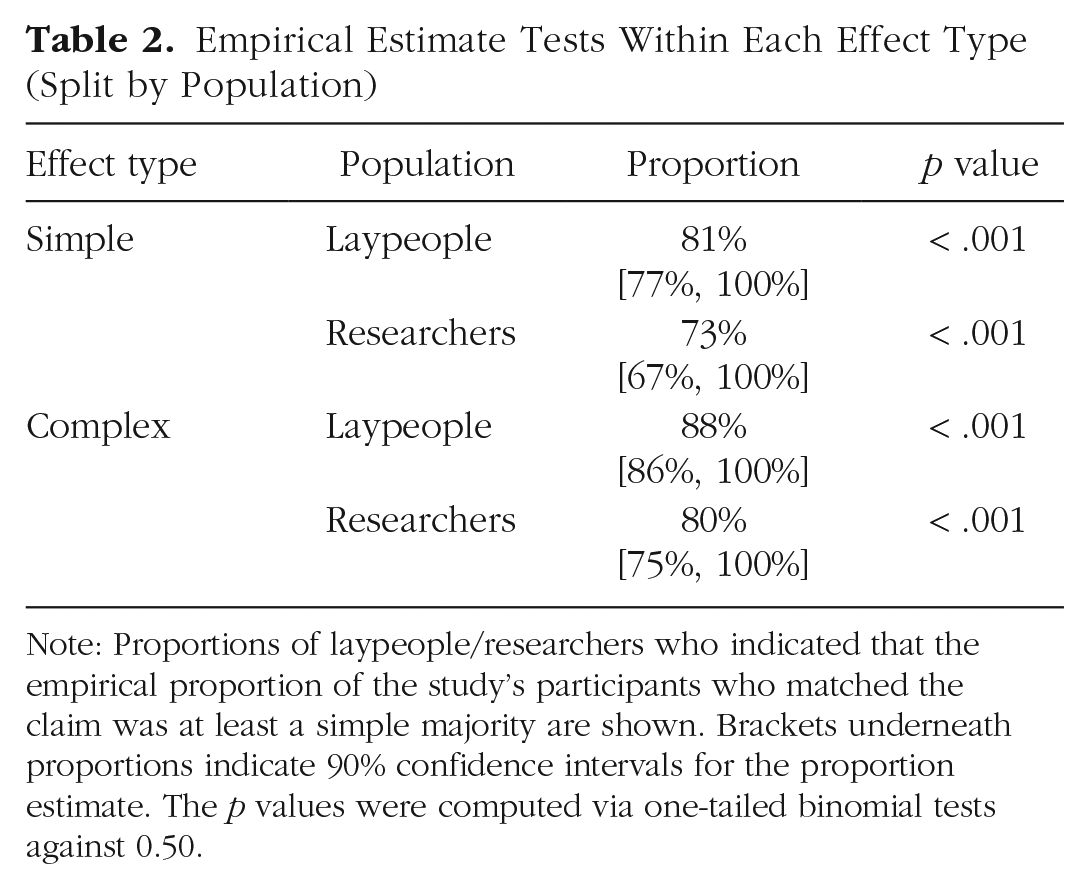
Note: Proportions of laypeople/researchers who indicated that the empirical proportion of the study’s participants who matched the claim was at least a simple majority are shown. Brackets underneath proportions indicate 90% confidence intervals for the proportion estimate. The p values were computed via one-tailed binomial tests against 0.50.
Theoretical Estimate Tests Within Each Effect Type (Split by Population)

Note: Proportions of laypeople/researchers who indicated that the proportion of the study’s participants who needed to match the claim was at least a simple majority if the results were to be used to support a person-level psychological theory are shown. Brackets underneath proportions indicate 90% confidence intervals for the proportion estimate. The p values were computed via one-tailed binomial tests against 0.50.
Theoretical proportion estimate
The majority of laypeople believed that at least a simple majority of a study’s participants ought to be described by authors’ claims for the results to support a person-level psychological theory for both simple (93%) and complex (92%) effects. The majority of researchers agreed for both simple and (80%) and complex (90%) effects (for additional descriptive statistics, see Table 1; for inferential statistics, see Tables 2 and 3). As shown in Figure 1, again, there is no discernible pattern as a function of research experience.2
Discussion
Overall, our data suggest that most laypeople and researchers interpret claims as being intended to describe most participants. Moreover, they believe this ought to be the case if the data are used to support a general theory of person-level psychology. These findings are problematic when considering how analyses are typically conducted and reported. First, if most researchers (and the public) interpret results of group-level tests as representing most sampled participants (and therefore most people in the population), it is unknown how often this interpretation is incorrect because person-level statistics are rarely (if ever) reported in published articles. Second, if a criterion for a claim to be able to properly support a theory or model is that it represents most sampled participants (and therefore most people in the population), then there are multitudes of psychological claims in the published literature that have not yet been properly tested because aggregation approaches (e.g., averaging across different participants’ responses) are ubiquitous in experimental psychology. In the rest of this article, we focus on documenting and explaining published and simulated instances in which within-subjects group-level effects fail to describe most sampled persons—the group-to-person generalizability problem.
Group-to-Person Generalizability Problems in the Wild
We examined open data from psychological research over the past 5 years (2016–2021) looking for the group-to-person generalizability problem. Because of the larger reform movements in psychology, publications from this era should be relatively more rigorous than prior eras (e.g., larger samples, better statistical inferences). Our investigation was not systematic in the sense that we can say, “X% of publications contain the group-to-person generalizability problem.” Rather, using a person-level approach, we reanalyzed open data with the goal of finding five instances of the problem from moral cognition—as we ourselves are moral psychologists—and five instances from social cognition generally (e.g., on race, gender, humor; see Table 4). Although we investigated examples from social cognition in particular, this problem is not limited to social cognition because others have identified pitfalls of averaging across persons in somewhat lower-level research on judgment and decision-making (Liew et al., 2016) and face perception (Grice et al., 2020).
Quotes, Relevant Tests, and Person-Level Proportions for Instances of the Group-to-Person Generalizability Problem

Note: Across publications, it was sometimes difficult to find specific claims that could be connected back to specific hypothesis tests. For some publications, there was not a specific, insulated claim that clearly referenced a specific hypothesis test (e.g., Stroessner et al., 2020), which is why some quoted sections are taken from multiple sections of the publication. In Law et al. (2021), the verbal claim was not an accurate representation of the set of group-level patterns (some necessary group-level patterns did not emerge). However, reanalysis of their data was based on the claim rather than the group-level patterns.
To accomplish person-level analysis, we adopted “pervasiveness” or “persons-as-effect-sizes” approaches (see Grice et al., 2020; Speelman & McGann, 2020). Put simply, we created variables in each data set that distinguished participants according to whether their response patterns supported the reported group-level patterns. If a participant’s responses had at least some distance between experimental conditions (e.g., 1 point on a Likert/sliding scale in a one-trial-per-condition design) and were directionally consistent with a group-level pattern, then that participant was categorized as supporting group-to-person generalizability. An important nuance is that all investigated claims are based on sets of group-level tests (e.g., multiple paired t tests). We therefore extended extant person-level approaches to accommodate such claims. Specifically, we categorized participants as supporting generalizability if their full set of responses matched the full set of group-level patterns. For example, if a 2 × 2 interaction pattern underlaid the claim, we counted person-level responses as supporting generalizability if a participant’s simple effects’ directions and differential magnitudes reflected the group-level pattern. But the ordering of all four condition averages was not accounted for because this is not typically relevant to the interpretation of statistical interactions. A minimal difference in the predicted direction could be seen as a liberal threshold for examining the group-to-person generalizability problem. Readers can imagine (and if they wish, investigate) what these analyses look like under stricter constraints (see our OSF page: https://osf.io/xyse4/).
For each claim, we used the descriptive sample proportion as a proxy for the proportion of people in the population who would be expected to show the group-level patterns. If the sample proportion was equal to or lower than 0.50, then we considered the claim unsupported at the person level. We chose this 0.50 value because most claims in psychology articles do not use language that suggests an experimental effect is one that describes only a subset of participants. This means that at least by implication, effects are being communicated as applying to most participants. Moreover, our statistical-cognition studies revealed that most laypeople and researchers infer reported effects as applying to more than 50% of participants. As Table 4 shows, proportions of participants favoring generalizability varied across publications but was low overall (3%–50%; most proportions ranged between 20% and 40%). Critically, this occurred across a variety of dependent variables (e.g., sliding scales, Likert scales, reaction times, error rates) and pattern types (crossover interactions, attenuation interactions, ordinal patterns, conjunctive differences), suggesting that this problem is not constrained to specific designs or measures.
At this point, an important objection may be raised. Some of the proportions in Table 4 are quite far from zero, meaning that it is likely that some of the documented group-level patterns are indeed the most common (i.e., modal) person-level pattern within their respective data sets. If this is generally true, then perhaps there is not a problem of group-to-person generalizability. For example, in our own prior research (McManus et al., 2021), the documented group-level patterns are the modal person-level patterns, at ≈30% of participants, with the next most common patterns matching only ≈13% of participants. Upon this person-level reanalysis, we could have argued that although the group-level patterns are not ones that most participants show, the most common person-level patterns mirror the group-level patterns. That is, if we were to randomly survey one new person from the population and asked to make a bet, we would (and should) bet on the documented group-level patterns being the pattern that the new person shows.
Although we value this argument, it is important to consider whether this is what most psychologists are intending to achieve when conducting experiments and making claims. There are at least two possibilities. First, most psychologists may be interested in basic science and therefore attempting to document general psychological laws (e.g., Hamaker, 2012), regularities or mechanisms. Second, most psychologists may be interested in applied science and therefore answering questions about whether it is a good idea to get a certain intervention or enact a certain policy change (e.g., to help or appease the largest subset of people). These are obviously not mutually exclusive, and we see either of these options as worthy pursuits. However, because of what our statistical-cognition studies revealed and because we ourselves are more concerned with basic science, we focus the rest of this article on group-to-person generalizability problems when the research goal is attempting to document general psychological laws, regularities, or mechanisms (although we still advocate for investigating person-level data in applied research so that the commonness of certain responses is known and disclosed). We next unpack an example from our own moral-cognition research showing how the group-to-person generalizability problem can occur.
Tutorial for the Group-to-Person Generalizability Problem
For relevant background, consider the two earlier moral-cognition scenarios: Someone helps an unrelated stranger, and someone helps a cousin. We predicted that agents who helped strangers should be judged as more morally good than agents who helped their cousin because stranger-helping agents lack an obligation to help but do so anyway. Now consider these two scenarios in a slightly different context: Someone chooses to help an unrelated stranger instead of a cousin, and someone chooses to help a cousin instead of an unrelated stranger. We predicted the opposite pattern here because stranger-helping agents would be violating their family obligation. These two contexts were described as “no choice” and “choice” contexts, respectively. Indeed, this interaction and context-based reversal of simple effects emerged at the group level.
In the general discussion, we communicated this effect as follows: On the one hand, people judged agents who helped a stranger as more morally good than agents who helped a family member. On the other hand, people judged agents who helped a stranger instead of a family member as less morally good than agents who helped a family member instead of a stranger.
Because two of the three authors of the current article were authors, we can say, honestly, that we intended to communicate this effect as applying to most people (i.e., as a general, causal regularity). Therefore, our claim is interesting and, arguably, accurate if and only if the interaction describes most participants’ psychology. We next explain how readers can reason through and investigate this person-level prediction by using their typical analysis-of-variance (ANOVA) and t-test knowledge as scaffolding.
To investigate the above claim at the person level, each simple effect and the interaction can be described by a set of directional patterns. The no-choice simple effect can be computed by subtracting the “helped a cousin” ratings from the “helped a stranger” ratings, whereas the choice simple effect can be computed by subtracting the “helped a cousin instead of a stranger” ratings from the “helped a stranger instead of a cousin” ratings. An interaction effect can then be computed by subtracting the choice effect from the no-choice effect (for an example of 13 hypothetical participants who reflect all possible qualitative patterns, see Table 5 and Fig. 2; for example R code to create generalizable 2 × 2 person-level patterns and investigate their descriptive proportions, see Table 6). The person-level combination in Table 5 and Figure 2 that matches the published claim is Pattern 6 (i.e., the “positive, negative, positive” pattern; no-choice simple effect, choice simple effect, interaction effect). Conversely, a person-level combination that does not match the published claim but can still be categorized as showing a “positive” interaction value is Pattern 10 (i.e., the “positive, zero, positive” pattern).
Example Hypothetical Participants Showing All Possible Qualitative Patterns in McManus et al. (2021)

Note: Each of these hypothetical person-level patterns constitute all possible combinations of two simple effects directions, leading to 13 possible interaction patterns. “NC” and “C” denote no choice and choice, respectively, as communicated in McManus et al. (2021). Subject Row 6 is bold to highlight the pattern that matches the claimed effect. The first four nonsubject columns are hypothetical raw scores in each within-subjects condition. The next two columns are hypothetical difference scores that constitute the simple effects of interest. Simple effects (NC_Diff and C_Diff) are calculated by subtracting “cousin” scores from “stranger” scores. The “Intx” column contains the interaction values, which are computed by subtracting the second simple effect from the first simple effect. These three shaded columns, together, make up the relevant units of analysis. The last three columns are directional labels to communicate the full person-level pattern for each subject. For ease of calculation and communication, for this table, we assumed that hypothetical participants used a simple 3-point scale. In principle, the number of scale points is irrelevant as long as the scale has more than 2 points (otherwise, there could not be differential magnitudes of simple effects).

Visualization of example hypothetical participants in McManus et al. (2021). If “Stranger” and “Cousin” lines are not parallel, then an interaction is implied. However, as documented in Table 5, there are multiple interaction patterns that do not match the hypothesized interaction pattern when considering the hypothesized simple effects. Only Pattern 6 is implied by the hypotheses (i.e., “People judge agents who help strangers as more morally good than agents who help a family member, but agents who help a stranger instead of a family member are judged as less morally good than agents who help a family member instead of a stranger”).
Instructions and Example R Code to Investigate Person-Level Patterns in a 2 × 2 Design

Note: The above R code was created using functions from the tidyverse package. In Step 2, all text-based patterns reflect the direction of the first simple effect, the second simple effect, and the interaction (e.g., “zero, zero, zero”) in that order.
As shown in Figure 3, ≈30% of our participants showed the full set of group-level effects. How can this happen? Consider first the crossover interaction. This interaction is typically tested for using a 2 × 2 repeated measures ANOVA, as we did. The interaction can be assessed using t tests, which can help to explain the discrepancy. To use the t-test methods, the analyst first creates difference-score variables by subtracting the second response from the first response within each simple effect of interest. The paired-samples t-test method is completed by conducting a t test on the two difference scores. The one-sample t-test method involves an extra step, creating a third difference-score variable—the interaction score—by subtracting the second simple effect’s difference score from the first simple effect’s difference score. The one-sample t-test method is completed by conducting a t test (against zero) on the interaction scores. If either t test returns a below-alpha p value, then an interaction effect exists. In this context, the p value from both t-test methods would be identical to one another and to the p value of the ANOVA’s interaction F test because all methods are testing for a difference in differences (for a demonstration, see the Supplemental Material).

Empirical person-level patterns from McManus et al. (2021). Pattern descriptions (e.g., Pos, Neg, Pos) communicate the no-choice difference, choice difference, and interaction difference, respectively. The black bar represents the claimed group-level patterns. Dark gray bars represent patterns that also yielded a positive interaction value and therefore contributed to the group-level interaction pattern’s emergence. Note that this claimed pattern was not even the modal pattern in much of our earlier research (McManus et al., 2020); however, because we consider our 2021 experiments as better designed, we report only their person-level patterns here. Pos = positive; neg = negative.
Why does this matter? As shown in Table 5 and Figures 2 and 3, there are five patterns that yield a positive interaction value, only one of which is the claimed pattern. 3 This is problematic considering that the interaction test is simply assessing whether the interaction scores’ average differs from zero, nothing more. Therefore, it is possible that more participants had a positive interaction value constituted by the “incorrect” set of simple effects than had a positive interaction value constituted by the “correct” set of simple effects. Indeed, more than 60% of our sample had a positive interaction value that contributed to the group-level interaction test (see Fig. 3).
Now consider the opposite-signed simple effects. It is an obvious but crucial point that a person-level claim about the full interaction pattern requires that participants show both simple effects. However, what seems nonobvious is that sets of typical inferential tests cannot provide this evidence. Because the units of analysis for a single paired-samples t test are the person-level difference scores, two separate paired-samples t tests cannot connect units across analyses (and as has already been established, the connection of units via the interaction test has its own problems). The only way to ensure that a particular proportion of participants show both simple effects is to first count how many show each individual pattern. Tabulations of within-persons differences showed that the first simple effect described 51% of participants, whereas the second simple effect described 55% of participants. Consequently, the maximum proportion of participants who could have shown both patterns was 51%. As established, however, fewer than 30% of participants showed both patterns.
Given this reanalysis and explanation, we suggest that the goal of a psychological experiment should not be to explain a large proportion of variance (e.g., as is often reported in an ANOVA/regression context) but to instead explain a large proportion of persons because psychology is a property of persons, not averages or distributions. Once this is recognized, psychologists can instead focus on developing and testing causal models that attempt to explain the underlying data-generation process happening at the person level (e.g., Grice, 2015; Grice et al., 2017).
The Problem Worsens (and Is Difficult to Fix)!
We believe that we have provided compelling reasoning that person-level hypotheses (common in experimental psychology) should be tested using pervasiveness approaches—tabulating the proportion of participants whose responses match predictions (Grice et al., 2020; Speelman & McGann, 2020). To provide further supporting evidence, we generated hypothetical data sets in which sets of group-level analyses are extremely poor representations of person-level psychology. In these three data sets (each with N = 100), we created 2 × 2 crossover interactions, 2 × 2 attenuation interactions, and three-level ordinal effects, all of which yield group-level effects (and survive nonparametric tests) but with none of the participants’ scores showing all of the relevant effects! For example, in the attenuation-interaction data set (i.e., when two same-direction simple effects emerge that are statistically different in magnitude), even though the interaction and two simple effects emerged at the group level, not a single participant’s scores matched all three effects (see Fig. 4; for additional examples, see the Supplemental Material). We also note that if these existence proofs indeed occurred in the real world, they would void any argument about the usefulness of modal patterns. Although we are unaware of such real-world instances, the theoretical possibility of group-level patterns being perfectly unrepresentative of persons should warrant caution. 4

Person-level patterns for A2-A1 and B2-B1 simple effects and their interaction. Pattern descriptions (e.g., Pos, Neg, Pos) communicate the A difference, B difference, and Interaction difference, respectively. The absent black bar represents the claimed group-level attenuation interaction pattern (i.e., “Pos, Pos, Pos,” which describes zero participants here). Dark gray bars represent patterns also yielding an interaction value that contributed to the group-level interaction pattern. See SOM For group-level test statistics and additional examples, see the Supplemental Material available online. Pos = positive; neg = negative.
Despite the low proportions found in published research (sometimes as little as 3%; see Table 4) and the existence proofs of group-level patterns being perfectly unrepresentative of persons, it could be argued that most discrepancies between group-level and person-level analyses are due to low measurement reliability and measurement error that can be remedied by appropriate improvements in experimental design. That is, most experiments may not be correctly designed to minimize measurement error and maximize measurement reliability. If strategies to reduce such method-based noise were adopted, then group-level patterns may better represent person-level patterns.
As an example, consider the problem of sequential stimulus presentation in typical judgment paradigms. When participants are presented with many stimuli, they are typically presented with one stimulus at a time, after which a judgment is measured. This sequential procedure continues until participants see and respond to all stimuli. This procedure can induce measurement noise in the following way. Some participants might not have judged an early stimulus with the extreme response option if they knew that they would perceive a later stimulus as more extreme; consequently, false ties between stimuli might emerge when participants truly wish to judge them differently. In addition, this same procedure can lead to some participants forgetting how they made judgments of earlier stimuli, leading to false differences between stimuli that they wished to judge similarly. Therefore, if this kind of noise occurs in typical judgment paradigms (and it is systematically reducing the number of participants who respond in a manner consistent with the predicted group-level effects), participants who have the ability to see all stimuli before making their judgments may be more likely to match the predicted effect.
To address this, using our moral-cognition paradigm described in the tutorial above (McManus et al., 2021), we conducted four preregistered experiments (all similar in spirit to the above description) that systematically varied methodological features hypothesized as reliability- and measurement-error-related causes of the group-to-person generalizability problem. Across these experiments, we replicated our original group-level effects and the low proportions of participants represented by them (17%–27%). However, none of our experiments was successful in explaining the problem and therefore better aligning person-level and group-level patterns (for a summary of the experiments’ logic and results, see Table 7; for full details, see the Supplemental Material). All four experiments were preregistered at the following links: https://osf.io/wfz3b, https://osf.io/7utrg, https://osf.io/8x69c, and https://osf.io/fcbxe.
Underlying Logic and Results for Methodology-Based Experiments
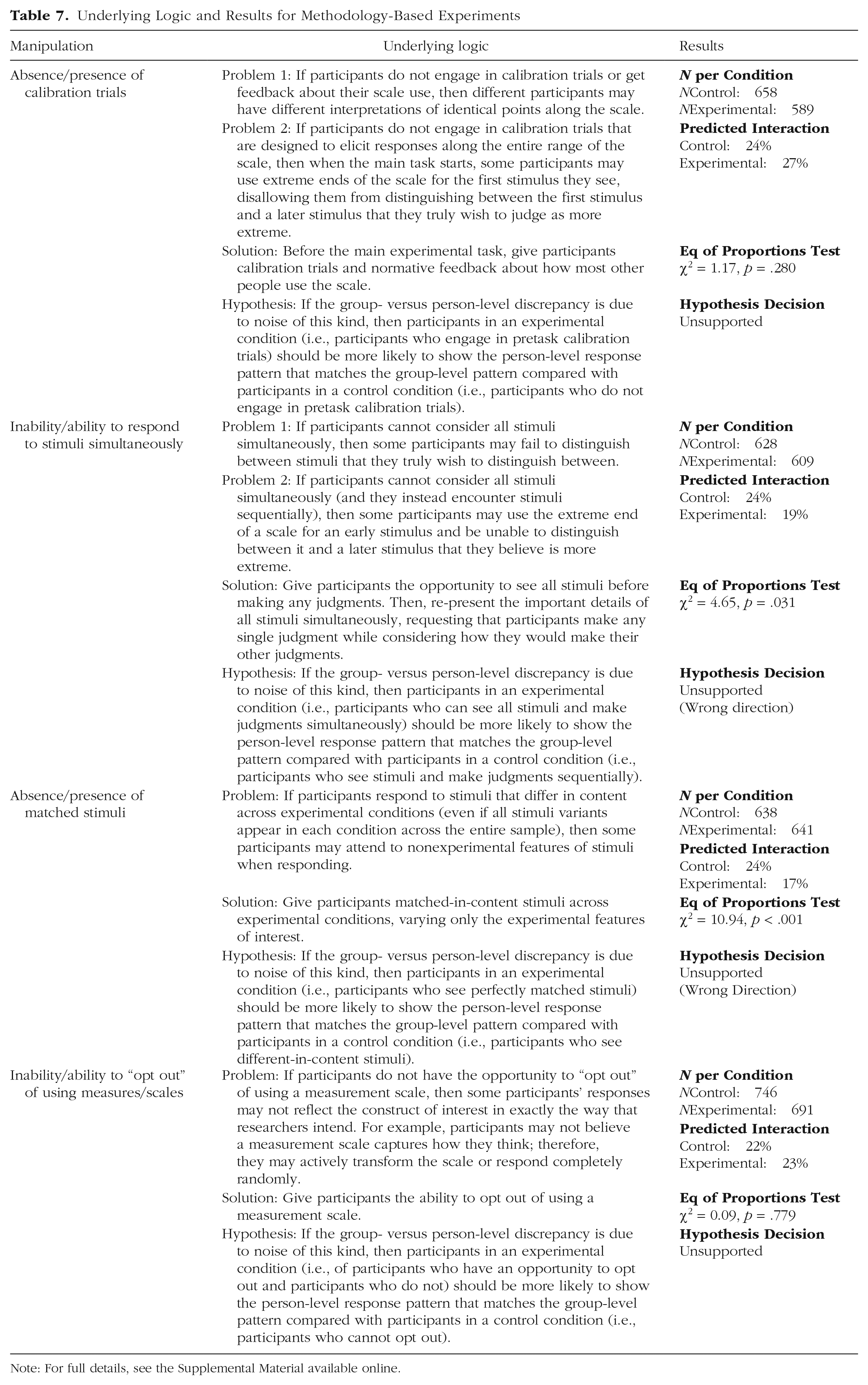
Note: For full details, see the Supplemental Material available online.
Recommendations for Confronting the Group-to-Person Generalizability Problem
Given the group-to-person generalizability problem, what should experimental psychologists do? In this section, we propose three easy-to-implement analytic strategies to aid in making person-level claims (for pros and cons of each, see Table 8; for a simple decision flowchart, see Fig. 5). R scripts for each strategy are provided at our OSF page: https://osf.io/xyse4/.
Easy-to-Implement Analytic Strategies to Aid in Making Person-Level Prevalence Claims

Note: NHST = null hypothesis significance test.

Decision flowchart for investigating proportions. Boxes represent questions that researchers need to answer, and ovals represent possible decisions.
To further investigate the proportion of people showing predicted effects (assuming within-subjects designs), researchers can engage in various analytic strategies. First (see the top box of Fig. 5), it must be decided whether an inference to the population is desired. If not, researchers must then decide whether they want to make an explanatory inference (i.e., an “inference to the best explanation” or whether it is reasonable to explain the pattern’s proportion as having arisen via causal factors and not “physical chance”). If researchers do not want to make an explanatory inference, they can simply calculate and report the sample proportion’s descriptive pervasiveness (see Table 4 and Supplemental Material). If, however, researchers want to make an explanatory inference, then they can conduct a randomization test to investigate whether the predicted effect(s) in the sample is unrelated to experimental condition—that is, emerges more than physical chance (Grice, 2021; Grice et al., 2020; for an example and an explanation of what constitutes physical chance, see the Supplemental Material). This approach has the attractive property that it does not rely on assumptions about populations. Note that this approach does not allow an inference from the sample to the population.
If researchers decide they want to make an inference to the population, they must have many trials per condition for each participant, which will allow them to make a population prevalence inference. The prevalence approach combines pervasiveness and within-persons approaches to estimate the prevalence of person-level effects in the population (see Allefeld et al., 2016; Donhauser et al., 2018; Ince et al., 2021, 2022). This is achieved by first conducting typical group-level tests within each person (controlling the false-positive rate at the person level) and second, using results from the first step, by estimating the most likely proportion of people in the population who would show the predicted pattern of effects, or testing against a theoretical proportion value of interest. Unlike the other approaches (i.e., descriptive pervasiveness and randomization tests), the first step of prevalence approaches test whether qualitative differences between conditions are truly nonzero, assuming measurement error is random and averages out within each person. Note that without many trials per condition for each participant, researchers will not be able to make inferences about the population prevalence of their effect because they would have to assume that (rather than test whether) each person’s pattern reflects true nonzero effects. These approaches allow researchers to test against a “global null hypothesis” of no effect in any subject in the population (H0: θ = θ0 vs. H1: θ ≠ θ0, where θ denotes the person-level population proportion and θ0 a population proportion of 0 or “chance”). However, the more conservative (and intuitive) “majority null hypothesis” (the effect is in less than or equal to half the population; H0: ≤ 0.5 vs. H1: θ > 0.5) is what we recommend comparing or testing against if one is intending to make a general psychological claim about most people in the population.
Here, researchers can decide whether they desire a frequentist or Bayesian approach to population prevalence given that prevalence inference can be conducted in both the frequentist (see Allefeld et al., 2016; Donhauser et al., 2018) and Bayesian (see Ince, et al., 2021, 2022; for an example, see the Supplemental Material) frameworks. In addition to the population prevalence estimate and its precision, the posterior in Bayesian prevalence estimation can be used to compute the probability or log odds that the population proportion is greater than the majority null hypothesis or any theoretically meaningful null hypothesis one deems sufficient for making general psychological claims. Because of the advantages of the prevalence approach, we recommend that researchers, if able, begin to adopt high-trial within-subjects designs. When this is not possible, we hope the arguments and options provided here still give researchers the motivation and tools to confront group-to-person generalizability in their own areas of interest. For a walkthrough of how researchers adopting this approach might think through their next experimental design, see the Supplemental Material for a detailed summary of how we believe this approach could be applied to our own area of research (McManus et al., 2021).
General Discussion
Drawing on recent pervasiveness and persons-as-effect-sizes approaches (Grice et al., 2020; Speelman & McGann, 2020), we showed that most laypeople and social-psychology researchers interpret psychologists as intending to make claims that represent a majority of their studies’ participants. Moreover, most laypeople and researchers believe that this ought to be the case if psychologists are using results to claim support for a general, person-level psychological theory. This article also documents instances of psychological claims, derived from typical sets of group-level statistical tests, that upon reanalysis, are quite poor representations of person-level psychology. As far as we are aware, our work is the first to show that group-level effects in factorial experiments cannot provide the person-level evidence that psychologists likely desire and that it is possible to have sets of group-level effects that fail to match the response patterns of any single person (see Fig. 4 and the Supplemental Material). The current research also experimentally tested multiple method-based noise explanations for this group-to-person generalizability problem in a moral-judgment paradigm, with obvious remedies proving unsuccessful. Finally, three easy-to-implement analytic strategies were outlined to help researchers confront the group-to-person generalizability problem in their own work and area of interest.
Overall, our research is consistent with recent critiques put forth in which some researchers (e.g., Richters, 2021; Speelman & McGann, 2020) have argued that there is a pervasive mismatch between psychological theorizing and the analytic procedures used for testing it—typical theorizing occurs at the person level, but analytic procedures operate at the group level. Over the past decade, much effort has gone toward correcting and promoting better statistical inferences (e.g., Lakens, 2021), but relatively fewer reform efforts have been aimed at appropriate psychological (i.e., scientific) inference (e.g., Liew et al., 2016; Moeller et al., 2022; Navarro, 2019) and development of explanatory formal theory (e.g., van Rooij & Baggio, 2021). The current research suggests that even if theorizing indeed improves, inference can still go wrong if familiar group-level statistical methods are privileged over person-level approaches. Put simply, psychologists seem to have put the statistical cart ahead of the psychological horse. This problem, however, should not be judged as just another instance of “psychology in crisis.” Instead, this is an opportunity to put past, current, and future research through more stringent tests—to better ground the field’s psychological claims and the theories they support or challenge in persons.
Potential Objections, Limitations, and Future Directions
In the approach we used throughout this article (reanalysis of ours and others’ data, experiments detailed in the Supplemental Material included), we used any one participant’s responses to create a variable that indicated a qualitative directional (e.g., positive) difference between conditions, assuming that this feature was error free. However, especially in cases in which this variable was created from single scores in each condition, it is a fair objection that this qualitative difference cannot be assumed as error free. The reported proportion estimates may be (extremely) higher or lower depending on how much measurement error played a role in single- and few-trial designs. This problem could be compounded in our own prior research by the fact that we often used many-pointed slider scales to measure constructs of interest. Therefore, it is possible that many participants who we counted as “hypothesis-inconsistent” were indeed “hypothesis-consistent,” but our many-pointed sliding measure made it possible to make very small, wrong-direction distinctions between conditions when a participant’s intention was to indicate a small, correct-direction distinction. To combat these two problems in future research, we recommend one analytic- and one design-based approach.
First, when possible, we suggest using prevalence approaches. We argue that the first step of these approaches combats within-persons measurement error in the same way that typical group-level approaches combat across-persons measurement error. With large sample sizes, typical group-level approaches (e.g., t tests) allow near-accurate estimation of population-level mean differences because measurement error is assumed to be random and to average out when scores are aggregated across persons. The first step of these prevalence approaches requires collecting enough person-level data to conduct typical group-level tests within each person’s data. Therefore, with a large enough trial set, a t test (or randomization test), for example, can be conducted to compare response scores across conditions within each person; as the logic goes for across-persons measurement error, here, measurement error should average out within each person’s set of high-N trials. Second, because the scale-point issue remains as another source of error, we also recommend a design-based approach. Specifically, when feasible, researchers could present stimuli/measures that require relative responses (e.g., “Which face is angrier?” with scales ranging from Face A is much angrier to Face B is much angrier). This might allow researchers to have more confidence in any one trial’s difference being a true difference (or nondifference). The number of scale points here likely matters as well, with many-pointed (unmarked and/or sliding) measures likely increasing the number of true nondifferences being recorded as small directional differences. This design-based approach should alleviate concerns about scale-based error, but more targeted research is necessary to fully support this recommendation. 5
Another, unrelated objection is that there are other sources of measurement noise accounting for the group-to-person generalizability problem beyond those tested here (see the Supplemental Material). For example, some participants are distracted, leading to frequencies of person-level patterns that do not represent the “true” frequencies. First, consistent with our experimental results, there is no reason to believe that if such noise was reduced, most person-level patterns would conveniently shift to the group-level pattern. Second, as our tutorial and hypothetical data sets show, there are simple nonmethod explanations for how group-level patterns can be (even perfectly) unrepresentative of persons. Therefore, rather than assuming that there are solvable methodological issues underlying the problem, it should be conceded that person-level patterns cannot be inferred from group-level analyses (see Hamaker, 2012) and that, therefore, the analytic approaches outlined here should be adopted.
One constraint of the pervasiveness- and prevalence-based person-level approaches outlined here is that they ignore magnitude information (e.g., the within-persons effect size). However, magnitude information can be incorporated into all of these approaches. Researchers can choose an “imprecision value” (Grice et al., 2020), allowing only certain magnitudes to support a qualitative pervasiveness pattern. In addition, researchers can plot frequencies of qualitative patterns by different imprecision values, allowing discernment between participants who show small versus large effects (see Speelman & McGann, 2020, Fig. 4). Likewise, prevalence approaches can consider the prevalence of different effect sizes in the population (Ince, et al., 2021).
Relatedly, there are other (potentially better) methods for evaluating person-level effects in high-repetition studies that also yield magnitude information, such as person-level effect sizes and confidence intervals (see e.g., Kurz et al., 2019; for incorporating measurement error in N = 1 designs specifically, see Schuurman et al., 2015). Although there are a broad range of powerful, albeit less familiar and technically more challenging, person-level approaches available (for a useful introduction, see Gates et al., 2023), we believe the relative strengths of the pervasiveness and prevalence approaches are clear: They require very little statistical knowledge, are easy to implement and interpret (see the Supplemental Material), and are, therefore, easy to communicate. We additionally note that prevalence approaches will require drastic changes in data-collection practices for some subdisciplines of experimental psychology given that within-persons statistical tests would be subject to the same issues that have pervaded the replicability movement (e.g., number of observations and therefore statistical precision/power).
Another limitation of this research is that we used only one moral-judgment paradigm to test method-based noise explanations for the group-to-person generalizability problem. In addition, much research in moral cognition—including our current experiments (see the Supplemental Material)—uses on-the-fly measurement practices (see Flake & Fried, 2020). Future research is needed to determine whether method manipulations fail to remedy the problem in other paradigms and areas of psychology with better measurement practices. However, as shown earlier, there are obvious nonmethod (and nonmeasurement) explanations for the problem. Therefore, a person-level approach should still be used in disciplines with better measurement standards to ensure group-to-person generalizability.
We argue that adoption of high-trial-per-condition experimental designs will allow for better approaches to measurement reliability. For example, researchers with high-trial data can estimate permutation-based split-half reliability, something not possible with single-trial-per-condition designs (for details, see Parsons et al., 2019). Moreover, high-trial designs also lend themselves to adopting statistical approaches that are aimed at addressing other features of researchers’ generalization intentions. For instance, in addition to generalizing from group to person, researchers often intend to generalize across other experimental features, such as stimuli (Yarkoni, 2020). Future research would do well to examine the relationship between these different forms of generalizability and measurement. As researchers following the various crises in psychological science, we find it exciting that high-trial approaches (along with the appropriate analytic techniques) may offer a single way of beginning to address many of these challenges.
Finally, we did not assess the ubiquity of the group-to-person generalizability problem. We simply documented (and replicated) existence proofs. We expect the complexity of the experimental designs employed and the phenomenon under investigation will be important in determining the ubiquity of group-to-person generalizability problems. For example, when experiments have factors with more than two levels, or multiple factors, the problem should be more likely to occur because the number of possible person-level patterns explodes as design complexity increases. In contrast, simple binary-choice designs common to developmental and comparative psychology may suffer less from the group-to-person generalizability problem. Intuitively, the problem seems more likely in higher-level areas such as social cognition compared with lower-level areas of inquiry such as perception. Presumably, this is due to basic shared physiological and neural-perceptual mechanisms, whereas higher-level cognition may be influenced more by individual differences (e.g., values and knowledge). In addition, social psychologists in particular are often interested in phenomena that participants do not have introspective access to or are motivated to conceal, leading to the overuse of between-subjects designs rather than the creative use of within-subjects designs (for an explanation of how we believe our suggested analysis and measurement approaches, along with one other method-based approach, could alleviate two typical concerns about the use of within-subjects designs, see the Supplemental Material). Therefore, any subdisciplines that habitually rely on between-subjects designs to make inferences about psychology may be especially prone to committing the error of assuming that group-level patterns generalize to the person level. Ultimately, we suggest that the group-to-person generalizability problem is an issue for any area of psychological research that does not routinely test or model person-level data.
Conclusion
Psychologists often make claims about and interpret others’ claims as being about person-level processes. Sometimes, however, these claims are made from experiments that disallow investigation of person-level phenomena. Even when such investigation is possible, these claims are typically derived from group-level patterns, interpreted as if they reveal truths concerning person-level, psychological phenomenon. The current work confirms and builds on previous warnings that this practice can lead to serious errors in inference given that (sets of) group-level patterns need not reflect even a simple majority of people in the sample or population. Put simply, psychology is a property of persons, not averages or distributions. Therefore, researchers should make person-level design and analytic approaches customary in psychological science.
Supplemental Material
sj-docx-1-amp-10.1177_25152459231186615 – Supplemental material for Psychology Is a Property of Persons, Not Averages or Distributions: Confronting the Group-to-Person Generalizability Problem in Experimental Psychology
Supplemental material, sj-docx-1-amp-10.1177_25152459231186615 for Psychology Is a Property of Persons, Not Averages or Distributions: Confronting the Group-to-Person Generalizability Problem in Experimental Psychology by Ryan M. McManus, Liane Young and Joseph Sweetman in Advances in Methods and Practices in Psychological Science
Footnotes
Acknowledgements
We thank Stefano Anzellotti, Hiram Brownell, Richard Morey, Ehri Ryu, and Jordan Theriault for helpful feedback at the beginning of this project. We thank Adam Bear, Tony Chen, Isaac Handley-Miner, Robin Ince, Minjae Kim, Aditi Kodipady, Gordon Kraft-Todd, Matthew Leitao, Shangzan (Sunny) Liu, Michael (Mookie) Manalili, Julia Marshall, Joshua Rottman, and Abraham Rutchick for helpful conversations at various stages of this project and for providing feedback on an early draft of the manuscript. We thank Nathan Liang and Sunny Liu (again) for investigating and diagnosing coding/output issues in R during the revision process. Finally, we thank James W. Grice, Ellen Hamaker, and Katie Corker, who provided invaluable feedback during the review process.
Transparency
Action Editor: Katie Corker
Editor: David A. Sbarra
Author Contributions
